THE 2017
Amazon
VIRTUAL SUMMIT
Presented BY:
AMAZON SUMMIT LOGISTICS
11am PST / 2pm EST EACH DAY
3-DAY EVENT | 2/28, 3/1 & 3/2
ALL 3 DAYS ARE BEING RECORDED & SENT OUT
HAVE A QUESTION? SUBMIT IN CHAT BOX
MORE RESOURCES IN ‘HANDOUTS’ SECTION
AMAZON SUMMIT LAYOUT
Maximizing Your Amazon Product
Discoverability via Content Optimization
Price Wars: Overtaking Your
Competitors On Amazon
Finding More Traffic, Finding More Sales
DAY 3
DAY 2
DAY 1
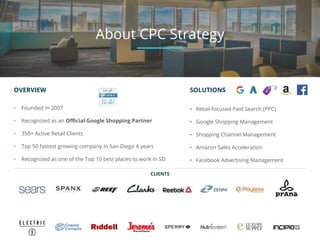
OVERVIEW
• Founded in 2007
• Recognized as an Official Google Shopping Partner
• 350+ Active Retail Clients
• Top 50 fastest growing company in San Diego 4 years
• Recognized as one of the Top 10 best places to work in SD
CLIENTS
SOLUTIONS
• Retail-focused Paid Search (PPC)
• Google Shopping Management
• Shopping Channel Management
• Amazon Sales Acceleration
• Facebook Advertising Management
About CPC Strategy
Today’s Speakers
James Hyatt
Marketplace Channel Analyst
Pat Petriello
Head of Marketplace Strategy
Maximizing Your Amazon Product
Discoverability via Content Optimization
DAY 1
Today’s Agenda
 A Different Way of Thinking About Your Amazon Content
 Understanding Amazon’s A9 Algorithm – What You Need to Know
 Optimizing Your Amazon Product Descriptions & Product Titles
 Feature Bullets – How to Optimize for Consumer Search Intent
 How Content Directly Relates to Your Sponsored products
 LIVE Amazon Product Listing Walk-Through and Q&A
SECTION #1
Understanding Amazon’s
A9 Algorithm – What You
Need to Know
Who is the Audience for Amazon Content?
Source: https://sellercentral.amazon.com/gp/help/help.html/?itemID=10471&ref_=ag_10471_h_r0_cont_sgsearch
Optimize Listings for Search and Browse
Customers must be able to find your products before they can buy your products. Search
is the primary way that customers use to locate products on Amazon.
Customers search by entering keywords, which are matched against the information (title,
description etc.) you provide for a product.
Factors such as degree of text match, price, availability, selection, and sales history help
determine where your product appears in a customer's search results. By providing
relevant and complete information for your product, you can increase your
product's visibility and sales.
RESULTS & RANKING
One of A9's tenets is that relevance is in the eye of the customer and [Amazon] strives to get the best
results for our users. Once we determine which items are good matches to the customer’s
query, our ranking algorithms score them to present the most relevant results to the user.
Amazon A9 Product Search
Source: http://www.amazon.jobs/
AMAZON’S GOALS
 It's Amazon’s goal to be Earth's most customer-centric company, where customers can find and discover anything
online
 Create the best possible buying experience for their customers
 Surface the most relevant and thoroughly vetted products on the SERP
 Optimize Amazon.com for conversion
 Customer-centric = Seller agnostic
 Build consumer trust
Source: http://www.a9.com/whatwedo/product-search/
Who is the Audience for Amazon Content?
SECTION #2
A Different Way of
Thinking About Your
Amazon Content
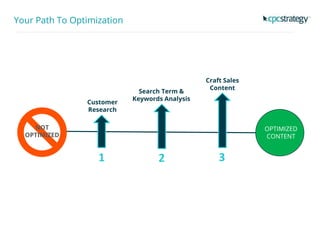
Your Path To Optimization
OPTIMIZED
CONTENT
Customer
Research
Search Term &
Keywords Analysis
Craft Sales
Content
1 2 3
NOT
OPTIMIZED
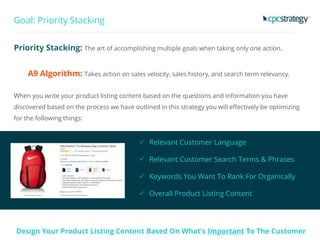
Goal: Priority Stacking
Priority Stacking: The art of accomplishing multiple goals when taking only one action.
A9 Algorithm: Takes action on sales velocity, sales history, and search term relevancy.
When you write your product listing content based on the questions and information you have
discovered based on the process we have outlined in this strategy you will effectively be optimizing
for the following things:
 Relevant Customer Language
 Relevant Customer Search Terms & Phrases
 Keywords You Want To Rank For Organically
 Overall Product Listing Content
Design Your Product Listing Content Based On What’s Important To The Customer
Customer Research - Language
Customer Language:
Learn how your customers talk about (and search) for your product by studying reviews (yours & competitors).
“The way in which your customers talk about and search for your products.”
 How do customers talk about your product?
 What language and search terms do they use?
 What language can we leverage from competitor reviews?
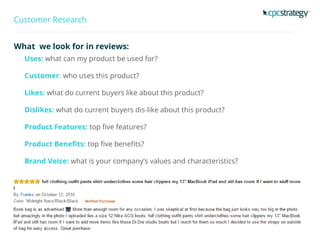
Customer Research
What we look for in reviews:
Uses: what can my product be used for?
Customer: who uses this product?
Likes: what do current buyers like about this product?
Dislikes: what do current buyers dis-like about this product?
Product Features: top five features?
Product Benefits: top five benefits?
Brand Voice: what is your company’s values and characteristics?
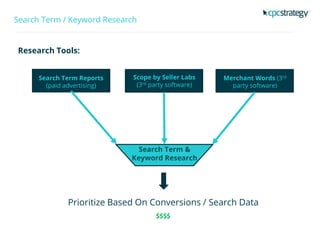
Search Term / Keyword Research
Research Tools:
Scope by Seller Labs
(3rd party software)
Search Term Reports
(paid advertising)
Merchant Words (3rd
party software)
Search Term &
Keyword Research
$$$$
Prioritize Based On Conversions / Search Data
SECTION #3
Optimizing Your Amazon
Product Descriptions &
Product Titles
Optimizing For Your Customer Avatar
Can you truthfully answer these questions about your prospective customer?
Problems/Pains: What are the 5 Biggest Problems/Pains your product can solve?
Solution: What Solution does your product offer?
Desire: What does your market desire?
Reason Why: Why do they want that desire?
Reason Not to Buy: Why might your market NOT buy your product?
How to get “Desire” so you can “Reason Why” without having to
“Reason Not To Buy”
Content Theme Formula:
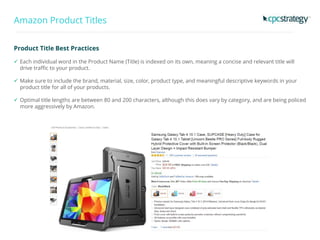
Amazon Product Titles
Product Title Best Practices
 Each individual word in the Product Name (Title) is indexed on its own, meaning a concise and relevant title will
drive traffic to your product.
 Make sure to include the brand, material, size, color, product type, and meaningful descriptive keywords in your
product title for all of your products.
 Optimal title lengths are between 80 and 200 characters, although this does vary by category, and are being policed
more aggressively by Amazon.
Optimizing Titles with Relevant Keywords
Keywords are a vital component of any product title but retailers should be weary of keyword stuffing – a practice
that can be detrimental to your ranking. Products with clear and detailed information are more likely to earn a
higher click-through-rate and convert. The increase in sales will ultimately lead to better ranking.
Below is an example of an optimized bubble sleeve case. As you can see, when a shopper is looking for a case
cover, they know the product’s important detail information because it is listed in the title including the brand, the
color, and the type of devices it is compatible with.
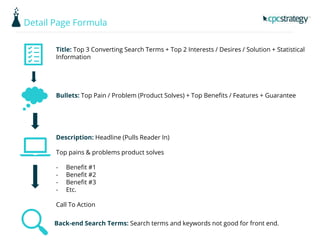
Detail Page Formula
Title: Top 3 Converting Search Terms + Top 2 Interests / Desires / Solution + Statistical
Information
Bullets: Top Pain / Problem (Product Solves) + Top Benefits / Features + Guarantee
Description: Headline (Pulls Reader In)
Top pains & problems product solves
- Benefit #1
- Benefit #2
- Benefit #3
- Etc.
Call To Action
Back-end Search Terms: Search terms and keywords not good for front end.
Product Descriptions
Information provided in the product description are indexed by Amazon and searchable by customers. You have a
2000 character maximum length for your product description.
Product Description Best Practices
 Optimize your descriptions for Amazon first and your customers second. Product descriptions
live “below the fold” of a detail page.
 Go beyond a simple to the point description. Well written product descriptions help the
customer imagine the
experience of owning or handling your product.
 Put yourself in your customers' shoes: what would they want to feel, touch, think, want?
 Mimic the in store experience as much as possible.
 The more rich your descriptions, the better your products will convert.
 Light HTML tags (ex: line breaks, bold, italics) technically not allowed but some have been
grandfathered in.
 Leave your customers feeling confident that your product solves their problem.
Organic Search Terms
Product search terms are not visible on product detail pages but are indexed for search by Amazon. You have a
1,000 character maximum total for your search terms.
Organic Search Terms Best Practices:
 Make sure you use the entire 1,000 available characters for all of your products.
 The best search terms are synonyms and common abbreviations customers might enter into
the search box.
 Use your sponsored product campaign data to inform the selection of keywords.
 If a keyword provides valuable information about your product, then it belongs in product
description or key product features (bullet points).
 Amazon Search automatically incorporates the title of the product, the seller name, and the
brand information provided in the product data, so you do not need to repeat this information
as search terms for your product.
 When entering several words as a search term, put them in the most logical order.
 Don’t provide redundant information that is already captured in other fields such as title,
author, product description, bullet points, brand, etc. It won’t improve your product placement
in search results.
Put yourselves in the shoes of your customers & use the terms they use to find your products.
SECTION #4
How Content Directly
Relates to Your
Sponsored products
Sponsored Products and Content
How the Sponsored Products Auction Works:
1) When a customer searches or browses Amazon for products, Amazon finds all Sponsored
Products ads that contain keywords that match the customer's search or browse page. In the
case of Automatic Campaigns where there are no keywords, product content is used to
determine relevancy.
2) Amazon first removes any Ads that are not currently winning the Buy Box.
3) The ads are then analyzed for relevance. Ads that are determined to not be relevant are
removed from the auction. For example, a customer has searched for the term "kitchen blender."
If a seller has bid on the keyword "kitchen blender" in an ad group that contains bath towel ads,
Amazon determines the bath towel ads are not relevant and removes them from the auction.
4) The remaining ads are then ranked and displayed to Amazon customers in the ad rank order. Ad
rank is based on the seller's bid and the likelihood the ad will get clicked.
Campaigns that have been active longer have a better chance of showing ads. Click
history plays an important role in Amazon’s bidding algorithm
Source: https://sellercentral.amazon.com/gp/help/help.html/?itemID=201528470&ref_=ag_201528470_a_r0_cont_sgsearch
SECTION #5
A+ Content & Enhanced
Brand Content
A+ Detail Page Content
A+ content is available to Vendors and Third Party Sellers participating in certain Amazon programs
(such as Amazon Exclusives) and allows you to add rich content to the detail page to improve the
shopping experience for customers.
A+ Detail Pages can help you to:
 Increase customer conversion
 Improve search relevancy
 Address purchase barriers
 Educate shoppers about model
variations and features
 Promote brand awareness
 Increase efficacy of your advertising
efforts
 Reduce customer returns, customer
contacts, or poor reviews due to
customer confusion
An A+ Detail Pages can include:
 Custom paragraph headers and images
 Unique image and text layouts
 Product comparison charts
 Bulleted feature lists
 Click to enlarge images
Enhanced Brand Content
EBC allows Brand Registered Sellers to showcase the unique value proposition of their products
through enhanced images and text placements. Adding EBC to your product detail pages may result
in higher conversion rates, increased traffic, and increased sales when used effectively.
EBC can help you to:
 Increase customer conversion
 Increased ability to showcase the
unique value proposition of their
products
 Differentiate their brand from that of
their competitors
 Turn more of their advertising clicks
into conversions
 Reduce customer returns, customer
contacts, or poor reviews due to
customer confusion
LIVE WALK-THROUGH
Questions?
James Hyatt
Marketplace Channel Analyst
Pat Petriello
Head of Marketplace Strategy

The 2017 Amazon Virtual Summit: Day 1

  • 1.
  • 2.
    AMAZON SUMMIT LOGISTICS 11amPST / 2pm EST EACH DAY 3-DAY EVENT | 2/28, 3/1 & 3/2 ALL 3 DAYS ARE BEING RECORDED & SENT OUT HAVE A QUESTION? SUBMIT IN CHAT BOX MORE RESOURCES IN ‘HANDOUTS’ SECTION
  • 3.
    AMAZON SUMMIT LAYOUT MaximizingYour Amazon Product Discoverability via Content Optimization Price Wars: Overtaking Your Competitors On Amazon Finding More Traffic, Finding More Sales DAY 3 DAY 2 DAY 1
  • 4.
    OVERVIEW • Founded in2007 • Recognized as an Official Google Shopping Partner • 350+ Active Retail Clients • Top 50 fastest growing company in San Diego 4 years • Recognized as one of the Top 10 best places to work in SD CLIENTS SOLUTIONS • Retail-focused Paid Search (PPC) • Google Shopping Management • Shopping Channel Management • Amazon Sales Acceleration • Facebook Advertising Management About CPC Strategy
  • 5.
    Today’s Speakers James Hyatt MarketplaceChannel Analyst Pat Petriello Head of Marketplace Strategy
  • 6.
    Maximizing Your AmazonProduct Discoverability via Content Optimization DAY 1
  • 7.
    Today’s Agenda  ADifferent Way of Thinking About Your Amazon Content  Understanding Amazon’s A9 Algorithm – What You Need to Know  Optimizing Your Amazon Product Descriptions & Product Titles  Feature Bullets – How to Optimize for Consumer Search Intent  How Content Directly Relates to Your Sponsored products  LIVE Amazon Product Listing Walk-Through and Q&A
  • 8.
    SECTION #1 Understanding Amazon’s A9Algorithm – What You Need to Know
  • 9.
    Who is theAudience for Amazon Content? Source: https://sellercentral.amazon.com/gp/help/help.html/?itemID=10471&ref_=ag_10471_h_r0_cont_sgsearch Optimize Listings for Search and Browse Customers must be able to find your products before they can buy your products. Search is the primary way that customers use to locate products on Amazon. Customers search by entering keywords, which are matched against the information (title, description etc.) you provide for a product. Factors such as degree of text match, price, availability, selection, and sales history help determine where your product appears in a customer's search results. By providing relevant and complete information for your product, you can increase your product's visibility and sales.
  • 10.
    RESULTS & RANKING Oneof A9's tenets is that relevance is in the eye of the customer and [Amazon] strives to get the best results for our users. Once we determine which items are good matches to the customer’s query, our ranking algorithms score them to present the most relevant results to the user. Amazon A9 Product Search Source: http://www.amazon.jobs/ AMAZON’S GOALS  It's Amazon’s goal to be Earth's most customer-centric company, where customers can find and discover anything online  Create the best possible buying experience for their customers  Surface the most relevant and thoroughly vetted products on the SERP  Optimize Amazon.com for conversion  Customer-centric = Seller agnostic  Build consumer trust Source: http://www.a9.com/whatwedo/product-search/
  • 11.
    Who is theAudience for Amazon Content?
  • 12.
    SECTION #2 A DifferentWay of Thinking About Your Amazon Content
  • 13.
    Your Path ToOptimization OPTIMIZED CONTENT Customer Research Search Term & Keywords Analysis Craft Sales Content 1 2 3 NOT OPTIMIZED
  • 14.
    Goal: Priority Stacking PriorityStacking: The art of accomplishing multiple goals when taking only one action. A9 Algorithm: Takes action on sales velocity, sales history, and search term relevancy. When you write your product listing content based on the questions and information you have discovered based on the process we have outlined in this strategy you will effectively be optimizing for the following things:  Relevant Customer Language  Relevant Customer Search Terms & Phrases  Keywords You Want To Rank For Organically  Overall Product Listing Content Design Your Product Listing Content Based On What’s Important To The Customer
  • 15.
    Customer Research -Language Customer Language: Learn how your customers talk about (and search) for your product by studying reviews (yours & competitors). “The way in which your customers talk about and search for your products.”  How do customers talk about your product?  What language and search terms do they use?  What language can we leverage from competitor reviews?
  • 16.
    Customer Research What welook for in reviews: Uses: what can my product be used for? Customer: who uses this product? Likes: what do current buyers like about this product? Dislikes: what do current buyers dis-like about this product? Product Features: top five features? Product Benefits: top five benefits? Brand Voice: what is your company’s values and characteristics?
  • 17.
    Search Term /Keyword Research Research Tools: Scope by Seller Labs (3rd party software) Search Term Reports (paid advertising) Merchant Words (3rd party software) Search Term & Keyword Research $$$$ Prioritize Based On Conversions / Search Data
  • 18.
    SECTION #3 Optimizing YourAmazon Product Descriptions & Product Titles
  • 19.
    Optimizing For YourCustomer Avatar Can you truthfully answer these questions about your prospective customer? Problems/Pains: What are the 5 Biggest Problems/Pains your product can solve? Solution: What Solution does your product offer? Desire: What does your market desire? Reason Why: Why do they want that desire? Reason Not to Buy: Why might your market NOT buy your product? How to get “Desire” so you can “Reason Why” without having to “Reason Not To Buy” Content Theme Formula:
  • 20.
    Amazon Product Titles ProductTitle Best Practices  Each individual word in the Product Name (Title) is indexed on its own, meaning a concise and relevant title will drive traffic to your product.  Make sure to include the brand, material, size, color, product type, and meaningful descriptive keywords in your product title for all of your products.  Optimal title lengths are between 80 and 200 characters, although this does vary by category, and are being policed more aggressively by Amazon.
  • 21.
    Optimizing Titles withRelevant Keywords Keywords are a vital component of any product title but retailers should be weary of keyword stuffing – a practice that can be detrimental to your ranking. Products with clear and detailed information are more likely to earn a higher click-through-rate and convert. The increase in sales will ultimately lead to better ranking. Below is an example of an optimized bubble sleeve case. As you can see, when a shopper is looking for a case cover, they know the product’s important detail information because it is listed in the title including the brand, the color, and the type of devices it is compatible with.
  • 22.
    Detail Page Formula Title:Top 3 Converting Search Terms + Top 2 Interests / Desires / Solution + Statistical Information Bullets: Top Pain / Problem (Product Solves) + Top Benefits / Features + Guarantee Description: Headline (Pulls Reader In) Top pains & problems product solves - Benefit #1 - Benefit #2 - Benefit #3 - Etc. Call To Action Back-end Search Terms: Search terms and keywords not good for front end.
  • 23.
    Product Descriptions Information providedin the product description are indexed by Amazon and searchable by customers. You have a 2000 character maximum length for your product description. Product Description Best Practices  Optimize your descriptions for Amazon first and your customers second. Product descriptions live “below the fold” of a detail page.  Go beyond a simple to the point description. Well written product descriptions help the customer imagine the experience of owning or handling your product.  Put yourself in your customers' shoes: what would they want to feel, touch, think, want?  Mimic the in store experience as much as possible.  The more rich your descriptions, the better your products will convert.  Light HTML tags (ex: line breaks, bold, italics) technically not allowed but some have been grandfathered in.  Leave your customers feeling confident that your product solves their problem.
  • 24.
    Organic Search Terms Productsearch terms are not visible on product detail pages but are indexed for search by Amazon. You have a 1,000 character maximum total for your search terms. Organic Search Terms Best Practices:  Make sure you use the entire 1,000 available characters for all of your products.  The best search terms are synonyms and common abbreviations customers might enter into the search box.  Use your sponsored product campaign data to inform the selection of keywords.  If a keyword provides valuable information about your product, then it belongs in product description or key product features (bullet points).  Amazon Search automatically incorporates the title of the product, the seller name, and the brand information provided in the product data, so you do not need to repeat this information as search terms for your product.  When entering several words as a search term, put them in the most logical order.  Don’t provide redundant information that is already captured in other fields such as title, author, product description, bullet points, brand, etc. It won’t improve your product placement in search results. Put yourselves in the shoes of your customers & use the terms they use to find your products.
  • 25.
    SECTION #4 How ContentDirectly Relates to Your Sponsored products
  • 26.
    Sponsored Products andContent How the Sponsored Products Auction Works: 1) When a customer searches or browses Amazon for products, Amazon finds all Sponsored Products ads that contain keywords that match the customer's search or browse page. In the case of Automatic Campaigns where there are no keywords, product content is used to determine relevancy. 2) Amazon first removes any Ads that are not currently winning the Buy Box. 3) The ads are then analyzed for relevance. Ads that are determined to not be relevant are removed from the auction. For example, a customer has searched for the term "kitchen blender." If a seller has bid on the keyword "kitchen blender" in an ad group that contains bath towel ads, Amazon determines the bath towel ads are not relevant and removes them from the auction. 4) The remaining ads are then ranked and displayed to Amazon customers in the ad rank order. Ad rank is based on the seller's bid and the likelihood the ad will get clicked. Campaigns that have been active longer have a better chance of showing ads. Click history plays an important role in Amazon’s bidding algorithm Source: https://sellercentral.amazon.com/gp/help/help.html/?itemID=201528470&ref_=ag_201528470_a_r0_cont_sgsearch
  • 27.
    SECTION #5 A+ Content& Enhanced Brand Content
  • 28.
    A+ Detail PageContent A+ content is available to Vendors and Third Party Sellers participating in certain Amazon programs (such as Amazon Exclusives) and allows you to add rich content to the detail page to improve the shopping experience for customers. A+ Detail Pages can help you to:  Increase customer conversion  Improve search relevancy  Address purchase barriers  Educate shoppers about model variations and features  Promote brand awareness  Increase efficacy of your advertising efforts  Reduce customer returns, customer contacts, or poor reviews due to customer confusion An A+ Detail Pages can include:  Custom paragraph headers and images  Unique image and text layouts  Product comparison charts  Bulleted feature lists  Click to enlarge images
  • 29.
    Enhanced Brand Content EBCallows Brand Registered Sellers to showcase the unique value proposition of their products through enhanced images and text placements. Adding EBC to your product detail pages may result in higher conversion rates, increased traffic, and increased sales when used effectively. EBC can help you to:  Increase customer conversion  Increased ability to showcase the unique value proposition of their products  Differentiate their brand from that of their competitors  Turn more of their advertising clicks into conversions  Reduce customer returns, customer contacts, or poor reviews due to customer confusion
  • 30.
  • 31.
    Questions? James Hyatt Marketplace ChannelAnalyst Pat Petriello Head of Marketplace Strategy