THE 2014 DIGITAL PATIENT JOURNEY
Bill Balderaz
Follow us @FathomHealth
March 24th, 2014
A Division of Fathom®
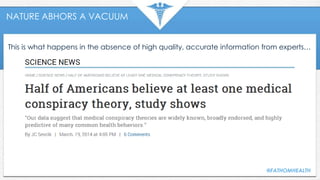
NATURE ABHORS A VACUUM
This is what happens in the absence of high quality, accurate information from experts…
@FATHOMHEALTH
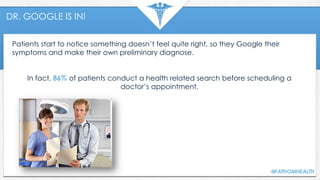
DR. GOOGLE IS IN!
Patients start to notice something doesn’t feel quite right, so they Google their
symptoms and make their own preliminary diagnose.
In fact, 86% of patients conduct a health related search before scheduling a
doctor’s appointment.
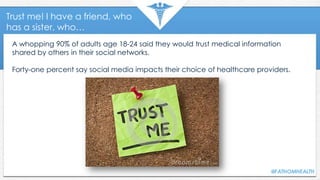
Trust me! I have a friend, who
has a sister, who…
A whopping 90% of adults age 18-24 said they would trust medical information
shared by others in their social networks.
Forty-one percent say social media impacts their choice of healthcare providers.
THAT ADDRESS WAS CORRECT…
Three Years Ago
They find a physician with some expertise in the disease or disorder and check
Google maps to see who is convenient to their homes or offices.
WHAT’S YOUR GRADE?
They assume they will end up with specialist, so they read the local specialists reviews
on Vitals and Healthgrades.
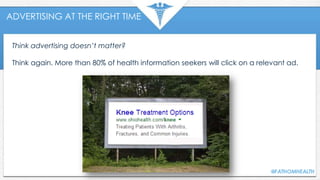
ADVERTISING AT THE RIGHT TIME
Think advertising doesn’t matter?
Think again. More than 80% of health information seekers will click on a relevant ad.
THE SEARCH CONTINUES
Searching continues throughout treatment, with 43%
of all visits to hospital websites coming from search
engines and most patients visiting the sites of two or
more hospitals during the research.
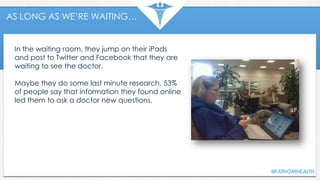
AS LONG AS WE’RE WAITING…
In the waiting room, they jump on their iPads
and post to Twitter and Facebook that they are
waiting to see the doctor.
Maybe they do some last minute research, 53%
of people say that information they found online
led them to ask a doctor new questions.
TO FILL OR NOT TO FILL
After the doctor visit, they research side effects of the
medications they were prescribed.
Sixty percent of patients say they research their prescriptions to understand them
better – and even decide whether they will fill it. They subscribe to a blog dedicated
to their condition.
DIGITAL BOOMERS & SENIORS
67% surveyed say that access to their health information is
important
70% say they want to be able to request prescription refills
electronically
67% want to make online appointments
58% want to email their healthcare providers
55% want to use a mobile device to manage
appointments
WELCOME TO THE DIGITAL PATIENT JOURNEY
IT’S ALL ABOUT TRANSPARENCY
The fact is that patients are more involved in healthcare than ever before,
and our industry is now as transparent as car shopping.
• 75% of Americans have conducted a search related to personal health in
the last year
• More than a third use social media to research health conditions.
• Half of all patients who use the Internet to self-diagnose end up making a
doctor’s appointment.
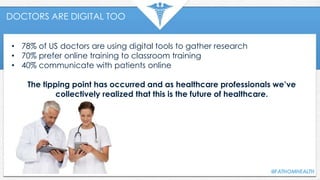
DOCTORS ARE DIGITAL TOO
• 78% of US doctors are using digital tools to gather research
• 70% prefer online training to classroom training
• 40% communicate with patients online
The tipping point has occurred and as healthcare professionals we’ve
collectively realized that this is the future of healthcare.
DIGITAL HEALTHCARE MARKETING TRENDS FOR 2014
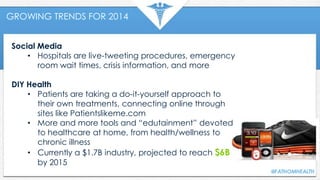
GROWING TRENDS FOR 2014
Social Media
• Hospitals are live-tweeting procedures, emergency
room wait times, crisis information, and more
DIY Health
• Patients are taking a do-it-yourself approach to
their own treatments, connecting online through
sites like Patientslikeme.com
• More and more tools and “edutainment” devoted
to healthcare at home, from health/wellness to
chronic illness
• Currently a $1.7B industry, projected to reach $6B
by 2015
GROWING TRENDS FOR 2014
Increased Focus on Mobile
• Only 9% of cellphone owners say they receive texts
about health-related issues
Direct Contact with Doctors Online
• Kaiser Permanente reported their doctors receive
2.6 million emails per quarter
PATIENT FOOTPRINTS
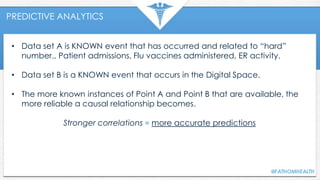
PREDICTIVE ANALYTICS
• Data set A is KNOWN event that has occurred and related to “hard”
number.. Patient admissions, Flu vaccines administered, ER activity.
• Data set B is a KNOWN event that occurs in the Digital Space.
• The more known instances of Point A and Point B that are available, the
more reliable a causal relationship becomes.
Stronger correlations = more accurate predictions
PREDICTING A FLU OUTBREAK
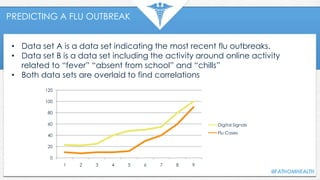
• Data set A is a data set indicating the most recent flu outbreaks.
• Data set B is a data set including the activity around online activity
related to “fever” “absent from school” and “chills”
• Both data sets are overlaid to find correlations
0
20
40
60
80
100
120
1 2 3 4 5 6 7 8 9
Digital Signals
Flu Cases
PREDICTING A FLU OUTBREAK
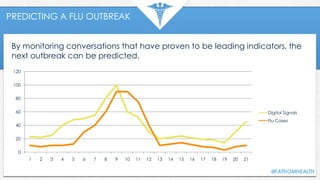
By monitoring conversations that have proven to be leading indicators, the
next outbreak can be predicted.
0
20
40
60
80
100
120
1 2 3 4 5 6 7 8 9 10 11 12 13 14 15 16 17 18 19 20 21
Digital Signals
Flu Cases
PREDICTIVE ANALYTICS
• We all leave a tremendous digital footprint.. Who we are, what we
do, where we are, who we know.
• In aggregate, this data can be used to identified very specific trends
Hard data.. Stock prices, product sales, student enrollments, or flu
vaccines, can be correlated with this data
• Large sampling sizes and repeated instances ensure data integrity
SUMMARY
You can’t catch fish where
there aren’t fish.
Patients, of all ages, of all walks of life, are Digital Patients.
If we want to engage with them, help them make decisions, educate and
inform them, and improve care quality along the way, we must become
Digital Healthcare pro.
Technology is at the intersection
of patients & healthcare
• Technology removes the knowledge barriers in patients lives. Patients
expect access to information and use technology to take control of their
healthcare (or the healthcare of others)
• Healthcare organizations and professionals see technology as essential to
connecting with patients, donors, referring physicians, media and the
community
• Technology is moving quickly to connect patients with providers
• Leveraging digital data can allow healthcare organizations to anticipate
events or trends
QUESTIONS?
Bill Balderaz
bbalderaz@fathomdelivers.com
@FathomHealth
For more healthcare marketing information & insight,
visit the Fathom Health Blog.

The 2014 Digital Patient Journey

  • 1.
    THE 2014 DIGITALPATIENT JOURNEY Bill Balderaz Follow us @FathomHealth March 24th, 2014 A Division of Fathom®
  • 2.
    NATURE ABHORS AVACUUM This is what happens in the absence of high quality, accurate information from experts… @FATHOMHEALTH
  • 3.
    DR. GOOGLE ISIN! Patients start to notice something doesn’t feel quite right, so they Google their symptoms and make their own preliminary diagnose. In fact, 86% of patients conduct a health related search before scheduling a doctor’s appointment.
  • 4.
    Trust me! Ihave a friend, who has a sister, who… A whopping 90% of adults age 18-24 said they would trust medical information shared by others in their social networks. Forty-one percent say social media impacts their choice of healthcare providers.
  • 5.
    THAT ADDRESS WASCORRECT… Three Years Ago They find a physician with some expertise in the disease or disorder and check Google maps to see who is convenient to their homes or offices.
  • 6.
    WHAT’S YOUR GRADE? Theyassume they will end up with specialist, so they read the local specialists reviews on Vitals and Healthgrades.
  • 7.
    ADVERTISING AT THERIGHT TIME Think advertising doesn’t matter? Think again. More than 80% of health information seekers will click on a relevant ad.
  • 8.
    THE SEARCH CONTINUES Searchingcontinues throughout treatment, with 43% of all visits to hospital websites coming from search engines and most patients visiting the sites of two or more hospitals during the research.
  • 9.
    AS LONG ASWE’RE WAITING… In the waiting room, they jump on their iPads and post to Twitter and Facebook that they are waiting to see the doctor. Maybe they do some last minute research, 53% of people say that information they found online led them to ask a doctor new questions.
  • 10.
    TO FILL ORNOT TO FILL After the doctor visit, they research side effects of the medications they were prescribed. Sixty percent of patients say they research their prescriptions to understand them better – and even decide whether they will fill it. They subscribe to a blog dedicated to their condition.
  • 11.
    DIGITAL BOOMERS &SENIORS 67% surveyed say that access to their health information is important 70% say they want to be able to request prescription refills electronically 67% want to make online appointments 58% want to email their healthcare providers 55% want to use a mobile device to manage appointments
  • 12.
    WELCOME TO THEDIGITAL PATIENT JOURNEY
  • 13.
    IT’S ALL ABOUTTRANSPARENCY The fact is that patients are more involved in healthcare than ever before, and our industry is now as transparent as car shopping. • 75% of Americans have conducted a search related to personal health in the last year • More than a third use social media to research health conditions. • Half of all patients who use the Internet to self-diagnose end up making a doctor’s appointment.
  • 14.
    DOCTORS ARE DIGITALTOO • 78% of US doctors are using digital tools to gather research • 70% prefer online training to classroom training • 40% communicate with patients online The tipping point has occurred and as healthcare professionals we’ve collectively realized that this is the future of healthcare.
  • 15.
  • 16.
    GROWING TRENDS FOR2014 Social Media • Hospitals are live-tweeting procedures, emergency room wait times, crisis information, and more DIY Health • Patients are taking a do-it-yourself approach to their own treatments, connecting online through sites like Patientslikeme.com • More and more tools and “edutainment” devoted to healthcare at home, from health/wellness to chronic illness • Currently a $1.7B industry, projected to reach $6B by 2015
  • 17.
    GROWING TRENDS FOR2014 Increased Focus on Mobile • Only 9% of cellphone owners say they receive texts about health-related issues Direct Contact with Doctors Online • Kaiser Permanente reported their doctors receive 2.6 million emails per quarter
  • 18.
  • 19.
    PREDICTIVE ANALYTICS • Dataset A is KNOWN event that has occurred and related to “hard” number.. Patient admissions, Flu vaccines administered, ER activity. • Data set B is a KNOWN event that occurs in the Digital Space. • The more known instances of Point A and Point B that are available, the more reliable a causal relationship becomes. Stronger correlations = more accurate predictions
  • 20.
    PREDICTING A FLUOUTBREAK • Data set A is a data set indicating the most recent flu outbreaks. • Data set B is a data set including the activity around online activity related to “fever” “absent from school” and “chills” • Both data sets are overlaid to find correlations 0 20 40 60 80 100 120 1 2 3 4 5 6 7 8 9 Digital Signals Flu Cases
  • 21.
    PREDICTING A FLUOUTBREAK By monitoring conversations that have proven to be leading indicators, the next outbreak can be predicted. 0 20 40 60 80 100 120 1 2 3 4 5 6 7 8 9 10 11 12 13 14 15 16 17 18 19 20 21 Digital Signals Flu Cases
  • 22.
    PREDICTIVE ANALYTICS • Weall leave a tremendous digital footprint.. Who we are, what we do, where we are, who we know. • In aggregate, this data can be used to identified very specific trends Hard data.. Stock prices, product sales, student enrollments, or flu vaccines, can be correlated with this data • Large sampling sizes and repeated instances ensure data integrity
  • 23.
  • 24.
    You can’t catchfish where there aren’t fish. Patients, of all ages, of all walks of life, are Digital Patients. If we want to engage with them, help them make decisions, educate and inform them, and improve care quality along the way, we must become Digital Healthcare pro.
  • 25.
    Technology is atthe intersection of patients & healthcare • Technology removes the knowledge barriers in patients lives. Patients expect access to information and use technology to take control of their healthcare (or the healthcare of others) • Healthcare organizations and professionals see technology as essential to connecting with patients, donors, referring physicians, media and the community • Technology is moving quickly to connect patients with providers • Leveraging digital data can allow healthcare organizations to anticipate events or trends
  • 26.
    QUESTIONS? Bill Balderaz bbalderaz@fathomdelivers.com @FathomHealth For morehealthcare marketing information & insight, visit the Fathom Health Blog.