Scale-up Systems


 Scale-up calculations
  using RC1e data in
      DynoChem
          Sanket Salgaonkar
   Scale-up Systems India


© 2012 Scale-up Systems Limited. All Rights Reserved.   www.scale-up.com
Scale-up Systems


                   Introduction


© 2012 Scale-up Systems Limited. All Rights Reserved.   www.scale-up.com
DynoChem in Pharma Industry

            Leading software for chemical process understanding
                              Scientists and engineers
                              Development, scale-up, tech transfer, troubleshooting and
                               continuous improvement
                              Unit ops with multiple phases, reactions, heat and mass transfer
                              Batch, fed batch or continuous operating modes

            Answers “what happens if …?” and “how to achieve …?”

            Facilitates R&D productivity, collaboration, material supply,
               QbD efforts


©2012 Scale-up Systems Ltd. All Rights Reserved.                                        www.scale-up.com   3
Model based approach to Process Development


       Process Understanding based                                  Design             Scale-up
            Model Generation


              Lab                                   Data     Model + Equipment data    Predicted
           Experiments                             (Model)    Large Scale Process     Performance
                                                                  Optimization


      Experiments are performed to generate Process Understanding, not
      necessarily to get good yields in the lab

      This Process Understanding is then captured by First Principles Mechanistic
      Models


©2012 Scale-up Systems Ltd. All Rights Reserved.                                          www.scale-up.com   4
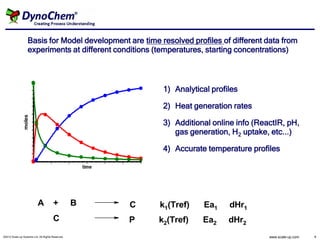
Basis for Model development are time resolved profiles of different data from
                   experiments at different conditions (temperatures, starting concentrations)


                                                            1) Analytical profiles

                                                            2) Heat generation rates

                                                            3) Additional online info (ReactIR, pH,
                                                               gas generation, H2 uptake, etc...)

                                                            4) Accurate temperature profiles


                           A           +           B   C   k1(Tref)     Ea1    dHr1
                                       C               P   k2(Tref)    Ea2     dHr2
©2012 Scale-up Systems Ltd. All Rights Reserved.                                          www.scale-up.com   5
Scale-up Systems


           Modeling ΔHR in
            DynoChem


© 2012 Scale-up Systems Limited. All Rights Reserved.   www.scale-up.com
Sources of ΔHR data

      The standard sources of ΔHR are experimental data from

       Reaction Calorimeters for desired reaction conditions

       DSC and Adiabatic Calorimeters for exploring Process
        Safety (potential runaway reactions)


         The Mettler RC1 benchmark Reaction Calorimeter
         generates heat flow profiles, which can be entered into
         DynoChem
        Reaction                                   Rate Exp.   kref                       Ea

        A + B --> P                                k [A] [B]   k> 0.0027 L/mol.s          Ea> 59.997 kJ/mol

        A + P --> SP                               k [A] [P]   k> 5.025E-4 L/mol.s        Ea> 90.011 kJ/mol
©2012 Scale-up Systems Ltd. All Rights Reserved.                                                   www.scale-up.com   7
Using RC1 Data
Reaction                                           Rate Exp.              kref                  Tref        Ea

A + B --> P                                        k [A] [B] k>           0.0027     L/mol.s    60.0 C      Ea>           59.997         kJ/mol

A + P --> SP                                       k [A] [P] k>           5.025E-4 L/mol.s      60.0 C      Ea>           90.011         kJ/mol
   RC1 run
                 70.0
                                                                                                Bulk liquid.Temperature (Imp) (C)
                                                                                                A feed.Qv (Imp) (ml/min)
                                                                                                Bulk liquid.Qr (Exp) (J/s)
                 56.0                                                                           Bulk liquid.Qr (J/s)


                 42.0
                                                                                               Qr = r ΔHr V, where r is the
                                                                                                   reaction rate of this
                                                                                                   reaction.
                 28.0
                                                                                               Qr = (Σri ΔHri ) V, since a
                                                                                                   calorimeter measures
                 14.0
                                                                                                   the sum of all the heat
                                                                                                   flows.
                   0.0
                      0.0                    60.0        120.0    180.0      240.0     300.0
                                                           Time (min)
©2012 Scale-up Systems Ltd. All Rights Reserved.                                                                              www.scale-up.com    8
Elucidation of ΔHR from Qr Data
    Reaction heats are adjusted to experimental Qr data by fitting
    in DynoChem.


                                                            Reaction       dHr

                                                            A + B --> P    -149.86        kJ/mol

                                                            A + P --> SP   -70.0          kJ/mol


©2012 Scale-up Systems Ltd. All Rights Reserved.                                   www.scale-up.com   9
Predictions from the process model

                     RC1 run
                                    1.5
                                                                                             Bulk liquid.SP (mol)
                                                                                             Bulk liquid.P (mol)
                                                                                             Bulk liquid.B (mol)
                                    1.2                                                      Bulk liquid.A (mol)
                                                                                             Bulk liquid.Volume (L)
                                                                                             Feed vessel.Volume (L)
                                    0.9


                                    0.6


                                    0.3


                                    0.0
                                       0.0         60.0   120.0      180.0   240.0   300.0
                                                             Time (min)


©2012 Scale-up Systems Ltd. All Rights Reserved.                                                               www.scale-up.com   10
Using ARC / DSC Data


©2012 Scale-up Systems Ltd. All Rights Reserved.                www.scale-up.com   11
Scale-up Systems


  The Impact of Process
 Safety – What-if Scenarios


© 2012 Scale-up Systems Limited. All Rights Reserved.   www.scale-up.com
Process Safety Concerns

                Reaction energy coupled with the reaction rates is responsible for
                heat generation rates and that these with the interplay of reactor
                cooling capacity will determine the reaction temperature profile.

                Typical What-if Scenarios

                 Loss of Cooling Capacity
                       Consequences of a cooling failure

                 Reaction time at which loss of cooling capacity is critical
                       Time for counter measures


©2012 Scale-up Systems Ltd. All Rights Reserved.                          www.scale-up.com   13
Process Safety Concerns
                       TMR =f(MTSR) ;TMR: Time for Maximum Rate

                                                   MTSR: Maximum Temperature of a Synthesis Reaction

                       R. Gigax Chem.Eng.Sci., 1988, 43, 1759)


©2012 Scale-up Systems Ltd. All Rights Reserved.                                              www.scale-up.com   14
Why DynoChem?


         DynoChem predicts :

          Temperature profiles and their consequences before any
           real large scale reaction is performed.

          The fate of reaction energy under deviations from the
           desired conditions

          The behaviour of TMR vs Temperature by allowing the
          automated run of multiple scenarios (like running DoE type
          experiments)


©2012 Scale-up Systems Ltd. All Rights Reserved.              www.scale-up.com   15
TMR v/s Tr


©2012 Scale-up Systems Ltd. All Rights Reserved.      www.scale-up.com   16
Effect of Temp & Dosing onTMR


©2012 Scale-up Systems Ltd. All Rights Reserved.                         www.scale-up.com   17
Easy Scale-up of RC1


©2012 Scale-up Systems Ltd. All Rights Reserved.                www.scale-up.com   18
Scale-up Systems


                Case Studies


© 2012 Scale-up Systems Limited. All Rights Reserved.   www.scale-up.com
Abbott


©2012 Scale-up Systems Ltd. All Rights Reserved.   www.scale-up.com   20
Abbott


©2012 Scale-up Systems Ltd. All Rights Reserved.   www.scale-up.com   21
Merck
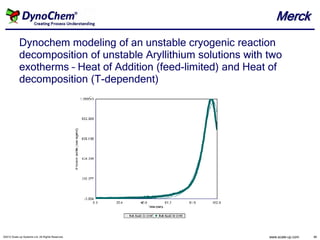
            Dynochem modeling of an unstable cryogenic reaction
            decomposition of unstable Aryllithium solutions with two
            exotherms – Heat of Addition (feed-limited) and Heat of
            decomposition (T-dependent)


©2012 Scale-up Systems Ltd. All Rights Reserved.                 www.scale-up.com   22
Janssen Pharmaceutica, Belgium


©2012 Scale-up Systems Ltd. All Rights Reserved.                          www.scale-up.com   23
Scale-up Systems


                     Conclusion


© 2012 Scale-up Systems Limited. All Rights Reserved.   www.scale-up.com
Conclusions
            Where DynoChem Fits?

                        Provides a generic simulation engine that designed for solving rate based
                         process models across many unit operations and model complexities

                        Comes with a substantial model library “out of the box” that include many
                         developed with your colleagues in the safety community

                        Is inherently extendable allowing templates to be customized to your
                         specific workgroup and workflow.

            The Role of Safety

                        The potential for safety to expand their role in pharmaceutical
                         organizations has never been greater with QbD fueling a desire for
                         predictive process knowledge

                        This starts just by using modeling tools to further leverage what you
                         already do!


©2012 Scale-up Systems Ltd. All Rights Reserved.                                         www.scale-up.com   25
www.scale-up.com


©2012 Scale-up Systems Ltd. All Rights Reserved.            www.scale-up.com   26
DynoChem Resources


©2012 Scale-up Systems Ltd. All Rights Reserved.               www.scale-up.com   27
Scale-up Expertise
            Principal Consultant – Dr Wilfried Hoffmann

            Wilfried has over 28 years experience working in the
               pharmaceutical industry, most recently with Pfizer in the
               UK and Germany. Wilfried has a PhD in Organic
               Chemistry from Ruhr-Universität Bochum and has a
               special interest in Thermochemical Kinetics.


            support@scale-up.com


©2012 Scale-up Systems Ltd. All Rights Reserved.                 www.scale-up.com   28
Scale-up Systems


  Thanks and Wrap-up


© 2012 Scale-up Systems Limited. All Rights Reserved.   www.scale-up.com

Scale-up Systems India Mettler RC1 Sanket Salgaonkar

  • 1.
    Scale-up Systems Scale-upcalculations using RC1e data in DynoChem Sanket Salgaonkar Scale-up Systems India © 2012 Scale-up Systems Limited. All Rights Reserved. www.scale-up.com
  • 2.
    Scale-up Systems Introduction © 2012 Scale-up Systems Limited. All Rights Reserved. www.scale-up.com
  • 3.
    DynoChem in PharmaIndustry Leading software for chemical process understanding  Scientists and engineers  Development, scale-up, tech transfer, troubleshooting and continuous improvement  Unit ops with multiple phases, reactions, heat and mass transfer  Batch, fed batch or continuous operating modes Answers “what happens if …?” and “how to achieve …?” Facilitates R&D productivity, collaboration, material supply, QbD efforts ©2012 Scale-up Systems Ltd. All Rights Reserved. www.scale-up.com 3
  • 4.
    Model based approachto Process Development Process Understanding based Design Scale-up Model Generation Lab Data Model + Equipment data Predicted Experiments (Model) Large Scale Process Performance Optimization Experiments are performed to generate Process Understanding, not necessarily to get good yields in the lab This Process Understanding is then captured by First Principles Mechanistic Models ©2012 Scale-up Systems Ltd. All Rights Reserved. www.scale-up.com 4
  • 5.
    Basis for Modeldevelopment are time resolved profiles of different data from experiments at different conditions (temperatures, starting concentrations) 1) Analytical profiles 2) Heat generation rates 3) Additional online info (ReactIR, pH, gas generation, H2 uptake, etc...) 4) Accurate temperature profiles A + B C k1(Tref) Ea1 dHr1 C P k2(Tref) Ea2 dHr2 ©2012 Scale-up Systems Ltd. All Rights Reserved. www.scale-up.com 5
  • 6.
    Scale-up Systems Modeling ΔHR in DynoChem © 2012 Scale-up Systems Limited. All Rights Reserved. www.scale-up.com
  • 7.
    Sources of ΔHRdata The standard sources of ΔHR are experimental data from  Reaction Calorimeters for desired reaction conditions  DSC and Adiabatic Calorimeters for exploring Process Safety (potential runaway reactions) The Mettler RC1 benchmark Reaction Calorimeter generates heat flow profiles, which can be entered into DynoChem Reaction Rate Exp. kref Ea A + B --> P k [A] [B] k> 0.0027 L/mol.s Ea> 59.997 kJ/mol A + P --> SP k [A] [P] k> 5.025E-4 L/mol.s Ea> 90.011 kJ/mol ©2012 Scale-up Systems Ltd. All Rights Reserved. www.scale-up.com 7
  • 8.
    Using RC1 Data Reaction Rate Exp. kref Tref Ea A + B --> P k [A] [B] k> 0.0027 L/mol.s 60.0 C Ea> 59.997 kJ/mol A + P --> SP k [A] [P] k> 5.025E-4 L/mol.s 60.0 C Ea> 90.011 kJ/mol RC1 run 70.0 Bulk liquid.Temperature (Imp) (C) A feed.Qv (Imp) (ml/min) Bulk liquid.Qr (Exp) (J/s) 56.0 Bulk liquid.Qr (J/s) 42.0 Qr = r ΔHr V, where r is the reaction rate of this reaction. 28.0 Qr = (Σri ΔHri ) V, since a calorimeter measures 14.0 the sum of all the heat flows. 0.0 0.0 60.0 120.0 180.0 240.0 300.0 Time (min) ©2012 Scale-up Systems Ltd. All Rights Reserved. www.scale-up.com 8
  • 9.
    Elucidation of ΔHRfrom Qr Data Reaction heats are adjusted to experimental Qr data by fitting in DynoChem. Reaction dHr A + B --> P -149.86 kJ/mol A + P --> SP -70.0 kJ/mol ©2012 Scale-up Systems Ltd. All Rights Reserved. www.scale-up.com 9
  • 10.
    Predictions from theprocess model RC1 run 1.5 Bulk liquid.SP (mol) Bulk liquid.P (mol) Bulk liquid.B (mol) 1.2 Bulk liquid.A (mol) Bulk liquid.Volume (L) Feed vessel.Volume (L) 0.9 0.6 0.3 0.0 0.0 60.0 120.0 180.0 240.0 300.0 Time (min) ©2012 Scale-up Systems Ltd. All Rights Reserved. www.scale-up.com 10
  • 11.
    Using ARC /DSC Data ©2012 Scale-up Systems Ltd. All Rights Reserved. www.scale-up.com 11
  • 12.
    Scale-up Systems The Impact of Process Safety – What-if Scenarios © 2012 Scale-up Systems Limited. All Rights Reserved. www.scale-up.com
  • 13.
    Process Safety Concerns Reaction energy coupled with the reaction rates is responsible for heat generation rates and that these with the interplay of reactor cooling capacity will determine the reaction temperature profile. Typical What-if Scenarios  Loss of Cooling Capacity  Consequences of a cooling failure  Reaction time at which loss of cooling capacity is critical  Time for counter measures ©2012 Scale-up Systems Ltd. All Rights Reserved. www.scale-up.com 13
  • 14.
    Process Safety Concerns TMR =f(MTSR) ;TMR: Time for Maximum Rate MTSR: Maximum Temperature of a Synthesis Reaction R. Gigax Chem.Eng.Sci., 1988, 43, 1759) ©2012 Scale-up Systems Ltd. All Rights Reserved. www.scale-up.com 14
  • 15.
    Why DynoChem? DynoChem predicts :  Temperature profiles and their consequences before any real large scale reaction is performed.  The fate of reaction energy under deviations from the desired conditions  The behaviour of TMR vs Temperature by allowing the automated run of multiple scenarios (like running DoE type experiments) ©2012 Scale-up Systems Ltd. All Rights Reserved. www.scale-up.com 15
  • 16.
    TMR v/s Tr ©2012Scale-up Systems Ltd. All Rights Reserved. www.scale-up.com 16
  • 17.
    Effect of Temp& Dosing onTMR ©2012 Scale-up Systems Ltd. All Rights Reserved. www.scale-up.com 17
  • 18.
    Easy Scale-up ofRC1 ©2012 Scale-up Systems Ltd. All Rights Reserved. www.scale-up.com 18
  • 19.
    Scale-up Systems Case Studies © 2012 Scale-up Systems Limited. All Rights Reserved. www.scale-up.com
  • 20.
    Abbott ©2012 Scale-up SystemsLtd. All Rights Reserved. www.scale-up.com 20
  • 21.
    Abbott ©2012 Scale-up SystemsLtd. All Rights Reserved. www.scale-up.com 21
  • 22.
    Merck Dynochem modeling of an unstable cryogenic reaction decomposition of unstable Aryllithium solutions with two exotherms – Heat of Addition (feed-limited) and Heat of decomposition (T-dependent) ©2012 Scale-up Systems Ltd. All Rights Reserved. www.scale-up.com 22
  • 23.
    Janssen Pharmaceutica, Belgium ©2012Scale-up Systems Ltd. All Rights Reserved. www.scale-up.com 23
  • 24.
    Scale-up Systems Conclusion © 2012 Scale-up Systems Limited. All Rights Reserved. www.scale-up.com
  • 25.
    Conclusions Where DynoChem Fits?  Provides a generic simulation engine that designed for solving rate based process models across many unit operations and model complexities  Comes with a substantial model library “out of the box” that include many developed with your colleagues in the safety community  Is inherently extendable allowing templates to be customized to your specific workgroup and workflow. The Role of Safety  The potential for safety to expand their role in pharmaceutical organizations has never been greater with QbD fueling a desire for predictive process knowledge  This starts just by using modeling tools to further leverage what you already do! ©2012 Scale-up Systems Ltd. All Rights Reserved. www.scale-up.com 25
  • 26.
    www.scale-up.com ©2012 Scale-up SystemsLtd. All Rights Reserved. www.scale-up.com 26
  • 27.
    DynoChem Resources ©2012 Scale-upSystems Ltd. All Rights Reserved. www.scale-up.com 27
  • 28.
    Scale-up Expertise Principal Consultant – Dr Wilfried Hoffmann Wilfried has over 28 years experience working in the pharmaceutical industry, most recently with Pfizer in the UK and Germany. Wilfried has a PhD in Organic Chemistry from Ruhr-Universität Bochum and has a special interest in Thermochemical Kinetics. support@scale-up.com ©2012 Scale-up Systems Ltd. All Rights Reserved. www.scale-up.com 28
  • 29.
    Scale-up Systems Thanks and Wrap-up © 2012 Scale-up Systems Limited. All Rights Reserved. www.scale-up.com