Collaborative Research for
Fundamental Insight into
Cannabis Production
Dr. Markus Roggen
Fundamental Collaboration
• Who am I?
• What is cannabis?
• Where am I now?
• What have I done?
Who am I?
• Born in Germany
• Germans only drink beer
• Highschool with focus on chemistry and math
• One guy used cannabis, but he was from a different school
• M/Sci Chemistry from Imperial College, London (2008)
• Voted “university hardest to find drugs at”
Who am I?
• PhD Organic Chemistry at ETH Zürich with Prof. Carreira (2012)
• Switzerland!!!
• PostDoc Physical Organic Chemistry at Scripps with Prof. Blackmond (2013)
• Colorado just legalized, wrong state
• Trip to Berlin to visit brother (2014)
• Finally learn what cannabis smells like
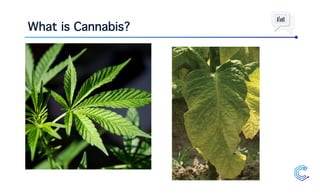
What is Cannabis?
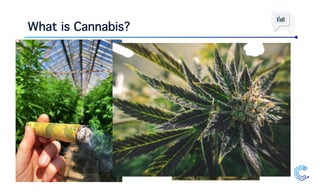
What is Cannabis?
Where am I now?
Complex Biotech Discovery Ventures
CBDV is a young research venture that seeks to add fundamental scientific
insight to the field of cannabis production.
We seek to support the cannabis industry by establishing a centralized
hub in Vancouver, BC for collaborative research focused on:
• Process Design
• Process Optimization
• Process Analytics
• Formulation Research
Where am I now?
Collaborative Research
CBDV collaborates with academic, industry and private groups around the
globe. Some highlights of those collaborations are:
• University of British Columbia, Vancouver
• Loyalist College, Belleville
• Vialpando, LLC by Dr. Monica Vialpando
• Veridient Science by Dr. Linda Klumpers
• Fritsch Milling
• PerkinElmer
What have I done?
I don’t know what cannabis is, so I try to understand it from first principle
• In-process analytics for reaction control
• Kinetic studies to understand mechanisms
• Computational studies to understand mechanisms
• Chemometrics and data analytics for process control and optimization
• Process development, like crystallization
Fundamental Cannabis Chemistry
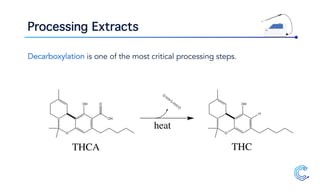
Processing Extracts
Decarboxylation is one of the most critical processing steps.
O
OH
OH
O
O
OH
H
C
O
O
heat
THCA THC
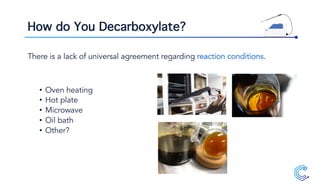
How do You Decarboxylate?
There is a lack of universal agreement regarding reaction conditions.
• Oven heating
• Hot plate
• Microwave
• Oil bath
• Other?
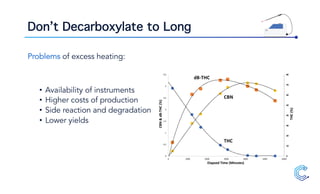
Don’t Decarboxylate to Long
Problems of excess heating:
• Availability of instruments
• Higher costs of production
• Side reaction and degradation
• Lower yields
0
10
20
30
40
50
60
70
80
0
0.5
1
1.5
2
2.5
3
3.5
0 1000 2000 3000 4000 5000 6000
THC
THC(%)
CBN&d8-THC(%)
d8-THC
CBN
Elapsed Time (Minutes)
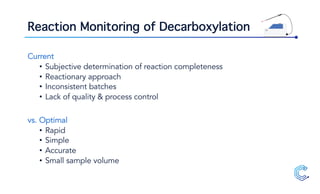
Reaction Monitoring of Decarboxylation
Current
• Subjective determination of reaction completeness
• Reactionary approach
• Inconsistent batches
• Lack of quality & process control
vs. Optimal
• Rapid
• Simple
• Accurate
• Small sample volume
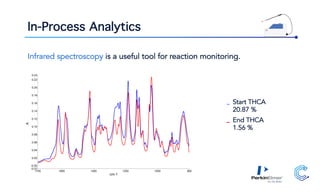
In-Process Analytics
Infrared spectroscopy is a useful tool for reaction monitoring.
BG62-64 T0
BG62-64 T80
Name
Sample 023 By Administrator Date Thursday, July 12 2018
Sample 041 By Administrator Date Thursday, July 12 2018
Description
1750 8001600 1400 1200 1000
0.23
-0.01
-0.00
0.02
0.04
0.06
0.08
0.10
0.12
0.14
0.16
0.18
0.20
0.22
cm-1
A
_ Start THCA
20.87 %
End THCA
1.56 %
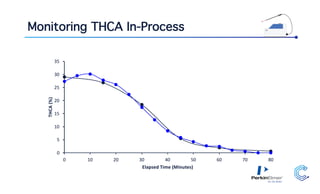
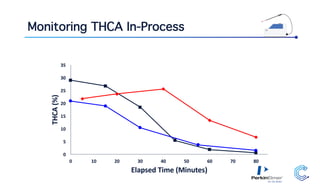
Monitoring THCA In-Process
0
5
10
15
20
25
30
35
0 10 20 30 40 50 60 70 80
THCA(%)
Elapsed Time (Minutes)
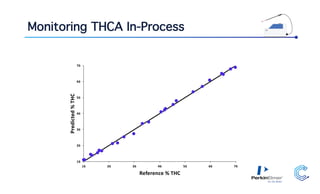
Monitoring THCA In-Process
16
26
36
46
56
66
76
16 26 36 46 56 66 76
Predicted%THC
Reference % THC
Monitoring THCA In-Process
0
5
10
15
20
25
30
35
0 10 20 30 40 50 60 70 80
THCA(%)
Elapsed Time (Minutes)
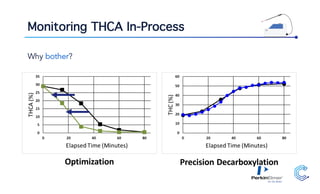
Monitoring THCA In-Process
Why bother?
Optimization Precision Decarboxylation
O
OH
OH
O
O
OH
H
C
O
O
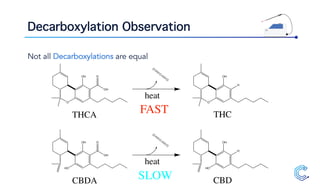
heat
THCA THC
HO
OH
OH
O
HO
OH
H
C
O
O
heat
CBDA CBD
FAST
SLOW
Decarboxylation Observation
Not all Decarboxylations are equal
Computational Studies
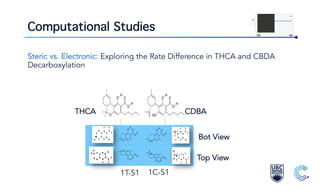
Steric vs. Electronic: Exploring the Rate Difference in THCA and CBDA
Decarboxylation
1T-S1 1C-S1
Bot View
THCA CDBA
Top View
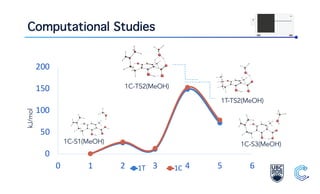
Computational StudieskJ/mol
0
50
100
150
200
0 1 2 3 4 5 61T 1C
1C-S1(MeOH) 1C-S3(MeOH)
1C-TS2(MeOH)
1T-TS2(MeOH)
Computational Studies
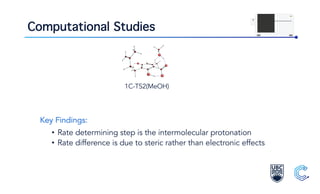
Key Findings:
• Rate determining step is the intermolecular protonation
• Rate difference is due to steric rather than electronic effects
1C-TS2(MeOH)
Computational Studies
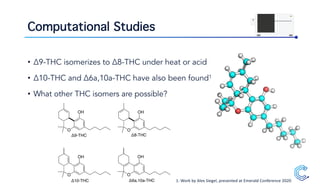
1: Work by Alex Siegel, presented at Emerald Conference 2020
• Δ9-THC isomerizes to Δ8-THC under heat or acid
• Δ10-THC and Δ6a,10a-THC have also been found1
• What other THC isomers are possible?
O
OH
O
OH
O
OH
O
OH
Δ9-THC Δ8-THC
Δ10-THC Δ6a,10a-THC
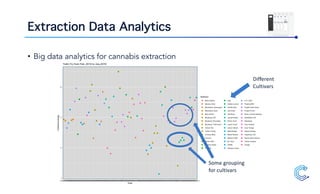
Extraction Data Analytics
• Big data analytics for cannabis extraction
Different
Cultivars
Some grouping
for cultivars
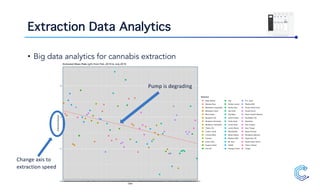
Extraction Data Analytics
• Big data analytics for cannabis extraction
Change axis to
extraction speed
Pump is degrading
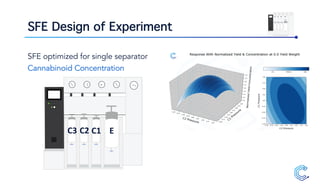
SFE Design of Experiment
SFE optimized for single separator
Cannabinoid Concentration
EC2 C1C3
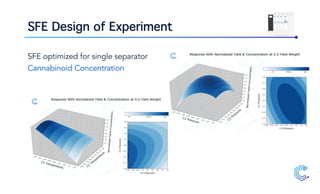
SFE Design of Experiment
SFE optimized for single separator
Cannabinoid Concentration
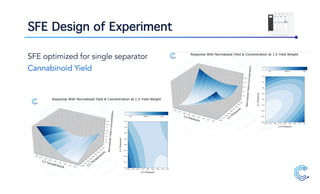
SFE Design of Experiment
SFE optimized for single separator
Cannabinoid Yield
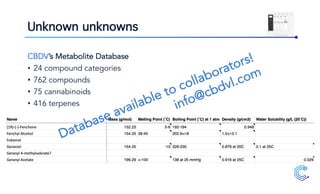
Unknown unknowns
CBDV’s Metabolite Database
• 24 compound categories
• 762 compounds
• 75 cannabinoids
• 416 terpenes
Database available to collaborators!
info@cbdvl.com
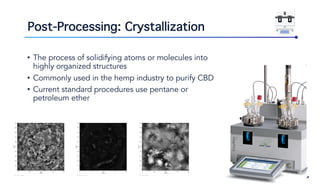
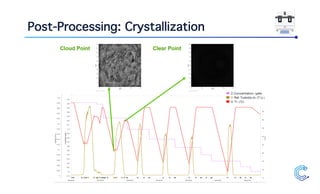
Post-Processing: Crystallization
• The process of solidifying atoms or molecules into
highly organized structures
• Commonly used in the hemp industry to purify CBD
• Current standard procedures use pentane or
petroleum ether
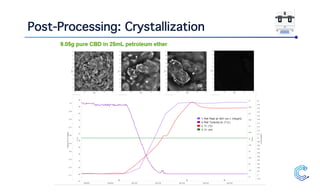
Post-Processing: Crystallization
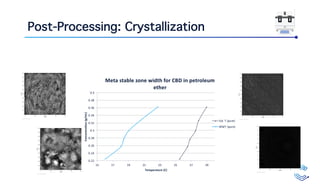
0.22
0.24
0.26
0.28
0.3
0.32
0.34
0.36
0.38
0.4
15 17 19 21 23 25 27 29
Concentration(g/mL)
Temperature (C)
Meta stable zone width for CBD in petroleum
ether
Sol. T (pure)
MSZT (pure)
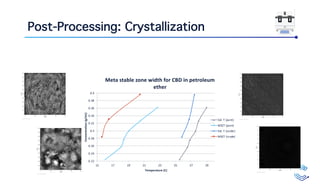
0.22
0.24
0.26
0.28
0.3
0.32
0.34
0.36
0.38
0.4
15 17 19 21 23 25 27 29
Concentration(g/mL)
Temperature (C)
Meta stable zone width for CBD in petroleum
ether
Sol. T (pure)
MSZT (pure)
Sol. T (curde)
MSZT (crude)
Post-Processing: Crystallization
Thank You
Thanks go to our collaborators:
• Blake Grauerholz, OutCo
• Taylor Trah, OutCo
• Dr. Allison Justice, Hemp Mine
• Ariel Bohman, PerkinElmer
• Dr. Toby Astill, PerkinElmer
• Barry Schubmehl, Fritsch Milling
• Antonio Marelli, Imperial College
• Weiying He, UBC
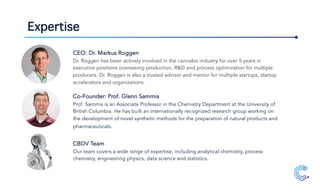
Expertise
CEO: Dr. Markus Roggen
Dr. Roggen has been actively involved in the cannabis industry for over 5 years in
executive positions overseeing production, R&D and process optimization for multiple
producers. Dr. Roggen is also a trusted advisor and mentor for multiple startups, startup
accelerators and organizations.
Co-Founder: Prof. Glenn Sammis
Prof. Sammis is an Associate Professor in the Chemistry Department at the University of
British Columbia. He has built an internationally recognized research group working on
the development of novel synthetic methods for the preparation of natural products and
pharmaceuticals.
CBDV Team
Our team covers a wide range of expertise, including analytical chemistry, process
chemistry, engineering physics, data science and statistics.
Dr. Markus Roggen markus@cbdvl.com

ElSohley Award Lecture 2020

  • 1.
    Collaborative Research for FundamentalInsight into Cannabis Production Dr. Markus Roggen
  • 2.
    Fundamental Collaboration • Whoam I? • What is cannabis? • Where am I now? • What have I done?
  • 3.
    Who am I? •Born in Germany • Germans only drink beer • Highschool with focus on chemistry and math • One guy used cannabis, but he was from a different school • M/Sci Chemistry from Imperial College, London (2008) • Voted “university hardest to find drugs at”
  • 4.
    Who am I? •PhD Organic Chemistry at ETH Zürich with Prof. Carreira (2012) • Switzerland!!! • PostDoc Physical Organic Chemistry at Scripps with Prof. Blackmond (2013) • Colorado just legalized, wrong state • Trip to Berlin to visit brother (2014) • Finally learn what cannabis smells like
  • 5.
  • 6.
  • 7.
    Where am Inow? Complex Biotech Discovery Ventures CBDV is a young research venture that seeks to add fundamental scientific insight to the field of cannabis production. We seek to support the cannabis industry by establishing a centralized hub in Vancouver, BC for collaborative research focused on: • Process Design • Process Optimization • Process Analytics • Formulation Research
  • 8.
    Where am Inow? Collaborative Research CBDV collaborates with academic, industry and private groups around the globe. Some highlights of those collaborations are: • University of British Columbia, Vancouver • Loyalist College, Belleville • Vialpando, LLC by Dr. Monica Vialpando • Veridient Science by Dr. Linda Klumpers • Fritsch Milling • PerkinElmer
  • 9.
    What have Idone? I don’t know what cannabis is, so I try to understand it from first principle • In-process analytics for reaction control • Kinetic studies to understand mechanisms • Computational studies to understand mechanisms • Chemometrics and data analytics for process control and optimization • Process development, like crystallization Fundamental Cannabis Chemistry
  • 10.
    Processing Extracts Decarboxylation isone of the most critical processing steps. O OH OH O O OH H C O O heat THCA THC
  • 11.
    How do YouDecarboxylate? There is a lack of universal agreement regarding reaction conditions. • Oven heating • Hot plate • Microwave • Oil bath • Other?
  • 12.
    Don’t Decarboxylate toLong Problems of excess heating: • Availability of instruments • Higher costs of production • Side reaction and degradation • Lower yields 0 10 20 30 40 50 60 70 80 0 0.5 1 1.5 2 2.5 3 3.5 0 1000 2000 3000 4000 5000 6000 THC THC(%) CBN&d8-THC(%) d8-THC CBN Elapsed Time (Minutes)
  • 13.
    Reaction Monitoring ofDecarboxylation Current • Subjective determination of reaction completeness • Reactionary approach • Inconsistent batches • Lack of quality & process control vs. Optimal • Rapid • Simple • Accurate • Small sample volume
  • 14.
    In-Process Analytics Infrared spectroscopyis a useful tool for reaction monitoring. BG62-64 T0 BG62-64 T80 Name Sample 023 By Administrator Date Thursday, July 12 2018 Sample 041 By Administrator Date Thursday, July 12 2018 Description 1750 8001600 1400 1200 1000 0.23 -0.01 -0.00 0.02 0.04 0.06 0.08 0.10 0.12 0.14 0.16 0.18 0.20 0.22 cm-1 A _ Start THCA 20.87 % End THCA 1.56 %
  • 15.
    Monitoring THCA In-Process 0 5 10 15 20 25 30 35 010 20 30 40 50 60 70 80 THCA(%) Elapsed Time (Minutes)
  • 16.
    Monitoring THCA In-Process 16 26 36 46 56 66 76 1626 36 46 56 66 76 Predicted%THC Reference % THC
  • 17.
    Monitoring THCA In-Process 0 5 10 15 20 25 30 35 010 20 30 40 50 60 70 80 THCA(%) Elapsed Time (Minutes)
  • 18.
    Monitoring THCA In-Process Whybother? Optimization Precision Decarboxylation
  • 19.
  • 20.
    Computational Studies Steric vs.Electronic: Exploring the Rate Difference in THCA and CBDA Decarboxylation 1T-S1 1C-S1 Bot View THCA CDBA Top View
  • 21.
    Computational StudieskJ/mol 0 50 100 150 200 0 12 3 4 5 61T 1C 1C-S1(MeOH) 1C-S3(MeOH) 1C-TS2(MeOH) 1T-TS2(MeOH)
  • 22.
    Computational Studies Key Findings: •Rate determining step is the intermolecular protonation • Rate difference is due to steric rather than electronic effects 1C-TS2(MeOH)
  • 23.
    Computational Studies 1: Workby Alex Siegel, presented at Emerald Conference 2020 • Δ9-THC isomerizes to Δ8-THC under heat or acid • Δ10-THC and Δ6a,10a-THC have also been found1 • What other THC isomers are possible? O OH O OH O OH O OH Δ9-THC Δ8-THC Δ10-THC Δ6a,10a-THC
  • 24.
    Extraction Data Analytics •Big data analytics for cannabis extraction Different Cultivars Some grouping for cultivars
  • 25.
    Extraction Data Analytics •Big data analytics for cannabis extraction Change axis to extraction speed Pump is degrading
  • 26.
    SFE Design ofExperiment SFE optimized for single separator Cannabinoid Concentration EC2 C1C3
  • 27.
    SFE Design ofExperiment SFE optimized for single separator Cannabinoid Concentration
  • 28.
    SFE Design ofExperiment SFE optimized for single separator Cannabinoid Yield
  • 29.
    Unknown unknowns CBDV’s MetaboliteDatabase • 24 compound categories • 762 compounds • 75 cannabinoids • 416 terpenes Database available to collaborators! info@cbdvl.com
  • 30.
    Post-Processing: Crystallization • Theprocess of solidifying atoms or molecules into highly organized structures • Commonly used in the hemp industry to purify CBD • Current standard procedures use pentane or petroleum ether
  • 31.
  • 32.
  • 33.
    Post-Processing: Crystallization 0.22 0.24 0.26 0.28 0.3 0.32 0.34 0.36 0.38 0.4 15 1719 21 23 25 27 29 Concentration(g/mL) Temperature (C) Meta stable zone width for CBD in petroleum ether Sol. T (pure) MSZT (pure)
  • 34.
    0.22 0.24 0.26 0.28 0.3 0.32 0.34 0.36 0.38 0.4 15 17 1921 23 25 27 29 Concentration(g/mL) Temperature (C) Meta stable zone width for CBD in petroleum ether Sol. T (pure) MSZT (pure) Sol. T (curde) MSZT (crude) Post-Processing: Crystallization
  • 35.
    Thank You Thanks goto our collaborators: • Blake Grauerholz, OutCo • Taylor Trah, OutCo • Dr. Allison Justice, Hemp Mine • Ariel Bohman, PerkinElmer • Dr. Toby Astill, PerkinElmer • Barry Schubmehl, Fritsch Milling • Antonio Marelli, Imperial College • Weiying He, UBC
  • 36.
    Expertise CEO: Dr. MarkusRoggen Dr. Roggen has been actively involved in the cannabis industry for over 5 years in executive positions overseeing production, R&D and process optimization for multiple producers. Dr. Roggen is also a trusted advisor and mentor for multiple startups, startup accelerators and organizations. Co-Founder: Prof. Glenn Sammis Prof. Sammis is an Associate Professor in the Chemistry Department at the University of British Columbia. He has built an internationally recognized research group working on the development of novel synthetic methods for the preparation of natural products and pharmaceuticals. CBDV Team Our team covers a wide range of expertise, including analytical chemistry, process chemistry, engineering physics, data science and statistics.
  • 37.
    Dr. Markus Roggenmarkus@cbdvl.com