Thalassaemia in Australia

      Dr Sant Rayn
      Dr Sant‐Rayn Pasricha
 Victorian Thalassaemia Service, 
         Southern Health
         S h      H lh
Australia
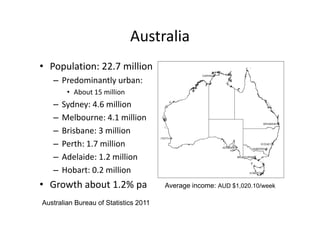
• Population: 22.7 million
   – Predominantly urban:
        • About 15 million
   –   Sydney: 4.6 million
   –   Melbourne: 4.1 million
   –   Brisbane: 3 million
   –   Perth: 1.7 million
   –   Adelaide: 1.2 million
   –   Hobart: 0.2 million
• Growth about 1.2% pa                 Average income: AUD $1,020.10/week

Australian Bureau of Statistics 2011
Australia
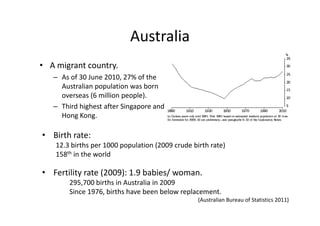
• A migrant country.
   – As of 30 June 2010, 27% of the 
     Australian population was born 
     Australian population was born
     overseas (6 million people). 
   – Third highest after Singapore and 
     Hong Kong. 

• Birth rate:
    12.3 births per 1000 population (2009 crude birth rate)
    158th in the world

• Fertility rate (2009): 1.9 babies/ woman. 
        295,700 births in Australia in 2009
        Since 1976, births have been below replacement.
        Si    1976 bi th h      b      b l    l      t
                                                  (Australian Bureau of Statistics 2011)
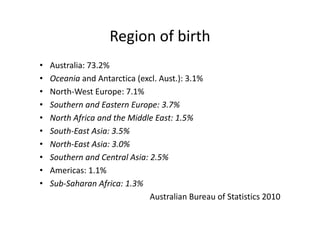
Region of birth
                    Region of birth
•   Australia: 73.2%
•   Oceania and Antarctica (excl. Aust.): 3.1%
•   North‐West Europe: 7.1%
•   Southern and Eastern Europe: 3.7%
•   North Africa and the Middle East: 1.5%
•   South‐East Asia: 3.5%
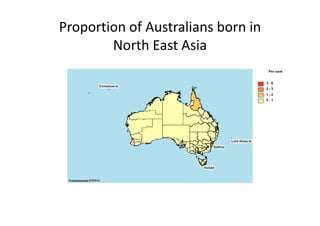
•   North‐East Asia: 3.0%
•   Southern and Central Asia: 2.5%
•   Americas: 1.1%
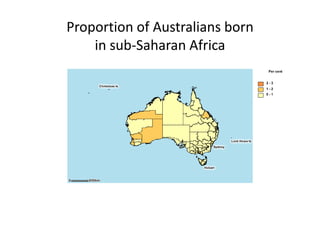
•   Sub‐Saharan Africa: 1.3%
                               Australian Bureau of Statistics 2010
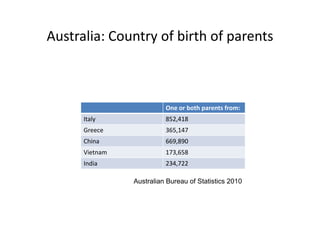
Australia: Country of birth of parents
Australia: Country of birth of parents


                          One or both parents from:
      Italy               852,418
      Greece              365,147
      China               669,890
      Vietnam             173,658
      India               234,722
                          234 722

                Australian Bureau of Statistics 2010
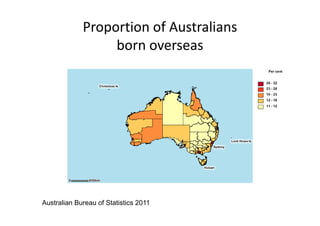
Proportion of Australians 
                  born overseas


Australian Bureau of Statistics 2011
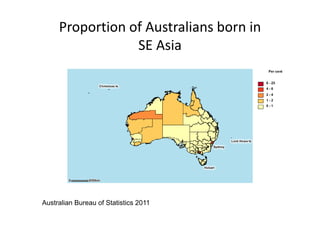
Proportion of Australians born in 
                 SE Asia


Australian Bureau of Statistics 2011
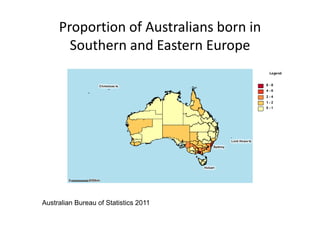
Proportion of Australians born in 
       Southern and Eastern Europe


Australian Bureau of Statistics 2011
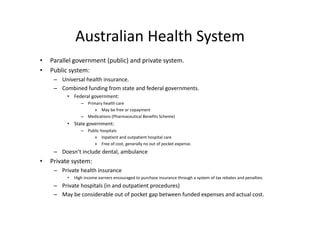
Australian Health System
              Australian Health System
•   Parallel government (public) and private system. 
    Parallel government (public) and private system
•   Public system:
     – Universal health insurance.
     – Combined funding from state and federal governments
       Combined funding from state and federal governments. 
          • Federal government:
                 – Primary health care
                       » May be free or copayment
                 – Medications (Pharmaceutical Benefits Scheme)
          • State government:
                 – Public hospitals
                      » Inpatient and outpatient hospital care
                           Inpatient and outpatient hospital care
                      » Free of cost, generally no out of pocket expense.
     – Doesn’t include dental, ambulance
•   Private system:
             y
     – Private health insurance
          •   High income earners encouraged to purchase insurance through a system of tax rebates and penalties.
     – Private hospitals (in and outpatient procedures)
     – May be considerable out of pocket gap between funded expenses and actual cost. 
Australian Health System
        Australian Health System
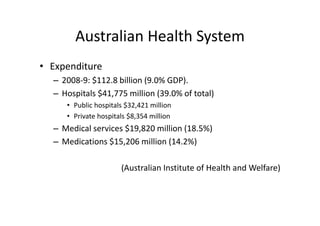
• Expenditure
  – 2008‐9: $112.8 billion (9.0% GDP). 
  – Hospitals $41,775 million (39.0% of total)
     • Public hospitals $32,421 million
     • Private hospitals $8,354 million
                         $
  – Medical services $19,820 million (18.5%)
  – Medications $15,206 million (14.2%)
      di i      $1 206 illi (14 2%)

                      (Australian Institute of Health and Welfare) 
Australian Health System
          Australian Health System
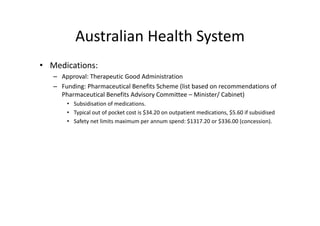
• Medications:
   – Approval: Therapeutic Good Administration
   – Funding: Pharmaceutical Benefits Scheme (list based on recommendations of
     Funding: Pharmaceutical Benefits Scheme (list based on recommendations of  
     Pharmaceutical Benefits Advisory Committee – Minister/ Cabinet)
       • Subsidisation of medications. 
       • Typical out of pocket cost is $34 20 on outpatient medications $5 60 if subsidised
         Typical out of pocket cost is $34.20 on outpatient medications, $5.60 if subsidised
       • Safety net limits maximum per annum spend: $1317.20 or $336.00 (concession).
Australian Government National Chronic 
              Diseases Policy 2005
•   Overarching framework of national direction for improving chronic disease prevention and 
    O       hi f           k f    i   l di   i f i          i   h i di                 i     d
    care across Australia.
•   Focusing on cancer, diabetes, asthma, cardiovascular disease, stroke, osteoporosis, osteo‐
    and rheumatoid arthritis. 
    and rheumatoid arthritis
•   Principles:
     –   Adopt a population health approach and reduce health inequalities
     –   Prioritise health promotion and disease prevention
            o se ea p o o o a d d sease p e e o
     –   Achieve person centred care and patient self management
     –   Provide the most effective care
     –   Facilitate coordinated and integrated multi‐disciplinary care across services, settings and sectors
     –   Achieve significant and sustainable change
     –   Monitor progress
•   Action areas:
     –   Prevention
                 i
     –   Early detection and treatment
     –   Integration and continuation of prevention and care
     –   Self management
         Self management
Thalassaemia in Australia
       Thalassaemia in Australia
• Epidemiology unclear:
  • No study has prospectively documented the prevalence of 
    haemoglobinopathies in the general Australian population. 
  • Carrier rate is likely to reflect the background of the 
    countries from which the Australian population is derived. 
         ti f           hi h th A t li           l ti i d i d
• No national government policy on:
  – Premarital screening
  – Antenatal screening
  – Newborn screening
Antenatal Screening: guidelines
   Antenatal Screening: guidelines
• Royal Australasian College of Obstetricians and 
  Gyanaecologists (November 2009):
• Screening for Haemoglobinopathies:
   – Each unit should have a defined policy for screening for haemoglobinopathies, 
     taking into account the ethnic mix of patients screened.
     taking into account the ethnic mix of patients screened
   – As a minimum, all women should be screened with (Hb), MCV and MCHC.
   – Haemoglobin electrophoresis and iron studies should be performed in the 
     event of thresholds not being reached.
          t f th h ld       tb i        h d
   – Consideration should also be given to the further screening of patients with 
     DNA analysis for alpha‐thalassaemia. 
   – Testing of normal‐MCV women for haemoglobinopathies may be considered if 
     they are members of high‐risk groups.
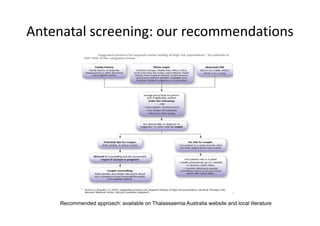
Antenatal screening: our recommendations 
Antenatal screening: our recommendations


     Recommended approach: available on Thalassaemia Australia website and local literature
Abortion laws in Australia
       Abortion laws in Australia
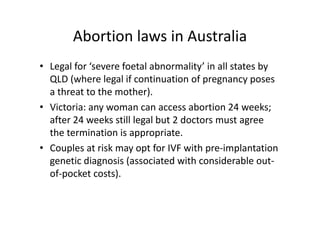
• Legal for ‘severe foetal abnormality’ in all states by 
  QLD (where legal if continuation of pregnancy poses 
  a threat to the mother).
• Victoria: any woman can access abortion 24 weeks; 
  after 24 weeks still legal but 2 doctors must agree 
  the termination is appropriate. 
• Couples at risk may opt for IVF with pre‐implantation 
  g
  genetic diagnosis (associated with considerable out‐
              g       (
  of‐pocket costs).  
Thalassaemia in Australia
            Thalassaemia in Australia
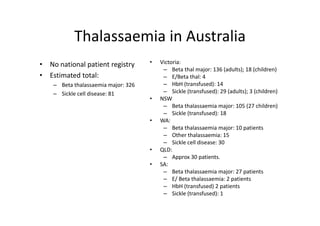
•   No national patient registry
               l                      •   Victoria:
                                           – Beta thal major: 136 (adults); 18 (children)
•   Estimated total:                       – E/Beta thal: 4
     – Beta thalassaemia major: 326
                               j           – HbH (transfused): 14
     – Sickle cell disease: 81             – Sickle (transfused): 29 (adults); 3 (children)
                                      •   NSW
                                           – Beta thalassaemia major: 105 (27 children)
                                           – Sickle (transfused): 18
                                               Sickle (transfused): 18
                                      •   WA:
                                           – Beta thalassaemia major: 10 patients
                                           – Other thalassaemia: 15
                                           – Sickle cell disease: 30 
                                      •   QLD:
                                           – Approx 30 patients. 
                                      •   SA:
                                           – Beta thalassaemia major: 27 patients
                                           – E/ Beta thalassaemia: 2 patients
                                           – HbH (transfused) 2 patients
                                           – Sickle (transfused): 1
Thalassaemia in Australia
        Thalassaemia in Australia
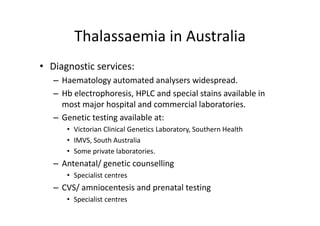
• Diagnostic services:
   – Haematology automated analysers widespread. 
   – Hb electrophoresis, HPLC and special stains available in 
     most major hospital and commercial laboratories. 
   – Genetic testing available at:
      • Victorian Clinical Genetics Laboratory, Southern Health
      • IMVS S th A t li
        IMVS, South Australia
      • Some private laboratories. 
   – Antenatal/ genetic counselling
     Antenatal/ genetic counselling
      • Specialist centres
   – CVS/ amniocentesis and prenatal testing
     CVS/ amniocentesis and prenatal testing
      • Specialist centres
Thalassaemia in Australia
       Thalassaemia in Australia
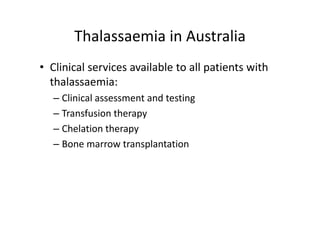
• Clinical services available to all patients with 
  thalassaemia:
   – Clinical assessment and testing
   – Transfusion therapy
     Transfusion therapy
   – Chelation therapy
   – Bone marrow transplantation
Thalassaemia in Australia
          Thalassaemia in Australia
• Thalassaemia Australia:
  Mission and objectives: 
                j
  – To provide consultation and communication to the community for:
      •   Care and Treatment 
      •   Best Transfusion Practice 
          B tT      f i P ti
      •   Member Education 
      •   Support to members of the public and individuals with Haemoglobinopathies 
      •   Advocacy 
           d
      •   Research 
      •   Consumer Health Groups 
      •   Conference and Seminar attendance
Blood Policy in Australia
           Blood Policy in Australia
• Single blood manufacturer (Australian Red Cross Blood 
  Service). 
• C t t d i th
  Contracted via the 
   – National Blood Authority, from the 
   – Federal Department of Health
     Federal Department of Health. 
• All non‐remunerated voluntary blood donations.
• All blood provided free of charge
  All blood provided free of charge.  
• Southern Health Clayton is the biggest user of blood in 
  Victoria, the Thalassaemia treatment centre is the largest user 
  Victoria, the Thalassaemia treatment centre is the largest user
  of blood at Southern Health. 
                                y
• Thalassaemia Australia society are involved in blood donation 
  marketing efforts. 
Prevention of transfusion 
             transmitted infections
•   HIV (serology, NAT)
    HIV (      l    NAT)
•   Hep C (serology, NAT)
•   Hep B (serology, NAT (new!))
    Hep B (serology NAT (new!))
•   Syphillis (serology)
•   Malaria (serology)
             (       gy)
•   HTLV (serology)
•   Bacteria (bacterial contamination screening)
•   VCJD:
    – people who have spent a cumulative period of 6 months in the 
      UK between 1 January 1980 and 31 December 1996 and/or had 
      UK between 1 January 1980 and 31 December 1996 and/or had
      a transfusion in the UK between 1 January 1980 and the present 
      time are not accepted as donors.
Transfusion practice at our centre
    Transfusion practice at our centre
•   No specific guideline 
•   Pre‐transfusion haemoglobin 90‐110g/L.
•   Transfusion intervals 1‐4 weekly.  
•   Titrated to patient symptoms and tolerance. 
    Titrated to patient symptoms and tolerance
     – Fatigue
     – Iron loading
       Iron loading
     – Pain
• M
  More frequent transfusions during pregnancy, while 
       f       tt    f i     d i                hil
  on combination HCV therapy. 
Iron Chelation in Australia
        Iron Chelation in Australia
• Pharmaceutical Benefits Scheme covers:
   – Desferrioxamine:
       • Restriction: “Disorders of erythropoiesis associated with treatment
         Restriction:  Disorders of erythropoiesis associated with treatment‐
         related chronic iron overload.”
       • Cost to patient: up to $34.20
   – Deferiprone:
       • Restriction: Iron overload in patients with thalassaemia major who are 
         unable to take desferrioxamine therapy; or in whom desferrioxamine has 
         been ineffective 
       • Cost to patient: up to $34.20
   – Desferasirox:
       • Restriction: “chronic iron overload in patients with disorders of 
         erythropoiesis”
       • C tt
         Cost to patient: up to $34.20
                   ti t      t $34 20
Iron chelation in Australia
      Iron chelation in Australia
• In our centre:
  – Approximately 4:1 Deferasirox to desferioxamine. 
     pp         y
     • Desferrioxamine only if:
        –   Patient unwilling to switch to deferasirox
        –   Deferasirox failure
        –   Deferasirox poorly tolerated (GI/ renal/ hepatic)
        –   Underlying renal/ hepatic impairment
        –   Pregnancy
Iron monitoring
               Iron monitoring
• Ferritin
   – 1‐3 monthly
               y
• MRI T2* liver and cardiac now available (about 
  2‐3 years as a research tool, 1 year as a 
  2 3 years as a research tool 1 year as a
  routine). 
   – Annually (6 monthly in severe iron overload)
• (CT ‐ historically)
  (CT 
Multidisciplinary services
       Multidisciplinary services
• Our centre works in close collaboration with 
   p
  specialist services with an interest in 
  thalassaemia:
  – Social work
    Social work
  – Hepatology (Hepatitis C Treatment)
  – Metabolic bone
  – General endocrinology
  – Cardiology
  – Others eg plastic surgery
    Others, eg plastic surgery
The Future
                    The Future
• Changing demographics
  – Further migration and intermarriage. 
               g                        g
  – Increase in sickle cell gene prevalence. 
     • ?Routine neonatal screening
       ?Routine neonatal screening
     • ?National policies for antenatal screening
• A i
  Ageing population of patients with 
              l ti   f ti t ith
  thalassaemia:
  – Patients >60 years.
Acknowledgements
• Professor Don Bowden
• Ms Joanne Shaw and staff at the Medical Therapy Unit, 
  Southern Health, Victoria
  S th      H lth Vi t i
• A/Prof Joy Ho, A/Prof Robert Lindeman (NSW) 
• D D id J k (WA)
  Dr David Joske (WA)
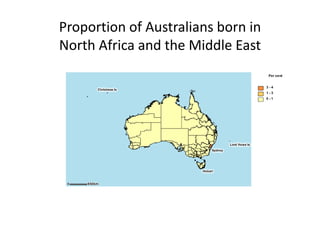
Proportion of Australians born in 
North Africa and the Middle East
Proportion of Australians born 
    in sub‐Saharan Africa
Proportion of Australians born in 
        North East Asia

Australia - Current Situation in Control Strategies and Health Systems in Asia

  • 1.
    Thalassaemia in Australia Dr Sant Rayn Dr Sant‐Rayn Pasricha Victorian Thalassaemia Service,  Southern Health S h H lh
  • 2.
    Australia • Population: 22.7 million – Predominantly urban: • About 15 million – Sydney: 4.6 million – Melbourne: 4.1 million – Brisbane: 3 million – Perth: 1.7 million – Adelaide: 1.2 million – Hobart: 0.2 million • Growth about 1.2% pa Average income: AUD $1,020.10/week Australian Bureau of Statistics 2011
  • 3.
    Australia • A migrant country. – As of 30 June 2010, 27% of the  Australian population was born  Australian population was born overseas (6 million people).  – Third highest after Singapore and  Hong Kong.  • Birth rate: 12.3 births per 1000 population (2009 crude birth rate) 158th in the world • Fertility rate (2009): 1.9 babies/ woman.  295,700 births in Australia in 2009 Since 1976, births have been below replacement. Si 1976 bi th h b b l l t (Australian Bureau of Statistics 2011)
  • 4.
    Region of birth Region of birth • Australia: 73.2% • Oceania and Antarctica (excl. Aust.): 3.1% • North‐West Europe: 7.1% • Southern and Eastern Europe: 3.7% • North Africa and the Middle East: 1.5% • South‐East Asia: 3.5% • North‐East Asia: 3.0% • Southern and Central Asia: 2.5% • Americas: 1.1% • Sub‐Saharan Africa: 1.3% Australian Bureau of Statistics 2010
  • 5.
    Australia: Country of birth of parents Australia: Country ofbirth of parents One or both parents from: Italy 852,418 Greece 365,147 China 669,890 Vietnam 173,658 India 234,722 234 722 Australian Bureau of Statistics 2010
  • 6.
    Proportion of Australians  born overseas Australian Bureau of Statistics 2011
  • 7.
    Proportion of Australians born in  SE Asia Australian Bureau of Statistics 2011
  • 8.
    Proportion of Australians born in  Southern and Eastern Europe Australian Bureau of Statistics 2011
  • 9.
    Australian Health System Australian Health System • Parallel government (public) and private system.  Parallel government (public) and private system • Public system: – Universal health insurance. – Combined funding from state and federal governments Combined funding from state and federal governments.  • Federal government: – Primary health care » May be free or copayment – Medications (Pharmaceutical Benefits Scheme) • State government: – Public hospitals » Inpatient and outpatient hospital care Inpatient and outpatient hospital care » Free of cost, generally no out of pocket expense. – Doesn’t include dental, ambulance • Private system: y – Private health insurance • High income earners encouraged to purchase insurance through a system of tax rebates and penalties. – Private hospitals (in and outpatient procedures) – May be considerable out of pocket gap between funded expenses and actual cost. 
  • 10.
    Australian Health System Australian Health System • Expenditure – 2008‐9: $112.8 billion (9.0% GDP).  – Hospitals $41,775 million (39.0% of total) • Public hospitals $32,421 million • Private hospitals $8,354 million $ – Medical services $19,820 million (18.5%) – Medications $15,206 million (14.2%) di i $1 206 illi (14 2%) (Australian Institute of Health and Welfare) 
  • 11.
    Australian Health System Australian Health System • Medications: – Approval: Therapeutic Good Administration – Funding: Pharmaceutical Benefits Scheme (list based on recommendations of Funding: Pharmaceutical Benefits Scheme (list based on recommendations of   Pharmaceutical Benefits Advisory Committee – Minister/ Cabinet) • Subsidisation of medications.  • Typical out of pocket cost is $34 20 on outpatient medications $5 60 if subsidised Typical out of pocket cost is $34.20 on outpatient medications, $5.60 if subsidised • Safety net limits maximum per annum spend: $1317.20 or $336.00 (concession).
  • 12.
    Australian Government National Chronic  Diseases Policy 2005 • Overarching framework of national direction for improving chronic disease prevention and  O hi f k f i l di i f i i h i di i d care across Australia. • Focusing on cancer, diabetes, asthma, cardiovascular disease, stroke, osteoporosis, osteo‐ and rheumatoid arthritis.  and rheumatoid arthritis • Principles: – Adopt a population health approach and reduce health inequalities – Prioritise health promotion and disease prevention o se ea p o o o a d d sease p e e o – Achieve person centred care and patient self management – Provide the most effective care – Facilitate coordinated and integrated multi‐disciplinary care across services, settings and sectors – Achieve significant and sustainable change – Monitor progress • Action areas: – Prevention i – Early detection and treatment – Integration and continuation of prevention and care – Self management Self management
  • 13.
    Thalassaemia in Australia Thalassaemia in Australia • Epidemiology unclear: • No study has prospectively documented the prevalence of  haemoglobinopathies in the general Australian population.  • Carrier rate is likely to reflect the background of the  countries from which the Australian population is derived.  ti f hi h th A t li l ti i d i d • No national government policy on: – Premarital screening – Antenatal screening – Newborn screening
  • 14.
    Antenatal Screening: guidelines Antenatal Screening: guidelines • Royal Australasian College of Obstetricians and  Gyanaecologists (November 2009): • Screening for Haemoglobinopathies: – Each unit should have a defined policy for screening for haemoglobinopathies,  taking into account the ethnic mix of patients screened. taking into account the ethnic mix of patients screened – As a minimum, all women should be screened with (Hb), MCV and MCHC. – Haemoglobin electrophoresis and iron studies should be performed in the  event of thresholds not being reached. t f th h ld tb i h d – Consideration should also be given to the further screening of patients with  DNA analysis for alpha‐thalassaemia.  – Testing of normal‐MCV women for haemoglobinopathies may be considered if  they are members of high‐risk groups.
  • 15.
    Antenatal screening: our recommendations  Antenatal screening: ourrecommendations Recommended approach: available on Thalassaemia Australia website and local literature
  • 16.
    Abortion laws in Australia Abortion laws in Australia • Legal for ‘severe foetal abnormality’ in all states by  QLD (where legal if continuation of pregnancy poses  a threat to the mother). • Victoria: any woman can access abortion 24 weeks;  after 24 weeks still legal but 2 doctors must agree  the termination is appropriate.  • Couples at risk may opt for IVF with pre‐implantation  g genetic diagnosis (associated with considerable out‐ g ( of‐pocket costs).  
  • 17.
    Thalassaemia in Australia Thalassaemia in Australia • No national patient registry l • Victoria: – Beta thal major: 136 (adults); 18 (children) • Estimated total: – E/Beta thal: 4 – Beta thalassaemia major: 326 j – HbH (transfused): 14 – Sickle cell disease: 81 – Sickle (transfused): 29 (adults); 3 (children) • NSW – Beta thalassaemia major: 105 (27 children) – Sickle (transfused): 18 Sickle (transfused): 18 • WA: – Beta thalassaemia major: 10 patients – Other thalassaemia: 15 – Sickle cell disease: 30  • QLD: – Approx 30 patients.  • SA: – Beta thalassaemia major: 27 patients – E/ Beta thalassaemia: 2 patients – HbH (transfused) 2 patients – Sickle (transfused): 1
  • 18.
    Thalassaemia in Australia Thalassaemia in Australia • Diagnostic services: – Haematology automated analysers widespread.  – Hb electrophoresis, HPLC and special stains available in  most major hospital and commercial laboratories.  – Genetic testing available at: • Victorian Clinical Genetics Laboratory, Southern Health • IMVS S th A t li IMVS, South Australia • Some private laboratories.  – Antenatal/ genetic counselling Antenatal/ genetic counselling • Specialist centres – CVS/ amniocentesis and prenatal testing CVS/ amniocentesis and prenatal testing • Specialist centres
  • 19.
    Thalassaemia in Australia Thalassaemia in Australia • Clinical services available to all patients with  thalassaemia: – Clinical assessment and testing – Transfusion therapy Transfusion therapy – Chelation therapy – Bone marrow transplantation
  • 20.
    Thalassaemia in Australia Thalassaemia in Australia • Thalassaemia Australia: Mission and objectives:  j – To provide consultation and communication to the community for: • Care and Treatment  • Best Transfusion Practice  B tT f i P ti • Member Education  • Support to members of the public and individuals with Haemoglobinopathies  • Advocacy  d • Research  • Consumer Health Groups  • Conference and Seminar attendance
  • 21.
    Blood Policy in Australia Blood Policy in Australia • Single blood manufacturer (Australian Red Cross Blood  Service).  • C t t d i th Contracted via the  – National Blood Authority, from the  – Federal Department of Health Federal Department of Health.  • All non‐remunerated voluntary blood donations. • All blood provided free of charge All blood provided free of charge.   • Southern Health Clayton is the biggest user of blood in  Victoria, the Thalassaemia treatment centre is the largest user  Victoria, the Thalassaemia treatment centre is the largest user of blood at Southern Health.  y • Thalassaemia Australia society are involved in blood donation  marketing efforts. 
  • 22.
    Prevention of transfusion  transmitted infections • HIV (serology, NAT) HIV ( l NAT) • Hep C (serology, NAT) • Hep B (serology, NAT (new!)) Hep B (serology NAT (new!)) • Syphillis (serology) • Malaria (serology) ( gy) • HTLV (serology) • Bacteria (bacterial contamination screening) • VCJD: – people who have spent a cumulative period of 6 months in the  UK between 1 January 1980 and 31 December 1996 and/or had  UK between 1 January 1980 and 31 December 1996 and/or had a transfusion in the UK between 1 January 1980 and the present  time are not accepted as donors.
  • 23.
    Transfusion practice at our centre Transfusion practice at our centre • No specific guideline  • Pre‐transfusion haemoglobin 90‐110g/L. • Transfusion intervals 1‐4 weekly.   • Titrated to patient symptoms and tolerance.  Titrated to patient symptoms and tolerance – Fatigue – Iron loading Iron loading – Pain • M More frequent transfusions during pregnancy, while  f tt f i d i hil on combination HCV therapy. 
  • 24.
    Iron Chelation in Australia Iron Chelation in Australia • Pharmaceutical Benefits Scheme covers: – Desferrioxamine: • Restriction: “Disorders of erythropoiesis associated with treatment Restriction:  Disorders of erythropoiesis associated with treatment‐ related chronic iron overload.” • Cost to patient: up to $34.20 – Deferiprone: • Restriction: Iron overload in patients with thalassaemia major who are  unable to take desferrioxamine therapy; or in whom desferrioxamine has  been ineffective  • Cost to patient: up to $34.20 – Desferasirox: • Restriction: “chronic iron overload in patients with disorders of  erythropoiesis” • C tt Cost to patient: up to $34.20 ti t t $34 20
  • 25.
    Iron chelation in Australia Iron chelation in Australia • In our centre: – Approximately 4:1 Deferasirox to desferioxamine.  pp y • Desferrioxamine only if: – Patient unwilling to switch to deferasirox – Deferasirox failure – Deferasirox poorly tolerated (GI/ renal/ hepatic) – Underlying renal/ hepatic impairment – Pregnancy
  • 26.
    Iron monitoring Iron monitoring • Ferritin – 1‐3 monthly y • MRI T2* liver and cardiac now available (about  2‐3 years as a research tool, 1 year as a  2 3 years as a research tool 1 year as a routine).  – Annually (6 monthly in severe iron overload) • (CT ‐ historically) (CT 
  • 28.
    Multidisciplinary services Multidisciplinary services • Our centre works in close collaboration with  p specialist services with an interest in  thalassaemia: – Social work Social work – Hepatology (Hepatitis C Treatment) – Metabolic bone – General endocrinology – Cardiology – Others eg plastic surgery Others, eg plastic surgery
  • 29.
    The Future The Future • Changing demographics – Further migration and intermarriage.  g g – Increase in sickle cell gene prevalence.  • ?Routine neonatal screening ?Routine neonatal screening • ?National policies for antenatal screening • A i Ageing population of patients with  l ti f ti t ith thalassaemia: – Patients >60 years.
  • 30.
    Acknowledgements • Professor Don Bowden • Ms Joanne Shaw and staff at the Medical Therapy Unit,  Southern Health, Victoria S th H lth Vi t i • A/Prof Joy Ho, A/Prof Robert Lindeman (NSW)  • D D id J k (WA) Dr David Joske (WA)
  • 31.
  • 32.
    Proportion of Australians born  in sub‐Saharan Africa
  • 33.