Textual Analysis
  Magazine 2 – Q Magazine, Issue 308,
             March 2012
Q Magazine
           Q’s Mission Statement:
 “Q is the magazine that brings music alive.
It draws together the biggest stars, the most
  exciting phenomena, the new artists that
 matter and a healthy dose of irreverence to
create an unmissable widescreen picture of
   what’s really happening in rock and roll
                  right now.”
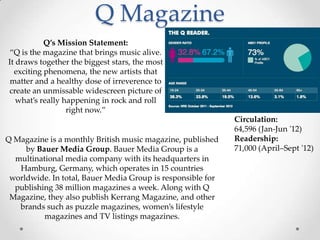
                                                             Circulation:
                                                             64,596 (Jan-Jun '12)
Q Magazine is a monthly British music magazine, published    Readership:
     by Bauer Media Group. Bauer Media Group is a            71,000 (April–Sept '12)
  multinational media company with its headquarters in
   Hamburg, Germany, which operates in 15 countries
 worldwide. In total, Bauer Media Group is responsible for
  publishing 38 million magazines a week. Along with Q
 Magazine, they also publish Kerrang Magazine, and other
   brands such as puzzle magazines, women’s lifestyle
          magazines and TV listings magazines.
Q Magazine
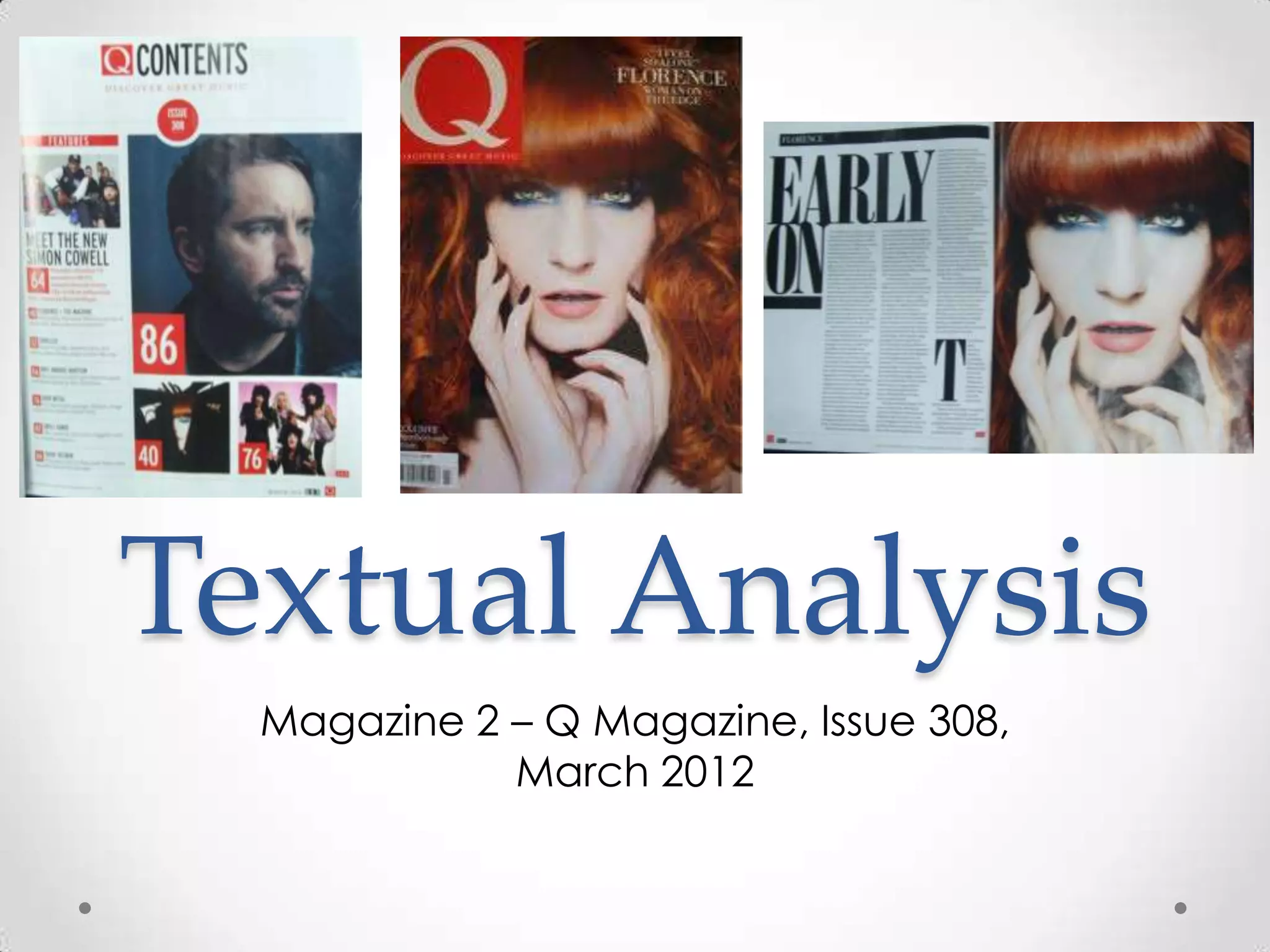
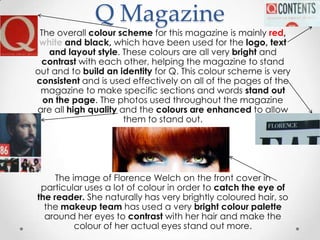
 The overall colour scheme for this magazine is mainly red,
 white and black, which have been used for the logo, text
   and layout style. These colours are all very bright and
 contrast with each other, helping the magazine to stand
out and to build an identity for Q. This colour scheme is very
consistent and is used effectively on all of the pages of the
 magazine to make specific sections and words stand out
  on the page. The photos used throughout the magazine
are all high quality and the colours are enhanced to allow
                      them to stand out.


     The image of Florence Welch on the front cover in
 particular uses a lot of colour in order to catch the eye of
the reader. She naturally has very brightly coloured hair, so
  the makeup team has used a very bright colour palette
  around her eyes to contrast with her hair and make the
          colour of her actual eyes stand out more.
Q Magazine
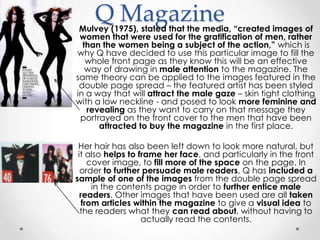
 Mulvey (1975), stated that the media, “created images of
 women that were used for the gratification of men, rather
  than the women being a subject of the action,” which is
why Q have decided to use this particular image to fill the
   whole front page as they know this will be an effective
   way of drawing in male attention to the magazine. The
same theory can be applied to the images featured in the
 double page spread – the featured artist has been styled
in a way that will attract the male gaze – skin tight clothing
with a low neckline - and posed to look more feminine and
   revealing as they want to carry on that message they
 portrayed on the front cover to the men that have been
      attracted to buy the magazine in the first place.

 Her hair has also been left down to look more natural, but
 it also helps to frame her face, and particularly in the front
     cover image, to fill more of the space on the page. In
  order to further persuade male readers, Q has included a
sample of one of the images from the double page spread
      in the contents page in order to further entice male
  readers. Other images that have been used are all taken
   from articles within the magazine to give a visual idea to
  the readers what they can read about, without having to
                   actually read the contents.
Q Magazine
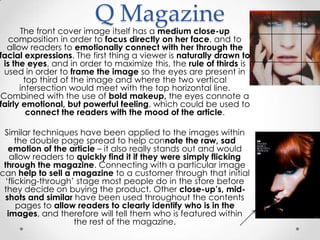
      The front cover image itself has a medium close-up
   composition in order to focus directly on her face, and to
  allow readers to emotionally connect with her through the
facial expressions. The first thing a viewer is naturally drawn to
 is the eyes, and in order to maximize this, the rule of thirds is
 used in order to frame the image so the eyes are present in
       top third of the image and where the two vertical
      intersection would meet with the top horizontal line.
Combined with the use of bold makeup, the eyes connote a
fairly emotional, but powerful feeling, which could be used to
        connect the readers with the mood of the article.

 Similar techniques have been applied to the images within
     the double page spread to help connote the raw, sad
  emotion of the article – it also really stands out and would
   allow readers to quickly find it if they were simply flicking
 through the magazine. Connecting with a particular image
can help to sell a magazine to a customer through that initial
 „flicking-through‟ stage most people do in the store before
 they decide on buying the product. Other close-up’s, mid-
 shots and similar have been used throughout the contents
     pages to allow readers to clearly identify who is in the
  images, and therefore will tell them who is featured within
                   the rest of the magazine.
Q Magazine
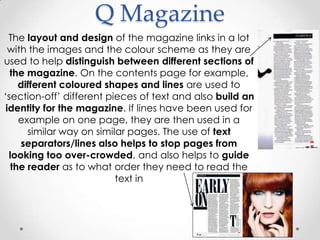
  The layout and design of the magazine links in a lot
  with the images and the colour scheme as they are
used to help distinguish between different sections of
  the magazine. On the contents page for example,
     different coloured shapes and lines are used to
„section-off‟ different pieces of text and also build an
 identity for the magazine. If lines have been used for
     example on one page, they are then used in a
       similar way on similar pages. The use of text
     separators/lines also helps to stop pages from
  looking too over-crowded, and also helps to guide
   the reader as to what order they need to read the
                           text in
Q Magazine
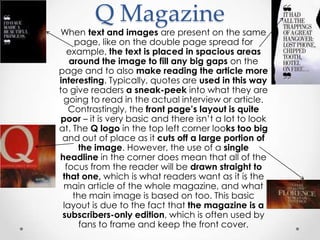
 When text and images are present on the same
    page, like on the double page spread for
  example, the text is placed in spacious areas
   around the image to fill any big gaps on the
page and to also make reading the article more
interesting. Typically, quotes are used in this way
to give readers a sneak-peek into what they are
 going to read in the actual interview or article.
   Contrastingly, the front page’s layout is quite
 poor – it is very basic and there isn‟t a lot to look
at. The Q logo in the top left corner looks too big
 and out of place as it cuts off a large portion of
     the image. However, the use of a single
headline in the corner does mean that all of the
  focus from the reader will be drawn straight to
 that one, which is what readers want as it is the
 main article of the whole magazine, and what
    the main image is based on too. This basic
 layout is due to the fact that the magazine is a
 subscribers-only edition, which is often used by
      fans to frame and keep the front cover.
Q Magazine
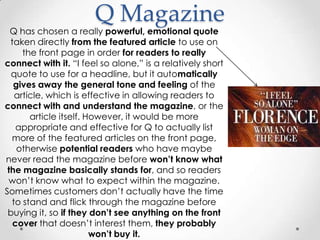
  Q has chosen a really powerful, emotional quote
  taken directly from the featured article to use on
     the front page in order for readers to really
connect with it. “I feel so alone,” is a relatively short
  quote to use for a headline, but it automatically
   gives away the general tone and feeling of the
   article, which is effective in allowing readers to
connect with and understand the magazine, or the
       article itself. However, it would be more
    appropriate and effective for Q to actually list
  more of the featured articles on the front page,
    otherwise potential readers who have maybe
never read the magazine before won’t know what
 the magazine basically stands for, and so readers
 won‟t know what to expect within the magazine.
Sometimes customers don‟t actually have the time
  to stand and flick through the magazine before
 buying it, so if they don’t see anything on the front
   cover that doesn‟t interest them, they probably
                        won’t buy it.
Q Magazine


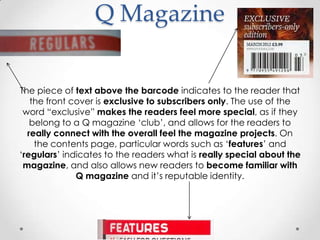
The piece of text above the barcode indicates to the reader that
   the front cover is exclusive to subscribers only. The use of the
 word “exclusive” makes the readers feel more special, as if they
   belong to a Q magazine „club‟, and allows for the readers to
  really connect with the overall feel the magazine projects. On
    the contents page, particular words such as „features‟ and
„regulars‟ indicates to the readers what is really special about the
 magazine, and also allows new readers to become familiar with
              Q magazine and it‟s reputable identity.
Q Magazine
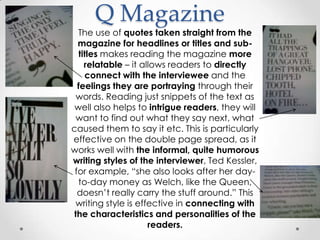
  The use of quotes taken straight from the
  magazine for headlines or titles and sub-
  titles makes reading the magazine more
    relatable – it allows readers to directly
    connect with the interviewee and the
  feelings they are portraying through their
 words. Reading just snippets of the text as
 well also helps to intrigue readers, they will
 want to find out what they say next, what
caused them to say it etc. This is particularly
effective on the double page spread, as it
works well with the informal, quite humorous
writing styles of the interviewer, Ted Kessler,
 for example, “she also looks after her day-
  to-day money as Welch, like the Queen,
  doesn‟t really carry the stuff around.” This
 writing style is effective in connecting with
the characteristics and personalities of the
                     readers.
Q Magazine


   The typical target audience of Q magazine is
    young to middle aged adults, who have an
interest in more common genres of music, such as
 pop, rock, indie etc. To suit this target audience,
  Q wants to provide a lot of factual information,
 but also make the magazine seem quite fun, and
     actually interesting to pick up and read. A
   classical music magazine, for example, may
  contrastingly use a more formal writing style, as
      target readers are likely to be older, and
             interested in the facts only.
Q Magazine
Overall, Q magazine is strong in creating an identity for itself.
After over 300 issues of the magazine, the brand and identity
of Q is widely known across Britain, and this is ultimately what
sells the magazine. The use of intriguing images and writing
  styles, bright colours and stylish layout helps to make the
 magazine visually interesting to look at, and captivating to
  read, which, over the years, has given Q its reputation as
 one of the best current music magazines. However, there
are some weaknesses to the magazine, such as some of the
double page spread pages and the contents pages – a lot
   of information is present on individual pages and could
  become too overwhelming for some readers, but on the
     other hand, some readers may enjoy seeing a lot of
                  information for them to read.
Q Magazine
 For my own magazine, I think I am going to use Q‟s image
 style as an influence for my own pictures, as I really like the
 thought they put into considerations such as the hair style,
 make-up, emotions and overall positioning of the model. I
  also find the writing style very influential; the main articles
 are almost like a documentary – they detail every piece of
 information to make it more informative for the reader, but
   also combines fun and interesting commentary to make
     actually reading the text more suitable for the target
audience. I have also started to create my own „identity‟ for
  my magazine through the design of my media pack, as I
   have similarly used lines and shapes to section text and
   create an overall design for the page’s layout, so this is
      something I will continue to use Q for as inspiration.

Textual analysis q magazine new

  • 1.
    Textual Analysis Magazine 2 – Q Magazine, Issue 308, March 2012
  • 2.
    Q Magazine Q’s Mission Statement: “Q is the magazine that brings music alive. It draws together the biggest stars, the most exciting phenomena, the new artists that matter and a healthy dose of irreverence to create an unmissable widescreen picture of what’s really happening in rock and roll right now.” Circulation: 64,596 (Jan-Jun '12) Q Magazine is a monthly British music magazine, published Readership: by Bauer Media Group. Bauer Media Group is a 71,000 (April–Sept '12) multinational media company with its headquarters in Hamburg, Germany, which operates in 15 countries worldwide. In total, Bauer Media Group is responsible for publishing 38 million magazines a week. Along with Q Magazine, they also publish Kerrang Magazine, and other brands such as puzzle magazines, women’s lifestyle magazines and TV listings magazines.
  • 3.
    Q Magazine Theoverall colour scheme for this magazine is mainly red, white and black, which have been used for the logo, text and layout style. These colours are all very bright and contrast with each other, helping the magazine to stand out and to build an identity for Q. This colour scheme is very consistent and is used effectively on all of the pages of the magazine to make specific sections and words stand out on the page. The photos used throughout the magazine are all high quality and the colours are enhanced to allow them to stand out. The image of Florence Welch on the front cover in particular uses a lot of colour in order to catch the eye of the reader. She naturally has very brightly coloured hair, so the makeup team has used a very bright colour palette around her eyes to contrast with her hair and make the colour of her actual eyes stand out more.
  • 4.
    Q Magazine Mulvey(1975), stated that the media, “created images of women that were used for the gratification of men, rather than the women being a subject of the action,” which is why Q have decided to use this particular image to fill the whole front page as they know this will be an effective way of drawing in male attention to the magazine. The same theory can be applied to the images featured in the double page spread – the featured artist has been styled in a way that will attract the male gaze – skin tight clothing with a low neckline - and posed to look more feminine and revealing as they want to carry on that message they portrayed on the front cover to the men that have been attracted to buy the magazine in the first place. Her hair has also been left down to look more natural, but it also helps to frame her face, and particularly in the front cover image, to fill more of the space on the page. In order to further persuade male readers, Q has included a sample of one of the images from the double page spread in the contents page in order to further entice male readers. Other images that have been used are all taken from articles within the magazine to give a visual idea to the readers what they can read about, without having to actually read the contents.
  • 5.
    Q Magazine The front cover image itself has a medium close-up composition in order to focus directly on her face, and to allow readers to emotionally connect with her through the facial expressions. The first thing a viewer is naturally drawn to is the eyes, and in order to maximize this, the rule of thirds is used in order to frame the image so the eyes are present in top third of the image and where the two vertical intersection would meet with the top horizontal line. Combined with the use of bold makeup, the eyes connote a fairly emotional, but powerful feeling, which could be used to connect the readers with the mood of the article. Similar techniques have been applied to the images within the double page spread to help connote the raw, sad emotion of the article – it also really stands out and would allow readers to quickly find it if they were simply flicking through the magazine. Connecting with a particular image can help to sell a magazine to a customer through that initial „flicking-through‟ stage most people do in the store before they decide on buying the product. Other close-up’s, mid- shots and similar have been used throughout the contents pages to allow readers to clearly identify who is in the images, and therefore will tell them who is featured within the rest of the magazine.
  • 6.
    Q Magazine The layout and design of the magazine links in a lot with the images and the colour scheme as they are used to help distinguish between different sections of the magazine. On the contents page for example, different coloured shapes and lines are used to „section-off‟ different pieces of text and also build an identity for the magazine. If lines have been used for example on one page, they are then used in a similar way on similar pages. The use of text separators/lines also helps to stop pages from looking too over-crowded, and also helps to guide the reader as to what order they need to read the text in
  • 7.
    Q Magazine Whentext and images are present on the same page, like on the double page spread for example, the text is placed in spacious areas around the image to fill any big gaps on the page and to also make reading the article more interesting. Typically, quotes are used in this way to give readers a sneak-peek into what they are going to read in the actual interview or article. Contrastingly, the front page’s layout is quite poor – it is very basic and there isn‟t a lot to look at. The Q logo in the top left corner looks too big and out of place as it cuts off a large portion of the image. However, the use of a single headline in the corner does mean that all of the focus from the reader will be drawn straight to that one, which is what readers want as it is the main article of the whole magazine, and what the main image is based on too. This basic layout is due to the fact that the magazine is a subscribers-only edition, which is often used by fans to frame and keep the front cover.
  • 8.
    Q Magazine Q has chosen a really powerful, emotional quote taken directly from the featured article to use on the front page in order for readers to really connect with it. “I feel so alone,” is a relatively short quote to use for a headline, but it automatically gives away the general tone and feeling of the article, which is effective in allowing readers to connect with and understand the magazine, or the article itself. However, it would be more appropriate and effective for Q to actually list more of the featured articles on the front page, otherwise potential readers who have maybe never read the magazine before won’t know what the magazine basically stands for, and so readers won‟t know what to expect within the magazine. Sometimes customers don‟t actually have the time to stand and flick through the magazine before buying it, so if they don’t see anything on the front cover that doesn‟t interest them, they probably won’t buy it.
  • 9.
    Q Magazine The pieceof text above the barcode indicates to the reader that the front cover is exclusive to subscribers only. The use of the word “exclusive” makes the readers feel more special, as if they belong to a Q magazine „club‟, and allows for the readers to really connect with the overall feel the magazine projects. On the contents page, particular words such as „features‟ and „regulars‟ indicates to the readers what is really special about the magazine, and also allows new readers to become familiar with Q magazine and it‟s reputable identity.
  • 10.
    Q Magazine The use of quotes taken straight from the magazine for headlines or titles and sub- titles makes reading the magazine more relatable – it allows readers to directly connect with the interviewee and the feelings they are portraying through their words. Reading just snippets of the text as well also helps to intrigue readers, they will want to find out what they say next, what caused them to say it etc. This is particularly effective on the double page spread, as it works well with the informal, quite humorous writing styles of the interviewer, Ted Kessler, for example, “she also looks after her day- to-day money as Welch, like the Queen, doesn‟t really carry the stuff around.” This writing style is effective in connecting with the characteristics and personalities of the readers.
  • 11.
    Q Magazine The typical target audience of Q magazine is young to middle aged adults, who have an interest in more common genres of music, such as pop, rock, indie etc. To suit this target audience, Q wants to provide a lot of factual information, but also make the magazine seem quite fun, and actually interesting to pick up and read. A classical music magazine, for example, may contrastingly use a more formal writing style, as target readers are likely to be older, and interested in the facts only.
  • 12.
    Q Magazine Overall, Qmagazine is strong in creating an identity for itself. After over 300 issues of the magazine, the brand and identity of Q is widely known across Britain, and this is ultimately what sells the magazine. The use of intriguing images and writing styles, bright colours and stylish layout helps to make the magazine visually interesting to look at, and captivating to read, which, over the years, has given Q its reputation as one of the best current music magazines. However, there are some weaknesses to the magazine, such as some of the double page spread pages and the contents pages – a lot of information is present on individual pages and could become too overwhelming for some readers, but on the other hand, some readers may enjoy seeing a lot of information for them to read.
  • 13.
    Q Magazine Formy own magazine, I think I am going to use Q‟s image style as an influence for my own pictures, as I really like the thought they put into considerations such as the hair style, make-up, emotions and overall positioning of the model. I also find the writing style very influential; the main articles are almost like a documentary – they detail every piece of information to make it more informative for the reader, but also combines fun and interesting commentary to make actually reading the text more suitable for the target audience. I have also started to create my own „identity‟ for my magazine through the design of my media pack, as I have similarly used lines and shapes to section text and create an overall design for the page’s layout, so this is something I will continue to use Q for as inspiration.