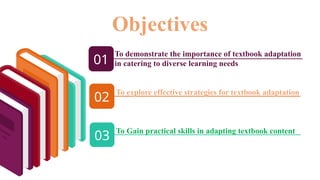
Objectives
01
To Gain practicalskills in adapting textbook content
02
03
To demonstrate the importance of textbook adaptation
in catering to diverse learning needs
To explore effective strategies for textbook adaptation
3.
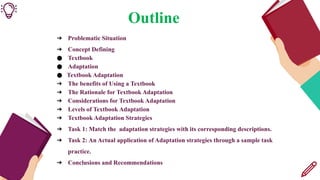
Outline
➔ Problematic Situation
➔Concept Defining
● Textbook
● Adaptation
● Textbook Adaptation
➔ The benefits of Using a Textbook
➔ The Rationale for Textbook Adaptation
➔ Considerations for Textbook Adaptation
➔ Levels of Textbook Adaptation
➔ Textbook Adaptation Strategies
➔ Task 1: Match the adaptation strategies with its corresponding descriptions.
➔ Task 2: An Actual application of Adaptation strategies through a sample task
practice.
➔ Conclusions and Recommendations
4.
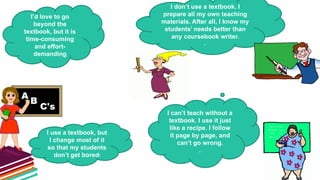
I can’t teachwithout a
textbook. I use it just
like a recipe. I follow
it page by page, and
can’t go wrong.
.
I don’t use a textbook. I
prepare all my own teaching
materials. After all, I know my
students’ needs better than
any coursebook writer.
.
I use a textbook, but
I change most of it
so that my students
don’t get bored!
I’d love to go
beyond the
textbook, but it is
time-consuming
and effort-
demanding
5.
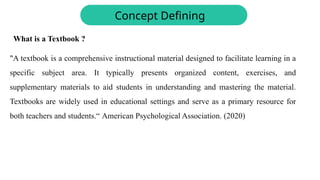
Concept Defining
"A textbookis a comprehensive instructional material designed to facilitate learning in a
specific subject area. It typically presents organized content, exercises, and
supplementary materials to aid students in understanding and mastering the material.
Textbooks are widely used in educational settings and serve as a primary resource for
both teachers and students.“ American Psychological Association. (2020)
What is a Textbook ?
6.
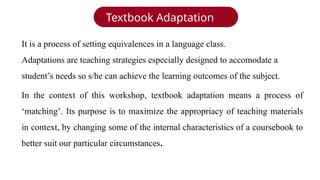
Textbook Adaptation
In thecontext of this workshop, textbook adaptation means a process of
‘matching’. Its purpose is to maximize the appropriacy of teaching materials
in context, by changing some of the internal characteristics of a coursebook to
better suit our particular circumstances.
It is a process of setting equivalences in a language class.
Adaptations are teaching strategies especially designed to accomodate a
student’s needs so s/he can achieve the learning outcomes of the subject.
7.
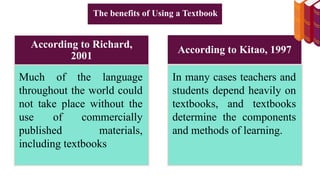
According to Richard,
2001
Muchof the language
throughout the world could
not take place without the
use of commercially
published materials,
including textbooks
According to Kitao, 1997
In many cases teachers and
students depend heavily on
textbooks, and textbooks
determine the components
and methods of learning.
The benefits of Using a Textbook
8.
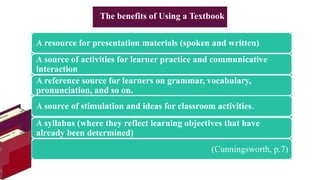
A resource forpresentation materials (spoken and written)
A source of activities for learner practice and communicative
interaction
A reference source for learners on grammar, vocabulary,
pronunciation, and so on.
A source of stimulation and ideas for classroom activities.
A syllabus (where they reflect learning objectives that have
already been determined)
(Cunningsworth, p.7)
The benefits of Using a Textbook
9.
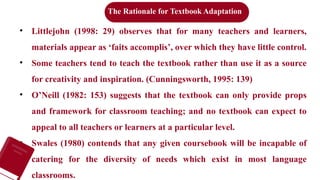
• Littlejohn (1998:29) observes that for many teachers and learners,
materials appear as ‘faits accomplis’, over which they have little control.
• Some teachers tend to teach the textbook rather than use it as a source
for creativity and inspiration. (Cunningsworth, 1995: 139)
• O’Neill (1982: 153) suggests that the textbook can only provide props
and framework for classroom teaching; and no textbook can expect to
appeal to all teachers or learners at a particular level.
• Swales (1980) contends that any given coursebook will be incapable of
catering for the diversity of needs which exist in most language
classrooms.
The Rationale for Textbook Adaptation
10.
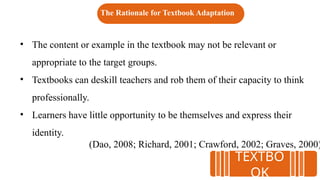
• The contentor example in the textbook may not be relevant or
appropriate to the target groups.
• Textbooks can deskill teachers and rob them of their capacity to think
professionally.
• Learners have little opportunity to be themselves and express their
identity.
(Dao, 2008; Richard, 2001; Crawford, 2002; Graves, 2000)
The Rationale for Textbook Adaptation
TEXTBO
OK
11.
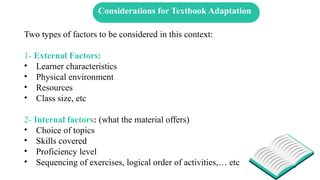
Considerations for TextbookAdaptation
Two types of factors to be considered in this context:
1- External Factors:
• Learner characteristics
• Physical environment
• Resources
• Class size, etc
2- Internal factors: (what the material offers)
• Choice of topics
• Skills covered
• Proficiency level
• Sequencing of exercises, logical order of activities,… etc
12.
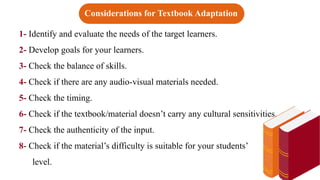
1- Identify andevaluate the needs of the target learners.
2- Develop goals for your learners.
3- Check the balance of skills.
4- Check if there are any audio-visual materials needed.
5- Check the timing.
6- Check if the textbook/material doesn’t carry any cultural sensitivities.
7- Check the authenticity of the input.
8- Check if the material’s difficulty is suitable for your students’
level.
Considerations for Textbook Adaptation
13.
Considerations for TextbookAdaptation
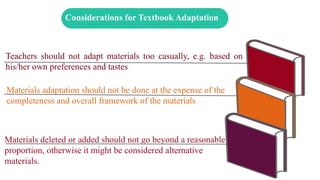
Materials deleted or added should not go beyond a reasonable
proportion, otherwise it might be considered alternative
materials.
Materials adaptation should not be done at the expense of the
completeness and overall framework of the materials.
Teachers should not adapt materials too casually, e.g. based on
his/her own preferences and tastes.
14.
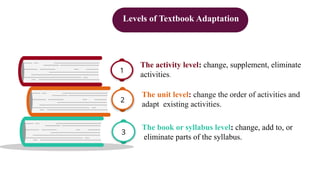
1
2
3
The book orsyllabus level: change, add to, or
eliminate parts of the syllabus.
The activity level: change, supplement, eliminate
activities.
The unit level: change the order of activities and
adapt existing activities.
Levels of Textbook Adaptation
15.
Levels of Adaptation
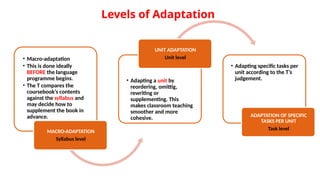
•Macro-adaptation
• This is done ideally
BEFORE the language
programme begins.
• The T compares the
coursebook’s contents
against the syllabus and
may decide how to
supplement the book in
advance.
MACRO-ADAPTATION
Syllabus level
• Adapting a unit by
reordering, omittig,
rewriting or
supplementing. This
makes classroom teaching
smoother and more
cohesive.
UNIT ADAPTATION
Unit level
• Adapting specific tasks per
unit according to the T’s
judgement.
ADAPTATION OF SPECIFIC
TASKS PER UNIT
Task level
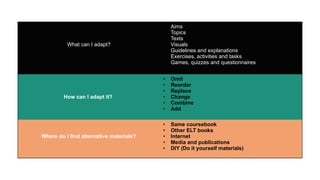
What can Iadapt?
• Aims
• Topics
• Texts
• Visuals
• Guidelines and explanations
• Exercises, activities and tasks
• Games, quizzes and questionnaires
How can I adapt it?
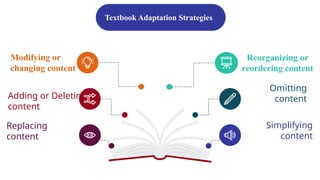
• Omit
• Reorder
• Replace
• Change
• Combine
• Add
Where do I find alternative materials?
• Same coursebook
• Other ELT books
• Internet
• Media and publications
• DIY (Do it yourself materials)
18.
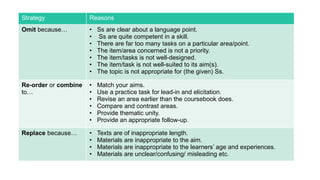
Strategy Reasons
Omit because…• Ss are clear about a language point.
• Ss are quite competent in a skill.
• There are far too many tasks on a particular area/point.
• The item/area concerned is not a priority.
• The item/tasks is not well-designed.
• The item/task is not well-suited to its aim(s).
• The topic is not appropriate for (the given) Ss.
Re-order or combine
to…
• Match your aims.
• Use a practice task for lead-in and elicitation.
• Revise an area earlier than the coursebook does.
• Compare and contrast areas.
• Provide thematic unity.
• Provide an appropriate follow-up.
Replace because… • Texts are of inappropriate length.
• Materials are inappropriate to the aim.
• Materials are inappropriate to the learners’ age and experiences.
• Materials are unclear/confusing/ misleading etc.
19.
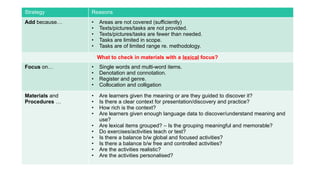
Strategy Reasons
Add because…• Areas are not covered (sufficiently)
• Texts/pictures/tasks are not provided.
• Texts/pictures/tasks are fewer than needed.
• Tasks are limited in scope.
• Tasks are of limited range re. methodology.
What to check in materials with a lexical focus?
Focus on… • Single words and multi-word items.
• Denotation and connotation.
• Register and genre.
• Collocation and colligation
Materials and
Procedures …
• Are learners given the meaning or are they guided to discover it?
• Is there a clear context for presentation/discovery and practice?
• How rich is the context?
• Are learners given enough language data to discover/understand meaning and
use?
• Are lexical items grouped? – Is the grouping meaningful and memorable?
• Do exercises/activities teach or test?
• Is there a balance b/w global and focused activities?
• Is there a balance b/w free and controlled activities?
• Are the activities realistic?
• Are the activities personalised?
20.
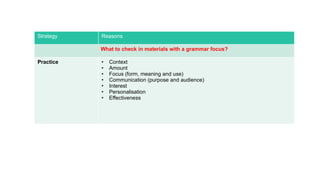
Strategy Reasons
What tocheck in materials with a grammar focus?
Practice • Context
• Amount
• Focus (form, meaning and use)
• Communication (purpose and audience)
• Interest
• Personalisation
• Effectiveness
21.
Adaptation can onlybe carried out effectively if it develops from
an understanding of the possible design features of syllabuses and
materials.
Every teacher feels the need for some individuality and freedom.
We have our own personalities. We all know that every class is
different. Hence the same lesson almost always has to be taught
differently to different classes. Even so, it is very difficult for
most of us to teach systematically without a testbook.
Conclusions and Recommendations




![Planning and Managing End-of-Unit Integration Activitiesraw[1][1] (1)[2].pptx](https://cdn.slidesharecdn.com/ss_thumbnails/planningandmanagingend-of-unitintegrationactivitiesraw1112-240516203341-0a8ad377-thumbnail.jpg?width=640&height=640&fit=bounds)


