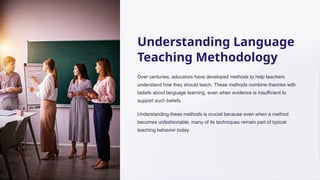
Understanding Language
Teaching Methodology
Over centuries, educators have developed methods to help teachers
understand how they should teach. These methods combine theories with
beliefs about language learning, even when evidence is insufficient to
support such beliefs.
Understanding these methods is crucial because even when a method
becomes unfashionable, many of its techniques remain part of typical
teaching behavior today.
Defining Key Terms
Approach
Theories about language nature and learning that
provide reasons for classroom activities and how
they're done.
Method
The practical classroom realization of an approach,
including various procedures and techniques.
Procedure
An ordered sequence of techniques, described as
"First you do this, then you do that..."
Technique
A single activity rather than a sequence, like silent
viewing or finger technique.
Three and a Half Methods
1
Grammar-Translation
Students received grammar explanations in
their native language and translated sentences
between languages. Focus was on accuracy at
sentence level with little context.
2 Direct Method
Translation abandoned in favor of
teacher-student interaction. Grammar
learned inductively through exposure.
Only target language used in classroom.
3
Audiolingualism
Used stimulus-response-reinforcement
model with drills to form language habits.
Aimed to banish mistakes through
constant repetition.
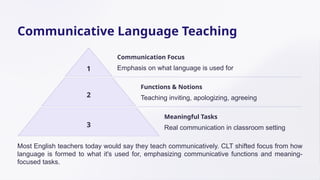
Communicative Language Teaching
1
Communication Focus
Emphasis on what language is used for
2
Functions & Notions
Teaching inviting, apologizing, agreeing
3
Meaningful Tasks
Real communication in classroom setting
Most English teachers today would say they teach communicatively. CLT shifted focus from how
language is formed to what it's used for, emphasizing communicative functions and meaning-
focused tasks.
Teaching Unplugged: Dogme ELT
Conversation-Driven
Interactive talk drives
classroom procedures
between students and with
the teacher.
1
Materials-Light
Teachers respond to
students' needs rather than
using pre-packaged
materials like coursebooks.
Emergent Language
Focus on language that
emerges naturally rather
than following a prescribed
syllabus.
3
Task-Based Learning
Pre-Task
Teacher explores topic, highlights useful words, helps students
understand instructions.
Task Cycle
Students perform task in pairs/groups, plan how to report,
then present results.
Language Focus
Students examine specific language features the task has provoked.
Task-based learning makes meaningful tasks central to the learning process.
It's informed by the belief that focusing on task completion is as effective for
language learning as focusing on language forms.
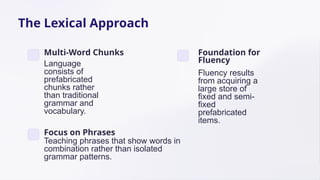
The Lexical Approach
Multi-Word Chunks
Language
consists of
prefabricated
chunks rather
than traditional
grammar and
vocabulary.
Foundation for
Fluency
Fluency results
from acquiring a
large store of
fixed and semi-
fixed
prefabricated
items.
Focus on Phrases
Teaching phrases that show words in
combination rather than isolated
grammar patterns.
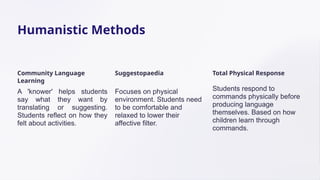
Humanistic Methods
Community Language
Learning
A 'knower' helps students
say what they want by
translating or suggesting.
Students reflect on how they
felt about activities.
Suggestopaedia
Focuses on physical
environment. Students need
to be comfortable and
relaxed to lower their
affective filter.
Total Physical Response
Students respond to
commands physically before
producing language
themselves. Based on how
children learn through
commands.
The PPP Procedure
Presentation
Teacher introduces a situation
contextualizing the language,
models it, and explains form
and meaning.
Practice
Students practice using
accurate reproduction
techniques like choral
repetition, individual repetition,
and controlled drills.
Production
Students use the new
language to make sentences
of their own, often through
personalization activities.
Despite criticisms that PPP is too teacher-centered and assumes linear learning, it remains widely used, especially at lower levels for teaching
certain language points.
a) To what extent does reliance on a coursebook support or hinder the development
of communicative competence in real-world contexts?
Does it encourage authentic language use, or does it promote formulaic and
decontextualized learning?
b) How do coursebooks reflect (or fail to reflect) diverse cultural perspectives and
learner identities?
Whose voices and experiences are centered, and whose are marginalized or absent?
c) Can a standardized coursebook truly meet the needs of a diverse classroom with
varying linguistic, cultural, and learning backgrounds?
How can teachers adapt or supplement coursebooks to foster learner-centered
pedagogy?
d) What power dynamics are at play in the production, selection, and use of
coursebooks in foreign language education?
Who decides what content is valuable, and how might this influence classroom
practices and learner agency?
The Coursebook Debate
Arguments For
• Coherent syllabus with language control
• Attractive presentation and materials
• Useful reference for students
• Helpful teacher's guides
Arguments Against
• Imposes learning styles
• Stifles teacher creativity
• Often bland to avoid offense
• Unrelenting format becomes boring
Using Coursebooks Effectively
Omit
Skip material that's inappropriate or unnecessary for your students.
Replace
Substitute coursebook sections with your own preferred materials.
Adapt
Modify existing content to better suit your teaching context.
Add
Supplement with additional activities to enhance learning.
Creative Adaptation Ideas
Dramatize
Students act out dialogues as
different characters or with varied
emotions.
Expand
Extend dialogues and texts to make them more engaging.
Research
Students find related content online to supplement topics.
Randomize
Extract random words from texts for creative language activities.
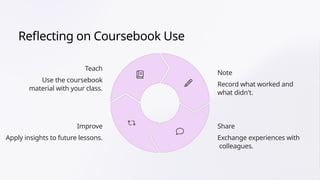
Reflecting on Coursebook Use
Teach
Use the coursebook
material with your class.
Note
Record what worked and
what didn't.
Share
Exchange experiences with
colleagues.
Improve
Apply insights to future lessons.
Choosing the Right
Coursebook
Practical Considerations
• Price and availability
• Layout and ease of use
• Clear instructions
Content Evaluation
• Appropriate methodology
• Suitable syllabus
• Engaging topics
Support Features
• Quality of teacher's guide
• Digital components
• Technical support
Designing Your Own Materials
Set clear objectives
Define exactly what students will achieve.
Consider time investment
Ensure preparation time justifies classroom benefits.
Plan for reusability
Create materials that can be used multiple times.
Enduring Fundamentals
Productive Practice
Meaningful language use in authentic contexts
Collaboration
Learning through interaction with others
Teacher Guidance
Expert facilitation of the learning process
Motivation
The fundamental drive to learn
Key Takeaways
Balance is key
Use coursebooks as
resources, not
constraints.
Be creative
Adapt materials to
suit your unique
teaching context.
Reflect
regularly
Continuously
evaluate and improve
your approach.
Embrace
change
Stay open to new
technologies while
preserving core
principles.
Understanding language teaching methodology

  • 1.
    Understanding Language Teaching Methodology Overcenturies, educators have developed methods to help teachers understand how they should teach. These methods combine theories with beliefs about language learning, even when evidence is insufficient to support such beliefs. Understanding these methods is crucial because even when a method becomes unfashionable, many of its techniques remain part of typical teaching behavior today.
  • 2.
    Defining Key Terms Approach Theoriesabout language nature and learning that provide reasons for classroom activities and how they're done. Method The practical classroom realization of an approach, including various procedures and techniques. Procedure An ordered sequence of techniques, described as "First you do this, then you do that..." Technique A single activity rather than a sequence, like silent viewing or finger technique.
  • 3.
    Three and aHalf Methods 1 Grammar-Translation Students received grammar explanations in their native language and translated sentences between languages. Focus was on accuracy at sentence level with little context. 2 Direct Method Translation abandoned in favor of teacher-student interaction. Grammar learned inductively through exposure. Only target language used in classroom. 3 Audiolingualism Used stimulus-response-reinforcement model with drills to form language habits. Aimed to banish mistakes through constant repetition.
  • 4.
    Communicative Language Teaching 1 CommunicationFocus Emphasis on what language is used for 2 Functions & Notions Teaching inviting, apologizing, agreeing 3 Meaningful Tasks Real communication in classroom setting Most English teachers today would say they teach communicatively. CLT shifted focus from how language is formed to what it's used for, emphasizing communicative functions and meaning- focused tasks.
  • 5.
    Teaching Unplugged: DogmeELT Conversation-Driven Interactive talk drives classroom procedures between students and with the teacher. 1 Materials-Light Teachers respond to students' needs rather than using pre-packaged materials like coursebooks. Emergent Language Focus on language that emerges naturally rather than following a prescribed syllabus. 3
  • 6.
    Task-Based Learning Pre-Task Teacher explorestopic, highlights useful words, helps students understand instructions. Task Cycle Students perform task in pairs/groups, plan how to report, then present results. Language Focus Students examine specific language features the task has provoked. Task-based learning makes meaningful tasks central to the learning process. It's informed by the belief that focusing on task completion is as effective for language learning as focusing on language forms.
  • 7.
    The Lexical Approach Multi-WordChunks Language consists of prefabricated chunks rather than traditional grammar and vocabulary. Foundation for Fluency Fluency results from acquiring a large store of fixed and semi- fixed prefabricated items. Focus on Phrases Teaching phrases that show words in combination rather than isolated grammar patterns.
  • 8.
    Humanistic Methods Community Language Learning A'knower' helps students say what they want by translating or suggesting. Students reflect on how they felt about activities. Suggestopaedia Focuses on physical environment. Students need to be comfortable and relaxed to lower their affective filter. Total Physical Response Students respond to commands physically before producing language themselves. Based on how children learn through commands.
  • 9.
    The PPP Procedure Presentation Teacherintroduces a situation contextualizing the language, models it, and explains form and meaning. Practice Students practice using accurate reproduction techniques like choral repetition, individual repetition, and controlled drills. Production Students use the new language to make sentences of their own, often through personalization activities. Despite criticisms that PPP is too teacher-centered and assumes linear learning, it remains widely used, especially at lower levels for teaching certain language points.
  • 10.
    a) To whatextent does reliance on a coursebook support or hinder the development of communicative competence in real-world contexts? Does it encourage authentic language use, or does it promote formulaic and decontextualized learning? b) How do coursebooks reflect (or fail to reflect) diverse cultural perspectives and learner identities? Whose voices and experiences are centered, and whose are marginalized or absent? c) Can a standardized coursebook truly meet the needs of a diverse classroom with varying linguistic, cultural, and learning backgrounds? How can teachers adapt or supplement coursebooks to foster learner-centered pedagogy? d) What power dynamics are at play in the production, selection, and use of coursebooks in foreign language education? Who decides what content is valuable, and how might this influence classroom practices and learner agency?
  • 11.
    The Coursebook Debate ArgumentsFor • Coherent syllabus with language control • Attractive presentation and materials • Useful reference for students • Helpful teacher's guides Arguments Against • Imposes learning styles • Stifles teacher creativity • Often bland to avoid offense • Unrelenting format becomes boring
  • 12.
    Using Coursebooks Effectively Omit Skipmaterial that's inappropriate or unnecessary for your students. Replace Substitute coursebook sections with your own preferred materials. Adapt Modify existing content to better suit your teaching context. Add Supplement with additional activities to enhance learning.
  • 13.
    Creative Adaptation Ideas Dramatize Studentsact out dialogues as different characters or with varied emotions. Expand Extend dialogues and texts to make them more engaging. Research Students find related content online to supplement topics. Randomize Extract random words from texts for creative language activities.
  • 14.
    Reflecting on CoursebookUse Teach Use the coursebook material with your class. Note Record what worked and what didn't. Share Exchange experiences with colleagues. Improve Apply insights to future lessons.
  • 15.
    Choosing the Right Coursebook PracticalConsiderations • Price and availability • Layout and ease of use • Clear instructions Content Evaluation • Appropriate methodology • Suitable syllabus • Engaging topics Support Features • Quality of teacher's guide • Digital components • Technical support
  • 16.
    Designing Your OwnMaterials Set clear objectives Define exactly what students will achieve. Consider time investment Ensure preparation time justifies classroom benefits. Plan for reusability Create materials that can be used multiple times.
  • 17.
    Enduring Fundamentals Productive Practice Meaningfullanguage use in authentic contexts Collaboration Learning through interaction with others Teacher Guidance Expert facilitation of the learning process Motivation The fundamental drive to learn
  • 18.
    Key Takeaways Balance iskey Use coursebooks as resources, not constraints. Be creative Adapt materials to suit your unique teaching context. Reflect regularly Continuously evaluate and improve your approach. Embrace change Stay open to new technologies while preserving core principles.