CLINICAL CASE PRESENTATION
By: Smriti Ranjan & Snehashish mishra
3–5 days following a bullet injury, a person
developed trismus followed by muscle pain
and stiffness, back pain, and difficulty in
swallowing. Excised tissue bits from the
necrotic depths of the wound revealed
gram-positive bacilli with terminal and
spherical spores
Case
Q: What is the probable diagnosis of this clinical condition?
‘TETANUS’
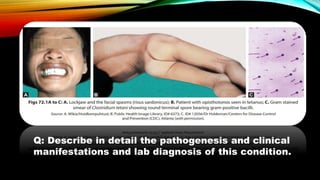
Clostridium tetani is an obligate anaerobic, gram
positive bacillus with terminal round spore (drum stick
appearance).
™
It is the causative agent of ‘tetanus’—an acute disease,
manifested by skeletal muscle spasm and autonomic
nervous system disturbance
Q: Describe in detail the pathogenesis and clinical
manifestations and lab diagnosis of this condition.
PATHOGENESIS
Virulence Factors
Clostridium tetani produces two exotoxins—tetanolysin and
tetanospasmin.
1.Tetanolysin: It is a hemolysin, has no role in the pathogenesis of
tetanus
2. Tetanospasmin (or tetanus toxin): It is a neurotoxin responsible
for the disease manifestations
It is antigenic and is specifically neutralized by its antitoxin
It gets toxoided spontaneously or by formaldehyde. The toxoid
form is antigenic, but loses its virulence property, hence, it is
used for vaccine preparation
Tetanus toxin is plasmid coded
CLINICAL MANIFESTATION
 The incubation period is about 6–10 days. Shorter the incubation
period, graver is the prognosis. Muscles of the face and jaw are
often affected first (due to shorter distances for the toxin to reach
the presynaptic terminals).
First symptom: Increase in the masseter tone leading to trismus or
lockjaw, followed by muscle pain and stiffness, back pain, and
difficulty in swallowing.
In neonates, difficulty in feeding is the initial presentation
As the disease progresses, painful muscle spasm develops
which may be:
 Localized: Involves the affected limb
 Generalized painful muscle spasm → leads to descending
spastic paralysis.
 Hands, feet are spared and mentation is unimpaired. Deep
tendon reflexes are exaggerated
 Autonomic disturbance is maximal during the second week
of severe tetanus-characterized by low or high blood
pressure, tachycardia, intestinal stasis, sweating, increased
tracheal secretions and acute renal failure.
 Treatment should be started immediately based on clinical
diagnosis.
 Laboratory diagnosis provides supportive evidence for
confirmation.
Specimen
Excised tissue bits from the necrotic depths of wounds are more
reliable than wound swabs.
Gram Staining
Gram staining reveals gram-positive bacilli with terminal and round
spores (drum stick appearance)
However, microscopy alone is unreliable as it cannot distinguish C. tetani from
morphologically similar non- pathogenic clostridia like C. tetanomorphum and C.
sphenoides.
LAB DIAGNOSIS
Culture
Culture is more reliable than microscopy
Robertson cooked meat broth: C. tetani, being proteo- lytic turns
the meat particles black and produces foul odor
Blood agar with polymyxin B: These plates are incubated at 37°C
for 24–48 hours under anaerobic condition. C. tetani produces
characteristic swarming growth.
Toxigenicity Test
As pathogenesis of tetanus is toxin mediated, the association of
the isolated organism can only be established when its toxin
production is demonstrated. Toxin assay can be performed by in
vivo mouse inoculation test on specimens such as serum and
urine.
Q: Add a note on vaccination to prevent this condition.
Passive immunization (tetanus immunoglobulin) It is the treatment
of choice for tetanus.
Two preparations are available:
1. HTIG (Human tetanus immunoglobulin), prepared in Serum
Institute of India, Pune
2. ATS (Antitetanus serum, equine derived)
Dosage: 250 IU of HTIG or 1,500 IU of ATS is given as a single IM
dose. Intrathecal route is more effective
Duration of protection: Effect of HTIG and ATS last for 30 days and
7–10 days respectively
HTIG is preferred over ATS as the latter is associated with side effects such as
serum sickness and anaphylactoid reactions.
VACCINATION
Active Immunization (Vaccine)
It is the most effective method of prophylaxis.
Tetanus toxoid (TT) is commonly used for active immunization.
It is available either as:
Monovalent vaccine: Tetanus toxoid is (TT) is prepared by incubating
toxin with formalin to become toxoid and then adsorbed on to alum
Combined vaccine:
 DPT vaccine (consists of diphtheria toxoid, pertussis whole cell
killed preparation and tetanus toxoid)
 Td vaccine (tetanus toxoid and adult diphtheria toxoid)
 Pentavalent vaccine (DPT, hepatitis B and Hib)
Combined Immunization
(Both active and passive immunization):
In nonvaccinated person, it is ideal to immunize with first dose of
tetanus toxoid (TT) vaccine in one arm along with administration
of ATS or HTIG in another arm, followed by a complete course of
TT vaccine
Primary immunization of children:
Tetanus toxoid is given under National Immunization Schedule of
India. Total ‘seven doses’ are given—
 Three doses of pentavalent vaccine at 6, 10 and 14 weeks of birth,
followed by
 Two booster doses of DPT at 16–24
Adult immunization:
If primary immunization is not administered in childhood, then adults
can be immunized with Td (tetanus toxoid and adult diphtheria toxoid)
Site: Tetanus vaccine is given by deep intramuscular route at
anterolateral aspect of thigh (children) and in deltoid (adults)
Protective titer: Persons are said to be protected if tetanus antitoxin
titre is ≥0.01 IU/mL.
1. The most effective way of preventing tetanus:
a. Hyperbaric oxygen
b. Antibiotics
c. Tetanus toxoid
d. Surgical debridement and toilet
2. Spore with drum stick appearance is produced by:
a. C. bifermentans
b. C. perfringens
c. C. tetani
d. C. tertium
MCQ
3. A 32-year-old male has got clean wound without
laceration. he had a booster dose of TT 6 years back. what
is next line of management?
a. Wound care with single dose of tetanus toxoid
b. Wound care with human tetanus Ig with tetanus toxoid
single dose
c. Wound care with complete course of tetanus toxoid
d. Wound care with no immunization
4. A man is presented with trismus with opisthotonus position.
The probable causative agent is:
a. Clostridium tetani
b. Clostridium perfringens
c. Clostridium difficile
d. Clostridium tetanomorphum
5. Mechanism of action of tetanospasmin:
a. Inhibition of GABA release
b. Inhibition cAMP
c. Inactivation of ACh receptors
d. Inhibition of cGM
6. A 25-year-boy is presented with deep injury and abrasions on
the left shoulder, thigh and leg with immunization status
unknown. what is to be given now?
a. DTaP only
b. DTaP + Ig
c. Td only
d. Td + Ig
7. A person has received complete immunization against
tetanus 12 years ago. Now he presents with a contaminated
wound with lacerations from an injury sustained 8 hours ago. he
should now be given:
a. Full course of tetanus toxoid
b. Single dose of tetanus toxoid
c. Human Tet globulin
d. Human tetanus globulin and single dose of toxoid
Tetanus Clinical case.pptx

Tetanus Clinical case.pptx

  • 1.
    CLINICAL CASE PRESENTATION By:Smriti Ranjan & Snehashish mishra
  • 2.
    3–5 days followinga bullet injury, a person developed trismus followed by muscle pain and stiffness, back pain, and difficulty in swallowing. Excised tissue bits from the necrotic depths of the wound revealed gram-positive bacilli with terminal and spherical spores Case
  • 3.
    Q: What isthe probable diagnosis of this clinical condition? ‘TETANUS’ Clostridium tetani is an obligate anaerobic, gram positive bacillus with terminal round spore (drum stick appearance). ™ It is the causative agent of ‘tetanus’—an acute disease, manifested by skeletal muscle spasm and autonomic nervous system disturbance
  • 4.
    Q: Describe indetail the pathogenesis and clinical manifestations and lab diagnosis of this condition.
  • 5.
    PATHOGENESIS Virulence Factors Clostridium tetaniproduces two exotoxins—tetanolysin and tetanospasmin. 1.Tetanolysin: It is a hemolysin, has no role in the pathogenesis of tetanus 2. Tetanospasmin (or tetanus toxin): It is a neurotoxin responsible for the disease manifestations It is antigenic and is specifically neutralized by its antitoxin It gets toxoided spontaneously or by formaldehyde. The toxoid form is antigenic, but loses its virulence property, hence, it is used for vaccine preparation Tetanus toxin is plasmid coded
  • 6.
    CLINICAL MANIFESTATION  Theincubation period is about 6–10 days. Shorter the incubation period, graver is the prognosis. Muscles of the face and jaw are often affected first (due to shorter distances for the toxin to reach the presynaptic terminals). First symptom: Increase in the masseter tone leading to trismus or lockjaw, followed by muscle pain and stiffness, back pain, and difficulty in swallowing. In neonates, difficulty in feeding is the initial presentation
  • 7.
    As the diseaseprogresses, painful muscle spasm develops which may be:  Localized: Involves the affected limb  Generalized painful muscle spasm → leads to descending spastic paralysis.  Hands, feet are spared and mentation is unimpaired. Deep tendon reflexes are exaggerated  Autonomic disturbance is maximal during the second week of severe tetanus-characterized by low or high blood pressure, tachycardia, intestinal stasis, sweating, increased tracheal secretions and acute renal failure.
  • 8.
     Treatment shouldbe started immediately based on clinical diagnosis.  Laboratory diagnosis provides supportive evidence for confirmation. Specimen Excised tissue bits from the necrotic depths of wounds are more reliable than wound swabs. Gram Staining Gram staining reveals gram-positive bacilli with terminal and round spores (drum stick appearance) However, microscopy alone is unreliable as it cannot distinguish C. tetani from morphologically similar non- pathogenic clostridia like C. tetanomorphum and C. sphenoides. LAB DIAGNOSIS
  • 9.
    Culture Culture is morereliable than microscopy Robertson cooked meat broth: C. tetani, being proteo- lytic turns the meat particles black and produces foul odor Blood agar with polymyxin B: These plates are incubated at 37°C for 24–48 hours under anaerobic condition. C. tetani produces characteristic swarming growth. Toxigenicity Test As pathogenesis of tetanus is toxin mediated, the association of the isolated organism can only be established when its toxin production is demonstrated. Toxin assay can be performed by in vivo mouse inoculation test on specimens such as serum and urine.
  • 10.
    Q: Add anote on vaccination to prevent this condition.
  • 11.
    Passive immunization (tetanusimmunoglobulin) It is the treatment of choice for tetanus. Two preparations are available: 1. HTIG (Human tetanus immunoglobulin), prepared in Serum Institute of India, Pune 2. ATS (Antitetanus serum, equine derived) Dosage: 250 IU of HTIG or 1,500 IU of ATS is given as a single IM dose. Intrathecal route is more effective Duration of protection: Effect of HTIG and ATS last for 30 days and 7–10 days respectively HTIG is preferred over ATS as the latter is associated with side effects such as serum sickness and anaphylactoid reactions. VACCINATION
  • 12.
    Active Immunization (Vaccine) Itis the most effective method of prophylaxis. Tetanus toxoid (TT) is commonly used for active immunization. It is available either as: Monovalent vaccine: Tetanus toxoid is (TT) is prepared by incubating toxin with formalin to become toxoid and then adsorbed on to alum Combined vaccine:  DPT vaccine (consists of diphtheria toxoid, pertussis whole cell killed preparation and tetanus toxoid)  Td vaccine (tetanus toxoid and adult diphtheria toxoid)  Pentavalent vaccine (DPT, hepatitis B and Hib)
  • 13.
    Combined Immunization (Both activeand passive immunization): In nonvaccinated person, it is ideal to immunize with first dose of tetanus toxoid (TT) vaccine in one arm along with administration of ATS or HTIG in another arm, followed by a complete course of TT vaccine
  • 14.
    Primary immunization ofchildren: Tetanus toxoid is given under National Immunization Schedule of India. Total ‘seven doses’ are given—  Three doses of pentavalent vaccine at 6, 10 and 14 weeks of birth, followed by  Two booster doses of DPT at 16–24 Adult immunization: If primary immunization is not administered in childhood, then adults can be immunized with Td (tetanus toxoid and adult diphtheria toxoid) Site: Tetanus vaccine is given by deep intramuscular route at anterolateral aspect of thigh (children) and in deltoid (adults) Protective titer: Persons are said to be protected if tetanus antitoxin titre is ≥0.01 IU/mL.
  • 15.
    1. The mosteffective way of preventing tetanus: a. Hyperbaric oxygen b. Antibiotics c. Tetanus toxoid d. Surgical debridement and toilet 2. Spore with drum stick appearance is produced by: a. C. bifermentans b. C. perfringens c. C. tetani d. C. tertium MCQ
  • 16.
    3. A 32-year-oldmale has got clean wound without laceration. he had a booster dose of TT 6 years back. what is next line of management? a. Wound care with single dose of tetanus toxoid b. Wound care with human tetanus Ig with tetanus toxoid single dose c. Wound care with complete course of tetanus toxoid d. Wound care with no immunization
  • 17.
    4. A manis presented with trismus with opisthotonus position. The probable causative agent is: a. Clostridium tetani b. Clostridium perfringens c. Clostridium difficile d. Clostridium tetanomorphum 5. Mechanism of action of tetanospasmin: a. Inhibition of GABA release b. Inhibition cAMP c. Inactivation of ACh receptors d. Inhibition of cGM
  • 18.
    6. A 25-year-boyis presented with deep injury and abrasions on the left shoulder, thigh and leg with immunization status unknown. what is to be given now? a. DTaP only b. DTaP + Ig c. Td only d. Td + Ig 7. A person has received complete immunization against tetanus 12 years ago. Now he presents with a contaminated wound with lacerations from an injury sustained 8 hours ago. he should now be given: a. Full course of tetanus toxoid b. Single dose of tetanus toxoid c. Human Tet globulin d. Human tetanus globulin and single dose of toxoid