1
2
3
Tetanus
4
5
6
Leprosy
7
EPIDEMIOLOGY,
PREVENTION & CONTROLOF
TETANUS AND LEPROSY
DEPARTMENT OF COMMUNITY MEDICINE
KIMS, B - 70
8
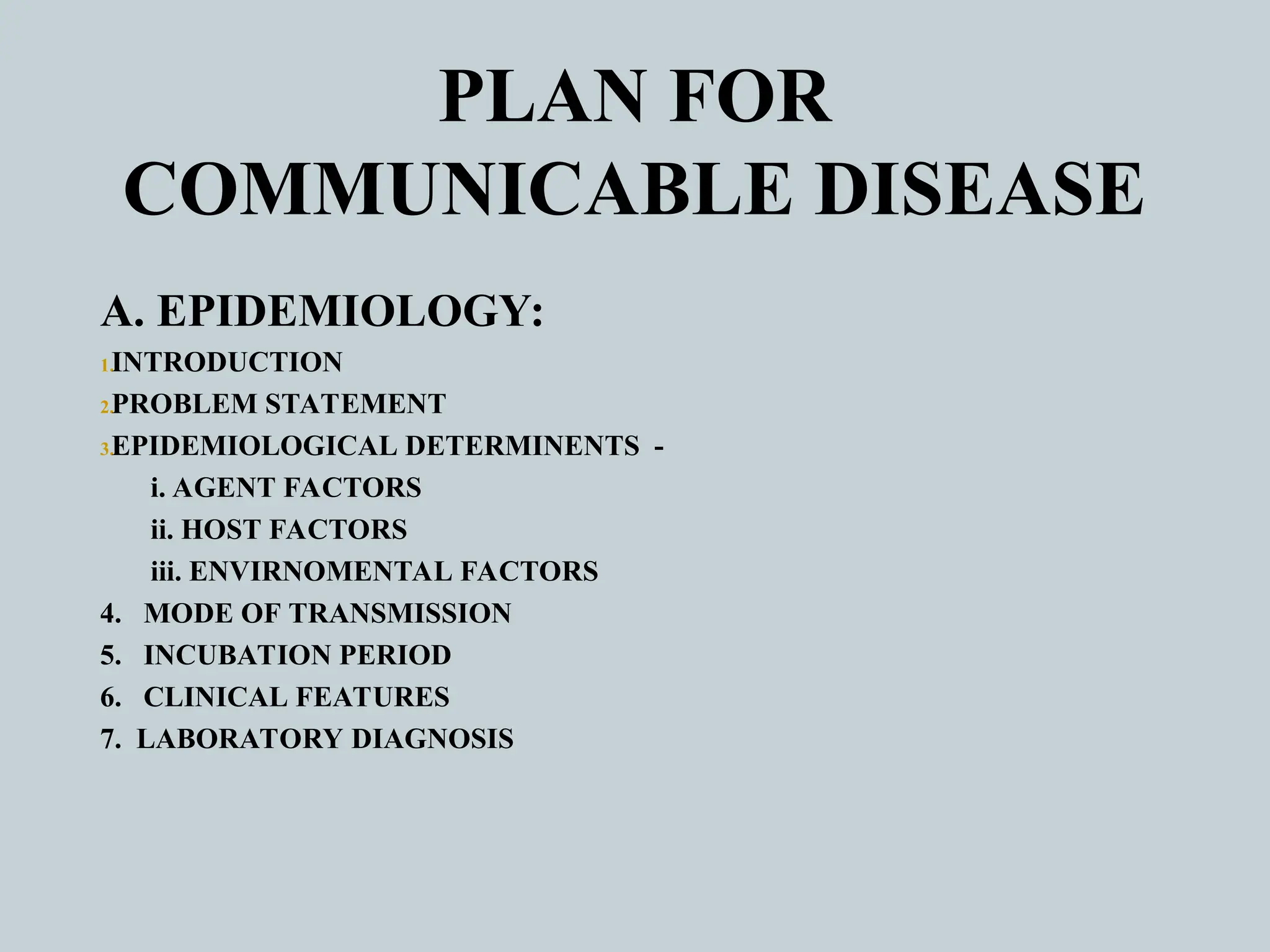
PLAN FOR
COMMUNICABLE DISEASE
A. EPIDEMIOLOGY:
1.INTRODUCTION
2.PROBLEM STATEMENT
3.EPIDEMIOLOGICAL DETERMINENTS -
i. AGENT FACTORS
ii. HOST FACTORS
iii. ENVIRNOMENTAL FACTORS
4. MODE OF TRANSMISSION
5. INCUBATION PERIOD
6. CLINICAL FEATURES
7. LABORATORY DIAGNOSIS
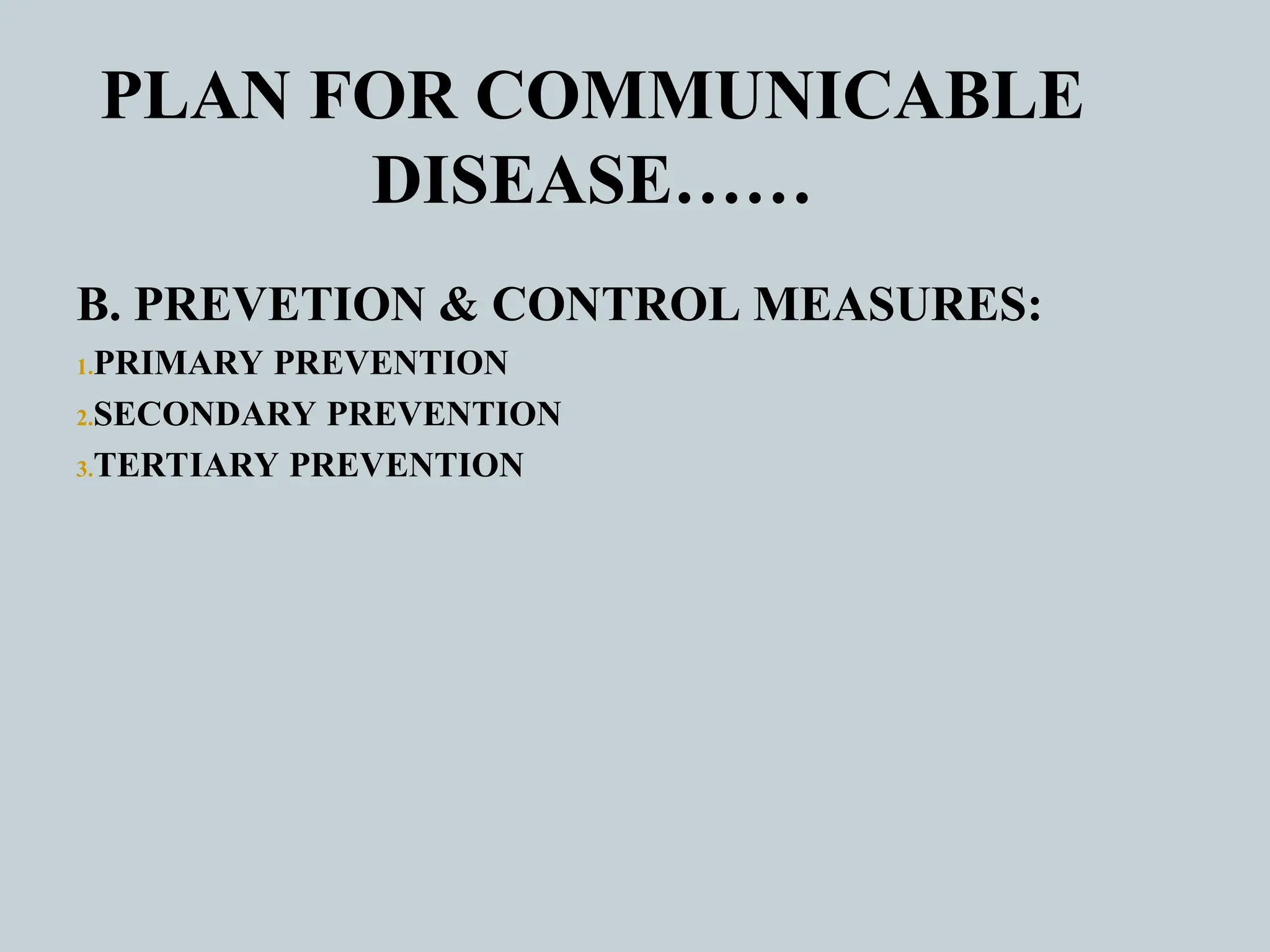
PLAN FOR COMMUNICABLE
DISEASE……
B. PREVETION & CONTROL MEASURES:
1.PRIMARY PREVENTION
2.SECONDARY PREVENTION
3.TERTIARY PREVENTION
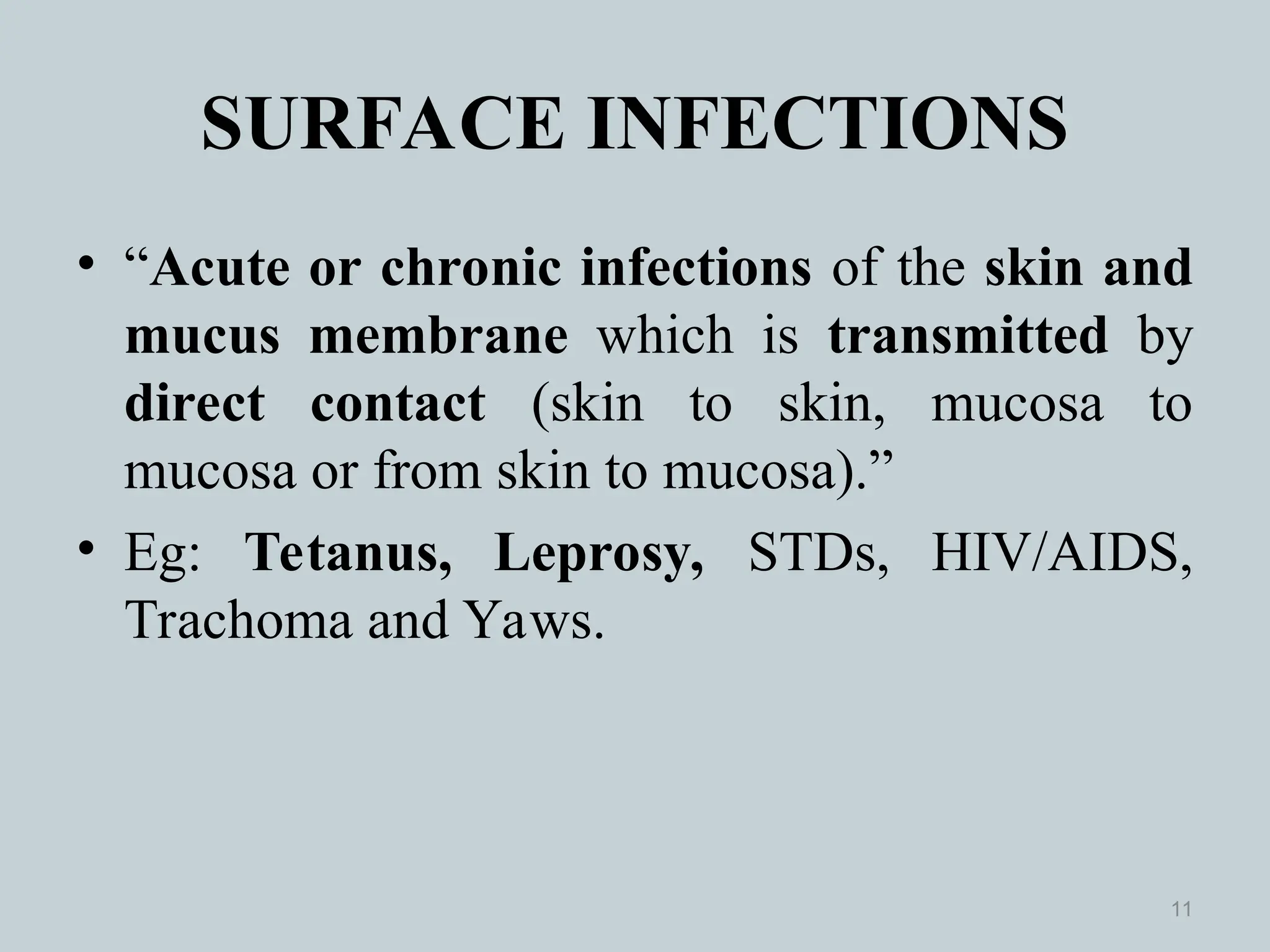
SURFACE INFECTIONS
• “Acute or chronic infections of the skin and
mucus membrane which is transmitted by
direct contact (skin to skin, mucosa to
mucosa or from skin to mucosa).”
• Eg: Tetanus, Leprosy, STDs, HIV/AIDS,
Trachoma and Yaws.
11
TETANUS
12
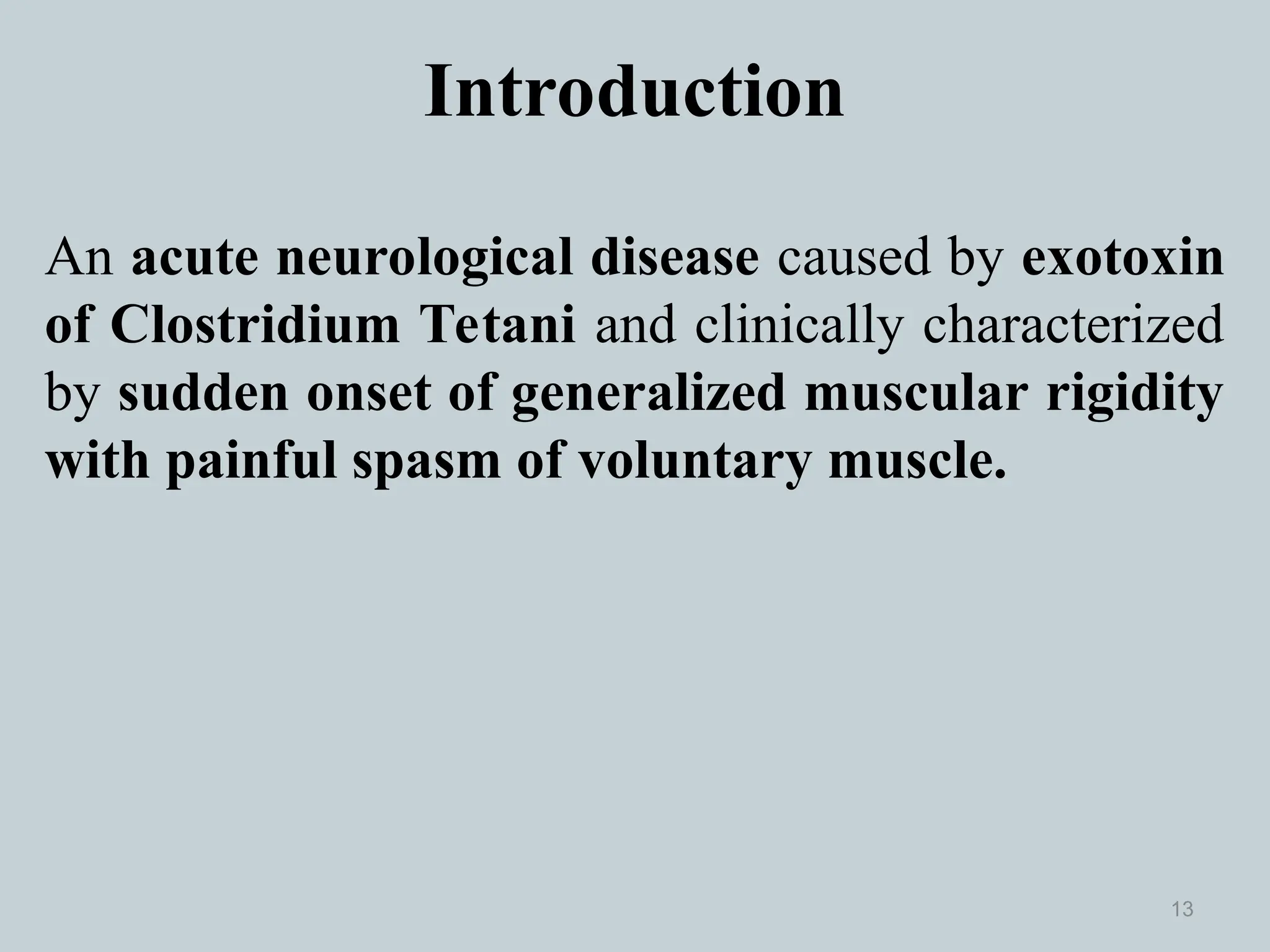
Introduction
An acute neurological disease caused by exotoxin
of Clostridium Tetani and clinically characterized
by sudden onset of generalized muscular rigidity
with painful spasm of voluntary muscle.
13
Problem statement
• WORLD: In 2017 – 56000 cases.
• INDIA: Tetanus is endemic disease in India
and known as “Dhanuvau.”
• In 2017, 4946 cases were reported in India.
• In 2015, India has achieved public health
milestone of Neonatal tetanus (NT)
elimination.
14
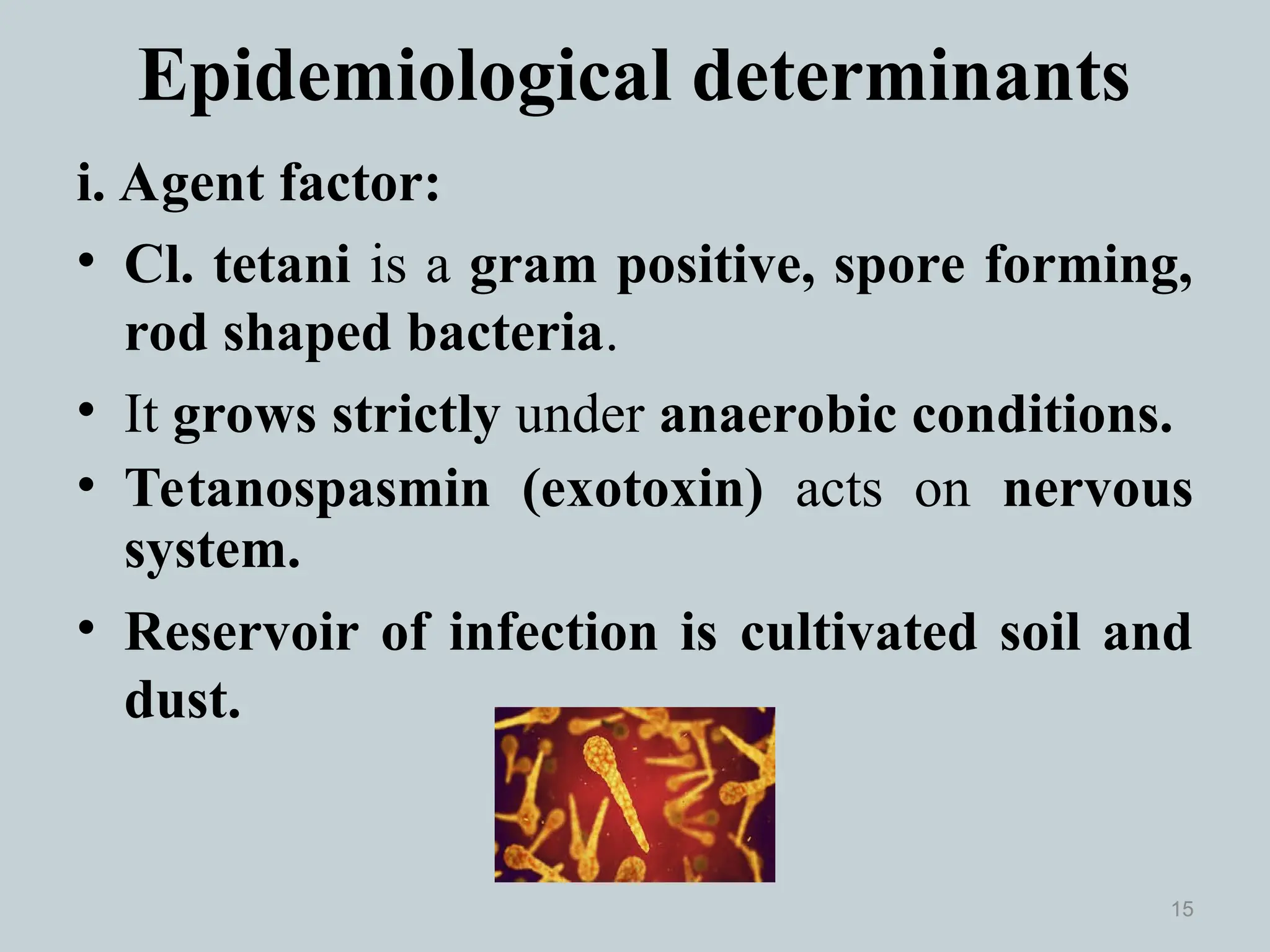
Epidemiological determinants
i. Agent factor:
• Cl. tetani is a gram positive, spore forming,
rod shaped bacteria.
• It grows strictly under anaerobic conditions.
• Tetanospasmin (exotoxin) acts on nervous
system.
• Reservoir of infection is cultivated soil and
dust.
15
Epidemiological determinants
ii. Host factors:
• It occurs in active age group (5 – 40 years).
• Males are more affected than females.
iii. Environmental factors:
• Agricultural environment – use of manured
soil increases the risk of infection.
16
Mode of transmission:
• Direct contact - Injury such as pin prick,
abrasion, punctured wounds, burns, bowel
surgery, dental extraction, otitis media etc.
• Tetanus prone wound (S/N): Any wound
having foreign body (soil and dust), necrotic
tissues, blood clots and super added secondary
bacterial infection.
Incubation period: 3 to 21 days.
17
Clinical types of Tetanus
1. Post-traumatic
2. Post-abortal
3. Puerperal
4. Tetanus neonatarum
5. Otogenic
6. Tetanus after injection
7. Post- operative
8. Idiopathic
18
19
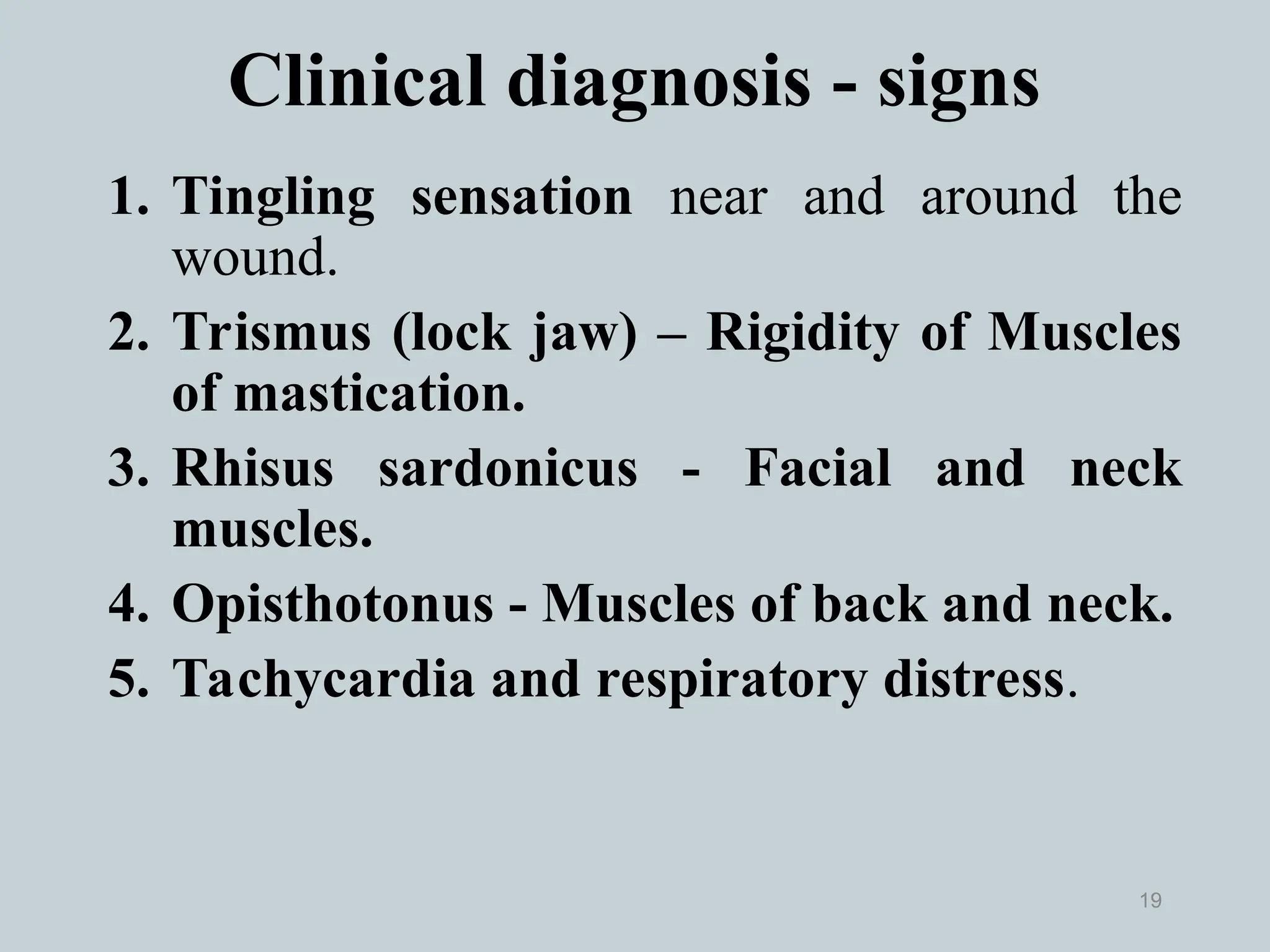
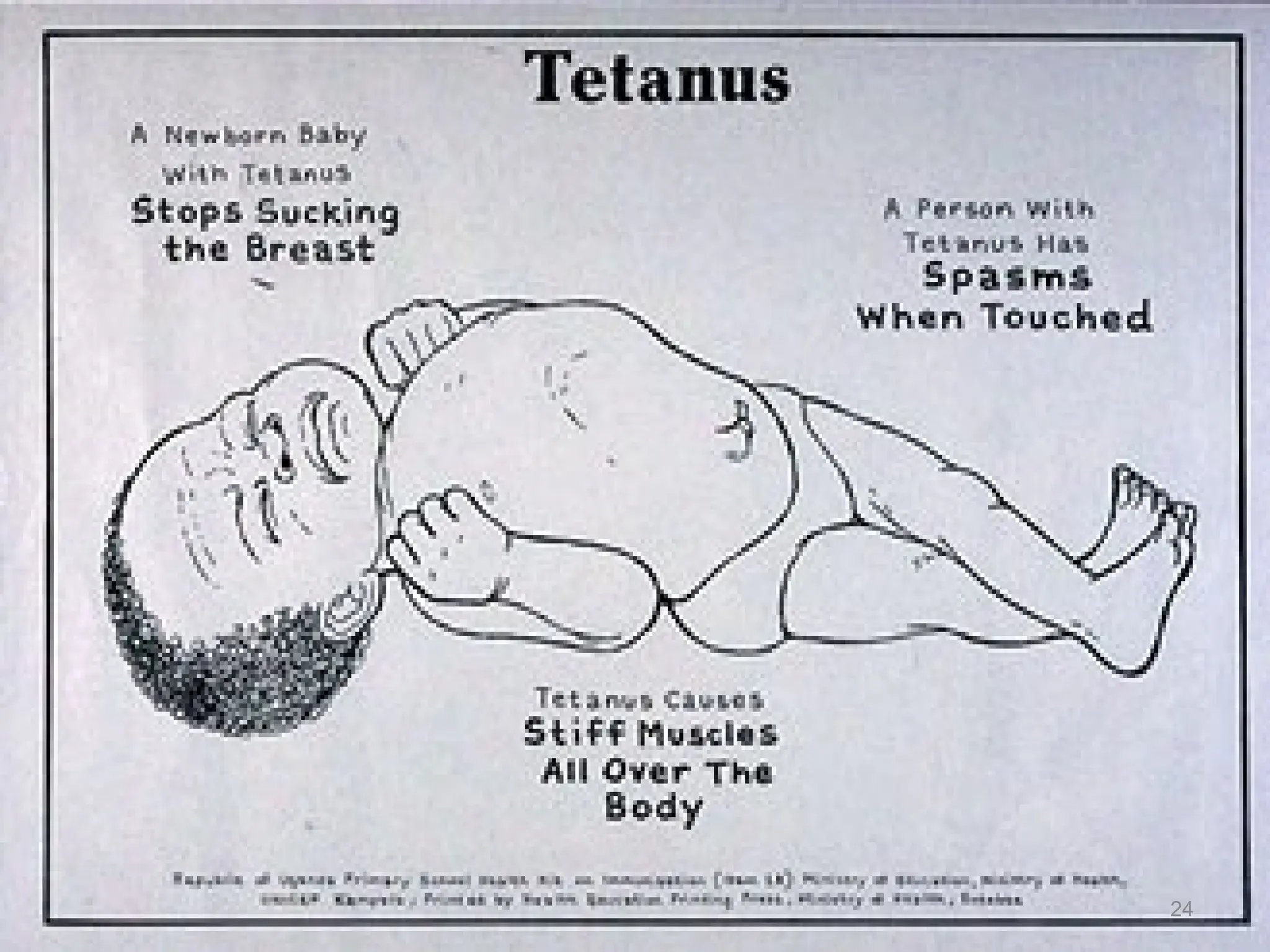
1. Tingling sensation near and around the
wound.
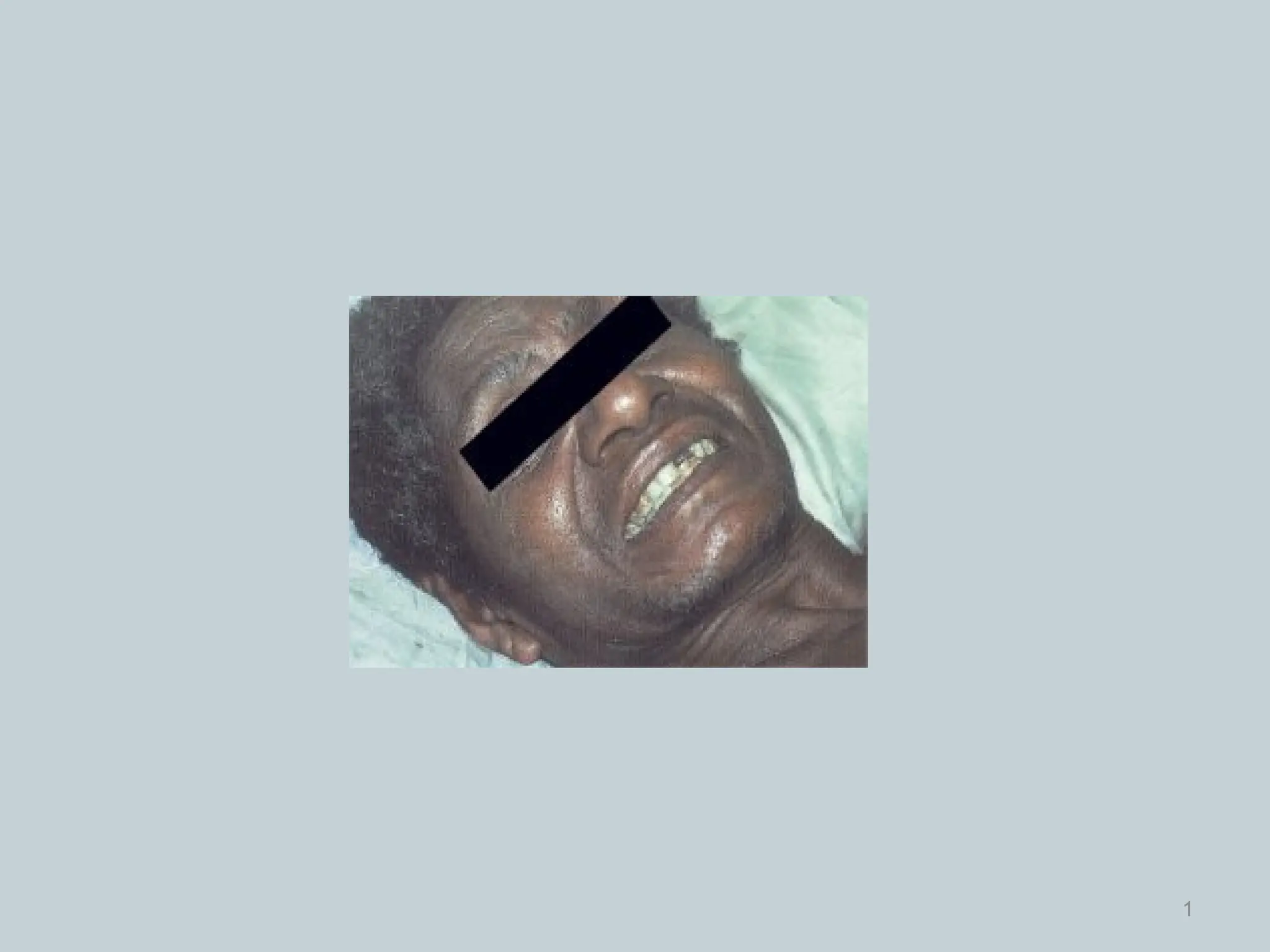
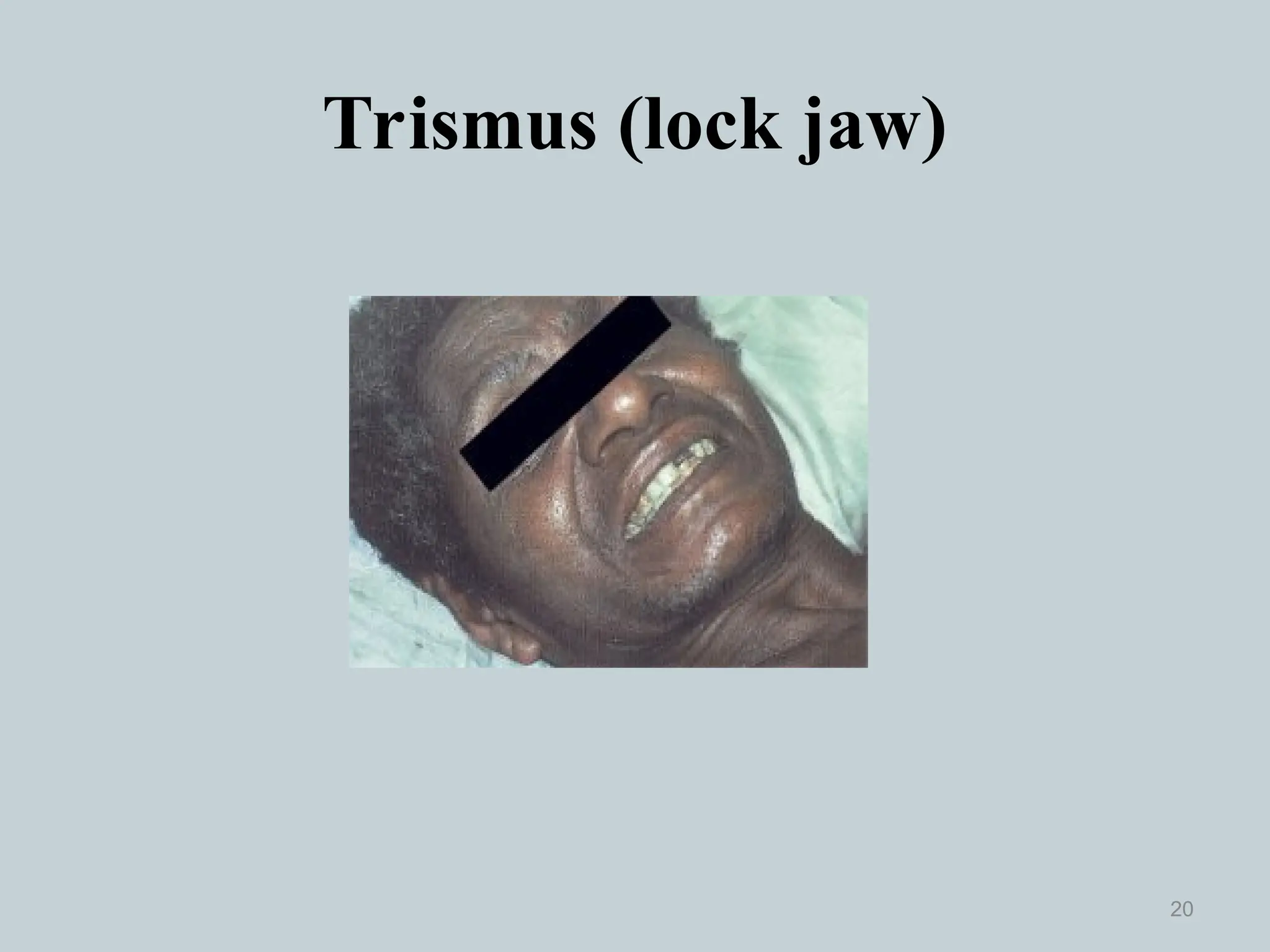
2. Trismus (lock jaw) – Rigidity of Muscles
of mastication.
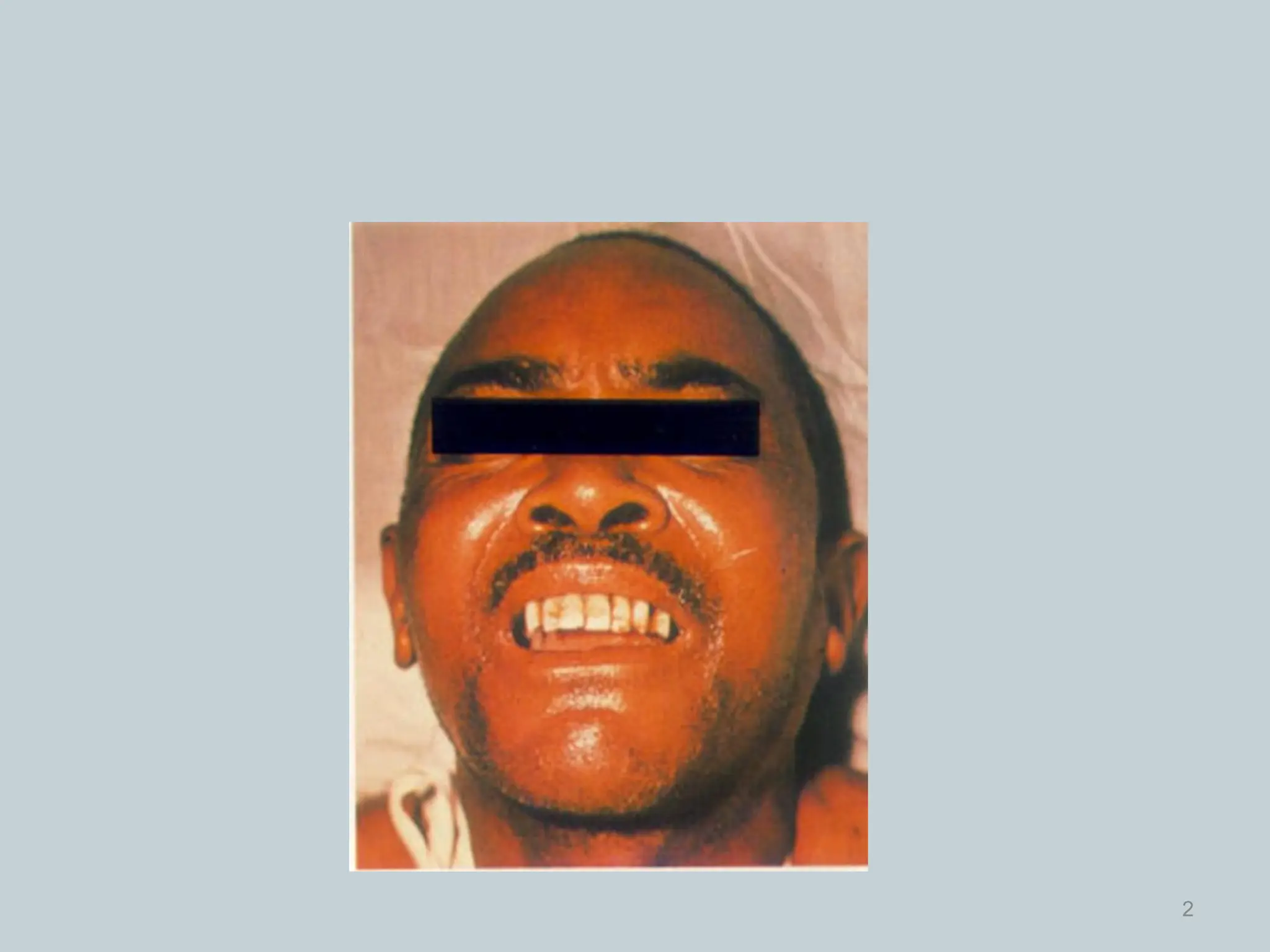
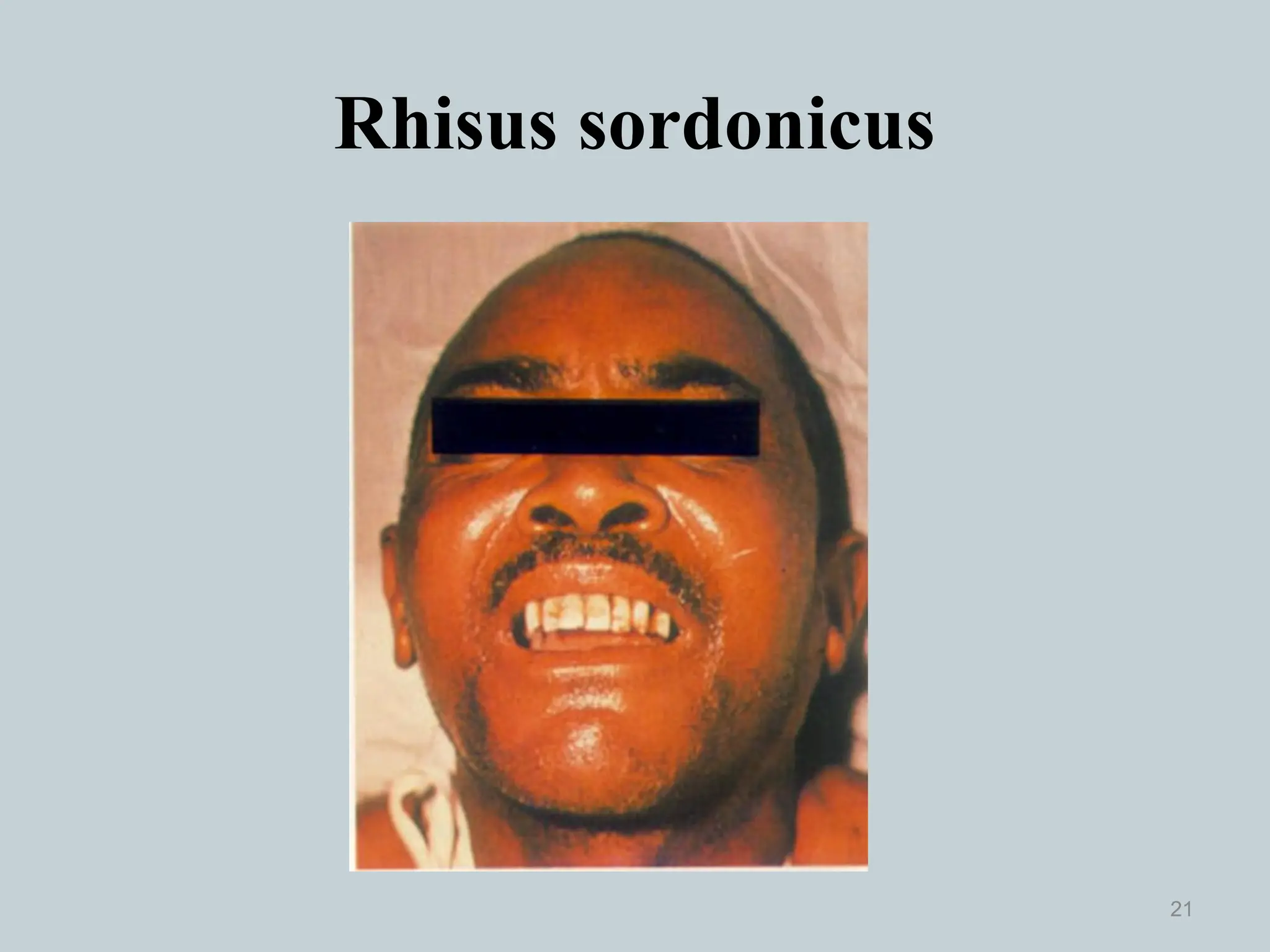
3. Rhisus sardonicus - Facial and neck
muscles.
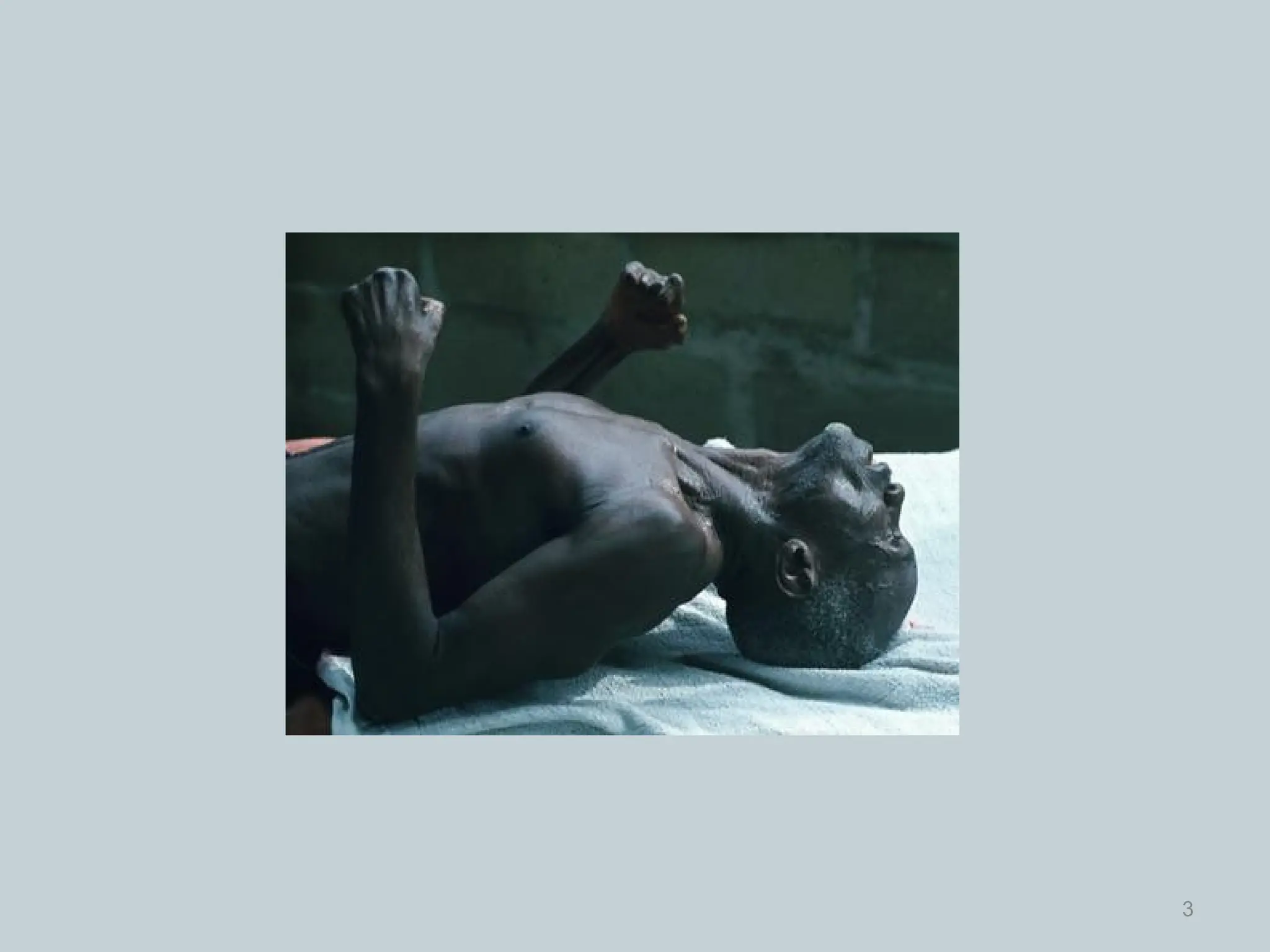
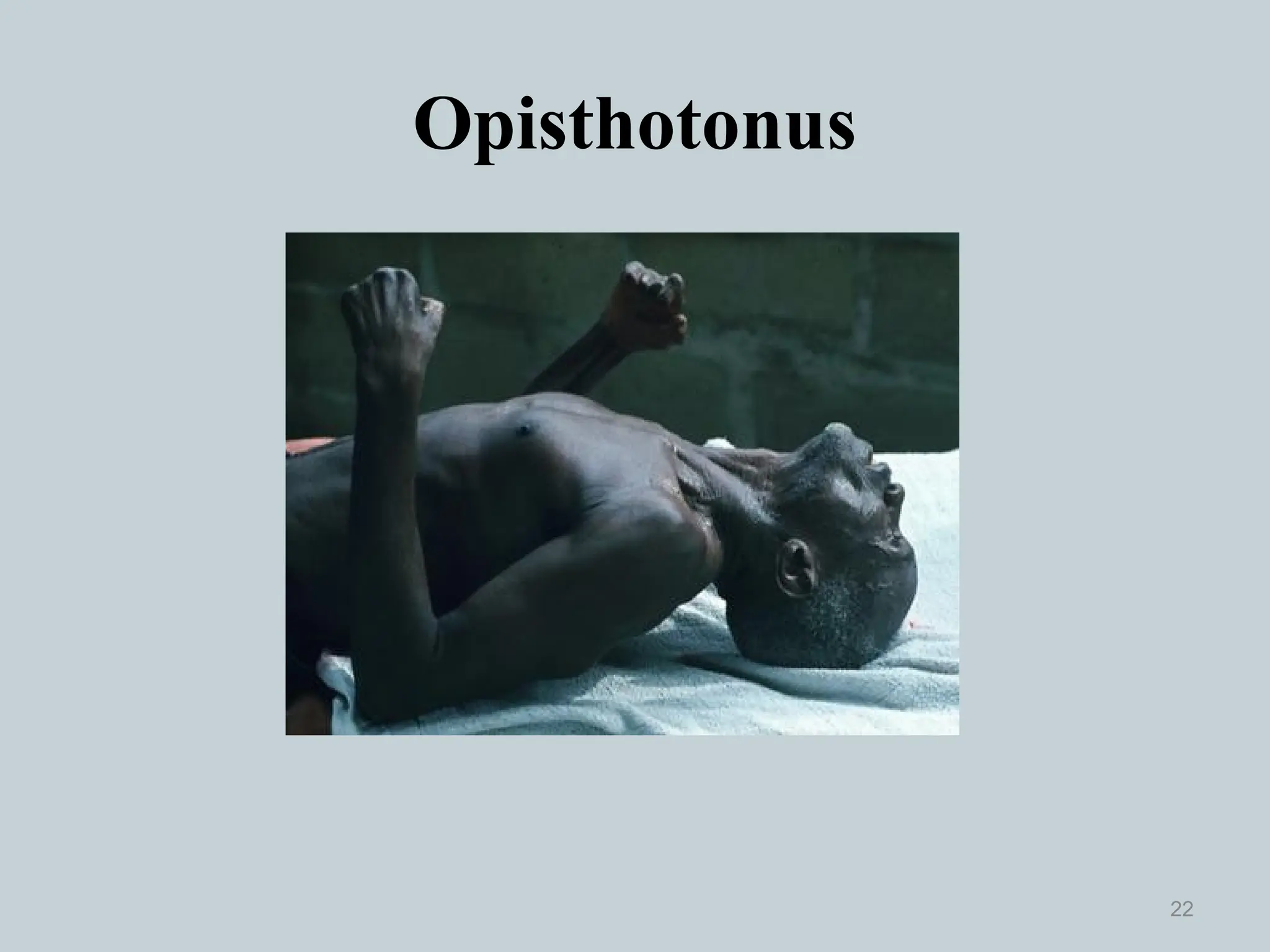
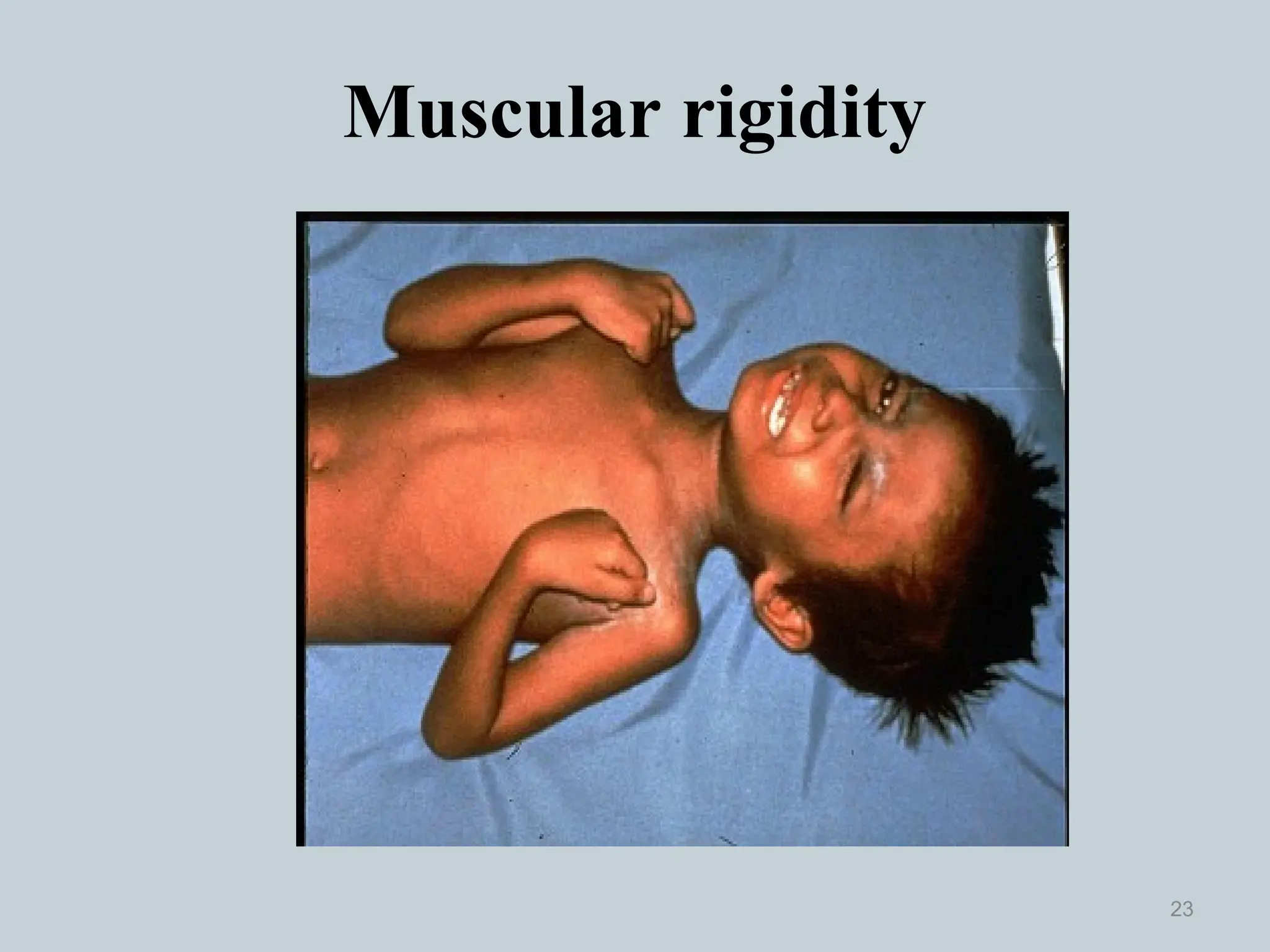
4. Opisthotonus - Muscles of back and neck.
5. Tachycardia and respiratory distress.
Clinical diagnosis - signs
Trismus (lock jaw)
20
Rhisus sordonicus
21
Opisthotonus
22
Muscular rigidity
23
24
Prevention and control
1. Primary prevention:
A. Health promotion:
i. Health education: creating awareness about
disease, cause, modes of transmission,
prevention and control.
ii. Environmental modification:
- Regular sweeping of floor to prevent
accumulation of dust.
- Building sheds for cattle, sheeps and
goats. 25
Prevention and control
iii. Life style and behavioural changes:
- Proper hand washing.
- Aseptic wound management.
- Aseptic delivery practices.
26
Prevention and control
B. Specific protection:
i. Vaccination:
a. Primary immunization with tetanus toxoid:
• 2 doses of TT- intramuscularly- one month
apart.
• 1st
booster dose – after 1 year.
• 2nd
booster dose – 5 year after 1st
booster
dose.
b. UIP - DPT and TT.
c. 2 doses of TT for pregnant mother. 27
Prevention and control
ii. Prophylactic use of Human tetanus
immunoglobulin:
• Following road traffic accident with in 6 hours
– 250 - 500 IU/IM of HTIG.
Iii. Active and passive immunization:
• Primary immunization within 5 years – No TT.
• Primary immunization between 5 – 10 years – 1
dose of TT.
• Primary immunization more than 10 years –
1dose of TT+ HTIG
• Immunization status is not known – complete
primary immunization and HTIG. 28
Prevention and control
iv. Sterilization of surgical instruments.
v. Fumigation.
29
Prevention and control
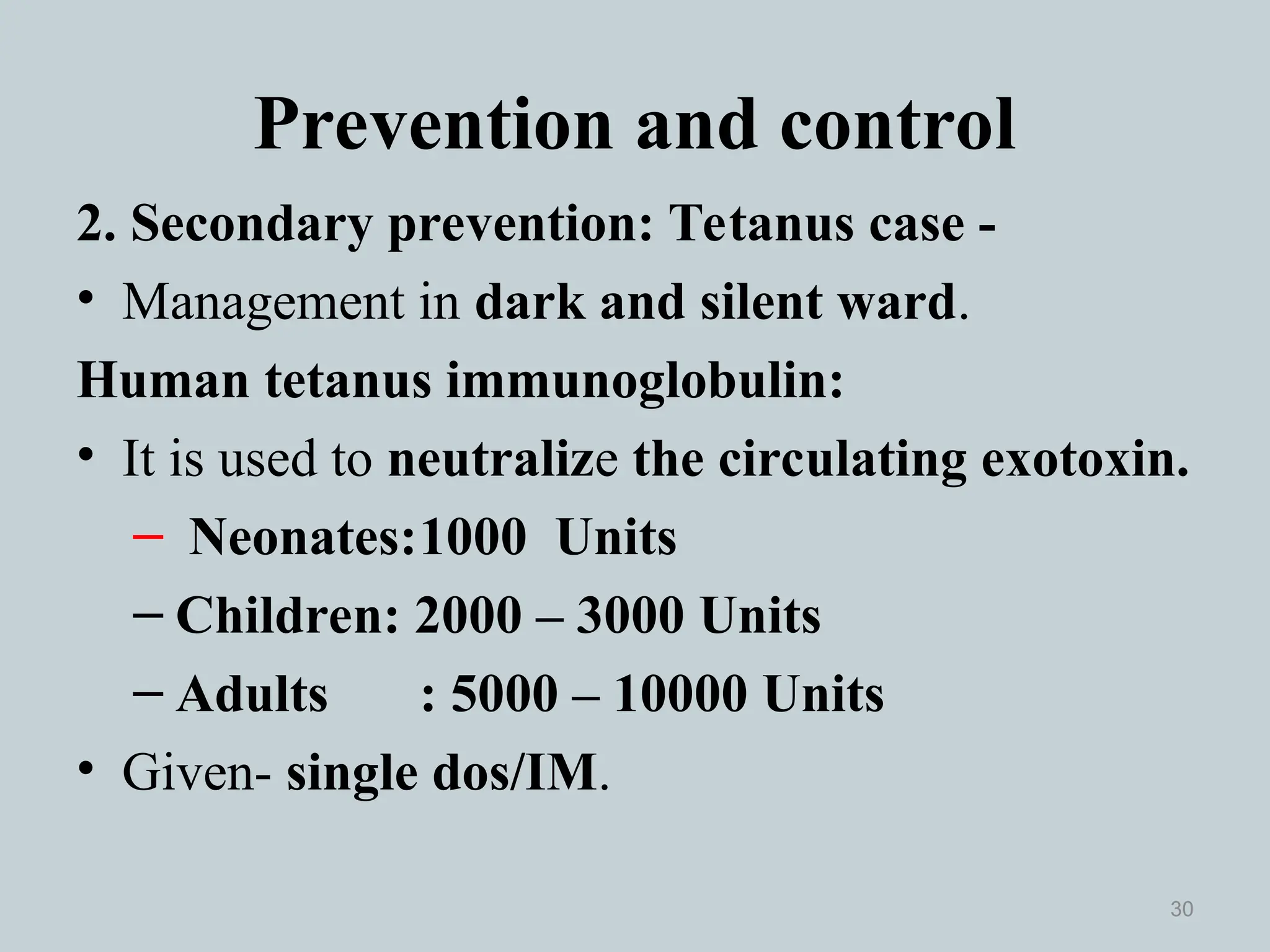
2. Secondary prevention: Tetanus case -
• Management in dark and silent ward.
Human tetanus immunoglobulin:
• It is used to neutralize the circulating exotoxin.
– Neonates:1000 Units
– Children: 2000 – 3000 Units
– Adults : 5000 – 10000 Units
• Given- single dos/IM.
30
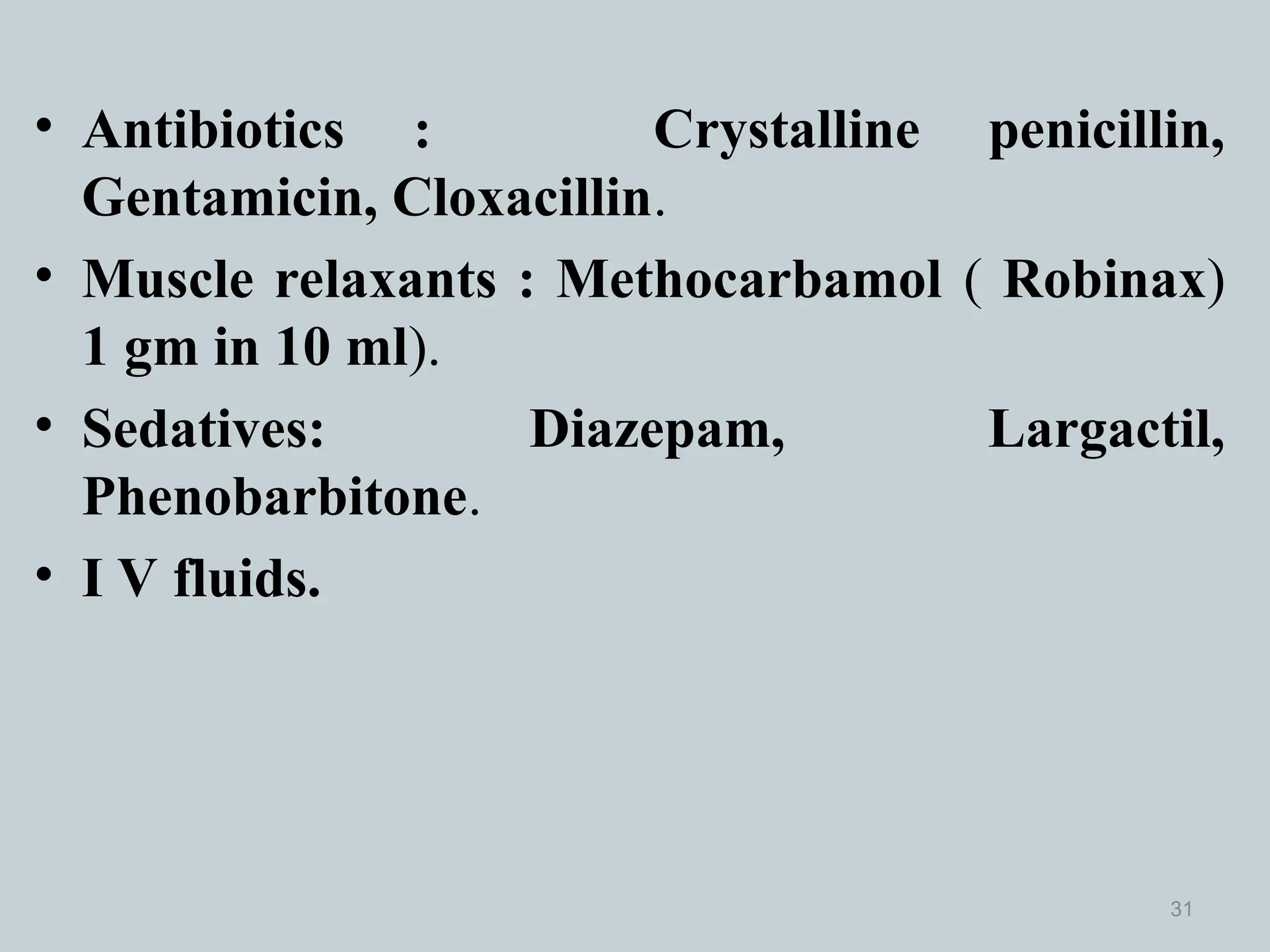
• Antibiotics : Crystalline penicillin,
Gentamicin, Cloxacillin.
• Muscle relaxants : Methocarbamol ( Robinax)
1 gm in 10 ml).
• Sedatives: Diazepam, Largactil,
Phenobarbitone.
• I V fluids.
31
LEPROSY
32
Introduction
• Leprosy (Hansen’s disease) is a chronic
infectious disease caused by M leprae
affecting skin, peripheral nerve, eye, bone
and clinically characterized by one or more
of the following features -
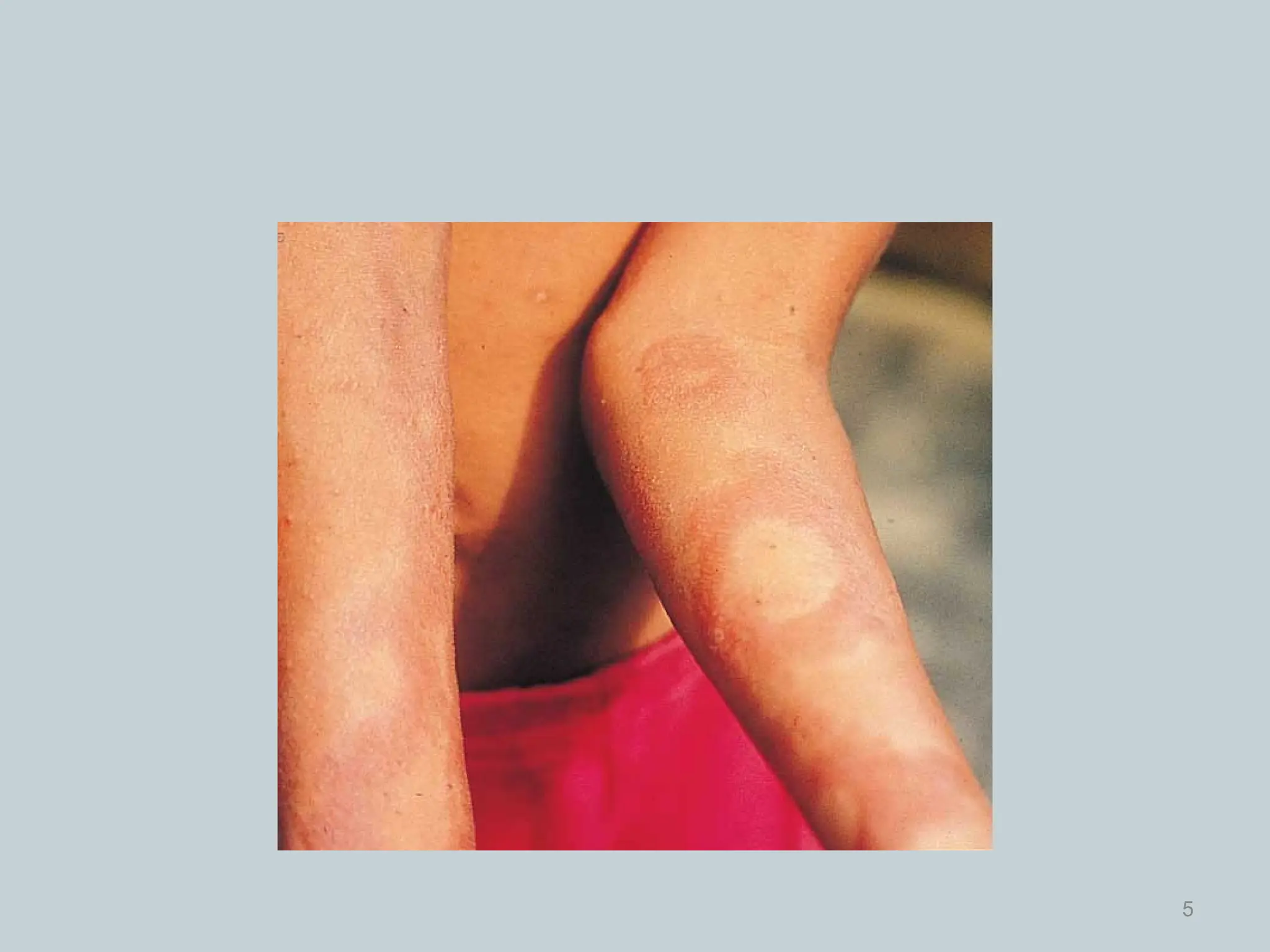
a. Hypo pigmented patches.
b. Partial or total loss of cutaneous sensation.
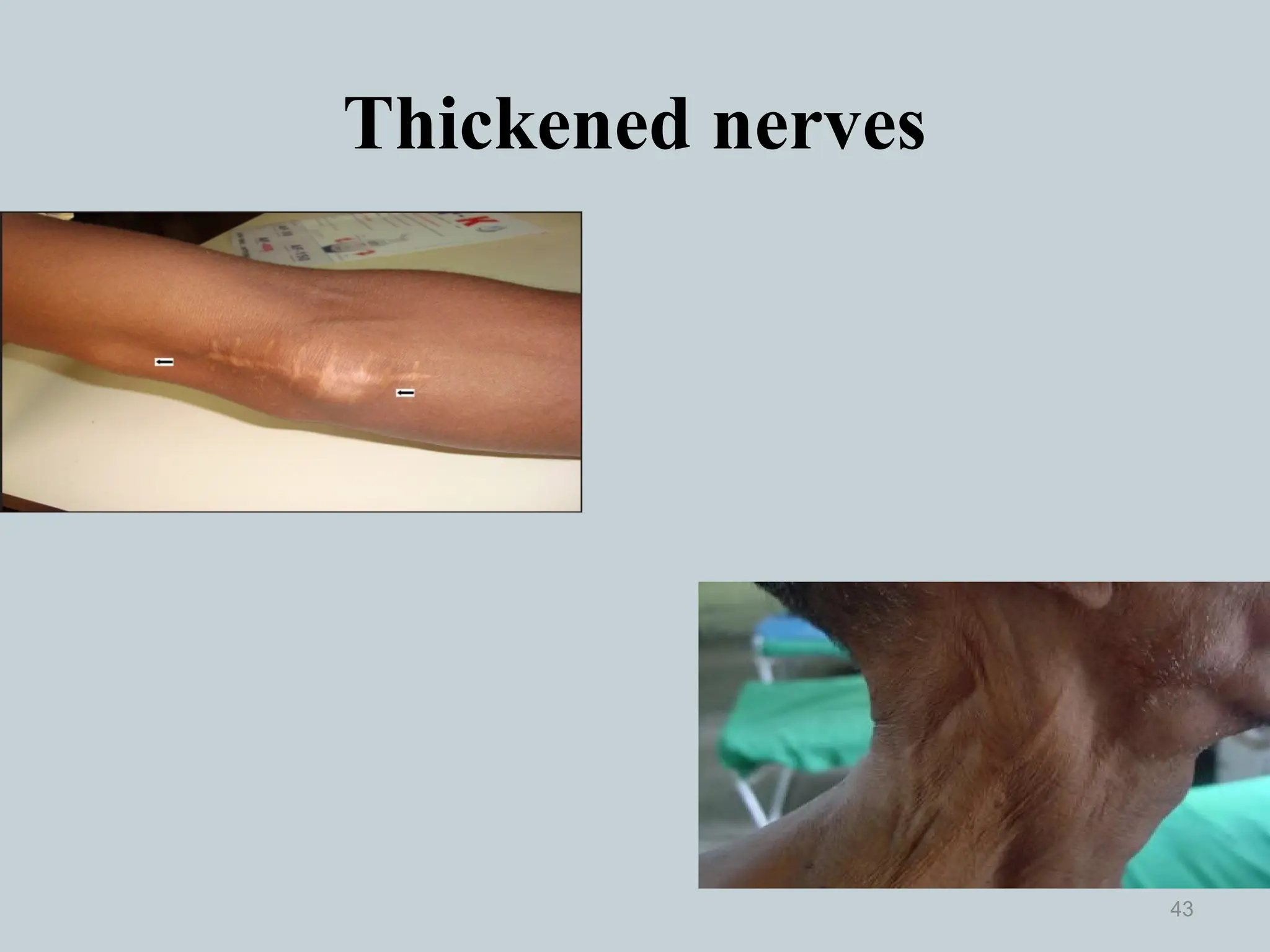
c. Presence of thickened nerves.
33
Problem statement
WORLD:
• In 2017, global prevalence rate was 0.21 per
10,000 population.
INDIA:
• leprosy is endemic in the India.
• In 2017, prevalence of leprosy was 0.68 per
10000 population (achieved elimination of
leprosy in 2005).
34
i. Agent factors:
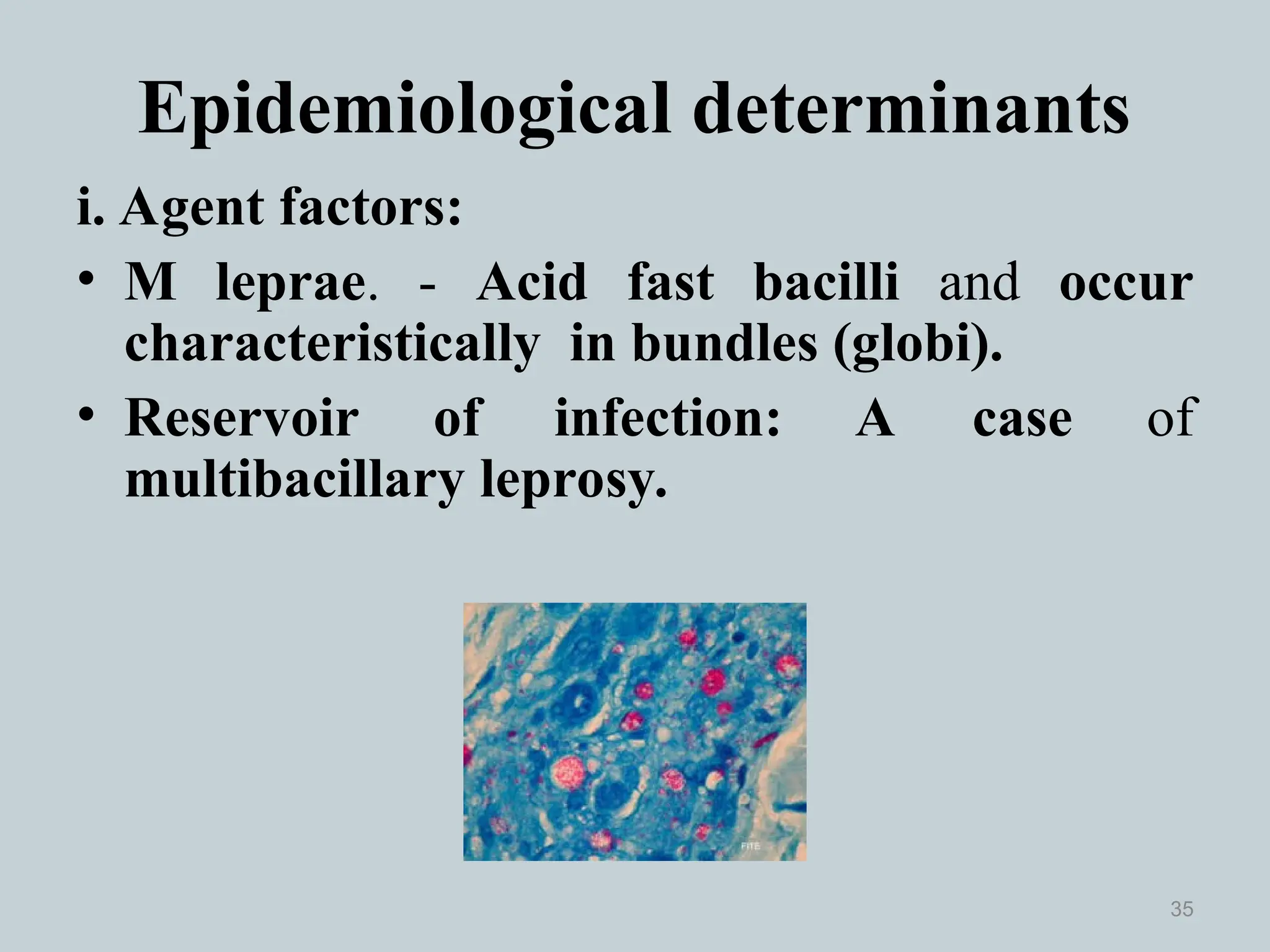
• M leprae. - Acid fast bacilli and occur
characteristically in bundles (globi).
• Reservoir of infection: A case of
multibacillary leprosy.
35
Epidemiological determinants
ii. Host factors:
• Age: commonly between 10 – 20 years.
• Sex: More in males than females
• Locality: It is serious problem in urban
(slum).
36
Epidemiological determinants
iii. Environmental Factors:
Overcrowding and poor ventilation in the
house increases the risk.
37
Modes of transmission:
• Air borne - Droplet infection
• Direct contact with skin
Incubation period:
• An average of 3 to 5 years.
38
Classification of leprosy
For treatements purpose:
1. Paucibacillary type (1-5 skin lesion).
2. Multibacillary leprosy (more than 5 skin
lesion).
39
Clinical diagnosis
• Medical history – History of loss of
sensation.
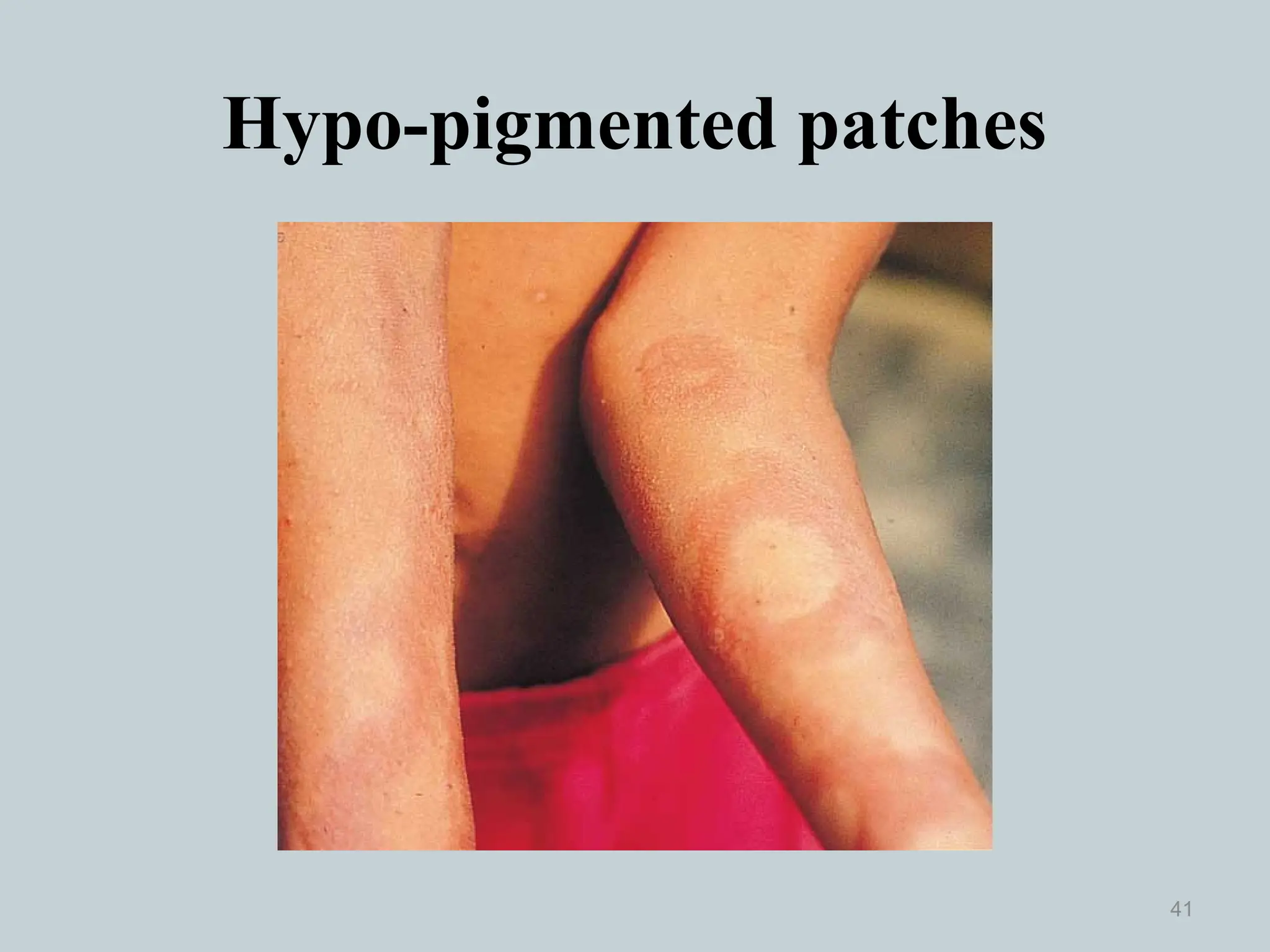
• Examination of skin for hypo-pigmented
patches and sensory examination.
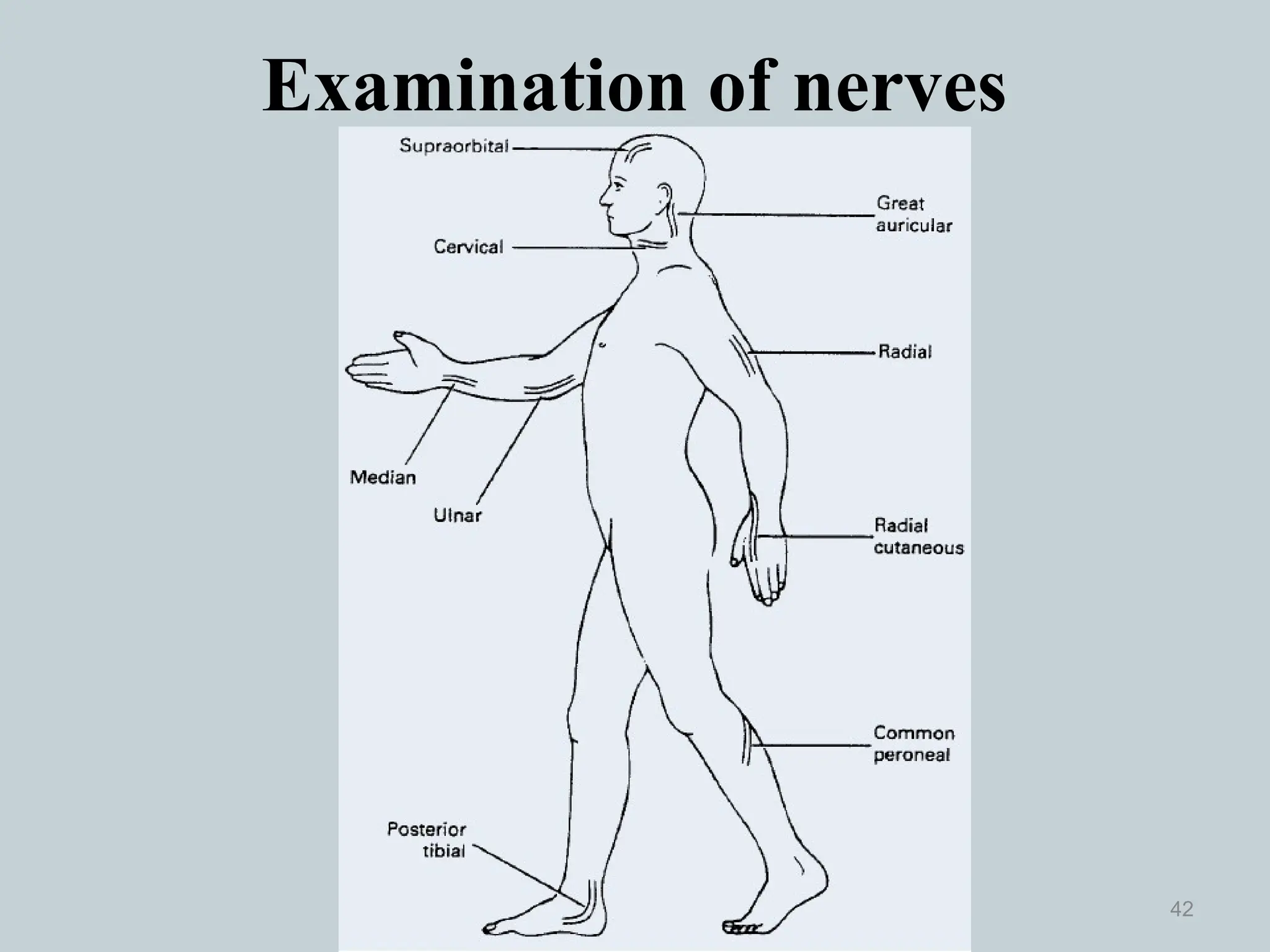
• Examination for thickened nerves.
40
Hypo-pigmented patches
41
Examination of nerves
42
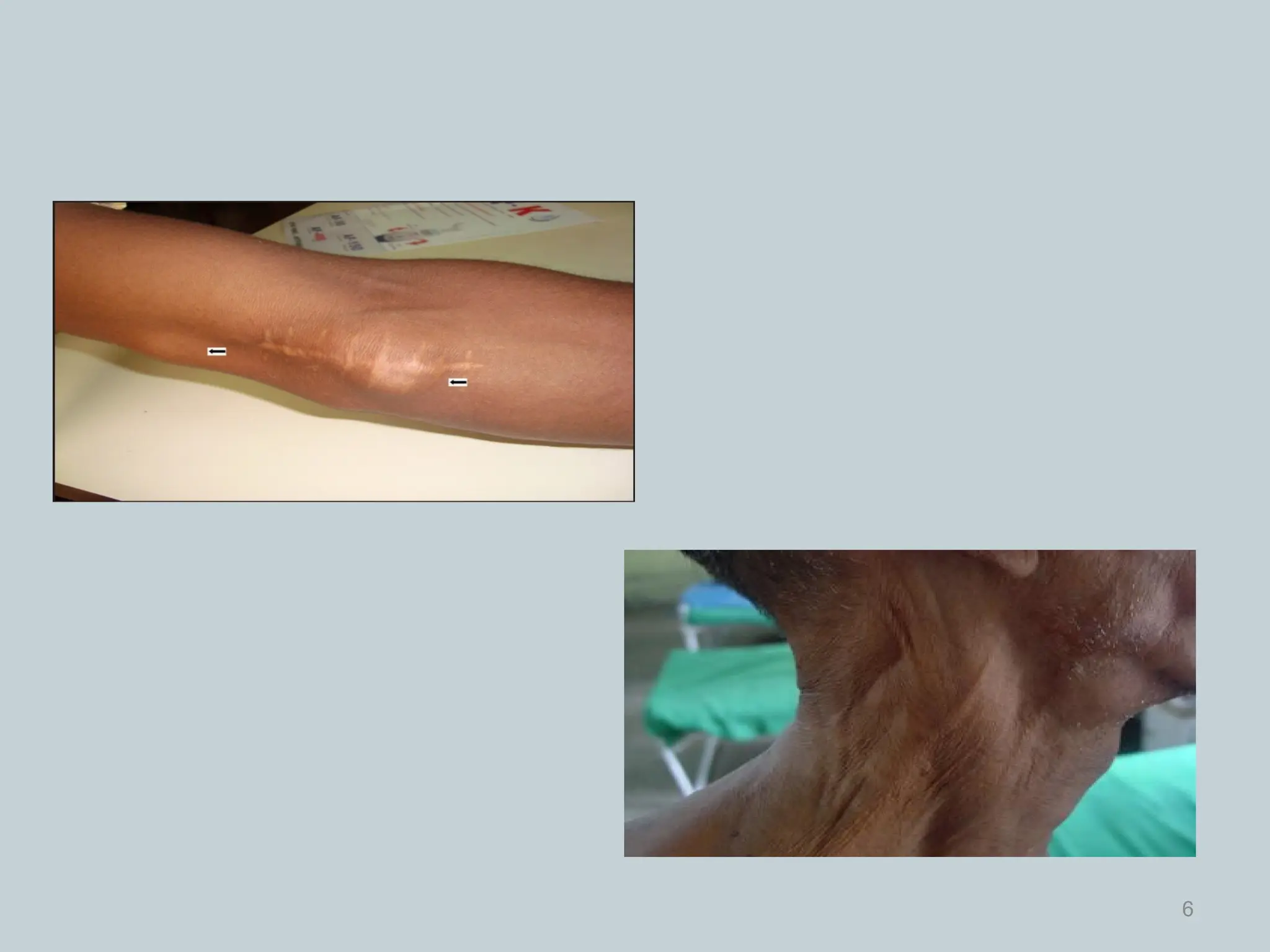
Thickened nerves
43
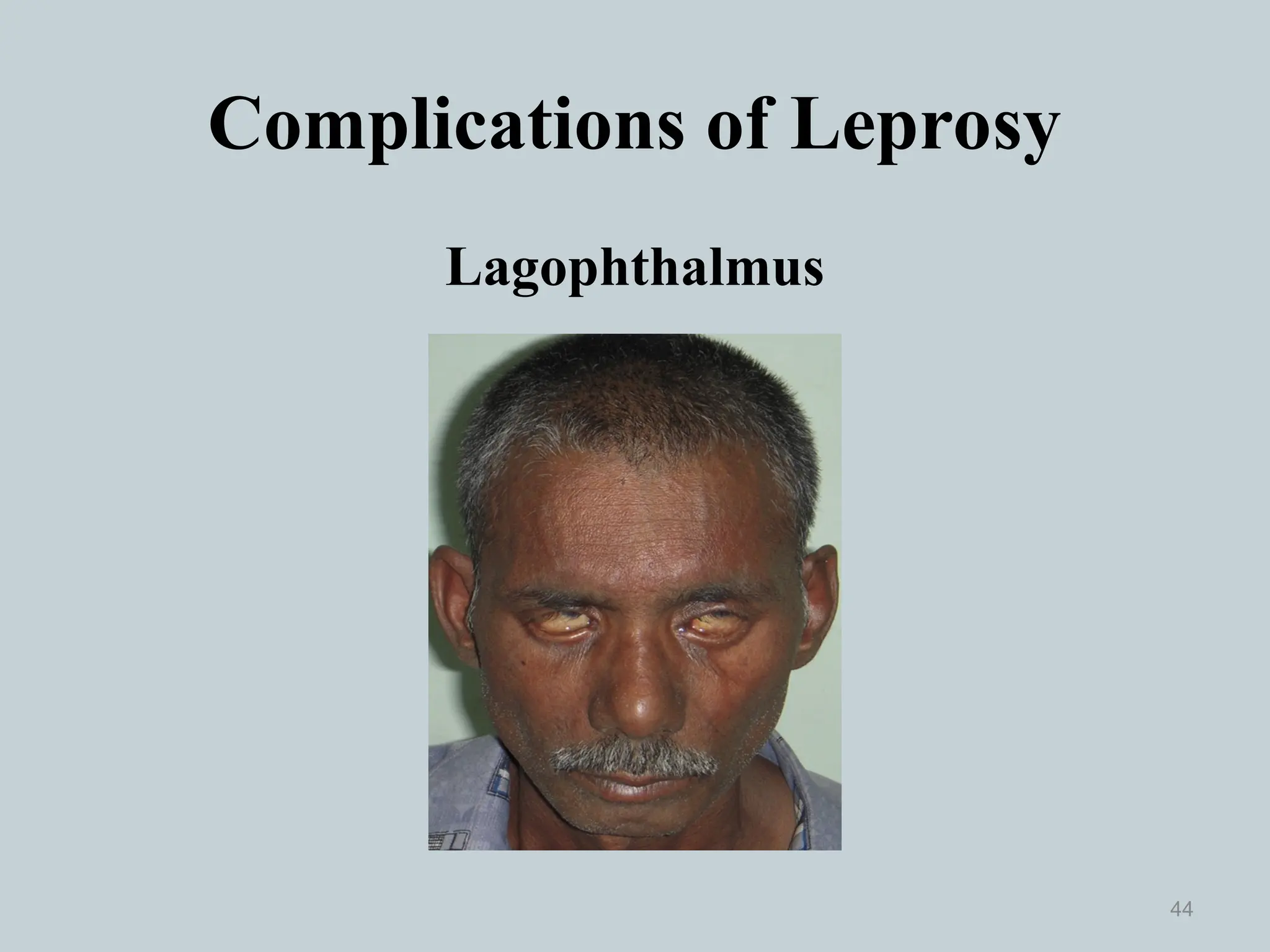
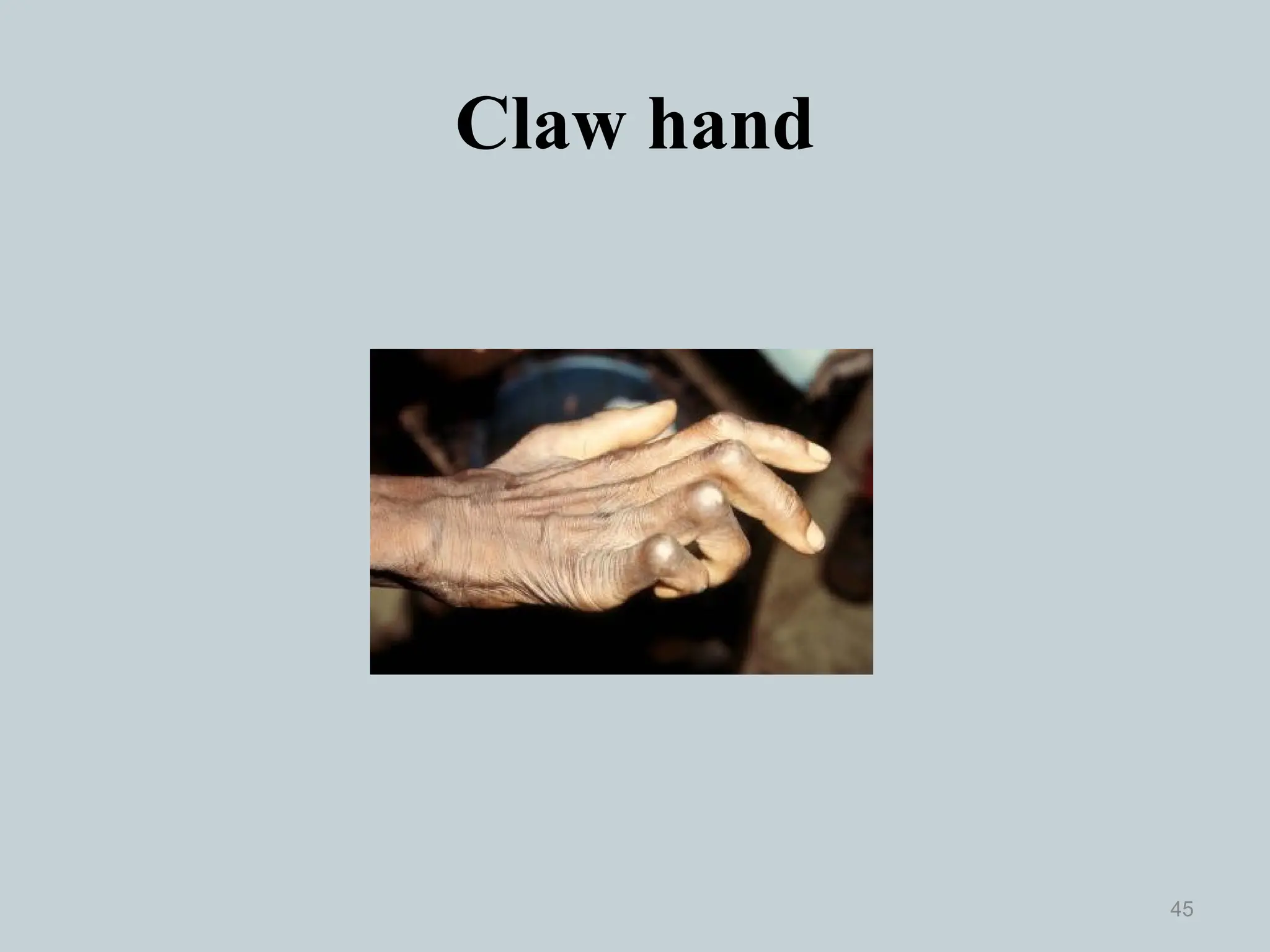
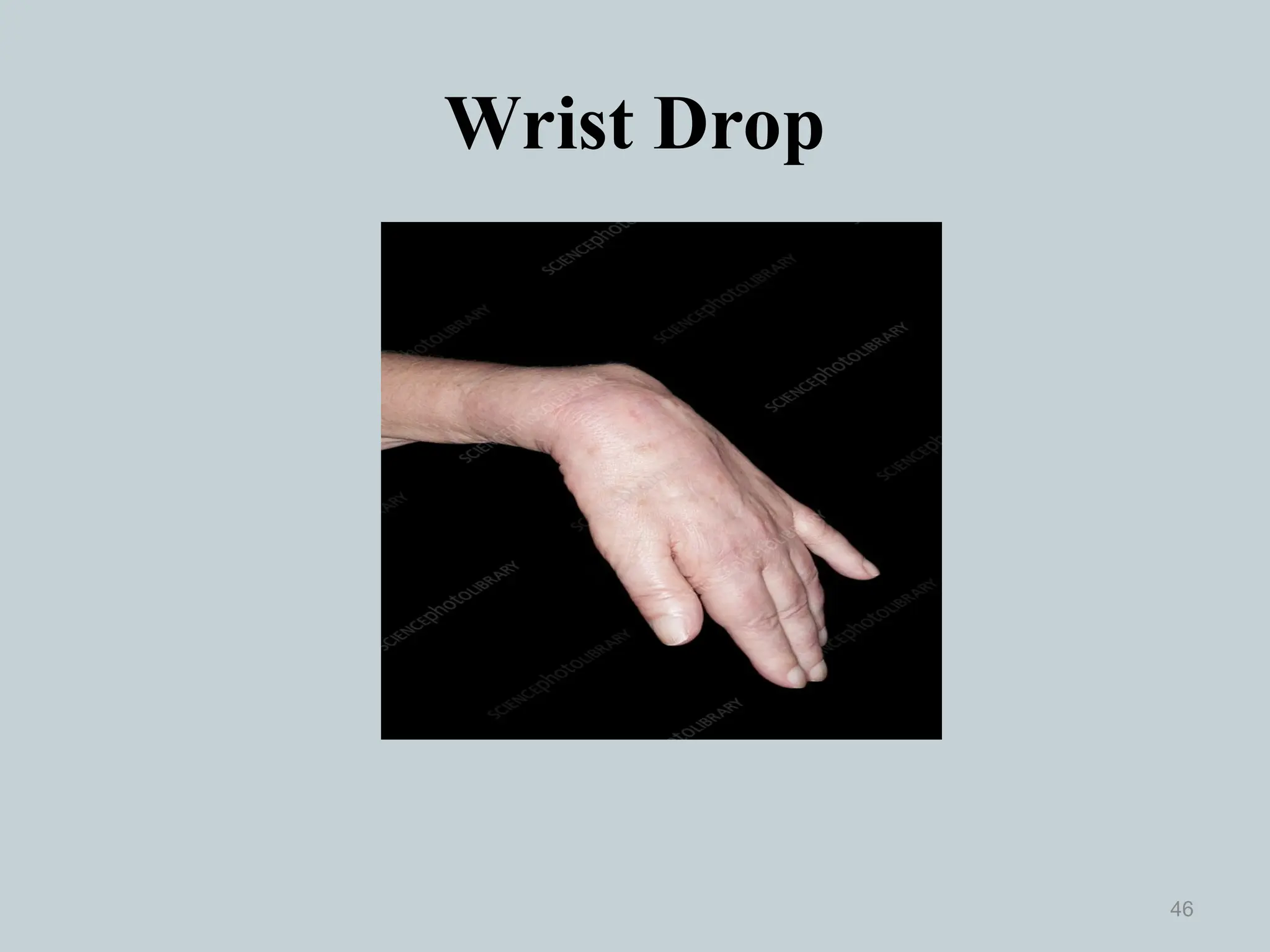
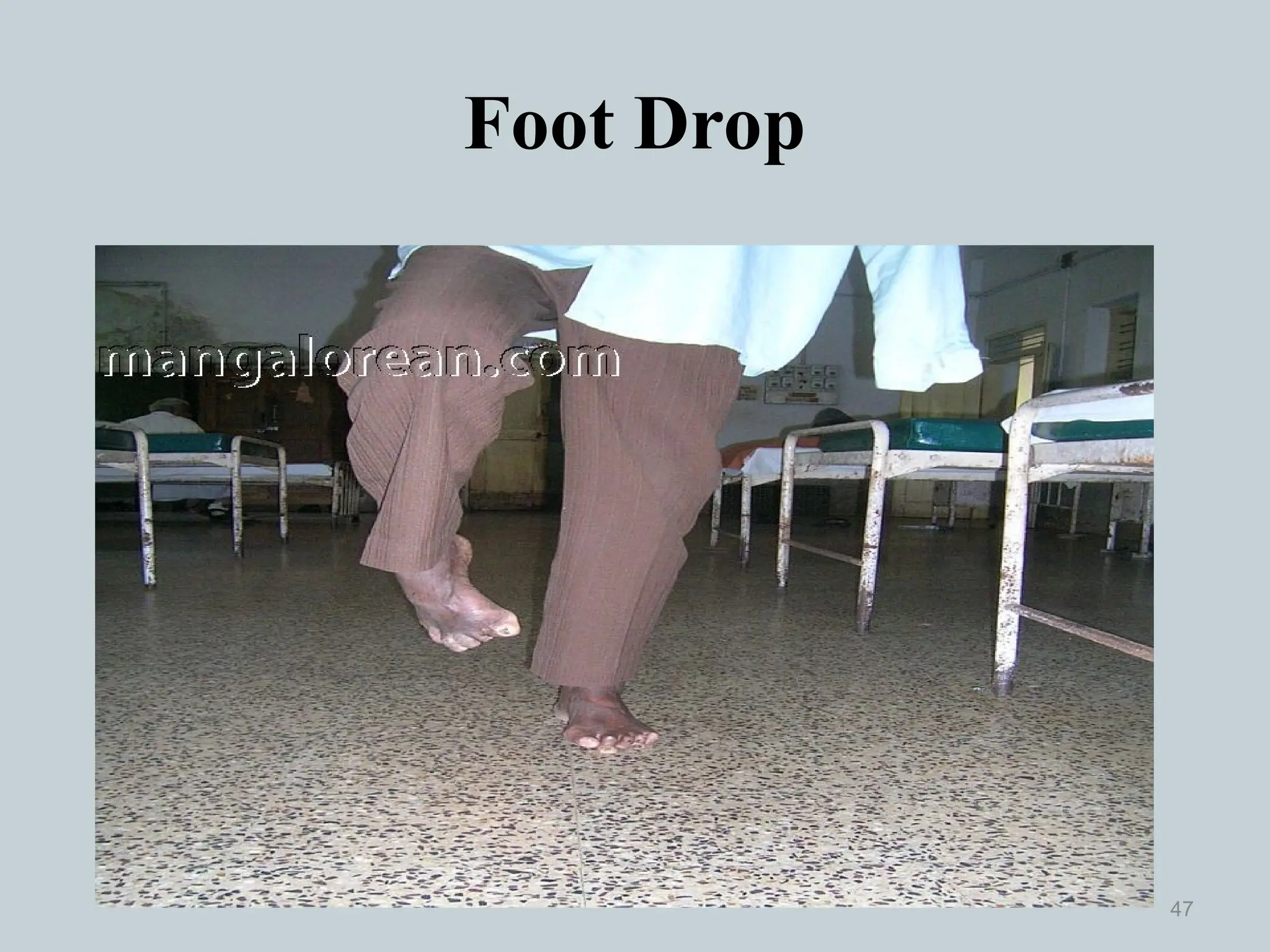
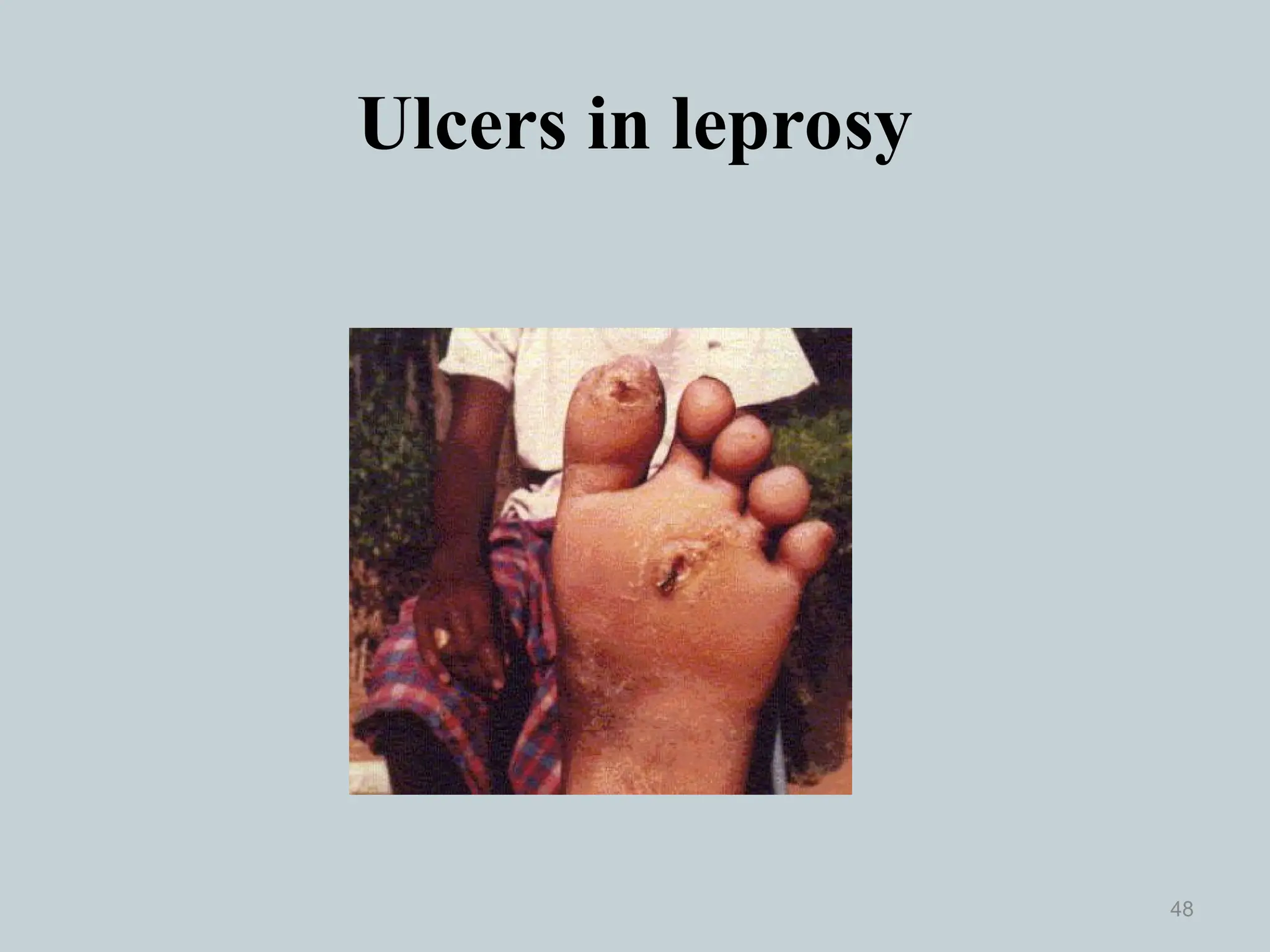
Complications of Leprosy
Lagophthalmus
44
Claw hand
45
Wrist Drop
46
Foot Drop
47
Ulcers in leprosy
48
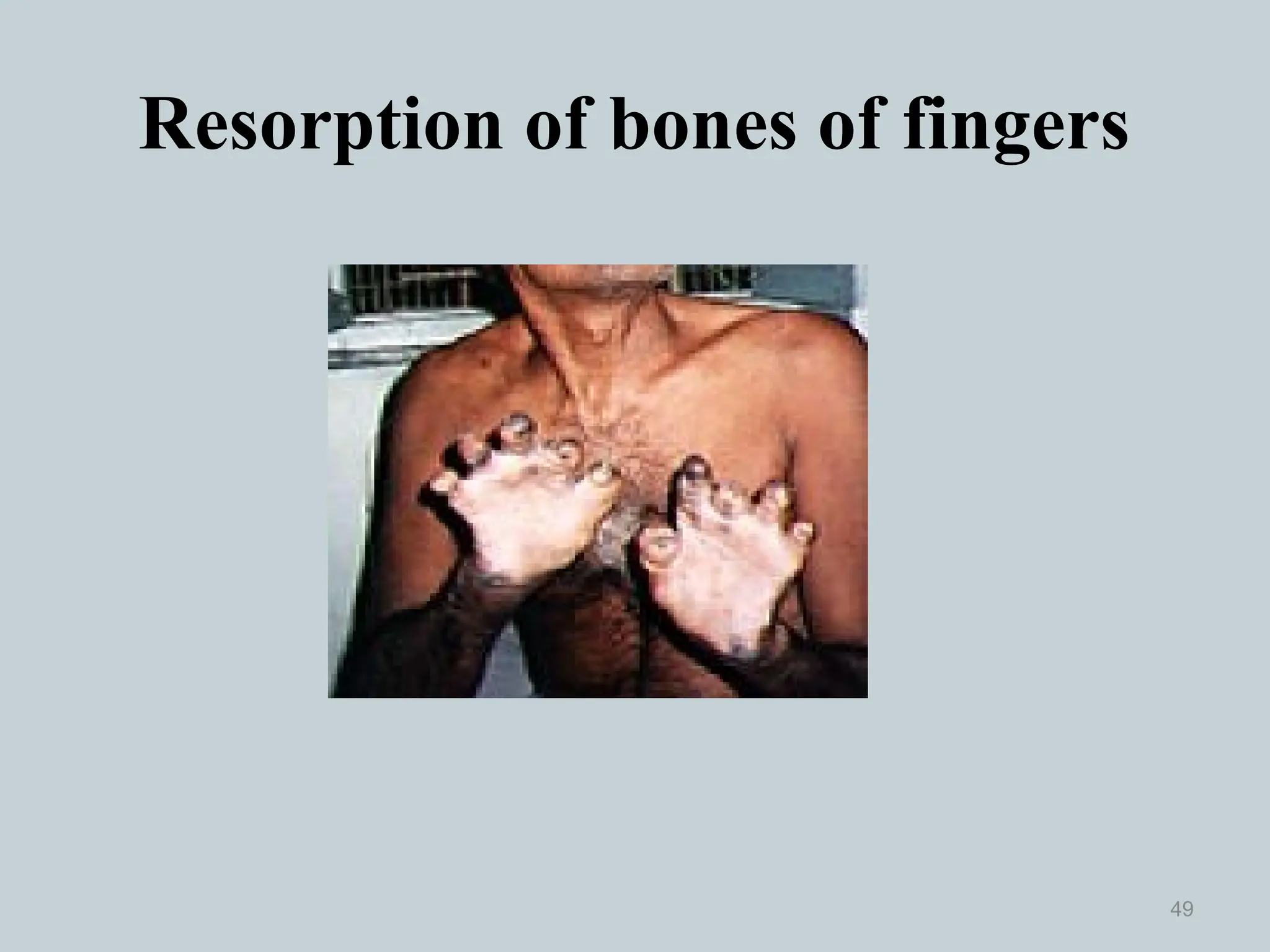
Resorption of bones of fingers
49
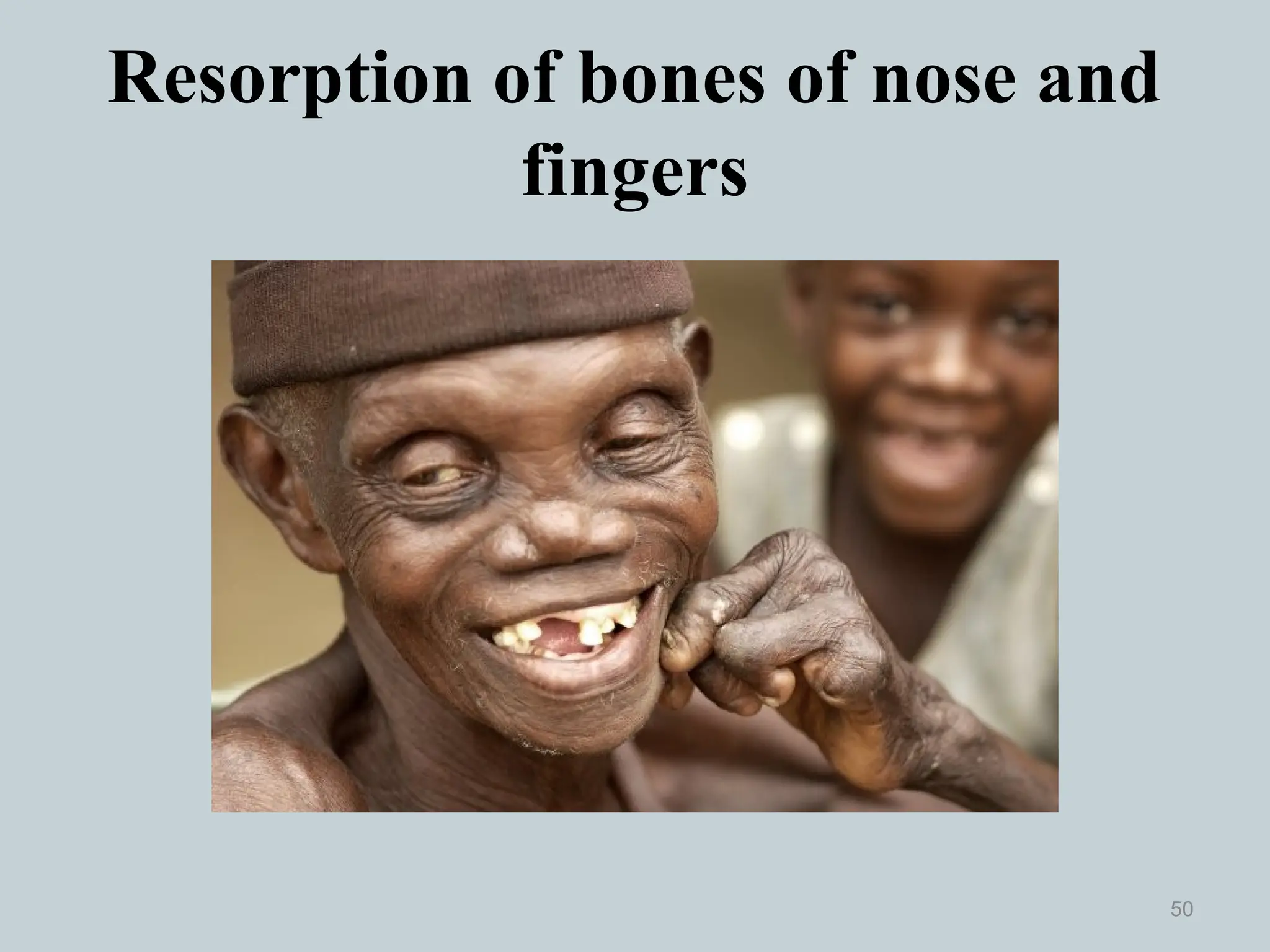
Resorption of bones of nose and
fingers
50
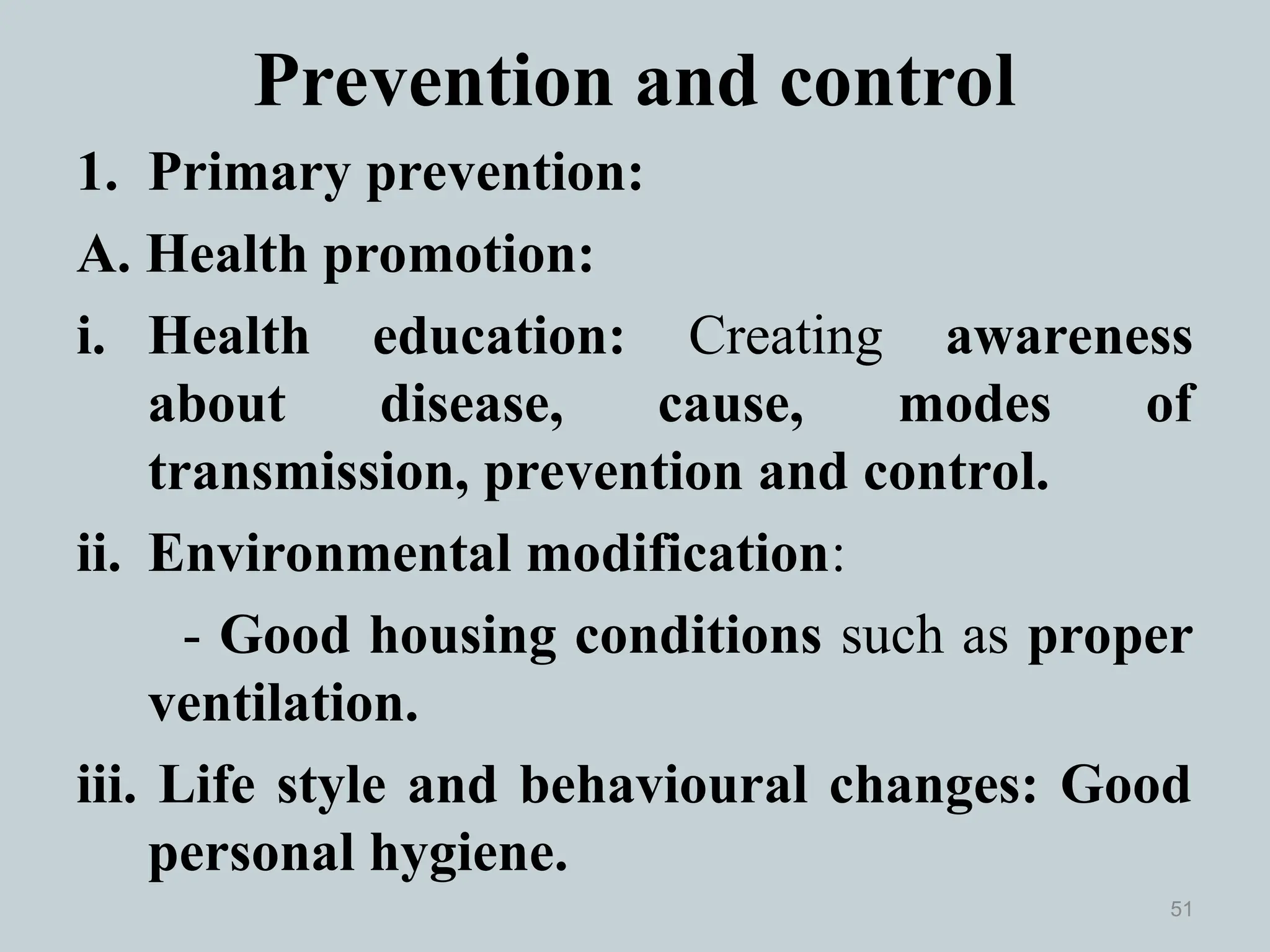
Prevention and control
1. Primary prevention:
A. Health promotion:
i. Health education: Creating awareness
about disease, cause, modes of
transmission, prevention and control.
ii. Environmental modification:
- Good housing conditions such as proper
ventilation.
iii. Life style and behavioural changes: Good
personal hygiene.
51
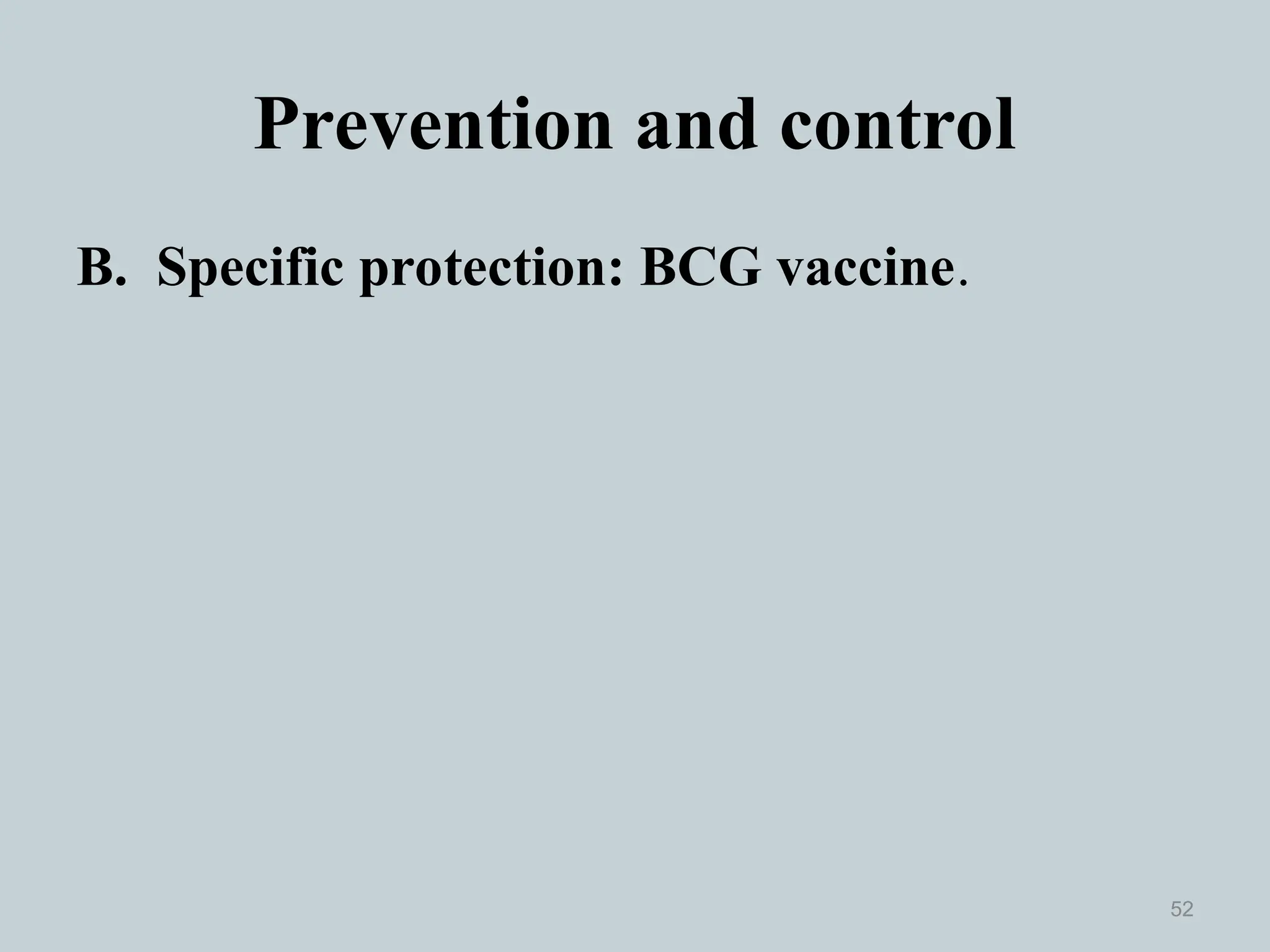
Prevention and control
B. Specific protection: BCG vaccine.
52
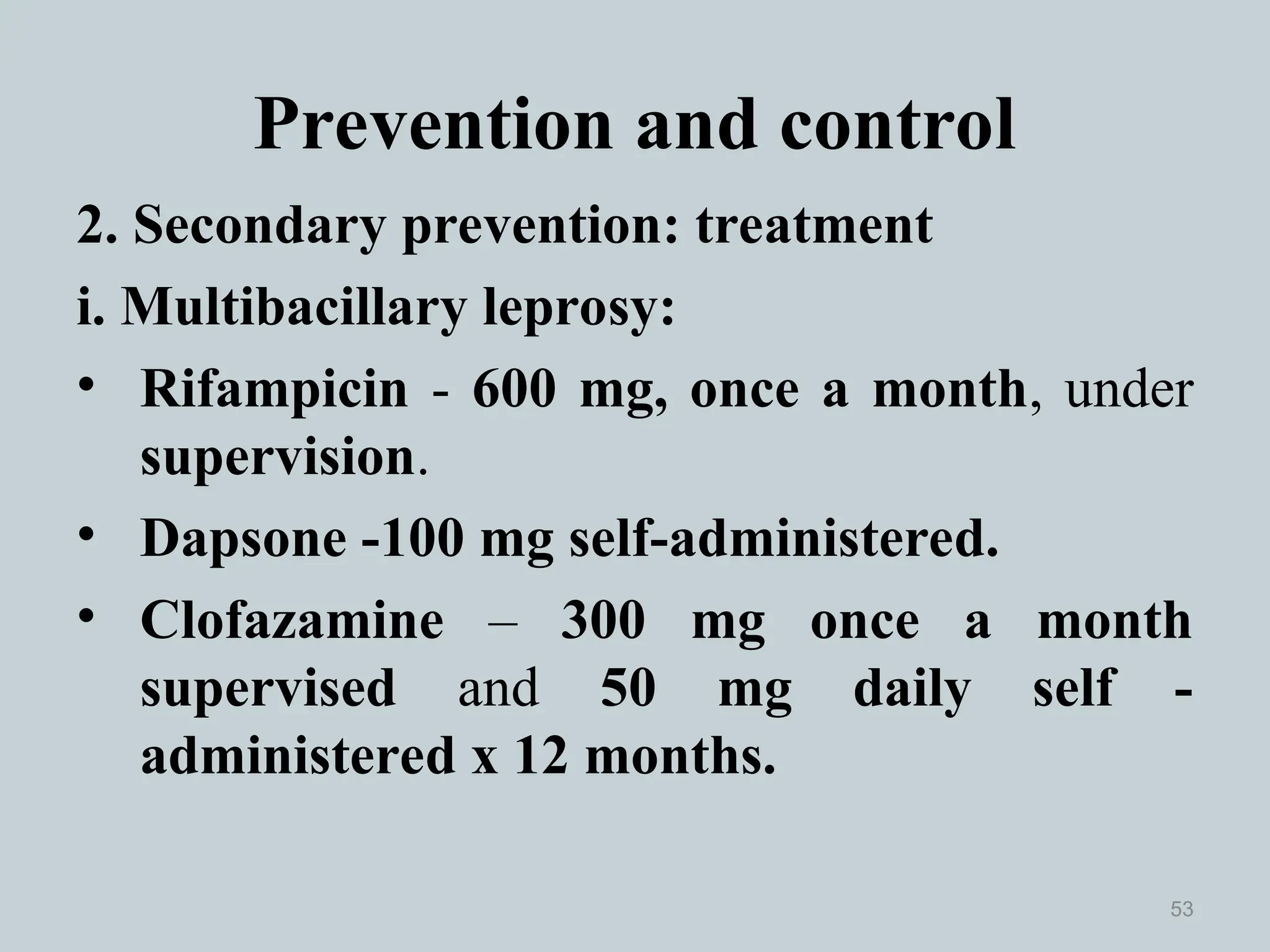
Prevention and control
2. Secondary prevention: treatment
i. Multibacillary leprosy:
• Rifampicin - 600 mg, once a month, under
supervision.
• Dapsone -100 mg self-administered.
• Clofazamine – 300 mg once a month
supervised and 50 mg daily self -
administered x 12 months.
53
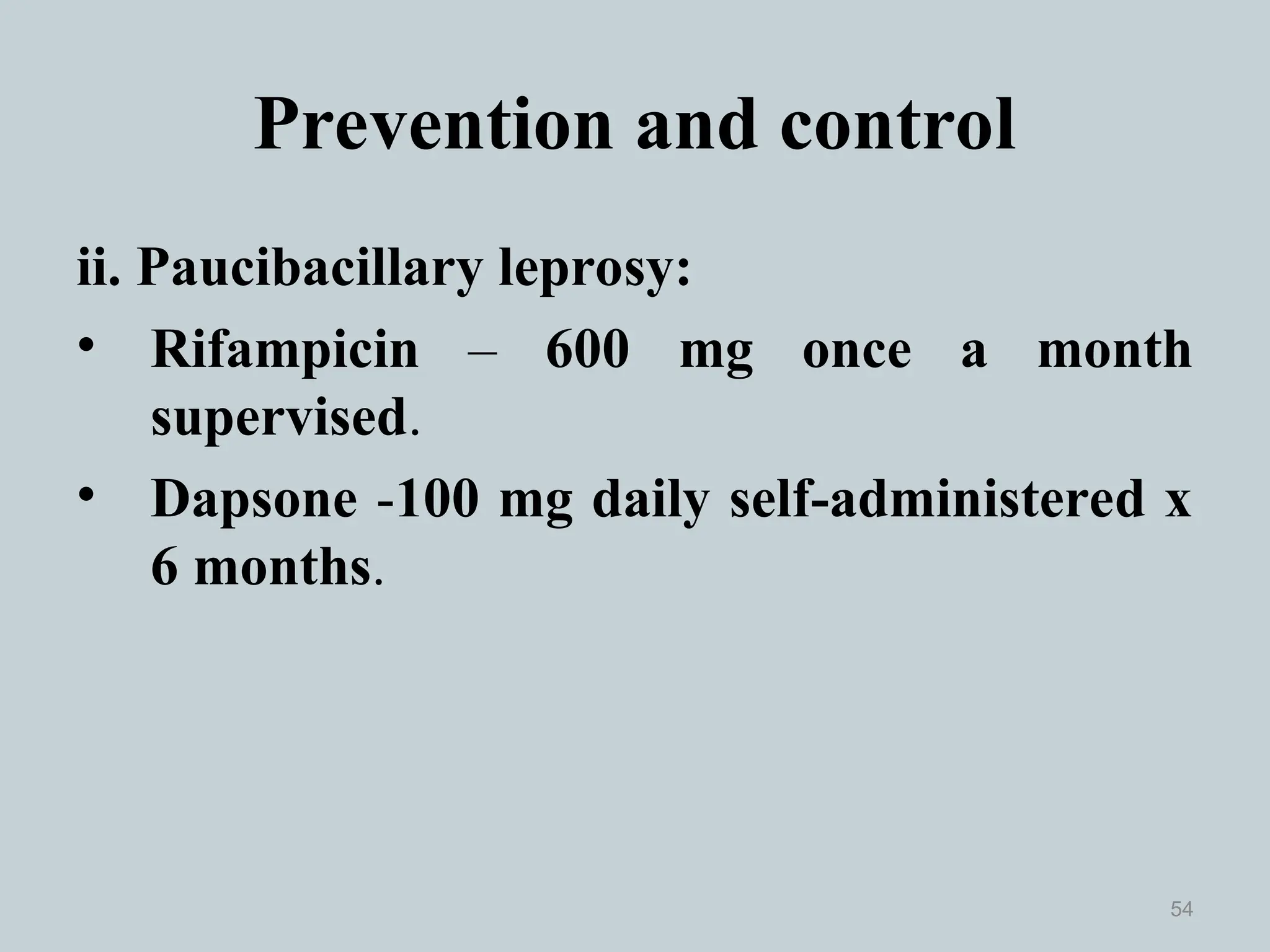
Prevention and control
ii. Paucibacillary leprosy:
• Rifampicin – 600 mg once a month
supervised.
• Dapsone -100 mg daily self-administered x
6 months.
54
Prevention and control
3. Tertiary prevention:
•Rehabilitation:
•Medical rehabilitation: Restoration of function.
Eg: physiotherapy, heat therapy etc.
•Surgery: Tendon transplant operation.
•Vocational rehabilitation: Restoration of
capacity to earn livelihood. Eg: Training in
suitable jobs such as handicraft making etc.
•Social rehabilitation: Restoration of family and
social relationship. Eg: Marriage of leprosy
patients. 55
Summary
• Tetanus and leprosy are surface infections.
• These diseases are endemic in India and
diagnosed based on clinical signs – clinical
diagnosis.
• In India, UIP and NLEP programmes are
working against these diseases.
56
Thank you
57

TETANUS AND LEPROSY - EPIDEMIOOGY, PREVENTION AND CONTROL.ppt

  • 1.
  • 2.
  • 3.
  • 4.
  • 5.
  • 6.
  • 7.
  • 8.
    EPIDEMIOLOGY, PREVENTION & CONTROLOF TETANUSAND LEPROSY DEPARTMENT OF COMMUNITY MEDICINE KIMS, B - 70 8
  • 9.
    PLAN FOR COMMUNICABLE DISEASE A.EPIDEMIOLOGY: 1.INTRODUCTION 2.PROBLEM STATEMENT 3.EPIDEMIOLOGICAL DETERMINENTS - i. AGENT FACTORS ii. HOST FACTORS iii. ENVIRNOMENTAL FACTORS 4. MODE OF TRANSMISSION 5. INCUBATION PERIOD 6. CLINICAL FEATURES 7. LABORATORY DIAGNOSIS
  • 10.
    PLAN FOR COMMUNICABLE DISEASE…… B.PREVETION & CONTROL MEASURES: 1.PRIMARY PREVENTION 2.SECONDARY PREVENTION 3.TERTIARY PREVENTION
  • 11.
    SURFACE INFECTIONS • “Acuteor chronic infections of the skin and mucus membrane which is transmitted by direct contact (skin to skin, mucosa to mucosa or from skin to mucosa).” • Eg: Tetanus, Leprosy, STDs, HIV/AIDS, Trachoma and Yaws. 11
  • 12.
  • 13.
    Introduction An acute neurologicaldisease caused by exotoxin of Clostridium Tetani and clinically characterized by sudden onset of generalized muscular rigidity with painful spasm of voluntary muscle. 13
  • 14.
    Problem statement • WORLD:In 2017 – 56000 cases. • INDIA: Tetanus is endemic disease in India and known as “Dhanuvau.” • In 2017, 4946 cases were reported in India. • In 2015, India has achieved public health milestone of Neonatal tetanus (NT) elimination. 14
  • 15.
    Epidemiological determinants i. Agentfactor: • Cl. tetani is a gram positive, spore forming, rod shaped bacteria. • It grows strictly under anaerobic conditions. • Tetanospasmin (exotoxin) acts on nervous system. • Reservoir of infection is cultivated soil and dust. 15
  • 16.
    Epidemiological determinants ii. Hostfactors: • It occurs in active age group (5 – 40 years). • Males are more affected than females. iii. Environmental factors: • Agricultural environment – use of manured soil increases the risk of infection. 16
  • 17.
    Mode of transmission: •Direct contact - Injury such as pin prick, abrasion, punctured wounds, burns, bowel surgery, dental extraction, otitis media etc. • Tetanus prone wound (S/N): Any wound having foreign body (soil and dust), necrotic tissues, blood clots and super added secondary bacterial infection. Incubation period: 3 to 21 days. 17
  • 18.
    Clinical types ofTetanus 1. Post-traumatic 2. Post-abortal 3. Puerperal 4. Tetanus neonatarum 5. Otogenic 6. Tetanus after injection 7. Post- operative 8. Idiopathic 18
  • 19.
    19 1. Tingling sensationnear and around the wound. 2. Trismus (lock jaw) – Rigidity of Muscles of mastication. 3. Rhisus sardonicus - Facial and neck muscles. 4. Opisthotonus - Muscles of back and neck. 5. Tachycardia and respiratory distress. Clinical diagnosis - signs
  • 20.
  • 21.
  • 22.
  • 23.
  • 24.
  • 25.
    Prevention and control 1.Primary prevention: A. Health promotion: i. Health education: creating awareness about disease, cause, modes of transmission, prevention and control. ii. Environmental modification: - Regular sweeping of floor to prevent accumulation of dust. - Building sheds for cattle, sheeps and goats. 25
  • 26.
    Prevention and control iii.Life style and behavioural changes: - Proper hand washing. - Aseptic wound management. - Aseptic delivery practices. 26
  • 27.
    Prevention and control B.Specific protection: i. Vaccination: a. Primary immunization with tetanus toxoid: • 2 doses of TT- intramuscularly- one month apart. • 1st booster dose – after 1 year. • 2nd booster dose – 5 year after 1st booster dose. b. UIP - DPT and TT. c. 2 doses of TT for pregnant mother. 27
  • 28.
    Prevention and control ii.Prophylactic use of Human tetanus immunoglobulin: • Following road traffic accident with in 6 hours – 250 - 500 IU/IM of HTIG. Iii. Active and passive immunization: • Primary immunization within 5 years – No TT. • Primary immunization between 5 – 10 years – 1 dose of TT. • Primary immunization more than 10 years – 1dose of TT+ HTIG • Immunization status is not known – complete primary immunization and HTIG. 28
  • 29.
    Prevention and control iv.Sterilization of surgical instruments. v. Fumigation. 29
  • 30.
    Prevention and control 2.Secondary prevention: Tetanus case - • Management in dark and silent ward. Human tetanus immunoglobulin: • It is used to neutralize the circulating exotoxin. – Neonates:1000 Units – Children: 2000 – 3000 Units – Adults : 5000 – 10000 Units • Given- single dos/IM. 30
  • 31.
    • Antibiotics :Crystalline penicillin, Gentamicin, Cloxacillin. • Muscle relaxants : Methocarbamol ( Robinax) 1 gm in 10 ml). • Sedatives: Diazepam, Largactil, Phenobarbitone. • I V fluids. 31
  • 32.
  • 33.
    Introduction • Leprosy (Hansen’sdisease) is a chronic infectious disease caused by M leprae affecting skin, peripheral nerve, eye, bone and clinically characterized by one or more of the following features - a. Hypo pigmented patches. b. Partial or total loss of cutaneous sensation. c. Presence of thickened nerves. 33
  • 34.
    Problem statement WORLD: • In2017, global prevalence rate was 0.21 per 10,000 population. INDIA: • leprosy is endemic in the India. • In 2017, prevalence of leprosy was 0.68 per 10000 population (achieved elimination of leprosy in 2005). 34
  • 35.
    i. Agent factors: •M leprae. - Acid fast bacilli and occur characteristically in bundles (globi). • Reservoir of infection: A case of multibacillary leprosy. 35 Epidemiological determinants
  • 36.
    Epidemiological determinants ii. Hostfactors: • Age: commonly between 10 – 20 years. • Sex: More in males than females • Locality: It is serious problem in urban (slum). 36
  • 37.
    Epidemiological determinants iii. EnvironmentalFactors: Overcrowding and poor ventilation in the house increases the risk. 37
  • 38.
    Modes of transmission: •Air borne - Droplet infection • Direct contact with skin Incubation period: • An average of 3 to 5 years. 38
  • 39.
    Classification of leprosy Fortreatements purpose: 1. Paucibacillary type (1-5 skin lesion). 2. Multibacillary leprosy (more than 5 skin lesion). 39
  • 40.
    Clinical diagnosis • Medicalhistory – History of loss of sensation. • Examination of skin for hypo-pigmented patches and sensory examination. • Examination for thickened nerves. 40
  • 41.
  • 42.
  • 43.
  • 44.
  • 45.
  • 46.
  • 47.
  • 48.
  • 49.
    Resorption of bonesof fingers 49
  • 50.
    Resorption of bonesof nose and fingers 50
  • 51.
    Prevention and control 1.Primary prevention: A. Health promotion: i. Health education: Creating awareness about disease, cause, modes of transmission, prevention and control. ii. Environmental modification: - Good housing conditions such as proper ventilation. iii. Life style and behavioural changes: Good personal hygiene. 51
  • 52.
    Prevention and control B.Specific protection: BCG vaccine. 52
  • 53.
    Prevention and control 2.Secondary prevention: treatment i. Multibacillary leprosy: • Rifampicin - 600 mg, once a month, under supervision. • Dapsone -100 mg self-administered. • Clofazamine – 300 mg once a month supervised and 50 mg daily self - administered x 12 months. 53
  • 54.
    Prevention and control ii.Paucibacillary leprosy: • Rifampicin – 600 mg once a month supervised. • Dapsone -100 mg daily self-administered x 6 months. 54
  • 55.
    Prevention and control 3.Tertiary prevention: •Rehabilitation: •Medical rehabilitation: Restoration of function. Eg: physiotherapy, heat therapy etc. •Surgery: Tendon transplant operation. •Vocational rehabilitation: Restoration of capacity to earn livelihood. Eg: Training in suitable jobs such as handicraft making etc. •Social rehabilitation: Restoration of family and social relationship. Eg: Marriage of leprosy patients. 55
  • 56.
    Summary • Tetanus andleprosy are surface infections. • These diseases are endemic in India and diagnosed based on clinical signs – clinical diagnosis. • In India, UIP and NLEP programmes are working against these diseases. 56
  • 57.

Editor's Notes

  • #1 GOOD AFTERNOON DOCTORSS, NOW I WILL SHOW YOU SIGNS OF THE DISEASE – CAN YOU IDENTIFY….