Break it while you make it writing (more) secure software Leigh Honeywell HackLab.to [email_address] http://twitter.com/hypatiadotca
About Me Co-Founder and Board Member of HackLab.TO
Advisor to the SecTor Security Conference
U of T student
Malware Operations Engineer at a major anti-virus vendor (who I am not speaking as a representative of)
Why I'm here To talk about the core security principles developers need to know
To get you thinking like the people who will try to break your app
To show some nifty tools
Maybe to scare you a little?
To get you breaking your own apps :)
#3hotsecurewords There are three core “pillars” of information security: Confidentiality
Integrity
Availability
Confidentiality Only allow access to data for which the user is permitted.
The user may not be permitted anything!
Sometimes called  secrecy  or  privacy
There are real consequences for failing at this – PIPEDA, HIPAA, PCI-DSS, and various other acronyms.
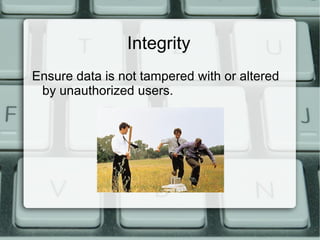
Integrity Ensure data is not tampered with or altered by unauthorized users.
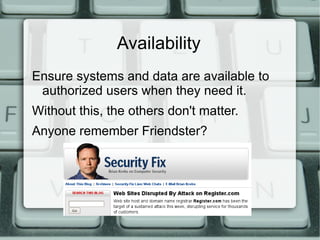
Availability Ensure systems and data are available to authorized users when they need it.
Without this, the others don't matter.
Anyone remember Friendster?
Vulnerabilities
Vulnerabilities A  vulnerability  is an error made in a program, causing unintended behavior of the program in a way that affects security negatively. FIRST defines a vulnerability as: “a bug, flaw, weakness, or exposure of an application, system, device, or service that could lead to a failure of confidentiality, integrity, or availability.”
Vulnerabilities Examples of vulnerabilities: Weak passwords
Insecure permissions
Directory traversal
Buffer overflows
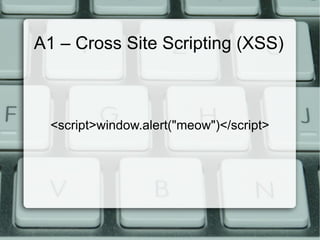
Cross-site scripting and request forgery
Exploits
Exploits An  exploit  is a specific example of triggering a vulnerability. If the vulnerability is a missile, the exploit is the warhead.
Exploits Examples of exploits: Morris Worm Almost everything at http://www.milw0rm.com/ http://www.example.com/displayfile.php?../../../../etc/passwd
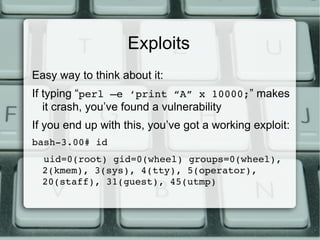
Exploits Easy way to think about it: If typing “ perl –e ‘print “A” x 10000; ” makes it crash, you’ve found a vulnerability If you end up with this, you’ve got a working exploit: bash-3.00# id uid=0(root) gid=0(wheel) groups=0(wheel), 2(kmem), 3(sys), 4(tty), 5(operator), 20(staff), 31(guest), 45(utmp)
The Security Mindset How many security features are there in a grocery store self-check-out?
How can you break each of them?
What did they forget to think of?
Bruce Schneier on the mindset:  http://tinyurl.com/2sj365
The Security Mindset How many of you opened that tinyurl? What if I'd just dropped a Firefox 0-day on you?
I didn't, don't worry. That would get me fired.
This is why I suck at programming
Finding Balance “Not all "harmless failures" lead to big trouble, but it's surprising how often a clever adversary can pile up a stack of seemingly harmless failures into a dangerous tower of trouble. Harmless failures are bad hygiene. We try to stamp them out when we can.” – Ed Felten, Freedom to Tinker http://preview.tinyurl.com/c6ewzv
Security Architecture The OWASP Secure Coding Principles puts it thus: “ Security architecture starts on the day the business requirements are modeled, and never finish until the last copy of your application is decommissioned. Security is a life-long process, not a one shot accident.” http://www.owasp.org/index.php/Secure_Coding_Principles
Right from the Start When starting a new application or re-factoring an existing application, you should consider each functional feature, and consider: Is the process surrounding this feature as safe as possible? In other words, is this a flawed process?
If I were evil, how would I abuse this feature?
Is the feature required to be on by default? If so, are there limits or options that could help reduce the risk from this feature?
(also from OWASP)
Security in the Bones Software design, as well as implementation, must consider the three pillars of information security. Otherwise, you're going to fail.
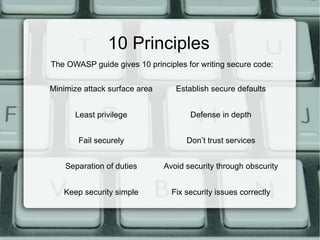
10 Principles Minimize attack surface area Establish secure defaults Least privilege Defense in depth Fail securely Don’t trust services Separation of duties Avoid security through obscurity Keep security simple Fix security issues correctly The OWASP guide gives 10 principles for writing secure code:
10 Principles Minimize attack surface area
Give the attacker the absolute minimum possible to work with when trying to discover an attack. By reducing complexity of an application, the number of possible vulnerabilities is also reduced.
Establish secure defaults
If a variable level of security is desired, have the default be high, and leave it up to the user to make the decision to lower it. This prevents “out of the box” insecurities.
10 Principles Least privilege
Any component of a system should have only as much privilege as necessary to function properly. This is best known for permissions on user accounts, but also applies to software components.
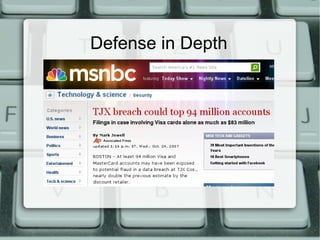
Defense in depth
Adding on more security methods is a good thing, but they must approach the problem in different ways.

Break it while you make it: writing (more) secure software

  • 1.
    Break it whileyou make it writing (more) secure software Leigh Honeywell HackLab.to [email_address] http://twitter.com/hypatiadotca
  • 2.
    About Me Co-Founderand Board Member of HackLab.TO
  • 3.
    Advisor to theSecTor Security Conference
  • 4.
    U of Tstudent
  • 5.
    Malware Operations Engineerat a major anti-virus vendor (who I am not speaking as a representative of)
  • 6.
    Why I'm hereTo talk about the core security principles developers need to know
  • 7.
    To get youthinking like the people who will try to break your app
  • 8.
    To show somenifty tools
  • 9.
    Maybe to scareyou a little?
  • 10.
    To get youbreaking your own apps :)
  • 11.
    #3hotsecurewords There arethree core “pillars” of information security: Confidentiality
  • 12.
  • 13.
  • 14.
    Confidentiality Only allowaccess to data for which the user is permitted.
  • 15.
    The user maynot be permitted anything!
  • 16.
    Sometimes called secrecy or privacy
  • 17.
    There are realconsequences for failing at this – PIPEDA, HIPAA, PCI-DSS, and various other acronyms.
  • 18.
    Integrity Ensure datais not tampered with or altered by unauthorized users.
  • 19.
    Availability Ensure systemsand data are available to authorized users when they need it.
  • 20.
    Without this, theothers don't matter.
  • 21.
  • 22.
  • 23.
    Vulnerabilities A vulnerability is an error made in a program, causing unintended behavior of the program in a way that affects security negatively. FIRST defines a vulnerability as: “a bug, flaw, weakness, or exposure of an application, system, device, or service that could lead to a failure of confidentiality, integrity, or availability.”
  • 24.
    Vulnerabilities Examples ofvulnerabilities: Weak passwords
  • 25.
  • 26.
  • 27.
  • 28.
    Cross-site scripting andrequest forgery
  • 29.
  • 30.
    Exploits An exploit is a specific example of triggering a vulnerability. If the vulnerability is a missile, the exploit is the warhead.
  • 31.
    Exploits Examples ofexploits: Morris Worm Almost everything at http://www.milw0rm.com/ http://www.example.com/displayfile.php?../../../../etc/passwd
  • 32.
    Exploits Easy wayto think about it: If typing “ perl –e ‘print “A” x 10000; ” makes it crash, you’ve found a vulnerability If you end up with this, you’ve got a working exploit: bash-3.00# id uid=0(root) gid=0(wheel) groups=0(wheel), 2(kmem), 3(sys), 4(tty), 5(operator), 20(staff), 31(guest), 45(utmp)
  • 33.
    The Security MindsetHow many security features are there in a grocery store self-check-out?
  • 34.
    How can youbreak each of them?
  • 35.
    What did theyforget to think of?
  • 36.
    Bruce Schneier onthe mindset: http://tinyurl.com/2sj365
  • 37.
    The Security MindsetHow many of you opened that tinyurl? What if I'd just dropped a Firefox 0-day on you?
  • 38.
    I didn't, don'tworry. That would get me fired.
  • 39.
    This is whyI suck at programming
  • 40.
    Finding Balance “Notall "harmless failures" lead to big trouble, but it's surprising how often a clever adversary can pile up a stack of seemingly harmless failures into a dangerous tower of trouble. Harmless failures are bad hygiene. We try to stamp them out when we can.” – Ed Felten, Freedom to Tinker http://preview.tinyurl.com/c6ewzv
  • 41.
    Security Architecture TheOWASP Secure Coding Principles puts it thus: “ Security architecture starts on the day the business requirements are modeled, and never finish until the last copy of your application is decommissioned. Security is a life-long process, not a one shot accident.” http://www.owasp.org/index.php/Secure_Coding_Principles
  • 42.
    Right from theStart When starting a new application or re-factoring an existing application, you should consider each functional feature, and consider: Is the process surrounding this feature as safe as possible? In other words, is this a flawed process?
  • 43.
    If I wereevil, how would I abuse this feature?
  • 44.
    Is the featurerequired to be on by default? If so, are there limits or options that could help reduce the risk from this feature?
  • 45.
  • 46.
    Security in theBones Software design, as well as implementation, must consider the three pillars of information security. Otherwise, you're going to fail.
  • 47.
    10 Principles Minimizeattack surface area Establish secure defaults Least privilege Defense in depth Fail securely Don’t trust services Separation of duties Avoid security through obscurity Keep security simple Fix security issues correctly The OWASP guide gives 10 principles for writing secure code:
  • 48.
    10 Principles Minimizeattack surface area
  • 49.
    Give the attackerthe absolute minimum possible to work with when trying to discover an attack. By reducing complexity of an application, the number of possible vulnerabilities is also reduced.
  • 50.
  • 51.
    If a variablelevel of security is desired, have the default be high, and leave it up to the user to make the decision to lower it. This prevents “out of the box” insecurities.
  • 52.
  • 53.
    Any component ofa system should have only as much privilege as necessary to function properly. This is best known for permissions on user accounts, but also applies to software components.
  • 54.
  • 55.
    Adding on moresecurity methods is a good thing, but they must approach the problem in different ways.