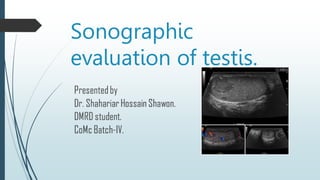
Sonographic
evaluation of testis.
Testis.
The testes (singular: testis), also known as the
testicles, are the male gonads and are
contained within the scrotum. The testes are
responsible for the production of sperm and
testosterone.
Normal adult testes are ovoid in shape.
Testes develop in the abdomen and move
before birth into the scrotum.
The left testis usually lower then the right.
Normal adult testes are ovoid.
 Measure approximately 3.75 cm long x
2.5 cm broad x 2 cm thick, with a volume
of 12-18 mL. weights about 10-15 grams.
 The size of the testes decreases with
age.
At birth, testes measure approximately
1.5 cm (length) x 1 cm (width), reaching
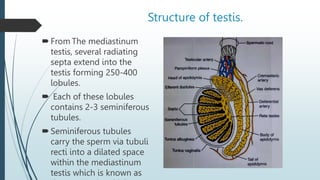
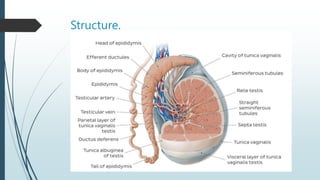
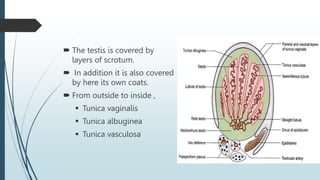
Structure of testis.
From The mediastinum
testis, several radiating
septa extend into the
testis forming 250-400
lobules.
 Each of these lobules
contains 2-3 seminiferous
tubules.
Seminiferous tubules
carry the sperm via tubuli
recti into a dilated space
within the mediastinum
testis which is known as
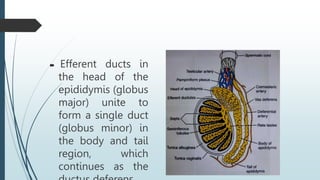
 Efferent ducts in
the head of the
epididymis (globus
major) unite to
form a single duct
(globus minor) in
the body and tail
region, which
continues as the
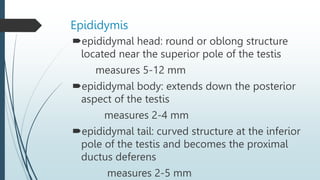
Epididymis
epididymal head: round or oblong structure
located near the superior pole of the testis
measures 5-12 mm
epididymal body: extends down the posterior
aspect of the testis
measures 2-4 mm
epididymal tail: curved structure at the inferior
pole of the testis and becomes the proximal
ductus deferens
measures 2-5 mm
Structure.
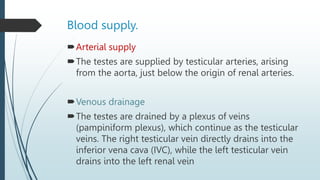
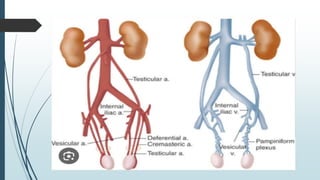
Blood supply.
Arterial supply
The testes are supplied by testicular arteries, arising
from the aorta, just below the origin of renal arteries.
Venous drainage
The testes are drained by a plexus of veins
(pampiniform plexus), which continue as the testicular
veins. The right testicular vein directly drains into the
inferior vena cava (IVC), while the left testicular vein
drains into the left renal vein
 The testis is covered by
layers of scrotum.
 In addition it is also covered
by here its own coats.
 From outside to inside ,
 Tunica vaginalis
 Tunica albuginea
 Tunica vasculosa
Ultrasound
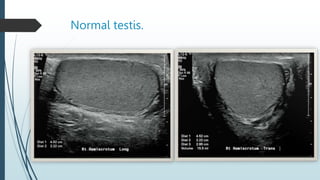
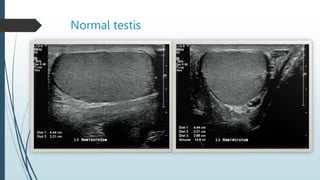
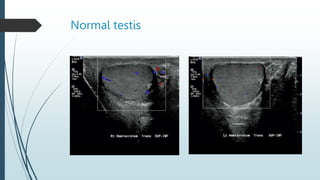
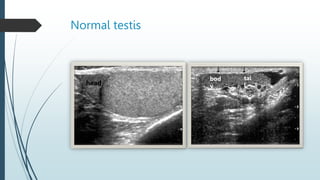
The normal testes have a homogeneous,
moderately echogenic pattern.
 A testis is surrounded by a thin echogenic
fibrous band, which represents the visceral
component of the tunica vaginalis and the tunica
albuginea.
 In the absence of intrascrotal fluid, the tunica is
usually visualized only at its hilum as an
echogenic structure, where it invaginates into the
testis, to form the mediastinum testis.
 epididymal head: round or oblong structure
located near the superior pole of the testis
Technique
A high-frequency transducer (14-18 MHz) is
usually used for evaluation of the testes and
scrotum
Patient is in supine position.
Scrotum is supported on a towel laid over the
thighs , and the penis is placed on the patients
abdomen and covered with a towel.
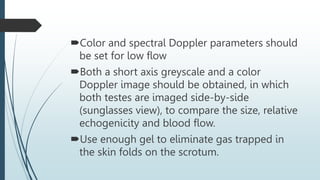
Testes should be evaluated in both long and
short axes.
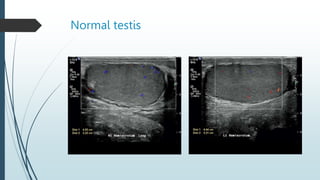
Color and spectral Doppler parameters should
be set for low flow
Both a short axis greyscale and a color
Doppler image should be obtained, in which
both testes are imaged side-by-side
(sunglasses view), to compare the size, relative
echogenicity and blood flow.
Use enough gel to eliminate gas trapped in
the skin folds on the scrotum.
Normal testis.
Normal testis
Normal testis
Normal testis
Normal testis
head
bod
y
tai
l
Common testicular
pathology and USG findings.
Orchitis
Inflammation of testicle itself.
May be seen in systemic viral illness
(classically mumps) or in association with
bacterial epididymitis.
Upto 25% postpubartal male with mumps
will suffer some degree of orchitis.
It appears at 7-10 days after parotitis.
Approximately 2/3rd are unilateral.
Orchitis
In the acute phase USG may show
testicular swelling with patchy or diffuse
reduction in echogenicity.
Hypervascularity.
Following resolution the testicle may
return to normal but in severe orchitis
there may be atrophy, with reduction in
size and echogenicity.
Orchitis.
Bacterial orchitis shows similar acute
features.But marked changed in
epididymitis.
Severe orchitis may be associated with
ischemia and infarction with reduced or
absent vascularity.
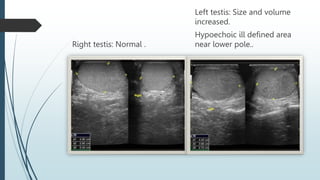
Right testis: Normal .
Left testis: Size and volume
increased.
Hypoechoic ill defined area
near lower pole..
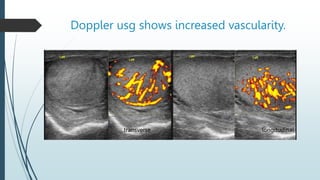
Doppler usg shows increased vascularity.
transverse longitudinal
Torsion
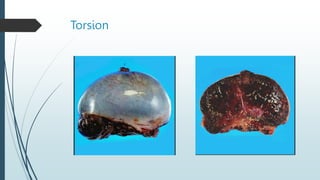
Testicular torsion ,in this condition the
spermatic cord became twisted as a result of
testicular rotation, producing testicular
ischemia.
It may occur at any age but in most frequent
in the first year of life or in adolescence.
Torsion
Torsion
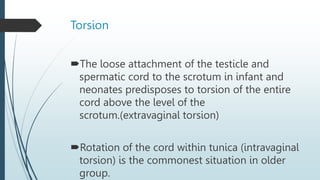
The loose attachment of the testicle and
spermatic cord to the scrotum in infant and
neonates predisposes to torsion of the entire
cord above the level of the
scrotum.(extravaginal torsion)
Rotation of the cord within tunica (intravaginal
torsion) is the commonest situation in older
group.
Torsion
Poor testicular
attachment to the post
scrotal wall by an
abnormally narrow
mesentery , which
predisposes to rotation
of the cord. This
anatomical situation
has been referred to as
the bell-and-clapper
malformation and may
USG findings of torsion.
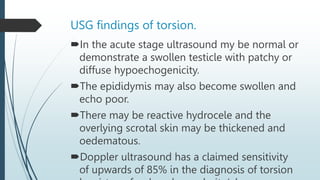
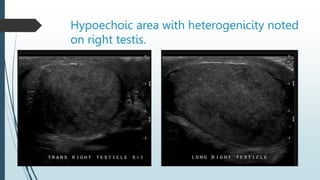
In the acute stage ultrasound my be normal or
demonstrate a swollen testicle with patchy or
diffuse hypoechogenicity.
The epididymis may also become swollen and
echo poor.
There may be reactive hydrocele and the
overlying scrotal skin may be thickened and
oedematous.
Doppler ultrasound has a claimed sensitivity
of upwards of 85% in the diagnosis of torsion
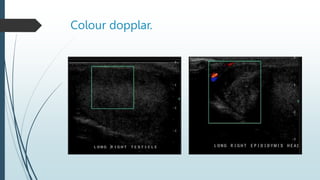
Hypoechoic area with heterogenicity noted
on right testis.
Colour dopplar.
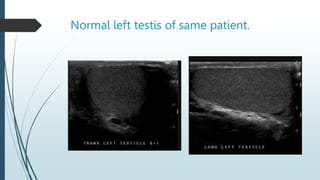
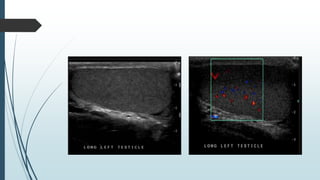
Normal left testis of same patient.
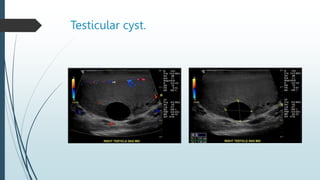
Testicular cyst.
Testicular cyst as with cysts elsewhere in
the body.
Testicular cysts are well defined, thin
walled and anechoic on ultrasound,
sometimes with distal acoustic
enhancement.
They are vary in size from a millimeter to
centimeter.
Occasionally multiple.
Cysts directly arising from the tunica
albuginea have been described with similar
features.
Testicular cysts are usually benign in nature.
Multiple small cystic areas are not infrequently
seen at the testicular hilum.
Testicular cyst.
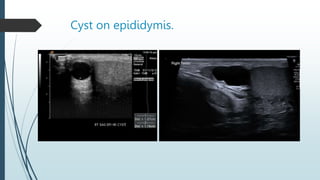
Cyst on epididymis.
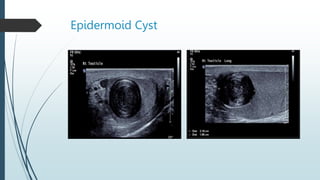
Epidermoid cyst
This uncommon benign tumours are
thought to derive from epithelial rests or
inclusions.
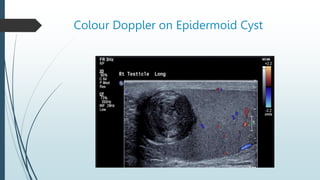
On usg ,they are well defined avascular
rounded lesions and may be solitary
,multiple or bilateral.
Calcification may be present and adopt a
variety of patterns. (multiple foci within
the cyst , curvilinear along the wall or
Epidermoid Cyst
Colour Doppler on Epidermoid Cyst
Testicular cancer.
Uncommon (1% to 2% of male cancer).
Common age 15-49 years
95% are germ cell origin, 4% lymphomas, 1%
others and metastasis.
 50% of germ cell tumours are pure
seminomas.(less aggressive and present with
older age group.
Scrotal ultrasound is the investigation of
choice,with a sensitivity approaching nearly
100%.
Tumours are seen as intratesticular lesion with
replacement of the normal architecturel
pattern by material of predominantly low
echogenicity.
Small tumours may show no mass effect.
When larger then 2-3 cm they are
associated with deformity and expansion
of outline of testicle.
The histology can not be predicted from
the ultrasound appearences, which are
usually non-specific.
Classically seminomas are well defined and
uniformly modesty echo-poor.
NSGCTs more often show significant
echogenic areas of fibrosis or calcification and
echo-free cystic areas.
Large tumours may show increased vascularity
on colour flow Doppler. Smaller ones are more
often hypovascular.
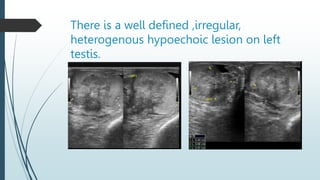
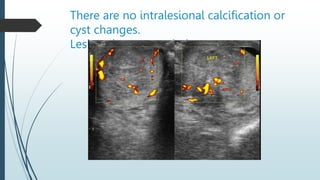
There is a well defined ,irregular,
heterogenous hypoechoic lesion on left
testis.
There are no intralesional calcification or
cyst changes.
Lesion shows vascularity.
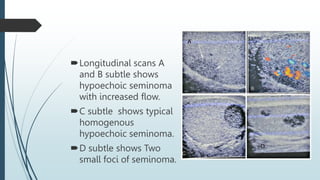
Longitudinal scans A
and B subtle shows
hypoechoic seminoma
with increased flow.
C subtle shows typical
homogenous
hypoechoic seminoma.
D subtle shows Two
small foci of seminoma.
A
D
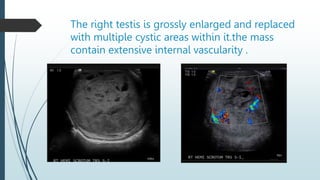
The right testis is grossly enlarged and replaced
with multiple cystic areas within it.the mass
contain extensive internal vascularity .
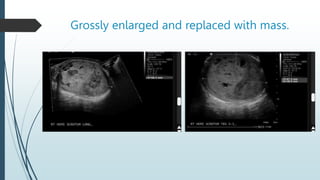
Grossly enlarged and replaced with mass.
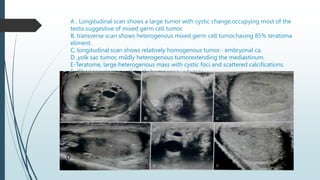
A , Longitudinal scan shows a large tumor with cystic change,occupying most of the
testis.suggestive of mixed germ cell tumor.
B, transverse scan shows heterogenous mixed germ cell tumor,having 85% teratoma
eliment.
C, longitudinal scan shows relatively homogenous tumor.- embryonal ca.
D ,yolk sac tumor, mildly heterogenous tumorextending the mediastinum.
E-Teratome, large heterogenous mass with cystic foci and scattered calcifications.
F- Choriocarcinoma ,relatively homogenous tumor.
A
D
Common extra testicular scrotal disorders.
Hydeocele
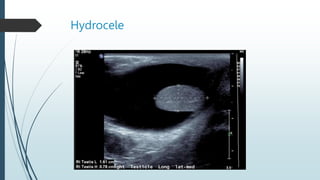
A hydrocele is the formation of fluid between
the two layers of tunica vaginalis.
Ultrasonographically it is seen as echo-free
area partly surrounding the testicle.
It may develop from
,trauma,infection,malignancy,infarction,etc.
Hydrocele
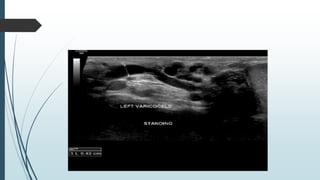
Varicocele
Dilatation of the network of veins draining the
testicle is described as a varicocele.
They are extremely common.
Usually asymptomatic.
Most frequent between 15 and 25 years of
age.
Almost always left sided
When symptomatic, present with scrotal
aching and/or soft mass.
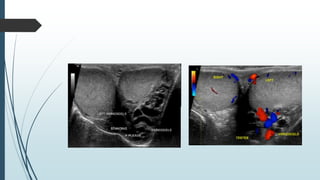
On ultrasound varicoceles are seen as a leash
of predominantly echo-free serpiginous
structures measuring more then 2mm
maximum diameter.
Visible flow may be seen within large
varicoceles on conventional ultrasound.
 Evaluation
 Baseline greyscale study in supine position and
measure the diameters of veins, as well as the total
diameter of the plexus.
 Next do colour Doppler interrogation and see reflux
during valsalva manoeuvre.
 Repeat in standing position.
Grading of varicocele
Grading of varicocele
 Grade 1 – No dilated intrascrotal veins. Reflux in
spermatic cord veins of the inguinal region during
valsalva manoeuvre.
 Grade 2 – Prominent veins at upper pole of testis.
Reflux at upper pole veins during valsalva
manoeuvre.
 Geade 3 – No major dilatation in supine position.
Dilated veins up to lower pole of testis seen only in
standing position. Reflux at lower pole veins during
valsalva manoeuvre.
 Grade 4 – dilated veins ever in supine position. Reflux
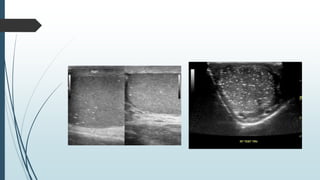
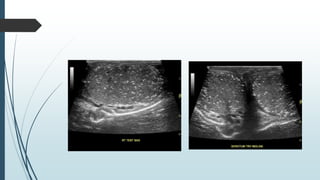
Testicular microlithiasis
 This is a condition in which calcifications are present within
the seminiferous tubules of the testis either unilaterally or
bilaterally.
 Caused by defective sertoli cell phagocytosis of degenerating
tubular cells, which then calcify within seminiferous tubules.
 1%-2% testicular sonography shows microlithiasis.
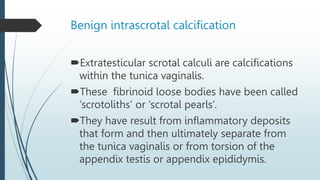
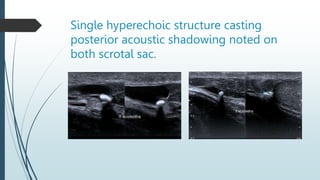
Benign intrascrotal calcification
Extratesticular scrotal calculi are calcifications
within the tunica vaginalis.
These fibrinoid loose bodies have been called
‘scrotoliths’ or ‘scrotal pearls’.
They have result from inflammatory deposits
that form and then ultimately separate from
the tunica vaginalis or from torsion of the
appendix testis or appendix epididymis.
Single hyperechoic structure casting
posterior acoustic shadowing noted on
both scrotal sac.
Sources of information and images-
 Textbook of Radiology and Imaging by David Sutton 7th
edition.
 Diagnostic ultrasound by Carol M. Rumack 5th edition
 Chaurasia’s Human Anatomy, 5th edition.
 www.radiopaedia.org
ThankYouAll

testis presentation.pptx by dr. shahariar hossain

  • 1.
  • 2.
    Testis. The testes (singular:testis), also known as the testicles, are the male gonads and are contained within the scrotum. The testes are responsible for the production of sperm and testosterone. Normal adult testes are ovoid in shape. Testes develop in the abdomen and move before birth into the scrotum. The left testis usually lower then the right.
  • 3.
    Normal adult testesare ovoid.  Measure approximately 3.75 cm long x 2.5 cm broad x 2 cm thick, with a volume of 12-18 mL. weights about 10-15 grams.  The size of the testes decreases with age. At birth, testes measure approximately 1.5 cm (length) x 1 cm (width), reaching
  • 4.
    Structure of testis. FromThe mediastinum testis, several radiating septa extend into the testis forming 250-400 lobules.  Each of these lobules contains 2-3 seminiferous tubules. Seminiferous tubules carry the sperm via tubuli recti into a dilated space within the mediastinum testis which is known as
  • 5.
     Efferent ductsin the head of the epididymis (globus major) unite to form a single duct (globus minor) in the body and tail region, which continues as the
  • 6.
    Epididymis epididymal head: roundor oblong structure located near the superior pole of the testis measures 5-12 mm epididymal body: extends down the posterior aspect of the testis measures 2-4 mm epididymal tail: curved structure at the inferior pole of the testis and becomes the proximal ductus deferens measures 2-5 mm
  • 7.
  • 8.
    Blood supply. Arterial supply Thetestes are supplied by testicular arteries, arising from the aorta, just below the origin of renal arteries. Venous drainage The testes are drained by a plexus of veins (pampiniform plexus), which continue as the testicular veins. The right testicular vein directly drains into the inferior vena cava (IVC), while the left testicular vein drains into the left renal vein
  • 10.
     The testisis covered by layers of scrotum.  In addition it is also covered by here its own coats.  From outside to inside ,  Tunica vaginalis  Tunica albuginea  Tunica vasculosa
  • 11.
    Ultrasound The normal testeshave a homogeneous, moderately echogenic pattern.  A testis is surrounded by a thin echogenic fibrous band, which represents the visceral component of the tunica vaginalis and the tunica albuginea.  In the absence of intrascrotal fluid, the tunica is usually visualized only at its hilum as an echogenic structure, where it invaginates into the testis, to form the mediastinum testis.  epididymal head: round or oblong structure located near the superior pole of the testis
  • 12.
    Technique A high-frequency transducer(14-18 MHz) is usually used for evaluation of the testes and scrotum Patient is in supine position. Scrotum is supported on a towel laid over the thighs , and the penis is placed on the patients abdomen and covered with a towel. Testes should be evaluated in both long and short axes.
  • 13.
    Color and spectralDoppler parameters should be set for low flow Both a short axis greyscale and a color Doppler image should be obtained, in which both testes are imaged side-by-side (sunglasses view), to compare the size, relative echogenicity and blood flow. Use enough gel to eliminate gas trapped in the skin folds on the scrotum.
  • 14.
  • 15.
  • 16.
  • 17.
  • 18.
  • 19.
  • 20.
    Orchitis Inflammation of testicleitself. May be seen in systemic viral illness (classically mumps) or in association with bacterial epididymitis. Upto 25% postpubartal male with mumps will suffer some degree of orchitis. It appears at 7-10 days after parotitis. Approximately 2/3rd are unilateral.
  • 21.
    Orchitis In the acutephase USG may show testicular swelling with patchy or diffuse reduction in echogenicity. Hypervascularity. Following resolution the testicle may return to normal but in severe orchitis there may be atrophy, with reduction in size and echogenicity.
  • 22.
    Orchitis. Bacterial orchitis showssimilar acute features.But marked changed in epididymitis. Severe orchitis may be associated with ischemia and infarction with reduced or absent vascularity.
  • 23.
    Right testis: Normal. Left testis: Size and volume increased. Hypoechoic ill defined area near lower pole..
  • 24.
    Doppler usg showsincreased vascularity. transverse longitudinal
  • 25.
    Torsion Testicular torsion ,inthis condition the spermatic cord became twisted as a result of testicular rotation, producing testicular ischemia. It may occur at any age but in most frequent in the first year of life or in adolescence.
  • 26.
  • 27.
    Torsion The loose attachmentof the testicle and spermatic cord to the scrotum in infant and neonates predisposes to torsion of the entire cord above the level of the scrotum.(extravaginal torsion) Rotation of the cord within tunica (intravaginal torsion) is the commonest situation in older group.
  • 28.
    Torsion Poor testicular attachment tothe post scrotal wall by an abnormally narrow mesentery , which predisposes to rotation of the cord. This anatomical situation has been referred to as the bell-and-clapper malformation and may
  • 29.
    USG findings oftorsion. In the acute stage ultrasound my be normal or demonstrate a swollen testicle with patchy or diffuse hypoechogenicity. The epididymis may also become swollen and echo poor. There may be reactive hydrocele and the overlying scrotal skin may be thickened and oedematous. Doppler ultrasound has a claimed sensitivity of upwards of 85% in the diagnosis of torsion
  • 30.
    Hypoechoic area withheterogenicity noted on right testis.
  • 31.
  • 32.
    Normal left testisof same patient.
  • 35.
    Testicular cyst. Testicular cystas with cysts elsewhere in the body. Testicular cysts are well defined, thin walled and anechoic on ultrasound, sometimes with distal acoustic enhancement. They are vary in size from a millimeter to centimeter. Occasionally multiple.
  • 36.
    Cysts directly arisingfrom the tunica albuginea have been described with similar features. Testicular cysts are usually benign in nature. Multiple small cystic areas are not infrequently seen at the testicular hilum.
  • 37.
  • 38.
  • 39.
    Epidermoid cyst This uncommonbenign tumours are thought to derive from epithelial rests or inclusions. On usg ,they are well defined avascular rounded lesions and may be solitary ,multiple or bilateral. Calcification may be present and adopt a variety of patterns. (multiple foci within the cyst , curvilinear along the wall or
  • 40.
  • 41.
    Colour Doppler onEpidermoid Cyst
  • 42.
    Testicular cancer. Uncommon (1%to 2% of male cancer). Common age 15-49 years 95% are germ cell origin, 4% lymphomas, 1% others and metastasis.  50% of germ cell tumours are pure seminomas.(less aggressive and present with older age group.
  • 43.
    Scrotal ultrasound isthe investigation of choice,with a sensitivity approaching nearly 100%. Tumours are seen as intratesticular lesion with replacement of the normal architecturel pattern by material of predominantly low echogenicity. Small tumours may show no mass effect.
  • 44.
    When larger then2-3 cm they are associated with deformity and expansion of outline of testicle. The histology can not be predicted from the ultrasound appearences, which are usually non-specific.
  • 45.
    Classically seminomas arewell defined and uniformly modesty echo-poor. NSGCTs more often show significant echogenic areas of fibrosis or calcification and echo-free cystic areas. Large tumours may show increased vascularity on colour flow Doppler. Smaller ones are more often hypovascular.
  • 46.
    There is awell defined ,irregular, heterogenous hypoechoic lesion on left testis.
  • 47.
    There are nointralesional calcification or cyst changes. Lesion shows vascularity.
  • 48.
    Longitudinal scans A andB subtle shows hypoechoic seminoma with increased flow. C subtle shows typical homogenous hypoechoic seminoma. D subtle shows Two small foci of seminoma. A D
  • 49.
    The right testisis grossly enlarged and replaced with multiple cystic areas within it.the mass contain extensive internal vascularity .
  • 50.
    Grossly enlarged andreplaced with mass.
  • 51.
    A , Longitudinalscan shows a large tumor with cystic change,occupying most of the testis.suggestive of mixed germ cell tumor. B, transverse scan shows heterogenous mixed germ cell tumor,having 85% teratoma eliment. C, longitudinal scan shows relatively homogenous tumor.- embryonal ca. D ,yolk sac tumor, mildly heterogenous tumorextending the mediastinum. E-Teratome, large heterogenous mass with cystic foci and scattered calcifications. F- Choriocarcinoma ,relatively homogenous tumor. A D
  • 52.
    Common extra testicularscrotal disorders. Hydeocele A hydrocele is the formation of fluid between the two layers of tunica vaginalis. Ultrasonographically it is seen as echo-free area partly surrounding the testicle. It may develop from ,trauma,infection,malignancy,infarction,etc.
  • 53.
  • 54.
    Varicocele Dilatation of thenetwork of veins draining the testicle is described as a varicocele. They are extremely common. Usually asymptomatic. Most frequent between 15 and 25 years of age. Almost always left sided When symptomatic, present with scrotal aching and/or soft mass.
  • 55.
    On ultrasound varicocelesare seen as a leash of predominantly echo-free serpiginous structures measuring more then 2mm maximum diameter. Visible flow may be seen within large varicoceles on conventional ultrasound.
  • 56.
     Evaluation  Baselinegreyscale study in supine position and measure the diameters of veins, as well as the total diameter of the plexus.  Next do colour Doppler interrogation and see reflux during valsalva manoeuvre.  Repeat in standing position.
  • 57.
    Grading of varicocele Gradingof varicocele  Grade 1 – No dilated intrascrotal veins. Reflux in spermatic cord veins of the inguinal region during valsalva manoeuvre.  Grade 2 – Prominent veins at upper pole of testis. Reflux at upper pole veins during valsalva manoeuvre.  Geade 3 – No major dilatation in supine position. Dilated veins up to lower pole of testis seen only in standing position. Reflux at lower pole veins during valsalva manoeuvre.  Grade 4 – dilated veins ever in supine position. Reflux
  • 60.
    Testicular microlithiasis  Thisis a condition in which calcifications are present within the seminiferous tubules of the testis either unilaterally or bilaterally.  Caused by defective sertoli cell phagocytosis of degenerating tubular cells, which then calcify within seminiferous tubules.  1%-2% testicular sonography shows microlithiasis.
  • 63.
    Benign intrascrotal calcification Extratesticularscrotal calculi are calcifications within the tunica vaginalis. These fibrinoid loose bodies have been called ‘scrotoliths’ or ‘scrotal pearls’. They have result from inflammatory deposits that form and then ultimately separate from the tunica vaginalis or from torsion of the appendix testis or appendix epididymis.
  • 64.
    Single hyperechoic structurecasting posterior acoustic shadowing noted on both scrotal sac.
  • 65.
    Sources of informationand images-  Textbook of Radiology and Imaging by David Sutton 7th edition.  Diagnostic ultrasound by Carol M. Rumack 5th edition  Chaurasia’s Human Anatomy, 5th edition.  www.radiopaedia.org
  • 66.