TEST-DRIVEN
SOFTWARE DEVELOPMENT
JOHN BLUM
2015 JUNE 17
AGENDA
 Misconceptions
 Why Test
 Types of Tests
 What & How to Test
 Using JUnit, Mockito and MultithreadedTC
 Best Practices
 Final Thoughts
 QA
“No amount of testing can prove a software right,
but a single test can prove a software wrong.”
– Amir Ghahrai
MISCONCEPTIONS
Testing is a Quality Engineer’s (QE/SDET) job
 Quality Assurance (QA) is everyone’s responsibility
MISCONCEPTIONS
Automated tests are unnecessary if I manually test and
debug my code
 Testing is not a replacement for debuggers and other
development tools either (e.g. Profilers, FindBugs, etc)
Not possible to automate all tests
 Difficult when the software architecture & design is flawed
Developer tests are “Unit Tests”
JUnit is a “Unit Test” framework
 JUnit is a framework facilitating the development and
execution of automated tests
 Used in Integration and Functional (Acceptance) testing
MISCONCEPTIONS
Software is correct when there is 100% test coverage and no
FindBugs (CheckStyle, PMD) errors
 A bug occurs when the software fails to function properly in a
prescribed manner
 A defect occurs after the software is used in a unintentional
way and behaves unexpectedly
MISCONCEPTIONS
"Not everything that can be counted counts and not
everything that counts can be counted."
- Albert Einstein
Why do software engineers write tests?
Or…
Why don’t software engineers write tests?
TO TEST OR NOT TO TEST?
Time Constraints
 Time-based vs. Functional-based releases
 Quantity (Scope) over Quality (Less is More)
(Cultural) Responsibility
Laziness, Ignorance, Fear
 Not detail-oriented
Verifies software is behaviorally correct and functionally
complete
 “Definition of Done” (DoD)
 No “works on my box” arguments (we don’t ship your box)
Ensures functional integration
 Your code plays nicely with others
Increases regression coverage
 Tests in a suite is money in the bank; ensure what worked
yesterday, works today and will work tomorrow
WHY TEST
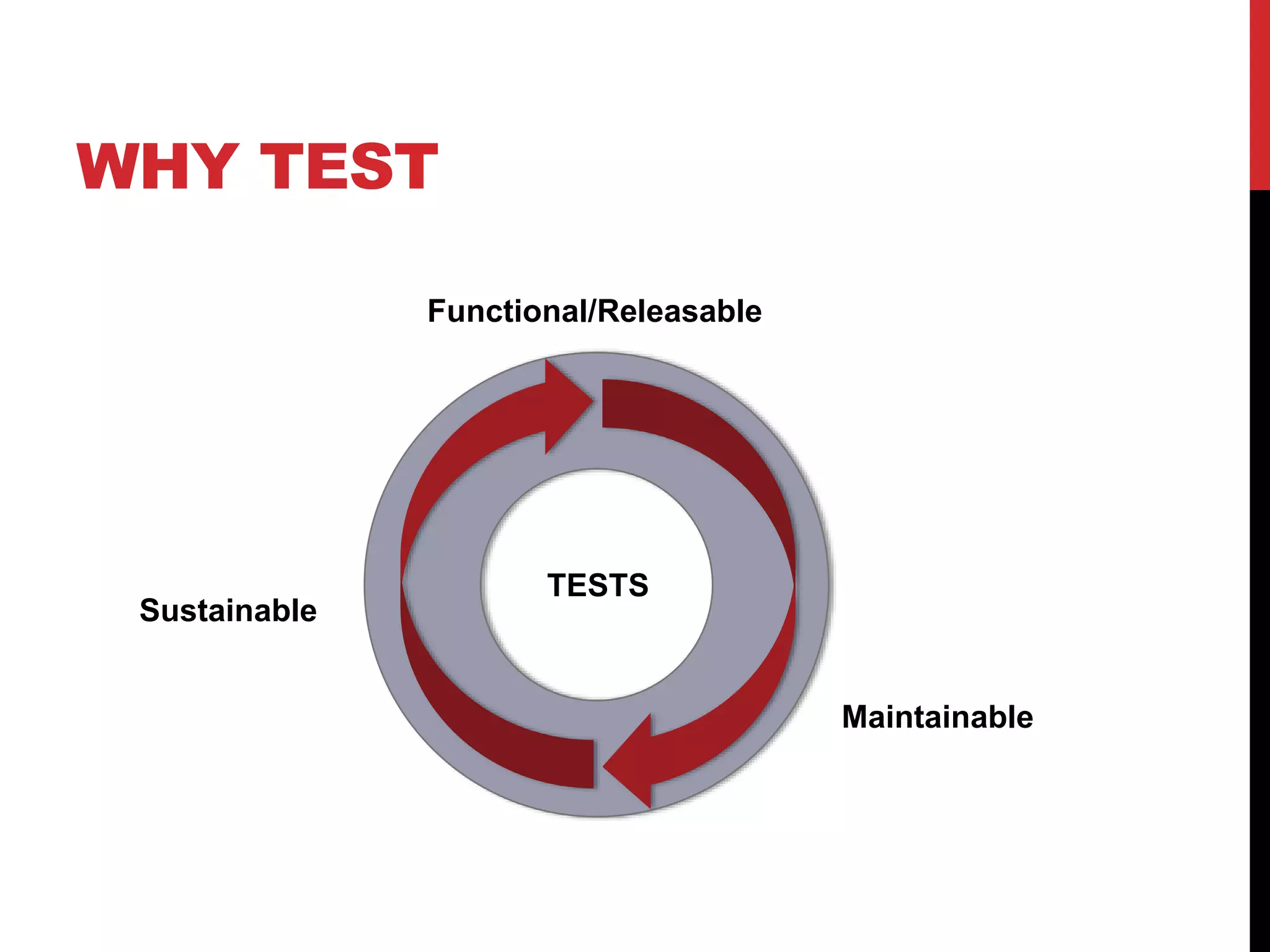
WHY TEST
Functional/Releasable
Maintainable
Sustainable
TESTS
WHY TEST
Tests are a form of feedback
 Developers get immediate feedback on changes to code by
running the test(s) to ensure the “contract is upheld”
Tests are a form of documentation
 Demonstrates how the code (e.g. API) is properly used
WHY TEST
Focus on the problem that needs to be solved
 Tests are a “contract for deliverables”; avoid “scope creep”
 Tests limits “over-engineering” (future coders)
 TDD
Testing gives developers confidence in their changes
 And more importantly… to “refactor” and make changes
 To learn
Testing encourages smaller, more frequent commits
 And by extension, “releasable” code
WHY TEST
Testing identifies design flaws
 Hard to test code is flawed and a sure sign of technical debt
Untested code triggers a domino effect
 User becomes the Tester leading to undesirable, costly
“workarounds” leading to technical debt leading to other bugs
leading to more serious issues like data corruption and so on
“Don’t be that guy!”
(the guy who doesn’t test his code)
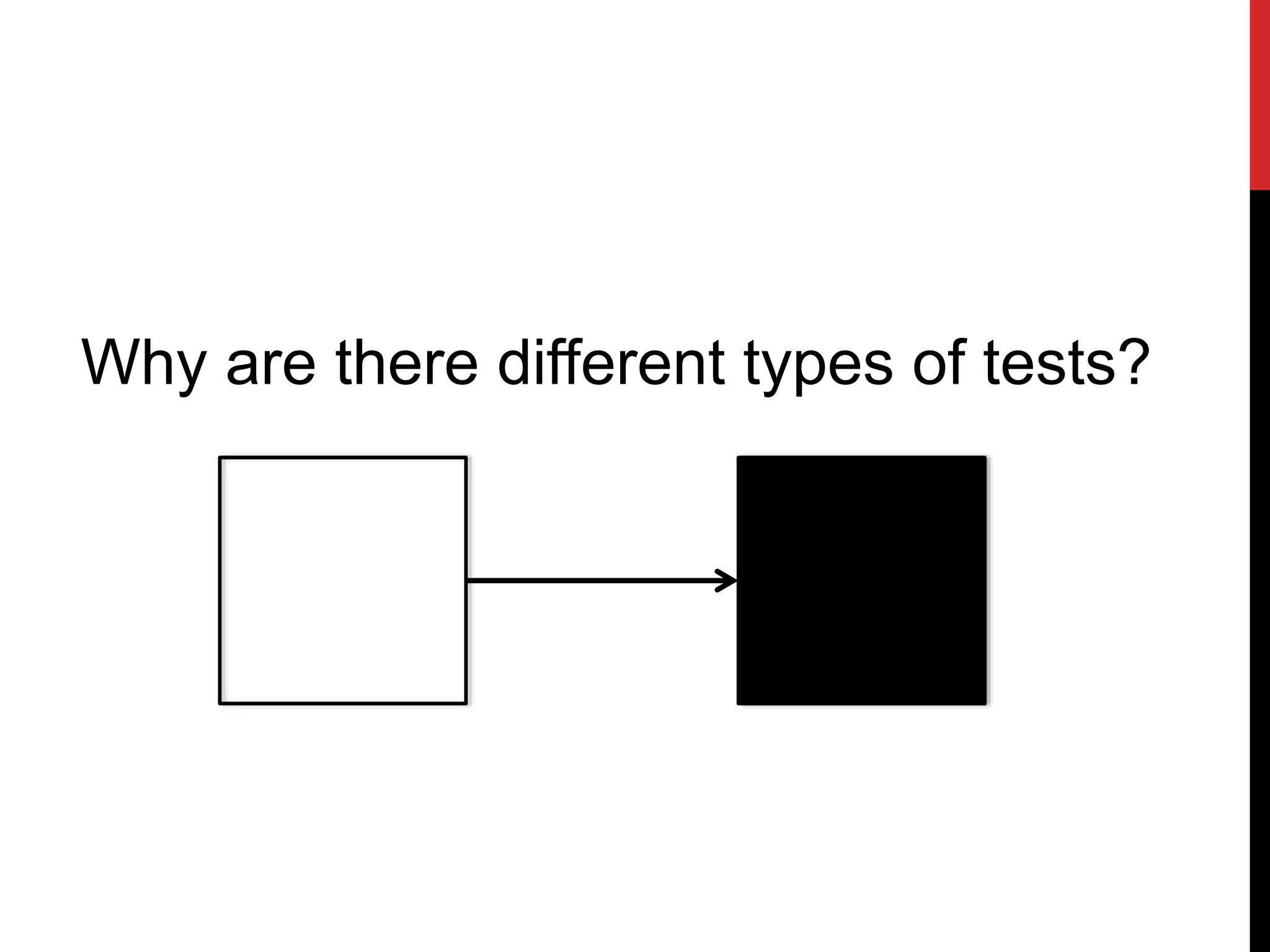
Why are there different types of tests?
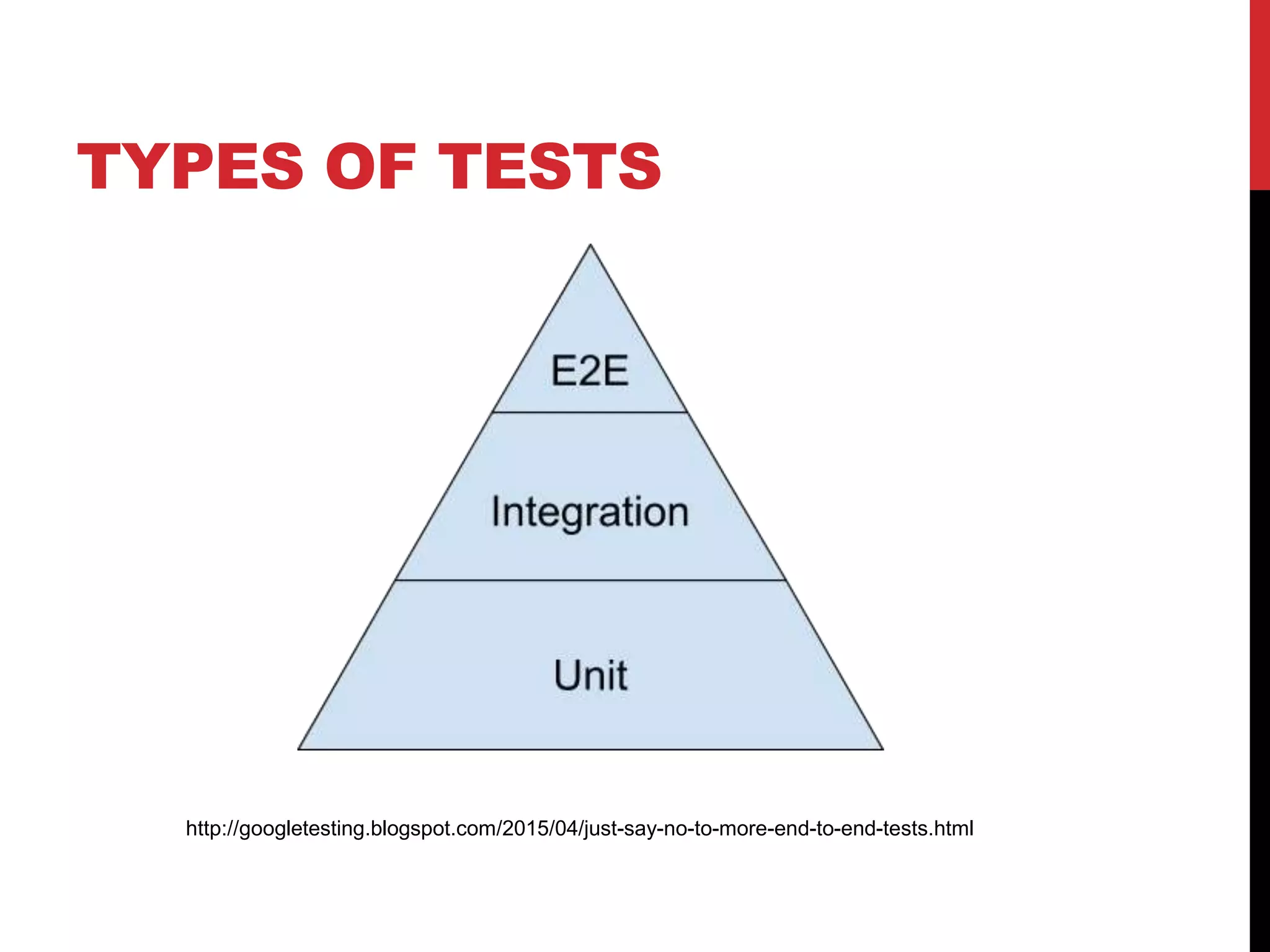
TYPES OF TESTS
Different types of tests cover different “aspects” (concerns)
of the software under test…
 Different test types serve to “close the feedback loop” at
different intervals in the software development lifecycle…
TYPES OF TESTS
Unit Tests
 Tests a single, contained “unit” of functionality
 Objects adhere to their contract (specified by the “interface”)
 Class invariants are upheld as object state changes
Integration Tests
 Tests interactions between “collaborators”
 Actual “dependencies” used
TYPES OF TESTS
Functional, Acceptance-based Tests (End-To-End)
 Tests user/software interaction based on predefined workflows
(Use Cases) and Functional Requirements
 Acceptance Tests are defined by Acceptance Criteria (based
on Functional Requirements)
 Usability Testing (UAT)
Performance-based Tests
 load/stress testing
TYPES OF TESTS
http://googletesting.blogspot.com/2015/04/just-say-no-to-more-end-to-end-tests.html
“What” and “How” do you test?
WHAT TO TEST
Test everything (or as much as you can)!
 Constructors, methods, input, output, Exception conditions, all
code paths, invariants/object state, thread safety…
 Test the unexpected
Don’t make assumptions; verify with tests
 “It is not only what you don’t know that gets you in trouble, it is
what you thought you knew that just isn’t so!”
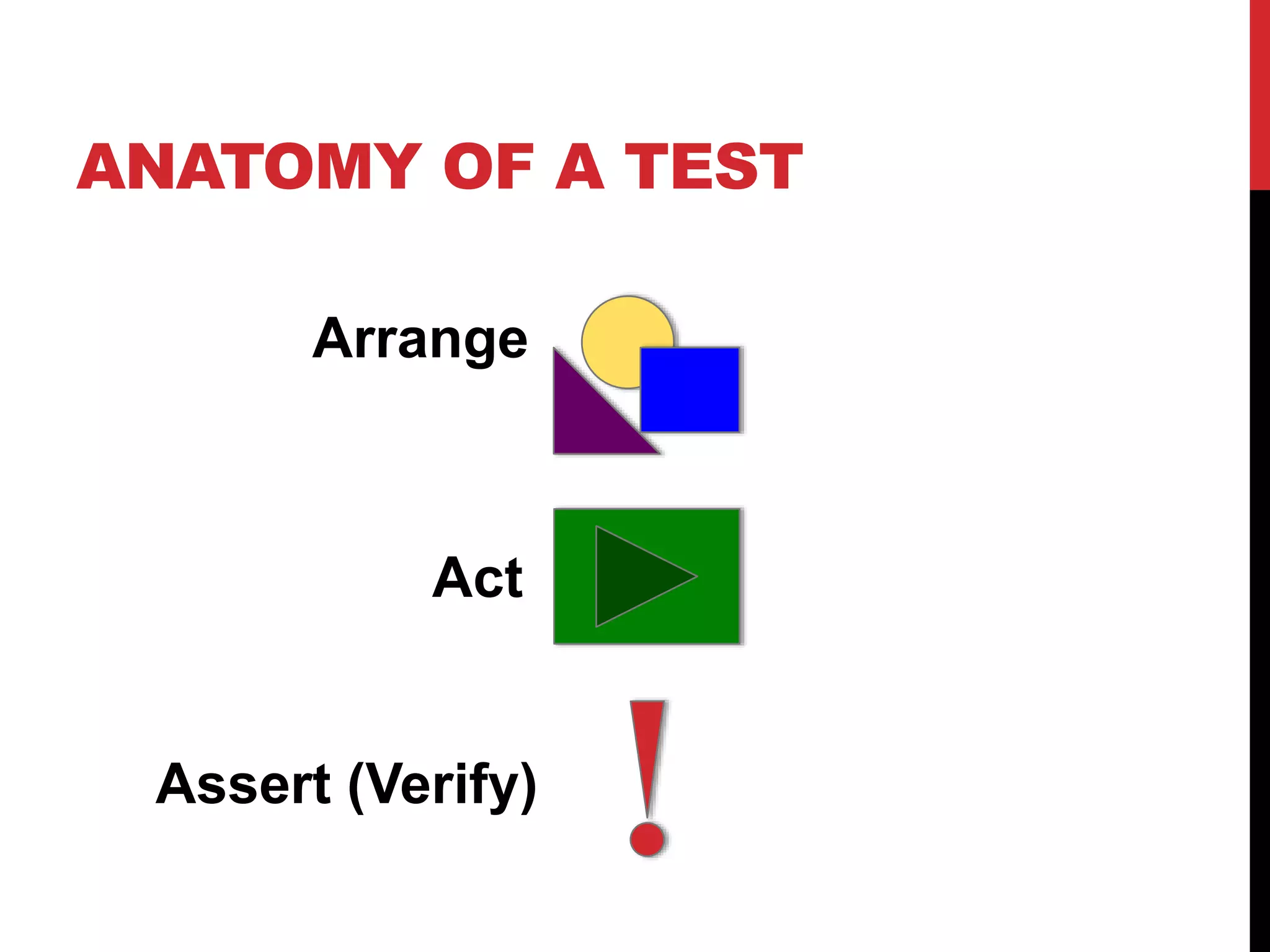
ANATOMY OF A TEST
Arrange
Act
Assert (Verify)
How-To Unit Test Demonstration
JUnit
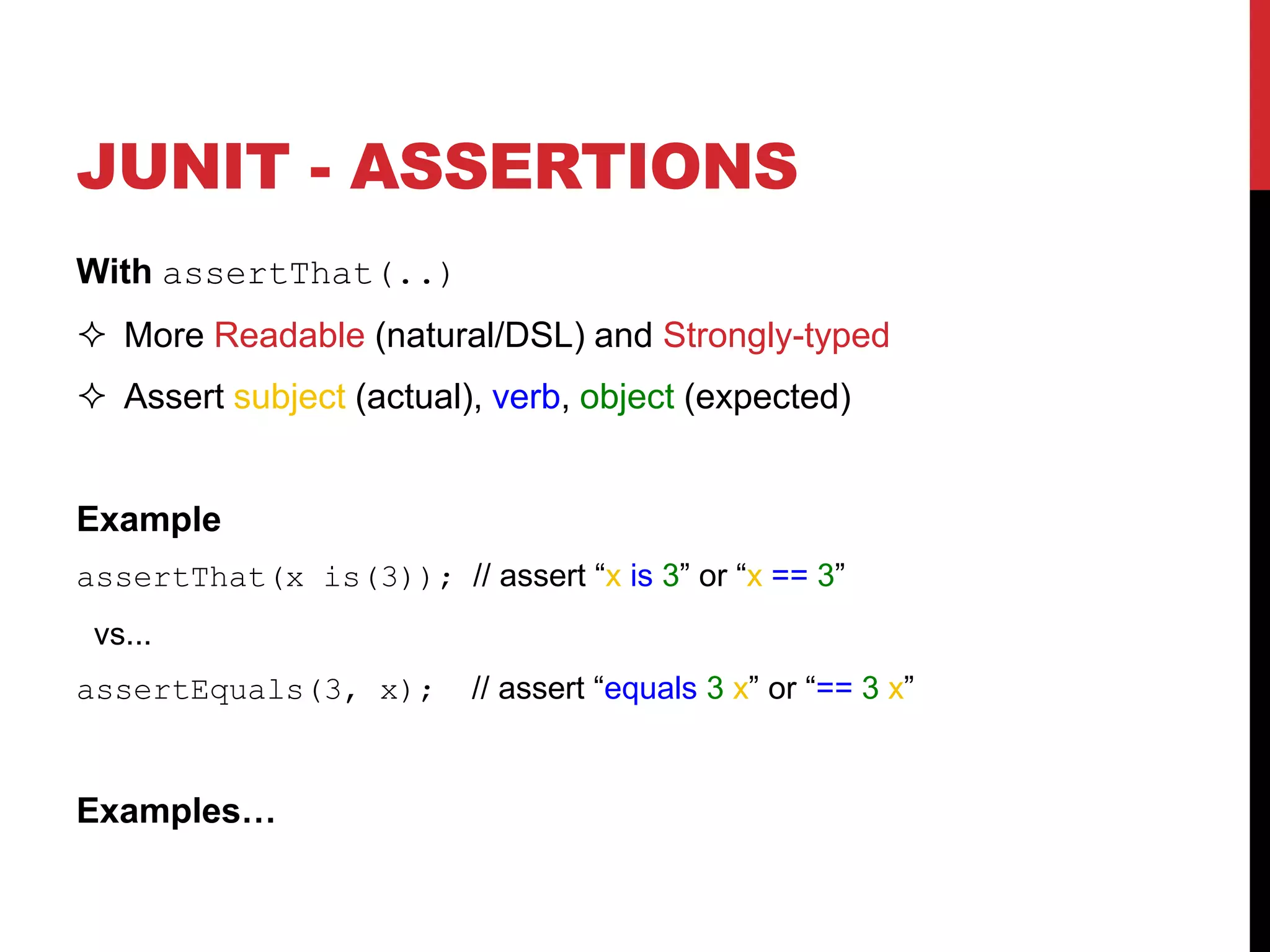
JUNIT - ASSERTIONS
With assertThat(..)
 More Readable (natural/DSL) and Strongly-typed
 Assert subject (actual), verb, object (expected)
Example
assertThat(x is(3)); // assert “x is 3” or “x == 3”
vs...
assertEquals(3, x); // assert “equals 3 x” or “== 3 x”
Examples…
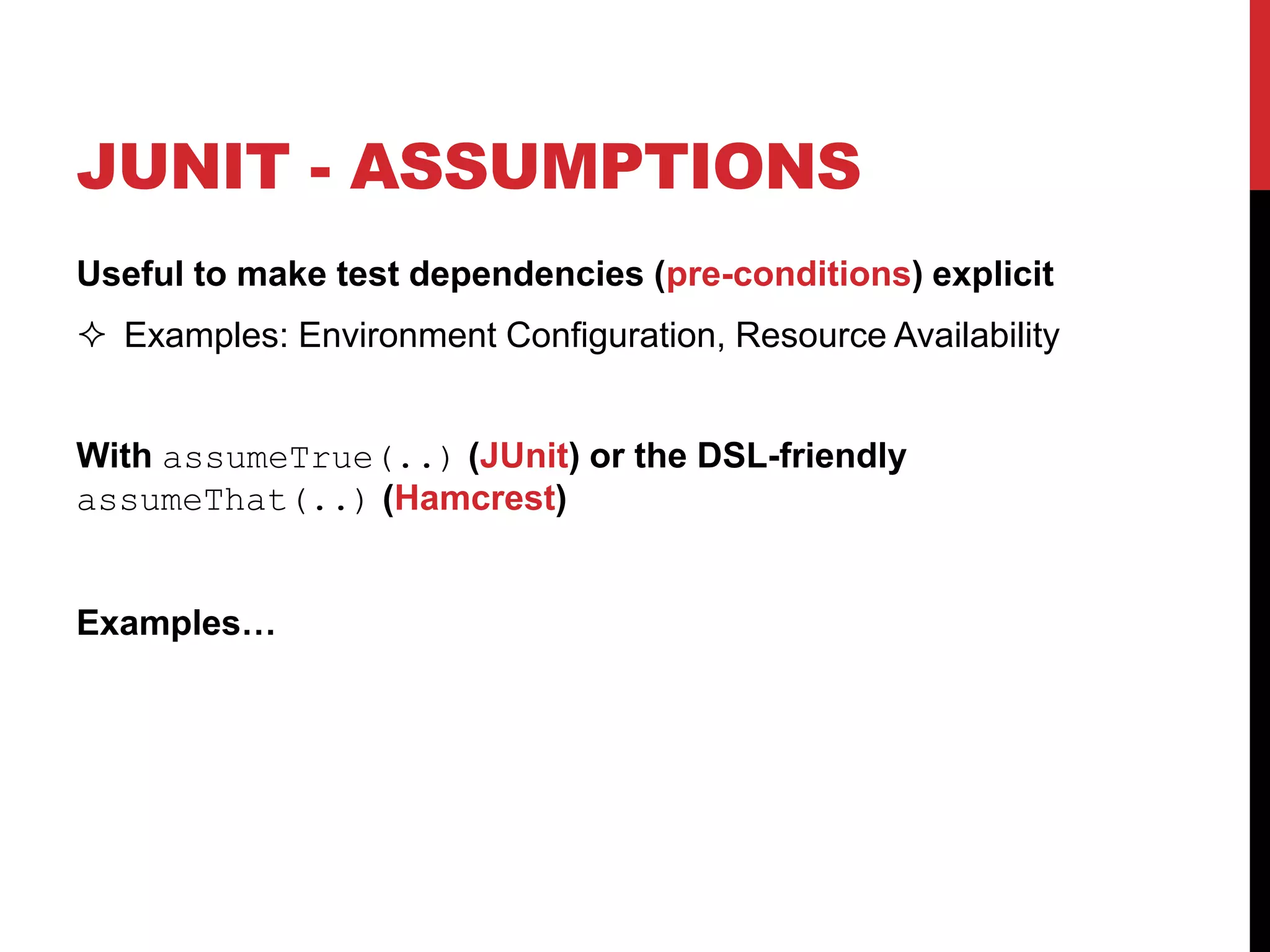
JUNIT - ASSUMPTIONS
Useful to make test dependencies (pre-conditions) explicit
 Examples: Environment Configuration, Resource Availability
With assumeTrue(..) (JUnit) or the DSL-friendly
assumeThat(..) (Hamcrest)
Examples…
JUNIT - EXCEPTIONS
With Try/Catch Idiom (JUnit 3.x)
With @Test(expected = Class<? extends Throwable>)
With ExpectedException Rule (JUnit 4)
Examples…
JUNIT - PARAMETERIZED
Parameterized test class instances created for the cross-product of test case
methods and test data elements.
 Useful for large volume of data
Run test class with the Parameterized Test Runner.
@RunWith(Parameterized.class)
public class ParameterizedTest {
@Parameters
public Iterable<Object[]> data = …;
public ParameterizedTest(..) {
}
}
Example…
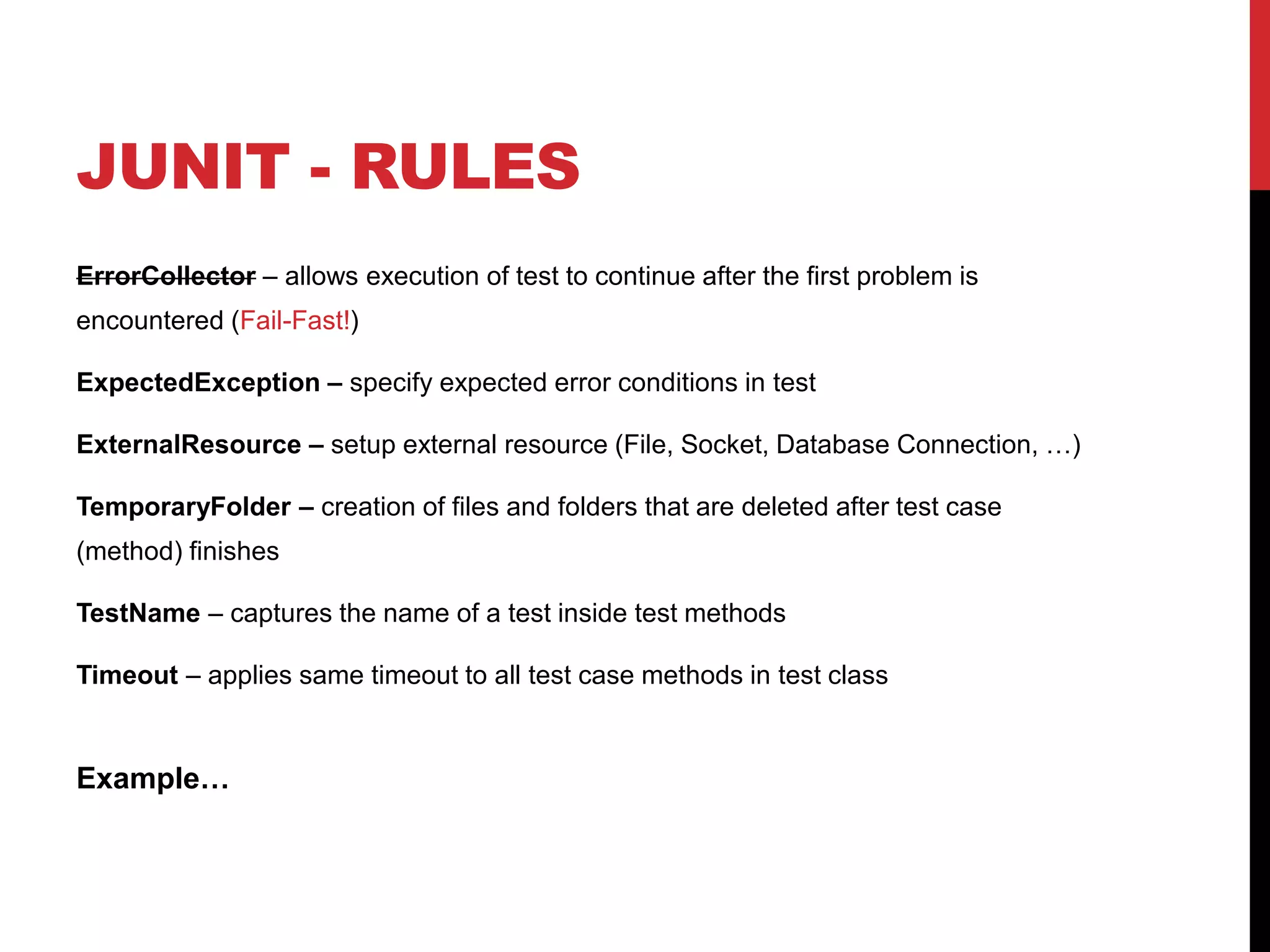
JUNIT - RULES
ErrorCollector – allows execution of test to continue after the first problem is
encountered (Fail-Fast!)
ExpectedException – specify expected error conditions in test
ExternalResource – setup external resource (File, Socket, Database Connection, …)
TemporaryFolder – creation of files and folders that are deleted after test case
(method) finishes
TestName – captures the name of a test inside test methods
Timeout – applies same timeout to all test case methods in test class
Example…
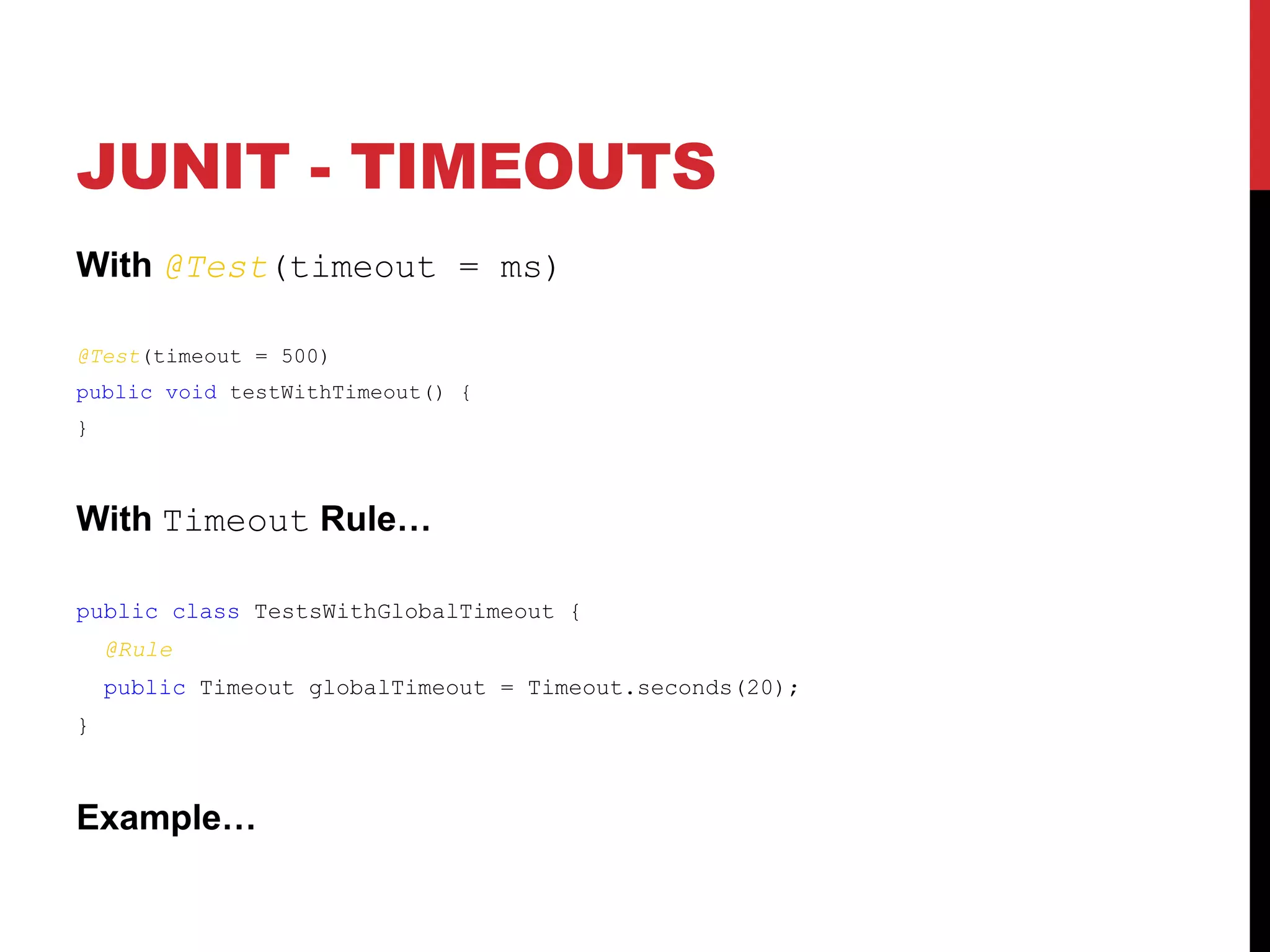
JUNIT - TIMEOUTS
With @Test(timeout = ms)
@Test(timeout = 500)
public void testWithTimeout() {
}
With Timeout Rule…
public class TestsWithGlobalTimeout {
@Rule
public Timeout globalTimeout = Timeout.seconds(20);
}
Example…
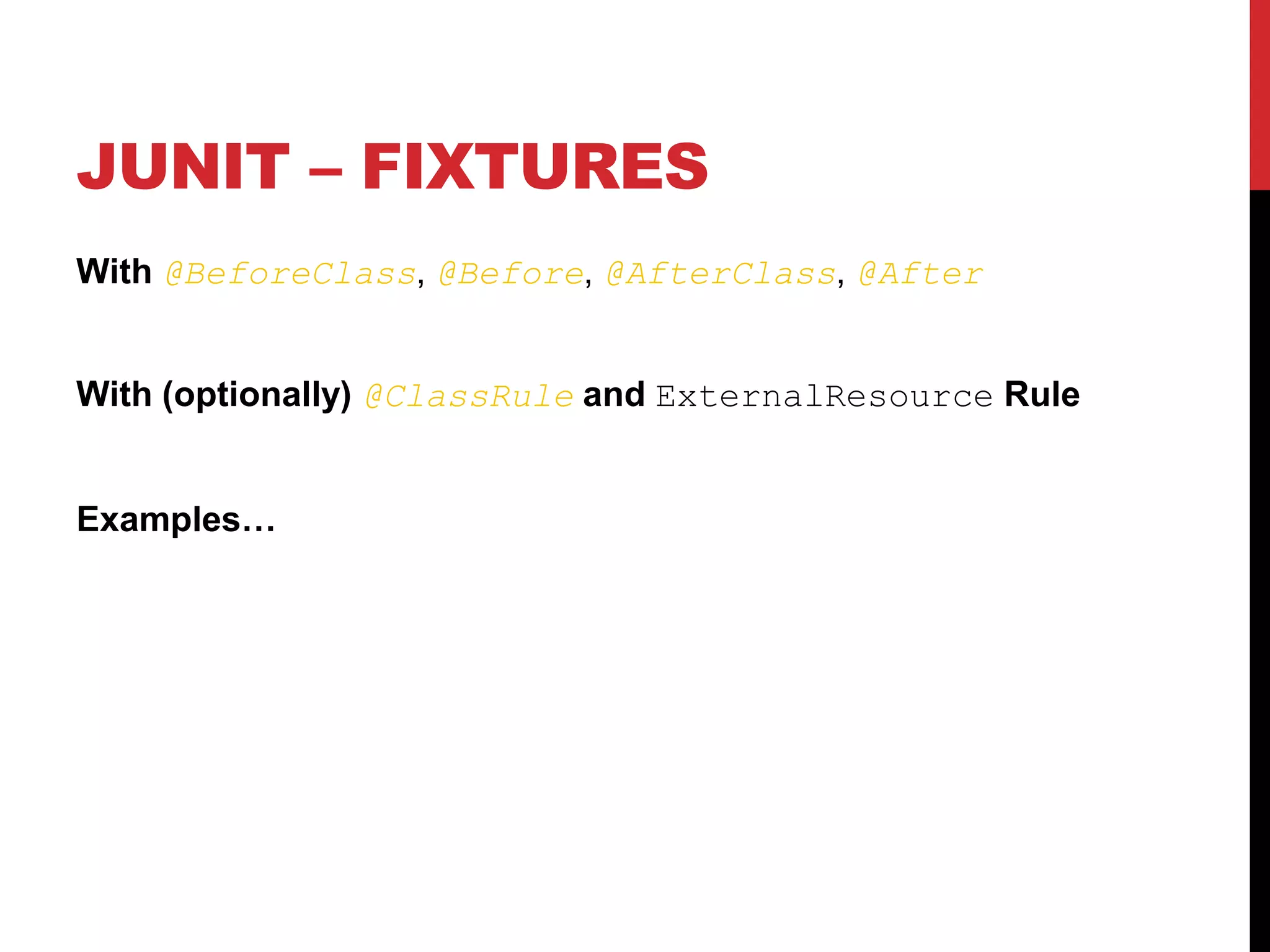
JUNIT – FIXTURES
With @BeforeClass, @Before, @AfterClass, @After
With (optionally) @ClassRule and ExternalResource Rule
Examples…
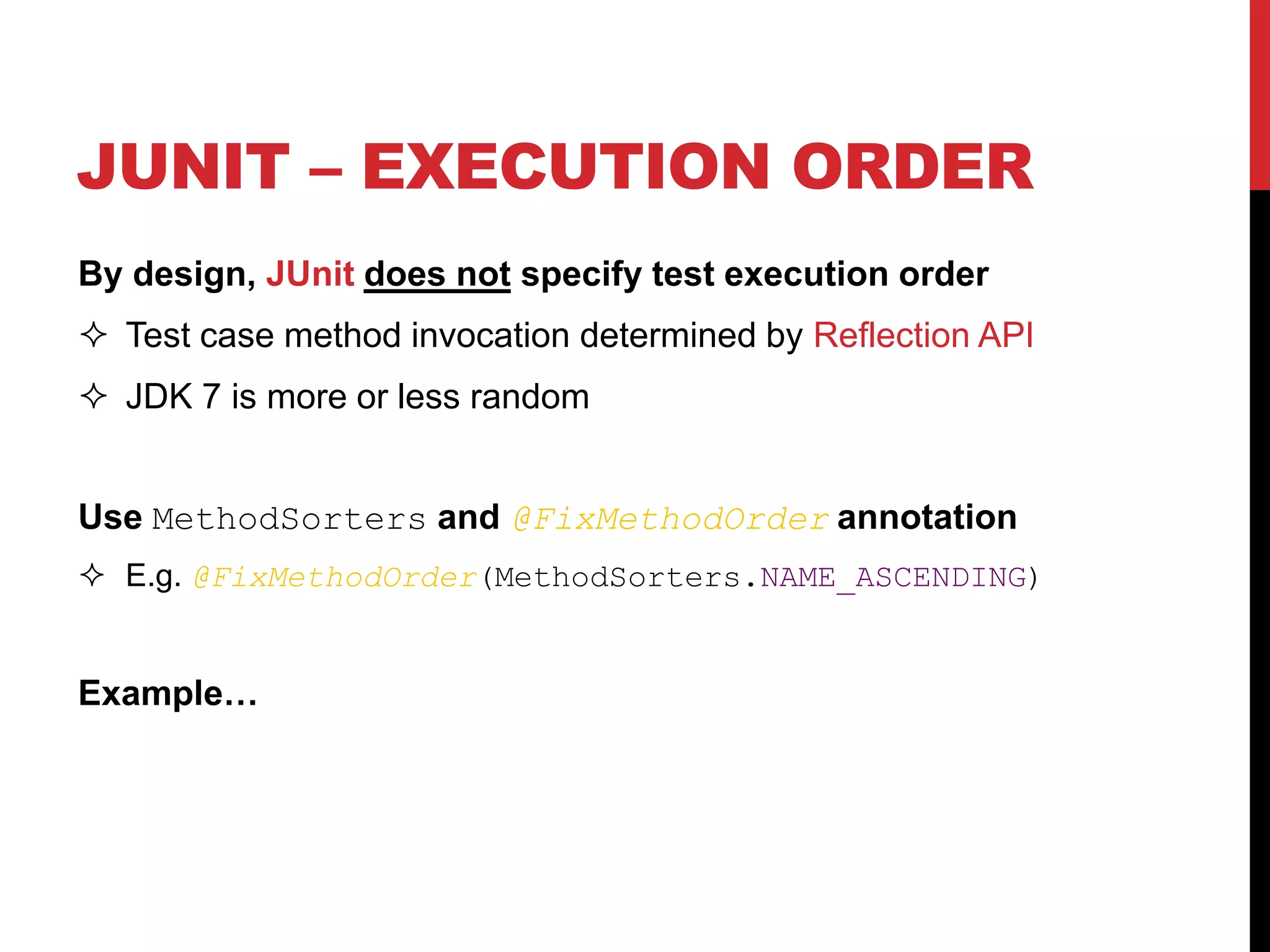
JUNIT – EXECUTION ORDER
By design, JUnit does not specify test execution order
 Test case method invocation determined by Reflection API
 JDK 7 is more or less random
Use MethodSorters and @FixMethodOrder annotation
 E.g. @FixMethodOrder(MethodSorters.NAME_ASCENDING)
Example…
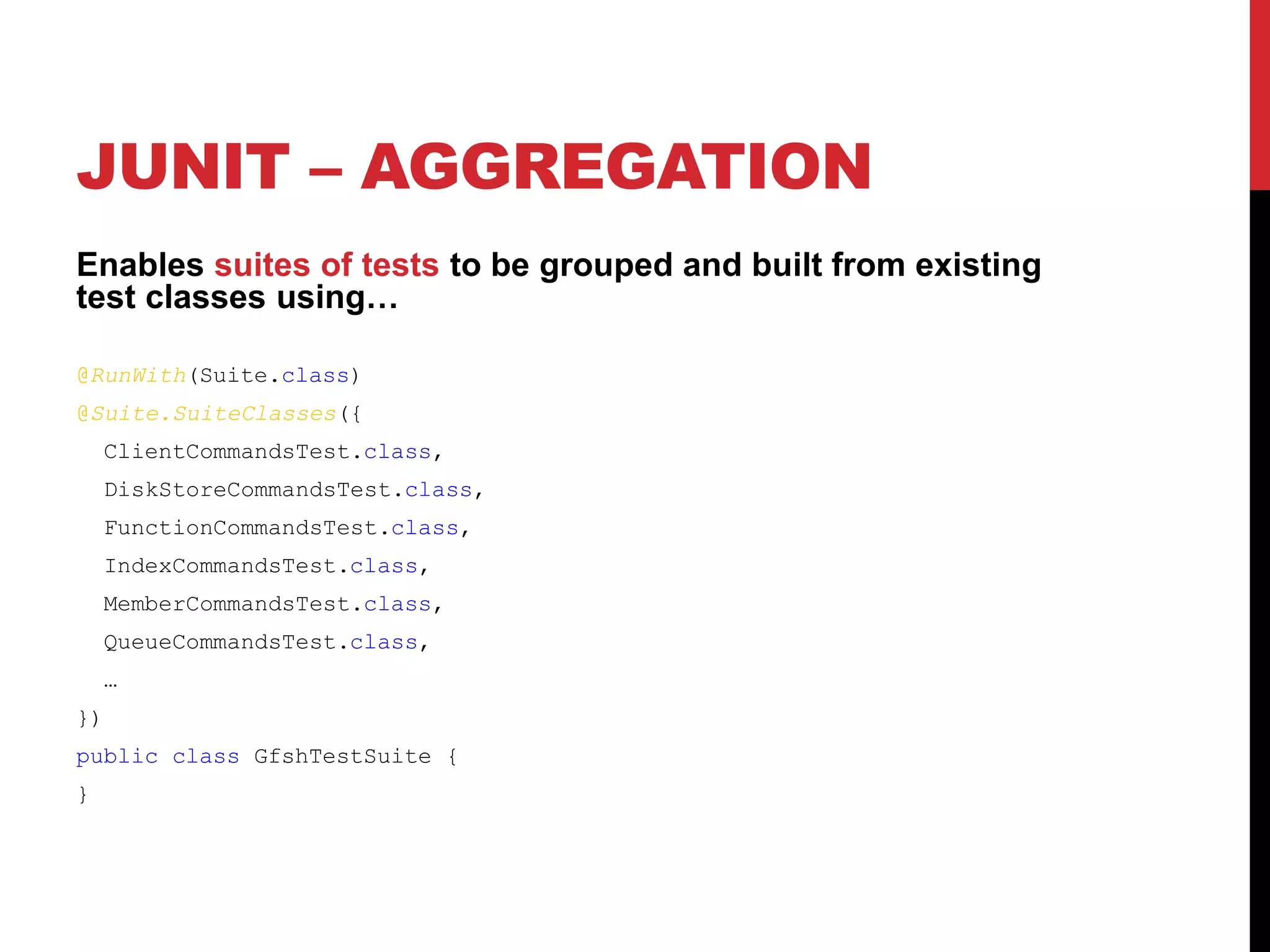
JUNIT – AGGREGATION
Enables suites of tests to be grouped and built from existing
test classes using…
@RunWith(Suite.class)
@Suite.SuiteClasses({
ClientCommandsTest.class,
DiskStoreCommandsTest.class,
FunctionCommandsTest.class,
IndexCommandsTest.class,
MemberCommandsTest.class,
QueueCommandsTest.class,
…
})
public class GfshTestSuite {
}
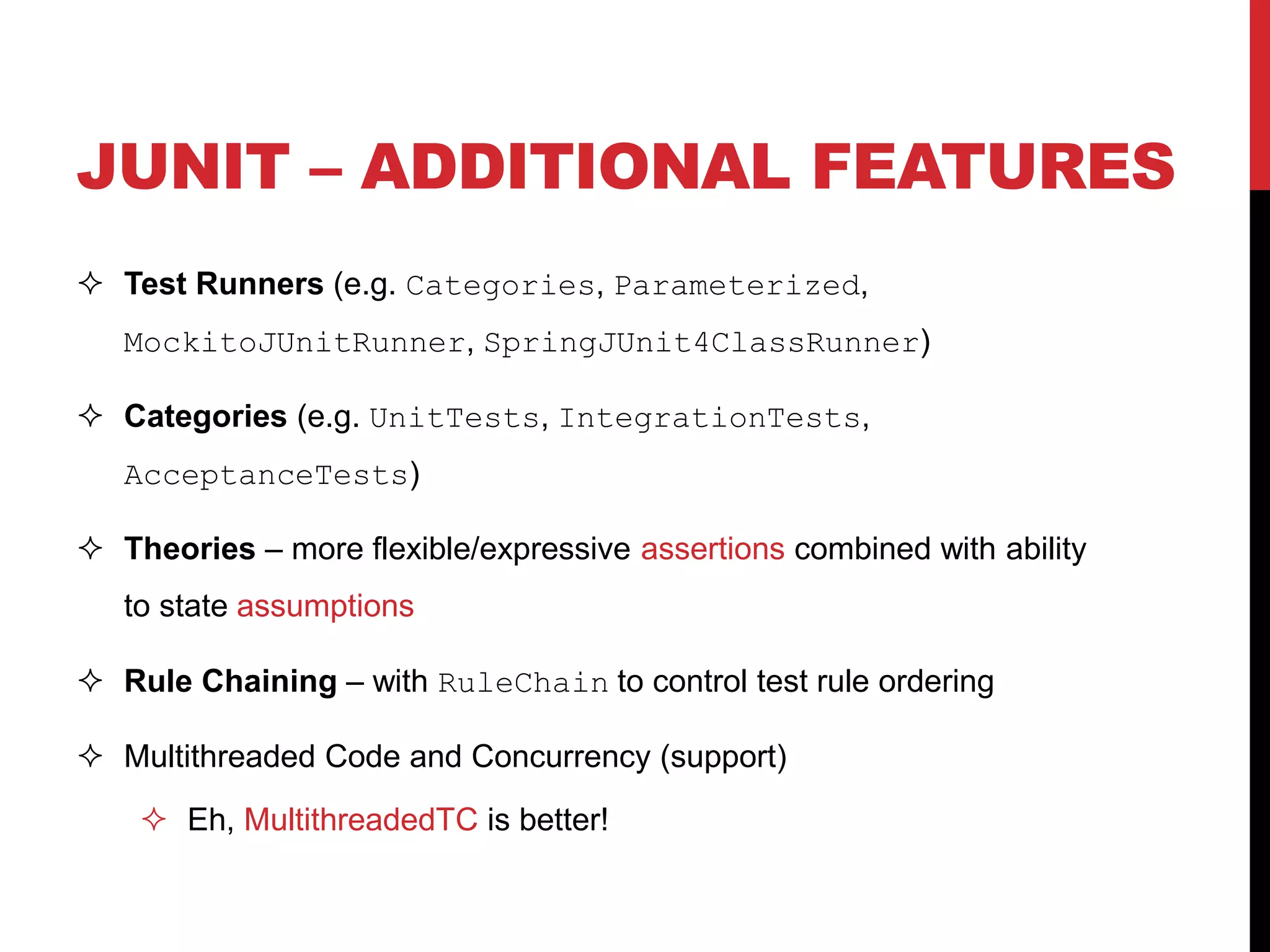
JUNIT – ADDITIONAL FEATURES
 Test Runners (e.g. Categories, Parameterized,
MockitoJUnitRunner, SpringJUnit4ClassRunner)
 Categories (e.g. UnitTests, IntegrationTests,
AcceptanceTests)
 Theories – more flexible/expressive assertions combined with ability
to state assumptions
 Rule Chaining – with RuleChain to control test rule ordering
 Multithreaded Code and Concurrency (support)
 Eh, MultithreadedTC is better!
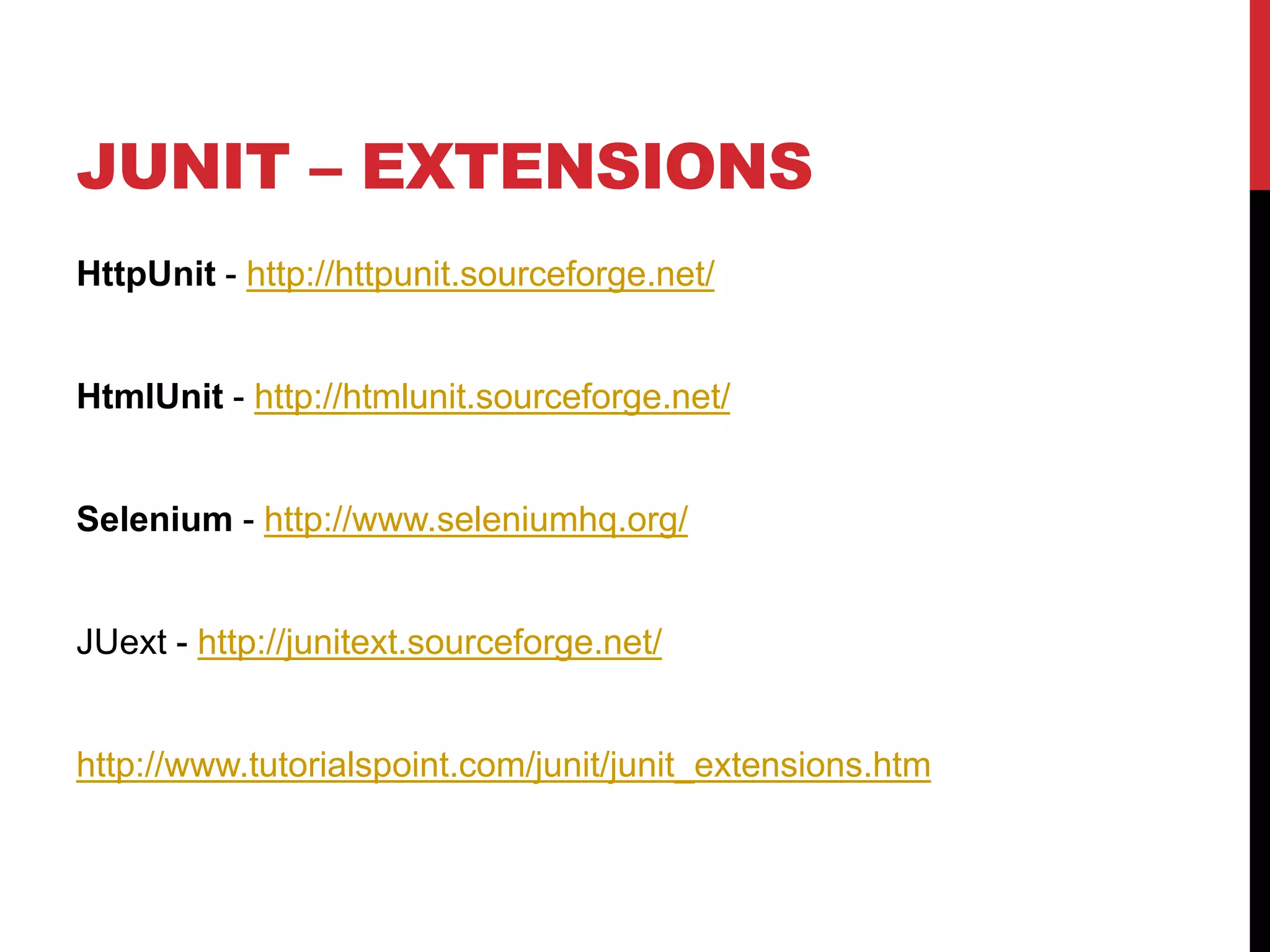
JUNIT – EXTENSIONS
HttpUnit - http://httpunit.sourceforge.net/
HtmlUnit - http://htmlunit.sourceforge.net/
Selenium - http://www.seleniumhq.org/
JUext - http://junitext.sourceforge.net/
http://www.tutorialspoint.com/junit/junit_extensions.htm
Unit Testing with Mocks
using Mockito
Why use Mocks in testing?
UNIT TESTING WITH MOCKS
Because… “If you can’t make it, fake it”
Mocks ensure focus is on the Subject (“unit”) of the test by
mocking interactions with Collaborators to verify appropriate
behavior of the Subject, not the Collaborator(s)
 Mocked Collaborators are “expected to behave” according to
their contract
Promotes programming to interfaces and delineation of
functional responsibility across teams
How-To Mock Demonstration
Mockito
MOCKITO - CALLBACKS
With…
when(mock.doSomething(..)).thenAnswer(new Answer<Object>() {
@Override public Object answer(InvocationOnMock invocation) throws Throwable {
Object[] args = invocation.getArguments();
Integer intArg = invocation.getArgumentAt(0, Integer.class);
Object mock = invocation.getMock();
return …;
}
));
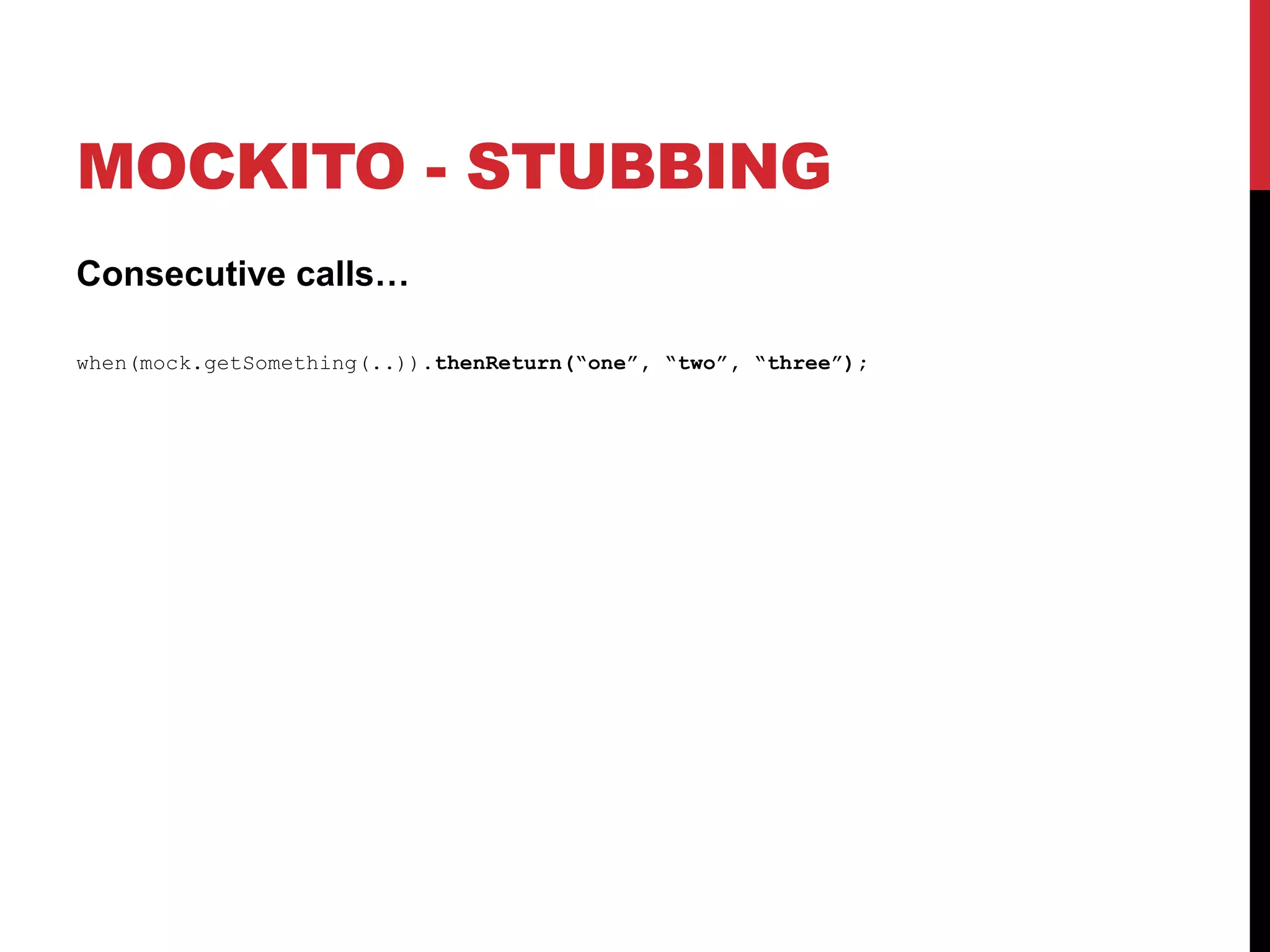
MOCKITO - STUBBING
Consecutive calls…
when(mock.getSomething(..)).thenReturn(“one”, “two”, “three”);
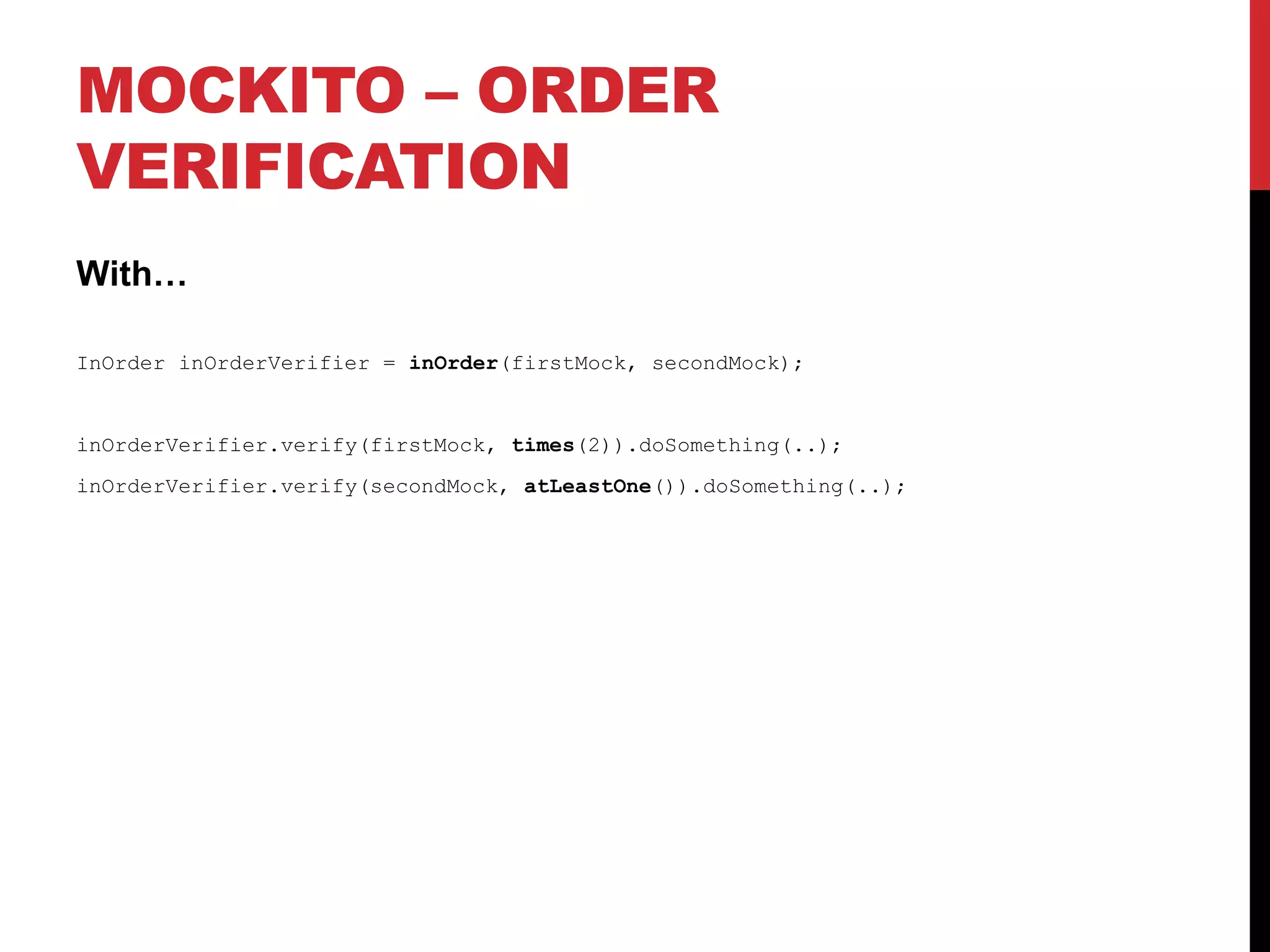
MOCKITO – ORDER
VERIFICATION
With…
InOrder inOrderVerifier = inOrder(firstMock, secondMock);
inOrderVerifier.verify(firstMock, times(2)).doSomething(..);
inOrderVerifier.verify(secondMock, atLeastOne()).doSomething(..);
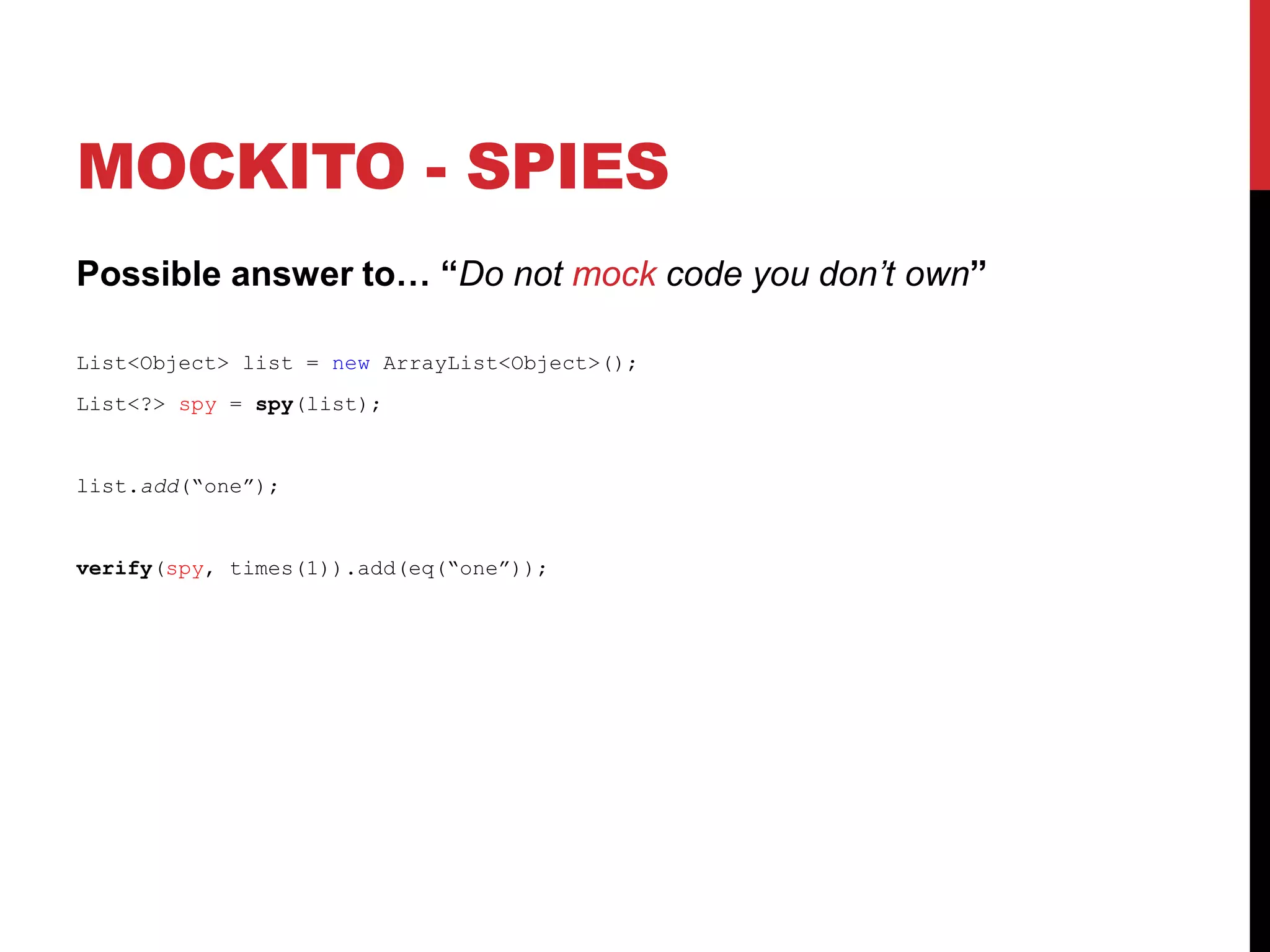
MOCKITO - SPIES
Possible answer to… “Do not mock code you don’t own”
List<Object> list = new ArrayList<Object>();
List<?> spy = spy(list);
list.add(“one”);
verify(spy, times(1)).add(eq(“one”));
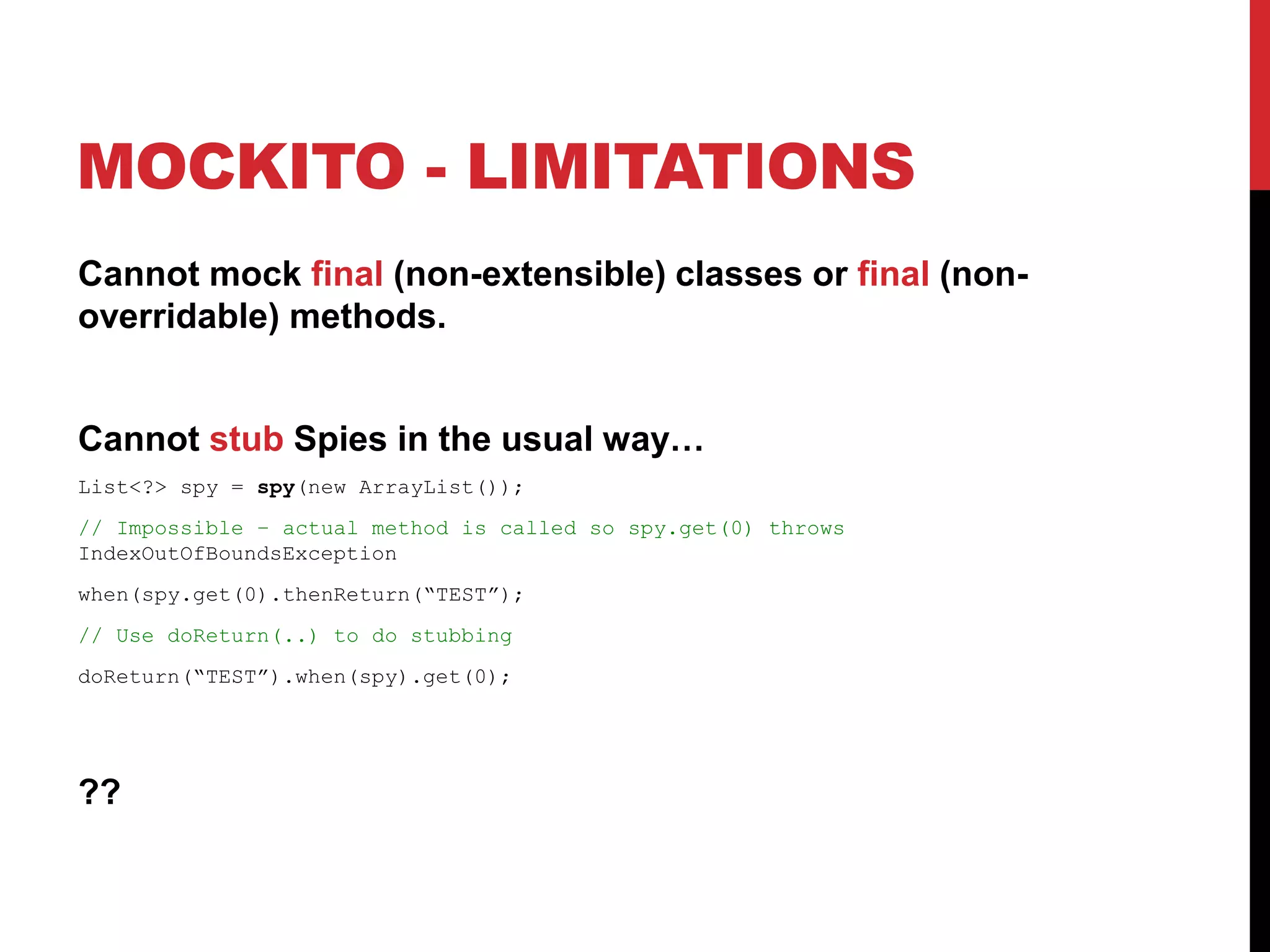
MOCKITO - LIMITATIONS
Cannot mock final (non-extensible) classes or final (non-
overridable) methods.
Cannot stub Spies in the usual way…
List<?> spy = spy(new ArrayList());
// Impossible – actual method is called so spy.get(0) throws
IndexOutOfBoundsException
when(spy.get(0).thenReturn(“TEST”);
// Use doReturn(..) to do stubbing
doReturn(“TEST”).when(spy).get(0);
??
MOCKITO - EXTENSIONS
PowerMock – enables mocking of static methods, constructors,
final classes and methods, private methods, removal of static
initializers plus more…
 Uses custom ClassLoader
 https://code.google.com/p/powermock/
MultithreadedTC
(sorry)
BEST PRACTICES
Test one thing at a time (per test case)
 Single code path; one interaction with a collaborator; one user
story, and so on…
 Prefer more test cases rather than bloated test cases
Tests should run quickly providing immediate feedback
* 10-minute build
Tests should fail-fast
Tests should be 100% reliable
BEST PRACTICES
Please do not ignore (@Ignore) or comment out failing tests!
 Understand test failures, take responsibility, fix the failures and
don’t commit until all tests pass
Write a test before fixing a bug
 Without a test it is problematic to verify the fix
BEST PRACTICES
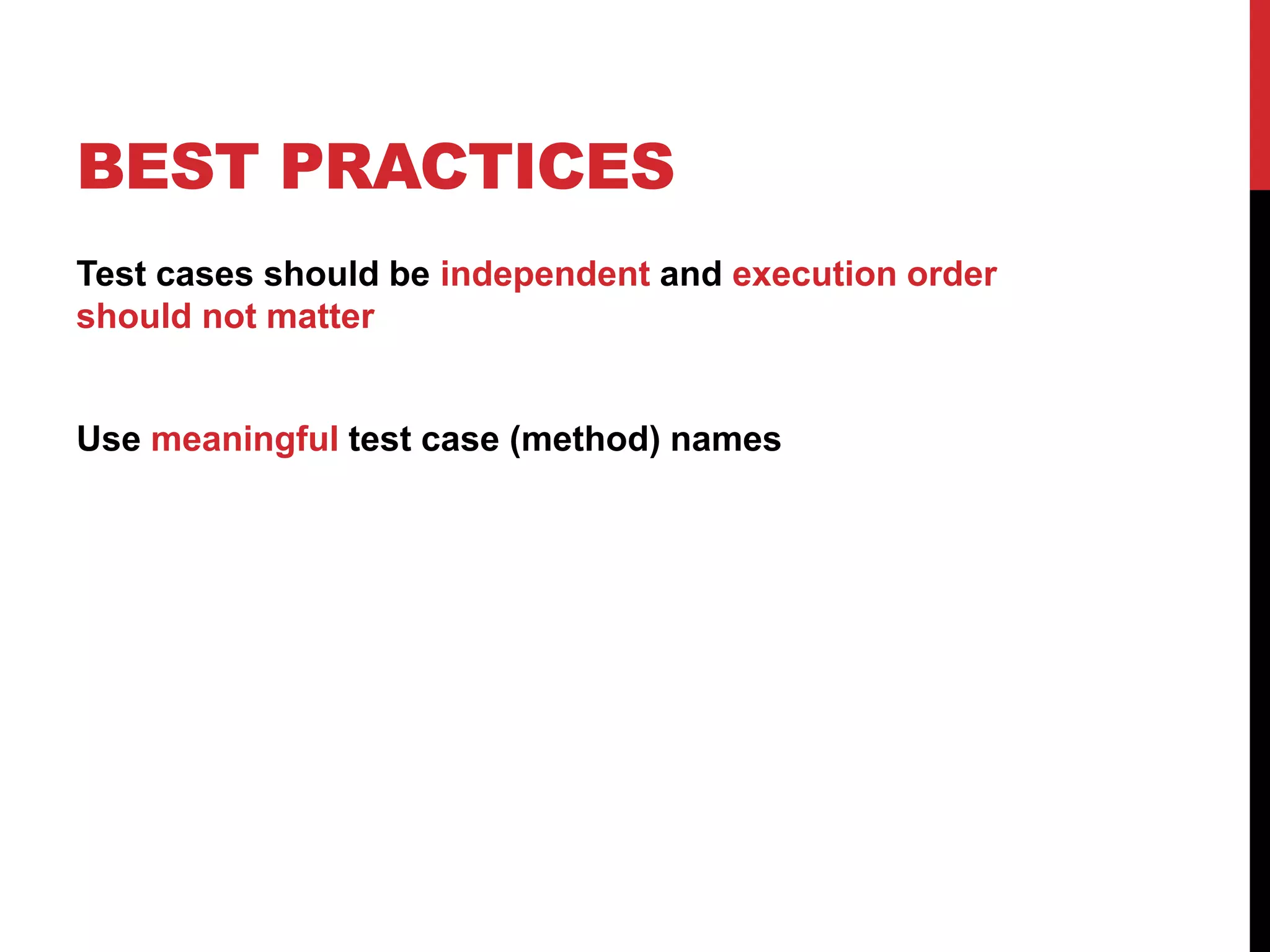
Test cases should be independent and execution order
should not matter
Use meaningful test case (method) names
BEST PRACTICES
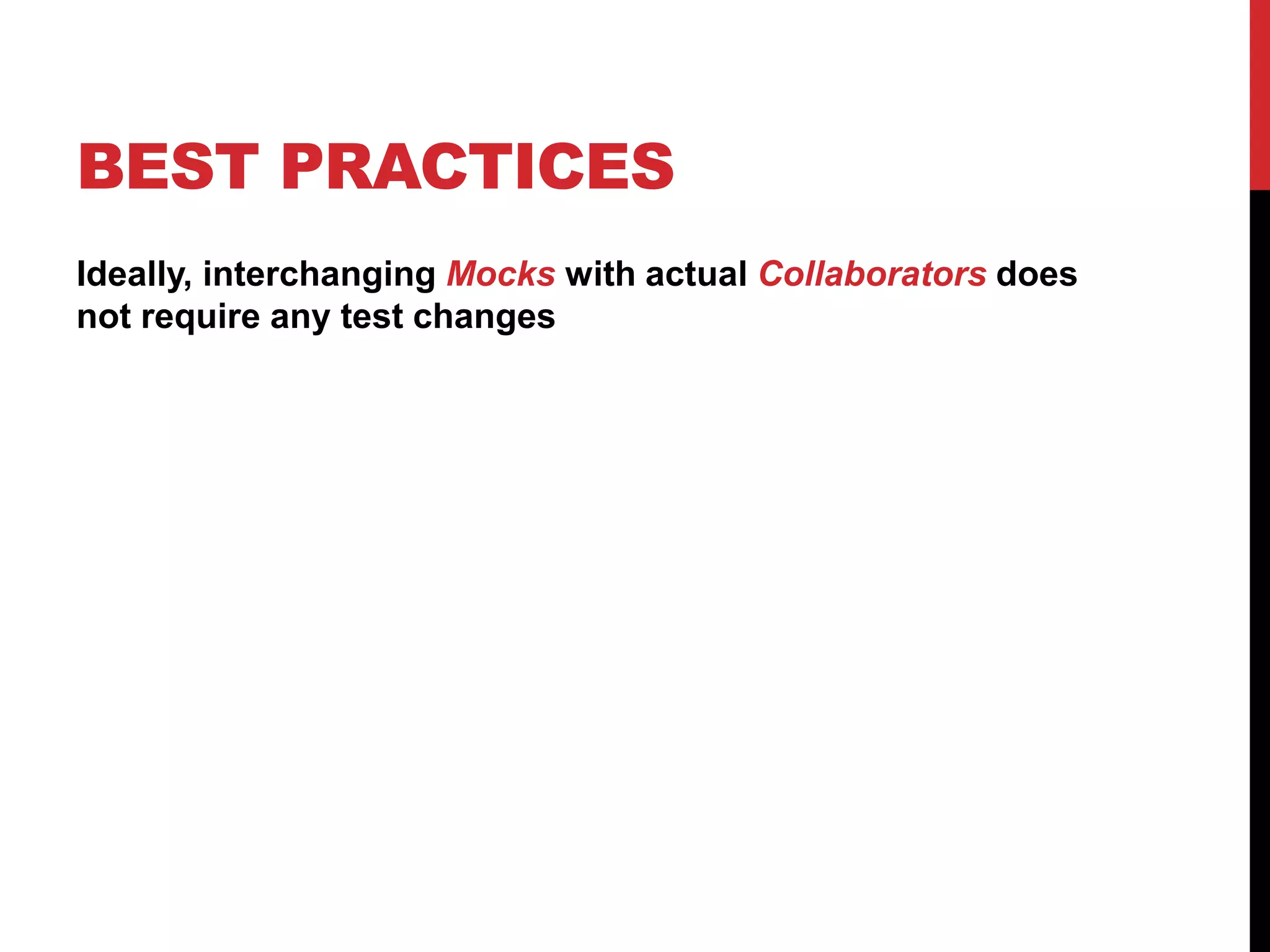
Ideally, interchanging Mocks with actual Collaborators does
not require any test changes
BEST PRACTICES
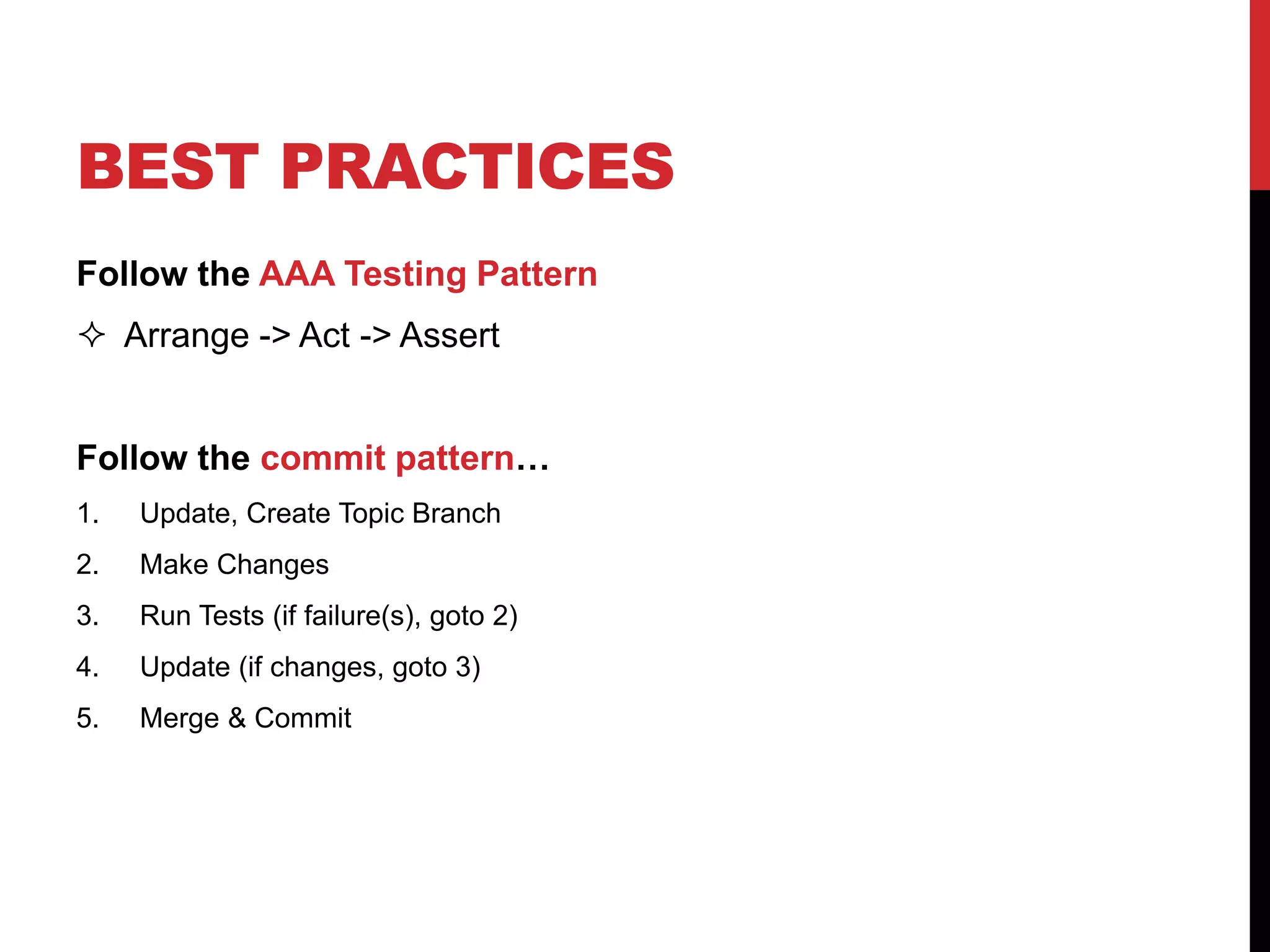
Follow the AAA Testing Pattern
 Arrange -> Act -> Assert
Follow the commit pattern…
1. Update, Create Topic Branch
2. Make Changes
3. Run Tests (if failure(s), goto 2)
4. Update (if changes, goto 3)
5. Merge & Commit
FINAL TESTING THOUGHT
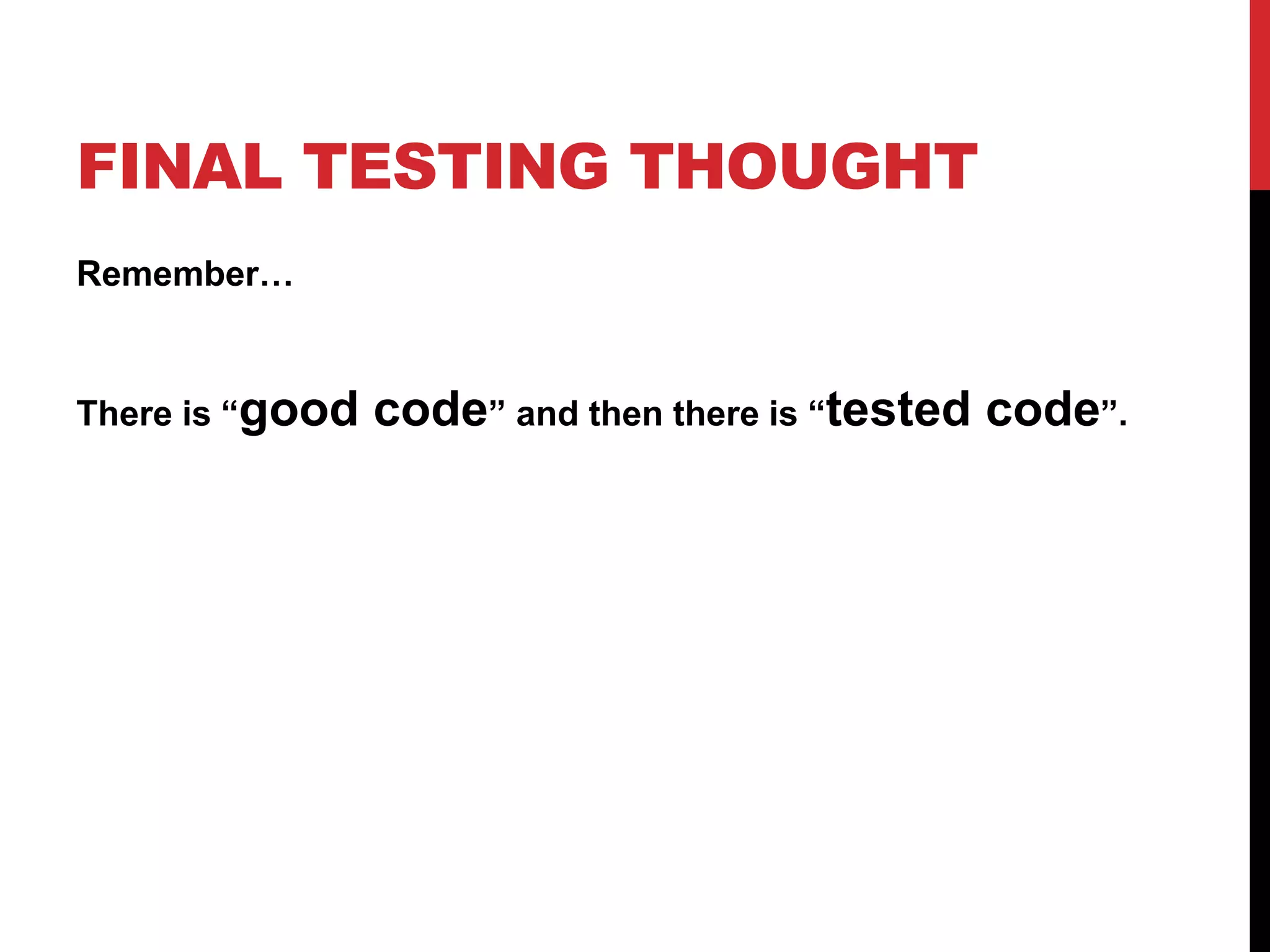
Remember…
There is “good code” and then there is “tested code”.
REFERENCES
http://www.softwaretestinghelp.com/types-of-software-testing/
http://junit.org/
http://mockito.org/
http://docs.mockito.googlecode.com/hg/org/mockito/Mockito.html
https://code.google.com/p/powermock/
https://www.cs.umd.edu/projects/PL/multithreadedtc/overview.html
http://googletesting.blogspot.com/2015/04/just-say-no-to-more-end-to-end-tests.html
https://zeroturnaround.com/rebellabs/olegs-half-smart-hacks-put-a-timestamp-on-
ignore-with-java-8s-new-date-and-time-api/
http://www.codeaffine.com/2013/11/18/a-junit-rule-to-conditionally-ignore-tests/
REFERENCES
https://github.com/codeprimate-software/test-driven-development
Questions

Test-Driven Development

  • 1.
  • 2.
    AGENDA  Misconceptions  WhyTest  Types of Tests  What & How to Test  Using JUnit, Mockito and MultithreadedTC  Best Practices  Final Thoughts  QA
  • 3.
    “No amount oftesting can prove a software right, but a single test can prove a software wrong.” – Amir Ghahrai
  • 4.
    MISCONCEPTIONS Testing is aQuality Engineer’s (QE/SDET) job  Quality Assurance (QA) is everyone’s responsibility
  • 5.
    MISCONCEPTIONS Automated tests areunnecessary if I manually test and debug my code  Testing is not a replacement for debuggers and other development tools either (e.g. Profilers, FindBugs, etc) Not possible to automate all tests  Difficult when the software architecture & design is flawed
  • 6.
    Developer tests are“Unit Tests” JUnit is a “Unit Test” framework  JUnit is a framework facilitating the development and execution of automated tests  Used in Integration and Functional (Acceptance) testing MISCONCEPTIONS
  • 7.
    Software is correctwhen there is 100% test coverage and no FindBugs (CheckStyle, PMD) errors  A bug occurs when the software fails to function properly in a prescribed manner  A defect occurs after the software is used in a unintentional way and behaves unexpectedly MISCONCEPTIONS
  • 8.
    "Not everything thatcan be counted counts and not everything that counts can be counted." - Albert Einstein
  • 9.
    Why do softwareengineers write tests?
  • 10.
    Or… Why don’t softwareengineers write tests?
  • 11.
    TO TEST ORNOT TO TEST? Time Constraints  Time-based vs. Functional-based releases  Quantity (Scope) over Quality (Less is More) (Cultural) Responsibility Laziness, Ignorance, Fear  Not detail-oriented
  • 12.
    Verifies software isbehaviorally correct and functionally complete  “Definition of Done” (DoD)  No “works on my box” arguments (we don’t ship your box) Ensures functional integration  Your code plays nicely with others Increases regression coverage  Tests in a suite is money in the bank; ensure what worked yesterday, works today and will work tomorrow WHY TEST
  • 13.
  • 14.
    WHY TEST Tests area form of feedback  Developers get immediate feedback on changes to code by running the test(s) to ensure the “contract is upheld” Tests are a form of documentation  Demonstrates how the code (e.g. API) is properly used
  • 15.
    WHY TEST Focus onthe problem that needs to be solved  Tests are a “contract for deliverables”; avoid “scope creep”  Tests limits “over-engineering” (future coders)  TDD Testing gives developers confidence in their changes  And more importantly… to “refactor” and make changes  To learn Testing encourages smaller, more frequent commits  And by extension, “releasable” code
  • 16.
    WHY TEST Testing identifiesdesign flaws  Hard to test code is flawed and a sure sign of technical debt Untested code triggers a domino effect  User becomes the Tester leading to undesirable, costly “workarounds” leading to technical debt leading to other bugs leading to more serious issues like data corruption and so on
  • 17.
    “Don’t be thatguy!” (the guy who doesn’t test his code)
  • 18.
    Why are theredifferent types of tests?
  • 19.
    TYPES OF TESTS Differenttypes of tests cover different “aspects” (concerns) of the software under test…  Different test types serve to “close the feedback loop” at different intervals in the software development lifecycle…
  • 20.
    TYPES OF TESTS UnitTests  Tests a single, contained “unit” of functionality  Objects adhere to their contract (specified by the “interface”)  Class invariants are upheld as object state changes Integration Tests  Tests interactions between “collaborators”  Actual “dependencies” used
  • 21.
    TYPES OF TESTS Functional,Acceptance-based Tests (End-To-End)  Tests user/software interaction based on predefined workflows (Use Cases) and Functional Requirements  Acceptance Tests are defined by Acceptance Criteria (based on Functional Requirements)  Usability Testing (UAT) Performance-based Tests  load/stress testing
  • 22.
  • 23.
  • 24.
    WHAT TO TEST Testeverything (or as much as you can)!  Constructors, methods, input, output, Exception conditions, all code paths, invariants/object state, thread safety…  Test the unexpected Don’t make assumptions; verify with tests  “It is not only what you don’t know that gets you in trouble, it is what you thought you knew that just isn’t so!”
  • 25.
    ANATOMY OF ATEST Arrange Act Assert (Verify)
  • 26.
    How-To Unit TestDemonstration
  • 27.
  • 28.
    JUNIT - ASSERTIONS WithassertThat(..)  More Readable (natural/DSL) and Strongly-typed  Assert subject (actual), verb, object (expected) Example assertThat(x is(3)); // assert “x is 3” or “x == 3” vs... assertEquals(3, x); // assert “equals 3 x” or “== 3 x” Examples…
  • 29.
    JUNIT - ASSUMPTIONS Usefulto make test dependencies (pre-conditions) explicit  Examples: Environment Configuration, Resource Availability With assumeTrue(..) (JUnit) or the DSL-friendly assumeThat(..) (Hamcrest) Examples…
  • 30.
    JUNIT - EXCEPTIONS WithTry/Catch Idiom (JUnit 3.x) With @Test(expected = Class<? extends Throwable>) With ExpectedException Rule (JUnit 4) Examples…
  • 31.
    JUNIT - PARAMETERIZED Parameterizedtest class instances created for the cross-product of test case methods and test data elements.  Useful for large volume of data Run test class with the Parameterized Test Runner. @RunWith(Parameterized.class) public class ParameterizedTest { @Parameters public Iterable<Object[]> data = …; public ParameterizedTest(..) { } } Example…
  • 32.
    JUNIT - RULES ErrorCollector– allows execution of test to continue after the first problem is encountered (Fail-Fast!) ExpectedException – specify expected error conditions in test ExternalResource – setup external resource (File, Socket, Database Connection, …) TemporaryFolder – creation of files and folders that are deleted after test case (method) finishes TestName – captures the name of a test inside test methods Timeout – applies same timeout to all test case methods in test class Example…
  • 33.
    JUNIT - TIMEOUTS With@Test(timeout = ms) @Test(timeout = 500) public void testWithTimeout() { } With Timeout Rule… public class TestsWithGlobalTimeout { @Rule public Timeout globalTimeout = Timeout.seconds(20); } Example…
  • 34.
    JUNIT – FIXTURES With@BeforeClass, @Before, @AfterClass, @After With (optionally) @ClassRule and ExternalResource Rule Examples…
  • 35.
    JUNIT – EXECUTIONORDER By design, JUnit does not specify test execution order  Test case method invocation determined by Reflection API  JDK 7 is more or less random Use MethodSorters and @FixMethodOrder annotation  E.g. @FixMethodOrder(MethodSorters.NAME_ASCENDING) Example…
  • 36.
    JUNIT – AGGREGATION Enablessuites of tests to be grouped and built from existing test classes using… @RunWith(Suite.class) @Suite.SuiteClasses({ ClientCommandsTest.class, DiskStoreCommandsTest.class, FunctionCommandsTest.class, IndexCommandsTest.class, MemberCommandsTest.class, QueueCommandsTest.class, … }) public class GfshTestSuite { }
  • 37.
    JUNIT – ADDITIONALFEATURES  Test Runners (e.g. Categories, Parameterized, MockitoJUnitRunner, SpringJUnit4ClassRunner)  Categories (e.g. UnitTests, IntegrationTests, AcceptanceTests)  Theories – more flexible/expressive assertions combined with ability to state assumptions  Rule Chaining – with RuleChain to control test rule ordering  Multithreaded Code and Concurrency (support)  Eh, MultithreadedTC is better!
  • 38.
    JUNIT – EXTENSIONS HttpUnit- http://httpunit.sourceforge.net/ HtmlUnit - http://htmlunit.sourceforge.net/ Selenium - http://www.seleniumhq.org/ JUext - http://junitext.sourceforge.net/ http://www.tutorialspoint.com/junit/junit_extensions.htm
  • 39.
    Unit Testing withMocks using Mockito
  • 40.
    Why use Mocksin testing?
  • 41.
    UNIT TESTING WITHMOCKS Because… “If you can’t make it, fake it” Mocks ensure focus is on the Subject (“unit”) of the test by mocking interactions with Collaborators to verify appropriate behavior of the Subject, not the Collaborator(s)  Mocked Collaborators are “expected to behave” according to their contract Promotes programming to interfaces and delineation of functional responsibility across teams
  • 42.
  • 43.
  • 44.
    MOCKITO - CALLBACKS With… when(mock.doSomething(..)).thenAnswer(newAnswer<Object>() { @Override public Object answer(InvocationOnMock invocation) throws Throwable { Object[] args = invocation.getArguments(); Integer intArg = invocation.getArgumentAt(0, Integer.class); Object mock = invocation.getMock(); return …; } ));
  • 45.
    MOCKITO - STUBBING Consecutivecalls… when(mock.getSomething(..)).thenReturn(“one”, “two”, “three”);
  • 46.
    MOCKITO – ORDER VERIFICATION With… InOrderinOrderVerifier = inOrder(firstMock, secondMock); inOrderVerifier.verify(firstMock, times(2)).doSomething(..); inOrderVerifier.verify(secondMock, atLeastOne()).doSomething(..);
  • 47.
    MOCKITO - SPIES Possibleanswer to… “Do not mock code you don’t own” List<Object> list = new ArrayList<Object>(); List<?> spy = spy(list); list.add(“one”); verify(spy, times(1)).add(eq(“one”));
  • 48.
    MOCKITO - LIMITATIONS Cannotmock final (non-extensible) classes or final (non- overridable) methods. Cannot stub Spies in the usual way… List<?> spy = spy(new ArrayList()); // Impossible – actual method is called so spy.get(0) throws IndexOutOfBoundsException when(spy.get(0).thenReturn(“TEST”); // Use doReturn(..) to do stubbing doReturn(“TEST”).when(spy).get(0); ??
  • 49.
    MOCKITO - EXTENSIONS PowerMock– enables mocking of static methods, constructors, final classes and methods, private methods, removal of static initializers plus more…  Uses custom ClassLoader  https://code.google.com/p/powermock/
  • 50.
  • 51.
    BEST PRACTICES Test onething at a time (per test case)  Single code path; one interaction with a collaborator; one user story, and so on…  Prefer more test cases rather than bloated test cases Tests should run quickly providing immediate feedback * 10-minute build Tests should fail-fast Tests should be 100% reliable
  • 52.
    BEST PRACTICES Please donot ignore (@Ignore) or comment out failing tests!  Understand test failures, take responsibility, fix the failures and don’t commit until all tests pass Write a test before fixing a bug  Without a test it is problematic to verify the fix
  • 53.
    BEST PRACTICES Test casesshould be independent and execution order should not matter Use meaningful test case (method) names
  • 54.
    BEST PRACTICES Ideally, interchangingMocks with actual Collaborators does not require any test changes
  • 55.
    BEST PRACTICES Follow theAAA Testing Pattern  Arrange -> Act -> Assert Follow the commit pattern… 1. Update, Create Topic Branch 2. Make Changes 3. Run Tests (if failure(s), goto 2) 4. Update (if changes, goto 3) 5. Merge & Commit
  • 56.
    FINAL TESTING THOUGHT Remember… Thereis “good code” and then there is “tested code”.
  • 57.
  • 58.
  • 59.