Organization, Technology and Information

Aj.Patcharaporn Panwong
E-mail: patcharaporn.panwong@gmail.com
School of IT
7/11/2011
Announcement
Group Work: Announcement

• Group Work might be assigned weekly (flexible)

• Due to many questions & requests, change number of group
  member
     – 10 people : 1 company
     – Form group member from different sections (Mixing)


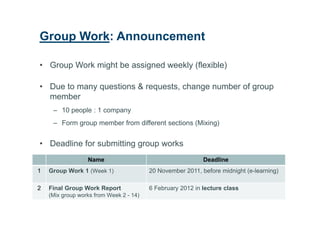
• Deadline for submitting group works
                  Name                                      Deadline
1   Group Work 1 (Week 1)                20 November 2011, before midnight (e-learning)

2   Final Group Work Report              6 February 2012 in lecture class
    (Mix group works from Week 2 - 14)
Rule

• Not accept late work = 0 mark, due to many students
• Cheating = 0 mark
• Absence: Will check class attendance for you, IF
   – Sick: Send “doctor certificate” plus “sick leave letter”
   – Other important cases e.g. visa extension: 1) Inform in advance by
     mail / in person + 2) Send letter later
For your information,

1. Lecture = for all students who study OAM
2. Lab = 2 sections. Important, you need to remember your lab
   section for submitting individual work + attending lab hour/lab
   test + writing down in your exam paper.
Getting started with Chapter 2
Agenda

• Type of Enterprises / Firms
• Organizational Structures
• Information Characteristics in Organization
• The Flow of Information within an Organization
• Information Systems Using in the Organization
• Leverage IT as a competitive strategy
Type of Enterprises / Firm

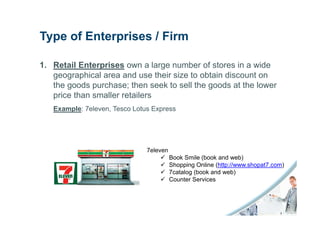
1. Retail Enterprises own a large number of stores in a wide
   geographical area and use their size to obtain discount on
   the goods purchase; then seek to sell the goods at the lower
   price than smaller retailers
   Example: 7eleven, Tesco Lotus Express


                               7eleven
                                         Book Smile (book and web)
                                         Shopping Online (http://www.shopat7.com)
                                         7catalog (book and web)
                                         Counter Services
Type of Enterprises (cont)

2. Manufacturing Enterprises create goods on a large scale
   and then distribute & sell the goods to customers or other
   organizations.
   Example:
   - Digital camera: Fujifilm ( Japan) using ERP system
   - Car: Toyota
Type of Enterprises (cont)

3. Service Enterprises typical create or sell goods, but provide
   service for customers or other organizations.
   Example:
   - Insurance: Worldcare Travel Insurance, AIA and etc.
   - Banking & Financial industries: Citibank, SCB and etc.
   - Restaurant: MK
Type of Enterprises (cont)

4. Wholesale Enterprises seek to purchase and sale in large
   quantities of goods to other organizations, usually at a lower cost
   than retail.
5. Government Enterprises include large city governments, state
   governments, and the departments & agencies of the federal
   department
Type of Enterprises (cont)

6. Education Enterprises include large universities or school
   systems which consist of executives, instructors, and other service
   personnel and whose reach extends throughout a country, a state,
   or the entire country.
   Example: MFU, e-learning web-based system
Organizational Structures

“Organizational subunits and the way they relate to the
overall organization.” (Ralph Stair and George Reynolds
2010)
   • Directly impact to organization’s information system
   • There are four main structures as follows:
      1. Traditional Organizational Structure
      2. Project Organizational Structures
      3. Team Organizational Structures
      4. Virtual Organizational Structure and Collaborative Work
Traditional Organizational Structure

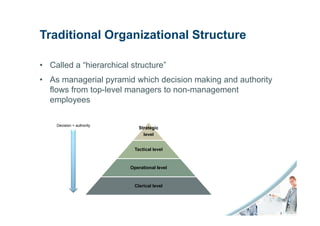
• Called a “hierarchical structure”
• As managerial pyramid which decision making and authority
  flows from top-level managers to non-management
  employees

    Decision + authority
                               Strategic
                                 level


                             Tactical level


                           Operational level


                             Clerical level
Traditional Organizational Structure (Cont)

• Trend: “Flat organizational structure”
• To reduce number of management levels / layers in the
  traditional organizational structure
• Empowerment of employees & their managers
   – By giving more responsibility & authority to make decisions and solve
     problems without permission from midlevel managers.


• IS    a key which provides required information to make
  decision for employee
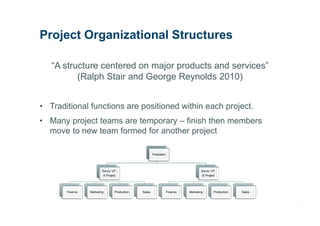
Project Organizational Structures

   “A structure centered on major products and services”
          (Ralph Stair and George Reynolds 2010)


• Traditional functions are positioned within each project.
• Many project teams are temporary – finish then members
  move to new team formed for another project

                                                     President


                        Senior VP,                                                Senior VP,
                         A Project                                                 B Project


       Finance   Marketing      Production   Sales               Finance   Marketing      Production   Sales
Team Organizational Structures

  “ A structure centered on work teams or groups” (Ralph
              Stair and George Reynolds 2010)


• Team can be
   – small / large
   – temporary / permanent.
• Each team has a leader who reports to an upper-level
  manager
Virtual Organizational Structure and
Collaborative Work
 “A structure that employs individuals, groups, or complete
 business units in geographically dispersed areas that can
        last for a few weeks or years, often requiring
   telecommunications or the Internet” (Ralph Stair and
                    George Reynolds 2010)


• Work can be done anywhere, anytime
• Allow collaborative work
• Use IT to communicate and coordinate work
Virtual Organizational Structure and
Collaborative Work
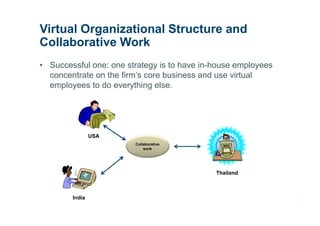
• Successful one: one strategy is to have in-house employees
  concentrate on the firm’s core business and use virtual
  employees to do everything else.


                USA
                        Collaborative
                            work


                                             Thailand


        India
Information characteristics in organization

• People in the organization need different information, due to
  different responsibilities.
• Data have its own flow    called as “Data flow”
Differing information Needs

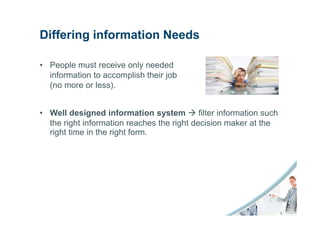
• People must receive only needed
  information to accomplish their job
  (no more or less).


• Well designed information system          filter information such
  the right information reaches the right decision maker at the
  right time in the right form.
Differing information Needs (cont)

There are 4 basic levels of knowledge workers in every company as
follows:

   1. Clerical level
   2. Operational level
   3. Tactical Level
   4. Strategic Level
Differing information Needs (cont)

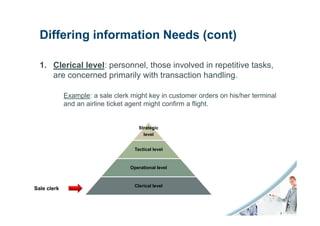
  1. Clerical level: personnel, those involved in repetitive tasks,
     are concerned primarily with transaction handling.

             Example: a sale clerk might key in customer orders on his/her terminal
             and an airline ticket agent might confirm a flight.


                                      Strategic
                                        level


                                    Tactical level


                                  Operational level


                                    Clerical level
Sale clerk
Differing information Needs (cont)

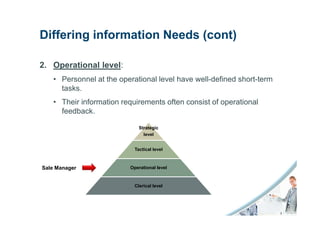
2. Operational level:
   • Personnel at the operational level have well-defined short-term
     tasks.
   • Their information requirements often consist of operational
     feedback.

                             Strategic
                               level


                           Tactical level


Sale Manager             Operational level


                           Clerical level
Differing information Needs (cont)

3. Tactical Level: Manager and knowledge workers
   concentrate on achieving a series of goals required to meet
   the objective set at the strategic level.
   • The information requirements are usually periodic.
   • Tactical level personnel are concerned primary with operation
     and budgets from year to year.
      Example: In the sale of information system, the national sales director,
      who is at the tactical level, might want the cooperate sale report.
Differing information Needs (cont)

4. Strategic Level: Provide overall direction and guidance of
   the organization (objective-oriented)
   • Their information requirements are often one time reports, what
     – if reports and trend analyses.
      Example: the president of the company might ask for the report that
      shows the four-year sales trend for each product.
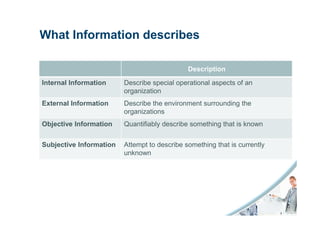
What Information describes

                                              Description

Internal Information     Describe special operational aspects of an
                         organization
External Information     Describe the environment surrounding the
                         organizations
Objective Information    Quantifiably describe something that is known


Subjective Information   Attempt to describe something that is currently
                         unknown
The flow of information within an
Organization
1. The Vertical flow
   1.1. The upward flow
       - Based on daily transactions (such as sales)
       - People in the lower level: capture the information and store it
         in the central database
       - People in the upper levels: access and use that information
The flow of information within an
Organization (cont)
1. The Vertical flow (cont)
   1.2. The downward flow
       - Consists of the strategies, goals, and directive that originate
         at one level and are passed to lower levels


       Example: An overall sales goal might originate at the strategic
        management level., which would develop more specific sales
        goals pass them to the operational management level.
The flow of information within an
Organization (cont)
2. The horizontal flow
   - Information that passes among various departments


3. The Decentralized Organization (New information flow):
   - Computer network era to a decentralized form
   - Flat Organization
   - Cooperative work by a group of people
   - Share use of databases
Information systems in the Enterprise

• Accounting and Finance
• Human Resources (HR)
• Manufacturing
• Quality Control
• Marketing
• Sales
• Distribution
• Customer Services
Information systems in the Enterprise (cont)

1. Accounting and Finance
  - Accounting software manages everyday transactions, such as
    sales and payments to suppliers.
  - Financial software helps to manage a budget, forecast, and
    analyze.
Information systems in the Enterprise (cont)

2. Human Resources (HR)
  - Human Resources Information System (HRIS) manages one or
    more human resources functions.
     Example: Wal-Mart maintains records on its more than 1.8 million
     employees.
  - Employee Relationship Management (ERM) system automates
    and manages much of the communication between employees
    and business such as
     - Preparing an overall training plan of company
     - Preparing a statement of payments and mailing of salary bulletins
Information systems in the Enterprise (cont)

3. Manufacturing
  - Assist on the actual assembly process such as scheduling and
    managing the product inventory.
  - Example: Material Requirement Planning (MRP) focuses on
    issue related to inventory of parts and forecasting future
    demand. So those materials are always available when needed.
Information systems in the Enterprise (cont)

4. Quality control
   - Quality control systems help the company to maintain or improve
     the quality of products and services.
   - Quality control software needs the data that gathers from the on
     going process.
   - Combining with static analysis software can define or predict the
     product defects and problems with the company process.
Information systems in the Enterprise (cont)

5. Marketing
  - A marketing information system serves as central repository for
    the tasks of the marketing functional units.
  - Example: A market research system stores and analyzes data
    gathered from demographics and surveys; targeting market by
    querying database with criteria e.g. income, gender, previous
    purchase, and favorite recreational activities.
Information systems in the Enterprise (cont)

6. Sales
  - Help sales people manage customer contacts, scheduling
    customer meeting, manage product information, and take orders
    from customers.
  - Example: Sales Force Automation (SFA) system records all the
    stages in a sales process. (Wikipedia)
Information systems in the Enterprise (cont)

7. Distribution
   - Distribution systems provide forecasting for inventory control,
     manage & track product shipping, and provide information to
     analysis on inventory in warehouse.
   - Some distribution systems need GPS and other navigation
     technologies to track real-time shipping.
Information systems in the Enterprise (cont)

8. Customer Services
  - Customer Interaction Management (CIM) software handles the
    day to day interactions with customers across different channels
    e.g. telephone, e-mail, instant message and etc.
  - CIM routes customer’s telephone call to the right person
    depending on the identity or response that customer giving to the
    prompts.
IT department as a key resource

• Make technology decisions for the enterprise e.g. decision
  whether to build or buy new customer interaction
  management information systems.
• Many companies elevate the importance of IT by including a
  CIO executive position that reports to CEO.
Competitive strategies

  “the strategic advantage one business entity has over its rival
  entities within its competitive industry” (Wikipedia)
  • All information systems in organization must facilitate
    organization’s competitive strategies.
  • Porter’s Generic Competitive Strategies:
                                                     Cost           Differentiation
      • Cost
      • Differentiation                                                 Better
                                      Broad     Lowest cost
                                                                    product/service
      • Focus                         target   across industry
                                                                    across industry


                                                                          Better
                                      Narrow   Lowest cost within
                                                                     product/service
                                      target      an industry
                                                                    within an industry
                                                   segment
                                                                         segment
Leverage IT as a competitive strategy

• Increasing Sales
• Increasing productivity and reduce cost
• Improving Customer Service
Leverage IT as a competitive strategy (cont)

 “If information technology is so clearly the solution for
 establishing the competitive advantage, why isn’t everybody
 doing it?”


  – IT solutions often are expensive and time consuming
  – Risk failure
  – Resist change
The Impact of IT on organizations

• Business strategy: service can be delivered over network
  channels.
• Organization culture: change in the way of information flow
  (communication)
• Organization structure: enable more flexible structure
• Management process: reduce unnecessary process and provide
  more ways of accessing information
• Work: change nature of professional work by using IT
• The Workplace: work anywhere + anytime.
Assignment
Individual Assignment

• Will be announced in your lab hour
       • Section 01: Tuesday       8.00-10.00   S3 101
       • Section 02: Thursday      8.00-10.00   S3 101
Group Work2 (Briefly)

• Remark: Be part of final group work report, submit on 6
  February 2012 in lecture class
• As launching a new company from your group work1,
   – What is a type of your organizational structure?
   – Draw your organizational structure using MS word 2011
   – Define job position of each member in your group


• Download “group work assignment & template2” from e-learning
   – From workbin: “1301341: Office Automation Management (2/2011)”
   – Under folder: “Group work Assignment”
Reference

•   Ralph M. Stair and George W. Reynolds. (2010). Information Systems. 9th Edition. Canada :
    International ISE Edition.

•   Stephen Haag. … [et al.]. (2007). Management Information Systems for the Information Age.
    6th Edition. Singapore : McGraw-Hill/Irwin, The McGraw-Hill Companies, Inc.

•   Vijayagopal. (2011). Communication Flow in the Organization.
    http://vijagopalk.tripod.com/trainervijayagopal/id19.html

•   Wikipedia. (2011). http://en.wikipedia.org/wiki/Main_Page

•   Kioskea. (2011). Employee Relationship Management (ERM).
    http://en.kioskea.net/contents/entreprise/erm.php3

•   QuickMBA. (2011). Competitive Advantage. http://www.quickmba.com/strategy/competitive-
    advantage/

•   What is the difference between upward and downward flow of information?.
    http://www.kaschassociates.com/101web/ex1%20oc%20upward%20downward.htm

•   David Skyrme. (2011). The Impact of IT on Organizations.
    http://www.skyrme.com/insights/5itorg.htm
Questions?
Test

Test

  • 1.
    Organization, Technology andInformation Aj.Patcharaporn Panwong E-mail: patcharaporn.panwong@gmail.com School of IT 7/11/2011
  • 2.
  • 3.
    Group Work: Announcement •Group Work might be assigned weekly (flexible) • Due to many questions & requests, change number of group member – 10 people : 1 company – Form group member from different sections (Mixing) • Deadline for submitting group works Name Deadline 1 Group Work 1 (Week 1) 20 November 2011, before midnight (e-learning) 2 Final Group Work Report 6 February 2012 in lecture class (Mix group works from Week 2 - 14)
  • 4.
    Rule • Not acceptlate work = 0 mark, due to many students • Cheating = 0 mark • Absence: Will check class attendance for you, IF – Sick: Send “doctor certificate” plus “sick leave letter” – Other important cases e.g. visa extension: 1) Inform in advance by mail / in person + 2) Send letter later
  • 5.
    For your information, 1.Lecture = for all students who study OAM 2. Lab = 2 sections. Important, you need to remember your lab section for submitting individual work + attending lab hour/lab test + writing down in your exam paper.
  • 6.
  • 7.
    Agenda • Type ofEnterprises / Firms • Organizational Structures • Information Characteristics in Organization • The Flow of Information within an Organization • Information Systems Using in the Organization • Leverage IT as a competitive strategy
  • 8.
    Type of Enterprises/ Firm 1. Retail Enterprises own a large number of stores in a wide geographical area and use their size to obtain discount on the goods purchase; then seek to sell the goods at the lower price than smaller retailers Example: 7eleven, Tesco Lotus Express 7eleven Book Smile (book and web) Shopping Online (http://www.shopat7.com) 7catalog (book and web) Counter Services
  • 9.
    Type of Enterprises(cont) 2. Manufacturing Enterprises create goods on a large scale and then distribute & sell the goods to customers or other organizations. Example: - Digital camera: Fujifilm ( Japan) using ERP system - Car: Toyota
  • 10.
    Type of Enterprises(cont) 3. Service Enterprises typical create or sell goods, but provide service for customers or other organizations. Example: - Insurance: Worldcare Travel Insurance, AIA and etc. - Banking & Financial industries: Citibank, SCB and etc. - Restaurant: MK
  • 11.
    Type of Enterprises(cont) 4. Wholesale Enterprises seek to purchase and sale in large quantities of goods to other organizations, usually at a lower cost than retail. 5. Government Enterprises include large city governments, state governments, and the departments & agencies of the federal department
  • 12.
    Type of Enterprises(cont) 6. Education Enterprises include large universities or school systems which consist of executives, instructors, and other service personnel and whose reach extends throughout a country, a state, or the entire country. Example: MFU, e-learning web-based system
  • 13.
    Organizational Structures “Organizational subunitsand the way they relate to the overall organization.” (Ralph Stair and George Reynolds 2010) • Directly impact to organization’s information system • There are four main structures as follows: 1. Traditional Organizational Structure 2. Project Organizational Structures 3. Team Organizational Structures 4. Virtual Organizational Structure and Collaborative Work
  • 14.
    Traditional Organizational Structure •Called a “hierarchical structure” • As managerial pyramid which decision making and authority flows from top-level managers to non-management employees Decision + authority Strategic level Tactical level Operational level Clerical level
  • 15.
    Traditional Organizational Structure(Cont) • Trend: “Flat organizational structure” • To reduce number of management levels / layers in the traditional organizational structure • Empowerment of employees & their managers – By giving more responsibility & authority to make decisions and solve problems without permission from midlevel managers. • IS a key which provides required information to make decision for employee
  • 16.
    Project Organizational Structures “A structure centered on major products and services” (Ralph Stair and George Reynolds 2010) • Traditional functions are positioned within each project. • Many project teams are temporary – finish then members move to new team formed for another project President Senior VP, Senior VP, A Project B Project Finance Marketing Production Sales Finance Marketing Production Sales
  • 17.
    Team Organizational Structures “ A structure centered on work teams or groups” (Ralph Stair and George Reynolds 2010) • Team can be – small / large – temporary / permanent. • Each team has a leader who reports to an upper-level manager
  • 18.
    Virtual Organizational Structureand Collaborative Work “A structure that employs individuals, groups, or complete business units in geographically dispersed areas that can last for a few weeks or years, often requiring telecommunications or the Internet” (Ralph Stair and George Reynolds 2010) • Work can be done anywhere, anytime • Allow collaborative work • Use IT to communicate and coordinate work
  • 19.
    Virtual Organizational Structureand Collaborative Work • Successful one: one strategy is to have in-house employees concentrate on the firm’s core business and use virtual employees to do everything else. USA Collaborative work Thailand India
  • 20.
    Information characteristics inorganization • People in the organization need different information, due to different responsibilities. • Data have its own flow called as “Data flow”
  • 21.
    Differing information Needs •People must receive only needed information to accomplish their job (no more or less). • Well designed information system filter information such the right information reaches the right decision maker at the right time in the right form.
  • 22.
    Differing information Needs(cont) There are 4 basic levels of knowledge workers in every company as follows: 1. Clerical level 2. Operational level 3. Tactical Level 4. Strategic Level
  • 23.
    Differing information Needs(cont) 1. Clerical level: personnel, those involved in repetitive tasks, are concerned primarily with transaction handling. Example: a sale clerk might key in customer orders on his/her terminal and an airline ticket agent might confirm a flight. Strategic level Tactical level Operational level Clerical level Sale clerk
  • 24.
    Differing information Needs(cont) 2. Operational level: • Personnel at the operational level have well-defined short-term tasks. • Their information requirements often consist of operational feedback. Strategic level Tactical level Sale Manager Operational level Clerical level
  • 25.
    Differing information Needs(cont) 3. Tactical Level: Manager and knowledge workers concentrate on achieving a series of goals required to meet the objective set at the strategic level. • The information requirements are usually periodic. • Tactical level personnel are concerned primary with operation and budgets from year to year. Example: In the sale of information system, the national sales director, who is at the tactical level, might want the cooperate sale report.
  • 26.
    Differing information Needs(cont) 4. Strategic Level: Provide overall direction and guidance of the organization (objective-oriented) • Their information requirements are often one time reports, what – if reports and trend analyses. Example: the president of the company might ask for the report that shows the four-year sales trend for each product.
  • 27.
    What Information describes Description Internal Information Describe special operational aspects of an organization External Information Describe the environment surrounding the organizations Objective Information Quantifiably describe something that is known Subjective Information Attempt to describe something that is currently unknown
  • 28.
    The flow ofinformation within an Organization 1. The Vertical flow 1.1. The upward flow - Based on daily transactions (such as sales) - People in the lower level: capture the information and store it in the central database - People in the upper levels: access and use that information
  • 29.
    The flow ofinformation within an Organization (cont) 1. The Vertical flow (cont) 1.2. The downward flow - Consists of the strategies, goals, and directive that originate at one level and are passed to lower levels Example: An overall sales goal might originate at the strategic management level., which would develop more specific sales goals pass them to the operational management level.
  • 30.
    The flow ofinformation within an Organization (cont) 2. The horizontal flow - Information that passes among various departments 3. The Decentralized Organization (New information flow): - Computer network era to a decentralized form - Flat Organization - Cooperative work by a group of people - Share use of databases
  • 31.
    Information systems inthe Enterprise • Accounting and Finance • Human Resources (HR) • Manufacturing • Quality Control • Marketing • Sales • Distribution • Customer Services
  • 32.
    Information systems inthe Enterprise (cont) 1. Accounting and Finance - Accounting software manages everyday transactions, such as sales and payments to suppliers. - Financial software helps to manage a budget, forecast, and analyze.
  • 33.
    Information systems inthe Enterprise (cont) 2. Human Resources (HR) - Human Resources Information System (HRIS) manages one or more human resources functions. Example: Wal-Mart maintains records on its more than 1.8 million employees. - Employee Relationship Management (ERM) system automates and manages much of the communication between employees and business such as - Preparing an overall training plan of company - Preparing a statement of payments and mailing of salary bulletins
  • 34.
    Information systems inthe Enterprise (cont) 3. Manufacturing - Assist on the actual assembly process such as scheduling and managing the product inventory. - Example: Material Requirement Planning (MRP) focuses on issue related to inventory of parts and forecasting future demand. So those materials are always available when needed.
  • 35.
    Information systems inthe Enterprise (cont) 4. Quality control - Quality control systems help the company to maintain or improve the quality of products and services. - Quality control software needs the data that gathers from the on going process. - Combining with static analysis software can define or predict the product defects and problems with the company process.
  • 36.
    Information systems inthe Enterprise (cont) 5. Marketing - A marketing information system serves as central repository for the tasks of the marketing functional units. - Example: A market research system stores and analyzes data gathered from demographics and surveys; targeting market by querying database with criteria e.g. income, gender, previous purchase, and favorite recreational activities.
  • 37.
    Information systems inthe Enterprise (cont) 6. Sales - Help sales people manage customer contacts, scheduling customer meeting, manage product information, and take orders from customers. - Example: Sales Force Automation (SFA) system records all the stages in a sales process. (Wikipedia)
  • 38.
    Information systems inthe Enterprise (cont) 7. Distribution - Distribution systems provide forecasting for inventory control, manage & track product shipping, and provide information to analysis on inventory in warehouse. - Some distribution systems need GPS and other navigation technologies to track real-time shipping.
  • 39.
    Information systems inthe Enterprise (cont) 8. Customer Services - Customer Interaction Management (CIM) software handles the day to day interactions with customers across different channels e.g. telephone, e-mail, instant message and etc. - CIM routes customer’s telephone call to the right person depending on the identity or response that customer giving to the prompts.
  • 40.
    IT department asa key resource • Make technology decisions for the enterprise e.g. decision whether to build or buy new customer interaction management information systems. • Many companies elevate the importance of IT by including a CIO executive position that reports to CEO.
  • 41.
    Competitive strategies “the strategic advantage one business entity has over its rival entities within its competitive industry” (Wikipedia) • All information systems in organization must facilitate organization’s competitive strategies. • Porter’s Generic Competitive Strategies: Cost Differentiation • Cost • Differentiation Better Broad Lowest cost product/service • Focus target across industry across industry Better Narrow Lowest cost within product/service target an industry within an industry segment segment
  • 42.
    Leverage IT asa competitive strategy • Increasing Sales • Increasing productivity and reduce cost • Improving Customer Service
  • 43.
    Leverage IT asa competitive strategy (cont) “If information technology is so clearly the solution for establishing the competitive advantage, why isn’t everybody doing it?” – IT solutions often are expensive and time consuming – Risk failure – Resist change
  • 44.
    The Impact ofIT on organizations • Business strategy: service can be delivered over network channels. • Organization culture: change in the way of information flow (communication) • Organization structure: enable more flexible structure • Management process: reduce unnecessary process and provide more ways of accessing information • Work: change nature of professional work by using IT • The Workplace: work anywhere + anytime.
  • 45.
  • 46.
    Individual Assignment • Willbe announced in your lab hour • Section 01: Tuesday 8.00-10.00 S3 101 • Section 02: Thursday 8.00-10.00 S3 101
  • 47.
    Group Work2 (Briefly) •Remark: Be part of final group work report, submit on 6 February 2012 in lecture class • As launching a new company from your group work1, – What is a type of your organizational structure? – Draw your organizational structure using MS word 2011 – Define job position of each member in your group • Download “group work assignment & template2” from e-learning – From workbin: “1301341: Office Automation Management (2/2011)” – Under folder: “Group work Assignment”
  • 48.
    Reference • Ralph M. Stair and George W. Reynolds. (2010). Information Systems. 9th Edition. Canada : International ISE Edition. • Stephen Haag. … [et al.]. (2007). Management Information Systems for the Information Age. 6th Edition. Singapore : McGraw-Hill/Irwin, The McGraw-Hill Companies, Inc. • Vijayagopal. (2011). Communication Flow in the Organization. http://vijagopalk.tripod.com/trainervijayagopal/id19.html • Wikipedia. (2011). http://en.wikipedia.org/wiki/Main_Page • Kioskea. (2011). Employee Relationship Management (ERM). http://en.kioskea.net/contents/entreprise/erm.php3 • QuickMBA. (2011). Competitive Advantage. http://www.quickmba.com/strategy/competitive- advantage/ • What is the difference between upward and downward flow of information?. http://www.kaschassociates.com/101web/ex1%20oc%20upward%20downward.htm • David Skyrme. (2011). The Impact of IT on Organizations. http://www.skyrme.com/insights/5itorg.htm
  • 49.