SRIDHAR.P [17Q91A0334]
Mechanical Engineering
Malla Reddy College of Engineering
TOPIC:
TESLA TURBINE
 The Tesla turbine is a bladeless centripetal flow turbine patented by Nikola Tesla in 1913.
 It is referred to as a bladeless turbine because it uses the boundary layer effect and not a
fluid impinging upon the blades as in a conventional turbine.
 The Tesla turbine is also known as the boundary layer turbine, cohesion-type turbine, and
Prandtl layer turbine (after Ludwig Prandtl). Bioengineering researchers have referred to it
as a multiple disk centrifugal pump.

 The job of any engine is to convert energy from a fuel source into mechanical
energy. Whether the natural source is air, moving water, coal or petroleum, the input
energy is a fluid. And by fluid we mean something very specific -- it's any substance
that flows under an applied stress.
Abstract:
 Modern turbines rely on principles of aerodynamics, where the air flow pushes the blades attached to an axle
causing them to turn. Tesla’s turbine however side steps friction and instead uses adhesion to power itself.
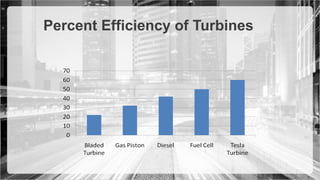
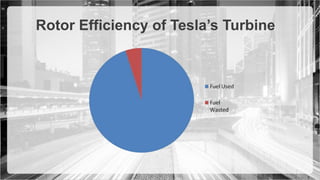
This bladeless turbine is up to 95% efficient when using steam as the fuel, far exceeding any competition in
its time.
 Pressurized gas entering at the inlet spirals its way to the center of equally spaced parallel discs and then
exits through the middle holes, turning the discs at really high speeds in the process. A variety of fuels could
be used such as steam and water. This simple design can also be reversed and made to act as a pump with
a slight modification for the medium. The potential of this turbine still remains widely unused to this day since
Tesla did not get any major contracts to mass produce this technology.
 This turbine is surprisingly easy to make and only requires a basic knowledge of how to work with ordinary
tools. However enthusiasts can apply this turbine to a variety of uses and also build large scale heavy duty
turbines using the same principles. Tesla’s smallest model alone could produce 110 horsepower, and is
surprisingly light weight compared to other conventional turbines. To produce one of these turbines you will
need the following: a few dead hard drives, a threaded metal rod with a diameter of 0.98’’ with appropriate
nuts and some stock acrylic or wood.
Description
What is it?
 Turbine with flat, encased, co-rotating disks
Extract energy from a fluid inserted tangentially
Converts kinetic energy of fluid into mechanical energy of a rotating shaft through frictional energy
transfer
Why study it?
 To explore why such a potentially green energy conversion device has not made it to wide-spread
industrial use today
Review the Tesla Turbine
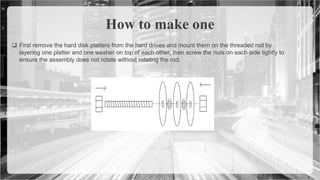
 First remove the hard disk platters from the hard drives and mount them on the threaded rod by
layering one platter and one washer on top of each other, then screw the nuts on each side tightly to
ensure the assembly does not rotate without rotating the rod.
How to make one
The Casing
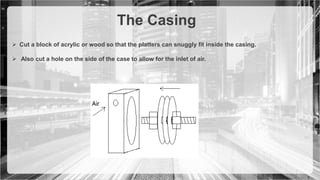
 Cut a block of acrylic or wood so that the platters can snuggly fit inside the casing.
 Also cut a hole on the side of the case to allow for the inlet of air.
Side Covers
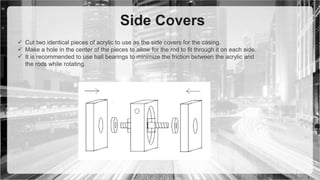
 Cut two identical pieces of acrylic to use as the side covers for the casing.
 Make a hole in the center of the pieces to allow for the rod to fit through it on each side.
 It is recommended to use ball bearings to minimize the friction between the acrylic and
the rods while rotating.
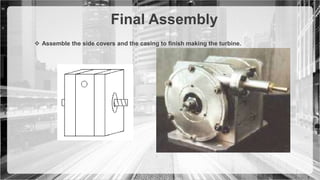
Final Assembly
 Assemble the side covers and the casing to finish making the turbine.
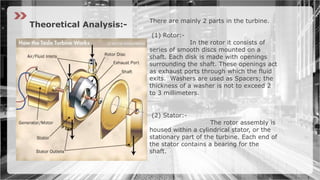
There are mainly 2 parts in the turbine.
(1) Rotor:-
In the rotor it consists of
series of smooth discs mounted on a
shaft. Each disk is made with openings
surrounding the shaft. These openings act
as exhaust ports through which the fluid
exits. Washers are used as Spacers; the
thickness of a washer is not to exceed 2
to 3 millimeters.
(2) Stator:-
The rotor assembly is
housed within a cylindrical stator, or the
stationary part of the turbine. Each end of
the stator contains a bearing for the
shaft.
Theoretical Analysis:-
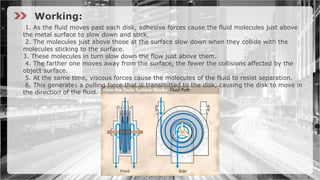
1. As the fluid moves past each disk, adhesive forces cause the fluid molecules just above
the metal surface to slow down and stick.
2. The molecules just above those at the surface slow down when they collide with the
molecules sticking to the surface.
3. These molecules in turn slow down the flow just above them.
4. The farther one moves away from the surface, the fewer the collisions affected by the
object surface.
5. At the same time, viscous forces cause the molecules of the fluid to resist separation.
6. This generates a pulling force that is transmitted to the disk, causing the disk to move in
the direction of the fluid.
Working:
Advantages:-
Simple in construction.
Corrosion and cavitation is less.
Pollution free.
Low cost to produce and maintain.
Lower design and production costs than standard turbines, jet engines and pumps
Blade-less
High-speed (100,000rpm+ be achieved with some versions)
Low friction (uses boundary layer effect , adhesion + viscosity rather friction)
Reversible
Can be run on a vacuum
Can be powered by air, steam, gasses or liquids
Proven technology (but rarely used)
Lower complexity the conventional Jet Engine
Can be used as a pump by rotating the shaft
Quieter in operation than conventional machinery
Noise is more ‘white’
2 stage or multi stage versions can run on combustible gas/liquids (Just like a jet
engine)
Disadvantages:-
Low rotor torque
Often not suitable for a direct replacement for conventional turbines and pumps,
without changes to the machinery it is interacting with.
Proof of its efficiency compared to conventional turbines is still questionable and
needs more research
It has remain underdeveloped and hence design improvements are still being
made
Percent Efficiency of Turbines
Rotor Efficiency of Tesla’s Turbine
Applications:-
Tesla turbine has not seen widespread commercial use since its invention.
The Tesla pump, however, has been commercially available since 1982 and is used to pump
fluids that are abrasive, viscous, contain solids, shear sensitive or otherwise difficult to handle
with other pumps.
Applications of the Tesla turbine as a multiple-disk centrifugal blood pump have yielded
promising results. Biomedical engineering research on such applications has been continued
into the 21st century.
Future of the turbine:-
Tesla’s ultimate goal was to replace the piston combustion engine with a much more
efficient, more reliable engine based on his technology.
THANKS

Tesla Turbine PPT

  • 1.
    SRIDHAR.P [17Q91A0334] Mechanical Engineering MallaReddy College of Engineering TOPIC: TESLA TURBINE
  • 2.
     The Teslaturbine is a bladeless centripetal flow turbine patented by Nikola Tesla in 1913.  It is referred to as a bladeless turbine because it uses the boundary layer effect and not a fluid impinging upon the blades as in a conventional turbine.  The Tesla turbine is also known as the boundary layer turbine, cohesion-type turbine, and Prandtl layer turbine (after Ludwig Prandtl). Bioengineering researchers have referred to it as a multiple disk centrifugal pump.   The job of any engine is to convert energy from a fuel source into mechanical energy. Whether the natural source is air, moving water, coal or petroleum, the input energy is a fluid. And by fluid we mean something very specific -- it's any substance that flows under an applied stress. Abstract:
  • 3.
     Modern turbinesrely on principles of aerodynamics, where the air flow pushes the blades attached to an axle causing them to turn. Tesla’s turbine however side steps friction and instead uses adhesion to power itself. This bladeless turbine is up to 95% efficient when using steam as the fuel, far exceeding any competition in its time.  Pressurized gas entering at the inlet spirals its way to the center of equally spaced parallel discs and then exits through the middle holes, turning the discs at really high speeds in the process. A variety of fuels could be used such as steam and water. This simple design can also be reversed and made to act as a pump with a slight modification for the medium. The potential of this turbine still remains widely unused to this day since Tesla did not get any major contracts to mass produce this technology.  This turbine is surprisingly easy to make and only requires a basic knowledge of how to work with ordinary tools. However enthusiasts can apply this turbine to a variety of uses and also build large scale heavy duty turbines using the same principles. Tesla’s smallest model alone could produce 110 horsepower, and is surprisingly light weight compared to other conventional turbines. To produce one of these turbines you will need the following: a few dead hard drives, a threaded metal rod with a diameter of 0.98’’ with appropriate nuts and some stock acrylic or wood. Description
  • 4.
    What is it? Turbine with flat, encased, co-rotating disks Extract energy from a fluid inserted tangentially Converts kinetic energy of fluid into mechanical energy of a rotating shaft through frictional energy transfer Why study it?  To explore why such a potentially green energy conversion device has not made it to wide-spread industrial use today Review the Tesla Turbine
  • 5.
     First removethe hard disk platters from the hard drives and mount them on the threaded rod by layering one platter and one washer on top of each other, then screw the nuts on each side tightly to ensure the assembly does not rotate without rotating the rod. How to make one
  • 6.
    The Casing  Cuta block of acrylic or wood so that the platters can snuggly fit inside the casing.  Also cut a hole on the side of the case to allow for the inlet of air.
  • 7.
    Side Covers  Cuttwo identical pieces of acrylic to use as the side covers for the casing.  Make a hole in the center of the pieces to allow for the rod to fit through it on each side.  It is recommended to use ball bearings to minimize the friction between the acrylic and the rods while rotating.
  • 8.
    Final Assembly  Assemblethe side covers and the casing to finish making the turbine.
  • 9.
    There are mainly2 parts in the turbine. (1) Rotor:- In the rotor it consists of series of smooth discs mounted on a shaft. Each disk is made with openings surrounding the shaft. These openings act as exhaust ports through which the fluid exits. Washers are used as Spacers; the thickness of a washer is not to exceed 2 to 3 millimeters. (2) Stator:- The rotor assembly is housed within a cylindrical stator, or the stationary part of the turbine. Each end of the stator contains a bearing for the shaft. Theoretical Analysis:-
  • 10.
    1. As thefluid moves past each disk, adhesive forces cause the fluid molecules just above the metal surface to slow down and stick. 2. The molecules just above those at the surface slow down when they collide with the molecules sticking to the surface. 3. These molecules in turn slow down the flow just above them. 4. The farther one moves away from the surface, the fewer the collisions affected by the object surface. 5. At the same time, viscous forces cause the molecules of the fluid to resist separation. 6. This generates a pulling force that is transmitted to the disk, causing the disk to move in the direction of the fluid. Working:
  • 11.
    Advantages:- Simple in construction. Corrosionand cavitation is less. Pollution free. Low cost to produce and maintain. Lower design and production costs than standard turbines, jet engines and pumps Blade-less High-speed (100,000rpm+ be achieved with some versions) Low friction (uses boundary layer effect , adhesion + viscosity rather friction) Reversible Can be run on a vacuum Can be powered by air, steam, gasses or liquids Proven technology (but rarely used) Lower complexity the conventional Jet Engine Can be used as a pump by rotating the shaft Quieter in operation than conventional machinery Noise is more ‘white’ 2 stage or multi stage versions can run on combustible gas/liquids (Just like a jet engine)
  • 12.
    Disadvantages:- Low rotor torque Oftennot suitable for a direct replacement for conventional turbines and pumps, without changes to the machinery it is interacting with. Proof of its efficiency compared to conventional turbines is still questionable and needs more research It has remain underdeveloped and hence design improvements are still being made
  • 13.
  • 14.
    Rotor Efficiency ofTesla’s Turbine
  • 15.
    Applications:- Tesla turbine hasnot seen widespread commercial use since its invention. The Tesla pump, however, has been commercially available since 1982 and is used to pump fluids that are abrasive, viscous, contain solids, shear sensitive or otherwise difficult to handle with other pumps. Applications of the Tesla turbine as a multiple-disk centrifugal blood pump have yielded promising results. Biomedical engineering research on such applications has been continued into the 21st century.
  • 16.
    Future of theturbine:- Tesla’s ultimate goal was to replace the piston combustion engine with a much more efficient, more reliable engine based on his technology.
  • 17.