HOW TO LEARN ABOUT
YOUR EMPLOYER'S
CHARITABLE WORK
DES HAGUE
D E S H A G U E N E W S . C O M
CORPORATE SOCIAL
RESPONSIBILITY
Corporate social responsibility, which is also
known as “corporate conscience” or “responsible
business,” is a concept that millennial employees
emerging into the workplace are inquiring about,
even at the early stages of the interview process.
The acronym commonly used for corporate social
responsibility (CSR), is centered around charitable
functions or other forms of philanthropy within the
standards of national or international law.
In addition to employees and often times
consumers agreeing that CSR should be achieved
while business goals are met, various researchers
within the field of charity confirm that corporate
social responsibility is also a catalyst for other
positive outcomes. These positive outcomes
include consumers’ willingness to spend money
on a certain brand’s products, increased loyalty
from employees and rising company trust
altogether.
The rise of corporate social
responsibility programs in the
private sector has somewhat
changedglobal citizenship the
status quo within the interview
process. Millennials undergoing
the interview process have
shown increased interest in
terms of exactly how their
potential employer actively
engages charity along with their
day to day business goals.
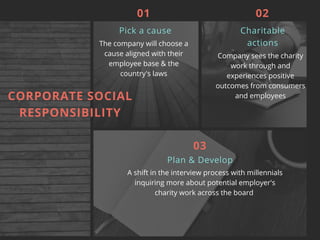
The company will choose a
cause aligned with their
employee base & the
country's laws
Pick a cause
01
Company sees the charity
work through and
experiences positive
outcomes from consumers
and employees
Charitable
actions
02
A shift in the interview process with millennials
inquiring more about potential employer's
charity work across the board
Plan & Develop
03
CORPORATE SOCIAL
RESPONSIBILITY
In other words, these emerging employees are
essentially shaping the two way conversation
during the interview by asking questions about
the company, brand or organization’s
philanthropic work. In order to gain a better
understanding of the employer’s charitable
stance, be sure to ask the following questions
during your interview:
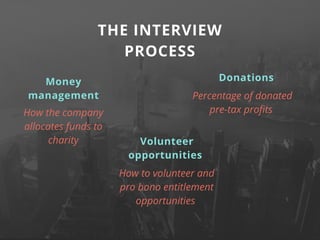
How the company
allocates funds to
charity
THE INTERVIEW
PROCESS
Percentage of donated
pre-tax profits
Money
management
Donations
Volunteer
opportunities
How to volunteer and
pro bono entitlement
opportunities
Money Management
Once you have asked the initial question regarding how the
company exactly addresses charity, pay close attention to
the key points highlighted by the interviewer. Absorbing the
information in relation to whether or not the entity matches
funds, works with a different charity every year or
participates in different fundraising campaigns are
important to know moving forward. Also, inquiring about
hard numbers of exactly what amount the employer gives
on either annual, semi-annual, or seasonal basis is also a
useful question to ask.
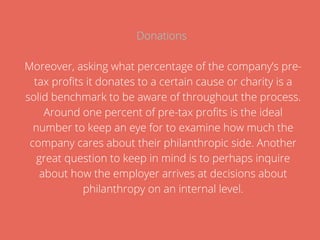
Donations
Moreover, asking what percentage of the company’s pre-
tax profits it donates to a certain cause or charity is a
solid benchmark to be aware of throughout the process.
Around one percent of pre-tax profits is the ideal
number to keep an eye for to examine how much the
company cares about their philanthropic side. Another
great question to keep in mind is to perhaps inquire
about how the employer arrives at decisions about
philanthropy on an internal level.
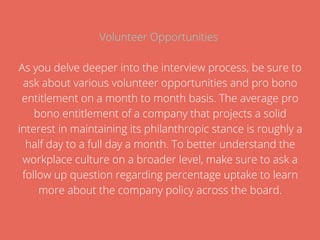
Volunteer Opportunities
As you delve deeper into the interview process, be sure to
ask about various volunteer opportunities and pro bono
entitlement on a month to month basis. The average pro
bono entitlement of a company that projects a solid
interest in maintaining its philanthropic stance is roughly a
half day to a full day a month. To better understand the
workplace culture on a broader level, make sure to ask a
follow up question regarding percentage uptake to learn
more about the company policy across the board.
THIS POST WAS ORGINIALLY
PUBLISHED ON:
DESHAGUENEWS.COM

How to Learn About Your Employer's Charitable Work

  • 1.
    HOW TO LEARNABOUT YOUR EMPLOYER'S CHARITABLE WORK DES HAGUE D E S H A G U E N E W S . C O M
  • 2.
  • 3.
    Corporate social responsibility,which is also known as “corporate conscience” or “responsible business,” is a concept that millennial employees emerging into the workplace are inquiring about, even at the early stages of the interview process. The acronym commonly used for corporate social responsibility (CSR), is centered around charitable functions or other forms of philanthropy within the standards of national or international law.
  • 4.
    In addition toemployees and often times consumers agreeing that CSR should be achieved while business goals are met, various researchers within the field of charity confirm that corporate social responsibility is also a catalyst for other positive outcomes. These positive outcomes include consumers’ willingness to spend money on a certain brand’s products, increased loyalty from employees and rising company trust altogether.
  • 5.
    The rise ofcorporate social responsibility programs in the private sector has somewhat changedglobal citizenship the status quo within the interview process. Millennials undergoing the interview process have shown increased interest in terms of exactly how their potential employer actively engages charity along with their day to day business goals.
  • 6.
    The company willchoose a cause aligned with their employee base & the country's laws Pick a cause 01 Company sees the charity work through and experiences positive outcomes from consumers and employees Charitable actions 02 A shift in the interview process with millennials inquiring more about potential employer's charity work across the board Plan & Develop 03 CORPORATE SOCIAL RESPONSIBILITY
  • 7.
    In other words,these emerging employees are essentially shaping the two way conversation during the interview by asking questions about the company, brand or organization’s philanthropic work. In order to gain a better understanding of the employer’s charitable stance, be sure to ask the following questions during your interview:
  • 8.
    How the company allocatesfunds to charity THE INTERVIEW PROCESS Percentage of donated pre-tax profits Money management Donations Volunteer opportunities How to volunteer and pro bono entitlement opportunities
  • 9.
    Money Management Once youhave asked the initial question regarding how the company exactly addresses charity, pay close attention to the key points highlighted by the interviewer. Absorbing the information in relation to whether or not the entity matches funds, works with a different charity every year or participates in different fundraising campaigns are important to know moving forward. Also, inquiring about hard numbers of exactly what amount the employer gives on either annual, semi-annual, or seasonal basis is also a useful question to ask.
  • 10.
    Donations Moreover, asking whatpercentage of the company’s pre- tax profits it donates to a certain cause or charity is a solid benchmark to be aware of throughout the process. Around one percent of pre-tax profits is the ideal number to keep an eye for to examine how much the company cares about their philanthropic side. Another great question to keep in mind is to perhaps inquire about how the employer arrives at decisions about philanthropy on an internal level.
  • 11.
    Volunteer Opportunities As youdelve deeper into the interview process, be sure to ask about various volunteer opportunities and pro bono entitlement on a month to month basis. The average pro bono entitlement of a company that projects a solid interest in maintaining its philanthropic stance is roughly a half day to a full day a month. To better understand the workplace culture on a broader level, make sure to ask a follow up question regarding percentage uptake to learn more about the company policy across the board.
  • 12.
    THIS POST WASORGINIALLY PUBLISHED ON: DESHAGUENEWS.COM