Bamboo and Resilient Landscapes 
5 December 2014, Lima, Peru 
hfriederich@inbar.int 
www.inbar.int
Contents of Presentation 
• International Network for 
Bamboo and Rattan - INBAR 
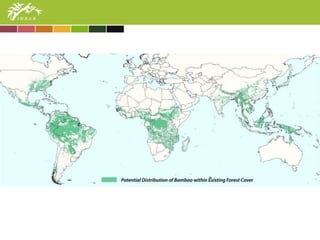
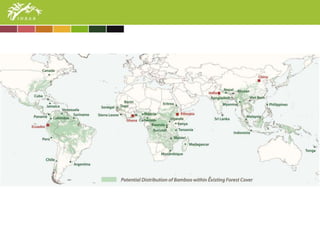
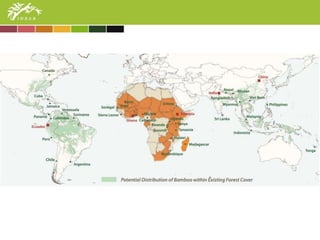
• Bamboo distribution 
• Bamboo and erosion control 
• Bamboo and land restoration 
• Bamboo products and 
international trade 
• Conclusion and what next?
INBAR 
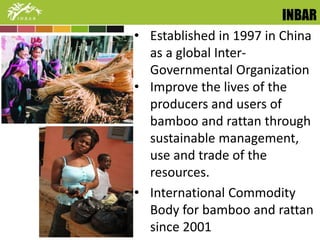
• Established in 1997 in China 
as a global Inter- 
Governmental Organization 
• Improve the lives of the 
producers and users of 
bamboo and rattan through 
sustainable management, 
use and trade of the 
resources. 
• International Commodity 
Body for bamboo and rattan 
since 2001
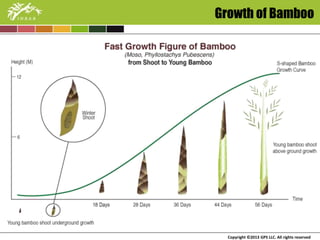
Growth of Bamboo 
Copyright ©2013 GPS LLC. All rights reserved
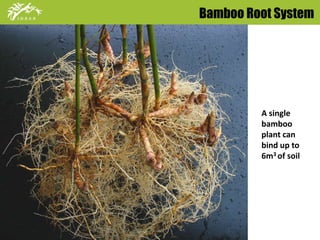
Bamboo Root System 
Bamboo can bind up to 6m3 of soil 
A single 
bamboo 
plant can 
bind up to 
6m3 of soil
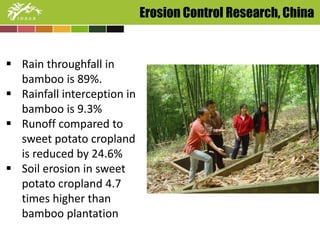
Erosion Control Research, China 
 Rain throughfall in 
bamboo is 89%. 
 Rainfall interception in 
bamboo is 9.3% 
 Runoff compared to 
sweet potato cropland 
is reduced by 24.6% 
 Soil erosion in sweet 
potato cropland 4.7 
times higher than 
bamboo plantation
Rwanda National Bamboo Policy 
 Grow bamboo in order to reduce soil 
erosion and siltation of rivers and water 
bodies 
 Plant bamboo in 5 metre corridors along 
small rivers 
 Plant bamboo in 10 metre corridors along 
big rivers 
 Plant bamboo in 50 metre corridors along 
lake shores
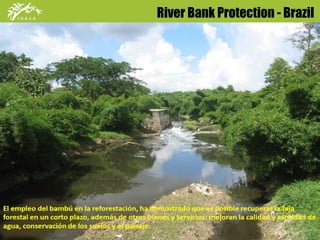
River Bank Protection - Brazil
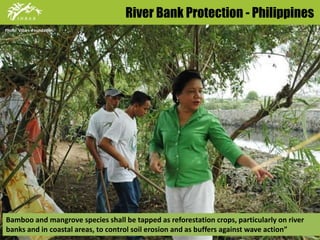
River Bank Protection - Philippines 
Photo: Villars Foundation 
Bamboo and mangrove species shall be tapped as reforestation crops, particularly on river 
banks and in coastal areas, to control soil erosion and as buffers against wave action”
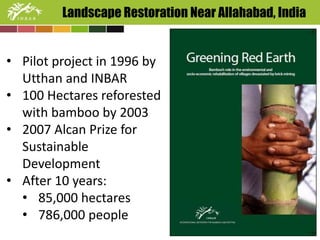
Landscape Restoration Near Allahabad, India 
• Pilot project in 1996 by 
Utthan and INBAR 
• 100 Hectares reforested 
with bamboo by 2003 
• 2007 Alcan Prize for 
Sustainable 
Development 
• After 10 years: 
• 85,000 hectares 
• 786,000 people
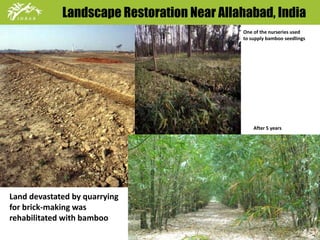
Landscape Restoration Near Allahabad, India 
Land devastated by quarrying 
for brick-making was 
rehabilitated with bamboo 
One of the nurseries used 
to supply bamboo seedlings 
After 5 years
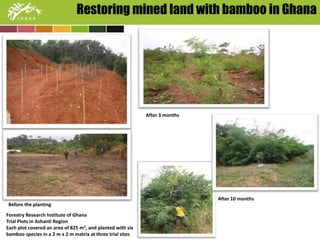
Restoring mined land with bamboo in Ghana 
After 10 months 
After 3 months 
Before the planting 
Forestry Research Institute of Ghana 
Trial Plots in Ashanti Region 
Each plot covered an area of 825 m2, and planted with six 
bamboo species in a 2 m x 2 m matrix at three trial sites
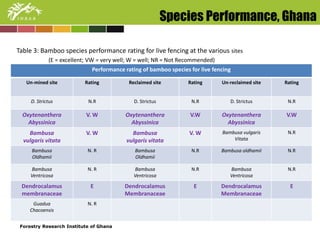
Species Performance, Ghana 
Table 3: Bamboo species performance rating for live fencing at the various sites 
(E = excellent; VW = very well; W = well; NR = Not Recommended) 
Performance rating of bamboo species for live fencing 
Un-mined site Rating Reclaimed site 
Rating Un-reclaimed site 
Rating 
D. Strictus N.R D. Strictus N.R D. Strictus N.R 
Oxytenanthera 
Abyssinica 
V. W Oxytenanthera 
Forestry Research Institute of Ghana 
Abyssinica 
V.W Oxytenanthera 
Abyssinica 
V.W 
Bambusa 
vulgaris vitata 
V. W Bambusa 
vulgaris vitata 
V. W Bambusa vulgaris 
Vitata 
N.R 
Bambusa 
Oldhamii 
N. R Bambusa 
Oldhamii 
N.R Bambusa oldhamii N.R 
Bambusa 
Ventricosa 
N. R Bambusa 
Ventricosa 
N.R Bambusa 
Ventricosa 
N.R 
Dendrocalamus 
membranaceae 
E Dendrocalamus 
Membranaceae 
E Dendrocalamus 
Membranaceae 
E 
Guadua 
Chacoensis 
N. R
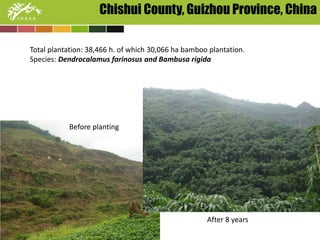
Chishui County, Guizhou Province, China 
Total plantation: 38,466 h. of which 30,066 ha bamboo plantation. 
Species: Dendrocalamus farinosus and Bambusa rigida 
Before planting 
After 8 years
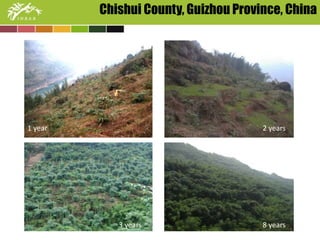
Chishui County, Guizhou Province, China 
1 year 2 years 
3 years 8 years
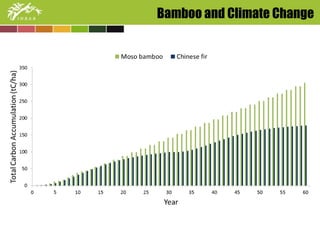
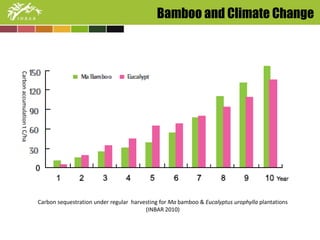
Bamboo and Climate Change
Carbon accumulation t C/ha 
Bamboo and Climate Change 
Carbon sequestration under regular harvesting for Ma bamboo & Eucalyptus urophylla plantations 
(INBAR 2010)
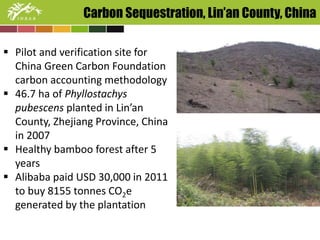
Carbon Sequestration, Lin’an County, China 
 Pilot and verification site for 
China Green Carbon Foundation 
carbon accounting methodology 
 46.7 ha of Phyllostachys 
pubescens planted in Lin’an 
County, Zhejiang Province, China 
in 2007 
 Healthy bamboo forest after 5 
years 
 Alibaba paid USD 30,000 in 2011 
to buy 8155 tonnes CO2e 
generated by the plantation
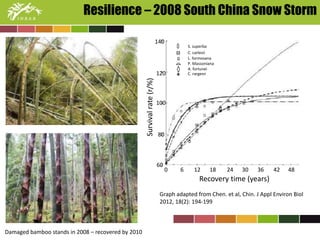
Resilience – 2008 South China Snow Storm 
Damaged bamboo stands in 2008 – recovered by 2010 
0 6 12 18 24 30 36 42 48 
Recovery time (years) 
Survival rate (r/%) 
140 
120 
100 
80 
60 
* 
S. superba 
C. carlesii 
L. formosana 
P. Massoniana 
A. fortunei 
C. rargesn 
Graph adapted from Chen. et al, Chin. J Appl Environ Biol 
2012, 18(2): 194-199
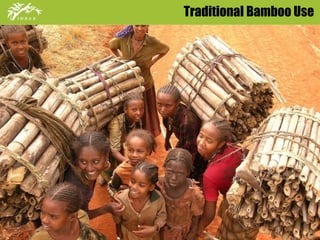
Traditional Bamboo Use
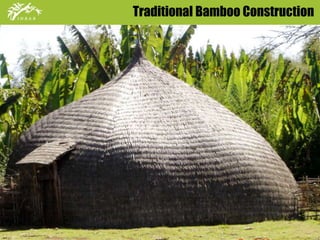
Traditional Bamboo Construction
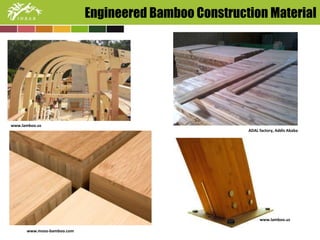
Engineered Bamboo Construction Material 
www.lamboo.us 
www.moso-bamboo.com 
ADAL factory, Addis Ababa 
www.lamboo.us
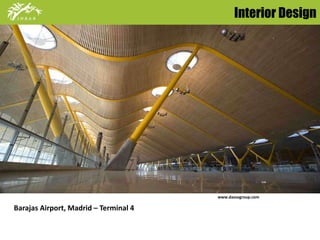
Interior Design 
Barajas Airport, Madrid – Terminal 4 
www.dassogroup.com
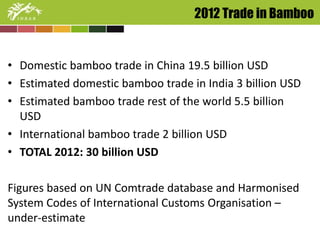
2012 Trade in Bamboo 
• Domestic bamboo trade in China 19.5 billion USD 
• Estimated domestic bamboo trade in India 3 billion USD 
• Estimated bamboo trade rest of the world 5.5 billion 
USD 
• International bamboo trade 2 billion USD 
• TOTAL 2012: 30 billion USD 
Figures based on UN Comtrade database and Harmonised 
System Codes of International Customs Organisation – 
under-estimate
Conclusion 
• Bamboo is a crop that grows fast and can 
be harvested annually 
• Bamboo plants are good soil conservation 
and slope restoration 
• Using bamboo will help avoided 
deforestation 
• Bamboo as a traded commodity is a 
serious development option 
• Bamboo could and should be used in 
African landscape management
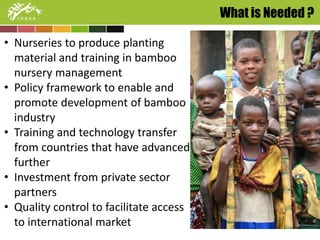
What is Needed ? 
• Nurseries to produce planting 
material and training in bamboo 
nursery management 
• Policy framework to enable and 
promote development of bamboo 
industry 
• Training and technology transfer 
from countries that have advanced 
further 
• Investment from private sector 
partners 
• Quality control to facilitate access 
to international market

Terr africa cop20

  • 1.
    Bamboo and ResilientLandscapes 5 December 2014, Lima, Peru hfriederich@inbar.int www.inbar.int
  • 2.
    Contents of Presentation • International Network for Bamboo and Rattan - INBAR • Bamboo distribution • Bamboo and erosion control • Bamboo and land restoration • Bamboo products and international trade • Conclusion and what next?
  • 3.
    INBAR • Establishedin 1997 in China as a global Inter- Governmental Organization • Improve the lives of the producers and users of bamboo and rattan through sustainable management, use and trade of the resources. • International Commodity Body for bamboo and rattan since 2001
  • 7.
    Growth of Bamboo Copyright ©2013 GPS LLC. All rights reserved
  • 8.
    Bamboo Root System Bamboo can bind up to 6m3 of soil A single bamboo plant can bind up to 6m3 of soil
  • 9.
    Erosion Control Research,China  Rain throughfall in bamboo is 89%.  Rainfall interception in bamboo is 9.3%  Runoff compared to sweet potato cropland is reduced by 24.6%  Soil erosion in sweet potato cropland 4.7 times higher than bamboo plantation
  • 10.
    Rwanda National BambooPolicy  Grow bamboo in order to reduce soil erosion and siltation of rivers and water bodies  Plant bamboo in 5 metre corridors along small rivers  Plant bamboo in 10 metre corridors along big rivers  Plant bamboo in 50 metre corridors along lake shores
  • 11.
  • 12.
    River Bank Protection- Philippines Photo: Villars Foundation Bamboo and mangrove species shall be tapped as reforestation crops, particularly on river banks and in coastal areas, to control soil erosion and as buffers against wave action”
  • 13.
    Landscape Restoration NearAllahabad, India • Pilot project in 1996 by Utthan and INBAR • 100 Hectares reforested with bamboo by 2003 • 2007 Alcan Prize for Sustainable Development • After 10 years: • 85,000 hectares • 786,000 people
  • 14.
    Landscape Restoration NearAllahabad, India Land devastated by quarrying for brick-making was rehabilitated with bamboo One of the nurseries used to supply bamboo seedlings After 5 years
  • 15.
    Restoring mined landwith bamboo in Ghana After 10 months After 3 months Before the planting Forestry Research Institute of Ghana Trial Plots in Ashanti Region Each plot covered an area of 825 m2, and planted with six bamboo species in a 2 m x 2 m matrix at three trial sites
  • 16.
    Species Performance, Ghana Table 3: Bamboo species performance rating for live fencing at the various sites (E = excellent; VW = very well; W = well; NR = Not Recommended) Performance rating of bamboo species for live fencing Un-mined site Rating Reclaimed site Rating Un-reclaimed site Rating D. Strictus N.R D. Strictus N.R D. Strictus N.R Oxytenanthera Abyssinica V. W Oxytenanthera Forestry Research Institute of Ghana Abyssinica V.W Oxytenanthera Abyssinica V.W Bambusa vulgaris vitata V. W Bambusa vulgaris vitata V. W Bambusa vulgaris Vitata N.R Bambusa Oldhamii N. R Bambusa Oldhamii N.R Bambusa oldhamii N.R Bambusa Ventricosa N. R Bambusa Ventricosa N.R Bambusa Ventricosa N.R Dendrocalamus membranaceae E Dendrocalamus Membranaceae E Dendrocalamus Membranaceae E Guadua Chacoensis N. R
  • 17.
    Chishui County, GuizhouProvince, China Total plantation: 38,466 h. of which 30,066 ha bamboo plantation. Species: Dendrocalamus farinosus and Bambusa rigida Before planting After 8 years
  • 18.
    Chishui County, GuizhouProvince, China 1 year 2 years 3 years 8 years
  • 19.
  • 20.
    Carbon accumulation tC/ha Bamboo and Climate Change Carbon sequestration under regular harvesting for Ma bamboo & Eucalyptus urophylla plantations (INBAR 2010)
  • 21.
    Carbon Sequestration, Lin’anCounty, China  Pilot and verification site for China Green Carbon Foundation carbon accounting methodology  46.7 ha of Phyllostachys pubescens planted in Lin’an County, Zhejiang Province, China in 2007  Healthy bamboo forest after 5 years  Alibaba paid USD 30,000 in 2011 to buy 8155 tonnes CO2e generated by the plantation
  • 22.
    Resilience – 2008South China Snow Storm Damaged bamboo stands in 2008 – recovered by 2010 0 6 12 18 24 30 36 42 48 Recovery time (years) Survival rate (r/%) 140 120 100 80 60 * S. superba C. carlesii L. formosana P. Massoniana A. fortunei C. rargesn Graph adapted from Chen. et al, Chin. J Appl Environ Biol 2012, 18(2): 194-199
  • 25.
  • 26.
  • 27.
    Engineered Bamboo ConstructionMaterial www.lamboo.us www.moso-bamboo.com ADAL factory, Addis Ababa www.lamboo.us
  • 28.
    Interior Design BarajasAirport, Madrid – Terminal 4 www.dassogroup.com
  • 29.
    2012 Trade inBamboo • Domestic bamboo trade in China 19.5 billion USD • Estimated domestic bamboo trade in India 3 billion USD • Estimated bamboo trade rest of the world 5.5 billion USD • International bamboo trade 2 billion USD • TOTAL 2012: 30 billion USD Figures based on UN Comtrade database and Harmonised System Codes of International Customs Organisation – under-estimate
  • 30.
    Conclusion • Bamboois a crop that grows fast and can be harvested annually • Bamboo plants are good soil conservation and slope restoration • Using bamboo will help avoided deforestation • Bamboo as a traded commodity is a serious development option • Bamboo could and should be used in African landscape management
  • 31.
    What is Needed? • Nurseries to produce planting material and training in bamboo nursery management • Policy framework to enable and promote development of bamboo industry • Training and technology transfer from countries that have advanced further • Investment from private sector partners • Quality control to facilitate access to international market