TENSES
Definition:
A distinction of form in a verb to express distinctions of time or
duration of theaction or stateit denotes
Adalah bentuk kata kerja dalam bahasa Inggris untuk menunjukkan
waktu (sekarang, masa depan, atau masa lalu) terjadinya suatu
perbuatan atau peristiwa.
5 Basic Tenses
SimplePresent Tense
SimplePast Tense
Present ContinuousTense
SimpleFuture Tense
Present Perfect Tense
1. SIMPLE PRESENT TENSE
Simple present tense is the tense used to express an
action or activity that takes place / happening at the
current time in a simple form, activity or work
performed repeatedly, daily habits, events or actions
that have nothing to do with time, and to express
generaltruths.
Suatu bentuk kata kerja untuk menyatakan fakta,
kebiasaan, atau kejadian yang terjadi pada saat
ini.
eg : I wait for the bus every day
PATTERN OF SIMPLEPRESENT TENSE
 Kalimat Rumus Simple Present Tense Contoh Simple
Present Tense positif
(+) S + V-1
S +/- auxiliary (do/does) + bare infinitive She likes
eating out
Note
 Pada kalimat positif, normalnya auxiliary verb (do/does) tidak digunakan, melainkan
hanyadigunakanjika perluuntukmemberi penekananpadakeharusanmelakukanaksi.
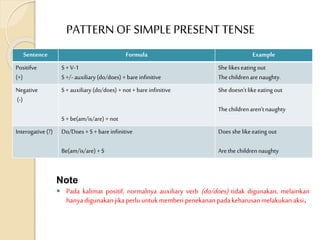
Sentence Formula Example
Positifve
(+)
S+ V-1
S+/- auxiliary (do/does) + bare infinitive
She likeseating out
Thechildrenare naughty.
Negative
(-)
S+ auxiliary (do/does) + not + bare infinitive
S+ be(am/is/are) + not
She doesn’t like eating out
Thechildrenaren’tnaughty
Interogative(?) Do/Does + S+ bare infinitive
Be(am/is/are) + S
Does she likeeating out
Arethe childrennaughty
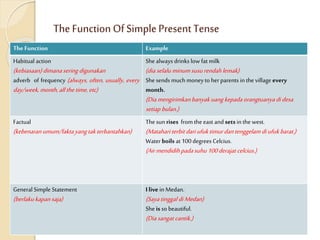
The Function Of SimplePresent Tense
The Function Example
Habitual action
(kebiasaan) dimanaseringdigunakan
adverb of frequency (always, often, usually, every
day/week,month,all thetime,etc)
She always drinks low fat milk
(dia selalu minumsusu rendahlemak)
She sends much moneyto herparents inthe village every
month.
(Dia mengirimkanbanyakuangkepadaorangtuanyadidesa
setiap bulan.)
Factual
(kebenaranumum/faktayangtakterbantahkan)
Thesunrises from the east and sets in the west.
(Matahari terbit dariufuktimurdantenggelamdiufukbarat.)
Water boils at 100degrees Celcius.
(Airmendidihpada suhu100derajat celcius.)
GeneralSimple Statement
(berlakukapansaja)
I live in Medan.
(Sayatinggal di Medan)
She is so beautiful.
(Dia sangat cantik.)
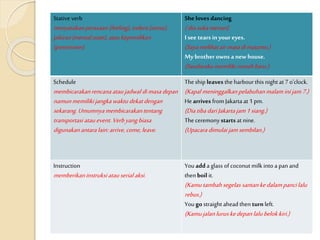
Stative verb
menyatakanperasaan (feeling), indera(sense),
pikiran(mentalstate), atau kepemilikan
(possession).
She loves dancing
(dia sukamenari)
I see tears in your eyes.
(Sayamelihatairmata dimatamu.)
My brother owns a new house.
(Saudarakumemilikirumahbaru.)
Schedule
membicarakanrencanaataujadwal dimasa depan
namunmemilikijangkawaktudekatdengan
sekarang.Umumnyamembicarakantentang
transportasi atauevent.Verbyangbiasa
digunakanantaralain:arrive,come,leave.
Theship leaves the harbour this night at 7 o’clock.
(Kapal meninggalkanpelabuhanmalam inijam7.)
He arrives fromJakartaat 1 pm.
(Dia tiba dariJakartajam1siang.)
Theceremonystartsat nine.
(Upacara dimulai jamsembilan.)
Instruction
memberikaninstruksiatauserial aksi.
You adda glass of coconut milk into a panand
thenboil it.
(Kamutambah segelas santankedalam pancilalu
rebus.)
You go straight ahead then turn left.
(Kamujalanluruskedepanlalubelokkiri.)
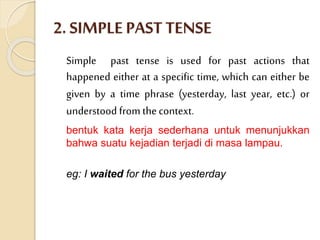
2. SIMPLE PAST TENSE
Simple past tense is used for past actions that
happened either at a specific time, which can either be
given by a time phrase (yesterday, last year, etc.) or
understood from thecontext.
bentuk kata kerja sederhana untuk menunjukkan
bahwa suatu kejadian terjadi di masa lampau.
eg: I waited for the bus yesterday
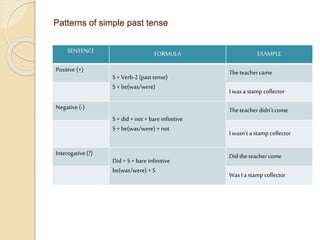
Patterns of simple past tense
SENTENCE FORMULA EXAMPLE
Positive (+)
S+ Verb-2 (past tense)
S+ be(was/were)
Theteachercame
I was a stamp collector
Negative(-)
S+ did + not + bare infinitive
S+ be(was/were) + not
Theteacherdidn’t come
I wasn’t a stamp collector
Interogative(?)
Did + S + bare infinitive
be(was/were) + S
Did the teachercome
Was I a stamp collector
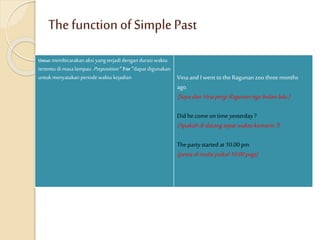
The function ofSimplePast
Untuk membicarakan aksi yangterjadi dengan durasi waktu
tertentu di masa lampau. Preposition ” For “dapat digunakan
untuk menyatakan periode waktu kejadian Vina and I went to the Ragunanzoothreemonths
ago.
(SayadanVinapergi Ragunantiga bulanlalu.)
Did hecome on time yesterday ?
(Apakahdi datang tepat waktukemarin?)
Theparty started at 10.00pm
(pesta di mulaipukul10.00pagi)
3. PresentContinuousTense
Present continuous tense is used to express a continued
or ongoing action at present time. It expresses an action
whichis in progress at thetimeof speaking.
Merupakan tense bentuk yang menunjuk pada tindakan yang
sedang berlangsung sekarang atau ketika pembicaraan itu sedang
berlangsung. Jadi tindakan itu sudah dimulai, dan belum berakhir
ketika pembicaraan itu berlangsung.
eg : I am waiting for bus now
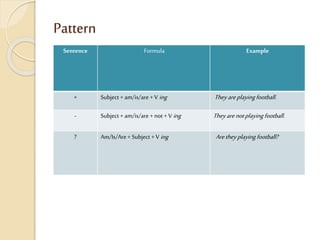
Pattern
Sentence Formula Example
+ Subject + am/is/are + V ing Theyareplayingfootball.
- Subject + am/is/are + not + V ing Theyarenotplayingfootball.
? Am/Is/Are+ Subject + V ing Aretheyplayingfootball?
The FunctionofPresent continuousTense
Present continuous Tense is also called Present
Progressive Tense. We use the present continuous
tense to show we are in the middle of an activity that is in
progress at this moment. The activity started in the past and
willgoonin thefuture.
So when we use the present continuous tense we are
talking about something that is still not yet finished or
completeatthetimeofspeaking.
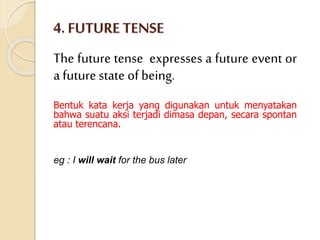
4. FUTURE TENSE
The future tense expresses a future event or
a future state ofbeing.
Bentuk kata kerja yang digunakan untuk menyatakan
bahwa suatu aksi terjadi dimasa depan, secara spontan
atau terencana.
eg : I will wait for the bus later
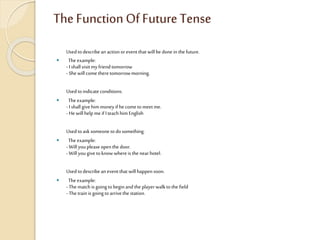
The Function Of Future Tense
Usedtodescribean actionoreventthat willbe donein the future.
 The example:
- I shallvisitmy friendtomorrow
- Shewill cometheretomorrowmorning.
Usedtoindicateconditions.
 The example:
- I shallgivehimmoney if hecometomeet me.
- Hewillhelp me ifI teachhimEnglish
Usedtoasksomeonetodo something.
 The example:
- Willyoupleaseopenthe door.
- Willyougivetoknow whereisthe nearhotel.
Usedtodescribean eventthat willhappensoon.
 The example:
- Thematch isgoingtobeginand the playerwalkto the field
- Thetrainisgoing toarrivethe station.
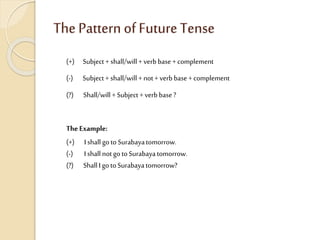
The Pattern of FutureTense
(+) Subject +shall/will+verb base +complement
(-) Subject +shall/will+not+verb base +complement
(?) Shall/will+Subject +verbbase?
The Example:
(+) I shallgoto Surabayatomorrow.
(-) I shallnotgotoSurabayatomorrow.
(?) ShallI gotoSurabayatomorrow?
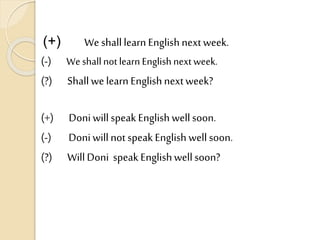
(+) We shalllearn Englishnext week.
(-) Weshallnot learnEnglishnextweek.
(?) Shallwe learn Englishnextweek?
(+) Doni will speak Englishwellsoon.
(-) Doniwill not speak English wellsoon.
(?) WillDoni speak Englishwellsoon?
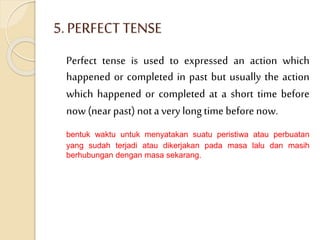
5.PERFECT TENSE
Perfect tense is used to expressed an action which
happened or completed in past but usually the action
which happened or completed at a short time before
now (near past) not a very longtime before now.
bentuk waktu untuk menyatakan suatu peristiwa atau perbuatan
yang sudah terjadi atau dikerjakan pada masa lalu dan masih
berhubungan dengan masa sekarang.
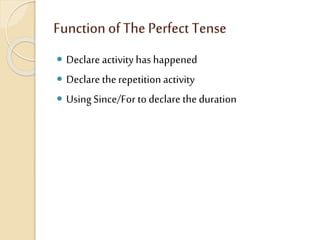
Function of The Perfect Tense
 Declare activity has happened
 Declare therepetition activity
 Using Since/For to declare the duration
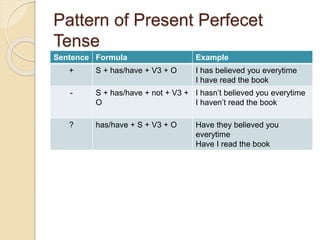
Pattern of Present Perfecet
Tense
Sentence Formula Example
+ S + has/have + V3 + O I has believed you everytime
I have read the book
- S + has/have + not + V3 +
O
I hasn’t believed you everytime
I haven’t read the book
? has/have + S + V3 + O Have they believed you
everytime
Have I read the book
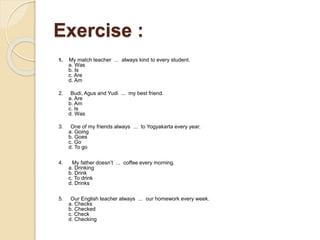
Exercise :
1. My match teacher ... always kind to every student.
a. Was
b. Is
c. Are
d. Am
2. Budi, Agus and Yudi ... my best friend.
a. Are
b. Am
c. Is
d. Was
3. One of my friends always ... to Yogyakarta every year.
a. Going
b. Goes
c. Go
d. To go
4. My father doesn’t ... coffee every morning.
a. Drinking
b. Drink
c. To drink
d. Drinks
5. Our English teacher always ... our homework every week.
a. Checks
b. Checked
c. Check
d. Checking
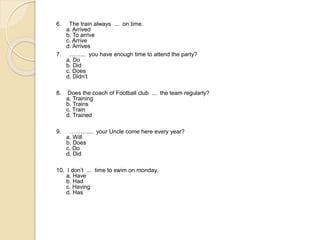
6. The train always ... on time.
a. Arrived
b. To arrive
c. Arrive
d. Arrives
7. ……... you have enough time to attend the party?
a. Do
b. Did
c. Does
d. Didn’t
8. Does the coach of Football club ... the team regularly?
a. Training
b. Trains
c. Train
d. Trained
9. ……….... your Uncle come here every year?
a. Will
b. Does
c. Do
d. Did
10. I don’t ... time to swim on monday.
a. Have
b. Had
c. Having
d. Has
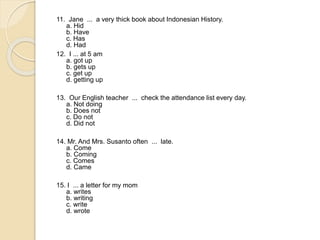
11. Jane ... a very thick book about Indonesian History.
a. Hid
b. Have
c. Has
d. Had
12. I ... at 5 am
a. got up
b. gets up
c. get up
d. getting up
13. Our English teacher ... check the attendance list every day.
a. Not doing
b. Does not
c. Do not
d. Did not
14. Mr. And Mrs. Susanto often ... late.
a. Come
b. Coming
c. Comes
d. Came
15. I ... a letter for my mom
a. writes
b. writing
c. write
d. wrote
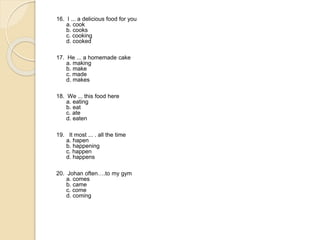
16. I ... a delicious food for you
a. cook
b. cooks
c. cooking
d. cooked
17. He ... a homemade cake
a. making
b. make
c. made
d. makes
18. We ... this food here
a. eating
b. eat
c. ate
d. eaten
19. It most ... . all the time
a. hapen
b. happening
c. happen
d. happens
20. Johan often….to my gym
a. comes
b. came
c. come
d. coming

TENSES.pptx

  • 1.
    TENSES Definition: A distinction ofform in a verb to express distinctions of time or duration of theaction or stateit denotes Adalah bentuk kata kerja dalam bahasa Inggris untuk menunjukkan waktu (sekarang, masa depan, atau masa lalu) terjadinya suatu perbuatan atau peristiwa.
  • 2.
    5 Basic Tenses SimplePresentTense SimplePast Tense Present ContinuousTense SimpleFuture Tense Present Perfect Tense
  • 3.
    1. SIMPLE PRESENTTENSE Simple present tense is the tense used to express an action or activity that takes place / happening at the current time in a simple form, activity or work performed repeatedly, daily habits, events or actions that have nothing to do with time, and to express generaltruths. Suatu bentuk kata kerja untuk menyatakan fakta, kebiasaan, atau kejadian yang terjadi pada saat ini. eg : I wait for the bus every day
  • 4.
    PATTERN OF SIMPLEPRESENTTENSE  Kalimat Rumus Simple Present Tense Contoh Simple Present Tense positif (+) S + V-1 S +/- auxiliary (do/does) + bare infinitive She likes eating out Note  Pada kalimat positif, normalnya auxiliary verb (do/does) tidak digunakan, melainkan hanyadigunakanjika perluuntukmemberi penekananpadakeharusanmelakukanaksi. Sentence Formula Example Positifve (+) S+ V-1 S+/- auxiliary (do/does) + bare infinitive She likeseating out Thechildrenare naughty. Negative (-) S+ auxiliary (do/does) + not + bare infinitive S+ be(am/is/are) + not She doesn’t like eating out Thechildrenaren’tnaughty Interogative(?) Do/Does + S+ bare infinitive Be(am/is/are) + S Does she likeeating out Arethe childrennaughty
  • 5.
    The Function OfSimplePresent Tense The Function Example Habitual action (kebiasaan) dimanaseringdigunakan adverb of frequency (always, often, usually, every day/week,month,all thetime,etc) She always drinks low fat milk (dia selalu minumsusu rendahlemak) She sends much moneyto herparents inthe village every month. (Dia mengirimkanbanyakuangkepadaorangtuanyadidesa setiap bulan.) Factual (kebenaranumum/faktayangtakterbantahkan) Thesunrises from the east and sets in the west. (Matahari terbit dariufuktimurdantenggelamdiufukbarat.) Water boils at 100degrees Celcius. (Airmendidihpada suhu100derajat celcius.) GeneralSimple Statement (berlakukapansaja) I live in Medan. (Sayatinggal di Medan) She is so beautiful. (Dia sangat cantik.)
  • 6.
    Stative verb menyatakanperasaan (feeling),indera(sense), pikiran(mentalstate), atau kepemilikan (possession). She loves dancing (dia sukamenari) I see tears in your eyes. (Sayamelihatairmata dimatamu.) My brother owns a new house. (Saudarakumemilikirumahbaru.) Schedule membicarakanrencanaataujadwal dimasa depan namunmemilikijangkawaktudekatdengan sekarang.Umumnyamembicarakantentang transportasi atauevent.Verbyangbiasa digunakanantaralain:arrive,come,leave. Theship leaves the harbour this night at 7 o’clock. (Kapal meninggalkanpelabuhanmalam inijam7.) He arrives fromJakartaat 1 pm. (Dia tiba dariJakartajam1siang.) Theceremonystartsat nine. (Upacara dimulai jamsembilan.) Instruction memberikaninstruksiatauserial aksi. You adda glass of coconut milk into a panand thenboil it. (Kamutambah segelas santankedalam pancilalu rebus.) You go straight ahead then turn left. (Kamujalanluruskedepanlalubelokkiri.)
  • 7.
    2. SIMPLE PASTTENSE Simple past tense is used for past actions that happened either at a specific time, which can either be given by a time phrase (yesterday, last year, etc.) or understood from thecontext. bentuk kata kerja sederhana untuk menunjukkan bahwa suatu kejadian terjadi di masa lampau. eg: I waited for the bus yesterday
  • 8.
    Patterns of simplepast tense SENTENCE FORMULA EXAMPLE Positive (+) S+ Verb-2 (past tense) S+ be(was/were) Theteachercame I was a stamp collector Negative(-) S+ did + not + bare infinitive S+ be(was/were) + not Theteacherdidn’t come I wasn’t a stamp collector Interogative(?) Did + S + bare infinitive be(was/were) + S Did the teachercome Was I a stamp collector
  • 9.
    The function ofSimplePast Untukmembicarakan aksi yangterjadi dengan durasi waktu tertentu di masa lampau. Preposition ” For “dapat digunakan untuk menyatakan periode waktu kejadian Vina and I went to the Ragunanzoothreemonths ago. (SayadanVinapergi Ragunantiga bulanlalu.) Did hecome on time yesterday ? (Apakahdi datang tepat waktukemarin?) Theparty started at 10.00pm (pesta di mulaipukul10.00pagi)
  • 10.
    3. PresentContinuousTense Present continuoustense is used to express a continued or ongoing action at present time. It expresses an action whichis in progress at thetimeof speaking. Merupakan tense bentuk yang menunjuk pada tindakan yang sedang berlangsung sekarang atau ketika pembicaraan itu sedang berlangsung. Jadi tindakan itu sudah dimulai, dan belum berakhir ketika pembicaraan itu berlangsung. eg : I am waiting for bus now
  • 11.
    Pattern Sentence Formula Example +Subject + am/is/are + V ing Theyareplayingfootball. - Subject + am/is/are + not + V ing Theyarenotplayingfootball. ? Am/Is/Are+ Subject + V ing Aretheyplayingfootball?
  • 12.
    The FunctionofPresent continuousTense Presentcontinuous Tense is also called Present Progressive Tense. We use the present continuous tense to show we are in the middle of an activity that is in progress at this moment. The activity started in the past and willgoonin thefuture. So when we use the present continuous tense we are talking about something that is still not yet finished or completeatthetimeofspeaking.
  • 13.
    4. FUTURE TENSE Thefuture tense expresses a future event or a future state ofbeing. Bentuk kata kerja yang digunakan untuk menyatakan bahwa suatu aksi terjadi dimasa depan, secara spontan atau terencana. eg : I will wait for the bus later
  • 14.
    The Function OfFuture Tense Usedtodescribean actionoreventthat willbe donein the future.  The example: - I shallvisitmy friendtomorrow - Shewill cometheretomorrowmorning. Usedtoindicateconditions.  The example: - I shallgivehimmoney if hecometomeet me. - Hewillhelp me ifI teachhimEnglish Usedtoasksomeonetodo something.  The example: - Willyoupleaseopenthe door. - Willyougivetoknow whereisthe nearhotel. Usedtodescribean eventthat willhappensoon.  The example: - Thematch isgoingtobeginand the playerwalkto the field - Thetrainisgoing toarrivethe station.
  • 15.
    The Pattern ofFutureTense (+) Subject +shall/will+verb base +complement (-) Subject +shall/will+not+verb base +complement (?) Shall/will+Subject +verbbase? The Example: (+) I shallgoto Surabayatomorrow. (-) I shallnotgotoSurabayatomorrow. (?) ShallI gotoSurabayatomorrow?
  • 16.
    (+) We shalllearnEnglishnext week. (-) Weshallnot learnEnglishnextweek. (?) Shallwe learn Englishnextweek? (+) Doni will speak Englishwellsoon. (-) Doniwill not speak English wellsoon. (?) WillDoni speak Englishwellsoon?
  • 17.
    5.PERFECT TENSE Perfect tenseis used to expressed an action which happened or completed in past but usually the action which happened or completed at a short time before now (near past) not a very longtime before now. bentuk waktu untuk menyatakan suatu peristiwa atau perbuatan yang sudah terjadi atau dikerjakan pada masa lalu dan masih berhubungan dengan masa sekarang.
  • 18.
    Function of ThePerfect Tense  Declare activity has happened  Declare therepetition activity  Using Since/For to declare the duration
  • 19.
    Pattern of PresentPerfecet Tense Sentence Formula Example + S + has/have + V3 + O I has believed you everytime I have read the book - S + has/have + not + V3 + O I hasn’t believed you everytime I haven’t read the book ? has/have + S + V3 + O Have they believed you everytime Have I read the book
  • 20.
    Exercise : 1. Mymatch teacher ... always kind to every student. a. Was b. Is c. Are d. Am 2. Budi, Agus and Yudi ... my best friend. a. Are b. Am c. Is d. Was 3. One of my friends always ... to Yogyakarta every year. a. Going b. Goes c. Go d. To go 4. My father doesn’t ... coffee every morning. a. Drinking b. Drink c. To drink d. Drinks 5. Our English teacher always ... our homework every week. a. Checks b. Checked c. Check d. Checking
  • 21.
    6. The trainalways ... on time. a. Arrived b. To arrive c. Arrive d. Arrives 7. ……... you have enough time to attend the party? a. Do b. Did c. Does d. Didn’t 8. Does the coach of Football club ... the team regularly? a. Training b. Trains c. Train d. Trained 9. ……….... your Uncle come here every year? a. Will b. Does c. Do d. Did 10. I don’t ... time to swim on monday. a. Have b. Had c. Having d. Has
  • 22.
    11. Jane ...a very thick book about Indonesian History. a. Hid b. Have c. Has d. Had 12. I ... at 5 am a. got up b. gets up c. get up d. getting up 13. Our English teacher ... check the attendance list every day. a. Not doing b. Does not c. Do not d. Did not 14. Mr. And Mrs. Susanto often ... late. a. Come b. Coming c. Comes d. Came 15. I ... a letter for my mom a. writes b. writing c. write d. wrote
  • 23.
    16. I ...a delicious food for you a. cook b. cooks c. cooking d. cooked 17. He ... a homemade cake a. making b. make c. made d. makes 18. We ... this food here a. eating b. eat c. ate d. eaten 19. It most ... . all the time a. hapen b. happening c. happen d. happens 20. Johan often….to my gym a. comes b. came c. come d. coming