PART 1: TheISO LCA Standard
Leaning objective
Describe the four major phases of the ISO LCA Standard
List all of the ISO LCA Standard study design parameters
(SDPs)
Review SDPs given for an LCA study and assess both their
appropriateness and potential challenges in using them
Generate specific SDPs for an LCA study of your choosing
3.
Context Note
TheLCA standard requires a number of
components
Flexibility provided in what is not required, not
mentioned, excluded.
4.
History of LCA
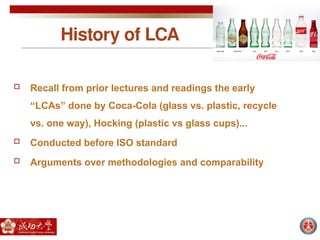
Recall from prior lectures and readings the early
“LCAs” done by Coca-Cola (glass vs. plastic, recycle
vs. one way), Hocking (plastic vs glass cups)...
Conducted before ISO standard
Arguments over methodologies and comparability
5.
Uses of aStandard
Want things done consistently
Common guidelines
Want to set level playing field in a market
Following the standard is assessable, and determined compliant
Analogous to ASTM and other “test standards”
e.g., consistent concrete is desired and can be specified in a
construction bid request: “we want ASTM C94 concrete”
LEED Green Building Standards family
Standards generally voluntary, but may be required by
contract (require ISO 9000 compliant firm)
6.
ISO isa global standards organization
Principles:
Responds to market need
• e.g., “need a way of measuring environmental impacts in an
industry so we can make claims about them”
Based on global expert opinion
Developed in multi-stakeholder process
Based on consensus
Managed by a technical committee
Standard is drafted, commented on, edited, voted on until
consensus (75% approval) is reached
7.
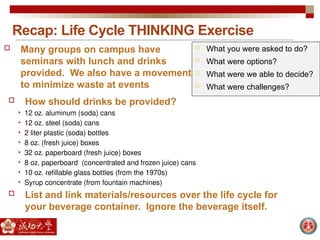
Recap: Life CycleTHINKING Exercise
What you were asked to do?
What were options?
What were we able to decide?
What were challenges?
Many groups on campus have
seminars with lunch and drinks
provided. We also have a movement
to minimize waste at events
How should drinks be provided?
• 12 oz. aluminum (soda) cans
• 12 oz. steel (soda) cans
• 2 liter plastic (soda) bottles
• 8 oz. (fresh juice) boxes
• 32 oz. paperboard (fresh juice) boxes
• 8 oz. paperboard (concentrated and frozen juice) cans
• 10 oz. refillable glass bottles (from the 1970s)
• Syrup concentrate (from fountain machines)
List and link materials/resources over the life cycle for
your beverage container. Ignore the beverage itself.
8.
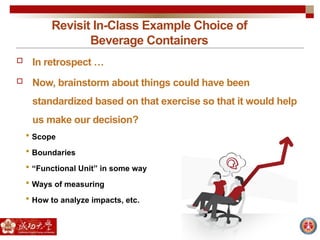
Revisit In-Class ExampleChoice of
Beverage Containers
In retrospect …
Now, brainstorm about things could have been
standardized based on that exercise so that it would help
us make our decision?
Scope
Boundaries
“Functional Unit” in some way
Ways of measuring
How to analyze impacts, etc.
9.
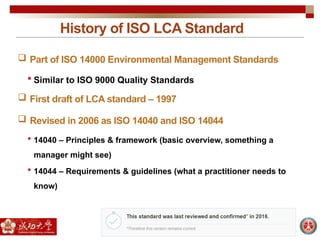
History of ISOLCA Standard
Part of ISO 14000 Environmental Management Standards
Similar to ISO 9000 Quality Standards
First draft of LCA standard – 1997
Revised in 2006 as ISO 14040 and ISO 14044
14040 – Principles & framework (basic overview, something a
manager might see)
14044 – Requirements & guidelines (what a practitioner needs to
know)
10.
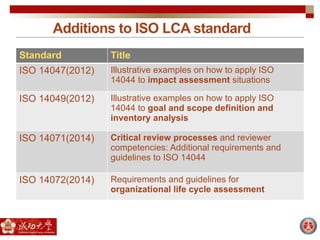
Additions to ISOLCA standard
Standard Title
ISO 14047(2012) Illustrative examples on how to apply ISO
14044 to impact assessment situations
ISO 14049(2012) Illustrative examples on how to apply ISO
14044 to goal and scope definition and
inventory analysis
ISO 14071(2014) Critical review processes and reviewer
competencies: Additional requirements and
guidelines to ISO 14044
ISO 14072(2014) Requirements and guidelines for
organizational life cycle assessment
11.
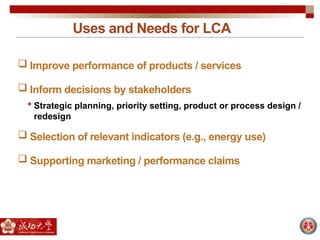
Uses and Needsfor LCA
Improve performance of products / services
Inform decisions by stakeholders
Strategic planning, priority setting, product or process design /
redesign
Selection of relevant indicators (e.g., energy use)
Supporting marketing / performance claims
12.
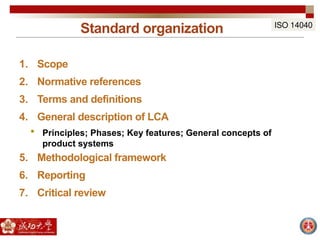
Standard organization
1. Scope
2.Normative references
3. Terms and definitions
4. General description of LCA
Principles; Phases; Key features; General concepts of
product systems
5. Methodological framework
6. Reporting
7. Critical review
ISO 14040
13.
LCA Terms andDefinitions
Big list of definitions in ISO documents (Section 3 of
ISO 14040:2006, repeated in 14044)
Won’t review all, but you need to know them
ISO 14040: Section 3.0
14.
LCA is intendedto be …
Focused on environmental aspects and impacts
Relative
Iterative
Transparent
Comprehensive
Based on science
ISO14040: Section 4.1
15.
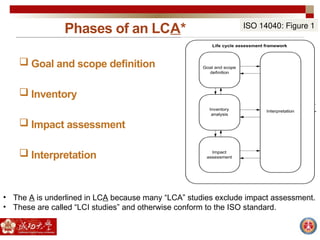
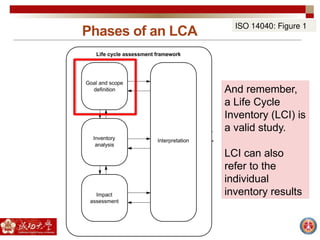
Phases of anLCA*
Goal and scope definition
Inventory
Impact assessment
Interpretation
ISO 14040: Figure 1
• The A is underlined in LCA because many “LCA” studies exclude impact assessment.
• These are called “LCI studies” and otherwise conform to the ISO standard.
16.
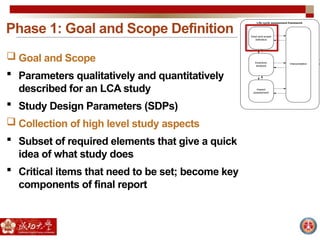
Phase 1: Goaland Scope Definition
Goal and Scope
Parameters qualitatively and quantitatively
described for an LCA study
Study Design Parameters (SDPs)
Collection of high level study aspects
Subset of required elements that give a quick
idea of what study does
Critical items that need to be set; become key
components of final report
17.
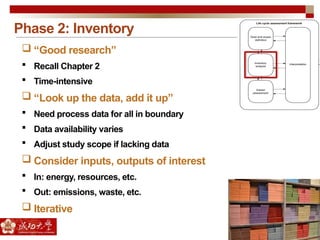
Phase 2: Inventory
“Good research”
Recall Chapter 2
Time-intensive
“Look up the data, add it up”
Need process data for all in boundary
Data availability varies
Adjust study scope if lacking data
Consider inputs, outputs of interest
In: energy, resources, etc.
Out: emissions, waste, etc.
Iterative
18.
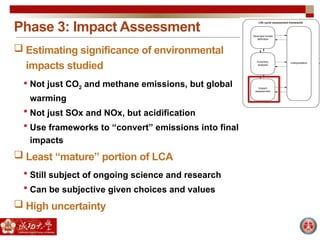
Phase 3: ImpactAssessment
Estimating significance of environmental
impacts studied
Not just CO2 and methane emissions, but global
warming
Not just SOx and NOx, but acidification
Use frameworks to “convert” emissions into final
impacts
Least “mature” portion of LCA
Still subject of ongoing science and research
Can be subjective given choices and values
High uncertainty
19.
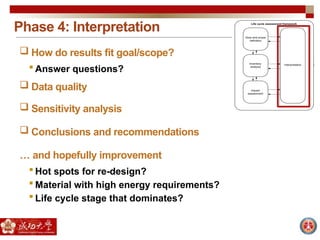
Phase 4: Interpretation
How do results fit goal/scope?
Answer questions?
Data quality
Sensitivity analysis
Conclusions and recommendations
… and hopefully improvement
Hot spots for re-design?
Material with high energy requirements?
Life cycle stage that dominates?
20.
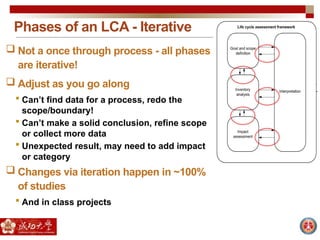
Phases of anLCA - Iterative
Not a once through process - all phases
are iterative!
Adjust as you go along
Can’t find data for a process, redo the
scope/boundary!
Can’t make a solid conclusion, refine scope
or collect more data
Unexpected result, may need to add impact
or category
Changes via iteration happen in ~100%
of studies
And in class projects
21.
Summary definitions forLCA stages
Life cycle assessment (LCA) (3.2)
Compilation and evaluation of the inputs, outputs and the
potential environmental impacts of a product system
throughout its life cycle
Life cycle inventory analysis (LCI) (3.3)
Phase of life cycle assessment involving the compilation
and quantification of inputs and outputs for a product
throughout its life cycle
22.
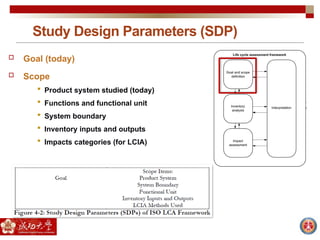
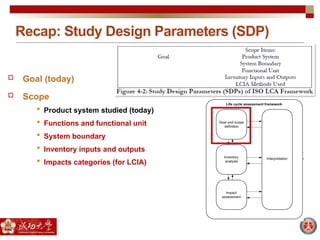
Study Design Parameters(SDP)
Goal (today)
Scope
Product system studied (today)
Functions and functional unit
System boundary
Inventory inputs and outputs
Impacts categories (for LCIA)
23.
Study Design Parameter- Goal
ISO14040: 5.2.1.1
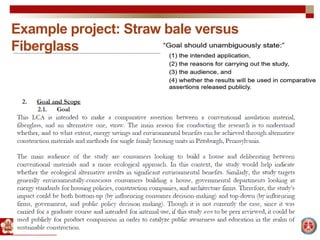
“Goal should unambiguously state:”
(1) the intended application,
(2) the reasons for carrying out the study,
(3) the audience, and
(4) whether the results will be used in comparative assertions
released publicly.
… Or “who might care about this and why?” and “why
we did it and what will we do with it?”
24.
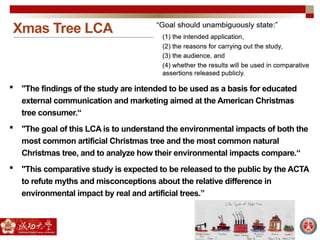
Xmas Tree LCA
"The findings of the study are intended to be used as a basis for educated
external communication and marketing aimed at the American Christmas
tree consumer.“
"The goal of this LCA is to understand the environmental impacts of both the
most common artificial Christmas tree and the most common natural
Christmas tree, and to analyze how their environmental impacts compare.“
"This comparative study is expected to be released to the public by the ACTA
to refute myths and misconceptions about the relative difference in
environmental impact by real and artificial trees.”
25.
Potential Issues withGoals
(1) Intended application, (3) Audience
• Are the intended applications or audience relevant (or the most
relevant)? Is it missing the point?
• Does chosen goal/audience preclude use by others?
• Example from actual study: “...The findings of the study are intended to
be used as a basis for educated external communication and marketing
aimed at the American Christmas tree consumer.”
• Is it useful for supporting actual purchasing decisions? Is it useful for
non-consumers (retailers?)
Source: “Comparative Life Cycle Assessment of an Artificial Christmas
Tree and a Natural Christmas Tree”, PE Americas, Sept 2010
26.
LCA Goals (cont.)
“…This comparative study is expected to be released to the
public by the ACTA to refute myths and misconceptions about
the relative difference in environmental impact by real and
artificial trees.”
Who did the work, who provided data, who paid for it?
Everyone has biases, conflicts of interest. Question is
whether they affect the work done
Always useful to be skeptical and force study to convince
you
ACTA is a trade association of artificial tree manufacturers
Don’t panic. Sometimes sponsors want single credible
study out there when result is well known (i.e., maybe
artificial is better!)
Not required to stipulate any of this in goal statement
27.
LCA Goals (cont.)
(2)Reason, (4) Whether it will make comparisons
• a.k.a. “why we did it and what will we do with it?”
• Can we expect the audience to use it to make these decisions? (I don’t
choose Xmas trees based on this)
• Example from actual study: “The goal of this LCA is to understand the
environmental impacts of both the most common artificial Christmas
tree and the most common natural Christmas tree...”
• Inevitably results will be shortened / generalized in secondary sources
(e.g., “artificial trees are better”)
• Are those the study author’s fault? What could be done to
ensure best possible attribution of results?
Final Thoughts onGoal
Should be able to read and assess goal statements,
identify shortcomings, and fix them
Goal can certainly change during the course of a
study (or its documentation)
31.
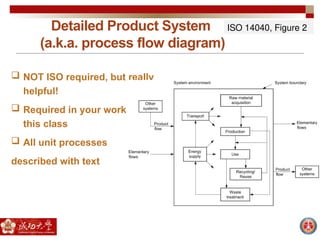
SDP: Product System
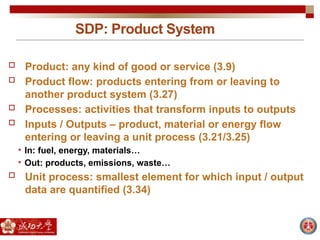
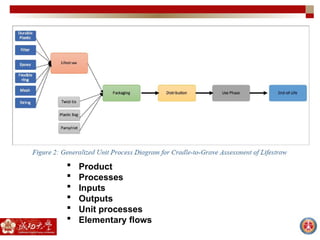
Product: any kind of good or service (3.9)
Product flow: products entering from or leaving to
another product system (3.27)
Processes: activities that transform inputs to outputs
Inputs / Outputs – product, material or energy flow
entering or leaving a unit process (3.21/3.25)
• In: fuel, energy, materials…
• Out: products, emissions, waste…
Unit process: smallest element for which input / output
data are quantified (3.34)
32.
SDP: Product System
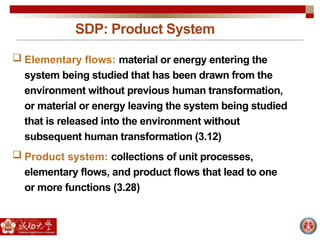
Elementary flows: material or energy entering the
system being studied that has been drawn from the
environment without previous human transformation,
or material or energy leaving the system being studied
that is released into the environment without
subsequent human transformation (3.12)
Product system: collections of unit processes,
elementary flows, and product flows that lead to one
or more functions (3.28)
33.
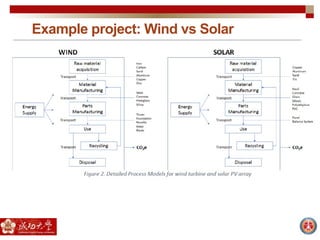
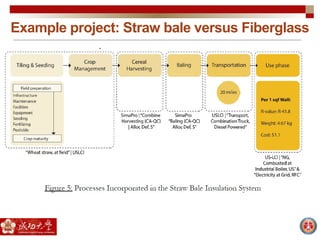
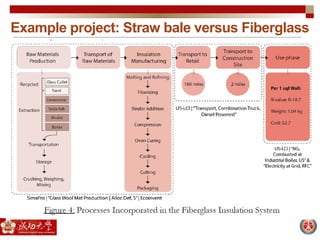
Detailed Product System
(a.k.a.process flow diagram)
NOT ISO required, but really
helpful!
Required in your work for
this class
All unit processes
described with text
ISO 14040, Figure 2
34.
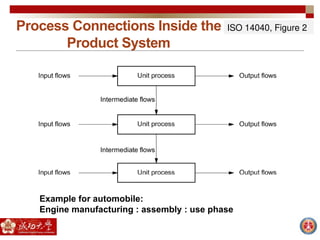
Process Connections Insidethe
Product System
Example for automobile:
Engine manufacturing : assembly : use phase
ISO 14040, Figure 2
End of Part1
To-dos for next lecture:
• Finish reading Chapter 4
• Read 14044, skim others
• Cross walk of LCA standards
• Christmas Tree LCA
Questions?
46.
PART 2: TheISO LCA Standard
Completion of overview of ISO LCA standards
Some more Study Design Parameters
Reporting
Critical review
Types of LCA
Limitations of LCA
Database of LCAs
47.
Phases of anLCA ISO 14040: Figure 1
And remember,
a Life Cycle
Inventory (LCI) is
a valid study.
LCI can also
refer to the
individual
inventory results
48.
Recap: Study DesignParameters (SDP)
Goal (today)
Scope
Product system studied (today)
Functions and functional unit
System boundary
Inventory inputs and outputs
Impacts categories (for LCIA)
49.
SDP: Function andFunctional Unit
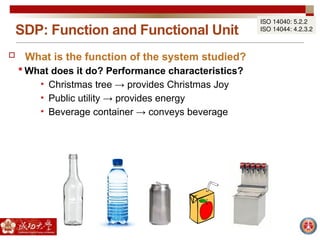
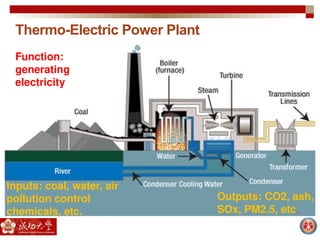
What is the function of the system studied?
What does it do? Performance characteristics?
• Christmas tree → provides Christmas Joy
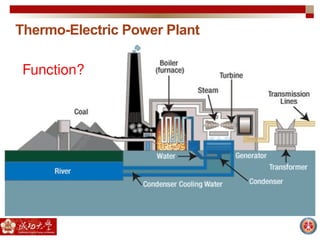
• Public utility → provides energy
• Beverage container → conveys beverage
ISO 14040: 5.2.2
ISO 14044: 4.2.3.2
50.
SDP: Function andFunctional Unit
ISO 14040: 5.2.2
ISO 14044: 4.2.3.2
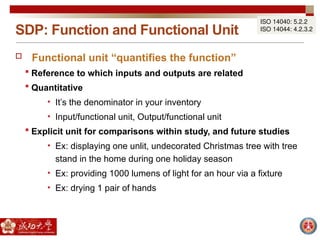
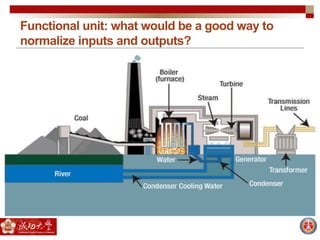
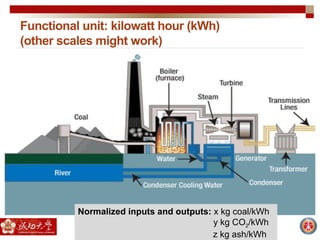
Functional unit “quantifies the function”
Reference to which inputs and outputs are related
Quantitative
• It’s the denominator in your inventory
• Input/functional unit, Output/functional unit
Explicit unit for comparisons within study, and future studies
• Ex: displaying one unlit, undecorated Christmas tree with tree
stand in the home during one holiday season
• Ex: providing 1000 lumens of light for an hour via a fixture
• Ex: drying 1 pair of hands
When Functional UnitsGo Wrong
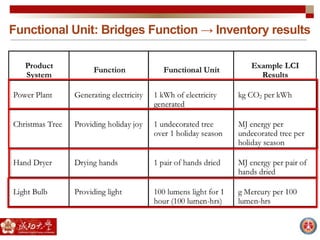
Getting the functional unit wrong causes lots of
wasted effort
Not including units (too much like a function)
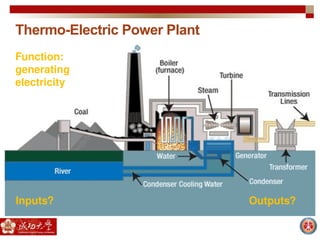
• Error: “functional unit is generating electricity”
Not including quantity
• Error: “kWhs of electricity”
Confusing with inventory result
• Error: CO2 per kWh
Your functional unit bridges function and inventory
it doesn’t replace them.
58.
Functional Units forComparisons
If functional unit isn’t related to a generic function,
might be impossible to compare
Ex: Different fuels. Can’t have functional unit be
“driving a car 1 mile on gasoline” and then compare
gasoline to ethanol
Fixed: Generalized functional units:
“driving a car 1 mile”
• “using 1 gallon-equivalent (MJ basis) in a car”
• “using 1 MJ of energy in a car”
59.
Group Exercise
Teamsof 2 or 3, mix it up again
Work through the list of product systems,
completing each of the following:
Describe function
Draft a functional unit
List one inventory input, normalized
List one inventory output, normalized
10 minutes work, then we’ll discuss
60.
Group Exercise
Product orprocess Function Functional unit Normalized
input
Normalized
output
Grocery bag (plastic
vs cloth)
carry goods 1 kg of goods - X kg crude oil
- X kg of cotton
- X kg of CO2
- X kg of NOx
Diapers (cloth vs
disposable)
hold the waste 1kg of urine X gram of
cotton, diapers
Roofing material
(asphalt shingles vs
metal shingles)
water proofing 1 kg of rain Sand, stone,
asphalt
Snow removal
(shovel vs snow
blower)
removal snow 1m3 of snow steel, wood,
rubber
Going to NYC for the
weekend (transport
only)
traveling unit distance
Unit time
travelling
distance
gas, fuel,
Cup of coffee (home
vs at a café)
enjoy/stay awake coffee bean,
drinking water
61.
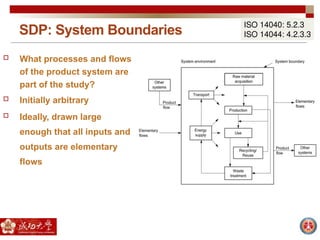
SDP: System Boundaries
ISO14040: 5.2.3
ISO 14044: 4.2.3.3
What processes and flows
of the product system are
part of the study?
Initially arbitrary
Ideally, drawn large
enough that all inputs and
outputs are elementary
flows
62.
SDP: System Boundaries
ISO14040: 5.2.3
ISO 14044: 4.2.3.3
What’s excluded?
“The deletion of life cycle stages, processes, inputs
or outputs is only permitted if it does not significantly
change the overall conclusions of the study.”
• But how would you know it wouldn’t change
conclusions!?
• You can omit things if you explain why
63.
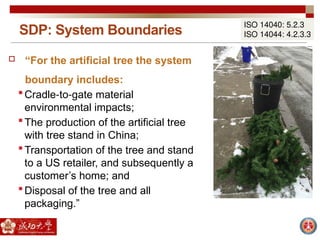
SDP: System Boundaries
ISO14040: 5.2.3
ISO 14044: 4.2.3.3
“For the artificial tree the system
boundary includes:
Cradle to gate material
‐ ‐
environmental impacts;
The production of the artificial tree
with tree stand in China;
Transportation of the tree and stand
to a US retailer, and subsequently a
customer’s home; and
Disposal of the tree and all
packaging.”
64.
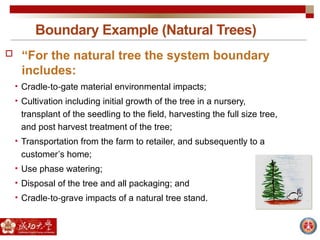
Boundary Example (NaturalTrees)
“For the natural tree the system boundary
includes:
• Cradle to gate material environmental impacts;
‐ ‐
• Cultivation including initial growth of the tree in a nursery,
transplant of the seedling to the field, harvesting the full size tree,
and post harvest treatment of the tree;
• Transportation from the farm to retailer, and subsequently to a
customer’s home;
• Use phase watering;
• Disposal of the tree and all packaging; and
• Cradle to grave impacts of a natural tree stand.
‐ ‐
65.
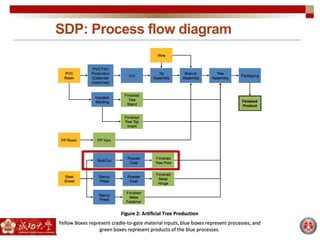
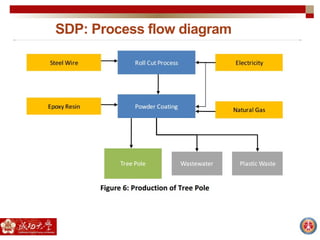
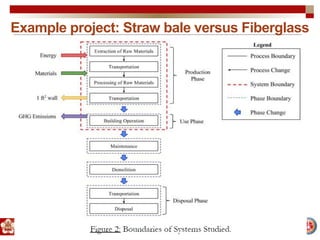
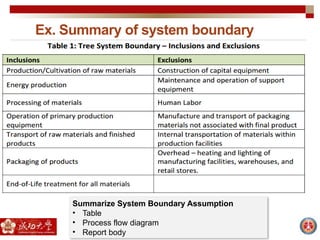
Ex. Summary ofsystem boundary
Summarize System Boundary Assumption
• Table
• Process flow diagram
• Report body
67.
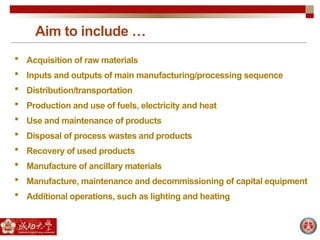
Aim to include…
Acquisition of raw materials
Inputs and outputs of main manufacturing/processing sequence
Distribution/transportation
Production and use of fuels, electricity and heat
Use and maintenance of products
Disposal of process wastes and products
Recovery of used products
Manufacture of ancillary materials
Manufacture, maintenance and decommissioning of capital equipment
Additional operations, such as lighting and heating
68.
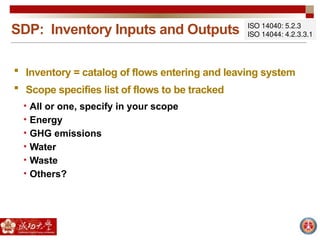
SDP: Inventory Inputsand Outputs ISO 14040: 5.2.3
ISO 14044: 4.2.3.3.1
Inventory = catalog of flows entering and leaving system
Scope specifies list of flows to be tracked
• All or one, specify in your scope
• Energy
• GHG emissions
• Water
• Waste
• Others?
69.
Modeling what comes“in” is easy...
Harder for “what comes out”
Inputs
• Materials, resources, etc., fairly straightforward
Lots of “outputs” – emissions, products, waste
• Product – the single useful output of the process
• Co-product – when there are more than one
• Waste – an output that has to be disposed of
• By-products – partly product, partly waste (could be
uncertain, confusing)
70.
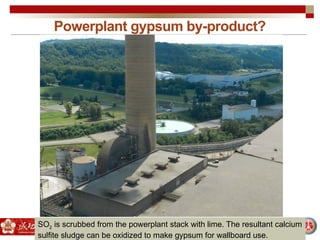
Powerplant gypsum by-product?
SO2is scrubbed from the powerplant stack with lime. The resultant calcium
sulfite sludge can be oxidized to make gypsum for wallboard use.
71.
SDP: Inventory Inputsand Outputs
Avoid generic categories “air emissions” or “water
emissions”, or “everything”.
Specify which emissions of gases or substances
• e.g., CO2, SO2, benzene, water, uranium...
72.
Group Exercise
Teamsof 2 or 3, mix it up again
Work through the list of product systems, completing
each of the following:
o Describe function
o Draft a functional unit
o List one inventory input, normalized
o List one inventory output, normalized
10 minutes work, then we’ll discuss
Now complete the last 2 columns
73.
System boundary: “Cut-off”criteria
Threshold by which you can exclude inputs and outputs
• Describe assumptions and effect of cut-off on results
Intention: “answer wouldn’t change with more data”
• Problem is – how do you know?
• Often a qualitative statement discussing potential effects
Mass – “exclude anything with mass < 1g” or “less than 1%
of product mass”
Energy – similar
Environmental significance
Easy to start excluding important items
“Try to avoid using cut-offs”
74.
SDP: Life CycleImpact Assessment
Categories and Methods
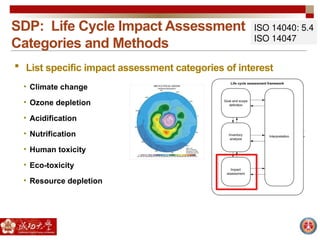
List specific impact assessment categories of interest
• Climate change
• Ozone depletion
• Acidification
• Nutrification
• Human toxicity
• Eco-toxicity
• Resource depletion
ISO 14040: 5.4
ISO 14047
75.
SDP: Life CycleImpact Assessment
Categories and Methods ISO 14047: 4.2.2.3
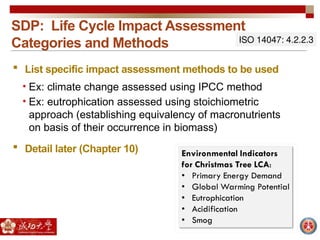
List specific impact assessment methods to be used
• Ex: climate change assessed using IPCC method
• Ex: eutrophication assessed using stoichiometric
approach (establishing equivalency of macronutrients
on basis of their occurrence in biomass)
Detail later (Chapter 10)
76.
Reporting ISO 14040:Section 6
ISO 14044: Section 5
Report
• Critical aspect of LCA!
• Record of the study
• Indicator of study quality
• May or may not be made public (most are not)
• Use specified ISO terminology: goal, scope, functional
unit, etc.
Define type and format in Goal & Scope phase
77.
Reporting
Results/conclusions completelyand accurately
reported without bias to intended audience
Results, data, methods, assumptions and limitations
Transparent
Detailed enough to describe complexities / trade-offs
Allow results/interpretation to be used in a manner
consistent with study goals
ISO 14044: Section 5.1.1
78.
Critical Review ISO14040: Section 7
ISO 14044: Section 6
Critical Review required if making comparative
assertions for public release
• Checking for “ISO compliance”
• Methods used are scientifically/technically valid
• Data used are appropriate/reasonable
• Interpretations reflect the limitations identified and goal
of the study
• Study report is transparent and consistent
Chance for inconsistencies, errors, etc. to be found
79.
Quick Word onLCA Types
Two “types” of environmental LCAs
• Attributional: studies an existing product
• Consequential: studies the effects of potential changes to
a product, process, etc.
• Nearly all to date attributional
Mostly attributional in this course
• Brief coverage of consequential analysis
ISO 14040: A.2
80.
Criticisms / Limitationsof LCA
No single, accepted method (just 1 framework)
Data reliability and quality is questionable
Models based on assumptions
Problem boundaries are arbitrary
Scale issues – global → local
Uncertainty is everywhere
Spatial and temporal issues
Comparisons between studies difficult
81.
Alternatives to LCAModeling Approaches
Risk analysis
Environmental impact assessment
Environmental audit
Benefit-cost analysis
Life cycle assessment is not required to address economic
or social aspects (key part of sustainability!) and so may
differ from above.
• Models may be combinable
82.
For Next Class
Read Chapter 5 through p. 114, and Section 1 of the
Advanced Material at the end of the chapter (starting at
p. 135)
Skim the NREL User Guide
Complete the CATME survey.
Editor's Notes
#8 Realistically, the things we would want to standardize are:
Scope
Boundaries
“Functional Unit” in some way
Ways of measuring
How to analyze impacts, etc.
https://www.flickr.com/photos/roebot/3310412245
#9 Realistically, the things we would want to standardize are:
Scope
Boundaries
“Functional Unit” in some way
Ways of measuring
How to analyze impacts, etc.
https://www.flickr.com/photos/roebot/3310412245
#11 From 14040 Introduction
So, to begin LCA we first need to consider why we are doing one in the first place.
Helps to determine scope and goal
#15 We will skip LCIA for a while and come back to it later.
#20 We will skip LCIA for a while and come back to it later.
Regardless, need to learn terminology first before doing anything else
#22 14, focusing on these for these 2 lectures
“…are generally the most critical considerations and thus those that at a glance would tell you nearly everything you
needed to know about what the study did and did not seek to do.”
#24 Are all 4 elements here?
The intended application is external marketing.
The reasons are to refute misconceptions.
The audience is American tree consumers.
Finally, the study was noted to be planned for public release
#26 First underlined phrase is intended audience
Second is intended application
#27 First underlined phrase – reason/purpose
Second – intended use
Third – more purpose
#31 Beverage can example is product system - which product is “better”? Maps list collections of unit processes, elementary flows, product flows. Ins, perhaps some outs.
#32 All in the standard (both). We will discuss each in more detail.
#33 Be familiar with the definitions we just went over, and where they fit into this system: product, product flow, processes, inputs/outputs, unit processes, elementary flows, all together give a product system
#47 need to learn terminology first before doing anything else
#48 14, focusing on these for these 2 lectures
“…are generally the most critical considerations and thus those that at a glance would tell you nearly everything you
needed to know about what the study did and did not seek to do.”
#49 equivalent lumen-hours?
Function = performance characteristics
Functional unit = Provides a reference to which the inputs and outputs are related
Allows for comparability of results
#50 Function = performance characteristics
Functional unit = Provides a reference to which the inputs and outputs are related
Allows for comparability of results
#56 product system inputs and outputs have no place in a functional unit definition
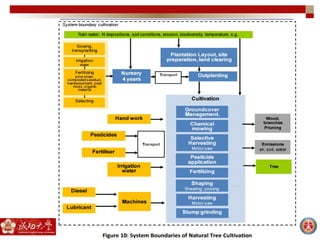
#66 Focuses on Natural tree cultivation. Note the white Transport boxes – these were identified as being “excluded” from the system boundary
#68 your analysis does not need to consider the universe of all potential inputs and outputs. It could consider only inputs (e.g., an energy use
footprint), only outputs (e.g., a carbon emissions footprint), or both
#69 your analysis does not need to consider the universe of all potential inputs and outputs. It could consider only inputs (e.g., an energy use
footprint), only outputs (e.g., a carbon emissions footprint), or both
#70 ISO has no specific subcategory for “by products” (sometimes products, sometimes wastes).
Study author has to define/assume how to deal with something like that. Either assume as co-product or assume as waste. Could pick one option, then do sensitivity analysis of LCA results if chose other option instead – does it matter?
ISO mentions also using ratio of co-product to waste (an allocation ratio) since only products get things allocated to them!
Bruce Mansfield power plant, down the Ohio River. Picture taken from roof of boiler building.
In the distance, National Gypsum plant which takes some of the flue gas desulfurization sludge and converts it to gypsum and drywall
#73 Problem is – how do you know for sure unless you include it?
THIS IS A CONCEPT WE WILL COME BACK TO A ZILLION TIMES IN THE COURSE. WEAKNESS OF LCA METHOD. ASSUMES YOU KNOW (OR CAN KNOW) this answer. Authors hide behind it a lot.
#74 evaluating the significance of potential environmental
impacts using the LCI results. In general, this process involves associating inventory data with specific
environmental impact categories and category indicators, thereby attempting to understand these impacts
#75 evaluating the significance of potential environmental
impacts using the LCI results. In general, this process involves associating inventory data with specific
environmental impact categories and category indicators, thereby attempting to understand these impacts