TEMPERATURE, PULSE,
RESPIRATION (TPR)
EDGAR A. ULEP, RM, LPT, MSPH.
College of Midwifery
QSU Cabarroguis
TEMPERATURE
• The measurement of core body heat
• Heat is produced in the body by the muscles and glands
• Heat is lost from the body by respiration, perspiration and excretion
TEMPERATURE
• If the body temperature is within a normal range, it is afebrile.
• If the temperature is elevated, usually considered one degree over the
patient’s norm, it is febrile
• Temperature below normal, is called hypothermia
• Temperature above normal is called pyrexia
FEVER
• FEVER is not an illness. Actually, it is an important part of the body’s
defense against infection
ABNORMAL TEMPERATURES
• Fever – is greater than 37.5C
• High fever – anything over 39C
• Moderate Fever – 37.5C – 39C
• Hypothermia is subnormal temperature. This can be equally problematic for
a person. Anything under 35C
ROUTES/SITE TO MEASURE
TEMPERATURE
• ORAL – Mouth
• RECTAL – Rectum
• AXILLA – Armpit
• AURAL/TYMPANIC – Ear
• TEMPORAL - Forehead
TYPES OF THERMOMETERS
• DIGITAL ELECTRONIC – used fro oral, rectal and axilla
• THERMOSCAN-DIGITAL – used for tympanic & temporal
• MERCURY – used for oral, rectal and axilla
RULES TO FOLLOW
• Always hold the thermometer in place while measuring temperatures
• Red covering for rectal and blue for oral/axillary
• Always use lubricant with rectal temperatures
• Always remove clothing around axilla
PULSE
• The wave of blood created by the pumping, that travels along the arteries
• The pulse is caused by the pressure of the blood pushing against the wall of an
artery as the heart contracts and relaxes
• It is the throbbing of an artery as the human heart beats
• The pulse rate is an important vital signs because it indicates how well the blood is
circulating through the body
• When you check the pulse rate , you count the number of beats in 1 full minute
called BEATS PER MINUTE (bpm)
FINDING A PULSE
• At points where the artery is between finger tips and a bony area
• Called pulse points
• Felt with 2-3 fingers, but never the thumb
HOW TO MEASURE?
• Measured in beats per minute
• Count the waves for 1 full minute
QUALITY OF PULSE
• RHYTHM – regular or irregular
• RATE – within the normal limits
• STRENGTH – strong, bounding, thready
NORMS
• Normal pulse rate 60-100bpm
• TACHYCARDIA – faster than 100bpm
• BRADYCARDIA – slower than 60bpm
• ARRHYTHMIA – irregular pulse rate
PULSE RATE
• Pulse rate generally increases with exercise, emotional excitement,
hemorrhage, or elevated temperature
• Drugs can increase or decrease the heart rate
AFFECTING PULSE RATE AND QUALITY
• Fever
• Emotions
• Exercise
• Drugs
• Hypovolemia(blood loss)
• Age
RADIAL PULSE
Is the most common site for counting the pulse rate
Do not use your thumb to count a pulse because you have a pulse in your
thums
APICAL PULSE
• Pulse is counted at the APEX (pointed end) of the heart
• Count the apical heartbeat by placing stethoscope
RESPIRATION
• The mechanical act of breathing in air (inspiration) and expelling air (expiration) from
the body
• Is the process of taking oxygen into the body and expelling carbon dioxide from the
body
• One inspiration (breathing in) and one expiration (breathing out) are considered as one
respiration
• When you count a patient’s respiration, you do not want the patient to be aware of what
you are doing. If the patient realizes that you are counting respiration, he or she may not
breathe normally
RESPIRATION
• Measured in cycle per minute
• Normal range is 16-20cpm(Adult) / 40-40cpm(Infant)
• TACHYPNEA – above 20cpm
• BRADYPNEA – below 16cpm
RESPIRATION TERMS
• EUPNEA – normal breathing
• DYSPNEA – difficulty of breathing
• APNEA – absence of breathing
• HYPERPNEA – fast & deep breathing
• ORTHOPNEA – shortness of breath occurs while lying flat and is relieved
by sitting or standing
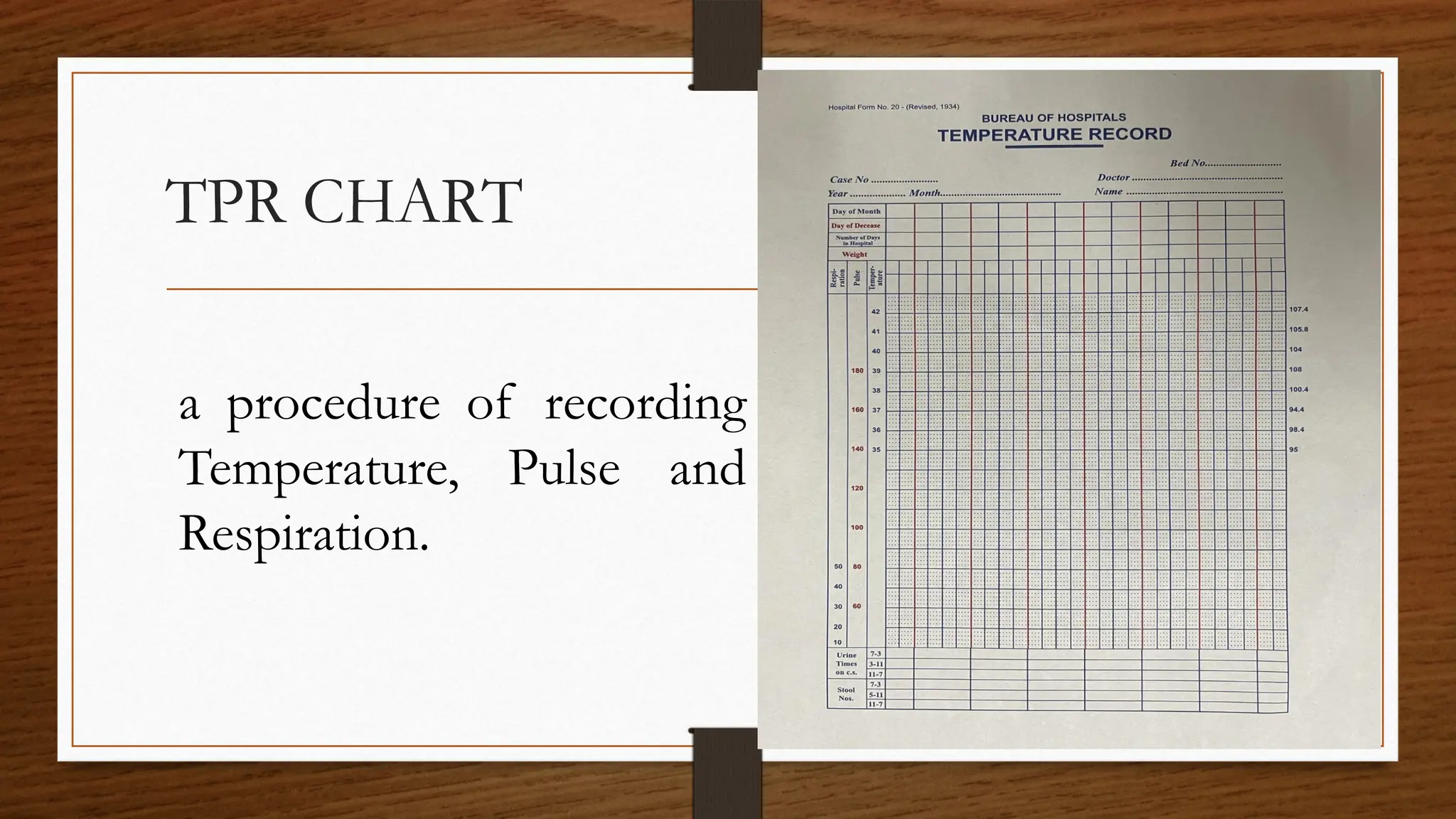
TPR CHART
a procedure of recording
Temperature, Pulse and
Respiration.
TPR
• Is a procedure to check temperature, pulse and respiration of a patient. It is
also known as checking vital signs when we include checking of blood
pressure in the procedure.
PREPARATION
• TPR tray should contain;
• thermometers
• Antiseptic solution
• Cotton
• Kidney basin
• Paper and TPR chart
PROCEDURES
• Explain the procedure to the patient or relative of the patient
• The patient should be in comfortable position preferably in lie down position
• Wash hands before starting the procedure
• Take out a thermometer and clean the thermometer from bulb to stem with cotton swab in circular motion
• Discard the swab in kidney tray
• Place the patient hand into her/his abdomen and count the radial pulse for one full minute
• While holding the radial pulse start counting respiratory rate in one (1) full minute
• After 2 minutes. Remove the thermometer and clean from stem to bulb
• Wash hands and record the temperature, pulse and respiration in patient’s TPR chart
EXERCISES
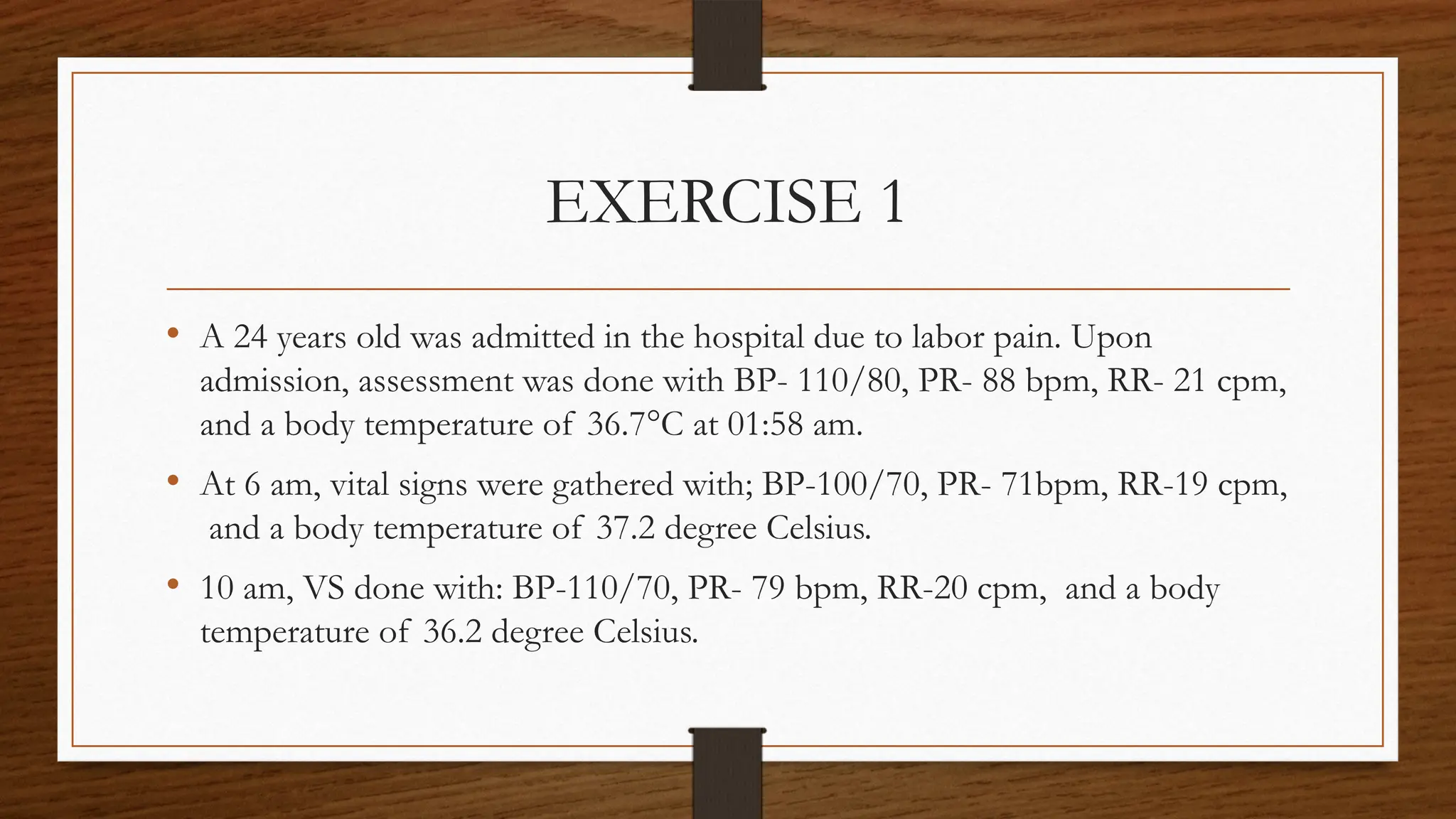
EXERCISE 1
• A 24 years old was admitted in the hospital due to labor pain. Upon
admission, assessment was done with BP- 110/80, PR- 88 bpm, RR- 21 cpm,
and a body temperature of 36.7°C at 01:58 am.
• At 6 am, vital signs were gathered with; BP-100/70, PR- 71bpm, RR-19 cpm,
and a body temperature of 37.2 degree Celsius.
• 10 am, VS done with: BP-110/70, PR- 79 bpm, RR-20 cpm, and a body
temperature of 36.2 degree Celsius.
EXERCISE 1
• 2 pm, VS done with: BP-100/70, PR- 87 bpm, RR-18 cpm, and a body
temperature of 37 degree Celsius.
• 6 pm, VS were gathered and are as follows: BP-100/70, PR- 92 bpm, RR-21
cpm, and a body temperature of 37.8 degree Celsius. Paracetamol given.
• 10 pm, VS are: BP 110/70 mmHg, PR-82 bpm, RR-20 cpm and a body
temperature of 37.2 degree Celsius.
• At 2 am, BP-100/70, PR- 73 bpm, RR-18 cpm, and a body temperature of
36.4 degree Celsius.
THANK YOU

Temperature, Pulse, & Respiration CHART.pptx

  • 1.
    TEMPERATURE, PULSE, RESPIRATION (TPR) EDGARA. ULEP, RM, LPT, MSPH. College of Midwifery QSU Cabarroguis
  • 2.
    TEMPERATURE • The measurementof core body heat • Heat is produced in the body by the muscles and glands • Heat is lost from the body by respiration, perspiration and excretion
  • 3.
    TEMPERATURE • If thebody temperature is within a normal range, it is afebrile. • If the temperature is elevated, usually considered one degree over the patient’s norm, it is febrile • Temperature below normal, is called hypothermia • Temperature above normal is called pyrexia
  • 4.
    FEVER • FEVER isnot an illness. Actually, it is an important part of the body’s defense against infection
  • 5.
    ABNORMAL TEMPERATURES • Fever– is greater than 37.5C • High fever – anything over 39C • Moderate Fever – 37.5C – 39C • Hypothermia is subnormal temperature. This can be equally problematic for a person. Anything under 35C
  • 6.
    ROUTES/SITE TO MEASURE TEMPERATURE •ORAL – Mouth • RECTAL – Rectum • AXILLA – Armpit • AURAL/TYMPANIC – Ear • TEMPORAL - Forehead
  • 7.
    TYPES OF THERMOMETERS •DIGITAL ELECTRONIC – used fro oral, rectal and axilla • THERMOSCAN-DIGITAL – used for tympanic & temporal • MERCURY – used for oral, rectal and axilla
  • 8.
    RULES TO FOLLOW •Always hold the thermometer in place while measuring temperatures • Red covering for rectal and blue for oral/axillary • Always use lubricant with rectal temperatures • Always remove clothing around axilla
  • 9.
    PULSE • The waveof blood created by the pumping, that travels along the arteries • The pulse is caused by the pressure of the blood pushing against the wall of an artery as the heart contracts and relaxes • It is the throbbing of an artery as the human heart beats • The pulse rate is an important vital signs because it indicates how well the blood is circulating through the body • When you check the pulse rate , you count the number of beats in 1 full minute called BEATS PER MINUTE (bpm)
  • 10.
    FINDING A PULSE •At points where the artery is between finger tips and a bony area • Called pulse points • Felt with 2-3 fingers, but never the thumb
  • 11.
    HOW TO MEASURE? •Measured in beats per minute • Count the waves for 1 full minute
  • 12.
    QUALITY OF PULSE •RHYTHM – regular or irregular • RATE – within the normal limits • STRENGTH – strong, bounding, thready
  • 13.
    NORMS • Normal pulserate 60-100bpm • TACHYCARDIA – faster than 100bpm • BRADYCARDIA – slower than 60bpm • ARRHYTHMIA – irregular pulse rate
  • 14.
    PULSE RATE • Pulserate generally increases with exercise, emotional excitement, hemorrhage, or elevated temperature • Drugs can increase or decrease the heart rate
  • 15.
    AFFECTING PULSE RATEAND QUALITY • Fever • Emotions • Exercise • Drugs • Hypovolemia(blood loss) • Age
  • 16.
    RADIAL PULSE Is themost common site for counting the pulse rate Do not use your thumb to count a pulse because you have a pulse in your thums
  • 17.
    APICAL PULSE • Pulseis counted at the APEX (pointed end) of the heart • Count the apical heartbeat by placing stethoscope
  • 18.
    RESPIRATION • The mechanicalact of breathing in air (inspiration) and expelling air (expiration) from the body • Is the process of taking oxygen into the body and expelling carbon dioxide from the body • One inspiration (breathing in) and one expiration (breathing out) are considered as one respiration • When you count a patient’s respiration, you do not want the patient to be aware of what you are doing. If the patient realizes that you are counting respiration, he or she may not breathe normally
  • 19.
    RESPIRATION • Measured incycle per minute • Normal range is 16-20cpm(Adult) / 40-40cpm(Infant) • TACHYPNEA – above 20cpm • BRADYPNEA – below 16cpm
  • 20.
    RESPIRATION TERMS • EUPNEA– normal breathing • DYSPNEA – difficulty of breathing • APNEA – absence of breathing • HYPERPNEA – fast & deep breathing • ORTHOPNEA – shortness of breath occurs while lying flat and is relieved by sitting or standing
  • 21.
    TPR CHART a procedureof recording Temperature, Pulse and Respiration.
  • 22.
    TPR • Is aprocedure to check temperature, pulse and respiration of a patient. It is also known as checking vital signs when we include checking of blood pressure in the procedure.
  • 23.
    PREPARATION • TPR trayshould contain; • thermometers • Antiseptic solution • Cotton • Kidney basin • Paper and TPR chart
  • 24.
    PROCEDURES • Explain theprocedure to the patient or relative of the patient • The patient should be in comfortable position preferably in lie down position • Wash hands before starting the procedure • Take out a thermometer and clean the thermometer from bulb to stem with cotton swab in circular motion • Discard the swab in kidney tray • Place the patient hand into her/his abdomen and count the radial pulse for one full minute • While holding the radial pulse start counting respiratory rate in one (1) full minute • After 2 minutes. Remove the thermometer and clean from stem to bulb • Wash hands and record the temperature, pulse and respiration in patient’s TPR chart
  • 25.
  • 26.
    EXERCISE 1 • A24 years old was admitted in the hospital due to labor pain. Upon admission, assessment was done with BP- 110/80, PR- 88 bpm, RR- 21 cpm, and a body temperature of 36.7°C at 01:58 am. • At 6 am, vital signs were gathered with; BP-100/70, PR- 71bpm, RR-19 cpm, and a body temperature of 37.2 degree Celsius. • 10 am, VS done with: BP-110/70, PR- 79 bpm, RR-20 cpm, and a body temperature of 36.2 degree Celsius.
  • 27.
    EXERCISE 1 • 2pm, VS done with: BP-100/70, PR- 87 bpm, RR-18 cpm, and a body temperature of 37 degree Celsius. • 6 pm, VS were gathered and are as follows: BP-100/70, PR- 92 bpm, RR-21 cpm, and a body temperature of 37.8 degree Celsius. Paracetamol given. • 10 pm, VS are: BP 110/70 mmHg, PR-82 bpm, RR-20 cpm and a body temperature of 37.2 degree Celsius. • At 2 am, BP-100/70, PR- 73 bpm, RR-18 cpm, and a body temperature of 36.4 degree Celsius.
  • 28.

Editor's Notes