




TELEVISION
INTRODUCTION
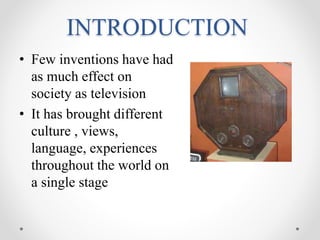
• Few inventions have had
as much effect on
society as television
• It has brought different
culture , views,
language, experiences
throughout the world on
a single stage
Inventors
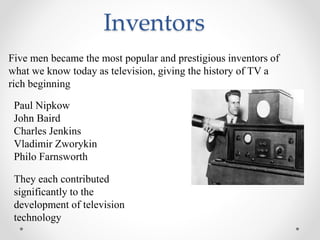
Five men became the most popular and prestigious inventors of
what we know today as television, giving the history of TV a
rich beginning
Paul Nipkow
John Baird
Charles Jenkins
Vladimir Zworykin
Philo Farnsworth
They each contributed
significantly to the
development of television
technology
Inventors and Their
Contributions
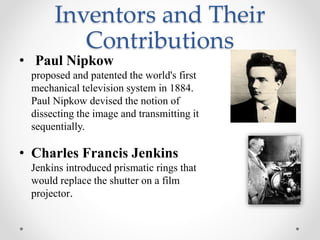
• Paul Nipkow
proposed and patented the world's first
mechanical television system in 1884.
Paul Nipkow devised the notion of
dissecting the image and transmitting it
sequentially.
• Charles Francis Jenkins
Jenkins introduced prismatic rings that
would replace the shutter on a film
projector.
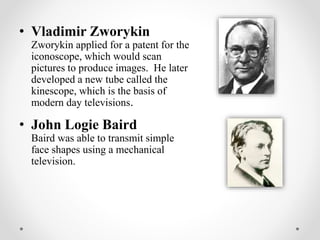
• Vladimir Zworykin
Zworykin applied for a patent for the
iconoscope, which would scan
pictures to produce images. He later
developed a new tube called the
kinescope, which is the basis of
modern day televisions.
• John Logie Baird
Baird was able to transmit simple
face shapes using a mechanical
television.
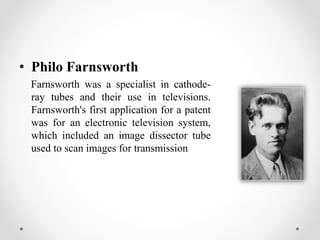
• Philo Farnsworth
Farnsworth was a specialist in cathode-
ray tubes and their use in televisions.
Farnsworth's first application for a patent
was for an electronic television system,
which included an image dissector tube
used to scan images for transmission
Mechanical vs. Electronic
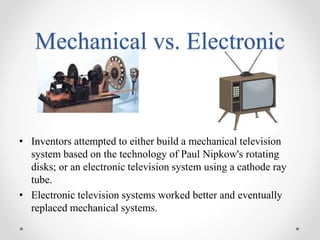
• Inventors attempted to either build a mechanical television
system based on the technology of Paul Nipkow's rotating
disks; or an electronic television system using a cathode ray
tube.
• Electronic television systems worked better and eventually
replaced mechanical systems.
Mechanical vs. Electronic
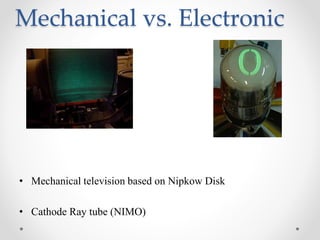
• Mechanical television based on Nipkow Disk
• Cathode Ray tube (NIMO)
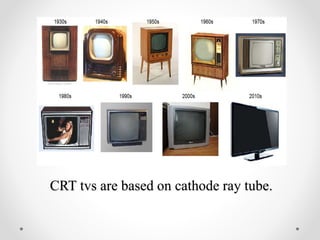
CRT TELEVISIONS
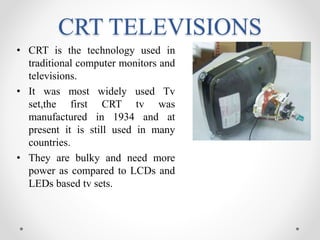
• CRT is the technology used in
traditional computer monitors and
televisions.
• It was most widely used Tv
set,the first CRT tv was
manufactured in 1934 and at
present it is still used in many
countries.
• They are bulky and need more
power as compared to LCDs and
LEDs based tv sets.
CRT tvs are based on cathode ray tube.
Today’s TV’s
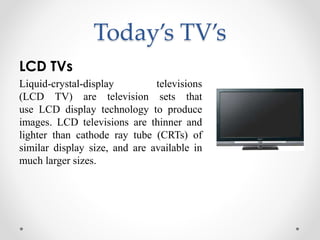
LCD TVs
Liquid-crystal-display televisions
(LCD TV) are television sets that
use LCD display technology to produce
images. LCD televisions are thinner and
lighter than cathode ray tube (CRTs) of
similar display size, and are available in
much larger sizes.
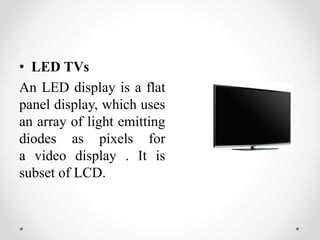
• LED TVs
An LED display is a flat
panel display, which uses
an array of light emitting
diodes as pixels for
a video display . It is
subset of LCD.
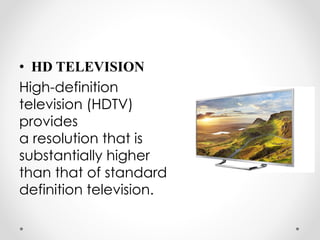
• HD TELEVISION
High-definition
television (HDTV)
provides
a resolution that is
substantially higher
than that of standard
definition television.
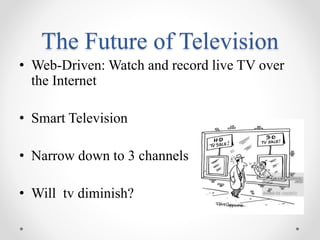
The Future of Television
• Web-Driven: Watch and record live TV over
the Internet
• Smart Television
• Narrow down to 3 channels
• Will tv diminish?
Impact
• Television has has some positive effects with
regards to education, entertainment and
providing current world events
• There have been also some negative effects that
television has brought. This is especially evident
in the social and health aspects.
Positive Effect Of
Television
• Powerful and effective learning tool
• Give knowledge about science, technology,
history, geography etc
• Helps Individuals suffering from Social
isolations
• Raises important issue of our siciety
• Convey Information across the globe
• used as platform to find new talents
• Good medium of communication.
• Potential to unite communities.
• Share of cultural experience
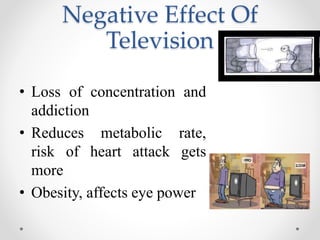
Negative Effect Of
Television
• Loss of concentration and
addiction
• Reduces metabolic rate,
risk of heart attack gets
more
• Obesity, affects eye power
• Spreading false information
• Adult less sensitive to violence and commit it
easily
• have learning difficulties
• Youths getting attracted to Alcohol, drugs and
cigarettes
THANK YOU
•

Television

  • 1.
  • 2.
    INTRODUCTION • Few inventionshave had as much effect on society as television • It has brought different culture , views, language, experiences throughout the world on a single stage
  • 3.
    Inventors Five men becamethe most popular and prestigious inventors of what we know today as television, giving the history of TV a rich beginning Paul Nipkow John Baird Charles Jenkins Vladimir Zworykin Philo Farnsworth They each contributed significantly to the development of television technology
  • 4.
    Inventors and Their Contributions •Paul Nipkow proposed and patented the world's first mechanical television system in 1884. Paul Nipkow devised the notion of dissecting the image and transmitting it sequentially. • Charles Francis Jenkins Jenkins introduced prismatic rings that would replace the shutter on a film projector.
  • 5.
    • Vladimir Zworykin Zworykinapplied for a patent for the iconoscope, which would scan pictures to produce images. He later developed a new tube called the kinescope, which is the basis of modern day televisions. • John Logie Baird Baird was able to transmit simple face shapes using a mechanical television.
  • 6.
    • Philo Farnsworth Farnsworthwas a specialist in cathode- ray tubes and their use in televisions. Farnsworth's first application for a patent was for an electronic television system, which included an image dissector tube used to scan images for transmission
  • 7.
    Mechanical vs. Electronic •Inventors attempted to either build a mechanical television system based on the technology of Paul Nipkow's rotating disks; or an electronic television system using a cathode ray tube. • Electronic television systems worked better and eventually replaced mechanical systems.
  • 8.
    Mechanical vs. Electronic •Mechanical television based on Nipkow Disk • Cathode Ray tube (NIMO)
  • 9.
    CRT TELEVISIONS • CRTis the technology used in traditional computer monitors and televisions. • It was most widely used Tv set,the first CRT tv was manufactured in 1934 and at present it is still used in many countries. • They are bulky and need more power as compared to LCDs and LEDs based tv sets.
  • 10.
    CRT tvs arebased on cathode ray tube.
  • 11.
    Today’s TV’s LCD TVs Liquid-crystal-displaytelevisions (LCD TV) are television sets that use LCD display technology to produce images. LCD televisions are thinner and lighter than cathode ray tube (CRTs) of similar display size, and are available in much larger sizes.
  • 12.
    • LED TVs AnLED display is a flat panel display, which uses an array of light emitting diodes as pixels for a video display . It is subset of LCD.
  • 13.
    • HD TELEVISION High-definition television(HDTV) provides a resolution that is substantially higher than that of standard definition television.
  • 14.
    The Future ofTelevision • Web-Driven: Watch and record live TV over the Internet • Smart Television • Narrow down to 3 channels • Will tv diminish?
  • 15.
    Impact • Television hashas some positive effects with regards to education, entertainment and providing current world events • There have been also some negative effects that television has brought. This is especially evident in the social and health aspects.
  • 16.
    Positive Effect Of Television •Powerful and effective learning tool • Give knowledge about science, technology, history, geography etc • Helps Individuals suffering from Social isolations • Raises important issue of our siciety
  • 17.
    • Convey Informationacross the globe • used as platform to find new talents • Good medium of communication. • Potential to unite communities. • Share of cultural experience
  • 18.
    Negative Effect Of Television •Loss of concentration and addiction • Reduces metabolic rate, risk of heart attack gets more • Obesity, affects eye power
  • 19.
    • Spreading falseinformation • Adult less sensitive to violence and commit it easily • have learning difficulties • Youths getting attracted to Alcohol, drugs and cigarettes
  • 20.