TELEPHONE
ETIQUETTE
1. Pick up the phone in three rings . More
than three rings signals chaos in your
office or inattentiveness.
2. Greet the caller, e.g. “hello”, “good
morning”. Good manners shows you
respect the caller.
3. Give your name. This is a courtesy that
serves to personalize the customer
service experience as well as allowing the
customer to hold you accountable for
your level of service.
Answering the Telephone
4. Ask the customer if or how
you can help. Asking to help
tells the customer you are
there to serve his/her needs
and to solve his/her
problems. This also leaves
the customer with a positive
impression.
5. The greeting is key, it sets
the tone and style of the
whole interaction.
Answering the Telephone
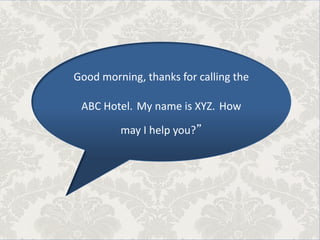
Good morning, thanks for calling the
ABC Hotel. My name is XYZ. How
may I help you?”
Telephone Etiquette
Work performed by the Academy for Educational Development under sponsorship of the United States Agency for
International Development (USAID) Contract Number: LAG -I-00-98-00011-00, Task Order Number: 804
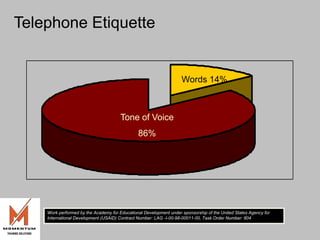
Tone of Voice
86%
Words 14%
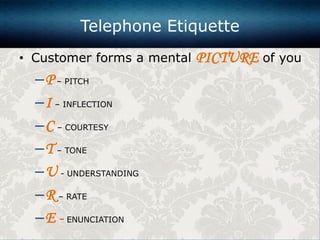
• Customer forms a mental PICTURE of you
–P – PITCH
–I – INFLECTION
–C – COURTESY
–T – TONE
–U - UNDERSTANDING
–R – RATE
–E - ENUNCIATION
Telephone Etiquette
Interviewing Techniques
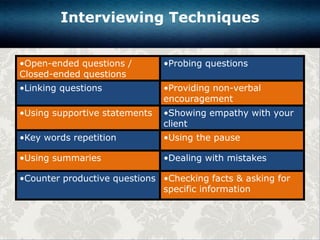
•Open-ended questions /
Closed-ended questions
•Probing questions
•Linking questions •Providing non-verbal
encouragement
•Using supportive statements •Showing empathy with your
client
•Key words repetition •Using the pause
•Using summaries •Dealing with mistakes
•Counter productive questions •Checking facts & asking for
specific information
Interviewing Techniques
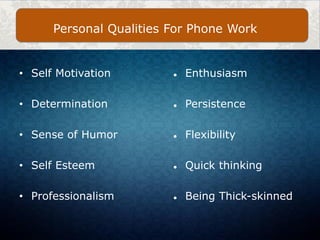
• Self Motivation
• Determination
• Sense of Humor
• Self Esteem
• Professionalism
● Enthusiasm
● Persistence
● Flexibility
● Quick thinking
● Being Thick-skinned
Personal Qualities For Phone Work
Tips for Telephone Etiquette
• Before you answer, be prepared:
—Have your computer switched on.
—Have pens, pencils and notepad ready.
• In answering the phone:
—Answer calls promptly by the second or third ring.
—Smile as you pick up the phone.
—Use your ‘telephone’ voice, controlling your volume and
speed.
—Project a tone that is enthusiastic, natural, attentive and
respectful.
—Greet the Customer, identify your Company and yourself.
Tips for Telephone Etiquette
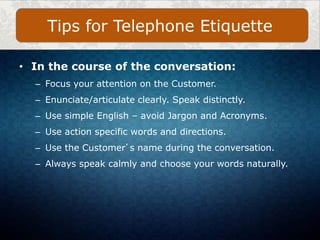
• In the course of the conversation:
– Focus your attention on the Customer.
– Enunciate/articulate clearly. Speak distinctly.
– Use simple English – avoid Jargon and Acronyms.
– Use action specific words and directions.
– Use the Customer’s name during the conversation.
– Always speak calmly and choose your words naturally.
Tips for Telephone Etiquette
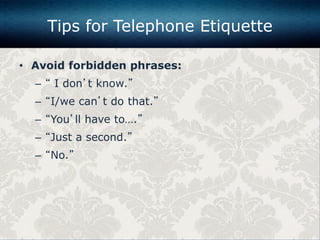
• Avoid forbidden phrases:
– “ I don’t know.”
– “I/we can’t do that.”
– “You’ll have to….”
– “Just a second.”
– “No.”
Tips for Telephone Etiquette
▪ The first step in handling an Irate Caller is
to simply hear the other person out.
Listen intently. Allow the Customer to
vent some frustration.
▪ Empathizing allows you to understand
another person’s motives without
requiring you to agree with them.
Handling Irate Customers
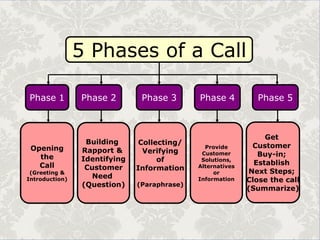
5 Phases of a Call
Phase 1 Phase 2 Phase 3 Phase 4 Phase 5
Opening
the
Call
(Greeting &
Introduction)
Building
Rapport &
Identifying
Customer
Need
(Question)
Collecting/
Verifying
of
Information
(Paraphrase)
Provide
Customer
Solutions,
Alternatives
or
Information
Get
Customer
Buy-in;
Establish
Next Steps;
Close the call
(Summarize)
Contact Information

telephone-etiquette.pdf

  • 1.
  • 2.
    1. Pick upthe phone in three rings . More than three rings signals chaos in your office or inattentiveness. 2. Greet the caller, e.g. “hello”, “good morning”. Good manners shows you respect the caller. 3. Give your name. This is a courtesy that serves to personalize the customer service experience as well as allowing the customer to hold you accountable for your level of service. Answering the Telephone
  • 3.
    4. Ask thecustomer if or how you can help. Asking to help tells the customer you are there to serve his/her needs and to solve his/her problems. This also leaves the customer with a positive impression. 5. The greeting is key, it sets the tone and style of the whole interaction. Answering the Telephone
  • 4.
    Good morning, thanksfor calling the ABC Hotel. My name is XYZ. How may I help you?”
  • 5.
    Telephone Etiquette Work performedby the Academy for Educational Development under sponsorship of the United States Agency for International Development (USAID) Contract Number: LAG -I-00-98-00011-00, Task Order Number: 804 Tone of Voice 86% Words 14%
  • 6.
    • Customer formsa mental PICTURE of you –P – PITCH –I – INFLECTION –C – COURTESY –T – TONE –U - UNDERSTANDING –R – RATE –E - ENUNCIATION Telephone Etiquette
  • 7.
  • 8.
    •Open-ended questions / Closed-endedquestions •Probing questions •Linking questions •Providing non-verbal encouragement •Using supportive statements •Showing empathy with your client •Key words repetition •Using the pause •Using summaries •Dealing with mistakes •Counter productive questions •Checking facts & asking for specific information Interviewing Techniques
  • 9.
    • Self Motivation •Determination • Sense of Humor • Self Esteem • Professionalism ● Enthusiasm ● Persistence ● Flexibility ● Quick thinking ● Being Thick-skinned Personal Qualities For Phone Work
  • 10.
  • 11.
    • Before youanswer, be prepared: —Have your computer switched on. —Have pens, pencils and notepad ready. • In answering the phone: —Answer calls promptly by the second or third ring. —Smile as you pick up the phone. —Use your ‘telephone’ voice, controlling your volume and speed. —Project a tone that is enthusiastic, natural, attentive and respectful. —Greet the Customer, identify your Company and yourself. Tips for Telephone Etiquette
  • 12.
    • In thecourse of the conversation: – Focus your attention on the Customer. – Enunciate/articulate clearly. Speak distinctly. – Use simple English – avoid Jargon and Acronyms. – Use action specific words and directions. – Use the Customer’s name during the conversation. – Always speak calmly and choose your words naturally. Tips for Telephone Etiquette
  • 13.
    • Avoid forbiddenphrases: – “ I don’t know.” – “I/we can’t do that.” – “You’ll have to….” – “Just a second.” – “No.” Tips for Telephone Etiquette
  • 14.
    ▪ The firststep in handling an Irate Caller is to simply hear the other person out. Listen intently. Allow the Customer to vent some frustration. ▪ Empathizing allows you to understand another person’s motives without requiring you to agree with them. Handling Irate Customers
  • 15.
    5 Phases ofa Call Phase 1 Phase 2 Phase 3 Phase 4 Phase 5 Opening the Call (Greeting & Introduction) Building Rapport & Identifying Customer Need (Question) Collecting/ Verifying of Information (Paraphrase) Provide Customer Solutions, Alternatives or Information Get Customer Buy-in; Establish Next Steps; Close the call (Summarize)
  • 16.