Telephone Etiquette
• Always keep in mind that effective business telephone etiquette requires you to be:
• Prepared,
• Present,
• Polite,
• Patient,
• Personable,
• Professional,
• Proactive.
TELEPHONE PROCEDURES
 PRINCIPLES OFTELEPHONE PROCEDURES
• Discipline. It is an important component of effective communications and should be maintained at all times.
• Voice Procedure. Talk clearly and directly into the mouthpiece. Do not eat or smoke while you are receiving or
conveying a message.
• Transmission of Message. Ensure that messages are well thought out, contain facts and are concise.
• Speed and Accuracy. Be concise and accurate when conveying a message.
• Tact. Try to be tactful even under stress of an emergency.
• Patience. Handle all calls with patience and genuine interest.
• Courtesy. Always be courteous with callers, even your sub ordinates.
‑
• Confidence. Handle all calls with self confidence.
‑
• Incoming Calls. Handle all incoming calls immediately.
• Receive and convey a telephone message. Always keep a pen and paper handy next to the telephone.
TELEPHONE PROCEDURES continues
 RECEIVING ATELEPHONE CALL
• When receiving a call obtain and note the following information:
o Date and time of call.
o Name and company of caller.
o Reason for call or message.
o Person to whom the message must be conveyed.
o Telephone numbers and time when the caller can be located.
o Write down the complete message and hand it over to the specific person.
o If you won’t see him/her write the message in the Information Book or register specially
used for messages.
Answering the Telephone
1. Answer the phone promptly.
2. Identify your department and then identify yourself; e.g.“Ground Floor Front Desk; this is John
Agbo."
3. Speak with a smile in your voice. If you smile when speaking on the phone, your tone of voice is
more welcoming and friendly.
4. Show interest in the caller and their problems.
5. Be of service and offer assistance.
6. Be informed about Banwo & Ighodalo, its services, and personnel. Have basic materials and
information readily available for reference. Become an informed person so that you may be of
help to others.
1. Make referrals to other people and departments properly. Offer to transfer the call, making sure
to always give the number you are referring them to in case you get disconnected.
2. If you must put a person on hold, ask permission first and only keep them on hold for about
45seconds before checking back with them.
3. If the person that was being called is not available, say, "I’m sorry; Musa is not available right now.
May I help you with something?"
4. Take messages clearly and correctly.Telephone messages must be taken carefully and delivered
promptly.Taking a message requires: (1) being polite and professional on the telephone and (2)
recording all the facts correctly. Double check spelling and numbers with the caller.
Answering the Telephone
TELEPHONE ETIQUETTE
1. Identify who you are at the beginning of the conversation.
2. Use good telephone etiquette with people.
3. Don't interrupt people when they are speaking. Let them finish their sentence or idea.
4. If you are not able to speak with the person you called, don't pry. For example, it would be inappropriate to
say "Oh, is John off today?"
5. Always identify yourself when you answer the phone and when you call someone, department and by your
name. (Remember that not everyone has caller ID, and those who do sometimes still don't know who you
are.)
6. Pick up the phone with a smile. Be happy!
1. Please treat the caller with respect and courtesy.
2. Please treat the person you call with respect and courtesy.
3. Never hang up on someone just because you are finished with the conversation.
4. Apologize if you dialed a wrong number and be understanding if they dialed you incorrectly.
5. Don't convey an "I'm an important person" attitude.We are all important people.
6. Do not be speaking to someone else when you pick up the phone.
7. Don't sound impatient or put-out.
8. Try to be as helpful as you possibly can. Put yourself in the caller's position.
TELEPHONE ETIQUETTE
Use respectful and considerate words and phrases, such as:
• "I'm sorry."
• "Thank you."
• "Please."
• "May I take a message?"
• "Would you like to leave your number?"
• "May I put you on hold?"
• "I'm sorry to keep you waiting."
• "He's away from his desk. May I have him return your call?"
TELEPHONE ETIQUETTE
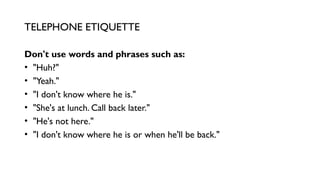
Don't use words and phrases such as:
• "Huh?"
• "Yeah."
• "I don't know where he is."
• "She's at lunch. Call back later."
• "He's not here."
• "I don't know where he is or when he'll be back."
TELEPHONE ETIQUETTE
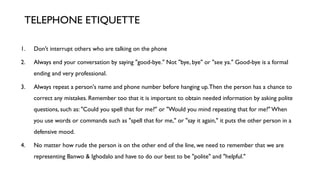
1. Don't interrupt others who are talking on the phone
2. Always end your conversation by saying "good-bye." Not "bye, bye" or "see ya." Good-bye is a formal
ending and very professional.
3. Always repeat a person's name and phone number before hanging up.Then the person has a chance to
correct any mistakes. Remember too that it is important to obtain needed information by asking polite
questions, such as: "Could you spell that for me?" or "Would you mind repeating that for me?"When
you use words or commands such as "spell that for me," or "say it again," it puts the other person in a
defensive mood.
4. No matter how rude the person is on the other end of the line, we need to remember that we are
representing Banwo & Ighodalo and have to do our best to be "polite" and "helpful."
TELEPHONE ETIQUETTE

Telephone Procedures and Etiquette.ppt 2x

  • 2.
    Telephone Etiquette • Alwayskeep in mind that effective business telephone etiquette requires you to be: • Prepared, • Present, • Polite, • Patient, • Personable, • Professional, • Proactive.
  • 3.
    TELEPHONE PROCEDURES  PRINCIPLESOFTELEPHONE PROCEDURES • Discipline. It is an important component of effective communications and should be maintained at all times. • Voice Procedure. Talk clearly and directly into the mouthpiece. Do not eat or smoke while you are receiving or conveying a message. • Transmission of Message. Ensure that messages are well thought out, contain facts and are concise. • Speed and Accuracy. Be concise and accurate when conveying a message. • Tact. Try to be tactful even under stress of an emergency. • Patience. Handle all calls with patience and genuine interest. • Courtesy. Always be courteous with callers, even your sub ordinates. ‑ • Confidence. Handle all calls with self confidence. ‑ • Incoming Calls. Handle all incoming calls immediately. • Receive and convey a telephone message. Always keep a pen and paper handy next to the telephone.
  • 4.
    TELEPHONE PROCEDURES continues RECEIVING ATELEPHONE CALL • When receiving a call obtain and note the following information: o Date and time of call. o Name and company of caller. o Reason for call or message. o Person to whom the message must be conveyed. o Telephone numbers and time when the caller can be located. o Write down the complete message and hand it over to the specific person. o If you won’t see him/her write the message in the Information Book or register specially used for messages.
  • 5.
    Answering the Telephone 1.Answer the phone promptly. 2. Identify your department and then identify yourself; e.g.“Ground Floor Front Desk; this is John Agbo." 3. Speak with a smile in your voice. If you smile when speaking on the phone, your tone of voice is more welcoming and friendly. 4. Show interest in the caller and their problems. 5. Be of service and offer assistance. 6. Be informed about Banwo & Ighodalo, its services, and personnel. Have basic materials and information readily available for reference. Become an informed person so that you may be of help to others.
  • 6.
    1. Make referralsto other people and departments properly. Offer to transfer the call, making sure to always give the number you are referring them to in case you get disconnected. 2. If you must put a person on hold, ask permission first and only keep them on hold for about 45seconds before checking back with them. 3. If the person that was being called is not available, say, "I’m sorry; Musa is not available right now. May I help you with something?" 4. Take messages clearly and correctly.Telephone messages must be taken carefully and delivered promptly.Taking a message requires: (1) being polite and professional on the telephone and (2) recording all the facts correctly. Double check spelling and numbers with the caller. Answering the Telephone
  • 7.
    TELEPHONE ETIQUETTE 1. Identifywho you are at the beginning of the conversation. 2. Use good telephone etiquette with people. 3. Don't interrupt people when they are speaking. Let them finish their sentence or idea. 4. If you are not able to speak with the person you called, don't pry. For example, it would be inappropriate to say "Oh, is John off today?" 5. Always identify yourself when you answer the phone and when you call someone, department and by your name. (Remember that not everyone has caller ID, and those who do sometimes still don't know who you are.) 6. Pick up the phone with a smile. Be happy!
  • 8.
    1. Please treatthe caller with respect and courtesy. 2. Please treat the person you call with respect and courtesy. 3. Never hang up on someone just because you are finished with the conversation. 4. Apologize if you dialed a wrong number and be understanding if they dialed you incorrectly. 5. Don't convey an "I'm an important person" attitude.We are all important people. 6. Do not be speaking to someone else when you pick up the phone. 7. Don't sound impatient or put-out. 8. Try to be as helpful as you possibly can. Put yourself in the caller's position. TELEPHONE ETIQUETTE
  • 9.
    Use respectful andconsiderate words and phrases, such as: • "I'm sorry." • "Thank you." • "Please." • "May I take a message?" • "Would you like to leave your number?" • "May I put you on hold?" • "I'm sorry to keep you waiting." • "He's away from his desk. May I have him return your call?" TELEPHONE ETIQUETTE
  • 10.
    Don't use wordsand phrases such as: • "Huh?" • "Yeah." • "I don't know where he is." • "She's at lunch. Call back later." • "He's not here." • "I don't know where he is or when he'll be back." TELEPHONE ETIQUETTE
  • 11.
    1. Don't interruptothers who are talking on the phone 2. Always end your conversation by saying "good-bye." Not "bye, bye" or "see ya." Good-bye is a formal ending and very professional. 3. Always repeat a person's name and phone number before hanging up.Then the person has a chance to correct any mistakes. Remember too that it is important to obtain needed information by asking polite questions, such as: "Could you spell that for me?" or "Would you mind repeating that for me?"When you use words or commands such as "spell that for me," or "say it again," it puts the other person in a defensive mood. 4. No matter how rude the person is on the other end of the line, we need to remember that we are representing Banwo & Ighodalo and have to do our best to be "polite" and "helpful." TELEPHONE ETIQUETTE