Hartwell T Paul Davis
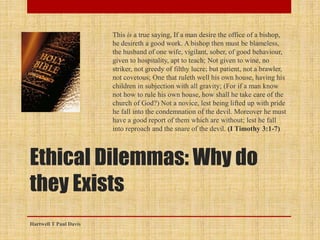
Ethical Dilemmas: Why do
they Exists
This is a true saying, If a man desire the office of a bishop,
he desireth a good work. A bishop then must be blameless,
the husband of one wife, vigilant, sober, of good behaviour,
given to hospitality, apt to teach; Not given to wine, no
striker, not greedy of filthy lucre; but patient, not a brawler,
not covetous; One that ruleth well his own house, having his
children in subjection with all gravity; (For if a man know
not how to rule his own house, how shall he take care of the
church of God?) Not a novice, lest being lifted up with pride
he fall into the condemnation of the devil. Moreover he must
have a good report of them which are without; lest he fall
into reproach and the snare of the devil. (I Timothy 3:1-7)
Hartwell T Paul Davis
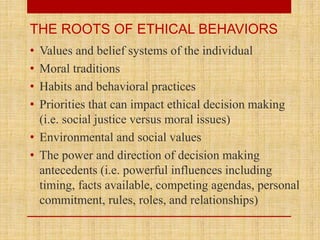
• Values and belief systems of the individual
• Moral traditions
• Habits and behavioral practices
• Priorities that can impact ethical decision making
(i.e. social justice versus moral issues)
• Environmental and social values
• The power and direction of decision making
antecedents (i.e. powerful influences including
timing, facts available, competing agendas, personal
commitment, rules, roles, and relationships)
THE ROOTS OF ETHICAL BEHAVIORS
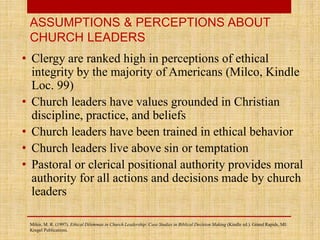
• Clergy are ranked high in perceptions of ethical
integrity by the majority of Americans (Milco, Kindle
Loc. 99)
• Church leaders have values grounded in Christian
discipline, practice, and beliefs
• Church leaders have been trained in ethical behavior
• Church leaders live above sin or temptation
• Pastoral or clerical positional authority provides moral
authority for all actions and decisions made by church
leaders
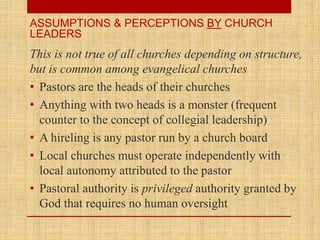
ASSUMPTIONS & PERCEPTIONS ABOUT
CHURCH LEADERS
Milco, M. R. (1997). Ethical Dilemmas in Church Leadership: Case Studies in Biblical Decision Making (Kindle ed.). Grand Rapids, MI:
Kregel Publications.
This is not true of all churches depending on structure,
but is common among evangelical churches
• Pastors are the heads of their churches
• Anything with two heads is a monster (frequent
counter to the concept of collegial leadership)
• A hireling is any pastor run by a church board
• Local churches must operate independently with
local autonomy attributed to the pastor
• Pastoral authority is privileged authority granted by
God that requires no human oversight
ASSUMPTIONS & PERCEPTIONS BY CHURCH
LEADERS
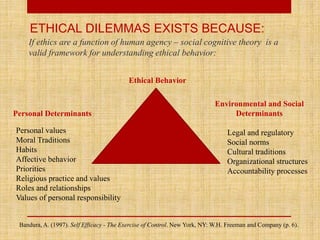
ETHICAL DILEMMAS EXISTS BECAUSE:
If ethics are a function of human agency – social cognitive theory is a
valid framework for understanding ethical behavior:
Ethical Behavior
Personal Determinants
Environmental and Social
Determinants
Personal values
Moral Traditions
Habits
Affective behavior
Priorities
Religious practice and values
Roles and relationships
Values of personal responsibility
Legal and regulatory
Social norms
Cultural traditions
Organizational structures
Accountability processes
Bandura, A. (1997). Self Efficacy - The Exercise of Control. New York, NY: W.H. Freeman and Company (p. 6).
Church Ethical Dilemmas
Encompass leadership behaviors and
also leadership decision making relative
to ethical behaviors of church members
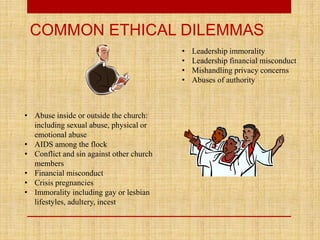
COMMON ETHICAL DILEMMAS
• Abuse inside or outside the church:
including sexual abuse, physical or
emotional abuse
• AIDS among the flock
• Conflict and sin against other church
members
• Financial misconduct
• Crisis pregnancies
• Immorality including gay or lesbian
lifestyles, adultery, incest
• Leadership immorality
• Leadership financial misconduct
• Mishandling privacy concerns
• Abuses of authority
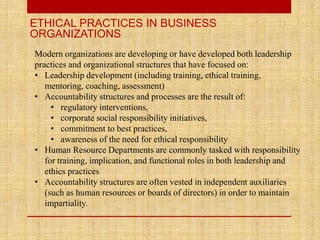
ETHICAL PRACTICES IN BUSINESS
ORGANIZATIONS
Modern organizations are developing or have developed both leadership
practices and organizational structures that have focused on:
• Leadership development (including training, ethical training,
mentoring, coaching, assessment)
• Accountability structures and processes are the result of:
• regulatory interventions,
• corporate social responsibility initiatives,
• commitment to best practices,
• awareness of the need for ethical responsibility
• Human Resource Departments are commonly tasked with responsibility
for training, implication, and functional roles in both leadership and
ethics practices
• Accountability structures are often vested in independent auxiliaries
(such as human resources or boards of directors) in order to maintain
impartiality.
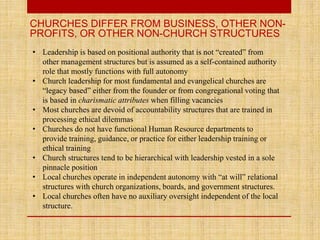
CHURCHES DIFFER FROM BUSINESS, OTHER NON-
PROFITS, OR OTHER NON-CHURCH STRUCTURES
• Leadership is based on positional authority that is not “created” from
other management structures but is assumed as a self-contained authority
role that mostly functions with full autonomy
• Church leadership for most fundamental and evangelical churches are
“legacy based” either from the founder or from congregational voting that
is based in charismatic attributes when filling vacancies
• Most churches are devoid of accountability structures that are trained in
processing ethical dilemmas
• Churches do not have functional Human Resource departments to
provide training, guidance, or practice for either leadership training or
ethical training
• Church structures tend to be hierarchical with leadership vested in a sole
pinnacle position
• Local churches operate in independent autonomy with “at will” relational
structures with church organizations, boards, and government structures.
• Local churches often have no auxiliary oversight independent of the local
structure.
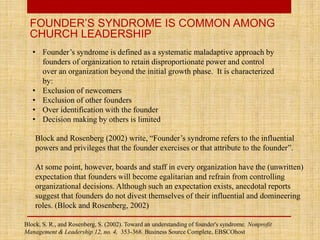
FOUNDER’S SYNDROME IS COMMON AMONG
CHURCH LEADERSHIP
• Founder’s syndrome is defined as a systematic maladaptive approach by
founders of organization to retain disproportionate power and control
over an organization beyond the initial growth phase. It is characterized
by:
• Exclusion of newcomers
• Exclusion of other founders
• Over identification with the founder
• Decision making by others is limited
Block and Rosenberg (2002) write, “Founder’s syndrome refers to the influential
powers and privileges that the founder exercises or that attribute to the founder”.
At some point, however, boards and staff in every organization have the (unwritten)
expectation that founders will become egalitarian and refrain from controlling
organizational decisions. Although such an expectation exists, anecdotal reports
suggest that founders do not divest themselves of their influential and domineering
roles. (Block and Rosenberg, 2002)
Block, S. R., and Rosenberg, S. (2002). Toward an understanding of founder's syndrome. Nonprofit
Management & Leadership 12, no. 4, 353-368. Business Source Complete, EBSCOhost
• RESPONSIBILITY
• ACCOUNTABILITY
• REINFORCMENT OF ETHICAL
LEADERSHIP BY STRUCTURAL SUPPORT
AND ETHICAL DEVELOPMENT
PRACTICES
THE KEY TO ETHICAL INTEGRITY
BIBLICAL LEADERSHIP
STRUCTURE
Biblical leadership structures were intended to
provide for both responsibility and accountability
THE BIBLE TEACHES LEADERSHIP
RESPONSIBILITY
1 Timothy 3:1-7 (KJV)
1 This is a true saying, If a man desire the office of a
bishop, he desireth a good work.
2 A bishop then must be blameless, the husband of one
wife, vigilant, sober, of good behaviour, given to hospitality,
apt to teach;
3 Not given to wine, no striker, not greedy of filthy lucre;
but patient, not a brawler, not covetous;
4 One that ruleth well his own house, having his children in
subjection with all gravity;
5 (For if a man know not how to rule his own house, how
shall he take care of the church of God?)
6 Not a novice, lest being lifted up with pride he fall into
the condemnation of the devil.
7 Moreover he must have a good report of them which are
without; lest he fall into reproach and the snare of the devil.
• 1 Timothy 5:17-20 (KJV)
17 Let the elders that rule well be counted
worthy of double honour, especially they
who labour in the word and doctrine.
18 For the scripture saith, Thou shalt not
muzzle the ox that treadeth out the corn.
And, The labourer is worthy of his
reward.
19 Against an elder receive not an
accusation, but before two or three
witnesses.
20 Them that sin rebuke before all, that
others also may fear.
THE BIBLE TEACHES LEADERSHIP
ACCOUNTABILITY
PASTORAL CONCEPTS
• There is no scripture that equates the role of pastor with sole church
authority
• The term pastor is not used in reference to church leadership in the
New Testament – it is used but once in reference to the five-fold
ministry (Ephesians 4:11)
• The term pastor does not refer to an office but a ministerial gift (i.e.
how a ministry functions) (Ephesians 4:11)
• Biblical church leadership is always in the plural for the local
assembly operating as a collegial, collaborative leadership style
devoid of single authorities except for that of Jesus Christ as the head
of the church (Acts 14:23, Titus 1:5, Hebrews 13:17, Philippians 1:1)
• Church leadership derives from the servant-leader perspective
(Matthew 20:25) that contrast with the role of “exercising authority”
Hartwell T Paul Davis
• Which of the 12 apostles was pastor of Jerusalem?
• James is assumed but do we therefore assume James was
over Peter and John. James is listed as one of three
pillars of the church (Galatians 2:9)
• The 12 voted on adding a new leader (Matthias) to the
group (Acts 1:26) even though Peter initiated the process
• The 12 acted in concert in the establishment of deacons,
the case of circumcision, the sending forth of apostles, the
sending forth of decrees
Hartwell T Paul Davis
COLLEGIAL LEADERSHIP WAS THE PRACTICE
OF THE ORIGINAL JERUSALEM CHURCH
• There can be only one pastor in the church! Anything with 2 heads is a monster:
• Can there be more than one evangelist, one apostle, one prophet, one teacher?
• A pastor is not mentioned in the plural leadership structure of Philippians (1:1) or
Antioch (Acts 13:1-3) where prophets and teachers are the leadership structure
• The pastoral verse of Acts 20:28 was addressed to “elders” at Miletus (Acts 20:17)
• The office of “elder” may be occupied by apostles, prophets, evangelist, pastors, or teachers
(Ephesians 4:11)
• All references to the office of elder in the local assembly was in the plural:
• Acts 11:30
• Acts 14:23
• Acts 15:2 - 22
• Acts 16:4
• Acts 20:17
• Acts 21:18
• I Timothy 5:17
• Titus 1:5
• Hebrews 1317
• James 5:14
• I Peter 5:1
Hartwell T Paul Davis
OBJECTIONS TO SINGULAR LEADERSHIP
Historical Perspective
The historical records indicate local churches operated in
collegial leadership until the 3rd century. There is not an
implication that Jerusalem served as hierarchical authority,
but operated as advisories to local assemblies. The
apostolic authority of Paul, Timothy, or Titus in the
ordination and oversight of local churches are not construed
to be local church leadership structures – but both
Jerusalem and apostolic authority suggest accountability
structures “outside” of the local leadership structure which
reflect on the need for stronger outside accountability
structures for local assemblies.
Hartwell T Paul Davis
During the 3rd century, rising into notice by way of geographical
distribution rather than in definite chronological order, this twofold
congregational ministry became threefold in the sense that one man was
placed at the head of each community with the title of pastor or bishop
(the titles are interchangeable as late as the 4th century at least)
Hartwell T Paul Davis
Ministry, in International Standard Bible Encyclopedia, Electronic Database,
Biblesoft, 1996.
During the 2nd century the ministry was subject to a change. The ruling body
of office-bearers in every congregation received a permanent president, who
was called the pastor or bishop, the latter term being the commoner. The
change came gradually. It provoked no strong opposition. By the beginning of
the third century, it was everywhere accepted.
Lindsey, The Church and the Ministry in the Early Centuries, 180, 183-85)
Jerome, one of the early church fathers
wrote, “A presbyter is the same as a bishop.
And until there arose divisions in religion,
churches were governed by a common
counsel of presbyters. But afterward, it was
everywhere decreed, that one person, elected
from the presbyters, should be placed over
the others.”
Hartwell T Paul Davis
Annotations on the Epistle to Titus, as quoted by Dr. Woods on Episcopacy, p. 63.
THE PARADIGM SHIFT
• Create accountability for the single-pastor/leader church
by re-examining Biblical church structure and putting
collegial eldership into practice
• Train church leaders in the concepts of servant-leadership
• Use team approaches in church planting and missions
• Develop leadership mentoring (analogous to discipleship)
for church leaders
• Develop auxiliary accountability structures whether with
other church leaders or stronger organizational ties
• Change the mindset from “my church” to “his church”
• Do not allow members to call the church by the pastor’s
name
Hartwell T Paul Davis
THE PARADIGM SHIFT
• Avoid reinforcing the single pastor concept by avoiding
“pastoral appreciation days”. If there are no
corresponding appreciation days for the rest of the five-
fold ministry, it demeans other ministers and dilutes the
concept of ministerial gifts and servant leadership.
• Beware of the “Peter, Paul, Apollos syndrome (preacher
religion) that developed in the Corinthian church (I Cor.
1:10-13).
• Instead of pastor’s anniversaries, have “church”
anniversaries. The church is not about the pastor – it is
about Jesus Christ.
• Remember the sin of Diotrephes (3 John 1:9)
Hartwell T Paul Davis
CREATING
ACCOUNTABILITY
• Formalize ethics procedures for both the leadership and the
congregation
• Develop an ethics oversight committee and train in ethical
issues
• Single pastors who are intent on retaining power should at
least develop accountability relationships with other pastors
who will share in training workshops, ethical discussion,
mentoring, and counseling
• Pastors should consider contracting leadership development
training for themselves and other church leaders
Hartwell T Paul Davis

Paradigm Shift: Collegial Eldership vs the Single Pastor

  • 1.
  • 2.
    Ethical Dilemmas: Whydo they Exists This is a true saying, If a man desire the office of a bishop, he desireth a good work. A bishop then must be blameless, the husband of one wife, vigilant, sober, of good behaviour, given to hospitality, apt to teach; Not given to wine, no striker, not greedy of filthy lucre; but patient, not a brawler, not covetous; One that ruleth well his own house, having his children in subjection with all gravity; (For if a man know not how to rule his own house, how shall he take care of the church of God?) Not a novice, lest being lifted up with pride he fall into the condemnation of the devil. Moreover he must have a good report of them which are without; lest he fall into reproach and the snare of the devil. (I Timothy 3:1-7) Hartwell T Paul Davis
  • 3.
    • Values andbelief systems of the individual • Moral traditions • Habits and behavioral practices • Priorities that can impact ethical decision making (i.e. social justice versus moral issues) • Environmental and social values • The power and direction of decision making antecedents (i.e. powerful influences including timing, facts available, competing agendas, personal commitment, rules, roles, and relationships) THE ROOTS OF ETHICAL BEHAVIORS
  • 4.
    • Clergy areranked high in perceptions of ethical integrity by the majority of Americans (Milco, Kindle Loc. 99) • Church leaders have values grounded in Christian discipline, practice, and beliefs • Church leaders have been trained in ethical behavior • Church leaders live above sin or temptation • Pastoral or clerical positional authority provides moral authority for all actions and decisions made by church leaders ASSUMPTIONS & PERCEPTIONS ABOUT CHURCH LEADERS Milco, M. R. (1997). Ethical Dilemmas in Church Leadership: Case Studies in Biblical Decision Making (Kindle ed.). Grand Rapids, MI: Kregel Publications.
  • 5.
    This is nottrue of all churches depending on structure, but is common among evangelical churches • Pastors are the heads of their churches • Anything with two heads is a monster (frequent counter to the concept of collegial leadership) • A hireling is any pastor run by a church board • Local churches must operate independently with local autonomy attributed to the pastor • Pastoral authority is privileged authority granted by God that requires no human oversight ASSUMPTIONS & PERCEPTIONS BY CHURCH LEADERS
  • 6.
    ETHICAL DILEMMAS EXISTSBECAUSE: If ethics are a function of human agency – social cognitive theory is a valid framework for understanding ethical behavior: Ethical Behavior Personal Determinants Environmental and Social Determinants Personal values Moral Traditions Habits Affective behavior Priorities Religious practice and values Roles and relationships Values of personal responsibility Legal and regulatory Social norms Cultural traditions Organizational structures Accountability processes Bandura, A. (1997). Self Efficacy - The Exercise of Control. New York, NY: W.H. Freeman and Company (p. 6).
  • 7.
    Church Ethical Dilemmas Encompassleadership behaviors and also leadership decision making relative to ethical behaviors of church members
  • 8.
    COMMON ETHICAL DILEMMAS •Abuse inside or outside the church: including sexual abuse, physical or emotional abuse • AIDS among the flock • Conflict and sin against other church members • Financial misconduct • Crisis pregnancies • Immorality including gay or lesbian lifestyles, adultery, incest • Leadership immorality • Leadership financial misconduct • Mishandling privacy concerns • Abuses of authority
  • 9.
    ETHICAL PRACTICES INBUSINESS ORGANIZATIONS Modern organizations are developing or have developed both leadership practices and organizational structures that have focused on: • Leadership development (including training, ethical training, mentoring, coaching, assessment) • Accountability structures and processes are the result of: • regulatory interventions, • corporate social responsibility initiatives, • commitment to best practices, • awareness of the need for ethical responsibility • Human Resource Departments are commonly tasked with responsibility for training, implication, and functional roles in both leadership and ethics practices • Accountability structures are often vested in independent auxiliaries (such as human resources or boards of directors) in order to maintain impartiality.
  • 10.
    CHURCHES DIFFER FROMBUSINESS, OTHER NON- PROFITS, OR OTHER NON-CHURCH STRUCTURES • Leadership is based on positional authority that is not “created” from other management structures but is assumed as a self-contained authority role that mostly functions with full autonomy • Church leadership for most fundamental and evangelical churches are “legacy based” either from the founder or from congregational voting that is based in charismatic attributes when filling vacancies • Most churches are devoid of accountability structures that are trained in processing ethical dilemmas • Churches do not have functional Human Resource departments to provide training, guidance, or practice for either leadership training or ethical training • Church structures tend to be hierarchical with leadership vested in a sole pinnacle position • Local churches operate in independent autonomy with “at will” relational structures with church organizations, boards, and government structures. • Local churches often have no auxiliary oversight independent of the local structure.
  • 11.
    FOUNDER’S SYNDROME ISCOMMON AMONG CHURCH LEADERSHIP • Founder’s syndrome is defined as a systematic maladaptive approach by founders of organization to retain disproportionate power and control over an organization beyond the initial growth phase. It is characterized by: • Exclusion of newcomers • Exclusion of other founders • Over identification with the founder • Decision making by others is limited Block and Rosenberg (2002) write, “Founder’s syndrome refers to the influential powers and privileges that the founder exercises or that attribute to the founder”. At some point, however, boards and staff in every organization have the (unwritten) expectation that founders will become egalitarian and refrain from controlling organizational decisions. Although such an expectation exists, anecdotal reports suggest that founders do not divest themselves of their influential and domineering roles. (Block and Rosenberg, 2002) Block, S. R., and Rosenberg, S. (2002). Toward an understanding of founder's syndrome. Nonprofit Management & Leadership 12, no. 4, 353-368. Business Source Complete, EBSCOhost
  • 12.
    • RESPONSIBILITY • ACCOUNTABILITY •REINFORCMENT OF ETHICAL LEADERSHIP BY STRUCTURAL SUPPORT AND ETHICAL DEVELOPMENT PRACTICES THE KEY TO ETHICAL INTEGRITY
  • 13.
    BIBLICAL LEADERSHIP STRUCTURE Biblical leadershipstructures were intended to provide for both responsibility and accountability
  • 14.
    THE BIBLE TEACHESLEADERSHIP RESPONSIBILITY 1 Timothy 3:1-7 (KJV) 1 This is a true saying, If a man desire the office of a bishop, he desireth a good work. 2 A bishop then must be blameless, the husband of one wife, vigilant, sober, of good behaviour, given to hospitality, apt to teach; 3 Not given to wine, no striker, not greedy of filthy lucre; but patient, not a brawler, not covetous; 4 One that ruleth well his own house, having his children in subjection with all gravity; 5 (For if a man know not how to rule his own house, how shall he take care of the church of God?) 6 Not a novice, lest being lifted up with pride he fall into the condemnation of the devil. 7 Moreover he must have a good report of them which are without; lest he fall into reproach and the snare of the devil.
  • 15.
    • 1 Timothy5:17-20 (KJV) 17 Let the elders that rule well be counted worthy of double honour, especially they who labour in the word and doctrine. 18 For the scripture saith, Thou shalt not muzzle the ox that treadeth out the corn. And, The labourer is worthy of his reward. 19 Against an elder receive not an accusation, but before two or three witnesses. 20 Them that sin rebuke before all, that others also may fear. THE BIBLE TEACHES LEADERSHIP ACCOUNTABILITY
  • 16.
    PASTORAL CONCEPTS • Thereis no scripture that equates the role of pastor with sole church authority • The term pastor is not used in reference to church leadership in the New Testament – it is used but once in reference to the five-fold ministry (Ephesians 4:11) • The term pastor does not refer to an office but a ministerial gift (i.e. how a ministry functions) (Ephesians 4:11) • Biblical church leadership is always in the plural for the local assembly operating as a collegial, collaborative leadership style devoid of single authorities except for that of Jesus Christ as the head of the church (Acts 14:23, Titus 1:5, Hebrews 13:17, Philippians 1:1) • Church leadership derives from the servant-leader perspective (Matthew 20:25) that contrast with the role of “exercising authority” Hartwell T Paul Davis
  • 17.
    • Which ofthe 12 apostles was pastor of Jerusalem? • James is assumed but do we therefore assume James was over Peter and John. James is listed as one of three pillars of the church (Galatians 2:9) • The 12 voted on adding a new leader (Matthias) to the group (Acts 1:26) even though Peter initiated the process • The 12 acted in concert in the establishment of deacons, the case of circumcision, the sending forth of apostles, the sending forth of decrees Hartwell T Paul Davis COLLEGIAL LEADERSHIP WAS THE PRACTICE OF THE ORIGINAL JERUSALEM CHURCH
  • 18.
    • There canbe only one pastor in the church! Anything with 2 heads is a monster: • Can there be more than one evangelist, one apostle, one prophet, one teacher? • A pastor is not mentioned in the plural leadership structure of Philippians (1:1) or Antioch (Acts 13:1-3) where prophets and teachers are the leadership structure • The pastoral verse of Acts 20:28 was addressed to “elders” at Miletus (Acts 20:17) • The office of “elder” may be occupied by apostles, prophets, evangelist, pastors, or teachers (Ephesians 4:11) • All references to the office of elder in the local assembly was in the plural: • Acts 11:30 • Acts 14:23 • Acts 15:2 - 22 • Acts 16:4 • Acts 20:17 • Acts 21:18 • I Timothy 5:17 • Titus 1:5 • Hebrews 1317 • James 5:14 • I Peter 5:1 Hartwell T Paul Davis OBJECTIONS TO SINGULAR LEADERSHIP
  • 19.
    Historical Perspective The historicalrecords indicate local churches operated in collegial leadership until the 3rd century. There is not an implication that Jerusalem served as hierarchical authority, but operated as advisories to local assemblies. The apostolic authority of Paul, Timothy, or Titus in the ordination and oversight of local churches are not construed to be local church leadership structures – but both Jerusalem and apostolic authority suggest accountability structures “outside” of the local leadership structure which reflect on the need for stronger outside accountability structures for local assemblies. Hartwell T Paul Davis
  • 20.
    During the 3rdcentury, rising into notice by way of geographical distribution rather than in definite chronological order, this twofold congregational ministry became threefold in the sense that one man was placed at the head of each community with the title of pastor or bishop (the titles are interchangeable as late as the 4th century at least) Hartwell T Paul Davis Ministry, in International Standard Bible Encyclopedia, Electronic Database, Biblesoft, 1996. During the 2nd century the ministry was subject to a change. The ruling body of office-bearers in every congregation received a permanent president, who was called the pastor or bishop, the latter term being the commoner. The change came gradually. It provoked no strong opposition. By the beginning of the third century, it was everywhere accepted. Lindsey, The Church and the Ministry in the Early Centuries, 180, 183-85)
  • 21.
    Jerome, one ofthe early church fathers wrote, “A presbyter is the same as a bishop. And until there arose divisions in religion, churches were governed by a common counsel of presbyters. But afterward, it was everywhere decreed, that one person, elected from the presbyters, should be placed over the others.” Hartwell T Paul Davis Annotations on the Epistle to Titus, as quoted by Dr. Woods on Episcopacy, p. 63.
  • 22.
    THE PARADIGM SHIFT •Create accountability for the single-pastor/leader church by re-examining Biblical church structure and putting collegial eldership into practice • Train church leaders in the concepts of servant-leadership • Use team approaches in church planting and missions • Develop leadership mentoring (analogous to discipleship) for church leaders • Develop auxiliary accountability structures whether with other church leaders or stronger organizational ties • Change the mindset from “my church” to “his church” • Do not allow members to call the church by the pastor’s name Hartwell T Paul Davis
  • 23.
    THE PARADIGM SHIFT •Avoid reinforcing the single pastor concept by avoiding “pastoral appreciation days”. If there are no corresponding appreciation days for the rest of the five- fold ministry, it demeans other ministers and dilutes the concept of ministerial gifts and servant leadership. • Beware of the “Peter, Paul, Apollos syndrome (preacher religion) that developed in the Corinthian church (I Cor. 1:10-13). • Instead of pastor’s anniversaries, have “church” anniversaries. The church is not about the pastor – it is about Jesus Christ. • Remember the sin of Diotrephes (3 John 1:9) Hartwell T Paul Davis
  • 24.
    CREATING ACCOUNTABILITY • Formalize ethicsprocedures for both the leadership and the congregation • Develop an ethics oversight committee and train in ethical issues • Single pastors who are intent on retaining power should at least develop accountability relationships with other pastors who will share in training workshops, ethical discussion, mentoring, and counseling • Pastors should consider contracting leadership development training for themselves and other church leaders Hartwell T Paul Davis