Telecom Sector Study
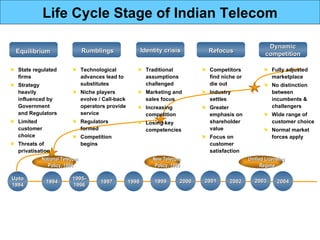
Equilibrium Rumblings Identity crisis Refocus Dynamic competition 2001 1999 1998 1995- 1996 1997 1994 2000 2002 2003 Upto 1994 National Telecom  Policy, 1994 New Telecom  Policy, 1999 2004 Unified Licensing  Regime State regulated firms Strategy heavily influenced by Government and Regulators Limited customer choice Threats of privatisation Fully adjusted marketplace No distinction between incumbents & challengers Wide range of customer choice Normal market forces apply Technological advances lead to substitutes Niche players evolve / Call-back operators provide service Regulators formed Competition begins Traditional assumptions challenged Marketing and sales focus Increasing competition Losing key competencies Competitors find niche or die out Industry settles Greater emphasis on shareholder value Focus on customer satisfaction Life Cycle Stage of Indian Telecom
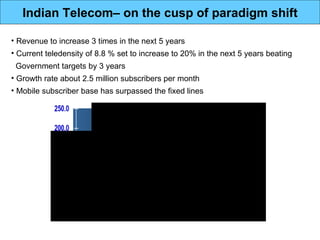
Revenue to increase 3 times in the next 5 years Current teledensity of 8.8 % set to increase to 20% in the next 5 years beating  Government targets by 3 years Growth rate about 2.5 million subscribers per month Mobile subscriber base has surpassed the fixed lines Indian Telecom– on the cusp of paradigm shift
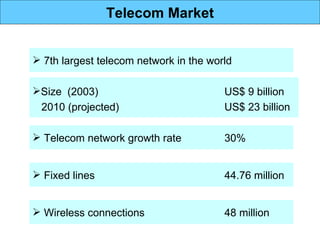
Telecom Market 7th largest telecom network in the world Telecom network growth rate 30% Fixed lines 44.76 million Wireless connections  48 million Size  (2003) US$ 9 billion 2010 (projected) US$ 23 billion
Telecom Services Market Share in total revenue of Wireline services to fall from half to 30% Wireless services  to rise to half Data revenue  to rise from 2% to 8%  Over next  5-8 years
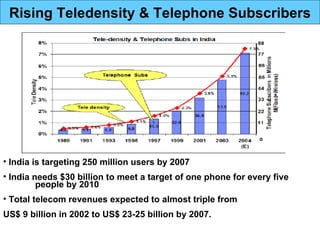
Rising Teledensity & Telephone Subscribers India is targeting 250 million users by 2007 India needs  $30 billion to meet a target of one phone for every five  people by 2010 Total telecom revenues expected to almost triple from  US$ 9 billion in 2002 to US$ 23-25 billion by 2007.
Telecom Equipment Market Telecom equipment market size   US$ 19.4 billion Telecom handset market  US$ 8.4 billion size 2004 - 08 (estimated)
Subscriber base :  Almost 1.5 million wireless  subscribers added every month The Mobile Market GSM 37.37 mn CDMA   11mn Number of networks(GSM) 70 Number of cities covered(GSM)  2000
Market Share of Major Players
Market Share of Major GSM Players
Market Share of Major CDMA Players
National Telecom Policy (NTP) - 1999 Impact of NTP-99 on mobile subscriber uptake Migration from fixed to revenue share license fee regime Liberalised long distance sector
FDI limit increased from 49% to 74%. Virtually complete deregulation Unified Access Service License Interconnection Usage Charge (IUC) Broadband Policy announced. Targets 20 million broadband subscribers by 2010.  Exemption from customs duty for import of MSCs (Mobile Switching Centre) Policy Advantage
India outshining China In the 9th year of wireless operation China  6.8 million India    28 million Subscriber In millions Years India Vs China in comparable years of service
Market share in telecom: 21.7% Market share in GSM Segment: 29.0% Customer base growth rate: 5.69% Services Provided: Airtel Prepaid Airtel Postpaid Blackberry Wireless Handheld Value Added Services Airtel: Major player in Indian Telecom Sector
Strength: Presence in all the  telecom circles Developed Infrastructure in place Strong and loyal consumer base Weaknesses: Presence only in GSM Weak communication in comparison of competition High attrition rates in the industry Airtel: SWOT Analysis
Airtel: SWOT Analysis Opportunities Market on a rise Favorable Govt. Policies Leverage form existing Infrastructure Rapidly turning into an entertainment media Threats Entrance of global players Risk of Technology obsoletion and continuous need of up gradation No distinction between new entrants and incumbents
www.indiainfoline.com www.ifeb.org   www.economictimes.com www.myiris.com References
Thank You

Telecom sector study

  • 1.
  • 2.
    Equilibrium Rumblings Identitycrisis Refocus Dynamic competition 2001 1999 1998 1995- 1996 1997 1994 2000 2002 2003 Upto 1994 National Telecom Policy, 1994 New Telecom Policy, 1999 2004 Unified Licensing Regime State regulated firms Strategy heavily influenced by Government and Regulators Limited customer choice Threats of privatisation Fully adjusted marketplace No distinction between incumbents & challengers Wide range of customer choice Normal market forces apply Technological advances lead to substitutes Niche players evolve / Call-back operators provide service Regulators formed Competition begins Traditional assumptions challenged Marketing and sales focus Increasing competition Losing key competencies Competitors find niche or die out Industry settles Greater emphasis on shareholder value Focus on customer satisfaction Life Cycle Stage of Indian Telecom
  • 3.
    Revenue to increase3 times in the next 5 years Current teledensity of 8.8 % set to increase to 20% in the next 5 years beating Government targets by 3 years Growth rate about 2.5 million subscribers per month Mobile subscriber base has surpassed the fixed lines Indian Telecom– on the cusp of paradigm shift
  • 4.
    Telecom Market 7thlargest telecom network in the world Telecom network growth rate 30% Fixed lines 44.76 million Wireless connections 48 million Size (2003) US$ 9 billion 2010 (projected) US$ 23 billion
  • 5.
    Telecom Services MarketShare in total revenue of Wireline services to fall from half to 30% Wireless services to rise to half Data revenue to rise from 2% to 8% Over next 5-8 years
  • 6.
    Rising Teledensity &Telephone Subscribers India is targeting 250 million users by 2007 India needs $30 billion to meet a target of one phone for every five people by 2010 Total telecom revenues expected to almost triple from US$ 9 billion in 2002 to US$ 23-25 billion by 2007.
  • 7.
    Telecom Equipment MarketTelecom equipment market size US$ 19.4 billion Telecom handset market US$ 8.4 billion size 2004 - 08 (estimated)
  • 8.
    Subscriber base : Almost 1.5 million wireless subscribers added every month The Mobile Market GSM 37.37 mn CDMA 11mn Number of networks(GSM) 70 Number of cities covered(GSM) 2000
  • 9.
    Market Share ofMajor Players
  • 10.
    Market Share ofMajor GSM Players
  • 11.
    Market Share ofMajor CDMA Players
  • 12.
    National Telecom Policy(NTP) - 1999 Impact of NTP-99 on mobile subscriber uptake Migration from fixed to revenue share license fee regime Liberalised long distance sector
  • 13.
    FDI limit increasedfrom 49% to 74%. Virtually complete deregulation Unified Access Service License Interconnection Usage Charge (IUC) Broadband Policy announced. Targets 20 million broadband subscribers by 2010. Exemption from customs duty for import of MSCs (Mobile Switching Centre) Policy Advantage
  • 14.
    India outshining ChinaIn the 9th year of wireless operation China 6.8 million India 28 million Subscriber In millions Years India Vs China in comparable years of service
  • 15.
    Market share intelecom: 21.7% Market share in GSM Segment: 29.0% Customer base growth rate: 5.69% Services Provided: Airtel Prepaid Airtel Postpaid Blackberry Wireless Handheld Value Added Services Airtel: Major player in Indian Telecom Sector
  • 16.
    Strength: Presence inall the telecom circles Developed Infrastructure in place Strong and loyal consumer base Weaknesses: Presence only in GSM Weak communication in comparison of competition High attrition rates in the industry Airtel: SWOT Analysis
  • 17.
    Airtel: SWOT AnalysisOpportunities Market on a rise Favorable Govt. Policies Leverage form existing Infrastructure Rapidly turning into an entertainment media Threats Entrance of global players Risk of Technology obsoletion and continuous need of up gradation No distinction between new entrants and incumbents
  • 18.
    www.indiainfoline.com www.ifeb.org www.economictimes.com www.myiris.com References
  • 19.

Editor's Notes

  • #3 The Indian telecom sector has been witnessing significant change.
  • #4 The sector is on the cusp of paradigm shift.
  • #5 Today, India has the seventh largest telecom network in the world, which is growing at an overall rate of over 20%. - Morgan Stanley estimates that the total revenue from the Indian telecom market in 2003 was US$ 9.2 billion.
  • #6 Presently, wireline services contribute about half of the total service revenues in the telecom market.
  • #7 India has about 44.76 million fixed lines and 48 million wireless subscribers contributing to the total teledensity of about 8.62%.
  • #8 The Telecom Equipment Market in India is also on a growth path. - It is expected that during 2004 - 08 , t elecom equipment market size would be worth US$ 19.4 billion. - The telecom handset market, meanwhile is set to touch US$ 8.4 billion.
  • #9 Indian GSM service providers are presently operating in over 70 networks - covering almost 2000 cities and towns and thousands of villages, - serving 37.37 million subscribers. CDMA ( Code Division Multiple Access) mobile has a subscriber base of 11 million in the country.
  • #13 The Government of India authored the landmark National Telecom Policy 1999 (NTP 99) and since then, has undertaken various steps to achieve the stated policy objectives. - Key highlights of NTP 99 are migration from a fixed to a revenue share license fee regime and l iberalisation of the long distance sector.
  • #14 A landmark decision has been taken by the GOI to increase the FDI limit in telecom from 49% to 74%. -The Government announced the Interconnection Usage Charge (IUC) regime, implemented from May 2003. - In December 2003, the Government came out with the Unified Access Licence allowing both basic and cellular service providers to provide access, using any technology in a specified service area. - The customs duty structure on imports related to telecom and specified infrastructure equipment has further been rationalised. - Parts of such equipment are being exempted from basic customs duty.
  • #15 In terms of performance, India has clearly outshined China. - In its ninth years of existence of wireless services, China had about 6.8 million subscribers. - In comparison, India starting late in 1995 had 28 million wireless subscribers by the end of 2003.