1Yet Another Metamorphosis for GCC Telecom Operators
Yet Another
Metamorphosis for
GCC Telecom Operators
Telecom operators in the Gulf region survived the
financial crisis and maturing markets by adjusting to
the end of explosive growth. Now new industry trends
are in the mix. How ready are they to adapt again?
2Yet Another Metamorphosis for GCC Telecom Operators
After years of strong growth, Gulf Cooperation Council (GCC) telecom operators have slowly
adapted to the new realities of their maturing markets. Now another batch of new trends could
have a profound impact on the industry, leaving GCC telecom groups to focus on redefining
their service portfolios, improving the customer experience, and tapping into the opportunities
that data-savvy consumers, businesses, and governments offer. Success in the next few years
will depend on creating synergy across product portfolios and adjusting operating models
to meet these new trends head on.
Didn’t We Just Adjust?
Years of strong growth and limited competition have delivered some of the industry’s highest
margins to telecommunications operators in the GCC region. Rising oil prices contributed
to sharp increases in the level of gross domestic product per capita, creating an attractive
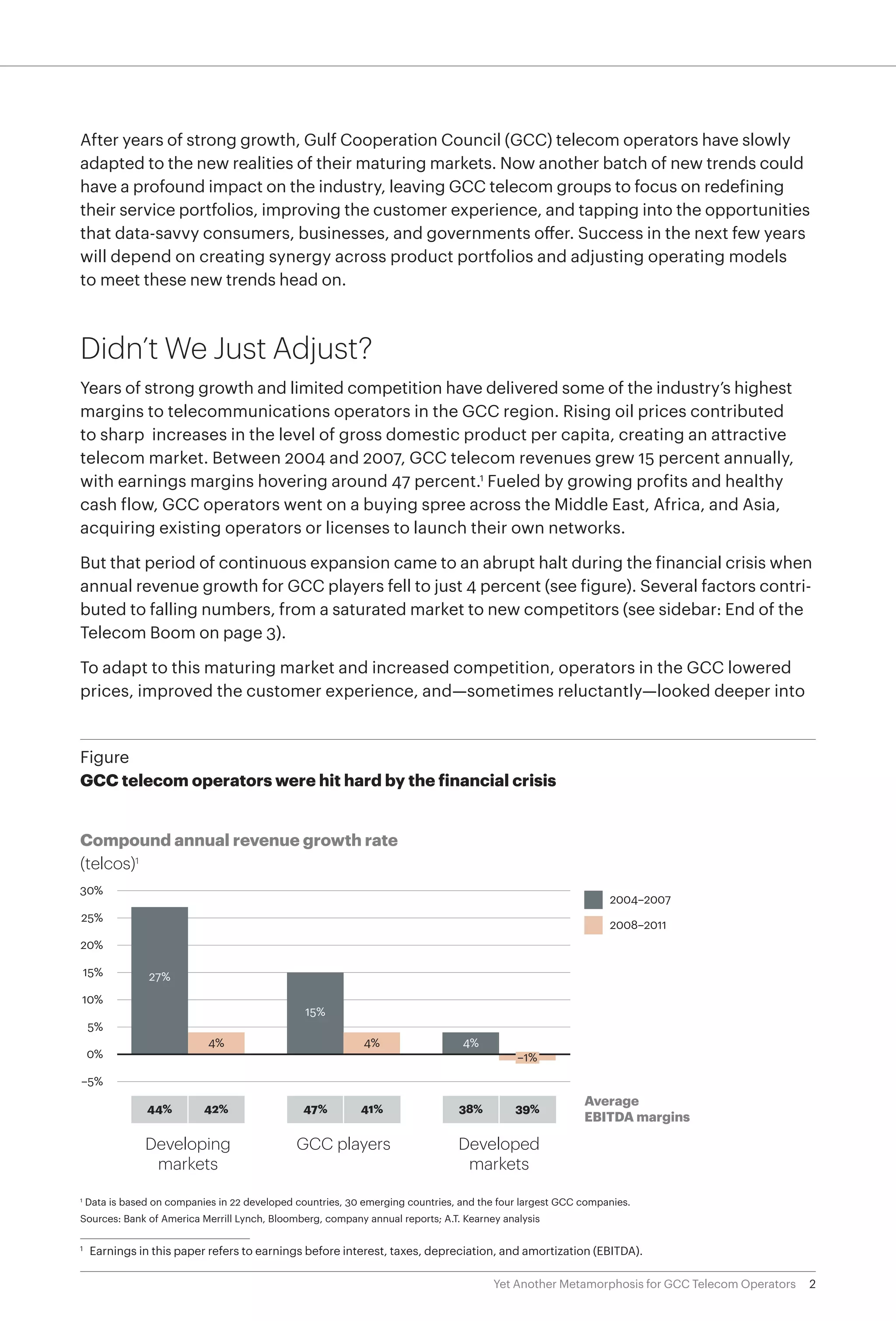
telecom market. Between 2004 and 2007, GCC telecom revenues grew 15 percent annually,
with earnings margins hovering around 47 percent.1
Fueled by growing profits and healthy
cash flow, GCC operators went on a buying spree across the Middle East, Africa, and Asia,
acquiring existing operators or licenses to launch their own networks.
But that period of continuous expansion came to an abrupt halt during the financial crisis when
annual revenue growth for GCC players fell to just 4 percent (see figure). Several factors contri-
buted to falling numbers, from a saturated market to new competitors (see sidebar: End of the
Telecom Boom on page 3).
To adapt to this maturing market and increased competition, operators in the GCC lowered
prices, improved the customer experience, and—sometimes reluctantly—looked deeper into
1
		
Earnings in this paper refers to earnings before interest, taxes, depreciation, and amortization (EBITDA).
Compound annual revenue growth rate
(telcos)1
1
Data is based on companies in 22 developed countries, 30 emerging countries, and the four largest GCC companies.
Sources: Bank of America Merrill Lynch, Bloomberg, company annual reports; A.T. Kearney analysis
Figure
GCC telecom operators were hit hard by the financial crisis
30%
25%
20%
15%
10%
5%
0%
–5%
Developing
markets
44% 42% 47% 41% 38% 39%
GCC players Developed
markets
Average
EBITDA margins
27%
15%
4% 4% 4%
2004–2007
2008–2011
–1%
3Yet Another Metamorphosis for GCC Telecom Operators
their organizations to improve efficiency. It began with small cost reductions, followed by several
GCC groups launching major cost-optimization programs in their home markets, addressing
their supplier base with strategic sourcing initiatives, and outsourcing select non-core activities.
Improving speed and quality and becoming more customer-centric would require a transfor-
mation of the entire organization.
Groups that had acquired operators across continents during the boom times shifted from
expansion to creating synergy, albeit with limited success. Synergy is not an easy concept to
attain and is often complicated by cultural, language, and legal differences. The level of control
proved to be limited as some groups had not acquired majority stakes, which made actively
managing their portfolios a challenge. It is not surprising, then, that some operators started
divesting some of their stakes, such as Zain selling its African operations to Bharti Airtel and
Etisalat divesting its Indonesian operator.
A Whole Host of New Trends
GCC operators are now turning their attention outward again—adapting to new industry dynamics
and getting ahead of the latest trends in the global telecom industry:
Data, data, and more data. The Middle East has not been immune to the worldwide explosion
in data, driven by data-savvy consumers and the deployment of a vast portfolio of mobile applica-
tions. Statistics from YouTube, which accounts for 24 percent of global mobile traffic, reveal that
Saudi Arabia has the world’s most YouTube clicks per Internet user (more than 90 million daily
page views). The Middle East ranks second after the United States in number of daily views, with
167 million video views per day. The Middle East and Africa are expected to have year-on-year
data increases of 133 percent through 2014.2
Technology. To meet the rising demand for data, operators must continually expand network
capacity and roll out new technologies, such as fiber-optic networks and high-speed mobile
broadband (4G), all while facing pressure from shareholders to limit capital expenditures and
maintain healthy cash flow and attractive returns. Next-generation high-speed mobile networks
are rapidly being rolled out around the world, with GCC operators ahead of most of their
End of the Telecom Boom
The GCC telecom market went
through a hyper-speed evolution
to reach maturity, but three
factors brought an end to the
explosive growth:
The region reached high
penetration levels for fixed and
mobile telephone connections
in a much shorter time frame
than Western markets. Consider
mobile penetration in Saudi
Arabia: At just 5 percent in 2000,
it has now overtaken Western
Europe at nearly 200 percent.3
Regulators intensified compe-
tition by allowing more telecom
operators to compete against the
incumbents. (For example, the
United Arab Emirates and Qatar
were monopoly markets until
2007.) As the markets matured
and reached high saturation
levels, these operators could
only grow by luring customers
away from their rivals, which
led to falling prices. Strong
regulatory interventions in some
markets, such as mobile number
portability in Saudi Arabia in
2006 and Bahrain in 2011, further
bolstered the competition.
The 2008 global financial crisis
pushed consumers to stop
shopping and in turn put added
pressure on businesses to lower
telecom expenses.
2
	Cisco
3
	 Economist Intelligence Unit, International Telecommunications Union
4Yet Another Metamorphosis for GCC Telecom Operators
Western peers. Several GCC telecom operators have made huge investments in fiber networks
and Internet-protocol television (IPTV) platforms, although the financial returns are not yet clear.
Newer players are competing with embedded media ecosystems, such as Netflix (streaming),
Apple TV (set-top boxes), and Samsung (smart televisions). Because they only need broadband
connections, the embedded systems are far more competitive than IPTV.
Aggressive OTT players. The rise of new competitors, broadly dubbed over-the-top (OTT)
players, has the potential to impact the global telecom industry. They offer attractive services
via their own platforms and ecosystems, including voice over Internet protocol (VoIP), instant
messaging (IM), and services such as TV, video, and music. And while subscribers pay telecom
operators for fast connections, most revenue comes from pay-per-usage and advertisements.
Operators benefit by charging subscribers for data consumption, but it is often restricted by data
packages that offer unlimited data. As a result, the battle between operators and OTT players
has begun for voice revenues (especially high-margin mobile international traffic), short
message services (SMS), and media.
Subscribers want the latest
smartphones, tablets, applications,
and content—most of which are neither
owned nor sold by operators.
Several examples illustrate this. The first quarter of 2012 registered a decline in usage minutes
in almost all regions of the world: North America (-5.3 percent), Asia Pacific (-0.6 percent),
and Western Europe (-0.4 percent). The Middle East grew, but only by 3.5 percent.4
OTT player
WhatsApp carries 5 percent of global messaging traffic, which is directly affecting operators.
For example, the total number of messages sent in the UAE dropped by 10 percent between
2010 and 2011.5
This trend could already be accelerating in some GCC markets, where some
operators have seen reductions in SMS traffic of more than 30 percent in less than a year,
mostly driven by free Internet-based offerings such as WhatsApp, Viber, Facebook, and
BlackBerry Messenger.
Consumerbehavior. Not so long ago, subscribers would make conscious decisions about which
telecom operator to join, if they had a choice at all. Low-value subscribers generally chose the
best value-for-money option, and high-value subscribers chose the operator with the best
network and the most extensive portfolio of value-added services. Regardless of how or why
these decisions were made, subscribers often developed emotional bonds with their telecom
operators. Well, those days are gone. Today’s subscribers want the latest smartphones, tablets,
applications, and content, most of which is neither owned nor sold by an operator. Subscribers
are just users now, taking advantage of an operator’s network to connect to services with which
they do have an emotional bond—Facebook, for example.
4
	 ABI Research
5
	 The Telecommunications Regulatory Authority of the United Arab Emirates
5Yet Another Metamorphosis for GCC Telecom Operators
Don’t Just Adjust to the New Dynamics—Embrace Them
GCC telecom operators face significant challenges, and how they build on what they have
achieved so far will define their long-term prospects. Companies that adopt the following
four approaches will have the best chance of success:
Redefinepricing,retention,andcustomerexperience. While GCC telecom operators will profit
from the increased demand for their data services, this is only part of the story. In fact, it is
estimated that data produces 90 percent or more of operators’ network traffic volume but
generates only 10 percent of revenues.6
With the demand for mobile data potentially unlimited,
operators that replace unlimited flat-rate data plans with usage-based data pricing and packages,
and focus on customer segmentation, tiered services based on customer life-time value, and
premium “out of bundle” services, will be best placed to reap the benefits. Smart plans that
integrate voice and data bundles and link them to devices are one possibility for the forward-
thinking operator. In the United States, Verizon has launched a data-centric “share everything”
plan offering unlimited voice minutes, unlimited text, and shareable data that can be used
across 10 devices; other U.S. operators offer similar packages. GCC operators could also gain
valuable insights and the ability to offer more-personalized services—assets they are not yet
fully exploiting—by tapping into their vast reservoirs of customer data.
GCC operators could also gain valuable
insights and the ability to offer more-
personalized services—assets they are
not yet fully exploiting—by tapping into
their vast reservoirs of customer data.
Make digital diversification a top priority. Diversifying from traditional telecom services and
taking advantage of the opportunities that the high-speed, high-priced mobile networks offer
is crucial for achieving attractive returns and defending against OTT players. Although value-
added services such as m-health, m-education, and m-banking have been available for some
years, GCC operators have yet to actively make them available. Offering high-quality voice
solutions as part of a data package will limit the impact of eroding revenues and profitability
from voice over Internet protocol (VoIP) players such as Skype. Improving features in the instant
messaging (IM) domain such as providing multiuser conversations, picture-sharing, and status
updates through partnerships, alliances with other players, or proprietary platforms will help
operators withstand the decrease in short message service usage.
Third-party application stores such as Apple’s and Google’s have completely taken over operators’
portals and revenues from mobile application downloads are set to surge from $8.4 billion in 2009
to 23.6 billion in 2014, with operators capturing only a fragment of that value.7
Application stores
offer tremendous potential for revenue-sharing relationships between operators and third parties.
6
	Nomura
7
	 Pyramid Research
6Yet Another Metamorphosis for GCC Telecom Operators
Operators’ capabilities in billing, marketing, and distribution make them potentially good
retailers and attractive partners.
Investing more in machine-to-machine communication—which is expected to be a major growth
market—is another step in the right direction, as is securing the right partnerships to bundle
connectivity with high-value products (e-readers, cameras, laptops, cars).
The relatively recent arrival of the fast-growing cloud services market makes this the ideal time
for telecom operators to capitalize on the opportunities the cloud has opened up in consumer
and enterprise businesses with the right value propositions, technology, and go-to-market
partnerships. A good example is Orange’s partnership with the Virtual Computing Environment
coalition, formed by Cisco, VMware, and EMC.8
Orange delivers a broad range of cloud-based
services while managing and owning customers as the single point of contact. We expect GCC
operators to play a more prominent role in this space.
GCC operators have started to realize the digital opportunities. Etisalat, for example, recently
established a new unit specifically focusing on developing the group’s digital strategy.
The relatively recent arrival of the fast-
growing cloud services market makes this
the ideal time for telecom operators to
capitalize on the opportunities the
cloud has opened up in consumer
and enterprise businesses.
Reassess and actively manage operator portfolio. This trend started in 2010 when Zain sold
its African operations to Bharti Airtel, and was followed by the failed attempts of Batelco and
Kingdom Holding to buy Zain KSA and of Etisalat to take over Zain’s other Middle East operations
in 2011. More recently, Etisalat divested its Indonesian operator, PT XL Axiata. Given the perfor-
mance of certain operators in GCC groups’ portfolios, selective divestments are expected,
especially in countries with relatively lower average revenues per user and high competition.
However, some GCC players will continue pursuing larger scale via acquisitions and in-country
operator consolidation in an effort to become global players. For example, earlier this year both
Ooredoo (formerly Qtel) and Etisalat indicated an interest in buying Vivendi’s 53 percent stake
in Maroc Telecom, Morocco’s biggest telecom operator. Ooredoo has also indicated its interest
in starting operations in Myanmar, one of the last real underserved and high-growth markets
in the world.
Overall, Africa remains the region with the most positive telecom growth outlook, although
several markets are both relatively small and fiercely competitive due to a large number of
operators (in some cases four or more). Some of these operators are owned by smaller regional
telecom groups or investors that often have Middle Eastern roots, such as Bintel (Bahrain),
8
	Id.
7Yet Another Metamorphosis for GCC Telecom Operators
Comium Telecom (Lebanon), Expresso Telecom (Sudan), LAP Green (Libya), VTEL (Jordan and
Dubai), and Warid Telecom (Abu Dhabi). It is not unlikely that in the near future these groups will
want to divest some of their African operations. But when they do, unlike the wave of acquisitions
around six years ago, GCC groups will not buy at all costs.
Transform the operating model to align with today’s industry dynamics. To cope with
increasing network complexity, investment requirements, and the financial expectations
of shareholders, GCC operators will continue to improve their balance sheets by off-loading
assets and to adopt a more asset-light model in line with developments in Asia, Europe, and
North America. As a consequence, more managed-services outsourcing deals of core activities
such as network operations and maintenance are expected, as is the selling of assets such
as towers to specialized tower companies. Smaller GCC operators have already started to do
this, such as du in the UAE which announced in 2012 it had entered a major five-year network
managed-services agreement with Chinese equipment vendor Huawei. Operators will benefit
from the scale and expertise of these third parties and be able to move from the traditional
network and infrastructure focus to critical topics such as pricing, retention, customer
experience, and digital diversification.
Smart Planning
The GCC telecom industry continues to be a highly dynamic sector and GCC operators are faced
with considerable challenges. But operators have reason to be optimistic. With their consumer
insights and proven ability to deliver breakthrough customer experiences, they are uniquely
positioned to defend themselves and tap into the current trends. Those that act now and choose
the right mix of defensive and offensive moves to limit revenue losses will have a good chance
of remaining relevant and maintaining healthy growth and margins.
Authors
Marc Biosca, partner, Middle East
marc.biosca@atkearney.com
Rob van Dale, principal, Middle East
rob.vandale@atkearney.com
A.T. Kearney is a global team of forward-thinking, collaborative partners that delivers
immediate, meaningful results and long-term transformative advantage to clients.
Since 1926, we have been trusted advisors on CEO-agenda issues to the world’s
leading organizations across all major industries and sectors. A.T. Kearney’s offices
are located in major business centers in 39 countries.
Americas
Europe
Asia Pacific
Middle East
and Africa
Atlanta
Calgary
Chicago
Dallas
Detroit
Houston
Mexico City
New York
San Francisco
São Paulo
Toronto
Washington, D.C.
Bangkok
Beijing
Hong Kong
Jakarta
Kuala Lumpur
Melbourne
Mumbai
New Delhi
Seoul
Shanghai
Singapore
Sydney
Tokyo
Amsterdam
Berlin
Brussels
Bucharest
Budapest
Copenhagen
Düsseldorf
Frankfurt
Helsinki
Istanbul
Kiev
Lisbon
Ljubljana
London
Madrid
Milan
Moscow
Munich
Oslo
Paris
Prague
Rome
Stockholm
Stuttgart
Vienna
Warsaw
Zurich
Abu Dhabi
Dubai
Johannesburg
Manama
Riyadh
A.T. Kearney Korea LLC is a separate and
independent legal entity operating under
the A.T. Kearney name in Korea.
© 2013, A.T. Kearney, Inc. All rights reserved.
The signature of our namesake and founder, Andrew Thomas Kearney, on the cover of this
document represents our pledge to live the values he instilled in our firm and uphold his
commitment to ensuring “essential rightness” in all that we do.
For more information, permission to reprint or translate this work, and all other correspondence,
please email: insight@atkearney.com.

Yet another metamorphosis for gcc telecom operators

  • 1.
    1Yet Another Metamorphosisfor GCC Telecom Operators Yet Another Metamorphosis for GCC Telecom Operators Telecom operators in the Gulf region survived the financial crisis and maturing markets by adjusting to the end of explosive growth. Now new industry trends are in the mix. How ready are they to adapt again?
  • 2.
    2Yet Another Metamorphosisfor GCC Telecom Operators After years of strong growth, Gulf Cooperation Council (GCC) telecom operators have slowly adapted to the new realities of their maturing markets. Now another batch of new trends could have a profound impact on the industry, leaving GCC telecom groups to focus on redefining their service portfolios, improving the customer experience, and tapping into the opportunities that data-savvy consumers, businesses, and governments offer. Success in the next few years will depend on creating synergy across product portfolios and adjusting operating models to meet these new trends head on. Didn’t We Just Adjust? Years of strong growth and limited competition have delivered some of the industry’s highest margins to telecommunications operators in the GCC region. Rising oil prices contributed to sharp increases in the level of gross domestic product per capita, creating an attractive telecom market. Between 2004 and 2007, GCC telecom revenues grew 15 percent annually, with earnings margins hovering around 47 percent.1 Fueled by growing profits and healthy cash flow, GCC operators went on a buying spree across the Middle East, Africa, and Asia, acquiring existing operators or licenses to launch their own networks. But that period of continuous expansion came to an abrupt halt during the financial crisis when annual revenue growth for GCC players fell to just 4 percent (see figure). Several factors contri- buted to falling numbers, from a saturated market to new competitors (see sidebar: End of the Telecom Boom on page 3). To adapt to this maturing market and increased competition, operators in the GCC lowered prices, improved the customer experience, and—sometimes reluctantly—looked deeper into 1 Earnings in this paper refers to earnings before interest, taxes, depreciation, and amortization (EBITDA). Compound annual revenue growth rate (telcos)1 1 Data is based on companies in 22 developed countries, 30 emerging countries, and the four largest GCC companies. Sources: Bank of America Merrill Lynch, Bloomberg, company annual reports; A.T. Kearney analysis Figure GCC telecom operators were hit hard by the financial crisis 30% 25% 20% 15% 10% 5% 0% –5% Developing markets 44% 42% 47% 41% 38% 39% GCC players Developed markets Average EBITDA margins 27% 15% 4% 4% 4% 2004–2007 2008–2011 –1%
  • 3.
    3Yet Another Metamorphosisfor GCC Telecom Operators their organizations to improve efficiency. It began with small cost reductions, followed by several GCC groups launching major cost-optimization programs in their home markets, addressing their supplier base with strategic sourcing initiatives, and outsourcing select non-core activities. Improving speed and quality and becoming more customer-centric would require a transfor- mation of the entire organization. Groups that had acquired operators across continents during the boom times shifted from expansion to creating synergy, albeit with limited success. Synergy is not an easy concept to attain and is often complicated by cultural, language, and legal differences. The level of control proved to be limited as some groups had not acquired majority stakes, which made actively managing their portfolios a challenge. It is not surprising, then, that some operators started divesting some of their stakes, such as Zain selling its African operations to Bharti Airtel and Etisalat divesting its Indonesian operator. A Whole Host of New Trends GCC operators are now turning their attention outward again—adapting to new industry dynamics and getting ahead of the latest trends in the global telecom industry: Data, data, and more data. The Middle East has not been immune to the worldwide explosion in data, driven by data-savvy consumers and the deployment of a vast portfolio of mobile applica- tions. Statistics from YouTube, which accounts for 24 percent of global mobile traffic, reveal that Saudi Arabia has the world’s most YouTube clicks per Internet user (more than 90 million daily page views). The Middle East ranks second after the United States in number of daily views, with 167 million video views per day. The Middle East and Africa are expected to have year-on-year data increases of 133 percent through 2014.2 Technology. To meet the rising demand for data, operators must continually expand network capacity and roll out new technologies, such as fiber-optic networks and high-speed mobile broadband (4G), all while facing pressure from shareholders to limit capital expenditures and maintain healthy cash flow and attractive returns. Next-generation high-speed mobile networks are rapidly being rolled out around the world, with GCC operators ahead of most of their End of the Telecom Boom The GCC telecom market went through a hyper-speed evolution to reach maturity, but three factors brought an end to the explosive growth: The region reached high penetration levels for fixed and mobile telephone connections in a much shorter time frame than Western markets. Consider mobile penetration in Saudi Arabia: At just 5 percent in 2000, it has now overtaken Western Europe at nearly 200 percent.3 Regulators intensified compe- tition by allowing more telecom operators to compete against the incumbents. (For example, the United Arab Emirates and Qatar were monopoly markets until 2007.) As the markets matured and reached high saturation levels, these operators could only grow by luring customers away from their rivals, which led to falling prices. Strong regulatory interventions in some markets, such as mobile number portability in Saudi Arabia in 2006 and Bahrain in 2011, further bolstered the competition. The 2008 global financial crisis pushed consumers to stop shopping and in turn put added pressure on businesses to lower telecom expenses. 2 Cisco 3 Economist Intelligence Unit, International Telecommunications Union
  • 4.
    4Yet Another Metamorphosisfor GCC Telecom Operators Western peers. Several GCC telecom operators have made huge investments in fiber networks and Internet-protocol television (IPTV) platforms, although the financial returns are not yet clear. Newer players are competing with embedded media ecosystems, such as Netflix (streaming), Apple TV (set-top boxes), and Samsung (smart televisions). Because they only need broadband connections, the embedded systems are far more competitive than IPTV. Aggressive OTT players. The rise of new competitors, broadly dubbed over-the-top (OTT) players, has the potential to impact the global telecom industry. They offer attractive services via their own platforms and ecosystems, including voice over Internet protocol (VoIP), instant messaging (IM), and services such as TV, video, and music. And while subscribers pay telecom operators for fast connections, most revenue comes from pay-per-usage and advertisements. Operators benefit by charging subscribers for data consumption, but it is often restricted by data packages that offer unlimited data. As a result, the battle between operators and OTT players has begun for voice revenues (especially high-margin mobile international traffic), short message services (SMS), and media. Subscribers want the latest smartphones, tablets, applications, and content—most of which are neither owned nor sold by operators. Several examples illustrate this. The first quarter of 2012 registered a decline in usage minutes in almost all regions of the world: North America (-5.3 percent), Asia Pacific (-0.6 percent), and Western Europe (-0.4 percent). The Middle East grew, but only by 3.5 percent.4 OTT player WhatsApp carries 5 percent of global messaging traffic, which is directly affecting operators. For example, the total number of messages sent in the UAE dropped by 10 percent between 2010 and 2011.5 This trend could already be accelerating in some GCC markets, where some operators have seen reductions in SMS traffic of more than 30 percent in less than a year, mostly driven by free Internet-based offerings such as WhatsApp, Viber, Facebook, and BlackBerry Messenger. Consumerbehavior. Not so long ago, subscribers would make conscious decisions about which telecom operator to join, if they had a choice at all. Low-value subscribers generally chose the best value-for-money option, and high-value subscribers chose the operator with the best network and the most extensive portfolio of value-added services. Regardless of how or why these decisions were made, subscribers often developed emotional bonds with their telecom operators. Well, those days are gone. Today’s subscribers want the latest smartphones, tablets, applications, and content, most of which is neither owned nor sold by an operator. Subscribers are just users now, taking advantage of an operator’s network to connect to services with which they do have an emotional bond—Facebook, for example. 4 ABI Research 5 The Telecommunications Regulatory Authority of the United Arab Emirates
  • 5.
    5Yet Another Metamorphosisfor GCC Telecom Operators Don’t Just Adjust to the New Dynamics—Embrace Them GCC telecom operators face significant challenges, and how they build on what they have achieved so far will define their long-term prospects. Companies that adopt the following four approaches will have the best chance of success: Redefinepricing,retention,andcustomerexperience. While GCC telecom operators will profit from the increased demand for their data services, this is only part of the story. In fact, it is estimated that data produces 90 percent or more of operators’ network traffic volume but generates only 10 percent of revenues.6 With the demand for mobile data potentially unlimited, operators that replace unlimited flat-rate data plans with usage-based data pricing and packages, and focus on customer segmentation, tiered services based on customer life-time value, and premium “out of bundle” services, will be best placed to reap the benefits. Smart plans that integrate voice and data bundles and link them to devices are one possibility for the forward- thinking operator. In the United States, Verizon has launched a data-centric “share everything” plan offering unlimited voice minutes, unlimited text, and shareable data that can be used across 10 devices; other U.S. operators offer similar packages. GCC operators could also gain valuable insights and the ability to offer more-personalized services—assets they are not yet fully exploiting—by tapping into their vast reservoirs of customer data. GCC operators could also gain valuable insights and the ability to offer more- personalized services—assets they are not yet fully exploiting—by tapping into their vast reservoirs of customer data. Make digital diversification a top priority. Diversifying from traditional telecom services and taking advantage of the opportunities that the high-speed, high-priced mobile networks offer is crucial for achieving attractive returns and defending against OTT players. Although value- added services such as m-health, m-education, and m-banking have been available for some years, GCC operators have yet to actively make them available. Offering high-quality voice solutions as part of a data package will limit the impact of eroding revenues and profitability from voice over Internet protocol (VoIP) players such as Skype. Improving features in the instant messaging (IM) domain such as providing multiuser conversations, picture-sharing, and status updates through partnerships, alliances with other players, or proprietary platforms will help operators withstand the decrease in short message service usage. Third-party application stores such as Apple’s and Google’s have completely taken over operators’ portals and revenues from mobile application downloads are set to surge from $8.4 billion in 2009 to 23.6 billion in 2014, with operators capturing only a fragment of that value.7 Application stores offer tremendous potential for revenue-sharing relationships between operators and third parties. 6 Nomura 7 Pyramid Research
  • 6.
    6Yet Another Metamorphosisfor GCC Telecom Operators Operators’ capabilities in billing, marketing, and distribution make them potentially good retailers and attractive partners. Investing more in machine-to-machine communication—which is expected to be a major growth market—is another step in the right direction, as is securing the right partnerships to bundle connectivity with high-value products (e-readers, cameras, laptops, cars). The relatively recent arrival of the fast-growing cloud services market makes this the ideal time for telecom operators to capitalize on the opportunities the cloud has opened up in consumer and enterprise businesses with the right value propositions, technology, and go-to-market partnerships. A good example is Orange’s partnership with the Virtual Computing Environment coalition, formed by Cisco, VMware, and EMC.8 Orange delivers a broad range of cloud-based services while managing and owning customers as the single point of contact. We expect GCC operators to play a more prominent role in this space. GCC operators have started to realize the digital opportunities. Etisalat, for example, recently established a new unit specifically focusing on developing the group’s digital strategy. The relatively recent arrival of the fast- growing cloud services market makes this the ideal time for telecom operators to capitalize on the opportunities the cloud has opened up in consumer and enterprise businesses. Reassess and actively manage operator portfolio. This trend started in 2010 when Zain sold its African operations to Bharti Airtel, and was followed by the failed attempts of Batelco and Kingdom Holding to buy Zain KSA and of Etisalat to take over Zain’s other Middle East operations in 2011. More recently, Etisalat divested its Indonesian operator, PT XL Axiata. Given the perfor- mance of certain operators in GCC groups’ portfolios, selective divestments are expected, especially in countries with relatively lower average revenues per user and high competition. However, some GCC players will continue pursuing larger scale via acquisitions and in-country operator consolidation in an effort to become global players. For example, earlier this year both Ooredoo (formerly Qtel) and Etisalat indicated an interest in buying Vivendi’s 53 percent stake in Maroc Telecom, Morocco’s biggest telecom operator. Ooredoo has also indicated its interest in starting operations in Myanmar, one of the last real underserved and high-growth markets in the world. Overall, Africa remains the region with the most positive telecom growth outlook, although several markets are both relatively small and fiercely competitive due to a large number of operators (in some cases four or more). Some of these operators are owned by smaller regional telecom groups or investors that often have Middle Eastern roots, such as Bintel (Bahrain), 8 Id.
  • 7.
    7Yet Another Metamorphosisfor GCC Telecom Operators Comium Telecom (Lebanon), Expresso Telecom (Sudan), LAP Green (Libya), VTEL (Jordan and Dubai), and Warid Telecom (Abu Dhabi). It is not unlikely that in the near future these groups will want to divest some of their African operations. But when they do, unlike the wave of acquisitions around six years ago, GCC groups will not buy at all costs. Transform the operating model to align with today’s industry dynamics. To cope with increasing network complexity, investment requirements, and the financial expectations of shareholders, GCC operators will continue to improve their balance sheets by off-loading assets and to adopt a more asset-light model in line with developments in Asia, Europe, and North America. As a consequence, more managed-services outsourcing deals of core activities such as network operations and maintenance are expected, as is the selling of assets such as towers to specialized tower companies. Smaller GCC operators have already started to do this, such as du in the UAE which announced in 2012 it had entered a major five-year network managed-services agreement with Chinese equipment vendor Huawei. Operators will benefit from the scale and expertise of these third parties and be able to move from the traditional network and infrastructure focus to critical topics such as pricing, retention, customer experience, and digital diversification. Smart Planning The GCC telecom industry continues to be a highly dynamic sector and GCC operators are faced with considerable challenges. But operators have reason to be optimistic. With their consumer insights and proven ability to deliver breakthrough customer experiences, they are uniquely positioned to defend themselves and tap into the current trends. Those that act now and choose the right mix of defensive and offensive moves to limit revenue losses will have a good chance of remaining relevant and maintaining healthy growth and margins. Authors Marc Biosca, partner, Middle East marc.biosca@atkearney.com Rob van Dale, principal, Middle East rob.vandale@atkearney.com
  • 8.
    A.T. Kearney isa global team of forward-thinking, collaborative partners that delivers immediate, meaningful results and long-term transformative advantage to clients. Since 1926, we have been trusted advisors on CEO-agenda issues to the world’s leading organizations across all major industries and sectors. A.T. Kearney’s offices are located in major business centers in 39 countries. Americas Europe Asia Pacific Middle East and Africa Atlanta Calgary Chicago Dallas Detroit Houston Mexico City New York San Francisco São Paulo Toronto Washington, D.C. Bangkok Beijing Hong Kong Jakarta Kuala Lumpur Melbourne Mumbai New Delhi Seoul Shanghai Singapore Sydney Tokyo Amsterdam Berlin Brussels Bucharest Budapest Copenhagen Düsseldorf Frankfurt Helsinki Istanbul Kiev Lisbon Ljubljana London Madrid Milan Moscow Munich Oslo Paris Prague Rome Stockholm Stuttgart Vienna Warsaw Zurich Abu Dhabi Dubai Johannesburg Manama Riyadh A.T. Kearney Korea LLC is a separate and independent legal entity operating under the A.T. Kearney name in Korea. © 2013, A.T. Kearney, Inc. All rights reserved. The signature of our namesake and founder, Andrew Thomas Kearney, on the cover of this document represents our pledge to live the values he instilled in our firm and uphold his commitment to ensuring “essential rightness” in all that we do. For more information, permission to reprint or translate this work, and all other correspondence, please email: insight@atkearney.com.