THE
ANALYTICS
ANGLE
WITHSAS
ACCENTURE TECHNOLOGY VISION 2020
#TechVision2020
These Tech Vision trends
are coming—for many,
they’re already here.
How will you put them
to work at scale?
The I in Experience AI and Me
The Dilemma of Smart Things Innovation DNA
#TechVision2020
Analytics has a
major role to play
in achieving scale.
Here are insights from SAS and
Accenture on the analytics angle
for each trend.
Athina Kanioura
Chief Analytics Officer and Global Lead
Applied Intelligence, Accenture
Dave Macdonald
Executive Vice President
and Chief Sales Officer
SAS
Executive sponsors
#TechVision2020
#TechVision2020
The I in Experience
Customers will expect
“cooperative experiences”
where companies are partners
in experience creation, not
just the providers and owners
of experiences.
The trend:
#TechVision2020
#TechVision2020
The I in Experience
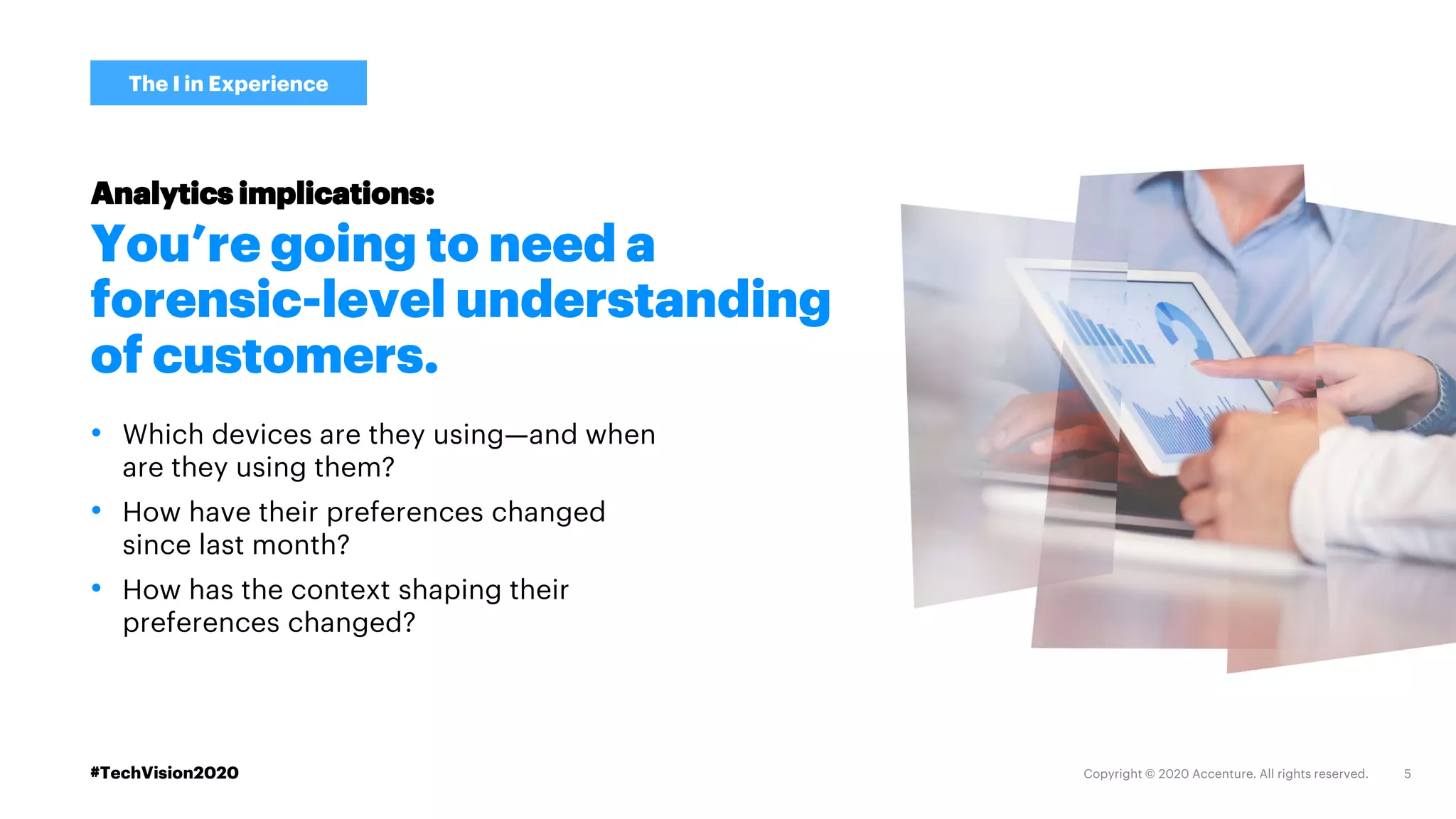
You’re going to need a
forensic-level understanding
of customers.
• Which devices are they using—and when
are they using them?
• How have their preferences changed
since last month?
• How has the context shaping their
preferences changed?
Analytics implications:
#TechVision2020
Insights needed to deliver
continuity of experience
Today there are countless ways for your customers
to get from point A to point B. You need to be able
to ensure a high level of continuity from one leg
of the customer journey to the next.
The I in Experience
Analytics implications:
Key analytics tools:
• Offer optimization/
recommendation engines.
• A/B testing.
• Multivariate testing.
Analytics implications:
Citation for stats: https://www.sas.com/en/whitepapers/customer-experience-2030-111008.html
The I in Experience
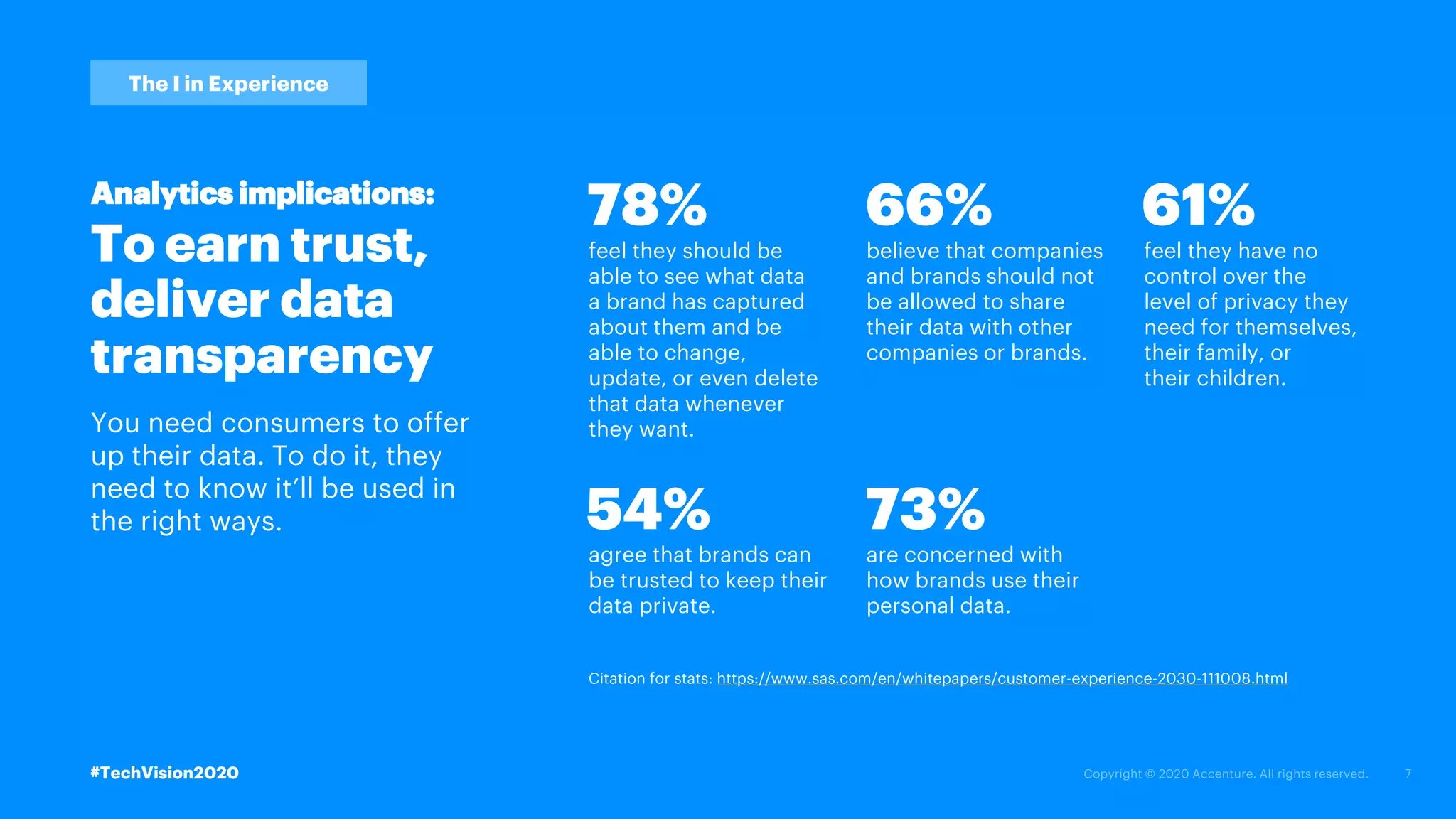
agree that brands can
be trusted to keep their
data private.
are concerned with
how brands use their
personal data.
54% 73%
feel they should be
able to see what data
a brand has captured
about them and be
able to change,
update, or even delete
that data whenever
they want.
believe that companies
and brands should not
be allowed to share
their data with other
companies or brands.
feel they have no
control over the
level of privacy they
need for themselves,
their family, or
their children.
78% 66% 61%
To earn trust,
deliver data
transparency
You need consumers to offer
up their data. To do it, they
need to know it’ll be used in
the right ways.
#TechVision2020
#TechVision2020
AI and Me
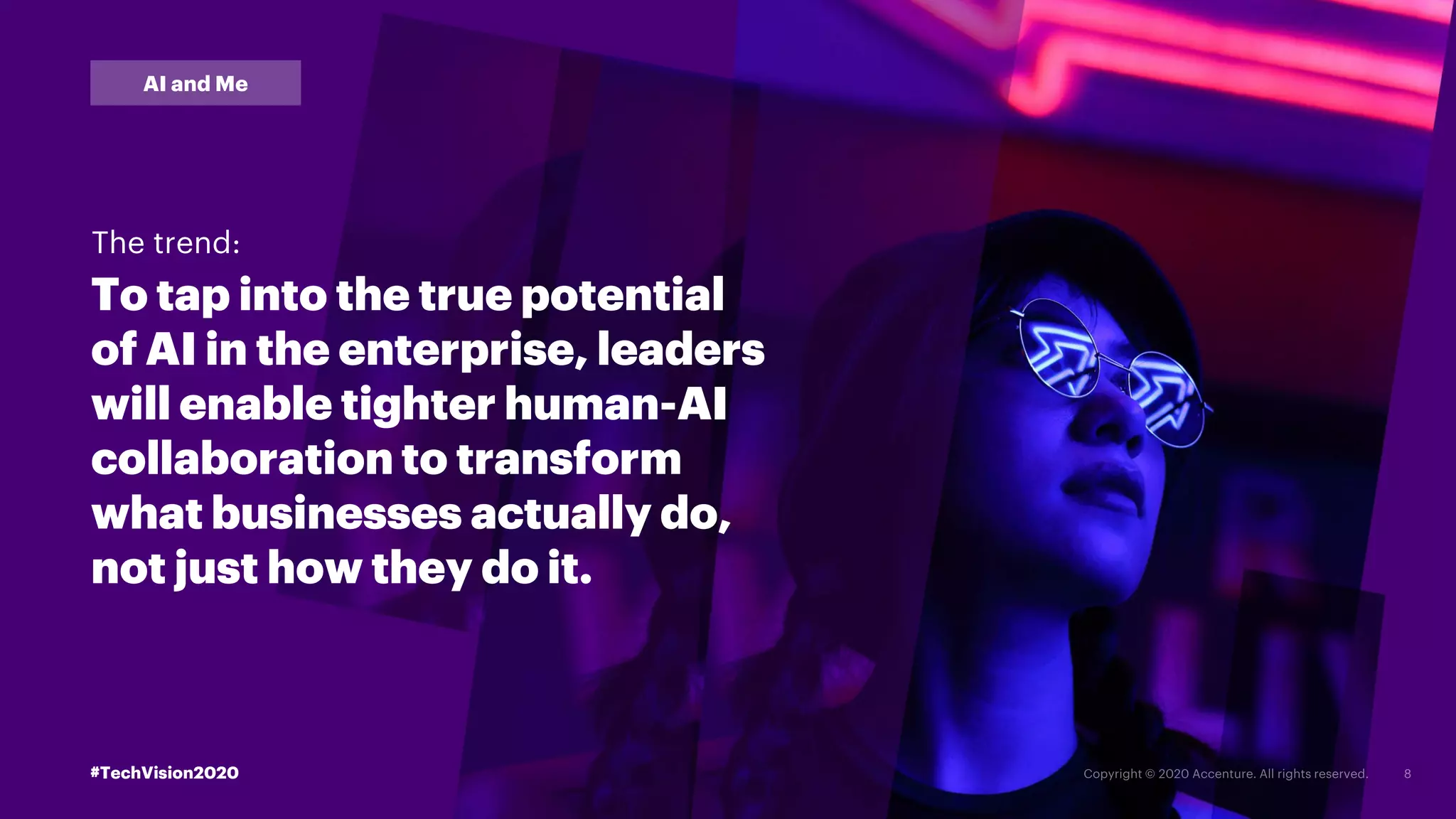
To tap into the true potential
of AI in the enterprise, leaders
will enable tighter human-AI
collaboration to transform
what businesses actually do,
not just how they do it.
The trend:
#TechVision2020
#TechVision2020
AI and Me
Analytics implications:
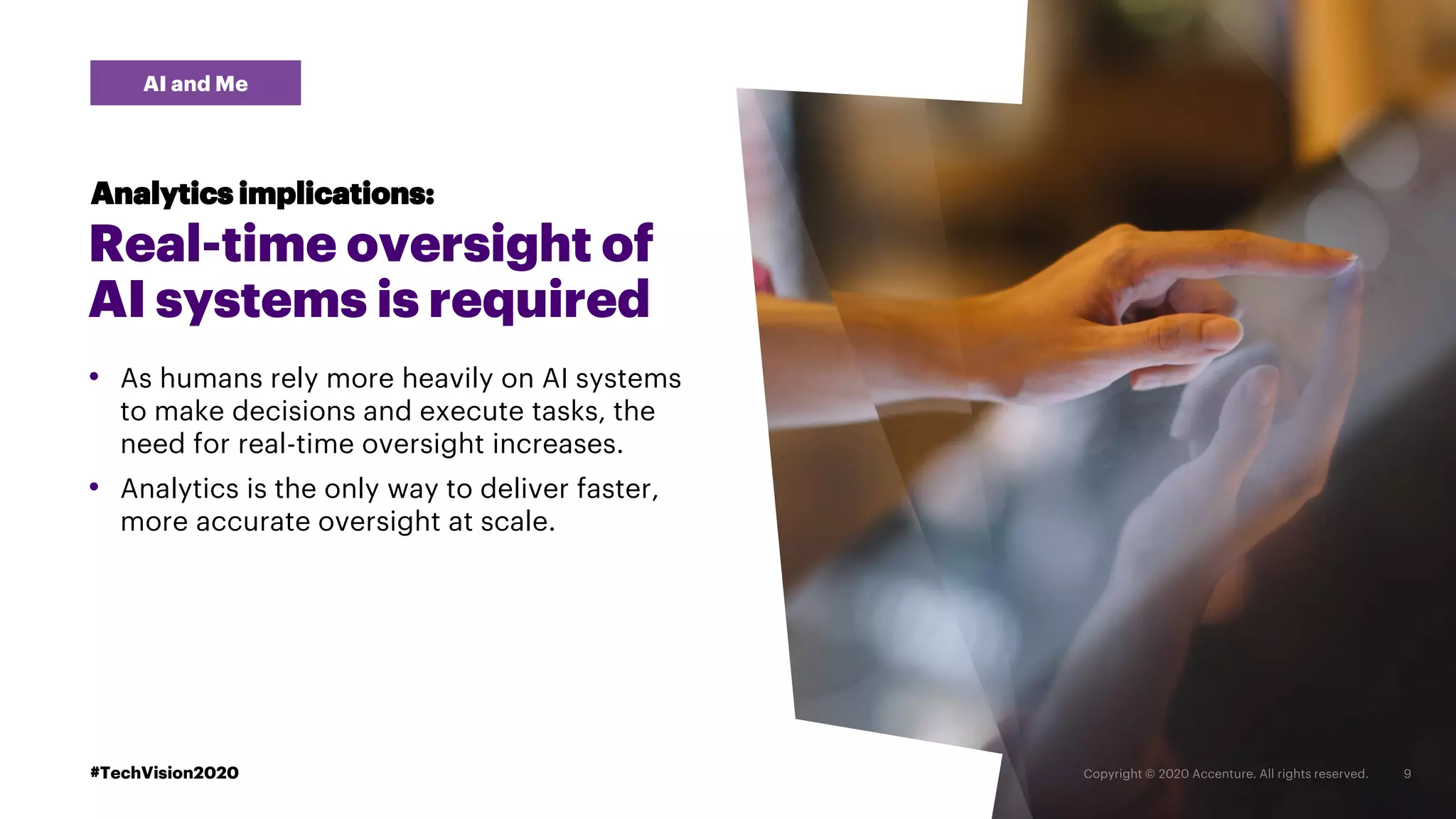
Real-time oversight of
AI systems is required
• As humans rely more heavily on AI systems
to make decisions and execute tasks, the
need for real-time oversight increases.
• Analytics is the only way to deliver faster,
more accurate oversight at scale.
#TechVision2020
#TechVision2020
AI supercharges
analytics insights
• When paired with AI, analytics capabilities
can present human decision makers with
more dynamic choices rooted in live data.
• AI can automatically deliver a steady
stream of insights and recommendations,
helping people take action faster, using
more insight.
Analytics implications:
AI and Me
#TechVision2020
#TechVision2020
Deliver user-specific context
for AI–based decisioning
• How can AI systems distinguish between users
to give them decisioning capabilities that match
their roles?
• Analytics can generate individually appropriate,
role-based decision options
• With more human input, these systems can
rapidly refine these capabilities.
Analytics implications:
AI and Me
#TechVision2020
The Dilemma of Smart Things
As smart things are continually
updated, they introduce the
“beta burden” —the unintended
consequences when products
and their contained experience
are constantly in flux.
The trend:
#TechVision2020
#TechVision2020
The Dilemma of Smart Things
New focus on
analytics governance
• In the past, governance for most
products ended at the point of purchase.
• With smart things, the sale opens the
door to a host of new governance issues.
• Data presents the most significant
governance decisions
Analytics implications:
Data governance questions
for smart things:
• What can be done legally and ethically
with “smart things” data? Who can do it?
• How is collected data being used?
• How long is the data kept?
• Which tools are used to analyze data,
and how is use governed?
#TechVision2020
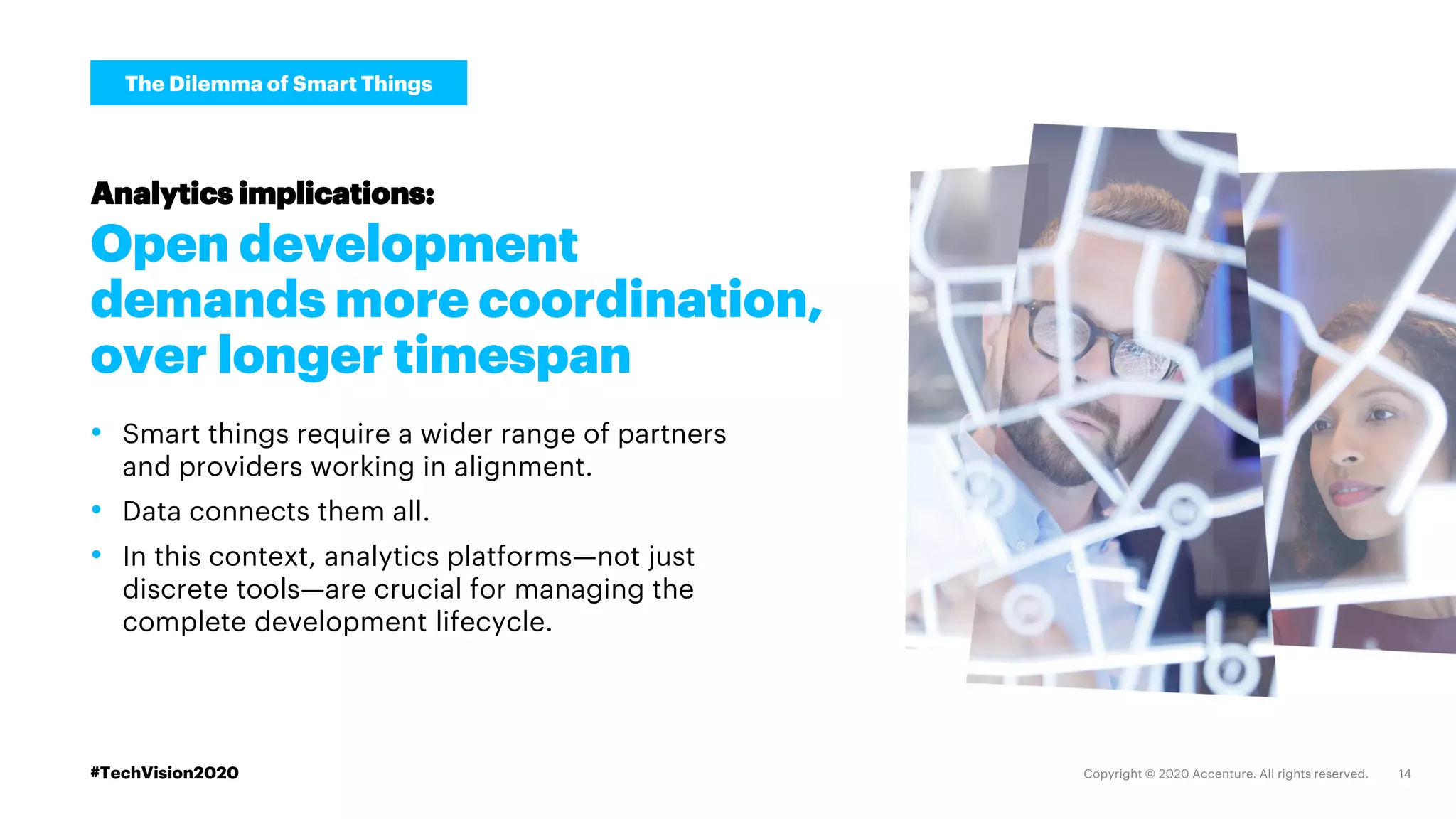
Open development
demands more coordination,
over longer timespan
• Smart things require a wider range of partners
and providers working in alignment.
• Data connects them all.
• In this context, analytics platforms—not just
discrete tools—are crucial for managing the
complete development lifecycle.
Analytics implications:
The Dilemma of Smart Things
#TechVision2020
All analytics tools used
to enable smart things
must be cloud-ready
Analytics implications:
• The impact of cloud computing on
critical decisions about architecture
is often overlooked.
• Be ready to move to newer, cheaper,
faster compute environments at a
moment’s notice to remain competitive
and deliver more to customers.
The Dilemma of Smart Things
#TechVision2020
#TechVision2020
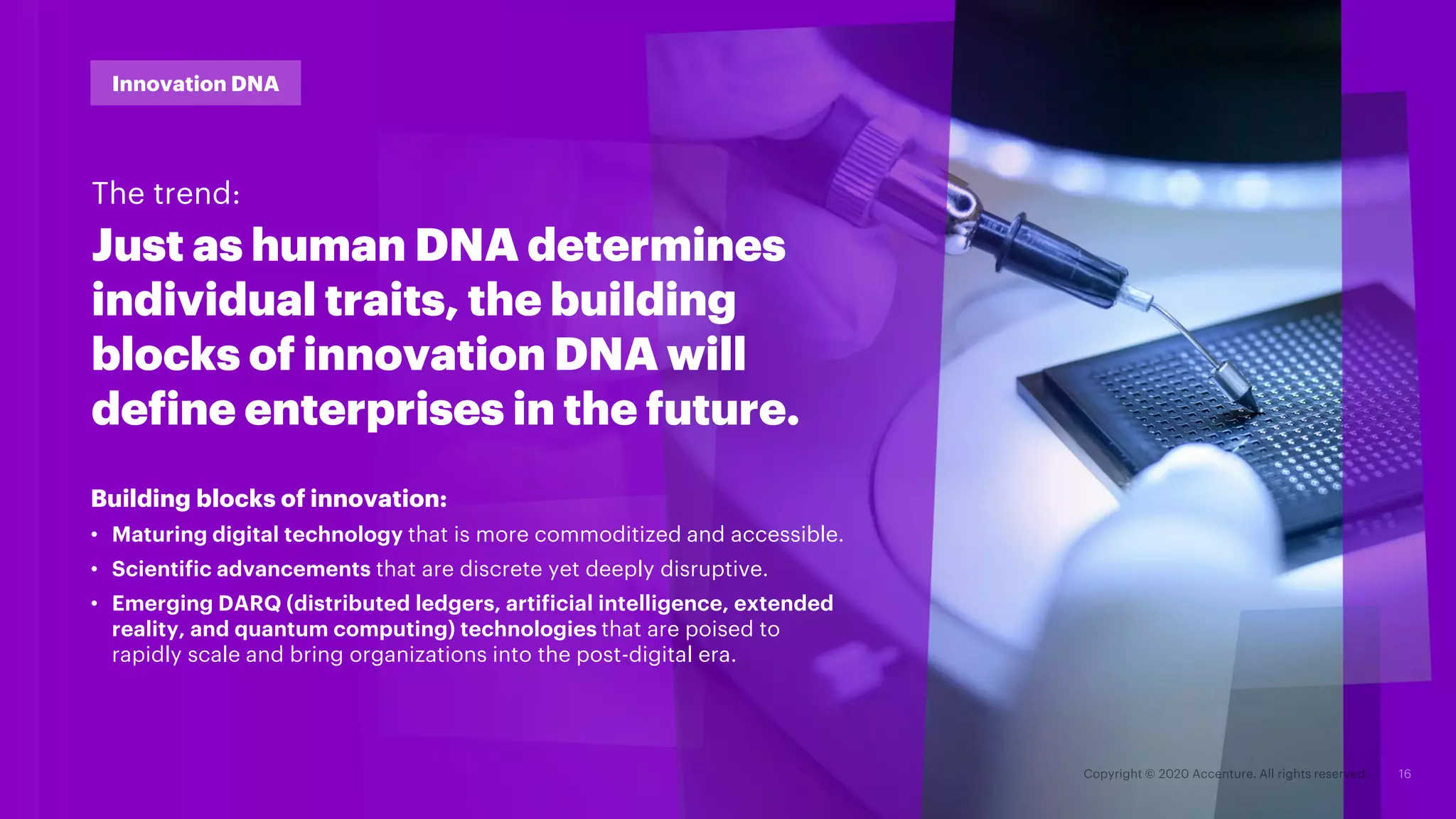
Building blocks of innovation:
• Maturing digital technology that is more commoditized and accessible.
• Scientific advancements that are discrete yet deeply disruptive.
• Emerging DARQ (distributed ledgers, artificial intelligence, extended
reality, and quantum computing) technologies that are poised to
rapidly scale and bring organizations into the post-digital era.
Just as human DNA determines
individual traits, the building
blocks of innovation DNA will
define enterprises in the future.
Innovation DNA
The trend:
#TechVision2020
Innovation DNA
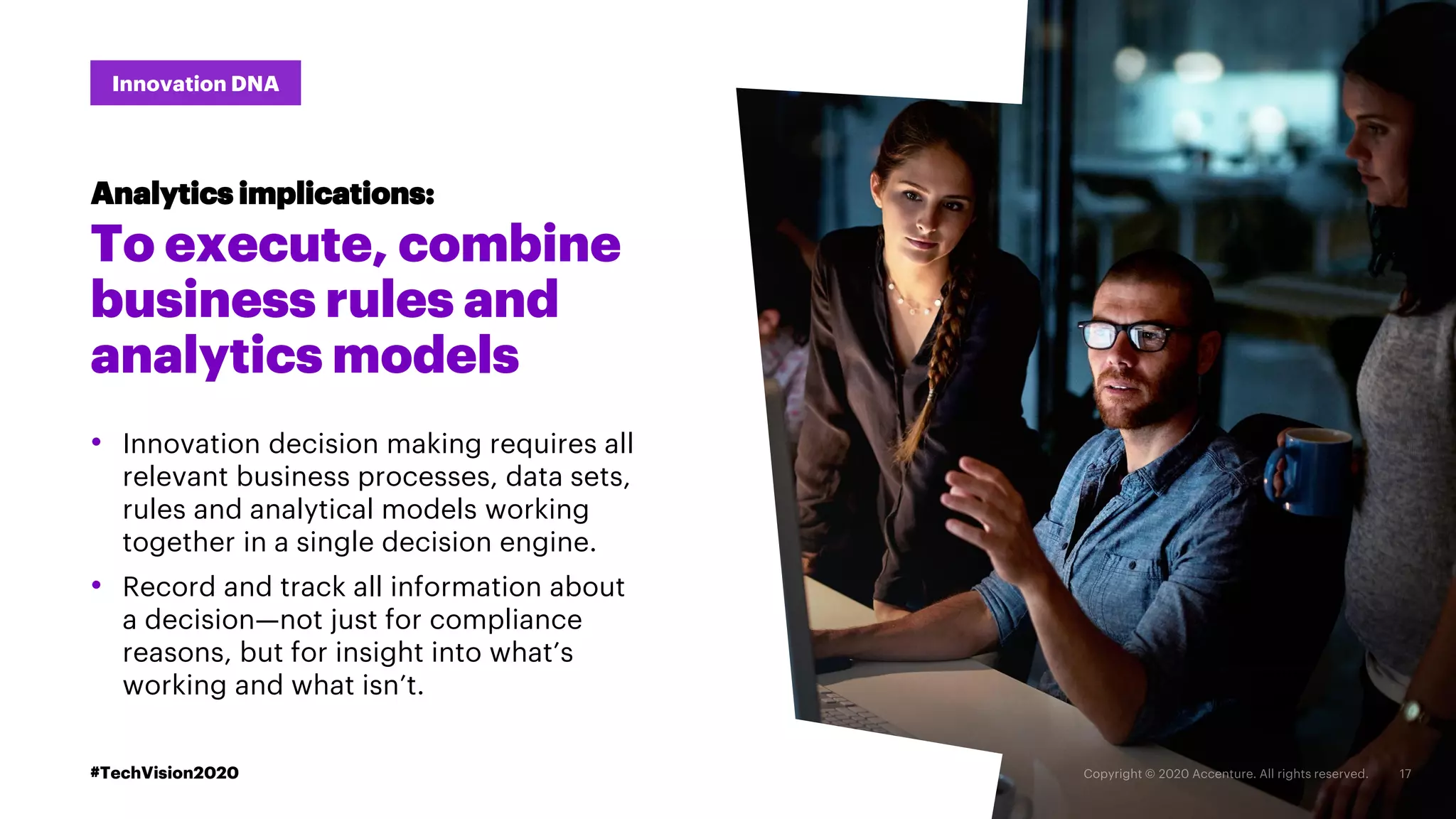
To execute, combine
business rules and
analytics models
• Innovation decision making requires all
relevant business processes, data sets,
rules and analytical models working
together in a single decision engine.
• Record and track all information about
a decision—not just for compliance
reasons, but for insight into what’s
working and what isn’t.
Analytics implications:
#TechVision2020
www.accenture.com/techvisionsas
Thankyou
#TECHVISION2020
#TechVision2020

Technology Vision 2020: The Analytics Angle with SAS

  • 1.
  • 2.
    #TechVision2020 These Tech Visiontrends are coming—for many, they’re already here. How will you put them to work at scale? The I in Experience AI and Me The Dilemma of Smart Things Innovation DNA #TechVision2020
  • 3.
    Analytics has a majorrole to play in achieving scale. Here are insights from SAS and Accenture on the analytics angle for each trend. Athina Kanioura Chief Analytics Officer and Global Lead Applied Intelligence, Accenture Dave Macdonald Executive Vice President and Chief Sales Officer SAS Executive sponsors #TechVision2020
  • 4.
    #TechVision2020 The I inExperience Customers will expect “cooperative experiences” where companies are partners in experience creation, not just the providers and owners of experiences. The trend: #TechVision2020
  • 5.
    #TechVision2020 The I inExperience You’re going to need a forensic-level understanding of customers. • Which devices are they using—and when are they using them? • How have their preferences changed since last month? • How has the context shaping their preferences changed? Analytics implications:
  • 6.
    #TechVision2020 Insights needed todeliver continuity of experience Today there are countless ways for your customers to get from point A to point B. You need to be able to ensure a high level of continuity from one leg of the customer journey to the next. The I in Experience Analytics implications: Key analytics tools: • Offer optimization/ recommendation engines. • A/B testing. • Multivariate testing.
  • 7.
    Analytics implications: Citation forstats: https://www.sas.com/en/whitepapers/customer-experience-2030-111008.html The I in Experience agree that brands can be trusted to keep their data private. are concerned with how brands use their personal data. 54% 73% feel they should be able to see what data a brand has captured about them and be able to change, update, or even delete that data whenever they want. believe that companies and brands should not be allowed to share their data with other companies or brands. feel they have no control over the level of privacy they need for themselves, their family, or their children. 78% 66% 61% To earn trust, deliver data transparency You need consumers to offer up their data. To do it, they need to know it’ll be used in the right ways. #TechVision2020
  • 8.
    #TechVision2020 AI and Me Totap into the true potential of AI in the enterprise, leaders will enable tighter human-AI collaboration to transform what businesses actually do, not just how they do it. The trend: #TechVision2020
  • 9.
    #TechVision2020 AI and Me Analyticsimplications: Real-time oversight of AI systems is required • As humans rely more heavily on AI systems to make decisions and execute tasks, the need for real-time oversight increases. • Analytics is the only way to deliver faster, more accurate oversight at scale. #TechVision2020
  • 10.
    #TechVision2020 AI supercharges analytics insights •When paired with AI, analytics capabilities can present human decision makers with more dynamic choices rooted in live data. • AI can automatically deliver a steady stream of insights and recommendations, helping people take action faster, using more insight. Analytics implications: AI and Me #TechVision2020
  • 11.
    #TechVision2020 Deliver user-specific context forAI–based decisioning • How can AI systems distinguish between users to give them decisioning capabilities that match their roles? • Analytics can generate individually appropriate, role-based decision options • With more human input, these systems can rapidly refine these capabilities. Analytics implications: AI and Me
  • 12.
    #TechVision2020 The Dilemma ofSmart Things As smart things are continually updated, they introduce the “beta burden” —the unintended consequences when products and their contained experience are constantly in flux. The trend: #TechVision2020
  • 13.
    #TechVision2020 The Dilemma ofSmart Things New focus on analytics governance • In the past, governance for most products ended at the point of purchase. • With smart things, the sale opens the door to a host of new governance issues. • Data presents the most significant governance decisions Analytics implications: Data governance questions for smart things: • What can be done legally and ethically with “smart things” data? Who can do it? • How is collected data being used? • How long is the data kept? • Which tools are used to analyze data, and how is use governed?
  • 14.
    #TechVision2020 Open development demands morecoordination, over longer timespan • Smart things require a wider range of partners and providers working in alignment. • Data connects them all. • In this context, analytics platforms—not just discrete tools—are crucial for managing the complete development lifecycle. Analytics implications: The Dilemma of Smart Things #TechVision2020
  • 15.
    All analytics toolsused to enable smart things must be cloud-ready Analytics implications: • The impact of cloud computing on critical decisions about architecture is often overlooked. • Be ready to move to newer, cheaper, faster compute environments at a moment’s notice to remain competitive and deliver more to customers. The Dilemma of Smart Things #TechVision2020
  • 16.
    #TechVision2020 Building blocks ofinnovation: • Maturing digital technology that is more commoditized and accessible. • Scientific advancements that are discrete yet deeply disruptive. • Emerging DARQ (distributed ledgers, artificial intelligence, extended reality, and quantum computing) technologies that are poised to rapidly scale and bring organizations into the post-digital era. Just as human DNA determines individual traits, the building blocks of innovation DNA will define enterprises in the future. Innovation DNA The trend:
  • 17.
    #TechVision2020 Innovation DNA To execute,combine business rules and analytics models • Innovation decision making requires all relevant business processes, data sets, rules and analytical models working together in a single decision engine. • Record and track all information about a decision—not just for compliance reasons, but for insight into what’s working and what isn’t. Analytics implications: #TechVision2020
  • 18.