Digitizing  the Social Contract: Producing American Political Culture in the Age of New Media By Philip N. Howard Department of Communication University of Washington
Social Contract “Renewed” by voting, political activities Affected by imperfect information Both citizens and government misread each other due to poor information This is why consulting and software companies design technologies the author calls “Political Hypermedia”
Campaigns: Evolving with Technology Campaigns: Evolving with Technology Pre modern: Mid 1800s-1950s:  local party volunteers gather data Modern: 1960s-1980s: Long, nationally coordinated campaigns run by professional consultants with a centralized headquarters Occasional opinion polls Television commercials were increasingly important-and therefore costly Post modern (Hypermedia)1990s-Today: Presidential campaigns increasingly use PR  More consultants, more opinion polls, more internet based
Age of Cyberpolitics  Political elites have less control over spin and facts More democratic, substantive, less biased political discussion  (race, gender, etc. are hidden) Activism is easier to coordinate across geographic/time zones Fast, fast, fast!
New Media Effects on Democracy Are they positive or negative influences?
Possible Positive Effects: New media might be able to overcome the inadequate, one way political message status quo Virtual communities add to the public debate, draw in new political participants Less distance between the government and governed
Possible Negative Effects Political content online is “political pornography”-grossly simplified, exaggerated, distorted Tools like email can overwhelm political offices with work, server crashes EX: In 2000, Capital Hill received over 6 million emails a month: 8K per Representative, 55K per Senator Ease of anonymity, hacking makes the internet a breeding ground for “mudslinging”
NO Political Effects Author argues that there is no distinct impact on democracy, it just amplifies existing politics No “direct democracy” in the near future C-Span effect: despite live broadcasting of congress, low viewership/understanding of politics
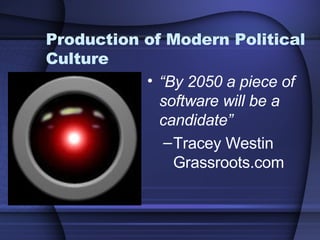
Production of Modern Political Culture “ By 2050 a piece of software will be a candidate” Tracey Westin Grassroots.com
Producing political culture involves: Defining a problem  creates an “issue” Finding the audience-those who are plagued by the issue or are sympathetic Mass media can only broadcast, but internet can target specific audiences This helps lobbyists, activists and politicians spread knowledge and desire for action
Political Hypermedia Communities Subsets of political community Not necessarily Democrat or Republican More selective issues, seeded by lobbyists, special interest groups Designed to focus on issues, not candidates
Political Hypermedia Tools Narrowcasting, mass customization: yields more in depth political preferences; this “tailors” the production of political culture by: Improving campaign efficiency Organizing public into activist/interest groups. (233)
How Digital Information  Helps Lobbyists and Politicians Find YOU example: Astroturf Compiler Software Helps lobbyists build a network of supporters for a specific cause Manages political “contradictions” by showing viewers information they are likely to sympathize with Combination of personal, demographic, political information and spending patterns
Message Tester Tool Software Goal: predict voter reactions to campaign or PR by testing political messages to smaller sample audiences over the internet Goal: figure out voters’ unmet desires What do they WANT candidates to say or do?
Science of Private Opinion Measurement As microscope is to natural science, hypermedia is to politics It allows politicians, academics, consultants to examine political behavior at both individual and group levels of analysis, in great detail Consultants can better predict/ensure campaign and legislative success  Political hypermedia study personality psychographics (interests, attitudes, opinions) as well as demographics
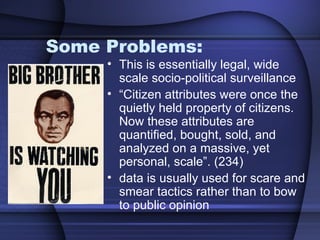
Some Problems: This is essentially legal, wide scale socio-political surveillance “ Citizen attributes were once the quietly held property of citizens. Now these attributes are quantified, bought, sold, and analyzed on a massive, yet personal, scale”. (234) data is usually used for scare and smear tactics rather than to bow to public opinion
Questions Do you think this style and amount of data mining is useful to the political system by informing politicians about the needs and wants of their constituents, or is it an abuse of information and privacy? Do you think it encourages politicians to follow the will of the people, or is it just E-pandering?

Digitizing the Social Contract

  • 1.
    Digitizing theSocial Contract: Producing American Political Culture in the Age of New Media By Philip N. Howard Department of Communication University of Washington
  • 2.
    Social Contract “Renewed”by voting, political activities Affected by imperfect information Both citizens and government misread each other due to poor information This is why consulting and software companies design technologies the author calls “Political Hypermedia”
  • 3.
    Campaigns: Evolving withTechnology Campaigns: Evolving with Technology Pre modern: Mid 1800s-1950s: local party volunteers gather data Modern: 1960s-1980s: Long, nationally coordinated campaigns run by professional consultants with a centralized headquarters Occasional opinion polls Television commercials were increasingly important-and therefore costly Post modern (Hypermedia)1990s-Today: Presidential campaigns increasingly use PR More consultants, more opinion polls, more internet based
  • 4.
    Age of Cyberpolitics Political elites have less control over spin and facts More democratic, substantive, less biased political discussion (race, gender, etc. are hidden) Activism is easier to coordinate across geographic/time zones Fast, fast, fast!
  • 5.
    New Media Effectson Democracy Are they positive or negative influences?
  • 6.
    Possible Positive Effects:New media might be able to overcome the inadequate, one way political message status quo Virtual communities add to the public debate, draw in new political participants Less distance between the government and governed
  • 7.
    Possible Negative EffectsPolitical content online is “political pornography”-grossly simplified, exaggerated, distorted Tools like email can overwhelm political offices with work, server crashes EX: In 2000, Capital Hill received over 6 million emails a month: 8K per Representative, 55K per Senator Ease of anonymity, hacking makes the internet a breeding ground for “mudslinging”
  • 8.
    NO Political EffectsAuthor argues that there is no distinct impact on democracy, it just amplifies existing politics No “direct democracy” in the near future C-Span effect: despite live broadcasting of congress, low viewership/understanding of politics
  • 9.
    Production of ModernPolitical Culture “ By 2050 a piece of software will be a candidate” Tracey Westin Grassroots.com
  • 10.
    Producing political cultureinvolves: Defining a problem  creates an “issue” Finding the audience-those who are plagued by the issue or are sympathetic Mass media can only broadcast, but internet can target specific audiences This helps lobbyists, activists and politicians spread knowledge and desire for action
  • 11.
    Political Hypermedia CommunitiesSubsets of political community Not necessarily Democrat or Republican More selective issues, seeded by lobbyists, special interest groups Designed to focus on issues, not candidates
  • 12.
    Political Hypermedia ToolsNarrowcasting, mass customization: yields more in depth political preferences; this “tailors” the production of political culture by: Improving campaign efficiency Organizing public into activist/interest groups. (233)
  • 13.
    How Digital Information Helps Lobbyists and Politicians Find YOU example: Astroturf Compiler Software Helps lobbyists build a network of supporters for a specific cause Manages political “contradictions” by showing viewers information they are likely to sympathize with Combination of personal, demographic, political information and spending patterns
  • 14.
    Message Tester ToolSoftware Goal: predict voter reactions to campaign or PR by testing political messages to smaller sample audiences over the internet Goal: figure out voters’ unmet desires What do they WANT candidates to say or do?
  • 15.
    Science of PrivateOpinion Measurement As microscope is to natural science, hypermedia is to politics It allows politicians, academics, consultants to examine political behavior at both individual and group levels of analysis, in great detail Consultants can better predict/ensure campaign and legislative success Political hypermedia study personality psychographics (interests, attitudes, opinions) as well as demographics
  • 16.
    Some Problems: Thisis essentially legal, wide scale socio-political surveillance “ Citizen attributes were once the quietly held property of citizens. Now these attributes are quantified, bought, sold, and analyzed on a massive, yet personal, scale”. (234) data is usually used for scare and smear tactics rather than to bow to public opinion
  • 17.
    Questions Do youthink this style and amount of data mining is useful to the political system by informing politicians about the needs and wants of their constituents, or is it an abuse of information and privacy? Do you think it encourages politicians to follow the will of the people, or is it just E-pandering?