Technology, Media, and
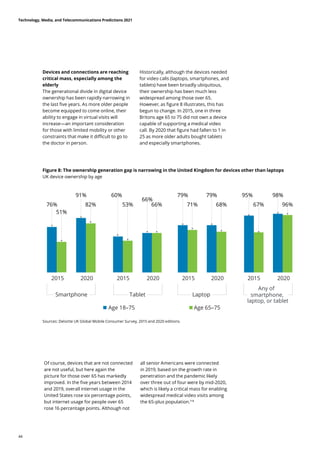
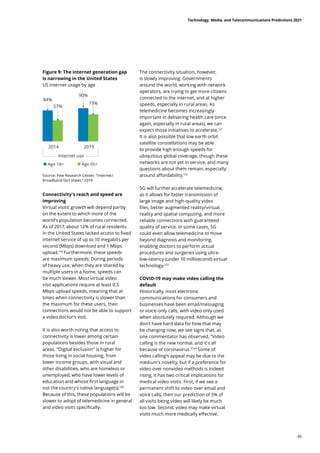
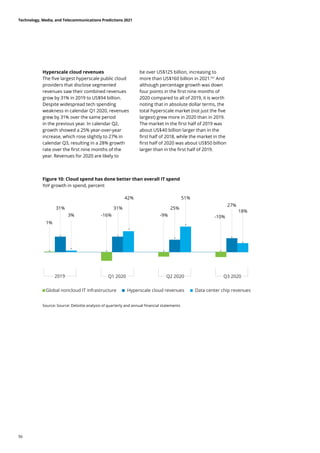
Telecommunications
Predictions 2021
India Edition
02
Brochure / report title goes here 
| Section title goes here
Contents
Foreword04
Let the games begin	 06
The cloud cover intesifies in 2021 and 	
it is a bright future 12
Gaining an intelligent edge 16
The next-generation radio access network 26
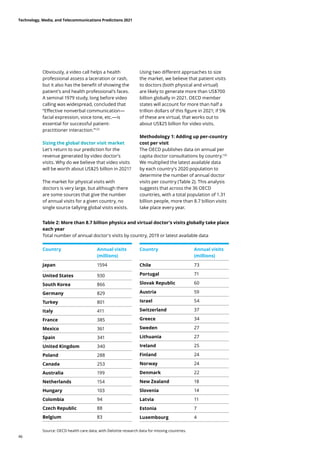
Video visits go viral  42
The cloud migration forecast		 54
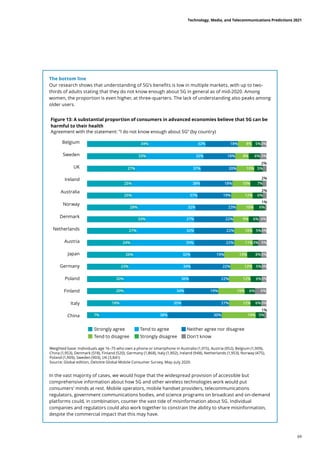
5G is not hazardous to your health 62
The hyperquantified athlete	 72
TV’s New Year’s resolution 82
From virtual to reality 96
Technology, Media, and Telecommunications Predictions 2021
03
Foreword
We can’t talk about 2021 without
mentioning COVID-19. All of our TMT
Predictions topics for this year were
shaped to some extent by the pandemic.
We hope that during 2021, we will be
closer to the end of the pandemic than
the beginning, focusing on thriving in the
future rather than responding
to the present.
Across multiple parts of the Technology,
Media, and Telecom (TMT) ecosystem,
observers have been repeating some
version of the comment, “There have
been five years of change in five months
due to the pandemic.” COVID-19 has been
a catalyst—an unwelcome one, but still a
catalyst—for needed changes across the
TMT landscape.
A catalyst is a substance that causes a
chemical reaction to occur more rapidly
than it would have without. Sometimes,
only a tiny amount of catalyst can trigger
a large change. In the same way, the
SARS-CoV-2 virus, which is only 100
nanometers across and weighs one
trillionth of a milligram, has catalyzed
considerable changes in many facets
of TMT.
Some of these changes happened
extremely quickly. Movements to the
cloud, to video visits for medicine, and
to the intelligent edge were already
underway in 2019, but they have been
accelerated by years or even decades
because of the pandemic. We expect
rapid evolution in these three areas to
continue through 2021.
Other parts of the TMT industry were also
shaped by the pandemic, although not
to the same extent. Upgrades to 8K TVs
may be accelerated by lockdowns and the
rise in time spent watching video. Digital
reality headsets helped enterprises train
workers and school educate students
virtually when COVID-19 made meeting
in person difficult. Misinformation
flourishes against a backdrop of
uncertainty, and myths about 5G’s health
risks surged. And the hyperquantification
of athletes may make sports viewing
more compelling in a time when stadiums
are less accessible.
Faster change isn’t always positive
change, of course. But many of the
trends accelerated by the pandemic look
likely to make the world a better place.
More gender balance in sport is a good
thing—end of story. Medical video visit
technology that works in the developed
world during a lockdown will likely lead
to more and better medical access in
the developing world and remote areas.
Greater use of the cloud, and of open
or virtual radio access network (RAN)
solutions, may make software and
cellular service more affordable for the
economically disadvantaged … and may
also do so more sustainably, helping not
just people but the planet too.
In a chemical reaction, when a catalyst
is removed, the reaction returns to its
slower rate. Will the post-pandemic world
see change, disruption, and innovation
decelerate from current levels? Or will
the acceleration induced by COVID-19
persist for the long term—perhaps even
permanently?
Welcome to TMT Predictions 2021.
Ariane Bucaille
Global TMT industry leader
PN Sudarshan
India TMT industry leader
Technology, Media, and Telecommunications Predictions 2021
04
Technology, Media, and Telecommunications Predictions 2021
05
Let the games begin
India is set to witness a boom in online gaming as several favorable
factors converge
Globally, the video game industry dwarfs
the cinema box office (being around four
times the size of the box office revenues).1
However, in India, the gaming industry is
less than half of box office collections.2
This gap is expected to narrow, with
several factors converging and providing
a tailwind to the gaming industry.
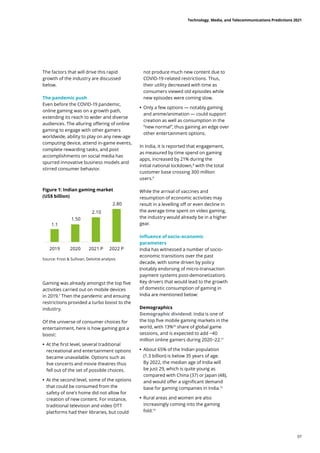
The Indian online gaming industry was
estimated to be US$1.1 billion in 20193
with ~5% share of the Indian Media
and Entertainment (ME) industry.4
We
predict that the online gaming industry
in India will continue to grow rapidly. The
industry is expected to grow at a CAGR of
40% untill 2022, taking the market size to
US$2.8 billion by 2022, and strengthening
the sector’s share of total ME by 4−5%.5
This growth would be majorly driven
by mobile gaming as 85% of the online
gaming in India takes place on mobile.6
Technology, Media, and Telecommunications Predictions 2021
06
The factors that will drive this rapid
growth of the industry are discussed
below.
The pandemic push
Even before the COVID-19 pandemic,
online gaming was on a growth path,
extending its reach to wider and diverse
audiences. The alluring offering of online
gaming to engage with other gamers
worldwide, ability to play on any new-age
computing device, attend in-game events,
complete rewarding tasks, and post
accomplishments on social media has
spurred innovative business models and
stirred consumer behavior.
Gaming was already amongst the top five
activities carried out on mobile devices
in 2019.7
Then the pandemic and ensuing
restrictions provided a turbo boost to the
industry.
Of the universe of consumer choices for
entertainment, here is how gaming got a
boost:
	
• At the first level, several traditional
recreational and entertainment options
became unavailable. Options such as
live concerts and movie theatres thus
fell out of the set of possible choices.
	
• At the second level, some of the options
that could be consumed from the
safety of one’s home did not allow for
creation of new content. For instance,
traditional television and video OTT
platforms had their libraries, but could
Source: Frost  Sullivan, Deloitte analysis
not produce much new content due to
COVID-19-related restrictions. Thus,
their utility decreased with time as
consumers viewed old episodes while
new episodes were coming slow.
	
• Only a few options — notably gaming
and anime/animation — could support
creation as well as consumption in the
“new normal”, thus gaining an edge over
other entertainment options.
In India, it is reported that engagement,
as measured by time spend on gaming
apps, increased by 21% during the
initial national lockdown,8
with the total
customer base crossing 300 million
users.9
While the arrival of vaccines and
resumption of economic activities may
result in a levelling off or even decline in
the average time spent on video gaming,
the industry would already be in a higher
gear.
Influence of socio-economic
parameters
India has witnessed a number of socio-
economic transitions over the past
decade, with some driven by policy
(notably endorsing of micro-transaction
payment systems post-demonetization).
Key drivers that would lead to the growth
of domestic consumption of gaming in
India are mentioned below:
Demographics
Demographic dividend: India is one of
the top five mobile gaming markets in the
world, with 13%10
share of global game
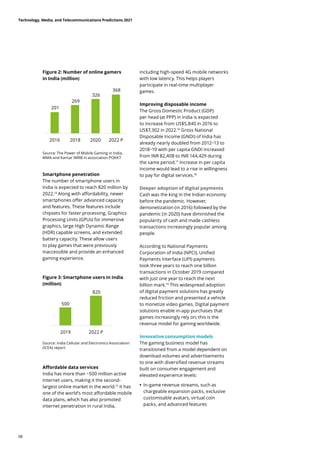
sessions, and is expected to add ~40
million online gamers during 2020−22.11
	
• About 65% of the Indian population
(1.3 billion) is below 35 years of age.
By 2022, the median age of India will
be just 29, which is quite young as
compared with China (37) or Japan (48),
and would offer a significant demand
base for gaming companies in India.12
	
• Rural areas and women are also
increasingly coming into the gaming
fold.13
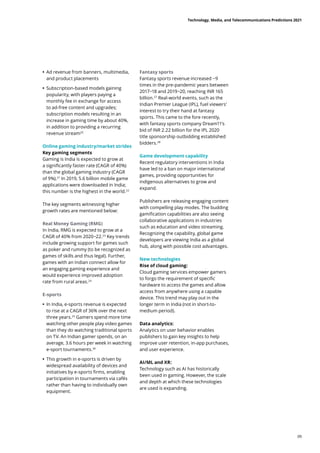
Figure 1: Indian gaming market
(US$ billion)
1.1
1.50
2.10
2.80
2019 2020 2021 P 2022 P
Technology, Media, and Telecommunications Predictions 2021
07
Source: The Power of Mobile Gaming in India,
MMA and Kantar IMRB in association POKKT
Source: India Cellular and Electronics Association
(ICEA) report
Smartphone penetration
The number of smartphone users in
India is expected to reach 820 million by
2022.14
Along with affordability, newer
smartphones offer advanced capacity
and features. These features include
chipsets for faster processing, Graphics
Processing Units (GPUs) for immersive
graphics, large High Dynamic Range
(HDR) capable screens, and extended
battery capacity. These allow users
to play games that were previously
inaccessible and provide an enhanced
gaming experience.
Affordable data services
India has more than ~500 million active
internet users, making it the second-
largest online market in the world.15
It has
one of the world’s most affordable mobile
data plans, which has also promoted
internet penetration in rural India,
including high-speed 4G mobile networks
with low latency. This helps players
participate in real-time multiplayer
games.
Improving disposable income
The Gross Domestic Product (GDP)
per head (at PPP) in India is expected
to increase from US$5,840 in 2016 to
US$7,302 in 2022.16
Gross National
Disposable Income (GNDI) of India has
already nearly doubled from 2012−13 to
2018−19 with per capita GNDI increased
from INR 82,408 to INR 144,429 during
the same period.17
Increase in per capita
income would lead to a rise in willingness
to pay for digital services.18
Deeper adoption of digital payments
Cash was the king in the Indian economy
before the pandemic. However,
demonetization (in 2016) followed by the
pandemic (in 2020) have diminished the
popularity of cash and made cashless
transactions increasingly popular among
people.
According to National Payments
Corporation of India (NPCI), Unified
Payments Interface (UPI) payments
took three years to reach one billion
transactions in October 2019 compared
with just one year to reach the next
billion mark.19
This widespread adoption
of digital payment solutions has greatly
reduced friction and presented a vehicle
to monetize video games. Digital payment
solutions enable in-app purchases that
games increasingly rely on; this is the
revenue model for gaming worldwide.
Innovative consumption models
The gaming business model has
transitioned from a model dependent on
download volumes and advertisements
to one with diversified revenue streams
built on consumer engagement and
elevated experience levels:
	
• In-game revenue streams, such as
chargeable expansion packs, exclusive
customisable avatars, virtual coin
packs, and advanced features
Figure 2: Number of online gamers
in India (million)
Figure 3: Smartphone users in India
(million)
201
269
326
368
2016 2018 2020 2022 P
500
820
2019 2022 P
Technology, Media, and Telecommunications Predictions 2021
08
• Ad revenue from banners, multimedia,
and product placements
	
• Subscription-based models gaining
popularity, with players paying a
monthly fee in exchange for access
to ad-free content and upgrades;
subscription models resulting in an
increase in gaming time by about 40%,
in addition to providing a recurring
revenue stream20
Online gaming industry/market strides
Key gaming segments
Gaming is India is expected to grow at
a significantly faster rate (CAGR of 40%)
than the global gaming industry (CAGR
of 9%).21
In 2019, 5.6 billion mobile game
applications were downloaded in India;
this number is the highest in the world.22
The key segments witnessing higher
growth rates are mentioned below:
Real Money Gaming (RMG)
In India, RMG is expected to grow at a
CAGR of 40% from 2020−22.23
Key trends
include growing support for games such
as poker and rummy (to be recognized as
games of skills and thus legal). Further,
games with an Indian connect allow for
an engaging gaming experience and
would experience improved adoption
rate from rural areas.24
E-sports
	
• In India, e-sports revenue is expected
to rise at a CAGR of 36% over the next
three years.25
Gamers spend more time
watching other people play video games
than they do watching traditional sports
on TV. An Indian gamer spends, on an
average, 3.6 hours per week in watching
e-sport tournaments.26
	
• This growth in e-sports is driven by
widespread availability of devices and
initiatives by e-sports firms, enabling
participation in tournaments via cafés
rather than having to individually own
equipment.
Fantasy sports
Fantasy sports revenue increased ~9
times in the pre-pandemic years between
2017−18 and 2019−20, reaching INR 165
billion.27
Real-world events, such as the
Indian Premier League (IPL), fuel viewers’
interest to try their hand at fantasy
sports. This came to the fore recently,
with fantasy sports company Dream11’s
bid of INR 2.22 billion for the IPL 2020
title sponsorship outbidding established
bidders.28
Game development capability
Recent regulatory interventions in India
have led to a ban on major international
games, providing opportunities for
indigenous alternatives to grow and
expand.
Publishers are releasing engaging content
with compelling play modes. The budding
gamification capabilities are also seeing
collaborative applications in industries
such as education and video streaming.
Recognizing the capability, global game
developers are viewing India as a global
hub, along with possible cost advantages.
New technologies
Rise of cloud gaming:
Cloud gaming services empower gamers
to forgo the requirement of specific
hardware to access the games and allow
access from anywhere using a capable
device. This trend may play out in the
longer term in India (not in short-to-
medium period).
Data analytics:
Analytics on user behavior enables
publishers to gain key insights to help
improve user retention, in-app purchases,
and user experience.
AI/ML and XR:
Technology such as AI has historically
been used in gaming. However, the scale
and depth at which these technologies
are used is expanding.
Technology, Media, and Telecommunications Predictions 2021
09
Ecosystem development
Local and foreign investment
Recognizing the potential, there is
a steady flow of local and foreign
Table 1: Local and foreign investments
Education and job creation
Recognizing the industry’s importance,
India’s prime minister is encouraging
the development of digital games
inspired from the Indian culture. The
Union Ministry of Education is taking
initiatives to create jobs in the digital
gaming industry to augment the dearth
of talent for indigenous game design
and development. The Information
and Broadcasting Ministry is working
on developing a center for training and
content creation in animation.35
On the policy front, the recently
announced drafting of a national
No. Investments
1 Pegasus Tech Ventures, Venture Highway, Luminaire Capitals, and other
investment firms infused US$90 million in 2020 in MPL gaming app 30
2 DSG, Jetline, and Triveni Engineering  Industries invested US$40 million in
Jetsynthesys31
3 PayTM and Alibaba Group formed a joint venture to launch Gamepind 32
4 Tencent, Steadview, Kalaari Capital, Think Investments, and Multiples Equity
invested in Dream1133
5 Reliance Jio invested in Mobile Gaming Startup Krikey34
investments, attracting more than
US$450 million from 2014−20 and over
400 active start-ups.29
Some notable
investments include the following:
The bottom line
The Indian online gaming sector has witnessed a positive momentum over the past few years, adding
~120 million users during 2016−20.37
Even before the pandemic, online gaming was on the growth
path being driven by India’s evolving socio-economic factors, such as improving disposable income,
rising rural user segments, affordable world-class smartphones, increased adoption of micropayment
solutions, and a 500 million large internet user base.38
Undoubtedly, the pandemic has propelled
the industry’s growth by changing consumers’ buying behavior, increasing digital adoption, and
positioning gaming as a go-to medium for entertainment. Games’ quality has improved. Players
are expected to continue using new technology and analytics to improve user experience and
engagement, bringing in engaging content for every age group and demographic background.
This would not only attract demand from foreign studios but also bring in investment into domestic
market – which has grown 78% between 2019 and 2020.39
Policy level and employment-related initiatives
would ensure any gaps in the talent pool are filled and enable the industry to reach closer to its potential.
Some of the pandemic-infused momentum may gradually taper as that happens with most industries.
However, the gaming sector has healthy growth factors and indicators that would take it to the next level.
animation, visual effect, and Gaming and
Comic (AVGC) policy is expected to give
the industry the much needed regulatory
support, encouraging investment and
expansion.
Additionally, the Union government has
announced plans to support young online
gamers to generate job opportunities by
showcasing their talents through national-
level hackathons.36
These key industry and government
initiatives are expected to lay the foundation
for job creation and enabling job seekers to
consider gaming as a career choice.
Technology, Media, and Telecommunications Predictions 2021
10
Technology, Media, and Telecommunications Predictions 2021
11
The cloud cover
intensifies in 2021 and
it is a bright future
Deloitte predicts 2021 to be an ‘overcast’
year – with a more broad-based cloud
adoption across the government and
public sectors at large, corporates, Small
and Medium Businesses (SMBs), and
start-ups. Some of this has been in the
works for a while − hyper-scale cloud
providers landed in India circa 2015 to
2017, cloud awareness and adoption have
been increasing. The COVID-19 pandemic
has changed the way we interact, live,
and work. However, this year, we observe
a number of unprecedented catalysts
that have accelerated and will continue
to accelerate demand for cloud in India.
These include the following:
	
• 	
Organizations have had to transform
themselves rapidly to adapt to the
‘new normal’, which has entailed
accelerated enablement of virtual
Technology, Media, and Telecommunications Predictions 2021
12
and digital business models (from a
customer lens) and virtual and digital
operating models (from an internal
lens). Cloud, associated exponential
technologies and business applications
(such as everything as a service,
NoOps, API economy and data science)
are expected to be key enablers
underpinning this transformation
	
• 	
The Government of India’s digital
initiatives, cloud adoption push,
regulatory shifts, and several proposals
around incentives for cloud and data
Center players (e.g., promotion of data
center parks, single window clearances,
GST subsidies/refunds, aiding, and
subsidizing land acquisition, and
subsidies for power, water, and fiber
connectivity)
	
• 	
Maturity in associated ecosystem
that includes telecom network
modernization, fiberization, 5G, and
power infrastructure, resulting in data
centre expansion
	
• 	
Increasing demand with preference
for agile, loosely coupled, asset
light models across the digital and
technology brethren
Given these various supply and demand
tailwinds, Deloitte predicts the cloud
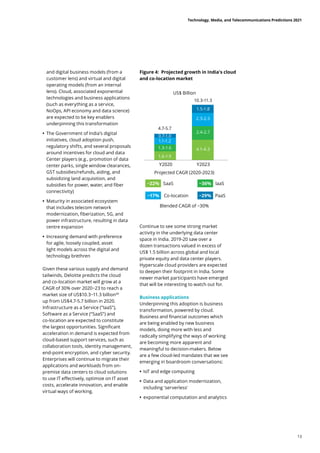
and co-location market will grow at a
CAGR of 30% over 2020−23 to reach a
market size of US$10.3−11.3 billion40
up from US$4.7-5.7 billion in 2020.
Infrastructure as a Service (“IaaS”),
Software as a Service (“SaaS”) and
co-location are expected to constitute
the largest opportunities. Significant
acceleration in demand is expected from
cloud-based support services, such as
collaboration tools, identity management,
end-point encryption, and cyber security.
Enterprises will continue to migrate their
applications and workloads from on-
premise data centers to cloud solutions
to use IT effectively, optimize on IT asset
costs, accelerate innovation, and enable
virtual ways of working.
Continue to see some strong market
activity in the underlying data center
space in India. 2019-20 saw over a
dozen transactions valued in excess of
US$ 1.5 billion across global and local
private equity and data center players.
Hyperscale cloud providers are expected
to deepen their footprint in India. Some
newer market participants have emerged
that will be interesting to watch out for.
Business applications
Underpinning this adoption is business
transformation, powered by cloud.
Business and financial outcomes which
are being enabled by new business
models, doing more with less and
radically simplifying the ways of working
are becoming more apparent and
meaningful to decision-makers. Below
are a few cloud-led mandates that we see
emerging in boardroom conversations:
	
• IoT and edge computing
	
• Data and application modernization,
including 'serverless'
	
• exponential computation and analytics
Blended CAGR of ~30%
Projected CAGR (2020-2023)
Y2020 Y2023
Figure 4: Projected growth in India's cloud
and co-location market
SaaS
~22% ~36%
~17% ~29%
laaS
US$ Billion
0.7-1.0
4.7-5.7
1.5-1.8
10.3-11.3
1.1-1.2
2.3-2.5
1.3-1.6 4.1-4.3
1.6-1.9
2.4-2.7
PaaS
Co-location
Technology, Media, and Telecommunications Predictions 2021
13
IoT and edge computing
With the drive and need for digitally
transforming organizations at a much
wider scale and pace, we see an ever-
increasing need for integrating various
parts of the organization and connecting
multiple end points with minimum
latency, augmented with Artificial
Intelligence (AI)/Machine Learning (ML).
IoT and edge computing are the building
blocks for enabling such transformations.
We are seeing diverse deployment use
cases emerging in areas such as smart
cities, electric vehicle charging, smart
surveillance, and smart manufacturing.
These use cases are expected to grow in
the next few years.
The rise of edge computing can in part be
attributed to the dramatic increase in the
number of IoT devices connected to the
internet every second. Edge computing
allows data generated by IoT devices to
be processed closer to its sources instead
of sending it across networks.
Expected proliferation of 5G capabilities
will add more muscle to edge computing
capabilities and serve as a power boost.
In the next few years, we are expecting
to see many IoT providers diversify
their focus equally on the consumer
marketplace. A plethora of IoT-generated
end points would also mean massive
transactional volumes and a potentially
wider proliferation of cyber risks. As a
result, we see a need for emergence of
new IoT security models to manage this.
‘Server less’ or ‘Function as a Service’
(FaaS)
Serverless, also known as FaaS, is
the next evolution from monolithic
application architecture after service-
oriented architecture and micro-services
architecture.
Serverless is a technology that
implements functions in the cloud on a
need basis. Enterprises rely on serverless
computing because it provides space
to work on core products without the
pressure to operate or manage servers.
The real innovation of these systems
is the possibility to run applications
without worrying about the underlying
infrastructure. For instance, this would
result in provisioning, scalability, and
server management being automatically
administered, with enormous advantages
for flexibility and performance, at a lower
cost.
Going serverless allows organizations
to optimize capital expenditures and
overall Total Cost of Ownership (TCO).
In addition, serverless infrastructure
reduces the need for human resource
deployment as a focus on batch
processing decreases. Together, these
reduce expenses significantly.
Serverless stacks from hyperscale
cloud providers create a robust and
intuitive environment for the developer
community at large. This further offers
a large set of ‘on cloud capabilities,’
which can be used as needed, enabling
developers to run at scale economically
and deliver highly agile application
development outcomes. Adoption
of serverless computing allows
organizations to shift from the restrictive,
time-consuming, and draining traditional
workflows and engage in event-based
computing. Now, coders can just write
algorithms and the serverless provider
can take care of the data storage and
computing needs. This will not only
reduce the time of transaction processing
and the cost of DevOps, but also free up
the time and space for coders to take on
other business logic tasks. Serverless
computing gives organizations the
freedom to focus on their core business
offerings and deal with only low-level
OS issues. Deployers, coders, and top
management can use this time, money,
and opportunity to develop competitive
offerings. This can help the organization
overtake competitors.
Technology, Media, and Telecommunications Predictions 2021
14
Exponential computation and
analytics
Embedding exponential computation
and analytics as a key enabler to decision
making is also seen driving numerous
use cases for cloud adoption. On the
cloud, XaaS platforms enable wider
and deeper business solutions around
AI, ML, deep learning, neural networks
and advanced data science. This drives
significant business outcomes, including
a better 360° view of customer, more
precise personalization, ability to manage
demand elasticity, enable real-time
analytics to drive behavioral sales,
and enhance the overall omni-channel
customer experience.
The bottom line
The year 2021 will be a watershed year for the cloud and data center market in India. COVID-19,
acceleration in digital and virtual adoption by organisations, the regulatory and policy push, and the
significant investments by existing data center players, hyperscale cloud providers and new emerging
market participants are unprecedented catalysts pushing the market forward. Deloitte predicts the
growth of the cloud and co-location market at a CAGR of 30% to reach US$10.3−11.3 billion by 2023.
The key cloud mandates we see emerging in the coming year are IoT and edge computing, data and
application modernization (specifically ‘serverless’), and exponential computation and analytics.
New business models will emerge in India to facilitate the deployment of edge through cloud
platforms using AI/ML capabilities. The rise of edge computing can in part be attributed to the rise
in the number of ‘connected’ devices connected to the internet every second. The importance of IoT
security will increase on the back of plethora of endpoints, transactional volumes and potentially
wider proliferation of cyber risks. Serverless computing with its high deliverability, coupled with the
immense opportunities it promises, makes it a must adopt. India will continue to lead the pack in
serverless adoption.
Technology, Media, and Telecommunications Predictions 2021
15
Gaining an intelligent edge
Edge computing and intelligence could propel tech and telecom growth
Rising from decades of instrumentation,
automation, and connectivity, the
intelligent edge is maturing into a
revolutionary set of capabilities that
are already transforming some of the
largest technology and communications
companies on the planet. Although
market estimates vary considerably,41
Deloitte predicts that in 2021, the global
market for the intelligent edge will
expand to US$12 billion, continuing a
CAGR of around 35%.42
Expansion in
2021 will be driven primarily by telecom
service providers by further deploying
the intelligent edge for 5G networks,
and by hyperscale cloud providers
optimizing their infrastructure and
service offerings. These highly capitalized
leaders are establishing the use cases
and best practices that may make it
easier for companies across multiple
industries to attain the capabilities of
the intelligent edge. By 2023, 70% of
enterprises may likely run some amount
Technology, Media, and Telecommunications Predictions 2021
16
of data processing at the edge.43
As one
leading Graphics Processing Unit (GPU)
manufacturer has stated, “We're about to
enter a phase where we're going to create
an internet that is thousands of times
bigger than the internet that we enjoy
today.”44
Though challenges and headwinds exist,
we believe that the intelligent edge is
poised to transform the computing
landscape, propelling the world’s
largest technology companies towards
the next generation of connectivity
and operational efficiency. By bringing
powerful computing capabilities closer
to where data originates and needs
to be consumed, the intelligent edge
is expected to unlock potential for
faster, less expensive, and more secure
operations across several use cases
ranging from autonomous vehicles to
virtual reality to the Internet of Things
(IoT)—helping to accelerate the Fourth
Industrial Revolution.45
What is the intelligent edge?
The intelligent edge is the combination
of advanced wireless connectivity,
compact processing power, and artificial
intelligence (AI) located near devices that
use and generate data.46
It represents
an evolution and convergence of trends
in industrial monitoring, automated
manufacturing, utility management, and
telecommunications, further amplified
by cloud computing, data analytics,
and AI. The intelligent edge puts these
latter capabilities physically near where
data needs rapid analysis and response,
enabling that data to be acted on
directly or filtered to push only the most
important bits to the core. In particular,
the intelligent edge’s ability to bring cloud
capabilities to remote operations could
greatly amplify their performance.
The monumental rise of artificial
intelligence and the evolution of
computation to support it are critical
enablers, further driving tectonics shifts
in the semiconductor industry.47
Graphics
The monumental rise of
artificial intelligence and the
evolution of computation to
support it are critical enablers,
further driving tectonic shifts
in the semiconductor industry.
processing units (GPUs) have been moving
into data centers, and dedicated AI chips
are reaching out to the edges, including
devices to operate on incoming data
immediately.48
Advanced connectivity
ties them all together, while virtualization
enables services to seamlessly run across a
web of diverse and dynamic components,
from the cloud to the edge. Indeed,
effective planning and implementation of
an intelligent edge strategy may require
coordination and orchestration of multiple
ecosystem providers.
This rise of the intelligent edge will
likely drive the evolution of service
architectures to become more location-
driven, decentralized, and distributed.
The intelligent edge does not replace the
cloud or data centers but, rather, is an
element within a holistic cloud-to-edge
architecture.49
Some components of a
service will run in a centralized cloud,
others at the data center, and more yet at
the edges on sensor arrays, autonomous
vehicles, and potentially billions of
machine endpoints. The ways that
computation operates on different parts
of the data journey, where it operates,
and the differing requirements those
operations place on connectivity and
speed may reshape how services are
architected by distributing components
based on their needs.
Technology, Media, and Telecommunications Predictions 2021
17
There are challenges to overcome,
however standards and best practices
have yet to cohere, and issues with
interoperability and security will likely
become more visible. The intelligent edge
today combines solutions from telecoms,
hyperscalers, and technology providers,
and effective implementation requires
coordination and integration across
multiple sectors. Who owns which pieces?
Who makes the most of their capabilities?
Who will deliver the best end-to-end
solutions for the rest of the market? The
answers to these questions could shape
the landscape for years.
Why is the intelligent edge important?
For businesses with data-driven use
cases, the intelligent edge offers the
following key capabilities:50
	
• 
More efficient use of bandwidth and
greater network visibility which can
lower costs
	
• Resilience against poor, unreliable,
and lost connectivity due to lower
dependency on wide-area networks
(WANs)
	
• More control over data triage,
normalization, residency, and privacy
through the ability to keep more data
local rather than needing to transmit it
across the network to the core
	
• Support for low-latency use cases and
fast response times
	
• Greater automation and autonomys
With these capabilities, the intelligent
edge can add greater visibility across
operations, support faster data analysis
and real-time response, and enable
better automation and more dynamic
systems. If certain microservices require
very low latency and high security, such
as facial recognition for facility access,
they can execute at the edge rather than
in the cloud. This can enable much tighter
decision loops, reducing the costs and
security risks of network transit. The edge
can send the most important bits to the
core and the core can manage the edge.
The intelligent edge can support large-
scale transformational solutions that
could radically evolve manufacturing,
logistics, robotics, mobility, and
consumer electronics.51
For instance,
an intelligent edge system can shift
supply chains from somewhat fragile,
linear systems to more programmable,
responsive, and adaptive digital networks
able to reshape themselves to address
changing demands and disruptions.52
As another example, utilities and similar
organizations could use the intelligent
edge to connect AI-enabled drones to
address mounting risks posed by aging
infrastructure,53
which would make
identifying and addressing those risks
much faster. One Norwegian oil rig has
already deployed a remote autonomous
robotic dog on that can patrol the rig and
visually inspect for issues such as gas
leaks.54
These devices can be deployed
24/7 to map and monitor assets, flag
problems, and alert the rig’s networks
and crews of potential risks.
The advantages of using the intelligent
edge for such operations can be
significant. Consider how an automated
drone could inspect a pipeline for
defects. With cloud, the drone might fill
its local storage with video of a pipeline
inspection, then return to its base
station. It would then upload the video
to a remote data center, potentially
sending gigabytes of information over the
network and requiring significant time
to do so. The cloud would apply machine
learning (ML) to evaluate the data for
defects and, upon spotting them, return
that information back to the pipeline site
to provoke a response: Treat the defect
and possibly reroute flows.
With edge intelligence, the same AI/ML
inference algorithms that the cloud uses
to evaluate the video can be run directly
on the drone. Instead of scanning and
analyzing the entire video, the drone
could operate on a small, near-real-
time buffer of the video feed to classify
defects. When it identifies a defect, the
drone can immediately notify nearby
Technology, Media, and Telecommunications Predictions 2021
18
crews to treat the problem. Only frames
with defects are archived in the cloud
to feed models and training sets, which
can then update other drones in the field
for better spotting. This minimizes the
data load for analysis and transit, greatly
reduces the time between inspection and
action, and uses the network only for
critical information that will add to the
toolchain and drive greater insights and
learning.
Who needs the intelligent edge?
The intelligent edge can benefit any
business that manages infrastructure,
networks, clouds, data centers, and
connected endpoints such as sensors,
actuators, and devices. It can support
consumer use cases that require very low
latency, like cloud gaming and augmented
and virtual reality. It can enable
enterprise uses that require aggregating,
securing, and analyzing a great deal of
data across operations and customers.
And it can improve industrial processes
for managing quality, materials, and
energy use, such as monitoring factory
floors, assembly lines, and logistics.
Not all businesses will be able to
implement intelligent edge solutions
broadly right away. Many may need to
invest in the right infrastructure and
partnerships first before seeing a return
on investment from narrow use cases.
But laying these foundations can give
organizations much greater opportunities
in the future.
What’s driving demand?
In the year ahead, we anticipate that
early growth will be led not only by large
telecoms but by hyperscale service
providers, content delivery network
(CDN) providers, and technology
companies as they both consume and
sell intelligent edge solutions. Technology
companies, while marketing intelligent
edge components, appliances, and
software layers to early adopters,
may also seek to reinforce their own
manufacturing and supply chains with
intelligent edge capabilities. Similarly,
telecoms, hyperscalers, and CDNs are not
only making more capabilities available
to their customers, but also expanding
their own intelligent edge infrastructures
to advance strategic initiatives. In the
medium term, the use of intelligent edge
beyond these early adopters will likely
grow among manufacturing, logistics,
and supply chain.
Most spending on edge computing
and intelligence today comes from US
telecoms and communication service
providers (CSPs).55
With more devices
moving on and off networks, and with
more diverse bandwidth needs emerging,
these network providers are facing
mounting management challenges. They
are using intelligent edge technologies
to transform and reinforce their own
infrastructure, such as by expanding
central offices to become next-generation
data centers and edge hubs, enabling
high-density and dynamic connectivity
for 5G and multi-access edge computing
(MEC),56
and virtualizing more of their
networks with solutions such as open
RAN. These steps support their core
business of delivering greater quality
of service to subscribers and selling
networks to enterprise customers.
The intelligent edge can
benefit any business that
manages infrastructure,
networks, clouds, data centers,
and connected endpoints such
as sensors, actuators, and
devices.
Technology, Media, and Telecommunications Predictions 2021
19
Hyperscale cloud and service providers
are also moving quickly to add intelligent
edge capabilities to their data-driven
businesses. Demand is growing from
use-case driven solutions such as
autonomous vehicles and mobile
robotics that require low-latency, high-
redundancy capabilities, as well as from
manufacturing and supply chains seeking
greater transparency and resilience in a
post-COVID-19 world. Further demand
may come from the intelligent edge’s
ability to address emerging regulations
for data sovereignty and compliance.
With an intelligent edge, data can be
secured and held locally, keeping it within
the region it was collected instead of
sending it to foreign clouds.57
This could
potentially draw more investment from
social media platforms looking to the
intelligent edge to help them comply with
regulatory regimes, such as the General
Data Protection Regulation (GDPR), that
may require personal information to be
processed locally and anonymously.58
Finally, rising demand from industries
like manufacturing and mobility (such
as automakers and ride-hailing services)
could lead to the development of more
packaged and managed offerings. This
could make it easier for more businesses
to attain intelligent edge capabilities. As
the COVID-19 crisis accelerates migration
to the cloud, businesses undergoing their
first wave of cloud transformation could
design cloud-to-edge solutions that best
meets the needs of their use cases.59
Who plays in the intelligent edge
ecosystem?
No single provider seems able to build
an effective intelligent edge solution by
itself. Telecoms, hyperscalers, CDNs, and
tech companies all play a role in enabling
the intelligent edge, with each providing
a part of the solution. Coordinating these
various components is not easy: With
each company pursuing its own strategic
goals, cooperation is often not far from
competition. Understanding the role of
these players, what they offer, and how
they fit in the competitive landscape can
better arm organizations looking to attain
intelligent edge capabilities.
Telecoms and the expanding internet
For many intelligent edge deployments,
telecoms are key partners,60
with the
largest telecoms increasingly selling their
own edge computing and IoT solutions
as well as on-premise private enterprise
networks. As providers within the edge
ecosystem, telecoms can offer their
enterprise customers and partners
end-to-end connectivity for wired and
wireless networks, from fiber, cable, 4G/
LTE, and Wi-Fi to advanced solutions with
5G and Wi-Fi 6. They also lease portions
of their network that enable direct access
to backhaul and offer real estate to
host edge appliances and datacenters
in central offices. Cell tower companies
can also lease space for edge appliances
at their towers, which typically connect
directly to fiber.61
One key challenge for telecoms is that
they no longer have a near-monopoly on
connectivity and communication, despite
the billions of dollars they spend each
year to modernize their networks. Many
CSPs deliver network services on top of
IP networks, and more hyperscalers and
CDNs are building their own network
infrastructure. However, telecoms’ ability
to provide the combination of backhaul,
5G, Wi-Fi 6, and the intelligent edge
could unleash stronger capabilities for
managed connectivity, giving them a
competitive advantage in delivering next-
generation networks with greater quality
of service.
Hyperscalers encircling the globe
Some of the world’s most valuable
companies—the so-called hyperscalers—
offer end-to-end technology solutions,
Technology, Media, and Telecommunications Predictions 2021
20
from cloud services to enterprise
productivity and consumer lifestyle
experiences. These businesses are
highly data-driven, both for optimizing
and extending their internal operations,
and to deliver better services and drive
continued engagement by understanding
their customers and users. They are
implementing the intelligent edge to
advance both efforts by extending their
hyperscale capabilities closer to the
things they measure, and the enterprises
they serve.
Hyperscalers’ biggest challenge will likely
be to maintain control over data while
partnering with connectivity providers.
Hyperscale networks could indirectly
encroach on CSPs, especially if they
were to offer connectivity as a part of
their platforms. Nevertheless, building
high-quality networks is difficult and
costly, especially at scale, which makes
partnerships with connectivity providers
a more feasible route.62
As hyperscalers pursue intelligent
edge deployments, they will establish
new proofs of concept and use cases
that will further drive adoption across
the market. For example, some
hyperscalers are positioning voice AI
as a key interface modality across all
their consumer services.63
Being able to
run natural language processing on the
device—a smartphone, smart speaker,
or car—without having to go back to
the cloud can reduce latency, guard
against connectivity failures and security
breaches, and deliver greater quality
of service while retaining data within
regulatory jurisdictions.
For businesses deploying intelligent
edge capabilities, hyperscalers offer
public clouds and the IT services and
management solutions that run on top
of them, as well as AI capabilities. Some
hyperscalers already control their own
CDNs as well. Their development and
marketing of these intelligent edge
solutions aim to support their expanding
business offerings across cloud,
payments, health care, transportation,
and media and entertainment.
CDNs aspiring to become the other
hyperscalers
Arguably, CDNs constitute a proto-edge in
that they were developed to shift content
closer to the consumer to accelerate the
early Web.64
Some CDN providers are
now actively pursuing and marketing
intelligent edge solutions, putting them in
both cooperation and competition with
telecoms and hyperscalers.65
CDNs have strong relationships with
many businesses, and they boast
some of the industry’s highest-quality,
redundancy, security, and delivery
capabilities. The intelligent edge may
reinforce their delivery networks and
enable greater quality of service at a
time when more companies need strong
delivery services. However, because
some hyperscalers and telecoms already
control their own CDNs, the sectors
currently driving the intelligent edge
may not need external CDN providers.
Additionally, CDN companies may not
have strong relationships with the
industries likely to adopt edge next, such
as manufacturing and automotive.
Tech providers offering hardware and
managed services
Underneath the cloud-to-edge value
chain reside innumerable hardware
components and software layers that
support it. Tech providers have a vast
growth opportunity in selling their
products and services into data centers,
networks, on-premise facilities, and
endpoints from factory floors and smart
buildings to computers and vehicles.
Technology, Media, and Telecommunications Predictions 2021
21
Data center equipment and Wi-Fi
connectivity will likely be in especially
high demand. One forecast expects the
edge data center market to approach
US$16 billion by 2025.66
Tech providers
can help telecoms transform their central
offices into modern data centers, help
manufacturing facilities build stronger
on-premise capabilities, and provide
intelligent edge appliances and micro-
datacenters to enterprise customers.
They can also offer the middleware and
management layers that tie these hybrid
clouds together into seamless fabrics. In
this sense, the edge is another location
for the hybrid cloud.
Also, not all intelligent edge solutions
require 5G, and more solutions may
develop hybrid networks that include
Wi-Fi, LTE, and 5G, depending on the
use case. This means that some tech
businesses may see more opportunities
as Wi-Fi providers. The latest generation
of Wi-Fi, Wi-Fi 6, offers bandwidth slicing,
better power management, and support
for an increased number of devices,67
all
of which can enable much more robust
and dynamic local networks. Private
local networks could also help some
businesses reduce their dependence on
cloud providers and telecoms.
All this being said, tech providers’ position
in the intelligent edge marketplace may
be challenged by some of their largest
customers—the hyperscalers and
telecoms—building more of their own
components, as well as the ongoing
trend to dematerialize hardware into
software wherever possible. However, as
the market matures, tech providers may
also serve more second-tier adopters
less able to build their own solutions.
This shift may be the next milestone
for the realization of Industry 4.0, in
which next-generation cloud-to-edge
architectures become more standardized
and commoditized.
Don’t forget semiconductors
Running AI on lightweight edge
devices can require more specialized
compute solutions such as custom field
programmable gate arrays (FPGAs) and
application-specific integrated circuits
(ASICS), as well as GPUs designed
specifically to accelerate AI algorithms
on devices, in edge appliances, and in
micro-data centers. Demand for edge AI
chips has grown substantially, and the
market will likely expand considerably
in the next few years.68
To meet this
demand, more semiconductor companies
are accelerating production of edge AI
chips.69
Some are pursuing monumental
MA deals to shore up their position in
the next wave of machine intelligence
and computation.70
Hyperscalers are also
designing more of their own specialized
chips to support their largest operations.
And foundries and chip design firms
are responding to meet the demand
driven by data centers, AI, and the
ever-expanding digitization of industrial
systems.
What are the potential headwinds?
As it matures, the intelligent edge market
faces some challenges. The COVID-19
crisis has disrupted demand, challenged
supply chains, dragged down earnings,
raised costs for many businesses, and
injected uncertainty into outlooks.
Additionally, the ongoing trade war
continues to drive supply uncertainty,
adding complexity, cost, and time to
navigating supplier networks. In this
environment, demand is difficult to
auger and supply may be unreliable.
Such conditions may engender a more
conservative approach to capex on
emerging technologies. Businesses
may feel they can reinforce their
existing cloud capabilities with less
risk than implementing an intelligent
edge, especially during a crisis that is
demanding more remote and connected
services.71
Building the fundamentals
Technology, Media, and Telecommunications Predictions 2021
22
The bottom line
Each party in the intelligent edge ecosystem—telecoms, hyperscalers, CDNs, tech providers and
semiconductor makers—has a stake in the success of the intelligent edge and the next generation
of cloud-to-edge architectures and services. The landscape is young and dynamic, but it also
has decades of momentum behind it due to ongoing computing and network trends toward
instrumentation, monitoring, and automation of facilities. With digitization, connectivity, and data
analysis now maturing rapidly, the intelligent edge is beginning to transform some of the largest
physical systems on the planet.
Like previous large-scale infrastructure upgrades, innumerable unexpected innovations will likely
emerge as intelligent edge adoption expands. Executives should wade in and develop pilots with a
clear path to results and strategic value. They should move beyond buzzwords and terminology to
focus on use cases, metrics, and outcomes. Most importantly, they should understand that “edge”
and “intelligence” are just components of a more holistic solution for faster data handling, greater
autonomy and transparency across operations, and a more flexible and adaptive enterprise.
of cloud migration may occupy many
businesses in the near term, leaving edge
development to the largest providers.
Additionally, while edge opportunities
are becoming clearer, many companies
may still regard them as a forward-
looking strategic investment rather
than an obvious way to drive their
current business. Implementation
can be challenging and costly, often
requiring orchestration between
multiple providers. Standards are still
forming, best practices are not yet
clear, and security across an abundance
of diverse edge endpoints cannot yet
be guaranteed.72
In times of greater
economic restraint, investments in the
future may be easiest for the largest and
most durable businesses—and even they
may need to orchestrate services across
providers.
The year 2021 may thus see the
intelligent edge colonized primarily
by already-dominant tech sector and
telecom leaders, further reinforcing their
competitive advantage in the coming
wave of transformation. The efforts of
these early adopters over the next year
can help the intelligent edge prove its
value. In the next two years, the market
will likely sort out best practices, establish
standards and interoperability, and
potentially lift early leaders while making
it easier for smaller businesses to adopt
intelligent edge capabilities.
Technology, Media, and Telecommunications Predictions 2021
23
India perspective
The edge computing market in India is
gaining momentum with the growth
of drivers’ in explosion of mobile data,
driving telcos’ need for low latency media
processing, public cloud, IoT, AI, and big
data. Players across the value chain,
including telecom service providers, web
scalers, technology companies and the
start-ups ecosystem, are collaborating
to bring together the segments of
hardware, platform, and services to use
on-the-edge computing opportunity. On
the retail side, virtualization of work, a
rise in consumption of high-definition
videos, home automation, gaming, and
increased usage of applications involving
AR/VR, have created demand for truly
immersive and digital experiences from
customers. With the surge of data due
to an increase in connected devices and
rapid penetration of over-the-top (OTT),
gaming, and e-commerce transactions in
India, the demand would further extend
to tier-2 and tier-3 cities. This requires the
computing power of networks to reside
as close to the consumer as possible.
Adoption of IoT, AI, and AR/VR in
various vertical markets (including
manufacturing, tele-medicine, video
surveillance, logistics, and smart cities)
is creating the need for ultra-high speed,
low-latency intelligent processing. This
would require cloud computing closer
to where the data is generated. The
IoT market in India was poised to reach
US$15 billion by 2020, accounting for
nearly 5% of the global market.73
As
various verticals use IoT and cloud-
based solutions to support their digital
transformation, edge computing would
become critical to support mission-
critical use cases. Companies are also
considering a multi-cloud approach that
offers specialized capabilities to better
align with the technical requirements and
business-level objectives of particular
workloads, applications, or services.
IoT represents a sizeable opportunity
that would drive the edge computing
market as technology providers, thus,
transforming telcos into hybrid multi
could service providers.
As 5G spectrum auctions are yet to
take place, telecom service providers
are looking for new revenue engines
and exploring the opportunity to forge
partnerships to enhance their offerings.
This will help them realize returns on
huge capital outlays to build and expand
4G networks.
Distributed multi-cloud strategy:
Enhancing B2B and B2C offerings
Telcos have partnered with tech players
and gearing makers to develop a
distributed multi-cloud network strategy
to build fully virtualized, scalable cloud
architecture supporting connectivity, IoT,
and fog and edge computing. Distributed
multi-cloud environments would
help address enterprise customers’
needs related to cost, capacity, and
performance and security.
Cloud transformation is aligned to telcos
revamping their own network cloud,
designing and integrating with IT cloud
(to make it more cost efficient, flexible,
and future-ready for core operations),
enabling new digital services.
Edge data center co-location:
Opportunity for infrastructure
providers and hardware players
Even web scalers are seeing the need
to process data closer to the source
and telcos are proving to be suitable
partners with licensing requirements
for infrastructure deployment and
already existing deep telco network
connectivity. Telcos use their existing
data centers to create edge data centers.
With about 500,000 telecom towers in
the country, infrastructure providers
have the opportunity to transform
legacy radio and transmission shelter
Technology, Media, and Telecommunications Predictions 2021
24
sites into edge computing-based micro
data centers. With improved and steady
power solutions, ready access to fibre
backhaul connectivity, and requisite real
estate, and Multi-access Edge Computing
(MEC) could bring in customers, including
Content Delivery Network (CDN) players,
cloud providers, and telcos.
Platform business growth
Customers are shifting their focus to
service-oriented consumption and
delivery models. This shift is leading to
collaboration between web scalers and
technology companies with telcos to
deliver a holistic platform-enabled edge
cloud service capacity and performance
metrics. Telcos are focused on monetizing
their edge networks and experience
delivered to customers on connected
platforms. They are seen to focus on the
platform segment, driving investments
into the segment from large tech players.
The collaboration promises to deliver
enabled platforms, bringing intelligent
cloud and edge across industry verticals.
These verticals include media, digital
commerce, financial services, gaming,
education, healthcare, agriculture,
e-governance, and smart cities,
supporting IoT, edge computing, and
content delivery networks. This will also
include providing benefits of network
slicing to offer private service-defined
networks supporting various applications
and services of enterprise and retail
customers.
Evolving start up ecosystem
Several start-ups are emerging in the
edge computing space, providing niche
solutions around hardware, products,
platforms, edge IoT solutions, and
services (including edge gateways,
edge internet, edge platforms, AI and
analytics). This is expected to further fuel
the development of ecosystem. Recently,
one of the leading telcos launched open
architecture-based universal cloud. It
is deploying the cloud across its edge
data centers. The telco plans to open the
platform to start-ups to drive innovation
and co-create solutions that would
enable start-ups to easily integrate and
deliver edge computing services through
the telco network.
The bottom line
The overall market in India for edge computing is in a relatively nascent stage and small compared
with global markets. However, the expected growth rate for edge computing in the region (driven by
IoT device management need and impending arrival of 5G) is likely to surpass global growth rate in
the period 2020−27 with accelerated growth following the launch of 5G.
Telcos started their cloud journey to support their network and IT virtualization initiatives with
impending arrival of 5G. With IoT growth, they see their critical role in the cloud value chain. The
large traditional data center has been the mainstay of computing and connectivity networks to date.
This will continue to expand in India across regions. However, the exponential rise in mobility and
application services, coupled with digital transformation of enterprises, will propel service providers
to increasingly add edge elements across the core, metro, and access networks. Following the growth
of edge data centers, the hardware segment is likely to dominate the edge computing market in India,
with the platform segment being a strong challenger as services evolve.
Edge computing’s widespread application would be crucial for various reasons: to deploy content
streaming services, smart assistants, AR/VR, Natural Language Processing (NLP), and speech
recognition; to deliver immersive digital experience; or to ensure a 5G-ready cloud to support
network slicing to create private networks (to support mission-critical IoT applications across
manufacturing, logistics, smart cities, and vertical industries).
Collaboration across ecosystem players, including telcos, content delivery networks, tech providers,
web scalers, and start-ups, to offer service-oriented consumption and delivery models (based on a
holistic platform) to enterprise and retail customers would be key to success.
Technology, Media, and Telecommunications Predictions 2021
25
The next-generation
radio access network
Open and virtualized RANs are the future of mobile
networks
Mobile network operators (MNOs) are
known for their ability to build and
operate massive, high-performance
wireless networks. They rely on highly
specialized radio access and networking
equipment with tightly integrated
proprietary software to deliver the
cellular services that connect our cell
phones, tablets, computers, and other
devices. But high costs, limited flexibility,
and constrained vendor choice are
prompting MNOs to shift away from such
Technology, Media, and Telecommunications Predictions 2021
26
systems toward more open, standards-
based, software-centric virtual platforms.
Many MNOs are well on the journey
toward opening and virtualizing their
core networks, achieving significant
operational gains. They now have
their sights on their distributed mobile
edge networks: the radio access
network (RAN). And because MNOs
must replace or augment existing RAN
equipment to deliver 5G service, they
have the opportunity to adopt open and
virtualized RAN architectures—which we
will refer to simply as “open RAN”—as
part of these deployments.
The open RAN market is still in its early
days. We estimate that there are currently
35 active open RAN deployments across
the globe,74
many of which involve
MNOs testing open RAN in greenfield,
rural, and emerging markets. Although
deployments are starting slowly, they
could easily double in 2021. While it may
take anywhere from three to five years
for the technology to fully mature, open
RAN adoption should accelerate rapidly
thanks to the logic of its network design
and its strategic alignment with carrier
needs. Economic and competitive forces
are also converging to drive the market
forward. If this trend continues, the
open RAN market has the potential to
grow substantially, with some estimating
double-digit growth rates75
that will push
open RAN to approach 10% of the total
RAN market by 202576
from less than
1% today.77
Moreover, if governments
force MNOs to replace installed 5G RAN
equipment from restricted vendors, the
growth rate may be even higher.
Why open RAN?
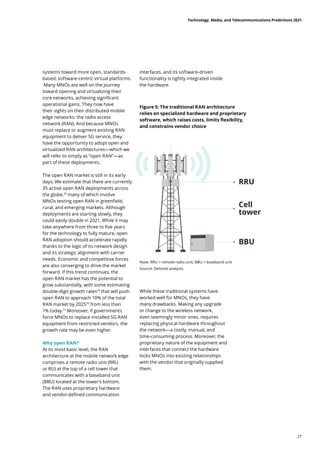
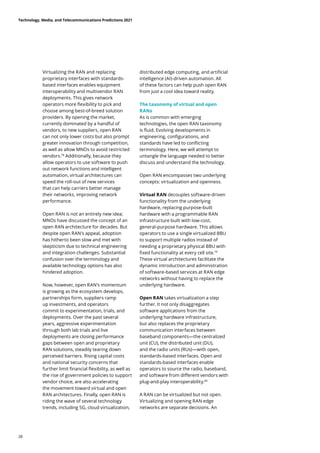
At its most basic level, the RAN
architecture at the mobile network edge
comprises a remote radio unit (RRU
or RU) at the top of a cell tower that
communicates with a baseband unit
(BBU) located at the tower’s bottom.
The RAN uses proprietary hardware
and vendor-defined communication
interfaces, and its software-driven
functionality is tightly integrated inside
the hardware.
While these traditional systems have
worked well for MNOs, they have
many drawbacks. Making any upgrade
or change to the wireless network,
even seemingly minor ones, requires
replacing physical hardware throughout
the network—a costly, manual, and
time-consuming process. Moreover, the
proprietary nature of the equipment and
interfaces that connect the hardware
locks MNOs into existing relationships
with the vendor that originally supplied
them.
Figure 5: The traditional RAN architecture
relies on specialized hardware and proprietary
software, which raises costs, limits flexibility,
and constrains vendor choice
Note: RRU = remote radio unit; BBU = baseband unit
Source: Deloitte analysis.
Technology, Media, and Telecommunications Predictions 2021
27
Virtualizing the RAN and replacing
proprietary interfaces with standards-
based interfaces enables equipment
interoperability and multivendor RAN
deployments. This gives network
operators more flexibility to pick and
choose among best-of-breed solution
providers. By opening the market,
currently dominated by a handful of
vendors, to new suppliers, open RAN
can not only lower costs but also prompt
greater innovation through competition,
as well as allow MNOs to avoid restricted
vendors.78
Additionally, because they
allow operators to use software to push
out network functions and intelligent
automation, virtual architectures can
speed the roll-out of new services
that can help carriers better manage
their networks, improving network
performance.
Open RAN is not an entirely new idea;
MNOs have discussed the concept of an
open RAN architecture for decades. But
despite open RAN’s appeal, adoption
has hitherto been slow and met with
skepticism due to technical engineering
and integration challenges. Substantial
confusion over the terminology and
available technology options has also
hindered adoption.
Now, however, open RAN’s momentum
is growing as the ecosystem develops,
partnerships form, suppliers ramp
up investments, and operators
commit to experimentation, trials, and
deployments. Over the past several
years, aggressive experimentation
through both lab trials and live
deployments are closing performance
gaps between open and proprietary
RAN solutions, steadily tearing down
perceived barriers. Rising capital costs
and national security concerns that
further limit financial flexibility, as well as
the rise of government policies to support
vendor choice, are also accelerating
the movement toward virtual and open
RAN architectures. Finally, open RAN is
riding the wave of several technology
trends, including 5G, cloud virtualization,
distributed edge computing, and artificial
intelligence (AI)-driven automation. All
of these factors can help push open RAN
from just a cool idea toward reality.
The taxonomy of virtual and open
RANs
As is common with emerging
technologies, the open RAN taxonomy
is fluid. Evolving developments in
engineering, configurations, and
standards have led to conflicting
terminology. Here, we will attempt to
untangle the language needed to better
discuss and understand the technology.
Open RAN encompasses two underlying
concepts: virtualization and openness.
Virtual RAN decouples software-driven
functionality from the underlying
hardware, replacing purpose-built
hardware with a programmable RAN
infrastructure built with low-cost,
general-purpose hardware. This allows
operators to use a single virtualized BBU
to support multiple radios instead of
needing a proprietary physical BBU with
fixed functionality at every cell site.79
These virtual architectures facilitate the
dynamic introduction and administration
of software-based services at RAN edge
networks without having to replace the
underlying hardware.
Open RAN takes virtualization a step
further. It not only disaggregates
software applications from the
underlying hardware infrastructure,
but also replaces the proprietary
communication interfaces between
baseband components—the centralized
unit (CU), the distributed unit (DU),
and the radio units (RUs)—with open,
standards-based interfaces. Open and
standards-based interfaces enable
operators to source the radio, baseband,
and software from different vendors with
plug-and-play interoperability.80
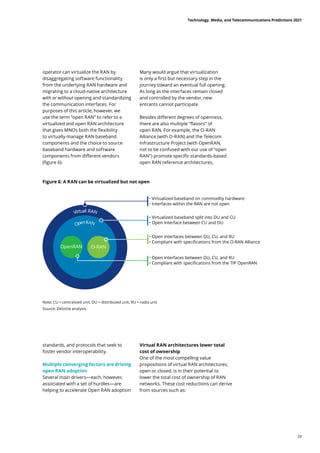
A RAN can be virtualized but not open.
Virtualizing and opening RAN edge
networks are separate decisions. An
Technology, Media, and Telecommunications Predictions 2021
28
operator can virtualize the RAN by
disaggregating software functionality
from the underlying RAN hardware and
migrating to a cloud-native architecture
with or without opening and standardizing
the communication interfaces. For
purposes of this article, however, we
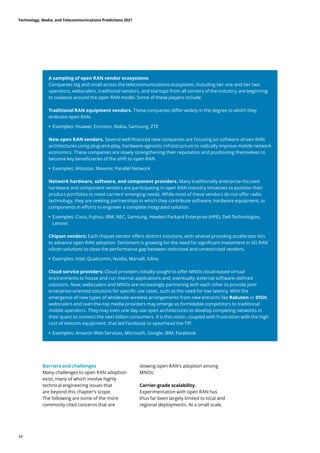
use the term “open RAN” to refer to a
virtualized and open RAN architecture
that gives MNOs both the flexibility
to virtually manage RAN baseband
components and the choice to source
baseband hardware and software
components from different vendors
(figure 6).
Figure 6: A RAN can be virtualized but not open
standards, and protocols that seek to
foster vendor interoperability.
Multiple converging factors are driving
open RAN adoption
Several main drivers—each, however,
associated with a set of hurdles—are
helping to accelerate Open RAN adoption
Many would argue that virtualization
is only a first but necessary step in the
journey toward an eventual full opening.
As long as the interfaces remain closed
and controlled by the vendor, new
entrants cannot participate.
Besides different degrees of openness,
there are also multiple “flavors” of
open RAN. For example, the O-RAN
Alliance (with O-RAN) and the Telecom
Infrastructure Project (with OpenRAN,
not to be confused with our use of “open
RAN”) promote specific standards-based
open RAN reference architectures,
Virtual RAN architectures lower total
cost of ownership
One of the most compelling value
propositions of virtual RAN architectures,
open or closed, is in their potential to
lower the total cost of ownership of RAN
networks. These cost reductions can derive
from sources such as:
Note: CU = centralized unit, DU = distributed unit, RU = radio unit
Source: Deloitte analysis.
Technology, Media, and Telecommunications Predictions 2021
29
Lower upfront capital deployment
costs. With rising capital intensity
and slowing subscriber and revenue
growth, MNOs view virtualized RAN as
an important lever for fundamentally
changing network economics. For
instance, lowering capital costs is key
to the optimal deployment of next-
generation 5G wireless networks. 5G will
require the addition of approximately
three to four times more cell sites, albeit
generally smaller cells on rooftops, lamp
posts, and utility poles.81
Greater network
density is needed to achieve 5G's promise
for enhanced coverage, capacity, speed,
and low latency, as well as to overcome
the limited propagation characteristics
of high-band spectrum. Estimates call for
the addition of more than 2 million 5G
cell sites in the United States by 2021, up
from roughly 200,000 today.82
By allowing
operators to aggregate baseband
functionality using a single virtualized
BBU to support multiple radios, open
RAN reduces overall hardware cost and
enables a smaller, simpler, and more
energy-efficient installation footprint.
Virtual architectures can also “future-
proof” investments in the physical
network. Operators can use software to
upgrade RAN features and functionality
on the same physical infrastructure
to keep pace with changing market
conditions instead of having to rip out
and replace whole physical systems.
Opening RAN architecture interfaces
introduces vendor competition that can
further reduce hardware costs. Open
RAN allows operators to pick and choose
among vendors—not just traditional
telecom vendors, but big tech companies
such as hardware manufacturers,
webscalers, original design
manufacturers, and others looking to
enter the market. The ability to change
out individual RAN components with off-
the-shelf hardware from any vendor can
improve flexibility as well as reduce costs
and downtime for system scaling and
maintenance. That said, these savings
from vendor choice are theoretical. Many
industry pundits argue that the additional
cost, time, and effort to test and integrate
multi-vendor systems could well offset,
if not completely negate, any benefits
from vendor diversity.83
Additionally, the
performance of processing-intensive RAN
capabilities on general-purpose hardware
may not match what can be achieved on
bespoke optimized hardware platforms.
Lower operating expenses through
automation. Open RAN has the
potential to reduce ongoing network
operating and maintenance expenses
while simultaneously addressing the
conflicting challenge of rising data traffic
growth and customer expectations.
Software-mediated RAN architectures
empower operators with new levels of
operational flexibility and intelligent
automation that fundamentally shift how
they manage networks.84
Programmable
RAN infrastructure also makes it simpler
and more cost-effective to roll out new
features and functions at distributed RAN
locations at a mobile network’s edge.
Moreover, open interfaces enable these
new network features and functions
to operate on any vendor’s hardware
without having to send out engineers
and technicians for vendor-specific
integration, as is common practice today.
Thus, open RAN could replace much of
the time-consuming and manual work of
maintaining, upgrading, and optimizing
networks with light-touch, centrally
managed, automated computing
processes.
This type of automation, however, comes
with its own challenges. To achieve
these types of operational efficiencies,
operators should become more adept
in IT-style systems management and
software engineering, imitating cloud
service providers whose velocity in
innovation showed the world how to
drive value from network platforms.
Operators must also adopt service-
oriented practices using rapid-fire
DevOps and continuous innovation and
delivery (CI/CD) practices to deploy new
applications with speed and precision—
Technology, Media, and Telecommunications Predictions 2021
30
something operators did not have to do
with more traditional RAN deployments.85
Not all operators are eager to take
a more hands-on approach toward
operations. For instance, anything that
could interfere with network reliability is
likely to give pause to MNO adoption.86
To reduce this risk, some carriers prefer
the ease and simplicity of traditional
systems in which they rely on a few
trusted vendors to provide new, fully
tested, carrier-grade solutions with
turnkey deployment, maintenance, and
integration support. Should something
go wrong, these operators can lean
on their one vendor for remediation
instead of having to identify and isolate
the issue, then chase down the culprit
from a pack of small, unproven vendors
who may point the finger at anyone but
themselves.
Open RAN encourages innovation
Beyond the capex and opex savings
discussed above, open RAN also drives
faster innovation. Instead of having to
replace network gear to introduce new
features and functions, MNOs using open
RAN can use software updates on white-
box gear to affect change, materially
shortening upgrade and innovation
cycles. Moreover, vendor interoperability
negates the need to send out technicians
for custom onsite integrations, further
reducing the time, effort, and cost of
launching new products and services.
Suppliers also benefit from open RAN
because it opens up market participation
and lowers barriers to entry. Because
of interoperability, vendors can develop
products and solutions for use by
multiple operators instead of having
to create unique one-offs for a specific
operator. Interoperability also fosters
best-of-breed solutions because vendors
can focus on what they do best—whether
hardware, software, or silicon—instead
of having to develop an entire integrated
end-to-end system.
Perhaps most importantly, open RAN
systems enable MNOs to leverage
insights from the traffic flowing across
their networks to develop solutions
that improve network performance.
Open interfaces encourage third-party
development of AI/machine learning-
driven solutions, which help operators
deal with increasing array of bandwidth-
intensive applications and the explosion
of data flowing over ubiquitous networks
and devices. Applications such as RAN
intelligent controllers (RICs) and self-
optimizing networks (SONs) are emerging
as essential and cost-effective methods
to manage future network complexity.
The ultimate objective is to lower costs
and achieve super-lean operations with
zero-touch, fully automated end-to-
end network management and service
orchestration using AI-optimized closed-
loop automation.87
Open RAN innovation offers operators
additional opportunities to evolve
from merely providing commoditized
“dumb pipe” connectivity to delivering
differentiated customer experiences. For
instance, MNOs might offer enterprise
customers networks optimized for
specific use cases. Examples of these
could include ultra-reliable networks
with near-real-time response for factory
robotics or pervasive low-power wide
area networks for widespread monitoring
of assets such as gas pipelines or oil rigs.
While it remains to be seen whether
enterprises would take up, let alone pay
for, these types of services, they do have
the potential to open the enterprise
market to operators—a market in which
they have not been historically active.
While innovations made possible by open
RAN could generate new revenue, it also
introduces the risk of competition from
new entrants. Although “coopetition”
currently characterizes the competitive
landscape, open RAN makes it easier
for alternative players (webscalers,
equipment vendors, system integrators,
and so on) to capitalize on the greater
availability of new low-cost wireless
equipment to disrupt the mobile
communications market. Rakuten
and DISH Networks, for example,
Technology, Media, and Telecommunications Predictions 2021
31
plan to use open architectures to build
low-cost alternative networks in direct
competition with incumbent MNOs.
And better access to lower-cost wireless
equipment was the initial inspiration
for Facebook to start the Telecom
Infrastructure Project.
Open RAN drives greater vendor
diversity and supply chain security
Consolidation over the years has
concentrated the RAN vendor market to
five major players: Huawei, Ericsson,
Nokia, ZTE, and Samsung. Together,
they account for more than 95% of the
market, with the top three vendors,
Huawei, Ericsson, and Nokia,
controlling 80% of the market.88
Market concentration has come to the
forefront of political debate in the United
States, where the government advisory
and prohibition against using federal
funds to purchase communications
equipment or services from companies
that pose a national security risk has
restricted business with Chinese
equipment manufacturers.89
This
effectively eliminates two of the five top
vendors mentioned above (Huawei and
ZTE) and highlights the degree of market
concentration. Additionally, in April 2020,
the US Department of State announced
the 5G Clean Path initiative, which
restricts the use of untrusted vendors in
the transmission, control, computing, and
storage equipment of all 5G mobile traffic
entering or exiting American diplomatic
systems at home or abroad.
The United States is not alone in making
such moves. Multiple government
initiatives around the globe are aiming to
restrict the use of untrusted vendors. In
July 2020, the United Kingdom announced
that it would ban new purchases
and require the complete removal of
restricted kit from UK networks. And
Australia, New Zealand, and Japan all
effectively ban the use of untrusted
vendors from their 5G deployments.
With more countries restricting vendors,
the urgency for a new approach is driving
greater worldwide interest in open RAN.
To allow for alternatives, US policymakers
increasingly seem to favor open RAN
initiatives. They prefer the market
development of alternative vendors to
expand the supplier ecosystem that can
give MNOs greater flexibility and choice.
For US MNOs, the lack of a US “national
champion” equivalent to the largest
players could become problematic if
trade tensions escalate and national
security is tied to homegrown network
providers. However, even though it lacks
a major integrated wireless equipment
manufacturer, the United States is home
to some of the most prominent emerging
open RAN startups, including Altiostar,
Mavenir, and Parallel Networks. Most of
these suppliers offer open RAN networks
compliant with the O-RAN architecture.
Moreover, the United States boasts many
of the most significant players in the
hardware, silicon, and software supply
chain ecosystem. These companies
can partner with one another to cobble
together an end-to-end carrier-grade
open RAN solution.
The industry is uniting around open
RAN
By opening the market and introducing
competition, open RAN sets up a rift
between traditional incumbents and
forward-looking new entrants. Most of
these new entrants, however, still need
to establish themselves in the market; for
now, the balance of power rests firmly
in the camp of a few traditional vendors,
which may, in fact, emerge stronger.
Nonetheless, open RAN will force
incumbent vendors to shift their business
models away from a hardware to a more
software-centric approach, introducing
new business and competitive risks
through the transition.
Technology, Media, and Telecommunications Predictions 2021
32
This tension is creating momentum for
several industry-led open RAN initiatives
that seek to unite an ecosystem of
supply chain partners and advance
open RAN through the definition,
development, and testing of standards
and reference architectures. Beyond the
standards defined by the 3rd Generation
Partnership Project (3GPP),90
multiple
industry groups are leading the open
RAN movement, each with a different
purpose. Prominent industry-led open
RAN initiatives include:
O-RAN Alliance. This alliance, formed
in early 2018, is a worldwide carrier-led
effort that seeks to define new radio
architectures. Its main objective is to
open designs and interfaces between the
RRU and BBU. It also focuses on vendor
interoperability.
Telecom Infrastructure Project (TIP).
Launched in early 2016 by Facebook,
the TIP has more than 500 members
and 12 project groups. Its OpenRAN
project group focuses on building white-
box baseband and radio unit designs
based on O-RAN Alliance architecture
and interfaces. TIP’s primary goals
are to develop an ecosystem to spur
innovation, enable supplier diversity, and
reduce deployment and maintenance
costs across access, transport, and core
networks.
Open RAN Policy Coalition. The Open
RAN Policy Coalition, launched in mid-
2020, advocates for government policies
to help drive open RAN adoption. Its
growing membership spans operators,
equipment manufacturers, software
developers, and silicon chip makers.
Open Networking Foundation (ONF).
In August 2020, the ONF announced
several new initiatives in the open
RAN domain. This group is looking to
deliver open-source implementations
of functionality included in open RAN
components such as CU, DU, and RICs.
From a technical perspective, the O-RAN
Alliance’s work is the most foundational,
prompting partnerships with many
other organizations. The TIP announced
a liaison agreement with the O-RAN
Alliance in early 2020 that will allow
the two groups to share information
and hopefully prevent duplication of
effort. In mid-2020, the telecom industry
lobby group GSMA announced that it
would partner with the O-RAN Alliance
to accelerate the adoption of open
RAN technologies.91
The ONF has also
indicated it will work with the O-RAN
Alliance to develop its solutions.
Like other aspects of open RAN, the
roles of dependencies between and
interactions across these groups can be
confusing. And while well-intentioned, the
plethora of initiatives has the potential to
further fragment the industry, with each
offering slightly different flavors of open
RAN. To deliver a solution that universally
appeals to multiple stakeholders, it will
be critical for these various organizations
to harmonize their efforts and provide a
simple way for operators to learn about
and embrace open RAN.
Technology, Media, and Telecommunications Predictions 2021
33
A sampling of open RAN vendor ecosystems
Companies big and small across the telecommunications ecosystem, including tier one and tier two
operators, webscalers, traditional vendors, and startups from all corners of the industry, are beginning
to coalesce around the open RAN model. Some of these players include:
Traditional RAN equipment vendors. These companies differ widely in the degree to which they
embrace open RAN.
	
• Examples: Huawei, Ericsson, Nokia, Samsung, ZTE
New open RAN vendors. Several well-financed new companies are focusing on software-driven RAN
architectures using plug-and-play, hardware-agnostic infrastructure to radically improve mobile network
economics. These companies are slowly strengthening their reputation and positioning themselves to
become key beneficiaries of the shift to open RAN.
	
• Examples: Altiostar, Mavenir, Parallel Network
Network hardware, software, and component providers. Many traditionally enterprise-focused
hardware and component vendors are participating in open RAN industry initiatives to position their
product portfolios to meet carriers’ emerging needs. While most of these vendors do not offer radio
technology, they are seeking partnerships in which they contribute software, hardware equipment, or
components in efforts to engineer a complete integrated solution.
	
• Examples: Cisco, Fujitsu, IBM, NEC, Samsung, Hewlett Packard Enterprise (HPE), Dell Technologies,
Lenovo
Chipset vendors: Each chipset vendor offers distinct solutions, with several providing accelerator kits
to advance open RAN adoption. Sentiment is growing for the need for significant investment in 5G RAN
silicon solutions to close the performance gap between restricted and unrestricted vendors.
	
• Examples: Intel, Qualcomm, Nvidia, Marvell, Xilinx
Cloud service providers: Cloud providers initially sought to offer MNOs cloud-based virtual
environments to house and run internal applications and, eventually, external software-defined
solutions. Now, webscalers and MNOs are increasingly partnering with each other to provide joint
enterprise-oriented solutions for specific use cases, such as the need for low latency. With the
emergence of new types of wholesale wireless arrangements from new entrants like Rakuten or DISH,
webscalers and over-the-top media providers may emerge as formidable competitors to traditional
mobile operators. They may even one day use open architectures to develop competing networks in
their quest to connect the next billion consumers. It is this vision, coupled with frustration with the high
cost of telecom equipment, that led Facebook to spearhead the TIP.
	
• Examples: Amazon Web Services, Microsoft, Google, IBM, Facebook
Barriers and challenges	
Many challenges to open RAN adoption
exist, many of which involve highly
technical engineering issues that
are beyond this chapter’s scope.
The following are some of the more
commonly cited concerns that are
slowing open RAN’s adoption among
MNOs:
Carrier-grade scalability.
Experimentation with open RAN has
thus far been largely limited to local and
regional deployments. At a small scale,
Technology, Media, and Telecommunications Predictions 2021
34
open RAN’s complexity of integration
and its load on RAN network functions
is readily managed. Several operators
are experimenting with open RAN
architectures in underserved areas where
the potential for stranded investment and
pressure for high performance is low and
there is little or no existing infrastructure.
In Turkey, for example, Vodafone is
working with vendor partners using
agile methods to make rapid iterative
updates to software and equipment
configurations, tracking KPIs to provide
evidence of and confidence in achieving
performance thresholds.
Whether this architecture is scalable to
larger networks with greater traffic loads
and higher performance requirements
is still unproven. Still, some evidence
of scalability comes from one of open
RAN’s few live deployments, undertaken
by the Japanese e-commerce giant
Rakuten. Rakuten is on track to deploy
7,000 open RAN sites in Japan by the end
of 2021—the equivalent of a medium-
sized European country such as Austria
or Portugal.92
But as the number of
subscribers on this network is relatively
low, the technology’s scalability to
support tens of millions of subscribers is
still in question.
Sunk costs. A traditional RAN’s total cost
of ownership, including the underlying
equipment, site rental, support,
maintenance, and energy costs, can be
the most expensive part of a mobile
network, representing 65–70% of its total
cost. Given that, open RAN’s appeal from
a cost perspective is easy to understand.
Several studies have concluded that open
RAN can reduce capex by 40–50% and
operating expenses by 30–40% relative
to a traditional cellular setup.93
Most
of these studies cite Rakuten, which is
striving to build the first and largest end-
to-end virtualized cloud-native network
using open RAN architectures.
The caveat is that while the total cost
of ownership claims may be valid in
greenfield environments such as in
Rakuten’s effort, this magnitude of
cost savings seems highly improbable
in “brownfield” environments where
significant investments have already
been made. One of the main reasons for
this is that 5G deployments build on and
require interoperability with existing 4G
infrastructure—and 4G’s closed vendor
implementations lock operators into
using the same vendor. Accordingly,
operators seeking to adopt open RAN
in existing infrastructures would need
to replace legacy equipment, which
would significantly raise an open RAN
deployment’s overall cost.94
Vendor interoperability concerns.
New solutions must compete against
proven, tightly integrated legacy RAN
systems designed and optimized for
high performance. While open RAN
provides greater vendor choice and
flexibility in implementation, it also
increases opportunities for incompatible
configurations from multiple possible
combinations of software and hardware.
Each combination of multi-vendor end-
to-end solutions must undergo extensive
testing in a controlled environment,
which would require significant additional
time, effort, and cost relative to
traditional setups.
To explore ways to alleviate this
problem, several industry-led initiatives,
including the O-RAN Alliance, are hosting
“plugfest” events that bring together
diverse ecosystems of component
vendors to test, validate, and harden
end-to-end operator solutions that can
also interoperate with existing legacy
architectures. Several leading vendors
and consortia are also launching
communal labs to test and validate
interoperability in a controlled and
managed environment.95
System integration. Integration
complexity also presents a significant
obstacle to open RAN adoption, as one
of the key benefits of remaining with
the traditional model is that operators
can turn complete responsibility
Technology, Media, and Telecommunications Predictions 2021
35
for implementation, upgrades, and
maintenance over to the vendor. Should
something go wrong—and it always
does—accountability in the current
environment is clear. If operators are to
evolve away from reliance on integrated
turnkey systems from a single vendor,
they must incubate new capabilities
to orchestrate and manage complex
multi-vendor RAN deployments, which
will necessitate the use of in-house,
vendor-supplied, or third-party systems
integrators. And since open RAN is a
relatively new area, there are not many
integrators with RAN experience that also
have the operator’s best interest in mind.
While anecdotal, Rakuten’s experience
again provides grounds for optimism. In
assembling its greenfield mobile network,
the company undertook a significant
role as system integrator to orchestrate
at least 10 different vendors, achieving
many industry firsts in the process.
Rakuten’s CEO originally thought that
the RAN integration would be the most
complex part of coordinating these
vendors. But he later acknowledged
that although the RAN integration was
extremely challenging, only 10% of the
challenge came from the RAN and 90%
came from “everything else.”96
Getting started with open RAN
Many operators are anxious to move
forward with open RAN, and the market
is developing rapidly. It may take some
time, but many are confident the industry
will eventually overcome the technical
and engineering challenges that stand
in the way of reaching a truly scalable
commercial-grade solution. A mid-2020
survey of operators found that a majority
believed that practical applications of 5G
open RAN baseband units would emerge
within two years.97
The same study found
that operators are not necessarily waiting
for full feature and performance parity.
Many said that they would be willing to
accept open radio units if they showed
80% of the performance capabilities of a
traditional integrated system, particularly
for service in underserved areas.98
Even if open RAN is still not quite ready
for widescale commercial deployment,
this is no time to stand still. Since the
telecom industry works on long multiyear
planning cycles that can span decades,
operators would benefit from taking
action today. Now is a good time to
assess the current state of their business,
understand where the company needs
to go, and determine how it needs to
change.
Operators should start educating
themselves on the opportunities and
challenges presented by open RAN. A
good place to begin is by separating hype
from reality by participating in industry
consortia, learning from those already
testing open RAN in labs and field trials.
Operators can also engage with vendors
and other experts to understand global
operator deployment trends, assess
technology and ecosystem maturity, and
evaluate the total cost of ownership of
alternate deployments based on their
own unique starting point.
While engineers tackle the technological
issues, operators can take decisive action
in developing an operationalization plan,
building an organization and culture of
innovation and continuous improvement
to support new software-centric business
and operating models enabled by open
cloud-native architectures. If they want
to successfully transition to open RAN,
operators will need to acquire new
capabilities, hire and develop internal
talent, and adopt new ways of working.
Technology, Media, and Telecommunications Predictions 2021
36
Significant live open RAN implementations and trials
Rakuten, with its 7,000-site deployment planned for launch by the end of 2020, is leading the telecom
industry's transformation toward open RAN architectures. Rakuten, which has a reputation for
disruptive innovation, is leveraging the strengths of different vendors for various parts of the network,
which has never been done before.99
The lack of legacy infrastructure helps reduce the risk and cost of
deployment.
Dish Network in the United States intends to build the first fully open RAN-compliant standalone
nationwide 5G wireless network. The company is in the process of selecting the vendors that will help
build the new, greenfield network. Dish plans to cover 70% of the US population with 5G by June 2023.100
Vodafone is conducting extensive open RAN trials in the United Kingdom, South Africa, Mozambique,
Turkey, Ireland, and the Democratic Republic of Congo with clear timelines for commercial deployments
across multiple wireless technologies (2G, 3G, 4G, and 5G). The company is seeking to deploy open RAN
technology across its considerable European footprint,101
which covers 100,000 cell sites and 400 million
people across 14 countries.
Telefonica announced it will conduct 4G and 5G Open RAN technology trials in Germany, Spain, the
United Kingdom, and Brazil in 2020. The Spanish operator will collaborate with several vendors to
develop and deploy O-RAN trials across its footprint. Telefonica also has several open RAN projects in
Peru.
Deutsche Telekom is collaborating with two vendors on developing a programmable open RAN
platform based on a disaggregated open RAN architecture. The collaboration is part of Deutsche
Telecom’s European Open Test and Integration Center to test O-RAN compliant solutions.
Etisalat, a telecom services provider based in the United Arab Emirates, is launching the first Middle
Eastern virtual RAN in collaboration with leading RAN technology vendors. Its solution seeks to
decouple programmable RAN software elements from the hardware. This would allow generally
available hardware and server platforms to process the RAN software, improving deployment flexibility,
scalability, agility, and energy efficiency.
The bottom line
The traditional RAN represents one of the last bastions of closed proprietary systems. If history
repeats itself, the adoption of open RAN may mimic the time it took the industry to transition to
open and virtual core networks—the seven years between 2013, when the tenets underlying core
network virtualization were introduced, and 2020, when more than half of the industry’s core wireless
shipments migrated from purpose-built to virtual network solutions. The expectation is that more
than 80% of core wireless network deployments will be virtualized by 2023.102
Though open RAN is still
in its infancy, the clear growing interest in the technology could be the start of a large and significant
trend with the potential to revolutionize the telecom industry.
Technology, Media, and Telecommunications Predictions 2021
37
India perspective
Before we deep-dive into the future
of open and virtualized Radio Access
Network (RAN) in India, a quick preview of
the Indian telecom market would indicate
the following attributes:
Hyper usage: India had already reached
the highest data consumption per user
globally in 2019. This has only increased
further in lieu of the black swan event
of COVID-19 in 2020 (increasing the
demand for seamless and high-speed
connectivity). With the average wireless
data consumption per user per month
of 12.15 Gigabytes (GB), the country’s
wireless data consumption has reached
about 8.2 Exabytes (EB) per month with a
CAGR of 265.3% during 2016−20.103
Frenzied capital intensity: Indian
telcos have been investing in capex
focused on 4G network expansion
with an intensity (capital expenditure/
sales ratio) of 40−50%, compared with
the global average of 17−18%104
in the
past few years. The launch of 4G in the
market with a pan-India reach meant
service providers had to up their game
in terms of technology, coverage, and
performance (to remain competitive), and
hyper data usage. While the investments
were made, the organic revenue
generation has not been sufficient to
cover capital expenditure needs and
service debts, resulting in additional
funding requirements with a total
industry debt of about US$60 billion in
FY20.105
Figure 7: Wireless data consumption
Data usage (GB) Total wireless data (EB per month)
2016
0.15
0.05
2017
1.22
0.46
2018
3.13
2019
9.77
5.86
2020
12.15
8.22
1.43
Impending auction for 5G airwaves:
5G spectrum auction is now likely
in 2021, delayed from the initial
plan of auction in 2019. The delay is
largely attributed to the industry’s
financial health of the industry. The
5G roll out plan would require further
investments by telcos in network
densification and deep fiberization.
Technology, Media, and Telecommunications Predictions 2021
38
With the roll out of 5G network in the
near future (to cater to the broadband
boom in the country), Indian telecom
service providers are channelising a
majority of their investments on wireless
and backbone infrastructure with
projected spend in the range of US$25−30
billion in the next 4−5 years.106
Telcos
are keen to invest in their 4G expansion
that are interoperable with the future 5G
deployments, and provide the benefits
of quick scalability and optimization
(using the network automation benefits
of virtualized networks). According to
some studies, significant cost savings
to the tune of 40−50% of the capex and
25−35% opex savings (associated with
deployment of Open RAN and overall
traditional RAN), is another key driver for
implementation.
Policy shifts involving restriction on
certain equipment gears are bringing
in procurement and supply chain
uncertainties. These shifts could lead to
increased dependence on existing gear
manufacturers. Hence, major telecom
service providers in the country that are
already part of the industry alliances
for Open RAN focus on extending
their telecom gear supplier options to
establish a new vendor ecosystem and
cooperation for Open RAN adoption.
Telcos are investing in creating the Indian
stack to develop open and interoperable
interface compliant architecture-based
5G solutions with a virtualized RAN by
collaborating with design houses and
manufacturers.
Expanding virtual and Open RAN
deployments
Virtual RAN is essential for 5G, including
mobile edge computing. Indian telcos
are expanding their virtual and Open
RAN footprint by deploying small cells
and a massive Multiple-In Multiple-Out
(MIMO) system across a dense location
(as an overlay on its current 4G macro cell
networks) and dis-aggregated solutions
using Commercial off-the-shelf (COTS)
equipment and capabilities aligned with
the radio network requirements. Early
adoption of Open RAN standards could
prevent vendor lock-in during 5G.
Standardization of architecture
Regulators and policymakers, in
conjunction with telecommunications
standard development bodies, have
initiated studies to develop cloud
interoperability standards for India
encompassing cloud for edge and Open
RAN scenarios. Indian telcos are working
with alliances, forums, and policymakers
for standardization of the Open RAN
standards and architectures that could
facilitate quicker adoption.
Open source platform/software
development
Tech players, gear makers, and telecom
service providers in India are partnering
to design Open RAN software to enable
4G and 5G radio network features and
interoperability that would meet the
most stringent requirements for a fully
loaded site, including its requirements
for availability, and network KPIs
for enhanced customer experience
(including throughput and handovers
across technologies). With extensive
benchmarking of performance in
peak traffic scenarios and proven
results, adoption across macro radio
networks and urban/high-average
revenue geographies is likely to be more
widespread.
Integration and interoperability
To address the Open RAN integration
challenges across hardware, software,
platforms, and architecture, various
players across the value chain (including
telcos, gear makers, and software
developers), are participating in plug-
fests to perform integration testing
and benchmarking against traditional
solutions, and assess deployment
readiness.
The first Open RAN plug-fest of the
region was organized recently by one
of the leading telcos. Players across the
value chain participated in the plug-fest,
demonstrating capabilities across Open
RAN integration, network performance,
dynamic network management, amongst
others.
Technology, Media, and Telecommunications Predictions 2021
39
The bottom line
In the Indian context, fiberization of sites would be critical to make Open and virtual RAN
architectures a reality and avoid performance limitations at a radio edge. Furthermore, the
architecture’s scalability to larger networks with greater traffic loads and higher-performance
requirements would only be proven after extensive trials in the 5G environment.
Although Indian telcos have embarked on the Open RAN journey, they are likely to tread carefully
to not shift their operations away from their tried-and-tested, traditional RAN partners, especially
at a large scale. Open interfaces are likely to be focused on secondary or small cell networks and
in underserved markets, especially for telecom service providers, delivering services up to fourth
generation technologies.
The current network deployment and management model deployed by telcos gave the option
to outsource end-to-end network services (across deployment and operation) with defined key
performance indicators and service-level agreements to be delivered by vendors. The Open RAN
architecture would require operators to continuously engage with various network vendors to
integrate, optimize, and operate their networks. This could require telcos to build specific in-house
capabilities to support new software-centric business and operating models.
In summary, the Open RAN ecosystem, technology, and standards are still evolving in India, with
telcos focusing on deployment of Open RAN architecture to realize the cost benefits and performance
efficiency. After the launch of 5G, adoption rates in India could accelerate rapidly and even surpass
global numbers.
With huge investment outlays that lay ahead in building and expanding communication networks,
many describe Open RAN as an economic imperative. Use of open standards and potential to source
‘white box’ for the radio network could be a game changer, providing financial feasibility, enabling
telcos to expand their footprint (and 5G coverage in the future), and bringing digital India to every
doorstep not just in cities but also in the remotest villages in India.
Technology, Media, and Telecommunications Predictions 2021
40
Technology, Media, and Telecommunications Predictions 2021
41
Video visits go viral
COVID-19 sparks new interest in video doctor’s visits
Of all the activities that COVID-19 brought
online, video doctor’s visits may be the
one that caused the most personal
trepidation. After all, how can a doctor
take your blood pressure, examine your
throat, or evaluate a skin tumor over
Zoom or Skype? But as it turns out, many
consumers (and doctors) have been quick
to change their minds about video visits’
efficacy and appeal, and they are now
prepared to do it that way for the long
term.
We predict that the percentage of
virtual video visits to doctors will rise
to 5% globally in 2021, up from an
estimated 1% in 2019.107
While 5% may
not sound like much, consider that 8.5
billion doctor’s visits, worth a total of
approximately US$500 billion, took place
in the Organisation for Economic Co-
operation and Development (OECD) 36
countries in 2019 alone. 5% of that would
translate into more than 400 million
video visits and about US$25 billion in
Technology, Media, and Telecommunications Predictions 2021
42
value, depending on how much doctors
are paid (either directly by a patient,
by insurance, or by national health
insurance) for video visits compared to
in-person ones.
The relationship of this growth to
COVID-19 is clear. In April 2020, 43.5% of
all US Medicare primary care visits were
via telehealth; pre-pandemic, this figure
stood at just 0.1%.108
While telehealth also
includes phone calls, emails, and non-
video software solutions, the number of
visits by video rose greatly. The number
of people using the Department of
Veteran’s Affairs Video Connect system
rose to 120,000 per week, compared
to 10,000 per week in the same period
in 2019.109
Meanwhile, in the spring of
2020, video consultation services in
France rose by 40–100%.110
And in a May
2020 survey, 14% of Canadians said they
would choose a video doctor’s visit where
possible going forward.111
More video and other types of virtual
visits mean more business for the
companies providing the technologies
to support them. We predict that the
market for pure-play telehealth virtual
visit solutions will reach US$8 billion in
2021.112
Partially driven by the growth in
virtual visits, we also expect that more
than US$33 billion of medical-grade
home health care technology (mainly
therapeutic and monitoring solutions,
which can include medically approved
consumer products such as smart
watches) will be sold in 2021, up almost
20% over 2019.113
What happened?
The technology for video visits has been
around for years. However, several
factors—COVID-19 foremost among
them—are converging today to drive
higher growth.
COVID-19 left people no choice, and
regulatory barriers were lowered
In March 2020 alone, authorities in the
United Kingdom, United States, and
Germany loosened regulatory barriers,
modified rules around privacy, and
endorsed telemedicine, including video
visits.114
To quote one UK doctor: “We’re
basically witnessing 10 years of change in
one week.”115
COVID-19 also forced people to learn
how to use the software. During the
pandemic, literally hundreds of millions
of people who had never used video
calling software and hardware before
used it for the first time as they worked
from home during lockdowns. Even
before the pandemic, video calling
was relatively easy to use … but many
people hadn’t. Postpandemic, almost
everyone is now a veteran at setting it up,
getting lighting levels right, muting and
unmuting themselves, and so on.
Importantly, the newly skilled at video
calling includes tens of millions of people
over age 65, who visit doctors more
frequently than younger individuals.
Although only 17% of the population,
the 65-plus demographic accounts for
more than 30% of all doctor’s visits in
the United States;116
in 2016, people age
65 and up made 80% more office visits
than the average number of visits among
the general US population. Historically,
research has shown that elderly users,
even when they have the right tools
and connections, are still less likely to
use digital applications, in part due to
unfamiliarity.117
COVID-19 provided the
impetus for them to change that. To stay
in touch with children, grandchildren, and
friends, the 65+ population underwent
a rapid and forced training on video
hardware and software. For them to be
able to use it for virtual video visits with
physicians is a fringe benefit that can
drive substantial growth in the video visit
market.
Technology, Media, and Telecommunications Predictions 2021
43
Of course, devices that are not connected
are not useful, but here again the
picture for those over 65 has markedly
improved. In the five years between 2014
and 2019, overall internet usage in the
United States rose six percentage points,
but internet usage for people over 65
rose 16 percentage points. Although not
all senior Americans were connected
in 2019, based on the growth rate in
penetration and the pandemic likely
over three out of four were by mid-2020,
which is likely a critical mass for enabling
widespread medical video visits among
the 65-plus population.118
Devices and connections are reaching
critical mass, especially among the
elderly
The generational divide in digital device
ownership has been rapidly narrowing in
the last five years. As more older people
become equipped to come online, their
ability to engage in virtual visits will
increase—an important consideration
for those with limited mobility or other
constraints that make it difficult to go to
the doctor in person.
Historically, although the devices needed
for video calls (laptops, smartphones, and
tablets) have been broadly ubiquitous,
their ownership has been much less
widespread among those over 65.
However, as figure 8 illustrates, this has
begun to change. In 2015, one in three
Britons age 65 to 75 did not own a device
capable of supporting a medical video
call. By 2020 that figure had fallen to 1 in
25 as more older adults bought tablets
and especially smartphones.
Figure 8: The ownership generation gap is narrowing in the United Kingdom for devices other than laptops
UK device ownership by age
Sources: Deloitte UK Global Mobile Consumer Survey, 2015 and 2020 editions.
Technology, Media, and Telecommunications Predictions 2021
44
Connectivity’s reach and speed are
improving
Virtual visits’ growth will depend partly
on the extent to which more of the
world’s population becomes connected.
As of 2017, about 12% of rural residents
in the United States lacked access to fixed
internet service of up to 10 megabits per
second (Mbps) download and 1 Mbps
upload.119
Furthermore, these speeds
are maximum speeds: During periods
of heavy use, when they are shared by
multiple users in a home, speeds can
be much slower. Most virtual video
visit applications require at least 0.5
Mbps upload speeds, meaning that at
times when connectivity is slower than
the maximum for these users, their
connections would not be able to support
a video doctor’s visit.
It is also worth noting that access to
connectivity is lower among certain
populations besides those in rural
areas. “Digital exclusion” is higher for
those living in social housing, from
lower income groups, with visual and
other disabilities, who are homeless or
unemployed, who have lower levels of
education and whose first language in
not the country’s native language(s).120
Because of this, these populations will be
slower to adopt of telemedicine in general
and video visits specifically.
The connectivity situation, however,
is slowly improving. Governments
around the world, working with network
operators, are trying to get more citizens
connected to the internet, and at higher
speeds, especially in rural areas. As
telemedicine becomes increasingly
important in delivering health care (once
again, especially in rural areas), we can
expect those initiatives to accelerate.121
It is also possible that low earth orbit
satellite constellations may be able
to provide high enough speeds for
ubiquitous global coverage, though these
networks are not yet in service, and many
questions about them remain, especially
around affordability.122
5G will further accelerate telemedicine,
as it allows for faster transmission of
large image and high-quality video
files, better augmented reality/virtual
reality and spatial computing, and more
reliable connections with guaranteed
quality of service. In some cases, 5G
could even allow telemedicine to move
beyond diagnosis and monitoring,
enabling doctors to perform actual
procedures and surgeries using ultra-
low-latency (under 10 millisecond) virtual
technology.123
COVID-19 may make video calling the
default
Historically, most electronic
communications for consumers and
businesses have been email/messaging
or voice-only calls, with video only used
when absolutely required. Although we
don’t have hard data for how that may
be changing now, we see signs that, as
one commentator has observed, “Video
calling is the new normal, and it's all
because of coronavirus.”124
Some of
video calling’s appeal may be due to the
medium’s novelty, but if a preference for
video over nonvideo methods is indeed
rising, it has two critical implications for
medical video visits. First, if we see a
permanent shift to video over email and
voice calls, then our prediction of 5% of
all visits being video will likely be much
too low. Second, video may make virtual
visits much more medically effective.
Figure 9: The internet generation gap
is narrowing in the United States
US internet usage by age
Source: Pew Research Center, “Internet/
broadband fact sheet,” 2019.
Technology, Media, and Telecommunications Predictions 2021
45
Obviously, a video call helps a health
professional assess a laceration or rash,
but it also has the benefit of showing the
patient’s and health professional’s faces.
A seminal 1979 study, long before video
calling was widespread, concluded that
“Effective nonverbal communication—
facial expression, voice tone, etc.—is
essential for successful patient-
practitioner interaction.”125
Sizing the global doctor visit market
Let’s return to our prediction for the
revenue generated by video doctor’s
visits. Why do we believe that video visits
will be worth about US$25 billion in 2021?
The market for physical visits with
doctors is very large, but although there
are some sources that give the number
of annual visits for a given country, no
single source tallying global visits exists.
Using two different approaches to size
the market, we believe that patient visits
to doctors (both physical and virtual)
are likely to generate more than US$700
billion globally in 2021. OECD member
states will account for more than half a
trillion dollars of this figure in 2021; if 5%
of these are virtual, that works out to
about US$25 billion for video visits.
Methodology 1: Adding up per-country
cost per visit
The OECD publishes data on annual per
capita doctor consultations by country.126
We multiplied the latest available data
by each country’s 2020 population to
determine the number of annual doctor
visits per country (Table 2). This analysis
suggests that across the 36 OECD
countries, with a total population of 1.31
billion people, more than 8.7 billion visits
take place every year.
Country Annual visits
(millions)
Japan 1594
United States 930
South Korea 866
Germany 829
Turkey 801
Italy 411
France 385
Mexico 361
Spain 341
United Kingdom 340
Poland 288
Canada 253
Australia 199
Netherlands 154
Hungary 103
Colombia 94
Czech Republic 88
Belgium 83
Table 2: More than 8.7 billion physica and virtual doctor's visits globally take place
each year
Total number of annual doctor's visits by country, 2019 or latest available data
Country Annual visits
(millions)
Chile 73
Portugal 71
Slovak Republic 60
Austria 59
Israel 54
Switzerland 37
Greece 34
Sweden 27
Lithuania 27
Ireland 25
Finland 24
Norway 24
Denmark 22
New Zealand 18
Slovenia 14
Latvia 11
Estonia 7
Luxembourg 4
Source: OECD health care data, with Deloitte research data for missing countries.
Technology, Media, and Telecommunications Predictions 2021
46
In some countries, patients, insurers, or
both pay specific prices for doctor’s visits.
In other countries with state medical
care, where the average patient pays
nothing or very little, we assumed an
average visit cost of what would be paid
by a non-covered visitor for a 15-minute
consultation with a general practitioner
(GP). This cost number is almost certainly
a minimum: Specialist visits would cost
much more.
Based on a variety of sources for the
36 OECD countries, we believe the
weighted average per-visit cost is about
US$61, although it varies widely between
countries.127
Multiplying each country’s
number of visits by the cost per visit for
that country yields a total of about $520
billion.
Methodology 2: Calculating visit
revenue as a percentage of GDP
Our second methodology for estimating
the market size for doctor’s visits used
the top-down approach of calculating
doctor’s visit revenue as a percentage of
GDP.
The OECD 36 members’ nominal GDP in
2018 was cumulatively US$53 trillion.128
In that same year, OECD members spent
an average of 8.8% of their GDP on health
care.129
However, expenditure varies by
country. Applying each country’s health
care expenditure percentage to its GDP
yields a total health care spend of $6.6
trillion across all 36 OECD countries.
OECD does have data for spending on
general primary care (which excludes all
hospital care as well as other primary
care services such as dental, preventive,
and home-based curative care), but only
for 22 of the 36 countries, and only for
2016. For those countries and that year,
general primary care (aka doctor’s visits)
represented an average of 6.8% of total
health care spending.130
Assuming that the rate is approximately
at that level across all 36 countries,
general primary care spending totaled
approximately US$450 billion for OECD
members in 2016. If we include spending
on specialist visits, it seems likely that
total OECD spending on all doctor’s visits
was more than US$500 billion, or more
or less in line with the number produced
using methodology 1.
Annual patient visit data also is available
for some non-OECD countries. For
example, in Brazil, the average person
went to the doctor 2.8 times per year
in 2017; with a population of over 212
million, that means that Brazilian doctors
had nearly 600 million visits.131
Even
assuming a cost of only US$25 per visit,
that would add another US$15 billion to
the total. And although we lack data for
very large markets such as Russia, China,
and India, at even one or two annual
visits per person in these countries, the
market would be billions of visits larger. In
sum, the global market for doctor’s visits
could approach more than 12 billion visits
per year, to the tune of US$700 billion.
Applying each country’s health
care expenditure percentage
to its GDP yields a total health
care spend of $6.6 trillion
across all 36 OECD countries.
Technology, Media, and Telecommunications Predictions 2021
47
The bottom line
Although we do not expect video visits to stay at pandemic levels, they will almost certainly not return
to the pre-pandemic rate of about 1%. Evidence suggests that many caregivers agree: A summer 2020
webinar survey of US health care professionals found that only 5% anticipated virtual visits to return
to pre-pandemic levels.132
One big reason that virtual visits are likely to persist is that patients like them. In a recent survey,
nearly half of Americans said they prefer health care professionals who offer phone or web-
conference-based consultations.133
Virtual visits tend to be more efficient, reducing visit time by
20%.134
They reduce the wait time for seeing a specialist (pre-COVID-19 studies show that median wait
times for specialist consultations were down 50% in New York City and 75% in San Francisco following
virtual consultations).135
They eliminate the need to travel to and from a doctor’s office. They are also
seen as safer.136
Further, having video visits offer value beyond just convenience will enhance adoption
over time.
That said, there are still some patients who do not see video visits as equal to physical ones. In an
April 2020 survey, 66% of respondents believe that a doctor or nurse needs to physically examine
them to understand their health needs, and 56% don’t think they get the same quality of care/value
from a virtual visit as from an in-person visit.137
More broadly, although many patients, health professionals, insurers, and regulators already like
video visits, driving adoption higher than pandemic levels will require buy-in from not just some,
but many or all of these stakeholders. Health care providers and the health care ecosystem have
considered video visits and other kinds of virtual health as a substitutive channel for in-person care
delivery. ”Next reality” transformation requires capabilities to position video visits as a integral
channel for care management and as a way to drive reduction in the total cost of care.
Doctors and medical professionals are still learning how to optimize video technology and their own
behavior for new models of care. As just one example, health care professionals should adapt their
learning and training to go from a bedside manner to a “webside” manner. They also should look
strongly at more proactive care with wearable and “nearables” (smart objects: everyday items with
small, wireless computing devices attached to them) and more ubiquitous team-based solutions that
also support caregivers.
Whether insurers and governments continue to reimburse for virtual video visits will matter a great
deal in markets where insurers play a key role. Historically, many insurers have not paid for virtual
visits at the same rate (or at all) as in-person visits. Once again, however, COVID-19 has prompted
the situation to change. Many US insurers and the US Center for Medicare and Medicaid Services
(CMS) relaxed rules around virtual visit reimbursement due to the pandemic. According to one US
analysis, only 0.2% of the medical claims filed in March 2019 were telehealth-related; in March 2020,
that number had risen to 7.5%.138
Two-thirds of health professionals surveyed in a pre-COVID-19
2020 survey said that “top accelerators [for virtual health adoption] included overcoming regulatory
barriers such as licensing restrictions and restrictions on allowing for site-neutral payments, along
with implementing payment methods that reward better health outcomes.”139
Technology, Media, and Telecommunications Predictions 2021
48
Investors and companies should expect higher levels of investment in areas related to virtual health,
as well as merger and acquisition (MA) activity. In the first two quarters of 2020, health innovation
funding globally was up by 19% compared to the same period in 2019, reaching a new record of
US$9.1 billion.140
And in August of 2020, two telemedicine industry leaders became one, as Teladoc
spent US$18.5 billion to purchase Livongo.141
Although they won’t all be megadeals of that magnitude,
more telemedicine MA deals are probable.
The growth of video visits will likely have implications for other industries as well. The telecom
industry, for instance, will have a large role to play in making virtual health care as widely available as
possible. Although 90% of adult Americans and 73% of Americans over the age of 65 are connected
to the internet, both numbers should be higher in order to make universal access to video visits
possible. The numbers are roughly similar in other developed countries, but they are lower in
developing countries and in rural areas globally.
In addition, sectors that produce technology that can be used for medical monitoring will likely
benefit from video visits’ growth. For instance, although smart watch sales declined to US$25 billion
in 2020, we anticipate that they will reach US$64 billion by 2024, in part due to their use in medical
applications.142
This in turn will drive change in the health care industry: Wearables such as smart
watches have the potential to reduce hospital costs by 16% over the next five years.143
But wearables
also need to be used appropriately. As an example, the US Food and Drug Administration-approved
Apple Watch wrist wearable device is a very useful tool for monitoring those who have been
diagnosed with atrial fibrillation, but are much less useful at screening populations of presumed
healthy people for the condition due to their high false positive rate.144
No one today expects a doctor, black bag in hand, to make house calls. But thanks to video visits, it’s
now possible for patients to receive medical care at home once again. While video visits may never
completely replace in-person consultations, we expect that over time, for those visits where they are
appropriate, they will become as ordinary and acceptable an option as going to a doctor’s office is today.
Technology, Media, and Telecommunications Predictions 2021
49
India perspective
Telehealth initiatives in India have been
practiced since early 2000s. Historically,
telehealth or telemedicine in the Indian
scenario has largely been in the context
of bridging the urban-rural divide in
healthcare service delivery. Now with
COVID-19, video consultations are
becoming mainstream in urban markets.
This is heralding the next phase of
digitization in the healthcare sector
where digital and technology investments
to enable telehealth in urban markets
could possibly provide an infrastructure
boost for the healthcare sector at large,
and improve the outreach and access
in rural and remote areas. With the
potential to fundamentally transform
our approach toward healthcare service
delivery, digital health initiatives taken
now are likely to be the game changer
for India in the next decade and bridge
the urban-rural divide in healthcare to a
greater extent.
The government expenditure in the
healthcare sector in India was roughly
1.3% of the Gross Domestic Product
(GDP) in 2016; the share increased to
1.6% in 2020.145
The central government
plans to increase healthcare spending
to 2.5% of the GDP by 2025.146
According
to National Health Policy 2019, there are
25,778 government-run hospitals across
the country, with 21,403 hospitals in
rural areas and 4,375 in urban areas.147
In
contrast, the private sector accounts for
43,487 hospitals.148
The Union Ministry
of Health and Family Welfare stated
that about 1.2 million allopathic doctors
registered with the state and central
medical councils, as of September 2019,
across the country.149
This translates into
one physician per 10,189 patients against
the one per thousand doctor-patient ratio
recommended by WHO.150
To summarize, roughly 70% of our 1.3
billion people live in rural and remote
areas, while 75% of the doctors are in
cities and towns. Telemedicine as an
approach was introduced in India in the
early 2000s to bridge this gap and provide
healthcare services digitally in remote
areas. Broadly speaking, telehealth
connects medical specialists in cities and
towns with rural patients to diagnose and
advise them on the treatment mode. The
technology-driven service also helps rural
patients avoid frequent trips to cities or
towns, and save on the cost and time
incurred on transport and stay.
Now with more than 700 million internet
subscribers across the country (as of
March 2020) and 696 million smartphone
device users,151
internet penetration
has increased phenomenally, even in
rural areas. The period also brought in
massive digitization and familiarity of
digital technologies, and access across
the board to the mass market, promoted
by government initiatives (such as
‘Digital India’). This sets the stage for
large-scale technology adoption in high-
impact sectors, such as education and
healthcare. The pace of adoption has
accelerated after the onset of COVID-19.
Over the past decade, digital health
witnessed various innovations and
developments, with pilot projects
paving the way for their acceptability
and subsequent growth. Cloud-based
platform models were increasingly
adopted to exchange and store
information. They play a key role in
enhancing telehealth services, improving
performance, and increasing efficiency
through high-speed technology, flexibility,
and capability to store large amounts of
data. Companies are also adopting AI and
ML to analyze huge amounts of data and
provide insights.
In these challenging times, the need
to maintain physical distance and
following other mandatory guidelines
led to rapid growth of telehealth services
Technology, Media, and Telecommunications Predictions 2021
50
across the country, especially in urban
areas. In a clinician’s survey, about 80%
respondents favourably responded to
embrace teleconsultation.152
Raising
income levels and demography, increased
affordability, and a higher awareness
toward health and wellness, coupled
with growth of digital technology, higher
penetration of internet connectivity, and
favorable regulations are expected to
drive the telemedicine market’s growth.
Investments in physical and cyber
security infrastructure to ensure data
privacy and protection will help support
this growth.
Growth in digital healthcare is a
significant step for a country like
India where there are infrastructure
bottlenecks in healthcare service
delivery. Video consultations have the
potential to unlock resources, including
“time” for healthcare professionals. Non-
critical and follow-up visits done remotely
not only reduces the load on healthcare
systems, but could also free-up time for
healthcare professionals. This time can
be efficiently used for critical care. For
a country with a highly skewed doctor
to patient ratio, digital and technology
investments to enable telehealth could
unlock critical healthcare resources and
provide the infrastructure boost for the
healthcare sector at large.
Another important outcome of digital
health initiatives centering telehealth
will be decoupling of “expertise” from
“infrastructure”. Hospitals will become
infrastructure enablers with trained
healthcare professionals who bring
specialists and experts from across
the world through partnerships with
global institutions, to provide high-
quality critical care. This will not only
bring global expertise to India, but
also become a significant forex earner
(through healthcare service exports).
Medical tourism is already an important
segment in the healthcare industry. With
digitization and telehealth becoming
mainstream, there is a strong possibility
that export of healthcare services
through digital channels become an
industry in itself in the medium-to-long
term.
Contemporaneous developments in
medical diagnostics technology through
low-cost consumer devices and mobile
health applications, including wearable
sensor-based medical devices and
smartphone apps, can be used in this
environment to provide efficient and
quality care. By various estimates, the
healthcare app market in India was
valued at US$370 million in 2018. It is
estimated to reach US$1.8 billion by
2024, growing at an estimated CAGR
of ~32% during the 2019−24 period.153
Advancements in technologies such as AI
are further accelerating the digitization
journey in domains such as medical
imaging and diagnostics, through
automated analysis of medical tests and
predictive healthcare diagnosis through
wearable devices. Taken together,
advancements in consumer healthcare
technology, along with the broader
digitization of healthcare infrastructure
through telehealth platforms, will herald
the next phase of healthcare service
delivery in India and across the world.
That said, the current telemedicine
market is largely skewed toward urban
areas, and Tier-2 and 3 cities are poised
to outpace tier-1 cities in the adaption of
preventive healthcare and technology.
Telemedicine is at a fledgling state in
rural India. Challenges such as low
acceptance of computer or app-based
tele-consultation, poor awareness
of the benefits of telemedicine, and
lack of guidance can be addressed by
various measures. These measures
include educating masses, provisioning
e-clinics or mobile units, improving
internet connectivity, and providing
assisted service delivery. Assisted digital
healthcare could become an important
service delivery model in rural and semi-
urban areas, where trained medical staff
helps patients get access to healthcare
Technology, Media, and Telecommunications Predictions 2021
51
The bottom line
As a disruptor, telehealth is likely to be a game-changer in post COVID-19 India. It has the potential
to revolutionize healthcare services in urban and rural areas and provide quality healthcare
delivery. While the current telehealth initiatives are still largely urban centric, digital and technology
investments to enable telehealth could provide an infrastructure boost for the healthcare sector.
Investments in physical and digital infrastructure, including cybersecurity protections for data
privacy and security, will help bridge the urban-rural divide and ensure everyone has access to quality
healthcare.
services through digital channels.
Combined with low-cost diagnostic
devices and solutions, this model could
significantly bolster the capabilities in
primary health centers (last mile delivery)
and bring high-quality medical care closer
to the doorstep of a larger population.
Collaboration among the government,
the private sector, digital health start-
ups, and insurance companies, along
with innovative pricing and commercial
models, would be necessary to make this
a reality.
Policy and regulatory scenarios
In March 2020, the Health and Family
Welfare Ministry and NITI Aayog released
guidelines on telemedicine.154
Per the
guidelines under the Indian Medical
Code Act, 1956, a Registered Medical
Practitioner (RMP) is eligible to provide
telemedicine consultation to patients
located anywhere across the country,
using any mode of communication
such as video, audio, and text-based
messaging/text-chat platforms. These
guidelines permit doctors to provide
teleconsultation to prescribe medicines,
provide counselling (for instance, diet
consultation, do’s and don’ts for a patient
on anti-cancer drugs, and proper use of
hearing aid) and impart health education
(advice on contagious infections,
exercises, hygiene practices, mosquito
control, etc.).
Technology, Media, and Telecommunications Predictions 2021
52
Technology, Media, and Telecommunications Predictions 2021
53
The cloud migration
forecast
Cloudy with a chance of clouds
Growth in cloud computing has been a
megatrend over the last decade, with the
market experiencing triple-digit annual
growth as recently as 2015. Even though
growth among the largest hyperscale
public cloud providers had declined to
“only” 31% annually by the end of 2019,
and this rate is projected to (slowly)
decline further in 2020 and 2021 as
the industry matures, growth in cloud
continued to outpace that in many other
sectors.
Technology, Media, and Telecommunications Predictions 2021
54
It would have not been surprising to see
cloud spending go down a few points in
2020, given the spending reduction in
multiple areas driven by the COVID-19
pandemic and the associated global
recession. Instead, the cloud market
has been remarkably resilient. By some
metrics, growth was more or less flat in
2020; by some other ways of measuring
growth, it increased faster than in 2019,
even in the face of the steepest economic
contraction in modern history. The likely
reason: COVID-19, lockdowns, and work
from anywhere (WFA) has increased
demand, and we predict that revenue
growth will remain at or above 2019
levels (that is, greater than 30%) for 2021
through 2025 as companies move to
cloud to save money, become more agile,
and drive innovation.
We've seen two
years of digital
transformation in
two months.
Microsoft CEO Satya Nadella,
April 2020155
Clearly, hybrid cloud is the new normal.
According to a March 2020 report, more
than 90% of global enterprises will rely on
hybrid cloud by 2022.157
Another survey
from the same month found that 97%
of IT managers planned to distribute
workloads across two or more clouds
in order to maximize resilience, meet
regulatory and compliance requirements,
and leverage best-of-breed services from
different providers.158
But even though many organizations
will retain at least some on-premise
resources, and even in current economic
conditions, cloud providers have much
to look forward to as migration to the
cloud accelerates. Various tangible and
measurable indicators highlight the
magnitude of this acceleration, including
workload, revenues among public
cloud providers, revenues among the
semiconductor companies whose chips
power the cloud, and growth in cloud
traffic across global telecom networks.
As a note, many cloud forecasts are black
boxes, based on proprietary information
that cannot be replicated.159
However,
metrics such as hyperscale cloud
revenues, data center chip revenues, and
cloud traffic are all publicly available, and
anyone can reproduce our work and see
the same trends.
On-premise versus cloud workload
An April 2020 survey of 50 CIOs found
that respondents expected to see the
proportion of total workload done on-
premise drop from 59% in 2019 to 35%
in 2021, a reduction of 41%.160
Moreover,
they expected public cloud’s proportion
of total workload to grow from 23% to
55% in the same timeframe, with private
and hybrid cloud reaching 20% and 7%
of workload, respectively. 78% of the
CIOs ranked “migrating to the public
cloud and/or expanding private cloud”
as the top IT spending driver in 2020, up
20 points from a similar survey only six
months earlier.
How do we know that cloud is growing?
Of course, cloud is not the only solution in
play. When viewed at the total company
level, very few systems will be only
on-premise, only public cloud, or only
private cloud. Most deployments will
likely use a combination of a public cloud
and a private environment that remain
distinct entities but are bound together,
an approach known as hybrid cloud.
Hybrid cloud can take many forms, such
as a combination of private with public
cloud or public cloud with on-premise
resources,156
but all offer the benefits of
multiple deployment models.
Technology, Media, and Telecommunications Predictions 2021
55
Figure 10: Cloud spend has done better than overall IT spend
YoY growth in spend, percent
Source: Source: Deloitte analysis of quarterly and annual financial statements
Hyperscale cloud revenues
The five largest hyperscale public cloud
providers that disclose segmented
revenues saw their combined revenues
grow by 31% in 2019 to US$94 billion.
Despite widespread tech spending
weakness in calendar Q1 2020, revenues
grew by 31% over the same period
in the previous year. In calendar Q2,
growth showed a 25% year-over-year
increase, which rose slightly to 27% in
calendar Q3, resulting in a 28% growth
rate over the first nine months of the
year. Revenues for 2020 are likely to
be over US$125 billion, increasing to
more than US$160 billion in 2021.161
And
although percentage growth was down
four points in the first nine months of
2020 compared to all of 2019, it is worth
noting that in absolute dollar terms, the
total hyperscale market (not just the five
largest) grew more in 2020 than in 2019.
The market in the first half of 2019 was
about US$40 billion larger than in the
first half of 2018, while the market in the
first half of 2020 was about US$50 billion
larger than in the first half of 2019.
Technology, Media, and Telecommunications Predictions 2021
56
Data center semiconductor revenues
As of mid-2020, there were 541
hyperscale data centers globally, with
26 added in the first half of 2020 and
another 176 planned over the next few
years.162
All of these data centers need
chips. Though chip spending and cloud
revenues are not perfectly correlated,
they are connected in the long run, with
growth in chip revenues usually being a
leading indicator: The chips need to be
bought and installed in the data centers
before the cloud revenues start flowing.163
The three largest semiconductor
companies that disclose segmented data
center sales saw their combined revenues
grow by only 3% in 2019 to just under
US$30 billion. In calendar Q1 2020, they
saw growth explode by 42% compared
to the previous year. In calendar Q2, their
revenues grew further to 51% year-over-
year. Although growth declined to 18% in
calendar Q3 this still works out to a 36%
increase in the first nine months of 2020.
Total 2020 revenues are likely to exceed
US$35 billion, and could top US$40 billion
in 2021.
Global cloud network traffic
According to a deep-packet inspection
report on network traffic during the
period from February 1 to April 19, 2020,
global cloud traffic as a percentage of
total internet traffic rose from 1.26%
to 1.83%, up by 45%.164
Over the same
timeframe, overall internet traffic grew
by 38%, meaning that cloud traffic,
measured by the absolute number of bits
per day, rose by almost exactly 100%.
More evidence of cloud growth
Only about 10 large public hyperscale
cloud providers and chip companies
break out their cloud revenues on a
quarterly basis in detail. However, many
other companies sell chips, storage, and
connectivity solutions into the cloud
space. Although these companies are not
necessarily providing detailed quarterly
numbers, their commentary has been
in line with those that do release exact
numbers. As just one example, Micron, a
supplier of storage for multiple markets,
said in Q2 2020 that “Our cloud DRAM
sales grew significantly quarter over
quarter, with strong demand due to the
work-from-home and e-learning economy
and significant increases in e-commerce
activity around the world.165
Additionally, investors have been
pumping funds into the cloud sector, with
total assets in the three largest cloud
exchange traded funds (ETFs) reaching
US$6 billion as of mid-August 2020, more
than US$2 billion more than at the start
of the year. Not only were assets up, but
so was performance, with the three cloud
ETFs yielding an average year-to-date
return of 47% as of October 30, compared
to only 22% for the NASDAQ and 1% for
the SP 500.166
Additionally, investors have
been pumping funds into the
cloud sector, with total assets
in the three largest cloud
exchange traded funds (ETFs)
reaching US$6 billion as of
mid-August 2020, more than
US$2 billion more than at the
start of the year.
All the COVID-19-driven interest in cloud
is driving mergers and acquisitions as
well. In just the first four months of
2020, the value of completed data center
acquisitions, at US$7.5 billion in only 28
deals, was greater than in all of 2019.167
Technology, Media, and Telecommunications Predictions 2021
57
The caveat
Although cloud is growing rapidly overall,
it serves multiple industries, many of
which have cut spending sharply. This
means that while overall growth is
strong, it is not uniform. As stated by
the industry publication SiliconANGLE:
“Because the big cloud players … are so
large, they are exposed to industries that
have been hard-hit by the pandemic.
As a result, we see pockets of spending
deceleration even at these companies.”168
What happens next?
Although the growth in cloud in the first
nine months of 2020 was very high, many
forecasts expected it to slow to some
extent in subsequent quarters. However,
two factors suggest that this decline in
growth could be less than expected.
First, although lockdowns are unlikely
to be as uniform as they were earlier in
2020, flareups in the pandemic and more-
localized lockdowns are still driving WFA
and cloud growth. Second, in the longer
term, the WFA “forced experiment”169
is
being seen as a success by many workers
and employers. As an example, Siemens
is allowing employees to WFA, where
feasible and reasonable, two to three
days per week going forward; this policy
applies to more than 140,000 employees
at about 125 locations in 43 countries.170
Continuing or growing WFA arrangements
like this could strengthen ongoing
demand for cloud.
As far as the industry landscape
goes, many technology markets see
significant concentration with one or
two large companies accounting for
almost all of the market, and cloud is no
exception. The two largest hyperscale
providers accounted for 78% of all
revenues among the top five hyperscale
providers in 2019, and the largest chip
company accounted for 82% of total
data center semiconductor revenue
in the same year.171
At least so far,
the effect of COVID-19 has not led to
increasing concentration; indeed, the
leading hyperscale providers’ market
share declined slightly (by one to three
percentage points) during the pandemic-
related surge in cloud growth. Longer-
term, as growth returns to historical
rates, it seems likely, based on the history
of technology, that market concentration
will increase again. Economies of
scale usually matter, and while it isn’t
necessarily “winner take all,” it may be
“winner take most.”
The market for hyperscale cloud services
might be shifting from a global market to
a decoupled market split between China,
served mainly by China-based providers,
and the rest of the world (ROW), served
primarily by US-owned hyperscale
companies. Based on limited data, it
appears that the Chinese cloud market
grew faster than the ROW hyperscale
market through September 2020, and
we would predict that decoupling would
continue, if not increase.172
Finally, it is worth noting that in addition
to the pandemic, the move to cloud
has a long-running tailwind in terms of
demand. Flexible consumption models,
also known as “everything (or anything)
as a service” or XaaS, have become an
increasingly important strategic shift for
enterprises across all industries. This
market draws on more than just cloud,
but cloud is a critical enabler. As of 2018,
the XaaS market was nearly US$94 billion,
and a pre-COVID forecast predicted a
five-year annual growth rate of 24%,
resulting in a market of over $340 billion
by 2024.173
COVID-19 likely will accelerate
the growth in flexible consumption
models, but even post-pandemic, those
making this cloud-driven shift can see
greater financial predictability, lower unit
costs from aggregation, and enhanced
customer relationships. Companies
that have shifted their offerings to an
XaaS model have already experienced
considerable success with both
consumers and investors, challenging
conventional valuations and placing
pressure on industry players that are
retaining traditional business models
such as perpetual licensing and long-term
contracts.174
Technology, Media, and Telecommunications Predictions 2021
58
The bottom line
Cloud providers can take several steps to support their continued growth.
First, to paraphrase Spider-Man, “With great growth comes great capital expenditures.” Higher-than-
expected growth is good news, but to keep up with it, cloud providers will likely need to spend more
on capex. In 2019, total hyperscale spending on capex (which includes both IT infrastructure and
physical infrastructure spend) was over US$120 billion.175
Given the continued growth in revenues, it
seems likely that hyperscale capex will continue to grow at double digits, reaching US$150 billion by
2022. Additionally, investment isn’t needed just for capex. For cloud providers, artificial intelligence
(AI) apps and dev tools are critical to attracting and maintaining enterprise customers and require
investment or acquisition.176
Also, as cloud moves from roughly one-third of enterprise workflow to roughly two-thirds, and that
more quickly than expected, concerns around privacy and security urgently need to be addressed. As
just one example, the health care industry, which has been among the fastest to shift to cloud during
the pandemic, will likely increase its exposure to new vulnerabilities, especially if the migration is not
done properly. As articulated by Healthcare IT News: While cloud computing better optimizes the use
of resources in health care, it also creates significant risks. This is especially true when cloud adoption
happens faster than proper due diligence can be applied by information security personnel. This
trend will persist well after the pandemic.177
One emerging development for hyperscale cloud providers is the intelligent edge. The intelligent
edge places computing power, specifically AI computing power, not in centralized data centers but
closer to the end user, typically less than 50 kilometers. The intelligent edge is not a replacement for
enterprise and hyperscale cloud data centers, but a way to distribute tasks across the network to
increase timeliness, connectivity, and security.178
In the intelligent edge model, much of the data that
used to always go to the data center doesn’t go there anymore, and hyperscale providers need to
make sure this data finds its way back to centralized clouds for analysis and AI training—and ensure
that they’re not cut out of access to this data. Another goal for cloud providers is to develop vertical-
specific apps that must reside at the edge due to latency requirements and other factors. One way
that hyperscalers can deal with both data transfer and app development is through partnerships.179
For their part, cloud users should consider the following factors as they continue to migrate to cloud:
The cloud migration strategy. Cloud migration isn’t just about moving to the cloud; it entails
a state of continuous reinvention if cloud is to reduce costs and create new opportunities. Pre-
pandemic, cloud migration was already often complex. Even a single application could be tied to
multiple business processes, affecting vendors, balance sheets, and regulatory compliance, and
different stakeholders could have different motives and expectations from the migration. A simple
process could often turn into a fog of conflicting goals, broken dependencies, and cost overruns.
Postpandemic, all of these factors will be even more challenging. It is critical to “disrupt your market
without interrupting your business” during the migration.180
Cloud, security, and COVID-19. As noted above, increases in cloud usage mean increases in the cyber
attack surface, making security more important than ever—especially given the growth in usage
driven by COVID-19. In an April 2020 survey of security professionals, 94% believed that the pandemic
increases the level of cyberthreat. Almost a quarter said that the increased threat is “critical and
imminent.” Only 15% believed that the cyber threat will return to previous levels postpandemic, while
five out of six believed that the new threat level is permanent.181
Technology, Media, and Telecommunications Predictions 2021
59
Cloud costs and benefits. As multiple enterprises shifted rapidly to cloud during the pandemic, some
saw costs balloon. Some companies saw costs rise by 20% to 50% just from the increase in usage,
even without adding in the cost of new applications or data.182
As organizations migrate, there is also
a cost of duplication, with organizations paying for both cloud and legacy systems at the same time
as well as the cost of synchronizing data between them.183
Going forward, companies should think
about cost planning (for instance, to take advantage of reserving instances at a discount), which can
reduce expensive fixes due to rushed deployments. Cost governance systems can also help maintain
control over expenses. To conduct a cost-benefit analysis, companies can use a cloud value calculator
to evaluate the gaps between the current state and potential future opportunities. This can help
optimize infrastructure, increase staff productivity, and enhance business value.184
New opportunities for value. Moving to the cloud is not only allowing organizations to recover but
positioning them to thrive postpandemic, increasing resilience and supporting business continuity
at first, and then allowing to them to do new things and offer new services. Going forward, cloud can
support benefits including collaboration, automation, scale, innovation, and agility.185
For example,
with regard to innovation, two-thirds of respondents in a 2018 Deloitte survey said that cloud fully
allowed them access to the newest technologies.186
Another study showed that 93% of companies
surveyed used the cloud for some or all of their AI needs, requiring less investment in infrastructure
and expertise.187
Thanks to COVID-19 driving enterprises toward cloud, the cloud market will likely emerge from the
pandemic stronger than ever. Cloud providers and others in the ecosystem have the opportunity to
capitalize on increased usage to grow and flourish, while cloud users can seek to explore new ways
for cloud to create value. Already, cloud has become much more than an alternative computing
approach; in the near future, it is poised to become standard operating procedure for all types of
businesses.
Sustainably powering the cloud
Many pundits as well as organizations, such as the World Economic Forum188
and the OECD,189
have
called for a “green reset” following COVID-19. In that regard, cloud computing can help, not hinder,
progress toward a more sustainable future.
As recently as 2018, cloud computing companies were attracting criticism for their energy consumption,
with some assigning them the epithet “energy hogs.” More recent articles, however, have pointed out
that these concerns are unjust. Cloud computing output rose by 600% between 2010 and 2018, while its
energy use rose only 6%.190
Further, not only is cloud’s energy use growing more slowly than its computing output, but cloud
computing often uses less energy than the noncloud alternative. On average, using the public cloud for
office productivity applications emits about 6-7 kg of CO2 per employee per year, while a nonvirtualized
on-premise solution would be responsible for nearly 30 kg of CO2 per employee per year.191
In the
consumer world, as of 2019, viewing a two-hour Netflix movie consumed just over eight watt-hours of
energy from Netflix and its distribution partners.192
This is a fraction of the energy needed to drive to a
movie theater or even of taking public transit.
The key measure for measuring the environmental intensiveness of cloud computing is power usage
effectiveness (PUE), in which great strides have been made. The average annual PUE for large data
Technology, Media, and Telecommunications Predictions 2021
60
centers has fallen by 36% over 13 years, from 2.5 in 2007 to 1.59 in 2020 (lower numbers are
better). Hyperscale data centers do even better on the PUE scale, at around 1.1–1.2.193
That said, this
improvement has slowed in recent years, and both hyperscale cloud companies and chip companies are
working hand in hand to keep power consumption as low as possible.
Two megatrends account for much of cloud computing’s energy demands. The first is obvious: if overall
use of the cloud doubles, then, all other things being equal, energy use doubles as well. The second is
that AI is making up a higher and higher percentage of cloud computing. Between mid-2012 and 2018,
the cloud computing resources used by state-of-the art AI grew by 300,000 times.194
Much of this can be
attributed to the increasing use of a kind of AI called machine learning—more specifically, a subset of
machine learning called deep learning. In the past decade, deep learning has become more widely used
in the cloud, offering tremendous new functionality. But the way that deep learning has become more
powerful is by using much larger data sets for training, which means more computation, which in turn
results in greater energy use. According to one Canadian AI researcher, “The concern is that machine-
learning algorithms in general are consuming more and more energy, using more data, [and] training for
longer and longer.”195
Several avenues exist to keep cloud’s rising energy needs under control:
Improving overall transistor efficiency. Over time, transistors keep getting smaller. Today, a state-of-
the-art 10-nanometer (nm) semiconductor device fabrication node is about 20–30 times more power-
efficient than a 90-nm node from fifteen years ago.196
Over time, we expect data center chips to keep
becoming still more efficient.
Moving to special AI chips. Initially, all AI computing took place on general-purpose central processing
unit chips (CPUs.) Over time, more specialized AI-specific kinds of chips were put into data centers:
graphics processing units (GPUs, used for both training and inference), field programmable gate arrays
(FPGAs, mainly used for inference), and application-specific integrated circuits (ASICs, used for both
training and inference.)197
Although power efficiency varies by the exact chips and tasks, at a high level,
GPUs are 10–100 times more efficient than CPUs at training and 1–10 times as efficient at inference;
FPGAs are 10–100 times more efficient at inference; and ASICs are 100–1000 times more efficient at both
training and inference.198
As more of these AI-specific chips are deployed in data centers, data center
efficiency will keep improving.
Improving special AI chips. Moving from CPUs to specialized AI chips improves AI power efficiency, but
AI chip technology is not standing still either. As one example, the next-generation AI GPU Tesla T4 from
Nvidia doubled the energy efficiency for inference AI compared to its predecessor, Tesla P4.199
Moving some AI processing to the edge: At one time, almost all AI was performed on the cloud,
as edge devices such as smartphones, cameras, sensors and robots lacked the onboard processing
capacity for complex AI. By 2024, in contrast, more than 1.5 billion devices will have dedicated edge
AI chips (called neural processing units, or NPUs) in them by 2023.200
These NPUs, mainly used for
inference, will likely reduce the demand for energy over time: They tend to be more efficient than
the chips in data centers, and they eliminate the need to send large data files up to the cloud, which
consumes more energy. And not only are edge AI chips relatively efficient already, but they are
progressing rapidly, with one company announcing that its current edge AI solution is 25 times more
efficient than last year’s model.201
Technology, Media, and Telecommunications Predictions 2021
61
5G is not hazardous to
your health
Busting the radiation risk myth
As 5G becomes more widespread,
some have sounded alarm bells about
its supposed health hazards. Two
main concerns have been voiced, both
related to the radiation associated with
the technology. The most common
perception is that 5G causes cancer. The
second fear is that 5G-emitted radiation
weakens the immune system, enabling
COVID-19 to spread.
Both of these fears, in our view, are
grossly overblown. We predict that in
2021, it is very unlikely that the radiation
from 5G mobile networks and 5G
phones will affect the health of any single
individual, be it a 5G user, a user of any
other generation of mobile phones, or
any individual in the vicinity of a mobile
network but not actually using a mobile
device. There is no link between the
Technology, Media, and Telecommunications Predictions 2021
62
growth in COVID-19 infections and the
roll-out of 5G networks.
Unfortunately, while extensive scientific
evidence proves that mobile phone
technologies have no adverse health
impacts—not just for 5G but also earlier
generations—we also predict that
between 10% and 20% adults in many
advanced economies will mistakenly
equate 5G with possible harm to their
health. A Deloitte consumer poll in May
2020 found a fifth or more adults in 6 out
of 14 countries surveyed agreed with the
statement “I believe there are health risks
associated with 5G” (figure 11).
Figure 11: A substantial proportion of consumers in advanced economies believe that 5G can be
harmful to their health
Agreement with the statement: “I believe there are health risks associated with 5G” (by country)
Weighted base: Individuals age 16–75 who own a phone or smartphone in Australia (1,915), Austria (952), Belgium (1,909), China
(1,953), Denmark (518), Finland (520), Germany (1,868), Italy (1,902), Ireland (948), Netherlands (1,953), Norway (475), Poland (1,909),
Sweden (903), United Kingdom (3,841).
Source: Global edition, Deloitte Global Mobile Consumer Survey, May–July 2020.
Strongly agree
Tend to disagree
Tend to agree
Strongly disagree
Neither agree nor disagree
Don't know
UK
Austria
Belgium
Italy
Poland
Ireland
Germany
Netherlands
Sweden
Australia
Norway
Japan
Finland
Denmark
China
Technology, Media, and Telecommunications Predictions 2021
63
Radiation ≠ radioactivity
What has led to this high level of concern
about 5G’s health impacts? It may
have its roots in a simple confusion of
terminology.
Radiation is commonly assumed to
involve radioactivity, but this is not
necessarily the case. The confusion
arises because the words “radiation”
and “radioactivity” have been conflated,
a confusion that has persisted since
the dropping of the Hiroshima and
Nagasaki nuclear bombs in 1945. As
a result of these events, as well as
incidents at several nuclear power
plants in the 75 years since, the term
“radiation” has mistakenly become
associated with destruction on a massive
scale. In a similar vein, “radiation”—in
reality, radioactivity—is also associated
with cancer, reinforcing the word’s
connotation of mortal peril.
The point here is that radiation is not
inherently radioactive. The literal
definition of radiation is merely any
process by which an object (from a
human to a radiator to a star) emits
energy (whether heat, light, or radioactive
particles), which then travels through a
medium (such as the air or hot water) and
is absorbed by another object (a human
body, a frying pan, a steam engine, or
anything else). Radiation thus spans
multiple everyday processes to which
most people do not give a moment’s
consideration. In our daily lives, most
of us are regularly exposed to multiple
types of radiation, most commonly in the
form of sunlight.
By this definition, 5G does generate
radiation, but at very safe levels, and
none of it is radioactive radiation. 5G
base stations and phones, and the
frequency ranges within which 5G
operates, are very likely to be operating
well within safe parameters in 2021 and
throughout 5G’s lifetime, which may
extend to two decades. Radiation within
these parameters does not significantly
raise the risk of cancer. It also does not
weaken the immune system, and thus
has not contributed to the spread of
COVID-19.
Radio waves, 5G, and health: A new
variation on a familiar theme
Understanding in more detail why 5G and
other cellular mobile technologies are
safe requires an elementary knowledge
of how mobile networks and similar radio
transmission-based services work.
Mobile phone networks are a variation
on a conventional radio setup. A central
transmitter relays sound via radio waves
to a device equipped with an antenna
(indeed, what is commonly referred to as
“radio” today is a reference to the use of
radio waves to distribute radio stations’
content). Radio waves, are also known as
radiofrequency electromagnetic fields
(EMF), are a form of radiation, but a
harmless one. Traditional television also
uses the same distribution technique:
A central transmitter relays sounds
and images that are then received by
antennas.
Today, billions of people receive TV
and radio content via a network of
transmitters that connect with receivers
in homes, offices, and vehicles around
the world. Although the proportion of
video content delivered on demand has
steadily risen over the past decade, most
of the hours of video consumed globally
are still likely to be transmitted wirelessly
via national networks of transmission
towers.
All generations of mobile phone
technology, including 5G, take the same
familiar underlying approach. A mobile
network consists of a nationwide grid of
cell sites. These sites feature transmitters
that generate radio waves, which are
received by a mobile phone’s antenna.
The radio waves generated by mobile
networks, TV stations, and radio stations
are innocuous. On the very broad
spectrum (known as the electromagnetic
spectrum) in which radiation exists,
Technology, Media, and Telecommunications Predictions 2021
64
radio waves fall on the low-frequency,
very low-energy end. Such radiation is
sometimes referred to as non-ionizing
radiation. This contrasts with radiation
such as X-rays, gamma rays, and some
types of ultraviolet light, which fall into
the high-frequency, very high-energy
end (figure 12). These types of radiation
are referred to as ionizing radiation, so
called because it has sufficient energy to
damage DNA by removing electrons from
atoms, potentially leading to cancer.
Admittedly, one difference between
broadcast radio and TV and mobile
telephony is that the receiving device can
also transmit. But even this capability
is not wholly new. Walkie-talkies were
first used in the 1940s; mobile phone
networks, though designed to be
scalable to whole countries and used for
person-to-person calls, work on the same
principle.
Another minor variation is the reach of
each transmitter. For television, most
transmitters in use today have a range of
65 to 90 kilometers.202
For FM radio, the
range is likely to be up to 45 kilometers.203
Mobile phone tower transmitters,
in contrast, typically have a range of
between 50 meters and 20 kilometers,
with the majority being low-range
transmitters of less than 500 meters.
The average range per base station has
generally decreased over time as the
number of base stations has increased,
with the majority of additional base
stations covering much less territory.
With the rollout of 5G networks, cell size
may be as little as 10 meters in radius
(known as small cells), with a transmission
power of 100 milliwatts.204
(The rationale
for reducing cell size is to enable higher
performance with regard to download
speeds or the number of users per
square kilometer.) With small cells, the
base stations are small enough to be wall-
mountable or attached to lampposts.205
As cell size decreases, transmission
power required declines.
The reason for mentioning these
similarities is to point out that mobile
telephony, including the latest 5G
standard, relies on the same underlying
Figure 12: The radio waves generated by 5G fall on the low end of the electromagnetic spectrum
Source: Adapted from SCAMP/Imperial College London/EBU.
Technology, Media, and Telecommunications Predictions 2021
65
transmission methods that have
been used for decades. Content is
created, relayed over radio waves, and
received—a technique that has been
delivering content wirelessly for more
than 100 years.
Like the technology itself, concerns
about the health effects of wireless
transmission are not new. Some
individuals were concerned about the
impacts of earlier mobile network
generations as well as of other types
of wireless network, principally Wi-Fi
and TETRA (a type of private radio
communications network often used by
emergency services). Looking further
back still, some people worried about
the health impacts of emissions from
television transmitters too.206
A common concern going back decades
has been the risk of brain and skin
cancer from mobile phones. However,
this concern has been demonstrated
to be unproven. A 2019 study of mobile
phone use and the incidence of brain
tumors in Australia found no increase
in the incidence of brain tumours since
the 1980s. The researchers looked at
the periods 1982–1992, 1993–2002,
and 2003–2013,207
which covered the
introduction of analog cellular (1G),
2G, 3G, and the beginning of 4G. Their
conclusion: “[There have been] no
increases in any brain tumour types,
including glioma and glioblastoma,
during the period of substantial mobile
phone use from 2003 to 2013.” As for skin
cancer, a 2018 review of medical studies
undertaken between 1995 and 2017
found that “overall evaluations showed
that the effects of mobile phone radiation
on skin diseases are weak and have no
statistical significance.”208
These skin
cancer study alone comprised data from
392,119 individuals—a very large sample
size.
What has been different about 5G
is that the means of amplifying
misunderstandings about its health
impacts, either deliberately or ignorantly,
are greater than ever, because the
capability to share true or false
information is greater than ever before.
Many individuals who believe 5G may
cause them harm have had these ideas
suggested to them, most typically via
social networks, in sensational but
plausible language.
Extremely low power, extremely
low risk
Of course, non-ionizing radiation is not
always completely harmless. The most
common form of non-ionizing radiation
is visible light, which has a higher energy
level than radio waves. An excess of
visible light—or even radio waves—can
produce heat, and in extreme cases cause
burns and body tissue damage. However,
the power behind the radiofrequency
radiation generated by mobile networks
is controlled and poses virtually no risk to
consumers.
Power transmission from mobile
telephony, including 5G, is far lower than
that from light bulbs, TV, radio towers,
or even sunlight on an overcast day. The
quantity of this power is measured in
watts, and a single watt is a tiny quantity
of energy. The power transmitted by the
mobile phones used in 2021 and into
the foreseeable future can reach up to
two watts, depending on the age of the
phone; it can be as low as 0.001 watt, with
the vast majority of devices in use this
year peaking at 1 watt. By comparison,
the power transmitted by CB radios,
which have been in use for decades,
reaches up to four watts.209
As with a car journey, the shorter the
distance, the less the power required.
A phone held next to the head or kept
in a pocket would have the greatest
impact. The radiation level from a phone
or speaker placed on a table near the
user would be lower. A smartphone
will transmit more power when base
stations are relatively distant, but most
smartphones are used predominantly
indoors, and tend to be connected to
Wi-Fi routers (which are effectively
Technology, Media, and Telecommunications Predictions 2021
66
miniature base stations), which are
often mere meters away. In all of these
cases, the amount of power transmitted
is minimal—certainly much lower than
required to be harmful. Further, a
smartphone transmits power only when
sending or receiving data, a mechanism
designed to prolong battery life.
The power generated by mobile network
base stations is similarly low. A base
station’s transmissions range in power
from a quarter of a watt for a small
cell (which would often be indoors and
cover a small range) to 200 watts210
for
a minority of 5G base stations.211
More
typically, an outdoor base station with
the greatest range would have a power
output of between 10 and 100 watts. The
output of indoor base stations, which
usually have a range of hundreds of
meters or less, is much lower.212
As with a phone, a base station’s power
level declines with distance from its
transmitter. An individual 100 meters
away from a 5G macrocell antenna
located at 30 meters’ height would
absorb less than one microwatt (one
thousandth of a watt) of power.213
When one is directly next to a base
station supporting any generation of
mobile standard (not just 5G), exposure
limits may be exceeded.214
But these
areas are inaccessible to the public,
sometimes because of their height (20
meters or higher for larger sites), their
location (often at the top of buildings),
or their design (because the units are
enclosed). In the case of indoor base
stations, excessive exposure would only
happen within a few centimeters of the
transmitter.
Average broadcast transmission
power has declined as the number of
base stations deployed has increased,
resulting in a smaller distance between
base stations and users. Transmitter
power levels for 1G and 2G networks
were far more powerful, on average, than
those used for 4G or 5G, since 1G and 2G
transmitters covered a far greater range,
often tens of kilometers in each direction.
In contrast, 4G and 5G masts in city
centers and other traditionally congested
areas may cover just 100 meters.
It is worth reiterating how minuscule
a watt is. An incandescent bulb, which
radiates light via a wire filament that is
heated until it glows, is rated between
25 to 200 watts. In domestic settings,
people may be less than half a meter
away from a light bulb. A person this
distance from a 25-watt bulb would be
exposed to thousands of times more
radiation than an individual who was 10
meters (unusually close) to a relatively
high-powered 5G base station.215
This is
not just the case in 2021—it should hold
true always. Similarly, people absorb five
times more radio frequency exposure
from FM radio and television broadcasts
than from mobile network base
stations.216
The broadcaster transmitter
power levels used for TV and FM radio
can reach up to 100,000 watts.217
For AM
radio, the transmission power may reach
500,000 watts.218
Humans have coexisted with
incandescent light bulbs, and their
radiation, since the 1880s with no known
malign effects (except, of course, from
being burnt from touching a lit bulb). As
for broadcast power, the first television
station went on the air in 1928,219
and the
first commercial radio station launched
in 1920220
—yet no reliable account of
people being harmed by the radiation
these stations generate has ever been
reported.
5G is even safer than previous mobile
network generations
In 2021, consumers who are concerned
about the health impacts of mobile
networks are likely to be most worried
about 5G, the latest generation of mobile
technology. However, in some ways,
5G is likely to have even lower potential
health impacts than earlier generations
of mobile telephony.
5G has been designed to use less power
Technology, Media, and Telecommunications Predictions 2021
67
than previous generations to reduce
operational costs; as a result, it emits
less power as well. This is accomplished
via the new, advanced radio and core
architecture used in the 5G standard,
with 5G networks assisting 5G devices in
minimizing power transmit levels.221
5G
base stations also can be put into sleep
mode when there are no active users
(for example, at night). This is capability
is not available with 4G networks, which
transmit control signals even when there
are no users in range.222
5G also incorporates a technique known
as beamforming, an approach that
involves directing a narrow beam of
radio waves to the user device (such as a
smartphone). This method is equivalent
to directing a narrow beam of light from a
pocket flashlight at a target, focusing the
radio waves on the device. This method
not only enables higher connection
speeds, but also leads to lower radio
wave exposure than prior network
generations,223
which would often spread
radio waves across a wide arc, similar to a
car’s headlight.
Some people may conflate the risks
associated with beamforming with
industrial-grade laser beams. A
manufacturing-grade laser beam, which
is 100 million times as powerful as a
typical laser pointer, is capable of melting
steel.224
But beamforming in 5G networks
involves innocuous levels of power.
As a final note, tests of 5G sites in 2020
by regulators such as Ofcom in the
United Kingdom have found that their
EMF levels are well within International
Commission on Non-Ionizing Radiation
Protection (ICNIRP) guidelines.225
ICNIRP
is an independent scientific commission
based in Germany that works with the
World Health Organization (WHO),
the International Labour Organization
(ILO), and the European Commission.
The highest EMF level recorded among
the 22 locations tested was 1.5% of
the acceptable level—in other words,
98.5% below the acceptable level. Most
of the sites tested supported four
generations of mobile technology; that
is, a combination of 2G, 3G, 4G, and 5G
(in many markets, 5G-only base stations
remain relatively rare). At all of these
sites, 5G contributed the least to the EMF
fields measured. In 19 of the 22 locations,
the highest 5G band value was less than
0.01% of the acceptable ICNIRP level.
5G and the spread of COVID-19
One myth about 5G’s impact on health
that has been widely spread in 2020 is the
fictional association between the roll-out
of 5G and the spread of COVID-19.226
Put plainly, the idea that 5G transmits
COVID-19 is as bogus as it is impossible.
COVID-19 is a virus spread through
respiratory droplets from other people. A
virus does not travel via radio waves.
A variant of 5G misinformation related
to COVID-19 is that 5G emits radiation
that weakens people’s immune systems,
making them more susceptible to
illness.227
This is similarly false.
It is likely that misinformation about
5G’s relationship to COVID-19 will be as
pervasive in 2021 as it was in 2020. An
Ofcom survey at the end of June 2020
found that 29% of respondents had come
across false or misleading information
about COVID-19 in the prior week.228
The most common topic, seen by 21%
of respondents, was “theories linking
the origins or causes of COVID-19 to
5G technology.” Misinformation about
5G was even more prevalent earlier in
the year: An Ofcom survey undertaken
from 10–12 April 2020 found that 50% of
respondents had seen false or misleading
statements about 5G. The good news
is that these people recognised the
misinformation as such.229
The bad
news is that the majority (57%) of
those who saw what they regarded as
misinformation did nothing about it.
Technology, Media, and Telecommunications Predictions 2021
68
The bottom line
Our research shows that understanding of 5G’s benefits is low in multiple markets, with up to two-
thirds of adults stating that they do not know enough about 5G in general as of mid-2020. Among
women, the proportion is even higher, at three-quarters. The lack of understanding also peaks among
older users.
In the vast majority of cases, we would hope that the widespread provision of accessible but
comprehensive information about how 5G and other wireless technologies work would put
consumers’ minds at rest. Mobile operators, mobile handset providers, telecommunications
regulators, government communications bodies, and science programs on broadcast and on-demand
platforms could, in combination, counter the vast tide of misinformation about 5G. Individual
companies and regulators could also work together to constrain the ability to share misinformation,
despite the commercial impact that this may have.
Figure 13: A substantial proportion of consumers in advanced economies believe that 5G can be
harmful to their health
Agreement with the statement: “I do not know enough about 5G” (by country)
Weighted base: Individuals age 16–75 who own a phone or smartphone in Australia (1,915), Austria (952), Belgium (1,909),
China (1,953), Denmark (518), Finland (520), Germany (1,868), Italy (1,902), Ireland (948), Netherlands (1,953), Norway (475),
Poland (1,909), Sweden (903), UK (3,841)
Source: Global edition, Deloitte Global Mobile Consumer Survey, May–July 2020.
Strongly agree
Tend to disagree
Tend to agree
Strongly disagree
Neither agree nor disagree
Don't know
Belgium
Sweden
UK
Ireland
Australia
Norway
Denmark
Netherlands
Austria
Germany
Poland
China
Finland
Italy
Japan
Technology, Media, and Telecommunications Predictions 2021
69
What would make an information campaign about 5G successful? Among other things, it would need
to be both proactive and reactive. It would need to be designed for all types of user, not just those
with a science background. And misinformation would need to be met with information of a similar
caliber. Headlines need to be met with headlines. Rebuttals to fake claims need to be expressed using
similar channels and similar language. Misinformation spread by well-known individuals should be
countered with information from well-known individuals. Celebrities with marketing relationships
on the basis of significant social media presence could be asked to become the figureheads of
information campaigns. Soap operas with mass market reach could include storylines that feature
discussions and explanations about 5G. Without such widespread and accessible efforts, the facts will
be ignored. It may not be enough only to post a link to ICNIRP.
Information campaigns also should do more than explain why 5G is safe. They should also educate
people about its positive applications—for example, making everyday mobile applications, such
as browsing and maps, notably faster. Carriers could also talk about how 5G could make other
mainstream applications, such as driving, easier and safer. (A car could provide regular status
updates, including video footage, to manufacturers, which would enable them to identify flaws
faster.) The telecom industry could also showcase the many applications that 4G has enabled and that
consumers have come to depend on.
There should also be debate on effective ways of preventing the proliferation of misinformation on
social media. As social media becomes a far more common source of news, checks and balances that
control for accuracy while still permitting freedom of speech are becoming increasingly important.
Offering the ability to fact-check is one way to help social media users filter facts from fiction, but all
readers cannot be relied on to have the discipline to verify.
It may not be possible to persuade everyone that 5G is safe. There is likely to be a niche—perhaps less
than 1% of the population—that will remain convinced not just that wireless technologies are harmful,
but that their deployment is deliberate and that the intent is to cause harm. Unfortunately, while such
niche views have in the past lacked widespread amplification, social media has often provided the
mechanism for conspiracy theories to flourish and proliferate. If education is to be effective in curbing
popular fears, it needs to be compelling, consistent, and pervasive, and it needs to begin now.
Technology, Media, and Telecommunications Predictions 2021
70
Technology, Media, and Telecommunications Predictions 2021
71
The hyperquantified
athlete
Technology, measurement, and the business of sports
From cricket to hockey, baseball to
basketball, the digital transformation
of sports is in full swing. Clubs, teams,
leagues, broadcasters, venue operators,
and athletes increasingly see the value in
analytics and are working to realize that
value. Technologies such as computer
vision, machine learning, advanced
wireless connectivity, and wearable
sensors are transforming how athletes
train, compete, and manage their careers.
This explosion of data, however, is raising
new questions about how best to use
it—and how to do so ethically. To begin to
address such concerns, we predict that
by the end of 2021, multiple professional
sports leagues will establish new formal
policies around the collection, use, and
commercialization of player data.
Technology, Media, and Telecommunications Predictions 2021
72
management. In baseball, intensive
statistical analysis of what works and
what doesn’t has dramatically changed
pitcher management, increased the use
of the “shift,” and replaced small ball with
swinging for the fences. Similar analyses
now inform how American football teams
approach fourth downs and the way
soccer teams select shots.
The difference today is that data collection
and analysis are becoming increasingly
real-time, and it is happening not just
on the field and in the gym but around
the clock. Further, it is now possible to
measure indicators inside as well as
outside the body; new layers of positional,
biometric, and biomechanical data
are creating hundreds of new metrics
to feed into decision-making. Finally,
advancements in computing power, cloud
technology, machine learning algorithms,
and high-speed video capabilities are
enabling ever more powerful ways to
collect and crunch the numbers.
In this era of the hyperquantified
athlete, the increasingly urgent question
is how to get from data collection (which
is easy) to actionable insight (which is
hard) to potential monetization (which
is really hard)—all the while protecting
athletes’ rights, ensuring fair play and
competitiveness, and meeting the
financial needs of leagues, players, and
owners.
Technologies such as computer vision, machine
learning, advanced wireless connectivity, and
wearable sensors are transforming how athletes
train, compete, and manage their careers.
Data is fundamentally changing sports
If measuring something in sports is
conceivable, chances are that someone,
somewhere is already measuring it.
Hundreds of different metrics can be
analyzed today through video analytics
and wearables such as harnesses,
sleeves, bands, straps, rings, and smart
fabrics. Over the past decade, the use of
analytics in sports has slowly transformed
everything from how talent is identified
and assessed to how athletes are trained
and managed to how games are played
on the field, court, and pitch.230
The
data and analytics revolution has begun
to blur the boundaries between many
disparate areas of sports, including
esports, virtual sports, gaming,
broadcasting, fantasy sports, betting,
and the live-venue experience. As the
use of data and analytics in sports
matures, the industry will likely have
to address issues about not just the
enabling technology, but also increasingly
about data rights management, privacy,
regulations, monetization, and new ways
to experience sports.
Almost all of the world’s major
professional sports teams have one or
more analytics experts on staff with
the mandate to find any advantage
that can improve the team’s chances
of winning. In basketball, video capture
and analysis have yielded insights that
have led to more three-point shots
and a greater emphasis on player-load
Technology, Media, and Telecommunications Predictions 2021
73
Performing in a pandemic
Sports leagues and teams continue to struggle to define their new normal during the COVID-19
pandemic. Leagues of all kinds have modified when, where, and how they play in their efforts to
keep their players, coaches, and staff safe and healthy. Some teams are using bubbles (single-site
tournaments) to continue play with no live fans, or relying on limited travel and strict behavioral
protocols. But many are also leveraging new technologies to provide an extra level of defense.
In the United States, both the National Basketball Association (NBA) and Women’s National Basketball
Association (WNBA) have offered their players the use of Oura rings to wear during their tournaments
in Florida to help monitor their body temperature and respiratory and heart rates as a way to determine
health risk.231
A similar technology has been used with promising results by golf’s PGA Tour. One player,
using a Whoop fitness tracker strap, noticed significant changes
in his respiratory rate while he was sleeping, prompting him to get a COVID-19 test despite being
symptom-free.232
He tested positive and removed himself from competition, potentially protecting other
players. Whoop straps have now been made widely available to the Tour’s players. The German Football
Bundesliga as well as the United States’ National Football League (NFL) and NBA are using devices to
monitor social distancing and enable contact tracing.233
These technologies existed prior to the pandemic, but COVID-19 has accelerated their use, giving them
the opportunity to prove themselves on the public stage. Athletes are becoming more comfortable with
tracking technology as they come to appreciate having more insight into and control over their health
and performance. Teams and leagues, meanwhile, have welcomed having additional data to inform
health and safety decisions.
Going forward, the COVID-19–driven influx of monitoring technology into sports poses some thought-
provoking questions. Will athletes let their organizations increasingly track their health and wellness
data in addition to their performance data? Will they accept being continuously monitored while
they sleep and relax as well as on the field? After this current pandemic, could monitoring help with
outbreaks of other communicable diseases in the locker room? These and similar issues point to the
growing need for dialogue and governance over professional sports’ practices around collecting and
using athlete data.
The state of play
For purposes of this article, we will
focus on two main types of data that are
typically collected from athletes:
Positional/tracking data. Positional/
tracking indicators measure, in three
dimensions, exactly where a player—or
ball, puck, or other object—is located
on a field or court. This data can include
metrics such as position, acceleration,
lateral motion, speed, jump height, and
other measures. The data is collected
either through video analytics or by
sensors in combination with global
satellite positioning systems and ground-
based wireless networks.
Biometric data. Biometric data refers
to any kind of biological information
from an individual player. These metrics
could include everything from pulse
rate and blood glucose or oxygen levels
to sweat rate and sleep rhythms. Some
biometric measurements, such as heart
rate, have been used for decades; now,
through digital sensors and ubiquitous
low-latency communication networks,
many more measurements can be made,
in more physical locations, at a greater
speed.
Technology, Media, and Telecommunications Predictions 2021
74
The market for quantifying athletes
is both diverse and fragmented, with
a broad range of options for sensor
technology, computing power, data
storage, and advanced analytics.
Purveyors of these technologies range
from “sport tech” companies such as
Catapult, KINEXON, Stats Perform, and
Zebra to tech giants such as Amazon
Web Services, IBM, and SAP, as well as a
plethora of startups. The broader sports
tech market has also seen a great deal of
venture capital interest in recent years,
with over 3,000 global deals and funding
rounds between 2014 and late 2019.234
Most, if not all, of the world’s major
sports leagues are using these
technologies and techniques in various
ways. In doing so, they are expanding
their view beyond just the technology to
Purveyors of these
technologies range from
“sport tech” companies such
as Catapult, KINEXON, Stats
Perform, and Zebra to tech
giants like Amazon Web
Services, IBM, and SAP, as well
as a plethora of startups.
Figure 14: Technology has greatly expanded the ways in which athletes can be
tracked and measured
Note: This list is not exhaustive.
Source: Deloitte analysis.
Body
	
• Real-time position
	
• Motion tracking
	
• Skin temperature
	
• Muscle stress/fatigue
Head
	
• Head impact
	
• Eye movement
	
• Rotational acceleration
Inside
	
• Heart rate
	
• Respiratory rate
	
• Blood oxygen and/or glucose levels
	
• Core body temperature
	
• Sleep quantity and quality
	
• Hormone levels
Legs
	
• Distance covered
	
• Acceleration/deceleration
	
• Stride length
	
• Top speed
	
• Jump height
Arm
	
• Arm speed
	
• Elbow stress
Feet
	
• Contact time duration
	
• Ball touches
Technology, Media, and Telecommunications Predictions 2021
75
how they balance the technology’s use
with players’ and coaches’ needs. For
example:
	
• 	
Beginning in 2014, the NFL began using
radiofrequency identification (RFID)
tags in players’ shoulder pads, balls,
and various areas of the field.235
Each
team is provided their own raw data
from that system to analyze and use as
they see fit.
	
• 	
The National Hockey League (NHL)
has been experimenting with puck
and player tracking for years. After
demonstrating the latest iteration of
these technologies at its 2020 all-star
game, the league is beginning to
incorporate them fully.236
	
• 	
Players in the Australian Football
League have been using positional
sensors and heart rate monitors during
games for the last few years.237
They
even use the data to make in-game
adjustments.
	
• In 2017, Major League Baseball (MLB)
approved the use of Whoop straps
by players on a voluntary basis to
track information that they can use
later to better understand their
performance.238
This is in addition to
other approved wearables that allow
players to measure factors such as arm
stress.239
Powering performance at the United States Olympic  Paralympic Committee
Scott Riewald is the senior director for high-performance projects at the United States Olympic 
Paralympic Committee (USOPC). His job is to build capabilities for and to improve the collaboration
between the technology, innovation, and data and analytics teams throughout the USPOC. He has been
strengthening connections between these different groups and, in his words, is now “pulling those
threads to bring everybody closer together to create a unified approach of how we use data to support
Olympic and Paralympic athletes.”240
Five years ago, the USOPC realized that it was not where they wanted and needed to be with regard to
data and analytics, and made the strategic decision to focus on the opportunity to expand
these capabilities. The USOPC works with thousands of elite athletes in scores of different sports,
giving the organization access to expansive data sets that create opportunities to discover “hidden
insights.”241
Riewald and the USOPC also work with the various Olympic and Paralympic sports’ National
Governing Bodies to establish best practices, provide more consistency around data and analytics, and
recommend which technologies to use.
The USOPC utilizes its Athlete 360 performance management platform to collect and analyze athlete
data. This system was designed to be device-agnostic so that data from different sports from different
sources and different pieces of technology (such as wearable sensors) can be easily aggregated. In the
next two to three years, Riewald and the USOPC aim to be able to capture more data in a less invasive
manner. As an example, Riewald points to the skin-mounted electronics pioneered by the Rogers
Research Group at Northwestern’s McCormick School of Engineering.242
These devices, when placed on
athletes, can noninvasively measure performance-impacting indicators such as sweat rate, electrolyte
loss, and blood glucose levels.
As its capabilities mature, the USOPC is looking beyond simple data collection and integration in the
quest to uncover meaningful and impactful insights for all athletes. Riewald wants to use data to
better understand causality—what performance measures preceded a particular result—to better
define the “pathways to success.”243
His team works hard to make athletes and coaches understand
that data collection and analysis are important. They want to make the value proposition clear, convey
information so it drives curiosity, and, ultimately, help drive positive behavioral changes. Riewald
emphasizes: “Thinking about ways in which you can convey information in order to achieve behavioral
change is what underpins what you’re trying to get from data-gathering.”
Technology, Media, and Telecommunications Predictions 2021
76
Riewald is acutely sensitive to these developments’ implications for privacy, security, and ethics. Every
day, more and more technology becomes available to monitor more and more aspects of an athlete’s
life. Trainers and coaches can potentially track everything about an athlete every minute of the day.
To balance the benefits against the risks, Riewald says, organizations need a clear reason to monitor
athletes and must prove its value to the person being monitored. He warns: “Just because you can
measure something doesn’t mean that you should. I really believe that we walk a fine line here. We want
to provide relevant data that positively impacts athlete health and performance, without doing so much
that we risk athletes and coaching going into data overload.”244
A competitive edge though
hyperquantification
The famous cycling coach Sir Dave
Brailsford once said, “It struck me
that we should think small, not big,
and adopt a philosophy of continuous
improvement through the aggregation of
marginal gains.”245
Hyperquantification
is helping teams, leagues, and players
discover these gains across the life cycle
of their sport—talent identification,
training, pregame preparation, game
play, postgame analysis, and rest and
recovery. Of these, three areas that could
see further innovation in the near future
are:
Talent identification. If a team is
going to make a significant financial
investment in a player, it wants to be
confident that the player has the skills,
raw physical ability, medical profile, and
mental makeup to succeed. This process
is becoming more virtual, especially in
the wake of COVID-19. In addition to
traditional in-person assessments, teams
are increasingly using automated video
analysis and positional and tracking data
in their scouting. These advances have
helped to expand the pool of potential
professional players to include those that
scouts may not be able to travel to see.
For example, one pro football hopeful
could not attend traditional scouting
events due to personal injury and the
COVID-19 pandemic, so he submitted
his player-tracking data from college
games to prove his speed in a real-world
environment.246
In the near future, more
biometric data will likely be added to
the mix to augment medical data for
predicting long-term performance.
One day, teams could have access to a
player’s biometric data from his or her
participation in youth sports through
high school and college programs. While
data is unlikely to completely replace
traditional evaluative methods, it is
poised to provide another set of objective
measures that will likely become more
and more important.
In-game decision-making. Today, most
biometric data collection and analysis
happens during training and practice,
or to help with postgame evaluations.
Its use is still not widespread in actual
games, and even if in-game data is
collected, it typically is not used for any
immediate coaching decisions. In fact,
some leagues prohibit the in-game
collection and use of biometrics unless
explicitly approved by the league. On
the other hand, in-game positional and
tracking data is already widely used.
Leagues such as the NFL, NHL, and the
Mexican football league Liga MX have
all done this to some extent, and they
have gained better insight into how game
strategies are working.247
As teams gain
more experience and data collection
becomes easier and analysis faster, real-
time analytics that guide how coaches
and managers direct their teams may
come into wider play, identifying who
might be at risk of injury, who is getting
close to exhaustion, who might be out
of position, and who may be primed to
make a big play.
Technology, Media, and Telecommunications Predictions 2021
77
Injury reduction. The holy grail for
many athletes and teams is being able to
predict when conditions may heighten
the risk of injury. For teams, it means
more wins and more revenue; for
athletes, it means having information that
can help them extend their careers—and
earnings potential—as much as possible.
Predicting injuries more effectively
requires measures that help balance
exertion and strain with the proper
amount of recovery time and sleep. The
potential benefits are vast: One study
estimated that the NFL lost more than
US$500 million in 2019 due to injuries.248
It’s no wonder that the NFL recently
partnered with Amazon Web Services
to use machine learning and computer
vision technologies, powered by multiple
different data sets, to gain insight into
head and other injuries.249
From measuring to monetizing
The hyperquantification of athletes
can provide more efficient training,
improve competitiveness, and increase
the likelihood that star athletes stay
healthy—benefits that, as organizations
well know, can potentially lead to higher
attendance, more sponsorships, and
greater broadcast viewership.
What may be significantly harder is to
figure out how this digital revolution
can create new revenue streams for
teams, leagues, and players themselves.
Although innovations are taking place
in smaller sports, many major leagues
are just starting to test how they
can monetize players’ biometric and
positional data, with some leagues even
banning the commercialization of player
data. There is still much to be done to
establish clear data-ownership policies,
provide equitable revenue distribution,
and ensure player protections. But
the potential for monetizing player
performance data is so great that it will
likely encourage the involved parties to
begin addressing these concerns in the
short to medium term.
We see several areas for experimentation
and innovation over the next few years:
Fan engagement. Leagues and players’
associations can work with broadcasters
and venue operators to use player data
to improve the fan experience and
create new ways for fans to engage
with sports and athletes. This could
lead to new direct-revenue streams,
generate new marketing and sponsorship
opportunities, and/or have a halo
effect on already established revenue
streams. For example, the Professional
Squash Association (PSA), working with
Sports Data Labs, tracks and displays
players’ heart rates in real time during
broadcasts.250
The goal is to give fans
a better understanding of the game’s
athleticism as well as create more
excitement around the gameplay; any
revenue generated through the biometric
data is shared among the league, players,
and partners.251
Similarly, the handball
league LIQUI MOLY Handball-Bundesliga
has teamed up with KINEXON and
Content Stadium to stream
real-time player performance information
in stadiums and across social media
platforms.252
Licensing. Another way for players and
leagues to make money is by licensing
player data to organizations such as
fantasy sports leagues, sportsbook
companies, broadcasters, and health
and fitness companies. In 2017, the
NFL Players Association came to an
agreement with Whoop that, among
other things, allowed players to sell
their personal health data collected
by the wearable.253
Many leagues
already have strategic partnerships
with sportsbooks, such as the PGA
Tour with DraftKings and the NBA with
William Hill, laying the groundwork for
emerging opportunities.254
Other types of
opportunities also exist: During its short
life, the Alliance of American Football, in
partnership with MGM, was developing
an application that would enable betting
during games where odds would be
adjusted based on data from player
wearables.255
Technology, Media, and Telecommunications Predictions 2021
78
One league that sees such opportunities
clearly is the WNBA. In its recently
enacted collective bargaining agreement
with players, they recognized the
potential for data collection and use,
saying that “the use of wearables and
other in-game technology provides
a unique opportunity for the WNBA
with respect to enhanced broadcasts,
differentiated fan experiences, player
health, and revenue generation.” 256
Key matchups
Any opportunity to improve athlete
performance or to increase the
amount of money in sports is clearly
extremely appealing. However, no
emerging technology or change in
approach is without consequences,
some expected, some not. We see three
critical areas that should be addressed
if hyperquantification is to come into its
own:
Quantity vs. quality. Coaches and their
staffs have traditionally relied on gut
feel and experience. Even today, some
use analytics more widely than others,
striking their own balance between data
and instinct. With new positional and
biometric data added to the mix, the
analytics becomes more complex and
the insights harder to communicate. To
heighten the data’s utility, much work
should be done to determine what
measures are most critical—what data
will truly make a difference, and what
will merely create noise in the system.
There is also debate over whether to
believe the data over seeing results
with one’s own eyes. Are there ways to
properly quantify the magic of once-
in-a-generation players? Finally, some
worry that overanalysis will lead to
a less entertaining product for fans,
essentially “ruining” sports. For example,
in MLB, longer games and less action
(more strikeouts and home runs) can
be attributed to the extensive use of
analytics.257
Performance vs. privacy. Questions
abound about who ultimately owns
player data, including any sensitive health
information that teams could collect. A
number of professional sports leagues
in the United States have established
guidance and rules around this issue in
their collective bargaining agreements
with players’ associations. These rules
specify how player data can be collected,
whether or not its collection and use is
voluntary, how it will be protected, and
how it can be used. Some leagues have
also established sensor and wearable
committees that approve device and data
use. For example, the NFL states that
“each individual player owns his personal
data collected by sensors,”258
while the
NBA’s collective bargaining agreement
says that “a player will have full access to
all data collected on him from approved
wearables.”259
But although these
agreements do afford some protections
and benefits, the speed of technology
development and the rapid evolution
of potential commercial opportunities
are not necessarily compatible with the
long-term nature of collective bargaining
agreements, which last years.
A focal point in this debate is what is best
for players. Many athletes are uneasy
about using wearables to collect their
data, especially biometric data. Some
feel like they are part of a laboratory
experiment, while others worry that,
even though such use is prohibited,
biometric data collection could bias
contract negotiations. Some also voice
concerns that required data collection
will increasingly encroach on activities
outside of work, such as sleeping. An
example of this conflict is “Project Red
Card”: A group of hundreds of former
and current soccer players in the United
Kingdom are suing sportsbooks and
data-processing companies, claiming that
they have illegally profited from player
statistics.260
The details of this lawsuit
are still emerging, but the results could
eventually shape how many types of
player data can be commercialized, as
well as who ultimately profits.
Technology, Media, and Telecommunications Predictions 2021
79
Betting vs. banning. By some estimates,
the global sports betting market is
predicted to top US$150 billion by 2024.261
With the 2018 repeal of the Professional
and Amateur Sports Protection Act in
the United States, and the legalization
of sports gambling by many US states,
American leagues in particular are
hungry to tap into new revenue
sources.262
One of the emerging issues
in this space is the potential for using
individual athlete data for bets, either
through using biometric and positional
data to set odds, or by betting on specific
measures such as pulse, top speed, and
acceleration.263
Such uses could generate
substantial pushback from players, who
may see it as a gross invasion of privacy—
but it could be a different story if they
could significantly profit from it. The
state of Illinois has gotten ahead of the
curve by banning the use of biometrics
in sports betting unless the relevant
players’ association gives permission.264
Even though the desire for this type of
wagering exists, the devil is in the details,
and players, leagues, unions, legislators,
and commercial businesses should all
come to the table to decide what is best.
The bottom line
In the near future, it may become commonplace for fans sitting in a stadium or arena to look up at
the scoreboard and see players’ top speeds in real time, or a ranked list of players’ level of physical
exertion during the game. The same information could also be broadcast to viewers at home and
streamed on social media. Fans, both at home and in person, could use their mobile devices to place a
bet in real or virtual currency on the outcome of the next play, with the odds influenced by positional
and biometric data. Ideally, this would all be backstopped by robust agreements among all involved
that guarantee voluntary collection of data, protect players’ rights, provide for proper data security
and privacy, and set out detailed licensing and compensation rules.
These issues should be approached with great care, as the emerging hyperquantification landscape
has the potential to become much more complex in the near future. As Yogi Berra once famously said,
“If you don’t know where you are going, you might wind up someplace else.” Critical open questions
include:
	
• How will advances in computer vision such as automated video analysis, sensor technologies, and
machine learning accelerate the state of the art?
	
• Would players benefit enough financially from sharing their personal and performance data to entice
them to do so?
	
• Will a standard agreement emerge between players and leagues across sports around the collection,
use, and monetization of private and sensitive information?
	
• How will performance data ultimately be used to enhance the in-stadium and remote fan experience?
For the hyperquantification of sports to succeed, the athlete should be at the center of every decision
and conversation. Athletes, trainers, coaches, player agents and representatives, and business
leaders should become knowledgeable about the enabling technologies and their responsible use.
Those collecting and using the data should convincingly demonstrate and effectively communicate
its value. Athletes should see that it is in their best interest to share their data and allow for its
thoughtful application. Above all, it is critical that trust be built and maintained among all parties.
Without it, the potential gains may never be fully realized.
Technology, Media, and Telecommunications Predictions 2021
80
Technology, Media, and Telecommunications Predictions 2021
81
TV’s New Year’s
resolution
The start of the 8K wave
If you have a 4K-resolution TV screen—
and many consumers do these days—
you’re used to seeing your favorite
shows, movies, and videos with few
visible individual pixels. But over the next
few years, those images may be about
to get even sharper. We predict that
8K—an upgrade and complement to 4K
resolution—will generate US$3.3 billion in
global revenue in 2021, with this amount
rising steadily over subsequent years
(figure 15).265
These revenues will come
predominantly from sales of 8K TV sets to
consumers (an anticipated 1 million units
with an average selling price [ASP] of
US$3,300), with the standard becoming
increasingly popular for the largest
television set sizes. In addition, sales of
equipment (such as cameras, monitors,
storage, and computers) related to the
creation and production of 8K content
should generate hundreds of millions of
dollars globally for the year.
Technology, Media, and Telecommunications Predictions 2021
82
Why some people are skeptical about
8K’s mass-market adoption
At first glance, consumer adoption of 8K
seems to face three principal hurdles:
	
• 	Content. Content is what makes
devices useful; without it, a device may
be mostly redundant. However, we
expect that less than 0.1% of all video
content created in 2021 will be in 8K,270
and that 8K will be an even smaller
proportion of the total base of video
content (TV programs, movies, user-
generated content, and video games).
	
• 	Cost. 8K TV sets are likely to cost up
to tens of thousands of dollars for
premium models. The starting price of
8K TVs, at around US$1,500, is likely to
be far higher than for 4K TVs, which are
available for under US$300.
	
• Comparison. In blind tests, consumers
have struggled to distinguish 8K video
from 4K.271
These hurdles may suggest that 8K is
unlikely to flourish in 2021. However,
our view is that these challenges can be
surmounted. There is already abundant
content that can be viewed in 8K
What is 8K?
The 8K standard is named after its resolution,
which is 7,680 horizontal x 4,320 vertical lines
on a 16:9 aspect ratio screen, equivalent to
about 33 million individual pixels.266
This
compares to 8.3 million pixels for 4K.267
The 8K
standard also includes specifications for:
	
• 	
Frame refresh rate, which varies from 24 to
120 frames per second
	
• 	
Color range, which spans every color
available in nature as well as additional
artificial colors, as well as improved dynamic
range related to brightness268
	
• Audio, which is upgraded to 22.2 channels of
surround sound269
resolution, and that quantity will likely
grow over the coming years. The cost of
entry-level 8K TVs should decline to about
US$1,500 by the end of 2021. And the
most common comparison of an 8K TV to
a 4K one is likely to be based on physical
size and peak pixel count, rather than
the screen definition used in day-to-day
viewing.
Surmounting the content hurdle
With 8K representing less than 0.1% of all
video content created in 2021, one might
think that viewers would have trouble
finding 8K content. But according to our
estimates, enough 8K content already
exists for an owner of an 8K TV to spend
every hour of every day throughout 2021
watching 8K material—without watching
a single repeat.
Further, the lack of native 8K content is,
in itself, not a major constraint to the
purchase of 8K TV sets. Back in 2012,
the lack of native 4K content when the
standard was launched was expected
to deter purchases of 4K TVs. But the
relative paucity of 4K content did not faze
many consumers. The majority of TV sets
sold since Q4 2018 have been 4K despite
Figure 15: 8K sales will likely surge over the next
two years
Global revenues from 8K panels, US$ billion
0.9
2019
2.3
2020
3.3
2021p
5.0
2022p
Source: Deloitte forecast based on data from IHS
Markit, Display Supply Chain, 2020.
Deloitte Insights | deloitte.com/insights
Technology, Media, and Telecommunications Predictions 2021
83
only a minority of broadcast, satellite,
video-on-demand, and disk content being
available in native or remastered 4K. If
history repeats itself, we would expect
that a large proportion of consumers
would buy an 8K panel if it were close in
price to a 4K set of the same size. And
these consumers would be content with
their purchase even if they watched 8K
content only occasionally.
If history repeats
itself, we would
expect that a large
proportion of
consumers would
buy an 8K panel if it
were close in price
to a 4K set of the
same size.
Upscaling is considered
successful if the viewer
perceives an image converted
to 8K as one that was originally
captured in that resolution.
It is also important to note that
consumers who buy an 8K TV set in
2021 may be buying it for the long term,
expecting to keep it for five to seven years
(the expected life of a TV set before it is
replaced) or more. This allows ample time
for more 8K content to become available.
But where will 8K content come from
in the near future? We expect that in
2021, at least six sources of content will
generate images that can be shown in 8K
or that require an 8K screen.
Source 1 of 6: Upscaling
The main workaround for the lack of
native 8K content (that is, content filmed
in 8K) is upscaling, which takes place
at the television set. This is the process
whereby an input at a lower resolution,
such as 4K, is converted into an 8K
image using local (on-device) artificial
intelligence (AI) algorithms and edge
computing. Upscaling is considered
successful if the viewer perceives an
image converted to 8K as one that was
originally captured in that resolution.
Ample 4K content already exists that
could be “fed” into an 8K TV with
upscaling capability. Netflix, as an
example, now has one of the largest 4K
catalogs in the world, with over 1,000
titles offering a total of tens of thousands
of hours of content.272
In upscaling, a TV set analyzes each
frame and applies AI to identify the
many different objects that may be in
it, be it a pair of sunglasses, a burger,
or a building. An upscaling engine then
converts each 4K-resolution object into
an 8K one, restoring edges, repairing
any compression artifacts, and coloring
each pixel as accurately as possible.273
To inform this conversion, the TV set
draws on a database that may contain
tens of thousands of image references.274
Upscaling quality for 8K TV sets should
improve over time, as more conversions
are done and the collective body of
knowledge per vendor on how to
optimize scaling grows. 8K TV upscaling
algorithms can be updated over the air.275
Technology, Media, and Telecommunications Predictions 2021
84
Upscaling is not new to 8K. It was a
feature of the first 4K sets in 2012 to
address the lack of 4K content then
available.276
Back then, upscaling was
less sophisticated and convincing. Initial
approaches were based on duplicating
neighboring pixels: If an empty new
pixel was next to a blue one, a blue pixel
would fill the space, often resulting in a
block of four blue pixels. Later versions of
upscaling averaged up to 16 neighboring
pixels in each direction to fill an empty
new pixel, but again, this can create
unsightly artifacts. However, with the
development of more sophisticated, AI-
driven techniques, these problems are
well on their way to being resolved.
Upscaling from HD to 8K is also possible.
This requires adding 15 pixels per HD
pixel, a far more challenging conversion
than for 4K to 8K. But as techniques
improve, artificially generated 8K video
may become ever more realistic, even
from HD.
Upscaling can also be deployed as part of
a compression process. Native 8K content
is downscaled to 4K, and then restored
via upscaling to 8K at the TV set guided
by instructions added to the compressed
video file. This approach, commercially
known as smart downscaling, promises
significant reductions in required bit
rate for transmission. 8K high-efficiency
video coding (HEVC) content can be
compressed from 40 megabits per
second (Mbit/s) to 25 Mbit/s,277
and AV1
(AO media video 1)-encoded 8K can be
reduced from 35 Mbit/s to 17 Mbit/s.278
This approach enables 8K content to
be delivered over broadband, satellite,
or terrestrial broadcast connections
originally designed for 4K.
Source 2 of 6: Remastering very high-
definition analog and digital content
8K resolution is not completely new.
Movies shot on 70mm film have a
resolution equivalent to 8K.
A few movies have already been
remastered in 8K (ultra-high-definition
4K digital remasters of 65mm and 70mm
movies have already been created). One
of the first to undergo this process was
2001: A Space Odyssey. This remastered
version was broadcast by NHK in
December 2018 on its BS8K channel.279
In March 2019, NHC also broadcast an
8K version of My Fair Lady.280
Dozens of
other major movies that were shot on
65mm or 70mm could undergo the same
treatment. Most iMax movies are shot
on 65mm or 75mm as well,281
so films
created for iMax cinemas, or with an iMax
version available, could be converted to
8K.
Content shot in 6K, principally to provide
more versatility in producing a reframed
4K master, may also be upscaled to 8K.
The third season of Netflix’s House of
Cards, for example, was shot in 6K. The
season was released as 4K, but the 6K
masters have been archived.282
Netflix’s
Mindhunter was also shot in 6K for
reasons similar to House of Cards.283
Source 3 of 6. Content shot
natively in 8K
A few major movies and TV series
have already been shot in 8K, although
they were released at 4K and lower
resolutions. These include:
	
• Homecoming’s second season on
Amazon Prime
	
• Money Heist’s fourth season on Netflix
	
• Mank, a black-and-white biopic of
Citizen Kane’s cowriter, directed by
David Fincher
	
• The Eddy, a musical drama by director
Damien Chazelle, on Netflix
	
• Guardians of the Galaxy 2
In the future, once a large enough base
of 8K TV sets exists, native 8K content
could be released as an 8K stream or
broadcast.
Technology, Media, and Telecommunications Predictions 2021
85
Source 4 of 6: User-generated content
User-generated content has exploded
in the last decade. The caliber of
photographic and video tools available
to consumers at relatively modest
prices has steadily grown, thanks to the
proliferation of the smartphone. One
of the most popular applications for
smartphones is photography, and in the
near term, this may be one of the major
sources of content that requires an 8K
display.
Most current smartphones have at least
one 12-megapixel (MP) camera, which
capture images in 12 million pixels (dots
of light which, in aggregate, make up each
frame). At least a billion smartphones
with 12MP capability are likely to be in
use in 2021. 12MP images can only be
displayed in their full resolution on an 8K
TV: A 4K TV, with a mere 8 million pixels, is
insufficient, but 8K televisions’ 33 million
pixels are ample for 12MP. Mobile devices
have collectively captured over a trillion
images, of varying artistic caliber but
consistent pixel count, which may only
ever be seen in their full resolution when
displayed on an 8K TV. Smartphones with
64MP and 108MP cameras are also in the
market, and their full resolution exceeds
that of even an 8K TV.284
The quality of photos taken on a
smartphone, particularly when natural
light is available, is very high. These
photos may look spectacular when shown
off on an 8K television screen, especially
if the TV incorporates software that
sharpens the image and removes noise.
The next frontier of widespread 8K
video is also fast approaching. A few
high-end smartphone models offered
8K video capture as of August 2020,
namely the Samsung S20, Xiaomi 10, and
Red Magic S3. This number is likely to
increase over 2021 and beyond. These
devices can capture content in 8K at
up to 24 frames per second;285
over the
next couple of years, the frame rate is
likely to increase. Most owners today
may only dabble with 8K video, partly
because of its large storage requirements
(600MB per minute) and because of the
slower frame rate relative to 4K and HD
capture. However, consumers who do
shoot videos in 8K capture could share
this content via online platforms such as
YouTube or Vimeo. Over the course of
2021 and the coming years, the volume
of 8K videos captured on a smartphone
should steadily grow as smartphone
memory capacity increases and frame
rates go up.
Source 5 of 6: Prosumer content
captured in 8K or greater than 4K
Prosumer photographers, whose
subjects span birthdays to corporate
videos, may start to experiment with 8K
capture, as could aspiring moviemakers
with smaller equipment budgets. These
content creators now have access to
compact 8K cameras whose cost starts at
about US$4,000, available from brands
including Canon and Sharp.286
A decade
ago, 8K prototype cameras weighed
hundreds of kilograms; Canon’s current
8K camera weighs less than one kilogram.
Cameras that can capture content in 6K,
which can then be upscaled to 8K are also
available. As of August 2020, companies
offering cameras with 6K capture
included Canon, Sony, Panasonic, and
Blackmagic Design.
One of the most
popular applications
for smartphones
is photography,
and in the near
term, this may be
one of the major
sources of content
that requires an 8K
display.
Technology, Media, and Telecommunications Predictions 2021
86
8K prosumer content is already available
online to watch on 8K TVs.287
YouTube
has accepted 8K uploads since 2015, and
Vimeo has thousands of videos tagged as
8K.288
Source 6 of 6: Game consoles
with 8K support
4K has already been a differentiator for
prior generations of game consoles, and
8K may prove the same. The year 2021
will be the first full year in which a new
generation of 8K-ready game consoles
will be sold. There will probably be few
titles to play in this resolution in 2021, but
over the next five years, more and more
8K games should become available.289
The latest consoles have been designed
to cope with much larger file sizes,290
with eight core processors that are able
to deal with more complex video.291
That said, 8K screens will likely appeal
more to amateur users than to the much
smaller population of professional game
players, who favor higher refresh rates
over resolution and would likely keep on
gaming in 4K or HD.292
8K’s uses beyond entertainment
8K can have applications far beyond its use in entertainment. For example, one potential use of 8K could
be for remote working. An 8K panel could be used to display multiple pages of content that
a person or team is working on more crisply than would be possible at lower resolutions. These pages—
perhaps a blend of diagrams, video calls, charts, and data sheets—could all be visible to a remote team
scattered in different locations. This would be an upgrade from working from a single screen or having
an array of monitors.
Office locations already use large panels for video calls and collaborative working. But for people
expecting to work predominantly at home during 2021, large panels equipped with 8K could improve
productivity due to their superior resolution. Documents viewed close up (from 20–30 centimeters),
which may be pixelated on an HD or even 4K screen, would look clear on an 80-inch screen with
8K screen resolution. Video calls with dozens of colleagues could also be more practical on a large
screen, with every individual discernible versus being visible only as a blurred rectangle.
The cost of 8K panels for work purposes may be tax deductible and/or subsidized by an employer.
And they could of course switch applications once the working day is done, and be used to watch
entertainment programs or play video games instead.
8K screens could also be used to display for online exercise classes, a content genre whose popularity
surged during lockdowns while people were not able to go to the gym, go for a run,
or ride a bike. The falling price of HD monitors and cameras enabled the first phase of online, interactive
exercise classes featuring treadmills and static bikes with integrated screens. Large 8K screens,
displayed on a wall, would enable instructors and fellow athletes to be shown larger—even life-size.
Screens could also be used to show performance metrics from fitness bands and smart watches.293
Prosumer photographers,
whose subjects span
birthdays to corporate videos,
may start to experiment with
8K capture, as could aspiring
moviemakers with smaller
equipment budgets.
Technology, Media, and Telecommunications Predictions 2021
87
Surmounting the cost hurdle
One major barrier to consumer adoption
of 8K screens is their cost—for now. But
in the near future, the cost is likely to
drop substantially, especially when one
calculates the cost per hour of viewing.
Combined with TV screens’ appeal as a
status symbol, this may be enough to
push many consumers to consider an 8K
set good value for their money.
8K panels should steadily fall in price
8K sets are unlikely to enjoy the exact
same pace of adoption as 4K sets, which
took only seven years from their launch
to become the most popular resolution
in 2019, when over 100 million 4K TV sets
were sold.296
8K adoption will be slower
because of their higher costs and larger
size. But the dynamic for 8K is likely to
be the same: As price falls, demand will
ramp up commensurately.
In 2017, the ASP for 8K sets was more
than US$8,000.297
The following year,
it had decreased to about US$5,500.298
By the end of 2021, we expect that
entry-level 8K TV sets will be offered for
US$1,500 or less, with an ASP of US$3,300
(figure 16). And as prices have fallen, sales
have grown. In 2017, about 2,400 8K TVs
were sold.299
In 2018, the first full year in
which 8K TV sets were available,300
sales
reached 18,600 units. In 2021, we forecast
Still another use for 8K panels is for “digital wallpaper” that decorates part of or all of a large screen. Ever
since the advent of digital screens, digital images have been used as screensavers, showing everything
from tropical fish to fractal images to personal photos. Vendors of TV streaming peripherals have also
included screensavers in their products.294
8K TVs, which display a greater range of colors than 4K sets,
can expand the range of images that can be effectively shown, including artwork from museums and
private collections. A few digital art-as-a-service providers are already in business, and their number is
likely to grow as more 8K sets become available.295
Figure 16: 8K panels should fall in price in the short to moderate term
Average selling price of 8K panels, 2017–2022, worldwide
Source: IHS Markit for 2017–2019; Deloitte forecast for 2020–2022.
2019
2018
2017 2020 2021p 2022p
9,000
8,000
7,000
6,000
5,000
4,000
3,000
2,000
1,000
0
Technology, Media, and Telecommunications Predictions 2021
88
1 million unit sales globally, compared
to 550,000 the prior year. Though this
is still a drop in the ocean relative to
the approximately 220 million sets of
all resolutions sold in 2018, the upward
trend is clear.301
8K sales are likely to accelerate as the cost
differential between 8K and 4K panels
narrows. The smaller the differential, the
more likely consumers will opt to future-
proof, particularly for larger, higher-
priced TV set sizes (65-inch or greater).
Moreover, as demand for 8K TV sets
rises, supply is likely to ramp up, further
driving down their price. In 2018, the
global manufacturing capacity for 65-inch
displays (of all resolutions) was just 12
million.302
In 2022, we expect this capacity
to increase to support the production of
154 million 55-inch TVs and 37 million 65-
inch TVs, with much of the incremental
capacity focused on 8K screens. This also
parallels what happened with 4K: The
number of brands offering 4K TV sets
globally more than doubled between
2016 and 2019, from 30 to 70.303
While lower prices are good news for
consumers, the rate of price decline
may, in the medium term (from 2025
and on), largely cancel out any increase
in revenues for 8K set manufacturers
and retailers. Purveyors of 4K sets have
already experienced this phenomenon.
In 2020, 4K TV unit sales in the United
States were expected to grow by 12% to
25 million, but revenues were projected
to increase by a mere 2%.304
More time at home means more TV sales
TV sets were popular sellers during the lockdown phase of the COVID-19 pandemic in 2020.
In the United States, unit sales of TV sets 65 inches or larger went up by 52% in the first half
of 2020, and larger sets over 65 inches were up 77% in the second quarter.307
In Germany,
TV sets sold strongly even as lockdowns were relaxed, with year-on-year sales up 37% in
May 2020 and 21% in June 2020.308
Should a degree of lockdown continue through 2021, at least until a vaccine is widely
available and applied, citizens may continue to spend more time at home and less time
in indoor venues such as cinemas. To help pass the time, they may continue to choose to
upgrade their home entertainment, partly by using savings made from not going out.
Televisions, including 8K models,
can cost as little as 25 cents per
viewing hour
Spending US$2,500, or even US$1,500,
for an entry-level 8K TV may appear very
hard to justify. But with an expected
lifetime of seven years and an average
usage of three to five hours per day, a
US$2,500 set would cost less than a dollar
a day and about 25 cents per hour of
viewing time, with the cost shared among
the entire household.
To put this into context, many consumers
are likely to spend more per year on
a smartphone. Multiple brands of
smartphones cost more than US$1,000,
and their ASP across all markets is about
US$380.305
The expected lifetime for
phones purchased in 2020 is forecast
at only 2.7 years.306
Hence, a household
with three people may spend around
US$3,000 on smartphones over a seven-
year period if each person purchases
a US$380 smartphone, and around
US$7,800 if each person spends an
average of U$1,000 per device.
Few consumers are likely to calculate
the cost per hour of a new TV set. But
the volume of usage of a new 8K TV and
the range of applications for which it can
be used—as well as the satisfaction of
showing a new, large, device to friends
and family—are all factors that can help
justify its purchase.
Technology, Media, and Telecommunications Predictions 2021
89
New business models may make
televisions more affordable
The revenue streams for TV vendors have
historically remained largely the same.
The manufacturer generates the bulk of
revenues at the point of sale, and then
waits until the sale of a replacement set
to generate further revenues. This model
has worked for makers and sellers of
television sets, as well as multiple other
appliances, for decades.
However, connectivity enables this
business model to change in ways
that can make TVs more affordable by
monetizing information about usage
habits. Rather than collect all revenues
in one go, a vendor could trade gross
margin at the point of sale for revenues
from advertisers and content owners
throughout the TV set’s life. This could
enable TVs to be sold at a lower price,
making the TV set more cost-competitive
while generating potentially higher
revenue over the device’s lifetime
ownership. For consumers, this may
mean that they are able to acquire an 8K
set for the same budget as a 4K set. The
only requirement would be to connect
the TV and agree to terms and conditions.
A connected TV generates information
useful to an array of vendors every time
it is used. For content vendors, the TV
can collect and share information about
programs watched, channels chosen,
and apps watched and deleted. It could
also collect data on what programs
are clicked on or, once started, paused
or abandoned, which can provide a
feedback loop to content creators or
content aggregators such as video-
on-demand companies. Additionally, a
connected TV can serve as a shop front
for content providers’ apps. Space on
the TV set can be rented to vendors,
or commissions collected with every
download. And it could be used to show
ads distributed by the TV vendor, which
could disintermediate TV broadcasters
and other entities that have traditionally
sold advertising space.
A connected TV can also collect data on
devices in the home to help build a profile
of the household based on the quantity
and quality of devices owned. It could,
for example, be connected to a smart
doorbell or to a video baby monitor to
be able to show who is at the door or to
reassure parents that a baby is sleeping.
The ability to collect additional data will
depend on each market’s specific data
privacy regulations.
This kind of business model is not new,
of course.309
Though relatively novel
to TV, other devices already collect or
enable the collection of data useful to
advertisers. Considering its success, TV is
likely to adopt this model over the course
of the 2020s.
The rising size of TV sets is likely to
make a stronger case for 8K
TV screen size has become steadily and
considerably larger ever since TVs were
first invented. Between 2004 and 2019,
the average screen size of TV sets in the
United States increased from 25.4 inches
(as measured on the diagonal from the
screen’s bottom left to top right corner)
to 47 inches. This translates into a steady
rise in the average screen size of the
installed TV base of one inch per year.310
Rather than collect
all revenues in one
go, a vendor could
trade gross margin
at the point of sale
for revenues from
advertisers and
content owners
throughout the TV
set’s life.
Technology, Media, and Telecommunications Predictions 2021
90
The growth in TV screen size has been
enabled by the shift to flat panels, which
cost far less per square inch of screen
to manufacture than those based on
older technologies. Between 2014 and
2019, the average cost per square inch
of screen in the United States fell from
US$2.15 to US$0.39, an 82% decline.311
Concurrently, sales of large-screen sales
increased. According to one analysis, the
most common size of TV set sold in 2019
in the United States was 65 inches. In the
same year, the price of 65-inch sets fell
by 25%.312
In the first half of 2020, US unit
sales of TV sets 65 inches or larger were
up by 52% in the first half of 2020, and
larger sets over 65 inches were up 77% in
the second quarter.313
The larger the TV screen, the more likely
a customer may be to opt for 8K so as
to have a perfectly smooth, pixel-free
image. The number of pixels on the
screen at a given resolution is constant
regardless of screen size; as screen area
increases, the number of pixels per inch
(PPI) for each resolution declines (figure
17), resulting in a grainier image. On a 36-
inch HD TV, its 2 million pixels are packed
so densely that the image appears
completely smooth.314
On a larger HD set,
say 55 inches (more than double the area
of a 36-inch screen), individual pixels may
be discernible depending on the viewing
distance. 4K video on a 55-inch screen
may be completely smooth, but on a
65-inch screen (1.17 m2
, 40% larger than
a 55-inch screen) individual pixels may
start to become visible. On an 85-inch
(1.99 m2
) or 100-inch (2.76 m2
) screen,
only 8K content, native or upscaled, may
guarantee a completely smooth image.
Figure 17: 8K’s higher pixel density becomes more important as screen
size increases
Average selling price of 8K panels, 2017–2022, worldwide
Source: Deloitte analysis.
104
Screen size
(diagonal, inches) 55 65 75 85 110
Pixels per
inch, 8K 160 136 118 104 80
Pixels per
inch, 4K 80 68 59 52 40
Screen area
(m2
) 0.83 1.17 1.55 1.99 3.34
Technology, Media, and Telecommunications Predictions 2021
91
The sheer size of an 80-inch or larger TV
set might appear to be a disincentive to
purchase, as it would be too large to fit in
most people’s cars. But online ordering
and delivery are ready solutions for this.
In the first half of 2019, one-quarter of all
TV sets sold globally were bought online;
in China, this figure was 50%.315
Lockdown
is likely to have accelerated the move
to online TV sales, even if research took
place in physical stores.
Surmounting the comparison hurdle
Many studies have examined consumers’
ability to tell an 8K image apart from a
4K one. These studies tend to suggest
that differentiating between the two is
hard, with capability varying by genre of
content. Nature documentaries appear to
benefit most from 8K, perhaps because
of the greater range of natural colors that
can be displayed with the standard.
However, the inability to tell 4K from 8K
may not matter in the long run. What
matters more may be that owners of
8K TV sets enjoy—and derive utility
from—the knowledge that their flat
panel is capable of showing images in
8K. This phenomenon recognizes that
the consumer is not always rational. The
rise of the 4K format occurred while most
content was available only in HD, and
the rise of HD happened while standard-
definition content prevailed. Even today,
moviegoers may only know that they
are watching in 4K if a trailer tells them
so: They are not readily able to tell the
difference.
The popularity of 8K TV sets is likely to
be boosted by the appeal of very large
panels of 75 inches and larger. The larger
the TV set, the more immersive the
experience. The television is steadily but
inexorably transitioning from being the
bulky cube in the corner to the slender
panel occupying ever larger expanses
of wall in ever more intense and vivid
colors. 8K and very large panels are
likely to become regarded by consumers
as one and the same, regardless of the
underlying resolution of the content.
This is likely to drive satisfaction among
owners and envy among visitors to
friends’ 8K-equipped living rooms.
8K’s production end
Though this chapter has focused mostly
on the drivers for consumers to adopt 8K,
we should also consider the incentives
and barriers to creating content in 8K.
8K film and television cameras have
existed for more than five years. Red,
one of the first companies in the market,
launched its first 8K camera in 2015.316
However, little content has been created
in 8K to date. One reason for this is
because few 8K TV cameras have been
commercially sold: For much of the last
decade, only prototypes were available.
Additionally, shooting in 8K entails
considerable incremental costs, such as
for additional storage—one hour of raw
8K footage requires more than seven
terabytes, or about 122GB per minute,
of storage space—as well as for new
monitors and cables.
That said, creating content in 8K also has
several advantages that may balance out
these current drawbacks. One of these
advantages is that shooting in 8K may
allow for better quality in postproduction.
Downsampling 8K video to 4K often
delivers a cleaner overall image than
footage originally captured in 4K. This
approach also eliminates certain types
of artifacts in the final image,317
and
may also help with image stabilization,
which requires zooming in up to 20%.318
8K capture for 4K masters is likely to be
particularly useful for movies with many
visual effects (VFX), whose images can be
subject to significant postprocessing.319
The rise of the 4K
format occurred
while most content
was available only in
HD, and the rise of
HD happened while
standard-definition
content prevailed.
Technology, Media, and Telecommunications Predictions 2021
92
Reframing from higher-resolution
images is also easier in 8K. Crops at 4K
resolution can be readily created from
an 8K file without loss of resolution,
delivering smaller pixels and more
detail.320
For sports, shooting in 8K
enables fast-moving subjects from
runners to racing cars to be more easily
framed in 4K. Indeed, 8K cameras,
whose prices as of summer 2020 started
from US$4,000, may even change how
sports photography is done.321
Sports
photographers have traditionally relied
on ever-faster SLR cameras capable of
shooting multiple frames per second,
with the hope that one of the hundreds
of photos taken will be the money shot.
With 8K video, the photographer can
film the action at the highest resolution,
then pull off a single frame, which will
be 33MP in size. Nature documentary
makers, whose subjects may move as
unpredictably as footballers around a
pitch or boxers in a ring, can also benefit
from 8K video to generate high-definition
stills.322
The cost of creating in 12K
to be able to downsample to 8K now
starts at US$10,000, with the launch of
Blackmagic’s 12K camera in the summer
of 2020.323
Finally, shooting in 8K extends the period
in which content could be monetized.
Content that is shot in 8K and mastered
to 4K for release in 2021 could be
rereleased in 8K in subsequent years
as more 8K screens become available.
This is important because the lifetime of
content can be measured in decades. For
instance, I Love Lucy, which first aired in
1951, was filmed in 35mm,324
enabling
remastered versions to be created from
the original recordings many years later.
An HD remaster of I Love Lucy on Blu-ray
was released in 2014.325
Beyond the consumer to commercial
environments
Most 8K content created or remastered in
2021 is likely to be targeted to consumers
for consumption at home. But a growing
volume of 8K content is also likely to be
created for commercial uses such as:
	
• Retail displays. Video displays
have long been a major weapon for
attracting and selling to customers
in physical retail. As retail recovers
from lockdown, 8K screens are likely
to become an increasingly important
differentiator, used both to lure
customers into a store and to market
products and brands. For retail
installations, 8K screens can be built
from modular panels, and they can also
be attached to curved surfaces. They do
not need to be 16:9 rectangles.
	
• Advertising panels. 8K is likely to
become increasingly important for
outdoor and instore panels due to its
higher resolution and greater color
range.
	
• Trade shows. Presenters at trade
shows need to compete relentlessly for
attention. 8K screens, bespoke or based
on standard panels, can be one way of
attracting visitors to a stand, continuing
a decades-long trend of screens being
a principal way to draw in potential
customers.
Sports
photographers
have traditionally
relied on ever-
faster SLR cameras
capable of shooting
multiple frames
per second, with
the hope that one
of the hundreds of
photos taken will be
the money shot.
Technology, Media, and Telecommunications Predictions 2021
93
• Live events. Concerts are
designed to be spectacular, and
a major element in this are the
vast, bespoke screens that serve
as a backdrop to musicians. Major
concerts featuring 8K walls are
likely to become increasingly
common once live events are
able to resume safely. One of
the first bands to use an 8K
screen was U2, whose 2017
Joshua Tree tour featured a five-
story (14-meter) 8K screen that
stretched the 61-meter width of
the stage, alternatively showing
high-resolution visuals and live
images of the band. Other stars
to feature 8K screens in their
concerts include Taylor Swift and
Lady Gaga. 326
	
• Office space. Reception areas
give visitors their first impression
of a company. 8K screens can be
used in these areas to showcase a
company’s messaging, such as its
brand values. Larger companies
may be able to readily afford the
cost of premium 8K panels costing
tens of thousands of dollars.327
8K’s implications for adjacent
industries
8K’s spread among consumers
can create opportunities for
adjacent industries, with the
telecommunications industry in
particular standing to benefit.
Operators should consider 8K TV
sets as an opportunity to market
higher-speed connections. They
could bundle their highest-speed
connections—1 gigabit per second
(Gbit/s) in many markets—with
subscription video on demand
(SVOD) services offering 8K
content, pairing the highest picture
quality with the best broadband
connections. However, operators
should not expect gains in revenue
from increased network traffic just
yet. In 2021, 8K is unlikely to have a
significant impact on network traffic
overall, not only due to the still-
niche installed base of 8K sets, but
also because most content shown
on 8K-capable panels is likely to be
in lower resolution.
For their part, SVOD providers
offering content in 8K may be able
to bundle this content as part of
a premium package. They will
incur additional costs for storing
and delivering higher-resolution
content, but some of these should
be recoupable by charging a
premium for 8K content, as many
pay TV (including SVOD) operators
already do for 4K and (in some
markets) HD content.
Content that is shot in 8K and
mastered to 4K for release in
2021 could be rereleased in
8K in subsequent years as more
8K screens become available. This
is important because the lifetime
of content can be measured
in decades.
Technology, Media, and Telecommunications Predictions 2021
94
The bottom line
Ultimately, 8K’s core attraction to consumers is as an option on the future of video, and it will appeal
to buyers for emotional as well as rational reasons. Owning an 8K screen offers the prospect of
enjoying movies and television programming in the best possible quality in terms of pixel density,
color range, screen brightness, and sound. It opens up the possibility of showing next-generation 8K
video games on the best available screen. It also gives consumers the option of using large TV sets
in new ways. They will no longer be just for watching video content, but also could be used to display
digital wallpaper or, for home workers, productivity tools.
Commentators should not dismiss 8K’s prospects on the grounds of irrationality. Similar arguments
were made about 4K: The screens would be too big for rooms, viewers would be seated too close or
too far from the screen, or few would be able to discern the difference between HD and 4K. These
resoundingly logical objections do not appear to have held sway. The majority of new TV buyers will
opt for 4K in 2021, and they are likely to increasingly opt for 8K over the coming years.
For virtually all consumers today, a television set is a necessary fixture of everyday life. A few
households will, of course, prioritize bookshelves over TV girth, but these may well be increasingly
rare. Besides 8K’s appeal in terms of video and sound quality, the mass market is likely to relish a
screen that dominates and defines a room rather than one hidden in a corner, and many will be eager
to claim the bragging rights of owning the latest, largest state-of-the art TV set. 8K televisions are
eminently suitable for all these purposes—and this will position them to invade the TV market in 2021
and beyond.
Technology, Media, and Telecommunications Predictions 2021
95
From virtual to reality
Digital reality headsets in enterprise and education
How can a company train workers to
unload hazardous materials, configure a
wind turbine, or service a jet engine when
a pandemic makes it impossible to teach
and learn these skills in person?328
One
way to do it is to use virtual reality (VR),
augmented reality (AR), and mixed reality
(MR) to simulate those environments
for workers to practice in. We predict
that, led by purchases by corporations
and educational institutions, sales
for enterprise and educational use of
wearable headsets for VR, AR, and
MR—collectively known as XR or digital
reality—will grow by 100% in 2021 over
2019 levels.
Technology, Media, and Telecommunications Predictions 2021
96
double every year from 2019 to 2024.
And both post-secondary and K–12 lab
and field spending on digital reality is
expected to rise more than 120% annually
over the same period.333
It may be surprising that organizational
XR sales are expected to gain ground on
those to consumers, especially in a time
of pandemic when consumers might have
flocked to VR headsets to alleviate the
boredom of being locked down at home.
(The consumer headset market is almost
entirely for VR headsets, with AR and
MR being primarily enterprise devices.)
In tech blogger Ben Evans’ memorable
phrase, pandemic lockdowns were a
kind of “forced experiment” for various
technologies—including work-from-home
tools, online grocery delivery, and home
entertainment setups for gaming and
video streaming—and VR seems a natural
technology for consumers to add to the
mix.334
But although consumer VR did not
collapse in 2020, neither did it surge. To
quote Ben Evans again: “This should have
been a [consumer] VR moment, and it
isn’t.”335
Consumers bought about US$2.9
billion worth of VR headsets in 2020,
down 12% from US$3.3 billion in 2019,
though sales are expected to rebound
to US$3.5 billion in 2021.336
That 2020
decline is better than what happened to
cinema attendance during the COVID-19
lockdowns, which were down 66%
worldwide for the year.337
But it is less
good than game console sales, which
were up 150% annually in March 2020 as
billions of people confined to their homes
sought ways to entertain themselves.338
Given lower-than-hoped for growth
in the consumer market, XR headset
makers have been shifting to the
enterprise. The first AR headset, Google
Glass, was originally intended for the
consumer market at its release in 2014,
but it was relaunched in 2017 in a pivot
to the enterprise market339
. In April of
2020, Magic Leap announced that it
too had decided to pursue enterprises
Overall spending on AR and VR headsets,
software, and services, including
purchases by consumers, rose in 2020
to US$12 billion globally, up 50% from
2019.329
Although this figure is lower
than the prepandemic forecast of almost
80% growth, it was much better than
worldwide IT spending, which declined by
more than 5% for 2020 year over year.330
Postpandemic, higher growth is expected
to resume for XR, with one group
predicting the industry will reach a total
of US$73 billion in 2024, or a 54% annual
growth rate between 2020 and 2024.331
Although the predicted growth rate in
headsets specifically is off a low base,
with fewer than 100,000 VR, AR, and
MR headsets purchased annually by
enterprises and schools from 2015
through 2019, the upward trend appears
clear. Market growth for these types
of headsets has already accelerated
in some markets due to the risk of
COVID-19 infection driving their use
in teaching employees and students
virtually rather than in person. With the
pandemic accelerating the opportunity
to demonstrate their value, digital
reality headsets may continue to gain
ground after the pandemic ends due to
a variety of other benefits, such as lower
cost, greater safety, and better learning
retention.
XR’s pivot to the enterprise market
Within the total XR industry, enterprise
applications such as training and
industrial maintenance were predicted
to generate US$1.3 billion and US$0.4
billion in 2020, respectively.332
These
numbers are still smaller than consumer
sales—but over the next few years,
organizational purchases of XR will likely
narrow the gap, with all of the fastest-
growing digital reality markets expected
to be in enterprise or education. Sales
of XR for use in public infrastructure
maintenance, industrial maintenance,
and logistics and package delivery
management are predicted to more than
Technology, Media, and Telecommunications Predictions 2021
97
as its primary market.340
Microsoft’s
HoloLens has always been targeted
at the enterprise, not the consumer.
Even consumer VR companies such as
Facebook-owned Oculus and HTC started
enterprise divisions in 2019.341
There are
rumors that Apple may launch AR and VR
products in 2021—likely mainly for the
consumer at first, but they may also have
enterprise and education applications
over time.342
Headsets, of course, are only part of a
complete XR package. Adding up all the
spending on enterprise XR, it is likely
that the enterprise digital reality market
generated revenues of US$13 billion
in 2019, up 19% from the prior year.
This number is larger than the total XR
market mentioned earlier, as it includes
internal RD, which is large at this stage
of the enterprise digital reality market
evolution.343
Determining the unit sales
and dollar value of the headset portion
only, excluding software, services, and
internal RD, is a difficult task: No XR
makers disclose segmented sales in
dollars or units on a quarterly or annual
basis. But despite this difficulty, it is still
possible to glean some information from
occasional announcements by headset
makers, enterprises, and educational
institutions, as well as from media
coverage.
Why aren’t enterprise and education
headset sales higher?
Between 2015 and 2020, there
were dozens of different public
announcements regarding enterprise
and education digital reality. Deloitte
Global has analyzed these public
announcements and found some
important trends.
Headsets are shared technology, not
personal
Although some enterprise technology
tools such as the PC and the smartphone
are personal (one per employee), other
tools such as printers and LED projectors
are shared among many employees:
Tens or hundreds of employees use the
same device as needed, and for only a
brief period of time per use. The latter
pattern of use is emerging as typical
for XR headsets. For instance, in 2018,
Walmart obtained 17,000 Oculus Go
entry-level VR headsets, sending four
units to all of its supercenters and two
units to smaller locations. Using these
17,000 headsets, the company was able
to train over a million employees on more
than 45 different modules about new
technology, customer service/empathy,
and compliance. On average, almost 60
employees used each headset.344
Not every employee may
need a headset
It may be obvious that some types of
workers, such as office workers, have
little need for XR headsets. But even in
jobs where digital reality headsets might
be useful, not every employee may
require one. One of the more common
uses for XR headsets in the workplace
is to onboard new hires only, rather
than using them to support existing
employees.
Not every location needs headsets
The Canadian province of Saskatchewan
has 1.2 million residents, 40% of whom
live in remote areas. It has deployed two
pairs of Google AR headsets in each of
11 communities so that onsite medical
practitioners can consult in real time
with experts in urban medical centers.
The tool has proved “invaluable for
wound treatment,” according to Ivar
Mendez, unified head of the Department
of Surgery at the University of
Saskatchewan.345
But as useful as digital
reality headsets can be in remote areas,
they are not needed for such applications
in urban areas, where a majority of the
world’s population lives.
Headsets may be only a small part of a
project’s total cost
The costliest publicly announced XR
project to date is the 2018 US$480 million
deal between the United States Army
and Microsoft using the MR HoloLens.346
This agreement was not for off-the-shelf
Technology, Media, and Telecommunications Predictions 2021
98
headsets, but for customized devices with
thermal sensing and night vision used
not just for training but on the battlefield
as well. Although there have been
discussions of follow-on orders for 40,219
headsets costing over US$2 billion over
several years,347
the initial deal covered
only 2,500 headsets over two years. Even
if these headsets cost 10 times more than
off-the-shelf HoloLens units, or about
US$30,000 each, the total hardware value
of 2,500 headsets would be a mere US$75
million. In other words, the software,
services, and development portions of
the overall MR solution likely represented
more than five-sixths of the total contract
value, and the headsets themselves only
about 16%.
Digital reality headsets are still in their
early days, and are mostly used in
pilots
More than half of the public
announcements concerning XR headsets
include the words “pilot,” “trial,” or “test.”
The training, enterprise, and education
market for headsets is still relatively
nascent, and it is therefore not surprising
that individual companies and schools
have only bought tens or hundreds of
units. That said, as the Walmart and
US Army stories illustrate, follow-on
purchases can be on the order of tens of
thousands of units.
Putting all of that together, the headset
markets that are moving fastest right
now are in immersive training, especially
where real-world training would be
dangerous, difficult, or expensive; for
frontline health care workers;348
for use
in retail (consumer-facing, but still an
enterprise use case); and for building
digital reality strategies across the
domains of hardware, software, and
services.
What about education?
As mentioned earlier, the market for
educational XR is poised to be among the
fastest-growing XR segments over the
next few years. Admittedly, this growth
is off a very small base. Educational uses
of digital reality have been embryonic
between 2015 and 2020; according to one
report, the global education XR market
was only US$0.68 billion in 2019,349
and the headset component of that (as
distinct from software, content, and
services) is likely less than US$100 million.
Our research on headset announcements
and partners uncovered no large
education-specific pilots. Some small
pilots do exist, but these use only a few
headsets. For example, Brock University
in Canada was using VR in classrooms
prior to the pandemic, but it only has six
headsets.350
That said, as schools and colleges have
been shut down due to the pandemic, XR
and XR headsets are proving a valuable
tool. As one example, a Canadian
postsecondary institution is using VR
for welding and automotive painting
vocational programs, and has found the
technology so useful and safe that it “will
likely continue to use it when COVID-19
restrictions ease.”351
And one university
in Kentucky has been teaching classes
during the pandemic with HTC Vive VR
headsets (although it has only 18 of
them).352
Other schools in California,
Michigan, and Mexico also use a variety
of digital reality headsets for MBAs and
other programs.353
Technology, Media, and Telecommunications Predictions 2021
99
The bottom line
As enterprise and education XR headset sales grow, it is worth keeping in mind that these sales are
likely to continue to represent a minority of total digital reality project spend compared to software,
development, content, and services. Over time, however, the hardware component will likely grow as
a percentage of project value, as many of the other costs tend to be upfront while headsets become
more material as pilots turn into full deployments.
What could boost enterprise headset sales even more would be if they follow the same trajectory as
several other workplace devices. In the 1980s, some businesses had a single portable computer or
radiotelephone/cellular phone for communal use. Over time, these devices became seen as so useful
that every employee had to have their own, and price points dropped so significantly that doing so
became affordable. A similar shift in both perceived utility and price for digital reality headsets could
increase the market by 10 times or more.
It is unclear how XR headsets will fare postpandemic. It is possible that some of the enterprise and
education use of digital reality headsets will be a blip: The headsets will be used during lockdown
periods, and then discarded when things return to normal. However, for most organizations, it seems
more likely that the COVID-19 period will be a crucible in which XR headsets prove their usefulness,
spurring continuing growth. After all, if it’s too dangerous, too difficult, or too expensive to train in the
real world, why wouldn’t you train in a virtual one?
Price will be one important factor spurring growth. It is anticipated that both existing manufacturers
and new entrants will introduce high-quality digital reality headsets under the magic US$1,000 price
point. Other reasons to anticipate increase in the use of digital reality include:
	
• 	
Hard numbers on some enterprise VR programs so far show that they improve productivity by an
average of 32%.354
	
• 	
Academic research suggests that AR is better than video in workplace settings. Employees prefer it,
their problem-solving improves, they make fewer errors, and they perceive it as more efficient than a
standard video call.355
	
• 	
AR training yields a 75% learning retention rate, higher than almost any other form of training.
(Lectures and reading have only a 5%–10% retention rate.)356
Another study showed that AR results in
greater knowledge transfer and more than doubles learning outcomes.357
	
• VR appeals to a variety of learning styles,358
and is especially useful for training that requires repetition
and retention.359
	
• For learning in dangerous environments (such as for firefighters), VR is safer and less risky for
employees and students.360
With VR, people do not need to travel to access training devices, and they do not need to bring heavy
equipment to a special training location.361
If it’s too dangerous, too difficult, or too
expensive to train in the real world, why wouldn’t
you train in a virtual one?
Technology, Media, and Telecommunications Predictions 2021
100
Companies and educational institutions looking to deploy XR can consider several best practices:362
	
• 	
Make it impactful. XR is about business outcomes and ROI, not about building shiny objects. Digital
reality should solve problems in ways that were not otherwise possible.
	
• 	
Make it engaging. Technology for technology’s sake isn’t helpful to anyone. It has to fit into the way
humans work in order to achieve better outcomes.
	
• 	
Make it flexible and scalable. A well-designed solution is built to evolve with new developments in
the technology.
	
• 	
Make it work with change management. XR is going to have far-reaching effects on workplaces and
schools in the years to come, which will require new ways of working and thinking.
	
• 	
Make it easy. Digital reality headsets should be more plug-and-play than they are now, especially for
consumers, but also for enterprise and education.
	
• 	
Make it physically attractive. Many early XR headsets were too large, uncomfortable, or ungainly.
Physical appeal matters even more for the consumer market, but it applies to both enterprise and
education markets too.
Not all work and learning are suitable for XR—for example, to receive fine-grained tactile feedback
when practicing surgery or delicate mechanical operations. Yet the future may see advances in
haptics as the technology further develops.363
And as it does, we can expect digital reality to become
more widespread among businesses and educational institutions alike, transforming the way we get
the job—or the learning—done.
Technology, Media, and Telecommunications Predictions 2021
101
Endnotes
01.	 https://www.weforum.org/agenda/2020/05/covid-19-taking-gaming-and-esports-next-level/
02.	 Deloitte analysis
03.	 Frost  Sullivan
04.	 Deloitte analysis
05.	 Deloitte analysis
06.	 Online gaming: How the pandemic has shaped the future of e-gaming in India | The Financial Express
07.	 https://www.itv-asia.com/en/articles/3657-the-state-of-mobile-insights-into-emerging-behaviors-on-
mobile-devices
08.	 Online gaming industry in India is expected to grow at a CAGR of 47% by FY22: Study - The Financial
Express
09.	 https://financesonline.com/number-of-gamers-worldwide/
10.	 India Among Top 5 Countries In Online Mobile Gaming: Report - Inc42 Media | Flurry analytics
11.	 https://www.thedmti.com/wp-content/uploads/2019/03/India_Mobile_Marketing_Handbook_2019.pdf
12.	 https://knowledge.wharton.upenn.edu/article/indias-demographic-dividend-asset-or-liability/
13.	 http://cmrindia.com/the-future-of-mobile-gaming-is-female-cmr/
14.	 ICEA report: 83 crore smartphone users by 2022 | Technology News, The Indian Express
15.	 Internet: India has over 500 mn active Internet users, 14% of 5-11 yrs: IAMAI - The Economic Times
(indiatimes.com)
16.	 EIU report | India
17.	 https://www.rbi.org.in/Scripts/PublicationsView.aspx?id=18992
18.	 https://www.orfonline.org/research/covid-19-and-indias-media-and-entertainment-sector-
recommendations-for-recovery-67249/
19.	 https://www.newsbytesapp.com/news/business/upi-records-over-two-billion-transactions-in-october/
story#:~:text=NPCI%2C%20which%20manages%20UPI%2C%20said,jump%20of%2015%25%20
from%20September.
20.	 Online gaming: How the pandemic has shaped the future of e-gaming in India | The Financial Express
21.	 Gaming Industry - Size, Growth, Trends, Forecasts (2020 - 2025) - mordorintelligence.com
22.	 Investing in India’s Online Gaming Sector: Growth Trends Amid COVID-19 - India-briefing.com
23.	 https://agbrief.com/headline/real-money-games-in-india-next-big-segment/
24.	 https://www.deccanchronicle.com/technology/in-other-news/110316/desi-card-games-rule-the-digital-
gaming-industry-in-india.html
25.	 https://startuptalky.com/growth-of-gaming-industry/
26.	 https://www.limelight.com/resources/white-paper/state-of-online-gaming-2020/
27.	 http://www.ficci.in/ficci-in-news-page.asp?nid=21022
28.	 https://www.imgglobalinfotech.com/blog/fantasy-sports-market-size-india
29.	 Online gaming: How the pandemic has shaped the future of e-gaming in India | The Financial Express
30.	 https://www.financialexpress.com/brandwagon/how-online-gaming-industry-attracted-money-and-
eyeballs-in-2020-rakes-in-173-million-in-investments/2149199/
31.	 https://www.financialexpress.com/brandwagon/how-online-gaming-industry-attracted-money-and-
eyeballs-in-2020-rakes-in-173-million-in-investments/2149199/
32.	 https://www.hindustantimes.com/brand-stories/2020-the-up-and-coming-year-for-indian-gaming-
industry/story-FZdh2XYuCVmXF5DoomuovK.html
33.	 https://www.hindustantimes.com/brand-stories/2020-the-up-and-coming-year-for-indian-gaming-
industry/story-FZdh2XYuCVmXF5DoomuovK.html
34.	 Reliance Jio Leads Series A Funding Of Mobile Gaming Start-up Krikey - inc42.com
35.	 Animation, gaming critical for job creation; IB Ministry working on policy' (livemint.com)
36.	 Online gaming: Education Ministry looks to tap massive job opportunity for students | Jobs News –
India TV
37.	 The Power of Mobile Gaming in India, MMA and Kantar IMRB in association POKKT
38.	 https://icea.org.in/wp-content/uploads/2020/07/Contribution-of-Smartphones-to-Digital-Governance-
Technology, Media, and Telecommunications Predictions 2021
102
in-India-09072020.pdf
39.	 https://www.financialexpress.com/brandwagon/how-online-gaming-industry-attracted-money-and-
eyeballs-in-2020-rakes-in-173-million-in-investments/2149199/
40.	 Deloitte analysis
41.	 Charles McLellan, “Edge computing: the state of the next IT transformation,” ZDNet, October 1, 2018.
42.	 This estimate is based on 3rd party market research and Deloitte’s own evaluations. For this evaluation,
the market includes hardware, edge networks, applications, and services that directly serve demand for
edge computing and intelligence. Given the broad nature of the market, these estimates may be more
directional than precise.
43.	 Robert Clark, “Telcos need to get in shape for the rush to the edge,” LightReading, September 17, 2020.
44.	 Patrick Moorhead, “It’s official- NVIDIA acquires Arm For $40 billion to create what could be a computing
juggernaut,” Forbes, September 13, 2020.
45.	 Klaus Schwab, “The Fourth Industrial Revolution: what it means, how to respond,” World Economic
Forum,January 14, 2016.
46.	 George Leopold, “Edge computing seen transitioning to ‘intelligent edge,” Enterprise AI, September 10,
2020.
47.	 Patrick Moorehead, “It’s official – NVIDIA acquires Arm for $40 billion to create what could be a
computing juggernaut.”
48.	 Mark Casey, Jeff Loucks, Duncan Stewart, and Craig Wigginton, Bringing AI to the device: Edge AI chips
come into their own, Deloitte Insights, December 9, 2019.
49.	 Ken Carroll and Mahesh Chandramouli, Scaling IoT to meet enterprise needs, Deloitte Insights, June 20,
2019.
50.	 Ibid.
51.	 Chris Arkenberg, Naima Hoque Essing, Sanket S. Nesargi, and Jeff Loucks, Unbundling the cloud with
the intelligent edge: How edge computing, AI, and advanced connectivity are enabling enterprises to
become more responsive to a fast-moving world, Deloitte Insights, September 8, 2020.
52.	 Rafael Calderon, Amit Sinha, Ednilson Bernardes, and Thorsten Wuest, “Digital supply networks,”
Deloitte,July 2020.
53.	 John McCormick, “California utilities hope drones, AI will lower risk of future wildfires,” Wall Street
Journal, September 11, 2020.
54.	 Charlotte Jee, “Boston Dynamics’ dog robot Spot is going to patrol an oil rig in Norway,” MIT Technology
Review, February 13, 2020.
55.	 Technology Business Research, Inc., “Telecom edge compute market landscape,” June 11, 2019.
56.	 Dr. Song Jun, “Challenges  key issues of constructing ‘MEC-ready’ 5G bearer networks for carriers,”
telecoms.com, January 20, 2020.
57.	 Pablo Valerio, “To comply with GDPR, most data should remain at the edge,” IoT Times, October 31,2018.
58.	 Sam Schechner and Emily Glazer, “Ireland to order Facebook to stop sending user data to U.S.,” Wall
Street Journal, September 9, 2020.
59.	 Aaron Tilley, “A cloud surge lifts Amazon, Microsoft, and Google’s results,” Wall Street Journal, July 31,
2020.
60.	 Mike Robuck, “Verizon and IBM take their talents to the enterprise edge with IoT and 5G,” Fierce
Telecom, July 16, 2020.
61.	 Mike Dano, “SBA, American Tower double down on edge computing opportunity,” LightReading, August
4, 2020.
62.	 Rich Miller, “The AWS cloud extends to the edge, with likely boost for colo providers,” Data Center
Frontier, December 20, 2019.
63.	 Technology Business Research, Inc., “Webscale ICT market landscape,” Third Calendar Quarter, 2019.
64.	 Chris Arkenberg, Mark Casey, and Craig Wigginton, Coming to a CDN near you: videos, games, and
much, much more, Deloitte Insights, December 9, 2019.
65.	 Matthew Prince, “The edge computing opportunity: it’s not what you think,” The Cloudflare Blog, July 26,
2020.
66.	 Preeti Wadhwani and Saloni Gankar, “Edge data center market size worth over $20 billion by 2026,”
Global Market Insights, press release, October 5, 2020.
67.	 Paul Gillin, “How three wireless technologies will soon ignite the edge computing revolution,”
SiliconANGLE, January 26, 2020.
Technology, Media, and Telecommunications Predictions 2021
103
68.	 Casey, Loucks, Stewart, and Wigginton, Bringing AI to the device: Edge AI chips come into their own.
69.	 Patrick Moorhead, “Intel quietly becoming a player on the ‘edge’,” Forbes, April 13, 2020.
70.	 Don Clark, “Nvidia buys Arm from SoftBank for $40 billion,” New York Times, September 13, 2020.
71.	 Mike Robuck, “Report: Despite Covid-19 disruption in 2020, data center capex poised to hit more than
$200B over next five years,” Fierce Telecom, July 24, 2020.
72.	 Pete Bartolik, “Edge computing frameworks abound—with none yet dominant,” IoT World Today,
January 14, 2020.
73.	 https://nasscom.in/knowledge-center/publications/iot-india-next-big-wave
74.	 Deloitte analysis of publicly available information (e.g., press releases, company websites, and industry
newsletters); analysis may combine multiple deployments in the same country and may not be
exhaustive.
75.	 Dell’Oro Group, “Open RAN market expected to eclipse $5B,” press release, September 1, 2020.
76.	 Matt Kapko, “Open RAN set to capture 10% of market by 2025,” SDxCentral, September 2, 2020.
77.	 Ken Wieland, “5G gives RAN market a Q1 boost–Dell’Oro,” Light Reading, May 15, 2020.
78.	 Thomas Seal, Huawei Barometer’ shows political pressure on 5G rollout: Map, Bloomberg,
September 4, 2020.
79.	 Open RAN enables the relocation of the BBU from the cell site to a virtualized central (CU) or distributed
(DU) data center.
80.	 Iain Gillott, “Open RAN integration: Run with it,” iGR, April 2020.
81.	 Pongratz, “Industry voices—Pongratz: Virtualized and open RAN gain momentum,” Fierce Wireless,
March 6, 2020.
82.	 CTIA, The state of wireless, 2018.
83.	 Higher integration costs are discussed later in this article.
84.	 Open RAN Policy Coalition, “5G and open RAN security: Next generation trust,” June 2020.
85.	 To push much of the traditional function of the core network out to the RAN edge network, Rakuten
had to spend considerable time and energy in creating an entirely new automated operations
support system (OSS), working closely with software developers to translate and enrich IT workload
management techniques to meet carrier-grade requirements.
86.	 A recent survey on Connectivity and Mobile Trends highlights that consumers care most about network
reliability and availability from their provider. See Kevin Westcott et al., Build it and they will embrace it,
Deloitte Insights, 2019.
87.	 Claudio Coletti et al., “O-RAN: Towards an open and smart RAN,” O-RAN Alliance, October 2018.
88.	 Dell’Oro Group, “RAN market returned to growth in 1Q 2020,” press release, May 15, 2020.
89.	 Bevin Fletcher, “FCC ‘stuns’ RWA with immediate USF ban on Huawei,” Fierce Wireless, July 1, 2020.
90.	 The 3rd Generation Partnership Project (3GPP) is a standards organization which develops protocols for
mobile telephony.
91.	 Jamie Davies, “GSMA cosies up to O-RAN Alliance,” Telecoms, May 29, 2020.
92.	 Martijn Rasser and Ainikki Riikonen, “Open future: The way forward on 5G,” Center for a New American
Security, July 28, 2020.
93.	 Ibid.
94.	 Rakuten convinced Nokia to open its optical networking and radio equipment to enable open RAN in
exchange for revenue associated with managing and maintaining the Phase 1 build out.
95.	 Eugina Jordan, “Open RAN 101—Integration and beyond: Why, what, when, how?,” RCR Wireless News,
July 23, 2020.
96.	 Matt Kapko, “How Rakuten Mobile corralled vendors for its open RAN vision,” SDxCentral, May 5, 2020.
97.	 Gabriel Brown, “The outlook for 5G open vRAN,” Light Reading, May 11, 2020.
98.	 Ibid.
99.	 Kapko, “How Rakuten Mobile corralled vendors for its open RAN vision.”
100.	 Ray Le Maistre, “DISH commits to open RAN for US 5G rollout, enters retail mobile market,” Telecom TV,
July 1, 2020.
101.	 Matt Kapko, “Telefonica wades into open RAN across global footprint,” SDxCentral, March 18, 2020.
102.	 Intel spokesperson citing Dell’Oro Jan 2020 report, Telecom TV presentation, June 23, 2020.
Technology, Media, and Telecommunications Predictions 2021
104
103.	 TRAI Archive
104.	 Deloitte Analysis
105.	 Deloitte Analysis
106.	 Deloitte Analysis
107.	 Benjamin Mueller, “Telemedicine arrives in the U.K.: ‘10 years of change in one week’,” New York Times,
April 4, 2020.
108.	 Assistant Secretary for Planning and Evaluation, “Medicare beneficiary use of telehealth visits: Early
data from the start of the COVID-19 pandemic,” July 28, 2020.
109.	 Office of Public and Intergovernmental Affairs, “VA Video Connect visits increase 1000% during
COVID-19 pandemic,” U.S. Department of Veterans Affairs, June 12, 2020.
110.	 Connexion, “Covid-19 sparks rise in online GP services in France,” March 6, 2020.
111.	 Amina Zafar, “Many Canadians used virtual medical care during COVID-19, poll suggests,” CBC, June 8,
2020.
112.	 Daily Chronicle, “Astonishing growth in telehealth virtual visits market which is growing exponentially
with the major key players in the market within the forecast period 2020-2027,” August 28, 2020.
113.	 Kavita Joshi and Onkar Sumant, Home and medical equipment market, Allied Market Research, March
2020.
114.	 Mueller, “Telemedicine arrives in the U.K.”
115.	 Ibid.
116.	 Jill J. Ashman, Pinyao Rui, and Titilayo Okeyode, “Characteristics of office-based physician visits, 2016,”
NCHS Data Brief No. 331, Centers of Disease Control and Prevention, January 2019.
117.	 Lancaster University, “Why some older people are rejecting digital technologies,” Science Daily, March
12, 2018.
118.	 Pew Research Center, “Internet/broadband fact sheet,” June 12, 2019.
119.	 Federal Communications Commission, 2019 Broadband deployment report, May 29, 2019.
120.	 Karen Taylor, Bill Hall, and Sara Siegel, Digital transformation: Shaping the future of European
Healthcare, Deloitte, September 2020.
121.	 Alex Schulte, Melissa Majerol, and Jessica Nadler, Narrowing the rural-urban health divide: Bringing
virtual health to rural communities, Deloitte Insights, November 27, 2019.
122.	 David Jarvis, Mark Casey, and Craig Wigginton, High speed from low orbit: A broadband revolution or a
bunch of space junk?—TMT Predictions 2020, Deloitte Insights, December 9, 2019.
123.	 ATT Business, “5 ways 5G will transform healthcare: Improving patient experience with personalized,
preventative care,” accessed September 28, 2020.
124.	 Sukhbir Cheema, “Video calling is the ‘new normal’ and it’s all because of coronavirus,” Mashable SE
Asia, accessed September 28, 2020.
125.	 Howard S. Friedman, “Nonverbal communication between patients and medical practitioners,” Journal
of Social Sciences 35, no. 1 (1979): pp. 82–99.
126.	 “This indicator presents data on the number of consultations patients have with doctors in a given
year. Consultations with doctors can take place in doctors’ offices or clinics, in hospital outpatient
departments, or, in some cases, in patients’ own homes. Consultations with doctors refer to the
number of contacts with physicians, both generalists and specialists. There are variations across
countries in the coverage of different types of consultations, notably in outpatient departments of
hospitals. The data come from administrative sources or surveys, depending on the country. This
indicator is measured per capita.” See: OECD, “Data: Doctors’ consultations,” accessed September 28,
2020.
127.	 The weighted average cost is weighted by the number of annual visits per country times the price per
visit paid in that country.
128.	 The World Bank, “GDP (current US$),” accessed September 28, 2020.
129.	 OECD, “OECD health statistics 2020,” July 1, 2020.
130.	 OECD, “Primary care,” accessed September 28, 2020.
131.	 The Commonwealth Fund, “Average annual number of physician visits per capita, 2017,” accessed
September 28, 2020.
Technology, Media, and Telecommunications Predictions 2021
105
132.	 Edward Worthington, “The future of telehealth and telemedicine,” Alpha Sense, accessed September 28,
2020.
133.	 Klick Health, “Patients prefer physicians who offer telemedicine during COVID-19 and beyond, says new
Everyday Health and Klick Health research,” August 6, 2020.
134.	 Jake DiBattista, “Is there a real time advantage to telemedicine?,” MiraMed, accessed September 28,
2020.
135.	 Brooke LeVasseur, “How telehealth and econsults are reducing patient wait times,” Patient Safety 
Quality Healthcare, November 14, 2019.
136.	 Jacob E. Simmering et al., “Are well-child visits a risk factor for subsequent influenza-like illness visits?,”
Infection Control and Hospital Epidemiology 35, no. 3 (2014): pp. 251–6.
137.	 David Betts, Leslie Korenda, and Shane Giuliani, Are consumers already living the future of health? Key
trends in agency, virtual health, remote monitoring, and data-sharing, Deloitte Insights, August 13,
2020.
138.	 Worthington, “The future of telehealth and telemedicine.”
139.	 Bill Fera, Casey Korba, and Maulesh Shukla, The future of virtual health: Executives see industrywide
investments on the horizon, Deloitte Insights, April 30, 2020.
140.	 StartUp Health, “StartUp Health’s 2020 midyear funding report shows a robust, diversified health
innovation market,” July 1, 2020.
141.	 Tom Murphy, “Telemedicine provider Teladoc to spend $18.5B on Livongo,” Associated Press, August 5,
2020.
142.	 GlobalData, “Wearable tech market set to grow 137% by 2024 but smartwatches to see a 10% decline
in revenue this year due to shipment delays and tighter consumer wallets, says GlobalData,” August 13,
2020.
143.	 Alexandro Pando, “Wearable health technologies and their impact on the health industry,” Forbes, May
2, 2019.
144.	 Mark Terry, “Apple Watch atrial fibrillation study has high rate of false positives,” Bio Space, March 18,
2019. Apple Watch is a trademark of Apple Inc., registered in the United States and other countries. TMT
Predictions 2021 is an independent publication and has not been authorized, sponsored, or otherwise
approved by Apple Inc.
145.	 Indian Brand Equity Foundation (IBEF), “Indian Healthcare Industry Analysis”, December 4, 2020 (article
link: https://www.ibef.org/industry/healthcare-presentation)
146.	 Indian Brand Equity Foundation (IBEF), “Indian Healthcare Industry Analysis”, December 4, 2020 (article
link : https://www.ibef.org/industry/healthcare-presentation)
147.	 Central Bureau of Health Intelligence (CBHI), “National Health Policy - 2019 (14th Issue)”, November 2019
(article link : https://cddep.org/wp-content/uploads/2020/04/State-wise-estimates-of-current-beds-
and-ventilators_24Apr2020.pdf)
148.	 The Center for Disease Dynamics, Economic Policy (CDDEP) and Princeton University, “Covid-19 in India:
State-wise estimates of current hospitals beds, intensive care unit (ICU) beds and ventilators”, April 20,
2020
149.	 The Hindu - Business Line by Radheshyam Jadhav, “52% of India’s Allopathic doctors are practicing in
just 5 states”, April 2, 2020 (article link: https://www.thehindubusinessline.com/news/52-of-indias-
allopathic-doctors-are-practising-in-just-5-states/article31227994.ece)
150.	 Times of India by Kanav Kahol, “Telemedicine: The next technology frontier in the healthcare ecosystem
in India”, August 21, 2020 (article link: https://www.expresshealthcare.in/news/eight-indian-digital-
health-companies-received-40-million-in-vc-funds-in-q3-2020/425334/)
151.	 Inc42Plus, “The Future of Edtech in India”, October 8, 2020
152.	 Assocham India and Sathguru, “Digital transformation of Indian healthcare”, September 2020
153.	 Healthcare Apps Market in India 2019 – research report from ResearchAndMarkets.com, accessed on
06 Jan 2021 (article link: https://www.businesswire.com/news/home/20200221005384/en/Healthcare-
Apps-Market-in-India-to-Generate-a-Value-of-INR-138-Billion-in-2024-from-IRN-27.01-Billion-in-2028-
--ResearchAndMarkets.com#:~:text=In%20terms%20of%20revenue%2C%20the,during%20the%20
2019%2D2024%20period)
Technology, Media, and Telecommunications Predictions 2021
106
154.	 Indian Ministry of Health and Family Welfare along with NITI Aayog, “Telemedicine Practice Guidelines”,
March 20, 2020
155.	 Jared Spataro, “2 years of digital transformation in 2 months,” Microsoft, April 30, 2020. The cloud
growth figures in the first two paragraphs are from Deloitte’s analysis of publicly reported quarterly
financial statements.
156.	 Wikipedia, “Cloud computing,” accessed November 4, 2020.
157.	 International Data Corporation, “IDC expects 2021 to be the year of multi-cloud as global COVID-19
pandemic reaffirms critical need for business agility,” March 31, 2020.
158.	 Business Wire, “Infrastructure and security challenges threaten multi-cloud and edge deployments,
new survey from Volterra shows,” March 9, 2020.
159.	 Wikipedia, “Replication crisis,” accessed November 4, 2020.
160.	 Eric Jhonsa, “Public clouds are bright spot as IT outlays slow due to virus,” The Street, April 3, 2020.
161.	 Deloitte analysis of publicly reported quarterly financial statements.
162.	 Synergy Research Group, “Hyperscale data center count reaches 541 in mid-2020; another 176 in the
pipeline,” Globe Newswire, July 7, 2020.
163.	 Deloitte analysis of publicly reported quarterly financial statements.
164.	 Sandvine, COVID internet phenomena spotlight report, accessed November 4, 2020. In the previous
paragraph, the semiconductor growth figures are from Deloitte’s analysis of publicly reported quarterly
financial statements.
165.	 Farhan Ahmad, “FQ3 2020 financial results,” Micron, June 29, 2020.
166.	 ETF Database, “Cloud computing ETF list,” accessed November 4, 2020.
167.	 James Bourne, “2020 to be a ‘bumper year’ for data centre MA—amid Covid-19—as value surpasses
2019 total,” Cloud Tech, April 24, 2020.
168.	 Dave Vellante, “Cloud computing market remains strong, but it’s not immune to COVID-19,”
SiliconANGLE, August 15, 2020.
169.	 Benedict Evans, “COVID and forced experiments,” April 13, 2020.
170.	 SightsIn Plus, “Siemens to let staff ‘Work From Anywhere’ permanently,” July 17, 2020.
171.	 Deloitte analysis of publicly reported quarterly financial statements.
172.	 Ibid.
173.	 IMARC Group, “Global anything-as-a-service market to reach US$ 344.3 billion by 2024, organizations
undergoing digital transformation facilitating growth,” press release, accessed November 4, 2020.
174.	 Deloitte, “XaaS models: Our offerings,” accessed November 4, 2020.
175.	 Synergy Research Group, “Hyperscale operator spending on data centers up 11% in 2019 despite only
modest capex growth,” March 24, 2020.
176.	 Stephanie Condon, “Google expands its Cloud AI portfolio,” ZD Net, September 1, 2020.
177.	 Mike Miliard, “Hasty rush to cloud hosting during COVID-19 crisis could set stage for ‘cyberpandemic’,”
Healthcare IT News, June 30, 2020.
178.	 Chris Arkenberg et al., Unbundling the cloud with the intelligent edge: How edge computing, AI, and
advanced connectivity are enabling enterprises to become more responsive to a fast-moving world,
Deloitte Insights, September 8, 2020.
179.	 Kelly Hill, “Google Cloud jumps into 5G and telco edge computing with a ‘GMEC’ vision,” RCR Wireless
News, March 5, 2020.
180.	 Deloitte, Cloud migration, 2019.
181.	 Blackhat, Cyber threats in turbulent times, accessed November 4, 2020.
182.	 David Linthicum, “COVID-19 leads to shocking cloud computing bills,” InfoWorld, July 31, 2020.
183.	 Mike Chan, “How to calculate the true cost cloud migration,” Network World, February 2, 2017.
184.	 Deloitte, “Cloud value calculator,” accessed November 4, 2020.
185.	 Deloitte, In times like these you learn to love the cloud, accessed November 4, 2020.
186.	 Gillian Crossan et al., Accelerating agility with XaaS: Many companies are using IT as-a-service to steer
their way to competitive advantage, Deloitte Insights, 2018.
187.	 Beena Ammanath, Susanne Hupfer, and David Jarvis, Thriving in the era of pervasive AI: Deloitte’s State
of AI in the Enterprise, 3rd edition, Deloitte Insights, 2020.
Technology, Media, and Telecommunications Predictions 2021
107
188.	 CB Bhattacharya, “How the great COVID-19 reset can help firms build a sustainable future,” World
Economic Forum, May 15, 2020.
189.	 OECD, “Building back better: A sustainable, resilient recovery after COVID-19,” June 5, 2020.
190.	 Steve Lohr, “Cloud computing is not the energy hog that had been feared,” New York Times, February
27, 2020.
191.	 NRDC, “Is cloud computing always greener?,” issue brief, October 2012.
192.	 Netflix used 451,000 megawatt hours to deliver video in 2019, and Netflix viewers consumed about
112 billion hours during the year. See: Netflix, Environmental social governance, 2019; Elsa Keslassy,
“Netflix’s Cindy Holland says subscribers watch an average of two hours a day,” Variety, March 11, 2019.
193.	 Rich Miller, “Data bytes: Cloud CapEx, PUE trends, HPC spending, servers on the edge,” Data Center
Frontier, August 3, 2020.
194.	 OpenAI, “AI and compute,” May 16, 2018.
195.	 Will Knight, “AI can do great things—if it does not burn the planet,” Wired, January 21, 2020.
196.	 Saif M. Khan Alexander Mann, AI chips: What they are and why they matter, Center for Security and
Emerging Technology, p. 18.
197.	 Deloitte, Hitting the accelerator: The next generation of machine-learning chips, 2017.
198.	 Khan and Mann, AI chips, p. 23.
199.	 Nvidia, Nvidia AI Inference platform, 2018.
200.	 Paul Lee et al. Technology, Media, and Telecommunications Predictions 2020, Deloitte Insights, 2019.
201.	 Thomas Lorenser, “Arm Cortex-M55 and Ethos-U55 processors: Extending the performance of Arm’s ML
portfolio for endpoint devices,” Arm Community, February 10, 2010.
202.	 Wikipedia, “Television transmitter,” accessed November 3, 2020.
203.	 PCS Electronics, “HQ FM/TV transmitter superstore: How to start guide,” accessed November 3, 2020.
204.	 For more information on small cells, see Safi Khan, “The backbone of 5G networks: A guide to small cell
technology,” Telit, March 12, 2020.
205.	 Very small base stations are also known as femtocells. Larger base stations are picocells, microcells,
and macrocells. With each generation of cellular technology, base station equipment has become
progressively smaller.
206.	 Rod Panter, “Electromagnetic radiation from TV and mobile phone towers: Health aspects,” Current
Issues Brief 26, Parliament of Australia, 1996–97. For the previous statement that television
transmitters have been delivering content wirelessly for more than 100 years, see Wikipedia, “History
of radio,” accessed November 20, 2020. The first radio broadcasts started in November 1919, in The
Hague, Netherlands.
207.	 Ken Karipidis et al., “Mobile phone use and incidence of brain tumour histological types, grading or
anatomical location: A population-based ecological study,” BMJ Open 8, no. 12 (2019).
208.	 For more information on the methodology, and for a more detailed review of the conclusions, see A.
Keykhosravi et al., “Radiation effects of mobile phones and tablets on the skin: A systematic review,”
Advances in Medicine, April 2018.
209.	 Media Arts and Technology, “The cell phone technology,” accessed November 30, 2020.
210.	 Christer Törnevik, “Impact of EMF limits on 5G network roll-out,” Ericsson, December 5, 2017.
211.	 Kurt Behnke, “Is this anything to worry about? 5G health issues explained,” Grandmetric, March 26,
2019; Kenneth R. Foster, Sachiko Kodera, and Akimasa Hirata, “5G communications systems and
radiofrequency exposure limits,” IEEE Future Networks Tech Focus 3, no. 2 (2019).
212.	 Ericsson, “Base stations and networks,” accessed November 3, 2020. It is important to note that there
are two metrics for measuring power output: the effective radiated power (ERP) and the actual radiated
power. An ERP of 100 watts would be equivalent to about 5–10 watts actual radiated power. See, US
Federal Communications Commission, “Human exposure to radio frequency fields: Guidelines for
cellular antenna sites,” October 15, 2019.
213.	 Behnke, “Is this anything to worry about?”
214.	 Ericsson, “Base stations and networks.”
215.	 Behnke, “Is this anything to worry about?”
216.	 According to the WHO, this is because the frequencies used for FM transmission and TV are typically
Technology, Media, and Telecommunications Predictions 2021
108
lower than for mobile telephony, that is at around 100 MHz, 300 MHz–400 MHz, and 900–1800 MHz and
up respectively. See World Health Organization, “Electromagnetic fields and public health,” accessed
November 3, 2020.
217.	 Science Direct, “Transmitter power,” accessed November 3, 2020.
218.	 Ibid.
219.	 Wikipedia, “History of television,” accessed November 3, 2020.
220.	 Wikipedia, “History of radio,” accessed November 3, 2020.
221.	 EMF Explained, “Welcome to the EMF explained series,” accessed November 3, 2020.
222.	 Dexter Johnson, “The 5G dilemma: More base stations, more antennas—less energy?,” IEEE Spectrum,
October 3, 2018.
223.	 Beaming forming is also known as massive MIMO; Ericsson, “Radio waves and health: 5G,” accessed
November 3, 2020.
224.	 National Institute of Standards and Technology, “High-power lasers for manufacturing,” accessed
November 3, 2020.
225.	 Ofcom, “Electromagnetic Field (EMF) measurements near 5G mobile phone base stations,” February 21,
2020.
226.	 Full Fact, “5G is not accelerating the spread of the new coronavirus,” March 31, 2020.
227.	 Wasim Ahmed et al., “Four experts investigate how the 5G coronavirus conspiracy theory began,”The
Conversation, June 11, 2020.
228.	 Ofcom, “COVID-19 news and information: Summary of views about misinformation,” July 7, 2020.
229.	 Data from week three of the Ofcom weekly survey of news consumption among UK consumers,
fielded between April 10–12, 2020. For more information, see Ofcom, “COVID-19 news and information:
Consumption and attitudes,” April 21, 2020.
230.	 Ben Cohen, Jared Diamond, and Andrew Beaton, “The decade when numbers broke sports,” Wall Street
Journal, December 19, 2019.
231.	 Oura Health, “Oura partners with WNBA for 2020 season,” press release, Business Wire, July 30, 2020;
Nicole Wetsman, “There’s unproven tech in the NBA’s COVID-19 prevention plan,” Verge, July 31, 2020;
Andrew Cohen, “NBA offers players smart rings to search for signs of COVID-19,” SportTechie, June 18,
2020.
232.	 Jessica Golden, “PGA Tour procures 1,000 smart bands to help detect coronavirus symptoms in golfers,”
CNBC, June 24 2020; Will Ahmed, “Podcast No. 80: Pro golfer Nick Watney on how WHOOP warned him
of COVID-19,” Whoop, June 27, 2020.
233.	 Jessica Golden, “Here’s the device the NFL and NBA are using for coronavirus contact tracing and social
distancing,” CNBC, July 21, 2020; KINEXON, “How KINEXON technology contributes to the restart in
German professional sports,” June 8, 2020.
234.	 Michael Long, “Sports tech investment: Where are the venture capitalists spending their money?,”
SportsPro, January 30, 2020.
235.	 NFL OPS, “NFL next gen stats,” accessed August 31, 2020.
236.	 Laine Higgins, “Big data is coming to the National Hockey League,” Wall Street Journal, October 10, 2019.
237.	 Niall Seewang, “Why Australia leads sports world in wearable technology,” ESPN, June 15, 2016.
238.	 Darren Rovell, “MLB approves device to measure biometrics of players,” ESPN, March 6, 2017.
239.	 Taylor Bloom, “Major League Baseball will now allow players to use two specific wearables during
games,” SportTechie, April 6, 2016.
240.	 Scott Riewald (senior director for high-performance projects, United States Olympic and Paralympic
Committee), interview with authors, August 20, 2020.
241.	 Ibid.
242.	 Northwestern University, “Rogers Research Group,” accessed August 31, 2020.
243.	 Riewald interview.
244.	 Ibid.
245.	 Eben Harrell, “How 1% performance improvements led to Olympic gold,” Harvard Business Review,
October 30, 2015.
246.	 Joe Lemire, “Scouting in the NFL may never be the same,” SportTechie, April 22, 2020.
Technology, Media, and Telecommunications Predictions 2021
109
247.	 Joe Lemire, “Wimu Pro wearable grows to all levels of elite Mexican soccer,” SportTechie, June 6, 2019.
248.	 Teresa M. Walker and Larry Fenn, “AP analysis: NFL teams lost over $500M to injuries in 2019,”
Associated Press, January 29, 2020.
249.	 Andrew Beaton, “The NFL wants to better predict injuries,” Wall Street Journal, December 5, 2019.
250.	 PSA, “New biometric data suggests squash could be world’s toughest racket sport,” April 6, 2018.
251.	 Mary Bates, “The rise of biometrics in sports,” IEEE Pulse, June 29, 2020.
252.	 KINEXON, “KINEXON and Content Stadium transform real-time data to real-time content,” October 14,
2019.
253.	 Mark Van Deusen, “Empowering players with data ownership,” Whoop, April 28, 2017.
254.	 NBA, “NBA announces sports betting partnership with William Hill,” press release, October 2, 2019; PGA
TOUR, “DraftKings becomes PGA TOUR’s first official betting operator,” July 28, 2020.
255.	 Darren Rovell, “Alliance of American Football will have enhanced in-game betting,” ESPN, September 10,
2018.
256.	 Women’s National Basketball Association, Collective bargaining agreement, January 17, 2020.
257.	 Brian Costa and Jared Diamond, “The downside of baseball’s data revolution—long games, less action,”
Wall Street Journal, October 3, 2017.
258.	 NFL, Collective bargaining agreement, 2020.
259.	 NBA, Collective bargaining agreement, January 19, 2017.
260.	 David Ornstein, “Players to sue for hundreds of millions over use of their statistics,” The Athletic, July 26,
2020.
261.	 Globe Newswire, “Global sports betting market size  share will reach USD 155.49 billion By 2024: Zion
Market Research,” August 29, 2019.
262.	 Brent Kendall, Chris Kirkham, and Andrew Beaton, “Supreme Court ruling for New Jersey opens door to
sports betting,” Wall Street Journal, May 14, 2018.
263.	 Brant James, “Biometrics: Currency, conundrum in sports betting future,” Gambling.com, November 30,
2018.
264.	 Jacob Gershman, “The brave new world of betting on athletes’ data,” Wall Street Journal, March 10,
2020.
265.	 Deloitte estimates based on various sources including The Korea Bizwire, “8K TV war intensifies but
consumers still prefer 4K,” October 24, 2019; Display Supply Chain Consultants, “Samsung extends lead
in advanced TV shipments in Q2,” August 3, 2020.
266.	 In the term “8K,” K refers to one thousand, and the naming is based on the approximate number of
horizontal lines, which is 7,680. The total number of pixels is derived from multiplying the number of
horizontal lines by the vertical lines.
267.	 4K is a reference to the number of horizontal lines, rounded up to the nearest thousand. There are
3,840 horizontal lines on a 4K screen and 2,160 vertical lines.
268.	 Sharp, “8K UHD reality will overwhelm you,” accessed September 4, 2020.
269.	 The audio specification splits sound into 24 separate channels, spread across 22 speakers and
two subwoofers. However, as few homes are likely to have 24 speakers, 8K video is likely also to be
offered in 5.1 sound, which is allocated to six speakers. See NHK STR, “22.2 multichannel audio format
standardization activity,” 2011.
270.	 The majority of content is likely to be filmed in HD or SD (high definition, standard definition). A small
proportion of content will be filmed in 4K.
271.	 For more information on one test undertaken, see Scott Wilkinson, “8K vs 4K TVs: Double-blind study
by Warner Bros. et al reveals most consumers can’t tell the difference,” TechHive, February 28, 2020.
272.	 HD Report, “List of 4k/HDR/Atmos movies and TV shows on Netflix,” accessed September 29, 2020.
For the previous statement on a TV’s expected lifespan, see Alexis C. Madrigal, “The new laws of TV
upgrading,” Atlantic, January 6, 2012; Lee Neikirk, “How long should your TV last?,” Reviewed.com,
February 13, 2019; Erin Lawrence, “When should I upgrade my TV?,” Best Buy Blog, September 20, 2020.
273.	 Samsung Newsroom, “‘All in’ on AI, part 2: Driving the evolution of 8K picture quality and advanced
sound on TV through AI,” February 14, 2018.
274.	 Michael Hicks, “Here’s the secret behind 8K AI upscaling technology,” TechRadar, August 26, 2019.
Technology, Media, and Telecommunications Predictions 2021
110
275.	 Samsung Newsroom, “[The future of viewing] QLED 8K: Where AI upscaling meets deep learning,” April
3, 2020.
276.	 For an explanation of how upscaling was applied on the first 4K TVs, and why this sometimes delivered
suboptimal images, see Hicks, “Here’s the secret behind 8K AI upscaling technology.”
277.	 Jeff Baumgartner, “Putting the squeeze on 8K,” Light Reading, May 19, 2020.
278.	 Ibid.
279.	 Gavin J. Blair, “Japan’s NHK launches world’s first 8K TV channel,” Hollywood Reporter, January 4, 2019.
280.	 My Fair Lady had already been scanned into 8K a few years back in order to create a 4K version. The 8K
version created for 8K broadcast was based on the existing archived scan. See Carolyn Giardina, “‘My
Fair Lady’ gets 8K restoration,” Hollywood Reporter, March 8, 2019.
281.	 Display Daily, “Production of 8K content for 8K TVs,” accessed November 5, 2020.
282.	 Jacob Kastrenakes, “Netflix had House of Cards’ third season made in 6K,” The Verge, March 10, 2015.
283.	 Matt Mulcahey, “DP Erik Messerschmidt on shooting Netflix’s Mindhunter with a custom red
Xenomorph,” Filmmaker Magazine, October 26, 2017.
284.	 There are also a few devices with 64-megapixel and 108-megapixel capabilities that may output photos
as 12 megapixels by compressing nine pixels into one. For more information, see Sam Byford, “Why
Samsung’s 108-megapixel camera isn’t just a gimmick,” The Verge, February 12, 2020; Sam Byford, “Do
64-megapixel phone cameras really make a difference?,” The Verge, October 1, 2019.
285.	 Richard Bennett, “The best 8K phones in 2020,” Wondershare, October 20, 2020.
286.	 Jamie Carter and James Artaius, “What is 8K? And what does it mean to photographers and
videomakers?,” Digital Camera World, July 7, 2020.
287.	 Rasmus Larsen, “YouTube now streaming 8K video on 8K TVs with AV1 support,” FlatpanelsHD, May 8,
2020.
288.	 Vimeo, “Videos tagged ‘8k,’” accessed September 23, 2020.
289.	 Geoffrey Morrison, “PS5 and Xbox Series X can game in 8K resolution. Should you care?,” CNET, October
29, 2020.
290.	 Consoles will use SSD to enable much faster loading of games content. See Chaim Gartenberg, “Sony
reveals full PS5 hardware specifications,” The Verge, March 18, 2020.
291.	 Ibid.
292.	 Charlie Noon, “1080p vs. 4K gaming: Is gaming at 4K worth it?,” WePC, October 28, 2020.
293.	 For example, Apple Fitness+ enables data from the Apple Watch wrist wearable device to be displayed
on a television set via the Apple TV digital media extender. See Apple, “Apple Fitness+,” accessed
September 23, 2020. TMT Predictions 2021 is an independent publication and has not been authorized,
sponsored, or otherwise approved by Apple Inc.
294.	 Amazon Fire TV, “All 182 screensavers on your Amazon Fire TV and their locations (photos),” June 16,
2017; Benjamin Mayo, “Apple TV now features 10 beautiful underwater video screensavers,” 9to5Mac,
September 25, 2019. TMT Predictions 2021 is an independent publication and has not been authorized,
sponsored, or otherwise approved by Apple Inc.
295.	 For example, see Loupe, accessed September 23, 2020.
296.	 GfK, “4K is becoming the standard for today’s TVs,” press release, September 4, 2019.
297.	 The Korea Bizwire, “8K TV war intensifies but consumers still prefer 4K.”
298.	 Ibid.
299.	 Ibid.
300.	 8K TV sets first went on sale in the last quarter of 2017. See GfK, “4K is becoming the standard for
today’s TVs.”
301.	 Advanced Television, “IHS: Over half of Q4 TV shipments were UHD,” March 7, 2019.
302.	 Chris Chinnock, “Yes, you really can see 8K in your future,” Information Display, November 28, 2019.
303.	 GfK, “4K is becoming the standard for today’s TVs.”
304.	 Danielle Cassagnol, “Consumer tech U.S. sales to reach record $422 billion in 2020; streaming services
spending soars, says CTA,” Consumer Technology Association, press release, January 5, 2020.
305.	 GfK, “Global smartphone sales reached $522 billion in 2018,” press release, February 22, 2019.
306.	 Gartner, “Gartner forecasts worldwide device shipments to decline 14% in 2020 due to coronavirus
impact,” press release, May 26, 2020.
Technology, Media, and Telecommunications Predictions 2021
111
307.	 Mike Snider, “Despite coronavirus pandemic, consumers still turned on by big-screen TVs,” USA Today,
July 20, 2020.
308.	 Jörn Krieger, “Corona crisis drives TV set sales in Germany,” Broadband TV News, July 21, 2020.
309.	 A further type of business model would be to offer the TV set on a subscription basis, with the cost
depending on the specification of the TV, and the quantity of advertising viewed.
310.	 Advanced Television, “IHS: Over half of Q4 TV shipments were UHD.”
311.	 David Katzmaier, “Remember when TVs weighed 200 pounds? A look back at TV trends over the years,”
CNET, July 26, 2020.
312.	 Jon Porter, “65-inch TVs are now the most popular choice for North American households: Report,” The
Verge, July 5, 2019.
313.	 Snider, “Despite coronavirus pandemic, consumers still turned on by big-screen TVs.”
314.	 For more information on pixel density, see Tim Fisher, “How many pixels in an inch (PPI)?,” Lifewire, May
5, 2020.
315.	 GfK, “4K is becoming the standard for today’s TVs.”
316.	 Jon Silberg, “8K ecosystem is ready for implementation,” TV Technology, April 20, 2020.
317.	 Display Daily, “Production of 8K content for 8K TVs.”
318.	 Steve May, “Why 8K is transforming movies, and why you probably haven’t noticed yet...,” Home Cinema
Choice, June 19, 2020.
319.	 Silberg, “8K ecosystem is ready for implementation.”
320.	 Ibid.
321.	 James Artaius, “Sharp 8K video camera—still alive, still under $4,000, due second half 2020,” Digital
Camera World, January 14, 2020.
322.	 Carter and Artaius, “What is 8K? And what does it mean to photographers and videomakers?.”
323.	 Chris George, “Wow! Blackmagic 12K camera makes stunning entrance (and the price is amazing too),”
Digital Camera World, July 17, 2020.
324.	 Leigh Allen, “Filming the I Love Lucy show,” American Cinematographer, April 1, 2020.
325.	 Gordon S. Miller, “I Love Lucy: Ultimate season 1,” High-Def Digest, May 7, 2014.
326.	 Stephen Armstrong, “Inside the Amish town that builds U2, Lady Gaga, and Taylor Swift’s live shows,”
Wired, January 5, 2018.
327.	 Amrita Khalid, “The world doesn’t need 8K TV—yet,” Quartz, January 24, 2020.
328.	 Tony DeMarinis et al., Real learning in a virtual world: How VR can improve learning and training
outcomes, Deloitte Insights, August 14, 2018.
329.	 IDC, “Worldwide spending on augmented and virtual reality forecast to deliver strong growth through
2024, according to a new IDC spending guide,” November 17, 2020.
330.	 Gartner, “Gartner says worldwide IT spending to grow 4% in 2021,” press release, October 20, 2020.
331.	 IDC, “Worldwide spending on augmented and virtual reality forecast to deliver strong growth through
2024.”
332.	 Ibid.
333.	 Ibid.
334.	 Benedict Evans, “COVID and forced experiments,” April 13, 2020. For the previous statement about the
consumer headset market being almost entirely for VR devices, see Jeremy Horwitz, “What’s next for
consumer AR in 2020,” VentureBeat, December 26, 2019.
335.	 Benedict Evans, “The VR winter,” May 9, 2020.
336.	 SuperData, “SuperData XR Q3 2020 update,” October 28, 2020.
337.	 Georg Szalai, “Global cinema revenue to drop 66 percent in 2020 amid pandemic: Forecast,” Hollywood
Reporter, September 3, 2020.
338.	 Christopher Dring, “What is happening with video game sales during coronavirus,” GamesIndustry.biz,
March 31, 2020.
339.	 Jay Kothari, “A new chapter for Glass,” X blog, July 18, 2017.
340.	 Rony Abovitz, “Charting a new course,” Magic Leap, April 22, 2020.
341.	 Charlie Fink, “HTC doubles down with Vive VR Enterprise Solutions,” Forbes, July 1, 2019; Oculus,
“Introducing the new Oculus for business,” April 30, 2019.
Technology, Media, and Telecommunications Predictions 2021
112
342.	 MacRumors, “Apple glasses,” October 22, 2020. TMT Predictions 2021 is an independent publication and
has not been authorized, sponsored, or otherwise approved by Apple Inc.
343.	 SuperData, “XR will save enterprise $13.5 billion in training costs,” February 13, 2019.
344.	 Jane Incao, “How VR is transforming the way we train associates,” Walmart, September 20, 2018.
345.	 John Dujay, “Google Glass returns as workplace tool,” Canadian HR Reporter, February 1, 2018.
346.	 Makena Kelly, “Microsoft secures $480 million HoloLens contract from US Army,” The Verge, November
28, 2018.
347.	 Todd South, “The Army wants to buy 40,000 ‘mixed reality’ goggles,” ArmyTimes, February 11, 2020.
348.	 Jeremy Horwitz, “NHS finds VR training boosts coronavirus frontline worker performance,” VentureBeat,
June 17, 2020.
349.	 Technavio, “COVID-19 impacts: Virtual reality market in education sector will accelerate at a CAGR of
over 59% through 2020–2024,” Business Wire, August 7, 2020.
350.	 Maryanne St. Denis, “Brock prof to enhance online learning with 3D classroom,” The BrockNews, July 18,
2019.
351.	 Denise Ryan, “COVID-19: Trades schools are thriving in the new normal,” Vancouver Sun, June 7, 2020.
352.	 Alicia Kelso, “How one UofL class turned to virtual reality during COVID-19,” UofL News, July 13, 2020.
353.	 VirBELA, “VirBELA use cases,” accessed November 4, 2020.
354.	 Magid Abraham and Marco Annunziata, “Augmented reality is already improving worker performance,”
Harvard Business Review, March 13, 2017.
355.	 XMReality, “Field study shows that remote guidance using augmented reality (AR) is more effective than
a standard video call,” press release, October 30, 2018.
356.	 Bobby Carlton, VR Learn: Virtual reality and learning, Eliott Masie, January 2017.
357.	 Johannes Moskaliuk, Johanna Bertram, and Ulrike Cress, “Impact of virtual training environments on
the acquisition and transfer of knowledge,” Cyberpsychology, Behavior, and Social Networking 16, no. 3
(2013).
358.	 Pixo, “How virtual reality suits different learning styles,” October 21, 2019.
359.	 DeMarinis et al., Real learning in a virtual world.
360.	 US Fire Administration, “Virtual reality training may save firefighter lives,” July 8, 2020.
361.	 Dieter Holger, “How businesses are cutting employee training costs with VR,” VR Scout, March 17, 2018.
362.	 Henrik Ebbesen and Claus Machholdt, “Digital reality changes everything,” Deloitte Digital, accessed
November 4, 2020.
363.	 Sophie Bushwick, “New virtual reality interface enables ‘touch’ across long distances,” Scientific
American, November 20, 2019.
Technology, Media, and Telecommunications Predictions 2021
113
Contact us
Contributors
PN Sudarshan
Partner, TMT industry leader,
Deloitte Touche Tohmatsu India LLP
pnsudarshan@deloitte.com
Sathish Gopalaiah
Partner, Telecom sector leader,
Deloitte Touche Tohmatsu India LLP
sathishtg@deloitte.com
Jehil Thakkar
Partner, Media  Entertainment sector leader,
Deloitte Touche Tohmatsu India LLP
jehilthakkar@deloitte.com
Aditya Khaitan
Siddhartha Tipnis
Prashanth Rao
Anoop Nambiar
Gunjan Gupta
Vivek Ramakrishnan
Manikanda Prabhu
Nikhil Srivastava
Vidyasagar Prabakar
Mazin Chakkarathodi
Ujjawal Sharma
Akash Pal
Radhika Dharmavarapu
Zayaan Khodaiji
Technology, Media, and Telecommunications Predictions 2021
114
Technology, Media, and Telecommunications Predictions 2021
115
Deloitte refers to one or more of Deloitte Touche Tohmatsu Limited, a UK
private company limited by guarantee (“DTTL”), its network of member firms,
and their related entities. DTTL and each of its member firms are legally
separate and independent entities. DTTL (also referred to as “Deloitte Global”)
does not provide services to clients. Please see www.deloitte.com/about for a
more detailed description of DTTL and its member firms.
This material is prepared by Deloitte Touche Tohmatsu India LLP (DTTILLP).
This material (including any information contained in it) is intended to provide
general information on a particular subject(s) and is not an exhaustive
treatment of such subject(s) or a substitute to obtaining professional
services or advice. This material may contain information sourced from
publicly available information or other third party sources. DTTILLP does
not independently verify any such sources and is not responsible for any
loss whatsoever caused due to reliance placed on information sourced
from such sources. None of DTTILLP, Deloitte Touche Tohmatsu Limited, its
member firms, or their related entities (collectively, the “Deloitte Network”)
is, by means of this material, rendering any kind of investment, legal or other
professional advice or services. You should seek specific advice of the relevant
professional(s) for these kind of services. This material or information is not
intended to be relied upon as the sole basis for any decision which may affect
you or your business. Before making any decision or taking any action that
might affect your personal finances or business, you should consult a qualified
professional adviser.
No entity in the Deloitte Network shall be responsible for any loss whatsoever
sustained by any person or entity by reason of access to, use of or reliance on,
this material. By using this material or any information contained in it, the user
accepts this entire notice and terms of use.
©2021 Deloitte Touche Tohmatsu India LLP. Member of Deloitte Touche
Tohmatsu Limited

Technology, Media, and Telecommunications Predictions 2021

  • 1.
  • 2.
    02 Brochure / reporttitle goes here | Section title goes here
  • 3.
    Contents Foreword04 Let the gamesbegin 06 The cloud cover intesifies in 2021 and it is a bright future 12 Gaining an intelligent edge 16 The next-generation radio access network 26 Video visits go viral 42 The cloud migration forecast 54 5G is not hazardous to your health 62 The hyperquantified athlete 72 TV’s New Year’s resolution 82 From virtual to reality 96 Technology, Media, and Telecommunications Predictions 2021 03
  • 4.
    Foreword We can’t talkabout 2021 without mentioning COVID-19. All of our TMT Predictions topics for this year were shaped to some extent by the pandemic. We hope that during 2021, we will be closer to the end of the pandemic than the beginning, focusing on thriving in the future rather than responding to the present. Across multiple parts of the Technology, Media, and Telecom (TMT) ecosystem, observers have been repeating some version of the comment, “There have been five years of change in five months due to the pandemic.” COVID-19 has been a catalyst—an unwelcome one, but still a catalyst—for needed changes across the TMT landscape. A catalyst is a substance that causes a chemical reaction to occur more rapidly than it would have without. Sometimes, only a tiny amount of catalyst can trigger a large change. In the same way, the SARS-CoV-2 virus, which is only 100 nanometers across and weighs one trillionth of a milligram, has catalyzed considerable changes in many facets of TMT. Some of these changes happened extremely quickly. Movements to the cloud, to video visits for medicine, and to the intelligent edge were already underway in 2019, but they have been accelerated by years or even decades because of the pandemic. We expect rapid evolution in these three areas to continue through 2021. Other parts of the TMT industry were also shaped by the pandemic, although not to the same extent. Upgrades to 8K TVs may be accelerated by lockdowns and the rise in time spent watching video. Digital reality headsets helped enterprises train workers and school educate students virtually when COVID-19 made meeting in person difficult. Misinformation flourishes against a backdrop of uncertainty, and myths about 5G’s health risks surged. And the hyperquantification of athletes may make sports viewing more compelling in a time when stadiums are less accessible. Faster change isn’t always positive change, of course. But many of the trends accelerated by the pandemic look likely to make the world a better place. More gender balance in sport is a good thing—end of story. Medical video visit technology that works in the developed world during a lockdown will likely lead to more and better medical access in the developing world and remote areas. Greater use of the cloud, and of open or virtual radio access network (RAN) solutions, may make software and cellular service more affordable for the economically disadvantaged … and may also do so more sustainably, helping not just people but the planet too. In a chemical reaction, when a catalyst is removed, the reaction returns to its slower rate. Will the post-pandemic world see change, disruption, and innovation decelerate from current levels? Or will the acceleration induced by COVID-19 persist for the long term—perhaps even permanently? Welcome to TMT Predictions 2021. Ariane Bucaille Global TMT industry leader PN Sudarshan India TMT industry leader Technology, Media, and Telecommunications Predictions 2021 04
  • 5.
    Technology, Media, andTelecommunications Predictions 2021 05
  • 6.
    Let the gamesbegin India is set to witness a boom in online gaming as several favorable factors converge Globally, the video game industry dwarfs the cinema box office (being around four times the size of the box office revenues).1 However, in India, the gaming industry is less than half of box office collections.2 This gap is expected to narrow, with several factors converging and providing a tailwind to the gaming industry. The Indian online gaming industry was estimated to be US$1.1 billion in 20193 with ~5% share of the Indian Media and Entertainment (ME) industry.4 We predict that the online gaming industry in India will continue to grow rapidly. The industry is expected to grow at a CAGR of 40% untill 2022, taking the market size to US$2.8 billion by 2022, and strengthening the sector’s share of total ME by 4−5%.5 This growth would be majorly driven by mobile gaming as 85% of the online gaming in India takes place on mobile.6 Technology, Media, and Telecommunications Predictions 2021 06
  • 7.
    The factors thatwill drive this rapid growth of the industry are discussed below. The pandemic push Even before the COVID-19 pandemic, online gaming was on a growth path, extending its reach to wider and diverse audiences. The alluring offering of online gaming to engage with other gamers worldwide, ability to play on any new-age computing device, attend in-game events, complete rewarding tasks, and post accomplishments on social media has spurred innovative business models and stirred consumer behavior. Gaming was already amongst the top five activities carried out on mobile devices in 2019.7 Then the pandemic and ensuing restrictions provided a turbo boost to the industry. Of the universe of consumer choices for entertainment, here is how gaming got a boost: • At the first level, several traditional recreational and entertainment options became unavailable. Options such as live concerts and movie theatres thus fell out of the set of possible choices. • At the second level, some of the options that could be consumed from the safety of one’s home did not allow for creation of new content. For instance, traditional television and video OTT platforms had their libraries, but could Source: Frost Sullivan, Deloitte analysis not produce much new content due to COVID-19-related restrictions. Thus, their utility decreased with time as consumers viewed old episodes while new episodes were coming slow. • Only a few options — notably gaming and anime/animation — could support creation as well as consumption in the “new normal”, thus gaining an edge over other entertainment options. In India, it is reported that engagement, as measured by time spend on gaming apps, increased by 21% during the initial national lockdown,8 with the total customer base crossing 300 million users.9 While the arrival of vaccines and resumption of economic activities may result in a levelling off or even decline in the average time spent on video gaming, the industry would already be in a higher gear. Influence of socio-economic parameters India has witnessed a number of socio- economic transitions over the past decade, with some driven by policy (notably endorsing of micro-transaction payment systems post-demonetization). Key drivers that would lead to the growth of domestic consumption of gaming in India are mentioned below: Demographics Demographic dividend: India is one of the top five mobile gaming markets in the world, with 13%10 share of global game sessions, and is expected to add ~40 million online gamers during 2020−22.11 • About 65% of the Indian population (1.3 billion) is below 35 years of age. By 2022, the median age of India will be just 29, which is quite young as compared with China (37) or Japan (48), and would offer a significant demand base for gaming companies in India.12 • Rural areas and women are also increasingly coming into the gaming fold.13 Figure 1: Indian gaming market (US$ billion) 1.1 1.50 2.10 2.80 2019 2020 2021 P 2022 P Technology, Media, and Telecommunications Predictions 2021 07
  • 8.
    Source: The Powerof Mobile Gaming in India, MMA and Kantar IMRB in association POKKT Source: India Cellular and Electronics Association (ICEA) report Smartphone penetration The number of smartphone users in India is expected to reach 820 million by 2022.14 Along with affordability, newer smartphones offer advanced capacity and features. These features include chipsets for faster processing, Graphics Processing Units (GPUs) for immersive graphics, large High Dynamic Range (HDR) capable screens, and extended battery capacity. These allow users to play games that were previously inaccessible and provide an enhanced gaming experience. Affordable data services India has more than ~500 million active internet users, making it the second- largest online market in the world.15 It has one of the world’s most affordable mobile data plans, which has also promoted internet penetration in rural India, including high-speed 4G mobile networks with low latency. This helps players participate in real-time multiplayer games. Improving disposable income The Gross Domestic Product (GDP) per head (at PPP) in India is expected to increase from US$5,840 in 2016 to US$7,302 in 2022.16 Gross National Disposable Income (GNDI) of India has already nearly doubled from 2012−13 to 2018−19 with per capita GNDI increased from INR 82,408 to INR 144,429 during the same period.17 Increase in per capita income would lead to a rise in willingness to pay for digital services.18 Deeper adoption of digital payments Cash was the king in the Indian economy before the pandemic. However, demonetization (in 2016) followed by the pandemic (in 2020) have diminished the popularity of cash and made cashless transactions increasingly popular among people. According to National Payments Corporation of India (NPCI), Unified Payments Interface (UPI) payments took three years to reach one billion transactions in October 2019 compared with just one year to reach the next billion mark.19 This widespread adoption of digital payment solutions has greatly reduced friction and presented a vehicle to monetize video games. Digital payment solutions enable in-app purchases that games increasingly rely on; this is the revenue model for gaming worldwide. Innovative consumption models The gaming business model has transitioned from a model dependent on download volumes and advertisements to one with diversified revenue streams built on consumer engagement and elevated experience levels: • In-game revenue streams, such as chargeable expansion packs, exclusive customisable avatars, virtual coin packs, and advanced features Figure 2: Number of online gamers in India (million) Figure 3: Smartphone users in India (million) 201 269 326 368 2016 2018 2020 2022 P 500 820 2019 2022 P Technology, Media, and Telecommunications Predictions 2021 08
  • 9.
    • Ad revenuefrom banners, multimedia, and product placements • Subscription-based models gaining popularity, with players paying a monthly fee in exchange for access to ad-free content and upgrades; subscription models resulting in an increase in gaming time by about 40%, in addition to providing a recurring revenue stream20 Online gaming industry/market strides Key gaming segments Gaming is India is expected to grow at a significantly faster rate (CAGR of 40%) than the global gaming industry (CAGR of 9%).21 In 2019, 5.6 billion mobile game applications were downloaded in India; this number is the highest in the world.22 The key segments witnessing higher growth rates are mentioned below: Real Money Gaming (RMG) In India, RMG is expected to grow at a CAGR of 40% from 2020−22.23 Key trends include growing support for games such as poker and rummy (to be recognized as games of skills and thus legal). Further, games with an Indian connect allow for an engaging gaming experience and would experience improved adoption rate from rural areas.24 E-sports • In India, e-sports revenue is expected to rise at a CAGR of 36% over the next three years.25 Gamers spend more time watching other people play video games than they do watching traditional sports on TV. An Indian gamer spends, on an average, 3.6 hours per week in watching e-sport tournaments.26 • This growth in e-sports is driven by widespread availability of devices and initiatives by e-sports firms, enabling participation in tournaments via cafés rather than having to individually own equipment. Fantasy sports Fantasy sports revenue increased ~9 times in the pre-pandemic years between 2017−18 and 2019−20, reaching INR 165 billion.27 Real-world events, such as the Indian Premier League (IPL), fuel viewers’ interest to try their hand at fantasy sports. This came to the fore recently, with fantasy sports company Dream11’s bid of INR 2.22 billion for the IPL 2020 title sponsorship outbidding established bidders.28 Game development capability Recent regulatory interventions in India have led to a ban on major international games, providing opportunities for indigenous alternatives to grow and expand. Publishers are releasing engaging content with compelling play modes. The budding gamification capabilities are also seeing collaborative applications in industries such as education and video streaming. Recognizing the capability, global game developers are viewing India as a global hub, along with possible cost advantages. New technologies Rise of cloud gaming: Cloud gaming services empower gamers to forgo the requirement of specific hardware to access the games and allow access from anywhere using a capable device. This trend may play out in the longer term in India (not in short-to- medium period). Data analytics: Analytics on user behavior enables publishers to gain key insights to help improve user retention, in-app purchases, and user experience. AI/ML and XR: Technology such as AI has historically been used in gaming. However, the scale and depth at which these technologies are used is expanding. Technology, Media, and Telecommunications Predictions 2021 09
  • 10.
    Ecosystem development Local andforeign investment Recognizing the potential, there is a steady flow of local and foreign Table 1: Local and foreign investments Education and job creation Recognizing the industry’s importance, India’s prime minister is encouraging the development of digital games inspired from the Indian culture. The Union Ministry of Education is taking initiatives to create jobs in the digital gaming industry to augment the dearth of talent for indigenous game design and development. The Information and Broadcasting Ministry is working on developing a center for training and content creation in animation.35 On the policy front, the recently announced drafting of a national No. Investments 1 Pegasus Tech Ventures, Venture Highway, Luminaire Capitals, and other investment firms infused US$90 million in 2020 in MPL gaming app 30 2 DSG, Jetline, and Triveni Engineering Industries invested US$40 million in Jetsynthesys31 3 PayTM and Alibaba Group formed a joint venture to launch Gamepind 32 4 Tencent, Steadview, Kalaari Capital, Think Investments, and Multiples Equity invested in Dream1133 5 Reliance Jio invested in Mobile Gaming Startup Krikey34 investments, attracting more than US$450 million from 2014−20 and over 400 active start-ups.29 Some notable investments include the following: The bottom line The Indian online gaming sector has witnessed a positive momentum over the past few years, adding ~120 million users during 2016−20.37 Even before the pandemic, online gaming was on the growth path being driven by India’s evolving socio-economic factors, such as improving disposable income, rising rural user segments, affordable world-class smartphones, increased adoption of micropayment solutions, and a 500 million large internet user base.38 Undoubtedly, the pandemic has propelled the industry’s growth by changing consumers’ buying behavior, increasing digital adoption, and positioning gaming as a go-to medium for entertainment. Games’ quality has improved. Players are expected to continue using new technology and analytics to improve user experience and engagement, bringing in engaging content for every age group and demographic background. This would not only attract demand from foreign studios but also bring in investment into domestic market – which has grown 78% between 2019 and 2020.39 Policy level and employment-related initiatives would ensure any gaps in the talent pool are filled and enable the industry to reach closer to its potential. Some of the pandemic-infused momentum may gradually taper as that happens with most industries. However, the gaming sector has healthy growth factors and indicators that would take it to the next level. animation, visual effect, and Gaming and Comic (AVGC) policy is expected to give the industry the much needed regulatory support, encouraging investment and expansion. Additionally, the Union government has announced plans to support young online gamers to generate job opportunities by showcasing their talents through national- level hackathons.36 These key industry and government initiatives are expected to lay the foundation for job creation and enabling job seekers to consider gaming as a career choice. Technology, Media, and Telecommunications Predictions 2021 10
  • 11.
    Technology, Media, andTelecommunications Predictions 2021 11
  • 12.
    The cloud cover intensifiesin 2021 and it is a bright future Deloitte predicts 2021 to be an ‘overcast’ year – with a more broad-based cloud adoption across the government and public sectors at large, corporates, Small and Medium Businesses (SMBs), and start-ups. Some of this has been in the works for a while − hyper-scale cloud providers landed in India circa 2015 to 2017, cloud awareness and adoption have been increasing. The COVID-19 pandemic has changed the way we interact, live, and work. However, this year, we observe a number of unprecedented catalysts that have accelerated and will continue to accelerate demand for cloud in India. These include the following: • Organizations have had to transform themselves rapidly to adapt to the ‘new normal’, which has entailed accelerated enablement of virtual Technology, Media, and Telecommunications Predictions 2021 12
  • 13.
    and digital businessmodels (from a customer lens) and virtual and digital operating models (from an internal lens). Cloud, associated exponential technologies and business applications (such as everything as a service, NoOps, API economy and data science) are expected to be key enablers underpinning this transformation • The Government of India’s digital initiatives, cloud adoption push, regulatory shifts, and several proposals around incentives for cloud and data Center players (e.g., promotion of data center parks, single window clearances, GST subsidies/refunds, aiding, and subsidizing land acquisition, and subsidies for power, water, and fiber connectivity) • Maturity in associated ecosystem that includes telecom network modernization, fiberization, 5G, and power infrastructure, resulting in data centre expansion • Increasing demand with preference for agile, loosely coupled, asset light models across the digital and technology brethren Given these various supply and demand tailwinds, Deloitte predicts the cloud and co-location market will grow at a CAGR of 30% over 2020−23 to reach a market size of US$10.3−11.3 billion40 up from US$4.7-5.7 billion in 2020. Infrastructure as a Service (“IaaS”), Software as a Service (“SaaS”) and co-location are expected to constitute the largest opportunities. Significant acceleration in demand is expected from cloud-based support services, such as collaboration tools, identity management, end-point encryption, and cyber security. Enterprises will continue to migrate their applications and workloads from on- premise data centers to cloud solutions to use IT effectively, optimize on IT asset costs, accelerate innovation, and enable virtual ways of working. Continue to see some strong market activity in the underlying data center space in India. 2019-20 saw over a dozen transactions valued in excess of US$ 1.5 billion across global and local private equity and data center players. Hyperscale cloud providers are expected to deepen their footprint in India. Some newer market participants have emerged that will be interesting to watch out for. Business applications Underpinning this adoption is business transformation, powered by cloud. Business and financial outcomes which are being enabled by new business models, doing more with less and radically simplifying the ways of working are becoming more apparent and meaningful to decision-makers. Below are a few cloud-led mandates that we see emerging in boardroom conversations: • IoT and edge computing • Data and application modernization, including 'serverless' • exponential computation and analytics Blended CAGR of ~30% Projected CAGR (2020-2023) Y2020 Y2023 Figure 4: Projected growth in India's cloud and co-location market SaaS ~22% ~36% ~17% ~29% laaS US$ Billion 0.7-1.0 4.7-5.7 1.5-1.8 10.3-11.3 1.1-1.2 2.3-2.5 1.3-1.6 4.1-4.3 1.6-1.9 2.4-2.7 PaaS Co-location Technology, Media, and Telecommunications Predictions 2021 13
  • 14.
    IoT and edgecomputing With the drive and need for digitally transforming organizations at a much wider scale and pace, we see an ever- increasing need for integrating various parts of the organization and connecting multiple end points with minimum latency, augmented with Artificial Intelligence (AI)/Machine Learning (ML). IoT and edge computing are the building blocks for enabling such transformations. We are seeing diverse deployment use cases emerging in areas such as smart cities, electric vehicle charging, smart surveillance, and smart manufacturing. These use cases are expected to grow in the next few years. The rise of edge computing can in part be attributed to the dramatic increase in the number of IoT devices connected to the internet every second. Edge computing allows data generated by IoT devices to be processed closer to its sources instead of sending it across networks. Expected proliferation of 5G capabilities will add more muscle to edge computing capabilities and serve as a power boost. In the next few years, we are expecting to see many IoT providers diversify their focus equally on the consumer marketplace. A plethora of IoT-generated end points would also mean massive transactional volumes and a potentially wider proliferation of cyber risks. As a result, we see a need for emergence of new IoT security models to manage this. ‘Server less’ or ‘Function as a Service’ (FaaS) Serverless, also known as FaaS, is the next evolution from monolithic application architecture after service- oriented architecture and micro-services architecture. Serverless is a technology that implements functions in the cloud on a need basis. Enterprises rely on serverless computing because it provides space to work on core products without the pressure to operate or manage servers. The real innovation of these systems is the possibility to run applications without worrying about the underlying infrastructure. For instance, this would result in provisioning, scalability, and server management being automatically administered, with enormous advantages for flexibility and performance, at a lower cost. Going serverless allows organizations to optimize capital expenditures and overall Total Cost of Ownership (TCO). In addition, serverless infrastructure reduces the need for human resource deployment as a focus on batch processing decreases. Together, these reduce expenses significantly. Serverless stacks from hyperscale cloud providers create a robust and intuitive environment for the developer community at large. This further offers a large set of ‘on cloud capabilities,’ which can be used as needed, enabling developers to run at scale economically and deliver highly agile application development outcomes. Adoption of serverless computing allows organizations to shift from the restrictive, time-consuming, and draining traditional workflows and engage in event-based computing. Now, coders can just write algorithms and the serverless provider can take care of the data storage and computing needs. This will not only reduce the time of transaction processing and the cost of DevOps, but also free up the time and space for coders to take on other business logic tasks. Serverless computing gives organizations the freedom to focus on their core business offerings and deal with only low-level OS issues. Deployers, coders, and top management can use this time, money, and opportunity to develop competitive offerings. This can help the organization overtake competitors. Technology, Media, and Telecommunications Predictions 2021 14
  • 15.
    Exponential computation and analytics Embeddingexponential computation and analytics as a key enabler to decision making is also seen driving numerous use cases for cloud adoption. On the cloud, XaaS platforms enable wider and deeper business solutions around AI, ML, deep learning, neural networks and advanced data science. This drives significant business outcomes, including a better 360° view of customer, more precise personalization, ability to manage demand elasticity, enable real-time analytics to drive behavioral sales, and enhance the overall omni-channel customer experience. The bottom line The year 2021 will be a watershed year for the cloud and data center market in India. COVID-19, acceleration in digital and virtual adoption by organisations, the regulatory and policy push, and the significant investments by existing data center players, hyperscale cloud providers and new emerging market participants are unprecedented catalysts pushing the market forward. Deloitte predicts the growth of the cloud and co-location market at a CAGR of 30% to reach US$10.3−11.3 billion by 2023. The key cloud mandates we see emerging in the coming year are IoT and edge computing, data and application modernization (specifically ‘serverless’), and exponential computation and analytics. New business models will emerge in India to facilitate the deployment of edge through cloud platforms using AI/ML capabilities. The rise of edge computing can in part be attributed to the rise in the number of ‘connected’ devices connected to the internet every second. The importance of IoT security will increase on the back of plethora of endpoints, transactional volumes and potentially wider proliferation of cyber risks. Serverless computing with its high deliverability, coupled with the immense opportunities it promises, makes it a must adopt. India will continue to lead the pack in serverless adoption. Technology, Media, and Telecommunications Predictions 2021 15
  • 16.
    Gaining an intelligentedge Edge computing and intelligence could propel tech and telecom growth Rising from decades of instrumentation, automation, and connectivity, the intelligent edge is maturing into a revolutionary set of capabilities that are already transforming some of the largest technology and communications companies on the planet. Although market estimates vary considerably,41 Deloitte predicts that in 2021, the global market for the intelligent edge will expand to US$12 billion, continuing a CAGR of around 35%.42 Expansion in 2021 will be driven primarily by telecom service providers by further deploying the intelligent edge for 5G networks, and by hyperscale cloud providers optimizing their infrastructure and service offerings. These highly capitalized leaders are establishing the use cases and best practices that may make it easier for companies across multiple industries to attain the capabilities of the intelligent edge. By 2023, 70% of enterprises may likely run some amount Technology, Media, and Telecommunications Predictions 2021 16
  • 17.
    of data processingat the edge.43 As one leading Graphics Processing Unit (GPU) manufacturer has stated, “We're about to enter a phase where we're going to create an internet that is thousands of times bigger than the internet that we enjoy today.”44 Though challenges and headwinds exist, we believe that the intelligent edge is poised to transform the computing landscape, propelling the world’s largest technology companies towards the next generation of connectivity and operational efficiency. By bringing powerful computing capabilities closer to where data originates and needs to be consumed, the intelligent edge is expected to unlock potential for faster, less expensive, and more secure operations across several use cases ranging from autonomous vehicles to virtual reality to the Internet of Things (IoT)—helping to accelerate the Fourth Industrial Revolution.45 What is the intelligent edge? The intelligent edge is the combination of advanced wireless connectivity, compact processing power, and artificial intelligence (AI) located near devices that use and generate data.46 It represents an evolution and convergence of trends in industrial monitoring, automated manufacturing, utility management, and telecommunications, further amplified by cloud computing, data analytics, and AI. The intelligent edge puts these latter capabilities physically near where data needs rapid analysis and response, enabling that data to be acted on directly or filtered to push only the most important bits to the core. In particular, the intelligent edge’s ability to bring cloud capabilities to remote operations could greatly amplify their performance. The monumental rise of artificial intelligence and the evolution of computation to support it are critical enablers, further driving tectonics shifts in the semiconductor industry.47 Graphics The monumental rise of artificial intelligence and the evolution of computation to support it are critical enablers, further driving tectonic shifts in the semiconductor industry. processing units (GPUs) have been moving into data centers, and dedicated AI chips are reaching out to the edges, including devices to operate on incoming data immediately.48 Advanced connectivity ties them all together, while virtualization enables services to seamlessly run across a web of diverse and dynamic components, from the cloud to the edge. Indeed, effective planning and implementation of an intelligent edge strategy may require coordination and orchestration of multiple ecosystem providers. This rise of the intelligent edge will likely drive the evolution of service architectures to become more location- driven, decentralized, and distributed. The intelligent edge does not replace the cloud or data centers but, rather, is an element within a holistic cloud-to-edge architecture.49 Some components of a service will run in a centralized cloud, others at the data center, and more yet at the edges on sensor arrays, autonomous vehicles, and potentially billions of machine endpoints. The ways that computation operates on different parts of the data journey, where it operates, and the differing requirements those operations place on connectivity and speed may reshape how services are architected by distributing components based on their needs. Technology, Media, and Telecommunications Predictions 2021 17
  • 18.
    There are challengesto overcome, however standards and best practices have yet to cohere, and issues with interoperability and security will likely become more visible. The intelligent edge today combines solutions from telecoms, hyperscalers, and technology providers, and effective implementation requires coordination and integration across multiple sectors. Who owns which pieces? Who makes the most of their capabilities? Who will deliver the best end-to-end solutions for the rest of the market? The answers to these questions could shape the landscape for years. Why is the intelligent edge important? For businesses with data-driven use cases, the intelligent edge offers the following key capabilities:50 • More efficient use of bandwidth and greater network visibility which can lower costs • Resilience against poor, unreliable, and lost connectivity due to lower dependency on wide-area networks (WANs) • More control over data triage, normalization, residency, and privacy through the ability to keep more data local rather than needing to transmit it across the network to the core • Support for low-latency use cases and fast response times • Greater automation and autonomys With these capabilities, the intelligent edge can add greater visibility across operations, support faster data analysis and real-time response, and enable better automation and more dynamic systems. If certain microservices require very low latency and high security, such as facial recognition for facility access, they can execute at the edge rather than in the cloud. This can enable much tighter decision loops, reducing the costs and security risks of network transit. The edge can send the most important bits to the core and the core can manage the edge. The intelligent edge can support large- scale transformational solutions that could radically evolve manufacturing, logistics, robotics, mobility, and consumer electronics.51 For instance, an intelligent edge system can shift supply chains from somewhat fragile, linear systems to more programmable, responsive, and adaptive digital networks able to reshape themselves to address changing demands and disruptions.52 As another example, utilities and similar organizations could use the intelligent edge to connect AI-enabled drones to address mounting risks posed by aging infrastructure,53 which would make identifying and addressing those risks much faster. One Norwegian oil rig has already deployed a remote autonomous robotic dog on that can patrol the rig and visually inspect for issues such as gas leaks.54 These devices can be deployed 24/7 to map and monitor assets, flag problems, and alert the rig’s networks and crews of potential risks. The advantages of using the intelligent edge for such operations can be significant. Consider how an automated drone could inspect a pipeline for defects. With cloud, the drone might fill its local storage with video of a pipeline inspection, then return to its base station. It would then upload the video to a remote data center, potentially sending gigabytes of information over the network and requiring significant time to do so. The cloud would apply machine learning (ML) to evaluate the data for defects and, upon spotting them, return that information back to the pipeline site to provoke a response: Treat the defect and possibly reroute flows. With edge intelligence, the same AI/ML inference algorithms that the cloud uses to evaluate the video can be run directly on the drone. Instead of scanning and analyzing the entire video, the drone could operate on a small, near-real- time buffer of the video feed to classify defects. When it identifies a defect, the drone can immediately notify nearby Technology, Media, and Telecommunications Predictions 2021 18
  • 19.
    crews to treatthe problem. Only frames with defects are archived in the cloud to feed models and training sets, which can then update other drones in the field for better spotting. This minimizes the data load for analysis and transit, greatly reduces the time between inspection and action, and uses the network only for critical information that will add to the toolchain and drive greater insights and learning. Who needs the intelligent edge? The intelligent edge can benefit any business that manages infrastructure, networks, clouds, data centers, and connected endpoints such as sensors, actuators, and devices. It can support consumer use cases that require very low latency, like cloud gaming and augmented and virtual reality. It can enable enterprise uses that require aggregating, securing, and analyzing a great deal of data across operations and customers. And it can improve industrial processes for managing quality, materials, and energy use, such as monitoring factory floors, assembly lines, and logistics. Not all businesses will be able to implement intelligent edge solutions broadly right away. Many may need to invest in the right infrastructure and partnerships first before seeing a return on investment from narrow use cases. But laying these foundations can give organizations much greater opportunities in the future. What’s driving demand? In the year ahead, we anticipate that early growth will be led not only by large telecoms but by hyperscale service providers, content delivery network (CDN) providers, and technology companies as they both consume and sell intelligent edge solutions. Technology companies, while marketing intelligent edge components, appliances, and software layers to early adopters, may also seek to reinforce their own manufacturing and supply chains with intelligent edge capabilities. Similarly, telecoms, hyperscalers, and CDNs are not only making more capabilities available to their customers, but also expanding their own intelligent edge infrastructures to advance strategic initiatives. In the medium term, the use of intelligent edge beyond these early adopters will likely grow among manufacturing, logistics, and supply chain. Most spending on edge computing and intelligence today comes from US telecoms and communication service providers (CSPs).55 With more devices moving on and off networks, and with more diverse bandwidth needs emerging, these network providers are facing mounting management challenges. They are using intelligent edge technologies to transform and reinforce their own infrastructure, such as by expanding central offices to become next-generation data centers and edge hubs, enabling high-density and dynamic connectivity for 5G and multi-access edge computing (MEC),56 and virtualizing more of their networks with solutions such as open RAN. These steps support their core business of delivering greater quality of service to subscribers and selling networks to enterprise customers. The intelligent edge can benefit any business that manages infrastructure, networks, clouds, data centers, and connected endpoints such as sensors, actuators, and devices. Technology, Media, and Telecommunications Predictions 2021 19
  • 20.
    Hyperscale cloud andservice providers are also moving quickly to add intelligent edge capabilities to their data-driven businesses. Demand is growing from use-case driven solutions such as autonomous vehicles and mobile robotics that require low-latency, high- redundancy capabilities, as well as from manufacturing and supply chains seeking greater transparency and resilience in a post-COVID-19 world. Further demand may come from the intelligent edge’s ability to address emerging regulations for data sovereignty and compliance. With an intelligent edge, data can be secured and held locally, keeping it within the region it was collected instead of sending it to foreign clouds.57 This could potentially draw more investment from social media platforms looking to the intelligent edge to help them comply with regulatory regimes, such as the General Data Protection Regulation (GDPR), that may require personal information to be processed locally and anonymously.58 Finally, rising demand from industries like manufacturing and mobility (such as automakers and ride-hailing services) could lead to the development of more packaged and managed offerings. This could make it easier for more businesses to attain intelligent edge capabilities. As the COVID-19 crisis accelerates migration to the cloud, businesses undergoing their first wave of cloud transformation could design cloud-to-edge solutions that best meets the needs of their use cases.59 Who plays in the intelligent edge ecosystem? No single provider seems able to build an effective intelligent edge solution by itself. Telecoms, hyperscalers, CDNs, and tech companies all play a role in enabling the intelligent edge, with each providing a part of the solution. Coordinating these various components is not easy: With each company pursuing its own strategic goals, cooperation is often not far from competition. Understanding the role of these players, what they offer, and how they fit in the competitive landscape can better arm organizations looking to attain intelligent edge capabilities. Telecoms and the expanding internet For many intelligent edge deployments, telecoms are key partners,60 with the largest telecoms increasingly selling their own edge computing and IoT solutions as well as on-premise private enterprise networks. As providers within the edge ecosystem, telecoms can offer their enterprise customers and partners end-to-end connectivity for wired and wireless networks, from fiber, cable, 4G/ LTE, and Wi-Fi to advanced solutions with 5G and Wi-Fi 6. They also lease portions of their network that enable direct access to backhaul and offer real estate to host edge appliances and datacenters in central offices. Cell tower companies can also lease space for edge appliances at their towers, which typically connect directly to fiber.61 One key challenge for telecoms is that they no longer have a near-monopoly on connectivity and communication, despite the billions of dollars they spend each year to modernize their networks. Many CSPs deliver network services on top of IP networks, and more hyperscalers and CDNs are building their own network infrastructure. However, telecoms’ ability to provide the combination of backhaul, 5G, Wi-Fi 6, and the intelligent edge could unleash stronger capabilities for managed connectivity, giving them a competitive advantage in delivering next- generation networks with greater quality of service. Hyperscalers encircling the globe Some of the world’s most valuable companies—the so-called hyperscalers— offer end-to-end technology solutions, Technology, Media, and Telecommunications Predictions 2021 20
  • 21.
    from cloud servicesto enterprise productivity and consumer lifestyle experiences. These businesses are highly data-driven, both for optimizing and extending their internal operations, and to deliver better services and drive continued engagement by understanding their customers and users. They are implementing the intelligent edge to advance both efforts by extending their hyperscale capabilities closer to the things they measure, and the enterprises they serve. Hyperscalers’ biggest challenge will likely be to maintain control over data while partnering with connectivity providers. Hyperscale networks could indirectly encroach on CSPs, especially if they were to offer connectivity as a part of their platforms. Nevertheless, building high-quality networks is difficult and costly, especially at scale, which makes partnerships with connectivity providers a more feasible route.62 As hyperscalers pursue intelligent edge deployments, they will establish new proofs of concept and use cases that will further drive adoption across the market. For example, some hyperscalers are positioning voice AI as a key interface modality across all their consumer services.63 Being able to run natural language processing on the device—a smartphone, smart speaker, or car—without having to go back to the cloud can reduce latency, guard against connectivity failures and security breaches, and deliver greater quality of service while retaining data within regulatory jurisdictions. For businesses deploying intelligent edge capabilities, hyperscalers offer public clouds and the IT services and management solutions that run on top of them, as well as AI capabilities. Some hyperscalers already control their own CDNs as well. Their development and marketing of these intelligent edge solutions aim to support their expanding business offerings across cloud, payments, health care, transportation, and media and entertainment. CDNs aspiring to become the other hyperscalers Arguably, CDNs constitute a proto-edge in that they were developed to shift content closer to the consumer to accelerate the early Web.64 Some CDN providers are now actively pursuing and marketing intelligent edge solutions, putting them in both cooperation and competition with telecoms and hyperscalers.65 CDNs have strong relationships with many businesses, and they boast some of the industry’s highest-quality, redundancy, security, and delivery capabilities. The intelligent edge may reinforce their delivery networks and enable greater quality of service at a time when more companies need strong delivery services. However, because some hyperscalers and telecoms already control their own CDNs, the sectors currently driving the intelligent edge may not need external CDN providers. Additionally, CDN companies may not have strong relationships with the industries likely to adopt edge next, such as manufacturing and automotive. Tech providers offering hardware and managed services Underneath the cloud-to-edge value chain reside innumerable hardware components and software layers that support it. Tech providers have a vast growth opportunity in selling their products and services into data centers, networks, on-premise facilities, and endpoints from factory floors and smart buildings to computers and vehicles. Technology, Media, and Telecommunications Predictions 2021 21
  • 22.
    Data center equipmentand Wi-Fi connectivity will likely be in especially high demand. One forecast expects the edge data center market to approach US$16 billion by 2025.66 Tech providers can help telecoms transform their central offices into modern data centers, help manufacturing facilities build stronger on-premise capabilities, and provide intelligent edge appliances and micro- datacenters to enterprise customers. They can also offer the middleware and management layers that tie these hybrid clouds together into seamless fabrics. In this sense, the edge is another location for the hybrid cloud. Also, not all intelligent edge solutions require 5G, and more solutions may develop hybrid networks that include Wi-Fi, LTE, and 5G, depending on the use case. This means that some tech businesses may see more opportunities as Wi-Fi providers. The latest generation of Wi-Fi, Wi-Fi 6, offers bandwidth slicing, better power management, and support for an increased number of devices,67 all of which can enable much more robust and dynamic local networks. Private local networks could also help some businesses reduce their dependence on cloud providers and telecoms. All this being said, tech providers’ position in the intelligent edge marketplace may be challenged by some of their largest customers—the hyperscalers and telecoms—building more of their own components, as well as the ongoing trend to dematerialize hardware into software wherever possible. However, as the market matures, tech providers may also serve more second-tier adopters less able to build their own solutions. This shift may be the next milestone for the realization of Industry 4.0, in which next-generation cloud-to-edge architectures become more standardized and commoditized. Don’t forget semiconductors Running AI on lightweight edge devices can require more specialized compute solutions such as custom field programmable gate arrays (FPGAs) and application-specific integrated circuits (ASICS), as well as GPUs designed specifically to accelerate AI algorithms on devices, in edge appliances, and in micro-data centers. Demand for edge AI chips has grown substantially, and the market will likely expand considerably in the next few years.68 To meet this demand, more semiconductor companies are accelerating production of edge AI chips.69 Some are pursuing monumental MA deals to shore up their position in the next wave of machine intelligence and computation.70 Hyperscalers are also designing more of their own specialized chips to support their largest operations. And foundries and chip design firms are responding to meet the demand driven by data centers, AI, and the ever-expanding digitization of industrial systems. What are the potential headwinds? As it matures, the intelligent edge market faces some challenges. The COVID-19 crisis has disrupted demand, challenged supply chains, dragged down earnings, raised costs for many businesses, and injected uncertainty into outlooks. Additionally, the ongoing trade war continues to drive supply uncertainty, adding complexity, cost, and time to navigating supplier networks. In this environment, demand is difficult to auger and supply may be unreliable. Such conditions may engender a more conservative approach to capex on emerging technologies. Businesses may feel they can reinforce their existing cloud capabilities with less risk than implementing an intelligent edge, especially during a crisis that is demanding more remote and connected services.71 Building the fundamentals Technology, Media, and Telecommunications Predictions 2021 22
  • 23.
    The bottom line Eachparty in the intelligent edge ecosystem—telecoms, hyperscalers, CDNs, tech providers and semiconductor makers—has a stake in the success of the intelligent edge and the next generation of cloud-to-edge architectures and services. The landscape is young and dynamic, but it also has decades of momentum behind it due to ongoing computing and network trends toward instrumentation, monitoring, and automation of facilities. With digitization, connectivity, and data analysis now maturing rapidly, the intelligent edge is beginning to transform some of the largest physical systems on the planet. Like previous large-scale infrastructure upgrades, innumerable unexpected innovations will likely emerge as intelligent edge adoption expands. Executives should wade in and develop pilots with a clear path to results and strategic value. They should move beyond buzzwords and terminology to focus on use cases, metrics, and outcomes. Most importantly, they should understand that “edge” and “intelligence” are just components of a more holistic solution for faster data handling, greater autonomy and transparency across operations, and a more flexible and adaptive enterprise. of cloud migration may occupy many businesses in the near term, leaving edge development to the largest providers. Additionally, while edge opportunities are becoming clearer, many companies may still regard them as a forward- looking strategic investment rather than an obvious way to drive their current business. Implementation can be challenging and costly, often requiring orchestration between multiple providers. Standards are still forming, best practices are not yet clear, and security across an abundance of diverse edge endpoints cannot yet be guaranteed.72 In times of greater economic restraint, investments in the future may be easiest for the largest and most durable businesses—and even they may need to orchestrate services across providers. The year 2021 may thus see the intelligent edge colonized primarily by already-dominant tech sector and telecom leaders, further reinforcing their competitive advantage in the coming wave of transformation. The efforts of these early adopters over the next year can help the intelligent edge prove its value. In the next two years, the market will likely sort out best practices, establish standards and interoperability, and potentially lift early leaders while making it easier for smaller businesses to adopt intelligent edge capabilities. Technology, Media, and Telecommunications Predictions 2021 23
  • 24.
    India perspective The edgecomputing market in India is gaining momentum with the growth of drivers’ in explosion of mobile data, driving telcos’ need for low latency media processing, public cloud, IoT, AI, and big data. Players across the value chain, including telecom service providers, web scalers, technology companies and the start-ups ecosystem, are collaborating to bring together the segments of hardware, platform, and services to use on-the-edge computing opportunity. On the retail side, virtualization of work, a rise in consumption of high-definition videos, home automation, gaming, and increased usage of applications involving AR/VR, have created demand for truly immersive and digital experiences from customers. With the surge of data due to an increase in connected devices and rapid penetration of over-the-top (OTT), gaming, and e-commerce transactions in India, the demand would further extend to tier-2 and tier-3 cities. This requires the computing power of networks to reside as close to the consumer as possible. Adoption of IoT, AI, and AR/VR in various vertical markets (including manufacturing, tele-medicine, video surveillance, logistics, and smart cities) is creating the need for ultra-high speed, low-latency intelligent processing. This would require cloud computing closer to where the data is generated. The IoT market in India was poised to reach US$15 billion by 2020, accounting for nearly 5% of the global market.73 As various verticals use IoT and cloud- based solutions to support their digital transformation, edge computing would become critical to support mission- critical use cases. Companies are also considering a multi-cloud approach that offers specialized capabilities to better align with the technical requirements and business-level objectives of particular workloads, applications, or services. IoT represents a sizeable opportunity that would drive the edge computing market as technology providers, thus, transforming telcos into hybrid multi could service providers. As 5G spectrum auctions are yet to take place, telecom service providers are looking for new revenue engines and exploring the opportunity to forge partnerships to enhance their offerings. This will help them realize returns on huge capital outlays to build and expand 4G networks. Distributed multi-cloud strategy: Enhancing B2B and B2C offerings Telcos have partnered with tech players and gearing makers to develop a distributed multi-cloud network strategy to build fully virtualized, scalable cloud architecture supporting connectivity, IoT, and fog and edge computing. Distributed multi-cloud environments would help address enterprise customers’ needs related to cost, capacity, and performance and security. Cloud transformation is aligned to telcos revamping their own network cloud, designing and integrating with IT cloud (to make it more cost efficient, flexible, and future-ready for core operations), enabling new digital services. Edge data center co-location: Opportunity for infrastructure providers and hardware players Even web scalers are seeing the need to process data closer to the source and telcos are proving to be suitable partners with licensing requirements for infrastructure deployment and already existing deep telco network connectivity. Telcos use their existing data centers to create edge data centers. With about 500,000 telecom towers in the country, infrastructure providers have the opportunity to transform legacy radio and transmission shelter Technology, Media, and Telecommunications Predictions 2021 24
  • 25.
    sites into edgecomputing-based micro data centers. With improved and steady power solutions, ready access to fibre backhaul connectivity, and requisite real estate, and Multi-access Edge Computing (MEC) could bring in customers, including Content Delivery Network (CDN) players, cloud providers, and telcos. Platform business growth Customers are shifting their focus to service-oriented consumption and delivery models. This shift is leading to collaboration between web scalers and technology companies with telcos to deliver a holistic platform-enabled edge cloud service capacity and performance metrics. Telcos are focused on monetizing their edge networks and experience delivered to customers on connected platforms. They are seen to focus on the platform segment, driving investments into the segment from large tech players. The collaboration promises to deliver enabled platforms, bringing intelligent cloud and edge across industry verticals. These verticals include media, digital commerce, financial services, gaming, education, healthcare, agriculture, e-governance, and smart cities, supporting IoT, edge computing, and content delivery networks. This will also include providing benefits of network slicing to offer private service-defined networks supporting various applications and services of enterprise and retail customers. Evolving start up ecosystem Several start-ups are emerging in the edge computing space, providing niche solutions around hardware, products, platforms, edge IoT solutions, and services (including edge gateways, edge internet, edge platforms, AI and analytics). This is expected to further fuel the development of ecosystem. Recently, one of the leading telcos launched open architecture-based universal cloud. It is deploying the cloud across its edge data centers. The telco plans to open the platform to start-ups to drive innovation and co-create solutions that would enable start-ups to easily integrate and deliver edge computing services through the telco network. The bottom line The overall market in India for edge computing is in a relatively nascent stage and small compared with global markets. However, the expected growth rate for edge computing in the region (driven by IoT device management need and impending arrival of 5G) is likely to surpass global growth rate in the period 2020−27 with accelerated growth following the launch of 5G. Telcos started their cloud journey to support their network and IT virtualization initiatives with impending arrival of 5G. With IoT growth, they see their critical role in the cloud value chain. The large traditional data center has been the mainstay of computing and connectivity networks to date. This will continue to expand in India across regions. However, the exponential rise in mobility and application services, coupled with digital transformation of enterprises, will propel service providers to increasingly add edge elements across the core, metro, and access networks. Following the growth of edge data centers, the hardware segment is likely to dominate the edge computing market in India, with the platform segment being a strong challenger as services evolve. Edge computing’s widespread application would be crucial for various reasons: to deploy content streaming services, smart assistants, AR/VR, Natural Language Processing (NLP), and speech recognition; to deliver immersive digital experience; or to ensure a 5G-ready cloud to support network slicing to create private networks (to support mission-critical IoT applications across manufacturing, logistics, smart cities, and vertical industries). Collaboration across ecosystem players, including telcos, content delivery networks, tech providers, web scalers, and start-ups, to offer service-oriented consumption and delivery models (based on a holistic platform) to enterprise and retail customers would be key to success. Technology, Media, and Telecommunications Predictions 2021 25
  • 26.
    The next-generation radio accessnetwork Open and virtualized RANs are the future of mobile networks Mobile network operators (MNOs) are known for their ability to build and operate massive, high-performance wireless networks. They rely on highly specialized radio access and networking equipment with tightly integrated proprietary software to deliver the cellular services that connect our cell phones, tablets, computers, and other devices. But high costs, limited flexibility, and constrained vendor choice are prompting MNOs to shift away from such Technology, Media, and Telecommunications Predictions 2021 26
  • 27.
    systems toward moreopen, standards- based, software-centric virtual platforms. Many MNOs are well on the journey toward opening and virtualizing their core networks, achieving significant operational gains. They now have their sights on their distributed mobile edge networks: the radio access network (RAN). And because MNOs must replace or augment existing RAN equipment to deliver 5G service, they have the opportunity to adopt open and virtualized RAN architectures—which we will refer to simply as “open RAN”—as part of these deployments. The open RAN market is still in its early days. We estimate that there are currently 35 active open RAN deployments across the globe,74 many of which involve MNOs testing open RAN in greenfield, rural, and emerging markets. Although deployments are starting slowly, they could easily double in 2021. While it may take anywhere from three to five years for the technology to fully mature, open RAN adoption should accelerate rapidly thanks to the logic of its network design and its strategic alignment with carrier needs. Economic and competitive forces are also converging to drive the market forward. If this trend continues, the open RAN market has the potential to grow substantially, with some estimating double-digit growth rates75 that will push open RAN to approach 10% of the total RAN market by 202576 from less than 1% today.77 Moreover, if governments force MNOs to replace installed 5G RAN equipment from restricted vendors, the growth rate may be even higher. Why open RAN? At its most basic level, the RAN architecture at the mobile network edge comprises a remote radio unit (RRU or RU) at the top of a cell tower that communicates with a baseband unit (BBU) located at the tower’s bottom. The RAN uses proprietary hardware and vendor-defined communication interfaces, and its software-driven functionality is tightly integrated inside the hardware. While these traditional systems have worked well for MNOs, they have many drawbacks. Making any upgrade or change to the wireless network, even seemingly minor ones, requires replacing physical hardware throughout the network—a costly, manual, and time-consuming process. Moreover, the proprietary nature of the equipment and interfaces that connect the hardware locks MNOs into existing relationships with the vendor that originally supplied them. Figure 5: The traditional RAN architecture relies on specialized hardware and proprietary software, which raises costs, limits flexibility, and constrains vendor choice Note: RRU = remote radio unit; BBU = baseband unit Source: Deloitte analysis. Technology, Media, and Telecommunications Predictions 2021 27
  • 28.
    Virtualizing the RANand replacing proprietary interfaces with standards- based interfaces enables equipment interoperability and multivendor RAN deployments. This gives network operators more flexibility to pick and choose among best-of-breed solution providers. By opening the market, currently dominated by a handful of vendors, to new suppliers, open RAN can not only lower costs but also prompt greater innovation through competition, as well as allow MNOs to avoid restricted vendors.78 Additionally, because they allow operators to use software to push out network functions and intelligent automation, virtual architectures can speed the roll-out of new services that can help carriers better manage their networks, improving network performance. Open RAN is not an entirely new idea; MNOs have discussed the concept of an open RAN architecture for decades. But despite open RAN’s appeal, adoption has hitherto been slow and met with skepticism due to technical engineering and integration challenges. Substantial confusion over the terminology and available technology options has also hindered adoption. Now, however, open RAN’s momentum is growing as the ecosystem develops, partnerships form, suppliers ramp up investments, and operators commit to experimentation, trials, and deployments. Over the past several years, aggressive experimentation through both lab trials and live deployments are closing performance gaps between open and proprietary RAN solutions, steadily tearing down perceived barriers. Rising capital costs and national security concerns that further limit financial flexibility, as well as the rise of government policies to support vendor choice, are also accelerating the movement toward virtual and open RAN architectures. Finally, open RAN is riding the wave of several technology trends, including 5G, cloud virtualization, distributed edge computing, and artificial intelligence (AI)-driven automation. All of these factors can help push open RAN from just a cool idea toward reality. The taxonomy of virtual and open RANs As is common with emerging technologies, the open RAN taxonomy is fluid. Evolving developments in engineering, configurations, and standards have led to conflicting terminology. Here, we will attempt to untangle the language needed to better discuss and understand the technology. Open RAN encompasses two underlying concepts: virtualization and openness. Virtual RAN decouples software-driven functionality from the underlying hardware, replacing purpose-built hardware with a programmable RAN infrastructure built with low-cost, general-purpose hardware. This allows operators to use a single virtualized BBU to support multiple radios instead of needing a proprietary physical BBU with fixed functionality at every cell site.79 These virtual architectures facilitate the dynamic introduction and administration of software-based services at RAN edge networks without having to replace the underlying hardware. Open RAN takes virtualization a step further. It not only disaggregates software applications from the underlying hardware infrastructure, but also replaces the proprietary communication interfaces between baseband components—the centralized unit (CU), the distributed unit (DU), and the radio units (RUs)—with open, standards-based interfaces. Open and standards-based interfaces enable operators to source the radio, baseband, and software from different vendors with plug-and-play interoperability.80 A RAN can be virtualized but not open. Virtualizing and opening RAN edge networks are separate decisions. An Technology, Media, and Telecommunications Predictions 2021 28
  • 29.
    operator can virtualizethe RAN by disaggregating software functionality from the underlying RAN hardware and migrating to a cloud-native architecture with or without opening and standardizing the communication interfaces. For purposes of this article, however, we use the term “open RAN” to refer to a virtualized and open RAN architecture that gives MNOs both the flexibility to virtually manage RAN baseband components and the choice to source baseband hardware and software components from different vendors (figure 6). Figure 6: A RAN can be virtualized but not open standards, and protocols that seek to foster vendor interoperability. Multiple converging factors are driving open RAN adoption Several main drivers—each, however, associated with a set of hurdles—are helping to accelerate Open RAN adoption Many would argue that virtualization is only a first but necessary step in the journey toward an eventual full opening. As long as the interfaces remain closed and controlled by the vendor, new entrants cannot participate. Besides different degrees of openness, there are also multiple “flavors” of open RAN. For example, the O-RAN Alliance (with O-RAN) and the Telecom Infrastructure Project (with OpenRAN, not to be confused with our use of “open RAN”) promote specific standards-based open RAN reference architectures, Virtual RAN architectures lower total cost of ownership One of the most compelling value propositions of virtual RAN architectures, open or closed, is in their potential to lower the total cost of ownership of RAN networks. These cost reductions can derive from sources such as: Note: CU = centralized unit, DU = distributed unit, RU = radio unit Source: Deloitte analysis. Technology, Media, and Telecommunications Predictions 2021 29
  • 30.
    Lower upfront capitaldeployment costs. With rising capital intensity and slowing subscriber and revenue growth, MNOs view virtualized RAN as an important lever for fundamentally changing network economics. For instance, lowering capital costs is key to the optimal deployment of next- generation 5G wireless networks. 5G will require the addition of approximately three to four times more cell sites, albeit generally smaller cells on rooftops, lamp posts, and utility poles.81 Greater network density is needed to achieve 5G's promise for enhanced coverage, capacity, speed, and low latency, as well as to overcome the limited propagation characteristics of high-band spectrum. Estimates call for the addition of more than 2 million 5G cell sites in the United States by 2021, up from roughly 200,000 today.82 By allowing operators to aggregate baseband functionality using a single virtualized BBU to support multiple radios, open RAN reduces overall hardware cost and enables a smaller, simpler, and more energy-efficient installation footprint. Virtual architectures can also “future- proof” investments in the physical network. Operators can use software to upgrade RAN features and functionality on the same physical infrastructure to keep pace with changing market conditions instead of having to rip out and replace whole physical systems. Opening RAN architecture interfaces introduces vendor competition that can further reduce hardware costs. Open RAN allows operators to pick and choose among vendors—not just traditional telecom vendors, but big tech companies such as hardware manufacturers, webscalers, original design manufacturers, and others looking to enter the market. The ability to change out individual RAN components with off- the-shelf hardware from any vendor can improve flexibility as well as reduce costs and downtime for system scaling and maintenance. That said, these savings from vendor choice are theoretical. Many industry pundits argue that the additional cost, time, and effort to test and integrate multi-vendor systems could well offset, if not completely negate, any benefits from vendor diversity.83 Additionally, the performance of processing-intensive RAN capabilities on general-purpose hardware may not match what can be achieved on bespoke optimized hardware platforms. Lower operating expenses through automation. Open RAN has the potential to reduce ongoing network operating and maintenance expenses while simultaneously addressing the conflicting challenge of rising data traffic growth and customer expectations. Software-mediated RAN architectures empower operators with new levels of operational flexibility and intelligent automation that fundamentally shift how they manage networks.84 Programmable RAN infrastructure also makes it simpler and more cost-effective to roll out new features and functions at distributed RAN locations at a mobile network’s edge. Moreover, open interfaces enable these new network features and functions to operate on any vendor’s hardware without having to send out engineers and technicians for vendor-specific integration, as is common practice today. Thus, open RAN could replace much of the time-consuming and manual work of maintaining, upgrading, and optimizing networks with light-touch, centrally managed, automated computing processes. This type of automation, however, comes with its own challenges. To achieve these types of operational efficiencies, operators should become more adept in IT-style systems management and software engineering, imitating cloud service providers whose velocity in innovation showed the world how to drive value from network platforms. Operators must also adopt service- oriented practices using rapid-fire DevOps and continuous innovation and delivery (CI/CD) practices to deploy new applications with speed and precision— Technology, Media, and Telecommunications Predictions 2021 30
  • 31.
    something operators didnot have to do with more traditional RAN deployments.85 Not all operators are eager to take a more hands-on approach toward operations. For instance, anything that could interfere with network reliability is likely to give pause to MNO adoption.86 To reduce this risk, some carriers prefer the ease and simplicity of traditional systems in which they rely on a few trusted vendors to provide new, fully tested, carrier-grade solutions with turnkey deployment, maintenance, and integration support. Should something go wrong, these operators can lean on their one vendor for remediation instead of having to identify and isolate the issue, then chase down the culprit from a pack of small, unproven vendors who may point the finger at anyone but themselves. Open RAN encourages innovation Beyond the capex and opex savings discussed above, open RAN also drives faster innovation. Instead of having to replace network gear to introduce new features and functions, MNOs using open RAN can use software updates on white- box gear to affect change, materially shortening upgrade and innovation cycles. Moreover, vendor interoperability negates the need to send out technicians for custom onsite integrations, further reducing the time, effort, and cost of launching new products and services. Suppliers also benefit from open RAN because it opens up market participation and lowers barriers to entry. Because of interoperability, vendors can develop products and solutions for use by multiple operators instead of having to create unique one-offs for a specific operator. Interoperability also fosters best-of-breed solutions because vendors can focus on what they do best—whether hardware, software, or silicon—instead of having to develop an entire integrated end-to-end system. Perhaps most importantly, open RAN systems enable MNOs to leverage insights from the traffic flowing across their networks to develop solutions that improve network performance. Open interfaces encourage third-party development of AI/machine learning- driven solutions, which help operators deal with increasing array of bandwidth- intensive applications and the explosion of data flowing over ubiquitous networks and devices. Applications such as RAN intelligent controllers (RICs) and self- optimizing networks (SONs) are emerging as essential and cost-effective methods to manage future network complexity. The ultimate objective is to lower costs and achieve super-lean operations with zero-touch, fully automated end-to- end network management and service orchestration using AI-optimized closed- loop automation.87 Open RAN innovation offers operators additional opportunities to evolve from merely providing commoditized “dumb pipe” connectivity to delivering differentiated customer experiences. For instance, MNOs might offer enterprise customers networks optimized for specific use cases. Examples of these could include ultra-reliable networks with near-real-time response for factory robotics or pervasive low-power wide area networks for widespread monitoring of assets such as gas pipelines or oil rigs. While it remains to be seen whether enterprises would take up, let alone pay for, these types of services, they do have the potential to open the enterprise market to operators—a market in which they have not been historically active. While innovations made possible by open RAN could generate new revenue, it also introduces the risk of competition from new entrants. Although “coopetition” currently characterizes the competitive landscape, open RAN makes it easier for alternative players (webscalers, equipment vendors, system integrators, and so on) to capitalize on the greater availability of new low-cost wireless equipment to disrupt the mobile communications market. Rakuten and DISH Networks, for example, Technology, Media, and Telecommunications Predictions 2021 31
  • 32.
    plan to useopen architectures to build low-cost alternative networks in direct competition with incumbent MNOs. And better access to lower-cost wireless equipment was the initial inspiration for Facebook to start the Telecom Infrastructure Project. Open RAN drives greater vendor diversity and supply chain security Consolidation over the years has concentrated the RAN vendor market to five major players: Huawei, Ericsson, Nokia, ZTE, and Samsung. Together, they account for more than 95% of the market, with the top three vendors, Huawei, Ericsson, and Nokia, controlling 80% of the market.88 Market concentration has come to the forefront of political debate in the United States, where the government advisory and prohibition against using federal funds to purchase communications equipment or services from companies that pose a national security risk has restricted business with Chinese equipment manufacturers.89 This effectively eliminates two of the five top vendors mentioned above (Huawei and ZTE) and highlights the degree of market concentration. Additionally, in April 2020, the US Department of State announced the 5G Clean Path initiative, which restricts the use of untrusted vendors in the transmission, control, computing, and storage equipment of all 5G mobile traffic entering or exiting American diplomatic systems at home or abroad. The United States is not alone in making such moves. Multiple government initiatives around the globe are aiming to restrict the use of untrusted vendors. In July 2020, the United Kingdom announced that it would ban new purchases and require the complete removal of restricted kit from UK networks. And Australia, New Zealand, and Japan all effectively ban the use of untrusted vendors from their 5G deployments. With more countries restricting vendors, the urgency for a new approach is driving greater worldwide interest in open RAN. To allow for alternatives, US policymakers increasingly seem to favor open RAN initiatives. They prefer the market development of alternative vendors to expand the supplier ecosystem that can give MNOs greater flexibility and choice. For US MNOs, the lack of a US “national champion” equivalent to the largest players could become problematic if trade tensions escalate and national security is tied to homegrown network providers. However, even though it lacks a major integrated wireless equipment manufacturer, the United States is home to some of the most prominent emerging open RAN startups, including Altiostar, Mavenir, and Parallel Networks. Most of these suppliers offer open RAN networks compliant with the O-RAN architecture. Moreover, the United States boasts many of the most significant players in the hardware, silicon, and software supply chain ecosystem. These companies can partner with one another to cobble together an end-to-end carrier-grade open RAN solution. The industry is uniting around open RAN By opening the market and introducing competition, open RAN sets up a rift between traditional incumbents and forward-looking new entrants. Most of these new entrants, however, still need to establish themselves in the market; for now, the balance of power rests firmly in the camp of a few traditional vendors, which may, in fact, emerge stronger. Nonetheless, open RAN will force incumbent vendors to shift their business models away from a hardware to a more software-centric approach, introducing new business and competitive risks through the transition. Technology, Media, and Telecommunications Predictions 2021 32
  • 33.
    This tension iscreating momentum for several industry-led open RAN initiatives that seek to unite an ecosystem of supply chain partners and advance open RAN through the definition, development, and testing of standards and reference architectures. Beyond the standards defined by the 3rd Generation Partnership Project (3GPP),90 multiple industry groups are leading the open RAN movement, each with a different purpose. Prominent industry-led open RAN initiatives include: O-RAN Alliance. This alliance, formed in early 2018, is a worldwide carrier-led effort that seeks to define new radio architectures. Its main objective is to open designs and interfaces between the RRU and BBU. It also focuses on vendor interoperability. Telecom Infrastructure Project (TIP). Launched in early 2016 by Facebook, the TIP has more than 500 members and 12 project groups. Its OpenRAN project group focuses on building white- box baseband and radio unit designs based on O-RAN Alliance architecture and interfaces. TIP’s primary goals are to develop an ecosystem to spur innovation, enable supplier diversity, and reduce deployment and maintenance costs across access, transport, and core networks. Open RAN Policy Coalition. The Open RAN Policy Coalition, launched in mid- 2020, advocates for government policies to help drive open RAN adoption. Its growing membership spans operators, equipment manufacturers, software developers, and silicon chip makers. Open Networking Foundation (ONF). In August 2020, the ONF announced several new initiatives in the open RAN domain. This group is looking to deliver open-source implementations of functionality included in open RAN components such as CU, DU, and RICs. From a technical perspective, the O-RAN Alliance’s work is the most foundational, prompting partnerships with many other organizations. The TIP announced a liaison agreement with the O-RAN Alliance in early 2020 that will allow the two groups to share information and hopefully prevent duplication of effort. In mid-2020, the telecom industry lobby group GSMA announced that it would partner with the O-RAN Alliance to accelerate the adoption of open RAN technologies.91 The ONF has also indicated it will work with the O-RAN Alliance to develop its solutions. Like other aspects of open RAN, the roles of dependencies between and interactions across these groups can be confusing. And while well-intentioned, the plethora of initiatives has the potential to further fragment the industry, with each offering slightly different flavors of open RAN. To deliver a solution that universally appeals to multiple stakeholders, it will be critical for these various organizations to harmonize their efforts and provide a simple way for operators to learn about and embrace open RAN. Technology, Media, and Telecommunications Predictions 2021 33
  • 34.
    A sampling ofopen RAN vendor ecosystems Companies big and small across the telecommunications ecosystem, including tier one and tier two operators, webscalers, traditional vendors, and startups from all corners of the industry, are beginning to coalesce around the open RAN model. Some of these players include: Traditional RAN equipment vendors. These companies differ widely in the degree to which they embrace open RAN. • Examples: Huawei, Ericsson, Nokia, Samsung, ZTE New open RAN vendors. Several well-financed new companies are focusing on software-driven RAN architectures using plug-and-play, hardware-agnostic infrastructure to radically improve mobile network economics. These companies are slowly strengthening their reputation and positioning themselves to become key beneficiaries of the shift to open RAN. • Examples: Altiostar, Mavenir, Parallel Network Network hardware, software, and component providers. Many traditionally enterprise-focused hardware and component vendors are participating in open RAN industry initiatives to position their product portfolios to meet carriers’ emerging needs. While most of these vendors do not offer radio technology, they are seeking partnerships in which they contribute software, hardware equipment, or components in efforts to engineer a complete integrated solution. • Examples: Cisco, Fujitsu, IBM, NEC, Samsung, Hewlett Packard Enterprise (HPE), Dell Technologies, Lenovo Chipset vendors: Each chipset vendor offers distinct solutions, with several providing accelerator kits to advance open RAN adoption. Sentiment is growing for the need for significant investment in 5G RAN silicon solutions to close the performance gap between restricted and unrestricted vendors. • Examples: Intel, Qualcomm, Nvidia, Marvell, Xilinx Cloud service providers: Cloud providers initially sought to offer MNOs cloud-based virtual environments to house and run internal applications and, eventually, external software-defined solutions. Now, webscalers and MNOs are increasingly partnering with each other to provide joint enterprise-oriented solutions for specific use cases, such as the need for low latency. With the emergence of new types of wholesale wireless arrangements from new entrants like Rakuten or DISH, webscalers and over-the-top media providers may emerge as formidable competitors to traditional mobile operators. They may even one day use open architectures to develop competing networks in their quest to connect the next billion consumers. It is this vision, coupled with frustration with the high cost of telecom equipment, that led Facebook to spearhead the TIP. • Examples: Amazon Web Services, Microsoft, Google, IBM, Facebook Barriers and challenges Many challenges to open RAN adoption exist, many of which involve highly technical engineering issues that are beyond this chapter’s scope. The following are some of the more commonly cited concerns that are slowing open RAN’s adoption among MNOs: Carrier-grade scalability. Experimentation with open RAN has thus far been largely limited to local and regional deployments. At a small scale, Technology, Media, and Telecommunications Predictions 2021 34
  • 35.
    open RAN’s complexityof integration and its load on RAN network functions is readily managed. Several operators are experimenting with open RAN architectures in underserved areas where the potential for stranded investment and pressure for high performance is low and there is little or no existing infrastructure. In Turkey, for example, Vodafone is working with vendor partners using agile methods to make rapid iterative updates to software and equipment configurations, tracking KPIs to provide evidence of and confidence in achieving performance thresholds. Whether this architecture is scalable to larger networks with greater traffic loads and higher performance requirements is still unproven. Still, some evidence of scalability comes from one of open RAN’s few live deployments, undertaken by the Japanese e-commerce giant Rakuten. Rakuten is on track to deploy 7,000 open RAN sites in Japan by the end of 2021—the equivalent of a medium- sized European country such as Austria or Portugal.92 But as the number of subscribers on this network is relatively low, the technology’s scalability to support tens of millions of subscribers is still in question. Sunk costs. A traditional RAN’s total cost of ownership, including the underlying equipment, site rental, support, maintenance, and energy costs, can be the most expensive part of a mobile network, representing 65–70% of its total cost. Given that, open RAN’s appeal from a cost perspective is easy to understand. Several studies have concluded that open RAN can reduce capex by 40–50% and operating expenses by 30–40% relative to a traditional cellular setup.93 Most of these studies cite Rakuten, which is striving to build the first and largest end- to-end virtualized cloud-native network using open RAN architectures. The caveat is that while the total cost of ownership claims may be valid in greenfield environments such as in Rakuten’s effort, this magnitude of cost savings seems highly improbable in “brownfield” environments where significant investments have already been made. One of the main reasons for this is that 5G deployments build on and require interoperability with existing 4G infrastructure—and 4G’s closed vendor implementations lock operators into using the same vendor. Accordingly, operators seeking to adopt open RAN in existing infrastructures would need to replace legacy equipment, which would significantly raise an open RAN deployment’s overall cost.94 Vendor interoperability concerns. New solutions must compete against proven, tightly integrated legacy RAN systems designed and optimized for high performance. While open RAN provides greater vendor choice and flexibility in implementation, it also increases opportunities for incompatible configurations from multiple possible combinations of software and hardware. Each combination of multi-vendor end- to-end solutions must undergo extensive testing in a controlled environment, which would require significant additional time, effort, and cost relative to traditional setups. To explore ways to alleviate this problem, several industry-led initiatives, including the O-RAN Alliance, are hosting “plugfest” events that bring together diverse ecosystems of component vendors to test, validate, and harden end-to-end operator solutions that can also interoperate with existing legacy architectures. Several leading vendors and consortia are also launching communal labs to test and validate interoperability in a controlled and managed environment.95 System integration. Integration complexity also presents a significant obstacle to open RAN adoption, as one of the key benefits of remaining with the traditional model is that operators can turn complete responsibility Technology, Media, and Telecommunications Predictions 2021 35
  • 36.
    for implementation, upgrades,and maintenance over to the vendor. Should something go wrong—and it always does—accountability in the current environment is clear. If operators are to evolve away from reliance on integrated turnkey systems from a single vendor, they must incubate new capabilities to orchestrate and manage complex multi-vendor RAN deployments, which will necessitate the use of in-house, vendor-supplied, or third-party systems integrators. And since open RAN is a relatively new area, there are not many integrators with RAN experience that also have the operator’s best interest in mind. While anecdotal, Rakuten’s experience again provides grounds for optimism. In assembling its greenfield mobile network, the company undertook a significant role as system integrator to orchestrate at least 10 different vendors, achieving many industry firsts in the process. Rakuten’s CEO originally thought that the RAN integration would be the most complex part of coordinating these vendors. But he later acknowledged that although the RAN integration was extremely challenging, only 10% of the challenge came from the RAN and 90% came from “everything else.”96 Getting started with open RAN Many operators are anxious to move forward with open RAN, and the market is developing rapidly. It may take some time, but many are confident the industry will eventually overcome the technical and engineering challenges that stand in the way of reaching a truly scalable commercial-grade solution. A mid-2020 survey of operators found that a majority believed that practical applications of 5G open RAN baseband units would emerge within two years.97 The same study found that operators are not necessarily waiting for full feature and performance parity. Many said that they would be willing to accept open radio units if they showed 80% of the performance capabilities of a traditional integrated system, particularly for service in underserved areas.98 Even if open RAN is still not quite ready for widescale commercial deployment, this is no time to stand still. Since the telecom industry works on long multiyear planning cycles that can span decades, operators would benefit from taking action today. Now is a good time to assess the current state of their business, understand where the company needs to go, and determine how it needs to change. Operators should start educating themselves on the opportunities and challenges presented by open RAN. A good place to begin is by separating hype from reality by participating in industry consortia, learning from those already testing open RAN in labs and field trials. Operators can also engage with vendors and other experts to understand global operator deployment trends, assess technology and ecosystem maturity, and evaluate the total cost of ownership of alternate deployments based on their own unique starting point. While engineers tackle the technological issues, operators can take decisive action in developing an operationalization plan, building an organization and culture of innovation and continuous improvement to support new software-centric business and operating models enabled by open cloud-native architectures. If they want to successfully transition to open RAN, operators will need to acquire new capabilities, hire and develop internal talent, and adopt new ways of working. Technology, Media, and Telecommunications Predictions 2021 36
  • 37.
    Significant live openRAN implementations and trials Rakuten, with its 7,000-site deployment planned for launch by the end of 2020, is leading the telecom industry's transformation toward open RAN architectures. Rakuten, which has a reputation for disruptive innovation, is leveraging the strengths of different vendors for various parts of the network, which has never been done before.99 The lack of legacy infrastructure helps reduce the risk and cost of deployment. Dish Network in the United States intends to build the first fully open RAN-compliant standalone nationwide 5G wireless network. The company is in the process of selecting the vendors that will help build the new, greenfield network. Dish plans to cover 70% of the US population with 5G by June 2023.100 Vodafone is conducting extensive open RAN trials in the United Kingdom, South Africa, Mozambique, Turkey, Ireland, and the Democratic Republic of Congo with clear timelines for commercial deployments across multiple wireless technologies (2G, 3G, 4G, and 5G). The company is seeking to deploy open RAN technology across its considerable European footprint,101 which covers 100,000 cell sites and 400 million people across 14 countries. Telefonica announced it will conduct 4G and 5G Open RAN technology trials in Germany, Spain, the United Kingdom, and Brazil in 2020. The Spanish operator will collaborate with several vendors to develop and deploy O-RAN trials across its footprint. Telefonica also has several open RAN projects in Peru. Deutsche Telekom is collaborating with two vendors on developing a programmable open RAN platform based on a disaggregated open RAN architecture. The collaboration is part of Deutsche Telecom’s European Open Test and Integration Center to test O-RAN compliant solutions. Etisalat, a telecom services provider based in the United Arab Emirates, is launching the first Middle Eastern virtual RAN in collaboration with leading RAN technology vendors. Its solution seeks to decouple programmable RAN software elements from the hardware. This would allow generally available hardware and server platforms to process the RAN software, improving deployment flexibility, scalability, agility, and energy efficiency. The bottom line The traditional RAN represents one of the last bastions of closed proprietary systems. If history repeats itself, the adoption of open RAN may mimic the time it took the industry to transition to open and virtual core networks—the seven years between 2013, when the tenets underlying core network virtualization were introduced, and 2020, when more than half of the industry’s core wireless shipments migrated from purpose-built to virtual network solutions. The expectation is that more than 80% of core wireless network deployments will be virtualized by 2023.102 Though open RAN is still in its infancy, the clear growing interest in the technology could be the start of a large and significant trend with the potential to revolutionize the telecom industry. Technology, Media, and Telecommunications Predictions 2021 37
  • 38.
    India perspective Before wedeep-dive into the future of open and virtualized Radio Access Network (RAN) in India, a quick preview of the Indian telecom market would indicate the following attributes: Hyper usage: India had already reached the highest data consumption per user globally in 2019. This has only increased further in lieu of the black swan event of COVID-19 in 2020 (increasing the demand for seamless and high-speed connectivity). With the average wireless data consumption per user per month of 12.15 Gigabytes (GB), the country’s wireless data consumption has reached about 8.2 Exabytes (EB) per month with a CAGR of 265.3% during 2016−20.103 Frenzied capital intensity: Indian telcos have been investing in capex focused on 4G network expansion with an intensity (capital expenditure/ sales ratio) of 40−50%, compared with the global average of 17−18%104 in the past few years. The launch of 4G in the market with a pan-India reach meant service providers had to up their game in terms of technology, coverage, and performance (to remain competitive), and hyper data usage. While the investments were made, the organic revenue generation has not been sufficient to cover capital expenditure needs and service debts, resulting in additional funding requirements with a total industry debt of about US$60 billion in FY20.105 Figure 7: Wireless data consumption Data usage (GB) Total wireless data (EB per month) 2016 0.15 0.05 2017 1.22 0.46 2018 3.13 2019 9.77 5.86 2020 12.15 8.22 1.43 Impending auction for 5G airwaves: 5G spectrum auction is now likely in 2021, delayed from the initial plan of auction in 2019. The delay is largely attributed to the industry’s financial health of the industry. The 5G roll out plan would require further investments by telcos in network densification and deep fiberization. Technology, Media, and Telecommunications Predictions 2021 38
  • 39.
    With the rollout of 5G network in the near future (to cater to the broadband boom in the country), Indian telecom service providers are channelising a majority of their investments on wireless and backbone infrastructure with projected spend in the range of US$25−30 billion in the next 4−5 years.106 Telcos are keen to invest in their 4G expansion that are interoperable with the future 5G deployments, and provide the benefits of quick scalability and optimization (using the network automation benefits of virtualized networks). According to some studies, significant cost savings to the tune of 40−50% of the capex and 25−35% opex savings (associated with deployment of Open RAN and overall traditional RAN), is another key driver for implementation. Policy shifts involving restriction on certain equipment gears are bringing in procurement and supply chain uncertainties. These shifts could lead to increased dependence on existing gear manufacturers. Hence, major telecom service providers in the country that are already part of the industry alliances for Open RAN focus on extending their telecom gear supplier options to establish a new vendor ecosystem and cooperation for Open RAN adoption. Telcos are investing in creating the Indian stack to develop open and interoperable interface compliant architecture-based 5G solutions with a virtualized RAN by collaborating with design houses and manufacturers. Expanding virtual and Open RAN deployments Virtual RAN is essential for 5G, including mobile edge computing. Indian telcos are expanding their virtual and Open RAN footprint by deploying small cells and a massive Multiple-In Multiple-Out (MIMO) system across a dense location (as an overlay on its current 4G macro cell networks) and dis-aggregated solutions using Commercial off-the-shelf (COTS) equipment and capabilities aligned with the radio network requirements. Early adoption of Open RAN standards could prevent vendor lock-in during 5G. Standardization of architecture Regulators and policymakers, in conjunction with telecommunications standard development bodies, have initiated studies to develop cloud interoperability standards for India encompassing cloud for edge and Open RAN scenarios. Indian telcos are working with alliances, forums, and policymakers for standardization of the Open RAN standards and architectures that could facilitate quicker adoption. Open source platform/software development Tech players, gear makers, and telecom service providers in India are partnering to design Open RAN software to enable 4G and 5G radio network features and interoperability that would meet the most stringent requirements for a fully loaded site, including its requirements for availability, and network KPIs for enhanced customer experience (including throughput and handovers across technologies). With extensive benchmarking of performance in peak traffic scenarios and proven results, adoption across macro radio networks and urban/high-average revenue geographies is likely to be more widespread. Integration and interoperability To address the Open RAN integration challenges across hardware, software, platforms, and architecture, various players across the value chain (including telcos, gear makers, and software developers), are participating in plug- fests to perform integration testing and benchmarking against traditional solutions, and assess deployment readiness. The first Open RAN plug-fest of the region was organized recently by one of the leading telcos. Players across the value chain participated in the plug-fest, demonstrating capabilities across Open RAN integration, network performance, dynamic network management, amongst others. Technology, Media, and Telecommunications Predictions 2021 39
  • 40.
    The bottom line Inthe Indian context, fiberization of sites would be critical to make Open and virtual RAN architectures a reality and avoid performance limitations at a radio edge. Furthermore, the architecture’s scalability to larger networks with greater traffic loads and higher-performance requirements would only be proven after extensive trials in the 5G environment. Although Indian telcos have embarked on the Open RAN journey, they are likely to tread carefully to not shift their operations away from their tried-and-tested, traditional RAN partners, especially at a large scale. Open interfaces are likely to be focused on secondary or small cell networks and in underserved markets, especially for telecom service providers, delivering services up to fourth generation technologies. The current network deployment and management model deployed by telcos gave the option to outsource end-to-end network services (across deployment and operation) with defined key performance indicators and service-level agreements to be delivered by vendors. The Open RAN architecture would require operators to continuously engage with various network vendors to integrate, optimize, and operate their networks. This could require telcos to build specific in-house capabilities to support new software-centric business and operating models. In summary, the Open RAN ecosystem, technology, and standards are still evolving in India, with telcos focusing on deployment of Open RAN architecture to realize the cost benefits and performance efficiency. After the launch of 5G, adoption rates in India could accelerate rapidly and even surpass global numbers. With huge investment outlays that lay ahead in building and expanding communication networks, many describe Open RAN as an economic imperative. Use of open standards and potential to source ‘white box’ for the radio network could be a game changer, providing financial feasibility, enabling telcos to expand their footprint (and 5G coverage in the future), and bringing digital India to every doorstep not just in cities but also in the remotest villages in India. Technology, Media, and Telecommunications Predictions 2021 40
  • 41.
    Technology, Media, andTelecommunications Predictions 2021 41
  • 42.
    Video visits goviral COVID-19 sparks new interest in video doctor’s visits Of all the activities that COVID-19 brought online, video doctor’s visits may be the one that caused the most personal trepidation. After all, how can a doctor take your blood pressure, examine your throat, or evaluate a skin tumor over Zoom or Skype? But as it turns out, many consumers (and doctors) have been quick to change their minds about video visits’ efficacy and appeal, and they are now prepared to do it that way for the long term. We predict that the percentage of virtual video visits to doctors will rise to 5% globally in 2021, up from an estimated 1% in 2019.107 While 5% may not sound like much, consider that 8.5 billion doctor’s visits, worth a total of approximately US$500 billion, took place in the Organisation for Economic Co- operation and Development (OECD) 36 countries in 2019 alone. 5% of that would translate into more than 400 million video visits and about US$25 billion in Technology, Media, and Telecommunications Predictions 2021 42
  • 43.
    value, depending onhow much doctors are paid (either directly by a patient, by insurance, or by national health insurance) for video visits compared to in-person ones. The relationship of this growth to COVID-19 is clear. In April 2020, 43.5% of all US Medicare primary care visits were via telehealth; pre-pandemic, this figure stood at just 0.1%.108 While telehealth also includes phone calls, emails, and non- video software solutions, the number of visits by video rose greatly. The number of people using the Department of Veteran’s Affairs Video Connect system rose to 120,000 per week, compared to 10,000 per week in the same period in 2019.109 Meanwhile, in the spring of 2020, video consultation services in France rose by 40–100%.110 And in a May 2020 survey, 14% of Canadians said they would choose a video doctor’s visit where possible going forward.111 More video and other types of virtual visits mean more business for the companies providing the technologies to support them. We predict that the market for pure-play telehealth virtual visit solutions will reach US$8 billion in 2021.112 Partially driven by the growth in virtual visits, we also expect that more than US$33 billion of medical-grade home health care technology (mainly therapeutic and monitoring solutions, which can include medically approved consumer products such as smart watches) will be sold in 2021, up almost 20% over 2019.113 What happened? The technology for video visits has been around for years. However, several factors—COVID-19 foremost among them—are converging today to drive higher growth. COVID-19 left people no choice, and regulatory barriers were lowered In March 2020 alone, authorities in the United Kingdom, United States, and Germany loosened regulatory barriers, modified rules around privacy, and endorsed telemedicine, including video visits.114 To quote one UK doctor: “We’re basically witnessing 10 years of change in one week.”115 COVID-19 also forced people to learn how to use the software. During the pandemic, literally hundreds of millions of people who had never used video calling software and hardware before used it for the first time as they worked from home during lockdowns. Even before the pandemic, video calling was relatively easy to use … but many people hadn’t. Postpandemic, almost everyone is now a veteran at setting it up, getting lighting levels right, muting and unmuting themselves, and so on. Importantly, the newly skilled at video calling includes tens of millions of people over age 65, who visit doctors more frequently than younger individuals. Although only 17% of the population, the 65-plus demographic accounts for more than 30% of all doctor’s visits in the United States;116 in 2016, people age 65 and up made 80% more office visits than the average number of visits among the general US population. Historically, research has shown that elderly users, even when they have the right tools and connections, are still less likely to use digital applications, in part due to unfamiliarity.117 COVID-19 provided the impetus for them to change that. To stay in touch with children, grandchildren, and friends, the 65+ population underwent a rapid and forced training on video hardware and software. For them to be able to use it for virtual video visits with physicians is a fringe benefit that can drive substantial growth in the video visit market. Technology, Media, and Telecommunications Predictions 2021 43
  • 44.
    Of course, devicesthat are not connected are not useful, but here again the picture for those over 65 has markedly improved. In the five years between 2014 and 2019, overall internet usage in the United States rose six percentage points, but internet usage for people over 65 rose 16 percentage points. Although not all senior Americans were connected in 2019, based on the growth rate in penetration and the pandemic likely over three out of four were by mid-2020, which is likely a critical mass for enabling widespread medical video visits among the 65-plus population.118 Devices and connections are reaching critical mass, especially among the elderly The generational divide in digital device ownership has been rapidly narrowing in the last five years. As more older people become equipped to come online, their ability to engage in virtual visits will increase—an important consideration for those with limited mobility or other constraints that make it difficult to go to the doctor in person. Historically, although the devices needed for video calls (laptops, smartphones, and tablets) have been broadly ubiquitous, their ownership has been much less widespread among those over 65. However, as figure 8 illustrates, this has begun to change. In 2015, one in three Britons age 65 to 75 did not own a device capable of supporting a medical video call. By 2020 that figure had fallen to 1 in 25 as more older adults bought tablets and especially smartphones. Figure 8: The ownership generation gap is narrowing in the United Kingdom for devices other than laptops UK device ownership by age Sources: Deloitte UK Global Mobile Consumer Survey, 2015 and 2020 editions. Technology, Media, and Telecommunications Predictions 2021 44
  • 45.
    Connectivity’s reach andspeed are improving Virtual visits’ growth will depend partly on the extent to which more of the world’s population becomes connected. As of 2017, about 12% of rural residents in the United States lacked access to fixed internet service of up to 10 megabits per second (Mbps) download and 1 Mbps upload.119 Furthermore, these speeds are maximum speeds: During periods of heavy use, when they are shared by multiple users in a home, speeds can be much slower. Most virtual video visit applications require at least 0.5 Mbps upload speeds, meaning that at times when connectivity is slower than the maximum for these users, their connections would not be able to support a video doctor’s visit. It is also worth noting that access to connectivity is lower among certain populations besides those in rural areas. “Digital exclusion” is higher for those living in social housing, from lower income groups, with visual and other disabilities, who are homeless or unemployed, who have lower levels of education and whose first language in not the country’s native language(s).120 Because of this, these populations will be slower to adopt of telemedicine in general and video visits specifically. The connectivity situation, however, is slowly improving. Governments around the world, working with network operators, are trying to get more citizens connected to the internet, and at higher speeds, especially in rural areas. As telemedicine becomes increasingly important in delivering health care (once again, especially in rural areas), we can expect those initiatives to accelerate.121 It is also possible that low earth orbit satellite constellations may be able to provide high enough speeds for ubiquitous global coverage, though these networks are not yet in service, and many questions about them remain, especially around affordability.122 5G will further accelerate telemedicine, as it allows for faster transmission of large image and high-quality video files, better augmented reality/virtual reality and spatial computing, and more reliable connections with guaranteed quality of service. In some cases, 5G could even allow telemedicine to move beyond diagnosis and monitoring, enabling doctors to perform actual procedures and surgeries using ultra- low-latency (under 10 millisecond) virtual technology.123 COVID-19 may make video calling the default Historically, most electronic communications for consumers and businesses have been email/messaging or voice-only calls, with video only used when absolutely required. Although we don’t have hard data for how that may be changing now, we see signs that, as one commentator has observed, “Video calling is the new normal, and it's all because of coronavirus.”124 Some of video calling’s appeal may be due to the medium’s novelty, but if a preference for video over nonvideo methods is indeed rising, it has two critical implications for medical video visits. First, if we see a permanent shift to video over email and voice calls, then our prediction of 5% of all visits being video will likely be much too low. Second, video may make virtual visits much more medically effective. Figure 9: The internet generation gap is narrowing in the United States US internet usage by age Source: Pew Research Center, “Internet/ broadband fact sheet,” 2019. Technology, Media, and Telecommunications Predictions 2021 45
  • 46.
    Obviously, a videocall helps a health professional assess a laceration or rash, but it also has the benefit of showing the patient’s and health professional’s faces. A seminal 1979 study, long before video calling was widespread, concluded that “Effective nonverbal communication— facial expression, voice tone, etc.—is essential for successful patient- practitioner interaction.”125 Sizing the global doctor visit market Let’s return to our prediction for the revenue generated by video doctor’s visits. Why do we believe that video visits will be worth about US$25 billion in 2021? The market for physical visits with doctors is very large, but although there are some sources that give the number of annual visits for a given country, no single source tallying global visits exists. Using two different approaches to size the market, we believe that patient visits to doctors (both physical and virtual) are likely to generate more than US$700 billion globally in 2021. OECD member states will account for more than half a trillion dollars of this figure in 2021; if 5% of these are virtual, that works out to about US$25 billion for video visits. Methodology 1: Adding up per-country cost per visit The OECD publishes data on annual per capita doctor consultations by country.126 We multiplied the latest available data by each country’s 2020 population to determine the number of annual doctor visits per country (Table 2). This analysis suggests that across the 36 OECD countries, with a total population of 1.31 billion people, more than 8.7 billion visits take place every year. Country Annual visits (millions) Japan 1594 United States 930 South Korea 866 Germany 829 Turkey 801 Italy 411 France 385 Mexico 361 Spain 341 United Kingdom 340 Poland 288 Canada 253 Australia 199 Netherlands 154 Hungary 103 Colombia 94 Czech Republic 88 Belgium 83 Table 2: More than 8.7 billion physica and virtual doctor's visits globally take place each year Total number of annual doctor's visits by country, 2019 or latest available data Country Annual visits (millions) Chile 73 Portugal 71 Slovak Republic 60 Austria 59 Israel 54 Switzerland 37 Greece 34 Sweden 27 Lithuania 27 Ireland 25 Finland 24 Norway 24 Denmark 22 New Zealand 18 Slovenia 14 Latvia 11 Estonia 7 Luxembourg 4 Source: OECD health care data, with Deloitte research data for missing countries. Technology, Media, and Telecommunications Predictions 2021 46
  • 47.
    In some countries,patients, insurers, or both pay specific prices for doctor’s visits. In other countries with state medical care, where the average patient pays nothing or very little, we assumed an average visit cost of what would be paid by a non-covered visitor for a 15-minute consultation with a general practitioner (GP). This cost number is almost certainly a minimum: Specialist visits would cost much more. Based on a variety of sources for the 36 OECD countries, we believe the weighted average per-visit cost is about US$61, although it varies widely between countries.127 Multiplying each country’s number of visits by the cost per visit for that country yields a total of about $520 billion. Methodology 2: Calculating visit revenue as a percentage of GDP Our second methodology for estimating the market size for doctor’s visits used the top-down approach of calculating doctor’s visit revenue as a percentage of GDP. The OECD 36 members’ nominal GDP in 2018 was cumulatively US$53 trillion.128 In that same year, OECD members spent an average of 8.8% of their GDP on health care.129 However, expenditure varies by country. Applying each country’s health care expenditure percentage to its GDP yields a total health care spend of $6.6 trillion across all 36 OECD countries. OECD does have data for spending on general primary care (which excludes all hospital care as well as other primary care services such as dental, preventive, and home-based curative care), but only for 22 of the 36 countries, and only for 2016. For those countries and that year, general primary care (aka doctor’s visits) represented an average of 6.8% of total health care spending.130 Assuming that the rate is approximately at that level across all 36 countries, general primary care spending totaled approximately US$450 billion for OECD members in 2016. If we include spending on specialist visits, it seems likely that total OECD spending on all doctor’s visits was more than US$500 billion, or more or less in line with the number produced using methodology 1. Annual patient visit data also is available for some non-OECD countries. For example, in Brazil, the average person went to the doctor 2.8 times per year in 2017; with a population of over 212 million, that means that Brazilian doctors had nearly 600 million visits.131 Even assuming a cost of only US$25 per visit, that would add another US$15 billion to the total. And although we lack data for very large markets such as Russia, China, and India, at even one or two annual visits per person in these countries, the market would be billions of visits larger. In sum, the global market for doctor’s visits could approach more than 12 billion visits per year, to the tune of US$700 billion. Applying each country’s health care expenditure percentage to its GDP yields a total health care spend of $6.6 trillion across all 36 OECD countries. Technology, Media, and Telecommunications Predictions 2021 47
  • 48.
    The bottom line Althoughwe do not expect video visits to stay at pandemic levels, they will almost certainly not return to the pre-pandemic rate of about 1%. Evidence suggests that many caregivers agree: A summer 2020 webinar survey of US health care professionals found that only 5% anticipated virtual visits to return to pre-pandemic levels.132 One big reason that virtual visits are likely to persist is that patients like them. In a recent survey, nearly half of Americans said they prefer health care professionals who offer phone or web- conference-based consultations.133 Virtual visits tend to be more efficient, reducing visit time by 20%.134 They reduce the wait time for seeing a specialist (pre-COVID-19 studies show that median wait times for specialist consultations were down 50% in New York City and 75% in San Francisco following virtual consultations).135 They eliminate the need to travel to and from a doctor’s office. They are also seen as safer.136 Further, having video visits offer value beyond just convenience will enhance adoption over time. That said, there are still some patients who do not see video visits as equal to physical ones. In an April 2020 survey, 66% of respondents believe that a doctor or nurse needs to physically examine them to understand their health needs, and 56% don’t think they get the same quality of care/value from a virtual visit as from an in-person visit.137 More broadly, although many patients, health professionals, insurers, and regulators already like video visits, driving adoption higher than pandemic levels will require buy-in from not just some, but many or all of these stakeholders. Health care providers and the health care ecosystem have considered video visits and other kinds of virtual health as a substitutive channel for in-person care delivery. ”Next reality” transformation requires capabilities to position video visits as a integral channel for care management and as a way to drive reduction in the total cost of care. Doctors and medical professionals are still learning how to optimize video technology and their own behavior for new models of care. As just one example, health care professionals should adapt their learning and training to go from a bedside manner to a “webside” manner. They also should look strongly at more proactive care with wearable and “nearables” (smart objects: everyday items with small, wireless computing devices attached to them) and more ubiquitous team-based solutions that also support caregivers. Whether insurers and governments continue to reimburse for virtual video visits will matter a great deal in markets where insurers play a key role. Historically, many insurers have not paid for virtual visits at the same rate (or at all) as in-person visits. Once again, however, COVID-19 has prompted the situation to change. Many US insurers and the US Center for Medicare and Medicaid Services (CMS) relaxed rules around virtual visit reimbursement due to the pandemic. According to one US analysis, only 0.2% of the medical claims filed in March 2019 were telehealth-related; in March 2020, that number had risen to 7.5%.138 Two-thirds of health professionals surveyed in a pre-COVID-19 2020 survey said that “top accelerators [for virtual health adoption] included overcoming regulatory barriers such as licensing restrictions and restrictions on allowing for site-neutral payments, along with implementing payment methods that reward better health outcomes.”139 Technology, Media, and Telecommunications Predictions 2021 48
  • 49.
    Investors and companiesshould expect higher levels of investment in areas related to virtual health, as well as merger and acquisition (MA) activity. In the first two quarters of 2020, health innovation funding globally was up by 19% compared to the same period in 2019, reaching a new record of US$9.1 billion.140 And in August of 2020, two telemedicine industry leaders became one, as Teladoc spent US$18.5 billion to purchase Livongo.141 Although they won’t all be megadeals of that magnitude, more telemedicine MA deals are probable. The growth of video visits will likely have implications for other industries as well. The telecom industry, for instance, will have a large role to play in making virtual health care as widely available as possible. Although 90% of adult Americans and 73% of Americans over the age of 65 are connected to the internet, both numbers should be higher in order to make universal access to video visits possible. The numbers are roughly similar in other developed countries, but they are lower in developing countries and in rural areas globally. In addition, sectors that produce technology that can be used for medical monitoring will likely benefit from video visits’ growth. For instance, although smart watch sales declined to US$25 billion in 2020, we anticipate that they will reach US$64 billion by 2024, in part due to their use in medical applications.142 This in turn will drive change in the health care industry: Wearables such as smart watches have the potential to reduce hospital costs by 16% over the next five years.143 But wearables also need to be used appropriately. As an example, the US Food and Drug Administration-approved Apple Watch wrist wearable device is a very useful tool for monitoring those who have been diagnosed with atrial fibrillation, but are much less useful at screening populations of presumed healthy people for the condition due to their high false positive rate.144 No one today expects a doctor, black bag in hand, to make house calls. But thanks to video visits, it’s now possible for patients to receive medical care at home once again. While video visits may never completely replace in-person consultations, we expect that over time, for those visits where they are appropriate, they will become as ordinary and acceptable an option as going to a doctor’s office is today. Technology, Media, and Telecommunications Predictions 2021 49
  • 50.
    India perspective Telehealth initiativesin India have been practiced since early 2000s. Historically, telehealth or telemedicine in the Indian scenario has largely been in the context of bridging the urban-rural divide in healthcare service delivery. Now with COVID-19, video consultations are becoming mainstream in urban markets. This is heralding the next phase of digitization in the healthcare sector where digital and technology investments to enable telehealth in urban markets could possibly provide an infrastructure boost for the healthcare sector at large, and improve the outreach and access in rural and remote areas. With the potential to fundamentally transform our approach toward healthcare service delivery, digital health initiatives taken now are likely to be the game changer for India in the next decade and bridge the urban-rural divide in healthcare to a greater extent. The government expenditure in the healthcare sector in India was roughly 1.3% of the Gross Domestic Product (GDP) in 2016; the share increased to 1.6% in 2020.145 The central government plans to increase healthcare spending to 2.5% of the GDP by 2025.146 According to National Health Policy 2019, there are 25,778 government-run hospitals across the country, with 21,403 hospitals in rural areas and 4,375 in urban areas.147 In contrast, the private sector accounts for 43,487 hospitals.148 The Union Ministry of Health and Family Welfare stated that about 1.2 million allopathic doctors registered with the state and central medical councils, as of September 2019, across the country.149 This translates into one physician per 10,189 patients against the one per thousand doctor-patient ratio recommended by WHO.150 To summarize, roughly 70% of our 1.3 billion people live in rural and remote areas, while 75% of the doctors are in cities and towns. Telemedicine as an approach was introduced in India in the early 2000s to bridge this gap and provide healthcare services digitally in remote areas. Broadly speaking, telehealth connects medical specialists in cities and towns with rural patients to diagnose and advise them on the treatment mode. The technology-driven service also helps rural patients avoid frequent trips to cities or towns, and save on the cost and time incurred on transport and stay. Now with more than 700 million internet subscribers across the country (as of March 2020) and 696 million smartphone device users,151 internet penetration has increased phenomenally, even in rural areas. The period also brought in massive digitization and familiarity of digital technologies, and access across the board to the mass market, promoted by government initiatives (such as ‘Digital India’). This sets the stage for large-scale technology adoption in high- impact sectors, such as education and healthcare. The pace of adoption has accelerated after the onset of COVID-19. Over the past decade, digital health witnessed various innovations and developments, with pilot projects paving the way for their acceptability and subsequent growth. Cloud-based platform models were increasingly adopted to exchange and store information. They play a key role in enhancing telehealth services, improving performance, and increasing efficiency through high-speed technology, flexibility, and capability to store large amounts of data. Companies are also adopting AI and ML to analyze huge amounts of data and provide insights. In these challenging times, the need to maintain physical distance and following other mandatory guidelines led to rapid growth of telehealth services Technology, Media, and Telecommunications Predictions 2021 50
  • 51.
    across the country,especially in urban areas. In a clinician’s survey, about 80% respondents favourably responded to embrace teleconsultation.152 Raising income levels and demography, increased affordability, and a higher awareness toward health and wellness, coupled with growth of digital technology, higher penetration of internet connectivity, and favorable regulations are expected to drive the telemedicine market’s growth. Investments in physical and cyber security infrastructure to ensure data privacy and protection will help support this growth. Growth in digital healthcare is a significant step for a country like India where there are infrastructure bottlenecks in healthcare service delivery. Video consultations have the potential to unlock resources, including “time” for healthcare professionals. Non- critical and follow-up visits done remotely not only reduces the load on healthcare systems, but could also free-up time for healthcare professionals. This time can be efficiently used for critical care. For a country with a highly skewed doctor to patient ratio, digital and technology investments to enable telehealth could unlock critical healthcare resources and provide the infrastructure boost for the healthcare sector at large. Another important outcome of digital health initiatives centering telehealth will be decoupling of “expertise” from “infrastructure”. Hospitals will become infrastructure enablers with trained healthcare professionals who bring specialists and experts from across the world through partnerships with global institutions, to provide high- quality critical care. This will not only bring global expertise to India, but also become a significant forex earner (through healthcare service exports). Medical tourism is already an important segment in the healthcare industry. With digitization and telehealth becoming mainstream, there is a strong possibility that export of healthcare services through digital channels become an industry in itself in the medium-to-long term. Contemporaneous developments in medical diagnostics technology through low-cost consumer devices and mobile health applications, including wearable sensor-based medical devices and smartphone apps, can be used in this environment to provide efficient and quality care. By various estimates, the healthcare app market in India was valued at US$370 million in 2018. It is estimated to reach US$1.8 billion by 2024, growing at an estimated CAGR of ~32% during the 2019−24 period.153 Advancements in technologies such as AI are further accelerating the digitization journey in domains such as medical imaging and diagnostics, through automated analysis of medical tests and predictive healthcare diagnosis through wearable devices. Taken together, advancements in consumer healthcare technology, along with the broader digitization of healthcare infrastructure through telehealth platforms, will herald the next phase of healthcare service delivery in India and across the world. That said, the current telemedicine market is largely skewed toward urban areas, and Tier-2 and 3 cities are poised to outpace tier-1 cities in the adaption of preventive healthcare and technology. Telemedicine is at a fledgling state in rural India. Challenges such as low acceptance of computer or app-based tele-consultation, poor awareness of the benefits of telemedicine, and lack of guidance can be addressed by various measures. These measures include educating masses, provisioning e-clinics or mobile units, improving internet connectivity, and providing assisted service delivery. Assisted digital healthcare could become an important service delivery model in rural and semi- urban areas, where trained medical staff helps patients get access to healthcare Technology, Media, and Telecommunications Predictions 2021 51
  • 52.
    The bottom line Asa disruptor, telehealth is likely to be a game-changer in post COVID-19 India. It has the potential to revolutionize healthcare services in urban and rural areas and provide quality healthcare delivery. While the current telehealth initiatives are still largely urban centric, digital and technology investments to enable telehealth could provide an infrastructure boost for the healthcare sector. Investments in physical and digital infrastructure, including cybersecurity protections for data privacy and security, will help bridge the urban-rural divide and ensure everyone has access to quality healthcare. services through digital channels. Combined with low-cost diagnostic devices and solutions, this model could significantly bolster the capabilities in primary health centers (last mile delivery) and bring high-quality medical care closer to the doorstep of a larger population. Collaboration among the government, the private sector, digital health start- ups, and insurance companies, along with innovative pricing and commercial models, would be necessary to make this a reality. Policy and regulatory scenarios In March 2020, the Health and Family Welfare Ministry and NITI Aayog released guidelines on telemedicine.154 Per the guidelines under the Indian Medical Code Act, 1956, a Registered Medical Practitioner (RMP) is eligible to provide telemedicine consultation to patients located anywhere across the country, using any mode of communication such as video, audio, and text-based messaging/text-chat platforms. These guidelines permit doctors to provide teleconsultation to prescribe medicines, provide counselling (for instance, diet consultation, do’s and don’ts for a patient on anti-cancer drugs, and proper use of hearing aid) and impart health education (advice on contagious infections, exercises, hygiene practices, mosquito control, etc.). Technology, Media, and Telecommunications Predictions 2021 52
  • 53.
    Technology, Media, andTelecommunications Predictions 2021 53
  • 54.
    The cloud migration forecast Cloudywith a chance of clouds Growth in cloud computing has been a megatrend over the last decade, with the market experiencing triple-digit annual growth as recently as 2015. Even though growth among the largest hyperscale public cloud providers had declined to “only” 31% annually by the end of 2019, and this rate is projected to (slowly) decline further in 2020 and 2021 as the industry matures, growth in cloud continued to outpace that in many other sectors. Technology, Media, and Telecommunications Predictions 2021 54
  • 55.
    It would havenot been surprising to see cloud spending go down a few points in 2020, given the spending reduction in multiple areas driven by the COVID-19 pandemic and the associated global recession. Instead, the cloud market has been remarkably resilient. By some metrics, growth was more or less flat in 2020; by some other ways of measuring growth, it increased faster than in 2019, even in the face of the steepest economic contraction in modern history. The likely reason: COVID-19, lockdowns, and work from anywhere (WFA) has increased demand, and we predict that revenue growth will remain at or above 2019 levels (that is, greater than 30%) for 2021 through 2025 as companies move to cloud to save money, become more agile, and drive innovation. We've seen two years of digital transformation in two months. Microsoft CEO Satya Nadella, April 2020155 Clearly, hybrid cloud is the new normal. According to a March 2020 report, more than 90% of global enterprises will rely on hybrid cloud by 2022.157 Another survey from the same month found that 97% of IT managers planned to distribute workloads across two or more clouds in order to maximize resilience, meet regulatory and compliance requirements, and leverage best-of-breed services from different providers.158 But even though many organizations will retain at least some on-premise resources, and even in current economic conditions, cloud providers have much to look forward to as migration to the cloud accelerates. Various tangible and measurable indicators highlight the magnitude of this acceleration, including workload, revenues among public cloud providers, revenues among the semiconductor companies whose chips power the cloud, and growth in cloud traffic across global telecom networks. As a note, many cloud forecasts are black boxes, based on proprietary information that cannot be replicated.159 However, metrics such as hyperscale cloud revenues, data center chip revenues, and cloud traffic are all publicly available, and anyone can reproduce our work and see the same trends. On-premise versus cloud workload An April 2020 survey of 50 CIOs found that respondents expected to see the proportion of total workload done on- premise drop from 59% in 2019 to 35% in 2021, a reduction of 41%.160 Moreover, they expected public cloud’s proportion of total workload to grow from 23% to 55% in the same timeframe, with private and hybrid cloud reaching 20% and 7% of workload, respectively. 78% of the CIOs ranked “migrating to the public cloud and/or expanding private cloud” as the top IT spending driver in 2020, up 20 points from a similar survey only six months earlier. How do we know that cloud is growing? Of course, cloud is not the only solution in play. When viewed at the total company level, very few systems will be only on-premise, only public cloud, or only private cloud. Most deployments will likely use a combination of a public cloud and a private environment that remain distinct entities but are bound together, an approach known as hybrid cloud. Hybrid cloud can take many forms, such as a combination of private with public cloud or public cloud with on-premise resources,156 but all offer the benefits of multiple deployment models. Technology, Media, and Telecommunications Predictions 2021 55
  • 56.
    Figure 10: Cloudspend has done better than overall IT spend YoY growth in spend, percent Source: Source: Deloitte analysis of quarterly and annual financial statements Hyperscale cloud revenues The five largest hyperscale public cloud providers that disclose segmented revenues saw their combined revenues grow by 31% in 2019 to US$94 billion. Despite widespread tech spending weakness in calendar Q1 2020, revenues grew by 31% over the same period in the previous year. In calendar Q2, growth showed a 25% year-over-year increase, which rose slightly to 27% in calendar Q3, resulting in a 28% growth rate over the first nine months of the year. Revenues for 2020 are likely to be over US$125 billion, increasing to more than US$160 billion in 2021.161 And although percentage growth was down four points in the first nine months of 2020 compared to all of 2019, it is worth noting that in absolute dollar terms, the total hyperscale market (not just the five largest) grew more in 2020 than in 2019. The market in the first half of 2019 was about US$40 billion larger than in the first half of 2018, while the market in the first half of 2020 was about US$50 billion larger than in the first half of 2019. Technology, Media, and Telecommunications Predictions 2021 56
  • 57.
    Data center semiconductorrevenues As of mid-2020, there were 541 hyperscale data centers globally, with 26 added in the first half of 2020 and another 176 planned over the next few years.162 All of these data centers need chips. Though chip spending and cloud revenues are not perfectly correlated, they are connected in the long run, with growth in chip revenues usually being a leading indicator: The chips need to be bought and installed in the data centers before the cloud revenues start flowing.163 The three largest semiconductor companies that disclose segmented data center sales saw their combined revenues grow by only 3% in 2019 to just under US$30 billion. In calendar Q1 2020, they saw growth explode by 42% compared to the previous year. In calendar Q2, their revenues grew further to 51% year-over- year. Although growth declined to 18% in calendar Q3 this still works out to a 36% increase in the first nine months of 2020. Total 2020 revenues are likely to exceed US$35 billion, and could top US$40 billion in 2021. Global cloud network traffic According to a deep-packet inspection report on network traffic during the period from February 1 to April 19, 2020, global cloud traffic as a percentage of total internet traffic rose from 1.26% to 1.83%, up by 45%.164 Over the same timeframe, overall internet traffic grew by 38%, meaning that cloud traffic, measured by the absolute number of bits per day, rose by almost exactly 100%. More evidence of cloud growth Only about 10 large public hyperscale cloud providers and chip companies break out their cloud revenues on a quarterly basis in detail. However, many other companies sell chips, storage, and connectivity solutions into the cloud space. Although these companies are not necessarily providing detailed quarterly numbers, their commentary has been in line with those that do release exact numbers. As just one example, Micron, a supplier of storage for multiple markets, said in Q2 2020 that “Our cloud DRAM sales grew significantly quarter over quarter, with strong demand due to the work-from-home and e-learning economy and significant increases in e-commerce activity around the world.165 Additionally, investors have been pumping funds into the cloud sector, with total assets in the three largest cloud exchange traded funds (ETFs) reaching US$6 billion as of mid-August 2020, more than US$2 billion more than at the start of the year. Not only were assets up, but so was performance, with the three cloud ETFs yielding an average year-to-date return of 47% as of October 30, compared to only 22% for the NASDAQ and 1% for the SP 500.166 Additionally, investors have been pumping funds into the cloud sector, with total assets in the three largest cloud exchange traded funds (ETFs) reaching US$6 billion as of mid-August 2020, more than US$2 billion more than at the start of the year. All the COVID-19-driven interest in cloud is driving mergers and acquisitions as well. In just the first four months of 2020, the value of completed data center acquisitions, at US$7.5 billion in only 28 deals, was greater than in all of 2019.167 Technology, Media, and Telecommunications Predictions 2021 57
  • 58.
    The caveat Although cloudis growing rapidly overall, it serves multiple industries, many of which have cut spending sharply. This means that while overall growth is strong, it is not uniform. As stated by the industry publication SiliconANGLE: “Because the big cloud players … are so large, they are exposed to industries that have been hard-hit by the pandemic. As a result, we see pockets of spending deceleration even at these companies.”168 What happens next? Although the growth in cloud in the first nine months of 2020 was very high, many forecasts expected it to slow to some extent in subsequent quarters. However, two factors suggest that this decline in growth could be less than expected. First, although lockdowns are unlikely to be as uniform as they were earlier in 2020, flareups in the pandemic and more- localized lockdowns are still driving WFA and cloud growth. Second, in the longer term, the WFA “forced experiment”169 is being seen as a success by many workers and employers. As an example, Siemens is allowing employees to WFA, where feasible and reasonable, two to three days per week going forward; this policy applies to more than 140,000 employees at about 125 locations in 43 countries.170 Continuing or growing WFA arrangements like this could strengthen ongoing demand for cloud. As far as the industry landscape goes, many technology markets see significant concentration with one or two large companies accounting for almost all of the market, and cloud is no exception. The two largest hyperscale providers accounted for 78% of all revenues among the top five hyperscale providers in 2019, and the largest chip company accounted for 82% of total data center semiconductor revenue in the same year.171 At least so far, the effect of COVID-19 has not led to increasing concentration; indeed, the leading hyperscale providers’ market share declined slightly (by one to three percentage points) during the pandemic- related surge in cloud growth. Longer- term, as growth returns to historical rates, it seems likely, based on the history of technology, that market concentration will increase again. Economies of scale usually matter, and while it isn’t necessarily “winner take all,” it may be “winner take most.” The market for hyperscale cloud services might be shifting from a global market to a decoupled market split between China, served mainly by China-based providers, and the rest of the world (ROW), served primarily by US-owned hyperscale companies. Based on limited data, it appears that the Chinese cloud market grew faster than the ROW hyperscale market through September 2020, and we would predict that decoupling would continue, if not increase.172 Finally, it is worth noting that in addition to the pandemic, the move to cloud has a long-running tailwind in terms of demand. Flexible consumption models, also known as “everything (or anything) as a service” or XaaS, have become an increasingly important strategic shift for enterprises across all industries. This market draws on more than just cloud, but cloud is a critical enabler. As of 2018, the XaaS market was nearly US$94 billion, and a pre-COVID forecast predicted a five-year annual growth rate of 24%, resulting in a market of over $340 billion by 2024.173 COVID-19 likely will accelerate the growth in flexible consumption models, but even post-pandemic, those making this cloud-driven shift can see greater financial predictability, lower unit costs from aggregation, and enhanced customer relationships. Companies that have shifted their offerings to an XaaS model have already experienced considerable success with both consumers and investors, challenging conventional valuations and placing pressure on industry players that are retaining traditional business models such as perpetual licensing and long-term contracts.174 Technology, Media, and Telecommunications Predictions 2021 58
  • 59.
    The bottom line Cloudproviders can take several steps to support their continued growth. First, to paraphrase Spider-Man, “With great growth comes great capital expenditures.” Higher-than- expected growth is good news, but to keep up with it, cloud providers will likely need to spend more on capex. In 2019, total hyperscale spending on capex (which includes both IT infrastructure and physical infrastructure spend) was over US$120 billion.175 Given the continued growth in revenues, it seems likely that hyperscale capex will continue to grow at double digits, reaching US$150 billion by 2022. Additionally, investment isn’t needed just for capex. For cloud providers, artificial intelligence (AI) apps and dev tools are critical to attracting and maintaining enterprise customers and require investment or acquisition.176 Also, as cloud moves from roughly one-third of enterprise workflow to roughly two-thirds, and that more quickly than expected, concerns around privacy and security urgently need to be addressed. As just one example, the health care industry, which has been among the fastest to shift to cloud during the pandemic, will likely increase its exposure to new vulnerabilities, especially if the migration is not done properly. As articulated by Healthcare IT News: While cloud computing better optimizes the use of resources in health care, it also creates significant risks. This is especially true when cloud adoption happens faster than proper due diligence can be applied by information security personnel. This trend will persist well after the pandemic.177 One emerging development for hyperscale cloud providers is the intelligent edge. The intelligent edge places computing power, specifically AI computing power, not in centralized data centers but closer to the end user, typically less than 50 kilometers. The intelligent edge is not a replacement for enterprise and hyperscale cloud data centers, but a way to distribute tasks across the network to increase timeliness, connectivity, and security.178 In the intelligent edge model, much of the data that used to always go to the data center doesn’t go there anymore, and hyperscale providers need to make sure this data finds its way back to centralized clouds for analysis and AI training—and ensure that they’re not cut out of access to this data. Another goal for cloud providers is to develop vertical- specific apps that must reside at the edge due to latency requirements and other factors. One way that hyperscalers can deal with both data transfer and app development is through partnerships.179 For their part, cloud users should consider the following factors as they continue to migrate to cloud: The cloud migration strategy. Cloud migration isn’t just about moving to the cloud; it entails a state of continuous reinvention if cloud is to reduce costs and create new opportunities. Pre- pandemic, cloud migration was already often complex. Even a single application could be tied to multiple business processes, affecting vendors, balance sheets, and regulatory compliance, and different stakeholders could have different motives and expectations from the migration. A simple process could often turn into a fog of conflicting goals, broken dependencies, and cost overruns. Postpandemic, all of these factors will be even more challenging. It is critical to “disrupt your market without interrupting your business” during the migration.180 Cloud, security, and COVID-19. As noted above, increases in cloud usage mean increases in the cyber attack surface, making security more important than ever—especially given the growth in usage driven by COVID-19. In an April 2020 survey of security professionals, 94% believed that the pandemic increases the level of cyberthreat. Almost a quarter said that the increased threat is “critical and imminent.” Only 15% believed that the cyber threat will return to previous levels postpandemic, while five out of six believed that the new threat level is permanent.181 Technology, Media, and Telecommunications Predictions 2021 59
  • 60.
    Cloud costs andbenefits. As multiple enterprises shifted rapidly to cloud during the pandemic, some saw costs balloon. Some companies saw costs rise by 20% to 50% just from the increase in usage, even without adding in the cost of new applications or data.182 As organizations migrate, there is also a cost of duplication, with organizations paying for both cloud and legacy systems at the same time as well as the cost of synchronizing data between them.183 Going forward, companies should think about cost planning (for instance, to take advantage of reserving instances at a discount), which can reduce expensive fixes due to rushed deployments. Cost governance systems can also help maintain control over expenses. To conduct a cost-benefit analysis, companies can use a cloud value calculator to evaluate the gaps between the current state and potential future opportunities. This can help optimize infrastructure, increase staff productivity, and enhance business value.184 New opportunities for value. Moving to the cloud is not only allowing organizations to recover but positioning them to thrive postpandemic, increasing resilience and supporting business continuity at first, and then allowing to them to do new things and offer new services. Going forward, cloud can support benefits including collaboration, automation, scale, innovation, and agility.185 For example, with regard to innovation, two-thirds of respondents in a 2018 Deloitte survey said that cloud fully allowed them access to the newest technologies.186 Another study showed that 93% of companies surveyed used the cloud for some or all of their AI needs, requiring less investment in infrastructure and expertise.187 Thanks to COVID-19 driving enterprises toward cloud, the cloud market will likely emerge from the pandemic stronger than ever. Cloud providers and others in the ecosystem have the opportunity to capitalize on increased usage to grow and flourish, while cloud users can seek to explore new ways for cloud to create value. Already, cloud has become much more than an alternative computing approach; in the near future, it is poised to become standard operating procedure for all types of businesses. Sustainably powering the cloud Many pundits as well as organizations, such as the World Economic Forum188 and the OECD,189 have called for a “green reset” following COVID-19. In that regard, cloud computing can help, not hinder, progress toward a more sustainable future. As recently as 2018, cloud computing companies were attracting criticism for their energy consumption, with some assigning them the epithet “energy hogs.” More recent articles, however, have pointed out that these concerns are unjust. Cloud computing output rose by 600% between 2010 and 2018, while its energy use rose only 6%.190 Further, not only is cloud’s energy use growing more slowly than its computing output, but cloud computing often uses less energy than the noncloud alternative. On average, using the public cloud for office productivity applications emits about 6-7 kg of CO2 per employee per year, while a nonvirtualized on-premise solution would be responsible for nearly 30 kg of CO2 per employee per year.191 In the consumer world, as of 2019, viewing a two-hour Netflix movie consumed just over eight watt-hours of energy from Netflix and its distribution partners.192 This is a fraction of the energy needed to drive to a movie theater or even of taking public transit. The key measure for measuring the environmental intensiveness of cloud computing is power usage effectiveness (PUE), in which great strides have been made. The average annual PUE for large data Technology, Media, and Telecommunications Predictions 2021 60
  • 61.
    centers has fallenby 36% over 13 years, from 2.5 in 2007 to 1.59 in 2020 (lower numbers are better). Hyperscale data centers do even better on the PUE scale, at around 1.1–1.2.193 That said, this improvement has slowed in recent years, and both hyperscale cloud companies and chip companies are working hand in hand to keep power consumption as low as possible. Two megatrends account for much of cloud computing’s energy demands. The first is obvious: if overall use of the cloud doubles, then, all other things being equal, energy use doubles as well. The second is that AI is making up a higher and higher percentage of cloud computing. Between mid-2012 and 2018, the cloud computing resources used by state-of-the art AI grew by 300,000 times.194 Much of this can be attributed to the increasing use of a kind of AI called machine learning—more specifically, a subset of machine learning called deep learning. In the past decade, deep learning has become more widely used in the cloud, offering tremendous new functionality. But the way that deep learning has become more powerful is by using much larger data sets for training, which means more computation, which in turn results in greater energy use. According to one Canadian AI researcher, “The concern is that machine- learning algorithms in general are consuming more and more energy, using more data, [and] training for longer and longer.”195 Several avenues exist to keep cloud’s rising energy needs under control: Improving overall transistor efficiency. Over time, transistors keep getting smaller. Today, a state-of- the-art 10-nanometer (nm) semiconductor device fabrication node is about 20–30 times more power- efficient than a 90-nm node from fifteen years ago.196 Over time, we expect data center chips to keep becoming still more efficient. Moving to special AI chips. Initially, all AI computing took place on general-purpose central processing unit chips (CPUs.) Over time, more specialized AI-specific kinds of chips were put into data centers: graphics processing units (GPUs, used for both training and inference), field programmable gate arrays (FPGAs, mainly used for inference), and application-specific integrated circuits (ASICs, used for both training and inference.)197 Although power efficiency varies by the exact chips and tasks, at a high level, GPUs are 10–100 times more efficient than CPUs at training and 1–10 times as efficient at inference; FPGAs are 10–100 times more efficient at inference; and ASICs are 100–1000 times more efficient at both training and inference.198 As more of these AI-specific chips are deployed in data centers, data center efficiency will keep improving. Improving special AI chips. Moving from CPUs to specialized AI chips improves AI power efficiency, but AI chip technology is not standing still either. As one example, the next-generation AI GPU Tesla T4 from Nvidia doubled the energy efficiency for inference AI compared to its predecessor, Tesla P4.199 Moving some AI processing to the edge: At one time, almost all AI was performed on the cloud, as edge devices such as smartphones, cameras, sensors and robots lacked the onboard processing capacity for complex AI. By 2024, in contrast, more than 1.5 billion devices will have dedicated edge AI chips (called neural processing units, or NPUs) in them by 2023.200 These NPUs, mainly used for inference, will likely reduce the demand for energy over time: They tend to be more efficient than the chips in data centers, and they eliminate the need to send large data files up to the cloud, which consumes more energy. And not only are edge AI chips relatively efficient already, but they are progressing rapidly, with one company announcing that its current edge AI solution is 25 times more efficient than last year’s model.201 Technology, Media, and Telecommunications Predictions 2021 61
  • 62.
    5G is nothazardous to your health Busting the radiation risk myth As 5G becomes more widespread, some have sounded alarm bells about its supposed health hazards. Two main concerns have been voiced, both related to the radiation associated with the technology. The most common perception is that 5G causes cancer. The second fear is that 5G-emitted radiation weakens the immune system, enabling COVID-19 to spread. Both of these fears, in our view, are grossly overblown. We predict that in 2021, it is very unlikely that the radiation from 5G mobile networks and 5G phones will affect the health of any single individual, be it a 5G user, a user of any other generation of mobile phones, or any individual in the vicinity of a mobile network but not actually using a mobile device. There is no link between the Technology, Media, and Telecommunications Predictions 2021 62
  • 63.
    growth in COVID-19infections and the roll-out of 5G networks. Unfortunately, while extensive scientific evidence proves that mobile phone technologies have no adverse health impacts—not just for 5G but also earlier generations—we also predict that between 10% and 20% adults in many advanced economies will mistakenly equate 5G with possible harm to their health. A Deloitte consumer poll in May 2020 found a fifth or more adults in 6 out of 14 countries surveyed agreed with the statement “I believe there are health risks associated with 5G” (figure 11). Figure 11: A substantial proportion of consumers in advanced economies believe that 5G can be harmful to their health Agreement with the statement: “I believe there are health risks associated with 5G” (by country) Weighted base: Individuals age 16–75 who own a phone or smartphone in Australia (1,915), Austria (952), Belgium (1,909), China (1,953), Denmark (518), Finland (520), Germany (1,868), Italy (1,902), Ireland (948), Netherlands (1,953), Norway (475), Poland (1,909), Sweden (903), United Kingdom (3,841). Source: Global edition, Deloitte Global Mobile Consumer Survey, May–July 2020. Strongly agree Tend to disagree Tend to agree Strongly disagree Neither agree nor disagree Don't know UK Austria Belgium Italy Poland Ireland Germany Netherlands Sweden Australia Norway Japan Finland Denmark China Technology, Media, and Telecommunications Predictions 2021 63
  • 64.
    Radiation ≠ radioactivity Whathas led to this high level of concern about 5G’s health impacts? It may have its roots in a simple confusion of terminology. Radiation is commonly assumed to involve radioactivity, but this is not necessarily the case. The confusion arises because the words “radiation” and “radioactivity” have been conflated, a confusion that has persisted since the dropping of the Hiroshima and Nagasaki nuclear bombs in 1945. As a result of these events, as well as incidents at several nuclear power plants in the 75 years since, the term “radiation” has mistakenly become associated with destruction on a massive scale. In a similar vein, “radiation”—in reality, radioactivity—is also associated with cancer, reinforcing the word’s connotation of mortal peril. The point here is that radiation is not inherently radioactive. The literal definition of radiation is merely any process by which an object (from a human to a radiator to a star) emits energy (whether heat, light, or radioactive particles), which then travels through a medium (such as the air or hot water) and is absorbed by another object (a human body, a frying pan, a steam engine, or anything else). Radiation thus spans multiple everyday processes to which most people do not give a moment’s consideration. In our daily lives, most of us are regularly exposed to multiple types of radiation, most commonly in the form of sunlight. By this definition, 5G does generate radiation, but at very safe levels, and none of it is radioactive radiation. 5G base stations and phones, and the frequency ranges within which 5G operates, are very likely to be operating well within safe parameters in 2021 and throughout 5G’s lifetime, which may extend to two decades. Radiation within these parameters does not significantly raise the risk of cancer. It also does not weaken the immune system, and thus has not contributed to the spread of COVID-19. Radio waves, 5G, and health: A new variation on a familiar theme Understanding in more detail why 5G and other cellular mobile technologies are safe requires an elementary knowledge of how mobile networks and similar radio transmission-based services work. Mobile phone networks are a variation on a conventional radio setup. A central transmitter relays sound via radio waves to a device equipped with an antenna (indeed, what is commonly referred to as “radio” today is a reference to the use of radio waves to distribute radio stations’ content). Radio waves, are also known as radiofrequency electromagnetic fields (EMF), are a form of radiation, but a harmless one. Traditional television also uses the same distribution technique: A central transmitter relays sounds and images that are then received by antennas. Today, billions of people receive TV and radio content via a network of transmitters that connect with receivers in homes, offices, and vehicles around the world. Although the proportion of video content delivered on demand has steadily risen over the past decade, most of the hours of video consumed globally are still likely to be transmitted wirelessly via national networks of transmission towers. All generations of mobile phone technology, including 5G, take the same familiar underlying approach. A mobile network consists of a nationwide grid of cell sites. These sites feature transmitters that generate radio waves, which are received by a mobile phone’s antenna. The radio waves generated by mobile networks, TV stations, and radio stations are innocuous. On the very broad spectrum (known as the electromagnetic spectrum) in which radiation exists, Technology, Media, and Telecommunications Predictions 2021 64
  • 65.
    radio waves fallon the low-frequency, very low-energy end. Such radiation is sometimes referred to as non-ionizing radiation. This contrasts with radiation such as X-rays, gamma rays, and some types of ultraviolet light, which fall into the high-frequency, very high-energy end (figure 12). These types of radiation are referred to as ionizing radiation, so called because it has sufficient energy to damage DNA by removing electrons from atoms, potentially leading to cancer. Admittedly, one difference between broadcast radio and TV and mobile telephony is that the receiving device can also transmit. But even this capability is not wholly new. Walkie-talkies were first used in the 1940s; mobile phone networks, though designed to be scalable to whole countries and used for person-to-person calls, work on the same principle. Another minor variation is the reach of each transmitter. For television, most transmitters in use today have a range of 65 to 90 kilometers.202 For FM radio, the range is likely to be up to 45 kilometers.203 Mobile phone tower transmitters, in contrast, typically have a range of between 50 meters and 20 kilometers, with the majority being low-range transmitters of less than 500 meters. The average range per base station has generally decreased over time as the number of base stations has increased, with the majority of additional base stations covering much less territory. With the rollout of 5G networks, cell size may be as little as 10 meters in radius (known as small cells), with a transmission power of 100 milliwatts.204 (The rationale for reducing cell size is to enable higher performance with regard to download speeds or the number of users per square kilometer.) With small cells, the base stations are small enough to be wall- mountable or attached to lampposts.205 As cell size decreases, transmission power required declines. The reason for mentioning these similarities is to point out that mobile telephony, including the latest 5G standard, relies on the same underlying Figure 12: The radio waves generated by 5G fall on the low end of the electromagnetic spectrum Source: Adapted from SCAMP/Imperial College London/EBU. Technology, Media, and Telecommunications Predictions 2021 65
  • 66.
    transmission methods thathave been used for decades. Content is created, relayed over radio waves, and received—a technique that has been delivering content wirelessly for more than 100 years. Like the technology itself, concerns about the health effects of wireless transmission are not new. Some individuals were concerned about the impacts of earlier mobile network generations as well as of other types of wireless network, principally Wi-Fi and TETRA (a type of private radio communications network often used by emergency services). Looking further back still, some people worried about the health impacts of emissions from television transmitters too.206 A common concern going back decades has been the risk of brain and skin cancer from mobile phones. However, this concern has been demonstrated to be unproven. A 2019 study of mobile phone use and the incidence of brain tumors in Australia found no increase in the incidence of brain tumours since the 1980s. The researchers looked at the periods 1982–1992, 1993–2002, and 2003–2013,207 which covered the introduction of analog cellular (1G), 2G, 3G, and the beginning of 4G. Their conclusion: “[There have been] no increases in any brain tumour types, including glioma and glioblastoma, during the period of substantial mobile phone use from 2003 to 2013.” As for skin cancer, a 2018 review of medical studies undertaken between 1995 and 2017 found that “overall evaluations showed that the effects of mobile phone radiation on skin diseases are weak and have no statistical significance.”208 These skin cancer study alone comprised data from 392,119 individuals—a very large sample size. What has been different about 5G is that the means of amplifying misunderstandings about its health impacts, either deliberately or ignorantly, are greater than ever, because the capability to share true or false information is greater than ever before. Many individuals who believe 5G may cause them harm have had these ideas suggested to them, most typically via social networks, in sensational but plausible language. Extremely low power, extremely low risk Of course, non-ionizing radiation is not always completely harmless. The most common form of non-ionizing radiation is visible light, which has a higher energy level than radio waves. An excess of visible light—or even radio waves—can produce heat, and in extreme cases cause burns and body tissue damage. However, the power behind the radiofrequency radiation generated by mobile networks is controlled and poses virtually no risk to consumers. Power transmission from mobile telephony, including 5G, is far lower than that from light bulbs, TV, radio towers, or even sunlight on an overcast day. The quantity of this power is measured in watts, and a single watt is a tiny quantity of energy. The power transmitted by the mobile phones used in 2021 and into the foreseeable future can reach up to two watts, depending on the age of the phone; it can be as low as 0.001 watt, with the vast majority of devices in use this year peaking at 1 watt. By comparison, the power transmitted by CB radios, which have been in use for decades, reaches up to four watts.209 As with a car journey, the shorter the distance, the less the power required. A phone held next to the head or kept in a pocket would have the greatest impact. The radiation level from a phone or speaker placed on a table near the user would be lower. A smartphone will transmit more power when base stations are relatively distant, but most smartphones are used predominantly indoors, and tend to be connected to Wi-Fi routers (which are effectively Technology, Media, and Telecommunications Predictions 2021 66
  • 67.
    miniature base stations),which are often mere meters away. In all of these cases, the amount of power transmitted is minimal—certainly much lower than required to be harmful. Further, a smartphone transmits power only when sending or receiving data, a mechanism designed to prolong battery life. The power generated by mobile network base stations is similarly low. A base station’s transmissions range in power from a quarter of a watt for a small cell (which would often be indoors and cover a small range) to 200 watts210 for a minority of 5G base stations.211 More typically, an outdoor base station with the greatest range would have a power output of between 10 and 100 watts. The output of indoor base stations, which usually have a range of hundreds of meters or less, is much lower.212 As with a phone, a base station’s power level declines with distance from its transmitter. An individual 100 meters away from a 5G macrocell antenna located at 30 meters’ height would absorb less than one microwatt (one thousandth of a watt) of power.213 When one is directly next to a base station supporting any generation of mobile standard (not just 5G), exposure limits may be exceeded.214 But these areas are inaccessible to the public, sometimes because of their height (20 meters or higher for larger sites), their location (often at the top of buildings), or their design (because the units are enclosed). In the case of indoor base stations, excessive exposure would only happen within a few centimeters of the transmitter. Average broadcast transmission power has declined as the number of base stations deployed has increased, resulting in a smaller distance between base stations and users. Transmitter power levels for 1G and 2G networks were far more powerful, on average, than those used for 4G or 5G, since 1G and 2G transmitters covered a far greater range, often tens of kilometers in each direction. In contrast, 4G and 5G masts in city centers and other traditionally congested areas may cover just 100 meters. It is worth reiterating how minuscule a watt is. An incandescent bulb, which radiates light via a wire filament that is heated until it glows, is rated between 25 to 200 watts. In domestic settings, people may be less than half a meter away from a light bulb. A person this distance from a 25-watt bulb would be exposed to thousands of times more radiation than an individual who was 10 meters (unusually close) to a relatively high-powered 5G base station.215 This is not just the case in 2021—it should hold true always. Similarly, people absorb five times more radio frequency exposure from FM radio and television broadcasts than from mobile network base stations.216 The broadcaster transmitter power levels used for TV and FM radio can reach up to 100,000 watts.217 For AM radio, the transmission power may reach 500,000 watts.218 Humans have coexisted with incandescent light bulbs, and their radiation, since the 1880s with no known malign effects (except, of course, from being burnt from touching a lit bulb). As for broadcast power, the first television station went on the air in 1928,219 and the first commercial radio station launched in 1920220 —yet no reliable account of people being harmed by the radiation these stations generate has ever been reported. 5G is even safer than previous mobile network generations In 2021, consumers who are concerned about the health impacts of mobile networks are likely to be most worried about 5G, the latest generation of mobile technology. However, in some ways, 5G is likely to have even lower potential health impacts than earlier generations of mobile telephony. 5G has been designed to use less power Technology, Media, and Telecommunications Predictions 2021 67
  • 68.
    than previous generationsto reduce operational costs; as a result, it emits less power as well. This is accomplished via the new, advanced radio and core architecture used in the 5G standard, with 5G networks assisting 5G devices in minimizing power transmit levels.221 5G base stations also can be put into sleep mode when there are no active users (for example, at night). This is capability is not available with 4G networks, which transmit control signals even when there are no users in range.222 5G also incorporates a technique known as beamforming, an approach that involves directing a narrow beam of radio waves to the user device (such as a smartphone). This method is equivalent to directing a narrow beam of light from a pocket flashlight at a target, focusing the radio waves on the device. This method not only enables higher connection speeds, but also leads to lower radio wave exposure than prior network generations,223 which would often spread radio waves across a wide arc, similar to a car’s headlight. Some people may conflate the risks associated with beamforming with industrial-grade laser beams. A manufacturing-grade laser beam, which is 100 million times as powerful as a typical laser pointer, is capable of melting steel.224 But beamforming in 5G networks involves innocuous levels of power. As a final note, tests of 5G sites in 2020 by regulators such as Ofcom in the United Kingdom have found that their EMF levels are well within International Commission on Non-Ionizing Radiation Protection (ICNIRP) guidelines.225 ICNIRP is an independent scientific commission based in Germany that works with the World Health Organization (WHO), the International Labour Organization (ILO), and the European Commission. The highest EMF level recorded among the 22 locations tested was 1.5% of the acceptable level—in other words, 98.5% below the acceptable level. Most of the sites tested supported four generations of mobile technology; that is, a combination of 2G, 3G, 4G, and 5G (in many markets, 5G-only base stations remain relatively rare). At all of these sites, 5G contributed the least to the EMF fields measured. In 19 of the 22 locations, the highest 5G band value was less than 0.01% of the acceptable ICNIRP level. 5G and the spread of COVID-19 One myth about 5G’s impact on health that has been widely spread in 2020 is the fictional association between the roll-out of 5G and the spread of COVID-19.226 Put plainly, the idea that 5G transmits COVID-19 is as bogus as it is impossible. COVID-19 is a virus spread through respiratory droplets from other people. A virus does not travel via radio waves. A variant of 5G misinformation related to COVID-19 is that 5G emits radiation that weakens people’s immune systems, making them more susceptible to illness.227 This is similarly false. It is likely that misinformation about 5G’s relationship to COVID-19 will be as pervasive in 2021 as it was in 2020. An Ofcom survey at the end of June 2020 found that 29% of respondents had come across false or misleading information about COVID-19 in the prior week.228 The most common topic, seen by 21% of respondents, was “theories linking the origins or causes of COVID-19 to 5G technology.” Misinformation about 5G was even more prevalent earlier in the year: An Ofcom survey undertaken from 10–12 April 2020 found that 50% of respondents had seen false or misleading statements about 5G. The good news is that these people recognised the misinformation as such.229 The bad news is that the majority (57%) of those who saw what they regarded as misinformation did nothing about it. Technology, Media, and Telecommunications Predictions 2021 68
  • 69.
    The bottom line Ourresearch shows that understanding of 5G’s benefits is low in multiple markets, with up to two- thirds of adults stating that they do not know enough about 5G in general as of mid-2020. Among women, the proportion is even higher, at three-quarters. The lack of understanding also peaks among older users. In the vast majority of cases, we would hope that the widespread provision of accessible but comprehensive information about how 5G and other wireless technologies work would put consumers’ minds at rest. Mobile operators, mobile handset providers, telecommunications regulators, government communications bodies, and science programs on broadcast and on-demand platforms could, in combination, counter the vast tide of misinformation about 5G. Individual companies and regulators could also work together to constrain the ability to share misinformation, despite the commercial impact that this may have. Figure 13: A substantial proportion of consumers in advanced economies believe that 5G can be harmful to their health Agreement with the statement: “I do not know enough about 5G” (by country) Weighted base: Individuals age 16–75 who own a phone or smartphone in Australia (1,915), Austria (952), Belgium (1,909), China (1,953), Denmark (518), Finland (520), Germany (1,868), Italy (1,902), Ireland (948), Netherlands (1,953), Norway (475), Poland (1,909), Sweden (903), UK (3,841) Source: Global edition, Deloitte Global Mobile Consumer Survey, May–July 2020. Strongly agree Tend to disagree Tend to agree Strongly disagree Neither agree nor disagree Don't know Belgium Sweden UK Ireland Australia Norway Denmark Netherlands Austria Germany Poland China Finland Italy Japan Technology, Media, and Telecommunications Predictions 2021 69
  • 70.
    What would makean information campaign about 5G successful? Among other things, it would need to be both proactive and reactive. It would need to be designed for all types of user, not just those with a science background. And misinformation would need to be met with information of a similar caliber. Headlines need to be met with headlines. Rebuttals to fake claims need to be expressed using similar channels and similar language. Misinformation spread by well-known individuals should be countered with information from well-known individuals. Celebrities with marketing relationships on the basis of significant social media presence could be asked to become the figureheads of information campaigns. Soap operas with mass market reach could include storylines that feature discussions and explanations about 5G. Without such widespread and accessible efforts, the facts will be ignored. It may not be enough only to post a link to ICNIRP. Information campaigns also should do more than explain why 5G is safe. They should also educate people about its positive applications—for example, making everyday mobile applications, such as browsing and maps, notably faster. Carriers could also talk about how 5G could make other mainstream applications, such as driving, easier and safer. (A car could provide regular status updates, including video footage, to manufacturers, which would enable them to identify flaws faster.) The telecom industry could also showcase the many applications that 4G has enabled and that consumers have come to depend on. There should also be debate on effective ways of preventing the proliferation of misinformation on social media. As social media becomes a far more common source of news, checks and balances that control for accuracy while still permitting freedom of speech are becoming increasingly important. Offering the ability to fact-check is one way to help social media users filter facts from fiction, but all readers cannot be relied on to have the discipline to verify. It may not be possible to persuade everyone that 5G is safe. There is likely to be a niche—perhaps less than 1% of the population—that will remain convinced not just that wireless technologies are harmful, but that their deployment is deliberate and that the intent is to cause harm. Unfortunately, while such niche views have in the past lacked widespread amplification, social media has often provided the mechanism for conspiracy theories to flourish and proliferate. If education is to be effective in curbing popular fears, it needs to be compelling, consistent, and pervasive, and it needs to begin now. Technology, Media, and Telecommunications Predictions 2021 70
  • 71.
    Technology, Media, andTelecommunications Predictions 2021 71
  • 72.
    The hyperquantified athlete Technology, measurement,and the business of sports From cricket to hockey, baseball to basketball, the digital transformation of sports is in full swing. Clubs, teams, leagues, broadcasters, venue operators, and athletes increasingly see the value in analytics and are working to realize that value. Technologies such as computer vision, machine learning, advanced wireless connectivity, and wearable sensors are transforming how athletes train, compete, and manage their careers. This explosion of data, however, is raising new questions about how best to use it—and how to do so ethically. To begin to address such concerns, we predict that by the end of 2021, multiple professional sports leagues will establish new formal policies around the collection, use, and commercialization of player data. Technology, Media, and Telecommunications Predictions 2021 72
  • 73.
    management. In baseball,intensive statistical analysis of what works and what doesn’t has dramatically changed pitcher management, increased the use of the “shift,” and replaced small ball with swinging for the fences. Similar analyses now inform how American football teams approach fourth downs and the way soccer teams select shots. The difference today is that data collection and analysis are becoming increasingly real-time, and it is happening not just on the field and in the gym but around the clock. Further, it is now possible to measure indicators inside as well as outside the body; new layers of positional, biometric, and biomechanical data are creating hundreds of new metrics to feed into decision-making. Finally, advancements in computing power, cloud technology, machine learning algorithms, and high-speed video capabilities are enabling ever more powerful ways to collect and crunch the numbers. In this era of the hyperquantified athlete, the increasingly urgent question is how to get from data collection (which is easy) to actionable insight (which is hard) to potential monetization (which is really hard)—all the while protecting athletes’ rights, ensuring fair play and competitiveness, and meeting the financial needs of leagues, players, and owners. Technologies such as computer vision, machine learning, advanced wireless connectivity, and wearable sensors are transforming how athletes train, compete, and manage their careers. Data is fundamentally changing sports If measuring something in sports is conceivable, chances are that someone, somewhere is already measuring it. Hundreds of different metrics can be analyzed today through video analytics and wearables such as harnesses, sleeves, bands, straps, rings, and smart fabrics. Over the past decade, the use of analytics in sports has slowly transformed everything from how talent is identified and assessed to how athletes are trained and managed to how games are played on the field, court, and pitch.230 The data and analytics revolution has begun to blur the boundaries between many disparate areas of sports, including esports, virtual sports, gaming, broadcasting, fantasy sports, betting, and the live-venue experience. As the use of data and analytics in sports matures, the industry will likely have to address issues about not just the enabling technology, but also increasingly about data rights management, privacy, regulations, monetization, and new ways to experience sports. Almost all of the world’s major professional sports teams have one or more analytics experts on staff with the mandate to find any advantage that can improve the team’s chances of winning. In basketball, video capture and analysis have yielded insights that have led to more three-point shots and a greater emphasis on player-load Technology, Media, and Telecommunications Predictions 2021 73
  • 74.
    Performing in apandemic Sports leagues and teams continue to struggle to define their new normal during the COVID-19 pandemic. Leagues of all kinds have modified when, where, and how they play in their efforts to keep their players, coaches, and staff safe and healthy. Some teams are using bubbles (single-site tournaments) to continue play with no live fans, or relying on limited travel and strict behavioral protocols. But many are also leveraging new technologies to provide an extra level of defense. In the United States, both the National Basketball Association (NBA) and Women’s National Basketball Association (WNBA) have offered their players the use of Oura rings to wear during their tournaments in Florida to help monitor their body temperature and respiratory and heart rates as a way to determine health risk.231 A similar technology has been used with promising results by golf’s PGA Tour. One player, using a Whoop fitness tracker strap, noticed significant changes in his respiratory rate while he was sleeping, prompting him to get a COVID-19 test despite being symptom-free.232 He tested positive and removed himself from competition, potentially protecting other players. Whoop straps have now been made widely available to the Tour’s players. The German Football Bundesliga as well as the United States’ National Football League (NFL) and NBA are using devices to monitor social distancing and enable contact tracing.233 These technologies existed prior to the pandemic, but COVID-19 has accelerated their use, giving them the opportunity to prove themselves on the public stage. Athletes are becoming more comfortable with tracking technology as they come to appreciate having more insight into and control over their health and performance. Teams and leagues, meanwhile, have welcomed having additional data to inform health and safety decisions. Going forward, the COVID-19–driven influx of monitoring technology into sports poses some thought- provoking questions. Will athletes let their organizations increasingly track their health and wellness data in addition to their performance data? Will they accept being continuously monitored while they sleep and relax as well as on the field? After this current pandemic, could monitoring help with outbreaks of other communicable diseases in the locker room? These and similar issues point to the growing need for dialogue and governance over professional sports’ practices around collecting and using athlete data. The state of play For purposes of this article, we will focus on two main types of data that are typically collected from athletes: Positional/tracking data. Positional/ tracking indicators measure, in three dimensions, exactly where a player—or ball, puck, or other object—is located on a field or court. This data can include metrics such as position, acceleration, lateral motion, speed, jump height, and other measures. The data is collected either through video analytics or by sensors in combination with global satellite positioning systems and ground- based wireless networks. Biometric data. Biometric data refers to any kind of biological information from an individual player. These metrics could include everything from pulse rate and blood glucose or oxygen levels to sweat rate and sleep rhythms. Some biometric measurements, such as heart rate, have been used for decades; now, through digital sensors and ubiquitous low-latency communication networks, many more measurements can be made, in more physical locations, at a greater speed. Technology, Media, and Telecommunications Predictions 2021 74
  • 75.
    The market forquantifying athletes is both diverse and fragmented, with a broad range of options for sensor technology, computing power, data storage, and advanced analytics. Purveyors of these technologies range from “sport tech” companies such as Catapult, KINEXON, Stats Perform, and Zebra to tech giants such as Amazon Web Services, IBM, and SAP, as well as a plethora of startups. The broader sports tech market has also seen a great deal of venture capital interest in recent years, with over 3,000 global deals and funding rounds between 2014 and late 2019.234 Most, if not all, of the world’s major sports leagues are using these technologies and techniques in various ways. In doing so, they are expanding their view beyond just the technology to Purveyors of these technologies range from “sport tech” companies such as Catapult, KINEXON, Stats Perform, and Zebra to tech giants like Amazon Web Services, IBM, and SAP, as well as a plethora of startups. Figure 14: Technology has greatly expanded the ways in which athletes can be tracked and measured Note: This list is not exhaustive. Source: Deloitte analysis. Body • Real-time position • Motion tracking • Skin temperature • Muscle stress/fatigue Head • Head impact • Eye movement • Rotational acceleration Inside • Heart rate • Respiratory rate • Blood oxygen and/or glucose levels • Core body temperature • Sleep quantity and quality • Hormone levels Legs • Distance covered • Acceleration/deceleration • Stride length • Top speed • Jump height Arm • Arm speed • Elbow stress Feet • Contact time duration • Ball touches Technology, Media, and Telecommunications Predictions 2021 75
  • 76.
    how they balancethe technology’s use with players’ and coaches’ needs. For example: • Beginning in 2014, the NFL began using radiofrequency identification (RFID) tags in players’ shoulder pads, balls, and various areas of the field.235 Each team is provided their own raw data from that system to analyze and use as they see fit. • The National Hockey League (NHL) has been experimenting with puck and player tracking for years. After demonstrating the latest iteration of these technologies at its 2020 all-star game, the league is beginning to incorporate them fully.236 • Players in the Australian Football League have been using positional sensors and heart rate monitors during games for the last few years.237 They even use the data to make in-game adjustments. • In 2017, Major League Baseball (MLB) approved the use of Whoop straps by players on a voluntary basis to track information that they can use later to better understand their performance.238 This is in addition to other approved wearables that allow players to measure factors such as arm stress.239 Powering performance at the United States Olympic Paralympic Committee Scott Riewald is the senior director for high-performance projects at the United States Olympic Paralympic Committee (USOPC). His job is to build capabilities for and to improve the collaboration between the technology, innovation, and data and analytics teams throughout the USPOC. He has been strengthening connections between these different groups and, in his words, is now “pulling those threads to bring everybody closer together to create a unified approach of how we use data to support Olympic and Paralympic athletes.”240 Five years ago, the USOPC realized that it was not where they wanted and needed to be with regard to data and analytics, and made the strategic decision to focus on the opportunity to expand these capabilities. The USOPC works with thousands of elite athletes in scores of different sports, giving the organization access to expansive data sets that create opportunities to discover “hidden insights.”241 Riewald and the USOPC also work with the various Olympic and Paralympic sports’ National Governing Bodies to establish best practices, provide more consistency around data and analytics, and recommend which technologies to use. The USOPC utilizes its Athlete 360 performance management platform to collect and analyze athlete data. This system was designed to be device-agnostic so that data from different sports from different sources and different pieces of technology (such as wearable sensors) can be easily aggregated. In the next two to three years, Riewald and the USOPC aim to be able to capture more data in a less invasive manner. As an example, Riewald points to the skin-mounted electronics pioneered by the Rogers Research Group at Northwestern’s McCormick School of Engineering.242 These devices, when placed on athletes, can noninvasively measure performance-impacting indicators such as sweat rate, electrolyte loss, and blood glucose levels. As its capabilities mature, the USOPC is looking beyond simple data collection and integration in the quest to uncover meaningful and impactful insights for all athletes. Riewald wants to use data to better understand causality—what performance measures preceded a particular result—to better define the “pathways to success.”243 His team works hard to make athletes and coaches understand that data collection and analysis are important. They want to make the value proposition clear, convey information so it drives curiosity, and, ultimately, help drive positive behavioral changes. Riewald emphasizes: “Thinking about ways in which you can convey information in order to achieve behavioral change is what underpins what you’re trying to get from data-gathering.” Technology, Media, and Telecommunications Predictions 2021 76
  • 77.
    Riewald is acutelysensitive to these developments’ implications for privacy, security, and ethics. Every day, more and more technology becomes available to monitor more and more aspects of an athlete’s life. Trainers and coaches can potentially track everything about an athlete every minute of the day. To balance the benefits against the risks, Riewald says, organizations need a clear reason to monitor athletes and must prove its value to the person being monitored. He warns: “Just because you can measure something doesn’t mean that you should. I really believe that we walk a fine line here. We want to provide relevant data that positively impacts athlete health and performance, without doing so much that we risk athletes and coaching going into data overload.”244 A competitive edge though hyperquantification The famous cycling coach Sir Dave Brailsford once said, “It struck me that we should think small, not big, and adopt a philosophy of continuous improvement through the aggregation of marginal gains.”245 Hyperquantification is helping teams, leagues, and players discover these gains across the life cycle of their sport—talent identification, training, pregame preparation, game play, postgame analysis, and rest and recovery. Of these, three areas that could see further innovation in the near future are: Talent identification. If a team is going to make a significant financial investment in a player, it wants to be confident that the player has the skills, raw physical ability, medical profile, and mental makeup to succeed. This process is becoming more virtual, especially in the wake of COVID-19. In addition to traditional in-person assessments, teams are increasingly using automated video analysis and positional and tracking data in their scouting. These advances have helped to expand the pool of potential professional players to include those that scouts may not be able to travel to see. For example, one pro football hopeful could not attend traditional scouting events due to personal injury and the COVID-19 pandemic, so he submitted his player-tracking data from college games to prove his speed in a real-world environment.246 In the near future, more biometric data will likely be added to the mix to augment medical data for predicting long-term performance. One day, teams could have access to a player’s biometric data from his or her participation in youth sports through high school and college programs. While data is unlikely to completely replace traditional evaluative methods, it is poised to provide another set of objective measures that will likely become more and more important. In-game decision-making. Today, most biometric data collection and analysis happens during training and practice, or to help with postgame evaluations. Its use is still not widespread in actual games, and even if in-game data is collected, it typically is not used for any immediate coaching decisions. In fact, some leagues prohibit the in-game collection and use of biometrics unless explicitly approved by the league. On the other hand, in-game positional and tracking data is already widely used. Leagues such as the NFL, NHL, and the Mexican football league Liga MX have all done this to some extent, and they have gained better insight into how game strategies are working.247 As teams gain more experience and data collection becomes easier and analysis faster, real- time analytics that guide how coaches and managers direct their teams may come into wider play, identifying who might be at risk of injury, who is getting close to exhaustion, who might be out of position, and who may be primed to make a big play. Technology, Media, and Telecommunications Predictions 2021 77
  • 78.
    Injury reduction. Theholy grail for many athletes and teams is being able to predict when conditions may heighten the risk of injury. For teams, it means more wins and more revenue; for athletes, it means having information that can help them extend their careers—and earnings potential—as much as possible. Predicting injuries more effectively requires measures that help balance exertion and strain with the proper amount of recovery time and sleep. The potential benefits are vast: One study estimated that the NFL lost more than US$500 million in 2019 due to injuries.248 It’s no wonder that the NFL recently partnered with Amazon Web Services to use machine learning and computer vision technologies, powered by multiple different data sets, to gain insight into head and other injuries.249 From measuring to monetizing The hyperquantification of athletes can provide more efficient training, improve competitiveness, and increase the likelihood that star athletes stay healthy—benefits that, as organizations well know, can potentially lead to higher attendance, more sponsorships, and greater broadcast viewership. What may be significantly harder is to figure out how this digital revolution can create new revenue streams for teams, leagues, and players themselves. Although innovations are taking place in smaller sports, many major leagues are just starting to test how they can monetize players’ biometric and positional data, with some leagues even banning the commercialization of player data. There is still much to be done to establish clear data-ownership policies, provide equitable revenue distribution, and ensure player protections. But the potential for monetizing player performance data is so great that it will likely encourage the involved parties to begin addressing these concerns in the short to medium term. We see several areas for experimentation and innovation over the next few years: Fan engagement. Leagues and players’ associations can work with broadcasters and venue operators to use player data to improve the fan experience and create new ways for fans to engage with sports and athletes. This could lead to new direct-revenue streams, generate new marketing and sponsorship opportunities, and/or have a halo effect on already established revenue streams. For example, the Professional Squash Association (PSA), working with Sports Data Labs, tracks and displays players’ heart rates in real time during broadcasts.250 The goal is to give fans a better understanding of the game’s athleticism as well as create more excitement around the gameplay; any revenue generated through the biometric data is shared among the league, players, and partners.251 Similarly, the handball league LIQUI MOLY Handball-Bundesliga has teamed up with KINEXON and Content Stadium to stream real-time player performance information in stadiums and across social media platforms.252 Licensing. Another way for players and leagues to make money is by licensing player data to organizations such as fantasy sports leagues, sportsbook companies, broadcasters, and health and fitness companies. In 2017, the NFL Players Association came to an agreement with Whoop that, among other things, allowed players to sell their personal health data collected by the wearable.253 Many leagues already have strategic partnerships with sportsbooks, such as the PGA Tour with DraftKings and the NBA with William Hill, laying the groundwork for emerging opportunities.254 Other types of opportunities also exist: During its short life, the Alliance of American Football, in partnership with MGM, was developing an application that would enable betting during games where odds would be adjusted based on data from player wearables.255 Technology, Media, and Telecommunications Predictions 2021 78
  • 79.
    One league thatsees such opportunities clearly is the WNBA. In its recently enacted collective bargaining agreement with players, they recognized the potential for data collection and use, saying that “the use of wearables and other in-game technology provides a unique opportunity for the WNBA with respect to enhanced broadcasts, differentiated fan experiences, player health, and revenue generation.” 256 Key matchups Any opportunity to improve athlete performance or to increase the amount of money in sports is clearly extremely appealing. However, no emerging technology or change in approach is without consequences, some expected, some not. We see three critical areas that should be addressed if hyperquantification is to come into its own: Quantity vs. quality. Coaches and their staffs have traditionally relied on gut feel and experience. Even today, some use analytics more widely than others, striking their own balance between data and instinct. With new positional and biometric data added to the mix, the analytics becomes more complex and the insights harder to communicate. To heighten the data’s utility, much work should be done to determine what measures are most critical—what data will truly make a difference, and what will merely create noise in the system. There is also debate over whether to believe the data over seeing results with one’s own eyes. Are there ways to properly quantify the magic of once- in-a-generation players? Finally, some worry that overanalysis will lead to a less entertaining product for fans, essentially “ruining” sports. For example, in MLB, longer games and less action (more strikeouts and home runs) can be attributed to the extensive use of analytics.257 Performance vs. privacy. Questions abound about who ultimately owns player data, including any sensitive health information that teams could collect. A number of professional sports leagues in the United States have established guidance and rules around this issue in their collective bargaining agreements with players’ associations. These rules specify how player data can be collected, whether or not its collection and use is voluntary, how it will be protected, and how it can be used. Some leagues have also established sensor and wearable committees that approve device and data use. For example, the NFL states that “each individual player owns his personal data collected by sensors,”258 while the NBA’s collective bargaining agreement says that “a player will have full access to all data collected on him from approved wearables.”259 But although these agreements do afford some protections and benefits, the speed of technology development and the rapid evolution of potential commercial opportunities are not necessarily compatible with the long-term nature of collective bargaining agreements, which last years. A focal point in this debate is what is best for players. Many athletes are uneasy about using wearables to collect their data, especially biometric data. Some feel like they are part of a laboratory experiment, while others worry that, even though such use is prohibited, biometric data collection could bias contract negotiations. Some also voice concerns that required data collection will increasingly encroach on activities outside of work, such as sleeping. An example of this conflict is “Project Red Card”: A group of hundreds of former and current soccer players in the United Kingdom are suing sportsbooks and data-processing companies, claiming that they have illegally profited from player statistics.260 The details of this lawsuit are still emerging, but the results could eventually shape how many types of player data can be commercialized, as well as who ultimately profits. Technology, Media, and Telecommunications Predictions 2021 79
  • 80.
    Betting vs. banning.By some estimates, the global sports betting market is predicted to top US$150 billion by 2024.261 With the 2018 repeal of the Professional and Amateur Sports Protection Act in the United States, and the legalization of sports gambling by many US states, American leagues in particular are hungry to tap into new revenue sources.262 One of the emerging issues in this space is the potential for using individual athlete data for bets, either through using biometric and positional data to set odds, or by betting on specific measures such as pulse, top speed, and acceleration.263 Such uses could generate substantial pushback from players, who may see it as a gross invasion of privacy— but it could be a different story if they could significantly profit from it. The state of Illinois has gotten ahead of the curve by banning the use of biometrics in sports betting unless the relevant players’ association gives permission.264 Even though the desire for this type of wagering exists, the devil is in the details, and players, leagues, unions, legislators, and commercial businesses should all come to the table to decide what is best. The bottom line In the near future, it may become commonplace for fans sitting in a stadium or arena to look up at the scoreboard and see players’ top speeds in real time, or a ranked list of players’ level of physical exertion during the game. The same information could also be broadcast to viewers at home and streamed on social media. Fans, both at home and in person, could use their mobile devices to place a bet in real or virtual currency on the outcome of the next play, with the odds influenced by positional and biometric data. Ideally, this would all be backstopped by robust agreements among all involved that guarantee voluntary collection of data, protect players’ rights, provide for proper data security and privacy, and set out detailed licensing and compensation rules. These issues should be approached with great care, as the emerging hyperquantification landscape has the potential to become much more complex in the near future. As Yogi Berra once famously said, “If you don’t know where you are going, you might wind up someplace else.” Critical open questions include: • How will advances in computer vision such as automated video analysis, sensor technologies, and machine learning accelerate the state of the art? • Would players benefit enough financially from sharing their personal and performance data to entice them to do so? • Will a standard agreement emerge between players and leagues across sports around the collection, use, and monetization of private and sensitive information? • How will performance data ultimately be used to enhance the in-stadium and remote fan experience? For the hyperquantification of sports to succeed, the athlete should be at the center of every decision and conversation. Athletes, trainers, coaches, player agents and representatives, and business leaders should become knowledgeable about the enabling technologies and their responsible use. Those collecting and using the data should convincingly demonstrate and effectively communicate its value. Athletes should see that it is in their best interest to share their data and allow for its thoughtful application. Above all, it is critical that trust be built and maintained among all parties. Without it, the potential gains may never be fully realized. Technology, Media, and Telecommunications Predictions 2021 80
  • 81.
    Technology, Media, andTelecommunications Predictions 2021 81
  • 82.
    TV’s New Year’s resolution Thestart of the 8K wave If you have a 4K-resolution TV screen— and many consumers do these days— you’re used to seeing your favorite shows, movies, and videos with few visible individual pixels. But over the next few years, those images may be about to get even sharper. We predict that 8K—an upgrade and complement to 4K resolution—will generate US$3.3 billion in global revenue in 2021, with this amount rising steadily over subsequent years (figure 15).265 These revenues will come predominantly from sales of 8K TV sets to consumers (an anticipated 1 million units with an average selling price [ASP] of US$3,300), with the standard becoming increasingly popular for the largest television set sizes. In addition, sales of equipment (such as cameras, monitors, storage, and computers) related to the creation and production of 8K content should generate hundreds of millions of dollars globally for the year. Technology, Media, and Telecommunications Predictions 2021 82
  • 83.
    Why some peopleare skeptical about 8K’s mass-market adoption At first glance, consumer adoption of 8K seems to face three principal hurdles: • Content. Content is what makes devices useful; without it, a device may be mostly redundant. However, we expect that less than 0.1% of all video content created in 2021 will be in 8K,270 and that 8K will be an even smaller proportion of the total base of video content (TV programs, movies, user- generated content, and video games). • Cost. 8K TV sets are likely to cost up to tens of thousands of dollars for premium models. The starting price of 8K TVs, at around US$1,500, is likely to be far higher than for 4K TVs, which are available for under US$300. • Comparison. In blind tests, consumers have struggled to distinguish 8K video from 4K.271 These hurdles may suggest that 8K is unlikely to flourish in 2021. However, our view is that these challenges can be surmounted. There is already abundant content that can be viewed in 8K What is 8K? The 8K standard is named after its resolution, which is 7,680 horizontal x 4,320 vertical lines on a 16:9 aspect ratio screen, equivalent to about 33 million individual pixels.266 This compares to 8.3 million pixels for 4K.267 The 8K standard also includes specifications for: • Frame refresh rate, which varies from 24 to 120 frames per second • Color range, which spans every color available in nature as well as additional artificial colors, as well as improved dynamic range related to brightness268 • Audio, which is upgraded to 22.2 channels of surround sound269 resolution, and that quantity will likely grow over the coming years. The cost of entry-level 8K TVs should decline to about US$1,500 by the end of 2021. And the most common comparison of an 8K TV to a 4K one is likely to be based on physical size and peak pixel count, rather than the screen definition used in day-to-day viewing. Surmounting the content hurdle With 8K representing less than 0.1% of all video content created in 2021, one might think that viewers would have trouble finding 8K content. But according to our estimates, enough 8K content already exists for an owner of an 8K TV to spend every hour of every day throughout 2021 watching 8K material—without watching a single repeat. Further, the lack of native 8K content is, in itself, not a major constraint to the purchase of 8K TV sets. Back in 2012, the lack of native 4K content when the standard was launched was expected to deter purchases of 4K TVs. But the relative paucity of 4K content did not faze many consumers. The majority of TV sets sold since Q4 2018 have been 4K despite Figure 15: 8K sales will likely surge over the next two years Global revenues from 8K panels, US$ billion 0.9 2019 2.3 2020 3.3 2021p 5.0 2022p Source: Deloitte forecast based on data from IHS Markit, Display Supply Chain, 2020. Deloitte Insights | deloitte.com/insights Technology, Media, and Telecommunications Predictions 2021 83
  • 84.
    only a minorityof broadcast, satellite, video-on-demand, and disk content being available in native or remastered 4K. If history repeats itself, we would expect that a large proportion of consumers would buy an 8K panel if it were close in price to a 4K set of the same size. And these consumers would be content with their purchase even if they watched 8K content only occasionally. If history repeats itself, we would expect that a large proportion of consumers would buy an 8K panel if it were close in price to a 4K set of the same size. Upscaling is considered successful if the viewer perceives an image converted to 8K as one that was originally captured in that resolution. It is also important to note that consumers who buy an 8K TV set in 2021 may be buying it for the long term, expecting to keep it for five to seven years (the expected life of a TV set before it is replaced) or more. This allows ample time for more 8K content to become available. But where will 8K content come from in the near future? We expect that in 2021, at least six sources of content will generate images that can be shown in 8K or that require an 8K screen. Source 1 of 6: Upscaling The main workaround for the lack of native 8K content (that is, content filmed in 8K) is upscaling, which takes place at the television set. This is the process whereby an input at a lower resolution, such as 4K, is converted into an 8K image using local (on-device) artificial intelligence (AI) algorithms and edge computing. Upscaling is considered successful if the viewer perceives an image converted to 8K as one that was originally captured in that resolution. Ample 4K content already exists that could be “fed” into an 8K TV with upscaling capability. Netflix, as an example, now has one of the largest 4K catalogs in the world, with over 1,000 titles offering a total of tens of thousands of hours of content.272 In upscaling, a TV set analyzes each frame and applies AI to identify the many different objects that may be in it, be it a pair of sunglasses, a burger, or a building. An upscaling engine then converts each 4K-resolution object into an 8K one, restoring edges, repairing any compression artifacts, and coloring each pixel as accurately as possible.273 To inform this conversion, the TV set draws on a database that may contain tens of thousands of image references.274 Upscaling quality for 8K TV sets should improve over time, as more conversions are done and the collective body of knowledge per vendor on how to optimize scaling grows. 8K TV upscaling algorithms can be updated over the air.275 Technology, Media, and Telecommunications Predictions 2021 84
  • 85.
    Upscaling is notnew to 8K. It was a feature of the first 4K sets in 2012 to address the lack of 4K content then available.276 Back then, upscaling was less sophisticated and convincing. Initial approaches were based on duplicating neighboring pixels: If an empty new pixel was next to a blue one, a blue pixel would fill the space, often resulting in a block of four blue pixels. Later versions of upscaling averaged up to 16 neighboring pixels in each direction to fill an empty new pixel, but again, this can create unsightly artifacts. However, with the development of more sophisticated, AI- driven techniques, these problems are well on their way to being resolved. Upscaling from HD to 8K is also possible. This requires adding 15 pixels per HD pixel, a far more challenging conversion than for 4K to 8K. But as techniques improve, artificially generated 8K video may become ever more realistic, even from HD. Upscaling can also be deployed as part of a compression process. Native 8K content is downscaled to 4K, and then restored via upscaling to 8K at the TV set guided by instructions added to the compressed video file. This approach, commercially known as smart downscaling, promises significant reductions in required bit rate for transmission. 8K high-efficiency video coding (HEVC) content can be compressed from 40 megabits per second (Mbit/s) to 25 Mbit/s,277 and AV1 (AO media video 1)-encoded 8K can be reduced from 35 Mbit/s to 17 Mbit/s.278 This approach enables 8K content to be delivered over broadband, satellite, or terrestrial broadcast connections originally designed for 4K. Source 2 of 6: Remastering very high- definition analog and digital content 8K resolution is not completely new. Movies shot on 70mm film have a resolution equivalent to 8K. A few movies have already been remastered in 8K (ultra-high-definition 4K digital remasters of 65mm and 70mm movies have already been created). One of the first to undergo this process was 2001: A Space Odyssey. This remastered version was broadcast by NHK in December 2018 on its BS8K channel.279 In March 2019, NHC also broadcast an 8K version of My Fair Lady.280 Dozens of other major movies that were shot on 65mm or 70mm could undergo the same treatment. Most iMax movies are shot on 65mm or 75mm as well,281 so films created for iMax cinemas, or with an iMax version available, could be converted to 8K. Content shot in 6K, principally to provide more versatility in producing a reframed 4K master, may also be upscaled to 8K. The third season of Netflix’s House of Cards, for example, was shot in 6K. The season was released as 4K, but the 6K masters have been archived.282 Netflix’s Mindhunter was also shot in 6K for reasons similar to House of Cards.283 Source 3 of 6. Content shot natively in 8K A few major movies and TV series have already been shot in 8K, although they were released at 4K and lower resolutions. These include: • Homecoming’s second season on Amazon Prime • Money Heist’s fourth season on Netflix • Mank, a black-and-white biopic of Citizen Kane’s cowriter, directed by David Fincher • The Eddy, a musical drama by director Damien Chazelle, on Netflix • Guardians of the Galaxy 2 In the future, once a large enough base of 8K TV sets exists, native 8K content could be released as an 8K stream or broadcast. Technology, Media, and Telecommunications Predictions 2021 85
  • 86.
    Source 4 of6: User-generated content User-generated content has exploded in the last decade. The caliber of photographic and video tools available to consumers at relatively modest prices has steadily grown, thanks to the proliferation of the smartphone. One of the most popular applications for smartphones is photography, and in the near term, this may be one of the major sources of content that requires an 8K display. Most current smartphones have at least one 12-megapixel (MP) camera, which capture images in 12 million pixels (dots of light which, in aggregate, make up each frame). At least a billion smartphones with 12MP capability are likely to be in use in 2021. 12MP images can only be displayed in their full resolution on an 8K TV: A 4K TV, with a mere 8 million pixels, is insufficient, but 8K televisions’ 33 million pixels are ample for 12MP. Mobile devices have collectively captured over a trillion images, of varying artistic caliber but consistent pixel count, which may only ever be seen in their full resolution when displayed on an 8K TV. Smartphones with 64MP and 108MP cameras are also in the market, and their full resolution exceeds that of even an 8K TV.284 The quality of photos taken on a smartphone, particularly when natural light is available, is very high. These photos may look spectacular when shown off on an 8K television screen, especially if the TV incorporates software that sharpens the image and removes noise. The next frontier of widespread 8K video is also fast approaching. A few high-end smartphone models offered 8K video capture as of August 2020, namely the Samsung S20, Xiaomi 10, and Red Magic S3. This number is likely to increase over 2021 and beyond. These devices can capture content in 8K at up to 24 frames per second;285 over the next couple of years, the frame rate is likely to increase. Most owners today may only dabble with 8K video, partly because of its large storage requirements (600MB per minute) and because of the slower frame rate relative to 4K and HD capture. However, consumers who do shoot videos in 8K capture could share this content via online platforms such as YouTube or Vimeo. Over the course of 2021 and the coming years, the volume of 8K videos captured on a smartphone should steadily grow as smartphone memory capacity increases and frame rates go up. Source 5 of 6: Prosumer content captured in 8K or greater than 4K Prosumer photographers, whose subjects span birthdays to corporate videos, may start to experiment with 8K capture, as could aspiring moviemakers with smaller equipment budgets. These content creators now have access to compact 8K cameras whose cost starts at about US$4,000, available from brands including Canon and Sharp.286 A decade ago, 8K prototype cameras weighed hundreds of kilograms; Canon’s current 8K camera weighs less than one kilogram. Cameras that can capture content in 6K, which can then be upscaled to 8K are also available. As of August 2020, companies offering cameras with 6K capture included Canon, Sony, Panasonic, and Blackmagic Design. One of the most popular applications for smartphones is photography, and in the near term, this may be one of the major sources of content that requires an 8K display. Technology, Media, and Telecommunications Predictions 2021 86
  • 87.
    8K prosumer contentis already available online to watch on 8K TVs.287 YouTube has accepted 8K uploads since 2015, and Vimeo has thousands of videos tagged as 8K.288 Source 6 of 6: Game consoles with 8K support 4K has already been a differentiator for prior generations of game consoles, and 8K may prove the same. The year 2021 will be the first full year in which a new generation of 8K-ready game consoles will be sold. There will probably be few titles to play in this resolution in 2021, but over the next five years, more and more 8K games should become available.289 The latest consoles have been designed to cope with much larger file sizes,290 with eight core processors that are able to deal with more complex video.291 That said, 8K screens will likely appeal more to amateur users than to the much smaller population of professional game players, who favor higher refresh rates over resolution and would likely keep on gaming in 4K or HD.292 8K’s uses beyond entertainment 8K can have applications far beyond its use in entertainment. For example, one potential use of 8K could be for remote working. An 8K panel could be used to display multiple pages of content that a person or team is working on more crisply than would be possible at lower resolutions. These pages— perhaps a blend of diagrams, video calls, charts, and data sheets—could all be visible to a remote team scattered in different locations. This would be an upgrade from working from a single screen or having an array of monitors. Office locations already use large panels for video calls and collaborative working. But for people expecting to work predominantly at home during 2021, large panels equipped with 8K could improve productivity due to their superior resolution. Documents viewed close up (from 20–30 centimeters), which may be pixelated on an HD or even 4K screen, would look clear on an 80-inch screen with 8K screen resolution. Video calls with dozens of colleagues could also be more practical on a large screen, with every individual discernible versus being visible only as a blurred rectangle. The cost of 8K panels for work purposes may be tax deductible and/or subsidized by an employer. And they could of course switch applications once the working day is done, and be used to watch entertainment programs or play video games instead. 8K screens could also be used to display for online exercise classes, a content genre whose popularity surged during lockdowns while people were not able to go to the gym, go for a run, or ride a bike. The falling price of HD monitors and cameras enabled the first phase of online, interactive exercise classes featuring treadmills and static bikes with integrated screens. Large 8K screens, displayed on a wall, would enable instructors and fellow athletes to be shown larger—even life-size. Screens could also be used to show performance metrics from fitness bands and smart watches.293 Prosumer photographers, whose subjects span birthdays to corporate videos, may start to experiment with 8K capture, as could aspiring moviemakers with smaller equipment budgets. Technology, Media, and Telecommunications Predictions 2021 87
  • 88.
    Surmounting the costhurdle One major barrier to consumer adoption of 8K screens is their cost—for now. But in the near future, the cost is likely to drop substantially, especially when one calculates the cost per hour of viewing. Combined with TV screens’ appeal as a status symbol, this may be enough to push many consumers to consider an 8K set good value for their money. 8K panels should steadily fall in price 8K sets are unlikely to enjoy the exact same pace of adoption as 4K sets, which took only seven years from their launch to become the most popular resolution in 2019, when over 100 million 4K TV sets were sold.296 8K adoption will be slower because of their higher costs and larger size. But the dynamic for 8K is likely to be the same: As price falls, demand will ramp up commensurately. In 2017, the ASP for 8K sets was more than US$8,000.297 The following year, it had decreased to about US$5,500.298 By the end of 2021, we expect that entry-level 8K TV sets will be offered for US$1,500 or less, with an ASP of US$3,300 (figure 16). And as prices have fallen, sales have grown. In 2017, about 2,400 8K TVs were sold.299 In 2018, the first full year in which 8K TV sets were available,300 sales reached 18,600 units. In 2021, we forecast Still another use for 8K panels is for “digital wallpaper” that decorates part of or all of a large screen. Ever since the advent of digital screens, digital images have been used as screensavers, showing everything from tropical fish to fractal images to personal photos. Vendors of TV streaming peripherals have also included screensavers in their products.294 8K TVs, which display a greater range of colors than 4K sets, can expand the range of images that can be effectively shown, including artwork from museums and private collections. A few digital art-as-a-service providers are already in business, and their number is likely to grow as more 8K sets become available.295 Figure 16: 8K panels should fall in price in the short to moderate term Average selling price of 8K panels, 2017–2022, worldwide Source: IHS Markit for 2017–2019; Deloitte forecast for 2020–2022. 2019 2018 2017 2020 2021p 2022p 9,000 8,000 7,000 6,000 5,000 4,000 3,000 2,000 1,000 0 Technology, Media, and Telecommunications Predictions 2021 88
  • 89.
    1 million unitsales globally, compared to 550,000 the prior year. Though this is still a drop in the ocean relative to the approximately 220 million sets of all resolutions sold in 2018, the upward trend is clear.301 8K sales are likely to accelerate as the cost differential between 8K and 4K panels narrows. The smaller the differential, the more likely consumers will opt to future- proof, particularly for larger, higher- priced TV set sizes (65-inch or greater). Moreover, as demand for 8K TV sets rises, supply is likely to ramp up, further driving down their price. In 2018, the global manufacturing capacity for 65-inch displays (of all resolutions) was just 12 million.302 In 2022, we expect this capacity to increase to support the production of 154 million 55-inch TVs and 37 million 65- inch TVs, with much of the incremental capacity focused on 8K screens. This also parallels what happened with 4K: The number of brands offering 4K TV sets globally more than doubled between 2016 and 2019, from 30 to 70.303 While lower prices are good news for consumers, the rate of price decline may, in the medium term (from 2025 and on), largely cancel out any increase in revenues for 8K set manufacturers and retailers. Purveyors of 4K sets have already experienced this phenomenon. In 2020, 4K TV unit sales in the United States were expected to grow by 12% to 25 million, but revenues were projected to increase by a mere 2%.304 More time at home means more TV sales TV sets were popular sellers during the lockdown phase of the COVID-19 pandemic in 2020. In the United States, unit sales of TV sets 65 inches or larger went up by 52% in the first half of 2020, and larger sets over 65 inches were up 77% in the second quarter.307 In Germany, TV sets sold strongly even as lockdowns were relaxed, with year-on-year sales up 37% in May 2020 and 21% in June 2020.308 Should a degree of lockdown continue through 2021, at least until a vaccine is widely available and applied, citizens may continue to spend more time at home and less time in indoor venues such as cinemas. To help pass the time, they may continue to choose to upgrade their home entertainment, partly by using savings made from not going out. Televisions, including 8K models, can cost as little as 25 cents per viewing hour Spending US$2,500, or even US$1,500, for an entry-level 8K TV may appear very hard to justify. But with an expected lifetime of seven years and an average usage of three to five hours per day, a US$2,500 set would cost less than a dollar a day and about 25 cents per hour of viewing time, with the cost shared among the entire household. To put this into context, many consumers are likely to spend more per year on a smartphone. Multiple brands of smartphones cost more than US$1,000, and their ASP across all markets is about US$380.305 The expected lifetime for phones purchased in 2020 is forecast at only 2.7 years.306 Hence, a household with three people may spend around US$3,000 on smartphones over a seven- year period if each person purchases a US$380 smartphone, and around US$7,800 if each person spends an average of U$1,000 per device. Few consumers are likely to calculate the cost per hour of a new TV set. But the volume of usage of a new 8K TV and the range of applications for which it can be used—as well as the satisfaction of showing a new, large, device to friends and family—are all factors that can help justify its purchase. Technology, Media, and Telecommunications Predictions 2021 89
  • 90.
    New business modelsmay make televisions more affordable The revenue streams for TV vendors have historically remained largely the same. The manufacturer generates the bulk of revenues at the point of sale, and then waits until the sale of a replacement set to generate further revenues. This model has worked for makers and sellers of television sets, as well as multiple other appliances, for decades. However, connectivity enables this business model to change in ways that can make TVs more affordable by monetizing information about usage habits. Rather than collect all revenues in one go, a vendor could trade gross margin at the point of sale for revenues from advertisers and content owners throughout the TV set’s life. This could enable TVs to be sold at a lower price, making the TV set more cost-competitive while generating potentially higher revenue over the device’s lifetime ownership. For consumers, this may mean that they are able to acquire an 8K set for the same budget as a 4K set. The only requirement would be to connect the TV and agree to terms and conditions. A connected TV generates information useful to an array of vendors every time it is used. For content vendors, the TV can collect and share information about programs watched, channels chosen, and apps watched and deleted. It could also collect data on what programs are clicked on or, once started, paused or abandoned, which can provide a feedback loop to content creators or content aggregators such as video- on-demand companies. Additionally, a connected TV can serve as a shop front for content providers’ apps. Space on the TV set can be rented to vendors, or commissions collected with every download. And it could be used to show ads distributed by the TV vendor, which could disintermediate TV broadcasters and other entities that have traditionally sold advertising space. A connected TV can also collect data on devices in the home to help build a profile of the household based on the quantity and quality of devices owned. It could, for example, be connected to a smart doorbell or to a video baby monitor to be able to show who is at the door or to reassure parents that a baby is sleeping. The ability to collect additional data will depend on each market’s specific data privacy regulations. This kind of business model is not new, of course.309 Though relatively novel to TV, other devices already collect or enable the collection of data useful to advertisers. Considering its success, TV is likely to adopt this model over the course of the 2020s. The rising size of TV sets is likely to make a stronger case for 8K TV screen size has become steadily and considerably larger ever since TVs were first invented. Between 2004 and 2019, the average screen size of TV sets in the United States increased from 25.4 inches (as measured on the diagonal from the screen’s bottom left to top right corner) to 47 inches. This translates into a steady rise in the average screen size of the installed TV base of one inch per year.310 Rather than collect all revenues in one go, a vendor could trade gross margin at the point of sale for revenues from advertisers and content owners throughout the TV set’s life. Technology, Media, and Telecommunications Predictions 2021 90
  • 91.
    The growth inTV screen size has been enabled by the shift to flat panels, which cost far less per square inch of screen to manufacture than those based on older technologies. Between 2014 and 2019, the average cost per square inch of screen in the United States fell from US$2.15 to US$0.39, an 82% decline.311 Concurrently, sales of large-screen sales increased. According to one analysis, the most common size of TV set sold in 2019 in the United States was 65 inches. In the same year, the price of 65-inch sets fell by 25%.312 In the first half of 2020, US unit sales of TV sets 65 inches or larger were up by 52% in the first half of 2020, and larger sets over 65 inches were up 77% in the second quarter.313 The larger the TV screen, the more likely a customer may be to opt for 8K so as to have a perfectly smooth, pixel-free image. The number of pixels on the screen at a given resolution is constant regardless of screen size; as screen area increases, the number of pixels per inch (PPI) for each resolution declines (figure 17), resulting in a grainier image. On a 36- inch HD TV, its 2 million pixels are packed so densely that the image appears completely smooth.314 On a larger HD set, say 55 inches (more than double the area of a 36-inch screen), individual pixels may be discernible depending on the viewing distance. 4K video on a 55-inch screen may be completely smooth, but on a 65-inch screen (1.17 m2 , 40% larger than a 55-inch screen) individual pixels may start to become visible. On an 85-inch (1.99 m2 ) or 100-inch (2.76 m2 ) screen, only 8K content, native or upscaled, may guarantee a completely smooth image. Figure 17: 8K’s higher pixel density becomes more important as screen size increases Average selling price of 8K panels, 2017–2022, worldwide Source: Deloitte analysis. 104 Screen size (diagonal, inches) 55 65 75 85 110 Pixels per inch, 8K 160 136 118 104 80 Pixels per inch, 4K 80 68 59 52 40 Screen area (m2 ) 0.83 1.17 1.55 1.99 3.34 Technology, Media, and Telecommunications Predictions 2021 91
  • 92.
    The sheer sizeof an 80-inch or larger TV set might appear to be a disincentive to purchase, as it would be too large to fit in most people’s cars. But online ordering and delivery are ready solutions for this. In the first half of 2019, one-quarter of all TV sets sold globally were bought online; in China, this figure was 50%.315 Lockdown is likely to have accelerated the move to online TV sales, even if research took place in physical stores. Surmounting the comparison hurdle Many studies have examined consumers’ ability to tell an 8K image apart from a 4K one. These studies tend to suggest that differentiating between the two is hard, with capability varying by genre of content. Nature documentaries appear to benefit most from 8K, perhaps because of the greater range of natural colors that can be displayed with the standard. However, the inability to tell 4K from 8K may not matter in the long run. What matters more may be that owners of 8K TV sets enjoy—and derive utility from—the knowledge that their flat panel is capable of showing images in 8K. This phenomenon recognizes that the consumer is not always rational. The rise of the 4K format occurred while most content was available only in HD, and the rise of HD happened while standard- definition content prevailed. Even today, moviegoers may only know that they are watching in 4K if a trailer tells them so: They are not readily able to tell the difference. The popularity of 8K TV sets is likely to be boosted by the appeal of very large panels of 75 inches and larger. The larger the TV set, the more immersive the experience. The television is steadily but inexorably transitioning from being the bulky cube in the corner to the slender panel occupying ever larger expanses of wall in ever more intense and vivid colors. 8K and very large panels are likely to become regarded by consumers as one and the same, regardless of the underlying resolution of the content. This is likely to drive satisfaction among owners and envy among visitors to friends’ 8K-equipped living rooms. 8K’s production end Though this chapter has focused mostly on the drivers for consumers to adopt 8K, we should also consider the incentives and barriers to creating content in 8K. 8K film and television cameras have existed for more than five years. Red, one of the first companies in the market, launched its first 8K camera in 2015.316 However, little content has been created in 8K to date. One reason for this is because few 8K TV cameras have been commercially sold: For much of the last decade, only prototypes were available. Additionally, shooting in 8K entails considerable incremental costs, such as for additional storage—one hour of raw 8K footage requires more than seven terabytes, or about 122GB per minute, of storage space—as well as for new monitors and cables. That said, creating content in 8K also has several advantages that may balance out these current drawbacks. One of these advantages is that shooting in 8K may allow for better quality in postproduction. Downsampling 8K video to 4K often delivers a cleaner overall image than footage originally captured in 4K. This approach also eliminates certain types of artifacts in the final image,317 and may also help with image stabilization, which requires zooming in up to 20%.318 8K capture for 4K masters is likely to be particularly useful for movies with many visual effects (VFX), whose images can be subject to significant postprocessing.319 The rise of the 4K format occurred while most content was available only in HD, and the rise of HD happened while standard-definition content prevailed. Technology, Media, and Telecommunications Predictions 2021 92
  • 93.
    Reframing from higher-resolution imagesis also easier in 8K. Crops at 4K resolution can be readily created from an 8K file without loss of resolution, delivering smaller pixels and more detail.320 For sports, shooting in 8K enables fast-moving subjects from runners to racing cars to be more easily framed in 4K. Indeed, 8K cameras, whose prices as of summer 2020 started from US$4,000, may even change how sports photography is done.321 Sports photographers have traditionally relied on ever-faster SLR cameras capable of shooting multiple frames per second, with the hope that one of the hundreds of photos taken will be the money shot. With 8K video, the photographer can film the action at the highest resolution, then pull off a single frame, which will be 33MP in size. Nature documentary makers, whose subjects may move as unpredictably as footballers around a pitch or boxers in a ring, can also benefit from 8K video to generate high-definition stills.322 The cost of creating in 12K to be able to downsample to 8K now starts at US$10,000, with the launch of Blackmagic’s 12K camera in the summer of 2020.323 Finally, shooting in 8K extends the period in which content could be monetized. Content that is shot in 8K and mastered to 4K for release in 2021 could be rereleased in 8K in subsequent years as more 8K screens become available. This is important because the lifetime of content can be measured in decades. For instance, I Love Lucy, which first aired in 1951, was filmed in 35mm,324 enabling remastered versions to be created from the original recordings many years later. An HD remaster of I Love Lucy on Blu-ray was released in 2014.325 Beyond the consumer to commercial environments Most 8K content created or remastered in 2021 is likely to be targeted to consumers for consumption at home. But a growing volume of 8K content is also likely to be created for commercial uses such as: • Retail displays. Video displays have long been a major weapon for attracting and selling to customers in physical retail. As retail recovers from lockdown, 8K screens are likely to become an increasingly important differentiator, used both to lure customers into a store and to market products and brands. For retail installations, 8K screens can be built from modular panels, and they can also be attached to curved surfaces. They do not need to be 16:9 rectangles. • Advertising panels. 8K is likely to become increasingly important for outdoor and instore panels due to its higher resolution and greater color range. • Trade shows. Presenters at trade shows need to compete relentlessly for attention. 8K screens, bespoke or based on standard panels, can be one way of attracting visitors to a stand, continuing a decades-long trend of screens being a principal way to draw in potential customers. Sports photographers have traditionally relied on ever- faster SLR cameras capable of shooting multiple frames per second, with the hope that one of the hundreds of photos taken will be the money shot. Technology, Media, and Telecommunications Predictions 2021 93
  • 94.
    • Live events.Concerts are designed to be spectacular, and a major element in this are the vast, bespoke screens that serve as a backdrop to musicians. Major concerts featuring 8K walls are likely to become increasingly common once live events are able to resume safely. One of the first bands to use an 8K screen was U2, whose 2017 Joshua Tree tour featured a five- story (14-meter) 8K screen that stretched the 61-meter width of the stage, alternatively showing high-resolution visuals and live images of the band. Other stars to feature 8K screens in their concerts include Taylor Swift and Lady Gaga. 326 • Office space. Reception areas give visitors their first impression of a company. 8K screens can be used in these areas to showcase a company’s messaging, such as its brand values. Larger companies may be able to readily afford the cost of premium 8K panels costing tens of thousands of dollars.327 8K’s implications for adjacent industries 8K’s spread among consumers can create opportunities for adjacent industries, with the telecommunications industry in particular standing to benefit. Operators should consider 8K TV sets as an opportunity to market higher-speed connections. They could bundle their highest-speed connections—1 gigabit per second (Gbit/s) in many markets—with subscription video on demand (SVOD) services offering 8K content, pairing the highest picture quality with the best broadband connections. However, operators should not expect gains in revenue from increased network traffic just yet. In 2021, 8K is unlikely to have a significant impact on network traffic overall, not only due to the still- niche installed base of 8K sets, but also because most content shown on 8K-capable panels is likely to be in lower resolution. For their part, SVOD providers offering content in 8K may be able to bundle this content as part of a premium package. They will incur additional costs for storing and delivering higher-resolution content, but some of these should be recoupable by charging a premium for 8K content, as many pay TV (including SVOD) operators already do for 4K and (in some markets) HD content. Content that is shot in 8K and mastered to 4K for release in 2021 could be rereleased in 8K in subsequent years as more 8K screens become available. This is important because the lifetime of content can be measured in decades. Technology, Media, and Telecommunications Predictions 2021 94
  • 95.
    The bottom line Ultimately,8K’s core attraction to consumers is as an option on the future of video, and it will appeal to buyers for emotional as well as rational reasons. Owning an 8K screen offers the prospect of enjoying movies and television programming in the best possible quality in terms of pixel density, color range, screen brightness, and sound. It opens up the possibility of showing next-generation 8K video games on the best available screen. It also gives consumers the option of using large TV sets in new ways. They will no longer be just for watching video content, but also could be used to display digital wallpaper or, for home workers, productivity tools. Commentators should not dismiss 8K’s prospects on the grounds of irrationality. Similar arguments were made about 4K: The screens would be too big for rooms, viewers would be seated too close or too far from the screen, or few would be able to discern the difference between HD and 4K. These resoundingly logical objections do not appear to have held sway. The majority of new TV buyers will opt for 4K in 2021, and they are likely to increasingly opt for 8K over the coming years. For virtually all consumers today, a television set is a necessary fixture of everyday life. A few households will, of course, prioritize bookshelves over TV girth, but these may well be increasingly rare. Besides 8K’s appeal in terms of video and sound quality, the mass market is likely to relish a screen that dominates and defines a room rather than one hidden in a corner, and many will be eager to claim the bragging rights of owning the latest, largest state-of-the art TV set. 8K televisions are eminently suitable for all these purposes—and this will position them to invade the TV market in 2021 and beyond. Technology, Media, and Telecommunications Predictions 2021 95
  • 96.
    From virtual toreality Digital reality headsets in enterprise and education How can a company train workers to unload hazardous materials, configure a wind turbine, or service a jet engine when a pandemic makes it impossible to teach and learn these skills in person?328 One way to do it is to use virtual reality (VR), augmented reality (AR), and mixed reality (MR) to simulate those environments for workers to practice in. We predict that, led by purchases by corporations and educational institutions, sales for enterprise and educational use of wearable headsets for VR, AR, and MR—collectively known as XR or digital reality—will grow by 100% in 2021 over 2019 levels. Technology, Media, and Telecommunications Predictions 2021 96
  • 97.
    double every yearfrom 2019 to 2024. And both post-secondary and K–12 lab and field spending on digital reality is expected to rise more than 120% annually over the same period.333 It may be surprising that organizational XR sales are expected to gain ground on those to consumers, especially in a time of pandemic when consumers might have flocked to VR headsets to alleviate the boredom of being locked down at home. (The consumer headset market is almost entirely for VR headsets, with AR and MR being primarily enterprise devices.) In tech blogger Ben Evans’ memorable phrase, pandemic lockdowns were a kind of “forced experiment” for various technologies—including work-from-home tools, online grocery delivery, and home entertainment setups for gaming and video streaming—and VR seems a natural technology for consumers to add to the mix.334 But although consumer VR did not collapse in 2020, neither did it surge. To quote Ben Evans again: “This should have been a [consumer] VR moment, and it isn’t.”335 Consumers bought about US$2.9 billion worth of VR headsets in 2020, down 12% from US$3.3 billion in 2019, though sales are expected to rebound to US$3.5 billion in 2021.336 That 2020 decline is better than what happened to cinema attendance during the COVID-19 lockdowns, which were down 66% worldwide for the year.337 But it is less good than game console sales, which were up 150% annually in March 2020 as billions of people confined to their homes sought ways to entertain themselves.338 Given lower-than-hoped for growth in the consumer market, XR headset makers have been shifting to the enterprise. The first AR headset, Google Glass, was originally intended for the consumer market at its release in 2014, but it was relaunched in 2017 in a pivot to the enterprise market339 . In April of 2020, Magic Leap announced that it too had decided to pursue enterprises Overall spending on AR and VR headsets, software, and services, including purchases by consumers, rose in 2020 to US$12 billion globally, up 50% from 2019.329 Although this figure is lower than the prepandemic forecast of almost 80% growth, it was much better than worldwide IT spending, which declined by more than 5% for 2020 year over year.330 Postpandemic, higher growth is expected to resume for XR, with one group predicting the industry will reach a total of US$73 billion in 2024, or a 54% annual growth rate between 2020 and 2024.331 Although the predicted growth rate in headsets specifically is off a low base, with fewer than 100,000 VR, AR, and MR headsets purchased annually by enterprises and schools from 2015 through 2019, the upward trend appears clear. Market growth for these types of headsets has already accelerated in some markets due to the risk of COVID-19 infection driving their use in teaching employees and students virtually rather than in person. With the pandemic accelerating the opportunity to demonstrate their value, digital reality headsets may continue to gain ground after the pandemic ends due to a variety of other benefits, such as lower cost, greater safety, and better learning retention. XR’s pivot to the enterprise market Within the total XR industry, enterprise applications such as training and industrial maintenance were predicted to generate US$1.3 billion and US$0.4 billion in 2020, respectively.332 These numbers are still smaller than consumer sales—but over the next few years, organizational purchases of XR will likely narrow the gap, with all of the fastest- growing digital reality markets expected to be in enterprise or education. Sales of XR for use in public infrastructure maintenance, industrial maintenance, and logistics and package delivery management are predicted to more than Technology, Media, and Telecommunications Predictions 2021 97
  • 98.
    as its primarymarket.340 Microsoft’s HoloLens has always been targeted at the enterprise, not the consumer. Even consumer VR companies such as Facebook-owned Oculus and HTC started enterprise divisions in 2019.341 There are rumors that Apple may launch AR and VR products in 2021—likely mainly for the consumer at first, but they may also have enterprise and education applications over time.342 Headsets, of course, are only part of a complete XR package. Adding up all the spending on enterprise XR, it is likely that the enterprise digital reality market generated revenues of US$13 billion in 2019, up 19% from the prior year. This number is larger than the total XR market mentioned earlier, as it includes internal RD, which is large at this stage of the enterprise digital reality market evolution.343 Determining the unit sales and dollar value of the headset portion only, excluding software, services, and internal RD, is a difficult task: No XR makers disclose segmented sales in dollars or units on a quarterly or annual basis. But despite this difficulty, it is still possible to glean some information from occasional announcements by headset makers, enterprises, and educational institutions, as well as from media coverage. Why aren’t enterprise and education headset sales higher? Between 2015 and 2020, there were dozens of different public announcements regarding enterprise and education digital reality. Deloitte Global has analyzed these public announcements and found some important trends. Headsets are shared technology, not personal Although some enterprise technology tools such as the PC and the smartphone are personal (one per employee), other tools such as printers and LED projectors are shared among many employees: Tens or hundreds of employees use the same device as needed, and for only a brief period of time per use. The latter pattern of use is emerging as typical for XR headsets. For instance, in 2018, Walmart obtained 17,000 Oculus Go entry-level VR headsets, sending four units to all of its supercenters and two units to smaller locations. Using these 17,000 headsets, the company was able to train over a million employees on more than 45 different modules about new technology, customer service/empathy, and compliance. On average, almost 60 employees used each headset.344 Not every employee may need a headset It may be obvious that some types of workers, such as office workers, have little need for XR headsets. But even in jobs where digital reality headsets might be useful, not every employee may require one. One of the more common uses for XR headsets in the workplace is to onboard new hires only, rather than using them to support existing employees. Not every location needs headsets The Canadian province of Saskatchewan has 1.2 million residents, 40% of whom live in remote areas. It has deployed two pairs of Google AR headsets in each of 11 communities so that onsite medical practitioners can consult in real time with experts in urban medical centers. The tool has proved “invaluable for wound treatment,” according to Ivar Mendez, unified head of the Department of Surgery at the University of Saskatchewan.345 But as useful as digital reality headsets can be in remote areas, they are not needed for such applications in urban areas, where a majority of the world’s population lives. Headsets may be only a small part of a project’s total cost The costliest publicly announced XR project to date is the 2018 US$480 million deal between the United States Army and Microsoft using the MR HoloLens.346 This agreement was not for off-the-shelf Technology, Media, and Telecommunications Predictions 2021 98
  • 99.
    headsets, but forcustomized devices with thermal sensing and night vision used not just for training but on the battlefield as well. Although there have been discussions of follow-on orders for 40,219 headsets costing over US$2 billion over several years,347 the initial deal covered only 2,500 headsets over two years. Even if these headsets cost 10 times more than off-the-shelf HoloLens units, or about US$30,000 each, the total hardware value of 2,500 headsets would be a mere US$75 million. In other words, the software, services, and development portions of the overall MR solution likely represented more than five-sixths of the total contract value, and the headsets themselves only about 16%. Digital reality headsets are still in their early days, and are mostly used in pilots More than half of the public announcements concerning XR headsets include the words “pilot,” “trial,” or “test.” The training, enterprise, and education market for headsets is still relatively nascent, and it is therefore not surprising that individual companies and schools have only bought tens or hundreds of units. That said, as the Walmart and US Army stories illustrate, follow-on purchases can be on the order of tens of thousands of units. Putting all of that together, the headset markets that are moving fastest right now are in immersive training, especially where real-world training would be dangerous, difficult, or expensive; for frontline health care workers;348 for use in retail (consumer-facing, but still an enterprise use case); and for building digital reality strategies across the domains of hardware, software, and services. What about education? As mentioned earlier, the market for educational XR is poised to be among the fastest-growing XR segments over the next few years. Admittedly, this growth is off a very small base. Educational uses of digital reality have been embryonic between 2015 and 2020; according to one report, the global education XR market was only US$0.68 billion in 2019,349 and the headset component of that (as distinct from software, content, and services) is likely less than US$100 million. Our research on headset announcements and partners uncovered no large education-specific pilots. Some small pilots do exist, but these use only a few headsets. For example, Brock University in Canada was using VR in classrooms prior to the pandemic, but it only has six headsets.350 That said, as schools and colleges have been shut down due to the pandemic, XR and XR headsets are proving a valuable tool. As one example, a Canadian postsecondary institution is using VR for welding and automotive painting vocational programs, and has found the technology so useful and safe that it “will likely continue to use it when COVID-19 restrictions ease.”351 And one university in Kentucky has been teaching classes during the pandemic with HTC Vive VR headsets (although it has only 18 of them).352 Other schools in California, Michigan, and Mexico also use a variety of digital reality headsets for MBAs and other programs.353 Technology, Media, and Telecommunications Predictions 2021 99
  • 100.
    The bottom line Asenterprise and education XR headset sales grow, it is worth keeping in mind that these sales are likely to continue to represent a minority of total digital reality project spend compared to software, development, content, and services. Over time, however, the hardware component will likely grow as a percentage of project value, as many of the other costs tend to be upfront while headsets become more material as pilots turn into full deployments. What could boost enterprise headset sales even more would be if they follow the same trajectory as several other workplace devices. In the 1980s, some businesses had a single portable computer or radiotelephone/cellular phone for communal use. Over time, these devices became seen as so useful that every employee had to have their own, and price points dropped so significantly that doing so became affordable. A similar shift in both perceived utility and price for digital reality headsets could increase the market by 10 times or more. It is unclear how XR headsets will fare postpandemic. It is possible that some of the enterprise and education use of digital reality headsets will be a blip: The headsets will be used during lockdown periods, and then discarded when things return to normal. However, for most organizations, it seems more likely that the COVID-19 period will be a crucible in which XR headsets prove their usefulness, spurring continuing growth. After all, if it’s too dangerous, too difficult, or too expensive to train in the real world, why wouldn’t you train in a virtual one? Price will be one important factor spurring growth. It is anticipated that both existing manufacturers and new entrants will introduce high-quality digital reality headsets under the magic US$1,000 price point. Other reasons to anticipate increase in the use of digital reality include: • Hard numbers on some enterprise VR programs so far show that they improve productivity by an average of 32%.354 • Academic research suggests that AR is better than video in workplace settings. Employees prefer it, their problem-solving improves, they make fewer errors, and they perceive it as more efficient than a standard video call.355 • AR training yields a 75% learning retention rate, higher than almost any other form of training. (Lectures and reading have only a 5%–10% retention rate.)356 Another study showed that AR results in greater knowledge transfer and more than doubles learning outcomes.357 • VR appeals to a variety of learning styles,358 and is especially useful for training that requires repetition and retention.359 • For learning in dangerous environments (such as for firefighters), VR is safer and less risky for employees and students.360 With VR, people do not need to travel to access training devices, and they do not need to bring heavy equipment to a special training location.361 If it’s too dangerous, too difficult, or too expensive to train in the real world, why wouldn’t you train in a virtual one? Technology, Media, and Telecommunications Predictions 2021 100
  • 101.
    Companies and educationalinstitutions looking to deploy XR can consider several best practices:362 • Make it impactful. XR is about business outcomes and ROI, not about building shiny objects. Digital reality should solve problems in ways that were not otherwise possible. • Make it engaging. Technology for technology’s sake isn’t helpful to anyone. It has to fit into the way humans work in order to achieve better outcomes. • Make it flexible and scalable. A well-designed solution is built to evolve with new developments in the technology. • Make it work with change management. XR is going to have far-reaching effects on workplaces and schools in the years to come, which will require new ways of working and thinking. • Make it easy. Digital reality headsets should be more plug-and-play than they are now, especially for consumers, but also for enterprise and education. • Make it physically attractive. Many early XR headsets were too large, uncomfortable, or ungainly. Physical appeal matters even more for the consumer market, but it applies to both enterprise and education markets too. Not all work and learning are suitable for XR—for example, to receive fine-grained tactile feedback when practicing surgery or delicate mechanical operations. Yet the future may see advances in haptics as the technology further develops.363 And as it does, we can expect digital reality to become more widespread among businesses and educational institutions alike, transforming the way we get the job—or the learning—done. Technology, Media, and Telecommunications Predictions 2021 101
  • 102.
    Endnotes 01. https://www.weforum.org/agenda/2020/05/covid-19-taking-gaming-and-esports-next-level/ 02. Deloitteanalysis 03. Frost Sullivan 04. Deloitte analysis 05. Deloitte analysis 06. Online gaming: How the pandemic has shaped the future of e-gaming in India | The Financial Express 07. https://www.itv-asia.com/en/articles/3657-the-state-of-mobile-insights-into-emerging-behaviors-on- mobile-devices 08. Online gaming industry in India is expected to grow at a CAGR of 47% by FY22: Study - The Financial Express 09. https://financesonline.com/number-of-gamers-worldwide/ 10. India Among Top 5 Countries In Online Mobile Gaming: Report - Inc42 Media | Flurry analytics 11. https://www.thedmti.com/wp-content/uploads/2019/03/India_Mobile_Marketing_Handbook_2019.pdf 12. https://knowledge.wharton.upenn.edu/article/indias-demographic-dividend-asset-or-liability/ 13. http://cmrindia.com/the-future-of-mobile-gaming-is-female-cmr/ 14. ICEA report: 83 crore smartphone users by 2022 | Technology News, The Indian Express 15. Internet: India has over 500 mn active Internet users, 14% of 5-11 yrs: IAMAI - The Economic Times (indiatimes.com) 16. EIU report | India 17. https://www.rbi.org.in/Scripts/PublicationsView.aspx?id=18992 18. https://www.orfonline.org/research/covid-19-and-indias-media-and-entertainment-sector- recommendations-for-recovery-67249/ 19. https://www.newsbytesapp.com/news/business/upi-records-over-two-billion-transactions-in-october/ story#:~:text=NPCI%2C%20which%20manages%20UPI%2C%20said,jump%20of%2015%25%20 from%20September. 20. Online gaming: How the pandemic has shaped the future of e-gaming in India | The Financial Express 21. Gaming Industry - Size, Growth, Trends, Forecasts (2020 - 2025) - mordorintelligence.com 22. Investing in India’s Online Gaming Sector: Growth Trends Amid COVID-19 - India-briefing.com 23. https://agbrief.com/headline/real-money-games-in-india-next-big-segment/ 24. https://www.deccanchronicle.com/technology/in-other-news/110316/desi-card-games-rule-the-digital- gaming-industry-in-india.html 25. https://startuptalky.com/growth-of-gaming-industry/ 26. https://www.limelight.com/resources/white-paper/state-of-online-gaming-2020/ 27. http://www.ficci.in/ficci-in-news-page.asp?nid=21022 28. https://www.imgglobalinfotech.com/blog/fantasy-sports-market-size-india 29. Online gaming: How the pandemic has shaped the future of e-gaming in India | The Financial Express 30. https://www.financialexpress.com/brandwagon/how-online-gaming-industry-attracted-money-and- eyeballs-in-2020-rakes-in-173-million-in-investments/2149199/ 31. https://www.financialexpress.com/brandwagon/how-online-gaming-industry-attracted-money-and- eyeballs-in-2020-rakes-in-173-million-in-investments/2149199/ 32. https://www.hindustantimes.com/brand-stories/2020-the-up-and-coming-year-for-indian-gaming- industry/story-FZdh2XYuCVmXF5DoomuovK.html 33. https://www.hindustantimes.com/brand-stories/2020-the-up-and-coming-year-for-indian-gaming- industry/story-FZdh2XYuCVmXF5DoomuovK.html 34. Reliance Jio Leads Series A Funding Of Mobile Gaming Start-up Krikey - inc42.com 35. Animation, gaming critical for job creation; IB Ministry working on policy' (livemint.com) 36. Online gaming: Education Ministry looks to tap massive job opportunity for students | Jobs News – India TV 37. The Power of Mobile Gaming in India, MMA and Kantar IMRB in association POKKT 38. https://icea.org.in/wp-content/uploads/2020/07/Contribution-of-Smartphones-to-Digital-Governance- Technology, Media, and Telecommunications Predictions 2021 102
  • 103.
    in-India-09072020.pdf 39. https://www.financialexpress.com/brandwagon/how-online-gaming-industry-attracted-money-and- eyeballs-in-2020-rakes-in-173-million-in-investments/2149199/ 40. Deloitteanalysis 41. Charles McLellan, “Edge computing: the state of the next IT transformation,” ZDNet, October 1, 2018. 42. This estimate is based on 3rd party market research and Deloitte’s own evaluations. For this evaluation, the market includes hardware, edge networks, applications, and services that directly serve demand for edge computing and intelligence. Given the broad nature of the market, these estimates may be more directional than precise. 43. Robert Clark, “Telcos need to get in shape for the rush to the edge,” LightReading, September 17, 2020. 44. Patrick Moorhead, “It’s official- NVIDIA acquires Arm For $40 billion to create what could be a computing juggernaut,” Forbes, September 13, 2020. 45. Klaus Schwab, “The Fourth Industrial Revolution: what it means, how to respond,” World Economic Forum,January 14, 2016. 46. George Leopold, “Edge computing seen transitioning to ‘intelligent edge,” Enterprise AI, September 10, 2020. 47. Patrick Moorehead, “It’s official – NVIDIA acquires Arm for $40 billion to create what could be a computing juggernaut.” 48. Mark Casey, Jeff Loucks, Duncan Stewart, and Craig Wigginton, Bringing AI to the device: Edge AI chips come into their own, Deloitte Insights, December 9, 2019. 49. Ken Carroll and Mahesh Chandramouli, Scaling IoT to meet enterprise needs, Deloitte Insights, June 20, 2019. 50. Ibid. 51. Chris Arkenberg, Naima Hoque Essing, Sanket S. Nesargi, and Jeff Loucks, Unbundling the cloud with the intelligent edge: How edge computing, AI, and advanced connectivity are enabling enterprises to become more responsive to a fast-moving world, Deloitte Insights, September 8, 2020. 52. Rafael Calderon, Amit Sinha, Ednilson Bernardes, and Thorsten Wuest, “Digital supply networks,” Deloitte,July 2020. 53. John McCormick, “California utilities hope drones, AI will lower risk of future wildfires,” Wall Street Journal, September 11, 2020. 54. Charlotte Jee, “Boston Dynamics’ dog robot Spot is going to patrol an oil rig in Norway,” MIT Technology Review, February 13, 2020. 55. Technology Business Research, Inc., “Telecom edge compute market landscape,” June 11, 2019. 56. Dr. Song Jun, “Challenges key issues of constructing ‘MEC-ready’ 5G bearer networks for carriers,” telecoms.com, January 20, 2020. 57. Pablo Valerio, “To comply with GDPR, most data should remain at the edge,” IoT Times, October 31,2018. 58. Sam Schechner and Emily Glazer, “Ireland to order Facebook to stop sending user data to U.S.,” Wall Street Journal, September 9, 2020. 59. Aaron Tilley, “A cloud surge lifts Amazon, Microsoft, and Google’s results,” Wall Street Journal, July 31, 2020. 60. Mike Robuck, “Verizon and IBM take their talents to the enterprise edge with IoT and 5G,” Fierce Telecom, July 16, 2020. 61. Mike Dano, “SBA, American Tower double down on edge computing opportunity,” LightReading, August 4, 2020. 62. Rich Miller, “The AWS cloud extends to the edge, with likely boost for colo providers,” Data Center Frontier, December 20, 2019. 63. Technology Business Research, Inc., “Webscale ICT market landscape,” Third Calendar Quarter, 2019. 64. Chris Arkenberg, Mark Casey, and Craig Wigginton, Coming to a CDN near you: videos, games, and much, much more, Deloitte Insights, December 9, 2019. 65. Matthew Prince, “The edge computing opportunity: it’s not what you think,” The Cloudflare Blog, July 26, 2020. 66. Preeti Wadhwani and Saloni Gankar, “Edge data center market size worth over $20 billion by 2026,” Global Market Insights, press release, October 5, 2020. 67. Paul Gillin, “How three wireless technologies will soon ignite the edge computing revolution,” SiliconANGLE, January 26, 2020. Technology, Media, and Telecommunications Predictions 2021 103
  • 104.
    68. Casey, Loucks,Stewart, and Wigginton, Bringing AI to the device: Edge AI chips come into their own. 69. Patrick Moorhead, “Intel quietly becoming a player on the ‘edge’,” Forbes, April 13, 2020. 70. Don Clark, “Nvidia buys Arm from SoftBank for $40 billion,” New York Times, September 13, 2020. 71. Mike Robuck, “Report: Despite Covid-19 disruption in 2020, data center capex poised to hit more than $200B over next five years,” Fierce Telecom, July 24, 2020. 72. Pete Bartolik, “Edge computing frameworks abound—with none yet dominant,” IoT World Today, January 14, 2020. 73. https://nasscom.in/knowledge-center/publications/iot-india-next-big-wave 74. Deloitte analysis of publicly available information (e.g., press releases, company websites, and industry newsletters); analysis may combine multiple deployments in the same country and may not be exhaustive. 75. Dell’Oro Group, “Open RAN market expected to eclipse $5B,” press release, September 1, 2020. 76. Matt Kapko, “Open RAN set to capture 10% of market by 2025,” SDxCentral, September 2, 2020. 77. Ken Wieland, “5G gives RAN market a Q1 boost–Dell’Oro,” Light Reading, May 15, 2020. 78. Thomas Seal, Huawei Barometer’ shows political pressure on 5G rollout: Map, Bloomberg, September 4, 2020. 79. Open RAN enables the relocation of the BBU from the cell site to a virtualized central (CU) or distributed (DU) data center. 80. Iain Gillott, “Open RAN integration: Run with it,” iGR, April 2020. 81. Pongratz, “Industry voices—Pongratz: Virtualized and open RAN gain momentum,” Fierce Wireless, March 6, 2020. 82. CTIA, The state of wireless, 2018. 83. Higher integration costs are discussed later in this article. 84. Open RAN Policy Coalition, “5G and open RAN security: Next generation trust,” June 2020. 85. To push much of the traditional function of the core network out to the RAN edge network, Rakuten had to spend considerable time and energy in creating an entirely new automated operations support system (OSS), working closely with software developers to translate and enrich IT workload management techniques to meet carrier-grade requirements. 86. A recent survey on Connectivity and Mobile Trends highlights that consumers care most about network reliability and availability from their provider. See Kevin Westcott et al., Build it and they will embrace it, Deloitte Insights, 2019. 87. Claudio Coletti et al., “O-RAN: Towards an open and smart RAN,” O-RAN Alliance, October 2018. 88. Dell’Oro Group, “RAN market returned to growth in 1Q 2020,” press release, May 15, 2020. 89. Bevin Fletcher, “FCC ‘stuns’ RWA with immediate USF ban on Huawei,” Fierce Wireless, July 1, 2020. 90. The 3rd Generation Partnership Project (3GPP) is a standards organization which develops protocols for mobile telephony. 91. Jamie Davies, “GSMA cosies up to O-RAN Alliance,” Telecoms, May 29, 2020. 92. Martijn Rasser and Ainikki Riikonen, “Open future: The way forward on 5G,” Center for a New American Security, July 28, 2020. 93. Ibid. 94. Rakuten convinced Nokia to open its optical networking and radio equipment to enable open RAN in exchange for revenue associated with managing and maintaining the Phase 1 build out. 95. Eugina Jordan, “Open RAN 101—Integration and beyond: Why, what, when, how?,” RCR Wireless News, July 23, 2020. 96. Matt Kapko, “How Rakuten Mobile corralled vendors for its open RAN vision,” SDxCentral, May 5, 2020. 97. Gabriel Brown, “The outlook for 5G open vRAN,” Light Reading, May 11, 2020. 98. Ibid. 99. Kapko, “How Rakuten Mobile corralled vendors for its open RAN vision.” 100. Ray Le Maistre, “DISH commits to open RAN for US 5G rollout, enters retail mobile market,” Telecom TV, July 1, 2020. 101. Matt Kapko, “Telefonica wades into open RAN across global footprint,” SDxCentral, March 18, 2020. 102. Intel spokesperson citing Dell’Oro Jan 2020 report, Telecom TV presentation, June 23, 2020. Technology, Media, and Telecommunications Predictions 2021 104
  • 105.
    103. TRAI Archive 104. Deloitte Analysis 105. Deloitte Analysis 106. Deloitte Analysis 107. Benjamin Mueller, “Telemedicine arrives in the U.K.: ‘10 years of change in one week’,” New York Times, April 4, 2020. 108. Assistant Secretary for Planning and Evaluation, “Medicare beneficiary use of telehealth visits: Early data from the start of the COVID-19 pandemic,” July 28, 2020. 109. Office of Public and Intergovernmental Affairs, “VA Video Connect visits increase 1000% during COVID-19 pandemic,” U.S. Department of Veterans Affairs, June 12, 2020. 110. Connexion, “Covid-19 sparks rise in online GP services in France,” March 6, 2020. 111. Amina Zafar, “Many Canadians used virtual medical care during COVID-19, poll suggests,” CBC, June 8, 2020. 112. Daily Chronicle, “Astonishing growth in telehealth virtual visits market which is growing exponentially with the major key players in the market within the forecast period 2020-2027,” August 28, 2020. 113. Kavita Joshi and Onkar Sumant, Home and medical equipment market, Allied Market Research, March 2020. 114. Mueller, “Telemedicine arrives in the U.K.” 115. Ibid. 116. Jill J. Ashman, Pinyao Rui, and Titilayo Okeyode, “Characteristics of office-based physician visits, 2016,” NCHS Data Brief No. 331, Centers of Disease Control and Prevention, January 2019. 117. Lancaster University, “Why some older people are rejecting digital technologies,” Science Daily, March 12, 2018. 118. Pew Research Center, “Internet/broadband fact sheet,” June 12, 2019. 119. Federal Communications Commission, 2019 Broadband deployment report, May 29, 2019. 120. Karen Taylor, Bill Hall, and Sara Siegel, Digital transformation: Shaping the future of European Healthcare, Deloitte, September 2020. 121. Alex Schulte, Melissa Majerol, and Jessica Nadler, Narrowing the rural-urban health divide: Bringing virtual health to rural communities, Deloitte Insights, November 27, 2019. 122. David Jarvis, Mark Casey, and Craig Wigginton, High speed from low orbit: A broadband revolution or a bunch of space junk?—TMT Predictions 2020, Deloitte Insights, December 9, 2019. 123. ATT Business, “5 ways 5G will transform healthcare: Improving patient experience with personalized, preventative care,” accessed September 28, 2020. 124. Sukhbir Cheema, “Video calling is the ‘new normal’ and it’s all because of coronavirus,” Mashable SE Asia, accessed September 28, 2020. 125. Howard S. Friedman, “Nonverbal communication between patients and medical practitioners,” Journal of Social Sciences 35, no. 1 (1979): pp. 82–99. 126. “This indicator presents data on the number of consultations patients have with doctors in a given year. Consultations with doctors can take place in doctors’ offices or clinics, in hospital outpatient departments, or, in some cases, in patients’ own homes. Consultations with doctors refer to the number of contacts with physicians, both generalists and specialists. There are variations across countries in the coverage of different types of consultations, notably in outpatient departments of hospitals. The data come from administrative sources or surveys, depending on the country. This indicator is measured per capita.” See: OECD, “Data: Doctors’ consultations,” accessed September 28, 2020. 127. The weighted average cost is weighted by the number of annual visits per country times the price per visit paid in that country. 128. The World Bank, “GDP (current US$),” accessed September 28, 2020. 129. OECD, “OECD health statistics 2020,” July 1, 2020. 130. OECD, “Primary care,” accessed September 28, 2020. 131. The Commonwealth Fund, “Average annual number of physician visits per capita, 2017,” accessed September 28, 2020. Technology, Media, and Telecommunications Predictions 2021 105
  • 106.
    132. Edward Worthington,“The future of telehealth and telemedicine,” Alpha Sense, accessed September 28, 2020. 133. Klick Health, “Patients prefer physicians who offer telemedicine during COVID-19 and beyond, says new Everyday Health and Klick Health research,” August 6, 2020. 134. Jake DiBattista, “Is there a real time advantage to telemedicine?,” MiraMed, accessed September 28, 2020. 135. Brooke LeVasseur, “How telehealth and econsults are reducing patient wait times,” Patient Safety Quality Healthcare, November 14, 2019. 136. Jacob E. Simmering et al., “Are well-child visits a risk factor for subsequent influenza-like illness visits?,” Infection Control and Hospital Epidemiology 35, no. 3 (2014): pp. 251–6. 137. David Betts, Leslie Korenda, and Shane Giuliani, Are consumers already living the future of health? Key trends in agency, virtual health, remote monitoring, and data-sharing, Deloitte Insights, August 13, 2020. 138. Worthington, “The future of telehealth and telemedicine.” 139. Bill Fera, Casey Korba, and Maulesh Shukla, The future of virtual health: Executives see industrywide investments on the horizon, Deloitte Insights, April 30, 2020. 140. StartUp Health, “StartUp Health’s 2020 midyear funding report shows a robust, diversified health innovation market,” July 1, 2020. 141. Tom Murphy, “Telemedicine provider Teladoc to spend $18.5B on Livongo,” Associated Press, August 5, 2020. 142. GlobalData, “Wearable tech market set to grow 137% by 2024 but smartwatches to see a 10% decline in revenue this year due to shipment delays and tighter consumer wallets, says GlobalData,” August 13, 2020. 143. Alexandro Pando, “Wearable health technologies and their impact on the health industry,” Forbes, May 2, 2019. 144. Mark Terry, “Apple Watch atrial fibrillation study has high rate of false positives,” Bio Space, March 18, 2019. Apple Watch is a trademark of Apple Inc., registered in the United States and other countries. TMT Predictions 2021 is an independent publication and has not been authorized, sponsored, or otherwise approved by Apple Inc. 145. Indian Brand Equity Foundation (IBEF), “Indian Healthcare Industry Analysis”, December 4, 2020 (article link: https://www.ibef.org/industry/healthcare-presentation) 146. Indian Brand Equity Foundation (IBEF), “Indian Healthcare Industry Analysis”, December 4, 2020 (article link : https://www.ibef.org/industry/healthcare-presentation) 147. Central Bureau of Health Intelligence (CBHI), “National Health Policy - 2019 (14th Issue)”, November 2019 (article link : https://cddep.org/wp-content/uploads/2020/04/State-wise-estimates-of-current-beds- and-ventilators_24Apr2020.pdf) 148. The Center for Disease Dynamics, Economic Policy (CDDEP) and Princeton University, “Covid-19 in India: State-wise estimates of current hospitals beds, intensive care unit (ICU) beds and ventilators”, April 20, 2020 149. The Hindu - Business Line by Radheshyam Jadhav, “52% of India’s Allopathic doctors are practicing in just 5 states”, April 2, 2020 (article link: https://www.thehindubusinessline.com/news/52-of-indias- allopathic-doctors-are-practising-in-just-5-states/article31227994.ece) 150. Times of India by Kanav Kahol, “Telemedicine: The next technology frontier in the healthcare ecosystem in India”, August 21, 2020 (article link: https://www.expresshealthcare.in/news/eight-indian-digital- health-companies-received-40-million-in-vc-funds-in-q3-2020/425334/) 151. Inc42Plus, “The Future of Edtech in India”, October 8, 2020 152. Assocham India and Sathguru, “Digital transformation of Indian healthcare”, September 2020 153. Healthcare Apps Market in India 2019 – research report from ResearchAndMarkets.com, accessed on 06 Jan 2021 (article link: https://www.businesswire.com/news/home/20200221005384/en/Healthcare- Apps-Market-in-India-to-Generate-a-Value-of-INR-138-Billion-in-2024-from-IRN-27.01-Billion-in-2028- --ResearchAndMarkets.com#:~:text=In%20terms%20of%20revenue%2C%20the,during%20the%20 2019%2D2024%20period) Technology, Media, and Telecommunications Predictions 2021 106
  • 107.
    154. Indian Ministryof Health and Family Welfare along with NITI Aayog, “Telemedicine Practice Guidelines”, March 20, 2020 155. Jared Spataro, “2 years of digital transformation in 2 months,” Microsoft, April 30, 2020. The cloud growth figures in the first two paragraphs are from Deloitte’s analysis of publicly reported quarterly financial statements. 156. Wikipedia, “Cloud computing,” accessed November 4, 2020. 157. International Data Corporation, “IDC expects 2021 to be the year of multi-cloud as global COVID-19 pandemic reaffirms critical need for business agility,” March 31, 2020. 158. Business Wire, “Infrastructure and security challenges threaten multi-cloud and edge deployments, new survey from Volterra shows,” March 9, 2020. 159. Wikipedia, “Replication crisis,” accessed November 4, 2020. 160. Eric Jhonsa, “Public clouds are bright spot as IT outlays slow due to virus,” The Street, April 3, 2020. 161. Deloitte analysis of publicly reported quarterly financial statements. 162. Synergy Research Group, “Hyperscale data center count reaches 541 in mid-2020; another 176 in the pipeline,” Globe Newswire, July 7, 2020. 163. Deloitte analysis of publicly reported quarterly financial statements. 164. Sandvine, COVID internet phenomena spotlight report, accessed November 4, 2020. In the previous paragraph, the semiconductor growth figures are from Deloitte’s analysis of publicly reported quarterly financial statements. 165. Farhan Ahmad, “FQ3 2020 financial results,” Micron, June 29, 2020. 166. ETF Database, “Cloud computing ETF list,” accessed November 4, 2020. 167. James Bourne, “2020 to be a ‘bumper year’ for data centre MA—amid Covid-19—as value surpasses 2019 total,” Cloud Tech, April 24, 2020. 168. Dave Vellante, “Cloud computing market remains strong, but it’s not immune to COVID-19,” SiliconANGLE, August 15, 2020. 169. Benedict Evans, “COVID and forced experiments,” April 13, 2020. 170. SightsIn Plus, “Siemens to let staff ‘Work From Anywhere’ permanently,” July 17, 2020. 171. Deloitte analysis of publicly reported quarterly financial statements. 172. Ibid. 173. IMARC Group, “Global anything-as-a-service market to reach US$ 344.3 billion by 2024, organizations undergoing digital transformation facilitating growth,” press release, accessed November 4, 2020. 174. Deloitte, “XaaS models: Our offerings,” accessed November 4, 2020. 175. Synergy Research Group, “Hyperscale operator spending on data centers up 11% in 2019 despite only modest capex growth,” March 24, 2020. 176. Stephanie Condon, “Google expands its Cloud AI portfolio,” ZD Net, September 1, 2020. 177. Mike Miliard, “Hasty rush to cloud hosting during COVID-19 crisis could set stage for ‘cyberpandemic’,” Healthcare IT News, June 30, 2020. 178. Chris Arkenberg et al., Unbundling the cloud with the intelligent edge: How edge computing, AI, and advanced connectivity are enabling enterprises to become more responsive to a fast-moving world, Deloitte Insights, September 8, 2020. 179. Kelly Hill, “Google Cloud jumps into 5G and telco edge computing with a ‘GMEC’ vision,” RCR Wireless News, March 5, 2020. 180. Deloitte, Cloud migration, 2019. 181. Blackhat, Cyber threats in turbulent times, accessed November 4, 2020. 182. David Linthicum, “COVID-19 leads to shocking cloud computing bills,” InfoWorld, July 31, 2020. 183. Mike Chan, “How to calculate the true cost cloud migration,” Network World, February 2, 2017. 184. Deloitte, “Cloud value calculator,” accessed November 4, 2020. 185. Deloitte, In times like these you learn to love the cloud, accessed November 4, 2020. 186. Gillian Crossan et al., Accelerating agility with XaaS: Many companies are using IT as-a-service to steer their way to competitive advantage, Deloitte Insights, 2018. 187. Beena Ammanath, Susanne Hupfer, and David Jarvis, Thriving in the era of pervasive AI: Deloitte’s State of AI in the Enterprise, 3rd edition, Deloitte Insights, 2020. Technology, Media, and Telecommunications Predictions 2021 107
  • 108.
    188. CB Bhattacharya,“How the great COVID-19 reset can help firms build a sustainable future,” World Economic Forum, May 15, 2020. 189. OECD, “Building back better: A sustainable, resilient recovery after COVID-19,” June 5, 2020. 190. Steve Lohr, “Cloud computing is not the energy hog that had been feared,” New York Times, February 27, 2020. 191. NRDC, “Is cloud computing always greener?,” issue brief, October 2012. 192. Netflix used 451,000 megawatt hours to deliver video in 2019, and Netflix viewers consumed about 112 billion hours during the year. See: Netflix, Environmental social governance, 2019; Elsa Keslassy, “Netflix’s Cindy Holland says subscribers watch an average of two hours a day,” Variety, March 11, 2019. 193. Rich Miller, “Data bytes: Cloud CapEx, PUE trends, HPC spending, servers on the edge,” Data Center Frontier, August 3, 2020. 194. OpenAI, “AI and compute,” May 16, 2018. 195. Will Knight, “AI can do great things—if it does not burn the planet,” Wired, January 21, 2020. 196. Saif M. Khan Alexander Mann, AI chips: What they are and why they matter, Center for Security and Emerging Technology, p. 18. 197. Deloitte, Hitting the accelerator: The next generation of machine-learning chips, 2017. 198. Khan and Mann, AI chips, p. 23. 199. Nvidia, Nvidia AI Inference platform, 2018. 200. Paul Lee et al. Technology, Media, and Telecommunications Predictions 2020, Deloitte Insights, 2019. 201. Thomas Lorenser, “Arm Cortex-M55 and Ethos-U55 processors: Extending the performance of Arm’s ML portfolio for endpoint devices,” Arm Community, February 10, 2010. 202. Wikipedia, “Television transmitter,” accessed November 3, 2020. 203. PCS Electronics, “HQ FM/TV transmitter superstore: How to start guide,” accessed November 3, 2020. 204. For more information on small cells, see Safi Khan, “The backbone of 5G networks: A guide to small cell technology,” Telit, March 12, 2020. 205. Very small base stations are also known as femtocells. Larger base stations are picocells, microcells, and macrocells. With each generation of cellular technology, base station equipment has become progressively smaller. 206. Rod Panter, “Electromagnetic radiation from TV and mobile phone towers: Health aspects,” Current Issues Brief 26, Parliament of Australia, 1996–97. For the previous statement that television transmitters have been delivering content wirelessly for more than 100 years, see Wikipedia, “History of radio,” accessed November 20, 2020. The first radio broadcasts started in November 1919, in The Hague, Netherlands. 207. Ken Karipidis et al., “Mobile phone use and incidence of brain tumour histological types, grading or anatomical location: A population-based ecological study,” BMJ Open 8, no. 12 (2019). 208. For more information on the methodology, and for a more detailed review of the conclusions, see A. Keykhosravi et al., “Radiation effects of mobile phones and tablets on the skin: A systematic review,” Advances in Medicine, April 2018. 209. Media Arts and Technology, “The cell phone technology,” accessed November 30, 2020. 210. Christer Törnevik, “Impact of EMF limits on 5G network roll-out,” Ericsson, December 5, 2017. 211. Kurt Behnke, “Is this anything to worry about? 5G health issues explained,” Grandmetric, March 26, 2019; Kenneth R. Foster, Sachiko Kodera, and Akimasa Hirata, “5G communications systems and radiofrequency exposure limits,” IEEE Future Networks Tech Focus 3, no. 2 (2019). 212. Ericsson, “Base stations and networks,” accessed November 3, 2020. It is important to note that there are two metrics for measuring power output: the effective radiated power (ERP) and the actual radiated power. An ERP of 100 watts would be equivalent to about 5–10 watts actual radiated power. See, US Federal Communications Commission, “Human exposure to radio frequency fields: Guidelines for cellular antenna sites,” October 15, 2019. 213. Behnke, “Is this anything to worry about?” 214. Ericsson, “Base stations and networks.” 215. Behnke, “Is this anything to worry about?” 216. According to the WHO, this is because the frequencies used for FM transmission and TV are typically Technology, Media, and Telecommunications Predictions 2021 108
  • 109.
    lower than formobile telephony, that is at around 100 MHz, 300 MHz–400 MHz, and 900–1800 MHz and up respectively. See World Health Organization, “Electromagnetic fields and public health,” accessed November 3, 2020. 217. Science Direct, “Transmitter power,” accessed November 3, 2020. 218. Ibid. 219. Wikipedia, “History of television,” accessed November 3, 2020. 220. Wikipedia, “History of radio,” accessed November 3, 2020. 221. EMF Explained, “Welcome to the EMF explained series,” accessed November 3, 2020. 222. Dexter Johnson, “The 5G dilemma: More base stations, more antennas—less energy?,” IEEE Spectrum, October 3, 2018. 223. Beaming forming is also known as massive MIMO; Ericsson, “Radio waves and health: 5G,” accessed November 3, 2020. 224. National Institute of Standards and Technology, “High-power lasers for manufacturing,” accessed November 3, 2020. 225. Ofcom, “Electromagnetic Field (EMF) measurements near 5G mobile phone base stations,” February 21, 2020. 226. Full Fact, “5G is not accelerating the spread of the new coronavirus,” March 31, 2020. 227. Wasim Ahmed et al., “Four experts investigate how the 5G coronavirus conspiracy theory began,”The Conversation, June 11, 2020. 228. Ofcom, “COVID-19 news and information: Summary of views about misinformation,” July 7, 2020. 229. Data from week three of the Ofcom weekly survey of news consumption among UK consumers, fielded between April 10–12, 2020. For more information, see Ofcom, “COVID-19 news and information: Consumption and attitudes,” April 21, 2020. 230. Ben Cohen, Jared Diamond, and Andrew Beaton, “The decade when numbers broke sports,” Wall Street Journal, December 19, 2019. 231. Oura Health, “Oura partners with WNBA for 2020 season,” press release, Business Wire, July 30, 2020; Nicole Wetsman, “There’s unproven tech in the NBA’s COVID-19 prevention plan,” Verge, July 31, 2020; Andrew Cohen, “NBA offers players smart rings to search for signs of COVID-19,” SportTechie, June 18, 2020. 232. Jessica Golden, “PGA Tour procures 1,000 smart bands to help detect coronavirus symptoms in golfers,” CNBC, June 24 2020; Will Ahmed, “Podcast No. 80: Pro golfer Nick Watney on how WHOOP warned him of COVID-19,” Whoop, June 27, 2020. 233. Jessica Golden, “Here’s the device the NFL and NBA are using for coronavirus contact tracing and social distancing,” CNBC, July 21, 2020; KINEXON, “How KINEXON technology contributes to the restart in German professional sports,” June 8, 2020. 234. Michael Long, “Sports tech investment: Where are the venture capitalists spending their money?,” SportsPro, January 30, 2020. 235. NFL OPS, “NFL next gen stats,” accessed August 31, 2020. 236. Laine Higgins, “Big data is coming to the National Hockey League,” Wall Street Journal, October 10, 2019. 237. Niall Seewang, “Why Australia leads sports world in wearable technology,” ESPN, June 15, 2016. 238. Darren Rovell, “MLB approves device to measure biometrics of players,” ESPN, March 6, 2017. 239. Taylor Bloom, “Major League Baseball will now allow players to use two specific wearables during games,” SportTechie, April 6, 2016. 240. Scott Riewald (senior director for high-performance projects, United States Olympic and Paralympic Committee), interview with authors, August 20, 2020. 241. Ibid. 242. Northwestern University, “Rogers Research Group,” accessed August 31, 2020. 243. Riewald interview. 244. Ibid. 245. Eben Harrell, “How 1% performance improvements led to Olympic gold,” Harvard Business Review, October 30, 2015. 246. Joe Lemire, “Scouting in the NFL may never be the same,” SportTechie, April 22, 2020. Technology, Media, and Telecommunications Predictions 2021 109
  • 110.
    247. Joe Lemire,“Wimu Pro wearable grows to all levels of elite Mexican soccer,” SportTechie, June 6, 2019. 248. Teresa M. Walker and Larry Fenn, “AP analysis: NFL teams lost over $500M to injuries in 2019,” Associated Press, January 29, 2020. 249. Andrew Beaton, “The NFL wants to better predict injuries,” Wall Street Journal, December 5, 2019. 250. PSA, “New biometric data suggests squash could be world’s toughest racket sport,” April 6, 2018. 251. Mary Bates, “The rise of biometrics in sports,” IEEE Pulse, June 29, 2020. 252. KINEXON, “KINEXON and Content Stadium transform real-time data to real-time content,” October 14, 2019. 253. Mark Van Deusen, “Empowering players with data ownership,” Whoop, April 28, 2017. 254. NBA, “NBA announces sports betting partnership with William Hill,” press release, October 2, 2019; PGA TOUR, “DraftKings becomes PGA TOUR’s first official betting operator,” July 28, 2020. 255. Darren Rovell, “Alliance of American Football will have enhanced in-game betting,” ESPN, September 10, 2018. 256. Women’s National Basketball Association, Collective bargaining agreement, January 17, 2020. 257. Brian Costa and Jared Diamond, “The downside of baseball’s data revolution—long games, less action,” Wall Street Journal, October 3, 2017. 258. NFL, Collective bargaining agreement, 2020. 259. NBA, Collective bargaining agreement, January 19, 2017. 260. David Ornstein, “Players to sue for hundreds of millions over use of their statistics,” The Athletic, July 26, 2020. 261. Globe Newswire, “Global sports betting market size share will reach USD 155.49 billion By 2024: Zion Market Research,” August 29, 2019. 262. Brent Kendall, Chris Kirkham, and Andrew Beaton, “Supreme Court ruling for New Jersey opens door to sports betting,” Wall Street Journal, May 14, 2018. 263. Brant James, “Biometrics: Currency, conundrum in sports betting future,” Gambling.com, November 30, 2018. 264. Jacob Gershman, “The brave new world of betting on athletes’ data,” Wall Street Journal, March 10, 2020. 265. Deloitte estimates based on various sources including The Korea Bizwire, “8K TV war intensifies but consumers still prefer 4K,” October 24, 2019; Display Supply Chain Consultants, “Samsung extends lead in advanced TV shipments in Q2,” August 3, 2020. 266. In the term “8K,” K refers to one thousand, and the naming is based on the approximate number of horizontal lines, which is 7,680. The total number of pixels is derived from multiplying the number of horizontal lines by the vertical lines. 267. 4K is a reference to the number of horizontal lines, rounded up to the nearest thousand. There are 3,840 horizontal lines on a 4K screen and 2,160 vertical lines. 268. Sharp, “8K UHD reality will overwhelm you,” accessed September 4, 2020. 269. The audio specification splits sound into 24 separate channels, spread across 22 speakers and two subwoofers. However, as few homes are likely to have 24 speakers, 8K video is likely also to be offered in 5.1 sound, which is allocated to six speakers. See NHK STR, “22.2 multichannel audio format standardization activity,” 2011. 270. The majority of content is likely to be filmed in HD or SD (high definition, standard definition). A small proportion of content will be filmed in 4K. 271. For more information on one test undertaken, see Scott Wilkinson, “8K vs 4K TVs: Double-blind study by Warner Bros. et al reveals most consumers can’t tell the difference,” TechHive, February 28, 2020. 272. HD Report, “List of 4k/HDR/Atmos movies and TV shows on Netflix,” accessed September 29, 2020. For the previous statement on a TV’s expected lifespan, see Alexis C. Madrigal, “The new laws of TV upgrading,” Atlantic, January 6, 2012; Lee Neikirk, “How long should your TV last?,” Reviewed.com, February 13, 2019; Erin Lawrence, “When should I upgrade my TV?,” Best Buy Blog, September 20, 2020. 273. Samsung Newsroom, “‘All in’ on AI, part 2: Driving the evolution of 8K picture quality and advanced sound on TV through AI,” February 14, 2018. 274. Michael Hicks, “Here’s the secret behind 8K AI upscaling technology,” TechRadar, August 26, 2019. Technology, Media, and Telecommunications Predictions 2021 110
  • 111.
    275. Samsung Newsroom,“[The future of viewing] QLED 8K: Where AI upscaling meets deep learning,” April 3, 2020. 276. For an explanation of how upscaling was applied on the first 4K TVs, and why this sometimes delivered suboptimal images, see Hicks, “Here’s the secret behind 8K AI upscaling technology.” 277. Jeff Baumgartner, “Putting the squeeze on 8K,” Light Reading, May 19, 2020. 278. Ibid. 279. Gavin J. Blair, “Japan’s NHK launches world’s first 8K TV channel,” Hollywood Reporter, January 4, 2019. 280. My Fair Lady had already been scanned into 8K a few years back in order to create a 4K version. The 8K version created for 8K broadcast was based on the existing archived scan. See Carolyn Giardina, “‘My Fair Lady’ gets 8K restoration,” Hollywood Reporter, March 8, 2019. 281. Display Daily, “Production of 8K content for 8K TVs,” accessed November 5, 2020. 282. Jacob Kastrenakes, “Netflix had House of Cards’ third season made in 6K,” The Verge, March 10, 2015. 283. Matt Mulcahey, “DP Erik Messerschmidt on shooting Netflix’s Mindhunter with a custom red Xenomorph,” Filmmaker Magazine, October 26, 2017. 284. There are also a few devices with 64-megapixel and 108-megapixel capabilities that may output photos as 12 megapixels by compressing nine pixels into one. For more information, see Sam Byford, “Why Samsung’s 108-megapixel camera isn’t just a gimmick,” The Verge, February 12, 2020; Sam Byford, “Do 64-megapixel phone cameras really make a difference?,” The Verge, October 1, 2019. 285. Richard Bennett, “The best 8K phones in 2020,” Wondershare, October 20, 2020. 286. Jamie Carter and James Artaius, “What is 8K? And what does it mean to photographers and videomakers?,” Digital Camera World, July 7, 2020. 287. Rasmus Larsen, “YouTube now streaming 8K video on 8K TVs with AV1 support,” FlatpanelsHD, May 8, 2020. 288. Vimeo, “Videos tagged ‘8k,’” accessed September 23, 2020. 289. Geoffrey Morrison, “PS5 and Xbox Series X can game in 8K resolution. Should you care?,” CNET, October 29, 2020. 290. Consoles will use SSD to enable much faster loading of games content. See Chaim Gartenberg, “Sony reveals full PS5 hardware specifications,” The Verge, March 18, 2020. 291. Ibid. 292. Charlie Noon, “1080p vs. 4K gaming: Is gaming at 4K worth it?,” WePC, October 28, 2020. 293. For example, Apple Fitness+ enables data from the Apple Watch wrist wearable device to be displayed on a television set via the Apple TV digital media extender. See Apple, “Apple Fitness+,” accessed September 23, 2020. TMT Predictions 2021 is an independent publication and has not been authorized, sponsored, or otherwise approved by Apple Inc. 294. Amazon Fire TV, “All 182 screensavers on your Amazon Fire TV and their locations (photos),” June 16, 2017; Benjamin Mayo, “Apple TV now features 10 beautiful underwater video screensavers,” 9to5Mac, September 25, 2019. TMT Predictions 2021 is an independent publication and has not been authorized, sponsored, or otherwise approved by Apple Inc. 295. For example, see Loupe, accessed September 23, 2020. 296. GfK, “4K is becoming the standard for today’s TVs,” press release, September 4, 2019. 297. The Korea Bizwire, “8K TV war intensifies but consumers still prefer 4K.” 298. Ibid. 299. Ibid. 300. 8K TV sets first went on sale in the last quarter of 2017. See GfK, “4K is becoming the standard for today’s TVs.” 301. Advanced Television, “IHS: Over half of Q4 TV shipments were UHD,” March 7, 2019. 302. Chris Chinnock, “Yes, you really can see 8K in your future,” Information Display, November 28, 2019. 303. GfK, “4K is becoming the standard for today’s TVs.” 304. Danielle Cassagnol, “Consumer tech U.S. sales to reach record $422 billion in 2020; streaming services spending soars, says CTA,” Consumer Technology Association, press release, January 5, 2020. 305. GfK, “Global smartphone sales reached $522 billion in 2018,” press release, February 22, 2019. 306. Gartner, “Gartner forecasts worldwide device shipments to decline 14% in 2020 due to coronavirus impact,” press release, May 26, 2020. Technology, Media, and Telecommunications Predictions 2021 111
  • 112.
    307. Mike Snider,“Despite coronavirus pandemic, consumers still turned on by big-screen TVs,” USA Today, July 20, 2020. 308. Jörn Krieger, “Corona crisis drives TV set sales in Germany,” Broadband TV News, July 21, 2020. 309. A further type of business model would be to offer the TV set on a subscription basis, with the cost depending on the specification of the TV, and the quantity of advertising viewed. 310. Advanced Television, “IHS: Over half of Q4 TV shipments were UHD.” 311. David Katzmaier, “Remember when TVs weighed 200 pounds? A look back at TV trends over the years,” CNET, July 26, 2020. 312. Jon Porter, “65-inch TVs are now the most popular choice for North American households: Report,” The Verge, July 5, 2019. 313. Snider, “Despite coronavirus pandemic, consumers still turned on by big-screen TVs.” 314. For more information on pixel density, see Tim Fisher, “How many pixels in an inch (PPI)?,” Lifewire, May 5, 2020. 315. GfK, “4K is becoming the standard for today’s TVs.” 316. Jon Silberg, “8K ecosystem is ready for implementation,” TV Technology, April 20, 2020. 317. Display Daily, “Production of 8K content for 8K TVs.” 318. Steve May, “Why 8K is transforming movies, and why you probably haven’t noticed yet...,” Home Cinema Choice, June 19, 2020. 319. Silberg, “8K ecosystem is ready for implementation.” 320. Ibid. 321. James Artaius, “Sharp 8K video camera—still alive, still under $4,000, due second half 2020,” Digital Camera World, January 14, 2020. 322. Carter and Artaius, “What is 8K? And what does it mean to photographers and videomakers?.” 323. Chris George, “Wow! Blackmagic 12K camera makes stunning entrance (and the price is amazing too),” Digital Camera World, July 17, 2020. 324. Leigh Allen, “Filming the I Love Lucy show,” American Cinematographer, April 1, 2020. 325. Gordon S. Miller, “I Love Lucy: Ultimate season 1,” High-Def Digest, May 7, 2014. 326. Stephen Armstrong, “Inside the Amish town that builds U2, Lady Gaga, and Taylor Swift’s live shows,” Wired, January 5, 2018. 327. Amrita Khalid, “The world doesn’t need 8K TV—yet,” Quartz, January 24, 2020. 328. Tony DeMarinis et al., Real learning in a virtual world: How VR can improve learning and training outcomes, Deloitte Insights, August 14, 2018. 329. IDC, “Worldwide spending on augmented and virtual reality forecast to deliver strong growth through 2024, according to a new IDC spending guide,” November 17, 2020. 330. Gartner, “Gartner says worldwide IT spending to grow 4% in 2021,” press release, October 20, 2020. 331. IDC, “Worldwide spending on augmented and virtual reality forecast to deliver strong growth through 2024.” 332. Ibid. 333. Ibid. 334. Benedict Evans, “COVID and forced experiments,” April 13, 2020. For the previous statement about the consumer headset market being almost entirely for VR devices, see Jeremy Horwitz, “What’s next for consumer AR in 2020,” VentureBeat, December 26, 2019. 335. Benedict Evans, “The VR winter,” May 9, 2020. 336. SuperData, “SuperData XR Q3 2020 update,” October 28, 2020. 337. Georg Szalai, “Global cinema revenue to drop 66 percent in 2020 amid pandemic: Forecast,” Hollywood Reporter, September 3, 2020. 338. Christopher Dring, “What is happening with video game sales during coronavirus,” GamesIndustry.biz, March 31, 2020. 339. Jay Kothari, “A new chapter for Glass,” X blog, July 18, 2017. 340. Rony Abovitz, “Charting a new course,” Magic Leap, April 22, 2020. 341. Charlie Fink, “HTC doubles down with Vive VR Enterprise Solutions,” Forbes, July 1, 2019; Oculus, “Introducing the new Oculus for business,” April 30, 2019. Technology, Media, and Telecommunications Predictions 2021 112
  • 113.
    342. MacRumors, “Appleglasses,” October 22, 2020. TMT Predictions 2021 is an independent publication and has not been authorized, sponsored, or otherwise approved by Apple Inc. 343. SuperData, “XR will save enterprise $13.5 billion in training costs,” February 13, 2019. 344. Jane Incao, “How VR is transforming the way we train associates,” Walmart, September 20, 2018. 345. John Dujay, “Google Glass returns as workplace tool,” Canadian HR Reporter, February 1, 2018. 346. Makena Kelly, “Microsoft secures $480 million HoloLens contract from US Army,” The Verge, November 28, 2018. 347. Todd South, “The Army wants to buy 40,000 ‘mixed reality’ goggles,” ArmyTimes, February 11, 2020. 348. Jeremy Horwitz, “NHS finds VR training boosts coronavirus frontline worker performance,” VentureBeat, June 17, 2020. 349. Technavio, “COVID-19 impacts: Virtual reality market in education sector will accelerate at a CAGR of over 59% through 2020–2024,” Business Wire, August 7, 2020. 350. Maryanne St. Denis, “Brock prof to enhance online learning with 3D classroom,” The BrockNews, July 18, 2019. 351. Denise Ryan, “COVID-19: Trades schools are thriving in the new normal,” Vancouver Sun, June 7, 2020. 352. Alicia Kelso, “How one UofL class turned to virtual reality during COVID-19,” UofL News, July 13, 2020. 353. VirBELA, “VirBELA use cases,” accessed November 4, 2020. 354. Magid Abraham and Marco Annunziata, “Augmented reality is already improving worker performance,” Harvard Business Review, March 13, 2017. 355. XMReality, “Field study shows that remote guidance using augmented reality (AR) is more effective than a standard video call,” press release, October 30, 2018. 356. Bobby Carlton, VR Learn: Virtual reality and learning, Eliott Masie, January 2017. 357. Johannes Moskaliuk, Johanna Bertram, and Ulrike Cress, “Impact of virtual training environments on the acquisition and transfer of knowledge,” Cyberpsychology, Behavior, and Social Networking 16, no. 3 (2013). 358. Pixo, “How virtual reality suits different learning styles,” October 21, 2019. 359. DeMarinis et al., Real learning in a virtual world. 360. US Fire Administration, “Virtual reality training may save firefighter lives,” July 8, 2020. 361. Dieter Holger, “How businesses are cutting employee training costs with VR,” VR Scout, March 17, 2018. 362. Henrik Ebbesen and Claus Machholdt, “Digital reality changes everything,” Deloitte Digital, accessed November 4, 2020. 363. Sophie Bushwick, “New virtual reality interface enables ‘touch’ across long distances,” Scientific American, November 20, 2019. Technology, Media, and Telecommunications Predictions 2021 113
  • 114.
    Contact us Contributors PN Sudarshan Partner,TMT industry leader, Deloitte Touche Tohmatsu India LLP pnsudarshan@deloitte.com Sathish Gopalaiah Partner, Telecom sector leader, Deloitte Touche Tohmatsu India LLP sathishtg@deloitte.com Jehil Thakkar Partner, Media Entertainment sector leader, Deloitte Touche Tohmatsu India LLP jehilthakkar@deloitte.com Aditya Khaitan Siddhartha Tipnis Prashanth Rao Anoop Nambiar Gunjan Gupta Vivek Ramakrishnan Manikanda Prabhu Nikhil Srivastava Vidyasagar Prabakar Mazin Chakkarathodi Ujjawal Sharma Akash Pal Radhika Dharmavarapu Zayaan Khodaiji Technology, Media, and Telecommunications Predictions 2021 114
  • 115.
    Technology, Media, andTelecommunications Predictions 2021 115
  • 116.
    Deloitte refers toone or more of Deloitte Touche Tohmatsu Limited, a UK private company limited by guarantee (“DTTL”), its network of member firms, and their related entities. DTTL and each of its member firms are legally separate and independent entities. DTTL (also referred to as “Deloitte Global”) does not provide services to clients. Please see www.deloitte.com/about for a more detailed description of DTTL and its member firms. This material is prepared by Deloitte Touche Tohmatsu India LLP (DTTILLP). This material (including any information contained in it) is intended to provide general information on a particular subject(s) and is not an exhaustive treatment of such subject(s) or a substitute to obtaining professional services or advice. This material may contain information sourced from publicly available information or other third party sources. DTTILLP does not independently verify any such sources and is not responsible for any loss whatsoever caused due to reliance placed on information sourced from such sources. None of DTTILLP, Deloitte Touche Tohmatsu Limited, its member firms, or their related entities (collectively, the “Deloitte Network”) is, by means of this material, rendering any kind of investment, legal or other professional advice or services. You should seek specific advice of the relevant professional(s) for these kind of services. This material or information is not intended to be relied upon as the sole basis for any decision which may affect you or your business. Before making any decision or taking any action that might affect your personal finances or business, you should consult a qualified professional adviser. No entity in the Deloitte Network shall be responsible for any loss whatsoever sustained by any person or entity by reason of access to, use of or reliance on, this material. By using this material or any information contained in it, the user accepts this entire notice and terms of use. ©2021 Deloitte Touche Tohmatsu India LLP. Member of Deloitte Touche Tohmatsu Limited