INDEPENDENT PUBLICATION BY RACONTEUR.NET #0556 29 / 11 / 2018
FUTURE OF XR
PRAESENT DIMENTUM
DIAM CURSUS MASSA
VIVAMUS ALIQUET NUNC
SIT AMET DUI EGESTAS0603 DUIS AT DAPIBUS JUSTO
PRAESENT TEMPOR08
The complete XR toolkit
Discover more at
zap.works
Powered by
XR FOR BUSINESS
GROUNDING TECH IN
EXTENDED REALITY
LEAPING OBSTACLES
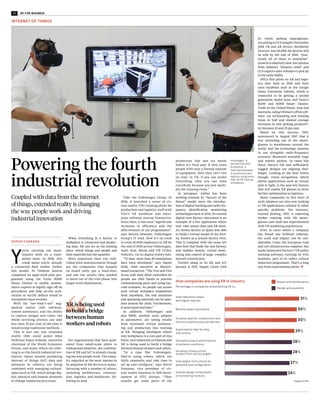
TO SUCCESSFUL XR0603 POWERING THE FOURTH
INDUSTRIAL REVOLUTION12
RACONTEUR.NET 03
/xr-business-2018
G
oogle Glass is going to
transform the world,
we were told five years
ago. The $1,500 (£1,160)
voice-activated, hands-free smart
spectacles would be as ubiquitous
and useful as smartphones.
Soon people realised that the real-
ity of Google Glass fell short of the
hype. In addition, it fulfilled no
use-case, was pricey, invaded pri-
vacy and was downright creepy. No
one batted an eyelid when Google
stopped selling the purportedly rev-
olutionary tech in 2015.
The bombastic entrance and
high-profile failure of Google Glass
is important, however, as it evolved
the concept of wearables and simul-
taneously elevated the barrier many
business leaders struggle to over-
come with new technologies.
Recent research shows that
C-suite executives are interested
in so-called extended reality (XR)
technologies, namely virtual, aug-
mented and mixed realities. Indeed,
analysts at Gartner predict that by
2019 some 20 per cent of large-enter-
prise businesses will have adopted
XR technologies.
Furthermore, managing director
of Accenture Technology, Maynard
Williams, reveals that according to
a 2018 study by his company: “Some
27 per cent of executives believe it is
very important for their organisa-
tions to be a pioneer in XR solutions.”
He says: “Making well-planned
forays into immersive experiences
now will help build the capabilities
needed to transform entire indus-
tries tomorrow.”
Business leaders can’t afford to
punt on potential, though; they seek
fully baked solutions that will make a
significant improvement today. Alas,
the Google Glass misstep is one of a
growing number of overhyped tech
products that have made corporate
decision-makers, among others, war-
ier about XR’s lofty promises, argues
Naji El-Arifi, head of innovation at
consultants Wunderman Commerce.
“Overall, the community is now
much more cautious of the tech-
nology due to Google Glass’s fail-
ures in approach. I feel most compa-
nies learnt from that and now take
things much more slowly,” says Mr
El-Arifi, while stressing the potency
of mature XR. “Understanding the
real and digital worlds, and bring-
ing them together seamlessly so they
can share the common reality, will be
the next big thing in B2B [business to
business] and B2C [business to con-
sumer]. It will also take the disrup-
tor crown away from mobile.”
Is the gulf between expectation
and reality widening, and is that
harming the long-term chance of
XR technologies triumphing?
Karl Maddix, co-founder and
chief executive of VR software
development company Masters of
Pie, believes there is often still too
much untruthful marketing in this
space. “It is easy to make people
excited with scenarios of XR rev-
olutionising our lives in the near
future, supported by captivating
mock-ups and videos of perfect vir-
tual environments, but this is often
lacking substance; all flash and no
Gordon,” he says.
“The hype they generate does help
when it comes to attracting inves-
tors and making potential end-users
excited enough to initiate a conver-
sation. But that conversation needs
to be grounded in reality, with peo-
ple who are on the front line and
are interested in building solutions,
and not just showing how visionary
they are.”
Jeremy Dalton, head of VR/AR
at PwC, contests that the ballyhoo
around XR is “partly the result of a
lack of understanding of the tech-
nology”. He continues: “Ultimately,
this stems from a minimal experi-
ence that is then used to build a view
on all areas of the technology, lead-
ing to many misconceptions about
the value of XR.
“It’s the kind of technology that
has to be tried before being under-
stood; in many cases we see, expec-
tations are exceeded as it’s diffi-
cult to describe in words what is
ultimately a very visual and immer-
sive experience.”
Richard Das, senior manager at
Deloitte Digital, agrees. “As the say-
ing goes, if you judge a fish by its
ability to climb a tree, you’ll be dis-
appointed,” he says. “Because we
bring many of our preconceptions
to the table of what tech is, it’s hard
to measure expectations of what it
could be.”
Dr Karen Correia da Silva, senior
social scientist at consumer behav-
iour specialists Canvas8, points
out that Google Glass is succeed-
ing in the B2B space. “An adapted
version is thriving in US facto-
ries,” she says. “At DHL, employ-
ees used Glass to streamline the
package-picking process, improv-
ing efficiency by 15 per cent. Google
tried jumping all the way to the cus-
tomer applications when the prod-
uct and tech perhaps weren’t quite
there. But when it shifted its focus
to a place that could get value out of
the technology as it was at the time,
it succeeded.”
The dearth of XR use-cases is
a worry, though it is expected to
improve before long. “Limited soft-
ware or applications will always
restrict demand, or kill the hype,
for a technically sound product,”
says Mark Bates, general man-
ager of Hire Intelligence, a B2B
rental organisation that has seen
a 394 per cent increase in XR
hardware inquires in the last
two years.
“The power and potential of XR is
strong, but the loop must be closed
between industry needs, hardware
capability and application devel-
opment. Once applications are rel-
evant, senior personnel in industry
will trial the tech and then word of
mouth about the quality of experi-
ence will drive greater adoption.”
For Rebecca Gregory-Clarke,
head of immersive technology at
Digital Catapult, it is clear that
business leaders have to look past
the hype and focus on matur-
ing XR. She concludes: “For those
looking to take full advantage of
immersive technology, it’s impor-
tant to get involved now to be
well positioned to take maximum
advantage once the technology has
fully evolved. We’re currently in
the ‘black-and-white TV’ era of XR,
a nascent version of a now-ubiqui-
tous technology.”
Grounding tech in
extended reality
XR FOR BUSINESS
@raconteur /raconteur.net @raconteur_london
The significant potential of reality technologies
should not be lost in past hype and disappointment
STEPHENARMSTRONG
Contributor to The Sunday
Times, Monocle, Wallpaper*
and GQ, he is also an
occasional broadcaster
on BBC Radio.
SOPHIE CHARARA
Associate editor at The
AmbientandWareable, she
is also a freelance writer
on technology and pop
culture, with bylines in
Stuff,WIREDand Forbes.
ANNA CODREA-RADO
Freelance culture and
technology journalist, her
work has been published in
The New York Times, The
Guardian and WIRED.
NICK EASEN
Award-winning freelance
journalist and broadcaster,
he produces for BBC
World News, and writeson
business,economics,science,
technologyandtravel.
OLIVER PICKUP
Award-winning
journalist, he specialises
in technology, business
and sport, and
contributes to a wide
range of publications.
EMMA
WOOLLACOTT
Specialist technology
writer, she covers legal and
regulatory issues, and has
contributed to Forbes and
the New Statesman.
Distributed in
OLIVER PICKUP
Distributed in association with
CONTRIBUTORS
TimothyFadek/CorbisviaGettyImages
DEVELOPMENT
Publishing manager
Frank Monaghan
Digital content executive
Fran Cassidy
Head of production
Justyna O'Connell
Design
Joanna Bird
Grant Chapman
Sara Gelfgren
Kellie Jerrard
Samuele Motta
Head of design
Tim Whitlock
Production editor
Benjamin Chiou
Managing editor
Peter Archer
Although this publication is funded through advertising and
sponsorship, all editorial is without bias and sponsored features
are clearly labelled. For an upcoming schedule, partnership
inquiries or feedback, please call +44 (0)20 3877 3800 or
email info@raconteur.net
Raconteur is a leading publisher of special-interest content and
research. Its publications and articles cover a wide range of topics,
including business, finance, sustainability, healthcare, lifestyle and
technology. Raconteur special reports are published exclusively in
The Times and The Sunday Times as well as online at raconteur.net
The information contained in this publication has been obtained
from sources the Proprietors believe to be correct. However,
no legal liability can be accepted for any errors. No part of this
publication may be reproduced without the prior consent of the
Publisher. © Raconteur Media
raconteur.net
The original model
of Google Glass
failed to live up
to the hype
Bringing immersive
technology to business
info@makereal.co.uk
+44 (0)845 0178 777
Why not arrange to meet and learn more?
For over a decade, Make Real has been working with the
enterprise sector to design, develop and deploy mission
critical business applications.
We don’t hype specific technologies, we evangelise
the real benefits.
We believe in using the right tools to meet business
challenges and add value, whether it’s augmented reality,
virtual reality, simulation or serious games.
Top concerns about XR startups
Concerns startups hear from potential investors
Slow adoption
71%
Lack of an
established market
for the technology
67%
Untested
technology
18%
Perkins Coie 2018
RACONTEUR.NET 03
/xr-business-2018
G
oogle Glass is going to
transform the world,
we were told five years
ago. The $1,500 (£1,160)
voice-activated, hands-free smart
spectacles would be as ubiquitous
and useful as smartphones.
Soon people realised that the real-
ity of Google Glass fell short of the
hype. In addition, it fulfilled no
use-case, was pricey, invaded pri-
vacy and was downright creepy. No
one batted an eyelid when Google
stopped selling the purportedly rev-
olutionary tech in 2015.
The bombastic entrance and
high-profile failure of Google Glass
is important, however, as it evolved
the concept of wearables and simul-
taneously elevated the barrier many
business leaders struggle to over-
come with new technologies.
Recent research shows that
C-suite executives are interested
in so-called extended reality (XR)
technologies, namely virtual, aug-
mented and mixed realities. Indeed,
analysts at Gartner predict that by
2019 some 20 per cent of large-enter-
prise businesses will have adopted
XR technologies.
Furthermore, managing director
of Accenture Technology, Maynard
Williams, reveals that according to
a 2018 study by his company: “Some
27 per cent of executives believe it is
very important for their organisa-
tions to be a pioneer in XR solutions.”
He says: “Making well-planned
forays into immersive experiences
now will help build the capabilities
needed to transform entire indus-
tries tomorrow.”
Business leaders can’t afford to
punt on potential, though; they seek
fully baked solutions that will make a
significant improvement today. Alas,
the Google Glass misstep is one of a
growing number of overhyped tech
products that have made corporate
decision-makers, among others, war-
ier about XR’s lofty promises, argues
Naji El-Arifi, head of innovation at
consultants Wunderman Commerce.
“Overall, the community is now
much more cautious of the tech-
nology due to Google Glass’s fail-
ures in approach. I feel most compa-
nies learnt from that and now take
things much more slowly,” says Mr
El-Arifi, while stressing the potency
of mature XR. “Understanding the
real and digital worlds, and bring-
ing them together seamlessly so they
can share the common reality, will be
the next big thing in B2B [business to
business] and B2C [business to con-
sumer]. It will also take the disrup-
tor crown away from mobile.”
Is the gulf between expectation
and reality widening, and is that
harming the long-term chance of
XR technologies triumphing?
Karl Maddix, co-founder and
chief executive of VR software
development company Masters of
Pie, believes there is often still too
much untruthful marketing in this
space. “It is easy to make people
excited with scenarios of XR rev-
olutionising our lives in the near
future, supported by captivating
mock-ups and videos of perfect vir-
tual environments, but this is often
lacking substance; all flash and no
Gordon,” he says.
“The hype they generate does help
when it comes to attracting inves-
tors and making potential end-users
excited enough to initiate a conver-
sation. But that conversation needs
to be grounded in reality, with peo-
ple who are on the front line and
are interested in building solutions,
and not just showing how visionary
they are.”
Jeremy Dalton, head of VR/AR
at PwC, contests that the ballyhoo
around XR is “partly the result of a
lack of understanding of the tech-
nology”. He continues: “Ultimately,
this stems from a minimal experi-
ence that is then used to build a view
on all areas of the technology, lead-
ing to many misconceptions about
the value of XR.
“It’s the kind of technology that
has to be tried before being under-
stood; in many cases we see, expec-
tations are exceeded as it’s diffi-
cult to describe in words what is
ultimately a very visual and immer-
sive experience.”
Richard Das, senior manager at
Deloitte Digital, agrees. “As the say-
ing goes, if you judge a fish by its
ability to climb a tree, you’ll be dis-
appointed,” he says. “Because we
bring many of our preconceptions
to the table of what tech is, it’s hard
to measure expectations of what it
could be.”
Dr Karen Correia da Silva, senior
social scientist at consumer behav-
iour specialists Canvas8, points
out that Google Glass is succeed-
ing in the B2B space. “An adapted
version is thriving in US facto-
ries,” she says. “At DHL, employ-
ees used Glass to streamline the
package-picking process, improv-
ing efficiency by 15 per cent. Google
tried jumping all the way to the cus-
tomer applications when the prod-
uct and tech perhaps weren’t quite
there. But when it shifted its focus
to a place that could get value out of
the technology as it was at the time,
it succeeded.”
The dearth of XR use-cases is
a worry, though it is expected to
improve before long. “Limited soft-
ware or applications will always
restrict demand, or kill the hype,
for a technically sound product,”
says Mark Bates, general man-
ager of Hire Intelligence, a B2B
rental organisation that has seen
a 394 per cent increase in XR
hardware inquires in the last
two years.
“The power and potential of XR is
strong, but the loop must be closed
between industry needs, hardware
capability and application devel-
opment. Once applications are rel-
evant, senior personnel in industry
will trial the tech and then word of
mouth about the quality of experi-
ence will drive greater adoption.”
For Rebecca Gregory-Clarke,
head of immersive technology at
Digital Catapult, it is clear that
business leaders have to look past
the hype and focus on matur-
ing XR. She concludes: “For those
looking to take full advantage of
immersive technology, it’s impor-
tant to get involved now to be
well positioned to take maximum
advantage once the technology has
fully evolved. We’re currently in
the ‘black-and-white TV’ era of XR,
a nascent version of a now-ubiqui-
tous technology.”
Grounding tech in
extended reality
XR FOR BUSINESS
@raconteur /raconteur.net @raconteur_london
The significant potential of reality technologies
should not be lost in past hype and disappointment
STEPHENARMSTRONG
Contributor to The Sunday
Times, Monocle, Wallpaper*
and GQ, he is also an
occasional broadcaster
on BBC Radio.
SOPHIE CHARARA
Associate editor at The
AmbientandWareable, she
is also a freelance writer
on technology and pop
culture, with bylines in
Stuff,WIREDand Forbes.
ANNA CODREA-RADO
Freelance culture and
technology journalist, her
work has been published in
The New York Times, The
Guardian and WIRED.
NICK EASEN
Award-winning freelance
journalist and broadcaster,
he produces for BBC
World News, and writeson
business,economics,science,
technologyandtravel.
OLIVER PICKUP
Award-winning
journalist, he specialises
in technology, business
and sport, and
contributes to a wide
range of publications.
EMMA
WOOLLACOTT
Specialist technology
writer, she covers legal and
regulatory issues, and has
contributed to Forbes and
the New Statesman.
Distributed in
OLIVER PICKUP
Distributed in association with
CONTRIBUTORS
TimothyFadek/CorbisviaGettyImages
DEVELOPMENT
Publishing manager
Frank Monaghan
Digital content executive
Fran Cassidy
Head of production
Justyna O'Connell
Design
Joanna Bird
Grant Chapman
Sara Gelfgren
Kellie Jerrard
Samuele Motta
Head of design
Tim Whitlock
Production editor
Benjamin Chiou
Managing editor
Peter Archer
Although this publication is funded through advertising and
sponsorship, all editorial is without bias and sponsored features
are clearly labelled. For an upcoming schedule, partnership
inquiries or feedback, please call +44 (0)20 3877 3800 or
email info@raconteur.net
Raconteur is a leading publisher of special-interest content and
research. Its publications and articles cover a wide range of topics,
including business, finance, sustainability, healthcare, lifestyle and
technology. Raconteur special reports are published exclusively in
The Times and The Sunday Times as well as online at raconteur.net
The information contained in this publication has been obtained
from sources the Proprietors believe to be correct. However,
no legal liability can be accepted for any errors. No part of this
publication may be reproduced without the prior consent of the
Publisher. © Raconteur Media
raconteur.net
The original model
of Google Glass
failed to live up
to the hype
Bringing immersive
technology to business
info@makereal.co.uk
+44 (0)845 0178 777
Why not arrange to meet and learn more?
For over a decade, Make Real has been working with the
enterprise sector to design, develop and deploy mission
critical business applications.
We don’t hype specific technologies, we evangelise
the real benefits.
We believe in using the right tools to meet business
challenges and add value, whether it’s augmented reality,
virtual reality, simulation or serious games.
Top concerns about XR startups
Concerns startups hear from potential investors
Slow adoption
71%
Lack of an
established market
for the technology
67%
Untested
technology
18%
Perkins Coie 2018
04 RACONTEUR.NET 05XR FOR BUSINESS
N
obody wants to sink money
in a gimmick and there’s
often a good case to be
made for hanging back a
little to watch how well a new tech-
nology works out for early adopters.
However, there comes a time when
an innovation has proved its worth
and it’s important to recognise
when that point has been reached.
Whether it’s Eastman Kodak’s fail-
ure to invest in digital photography
or Blockbuster dismissing the idea of
streaming video, corporate history
is littered with examples of organi-
sations that simply missed the boat.
It’s hardly surprising that many
organisations have taken a sceptical
view of XR (extended reality), seeing
it perhaps as a consumer technology
that has no real place in the commer-
cial world.
However, this could be a big mis-
take. With investment pouring into
the area from the likes of Microsoft,
ODG and Meta, analysts see it as a
booming technology that’s set for
far more widespread adoption.
“Virtual reality (VR) and aug-
mented reality (AR) technologies
are developing rapidly, with proof
of concepts and production deploy-
ments laying solid foundations for
widespread business adoption,” says
Mark Lillie, global chief information
officer programme leader at Deloitte.
“One of the most startling things
about the current landscape is
that there are two extremes when
it comes to understanding. We
either get a client approaching
us who knows exactly what they
want, the context that it’s going
to be used in and the potential
benefits to their organisation. Or
we get clients who really have no
idea what they want, they just
know they need to be looking at
immersive technology for their
future competitiveness.”
BIS Research predicts that the mar-
ket for AR will rise from $3.48 billion
in 2017 to a staggering $198.17 billion
by 2025, a compound annual growth
rate of 65.1 per cent. The technology
can, it says in a recent report, be seen
as just as ground-breaking as the
development of personal computers
back in 1981.
And in a survey earlier this year,
technology industry association
CompTIA found that three quar-
ters of companies were aware of VR,
with one in five already having a VR/
AR initiative underway; just under a
quarter are piloting the technology.
“Truthfully, we’re seeing less and
less resistance from C-suite exec-
utives and decision-makers when
it comes to VR, AR and MR [mixed
reality], certainly in comparison
to even just three years ago,” says
Shaun Allan, chief XR officer at digi-
tal consultancy hedgehog lab.
Return on investment
in reality technologies
can be protracted,
such are the lengthy
development times
Face up to reality before it’s too late
RoI
EMMA WOOLLACOTT
SerrahGalosonUnsplash
Many organisations fail to
understand the amount of
time and money required
The most common current use of
XR is in employee training, cited by
62 per cent in the CompTIA survey,
with half of early adopters using XR in
customer engagements. Other early
uses include virtual meetings (47
per cent), research and development
simulations (45 per cent) and on-the-
job information, delivering informa-
tion to an employee while they are
engaged with a task (43 per cent).
James Burrows, technical director
at Immersive Studios, says his com-
pany’s clients are happy using VR in
these niches because there’s already
a wealth of successful case studies
making the value proposition clear.
“That doesn’t mean we’re not see-
ing new, novel or unusual briefs, but
certainly we have started noticing
certain consistent trends in the what,
where and when of VR/AR,” he says.
“This means clients who fall out-
side those parameters tend to be
more cautious, for the simple rea-
son there isn’t the same body of
proven success.”
However, hanging back may mean
missing the boat, as XR is not a tech-
nology that can be implemented
overnight, and many organisations
failtounderstandtheamountoftime
and money required. Generating
content is comparable to producing a
video game; it’s time consuming and
requires highly skilled professionals.
“Clients have had a good ten years
of getting a handle on average budg-
ets for more traditional apps and web-
based projects, but suddenly those
assumptions go out of the window
when you add an AR or VR element
into the project,” says Mr Burrows.
“We’re only now getting to the
point where clients are starting to
understand the level of work which
goes into producing these sorts of
experiences and are planning these
sorts of amounts into their budgets.”
This high cost applies even in
the proof-of-concept (PoC) stage.
“Firms should work with the sup-
plier to scope the PoC so it fits their
budget and objective," says Jim
Tramontana, senior product man-
ager at Honeywell Process Solutions.
“Toooften,companiestrytovalidate
the technology by testing the entire
scope of the implementation. This
results in firms finding the PoC itself
too expensive and lengthy, meaning
results are difficult to validate.”
However, for those organisations
that are prepared to take the risk
and make the necessary investment,
the rewards can be significant.
According to a recent report from
the Capgemini Research Institute,
82 per cent of companies currently
implementing AR/VR say the bene-
fits are either meeting or exceeding
their expectations.
Indeed, efficiency improvements
mean that three quarters of compa-
nies with large-scale implementa-
tions say they’re seeing operational
benefits of more than 10 per cent.
Last year, for example, KFC intro-
duced a VR training simulation to
teach its “secret recipe” for prepar-
ing chicken. Using the simulation,
trainees were able to master the five
steps of making fried chicken in ten
minutes, compared with twenty five
minutes for conventional teaching.
Meanwhile, Boeing cut the time
engineers needed for wiring pro-
duction time by 25 per cent, after
replacing assembly manuals with
smartglasses displays.
“For businesses that are still ret-
icent about immersive technol-
ogy, we usually counter with the
same argument, no matter what the
industry. That is if they don’t start
looking at this now, they’re dead
in the water because one or more
of their competitors will be,” says
hedgehog lab’s Mr Allan.
“Simply put, if they don’t at least
dip their toe and have a go, they’re
going to be playing catch-up with
their competitors soon enough.”CompTIA 2017
Current state of XR adoption
XR initiative
already
underway
21%
Experimenting/
piloting with XR
23%
Planning to have XR
initiative in next year
18%
No current
plans/not sure
39%
Ways XR is used by early adopters
Employee
training
62%
Customer
engagement
50%
Virtual
meetings
47%
Simulation
in R&D
45%
On-the-job
information
43%
Commercial feature
S
ince Bryn Mooser co-founded
immersive media company
RYOT in 2012, the studio has
been pushing the boundaries
of what can be produced with VR and
AR. The idea of the company goes
back to the time he spent in Haiti’s
capital city Port-au-Prince, after the
devastating earthquake of 2010.
“I moved down to build a high
school and when I was there I met
my co-founder David Darg. We were
both film-makers who had an inter-
est in humanitarian work and we
started making films there,” explains
Mr Mooser.
It was very clear to him that the
global view of Haiti was cynical and
many people felt like there was noth-
ing they could do about global prob-
lems, but as technology advanced
and connected people around
the world through social media,
there was no longer any excuse to
do nothing.
“RYOT started as a news website
with a function where every story
had an action, so when you read
about something in the world, you
could actually do something about it,
whether it be to sign a petition, vol-
unteer or donate,” says Mr Mooser.
From creating the world’s first all-VR
film in a war zone with Welcome to
Aleppo to the first in natural disas-
ter VR with The Nepal Project, RYOT’s
work is now defining what is possible
in a fully VR world.
“My mission has always been how
do we use technology to try and
make the world a better place?
We began to experiment with new
technologies to tell stories and we
found our perfect medium with VR,”
explains Mr Mooser.
RYOT quickly made a name for
itself as the go-to VR firm for news
and documentaries, and developed
VR content for high-profile com-
panies, including The Associated
Press, HuffPost and The New York
Times. Today RYOT is focused
on building what the future of
content and media will look like in a
5G world.
“What will a movie or TV show look
like in 5G and how will you watch
content in the back of your driver-
less car when it’s enabled with 5G?
We believe 5G is ushering in the
fourth industrial revolution; it’s like
nothing that has come before and
it will create major disruptions in all
industries, from mobility to health to
technology,” says Mr Mooser.
Super-fast 5G internet will not only
offer mobile users more stable con-
nections and low latency, but this
game-changing innovation is set to
unlock exciting new types of expe-
riences. “We are focused on how
to help build and enable the prod-
ucts of the future, so the consumers
of tomorrow can’t live without 5G,”
says Mr Mooser.
Transitioning to a more AR-friendly
digital environment may not be the
leap many consumers expect it to
be. For example, although few users
will be fully aware of the underlying
AR technology, every time face fil-
ters are used in popular social media
apps, they will be becoming more
comfortable with AR applications.
Businesses are building new prod-
ucts and services that are going to
enable consumers and businesses
alike to do things they never dreamed
possible via 5G. “It’s not enough to
just have lower latency and better
download speeds. The 5G solutions
that leverage those benefits could
be amazing. But is that enough to get
somebody to switch phones? I don’t
know,” says Mr Mooser.
Ideas that were once based in sci-
ence fiction are on course to become
increasingly feasible thanks to the
power of 5G. Driverless cars will
be able to communicate with each
other driving down the road and the
near real-time rendering of items in
AR can be wholly achieved.
“We’re at the tipping point right
now and we’re looking at how to
bring forward-thinking companies
on to the bleeding edge of technol-
ogy, and use that technology to tell
stories in a new way and capture a
new audience,” says Mr Mooser.
If companies want to remain at the
top of their market, it’s no longer
possible for them to gloss over AR/
VR technologies and 5G-enabled
services, as the impact of these
solutions will mean every industry
is about to experience a dramatic
disruption. A fully 5G-enabled world
will fundamentally change the enter-
tainment experience for viewers, in
part thanks to the ability of advanced
computing in the cloud.
Mr Mooser believes leaders will
approach 5G in one of two ways.
“Either they’re going to take con-
trol of the tremendous opportunity
to lead into the future or get left
behind, which if you look at histori-
cal trends, is what happens to many,”
he says.
In an age of disruptive startups that
have the power to transform entire
industries through the use of new
technologies, it’s now up to busi-
nesses to make sure they are inno-
vating fast with the right partners.
Mr Mooser concludes: “From a
business perspective, there has
never been a more exciting time.”
For further information please visit
www.ryot.org
RYOT is focused on building
what the future of content
and media will look like in
a 5G world
Bryn Mooser
Founder, RYOT
5G coming of age
Virtual reality (VR) and augmented reality (AR) clearly have
the potential to change dramatically how we perceive the
world around us. But much more work has to be done
for these technologies to move from their current
limited phase to become a truly transformative power
and revolutionise how content is consumed
04 RACONTEUR.NET 05XR FOR BUSINESS
N
obody wants to sink money
in a gimmick and there’s
often a good case to be
made for hanging back a
little to watch how well a new tech-
nology works out for early adopters.
However, there comes a time when
an innovation has proved its worth
and it’s important to recognise
when that point has been reached.
Whether it’s Eastman Kodak’s fail-
ure to invest in digital photography
or Blockbuster dismissing the idea of
streaming video, corporate history
is littered with examples of organi-
sations that simply missed the boat.
It’s hardly surprising that many
organisations have taken a sceptical
view of XR (extended reality), seeing
it perhaps as a consumer technology
that has no real place in the commer-
cial world.
However, this could be a big mis-
take. With investment pouring into
the area from the likes of Microsoft,
ODG and Meta, analysts see it as a
booming technology that’s set for
far more widespread adoption.
“Virtual reality (VR) and aug-
mented reality (AR) technologies
are developing rapidly, with proof
of concepts and production deploy-
ments laying solid foundations for
widespread business adoption,” says
Mark Lillie, global chief information
officer programme leader at Deloitte.
“One of the most startling things
about the current landscape is
that there are two extremes when
it comes to understanding. We
either get a client approaching
us who knows exactly what they
want, the context that it’s going
to be used in and the potential
benefits to their organisation. Or
we get clients who really have no
idea what they want, they just
know they need to be looking at
immersive technology for their
future competitiveness.”
BIS Research predicts that the mar-
ket for AR will rise from $3.48 billion
in 2017 to a staggering $198.17 billion
by 2025, a compound annual growth
rate of 65.1 per cent. The technology
can, it says in a recent report, be seen
as just as ground-breaking as the
development of personal computers
back in 1981.
And in a survey earlier this year,
technology industry association
CompTIA found that three quar-
ters of companies were aware of VR,
with one in five already having a VR/
AR initiative underway; just under a
quarter are piloting the technology.
“Truthfully, we’re seeing less and
less resistance from C-suite exec-
utives and decision-makers when
it comes to VR, AR and MR [mixed
reality], certainly in comparison
to even just three years ago,” says
Shaun Allan, chief XR officer at digi-
tal consultancy hedgehog lab.
Return on investment
in reality technologies
can be protracted,
such are the lengthy
development times
Face up to reality before it’s too late
RoI
EMMA WOOLLACOTT
SerrahGalosonUnsplash
Many organisations fail to
understand the amount of
time and money required
The most common current use of
XR is in employee training, cited by
62 per cent in the CompTIA survey,
with half of early adopters using XR in
customer engagements. Other early
uses include virtual meetings (47
per cent), research and development
simulations (45 per cent) and on-the-
job information, delivering informa-
tion to an employee while they are
engaged with a task (43 per cent).
James Burrows, technical director
at Immersive Studios, says his com-
pany’s clients are happy using VR in
these niches because there’s already
a wealth of successful case studies
making the value proposition clear.
“That doesn’t mean we’re not see-
ing new, novel or unusual briefs, but
certainly we have started noticing
certain consistent trends in the what,
where and when of VR/AR,” he says.
“This means clients who fall out-
side those parameters tend to be
more cautious, for the simple rea-
son there isn’t the same body of
proven success.”
However, hanging back may mean
missing the boat, as XR is not a tech-
nology that can be implemented
overnight, and many organisations
failtounderstandtheamountoftime
and money required. Generating
content is comparable to producing a
video game; it’s time consuming and
requires highly skilled professionals.
“Clients have had a good ten years
of getting a handle on average budg-
ets for more traditional apps and web-
based projects, but suddenly those
assumptions go out of the window
when you add an AR or VR element
into the project,” says Mr Burrows.
“We’re only now getting to the
point where clients are starting to
understand the level of work which
goes into producing these sorts of
experiences and are planning these
sorts of amounts into their budgets.”
This high cost applies even in
the proof-of-concept (PoC) stage.
“Firms should work with the sup-
plier to scope the PoC so it fits their
budget and objective," says Jim
Tramontana, senior product man-
ager at Honeywell Process Solutions.
“Toooften,companiestrytovalidate
the technology by testing the entire
scope of the implementation. This
results in firms finding the PoC itself
too expensive and lengthy, meaning
results are difficult to validate.”
However, for those organisations
that are prepared to take the risk
and make the necessary investment,
the rewards can be significant.
According to a recent report from
the Capgemini Research Institute,
82 per cent of companies currently
implementing AR/VR say the bene-
fits are either meeting or exceeding
their expectations.
Indeed, efficiency improvements
mean that three quarters of compa-
nies with large-scale implementa-
tions say they’re seeing operational
benefits of more than 10 per cent.
Last year, for example, KFC intro-
duced a VR training simulation to
teach its “secret recipe” for prepar-
ing chicken. Using the simulation,
trainees were able to master the five
steps of making fried chicken in ten
minutes, compared with twenty five
minutes for conventional teaching.
Meanwhile, Boeing cut the time
engineers needed for wiring pro-
duction time by 25 per cent, after
replacing assembly manuals with
smartglasses displays.
“For businesses that are still ret-
icent about immersive technol-
ogy, we usually counter with the
same argument, no matter what the
industry. That is if they don’t start
looking at this now, they’re dead
in the water because one or more
of their competitors will be,” says
hedgehog lab’s Mr Allan.
“Simply put, if they don’t at least
dip their toe and have a go, they’re
going to be playing catch-up with
their competitors soon enough.”CompTIA 2017
Current state of XR adoption
XR initiative
already
underway
21%
Experimenting/
piloting with XR
23%
Planning to have XR
initiative in next year
18%
No current
plans/not sure
39%
Ways XR is used by early adopters
Employee
training
62%
Customer
engagement
50%
Virtual
meetings
47%
Simulation
in R&D
45%
On-the-job
information
43%
Commercial feature
S
ince Bryn Mooser co-founded
immersive media company
RYOT in 2012, the studio has
been pushing the boundaries
of what can be produced with VR and
AR. The idea of the company goes
back to the time he spent in Haiti’s
capital city Port-au-Prince, after the
devastating earthquake of 2010.
“I moved down to build a high
school and when I was there I met
my co-founder David Darg. We were
both film-makers who had an inter-
est in humanitarian work and we
started making films there,” explains
Mr Mooser.
It was very clear to him that the
global view of Haiti was cynical and
many people felt like there was noth-
ing they could do about global prob-
lems, but as technology advanced
and connected people around
the world through social media,
there was no longer any excuse to
do nothing.
“RYOT started as a news website
with a function where every story
had an action, so when you read
about something in the world, you
could actually do something about it,
whether it be to sign a petition, vol-
unteer or donate,” says Mr Mooser.
From creating the world’s first all-VR
film in a war zone with Welcome to
Aleppo to the first in natural disas-
ter VR with The Nepal Project, RYOT’s
work is now defining what is possible
in a fully VR world.
“My mission has always been how
do we use technology to try and
make the world a better place?
We began to experiment with new
technologies to tell stories and we
found our perfect medium with VR,”
explains Mr Mooser.
RYOT quickly made a name for
itself as the go-to VR firm for news
and documentaries, and developed
VR content for high-profile com-
panies, including The Associated
Press, HuffPost and The New York
Times. Today RYOT is focused
on building what the future of
content and media will look like in a
5G world.
“What will a movie or TV show look
like in 5G and how will you watch
content in the back of your driver-
less car when it’s enabled with 5G?
We believe 5G is ushering in the
fourth industrial revolution; it’s like
nothing that has come before and
it will create major disruptions in all
industries, from mobility to health to
technology,” says Mr Mooser.
Super-fast 5G internet will not only
offer mobile users more stable con-
nections and low latency, but this
game-changing innovation is set to
unlock exciting new types of expe-
riences. “We are focused on how
to help build and enable the prod-
ucts of the future, so the consumers
of tomorrow can’t live without 5G,”
says Mr Mooser.
Transitioning to a more AR-friendly
digital environment may not be the
leap many consumers expect it to
be. For example, although few users
will be fully aware of the underlying
AR technology, every time face fil-
ters are used in popular social media
apps, they will be becoming more
comfortable with AR applications.
Businesses are building new prod-
ucts and services that are going to
enable consumers and businesses
alike to do things they never dreamed
possible via 5G. “It’s not enough to
just have lower latency and better
download speeds. The 5G solutions
that leverage those benefits could
be amazing. But is that enough to get
somebody to switch phones? I don’t
know,” says Mr Mooser.
Ideas that were once based in sci-
ence fiction are on course to become
increasingly feasible thanks to the
power of 5G. Driverless cars will
be able to communicate with each
other driving down the road and the
near real-time rendering of items in
AR can be wholly achieved.
“We’re at the tipping point right
now and we’re looking at how to
bring forward-thinking companies
on to the bleeding edge of technol-
ogy, and use that technology to tell
stories in a new way and capture a
new audience,” says Mr Mooser.
If companies want to remain at the
top of their market, it’s no longer
possible for them to gloss over AR/
VR technologies and 5G-enabled
services, as the impact of these
solutions will mean every industry
is about to experience a dramatic
disruption. A fully 5G-enabled world
will fundamentally change the enter-
tainment experience for viewers, in
part thanks to the ability of advanced
computing in the cloud.
Mr Mooser believes leaders will
approach 5G in one of two ways.
“Either they’re going to take con-
trol of the tremendous opportunity
to lead into the future or get left
behind, which if you look at histori-
cal trends, is what happens to many,”
he says.
In an age of disruptive startups that
have the power to transform entire
industries through the use of new
technologies, it’s now up to busi-
nesses to make sure they are inno-
vating fast with the right partners.
Mr Mooser concludes: “From a
business perspective, there has
never been a more exciting time.”
For further information please visit
www.ryot.org
RYOT is focused on building
what the future of content
and media will look like in
a 5G world
Bryn Mooser
Founder, RYOT
5G coming of age
Virtual reality (VR) and augmented reality (AR) clearly have
the potential to change dramatically how we perceive the
world around us. But much more work has to be done
for these technologies to move from their current
limited phase to become a truly transformative power
and revolutionise how content is consumed
06 RACONTEUR.NET 07XR FOR BUSINESS
No standardisation
“There are more than eight different
VR/AR platforms that developers
work on, with no clear leader in sight
and no concerted effort towards
standardisation,” explains Thanos
Malevitis, Accenture Strategy’s
managing director for technology,
communications and media. “Major
platform companies with advanced
software, hardware and content
capabilities may be able to go it
alone by taking advantage of ‘win-
ner takes most’ platform dynamics,
but others will need to work together
in robust ecosystems to overcome
Hardware
Currently VR and AR headsets
are bulky and expensive, tethered
to specific platforms and unable
to display realistic pictures. This
has alienated consumers and hin-
dered the development of busi-
ness-to-consumer XR. Again, AR
is performing better than VR in
this area. Solomon Rogers, founder
and chief executive of immersive
content specialist Rewind, cites
German lift manufacturer Thyssen,
which has deployed mixed reality
HoloLens for its technicians as it
“has so many different models of
lift that not every technician knows
every lift”. He explains: “They can
No optimisation
Software and devices used across
industries will have to be opti-
mised for 3D experiences, explains
Accenture Strategy’s Mr Malevitis.
According to the XR Industry Survey
2018, potential adopters are deterred
by the lack of proof of return on
investment, and the challenge of
integrating the technology with
existing systems and processes.
“In most cases the benefit of XR is
measured on user experience, which
is difficult to quantify and compare
against costly software and device
investment,” Mr Malevitis explains.
“Unlike cloud-based solutions or
analytics and machine-learning,
the business case is less tangible.”
To overcome this, Amazon’s
Sumerian, Google Blocks and Adobe
Aero, among others, offer build-
ing-block technologies, tools to
Limited content
For consumers, lack of content has
proved a huge problem. “Oculus
Rift rushed into its huge investment
in hardware, but when the head-
set launched, there was almost no
content,” says Rewind’s Mr Rogers.
“Oculus is spending $0.5 billion
into content, but the killer app isn’t
clear. There are only a few compa-
nies right now that know how to
make good XR content and, for pro-
fessional developers, it may not be
worth their time or budget relative
to the installed base.”
Mr Rogers believes AR, which
overlays virtual images on to the
real world, as with 2016 sensation
Pokémon Go, is likely to spread
faster than VR in business to con-
sumer thanks to its ease of use
and existing content. “There is
the lack of standards and realise the
full potential of their investments.”
There is an OpenXR initiative
from the likes of Oculus, Vale,
Unity, Epic, Samsung, Magic Leap
and Google, among others, which
aims to develop a cross-platform VR
standard so applications only need
to be written once to run on any VR
system. Until the standard is in the
market, purchasing decisions on XR
may be held up.
look at a lift and navigate fixing it
with a feed back to base.”
Although in a market with no
clearly defined leader, even Microsoft
HoloLens has issues with convenience
andpricetag,whichlowersthechances
for widespread corporate use, accord-
ingtoAndrewMakarov,headofmobile
development at MobiDev. The answer
might be right under our noses as
mobilephonesareprovingsuccessfulat
deliveringAR,althoughwithVRthey’re
lessconsistent.
Ironically, there’s already evidence
that the smartphone itself will dis-
appear as XR spreads. In the future,
phones will be smart wearables, like
earbuds that have biometric sensors
and speakers, or rings and bracelets
that can sense motion, and glasses
that record and display information,
according to Amy Webb, founder of
the Future Today Institute.
build XR experiences through drag-
and-drop assets. An early proto-
type built on Sumerian by Fidelity
Labs involves a repurposed 3D vir-
tual persona, or host, that pro-
vides voice-guided visualisation for
investment data.
“Virtual hosts are probably the big-
gest building block of Sumerian that’s
obvious right now,” says Amazon
Sumerian’s general manager Kyle
Roche. “Having a character you can
make eye contact with, set up in the
same way you’d set up an Alexa skill,
just drag and drop in a browser, is very
attractive for some customers. You
don’t need specialised programming
or 3D graphics expertise.”
Mr Rogers at Rewind concludes: “In
the long run, everything will be fine.
The problem with the tech indus-
try is that we’re always washing our
laundry in public; no one has time to
develop well, so they ship alpha and
beta versions for testing which fail
fast and often. That’s good product
design, but tough when you’re trying
to convince the public.”
a sense that businesses are look-
ing for use-cases; IKEA has a fur-
niture app that’s brilliant. I can
put chairs in every corner of my
room,” he says. “But that’s not
enough of an incentive for a con-
sumer to invest.”
The forthcoming Harry Potter
Wizards Unite AR game, in which
players find objects, fight each
other or unite to defeat monsters,
will be an important demonstration
of potential.
“Microsoft’s HoloLens is work-
ing with developer Black Marble
on truServe, a scene of crime
investigation app,” says Mr
Rogers. “It allows you to over-
lay clues, keep track of what you
know and place virtual markers
or gather multimedia evidence
without disturbing the physical
scene and potentially tainting
evidence. It’s a little like a crime
scene investigation game, so as
developers see what Harry Potter
can do, they will take inspiration
for business uses.”
Different design language
This is film-maker Sir Ridley Scott’s
problem: when the eye isn’t targeted
to just a small range of viewing,
but can rotate 360 degrees, design-
ers have to adapt to an entirely new
way of creating things. Designers
need to get a 3D game engine, learn
how to sculpt, animate and rig com-
plex things when they actually want
something that’s easy to use in a
familiar environment.
“It’s about internal buy-in,” says
Gareth Coombes from the Cambridge
Strategy Centre. “People don’t like
change. Innovation tech companies
have to find internal stakeholders to
prove they have to spend some money
to make some money.”
What are the main barriers to adopting extended
reality and how can you overcome them?
Five obstacles to leap
for successful XR
BARRIERS TO ADOPTION
STEPHEN ARMSTRONG
Commercial feature
T
he potential application of vir-
tual and cross reality in enter-
prise is enormous, particularly
when visual and engaging expe-
riences clinch sales.
As a result, the real estate industry
will see some of the biggest growth in
its use, given its need to demonstrate
what properties will be like to walk
aroundandlivein,beforetheyarebuilt.
Its normal practice remains remark-
ably low tech, with sellers promoting
properties with glossy brochures and
generally quite basic information. The
same is true for architects and inte-
rior designers wanting to demonstrate
their ideas much better.
The latest VR and XR systems enable
potential customers to view and take a
virtual look around developments inter-
actively, and they can be anywhere in
the world while they are doing so.
“The traditional way of promoting
new luxury properties in different
locations is that the builder will go
out and conduct roadshows, one in
the United States, one in Singapore,
and around the world. So you have
people carrying brochures or models,
trying hard to convey what it will really
be like,” explains Shailesh Goswami
(Gosu), founder and chief executive
of FOYR, which creates VR and XR sys-
tems for the industry.
“Building firms can use our technol-
ogy to share links to virtual experiences.
There are no headsets and there’s no
special technology; everyone can see
what the new property will actually be
like using their normal devices.”
VR and XR becoming
affordable reality
for all real estate
Virtual and cross reality systems are yet to go truly mainstream outside
computer gaming, but that could soon change as the platforms
become open to developers, architects and interior designers
FOYR’s systems are available on
any web browser or smartphone,
and they are designed to be inter-
active and intuitive. Typically, archi-
tects, interior designers or property
developers would have found it com-
plicated and expensive to present a
virtual reality experience to a cus-
tomer, but with the new technology,
the experiences can be easily rolled
out from their designs, automatically
rendered for low-power devices.
A crucial element of making this
effective is a focus on transferring
content from legacy software already
in use by architecture, design or prop-
erty development firms, so they are
not obliged to start from scratch.
Integrating pertinent data is also a
key part of the process, with end-us-
ers able to request real-world details
about specific properties or designs
they are encountering virtually.
“Our aim is to simplify and democ-
ratise virtual experience creation,”
says Mr Goswami. “Part of that is about
making it extremely easy for people
to use. We want to make it possible
for anyone to create and offer virtual
designs and experiences very quickly.”
For FOYR, there is a dual focus on
making platforms as easy to use as pos-
sible, while also making them powerful
enough to be relied upon for demon-
strating quality design in detail. To this
end, the integration of artificial intelli-
gence has become vital because it can
be used routinely and automatically to
resolve any experience issues, as well
as recognising existing complex char-
acteristics on any design project for
faster rendering.
For the growth of VR and XR as a
whole, Mr Goswami views the wider
reliance on specially designed head-
sets as a lingering hindrance. Making
VR experiences available via browsers
and smartphones will go a long way
towards democratising the processes
across sectors.
“I still think it’s going to be a couple of
years before some of these alternatives
become really widespread,” he says.
“Until then our work is to simplify the
whole VR and virtual experience cre-
ation process and make it so that you
can write the code. To sell property
designs or other experiential products,
you have to have powerful VR that runs
on everyone’s normal devices.”
To find out more about simple and
accessible VR and XR in real estate and
interior design please visit foyr.com
Our aim is to simplify
and democratise
virtual experience
creation
B
ack in 2015, film director
Sir Ridley Scott was over-
seeing the The Man in the
High Castle for Amazon
and Ryan Gosling in the Blade
Runner sequel. Sir Ridley has
always experimented with new
technologies – he was an early sup-
plier to Amazon’s streaming ser-
vice – and decided to take a look
at virtual reality (VR) as a possible
creative medium.
“The problems were complex,” he
explained shortly afterwards. “It’s
hard to focus on a story when you
have infinite choices, and fast cut-
ting and editing make people feel
queasy. I’m not sure it’s the best sto-
rytelling medium.”
The following year, there was a
rush into VR from games compa-
nies, documentary makers and art-
ists, but since then, VR penetra-
tion has slowed down. There are
signs, however, that extended real-
ity (XR) – VR and its more accessi-
ble cousins augmented reality (AR)
and augmented virtuality – could
find a more natural home in the
business world.
Accenture’s Technology Vision
2018 survey found that more than
80 per cent of executives believe
XR will create a new way for com-
panies to interact, communi-
cate and inform, while 27 per cent
say it is very important for their
organisations to be a pioneer in
XR solutions.
And yet growth has been slow for
both. “The consumer sector and
the enterprise sector have experi-
enced similar amounts of growth,
but the majority consensus is that
this growth has been weaker than
hoped for consumers category,”
according to Simon Portman,
technology lawyer at Marks &
Clerk. So what are the five biggest
barriers to entry and how easy are
they to overcome?
06 RACONTEUR.NET 07XR FOR BUSINESS
No standardisation
“There are more than eight different
VR/AR platforms that developers
work on, with no clear leader in sight
and no concerted effort towards
standardisation,” explains Thanos
Malevitis, Accenture Strategy’s
managing director for technology,
communications and media. “Major
platform companies with advanced
software, hardware and content
capabilities may be able to go it
alone by taking advantage of ‘win-
ner takes most’ platform dynamics,
but others will need to work together
in robust ecosystems to overcome
Hardware
Currently VR and AR headsets
are bulky and expensive, tethered
to specific platforms and unable
to display realistic pictures. This
has alienated consumers and hin-
dered the development of busi-
ness-to-consumer XR. Again, AR
is performing better than VR in
this area. Solomon Rogers, founder
and chief executive of immersive
content specialist Rewind, cites
German lift manufacturer Thyssen,
which has deployed mixed reality
HoloLens for its technicians as it
“has so many different models of
lift that not every technician knows
every lift”. He explains: “They can
No optimisation
Software and devices used across
industries will have to be opti-
mised for 3D experiences, explains
Accenture Strategy’s Mr Malevitis.
According to the XR Industry Survey
2018, potential adopters are deterred
by the lack of proof of return on
investment, and the challenge of
integrating the technology with
existing systems and processes.
“In most cases the benefit of XR is
measured on user experience, which
is difficult to quantify and compare
against costly software and device
investment,” Mr Malevitis explains.
“Unlike cloud-based solutions or
analytics and machine-learning,
the business case is less tangible.”
To overcome this, Amazon’s
Sumerian, Google Blocks and Adobe
Aero, among others, offer build-
ing-block technologies, tools to
Limited content
For consumers, lack of content has
proved a huge problem. “Oculus
Rift rushed into its huge investment
in hardware, but when the head-
set launched, there was almost no
content,” says Rewind’s Mr Rogers.
“Oculus is spending $0.5 billion
into content, but the killer app isn’t
clear. There are only a few compa-
nies right now that know how to
make good XR content and, for pro-
fessional developers, it may not be
worth their time or budget relative
to the installed base.”
Mr Rogers believes AR, which
overlays virtual images on to the
real world, as with 2016 sensation
Pokémon Go, is likely to spread
faster than VR in business to con-
sumer thanks to its ease of use
and existing content. “There is
the lack of standards and realise the
full potential of their investments.”
There is an OpenXR initiative
from the likes of Oculus, Vale,
Unity, Epic, Samsung, Magic Leap
and Google, among others, which
aims to develop a cross-platform VR
standard so applications only need
to be written once to run on any VR
system. Until the standard is in the
market, purchasing decisions on XR
may be held up.
look at a lift and navigate fixing it
with a feed back to base.”
Although in a market with no
clearly defined leader, even Microsoft
HoloLens has issues with convenience
andpricetag,whichlowersthechances
for widespread corporate use, accord-
ingtoAndrewMakarov,headofmobile
development at MobiDev. The answer
might be right under our noses as
mobilephonesareprovingsuccessfulat
deliveringAR,althoughwithVRthey’re
lessconsistent.
Ironically, there’s already evidence
that the smartphone itself will dis-
appear as XR spreads. In the future,
phones will be smart wearables, like
earbuds that have biometric sensors
and speakers, or rings and bracelets
that can sense motion, and glasses
that record and display information,
according to Amy Webb, founder of
the Future Today Institute.
build XR experiences through drag-
and-drop assets. An early proto-
type built on Sumerian by Fidelity
Labs involves a repurposed 3D vir-
tual persona, or host, that pro-
vides voice-guided visualisation for
investment data.
“Virtual hosts are probably the big-
gest building block of Sumerian that’s
obvious right now,” says Amazon
Sumerian’s general manager Kyle
Roche. “Having a character you can
make eye contact with, set up in the
same way you’d set up an Alexa skill,
just drag and drop in a browser, is very
attractive for some customers. You
don’t need specialised programming
or 3D graphics expertise.”
Mr Rogers at Rewind concludes: “In
the long run, everything will be fine.
The problem with the tech indus-
try is that we’re always washing our
laundry in public; no one has time to
develop well, so they ship alpha and
beta versions for testing which fail
fast and often. That’s good product
design, but tough when you’re trying
to convince the public.”
a sense that businesses are look-
ing for use-cases; IKEA has a fur-
niture app that’s brilliant. I can
put chairs in every corner of my
room,” he says. “But that’s not
enough of an incentive for a con-
sumer to invest.”
The forthcoming Harry Potter
Wizards Unite AR game, in which
players find objects, fight each
other or unite to defeat monsters,
will be an important demonstration
of potential.
“Microsoft’s HoloLens is work-
ing with developer Black Marble
on truServe, a scene of crime
investigation app,” says Mr
Rogers. “It allows you to over-
lay clues, keep track of what you
know and place virtual markers
or gather multimedia evidence
without disturbing the physical
scene and potentially tainting
evidence. It’s a little like a crime
scene investigation game, so as
developers see what Harry Potter
can do, they will take inspiration
for business uses.”
Different design language
This is film-maker Sir Ridley Scott’s
problem: when the eye isn’t targeted
to just a small range of viewing,
but can rotate 360 degrees, design-
ers have to adapt to an entirely new
way of creating things. Designers
need to get a 3D game engine, learn
how to sculpt, animate and rig com-
plex things when they actually want
something that’s easy to use in a
familiar environment.
“It’s about internal buy-in,” says
Gareth Coombes from the Cambridge
Strategy Centre. “People don’t like
change. Innovation tech companies
have to find internal stakeholders to
prove they have to spend some money
to make some money.”
What are the main barriers to adopting extended
reality and how can you overcome them?
Five obstacles to leap
for successful XR
BARRIERS TO ADOPTION
STEPHEN ARMSTRONG
Commercial feature
T
he potential application of vir-
tual and cross reality in enter-
prise is enormous, particularly
when visual and engaging expe-
riences clinch sales.
As a result, the real estate industry
will see some of the biggest growth in
its use, given its need to demonstrate
what properties will be like to walk
aroundandlivein,beforetheyarebuilt.
Its normal practice remains remark-
ably low tech, with sellers promoting
properties with glossy brochures and
generally quite basic information. The
same is true for architects and inte-
rior designers wanting to demonstrate
their ideas much better.
The latest VR and XR systems enable
potential customers to view and take a
virtual look around developments inter-
actively, and they can be anywhere in
the world while they are doing so.
“The traditional way of promoting
new luxury properties in different
locations is that the builder will go
out and conduct roadshows, one in
the United States, one in Singapore,
and around the world. So you have
people carrying brochures or models,
trying hard to convey what it will really
be like,” explains Shailesh Goswami
(Gosu), founder and chief executive
of FOYR, which creates VR and XR sys-
tems for the industry.
“Building firms can use our technol-
ogy to share links to virtual experiences.
There are no headsets and there’s no
special technology; everyone can see
what the new property will actually be
like using their normal devices.”
VR and XR becoming
affordable reality
for all real estate
Virtual and cross reality systems are yet to go truly mainstream outside
computer gaming, but that could soon change as the platforms
become open to developers, architects and interior designers
FOYR’s systems are available on
any web browser or smartphone,
and they are designed to be inter-
active and intuitive. Typically, archi-
tects, interior designers or property
developers would have found it com-
plicated and expensive to present a
virtual reality experience to a cus-
tomer, but with the new technology,
the experiences can be easily rolled
out from their designs, automatically
rendered for low-power devices.
A crucial element of making this
effective is a focus on transferring
content from legacy software already
in use by architecture, design or prop-
erty development firms, so they are
not obliged to start from scratch.
Integrating pertinent data is also a
key part of the process, with end-us-
ers able to request real-world details
about specific properties or designs
they are encountering virtually.
“Our aim is to simplify and democ-
ratise virtual experience creation,”
says Mr Goswami. “Part of that is about
making it extremely easy for people
to use. We want to make it possible
for anyone to create and offer virtual
designs and experiences very quickly.”
For FOYR, there is a dual focus on
making platforms as easy to use as pos-
sible, while also making them powerful
enough to be relied upon for demon-
strating quality design in detail. To this
end, the integration of artificial intelli-
gence has become vital because it can
be used routinely and automatically to
resolve any experience issues, as well
as recognising existing complex char-
acteristics on any design project for
faster rendering.
For the growth of VR and XR as a
whole, Mr Goswami views the wider
reliance on specially designed head-
sets as a lingering hindrance. Making
VR experiences available via browsers
and smartphones will go a long way
towards democratising the processes
across sectors.
“I still think it’s going to be a couple of
years before some of these alternatives
become really widespread,” he says.
“Until then our work is to simplify the
whole VR and virtual experience cre-
ation process and make it so that you
can write the code. To sell property
designs or other experiential products,
you have to have powerful VR that runs
on everyone’s normal devices.”
To find out more about simple and
accessible VR and XR in real estate and
interior design please visit foyr.com
Our aim is to simplify
and democratise
virtual experience
creation
B
ack in 2015, film director
Sir Ridley Scott was over-
seeing the The Man in the
High Castle for Amazon
and Ryan Gosling in the Blade
Runner sequel. Sir Ridley has
always experimented with new
technologies – he was an early sup-
plier to Amazon’s streaming ser-
vice – and decided to take a look
at virtual reality (VR) as a possible
creative medium.
“The problems were complex,” he
explained shortly afterwards. “It’s
hard to focus on a story when you
have infinite choices, and fast cut-
ting and editing make people feel
queasy. I’m not sure it’s the best sto-
rytelling medium.”
The following year, there was a
rush into VR from games compa-
nies, documentary makers and art-
ists, but since then, VR penetra-
tion has slowed down. There are
signs, however, that extended real-
ity (XR) – VR and its more accessi-
ble cousins augmented reality (AR)
and augmented virtuality – could
find a more natural home in the
business world.
Accenture’s Technology Vision
2018 survey found that more than
80 per cent of executives believe
XR will create a new way for com-
panies to interact, communi-
cate and inform, while 27 per cent
say it is very important for their
organisations to be a pioneer in
XR solutions.
And yet growth has been slow for
both. “The consumer sector and
the enterprise sector have experi-
enced similar amounts of growth,
but the majority consensus is that
this growth has been weaker than
hoped for consumers category,”
according to Simon Portman,
technology lawyer at Marks &
Clerk. So what are the five biggest
barriers to entry and how easy are
they to overcome?
08 RACONTEUR.NET 09XR FOR BUSINESS
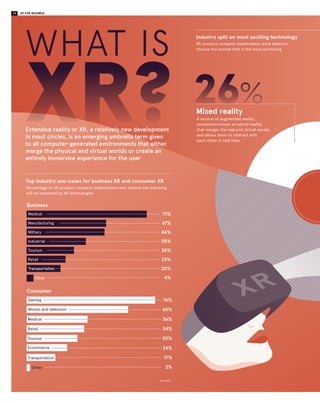
WHAT IS
XR?
Industry split on most exciting technology
XR product company stakeholders were asked to
choose the market that is the most promising
A version of augmented reality,
sometimes known as hybrid reality,
that merges the real and virtual worlds
and allows them to interact with
each other in real time
Mixed reality
Computer-generated graphics
overlaid on the physical world,
typically used with mobiles and
tablets through the camera
Augmented reality
Immersive headset experience
presenting a computer-
simulated, 360-degree-view
reality in a virtual world
Virtual reality
When XR is expected to become mainstream
Percentage of XR product company stakeholders who predict the following timeframes
Jabil 2018
6%
Already
mainstream
29%
1-3 years
34%
4-5 years
22%
6-10 years
8%
10+ years
1%
Never
6-10 years
Top industry use-cases for business XR and consumer XR
Percentage of XR product company stakeholders who believe the following
will be impacted by XR technologies
Business
Consumer
Medical 71%
Manufacturing 47%
Military 46%
Industrial 35%
Tourism 28%
Retail 23%
Transportation 20%
Other 4%
Jabil 2018
76%
36%
34%
30%
24%
Transportation 17%
Other 2%
60%
Gaming
Movies and television
Medical
Retail
Tourism
Ecommerce
AR/VR spending worldwide in 2017
Market share by industry ($bn)
When XR will generate a profit
XR developers were asked when they thought AR, VR and
MR would turn a profit for themselves and/or their clients
Consumer Other
Discrete
manufacturing
Retail
Personal and
consumer services
Process
manufacturing
6.2 3.7
1.5
1
0.8
0.7
38%
Medium term
23%
Long term
15%
Currently
profitable
11%
Project
not tied to
profitability
12%
Short term
1%
Never
IDC 2017
XRDC 2018
36%
26%
38%
Extended reality or XR, a relatively new development
in most circles, is an emerging umbrella term given
to all computer-generated environments that either
merge the physical and virtual worlds or create an
entirely immersive experience for the user
08 RACONTEUR.NET 09XR FOR BUSINESS
WHAT IS
XR?
Industry split on most exciting technology
XR product company stakeholders were asked to
choose the market that is the most promising
A version of augmented reality,
sometimes known as hybrid reality,
that merges the real and virtual worlds
and allows them to interact with
each other in real time
Mixed reality
Computer-generated graphics
overlaid on the physical world,
typically used with mobiles and
tablets through the camera
Augmented reality
Immersive headset experience
presenting a computer-
simulated, 360-degree-view
reality in a virtual world
Virtual reality
When XR is expected to become mainstream
Percentage of XR product company stakeholders who predict the following timeframes
Jabil 2018
6%
Already
mainstream
29%
1-3 years
34%
4-5 years
22%
6-10 years
8%
10+ years
1%
Never
6-10 years
Top industry use-cases for business XR and consumer XR
Percentage of XR product company stakeholders who believe the following
will be impacted by XR technologies
Business
Consumer
Medical 71%
Manufacturing 47%
Military 46%
Industrial 35%
Tourism 28%
Retail 23%
Transportation 20%
Other 4%
Jabil 2018
76%
36%
34%
30%
24%
Transportation 17%
Other 2%
60%
Gaming
Movies and television
Medical
Retail
Tourism
Ecommerce
AR/VR spending worldwide in 2017
Market share by industry ($bn)
When XR will generate a profit
XR developers were asked when they thought AR, VR and
MR would turn a profit for themselves and/or their clients
Consumer Other
Discrete
manufacturing
Retail
Personal and
consumer services
Process
manufacturing
6.2 3.7
1.5
1
0.8
0.7
38%
Medium term
23%
Long term
15%
Currently
profitable
11%
Project
not tied to
profitability
12%
Short term
1%
Never
IDC 2017
XRDC 2018
36%
26%
38%
Extended reality or XR, a relatively new development
in most circles, is an emerging umbrella term given
to all computer-generated environments that either
merge the physical and virtual worlds or create an
entirely immersive experience for the user
10 RACONTEUR.NET 11XR FOR BUSINESS
T
he ongoing trade spat
between Washington and
Beijing certainly makes
headline news, but behind
the ruffling of feathers over steel
pipes, wine and pork, there’s a much
bigger agenda. “What they are fight-
ing is not really a trade war, it’s a
tech war. A tech war is also a man-
ufacturing war,” according to Terry
Gou, chairman of Foxconn.
The Taiwanese electronics com-
pany should know; it employs more
than a million workers, many in
mainland China, and is a big sup-
plier to Apple. These tensions have
profound implications for the
extended reality (XR) industries.
Chinese investment in US tech firms
has officially been soured as the
Trump administration gets spikey
over alleged intellectual property
theft and unfair trade practices.
“Both the US and China see them-
selves as having a manifest destiny
to determine world affairs, and per-
ceive their economic and cultural
outputs as crucial to shaping how
the 21st century plays out globally,”
says Tim Mulligan, senior analyst
at MIDiA Research. “Technological
innovation is a crucial strand in
establishing global leadership.”
Alibaba, JD and Tencent are
among the Chinese tech giants
that have made big investments in
America. Alibaba is of note hav-
ing lavished hundreds of millions
of dollars on ultra-secretive Magic
Leap, a virtual reality (VR) startup
that’s arguably had difficulty mov-
ing beyond its own hype.
“Magic Leap will struggle to
continue development with the
likes of Alibaba not being able to
supplement their earlier invest-
ment rounds. This is true of other
US-based AR [augmented reality]
and VR ventures that have received
speculative investments from
China,” explains Mr Mulligan.
“However, money pumped into
mixed reality companies are going
to be subject to less US regulatory
oversight than say investments in
technology and telecoms infrastruc-
ture or back-end providers.”
You only have to look at the ban on
US companies selling vital compo-
nents to ZTE, China’s second-larg-
est telecoms hardware provider, to
realise this. Huawei is also banned
in the United States.
The numbers speak for them-
selves; in the first five months of
2018, overall Chinese investments
in the US fell to their lowest level in
seven years, a drop of 92 per cent,
according to Rhodium Group. It
doesn’t help that there’s been little
or no return on investment from the
nascent XR sector.
“Chinese companies don’t look
at foreign investments with a huge
appetite; it’s often more a vanity
investment than core to their strat-
egy. Chinese tech companies are
more obsessed with local develop-
ments because losing their domes-
tic market share is a much bigger
threat at this stage,” says Shann
Biglione, head of strategy at Zenith
USA and former head of business
transformation at Publicis Media
Greater China.
Rhodium points out that the tight-
ening of rules could have a chilling
impact on Chinese inward invest-
ment into the US, including money
moving into research and devel-
opment, as well as other innova-
tion-intensive activities. The trade
spat has also led to a mad scramble
in the tech sector before sanctions
kick in.
“Device-makers are aware of the
tensions. Faced with the rising
uncertainties, some vendors have
already begun increasing their pro-
duction and exports early to fulfil
the expected increase in demand
in the coming Q4 holiday season,
as well as in early-2019,” says Jason
Low, Shanghai-based senior ana-
lyst at Canalys.
“The big issue is that China and
its companies have to invest to stay
ahead of the game domestically.
XR is one of the top areas where
the country has put in a lot of time
and effort to create frameworks
to streamline this development,
as the industry requires key play-
ers from different areas, including
hardware, network operators, con-
tent providers and developers, to
work together.”
In the past, China’s tech giants
have looked for US startups, which
help them learn about new tech
and cutting-edge trends emanat-
ing from Silicon Valley, as well as
businesses that can complement
their core e-commerce offerings
at home. Their eyes are firmly on
the main prize of making money
out of China’s 900 million-plus,
hyper-connected consumers.
“There is enough growth to be
had in China. By 2020 you will have
600 million middle-class consum-
ers and companies will sell an extra
$2.3 trillion of goods each year by
that time,” says Tom Goodwin, head
of innovation at Zenith Media.
“At senior levels in Chinese corpo-
rations, they’re adamant that they
don’t need help when it comes to
tech. I’ve seen this time and time
again. From Huawei to Alibaba to
China Mobile to DJI. They are very
clear they ‘have tech covered’. It’s
not arrogance; they just have total
clarity on where their strengths lie,
and they feel software and manufac-
turing are perfect for their skillsets.”
It helps that there are five million
science and technology graduates
in China every year and their com-
petence levels are extraordinarily
high. They also have huge markets
to experiment in. Asia accounts for
59 per cent of the global popula-
tion. How consumers adopt XR here
today could be crucial to how it’s
rolled out worldwide tomorrow.
Asia has the fastest-growing mar-
kets when it comes to disposable
incomes. Consumers are crucially
leap-frogging traditional ways
of engagement when it comes to
digital experiences.
China also has a grand plan, con-
cocted by Beijing’s apparatchiks,
called Made in China 2025. It’s a
concerted national effort to domi-
nate high-tech industries globally,
moving China up the value chain as
labour costs grow.
The leading Chinese tech compa-
nies are vast, but their Achilles’ heel
is they conduct 90 per cent of their
business within the country. Even
so, such plans give Washington
law-makers the jitters.
By closing themselves off to China,
America could lose out. Chinese
companies will develop core tech-
nologies, including XR, whether
they get help from Silicon Valley or
not. They will also look elsewhere to
invest and are likely to be welcomed
with open arms. China is already
active in many other countries and
will increase this collaboration as it
is increasingly frowned upon in the
United States.
“Don’t forget that the reliance on
Chinese capital in Europe is far more
evident than in the US,” says Nick
Cooper, executive director and global
head of insights at Landor Associates.
“It is easy to overlook the fact that
innovation is thriving in multiple
locations around the world now.
Not only on London’s own Silicon
Roundabout and indeed Silicon Fen
in Cambridge. This emphasises the
UK’s lead in tech startups and invest-
ment within Europe. However, there
are many other vibrant centres of
tech excellence now, including Berlin,
Stockholm and Helsinki, and else-
where,suchasParisandAmsterdam.”
In many ways, being shut out of the
US could be a boon for China. It will
be forced to be more self-reliant when
it comes to the XR sector and other
tech developments, which it will incu-
bate, grow, exploit and then export.
Watch out.
NICK EASEN
Tech is targ et in US-China sanctions battle
Economic hostility and sanctions
exchanged between the United States
and China will impact development of
reality technologies, with winners and
losers on both sides of the trade war
Market leaders in VR
Revenue forecasts for the three largest virtual reality markets ($bn)
PwC/Statista 2017
Chinese companies
will develop core
technologies,
including XR, whether
they get help from
Silicon Valley or not
360-degree view
of the Temple
of Heaven in
Beijing, China
	IdeaImagesviaGettyImages
TRADE WAR
2016 2017 2018 2019 2020 2021
5
4
3
2
1
0
US
China
Japan
Compound
annual
growth rate
47%
103%
65%
Commercial feature
F
or the last few years, virtual real-
ity in business has been much
discussed, but less widely har-
nessed. Today, far from being
a notional advantage for the future,
some of the world’s biggest companies
are seeing the benefits for their train-
ing programmes.
“Many industries from manufactur-
ing and mining to healthcare, trans-
port and energy, have moved beyond
the tyre-kicking stage with VR train-
ing,” says Tom Symonds, founder and
chief executive of VR training com-
pany Immerse.io, whose clients include
Shell, DHL and GE Healthcare. “With
large businesses already using the
technology to help people train more
effectively, it’s important for others to
consider it so they are not left behind.”
By using the company’s VR plat-
form, up to ten people anywhere in
the world can enter an immersive vir-
tual environment and interact with one
another, with additional people view-
ing a 2D version on their web browser.
During or after the training, educators
can comment on steps taken or guide
participants. The technology is used
across industries, from manufacturing
processes to delivery firms, defence to
flight, healthcare to mining, energy to
communications and beyond.
In addition to optimising broader
business processes through analysis
of the usage data, organisations can
gain cost-savings within the delivery
of training, simply because so much
less travelling and ongoing investment
is required thanks to the live and dis-
tributed nature of the platform. The
sheer immersive nature of VR train-
ing enables learning experiences that
VR is revolutionising
the way businesses
approach training
Virtual reality holds huge promise for businesses,
reducing the costs of training and dramatically
improving results through immersive experiences
impact learners on a deep level, driving
improved knowledge retention.
“Everyone learns best when they’re
focused and even the most brilliant
trainer cannot hold learners’ attention
for 100 per cent of the time. There are
so many distractions in a normal office
environment that people’s minds nat-
urally wander,” Mr Symonds explains.
“But once learners are in a VR headset,
being handed a virtual object by a col-
league, they are fully focused as there
is an immediate imperative to act and
to interact.”
For industries such as oil and gas,
where safety issues are of utmost
importance, the capacity for VR train-
ing to avoid potentially dangerous out-
comes is critical. Energy giant Shell is
using the systems to train for emer-
gency response.
“We can show a person the impact
of a delay in shutting down a defec-
tive piece of equipment by a few sec-
onds. This ability to recreate differ-
ent working scenarios means learners
understand and experience the conse-
quences of one decision over another.
They wouldn’t forget this training in a
hurry,” says Mr Symonds. “That offers
real value for businesses where main-
taining the highest levels of worker
safety is paramount.”
Immerse.io’s VR platform is under-
pinned by training data capture on
a large scale, empowering live or
post-session assessment. Managers
can see how well trainees have per-
formed in a given VR scenario and
they are able then to pinpoint where
improvements can be made.
The technology company’s in-house
developers work closely with clients
to create bespoke VR training envi-
ronments, but Mr Symonds says busi-
nesses also use his company’s platform
independently to create their own per-
sonalised environments.
“We’ve created a software devel-
opment kit that allows our clients to
create their own content or to import
CAD [computer-aided design] models
to run on the platform,” he says. “This
means companies can quickly and
repeatedly build the virtual environ-
ments they need, enabling them to
take enterprise-wide training to the
next level and deliver massive change
in their organisation.”
To find out more about providing
accessible, immersive VR training
across your business please visit
immerse.io
With large
businesses already
using the technology
to help people train
more effectively, it’s
important for others
to consider it so they
are not left behind
Two trainees
work together in
a collaborative
virtual space
to identify and
prevent a gas leak
10 RACONTEUR.NET 11XR FOR BUSINESS
T
he ongoing trade spat
between Washington and
Beijing certainly makes
headline news, but behind
the ruffling of feathers over steel
pipes, wine and pork, there’s a much
bigger agenda. “What they are fight-
ing is not really a trade war, it’s a
tech war. A tech war is also a man-
ufacturing war,” according to Terry
Gou, chairman of Foxconn.
The Taiwanese electronics com-
pany should know; it employs more
than a million workers, many in
mainland China, and is a big sup-
plier to Apple. These tensions have
profound implications for the
extended reality (XR) industries.
Chinese investment in US tech firms
has officially been soured as the
Trump administration gets spikey
over alleged intellectual property
theft and unfair trade practices.
“Both the US and China see them-
selves as having a manifest destiny
to determine world affairs, and per-
ceive their economic and cultural
outputs as crucial to shaping how
the 21st century plays out globally,”
says Tim Mulligan, senior analyst
at MIDiA Research. “Technological
innovation is a crucial strand in
establishing global leadership.”
Alibaba, JD and Tencent are
among the Chinese tech giants
that have made big investments in
America. Alibaba is of note hav-
ing lavished hundreds of millions
of dollars on ultra-secretive Magic
Leap, a virtual reality (VR) startup
that’s arguably had difficulty mov-
ing beyond its own hype.
“Magic Leap will struggle to
continue development with the
likes of Alibaba not being able to
supplement their earlier invest-
ment rounds. This is true of other
US-based AR [augmented reality]
and VR ventures that have received
speculative investments from
China,” explains Mr Mulligan.
“However, money pumped into
mixed reality companies are going
to be subject to less US regulatory
oversight than say investments in
technology and telecoms infrastruc-
ture or back-end providers.”
You only have to look at the ban on
US companies selling vital compo-
nents to ZTE, China’s second-larg-
est telecoms hardware provider, to
realise this. Huawei is also banned
in the United States.
The numbers speak for them-
selves; in the first five months of
2018, overall Chinese investments
in the US fell to their lowest level in
seven years, a drop of 92 per cent,
according to Rhodium Group. It
doesn’t help that there’s been little
or no return on investment from the
nascent XR sector.
“Chinese companies don’t look
at foreign investments with a huge
appetite; it’s often more a vanity
investment than core to their strat-
egy. Chinese tech companies are
more obsessed with local develop-
ments because losing their domes-
tic market share is a much bigger
threat at this stage,” says Shann
Biglione, head of strategy at Zenith
USA and former head of business
transformation at Publicis Media
Greater China.
Rhodium points out that the tight-
ening of rules could have a chilling
impact on Chinese inward invest-
ment into the US, including money
moving into research and devel-
opment, as well as other innova-
tion-intensive activities. The trade
spat has also led to a mad scramble
in the tech sector before sanctions
kick in.
“Device-makers are aware of the
tensions. Faced with the rising
uncertainties, some vendors have
already begun increasing their pro-
duction and exports early to fulfil
the expected increase in demand
in the coming Q4 holiday season,
as well as in early-2019,” says Jason
Low, Shanghai-based senior ana-
lyst at Canalys.
“The big issue is that China and
its companies have to invest to stay
ahead of the game domestically.
XR is one of the top areas where
the country has put in a lot of time
and effort to create frameworks
to streamline this development,
as the industry requires key play-
ers from different areas, including
hardware, network operators, con-
tent providers and developers, to
work together.”
In the past, China’s tech giants
have looked for US startups, which
help them learn about new tech
and cutting-edge trends emanat-
ing from Silicon Valley, as well as
businesses that can complement
their core e-commerce offerings
at home. Their eyes are firmly on
the main prize of making money
out of China’s 900 million-plus,
hyper-connected consumers.
“There is enough growth to be
had in China. By 2020 you will have
600 million middle-class consum-
ers and companies will sell an extra
$2.3 trillion of goods each year by
that time,” says Tom Goodwin, head
of innovation at Zenith Media.
“At senior levels in Chinese corpo-
rations, they’re adamant that they
don’t need help when it comes to
tech. I’ve seen this time and time
again. From Huawei to Alibaba to
China Mobile to DJI. They are very
clear they ‘have tech covered’. It’s
not arrogance; they just have total
clarity on where their strengths lie,
and they feel software and manufac-
turing are perfect for their skillsets.”
It helps that there are five million
science and technology graduates
in China every year and their com-
petence levels are extraordinarily
high. They also have huge markets
to experiment in. Asia accounts for
59 per cent of the global popula-
tion. How consumers adopt XR here
today could be crucial to how it’s
rolled out worldwide tomorrow.
Asia has the fastest-growing mar-
kets when it comes to disposable
incomes. Consumers are crucially
leap-frogging traditional ways
of engagement when it comes to
digital experiences.
China also has a grand plan, con-
cocted by Beijing’s apparatchiks,
called Made in China 2025. It’s a
concerted national effort to domi-
nate high-tech industries globally,
moving China up the value chain as
labour costs grow.
The leading Chinese tech compa-
nies are vast, but their Achilles’ heel
is they conduct 90 per cent of their
business within the country. Even
so, such plans give Washington
law-makers the jitters.
By closing themselves off to China,
America could lose out. Chinese
companies will develop core tech-
nologies, including XR, whether
they get help from Silicon Valley or
not. They will also look elsewhere to
invest and are likely to be welcomed
with open arms. China is already
active in many other countries and
will increase this collaboration as it
is increasingly frowned upon in the
United States.
“Don’t forget that the reliance on
Chinese capital in Europe is far more
evident than in the US,” says Nick
Cooper, executive director and global
head of insights at Landor Associates.
“It is easy to overlook the fact that
innovation is thriving in multiple
locations around the world now.
Not only on London’s own Silicon
Roundabout and indeed Silicon Fen
in Cambridge. This emphasises the
UK’s lead in tech startups and invest-
ment within Europe. However, there
are many other vibrant centres of
tech excellence now, including Berlin,
Stockholm and Helsinki, and else-
where,suchasParisandAmsterdam.”
In many ways, being shut out of the
US could be a boon for China. It will
be forced to be more self-reliant when
it comes to the XR sector and other
tech developments, which it will incu-
bate, grow, exploit and then export.
Watch out.
NICK EASEN
Tech is targ et in US-China sanctions battle
Economic hostility and sanctions
exchanged between the United States
and China will impact development of
reality technologies, with winners and
losers on both sides of the trade war
Market leaders in VR
Revenue forecasts for the three largest virtual reality markets ($bn)
PwC/Statista 2017
Chinese companies
will develop core
technologies,
including XR, whether
they get help from
Silicon Valley or not
360-degree view
of the Temple
of Heaven in
Beijing, China
	IdeaImagesviaGettyImages
TRADE WAR
2016 2017 2018 2019 2020 2021
5
4
3
2
1
0
US
China
Japan
Compound
annual
growth rate
47%
103%
65%
Commercial feature
F
or the last few years, virtual real-
ity in business has been much
discussed, but less widely har-
nessed. Today, far from being
a notional advantage for the future,
some of the world’s biggest companies
are seeing the benefits for their train-
ing programmes.
“Many industries from manufactur-
ing and mining to healthcare, trans-
port and energy, have moved beyond
the tyre-kicking stage with VR train-
ing,” says Tom Symonds, founder and
chief executive of VR training com-
pany Immerse.io, whose clients include
Shell, DHL and GE Healthcare. “With
large businesses already using the
technology to help people train more
effectively, it’s important for others to
consider it so they are not left behind.”
By using the company’s VR plat-
form, up to ten people anywhere in
the world can enter an immersive vir-
tual environment and interact with one
another, with additional people view-
ing a 2D version on their web browser.
During or after the training, educators
can comment on steps taken or guide
participants. The technology is used
across industries, from manufacturing
processes to delivery firms, defence to
flight, healthcare to mining, energy to
communications and beyond.
In addition to optimising broader
business processes through analysis
of the usage data, organisations can
gain cost-savings within the delivery
of training, simply because so much
less travelling and ongoing investment
is required thanks to the live and dis-
tributed nature of the platform. The
sheer immersive nature of VR train-
ing enables learning experiences that
VR is revolutionising
the way businesses
approach training
Virtual reality holds huge promise for businesses,
reducing the costs of training and dramatically
improving results through immersive experiences
impact learners on a deep level, driving
improved knowledge retention.
“Everyone learns best when they’re
focused and even the most brilliant
trainer cannot hold learners’ attention
for 100 per cent of the time. There are
so many distractions in a normal office
environment that people’s minds nat-
urally wander,” Mr Symonds explains.
“But once learners are in a VR headset,
being handed a virtual object by a col-
league, they are fully focused as there
is an immediate imperative to act and
to interact.”
For industries such as oil and gas,
where safety issues are of utmost
importance, the capacity for VR train-
ing to avoid potentially dangerous out-
comes is critical. Energy giant Shell is
using the systems to train for emer-
gency response.
“We can show a person the impact
of a delay in shutting down a defec-
tive piece of equipment by a few sec-
onds. This ability to recreate differ-
ent working scenarios means learners
understand and experience the conse-
quences of one decision over another.
They wouldn’t forget this training in a
hurry,” says Mr Symonds. “That offers
real value for businesses where main-
taining the highest levels of worker
safety is paramount.”
Immerse.io’s VR platform is under-
pinned by training data capture on
a large scale, empowering live or
post-session assessment. Managers
can see how well trainees have per-
formed in a given VR scenario and
they are able then to pinpoint where
improvements can be made.
The technology company’s in-house
developers work closely with clients
to create bespoke VR training envi-
ronments, but Mr Symonds says busi-
nesses also use his company’s platform
independently to create their own per-
sonalised environments.
“We’ve created a software devel-
opment kit that allows our clients to
create their own content or to import
CAD [computer-aided design] models
to run on the platform,” he says. “This
means companies can quickly and
repeatedly build the virtual environ-
ments they need, enabling them to
take enterprise-wide training to the
next level and deliver massive change
in their organisation.”
To find out more about providing
accessible, immersive VR training
across your business please visit
immerse.io
With large
businesses already
using the technology
to help people train
more effectively, it’s
important for others
to consider it so they
are not left behind
Two trainees
work together in
a collaborative
virtual space
to identify and
prevent a gas leak
12 RACONTEUR.NET 13XR FOR BUSINESS
Commercial feature
App-less AR
will be a global
game-changer
It was only two years ago that consumers
across the globe were running around in
a crazed state looking for Pokémon on a
smartphone screen. These were virtual
objects in the real world, also known as
augmented reality
T
he 2016 Pokémon Go aug-
mented reality (AR) craze
was followed by an experi-
mental type of retail when
companies, such as IKEA, developed
apps that could place virtual furni-
ture in your living room before you
purchased. We were told these early
gimmicks would eventually revolu-
tionise entertainment, shopping and
industry. That was then.
Fast forward to today and the indus-
try is only just coming of age. AR is now
being worked seamlessly into the plat-
forms we regularly use. When Apple
announced AR Quick Look, an extension
to its ARKit for iOS12, Google was not far
behind touting their upcoming WebXR,
extending their ARCore technology.
All indications are that this rela-
tively new field of AR will soon find
its feet in the mainstream, in both
business-to-business and busi-
ness-to-consumer spaces.
“We are at a crucial juncture in the
rollout of this technology. AR, whether
used by businesses or consumers, has
to be effortless. Put it this way, if my
grandmother can’t easily use it, we’re
not there yet,” says Jon Cheney, chief
executive of Seek XR, a company that
has created a web-based solution for
AR on all platforms.
According to Seek XR, one of the
biggest barriers to widespread adop-
tion of AR is the need for users to
download an app to view any content.
This is a major sticking point. Many
people can’t be bothered to go to an
app store – too many clicks – or are
concerned with the security issues
of yet another app. One large US
retailer reported that only 8 per cent
of its traffic comes to their catalogue
through their app. The other 92 per
cent misses out entirely on their new
AR immersion.
“Everyone else is chasing the AR
rabbit down an app-based hole or
addressing only a subset of the market.
Limiting AR to the Apple crowd may be
plausible in the US, but Apple is not the
dominantplayerinEuropeorAsia,”says
Mr Cheney, whose company works with
the likes of Samsung, Volvo, Universal
Pictures and Harley Davidson.
“What we’ve cracked is the ability to
viewanyproductthroughARonanyweb-
sitefromasinglelink.It’sagame-changer.
Any 3D image file can be automatically
converted to work with whatever device
a user may have and is delivered intelli-
gently through a web browser.”
In the retail space, IKEA, Amazon
and Wayfair in America are just some
of the businesses that have focused
on app-based AR ever since Pokémon
Go hit the headlines. These are those
with deep pockets, scores of devel-
opers, and a clear vision and belief
that AR technology will improve the
home-shopping experience.
“SeekView does this with 3D files, ena-
bling AR on a web platform; it’s patent
pending because we’ve done an incred-
ible amount of work on both the front
and back-ends to make it seamless for
brands. There’s a lot under the hood,
but you never see it,” says Mr Cheney.
Arguably, what YouTube did for video
streaming, SeekView could do for AR.
The platform also provides data and
analytics, so brands can see how well
their AR files and products are doing,
and adjust their marketing and content
strategies accordingly.
“This could certainly spell the death
knell of bricks-and-mortar retail as
we know it. Already ecommerce is
slowly killing shopping on the high
street. Easy-to-use AR solutions
enable online shoppers to visualise
products in their intended space.
Can I close the garage door with this
truck? Where could I put this couch?
Will this washing machine fit in my
laundry room? What will the TV look
like here? Soon, AR will be as ubiqui-
tous as product photos,” says Robert
Bishop, technology evangelist and five
times tech entrepreneur who has seen
SeekView in action.
Whether you are Debenhams or
Sears, Macy’s or Marks and Spencer, all
retailers are facing a tough time, given
the rapid rise of ecommerce, growing
demand and expectations of always-on
consumers. Retail brands globally must
innovate with new technology and
investment or die.
“Analytics prove that AR experiences
increase conversion by 30 per cent and
in some cases by as much as 80 per
cent. We’ve seen this hold true with our
platform SeekView and we have the data
to prove it. More consumers are likely to
buy and less are likely to return goods,”
says Mr Cheney.
“Where’s AR headed? It doesn’t
take much imagination to think of
interesting use-cases, especially
with the simplicity unlocked by the
likes of SeekView; whether it’s having
a chart jump off the page or a hol-
iday toy appear on the table. What
if I could take a picture of my son at
the next Star Wars, standing next to
Han Solo?”
To experience SeekView now please
visit try.seekxr.com
We are at a crucial juncture
in the rollout of this
technology… What we’ve
cracked is the ability to view
any product through AR on
any website from a single
link. It’s a game-changer
“The vast majority of consum-
ers around the globe aren’t seeking
out AR experiences via apps. What
they’re doing is shopping online,
spending billions every day via ecom-
merce sites and on their smartphone.
They want to visualise products,
whether they fit, or how they look in
their home or office. They want to
do that without any friction, which is
why we created SeekView,” explains
Mr Cheney.
Any brand, worldwide with a 3D
model in one of dozens of different
formats, can upload their product to
SeekView, which then converts the
object into several compatible, easy-
to-use formats and spits them out as
one link to be used on any website.
This is exactly what YouTube does: it
receives a video and provides a link that
can then be embedded.
When YouTube upgrades its stream-
ing capabilities or a new type of screen
comes out, YouTube adds new support
to the system and the video seam-
lessly plays on the new device. There is
no need to upload a new video as the
link just gets smarter. They’ve future-
proofed their business model.
Jon Cheney
Chief executive, Seek
more likelihood of a purchase
when consumers view a
product in AR
reason a product purchased
online is returned is it wasn’t
what the customer expected
reason is the product
didn’t fit
30%
1
2
st
nd
Coupled with data from the internet
of things, extended reality is changing
the way people work and driving
industrial innovation
Powering the fourth
industrial revolution
its vision picking smartglasses.
AccordingtoCCSInsight’sNovember
2018 VR and AR Devices Worldwide
Forecast, just 66,000 AR devices will
be sold by the end of 2018, “prac-
tically all of those to enterprise”.
Growth is relatively slow, but interest
from industry “remains solid” and
CCS expects sales volumes to pick up
in the early-2020s.
DHL’s first pilots on AR and logis-
tics date back to 2015 and have
used hardware such as the Google
Glass: Enterprise Edition, which is
rumoured to be getting a second
generation model soon, and Vuzix’s
M100 and M300 Smart Glasses.
Trials in the United States, Asia and
Australia, using Ubimax’s xPick soft-
ware, cut on-boarding and training
times in half and showed average
increases in unit picking productiv-
ity between 10 and 25 per cent.
Based on this success, DHL
announced in August 2017 that it
was extending use of the smart-
glasses to warehouses around the
world, and the technology remains
in use alongside radio-frequency
scanners, Bluetooth wearable rings
and robotic pickers. In cases like
these, battery life and sufficiently
rugged designs are ongoing chal-
lenges. Looking to the near future
though, vision recognition, which
allows applications such as virtual
pick to light, is the next key feature
that will enable XR glasses to drive
further optimisation in logistics.
Many companies in this wave of
early adopters are also now looking
to XR applications tailored to other
specific problems. For instance,
beyond picking, DHL is exploring
worker training with AR smart-
glasses and Audi has experimented
with VR marketing experiences.
Even in cases where a company
has found one brilliant solution,
the scale and impact can be con-
siderable. Colas, the European road
and rail infrastructure supplier, has
made Immersive Factory’s VR safety
training software, running on Vive
headsets, part of its safety culture
induction programme. That’s a long
way from experimental pilots.
Y
ou’re carrying out main-
tenance work on a trans-
mitter mast. In 2018, this
could mean you’re already
a connected field worker. Earlier
this month, A1 Telekom Austria
completed an eight-week pilot pro-
gramme using the Vuzix M300
Smart Glasses to enable mainte-
nance experts to legally sign off on
procedures and help on-site tech-
nicians to rectify defects found in
transmitter mast reviews.
With the “see-what-I-see” aug-
mented reality (AR) software,
remote assistance, and the ability
to capture images and video, the
whole servicing process can take
less than 25 per cent of the time it
would using traditional methods.
This is just one way extended
reality (XR) could power what
Professor Klaus Schwab, executive
chairman of the World Economic
Forum, and many others are refer-
ring to as the fourth industrial rev-
olution. Smart sensors producing
internet of things (IoT) data and
advances in robotics are being
combined with emerging technol-
ogies such as XR, which merge dig-
ital, physical and human elements
to change industrial processes.
When everything in a factory or
workplace is connected and produc-
ing data, XR can act as the missing
piece, which brings real people and
their expertise into the equation.
More important than any indi-
vidual pilot announcement though
are the companies that jumped
on board early, got a head-start
and saw the results they needed
to move out of the trial phase into
larger-scale deployment.
SOPHIE CHARARA
Volkswagen/Innoactive
Take the Volkswagen Group. In
2016, it launched a series of vir-
tual reality (VR) training pilots for
production and logistics staff with
Vive’s VR hardware and enter-
prise software startup Innoactive.
Since then, it has seen “significant
increases in efficiency and the
effectiveness of our programmes”,
says Dennis Abmeier, Volkswagen
Group’s IT lead. Now it’s on track
to train 10,000 employees in XR by
the end of 2018 across Volkswagen,
Audi, Seat, Skoda and VW Utility
Vehicles, via its digital reality hub.
“To date, more than 30 simulations
have been developed,” says Daniel
Seidl, chief executive at Munich-
based Innoactive. “The Vive and Vive
Focus with their 6DoF controllers let
people use their hands to practise
commissioning parts and using bar-
code scanners. As people can access
such virtual workplace simulations
from anywhere, the real machines
and operating materials can be oper-
ated around the clock. Furthermore,
it saves travel and time.”
In addition, Volkswagen and
also BMW, another early adopter
in automotive, are seeing results
from increased virtual prototyp-
ing and production line training
in XR. Bringing intelligent robots
into workplaces is a core part of this
brave, new industrial revolution and
XR is being used to build a bridge
between human workers and robots.
“In a case like Volkswagen,
they’re using robots, which are
fairly expensive and take time to
set up and configure,” says Hervé
Fontaine, vice president of vir-
tual reality business to B2B devel-
opment at HTC Europe. “They
usually get some parts of the
Volkswagen, in
partnership with
Innoactive, is
training employees
in production and
logistics using more
than 30 VR training
simulations
INTERNET OF THINGS
production line just six weeks
before it’s final and, if they train
people with only a limited amount
of equipment, then they can’t run
on time. In VR, if you can model
everything, then you can train
everybody because you just multi-
ply the training room.”
In aerospace, Airbus has been
working towards its “factory of the
future” model since the introduc-
tion of digital tracking and radio-fre-
quency identification monitoring
technologies back in 2014. Its current
digital twin factory innovation is an
example of a live application where
real- time sensor data and XR meet.
An Airbus factory in Spain was able
to build a virtual model of the facil-
ity, known as a synced factory twin.
This is complete with the same IoT
data flow that feeds the real factory,
and enables remote, virtual moni-
toring and control of large, complex
aircraft construction.
Further along in its XR and IoT
journey is DHL Supply Chain with
XR is being used
to build a bridge
between human
workers and robots
How companies are using XR in industry
View reference videos
and digital manuals
Capgemini 2018
Remote expert assistance
Visualise specific components and
functions behind physical barriers
Superimpose step-by-step
instructions
Simulate product performance
in extreme conditions
Visualise infrastructure
project from various angles
View digital instructions for
assembly and configuration
Overlay design components
on to existing modules
31%
30%
30%
29%
28%
28%
27%
26%
Percentage of companies implementing XR to…
Repair and maintenance
Design and assembly
For organisations that have grad-
uated from small-scale pilots to
widespread adoption, the combina-
tion of XR and IoT is already chang-
ing the way people work. The indus-
try regarded as the most mature in
its adoption of XR devices is manu-
facturing with a number of others,
including architecture, construc-
tion, logistics and healthcare, fol-
lowing its lead.
12 RACONTEUR.NET 13XR FOR BUSINESS
Commercial feature
App-less AR
will be a global
game-changer
It was only two years ago that consumers
across the globe were running around in
a crazed state looking for Pokémon on a
smartphone screen. These were virtual
objects in the real world, also known as
augmented reality
T
he 2016 Pokémon Go aug-
mented reality (AR) craze
was followed by an experi-
mental type of retail when
companies, such as IKEA, developed
apps that could place virtual furni-
ture in your living room before you
purchased. We were told these early
gimmicks would eventually revolu-
tionise entertainment, shopping and
industry. That was then.
Fast forward to today and the indus-
try is only just coming of age. AR is now
being worked seamlessly into the plat-
forms we regularly use. When Apple
announced AR Quick Look, an extension
to its ARKit for iOS12, Google was not far
behind touting their upcoming WebXR,
extending their ARCore technology.
All indications are that this rela-
tively new field of AR will soon find
its feet in the mainstream, in both
business-to-business and busi-
ness-to-consumer spaces.
“We are at a crucial juncture in the
rollout of this technology. AR, whether
used by businesses or consumers, has
to be effortless. Put it this way, if my
grandmother can’t easily use it, we’re
not there yet,” says Jon Cheney, chief
executive of Seek XR, a company that
has created a web-based solution for
AR on all platforms.
According to Seek XR, one of the
biggest barriers to widespread adop-
tion of AR is the need for users to
download an app to view any content.
This is a major sticking point. Many
people can’t be bothered to go to an
app store – too many clicks – or are
concerned with the security issues
of yet another app. One large US
retailer reported that only 8 per cent
of its traffic comes to their catalogue
through their app. The other 92 per
cent misses out entirely on their new
AR immersion.
“Everyone else is chasing the AR
rabbit down an app-based hole or
addressing only a subset of the market.
Limiting AR to the Apple crowd may be
plausible in the US, but Apple is not the
dominantplayerinEuropeorAsia,”says
Mr Cheney, whose company works with
the likes of Samsung, Volvo, Universal
Pictures and Harley Davidson.
“What we’ve cracked is the ability to
viewanyproductthroughARonanyweb-
sitefromasinglelink.It’sagame-changer.
Any 3D image file can be automatically
converted to work with whatever device
a user may have and is delivered intelli-
gently through a web browser.”
In the retail space, IKEA, Amazon
and Wayfair in America are just some
of the businesses that have focused
on app-based AR ever since Pokémon
Go hit the headlines. These are those
with deep pockets, scores of devel-
opers, and a clear vision and belief
that AR technology will improve the
home-shopping experience.
“SeekView does this with 3D files, ena-
bling AR on a web platform; it’s patent
pending because we’ve done an incred-
ible amount of work on both the front
and back-ends to make it seamless for
brands. There’s a lot under the hood,
but you never see it,” says Mr Cheney.
Arguably, what YouTube did for video
streaming, SeekView could do for AR.
The platform also provides data and
analytics, so brands can see how well
their AR files and products are doing,
and adjust their marketing and content
strategies accordingly.
“This could certainly spell the death
knell of bricks-and-mortar retail as
we know it. Already ecommerce is
slowly killing shopping on the high
street. Easy-to-use AR solutions
enable online shoppers to visualise
products in their intended space.
Can I close the garage door with this
truck? Where could I put this couch?
Will this washing machine fit in my
laundry room? What will the TV look
like here? Soon, AR will be as ubiqui-
tous as product photos,” says Robert
Bishop, technology evangelist and five
times tech entrepreneur who has seen
SeekView in action.
Whether you are Debenhams or
Sears, Macy’s or Marks and Spencer, all
retailers are facing a tough time, given
the rapid rise of ecommerce, growing
demand and expectations of always-on
consumers. Retail brands globally must
innovate with new technology and
investment or die.
“Analytics prove that AR experiences
increase conversion by 30 per cent and
in some cases by as much as 80 per
cent. We’ve seen this hold true with our
platform SeekView and we have the data
to prove it. More consumers are likely to
buy and less are likely to return goods,”
says Mr Cheney.
“Where’s AR headed? It doesn’t
take much imagination to think of
interesting use-cases, especially
with the simplicity unlocked by the
likes of SeekView; whether it’s having
a chart jump off the page or a hol-
iday toy appear on the table. What
if I could take a picture of my son at
the next Star Wars, standing next to
Han Solo?”
To experience SeekView now please
visit try.seekxr.com
We are at a crucial juncture
in the rollout of this
technology… What we’ve
cracked is the ability to view
any product through AR on
any website from a single
link. It’s a game-changer
“The vast majority of consum-
ers around the globe aren’t seeking
out AR experiences via apps. What
they’re doing is shopping online,
spending billions every day via ecom-
merce sites and on their smartphone.
They want to visualise products,
whether they fit, or how they look in
their home or office. They want to
do that without any friction, which is
why we created SeekView,” explains
Mr Cheney.
Any brand, worldwide with a 3D
model in one of dozens of different
formats, can upload their product to
SeekView, which then converts the
object into several compatible, easy-
to-use formats and spits them out as
one link to be used on any website.
This is exactly what YouTube does: it
receives a video and provides a link that
can then be embedded.
When YouTube upgrades its stream-
ing capabilities or a new type of screen
comes out, YouTube adds new support
to the system and the video seam-
lessly plays on the new device. There is
no need to upload a new video as the
link just gets smarter. They’ve future-
proofed their business model.
Jon Cheney
Chief executive, Seek
more likelihood of a purchase
when consumers view a
product in AR
reason a product purchased
online is returned is it wasn’t
what the customer expected
reason is the product
didn’t fit
30%
1
2
st
nd
Coupled with data from the internet
of things, extended reality is changing
the way people work and driving
industrial innovation
Powering the fourth
industrial revolution
its vision picking smartglasses.
AccordingtoCCSInsight’sNovember
2018 VR and AR Devices Worldwide
Forecast, just 66,000 AR devices will
be sold by the end of 2018, “prac-
tically all of those to enterprise”.
Growth is relatively slow, but interest
from industry “remains solid” and
CCS expects sales volumes to pick up
in the early-2020s.
DHL’s first pilots on AR and logis-
tics date back to 2015 and have
used hardware such as the Google
Glass: Enterprise Edition, which is
rumoured to be getting a second
generation model soon, and Vuzix’s
M100 and M300 Smart Glasses.
Trials in the United States, Asia and
Australia, using Ubimax’s xPick soft-
ware, cut on-boarding and training
times in half and showed average
increases in unit picking productiv-
ity between 10 and 25 per cent.
Based on this success, DHL
announced in August 2017 that it
was extending use of the smart-
glasses to warehouses around the
world, and the technology remains
in use alongside radio-frequency
scanners, Bluetooth wearable rings
and robotic pickers. In cases like
these, battery life and sufficiently
rugged designs are ongoing chal-
lenges. Looking to the near future
though, vision recognition, which
allows applications such as virtual
pick to light, is the next key feature
that will enable XR glasses to drive
further optimisation in logistics.
Many companies in this wave of
early adopters are also now looking
to XR applications tailored to other
specific problems. For instance,
beyond picking, DHL is exploring
worker training with AR smart-
glasses and Audi has experimented
with VR marketing experiences.
Even in cases where a company
has found one brilliant solution,
the scale and impact can be con-
siderable. Colas, the European road
and rail infrastructure supplier, has
made Immersive Factory’s VR safety
training software, running on Vive
headsets, part of its safety culture
induction programme. That’s a long
way from experimental pilots.
Y
ou’re carrying out main-
tenance work on a trans-
mitter mast. In 2018, this
could mean you’re already
a connected field worker. Earlier
this month, A1 Telekom Austria
completed an eight-week pilot pro-
gramme using the Vuzix M300
Smart Glasses to enable mainte-
nance experts to legally sign off on
procedures and help on-site tech-
nicians to rectify defects found in
transmitter mast reviews.
With the “see-what-I-see” aug-
mented reality (AR) software,
remote assistance, and the ability
to capture images and video, the
whole servicing process can take
less than 25 per cent of the time it
would using traditional methods.
This is just one way extended
reality (XR) could power what
Professor Klaus Schwab, executive
chairman of the World Economic
Forum, and many others are refer-
ring to as the fourth industrial rev-
olution. Smart sensors producing
internet of things (IoT) data and
advances in robotics are being
combined with emerging technol-
ogies such as XR, which merge dig-
ital, physical and human elements
to change industrial processes.
When everything in a factory or
workplace is connected and produc-
ing data, XR can act as the missing
piece, which brings real people and
their expertise into the equation.
More important than any indi-
vidual pilot announcement though
are the companies that jumped
on board early, got a head-start
and saw the results they needed
to move out of the trial phase into
larger-scale deployment.
SOPHIE CHARARA
Volkswagen/Innoactive
Take the Volkswagen Group. In
2016, it launched a series of vir-
tual reality (VR) training pilots for
production and logistics staff with
Vive’s VR hardware and enter-
prise software startup Innoactive.
Since then, it has seen “significant
increases in efficiency and the
effectiveness of our programmes”,
says Dennis Abmeier, Volkswagen
Group’s IT lead. Now it’s on track
to train 10,000 employees in XR by
the end of 2018 across Volkswagen,
Audi, Seat, Skoda and VW Utility
Vehicles, via its digital reality hub.
“To date, more than 30 simulations
have been developed,” says Daniel
Seidl, chief executive at Munich-
based Innoactive. “The Vive and Vive
Focus with their 6DoF controllers let
people use their hands to practise
commissioning parts and using bar-
code scanners. As people can access
such virtual workplace simulations
from anywhere, the real machines
and operating materials can be oper-
ated around the clock. Furthermore,
it saves travel and time.”
In addition, Volkswagen and
also BMW, another early adopter
in automotive, are seeing results
from increased virtual prototyp-
ing and production line training
in XR. Bringing intelligent robots
into workplaces is a core part of this
brave, new industrial revolution and
XR is being used to build a bridge
between human workers and robots.
“In a case like Volkswagen,
they’re using robots, which are
fairly expensive and take time to
set up and configure,” says Hervé
Fontaine, vice president of vir-
tual reality business to B2B devel-
opment at HTC Europe. “They
usually get some parts of the
Volkswagen, in
partnership with
Innoactive, is
training employees
in production and
logistics using more
than 30 VR training
simulations
INTERNET OF THINGS
production line just six weeks
before it’s final and, if they train
people with only a limited amount
of equipment, then they can’t run
on time. In VR, if you can model
everything, then you can train
everybody because you just multi-
ply the training room.”
In aerospace, Airbus has been
working towards its “factory of the
future” model since the introduc-
tion of digital tracking and radio-fre-
quency identification monitoring
technologies back in 2014. Its current
digital twin factory innovation is an
example of a live application where
real- time sensor data and XR meet.
An Airbus factory in Spain was able
to build a virtual model of the facil-
ity, known as a synced factory twin.
This is complete with the same IoT
data flow that feeds the real factory,
and enables remote, virtual moni-
toring and control of large, complex
aircraft construction.
Further along in its XR and IoT
journey is DHL Supply Chain with
XR is being used
to build a bridge
between human
workers and robots
How companies are using XR in industry
View reference videos
and digital manuals
Capgemini 2018
Remote expert assistance
Visualise specific components and
functions behind physical barriers
Superimpose step-by-step
instructions
Simulate product performance
in extreme conditions
Visualise infrastructure
project from various angles
View digital instructions for
assembly and configuration
Overlay design components
on to existing modules
31%
30%
30%
29%
28%
28%
27%
26%
Percentage of companies implementing XR to…
Repair and maintenance
Design and assembly
For organisations that have grad-
uated from small-scale pilots to
widespread adoption, the combina-
tion of XR and IoT is already chang-
ing the way people work. The indus-
try regarded as the most mature in
its adoption of XR devices is manu-
facturing with a number of others,
including architecture, construc-
tion, logistics and healthcare, fol-
lowing its lead.
14 RACONTEUR.NET 15XR FOR BUSINESS
OPINION COLUMN
Michael O’Hara
Chief marketing officer
GSMA, representing mobile
network operators worldwide
I
n the not-to-distant future, it will
be commonplace to see people
wearing augmented reality (AR)
glasses or virtual reality (VR)
headsets, walking the streets, wait-
ing at bus stops or sat in offices.
They might be accessing infor-
mation on train times while on
the move, holding conference calls
with colleagues or playing com-
puter games with friends in differ-
ent locations around the world, all
in real time.
It’s set to revolutionise the way we
communicate and consume con-
tent. AR enhances a user’s view by
overlaying information on what is
in line of sight, while VR offers a
deeper and more immersive experi-
ence altogether.
Both have numerous applications
across the enterprise and enter-
tainment fields; however, AR/VR
technology will only become truly
mainstream with the broad-scale
adoption of 5G networks and its con-
vergence with the cloud.
Currently, if you wanted to play a
game using a VR headset, you would
typically need a device such as a PC
or a gaming console that has a large
amount of storage, power consump-
tion and processing power for it to
work effectively. This means you are
confined to a particular location,
while the headsets remain expen-
sive and niche.
Arrival of 5G will mean we can
push these capabilities away
from the PC and into something
called the edge cloud, so we only
require the headset. This is cloud
AR/VR technology.
Critical to this is the concept
known as a thin client that, while
not a new technology, is the idea of
a device, which typically includes a
number of features, such as appli-
cations, data or memory. They are
stored in the cloud or datacentre,
but can be easily and readily acces-
sible to the user.
Cloud VR/AR technology is set to
be a disruptive form of immersive
multimedia in a number of different
ways, from changes to the delivery
of new content, to the application of
different services, to a diverse num-
ber of use-cases.
However, these will require an
incredibly fast low-latency band-
width data connection to deliver
the ultra-high resolution 4K or 8K
viewing experience that it needs,
particularly when providing a conti-
nuity of service.
In contrast with current tech-
nology, which typically requires
content to be downloaded to a
device, there will be an expecta-
tion to use these services on the
move, placing pressure on the net-
work already struggling to deal
with high volumes of streaming
video content.
5G is the technology that can
deliver all these demands via its new
network capabilities, providing a
more reliable experience and ultra-
low latency service through edge
cloud technology.
But none of this will happen
without a common approach and
industry-wide collaboration that
focuses on avoiding market frag-
mentation from the outset. To this
end, we’ve been working to create a
forum with multiple global mobile
operators, vendors and other play-
ers in the ecosystem with the aim
of encouraging all parties to col-
laborate on accelerating the deliv-
ery and deployment of 5G cloud-
based VR/AR services.
5G is an incredible opportunity for
our industry and represents a fun-
damental transformation of the role
that mobile technology will play in
society. It is a catalyst for innova-
tion and an opportunity to create
an agile, purpose-built network tai-
lored to the different needs of citi-
zens and the economy.
From VR headsets to sensor-driven
smart parking, 5G will enable richer,
smarter and more convenient living
and working. It is a giant step for-
ward in the global race to digitise
economies and societies.
‘AR/VR technology
will only become
truly mainstream
with the broad-scale
adoption of
5G networks’
Are you serious
about business
performance?
Then our new exclusive content hub,
Business of Marketing, is for you.
This is not for the many, but for
senior executives and marketers
who are devoted to being in the
top 5 per cent in their field.
solutions.raconteur.net/bom
Closing gap of workplace engagement
T
he office of the future may
not have a physical loca-
tion. The immersive power
of XR, or extended reality,
will eliminate the problem of dis-
tance and bring employees together
in a new kind of decentralised work-
place, where augmented reality (AR)
and virtual reality (VR) are the norm.
In many companies, XR is already
enabling employees to collaborate
with one another in new ways, fun-
damentally shifting the way post-in-
dustrial businesses operate. This
trend will continue in an upwards
trajectory, according to research
from the management consultancy
Accenture, which found that 80 per
cent of executives believe it’s impor-
tant to leverage XR solutions to close
the gap of physical distance when
engaging employees and customers.
Mr Maddix says a suite of XR tools
will be essential for versatile collab-
orative processes that remove fric-
tion for employees. “AR is fantastic
for contextualising 3D data, while
with VR the real environmental
information is lost, but full immer-
sion can be achieved,” he says.
The sweet spot is when a range of
XR tools work together in different
stages of a project. Mr Maddix uses
an example of a new manufactur-
ing robot, which could be measured
up for the factory while the design-
ers are still at the conceptual phase.
3D-design data could then be shared
with an on-site factory worker who
could make suggestions based on
the holographic overlay in the phys-
ical environment.
Real-time collaboration would
then enable design adjust-
ments to be made on the fly and
enhanced by input from outside
expertise. By adding simulation
support and VR into the mix, a
team could have non-experts
adjust the way the robot moves in
real time.
“Sharing real-time data across
multiple devices in this way can
dramatically improve the way
teams can work together on complex
problems, whether they are located
together or spread out across the
globe,” says Mr Maddix.
Experts agree that for a scenario like
this to become reality, there needs
to be extensive cross-organisational
buy-in first. While all the indicators
point to XR being ingrained in the
future of work, cynicism nonetheless
remains around how it compares with
face-to-face communication.
“People quite rightly worry about
removing the human element from
our interactions,” Mr Greig says.
“However, compared to an email or
phone call, this way of working is a
much more human experience.”
Mr Bennet concurs: “There’s no
doubt that there is still very much
a time and place where face-to-face
communication is essential, but
over time, as the technology devel-
ops, formalities may be replaced
by practicality.”
While Mr Maddix concludes: “XR
offers a bridge between the tradi-
tional telephone call and face-to-
face interactions, allowing people
to feel like they’re in the same place
when it’s logistically impossible.”
With the ability to enhance communication
across continents, extended reality is a boost
for remote working and increased flexibility
within organisations
“These XR tools mean making this
experience feel natural and enjoya-
ble is getting easier all of the time,”
says Mr Greig. The company has
already made strides in implement-
ing mixed reality into its collabora-
tive processes.
With teams stationed around
the world, meetings are often held
in virtual spaces with attendees
appearing as avatars. “These virtual
meetings allow us to collaborate in a
workshop-style setting, as opposed
to a standard voice or video telecon-
ference,” he says.
More companies are expected
to look to XR solutions to bolster
their remote working options.
Accenture’s 2017 report on the
key technologies driving corpo-
rate change found that companies
are increasingly turning to XR as
a new way to address problems
around distance. The report also
found that 27 per cent of execu-
tives think it’s important for their
organisation to be pioneers in
XR solutions.
“Successful collaboration comes
from effective communication of
ideas,” says Karl Maddix, chief exec-
utive of VR collaboration software
development company Masters
of Pie. “This is not something
XR has a monopoly on, but it can
definitely improve.”
“It will essentially call for an end
to distance as know it,” says Ben
Bennett,founderofLuminousGroup.
“The ability to collaborate across cit-
ies, countries and even continents
will be enhanced dramatically.”
Luminous Group, a Microsoft-
accredited mixed reality partner,
delivers digital transformation to
organisations through the use of XR
technologies.Increasingly,companies
such as these will emerge as estab-
lished organisations look to imple-
ment XR strategies as part of a shift to
new, more remote ways of working.
At Deloitte, XR is being used in
this way. Ed Greig, chief disruptor
at Deloitte Digital, says the global
management consultancy is shift-
ing to a remote-first approach. This
means the first option is for an
enterprise solution to be used by a
remote worker, rather than initially
designing an office experience and
then downgrading it.
COLLABORATION
ANNA CODREA-RADO
Compared to an email or phone
call, this way of working is a
much more human experience
	MaskotviaGettyImages
14 RACONTEUR.NET 15XR FOR BUSINESS
OPINION COLUMN
Michael O’Hara
Chief marketing officer
GSMA, representing mobile
network operators worldwide
I
n the not-to-distant future, it will
be commonplace to see people
wearing augmented reality (AR)
glasses or virtual reality (VR)
headsets, walking the streets, wait-
ing at bus stops or sat in offices.
They might be accessing infor-
mation on train times while on
the move, holding conference calls
with colleagues or playing com-
puter games with friends in differ-
ent locations around the world, all
in real time.
It’s set to revolutionise the way we
communicate and consume con-
tent. AR enhances a user’s view by
overlaying information on what is
in line of sight, while VR offers a
deeper and more immersive experi-
ence altogether.
Both have numerous applications
across the enterprise and enter-
tainment fields; however, AR/VR
technology will only become truly
mainstream with the broad-scale
adoption of 5G networks and its con-
vergence with the cloud.
Currently, if you wanted to play a
game using a VR headset, you would
typically need a device such as a PC
or a gaming console that has a large
amount of storage, power consump-
tion and processing power for it to
work effectively. This means you are
confined to a particular location,
while the headsets remain expen-
sive and niche.
Arrival of 5G will mean we can
push these capabilities away
from the PC and into something
called the edge cloud, so we only
require the headset. This is cloud
AR/VR technology.
Critical to this is the concept
known as a thin client that, while
not a new technology, is the idea of
a device, which typically includes a
number of features, such as appli-
cations, data or memory. They are
stored in the cloud or datacentre,
but can be easily and readily acces-
sible to the user.
Cloud VR/AR technology is set to
be a disruptive form of immersive
multimedia in a number of different
ways, from changes to the delivery
of new content, to the application of
different services, to a diverse num-
ber of use-cases.
However, these will require an
incredibly fast low-latency band-
width data connection to deliver
the ultra-high resolution 4K or 8K
viewing experience that it needs,
particularly when providing a conti-
nuity of service.
In contrast with current tech-
nology, which typically requires
content to be downloaded to a
device, there will be an expecta-
tion to use these services on the
move, placing pressure on the net-
work already struggling to deal
with high volumes of streaming
video content.
5G is the technology that can
deliver all these demands via its new
network capabilities, providing a
more reliable experience and ultra-
low latency service through edge
cloud technology.
But none of this will happen
without a common approach and
industry-wide collaboration that
focuses on avoiding market frag-
mentation from the outset. To this
end, we’ve been working to create a
forum with multiple global mobile
operators, vendors and other play-
ers in the ecosystem with the aim
of encouraging all parties to col-
laborate on accelerating the deliv-
ery and deployment of 5G cloud-
based VR/AR services.
5G is an incredible opportunity for
our industry and represents a fun-
damental transformation of the role
that mobile technology will play in
society. It is a catalyst for innova-
tion and an opportunity to create
an agile, purpose-built network tai-
lored to the different needs of citi-
zens and the economy.
From VR headsets to sensor-driven
smart parking, 5G will enable richer,
smarter and more convenient living
and working. It is a giant step for-
ward in the global race to digitise
economies and societies.
‘AR/VR technology
will only become
truly mainstream
with the broad-scale
adoption of
5G networks’
Are you serious
about business
performance?
Then our new exclusive content hub,
Business of Marketing, is for you.
This is not for the many, but for
senior executives and marketers
who are devoted to being in the
top 5 per cent in their field.
solutions.raconteur.net/bom
Closing gap of workplace engagement
T
he office of the future may
not have a physical loca-
tion. The immersive power
of XR, or extended reality,
will eliminate the problem of dis-
tance and bring employees together
in a new kind of decentralised work-
place, where augmented reality (AR)
and virtual reality (VR) are the norm.
In many companies, XR is already
enabling employees to collaborate
with one another in new ways, fun-
damentally shifting the way post-in-
dustrial businesses operate. This
trend will continue in an upwards
trajectory, according to research
from the management consultancy
Accenture, which found that 80 per
cent of executives believe it’s impor-
tant to leverage XR solutions to close
the gap of physical distance when
engaging employees and customers.
Mr Maddix says a suite of XR tools
will be essential for versatile collab-
orative processes that remove fric-
tion for employees. “AR is fantastic
for contextualising 3D data, while
with VR the real environmental
information is lost, but full immer-
sion can be achieved,” he says.
The sweet spot is when a range of
XR tools work together in different
stages of a project. Mr Maddix uses
an example of a new manufactur-
ing robot, which could be measured
up for the factory while the design-
ers are still at the conceptual phase.
3D-design data could then be shared
with an on-site factory worker who
could make suggestions based on
the holographic overlay in the phys-
ical environment.
Real-time collaboration would
then enable design adjust-
ments to be made on the fly and
enhanced by input from outside
expertise. By adding simulation
support and VR into the mix, a
team could have non-experts
adjust the way the robot moves in
real time.
“Sharing real-time data across
multiple devices in this way can
dramatically improve the way
teams can work together on complex
problems, whether they are located
together or spread out across the
globe,” says Mr Maddix.
Experts agree that for a scenario like
this to become reality, there needs
to be extensive cross-organisational
buy-in first. While all the indicators
point to XR being ingrained in the
future of work, cynicism nonetheless
remains around how it compares with
face-to-face communication.
“People quite rightly worry about
removing the human element from
our interactions,” Mr Greig says.
“However, compared to an email or
phone call, this way of working is a
much more human experience.”
Mr Bennet concurs: “There’s no
doubt that there is still very much
a time and place where face-to-face
communication is essential, but
over time, as the technology devel-
ops, formalities may be replaced
by practicality.”
While Mr Maddix concludes: “XR
offers a bridge between the tradi-
tional telephone call and face-to-
face interactions, allowing people
to feel like they’re in the same place
when it’s logistically impossible.”
With the ability to enhance communication
across continents, extended reality is a boost
for remote working and increased flexibility
within organisations
“These XR tools mean making this
experience feel natural and enjoya-
ble is getting easier all of the time,”
says Mr Greig. The company has
already made strides in implement-
ing mixed reality into its collabora-
tive processes.
With teams stationed around
the world, meetings are often held
in virtual spaces with attendees
appearing as avatars. “These virtual
meetings allow us to collaborate in a
workshop-style setting, as opposed
to a standard voice or video telecon-
ference,” he says.
More companies are expected
to look to XR solutions to bolster
their remote working options.
Accenture’s 2017 report on the
key technologies driving corpo-
rate change found that companies
are increasingly turning to XR as
a new way to address problems
around distance. The report also
found that 27 per cent of execu-
tives think it’s important for their
organisation to be pioneers in
XR solutions.
“Successful collaboration comes
from effective communication of
ideas,” says Karl Maddix, chief exec-
utive of VR collaboration software
development company Masters
of Pie. “This is not something
XR has a monopoly on, but it can
definitely improve.”
“It will essentially call for an end
to distance as know it,” says Ben
Bennett,founderofLuminousGroup.
“The ability to collaborate across cit-
ies, countries and even continents
will be enhanced dramatically.”
Luminous Group, a Microsoft-
accredited mixed reality partner,
delivers digital transformation to
organisations through the use of XR
technologies.Increasingly,companies
such as these will emerge as estab-
lished organisations look to imple-
ment XR strategies as part of a shift to
new, more remote ways of working.
At Deloitte, XR is being used in
this way. Ed Greig, chief disruptor
at Deloitte Digital, says the global
management consultancy is shift-
ing to a remote-first approach. This
means the first option is for an
enterprise solution to be used by a
remote worker, rather than initially
designing an office experience and
then downgrading it.
COLLABORATION
ANNA CODREA-RADO
Compared to an email or phone
call, this way of working is a
much more human experience
	MaskotviaGettyImages
interact with a
. Oh, and product
iOS & Android, and 3D

XR for Business 2018

  • 1.
    INDEPENDENT PUBLICATION BYRACONTEUR.NET #0556 29 / 11 / 2018 FUTURE OF XR PRAESENT DIMENTUM DIAM CURSUS MASSA VIVAMUS ALIQUET NUNC SIT AMET DUI EGESTAS0603 DUIS AT DAPIBUS JUSTO PRAESENT TEMPOR08 The complete XR toolkit Discover more at zap.works Powered by XR FOR BUSINESS GROUNDING TECH IN EXTENDED REALITY LEAPING OBSTACLES TO SUCCESSFUL XR0603 POWERING THE FOURTH INDUSTRIAL REVOLUTION12
  • 2.
    RACONTEUR.NET 03 /xr-business-2018 G oogle Glassis going to transform the world, we were told five years ago. The $1,500 (£1,160) voice-activated, hands-free smart spectacles would be as ubiquitous and useful as smartphones. Soon people realised that the real- ity of Google Glass fell short of the hype. In addition, it fulfilled no use-case, was pricey, invaded pri- vacy and was downright creepy. No one batted an eyelid when Google stopped selling the purportedly rev- olutionary tech in 2015. The bombastic entrance and high-profile failure of Google Glass is important, however, as it evolved the concept of wearables and simul- taneously elevated the barrier many business leaders struggle to over- come with new technologies. Recent research shows that C-suite executives are interested in so-called extended reality (XR) technologies, namely virtual, aug- mented and mixed realities. Indeed, analysts at Gartner predict that by 2019 some 20 per cent of large-enter- prise businesses will have adopted XR technologies. Furthermore, managing director of Accenture Technology, Maynard Williams, reveals that according to a 2018 study by his company: “Some 27 per cent of executives believe it is very important for their organisa- tions to be a pioneer in XR solutions.” He says: “Making well-planned forays into immersive experiences now will help build the capabilities needed to transform entire indus- tries tomorrow.” Business leaders can’t afford to punt on potential, though; they seek fully baked solutions that will make a significant improvement today. Alas, the Google Glass misstep is one of a growing number of overhyped tech products that have made corporate decision-makers, among others, war- ier about XR’s lofty promises, argues Naji El-Arifi, head of innovation at consultants Wunderman Commerce. “Overall, the community is now much more cautious of the tech- nology due to Google Glass’s fail- ures in approach. I feel most compa- nies learnt from that and now take things much more slowly,” says Mr El-Arifi, while stressing the potency of mature XR. “Understanding the real and digital worlds, and bring- ing them together seamlessly so they can share the common reality, will be the next big thing in B2B [business to business] and B2C [business to con- sumer]. It will also take the disrup- tor crown away from mobile.” Is the gulf between expectation and reality widening, and is that harming the long-term chance of XR technologies triumphing? Karl Maddix, co-founder and chief executive of VR software development company Masters of Pie, believes there is often still too much untruthful marketing in this space. “It is easy to make people excited with scenarios of XR rev- olutionising our lives in the near future, supported by captivating mock-ups and videos of perfect vir- tual environments, but this is often lacking substance; all flash and no Gordon,” he says. “The hype they generate does help when it comes to attracting inves- tors and making potential end-users excited enough to initiate a conver- sation. But that conversation needs to be grounded in reality, with peo- ple who are on the front line and are interested in building solutions, and not just showing how visionary they are.” Jeremy Dalton, head of VR/AR at PwC, contests that the ballyhoo around XR is “partly the result of a lack of understanding of the tech- nology”. He continues: “Ultimately, this stems from a minimal experi- ence that is then used to build a view on all areas of the technology, lead- ing to many misconceptions about the value of XR. “It’s the kind of technology that has to be tried before being under- stood; in many cases we see, expec- tations are exceeded as it’s diffi- cult to describe in words what is ultimately a very visual and immer- sive experience.” Richard Das, senior manager at Deloitte Digital, agrees. “As the say- ing goes, if you judge a fish by its ability to climb a tree, you’ll be dis- appointed,” he says. “Because we bring many of our preconceptions to the table of what tech is, it’s hard to measure expectations of what it could be.” Dr Karen Correia da Silva, senior social scientist at consumer behav- iour specialists Canvas8, points out that Google Glass is succeed- ing in the B2B space. “An adapted version is thriving in US facto- ries,” she says. “At DHL, employ- ees used Glass to streamline the package-picking process, improv- ing efficiency by 15 per cent. Google tried jumping all the way to the cus- tomer applications when the prod- uct and tech perhaps weren’t quite there. But when it shifted its focus to a place that could get value out of the technology as it was at the time, it succeeded.” The dearth of XR use-cases is a worry, though it is expected to improve before long. “Limited soft- ware or applications will always restrict demand, or kill the hype, for a technically sound product,” says Mark Bates, general man- ager of Hire Intelligence, a B2B rental organisation that has seen a 394 per cent increase in XR hardware inquires in the last two years. “The power and potential of XR is strong, but the loop must be closed between industry needs, hardware capability and application devel- opment. Once applications are rel- evant, senior personnel in industry will trial the tech and then word of mouth about the quality of experi- ence will drive greater adoption.” For Rebecca Gregory-Clarke, head of immersive technology at Digital Catapult, it is clear that business leaders have to look past the hype and focus on matur- ing XR. She concludes: “For those looking to take full advantage of immersive technology, it’s impor- tant to get involved now to be well positioned to take maximum advantage once the technology has fully evolved. We’re currently in the ‘black-and-white TV’ era of XR, a nascent version of a now-ubiqui- tous technology.” Grounding tech in extended reality XR FOR BUSINESS @raconteur /raconteur.net @raconteur_london The significant potential of reality technologies should not be lost in past hype and disappointment STEPHENARMSTRONG Contributor to The Sunday Times, Monocle, Wallpaper* and GQ, he is also an occasional broadcaster on BBC Radio. SOPHIE CHARARA Associate editor at The AmbientandWareable, she is also a freelance writer on technology and pop culture, with bylines in Stuff,WIREDand Forbes. ANNA CODREA-RADO Freelance culture and technology journalist, her work has been published in The New York Times, The Guardian and WIRED. NICK EASEN Award-winning freelance journalist and broadcaster, he produces for BBC World News, and writeson business,economics,science, technologyandtravel. OLIVER PICKUP Award-winning journalist, he specialises in technology, business and sport, and contributes to a wide range of publications. EMMA WOOLLACOTT Specialist technology writer, she covers legal and regulatory issues, and has contributed to Forbes and the New Statesman. Distributed in OLIVER PICKUP Distributed in association with CONTRIBUTORS TimothyFadek/CorbisviaGettyImages DEVELOPMENT Publishing manager Frank Monaghan Digital content executive Fran Cassidy Head of production Justyna O'Connell Design Joanna Bird Grant Chapman Sara Gelfgren Kellie Jerrard Samuele Motta Head of design Tim Whitlock Production editor Benjamin Chiou Managing editor Peter Archer Although this publication is funded through advertising and sponsorship, all editorial is without bias and sponsored features are clearly labelled. For an upcoming schedule, partnership inquiries or feedback, please call +44 (0)20 3877 3800 or email info@raconteur.net Raconteur is a leading publisher of special-interest content and research. Its publications and articles cover a wide range of topics, including business, finance, sustainability, healthcare, lifestyle and technology. Raconteur special reports are published exclusively in The Times and The Sunday Times as well as online at raconteur.net The information contained in this publication has been obtained from sources the Proprietors believe to be correct. However, no legal liability can be accepted for any errors. No part of this publication may be reproduced without the prior consent of the Publisher. © Raconteur Media raconteur.net The original model of Google Glass failed to live up to the hype Bringing immersive technology to business info@makereal.co.uk +44 (0)845 0178 777 Why not arrange to meet and learn more? For over a decade, Make Real has been working with the enterprise sector to design, develop and deploy mission critical business applications. We don’t hype specific technologies, we evangelise the real benefits. We believe in using the right tools to meet business challenges and add value, whether it’s augmented reality, virtual reality, simulation or serious games. Top concerns about XR startups Concerns startups hear from potential investors Slow adoption 71% Lack of an established market for the technology 67% Untested technology 18% Perkins Coie 2018
  • 3.
    RACONTEUR.NET 03 /xr-business-2018 G oogle Glassis going to transform the world, we were told five years ago. The $1,500 (£1,160) voice-activated, hands-free smart spectacles would be as ubiquitous and useful as smartphones. Soon people realised that the real- ity of Google Glass fell short of the hype. In addition, it fulfilled no use-case, was pricey, invaded pri- vacy and was downright creepy. No one batted an eyelid when Google stopped selling the purportedly rev- olutionary tech in 2015. The bombastic entrance and high-profile failure of Google Glass is important, however, as it evolved the concept of wearables and simul- taneously elevated the barrier many business leaders struggle to over- come with new technologies. Recent research shows that C-suite executives are interested in so-called extended reality (XR) technologies, namely virtual, aug- mented and mixed realities. Indeed, analysts at Gartner predict that by 2019 some 20 per cent of large-enter- prise businesses will have adopted XR technologies. Furthermore, managing director of Accenture Technology, Maynard Williams, reveals that according to a 2018 study by his company: “Some 27 per cent of executives believe it is very important for their organisa- tions to be a pioneer in XR solutions.” He says: “Making well-planned forays into immersive experiences now will help build the capabilities needed to transform entire indus- tries tomorrow.” Business leaders can’t afford to punt on potential, though; they seek fully baked solutions that will make a significant improvement today. Alas, the Google Glass misstep is one of a growing number of overhyped tech products that have made corporate decision-makers, among others, war- ier about XR’s lofty promises, argues Naji El-Arifi, head of innovation at consultants Wunderman Commerce. “Overall, the community is now much more cautious of the tech- nology due to Google Glass’s fail- ures in approach. I feel most compa- nies learnt from that and now take things much more slowly,” says Mr El-Arifi, while stressing the potency of mature XR. “Understanding the real and digital worlds, and bring- ing them together seamlessly so they can share the common reality, will be the next big thing in B2B [business to business] and B2C [business to con- sumer]. It will also take the disrup- tor crown away from mobile.” Is the gulf between expectation and reality widening, and is that harming the long-term chance of XR technologies triumphing? Karl Maddix, co-founder and chief executive of VR software development company Masters of Pie, believes there is often still too much untruthful marketing in this space. “It is easy to make people excited with scenarios of XR rev- olutionising our lives in the near future, supported by captivating mock-ups and videos of perfect vir- tual environments, but this is often lacking substance; all flash and no Gordon,” he says. “The hype they generate does help when it comes to attracting inves- tors and making potential end-users excited enough to initiate a conver- sation. But that conversation needs to be grounded in reality, with peo- ple who are on the front line and are interested in building solutions, and not just showing how visionary they are.” Jeremy Dalton, head of VR/AR at PwC, contests that the ballyhoo around XR is “partly the result of a lack of understanding of the tech- nology”. He continues: “Ultimately, this stems from a minimal experi- ence that is then used to build a view on all areas of the technology, lead- ing to many misconceptions about the value of XR. “It’s the kind of technology that has to be tried before being under- stood; in many cases we see, expec- tations are exceeded as it’s diffi- cult to describe in words what is ultimately a very visual and immer- sive experience.” Richard Das, senior manager at Deloitte Digital, agrees. “As the say- ing goes, if you judge a fish by its ability to climb a tree, you’ll be dis- appointed,” he says. “Because we bring many of our preconceptions to the table of what tech is, it’s hard to measure expectations of what it could be.” Dr Karen Correia da Silva, senior social scientist at consumer behav- iour specialists Canvas8, points out that Google Glass is succeed- ing in the B2B space. “An adapted version is thriving in US facto- ries,” she says. “At DHL, employ- ees used Glass to streamline the package-picking process, improv- ing efficiency by 15 per cent. Google tried jumping all the way to the cus- tomer applications when the prod- uct and tech perhaps weren’t quite there. But when it shifted its focus to a place that could get value out of the technology as it was at the time, it succeeded.” The dearth of XR use-cases is a worry, though it is expected to improve before long. “Limited soft- ware or applications will always restrict demand, or kill the hype, for a technically sound product,” says Mark Bates, general man- ager of Hire Intelligence, a B2B rental organisation that has seen a 394 per cent increase in XR hardware inquires in the last two years. “The power and potential of XR is strong, but the loop must be closed between industry needs, hardware capability and application devel- opment. Once applications are rel- evant, senior personnel in industry will trial the tech and then word of mouth about the quality of experi- ence will drive greater adoption.” For Rebecca Gregory-Clarke, head of immersive technology at Digital Catapult, it is clear that business leaders have to look past the hype and focus on matur- ing XR. She concludes: “For those looking to take full advantage of immersive technology, it’s impor- tant to get involved now to be well positioned to take maximum advantage once the technology has fully evolved. We’re currently in the ‘black-and-white TV’ era of XR, a nascent version of a now-ubiqui- tous technology.” Grounding tech in extended reality XR FOR BUSINESS @raconteur /raconteur.net @raconteur_london The significant potential of reality technologies should not be lost in past hype and disappointment STEPHENARMSTRONG Contributor to The Sunday Times, Monocle, Wallpaper* and GQ, he is also an occasional broadcaster on BBC Radio. SOPHIE CHARARA Associate editor at The AmbientandWareable, she is also a freelance writer on technology and pop culture, with bylines in Stuff,WIREDand Forbes. ANNA CODREA-RADO Freelance culture and technology journalist, her work has been published in The New York Times, The Guardian and WIRED. NICK EASEN Award-winning freelance journalist and broadcaster, he produces for BBC World News, and writeson business,economics,science, technologyandtravel. OLIVER PICKUP Award-winning journalist, he specialises in technology, business and sport, and contributes to a wide range of publications. EMMA WOOLLACOTT Specialist technology writer, she covers legal and regulatory issues, and has contributed to Forbes and the New Statesman. Distributed in OLIVER PICKUP Distributed in association with CONTRIBUTORS TimothyFadek/CorbisviaGettyImages DEVELOPMENT Publishing manager Frank Monaghan Digital content executive Fran Cassidy Head of production Justyna O'Connell Design Joanna Bird Grant Chapman Sara Gelfgren Kellie Jerrard Samuele Motta Head of design Tim Whitlock Production editor Benjamin Chiou Managing editor Peter Archer Although this publication is funded through advertising and sponsorship, all editorial is without bias and sponsored features are clearly labelled. For an upcoming schedule, partnership inquiries or feedback, please call +44 (0)20 3877 3800 or email info@raconteur.net Raconteur is a leading publisher of special-interest content and research. Its publications and articles cover a wide range of topics, including business, finance, sustainability, healthcare, lifestyle and technology. Raconteur special reports are published exclusively in The Times and The Sunday Times as well as online at raconteur.net The information contained in this publication has been obtained from sources the Proprietors believe to be correct. However, no legal liability can be accepted for any errors. No part of this publication may be reproduced without the prior consent of the Publisher. © Raconteur Media raconteur.net The original model of Google Glass failed to live up to the hype Bringing immersive technology to business info@makereal.co.uk +44 (0)845 0178 777 Why not arrange to meet and learn more? For over a decade, Make Real has been working with the enterprise sector to design, develop and deploy mission critical business applications. We don’t hype specific technologies, we evangelise the real benefits. We believe in using the right tools to meet business challenges and add value, whether it’s augmented reality, virtual reality, simulation or serious games. Top concerns about XR startups Concerns startups hear from potential investors Slow adoption 71% Lack of an established market for the technology 67% Untested technology 18% Perkins Coie 2018
  • 4.
    04 RACONTEUR.NET 05XRFOR BUSINESS N obody wants to sink money in a gimmick and there’s often a good case to be made for hanging back a little to watch how well a new tech- nology works out for early adopters. However, there comes a time when an innovation has proved its worth and it’s important to recognise when that point has been reached. Whether it’s Eastman Kodak’s fail- ure to invest in digital photography or Blockbuster dismissing the idea of streaming video, corporate history is littered with examples of organi- sations that simply missed the boat. It’s hardly surprising that many organisations have taken a sceptical view of XR (extended reality), seeing it perhaps as a consumer technology that has no real place in the commer- cial world. However, this could be a big mis- take. With investment pouring into the area from the likes of Microsoft, ODG and Meta, analysts see it as a booming technology that’s set for far more widespread adoption. “Virtual reality (VR) and aug- mented reality (AR) technologies are developing rapidly, with proof of concepts and production deploy- ments laying solid foundations for widespread business adoption,” says Mark Lillie, global chief information officer programme leader at Deloitte. “One of the most startling things about the current landscape is that there are two extremes when it comes to understanding. We either get a client approaching us who knows exactly what they want, the context that it’s going to be used in and the potential benefits to their organisation. Or we get clients who really have no idea what they want, they just know they need to be looking at immersive technology for their future competitiveness.” BIS Research predicts that the mar- ket for AR will rise from $3.48 billion in 2017 to a staggering $198.17 billion by 2025, a compound annual growth rate of 65.1 per cent. The technology can, it says in a recent report, be seen as just as ground-breaking as the development of personal computers back in 1981. And in a survey earlier this year, technology industry association CompTIA found that three quar- ters of companies were aware of VR, with one in five already having a VR/ AR initiative underway; just under a quarter are piloting the technology. “Truthfully, we’re seeing less and less resistance from C-suite exec- utives and decision-makers when it comes to VR, AR and MR [mixed reality], certainly in comparison to even just three years ago,” says Shaun Allan, chief XR officer at digi- tal consultancy hedgehog lab. Return on investment in reality technologies can be protracted, such are the lengthy development times Face up to reality before it’s too late RoI EMMA WOOLLACOTT SerrahGalosonUnsplash Many organisations fail to understand the amount of time and money required The most common current use of XR is in employee training, cited by 62 per cent in the CompTIA survey, with half of early adopters using XR in customer engagements. Other early uses include virtual meetings (47 per cent), research and development simulations (45 per cent) and on-the- job information, delivering informa- tion to an employee while they are engaged with a task (43 per cent). James Burrows, technical director at Immersive Studios, says his com- pany’s clients are happy using VR in these niches because there’s already a wealth of successful case studies making the value proposition clear. “That doesn’t mean we’re not see- ing new, novel or unusual briefs, but certainly we have started noticing certain consistent trends in the what, where and when of VR/AR,” he says. “This means clients who fall out- side those parameters tend to be more cautious, for the simple rea- son there isn’t the same body of proven success.” However, hanging back may mean missing the boat, as XR is not a tech- nology that can be implemented overnight, and many organisations failtounderstandtheamountoftime and money required. Generating content is comparable to producing a video game; it’s time consuming and requires highly skilled professionals. “Clients have had a good ten years of getting a handle on average budg- ets for more traditional apps and web- based projects, but suddenly those assumptions go out of the window when you add an AR or VR element into the project,” says Mr Burrows. “We’re only now getting to the point where clients are starting to understand the level of work which goes into producing these sorts of experiences and are planning these sorts of amounts into their budgets.” This high cost applies even in the proof-of-concept (PoC) stage. “Firms should work with the sup- plier to scope the PoC so it fits their budget and objective," says Jim Tramontana, senior product man- ager at Honeywell Process Solutions. “Toooften,companiestrytovalidate the technology by testing the entire scope of the implementation. This results in firms finding the PoC itself too expensive and lengthy, meaning results are difficult to validate.” However, for those organisations that are prepared to take the risk and make the necessary investment, the rewards can be significant. According to a recent report from the Capgemini Research Institute, 82 per cent of companies currently implementing AR/VR say the bene- fits are either meeting or exceeding their expectations. Indeed, efficiency improvements mean that three quarters of compa- nies with large-scale implementa- tions say they’re seeing operational benefits of more than 10 per cent. Last year, for example, KFC intro- duced a VR training simulation to teach its “secret recipe” for prepar- ing chicken. Using the simulation, trainees were able to master the five steps of making fried chicken in ten minutes, compared with twenty five minutes for conventional teaching. Meanwhile, Boeing cut the time engineers needed for wiring pro- duction time by 25 per cent, after replacing assembly manuals with smartglasses displays. “For businesses that are still ret- icent about immersive technol- ogy, we usually counter with the same argument, no matter what the industry. That is if they don’t start looking at this now, they’re dead in the water because one or more of their competitors will be,” says hedgehog lab’s Mr Allan. “Simply put, if they don’t at least dip their toe and have a go, they’re going to be playing catch-up with their competitors soon enough.”CompTIA 2017 Current state of XR adoption XR initiative already underway 21% Experimenting/ piloting with XR 23% Planning to have XR initiative in next year 18% No current plans/not sure 39% Ways XR is used by early adopters Employee training 62% Customer engagement 50% Virtual meetings 47% Simulation in R&D 45% On-the-job information 43% Commercial feature S ince Bryn Mooser co-founded immersive media company RYOT in 2012, the studio has been pushing the boundaries of what can be produced with VR and AR. The idea of the company goes back to the time he spent in Haiti’s capital city Port-au-Prince, after the devastating earthquake of 2010. “I moved down to build a high school and when I was there I met my co-founder David Darg. We were both film-makers who had an inter- est in humanitarian work and we started making films there,” explains Mr Mooser. It was very clear to him that the global view of Haiti was cynical and many people felt like there was noth- ing they could do about global prob- lems, but as technology advanced and connected people around the world through social media, there was no longer any excuse to do nothing. “RYOT started as a news website with a function where every story had an action, so when you read about something in the world, you could actually do something about it, whether it be to sign a petition, vol- unteer or donate,” says Mr Mooser. From creating the world’s first all-VR film in a war zone with Welcome to Aleppo to the first in natural disas- ter VR with The Nepal Project, RYOT’s work is now defining what is possible in a fully VR world. “My mission has always been how do we use technology to try and make the world a better place? We began to experiment with new technologies to tell stories and we found our perfect medium with VR,” explains Mr Mooser. RYOT quickly made a name for itself as the go-to VR firm for news and documentaries, and developed VR content for high-profile com- panies, including The Associated Press, HuffPost and The New York Times. Today RYOT is focused on building what the future of content and media will look like in a 5G world. “What will a movie or TV show look like in 5G and how will you watch content in the back of your driver- less car when it’s enabled with 5G? We believe 5G is ushering in the fourth industrial revolution; it’s like nothing that has come before and it will create major disruptions in all industries, from mobility to health to technology,” says Mr Mooser. Super-fast 5G internet will not only offer mobile users more stable con- nections and low latency, but this game-changing innovation is set to unlock exciting new types of expe- riences. “We are focused on how to help build and enable the prod- ucts of the future, so the consumers of tomorrow can’t live without 5G,” says Mr Mooser. Transitioning to a more AR-friendly digital environment may not be the leap many consumers expect it to be. For example, although few users will be fully aware of the underlying AR technology, every time face fil- ters are used in popular social media apps, they will be becoming more comfortable with AR applications. Businesses are building new prod- ucts and services that are going to enable consumers and businesses alike to do things they never dreamed possible via 5G. “It’s not enough to just have lower latency and better download speeds. The 5G solutions that leverage those benefits could be amazing. But is that enough to get somebody to switch phones? I don’t know,” says Mr Mooser. Ideas that were once based in sci- ence fiction are on course to become increasingly feasible thanks to the power of 5G. Driverless cars will be able to communicate with each other driving down the road and the near real-time rendering of items in AR can be wholly achieved. “We’re at the tipping point right now and we’re looking at how to bring forward-thinking companies on to the bleeding edge of technol- ogy, and use that technology to tell stories in a new way and capture a new audience,” says Mr Mooser. If companies want to remain at the top of their market, it’s no longer possible for them to gloss over AR/ VR technologies and 5G-enabled services, as the impact of these solutions will mean every industry is about to experience a dramatic disruption. A fully 5G-enabled world will fundamentally change the enter- tainment experience for viewers, in part thanks to the ability of advanced computing in the cloud. Mr Mooser believes leaders will approach 5G in one of two ways. “Either they’re going to take con- trol of the tremendous opportunity to lead into the future or get left behind, which if you look at histori- cal trends, is what happens to many,” he says. In an age of disruptive startups that have the power to transform entire industries through the use of new technologies, it’s now up to busi- nesses to make sure they are inno- vating fast with the right partners. Mr Mooser concludes: “From a business perspective, there has never been a more exciting time.” For further information please visit www.ryot.org RYOT is focused on building what the future of content and media will look like in a 5G world Bryn Mooser Founder, RYOT 5G coming of age Virtual reality (VR) and augmented reality (AR) clearly have the potential to change dramatically how we perceive the world around us. But much more work has to be done for these technologies to move from their current limited phase to become a truly transformative power and revolutionise how content is consumed
  • 5.
    04 RACONTEUR.NET 05XRFOR BUSINESS N obody wants to sink money in a gimmick and there’s often a good case to be made for hanging back a little to watch how well a new tech- nology works out for early adopters. However, there comes a time when an innovation has proved its worth and it’s important to recognise when that point has been reached. Whether it’s Eastman Kodak’s fail- ure to invest in digital photography or Blockbuster dismissing the idea of streaming video, corporate history is littered with examples of organi- sations that simply missed the boat. It’s hardly surprising that many organisations have taken a sceptical view of XR (extended reality), seeing it perhaps as a consumer technology that has no real place in the commer- cial world. However, this could be a big mis- take. With investment pouring into the area from the likes of Microsoft, ODG and Meta, analysts see it as a booming technology that’s set for far more widespread adoption. “Virtual reality (VR) and aug- mented reality (AR) technologies are developing rapidly, with proof of concepts and production deploy- ments laying solid foundations for widespread business adoption,” says Mark Lillie, global chief information officer programme leader at Deloitte. “One of the most startling things about the current landscape is that there are two extremes when it comes to understanding. We either get a client approaching us who knows exactly what they want, the context that it’s going to be used in and the potential benefits to their organisation. Or we get clients who really have no idea what they want, they just know they need to be looking at immersive technology for their future competitiveness.” BIS Research predicts that the mar- ket for AR will rise from $3.48 billion in 2017 to a staggering $198.17 billion by 2025, a compound annual growth rate of 65.1 per cent. The technology can, it says in a recent report, be seen as just as ground-breaking as the development of personal computers back in 1981. And in a survey earlier this year, technology industry association CompTIA found that three quar- ters of companies were aware of VR, with one in five already having a VR/ AR initiative underway; just under a quarter are piloting the technology. “Truthfully, we’re seeing less and less resistance from C-suite exec- utives and decision-makers when it comes to VR, AR and MR [mixed reality], certainly in comparison to even just three years ago,” says Shaun Allan, chief XR officer at digi- tal consultancy hedgehog lab. Return on investment in reality technologies can be protracted, such are the lengthy development times Face up to reality before it’s too late RoI EMMA WOOLLACOTT SerrahGalosonUnsplash Many organisations fail to understand the amount of time and money required The most common current use of XR is in employee training, cited by 62 per cent in the CompTIA survey, with half of early adopters using XR in customer engagements. Other early uses include virtual meetings (47 per cent), research and development simulations (45 per cent) and on-the- job information, delivering informa- tion to an employee while they are engaged with a task (43 per cent). James Burrows, technical director at Immersive Studios, says his com- pany’s clients are happy using VR in these niches because there’s already a wealth of successful case studies making the value proposition clear. “That doesn’t mean we’re not see- ing new, novel or unusual briefs, but certainly we have started noticing certain consistent trends in the what, where and when of VR/AR,” he says. “This means clients who fall out- side those parameters tend to be more cautious, for the simple rea- son there isn’t the same body of proven success.” However, hanging back may mean missing the boat, as XR is not a tech- nology that can be implemented overnight, and many organisations failtounderstandtheamountoftime and money required. Generating content is comparable to producing a video game; it’s time consuming and requires highly skilled professionals. “Clients have had a good ten years of getting a handle on average budg- ets for more traditional apps and web- based projects, but suddenly those assumptions go out of the window when you add an AR or VR element into the project,” says Mr Burrows. “We’re only now getting to the point where clients are starting to understand the level of work which goes into producing these sorts of experiences and are planning these sorts of amounts into their budgets.” This high cost applies even in the proof-of-concept (PoC) stage. “Firms should work with the sup- plier to scope the PoC so it fits their budget and objective," says Jim Tramontana, senior product man- ager at Honeywell Process Solutions. “Toooften,companiestrytovalidate the technology by testing the entire scope of the implementation. This results in firms finding the PoC itself too expensive and lengthy, meaning results are difficult to validate.” However, for those organisations that are prepared to take the risk and make the necessary investment, the rewards can be significant. According to a recent report from the Capgemini Research Institute, 82 per cent of companies currently implementing AR/VR say the bene- fits are either meeting or exceeding their expectations. Indeed, efficiency improvements mean that three quarters of compa- nies with large-scale implementa- tions say they’re seeing operational benefits of more than 10 per cent. Last year, for example, KFC intro- duced a VR training simulation to teach its “secret recipe” for prepar- ing chicken. Using the simulation, trainees were able to master the five steps of making fried chicken in ten minutes, compared with twenty five minutes for conventional teaching. Meanwhile, Boeing cut the time engineers needed for wiring pro- duction time by 25 per cent, after replacing assembly manuals with smartglasses displays. “For businesses that are still ret- icent about immersive technol- ogy, we usually counter with the same argument, no matter what the industry. That is if they don’t start looking at this now, they’re dead in the water because one or more of their competitors will be,” says hedgehog lab’s Mr Allan. “Simply put, if they don’t at least dip their toe and have a go, they’re going to be playing catch-up with their competitors soon enough.”CompTIA 2017 Current state of XR adoption XR initiative already underway 21% Experimenting/ piloting with XR 23% Planning to have XR initiative in next year 18% No current plans/not sure 39% Ways XR is used by early adopters Employee training 62% Customer engagement 50% Virtual meetings 47% Simulation in R&D 45% On-the-job information 43% Commercial feature S ince Bryn Mooser co-founded immersive media company RYOT in 2012, the studio has been pushing the boundaries of what can be produced with VR and AR. The idea of the company goes back to the time he spent in Haiti’s capital city Port-au-Prince, after the devastating earthquake of 2010. “I moved down to build a high school and when I was there I met my co-founder David Darg. We were both film-makers who had an inter- est in humanitarian work and we started making films there,” explains Mr Mooser. It was very clear to him that the global view of Haiti was cynical and many people felt like there was noth- ing they could do about global prob- lems, but as technology advanced and connected people around the world through social media, there was no longer any excuse to do nothing. “RYOT started as a news website with a function where every story had an action, so when you read about something in the world, you could actually do something about it, whether it be to sign a petition, vol- unteer or donate,” says Mr Mooser. From creating the world’s first all-VR film in a war zone with Welcome to Aleppo to the first in natural disas- ter VR with The Nepal Project, RYOT’s work is now defining what is possible in a fully VR world. “My mission has always been how do we use technology to try and make the world a better place? We began to experiment with new technologies to tell stories and we found our perfect medium with VR,” explains Mr Mooser. RYOT quickly made a name for itself as the go-to VR firm for news and documentaries, and developed VR content for high-profile com- panies, including The Associated Press, HuffPost and The New York Times. Today RYOT is focused on building what the future of content and media will look like in a 5G world. “What will a movie or TV show look like in 5G and how will you watch content in the back of your driver- less car when it’s enabled with 5G? We believe 5G is ushering in the fourth industrial revolution; it’s like nothing that has come before and it will create major disruptions in all industries, from mobility to health to technology,” says Mr Mooser. Super-fast 5G internet will not only offer mobile users more stable con- nections and low latency, but this game-changing innovation is set to unlock exciting new types of expe- riences. “We are focused on how to help build and enable the prod- ucts of the future, so the consumers of tomorrow can’t live without 5G,” says Mr Mooser. Transitioning to a more AR-friendly digital environment may not be the leap many consumers expect it to be. For example, although few users will be fully aware of the underlying AR technology, every time face fil- ters are used in popular social media apps, they will be becoming more comfortable with AR applications. Businesses are building new prod- ucts and services that are going to enable consumers and businesses alike to do things they never dreamed possible via 5G. “It’s not enough to just have lower latency and better download speeds. The 5G solutions that leverage those benefits could be amazing. But is that enough to get somebody to switch phones? I don’t know,” says Mr Mooser. Ideas that were once based in sci- ence fiction are on course to become increasingly feasible thanks to the power of 5G. Driverless cars will be able to communicate with each other driving down the road and the near real-time rendering of items in AR can be wholly achieved. “We’re at the tipping point right now and we’re looking at how to bring forward-thinking companies on to the bleeding edge of technol- ogy, and use that technology to tell stories in a new way and capture a new audience,” says Mr Mooser. If companies want to remain at the top of their market, it’s no longer possible for them to gloss over AR/ VR technologies and 5G-enabled services, as the impact of these solutions will mean every industry is about to experience a dramatic disruption. A fully 5G-enabled world will fundamentally change the enter- tainment experience for viewers, in part thanks to the ability of advanced computing in the cloud. Mr Mooser believes leaders will approach 5G in one of two ways. “Either they’re going to take con- trol of the tremendous opportunity to lead into the future or get left behind, which if you look at histori- cal trends, is what happens to many,” he says. In an age of disruptive startups that have the power to transform entire industries through the use of new technologies, it’s now up to busi- nesses to make sure they are inno- vating fast with the right partners. Mr Mooser concludes: “From a business perspective, there has never been a more exciting time.” For further information please visit www.ryot.org RYOT is focused on building what the future of content and media will look like in a 5G world Bryn Mooser Founder, RYOT 5G coming of age Virtual reality (VR) and augmented reality (AR) clearly have the potential to change dramatically how we perceive the world around us. But much more work has to be done for these technologies to move from their current limited phase to become a truly transformative power and revolutionise how content is consumed
  • 6.
    06 RACONTEUR.NET 07XRFOR BUSINESS No standardisation “There are more than eight different VR/AR platforms that developers work on, with no clear leader in sight and no concerted effort towards standardisation,” explains Thanos Malevitis, Accenture Strategy’s managing director for technology, communications and media. “Major platform companies with advanced software, hardware and content capabilities may be able to go it alone by taking advantage of ‘win- ner takes most’ platform dynamics, but others will need to work together in robust ecosystems to overcome Hardware Currently VR and AR headsets are bulky and expensive, tethered to specific platforms and unable to display realistic pictures. This has alienated consumers and hin- dered the development of busi- ness-to-consumer XR. Again, AR is performing better than VR in this area. Solomon Rogers, founder and chief executive of immersive content specialist Rewind, cites German lift manufacturer Thyssen, which has deployed mixed reality HoloLens for its technicians as it “has so many different models of lift that not every technician knows every lift”. He explains: “They can No optimisation Software and devices used across industries will have to be opti- mised for 3D experiences, explains Accenture Strategy’s Mr Malevitis. According to the XR Industry Survey 2018, potential adopters are deterred by the lack of proof of return on investment, and the challenge of integrating the technology with existing systems and processes. “In most cases the benefit of XR is measured on user experience, which is difficult to quantify and compare against costly software and device investment,” Mr Malevitis explains. “Unlike cloud-based solutions or analytics and machine-learning, the business case is less tangible.” To overcome this, Amazon’s Sumerian, Google Blocks and Adobe Aero, among others, offer build- ing-block technologies, tools to Limited content For consumers, lack of content has proved a huge problem. “Oculus Rift rushed into its huge investment in hardware, but when the head- set launched, there was almost no content,” says Rewind’s Mr Rogers. “Oculus is spending $0.5 billion into content, but the killer app isn’t clear. There are only a few compa- nies right now that know how to make good XR content and, for pro- fessional developers, it may not be worth their time or budget relative to the installed base.” Mr Rogers believes AR, which overlays virtual images on to the real world, as with 2016 sensation Pokémon Go, is likely to spread faster than VR in business to con- sumer thanks to its ease of use and existing content. “There is the lack of standards and realise the full potential of their investments.” There is an OpenXR initiative from the likes of Oculus, Vale, Unity, Epic, Samsung, Magic Leap and Google, among others, which aims to develop a cross-platform VR standard so applications only need to be written once to run on any VR system. Until the standard is in the market, purchasing decisions on XR may be held up. look at a lift and navigate fixing it with a feed back to base.” Although in a market with no clearly defined leader, even Microsoft HoloLens has issues with convenience andpricetag,whichlowersthechances for widespread corporate use, accord- ingtoAndrewMakarov,headofmobile development at MobiDev. The answer might be right under our noses as mobilephonesareprovingsuccessfulat deliveringAR,althoughwithVRthey’re lessconsistent. Ironically, there’s already evidence that the smartphone itself will dis- appear as XR spreads. In the future, phones will be smart wearables, like earbuds that have biometric sensors and speakers, or rings and bracelets that can sense motion, and glasses that record and display information, according to Amy Webb, founder of the Future Today Institute. build XR experiences through drag- and-drop assets. An early proto- type built on Sumerian by Fidelity Labs involves a repurposed 3D vir- tual persona, or host, that pro- vides voice-guided visualisation for investment data. “Virtual hosts are probably the big- gest building block of Sumerian that’s obvious right now,” says Amazon Sumerian’s general manager Kyle Roche. “Having a character you can make eye contact with, set up in the same way you’d set up an Alexa skill, just drag and drop in a browser, is very attractive for some customers. You don’t need specialised programming or 3D graphics expertise.” Mr Rogers at Rewind concludes: “In the long run, everything will be fine. The problem with the tech indus- try is that we’re always washing our laundry in public; no one has time to develop well, so they ship alpha and beta versions for testing which fail fast and often. That’s good product design, but tough when you’re trying to convince the public.” a sense that businesses are look- ing for use-cases; IKEA has a fur- niture app that’s brilliant. I can put chairs in every corner of my room,” he says. “But that’s not enough of an incentive for a con- sumer to invest.” The forthcoming Harry Potter Wizards Unite AR game, in which players find objects, fight each other or unite to defeat monsters, will be an important demonstration of potential. “Microsoft’s HoloLens is work- ing with developer Black Marble on truServe, a scene of crime investigation app,” says Mr Rogers. “It allows you to over- lay clues, keep track of what you know and place virtual markers or gather multimedia evidence without disturbing the physical scene and potentially tainting evidence. It’s a little like a crime scene investigation game, so as developers see what Harry Potter can do, they will take inspiration for business uses.” Different design language This is film-maker Sir Ridley Scott’s problem: when the eye isn’t targeted to just a small range of viewing, but can rotate 360 degrees, design- ers have to adapt to an entirely new way of creating things. Designers need to get a 3D game engine, learn how to sculpt, animate and rig com- plex things when they actually want something that’s easy to use in a familiar environment. “It’s about internal buy-in,” says Gareth Coombes from the Cambridge Strategy Centre. “People don’t like change. Innovation tech companies have to find internal stakeholders to prove they have to spend some money to make some money.” What are the main barriers to adopting extended reality and how can you overcome them? Five obstacles to leap for successful XR BARRIERS TO ADOPTION STEPHEN ARMSTRONG Commercial feature T he potential application of vir- tual and cross reality in enter- prise is enormous, particularly when visual and engaging expe- riences clinch sales. As a result, the real estate industry will see some of the biggest growth in its use, given its need to demonstrate what properties will be like to walk aroundandlivein,beforetheyarebuilt. Its normal practice remains remark- ably low tech, with sellers promoting properties with glossy brochures and generally quite basic information. The same is true for architects and inte- rior designers wanting to demonstrate their ideas much better. The latest VR and XR systems enable potential customers to view and take a virtual look around developments inter- actively, and they can be anywhere in the world while they are doing so. “The traditional way of promoting new luxury properties in different locations is that the builder will go out and conduct roadshows, one in the United States, one in Singapore, and around the world. So you have people carrying brochures or models, trying hard to convey what it will really be like,” explains Shailesh Goswami (Gosu), founder and chief executive of FOYR, which creates VR and XR sys- tems for the industry. “Building firms can use our technol- ogy to share links to virtual experiences. There are no headsets and there’s no special technology; everyone can see what the new property will actually be like using their normal devices.” VR and XR becoming affordable reality for all real estate Virtual and cross reality systems are yet to go truly mainstream outside computer gaming, but that could soon change as the platforms become open to developers, architects and interior designers FOYR’s systems are available on any web browser or smartphone, and they are designed to be inter- active and intuitive. Typically, archi- tects, interior designers or property developers would have found it com- plicated and expensive to present a virtual reality experience to a cus- tomer, but with the new technology, the experiences can be easily rolled out from their designs, automatically rendered for low-power devices. A crucial element of making this effective is a focus on transferring content from legacy software already in use by architecture, design or prop- erty development firms, so they are not obliged to start from scratch. Integrating pertinent data is also a key part of the process, with end-us- ers able to request real-world details about specific properties or designs they are encountering virtually. “Our aim is to simplify and democ- ratise virtual experience creation,” says Mr Goswami. “Part of that is about making it extremely easy for people to use. We want to make it possible for anyone to create and offer virtual designs and experiences very quickly.” For FOYR, there is a dual focus on making platforms as easy to use as pos- sible, while also making them powerful enough to be relied upon for demon- strating quality design in detail. To this end, the integration of artificial intelli- gence has become vital because it can be used routinely and automatically to resolve any experience issues, as well as recognising existing complex char- acteristics on any design project for faster rendering. For the growth of VR and XR as a whole, Mr Goswami views the wider reliance on specially designed head- sets as a lingering hindrance. Making VR experiences available via browsers and smartphones will go a long way towards democratising the processes across sectors. “I still think it’s going to be a couple of years before some of these alternatives become really widespread,” he says. “Until then our work is to simplify the whole VR and virtual experience cre- ation process and make it so that you can write the code. To sell property designs or other experiential products, you have to have powerful VR that runs on everyone’s normal devices.” To find out more about simple and accessible VR and XR in real estate and interior design please visit foyr.com Our aim is to simplify and democratise virtual experience creation B ack in 2015, film director Sir Ridley Scott was over- seeing the The Man in the High Castle for Amazon and Ryan Gosling in the Blade Runner sequel. Sir Ridley has always experimented with new technologies – he was an early sup- plier to Amazon’s streaming ser- vice – and decided to take a look at virtual reality (VR) as a possible creative medium. “The problems were complex,” he explained shortly afterwards. “It’s hard to focus on a story when you have infinite choices, and fast cut- ting and editing make people feel queasy. I’m not sure it’s the best sto- rytelling medium.” The following year, there was a rush into VR from games compa- nies, documentary makers and art- ists, but since then, VR penetra- tion has slowed down. There are signs, however, that extended real- ity (XR) – VR and its more accessi- ble cousins augmented reality (AR) and augmented virtuality – could find a more natural home in the business world. Accenture’s Technology Vision 2018 survey found that more than 80 per cent of executives believe XR will create a new way for com- panies to interact, communi- cate and inform, while 27 per cent say it is very important for their organisations to be a pioneer in XR solutions. And yet growth has been slow for both. “The consumer sector and the enterprise sector have experi- enced similar amounts of growth, but the majority consensus is that this growth has been weaker than hoped for consumers category,” according to Simon Portman, technology lawyer at Marks & Clerk. So what are the five biggest barriers to entry and how easy are they to overcome?
  • 7.
    06 RACONTEUR.NET 07XRFOR BUSINESS No standardisation “There are more than eight different VR/AR platforms that developers work on, with no clear leader in sight and no concerted effort towards standardisation,” explains Thanos Malevitis, Accenture Strategy’s managing director for technology, communications and media. “Major platform companies with advanced software, hardware and content capabilities may be able to go it alone by taking advantage of ‘win- ner takes most’ platform dynamics, but others will need to work together in robust ecosystems to overcome Hardware Currently VR and AR headsets are bulky and expensive, tethered to specific platforms and unable to display realistic pictures. This has alienated consumers and hin- dered the development of busi- ness-to-consumer XR. Again, AR is performing better than VR in this area. Solomon Rogers, founder and chief executive of immersive content specialist Rewind, cites German lift manufacturer Thyssen, which has deployed mixed reality HoloLens for its technicians as it “has so many different models of lift that not every technician knows every lift”. He explains: “They can No optimisation Software and devices used across industries will have to be opti- mised for 3D experiences, explains Accenture Strategy’s Mr Malevitis. According to the XR Industry Survey 2018, potential adopters are deterred by the lack of proof of return on investment, and the challenge of integrating the technology with existing systems and processes. “In most cases the benefit of XR is measured on user experience, which is difficult to quantify and compare against costly software and device investment,” Mr Malevitis explains. “Unlike cloud-based solutions or analytics and machine-learning, the business case is less tangible.” To overcome this, Amazon’s Sumerian, Google Blocks and Adobe Aero, among others, offer build- ing-block technologies, tools to Limited content For consumers, lack of content has proved a huge problem. “Oculus Rift rushed into its huge investment in hardware, but when the head- set launched, there was almost no content,” says Rewind’s Mr Rogers. “Oculus is spending $0.5 billion into content, but the killer app isn’t clear. There are only a few compa- nies right now that know how to make good XR content and, for pro- fessional developers, it may not be worth their time or budget relative to the installed base.” Mr Rogers believes AR, which overlays virtual images on to the real world, as with 2016 sensation Pokémon Go, is likely to spread faster than VR in business to con- sumer thanks to its ease of use and existing content. “There is the lack of standards and realise the full potential of their investments.” There is an OpenXR initiative from the likes of Oculus, Vale, Unity, Epic, Samsung, Magic Leap and Google, among others, which aims to develop a cross-platform VR standard so applications only need to be written once to run on any VR system. Until the standard is in the market, purchasing decisions on XR may be held up. look at a lift and navigate fixing it with a feed back to base.” Although in a market with no clearly defined leader, even Microsoft HoloLens has issues with convenience andpricetag,whichlowersthechances for widespread corporate use, accord- ingtoAndrewMakarov,headofmobile development at MobiDev. The answer might be right under our noses as mobilephonesareprovingsuccessfulat deliveringAR,althoughwithVRthey’re lessconsistent. Ironically, there’s already evidence that the smartphone itself will dis- appear as XR spreads. In the future, phones will be smart wearables, like earbuds that have biometric sensors and speakers, or rings and bracelets that can sense motion, and glasses that record and display information, according to Amy Webb, founder of the Future Today Institute. build XR experiences through drag- and-drop assets. An early proto- type built on Sumerian by Fidelity Labs involves a repurposed 3D vir- tual persona, or host, that pro- vides voice-guided visualisation for investment data. “Virtual hosts are probably the big- gest building block of Sumerian that’s obvious right now,” says Amazon Sumerian’s general manager Kyle Roche. “Having a character you can make eye contact with, set up in the same way you’d set up an Alexa skill, just drag and drop in a browser, is very attractive for some customers. You don’t need specialised programming or 3D graphics expertise.” Mr Rogers at Rewind concludes: “In the long run, everything will be fine. The problem with the tech indus- try is that we’re always washing our laundry in public; no one has time to develop well, so they ship alpha and beta versions for testing which fail fast and often. That’s good product design, but tough when you’re trying to convince the public.” a sense that businesses are look- ing for use-cases; IKEA has a fur- niture app that’s brilliant. I can put chairs in every corner of my room,” he says. “But that’s not enough of an incentive for a con- sumer to invest.” The forthcoming Harry Potter Wizards Unite AR game, in which players find objects, fight each other or unite to defeat monsters, will be an important demonstration of potential. “Microsoft’s HoloLens is work- ing with developer Black Marble on truServe, a scene of crime investigation app,” says Mr Rogers. “It allows you to over- lay clues, keep track of what you know and place virtual markers or gather multimedia evidence without disturbing the physical scene and potentially tainting evidence. It’s a little like a crime scene investigation game, so as developers see what Harry Potter can do, they will take inspiration for business uses.” Different design language This is film-maker Sir Ridley Scott’s problem: when the eye isn’t targeted to just a small range of viewing, but can rotate 360 degrees, design- ers have to adapt to an entirely new way of creating things. Designers need to get a 3D game engine, learn how to sculpt, animate and rig com- plex things when they actually want something that’s easy to use in a familiar environment. “It’s about internal buy-in,” says Gareth Coombes from the Cambridge Strategy Centre. “People don’t like change. Innovation tech companies have to find internal stakeholders to prove they have to spend some money to make some money.” What are the main barriers to adopting extended reality and how can you overcome them? Five obstacles to leap for successful XR BARRIERS TO ADOPTION STEPHEN ARMSTRONG Commercial feature T he potential application of vir- tual and cross reality in enter- prise is enormous, particularly when visual and engaging expe- riences clinch sales. As a result, the real estate industry will see some of the biggest growth in its use, given its need to demonstrate what properties will be like to walk aroundandlivein,beforetheyarebuilt. Its normal practice remains remark- ably low tech, with sellers promoting properties with glossy brochures and generally quite basic information. The same is true for architects and inte- rior designers wanting to demonstrate their ideas much better. The latest VR and XR systems enable potential customers to view and take a virtual look around developments inter- actively, and they can be anywhere in the world while they are doing so. “The traditional way of promoting new luxury properties in different locations is that the builder will go out and conduct roadshows, one in the United States, one in Singapore, and around the world. So you have people carrying brochures or models, trying hard to convey what it will really be like,” explains Shailesh Goswami (Gosu), founder and chief executive of FOYR, which creates VR and XR sys- tems for the industry. “Building firms can use our technol- ogy to share links to virtual experiences. There are no headsets and there’s no special technology; everyone can see what the new property will actually be like using their normal devices.” VR and XR becoming affordable reality for all real estate Virtual and cross reality systems are yet to go truly mainstream outside computer gaming, but that could soon change as the platforms become open to developers, architects and interior designers FOYR’s systems are available on any web browser or smartphone, and they are designed to be inter- active and intuitive. Typically, archi- tects, interior designers or property developers would have found it com- plicated and expensive to present a virtual reality experience to a cus- tomer, but with the new technology, the experiences can be easily rolled out from their designs, automatically rendered for low-power devices. A crucial element of making this effective is a focus on transferring content from legacy software already in use by architecture, design or prop- erty development firms, so they are not obliged to start from scratch. Integrating pertinent data is also a key part of the process, with end-us- ers able to request real-world details about specific properties or designs they are encountering virtually. “Our aim is to simplify and democ- ratise virtual experience creation,” says Mr Goswami. “Part of that is about making it extremely easy for people to use. We want to make it possible for anyone to create and offer virtual designs and experiences very quickly.” For FOYR, there is a dual focus on making platforms as easy to use as pos- sible, while also making them powerful enough to be relied upon for demon- strating quality design in detail. To this end, the integration of artificial intelli- gence has become vital because it can be used routinely and automatically to resolve any experience issues, as well as recognising existing complex char- acteristics on any design project for faster rendering. For the growth of VR and XR as a whole, Mr Goswami views the wider reliance on specially designed head- sets as a lingering hindrance. Making VR experiences available via browsers and smartphones will go a long way towards democratising the processes across sectors. “I still think it’s going to be a couple of years before some of these alternatives become really widespread,” he says. “Until then our work is to simplify the whole VR and virtual experience cre- ation process and make it so that you can write the code. To sell property designs or other experiential products, you have to have powerful VR that runs on everyone’s normal devices.” To find out more about simple and accessible VR and XR in real estate and interior design please visit foyr.com Our aim is to simplify and democratise virtual experience creation B ack in 2015, film director Sir Ridley Scott was over- seeing the The Man in the High Castle for Amazon and Ryan Gosling in the Blade Runner sequel. Sir Ridley has always experimented with new technologies – he was an early sup- plier to Amazon’s streaming ser- vice – and decided to take a look at virtual reality (VR) as a possible creative medium. “The problems were complex,” he explained shortly afterwards. “It’s hard to focus on a story when you have infinite choices, and fast cut- ting and editing make people feel queasy. I’m not sure it’s the best sto- rytelling medium.” The following year, there was a rush into VR from games compa- nies, documentary makers and art- ists, but since then, VR penetra- tion has slowed down. There are signs, however, that extended real- ity (XR) – VR and its more accessi- ble cousins augmented reality (AR) and augmented virtuality – could find a more natural home in the business world. Accenture’s Technology Vision 2018 survey found that more than 80 per cent of executives believe XR will create a new way for com- panies to interact, communi- cate and inform, while 27 per cent say it is very important for their organisations to be a pioneer in XR solutions. And yet growth has been slow for both. “The consumer sector and the enterprise sector have experi- enced similar amounts of growth, but the majority consensus is that this growth has been weaker than hoped for consumers category,” according to Simon Portman, technology lawyer at Marks & Clerk. So what are the five biggest barriers to entry and how easy are they to overcome?
  • 8.
    08 RACONTEUR.NET 09XRFOR BUSINESS WHAT IS XR? Industry split on most exciting technology XR product company stakeholders were asked to choose the market that is the most promising A version of augmented reality, sometimes known as hybrid reality, that merges the real and virtual worlds and allows them to interact with each other in real time Mixed reality Computer-generated graphics overlaid on the physical world, typically used with mobiles and tablets through the camera Augmented reality Immersive headset experience presenting a computer- simulated, 360-degree-view reality in a virtual world Virtual reality When XR is expected to become mainstream Percentage of XR product company stakeholders who predict the following timeframes Jabil 2018 6% Already mainstream 29% 1-3 years 34% 4-5 years 22% 6-10 years 8% 10+ years 1% Never 6-10 years Top industry use-cases for business XR and consumer XR Percentage of XR product company stakeholders who believe the following will be impacted by XR technologies Business Consumer Medical 71% Manufacturing 47% Military 46% Industrial 35% Tourism 28% Retail 23% Transportation 20% Other 4% Jabil 2018 76% 36% 34% 30% 24% Transportation 17% Other 2% 60% Gaming Movies and television Medical Retail Tourism Ecommerce AR/VR spending worldwide in 2017 Market share by industry ($bn) When XR will generate a profit XR developers were asked when they thought AR, VR and MR would turn a profit for themselves and/or their clients Consumer Other Discrete manufacturing Retail Personal and consumer services Process manufacturing 6.2 3.7 1.5 1 0.8 0.7 38% Medium term 23% Long term 15% Currently profitable 11% Project not tied to profitability 12% Short term 1% Never IDC 2017 XRDC 2018 36% 26% 38% Extended reality or XR, a relatively new development in most circles, is an emerging umbrella term given to all computer-generated environments that either merge the physical and virtual worlds or create an entirely immersive experience for the user
  • 9.
    08 RACONTEUR.NET 09XRFOR BUSINESS WHAT IS XR? Industry split on most exciting technology XR product company stakeholders were asked to choose the market that is the most promising A version of augmented reality, sometimes known as hybrid reality, that merges the real and virtual worlds and allows them to interact with each other in real time Mixed reality Computer-generated graphics overlaid on the physical world, typically used with mobiles and tablets through the camera Augmented reality Immersive headset experience presenting a computer- simulated, 360-degree-view reality in a virtual world Virtual reality When XR is expected to become mainstream Percentage of XR product company stakeholders who predict the following timeframes Jabil 2018 6% Already mainstream 29% 1-3 years 34% 4-5 years 22% 6-10 years 8% 10+ years 1% Never 6-10 years Top industry use-cases for business XR and consumer XR Percentage of XR product company stakeholders who believe the following will be impacted by XR technologies Business Consumer Medical 71% Manufacturing 47% Military 46% Industrial 35% Tourism 28% Retail 23% Transportation 20% Other 4% Jabil 2018 76% 36% 34% 30% 24% Transportation 17% Other 2% 60% Gaming Movies and television Medical Retail Tourism Ecommerce AR/VR spending worldwide in 2017 Market share by industry ($bn) When XR will generate a profit XR developers were asked when they thought AR, VR and MR would turn a profit for themselves and/or their clients Consumer Other Discrete manufacturing Retail Personal and consumer services Process manufacturing 6.2 3.7 1.5 1 0.8 0.7 38% Medium term 23% Long term 15% Currently profitable 11% Project not tied to profitability 12% Short term 1% Never IDC 2017 XRDC 2018 36% 26% 38% Extended reality or XR, a relatively new development in most circles, is an emerging umbrella term given to all computer-generated environments that either merge the physical and virtual worlds or create an entirely immersive experience for the user
  • 10.
    10 RACONTEUR.NET 11XRFOR BUSINESS T he ongoing trade spat between Washington and Beijing certainly makes headline news, but behind the ruffling of feathers over steel pipes, wine and pork, there’s a much bigger agenda. “What they are fight- ing is not really a trade war, it’s a tech war. A tech war is also a man- ufacturing war,” according to Terry Gou, chairman of Foxconn. The Taiwanese electronics com- pany should know; it employs more than a million workers, many in mainland China, and is a big sup- plier to Apple. These tensions have profound implications for the extended reality (XR) industries. Chinese investment in US tech firms has officially been soured as the Trump administration gets spikey over alleged intellectual property theft and unfair trade practices. “Both the US and China see them- selves as having a manifest destiny to determine world affairs, and per- ceive their economic and cultural outputs as crucial to shaping how the 21st century plays out globally,” says Tim Mulligan, senior analyst at MIDiA Research. “Technological innovation is a crucial strand in establishing global leadership.” Alibaba, JD and Tencent are among the Chinese tech giants that have made big investments in America. Alibaba is of note hav- ing lavished hundreds of millions of dollars on ultra-secretive Magic Leap, a virtual reality (VR) startup that’s arguably had difficulty mov- ing beyond its own hype. “Magic Leap will struggle to continue development with the likes of Alibaba not being able to supplement their earlier invest- ment rounds. This is true of other US-based AR [augmented reality] and VR ventures that have received speculative investments from China,” explains Mr Mulligan. “However, money pumped into mixed reality companies are going to be subject to less US regulatory oversight than say investments in technology and telecoms infrastruc- ture or back-end providers.” You only have to look at the ban on US companies selling vital compo- nents to ZTE, China’s second-larg- est telecoms hardware provider, to realise this. Huawei is also banned in the United States. The numbers speak for them- selves; in the first five months of 2018, overall Chinese investments in the US fell to their lowest level in seven years, a drop of 92 per cent, according to Rhodium Group. It doesn’t help that there’s been little or no return on investment from the nascent XR sector. “Chinese companies don’t look at foreign investments with a huge appetite; it’s often more a vanity investment than core to their strat- egy. Chinese tech companies are more obsessed with local develop- ments because losing their domes- tic market share is a much bigger threat at this stage,” says Shann Biglione, head of strategy at Zenith USA and former head of business transformation at Publicis Media Greater China. Rhodium points out that the tight- ening of rules could have a chilling impact on Chinese inward invest- ment into the US, including money moving into research and devel- opment, as well as other innova- tion-intensive activities. The trade spat has also led to a mad scramble in the tech sector before sanctions kick in. “Device-makers are aware of the tensions. Faced with the rising uncertainties, some vendors have already begun increasing their pro- duction and exports early to fulfil the expected increase in demand in the coming Q4 holiday season, as well as in early-2019,” says Jason Low, Shanghai-based senior ana- lyst at Canalys. “The big issue is that China and its companies have to invest to stay ahead of the game domestically. XR is one of the top areas where the country has put in a lot of time and effort to create frameworks to streamline this development, as the industry requires key play- ers from different areas, including hardware, network operators, con- tent providers and developers, to work together.” In the past, China’s tech giants have looked for US startups, which help them learn about new tech and cutting-edge trends emanat- ing from Silicon Valley, as well as businesses that can complement their core e-commerce offerings at home. Their eyes are firmly on the main prize of making money out of China’s 900 million-plus, hyper-connected consumers. “There is enough growth to be had in China. By 2020 you will have 600 million middle-class consum- ers and companies will sell an extra $2.3 trillion of goods each year by that time,” says Tom Goodwin, head of innovation at Zenith Media. “At senior levels in Chinese corpo- rations, they’re adamant that they don’t need help when it comes to tech. I’ve seen this time and time again. From Huawei to Alibaba to China Mobile to DJI. They are very clear they ‘have tech covered’. It’s not arrogance; they just have total clarity on where their strengths lie, and they feel software and manufac- turing are perfect for their skillsets.” It helps that there are five million science and technology graduates in China every year and their com- petence levels are extraordinarily high. They also have huge markets to experiment in. Asia accounts for 59 per cent of the global popula- tion. How consumers adopt XR here today could be crucial to how it’s rolled out worldwide tomorrow. Asia has the fastest-growing mar- kets when it comes to disposable incomes. Consumers are crucially leap-frogging traditional ways of engagement when it comes to digital experiences. China also has a grand plan, con- cocted by Beijing’s apparatchiks, called Made in China 2025. It’s a concerted national effort to domi- nate high-tech industries globally, moving China up the value chain as labour costs grow. The leading Chinese tech compa- nies are vast, but their Achilles’ heel is they conduct 90 per cent of their business within the country. Even so, such plans give Washington law-makers the jitters. By closing themselves off to China, America could lose out. Chinese companies will develop core tech- nologies, including XR, whether they get help from Silicon Valley or not. They will also look elsewhere to invest and are likely to be welcomed with open arms. China is already active in many other countries and will increase this collaboration as it is increasingly frowned upon in the United States. “Don’t forget that the reliance on Chinese capital in Europe is far more evident than in the US,” says Nick Cooper, executive director and global head of insights at Landor Associates. “It is easy to overlook the fact that innovation is thriving in multiple locations around the world now. Not only on London’s own Silicon Roundabout and indeed Silicon Fen in Cambridge. This emphasises the UK’s lead in tech startups and invest- ment within Europe. However, there are many other vibrant centres of tech excellence now, including Berlin, Stockholm and Helsinki, and else- where,suchasParisandAmsterdam.” In many ways, being shut out of the US could be a boon for China. It will be forced to be more self-reliant when it comes to the XR sector and other tech developments, which it will incu- bate, grow, exploit and then export. Watch out. NICK EASEN Tech is targ et in US-China sanctions battle Economic hostility and sanctions exchanged between the United States and China will impact development of reality technologies, with winners and losers on both sides of the trade war Market leaders in VR Revenue forecasts for the three largest virtual reality markets ($bn) PwC/Statista 2017 Chinese companies will develop core technologies, including XR, whether they get help from Silicon Valley or not 360-degree view of the Temple of Heaven in Beijing, China IdeaImagesviaGettyImages TRADE WAR 2016 2017 2018 2019 2020 2021 5 4 3 2 1 0 US China Japan Compound annual growth rate 47% 103% 65% Commercial feature F or the last few years, virtual real- ity in business has been much discussed, but less widely har- nessed. Today, far from being a notional advantage for the future, some of the world’s biggest companies are seeing the benefits for their train- ing programmes. “Many industries from manufactur- ing and mining to healthcare, trans- port and energy, have moved beyond the tyre-kicking stage with VR train- ing,” says Tom Symonds, founder and chief executive of VR training com- pany Immerse.io, whose clients include Shell, DHL and GE Healthcare. “With large businesses already using the technology to help people train more effectively, it’s important for others to consider it so they are not left behind.” By using the company’s VR plat- form, up to ten people anywhere in the world can enter an immersive vir- tual environment and interact with one another, with additional people view- ing a 2D version on their web browser. During or after the training, educators can comment on steps taken or guide participants. The technology is used across industries, from manufacturing processes to delivery firms, defence to flight, healthcare to mining, energy to communications and beyond. In addition to optimising broader business processes through analysis of the usage data, organisations can gain cost-savings within the delivery of training, simply because so much less travelling and ongoing investment is required thanks to the live and dis- tributed nature of the platform. The sheer immersive nature of VR train- ing enables learning experiences that VR is revolutionising the way businesses approach training Virtual reality holds huge promise for businesses, reducing the costs of training and dramatically improving results through immersive experiences impact learners on a deep level, driving improved knowledge retention. “Everyone learns best when they’re focused and even the most brilliant trainer cannot hold learners’ attention for 100 per cent of the time. There are so many distractions in a normal office environment that people’s minds nat- urally wander,” Mr Symonds explains. “But once learners are in a VR headset, being handed a virtual object by a col- league, they are fully focused as there is an immediate imperative to act and to interact.” For industries such as oil and gas, where safety issues are of utmost importance, the capacity for VR train- ing to avoid potentially dangerous out- comes is critical. Energy giant Shell is using the systems to train for emer- gency response. “We can show a person the impact of a delay in shutting down a defec- tive piece of equipment by a few sec- onds. This ability to recreate differ- ent working scenarios means learners understand and experience the conse- quences of one decision over another. They wouldn’t forget this training in a hurry,” says Mr Symonds. “That offers real value for businesses where main- taining the highest levels of worker safety is paramount.” Immerse.io’s VR platform is under- pinned by training data capture on a large scale, empowering live or post-session assessment. Managers can see how well trainees have per- formed in a given VR scenario and they are able then to pinpoint where improvements can be made. The technology company’s in-house developers work closely with clients to create bespoke VR training envi- ronments, but Mr Symonds says busi- nesses also use his company’s platform independently to create their own per- sonalised environments. “We’ve created a software devel- opment kit that allows our clients to create their own content or to import CAD [computer-aided design] models to run on the platform,” he says. “This means companies can quickly and repeatedly build the virtual environ- ments they need, enabling them to take enterprise-wide training to the next level and deliver massive change in their organisation.” To find out more about providing accessible, immersive VR training across your business please visit immerse.io With large businesses already using the technology to help people train more effectively, it’s important for others to consider it so they are not left behind Two trainees work together in a collaborative virtual space to identify and prevent a gas leak
  • 11.
    10 RACONTEUR.NET 11XRFOR BUSINESS T he ongoing trade spat between Washington and Beijing certainly makes headline news, but behind the ruffling of feathers over steel pipes, wine and pork, there’s a much bigger agenda. “What they are fight- ing is not really a trade war, it’s a tech war. A tech war is also a man- ufacturing war,” according to Terry Gou, chairman of Foxconn. The Taiwanese electronics com- pany should know; it employs more than a million workers, many in mainland China, and is a big sup- plier to Apple. These tensions have profound implications for the extended reality (XR) industries. Chinese investment in US tech firms has officially been soured as the Trump administration gets spikey over alleged intellectual property theft and unfair trade practices. “Both the US and China see them- selves as having a manifest destiny to determine world affairs, and per- ceive their economic and cultural outputs as crucial to shaping how the 21st century plays out globally,” says Tim Mulligan, senior analyst at MIDiA Research. “Technological innovation is a crucial strand in establishing global leadership.” Alibaba, JD and Tencent are among the Chinese tech giants that have made big investments in America. Alibaba is of note hav- ing lavished hundreds of millions of dollars on ultra-secretive Magic Leap, a virtual reality (VR) startup that’s arguably had difficulty mov- ing beyond its own hype. “Magic Leap will struggle to continue development with the likes of Alibaba not being able to supplement their earlier invest- ment rounds. This is true of other US-based AR [augmented reality] and VR ventures that have received speculative investments from China,” explains Mr Mulligan. “However, money pumped into mixed reality companies are going to be subject to less US regulatory oversight than say investments in technology and telecoms infrastruc- ture or back-end providers.” You only have to look at the ban on US companies selling vital compo- nents to ZTE, China’s second-larg- est telecoms hardware provider, to realise this. Huawei is also banned in the United States. The numbers speak for them- selves; in the first five months of 2018, overall Chinese investments in the US fell to their lowest level in seven years, a drop of 92 per cent, according to Rhodium Group. It doesn’t help that there’s been little or no return on investment from the nascent XR sector. “Chinese companies don’t look at foreign investments with a huge appetite; it’s often more a vanity investment than core to their strat- egy. Chinese tech companies are more obsessed with local develop- ments because losing their domes- tic market share is a much bigger threat at this stage,” says Shann Biglione, head of strategy at Zenith USA and former head of business transformation at Publicis Media Greater China. Rhodium points out that the tight- ening of rules could have a chilling impact on Chinese inward invest- ment into the US, including money moving into research and devel- opment, as well as other innova- tion-intensive activities. The trade spat has also led to a mad scramble in the tech sector before sanctions kick in. “Device-makers are aware of the tensions. Faced with the rising uncertainties, some vendors have already begun increasing their pro- duction and exports early to fulfil the expected increase in demand in the coming Q4 holiday season, as well as in early-2019,” says Jason Low, Shanghai-based senior ana- lyst at Canalys. “The big issue is that China and its companies have to invest to stay ahead of the game domestically. XR is one of the top areas where the country has put in a lot of time and effort to create frameworks to streamline this development, as the industry requires key play- ers from different areas, including hardware, network operators, con- tent providers and developers, to work together.” In the past, China’s tech giants have looked for US startups, which help them learn about new tech and cutting-edge trends emanat- ing from Silicon Valley, as well as businesses that can complement their core e-commerce offerings at home. Their eyes are firmly on the main prize of making money out of China’s 900 million-plus, hyper-connected consumers. “There is enough growth to be had in China. By 2020 you will have 600 million middle-class consum- ers and companies will sell an extra $2.3 trillion of goods each year by that time,” says Tom Goodwin, head of innovation at Zenith Media. “At senior levels in Chinese corpo- rations, they’re adamant that they don’t need help when it comes to tech. I’ve seen this time and time again. From Huawei to Alibaba to China Mobile to DJI. They are very clear they ‘have tech covered’. It’s not arrogance; they just have total clarity on where their strengths lie, and they feel software and manufac- turing are perfect for their skillsets.” It helps that there are five million science and technology graduates in China every year and their com- petence levels are extraordinarily high. They also have huge markets to experiment in. Asia accounts for 59 per cent of the global popula- tion. How consumers adopt XR here today could be crucial to how it’s rolled out worldwide tomorrow. Asia has the fastest-growing mar- kets when it comes to disposable incomes. Consumers are crucially leap-frogging traditional ways of engagement when it comes to digital experiences. China also has a grand plan, con- cocted by Beijing’s apparatchiks, called Made in China 2025. It’s a concerted national effort to domi- nate high-tech industries globally, moving China up the value chain as labour costs grow. The leading Chinese tech compa- nies are vast, but their Achilles’ heel is they conduct 90 per cent of their business within the country. Even so, such plans give Washington law-makers the jitters. By closing themselves off to China, America could lose out. Chinese companies will develop core tech- nologies, including XR, whether they get help from Silicon Valley or not. They will also look elsewhere to invest and are likely to be welcomed with open arms. China is already active in many other countries and will increase this collaboration as it is increasingly frowned upon in the United States. “Don’t forget that the reliance on Chinese capital in Europe is far more evident than in the US,” says Nick Cooper, executive director and global head of insights at Landor Associates. “It is easy to overlook the fact that innovation is thriving in multiple locations around the world now. Not only on London’s own Silicon Roundabout and indeed Silicon Fen in Cambridge. This emphasises the UK’s lead in tech startups and invest- ment within Europe. However, there are many other vibrant centres of tech excellence now, including Berlin, Stockholm and Helsinki, and else- where,suchasParisandAmsterdam.” In many ways, being shut out of the US could be a boon for China. It will be forced to be more self-reliant when it comes to the XR sector and other tech developments, which it will incu- bate, grow, exploit and then export. Watch out. NICK EASEN Tech is targ et in US-China sanctions battle Economic hostility and sanctions exchanged between the United States and China will impact development of reality technologies, with winners and losers on both sides of the trade war Market leaders in VR Revenue forecasts for the three largest virtual reality markets ($bn) PwC/Statista 2017 Chinese companies will develop core technologies, including XR, whether they get help from Silicon Valley or not 360-degree view of the Temple of Heaven in Beijing, China IdeaImagesviaGettyImages TRADE WAR 2016 2017 2018 2019 2020 2021 5 4 3 2 1 0 US China Japan Compound annual growth rate 47% 103% 65% Commercial feature F or the last few years, virtual real- ity in business has been much discussed, but less widely har- nessed. Today, far from being a notional advantage for the future, some of the world’s biggest companies are seeing the benefits for their train- ing programmes. “Many industries from manufactur- ing and mining to healthcare, trans- port and energy, have moved beyond the tyre-kicking stage with VR train- ing,” says Tom Symonds, founder and chief executive of VR training com- pany Immerse.io, whose clients include Shell, DHL and GE Healthcare. “With large businesses already using the technology to help people train more effectively, it’s important for others to consider it so they are not left behind.” By using the company’s VR plat- form, up to ten people anywhere in the world can enter an immersive vir- tual environment and interact with one another, with additional people view- ing a 2D version on their web browser. During or after the training, educators can comment on steps taken or guide participants. The technology is used across industries, from manufacturing processes to delivery firms, defence to flight, healthcare to mining, energy to communications and beyond. In addition to optimising broader business processes through analysis of the usage data, organisations can gain cost-savings within the delivery of training, simply because so much less travelling and ongoing investment is required thanks to the live and dis- tributed nature of the platform. The sheer immersive nature of VR train- ing enables learning experiences that VR is revolutionising the way businesses approach training Virtual reality holds huge promise for businesses, reducing the costs of training and dramatically improving results through immersive experiences impact learners on a deep level, driving improved knowledge retention. “Everyone learns best when they’re focused and even the most brilliant trainer cannot hold learners’ attention for 100 per cent of the time. There are so many distractions in a normal office environment that people’s minds nat- urally wander,” Mr Symonds explains. “But once learners are in a VR headset, being handed a virtual object by a col- league, they are fully focused as there is an immediate imperative to act and to interact.” For industries such as oil and gas, where safety issues are of utmost importance, the capacity for VR train- ing to avoid potentially dangerous out- comes is critical. Energy giant Shell is using the systems to train for emer- gency response. “We can show a person the impact of a delay in shutting down a defec- tive piece of equipment by a few sec- onds. This ability to recreate differ- ent working scenarios means learners understand and experience the conse- quences of one decision over another. They wouldn’t forget this training in a hurry,” says Mr Symonds. “That offers real value for businesses where main- taining the highest levels of worker safety is paramount.” Immerse.io’s VR platform is under- pinned by training data capture on a large scale, empowering live or post-session assessment. Managers can see how well trainees have per- formed in a given VR scenario and they are able then to pinpoint where improvements can be made. The technology company’s in-house developers work closely with clients to create bespoke VR training envi- ronments, but Mr Symonds says busi- nesses also use his company’s platform independently to create their own per- sonalised environments. “We’ve created a software devel- opment kit that allows our clients to create their own content or to import CAD [computer-aided design] models to run on the platform,” he says. “This means companies can quickly and repeatedly build the virtual environ- ments they need, enabling them to take enterprise-wide training to the next level and deliver massive change in their organisation.” To find out more about providing accessible, immersive VR training across your business please visit immerse.io With large businesses already using the technology to help people train more effectively, it’s important for others to consider it so they are not left behind Two trainees work together in a collaborative virtual space to identify and prevent a gas leak
  • 12.
    12 RACONTEUR.NET 13XRFOR BUSINESS Commercial feature App-less AR will be a global game-changer It was only two years ago that consumers across the globe were running around in a crazed state looking for Pokémon on a smartphone screen. These were virtual objects in the real world, also known as augmented reality T he 2016 Pokémon Go aug- mented reality (AR) craze was followed by an experi- mental type of retail when companies, such as IKEA, developed apps that could place virtual furni- ture in your living room before you purchased. We were told these early gimmicks would eventually revolu- tionise entertainment, shopping and industry. That was then. Fast forward to today and the indus- try is only just coming of age. AR is now being worked seamlessly into the plat- forms we regularly use. When Apple announced AR Quick Look, an extension to its ARKit for iOS12, Google was not far behind touting their upcoming WebXR, extending their ARCore technology. All indications are that this rela- tively new field of AR will soon find its feet in the mainstream, in both business-to-business and busi- ness-to-consumer spaces. “We are at a crucial juncture in the rollout of this technology. AR, whether used by businesses or consumers, has to be effortless. Put it this way, if my grandmother can’t easily use it, we’re not there yet,” says Jon Cheney, chief executive of Seek XR, a company that has created a web-based solution for AR on all platforms. According to Seek XR, one of the biggest barriers to widespread adop- tion of AR is the need for users to download an app to view any content. This is a major sticking point. Many people can’t be bothered to go to an app store – too many clicks – or are concerned with the security issues of yet another app. One large US retailer reported that only 8 per cent of its traffic comes to their catalogue through their app. The other 92 per cent misses out entirely on their new AR immersion. “Everyone else is chasing the AR rabbit down an app-based hole or addressing only a subset of the market. Limiting AR to the Apple crowd may be plausible in the US, but Apple is not the dominantplayerinEuropeorAsia,”says Mr Cheney, whose company works with the likes of Samsung, Volvo, Universal Pictures and Harley Davidson. “What we’ve cracked is the ability to viewanyproductthroughARonanyweb- sitefromasinglelink.It’sagame-changer. Any 3D image file can be automatically converted to work with whatever device a user may have and is delivered intelli- gently through a web browser.” In the retail space, IKEA, Amazon and Wayfair in America are just some of the businesses that have focused on app-based AR ever since Pokémon Go hit the headlines. These are those with deep pockets, scores of devel- opers, and a clear vision and belief that AR technology will improve the home-shopping experience. “SeekView does this with 3D files, ena- bling AR on a web platform; it’s patent pending because we’ve done an incred- ible amount of work on both the front and back-ends to make it seamless for brands. There’s a lot under the hood, but you never see it,” says Mr Cheney. Arguably, what YouTube did for video streaming, SeekView could do for AR. The platform also provides data and analytics, so brands can see how well their AR files and products are doing, and adjust their marketing and content strategies accordingly. “This could certainly spell the death knell of bricks-and-mortar retail as we know it. Already ecommerce is slowly killing shopping on the high street. Easy-to-use AR solutions enable online shoppers to visualise products in their intended space. Can I close the garage door with this truck? Where could I put this couch? Will this washing machine fit in my laundry room? What will the TV look like here? Soon, AR will be as ubiqui- tous as product photos,” says Robert Bishop, technology evangelist and five times tech entrepreneur who has seen SeekView in action. Whether you are Debenhams or Sears, Macy’s or Marks and Spencer, all retailers are facing a tough time, given the rapid rise of ecommerce, growing demand and expectations of always-on consumers. Retail brands globally must innovate with new technology and investment or die. “Analytics prove that AR experiences increase conversion by 30 per cent and in some cases by as much as 80 per cent. We’ve seen this hold true with our platform SeekView and we have the data to prove it. More consumers are likely to buy and less are likely to return goods,” says Mr Cheney. “Where’s AR headed? It doesn’t take much imagination to think of interesting use-cases, especially with the simplicity unlocked by the likes of SeekView; whether it’s having a chart jump off the page or a hol- iday toy appear on the table. What if I could take a picture of my son at the next Star Wars, standing next to Han Solo?” To experience SeekView now please visit try.seekxr.com We are at a crucial juncture in the rollout of this technology… What we’ve cracked is the ability to view any product through AR on any website from a single link. It’s a game-changer “The vast majority of consum- ers around the globe aren’t seeking out AR experiences via apps. What they’re doing is shopping online, spending billions every day via ecom- merce sites and on their smartphone. They want to visualise products, whether they fit, or how they look in their home or office. They want to do that without any friction, which is why we created SeekView,” explains Mr Cheney. Any brand, worldwide with a 3D model in one of dozens of different formats, can upload their product to SeekView, which then converts the object into several compatible, easy- to-use formats and spits them out as one link to be used on any website. This is exactly what YouTube does: it receives a video and provides a link that can then be embedded. When YouTube upgrades its stream- ing capabilities or a new type of screen comes out, YouTube adds new support to the system and the video seam- lessly plays on the new device. There is no need to upload a new video as the link just gets smarter. They’ve future- proofed their business model. Jon Cheney Chief executive, Seek more likelihood of a purchase when consumers view a product in AR reason a product purchased online is returned is it wasn’t what the customer expected reason is the product didn’t fit 30% 1 2 st nd Coupled with data from the internet of things, extended reality is changing the way people work and driving industrial innovation Powering the fourth industrial revolution its vision picking smartglasses. AccordingtoCCSInsight’sNovember 2018 VR and AR Devices Worldwide Forecast, just 66,000 AR devices will be sold by the end of 2018, “prac- tically all of those to enterprise”. Growth is relatively slow, but interest from industry “remains solid” and CCS expects sales volumes to pick up in the early-2020s. DHL’s first pilots on AR and logis- tics date back to 2015 and have used hardware such as the Google Glass: Enterprise Edition, which is rumoured to be getting a second generation model soon, and Vuzix’s M100 and M300 Smart Glasses. Trials in the United States, Asia and Australia, using Ubimax’s xPick soft- ware, cut on-boarding and training times in half and showed average increases in unit picking productiv- ity between 10 and 25 per cent. Based on this success, DHL announced in August 2017 that it was extending use of the smart- glasses to warehouses around the world, and the technology remains in use alongside radio-frequency scanners, Bluetooth wearable rings and robotic pickers. In cases like these, battery life and sufficiently rugged designs are ongoing chal- lenges. Looking to the near future though, vision recognition, which allows applications such as virtual pick to light, is the next key feature that will enable XR glasses to drive further optimisation in logistics. Many companies in this wave of early adopters are also now looking to XR applications tailored to other specific problems. For instance, beyond picking, DHL is exploring worker training with AR smart- glasses and Audi has experimented with VR marketing experiences. Even in cases where a company has found one brilliant solution, the scale and impact can be con- siderable. Colas, the European road and rail infrastructure supplier, has made Immersive Factory’s VR safety training software, running on Vive headsets, part of its safety culture induction programme. That’s a long way from experimental pilots. Y ou’re carrying out main- tenance work on a trans- mitter mast. In 2018, this could mean you’re already a connected field worker. Earlier this month, A1 Telekom Austria completed an eight-week pilot pro- gramme using the Vuzix M300 Smart Glasses to enable mainte- nance experts to legally sign off on procedures and help on-site tech- nicians to rectify defects found in transmitter mast reviews. With the “see-what-I-see” aug- mented reality (AR) software, remote assistance, and the ability to capture images and video, the whole servicing process can take less than 25 per cent of the time it would using traditional methods. This is just one way extended reality (XR) could power what Professor Klaus Schwab, executive chairman of the World Economic Forum, and many others are refer- ring to as the fourth industrial rev- olution. Smart sensors producing internet of things (IoT) data and advances in robotics are being combined with emerging technol- ogies such as XR, which merge dig- ital, physical and human elements to change industrial processes. When everything in a factory or workplace is connected and produc- ing data, XR can act as the missing piece, which brings real people and their expertise into the equation. More important than any indi- vidual pilot announcement though are the companies that jumped on board early, got a head-start and saw the results they needed to move out of the trial phase into larger-scale deployment. SOPHIE CHARARA Volkswagen/Innoactive Take the Volkswagen Group. In 2016, it launched a series of vir- tual reality (VR) training pilots for production and logistics staff with Vive’s VR hardware and enter- prise software startup Innoactive. Since then, it has seen “significant increases in efficiency and the effectiveness of our programmes”, says Dennis Abmeier, Volkswagen Group’s IT lead. Now it’s on track to train 10,000 employees in XR by the end of 2018 across Volkswagen, Audi, Seat, Skoda and VW Utility Vehicles, via its digital reality hub. “To date, more than 30 simulations have been developed,” says Daniel Seidl, chief executive at Munich- based Innoactive. “The Vive and Vive Focus with their 6DoF controllers let people use their hands to practise commissioning parts and using bar- code scanners. As people can access such virtual workplace simulations from anywhere, the real machines and operating materials can be oper- ated around the clock. Furthermore, it saves travel and time.” In addition, Volkswagen and also BMW, another early adopter in automotive, are seeing results from increased virtual prototyp- ing and production line training in XR. Bringing intelligent robots into workplaces is a core part of this brave, new industrial revolution and XR is being used to build a bridge between human workers and robots. “In a case like Volkswagen, they’re using robots, which are fairly expensive and take time to set up and configure,” says Hervé Fontaine, vice president of vir- tual reality business to B2B devel- opment at HTC Europe. “They usually get some parts of the Volkswagen, in partnership with Innoactive, is training employees in production and logistics using more than 30 VR training simulations INTERNET OF THINGS production line just six weeks before it’s final and, if they train people with only a limited amount of equipment, then they can’t run on time. In VR, if you can model everything, then you can train everybody because you just multi- ply the training room.” In aerospace, Airbus has been working towards its “factory of the future” model since the introduc- tion of digital tracking and radio-fre- quency identification monitoring technologies back in 2014. Its current digital twin factory innovation is an example of a live application where real- time sensor data and XR meet. An Airbus factory in Spain was able to build a virtual model of the facil- ity, known as a synced factory twin. This is complete with the same IoT data flow that feeds the real factory, and enables remote, virtual moni- toring and control of large, complex aircraft construction. Further along in its XR and IoT journey is DHL Supply Chain with XR is being used to build a bridge between human workers and robots How companies are using XR in industry View reference videos and digital manuals Capgemini 2018 Remote expert assistance Visualise specific components and functions behind physical barriers Superimpose step-by-step instructions Simulate product performance in extreme conditions Visualise infrastructure project from various angles View digital instructions for assembly and configuration Overlay design components on to existing modules 31% 30% 30% 29% 28% 28% 27% 26% Percentage of companies implementing XR to… Repair and maintenance Design and assembly For organisations that have grad- uated from small-scale pilots to widespread adoption, the combina- tion of XR and IoT is already chang- ing the way people work. The indus- try regarded as the most mature in its adoption of XR devices is manu- facturing with a number of others, including architecture, construc- tion, logistics and healthcare, fol- lowing its lead.
  • 13.
    12 RACONTEUR.NET 13XRFOR BUSINESS Commercial feature App-less AR will be a global game-changer It was only two years ago that consumers across the globe were running around in a crazed state looking for Pokémon on a smartphone screen. These were virtual objects in the real world, also known as augmented reality T he 2016 Pokémon Go aug- mented reality (AR) craze was followed by an experi- mental type of retail when companies, such as IKEA, developed apps that could place virtual furni- ture in your living room before you purchased. We were told these early gimmicks would eventually revolu- tionise entertainment, shopping and industry. That was then. Fast forward to today and the indus- try is only just coming of age. AR is now being worked seamlessly into the plat- forms we regularly use. When Apple announced AR Quick Look, an extension to its ARKit for iOS12, Google was not far behind touting their upcoming WebXR, extending their ARCore technology. All indications are that this rela- tively new field of AR will soon find its feet in the mainstream, in both business-to-business and busi- ness-to-consumer spaces. “We are at a crucial juncture in the rollout of this technology. AR, whether used by businesses or consumers, has to be effortless. Put it this way, if my grandmother can’t easily use it, we’re not there yet,” says Jon Cheney, chief executive of Seek XR, a company that has created a web-based solution for AR on all platforms. According to Seek XR, one of the biggest barriers to widespread adop- tion of AR is the need for users to download an app to view any content. This is a major sticking point. Many people can’t be bothered to go to an app store – too many clicks – or are concerned with the security issues of yet another app. One large US retailer reported that only 8 per cent of its traffic comes to their catalogue through their app. The other 92 per cent misses out entirely on their new AR immersion. “Everyone else is chasing the AR rabbit down an app-based hole or addressing only a subset of the market. Limiting AR to the Apple crowd may be plausible in the US, but Apple is not the dominantplayerinEuropeorAsia,”says Mr Cheney, whose company works with the likes of Samsung, Volvo, Universal Pictures and Harley Davidson. “What we’ve cracked is the ability to viewanyproductthroughARonanyweb- sitefromasinglelink.It’sagame-changer. Any 3D image file can be automatically converted to work with whatever device a user may have and is delivered intelli- gently through a web browser.” In the retail space, IKEA, Amazon and Wayfair in America are just some of the businesses that have focused on app-based AR ever since Pokémon Go hit the headlines. These are those with deep pockets, scores of devel- opers, and a clear vision and belief that AR technology will improve the home-shopping experience. “SeekView does this with 3D files, ena- bling AR on a web platform; it’s patent pending because we’ve done an incred- ible amount of work on both the front and back-ends to make it seamless for brands. There’s a lot under the hood, but you never see it,” says Mr Cheney. Arguably, what YouTube did for video streaming, SeekView could do for AR. The platform also provides data and analytics, so brands can see how well their AR files and products are doing, and adjust their marketing and content strategies accordingly. “This could certainly spell the death knell of bricks-and-mortar retail as we know it. Already ecommerce is slowly killing shopping on the high street. Easy-to-use AR solutions enable online shoppers to visualise products in their intended space. Can I close the garage door with this truck? Where could I put this couch? Will this washing machine fit in my laundry room? What will the TV look like here? Soon, AR will be as ubiqui- tous as product photos,” says Robert Bishop, technology evangelist and five times tech entrepreneur who has seen SeekView in action. Whether you are Debenhams or Sears, Macy’s or Marks and Spencer, all retailers are facing a tough time, given the rapid rise of ecommerce, growing demand and expectations of always-on consumers. Retail brands globally must innovate with new technology and investment or die. “Analytics prove that AR experiences increase conversion by 30 per cent and in some cases by as much as 80 per cent. We’ve seen this hold true with our platform SeekView and we have the data to prove it. More consumers are likely to buy and less are likely to return goods,” says Mr Cheney. “Where’s AR headed? It doesn’t take much imagination to think of interesting use-cases, especially with the simplicity unlocked by the likes of SeekView; whether it’s having a chart jump off the page or a hol- iday toy appear on the table. What if I could take a picture of my son at the next Star Wars, standing next to Han Solo?” To experience SeekView now please visit try.seekxr.com We are at a crucial juncture in the rollout of this technology… What we’ve cracked is the ability to view any product through AR on any website from a single link. It’s a game-changer “The vast majority of consum- ers around the globe aren’t seeking out AR experiences via apps. What they’re doing is shopping online, spending billions every day via ecom- merce sites and on their smartphone. They want to visualise products, whether they fit, or how they look in their home or office. They want to do that without any friction, which is why we created SeekView,” explains Mr Cheney. Any brand, worldwide with a 3D model in one of dozens of different formats, can upload their product to SeekView, which then converts the object into several compatible, easy- to-use formats and spits them out as one link to be used on any website. This is exactly what YouTube does: it receives a video and provides a link that can then be embedded. When YouTube upgrades its stream- ing capabilities or a new type of screen comes out, YouTube adds new support to the system and the video seam- lessly plays on the new device. There is no need to upload a new video as the link just gets smarter. They’ve future- proofed their business model. Jon Cheney Chief executive, Seek more likelihood of a purchase when consumers view a product in AR reason a product purchased online is returned is it wasn’t what the customer expected reason is the product didn’t fit 30% 1 2 st nd Coupled with data from the internet of things, extended reality is changing the way people work and driving industrial innovation Powering the fourth industrial revolution its vision picking smartglasses. AccordingtoCCSInsight’sNovember 2018 VR and AR Devices Worldwide Forecast, just 66,000 AR devices will be sold by the end of 2018, “prac- tically all of those to enterprise”. Growth is relatively slow, but interest from industry “remains solid” and CCS expects sales volumes to pick up in the early-2020s. DHL’s first pilots on AR and logis- tics date back to 2015 and have used hardware such as the Google Glass: Enterprise Edition, which is rumoured to be getting a second generation model soon, and Vuzix’s M100 and M300 Smart Glasses. Trials in the United States, Asia and Australia, using Ubimax’s xPick soft- ware, cut on-boarding and training times in half and showed average increases in unit picking productiv- ity between 10 and 25 per cent. Based on this success, DHL announced in August 2017 that it was extending use of the smart- glasses to warehouses around the world, and the technology remains in use alongside radio-frequency scanners, Bluetooth wearable rings and robotic pickers. In cases like these, battery life and sufficiently rugged designs are ongoing chal- lenges. Looking to the near future though, vision recognition, which allows applications such as virtual pick to light, is the next key feature that will enable XR glasses to drive further optimisation in logistics. Many companies in this wave of early adopters are also now looking to XR applications tailored to other specific problems. For instance, beyond picking, DHL is exploring worker training with AR smart- glasses and Audi has experimented with VR marketing experiences. Even in cases where a company has found one brilliant solution, the scale and impact can be con- siderable. Colas, the European road and rail infrastructure supplier, has made Immersive Factory’s VR safety training software, running on Vive headsets, part of its safety culture induction programme. That’s a long way from experimental pilots. Y ou’re carrying out main- tenance work on a trans- mitter mast. In 2018, this could mean you’re already a connected field worker. Earlier this month, A1 Telekom Austria completed an eight-week pilot pro- gramme using the Vuzix M300 Smart Glasses to enable mainte- nance experts to legally sign off on procedures and help on-site tech- nicians to rectify defects found in transmitter mast reviews. With the “see-what-I-see” aug- mented reality (AR) software, remote assistance, and the ability to capture images and video, the whole servicing process can take less than 25 per cent of the time it would using traditional methods. This is just one way extended reality (XR) could power what Professor Klaus Schwab, executive chairman of the World Economic Forum, and many others are refer- ring to as the fourth industrial rev- olution. Smart sensors producing internet of things (IoT) data and advances in robotics are being combined with emerging technol- ogies such as XR, which merge dig- ital, physical and human elements to change industrial processes. When everything in a factory or workplace is connected and produc- ing data, XR can act as the missing piece, which brings real people and their expertise into the equation. More important than any indi- vidual pilot announcement though are the companies that jumped on board early, got a head-start and saw the results they needed to move out of the trial phase into larger-scale deployment. SOPHIE CHARARA Volkswagen/Innoactive Take the Volkswagen Group. In 2016, it launched a series of vir- tual reality (VR) training pilots for production and logistics staff with Vive’s VR hardware and enter- prise software startup Innoactive. Since then, it has seen “significant increases in efficiency and the effectiveness of our programmes”, says Dennis Abmeier, Volkswagen Group’s IT lead. Now it’s on track to train 10,000 employees in XR by the end of 2018 across Volkswagen, Audi, Seat, Skoda and VW Utility Vehicles, via its digital reality hub. “To date, more than 30 simulations have been developed,” says Daniel Seidl, chief executive at Munich- based Innoactive. “The Vive and Vive Focus with their 6DoF controllers let people use their hands to practise commissioning parts and using bar- code scanners. As people can access such virtual workplace simulations from anywhere, the real machines and operating materials can be oper- ated around the clock. Furthermore, it saves travel and time.” In addition, Volkswagen and also BMW, another early adopter in automotive, are seeing results from increased virtual prototyp- ing and production line training in XR. Bringing intelligent robots into workplaces is a core part of this brave, new industrial revolution and XR is being used to build a bridge between human workers and robots. “In a case like Volkswagen, they’re using robots, which are fairly expensive and take time to set up and configure,” says Hervé Fontaine, vice president of vir- tual reality business to B2B devel- opment at HTC Europe. “They usually get some parts of the Volkswagen, in partnership with Innoactive, is training employees in production and logistics using more than 30 VR training simulations INTERNET OF THINGS production line just six weeks before it’s final and, if they train people with only a limited amount of equipment, then they can’t run on time. In VR, if you can model everything, then you can train everybody because you just multi- ply the training room.” In aerospace, Airbus has been working towards its “factory of the future” model since the introduc- tion of digital tracking and radio-fre- quency identification monitoring technologies back in 2014. Its current digital twin factory innovation is an example of a live application where real- time sensor data and XR meet. An Airbus factory in Spain was able to build a virtual model of the facil- ity, known as a synced factory twin. This is complete with the same IoT data flow that feeds the real factory, and enables remote, virtual moni- toring and control of large, complex aircraft construction. Further along in its XR and IoT journey is DHL Supply Chain with XR is being used to build a bridge between human workers and robots How companies are using XR in industry View reference videos and digital manuals Capgemini 2018 Remote expert assistance Visualise specific components and functions behind physical barriers Superimpose step-by-step instructions Simulate product performance in extreme conditions Visualise infrastructure project from various angles View digital instructions for assembly and configuration Overlay design components on to existing modules 31% 30% 30% 29% 28% 28% 27% 26% Percentage of companies implementing XR to… Repair and maintenance Design and assembly For organisations that have grad- uated from small-scale pilots to widespread adoption, the combina- tion of XR and IoT is already chang- ing the way people work. The indus- try regarded as the most mature in its adoption of XR devices is manu- facturing with a number of others, including architecture, construc- tion, logistics and healthcare, fol- lowing its lead.
  • 14.
    14 RACONTEUR.NET 15XRFOR BUSINESS OPINION COLUMN Michael O’Hara Chief marketing officer GSMA, representing mobile network operators worldwide I n the not-to-distant future, it will be commonplace to see people wearing augmented reality (AR) glasses or virtual reality (VR) headsets, walking the streets, wait- ing at bus stops or sat in offices. They might be accessing infor- mation on train times while on the move, holding conference calls with colleagues or playing com- puter games with friends in differ- ent locations around the world, all in real time. It’s set to revolutionise the way we communicate and consume con- tent. AR enhances a user’s view by overlaying information on what is in line of sight, while VR offers a deeper and more immersive experi- ence altogether. Both have numerous applications across the enterprise and enter- tainment fields; however, AR/VR technology will only become truly mainstream with the broad-scale adoption of 5G networks and its con- vergence with the cloud. Currently, if you wanted to play a game using a VR headset, you would typically need a device such as a PC or a gaming console that has a large amount of storage, power consump- tion and processing power for it to work effectively. This means you are confined to a particular location, while the headsets remain expen- sive and niche. Arrival of 5G will mean we can push these capabilities away from the PC and into something called the edge cloud, so we only require the headset. This is cloud AR/VR technology. Critical to this is the concept known as a thin client that, while not a new technology, is the idea of a device, which typically includes a number of features, such as appli- cations, data or memory. They are stored in the cloud or datacentre, but can be easily and readily acces- sible to the user. Cloud VR/AR technology is set to be a disruptive form of immersive multimedia in a number of different ways, from changes to the delivery of new content, to the application of different services, to a diverse num- ber of use-cases. However, these will require an incredibly fast low-latency band- width data connection to deliver the ultra-high resolution 4K or 8K viewing experience that it needs, particularly when providing a conti- nuity of service. In contrast with current tech- nology, which typically requires content to be downloaded to a device, there will be an expecta- tion to use these services on the move, placing pressure on the net- work already struggling to deal with high volumes of streaming video content. 5G is the technology that can deliver all these demands via its new network capabilities, providing a more reliable experience and ultra- low latency service through edge cloud technology. But none of this will happen without a common approach and industry-wide collaboration that focuses on avoiding market frag- mentation from the outset. To this end, we’ve been working to create a forum with multiple global mobile operators, vendors and other play- ers in the ecosystem with the aim of encouraging all parties to col- laborate on accelerating the deliv- ery and deployment of 5G cloud- based VR/AR services. 5G is an incredible opportunity for our industry and represents a fun- damental transformation of the role that mobile technology will play in society. It is a catalyst for innova- tion and an opportunity to create an agile, purpose-built network tai- lored to the different needs of citi- zens and the economy. From VR headsets to sensor-driven smart parking, 5G will enable richer, smarter and more convenient living and working. It is a giant step for- ward in the global race to digitise economies and societies. ‘AR/VR technology will only become truly mainstream with the broad-scale adoption of 5G networks’ Are you serious about business performance? Then our new exclusive content hub, Business of Marketing, is for you. This is not for the many, but for senior executives and marketers who are devoted to being in the top 5 per cent in their field. solutions.raconteur.net/bom Closing gap of workplace engagement T he office of the future may not have a physical loca- tion. The immersive power of XR, or extended reality, will eliminate the problem of dis- tance and bring employees together in a new kind of decentralised work- place, where augmented reality (AR) and virtual reality (VR) are the norm. In many companies, XR is already enabling employees to collaborate with one another in new ways, fun- damentally shifting the way post-in- dustrial businesses operate. This trend will continue in an upwards trajectory, according to research from the management consultancy Accenture, which found that 80 per cent of executives believe it’s impor- tant to leverage XR solutions to close the gap of physical distance when engaging employees and customers. Mr Maddix says a suite of XR tools will be essential for versatile collab- orative processes that remove fric- tion for employees. “AR is fantastic for contextualising 3D data, while with VR the real environmental information is lost, but full immer- sion can be achieved,” he says. The sweet spot is when a range of XR tools work together in different stages of a project. Mr Maddix uses an example of a new manufactur- ing robot, which could be measured up for the factory while the design- ers are still at the conceptual phase. 3D-design data could then be shared with an on-site factory worker who could make suggestions based on the holographic overlay in the phys- ical environment. Real-time collaboration would then enable design adjust- ments to be made on the fly and enhanced by input from outside expertise. By adding simulation support and VR into the mix, a team could have non-experts adjust the way the robot moves in real time. “Sharing real-time data across multiple devices in this way can dramatically improve the way teams can work together on complex problems, whether they are located together or spread out across the globe,” says Mr Maddix. Experts agree that for a scenario like this to become reality, there needs to be extensive cross-organisational buy-in first. While all the indicators point to XR being ingrained in the future of work, cynicism nonetheless remains around how it compares with face-to-face communication. “People quite rightly worry about removing the human element from our interactions,” Mr Greig says. “However, compared to an email or phone call, this way of working is a much more human experience.” Mr Bennet concurs: “There’s no doubt that there is still very much a time and place where face-to-face communication is essential, but over time, as the technology devel- ops, formalities may be replaced by practicality.” While Mr Maddix concludes: “XR offers a bridge between the tradi- tional telephone call and face-to- face interactions, allowing people to feel like they’re in the same place when it’s logistically impossible.” With the ability to enhance communication across continents, extended reality is a boost for remote working and increased flexibility within organisations “These XR tools mean making this experience feel natural and enjoya- ble is getting easier all of the time,” says Mr Greig. The company has already made strides in implement- ing mixed reality into its collabora- tive processes. With teams stationed around the world, meetings are often held in virtual spaces with attendees appearing as avatars. “These virtual meetings allow us to collaborate in a workshop-style setting, as opposed to a standard voice or video telecon- ference,” he says. More companies are expected to look to XR solutions to bolster their remote working options. Accenture’s 2017 report on the key technologies driving corpo- rate change found that companies are increasingly turning to XR as a new way to address problems around distance. The report also found that 27 per cent of execu- tives think it’s important for their organisation to be pioneers in XR solutions. “Successful collaboration comes from effective communication of ideas,” says Karl Maddix, chief exec- utive of VR collaboration software development company Masters of Pie. “This is not something XR has a monopoly on, but it can definitely improve.” “It will essentially call for an end to distance as know it,” says Ben Bennett,founderofLuminousGroup. “The ability to collaborate across cit- ies, countries and even continents will be enhanced dramatically.” Luminous Group, a Microsoft- accredited mixed reality partner, delivers digital transformation to organisations through the use of XR technologies.Increasingly,companies such as these will emerge as estab- lished organisations look to imple- ment XR strategies as part of a shift to new, more remote ways of working. At Deloitte, XR is being used in this way. Ed Greig, chief disruptor at Deloitte Digital, says the global management consultancy is shift- ing to a remote-first approach. This means the first option is for an enterprise solution to be used by a remote worker, rather than initially designing an office experience and then downgrading it. COLLABORATION ANNA CODREA-RADO Compared to an email or phone call, this way of working is a much more human experience MaskotviaGettyImages
  • 15.
    14 RACONTEUR.NET 15XRFOR BUSINESS OPINION COLUMN Michael O’Hara Chief marketing officer GSMA, representing mobile network operators worldwide I n the not-to-distant future, it will be commonplace to see people wearing augmented reality (AR) glasses or virtual reality (VR) headsets, walking the streets, wait- ing at bus stops or sat in offices. They might be accessing infor- mation on train times while on the move, holding conference calls with colleagues or playing com- puter games with friends in differ- ent locations around the world, all in real time. It’s set to revolutionise the way we communicate and consume con- tent. AR enhances a user’s view by overlaying information on what is in line of sight, while VR offers a deeper and more immersive experi- ence altogether. Both have numerous applications across the enterprise and enter- tainment fields; however, AR/VR technology will only become truly mainstream with the broad-scale adoption of 5G networks and its con- vergence with the cloud. Currently, if you wanted to play a game using a VR headset, you would typically need a device such as a PC or a gaming console that has a large amount of storage, power consump- tion and processing power for it to work effectively. This means you are confined to a particular location, while the headsets remain expen- sive and niche. Arrival of 5G will mean we can push these capabilities away from the PC and into something called the edge cloud, so we only require the headset. This is cloud AR/VR technology. Critical to this is the concept known as a thin client that, while not a new technology, is the idea of a device, which typically includes a number of features, such as appli- cations, data or memory. They are stored in the cloud or datacentre, but can be easily and readily acces- sible to the user. Cloud VR/AR technology is set to be a disruptive form of immersive multimedia in a number of different ways, from changes to the delivery of new content, to the application of different services, to a diverse num- ber of use-cases. However, these will require an incredibly fast low-latency band- width data connection to deliver the ultra-high resolution 4K or 8K viewing experience that it needs, particularly when providing a conti- nuity of service. In contrast with current tech- nology, which typically requires content to be downloaded to a device, there will be an expecta- tion to use these services on the move, placing pressure on the net- work already struggling to deal with high volumes of streaming video content. 5G is the technology that can deliver all these demands via its new network capabilities, providing a more reliable experience and ultra- low latency service through edge cloud technology. But none of this will happen without a common approach and industry-wide collaboration that focuses on avoiding market frag- mentation from the outset. To this end, we’ve been working to create a forum with multiple global mobile operators, vendors and other play- ers in the ecosystem with the aim of encouraging all parties to col- laborate on accelerating the deliv- ery and deployment of 5G cloud- based VR/AR services. 5G is an incredible opportunity for our industry and represents a fun- damental transformation of the role that mobile technology will play in society. It is a catalyst for innova- tion and an opportunity to create an agile, purpose-built network tai- lored to the different needs of citi- zens and the economy. From VR headsets to sensor-driven smart parking, 5G will enable richer, smarter and more convenient living and working. It is a giant step for- ward in the global race to digitise economies and societies. ‘AR/VR technology will only become truly mainstream with the broad-scale adoption of 5G networks’ Are you serious about business performance? Then our new exclusive content hub, Business of Marketing, is for you. This is not for the many, but for senior executives and marketers who are devoted to being in the top 5 per cent in their field. solutions.raconteur.net/bom Closing gap of workplace engagement T he office of the future may not have a physical loca- tion. The immersive power of XR, or extended reality, will eliminate the problem of dis- tance and bring employees together in a new kind of decentralised work- place, where augmented reality (AR) and virtual reality (VR) are the norm. In many companies, XR is already enabling employees to collaborate with one another in new ways, fun- damentally shifting the way post-in- dustrial businesses operate. This trend will continue in an upwards trajectory, according to research from the management consultancy Accenture, which found that 80 per cent of executives believe it’s impor- tant to leverage XR solutions to close the gap of physical distance when engaging employees and customers. Mr Maddix says a suite of XR tools will be essential for versatile collab- orative processes that remove fric- tion for employees. “AR is fantastic for contextualising 3D data, while with VR the real environmental information is lost, but full immer- sion can be achieved,” he says. The sweet spot is when a range of XR tools work together in different stages of a project. Mr Maddix uses an example of a new manufactur- ing robot, which could be measured up for the factory while the design- ers are still at the conceptual phase. 3D-design data could then be shared with an on-site factory worker who could make suggestions based on the holographic overlay in the phys- ical environment. Real-time collaboration would then enable design adjust- ments to be made on the fly and enhanced by input from outside expertise. By adding simulation support and VR into the mix, a team could have non-experts adjust the way the robot moves in real time. “Sharing real-time data across multiple devices in this way can dramatically improve the way teams can work together on complex problems, whether they are located together or spread out across the globe,” says Mr Maddix. Experts agree that for a scenario like this to become reality, there needs to be extensive cross-organisational buy-in first. While all the indicators point to XR being ingrained in the future of work, cynicism nonetheless remains around how it compares with face-to-face communication. “People quite rightly worry about removing the human element from our interactions,” Mr Greig says. “However, compared to an email or phone call, this way of working is a much more human experience.” Mr Bennet concurs: “There’s no doubt that there is still very much a time and place where face-to-face communication is essential, but over time, as the technology devel- ops, formalities may be replaced by practicality.” While Mr Maddix concludes: “XR offers a bridge between the tradi- tional telephone call and face-to- face interactions, allowing people to feel like they’re in the same place when it’s logistically impossible.” With the ability to enhance communication across continents, extended reality is a boost for remote working and increased flexibility within organisations “These XR tools mean making this experience feel natural and enjoya- ble is getting easier all of the time,” says Mr Greig. The company has already made strides in implement- ing mixed reality into its collabora- tive processes. With teams stationed around the world, meetings are often held in virtual spaces with attendees appearing as avatars. “These virtual meetings allow us to collaborate in a workshop-style setting, as opposed to a standard voice or video telecon- ference,” he says. More companies are expected to look to XR solutions to bolster their remote working options. Accenture’s 2017 report on the key technologies driving corpo- rate change found that companies are increasingly turning to XR as a new way to address problems around distance. The report also found that 27 per cent of execu- tives think it’s important for their organisation to be pioneers in XR solutions. “Successful collaboration comes from effective communication of ideas,” says Karl Maddix, chief exec- utive of VR collaboration software development company Masters of Pie. “This is not something XR has a monopoly on, but it can definitely improve.” “It will essentially call for an end to distance as know it,” says Ben Bennett,founderofLuminousGroup. “The ability to collaborate across cit- ies, countries and even continents will be enhanced dramatically.” Luminous Group, a Microsoft- accredited mixed reality partner, delivers digital transformation to organisations through the use of XR technologies.Increasingly,companies such as these will emerge as estab- lished organisations look to imple- ment XR strategies as part of a shift to new, more remote ways of working. At Deloitte, XR is being used in this way. Ed Greig, chief disruptor at Deloitte Digital, says the global management consultancy is shift- ing to a remote-first approach. This means the first option is for an enterprise solution to be used by a remote worker, rather than initially designing an office experience and then downgrading it. COLLABORATION ANNA CODREA-RADO Compared to an email or phone call, this way of working is a much more human experience MaskotviaGettyImages
  • 16.
    interact with a .Oh, and product iOS & Android, and 3D