Mobile Phone Industry
     Globally
Mobile phone industry(Globally)
• $ 1.18 trillion industry – 14% from handsets sale
• 6 billion mobile phone subscribers at end of
  2011 – 76% of them in developing world
• Expected to rise to 8 billion by end of 2013
• 87% percent - Global market penetration rate
• 3.2 billion - Unique mobile phone subscribers
• China world’s largest market. Followed by India
  and US
Mobile Handsets
• Expected sales of 1.8 billion handsets in year
  2012. Up from 1.7 million in 2011
• 38.8% of sales will be from smartphones. A
  10% increase YoY
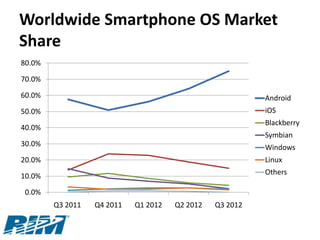
• Android accounted for 75% of smartphones
  sold in Q3 2012 – 91.5% YoY growth
• Market growth rate for smartphones is at
  46.4%
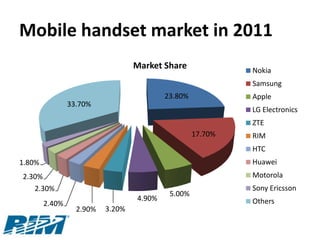
Mobile handset market in 2011
                                  Market Share              Nokia
                                                            Samsung
                                          23.80%            Apple
                33.70%
                                                            LG Electronics
                                                            ZTE
                                                   17.70%   RIM
                                                            HTC
1.80%                                                       Huawei
2.30%                                                       Motorola
   2.30%                                                    Sony Ericsson
                                           5.00%
                                  4.90%                     Others
        2.40%
                  2.90%   3.20%
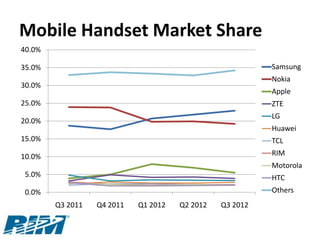
Mobile Handset Market Share
40.0%

35.0%                                                     Samsung
                                                          Nokia
30.0%
                                                          Apple
25.0%                                                     ZTE
                                                          LG
20.0%
                                                          Huawei
15.0%                                                     TCL
10.0%                                                     RIM
                                                          Motorola
 5.0%                                                     HTC
 0.0%                                                     Others
        Q3 2011   Q4 2011   Q1 2012   Q2 2012   Q3 2012
Worldwide Smartphone OS Market
Share
80.0%

70.0%

60.0%                                                     Android
50.0%                                                     iOS
                                                          Blackberry
40.0%
                                                          Symbian
30.0%                                                     Windows
20.0%                                                     Linux

10.0%                                                     Others

 0.0%
        Q3 2011   Q4 2011   Q1 2012   Q2 2012   Q3 2012
Mobile Phone Industry
       India
Industry Overview
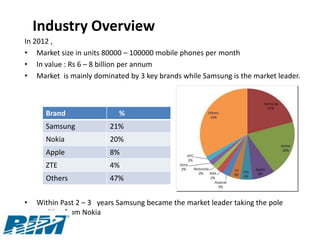
In 2012 ,
• Market size in units 80000 – 100000 mobile phones per month
• In value : Rs 6 – 8 billion per annum
• Market is mainly dominated by 3 key brands while Samsung is the market leader.


      Brand                 %
      Samsung            21%
      Nokia              20%
      Apple              8%
      ZTE                4%
      Others             47%


•   Within Past 2 – 3 years Samsung became the market leader taking the pole
    position from Nokia
• Market is mainly segmented by the income level while lower income
    group contributes around 70% of total revenue
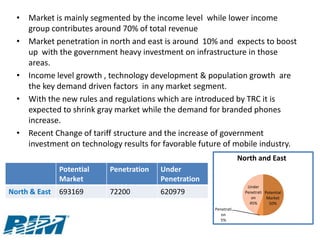
  • Market penetration in north and east is around 10% and expects to boost
    up with the government heavy investment on infrastructure in those
    areas.
  • Income level growth , technology development & population growth are
    the key demand driven factors in any market segment.
  • With the new rules and regulations which are introduced by TRC it is
    expected to shrink gray market while the demand for branded phones
    increase.
  • Recent Change of tariff structure and the increase of government
    investment on technology results for favorable future of mobile industry.
                                                                   North and East
               Potential   Penetration   Under
               Market                    Penetration
                                                                      Under
North & East   693169      72200         620979                      Penetrati Potential
                                                                        on      Market
                                                                       45%       50%
                                                       Penetrati
                                                          on
                                                         5%
Target Market
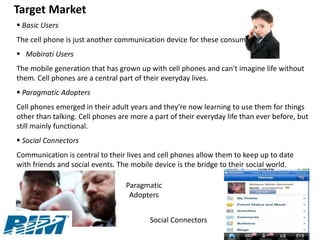
 Basic Users
The cell phone is just another communication device for these consumers.
 Mobirati Users
The mobile generation that has grown up with cell phones and can't imagine life without
them. Cell phones are a central part of their everyday lives.
 Paragmatic Adopters
Cell phones emerged in their adult years and they're now learning to use them for things
other than talking. Cell phones are more a part of their everyday life than ever before, but
still mainly functional.
 Social Connectors
Communication is central to their lives and cell phones allow them to keep up to date
with friends and social events. The mobile device is the bridge to their social world.

                                  Paragmatic
                                   Adopters


                                          Social Connectors
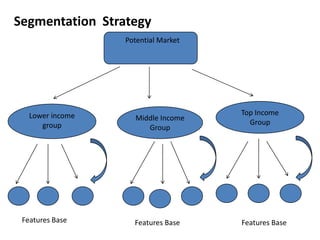
Segmentation Strategy
                  Potential Market


   Lower income                      Top Income
                     Middle Income
      group                            Group
                        Group


 Features Base      Features Base    Features Base
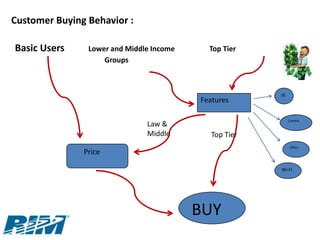
Customer Buying Behavior :

Basic Users     Lower and Middle Income     Top Tier
                    Groups


                                                        3G
                                          Features

                                                             Camera
                               Law &
                               Middle        Top Tier
                                                              Office
               Price

                                                        Wi-Fi


                                          BUY
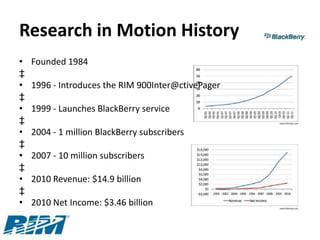
Research in Motion History
•   Founded 1984
‡
•   1996 - Introduces the RIM 900Inter@ctivePager
‡
•   1999 - Launches BlackBerry service
‡
•   2004 - 1 million BlackBerry subscribers
‡
•   2007 - 10 million subscribers
‡
•   2010 Revenue: $14.9 billion
‡
•   2010 Net Income: $3.46 billion
BlackBerry
• Started out as a two-way radio pager called
  the Inter@ctive Pager in the research labs of
  RIM in 1996
• Pager was the fist pocket-sized two-way
  messaging pager and the predecessor to the
  BlackBerry
• First phone-capable device was introduced in
  2004 as the BlackBerry 7100t
Push technology & QWERTY
• Email services serves as one of the main
  differentiating points
• Push technology allows emails to
  automatically show up on the device without
  the lag time of having to refresh a web-
  browser to view new emails.
• RIM designed and patented the now
  ubiquitous QWERTY keyboard
Purpose and Features of RIM
• Providing access to communication and important
  information all across the globe
• Build industry standards and improve performance of
  internationally mobile companies and their personnel.
• BB smartphones have supports for
  Email, text, IM, Social networks, Web access, GPS etc.
• Many offerings with variation in features
• International support on CANTEL and BellSouth
  network as well as nationwide network coverage on
  Ericsson’s Mobitex.
• Addon BlackBerry Enterprise Server for centralized
  administration ands support for laptop users
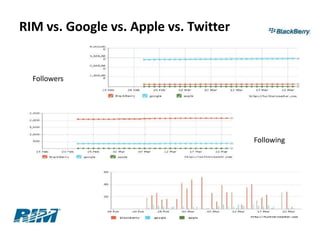
RIM vs. Google vs. Apple vs. Twitter


  Followers


                                       Following
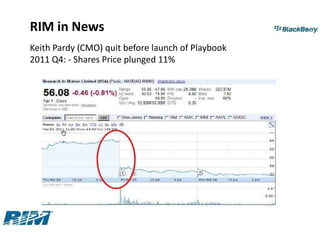
RIM in News
Keith Pardy (CMO) quit before launch of Playbook
2011 Q4: - Shares Price plunged 11%
Phase#1
Blackberry - Evolution
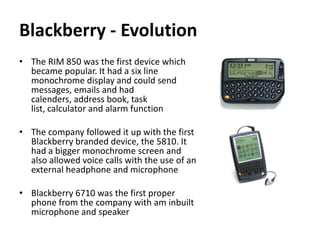
• The RIM 850 was the first device which
  became popular. It had a six line
  monochrome display and could send
  messages, emails and had
  calenders, address book, task
  list, calculator and alarm function

• The company followed it up with the first
  Blackberry branded device, the 5810. It
  had a bigger monochrome screen and
  also allowed voice calls with the use of an
  external headphone and microphone

• Blackberry 6710 was the first proper
  phone from the company with am inbuilt
  microphone and speaker
Blackberry Evolution – Contd.
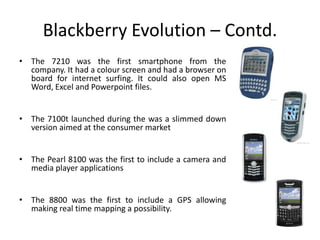
• The 7210 was the first smartphone from the
  company. It had a colour screen and had a browser on
  board for internet surfing. It could also open MS
  Word, Excel and Powerpoint files.


• The 7100t launched during the was a slimmed down
  version aimed at the consumer market


• The Pearl 8100 was the first to include a camera and
  media player applications


• The 8800 was the first to include a GPS allowing
  making real time mapping a possibility.
Blackberry Evolution – Contd.
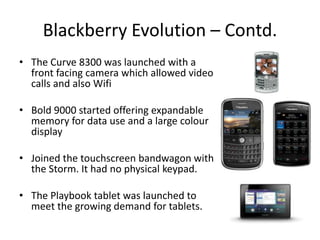
• The Curve 8300 was launched with a
  front facing camera which allowed video
  calls and also Wifi

• Bold 9000 started offering expandable
  memory for data use and a large colour
  display

• Joined the touchscreen bandwagon with
  the Storm. It had no physical keypad.

• The Playbook tablet was launched to
  meet the growing demand for tablets.
Phase#2
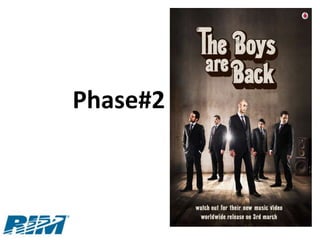
• BBM encouraged the entry of younger customers
  and the prepaid segment into BlackBerry services
  in India.
• BlackBerry Services – historically targeted at the
  corporate market – had a proven track record in
  commanding high ARPUs.
• With BBM, the impact is a lot more personal as
  compared to facebook and twitter with a one-on-
  one and group communication possible.
• They introduced the single interface point where
  multiple applications (like FB, Twitter) are
  integrated to enhance user experience.
• To tap into the young ‘BlackBerry Boys' generation,
  RIM had launched models such as Curve 8520.
• Although pre-paid commanded the lowest ARPU,
  research found that the youth liked to be seen as
  affluent, tech-savvy and constantly in touch with
  friends.
• Vodafone decided to tap into BBM’s attraction as a
  free alternative to more expensive text messaging and
  introduced pre-paid BlackBerry Services.
• The add-ons include colourful skins and packaging,
  while services were being added o at the back end for
  the ‘always connected' generation.
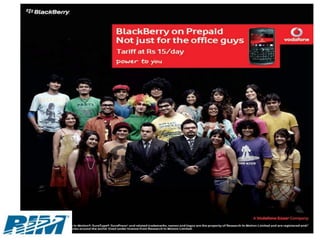
• Vodafone's Rs 5 per day or Rs 129 per month
  BlackBerry Messenger plan were introduced to
  attract more youngsters.
• The objective of the campaign was to increase
  the appeal of BlackBerry services on Vodafone to
  a larger audience with special emphasis on the
  younger generation.
• Results: Vodafone increased its share of
  BlackBerry users by 96%, nearly double its 50%
  target and within the first four months of the
  campaign it signed up nearly 154,000 additional
  subscribers (of which 35,000 were pre-paid)
• Its post-paid customer base grew 74% from
  160,000 pre-campaign to 279,000 post-campaign
Phase#3
Strategic Issues
• Operating Performance Declined

• Lost Product Innovation

• Changing Business Environment

• Increasing Competition
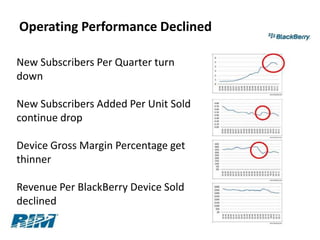
Operating Performance Declined

New Subscribers Per Quarter turn
down

New Subscribers Added Per Unit Sold
continue drop

Device Gross Margin Percentage get
thinner

Revenue Per BlackBerry Device Sold
declined
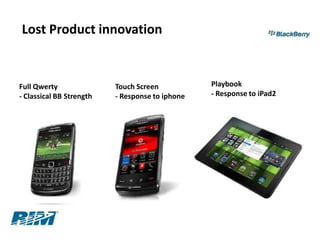
Lost Product innovation


Full Qwerty               Touch Screen           Playbook
- Classical BB Strength   - Response to iphone   - Response to iPad2
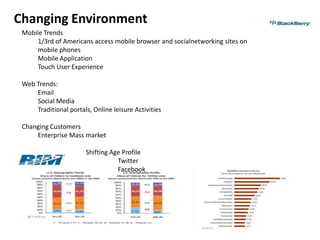
Changing Environment
 Mobile Trends
     1/3rd of Americans access mobile browser and socialnetworking sites on
     mobile phones
     Mobile Application
     Touch User Experience

 Web Trends:
     Email
     Social Media
     Traditional portals, Online leisure Activities
 Changing Customers
     Enterprise Mass market

                       Shifting Age Profile
                                  Twitter
                                  Facebook
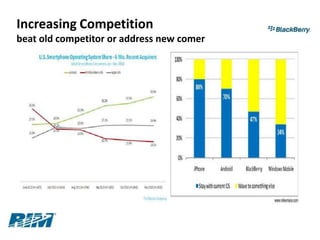
Increasing Competition
beat old competitor or address new comer
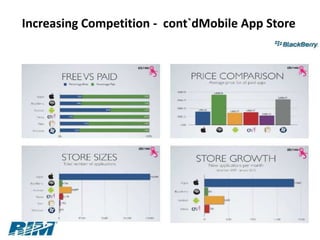
Increasing Competition - cont`dMobile App Store
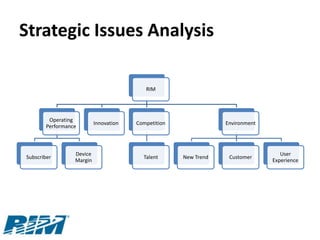
Strategic Issues Analysis

                                          RIM


        Operating
                          Innovation   Competition               Environment
       Performance


                 Device                                                           User
Subscriber                               Talent      New Trend    Customer
                 Margin                                                        Experience
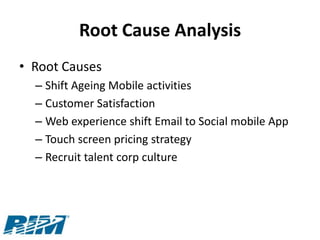
Root Cause Analysis
• Root Causes
  – Shift Ageing Mobile activities
  – Customer Satisfaction
  – Web experience shift Email to Social mobile App
  – Touch screen pricing strategy
  – Recruit talent corp culture
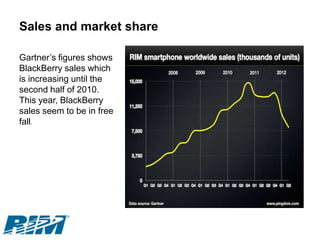
Sales and market share

Gartner’s figures shows
BlackBerry sales which
is increasing until the
second half of 2010.
This year, BlackBerry
sales seem to be in free
fall.
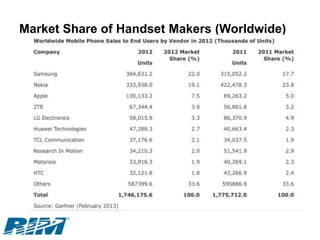
Market Share of Handset Makers (Worldwide)
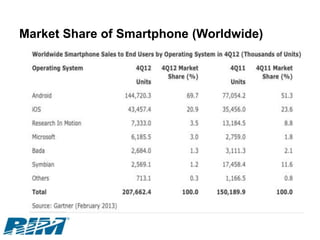
Market Share of Smartphone (Worldwide)
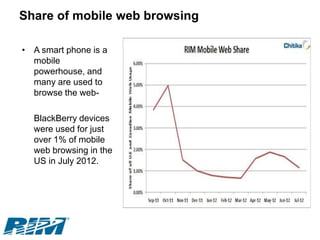
Share of mobile web browsing
• A smart phone is a
  mobile
  powerhouse, and
  many are used to
  browse the web-

  BlackBerry devices
  were used for just
  over 1% of mobile
  web browsing in the
  US in July 2012.

Technology management

  • 1.
  • 2.
    Mobile phone industry(Globally) •$ 1.18 trillion industry – 14% from handsets sale • 6 billion mobile phone subscribers at end of 2011 – 76% of them in developing world • Expected to rise to 8 billion by end of 2013 • 87% percent - Global market penetration rate • 3.2 billion - Unique mobile phone subscribers • China world’s largest market. Followed by India and US
  • 3.
    Mobile Handsets • Expectedsales of 1.8 billion handsets in year 2012. Up from 1.7 million in 2011 • 38.8% of sales will be from smartphones. A 10% increase YoY • Android accounted for 75% of smartphones sold in Q3 2012 – 91.5% YoY growth • Market growth rate for smartphones is at 46.4%
  • 4.
    Mobile handset marketin 2011 Market Share Nokia Samsung 23.80% Apple 33.70% LG Electronics ZTE 17.70% RIM HTC 1.80% Huawei 2.30% Motorola 2.30% Sony Ericsson 5.00% 4.90% Others 2.40% 2.90% 3.20%
  • 5.
    Mobile Handset MarketShare 40.0% 35.0% Samsung Nokia 30.0% Apple 25.0% ZTE LG 20.0% Huawei 15.0% TCL 10.0% RIM Motorola 5.0% HTC 0.0% Others Q3 2011 Q4 2011 Q1 2012 Q2 2012 Q3 2012
  • 6.
    Worldwide Smartphone OSMarket Share 80.0% 70.0% 60.0% Android 50.0% iOS Blackberry 40.0% Symbian 30.0% Windows 20.0% Linux 10.0% Others 0.0% Q3 2011 Q4 2011 Q1 2012 Q2 2012 Q3 2012
  • 7.
  • 8.
    Industry Overview In 2012, • Market size in units 80000 – 100000 mobile phones per month • In value : Rs 6 – 8 billion per annum • Market is mainly dominated by 3 key brands while Samsung is the market leader. Brand % Samsung 21% Nokia 20% Apple 8% ZTE 4% Others 47% • Within Past 2 – 3 years Samsung became the market leader taking the pole position from Nokia
  • 9.
    • Market ismainly segmented by the income level while lower income group contributes around 70% of total revenue • Market penetration in north and east is around 10% and expects to boost up with the government heavy investment on infrastructure in those areas. • Income level growth , technology development & population growth are the key demand driven factors in any market segment. • With the new rules and regulations which are introduced by TRC it is expected to shrink gray market while the demand for branded phones increase. • Recent Change of tariff structure and the increase of government investment on technology results for favorable future of mobile industry. North and East Potential Penetration Under Market Penetration Under North & East 693169 72200 620979 Penetrati Potential on Market 45% 50% Penetrati on 5%
  • 10.
    Target Market  BasicUsers The cell phone is just another communication device for these consumers.  Mobirati Users The mobile generation that has grown up with cell phones and can't imagine life without them. Cell phones are a central part of their everyday lives.  Paragmatic Adopters Cell phones emerged in their adult years and they're now learning to use them for things other than talking. Cell phones are more a part of their everyday life than ever before, but still mainly functional.  Social Connectors Communication is central to their lives and cell phones allow them to keep up to date with friends and social events. The mobile device is the bridge to their social world. Paragmatic Adopters Social Connectors
  • 11.
    Segmentation Strategy Potential Market Lower income Top Income Middle Income group Group Group Features Base Features Base Features Base
  • 12.
    Customer Buying Behavior: Basic Users Lower and Middle Income Top Tier Groups 3G Features Camera Law & Middle Top Tier Office Price Wi-Fi BUY
  • 13.
    Research in MotionHistory • Founded 1984 ‡ • 1996 - Introduces the RIM 900Inter@ctivePager ‡ • 1999 - Launches BlackBerry service ‡ • 2004 - 1 million BlackBerry subscribers ‡ • 2007 - 10 million subscribers ‡ • 2010 Revenue: $14.9 billion ‡ • 2010 Net Income: $3.46 billion
  • 14.
    BlackBerry • Started outas a two-way radio pager called the Inter@ctive Pager in the research labs of RIM in 1996 • Pager was the fist pocket-sized two-way messaging pager and the predecessor to the BlackBerry • First phone-capable device was introduced in 2004 as the BlackBerry 7100t
  • 15.
    Push technology &QWERTY • Email services serves as one of the main differentiating points • Push technology allows emails to automatically show up on the device without the lag time of having to refresh a web- browser to view new emails. • RIM designed and patented the now ubiquitous QWERTY keyboard
  • 16.
    Purpose and Featuresof RIM • Providing access to communication and important information all across the globe • Build industry standards and improve performance of internationally mobile companies and their personnel. • BB smartphones have supports for Email, text, IM, Social networks, Web access, GPS etc. • Many offerings with variation in features • International support on CANTEL and BellSouth network as well as nationwide network coverage on Ericsson’s Mobitex. • Addon BlackBerry Enterprise Server for centralized administration ands support for laptop users
  • 17.
    RIM vs. Googlevs. Apple vs. Twitter Followers Following
  • 18.
    RIM in News KeithPardy (CMO) quit before launch of Playbook 2011 Q4: - Shares Price plunged 11%
  • 19.
  • 20.
    Blackberry - Evolution •The RIM 850 was the first device which became popular. It had a six line monochrome display and could send messages, emails and had calenders, address book, task list, calculator and alarm function • The company followed it up with the first Blackberry branded device, the 5810. It had a bigger monochrome screen and also allowed voice calls with the use of an external headphone and microphone • Blackberry 6710 was the first proper phone from the company with am inbuilt microphone and speaker
  • 21.
    Blackberry Evolution –Contd. • The 7210 was the first smartphone from the company. It had a colour screen and had a browser on board for internet surfing. It could also open MS Word, Excel and Powerpoint files. • The 7100t launched during the was a slimmed down version aimed at the consumer market • The Pearl 8100 was the first to include a camera and media player applications • The 8800 was the first to include a GPS allowing making real time mapping a possibility.
  • 22.
    Blackberry Evolution –Contd. • The Curve 8300 was launched with a front facing camera which allowed video calls and also Wifi • Bold 9000 started offering expandable memory for data use and a large colour display • Joined the touchscreen bandwagon with the Storm. It had no physical keypad. • The Playbook tablet was launched to meet the growing demand for tablets.
  • 23.
  • 24.
    • BBM encouragedthe entry of younger customers and the prepaid segment into BlackBerry services in India. • BlackBerry Services – historically targeted at the corporate market – had a proven track record in commanding high ARPUs. • With BBM, the impact is a lot more personal as compared to facebook and twitter with a one-on- one and group communication possible. • They introduced the single interface point where multiple applications (like FB, Twitter) are integrated to enhance user experience.
  • 25.
    • To tapinto the young ‘BlackBerry Boys' generation, RIM had launched models such as Curve 8520. • Although pre-paid commanded the lowest ARPU, research found that the youth liked to be seen as affluent, tech-savvy and constantly in touch with friends. • Vodafone decided to tap into BBM’s attraction as a free alternative to more expensive text messaging and introduced pre-paid BlackBerry Services. • The add-ons include colourful skins and packaging, while services were being added o at the back end for the ‘always connected' generation.
  • 26.
    • Vodafone's Rs5 per day or Rs 129 per month BlackBerry Messenger plan were introduced to attract more youngsters. • The objective of the campaign was to increase the appeal of BlackBerry services on Vodafone to a larger audience with special emphasis on the younger generation. • Results: Vodafone increased its share of BlackBerry users by 96%, nearly double its 50% target and within the first four months of the campaign it signed up nearly 154,000 additional subscribers (of which 35,000 were pre-paid) • Its post-paid customer base grew 74% from 160,000 pre-campaign to 279,000 post-campaign
  • 28.
  • 29.
    Strategic Issues • OperatingPerformance Declined • Lost Product Innovation • Changing Business Environment • Increasing Competition
  • 30.
    Operating Performance Declined NewSubscribers Per Quarter turn down New Subscribers Added Per Unit Sold continue drop Device Gross Margin Percentage get thinner Revenue Per BlackBerry Device Sold declined
  • 31.
    Lost Product innovation FullQwerty Touch Screen Playbook - Classical BB Strength - Response to iphone - Response to iPad2
  • 32.
    Changing Environment MobileTrends 1/3rd of Americans access mobile browser and socialnetworking sites on mobile phones Mobile Application Touch User Experience Web Trends: Email Social Media Traditional portals, Online leisure Activities Changing Customers Enterprise Mass market Shifting Age Profile Twitter Facebook
  • 33.
    Increasing Competition beat oldcompetitor or address new comer
  • 34.
    Increasing Competition -cont`dMobile App Store
  • 35.
    Strategic Issues Analysis RIM Operating Innovation Competition Environment Performance Device User Subscriber Talent New Trend Customer Margin Experience
  • 36.
    Root Cause Analysis •Root Causes – Shift Ageing Mobile activities – Customer Satisfaction – Web experience shift Email to Social mobile App – Touch screen pricing strategy – Recruit talent corp culture
  • 37.
    Sales and marketshare Gartner’s figures shows BlackBerry sales which is increasing until the second half of 2010. This year, BlackBerry sales seem to be in free fall.
  • 38.
    Market Share ofHandset Makers (Worldwide)
  • 39.
    Market Share ofSmartphone (Worldwide)
  • 40.
    Share of mobileweb browsing • A smart phone is a mobile powerhouse, and many are used to browse the web- BlackBerry devices were used for just over 1% of mobile web browsing in the US in July 2012.