LET’S PLAY
A GAME!!!
“ARRANGE MY NAME ”
Go to your respected group first. I
provided 3 envelop for each group and
inside the envelop there are jumbled
letters. Arrange the jumbled letters and
paste it on the board. I also prepared a
picture that correspond to the words. Pick
and attach the picture that best describe
the word. You only have 5 minutes to that.
CLEANING
DETERGENT
CHEMICAL
TEMPERATURE
HEAT
CLEANING
AND
SANITIZING
 Is the process of
removing foods and
other types of soil
from a surface such as
a dish, glass or cutting
board.
 Cleaning is done with cleaning
agent that remove food, soil, or
other substances.
 The right cleaning agent must be
selected because not all cleaning
agents can be used on food-
contact surfaces.
 There are 4 categories of cleaning
agent.
 It is use routinely to wash
tableware, surfaces, and
equipment.
 It can penetrate soil
quickly and soften it.
 It is use periodically
on surfaces where
grease has burned
on.
 Solvent cleaners are
often called
degreasers.
 It is use periodically on
mineral deposits and other
soils that detergents cannot
remove.
 The cleaners are often used
to remove scale in ware
washing machines and steam
tables.
 It is used to remove heavy
accumulation of soil that are
difficult to remove with
detergent.
 Clean food-contact surfaces that
are used to prepare potentially
hazardous food as needed
throughout the day but no less
than every hours.
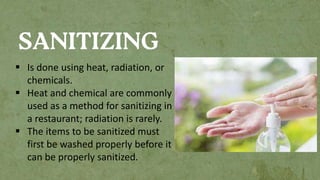
SANITIZING
 Is done using heat, radiation, or
chemicals.
 Heat and chemical are commonly
used as a method for sanitizing in
a restaurant; radiation is rarely.
 The items to be sanitized must
first be washed properly before it
can be properly sanitized.
 There are 3 methods
of using heat to
sanitized surfaces –
steam, hot water and
hot air
 Chemicals that are
approved sanitizers
are chlorine, iodine
and quaternary
ammonium.
CONCENTRATION TEMPERATURE CONTACT TIME
The presence of too
little sanitizer will
result in an
inadequate reduction
of harmful
microorganism. Too
much can be toxic.
Sanitizer’s
effectiveness is
evident
between 75 ℉
to 120 ℉
In order for the sanitizer
to kill harmful
microorganism, the
cleaned item must be in
with the sanitizer (either
heat or approved
chemical) for the
recommended length of
time.
Class what is the
importance of cleaning
and sanitizing kitchen
tool, and equipment?
“PUT ME WHERE I BELONG”
Let’s have another activity. I prepared
here a paper strips with definitions and
example of cleaning and sanitizing. You
have to differentiate the strip from
cleaning or sanitizing. Paste your
answer to the board.
EVALUATION:
Test I Direction: choose the letter of the correct answer.
1. It is the process of removing food and other types of soil from a surface,
such as dish, glass or cutting board.
A. Temperature C. Cleaning
B. Heat D. Sanitizing
2. Which of the following is commonly known as 'degreasers'?
A. Detergents C. Solvent Cleaners
B. Acid Cleaners D. Abrasives Cleaners
3. It is often used to remove scale in ware washing machines and steam
tables.
A. Acid cleaner C. Detergent
B. Sanitizing D. Chemical
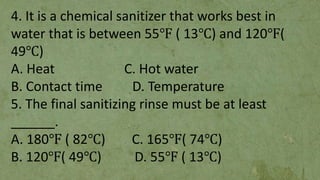
4. It is a chemical sanitizer that works best in
water that is between 55℉ ( 13℃) and 120℉(
49℃)
A. Heat C. Hot water
B. Contact time D. Temperature
5. The final sanitizing rinse must be at least
______.
A. 180℉ ( 82℃) C. 165℉( 74℃)
B. 120℉( 49℃) D. 55℉ ( 13℃)
Test II. Direction: Enumeration
6-7. The 2 methods of sanitizing
8-10. The 3 considered factors in sanitizing.
Test III. Direction: Identify the following words
that describes the statement.
11. It is the most commonly use method in the
restaurant.
12. It is use to remove heavy accumulations of
soil that are difficult to remove with detergent.
13. It is done with cleaning agent
that remove food, soil and other
substances.
14. It is done using heat, radiation or
chemical.
15. It is use periodically on surfaces
where grease has burned on.
Search for the meaning of this abbreviation.
1. Tbsp 6.℉
2. tsp 7. lb
3. inc 8.℃
4. fl.oz 9. g
5. oz 10. c
ASSIGNMENT
Cleaning and Sanitizing kitchen tool.pptx

Cleaning and Sanitizing kitchen tool.pptx

  • 1.
  • 2.
    “ARRANGE MY NAME” Go to your respected group first. I provided 3 envelop for each group and inside the envelop there are jumbled letters. Arrange the jumbled letters and paste it on the board. I also prepared a picture that correspond to the words. Pick and attach the picture that best describe the word. You only have 5 minutes to that.
  • 3.
  • 4.
  • 5.
  • 6.
  • 7.
  • 8.
  • 10.
     Is theprocess of removing foods and other types of soil from a surface such as a dish, glass or cutting board.
  • 11.
     Cleaning isdone with cleaning agent that remove food, soil, or other substances.  The right cleaning agent must be selected because not all cleaning agents can be used on food- contact surfaces.  There are 4 categories of cleaning agent.
  • 12.
     It isuse routinely to wash tableware, surfaces, and equipment.  It can penetrate soil quickly and soften it.
  • 13.
     It isuse periodically on surfaces where grease has burned on.  Solvent cleaners are often called degreasers.
  • 14.
     It isuse periodically on mineral deposits and other soils that detergents cannot remove.  The cleaners are often used to remove scale in ware washing machines and steam tables.
  • 15.
     It isused to remove heavy accumulation of soil that are difficult to remove with detergent.  Clean food-contact surfaces that are used to prepare potentially hazardous food as needed throughout the day but no less than every hours.
  • 16.
  • 17.
     Is doneusing heat, radiation, or chemicals.  Heat and chemical are commonly used as a method for sanitizing in a restaurant; radiation is rarely.  The items to be sanitized must first be washed properly before it can be properly sanitized.
  • 18.
     There are3 methods of using heat to sanitized surfaces – steam, hot water and hot air
  • 22.
     Chemicals thatare approved sanitizers are chlorine, iodine and quaternary ammonium.
  • 23.
    CONCENTRATION TEMPERATURE CONTACTTIME The presence of too little sanitizer will result in an inadequate reduction of harmful microorganism. Too much can be toxic. Sanitizer’s effectiveness is evident between 75 ℉ to 120 ℉ In order for the sanitizer to kill harmful microorganism, the cleaned item must be in with the sanitizer (either heat or approved chemical) for the recommended length of time.
  • 24.
    Class what isthe importance of cleaning and sanitizing kitchen tool, and equipment?
  • 25.
    “PUT ME WHEREI BELONG” Let’s have another activity. I prepared here a paper strips with definitions and example of cleaning and sanitizing. You have to differentiate the strip from cleaning or sanitizing. Paste your answer to the board.
  • 26.
    EVALUATION: Test I Direction:choose the letter of the correct answer. 1. It is the process of removing food and other types of soil from a surface, such as dish, glass or cutting board. A. Temperature C. Cleaning B. Heat D. Sanitizing 2. Which of the following is commonly known as 'degreasers'? A. Detergents C. Solvent Cleaners B. Acid Cleaners D. Abrasives Cleaners 3. It is often used to remove scale in ware washing machines and steam tables. A. Acid cleaner C. Detergent B. Sanitizing D. Chemical
  • 27.
    4. It isa chemical sanitizer that works best in water that is between 55℉ ( 13℃) and 120℉( 49℃) A. Heat C. Hot water B. Contact time D. Temperature 5. The final sanitizing rinse must be at least ______. A. 180℉ ( 82℃) C. 165℉( 74℃) B. 120℉( 49℃) D. 55℉ ( 13℃)
  • 28.
    Test II. Direction:Enumeration 6-7. The 2 methods of sanitizing 8-10. The 3 considered factors in sanitizing. Test III. Direction: Identify the following words that describes the statement. 11. It is the most commonly use method in the restaurant. 12. It is use to remove heavy accumulations of soil that are difficult to remove with detergent.
  • 29.
    13. It isdone with cleaning agent that remove food, soil and other substances. 14. It is done using heat, radiation or chemical. 15. It is use periodically on surfaces where grease has burned on.
  • 30.
    Search for themeaning of this abbreviation. 1. Tbsp 6.℉ 2. tsp 7. lb 3. inc 8.℃ 4. fl.oz 9. g 5. oz 10. c ASSIGNMENT