By Russell Guy 16748584 The Evolution of Technology
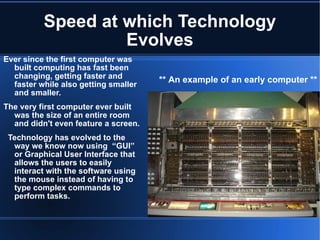
Speed at which Technology Evolves Ever since the first computer was built computing has fast been changing, getting faster and faster while also getting smaller and smaller.  The very first computer ever built was the size of an entire room and didn't even feature a screen. Technology has evolved to the way we know now using  “GUI” or Graphical User Interface that allows the users to easily interact with the software using the mouse instead of having to type complex commands to perform tasks. ** An example of an early computer **
Moore's Law Did you know that according to Moore's Law processing power of personal computers doubles every two years?  This has been proven correct multiple times by computing companies like IBM who now use Moore's law as a production goal for them to reach every year.  The storage size of computers is also increasing at a great speed, 20 years ago 1GB of storage space cost $1000, whilst today you could buy a 1GB flashdrive for under $5.
Computer Games Thanks to the increased speed and performance of computers; videogames evolved from simple text based adventures that featured no GUI (graphical user interface) to complex layered environments that are interacted with in realtime.  ** An early computer game pictured left, compared to a current one on the right. **
Conclusion In the last 40 years computers have come a long way from large and bulky systems without any display to the user-friendly, quick and powerful systems that can be found in almost any home.  However in the future computing technology will reach a point at which it cannot progress any smaller or faster due to physical limits, however I believe computer software will be able to keep progressing for a long time and will also give boosts to hardware performance.
QUESTIONS Any Questions? ?

Technology

  • 1.
    By Russell Guy16748584 The Evolution of Technology
  • 2.
    Speed at whichTechnology Evolves Ever since the first computer was built computing has fast been changing, getting faster and faster while also getting smaller and smaller. The very first computer ever built was the size of an entire room and didn't even feature a screen. Technology has evolved to the way we know now using “GUI” or Graphical User Interface that allows the users to easily interact with the software using the mouse instead of having to type complex commands to perform tasks. ** An example of an early computer **
  • 3.
    Moore's Law Didyou know that according to Moore's Law processing power of personal computers doubles every two years? This has been proven correct multiple times by computing companies like IBM who now use Moore's law as a production goal for them to reach every year. The storage size of computers is also increasing at a great speed, 20 years ago 1GB of storage space cost $1000, whilst today you could buy a 1GB flashdrive for under $5.
  • 4.
    Computer Games Thanksto the increased speed and performance of computers; videogames evolved from simple text based adventures that featured no GUI (graphical user interface) to complex layered environments that are interacted with in realtime. ** An early computer game pictured left, compared to a current one on the right. **
  • 5.
    Conclusion In thelast 40 years computers have come a long way from large and bulky systems without any display to the user-friendly, quick and powerful systems that can be found in almost any home. However in the future computing technology will reach a point at which it cannot progress any smaller or faster due to physical limits, however I believe computer software will be able to keep progressing for a long time and will also give boosts to hardware performance.
  • 6.