Editing (Moesha)

TECHNICAL TERMS FOR EDITING
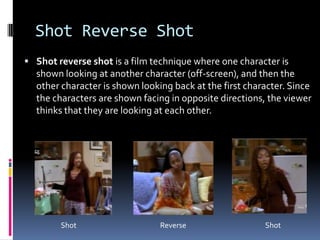
Shot Reverse Shot
 Shot reverse shot is a film technique where one character is
  shown looking at another character (off-screen), and then the
  other character is shown looking back at the first character. Since
  the characters are shown facing in opposite directions, the viewer
  thinks that they are looking at each other.


        Shot                    Reverse                  Shot
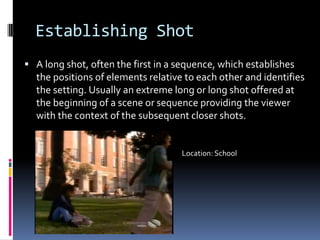
Establishing Shot
 A long shot, often the first in a sequence, which establishes
  the positions of elements relative to each other and identifies
  the setting. Usually an extreme long or long shot offered at
  the beginning of a scene or sequence providing the viewer
  with the context of the subsequent closer shots.


                                    Location: School
Cross Cutting
 Swiftly cutting backwards and forwards between more than
  one scene. The alternating of shots from two sequences,
  often in different locales, to suggest the sequences are
  taking place simultaneously.
Eye line Matching
 When a character looks into off-screen space the spectator
  expects to see what he or she is looking at so there will be a cut
  to show what is being looked at:
 object
 view
 another character
example, character A will look off-screen at character B. Cut to
  character B, who is in the same room and engaged.
Graphic Matching

 A visual rhyme between two following shots.
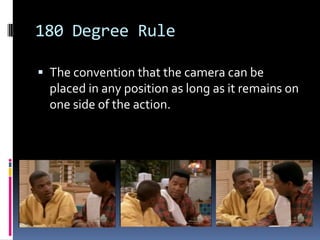
180 Degree Rule

 The convention that the camera can be
  placed in any position as long as it remains on
  one side of the action.
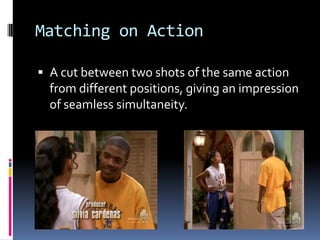
Matching on Action

 A cut between two shots of the same action
  from different positions, giving an impression
  of seamless simultaneity.

Technical terms for editing

  • 1.
  • 2.
    Shot Reverse Shot Shot reverse shot is a film technique where one character is shown looking at another character (off-screen), and then the other character is shown looking back at the first character. Since the characters are shown facing in opposite directions, the viewer thinks that they are looking at each other. Shot Reverse Shot
  • 3.
    Establishing Shot  Along shot, often the first in a sequence, which establishes the positions of elements relative to each other and identifies the setting. Usually an extreme long or long shot offered at the beginning of a scene or sequence providing the viewer with the context of the subsequent closer shots. Location: School
  • 4.
    Cross Cutting  Swiftlycutting backwards and forwards between more than one scene. The alternating of shots from two sequences, often in different locales, to suggest the sequences are taking place simultaneously.
  • 5.
    Eye line Matching When a character looks into off-screen space the spectator expects to see what he or she is looking at so there will be a cut to show what is being looked at:  object  view  another character example, character A will look off-screen at character B. Cut to character B, who is in the same room and engaged.
  • 6.
    Graphic Matching  Avisual rhyme between two following shots.
  • 7.
    180 Degree Rule The convention that the camera can be placed in any position as long as it remains on one side of the action.
  • 8.
    Matching on Action A cut between two shots of the same action from different positions, giving an impression of seamless simultaneity.