Technical Publications: The Big Picture
Narrating the Current Scenario
Technical publications are deep-seated as one major constituent of any product development
segment in all types of industry domains today.Failure to understand the rudiments of technical
publications process has repercussions at later stages of the product life cycle,affectingboth
employee productivity and customer satisfaction. An effectivetechnicalpublications delivery model
builds upon your existing capabilities to capture, manage, store, preserve, and deliver up-to-date
business information.
Enterprise Content Management systems have helped alleviate problems associated with
information access and data integrity, whichturns to reduced costs and inefficiencies.It
streamlines yourcontent creation and publishing process, offering a more formal solution to
updating existing documentation or for creating new information. However,these content
management systems are incompetent to subdue any challenges imposed by the traditional
technical publishing systems.
Challenges with Technical Publications
 Inability to Reuse Information: The ability to single-source yourcontent and reuse it on a
multitude of channels is an asset to the organization’s internal costs, productivity,and
customer satisfaction. Failure to do so implies overtime and delayed delivery, subsequently
resulting in revenue losses, loss of customer satisfaction, and mislaid new market
opportunities.
 Wasted Effortsin Manual Updates: Performing manual updates across a series of similar
documents can constrictthe scope of document maintenance and can be detrimental to the
interests of the organization. Changes to redundant content distributed at multiple locations
impacts both authoring efficiency andresponse time.
 Inconsistencies in Document Structure: An ideal technicalpublications model fed with
unstructured information will stumble miserably. This can cause additional review cycles
for the document at the time of updates and lead to additional complexities making it
difficultforthe readers to understand.
 Inability to Deliver Personalized Content: Failure to deliver personalized content catering to
the requirements of yourclients across geographical boundaries may result in loss of
business. Meeting the needs of worldwidecustomers lends a hand in winning new market
opportunities and bringing repeat business to yourorganization.
Moving from Traditional Approach to Componentization
The conventional paradigm of technical publications acts as a bar forthe product development and
delivery model of any business. For multi-channel delivery of information, it is elemental to break a
technical document into reusable components (knownas componentization).Splitting information
into meaningful definable segments eases content management and improves the scope of content
re-purposing and re-publishing.
Organizations can decipher the needs of various audiences and then leverage this approach to
collate and reuse their information components to deliver localized content. The logical segments of
information should be interchangeable to be reused in multiple instances across different
publications that cater to the needs of your global clientele. In this respect, componentization is the
cornerstone of automated publishing systems that publish contentto varied media types without
human intervention.
InterGlobe’s Edge in Technical Publications Arena: Growing from Scratch
to a Business Vertical
InterGlobe has taken a leap forwardto move squarely and dynamically into the content services
arena offering technicaldata and publishing solutions to leading airlines in the world. InterGlobe, a
leader in aviation, hospitality, and travel related services, is reckoned forits huge customer base
comprising some of the big players in travel industry. Expanding its business portfoliowith
technical documentation has created a new segment of opportunities forthe company to foray into
new markets. Currently, the technicalpublications department has successfully completed three
projects for a leading south-east Asian airline, for an industry giant in air transport communications
and IT,and for Oman GSL.
Initial Challenges Confronting InterGlobe’s Tech Pubs Department
Building from Scratch: With a minimal intellectual grasp of the technical publications process,
InterGlobe built a core team of authors that could successfully streamline workflowsandproduce
qualitative content flawlessly matching the needs of the customers. Initial challenges involved
handling complexities of each documentation phase and reducing turnaround time without
affectingthe product delivery.
Reducing Dependencies: One of the major efforts required was reducing dependency on subject
matter experts fordomain knowledge. Collating the scattered knowledge in one place and building
a repository of up-to-date information works round to optimize the technical publications
workflow,achievetimely deliveries, and minimize support calls.
Scaling downComplexities forBigger Screens: Big screens introduced complexities to the document
design and made way for unprecedented errors only to bring down quality and customer
satisfaction. It was critical to fend off unwanted errors and create a consistent generic structure to
be used for documenting both procedural as well as business content.
Targeting a Global Audience: Creating customized content fordifferent audiences in the same area
of interest initially required a multitude of changes. These changes derived the need forcreating a
ready reckoner that can be utilized as a base for generating contenttailored to our business needs
and consequently minimizing the changes.
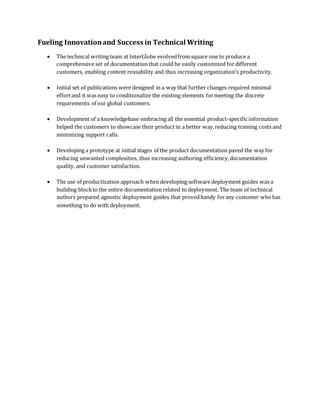
Technical Publications Business Delivery Model
InterGlobe Technical Writing Team
Live Application
Demos
Document Scope
Analysis
Prototype
Preparation
Document Creation
Quality Checks
Document
Publishing/
Maintenance
Customer
Feedback/Fixes
Document
Integration with
Application
Client
Provide Application
Demos
Monitor Standards/
Information
Accuracy
Provide Document
Feedback
Final Assessment/
Application Testing
Online Meetings
Standup Calls
Fueling Innovationand Success in Technical Writing
 The technical writing team at InterGlobe evolvedfrom square one to produce a
comprehensive set of documentation that could be easily customized for different
customers, enabling content reusability and thus increasing organization’s productivity.
 Initial set of publications were designed in a way that further changes required minimal
effortand it was easy to conditionalize the existing elements formeeting the discrete
requirements of our global customers.
 Development of a knowledgebase embracing all the essential product-specific information
helped the customers to showcase their product in a better way,reducing training costs and
minimizing support calls.
 Developing a prototype at initial stages of the product documentation paved the way for
reducing unwanted complexities, thus increasing authoring efficiency,documentation
quality, and customer satisfaction.
 The use of productization approach when developing software deployment guides was a
building blockto the entire documentation related to deployment. The team of technical
authors prepared agnostic deployment guides that provedhandy forany customer whohas
something to do with deployment.

Technical Publications Current Challenges

  • 1.
    Technical Publications: TheBig Picture Narrating the Current Scenario Technical publications are deep-seated as one major constituent of any product development segment in all types of industry domains today.Failure to understand the rudiments of technical publications process has repercussions at later stages of the product life cycle,affectingboth employee productivity and customer satisfaction. An effectivetechnicalpublications delivery model builds upon your existing capabilities to capture, manage, store, preserve, and deliver up-to-date business information. Enterprise Content Management systems have helped alleviate problems associated with information access and data integrity, whichturns to reduced costs and inefficiencies.It streamlines yourcontent creation and publishing process, offering a more formal solution to updating existing documentation or for creating new information. However,these content management systems are incompetent to subdue any challenges imposed by the traditional technical publishing systems. Challenges with Technical Publications  Inability to Reuse Information: The ability to single-source yourcontent and reuse it on a multitude of channels is an asset to the organization’s internal costs, productivity,and customer satisfaction. Failure to do so implies overtime and delayed delivery, subsequently resulting in revenue losses, loss of customer satisfaction, and mislaid new market opportunities.  Wasted Effortsin Manual Updates: Performing manual updates across a series of similar documents can constrictthe scope of document maintenance and can be detrimental to the interests of the organization. Changes to redundant content distributed at multiple locations impacts both authoring efficiency andresponse time.  Inconsistencies in Document Structure: An ideal technicalpublications model fed with unstructured information will stumble miserably. This can cause additional review cycles for the document at the time of updates and lead to additional complexities making it difficultforthe readers to understand.  Inability to Deliver Personalized Content: Failure to deliver personalized content catering to the requirements of yourclients across geographical boundaries may result in loss of business. Meeting the needs of worldwidecustomers lends a hand in winning new market opportunities and bringing repeat business to yourorganization.
  • 2.
    Moving from TraditionalApproach to Componentization The conventional paradigm of technical publications acts as a bar forthe product development and delivery model of any business. For multi-channel delivery of information, it is elemental to break a technical document into reusable components (knownas componentization).Splitting information into meaningful definable segments eases content management and improves the scope of content re-purposing and re-publishing. Organizations can decipher the needs of various audiences and then leverage this approach to collate and reuse their information components to deliver localized content. The logical segments of information should be interchangeable to be reused in multiple instances across different publications that cater to the needs of your global clientele. In this respect, componentization is the cornerstone of automated publishing systems that publish contentto varied media types without human intervention. InterGlobe’s Edge in Technical Publications Arena: Growing from Scratch to a Business Vertical InterGlobe has taken a leap forwardto move squarely and dynamically into the content services arena offering technicaldata and publishing solutions to leading airlines in the world. InterGlobe, a leader in aviation, hospitality, and travel related services, is reckoned forits huge customer base comprising some of the big players in travel industry. Expanding its business portfoliowith technical documentation has created a new segment of opportunities forthe company to foray into new markets. Currently, the technicalpublications department has successfully completed three projects for a leading south-east Asian airline, for an industry giant in air transport communications and IT,and for Oman GSL. Initial Challenges Confronting InterGlobe’s Tech Pubs Department Building from Scratch: With a minimal intellectual grasp of the technical publications process, InterGlobe built a core team of authors that could successfully streamline workflowsandproduce qualitative content flawlessly matching the needs of the customers. Initial challenges involved handling complexities of each documentation phase and reducing turnaround time without affectingthe product delivery.
  • 3.
    Reducing Dependencies: Oneof the major efforts required was reducing dependency on subject matter experts fordomain knowledge. Collating the scattered knowledge in one place and building a repository of up-to-date information works round to optimize the technical publications workflow,achievetimely deliveries, and minimize support calls. Scaling downComplexities forBigger Screens: Big screens introduced complexities to the document design and made way for unprecedented errors only to bring down quality and customer satisfaction. It was critical to fend off unwanted errors and create a consistent generic structure to be used for documenting both procedural as well as business content. Targeting a Global Audience: Creating customized content fordifferent audiences in the same area of interest initially required a multitude of changes. These changes derived the need forcreating a ready reckoner that can be utilized as a base for generating contenttailored to our business needs and consequently minimizing the changes. Technical Publications Business Delivery Model InterGlobe Technical Writing Team Live Application Demos Document Scope Analysis Prototype Preparation Document Creation Quality Checks Document Publishing/ Maintenance Customer Feedback/Fixes Document Integration with Application Client Provide Application Demos Monitor Standards/ Information Accuracy Provide Document Feedback Final Assessment/ Application Testing Online Meetings Standup Calls
  • 4.
    Fueling Innovationand Successin Technical Writing  The technical writing team at InterGlobe evolvedfrom square one to produce a comprehensive set of documentation that could be easily customized for different customers, enabling content reusability and thus increasing organization’s productivity.  Initial set of publications were designed in a way that further changes required minimal effortand it was easy to conditionalize the existing elements formeeting the discrete requirements of our global customers.  Development of a knowledgebase embracing all the essential product-specific information helped the customers to showcase their product in a better way,reducing training costs and minimizing support calls.  Developing a prototype at initial stages of the product documentation paved the way for reducing unwanted complexities, thus increasing authoring efficiency,documentation quality, and customer satisfaction.  The use of productization approach when developing software deployment guides was a building blockto the entire documentation related to deployment. The team of technical authors prepared agnostic deployment guides that provedhandy forany customer whohas something to do with deployment.