Technical & Product
Debt Management
By Dr. Sergey Sundukovskiy
1
Introduction
SergeySundukovskiy, Ph.D.
Co-Founder, CPO/CTO – Salesmsg
2
Point of Origin
3
“… Adesign or construction approach that is expedient in theshort term but that creates a technical
context inwhich the same workwill cost moreto do laterthan it would cost to do now (including
increased cost over time).”
4
Debt
EverythingYouWant toDo “Later” Is DEBT
• Let’s Document Later
• Let’s Test Later
• Let’s Architect Later
• Let’s Refactor Later
5
Debt
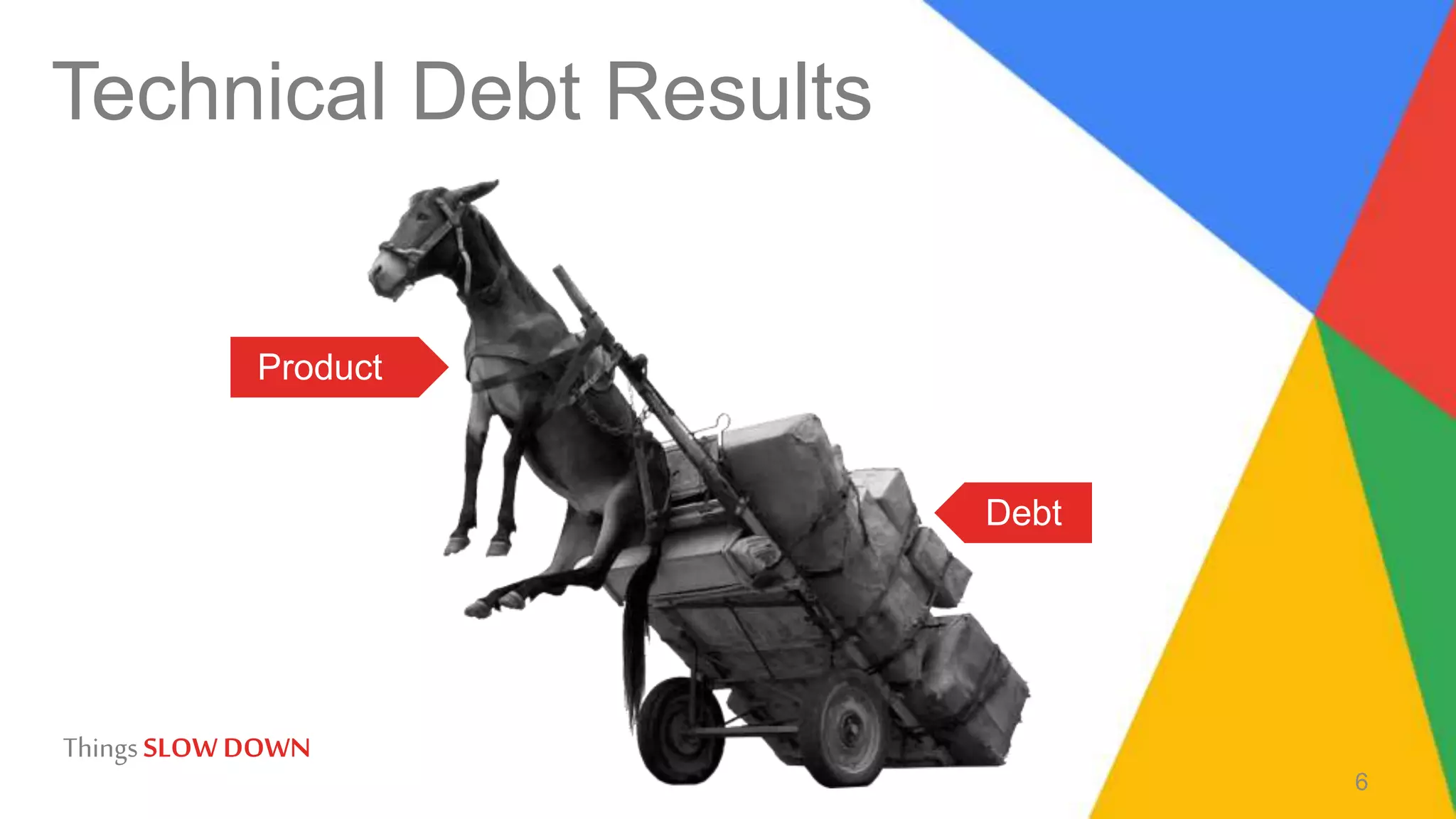
Technical Debt Results
Product
Debt
ThingsSLOW DOWN
6
• All Debt Is Bad
• No Debt Is Great
• Taking On Debt Always Gets You There Faster
7
Debt Misconceptions
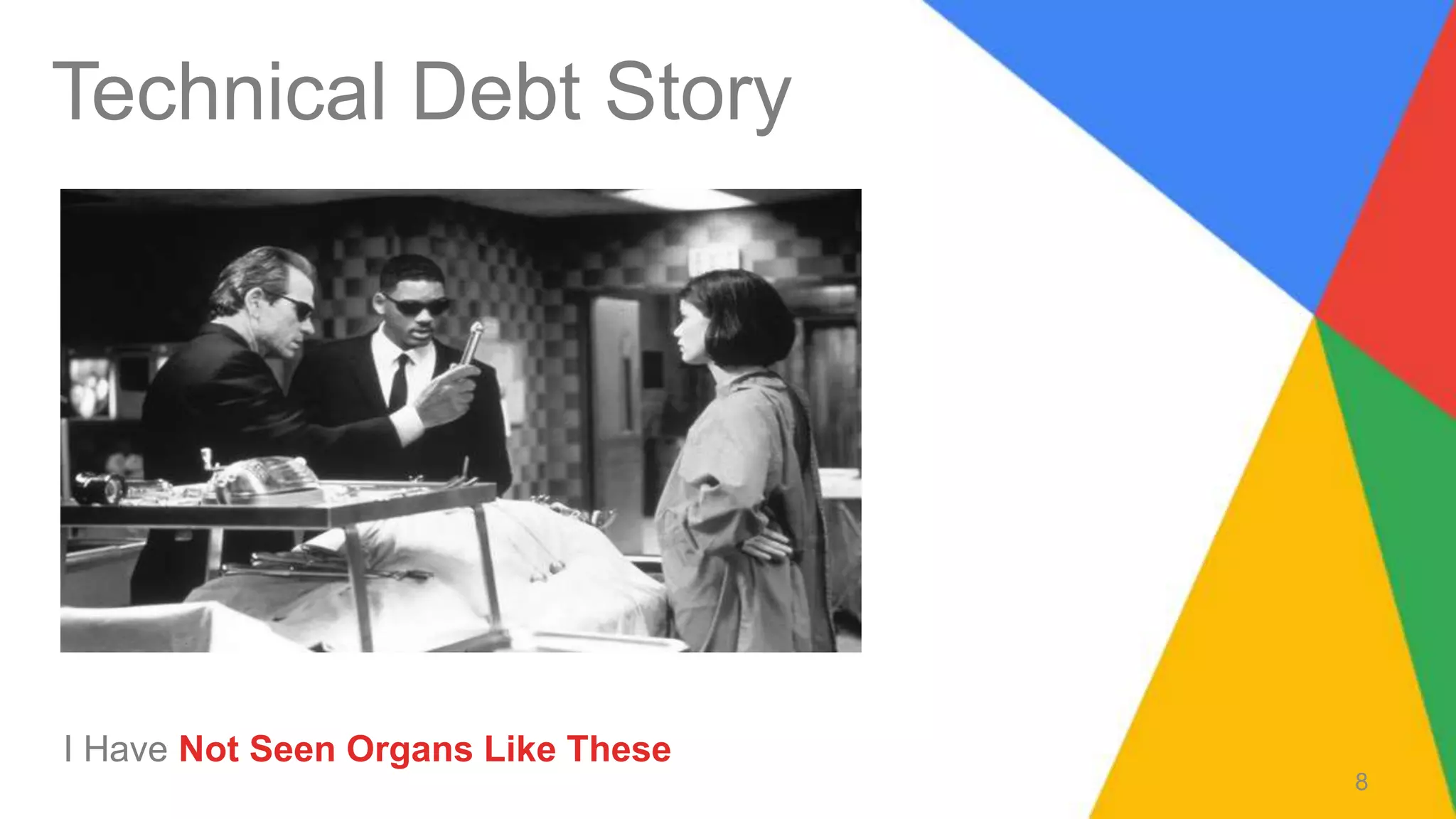
Technical Debt Story
I Have Not Seen Organs Like These
8
CEOs Tale
• We were very productive
• We kicked butt
• We became complacent
• I fired them all
• I hired a new team
• They are not productive either
• Must have chosen wrong
• I fired them all
• SAVE ME
9
Common Story
CTOs Tale
• We were very productive through debt accumulation
• We kicked butt but burned out
• We slowed down due to increasing debt support
• We got fired
• New team got hired
• They does not know where bodies are buried
• They got fired as well
• I have Not Seen Organs Like These
10
Common Story
Support Cost is a Euphemism for Debt
Support
(15%)
Innovation
(85%)
Support
(50%)
Innovation
(50%)
Support
(85%)
Innovation
(15%)
Year 1
Year 2
Year 3
Support to Innovation Ratio
11
Leveraging Debt
Continued
12
Known Cost for Known Benefit
• Time to Market – If taking on debt gets you to market disproportionately
faster
• Time to Contract – If strategic contract is at stake debt might be worth it
• Time to Funding – If funding is at stake debt might be worth it
• Time to Survival – Debt is irrelevant if there is no tomorrow
Leveraging Debt
13
Unknown Cost for Unknown Benefit
• Unintentional – This Module Is Just a Temporary Fix
• Unquantified – If We Develop This Feature Many New Customers Will
Buy the Product
• Unplanned – This Code Is Simple. We Do Not Need to Document It
• Inadvertent – We Were Not Aware This Library Has a Particular Side
Effect
• Reckless – This New Framework Looks Very Interesting, Let’s Use It in
Production
Leveraging Debt
14
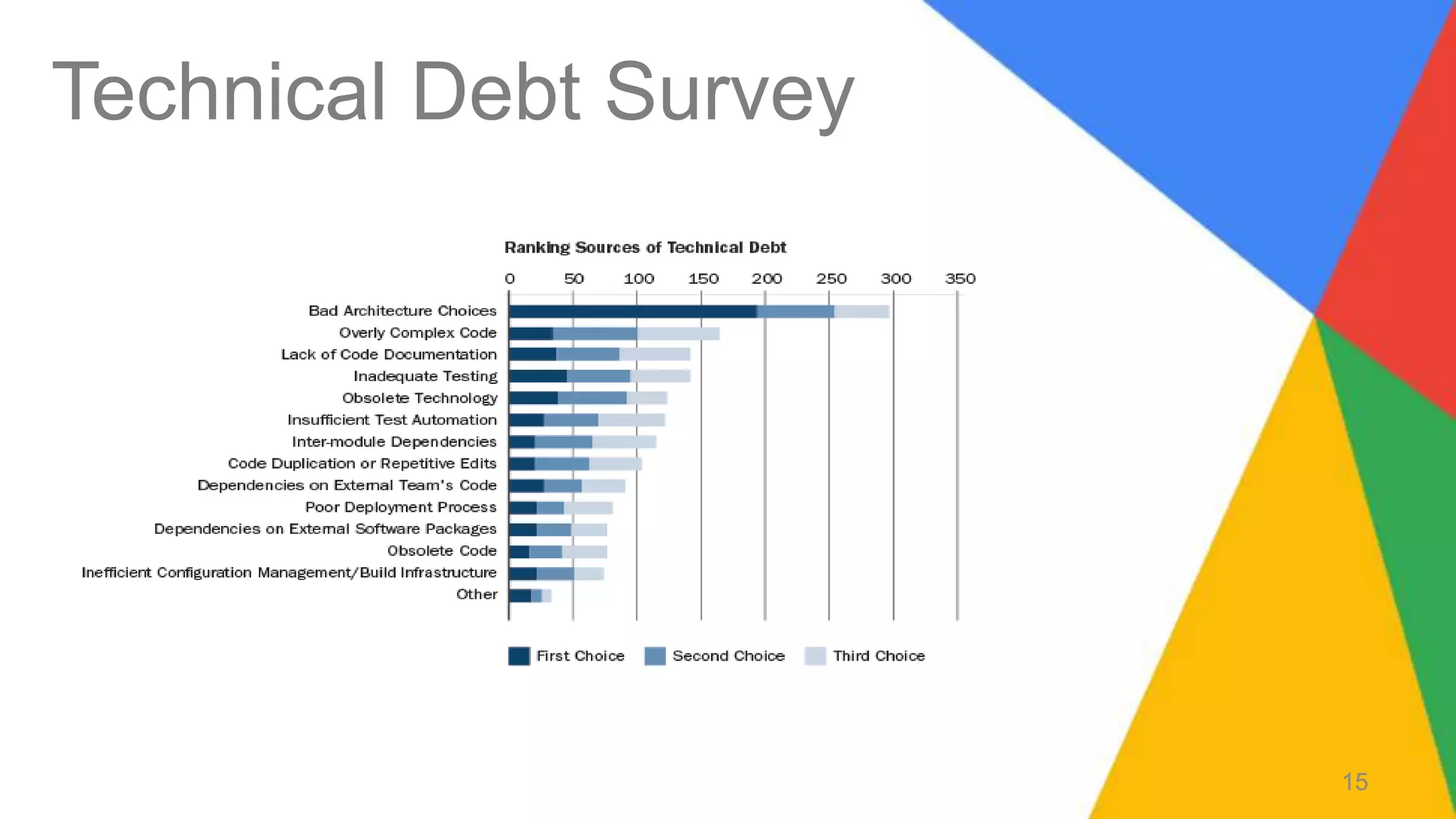
Technical Debt Survey
15
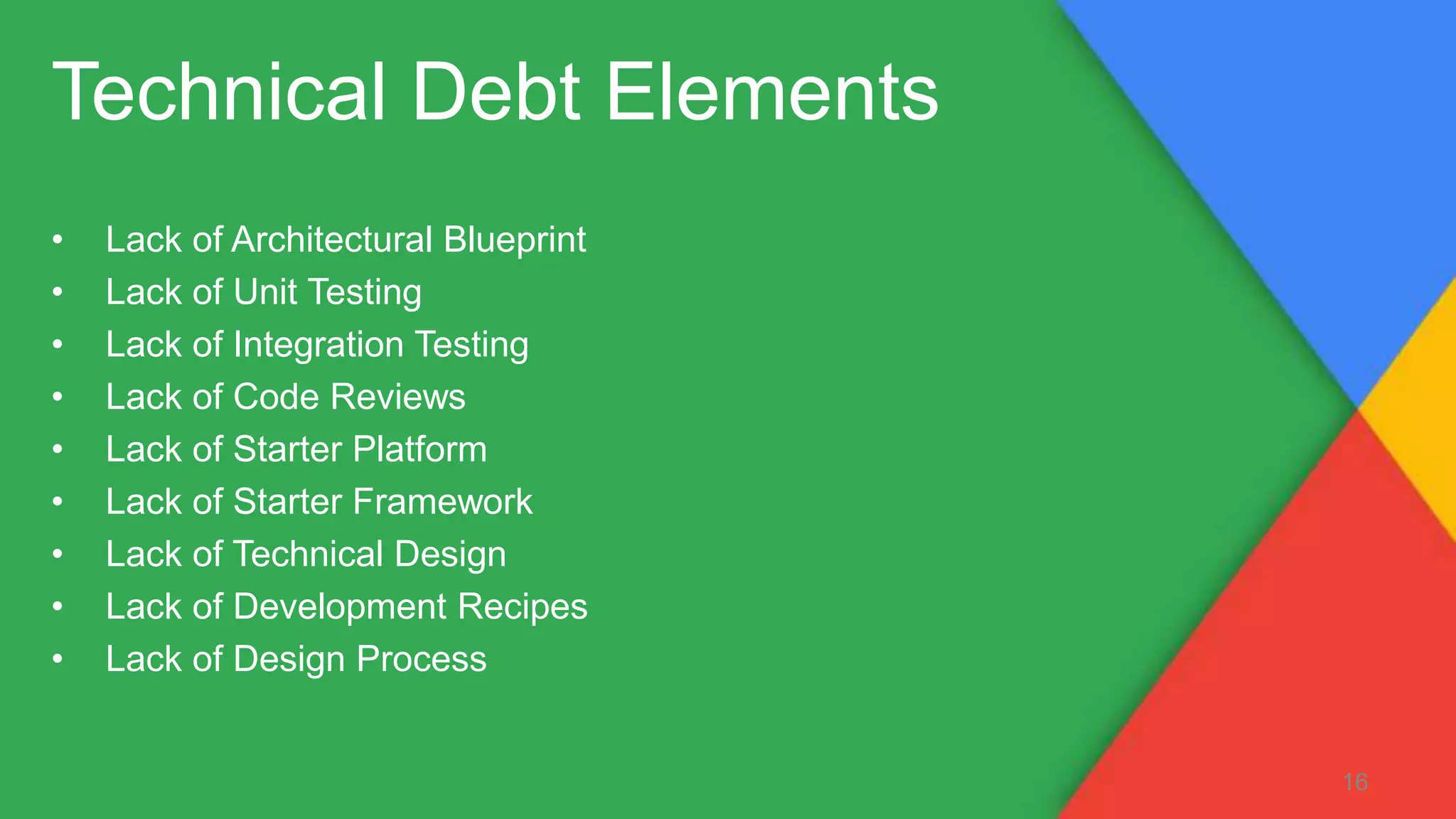
Technical Debt Elements
• Lack of Architectural Blueprint
• Lack of Unit Testing
• Lack of Integration Testing
• Lack of Code Reviews
• Lack of Starter Platform
• Lack of Starter Framework
• Lack of Technical Design
• Lack of Development Recipes
• Lack of Design Process
16
How Did We Let It Happen?
One Logical Debt Step at a Time
17
Broken Window Theory
One Broken Window Leads to Ruin
18
Broken Window Theory
Do Sweat the Small Stuff
Small Vandalism
Urban Decay
CRIME
19
Debt Tipping Point
Product Death
Year 2
Year 1
Tipping Point
20
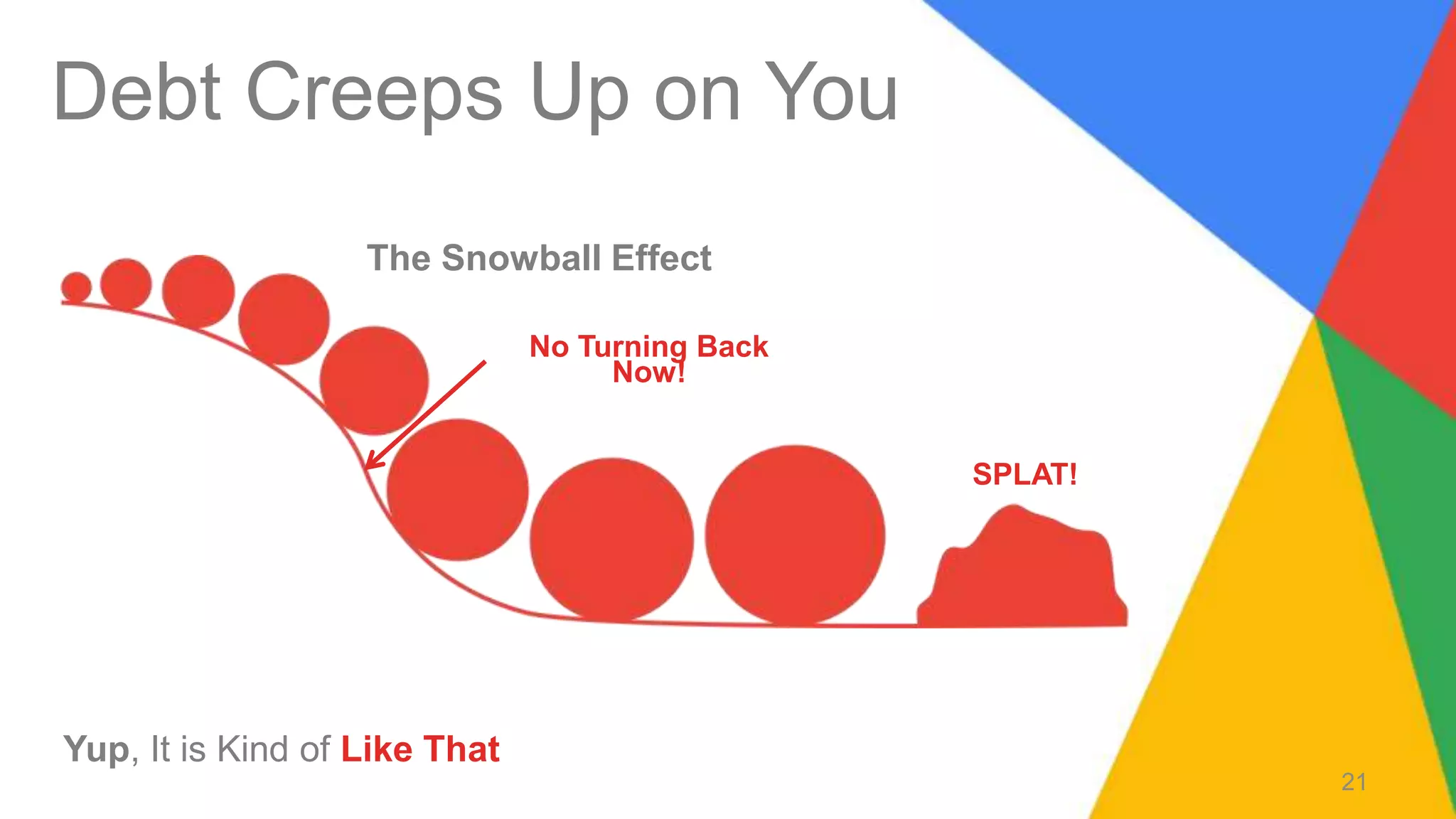
Debt Creeps Up on You
Yup, It is Kind of Like That
No Turning Back
Now!
The Snowball Effect
SPLAT!
21
Technical Debt Management
Technology Debt Management and Debt
Avoidance
• Build on Top of IaaS/PaaS
• Build on Top of Starter Product/Starter Framework
• Implement Unit/Integration/Functional Testing
• Conduct Code Review
• Implement CI/CD/CD
• Establish Short Sprints (Agile) or No Sprints (Kanban)
• Non-Monolithic Design
22
Product Debt
Yup, That’s Feature Creep
23
Minimal Viable
Eric Ries defines MVP as “…thatversion of a new product which allows a team to
collect the maximum amount of validated learning about customers with the least
effort.”
Minimal
Product nobody
wants touse
Viable
Productbuilt
bycompanies
that have no
financial limitations
MVP
24
Ideal MVP
Core Functionality
• Same Major Features
• Same Major Functionality
• Same Usability
• Not UpTo Scale
• Not As Aesthetic
25
Difficult Product Determinations
Prototypevs. MVP
• How Do IDistinguish?
– MVPvs. MatureProduct
• At What Point Do IStop?
– Intent Matters
• YouWill Get What YouAreAimingFor
26
MVP vs. Prototype Purpose
MVP
• Test Product Viability
• Test Assumptions
• Test theMarket
• Test Product Usability
• Get User Feedback
Prototype
• Demonstrate the Product Concept
27
MVP vs. Prototype Targeting
PrototypeTargetsInnovators
MVPTargetsEarly Adopters
EarlyAdopter Groups
• Educators
• Influencers
• Opinion Makers
• Social Connectors
28
MVP vs. Prototype Development
MVP
• Built by a Minimal Viable Team
• Evolutionaryin Its Development
Prototype
• Built by One Person
• Usually Throwaway in Its Development
29
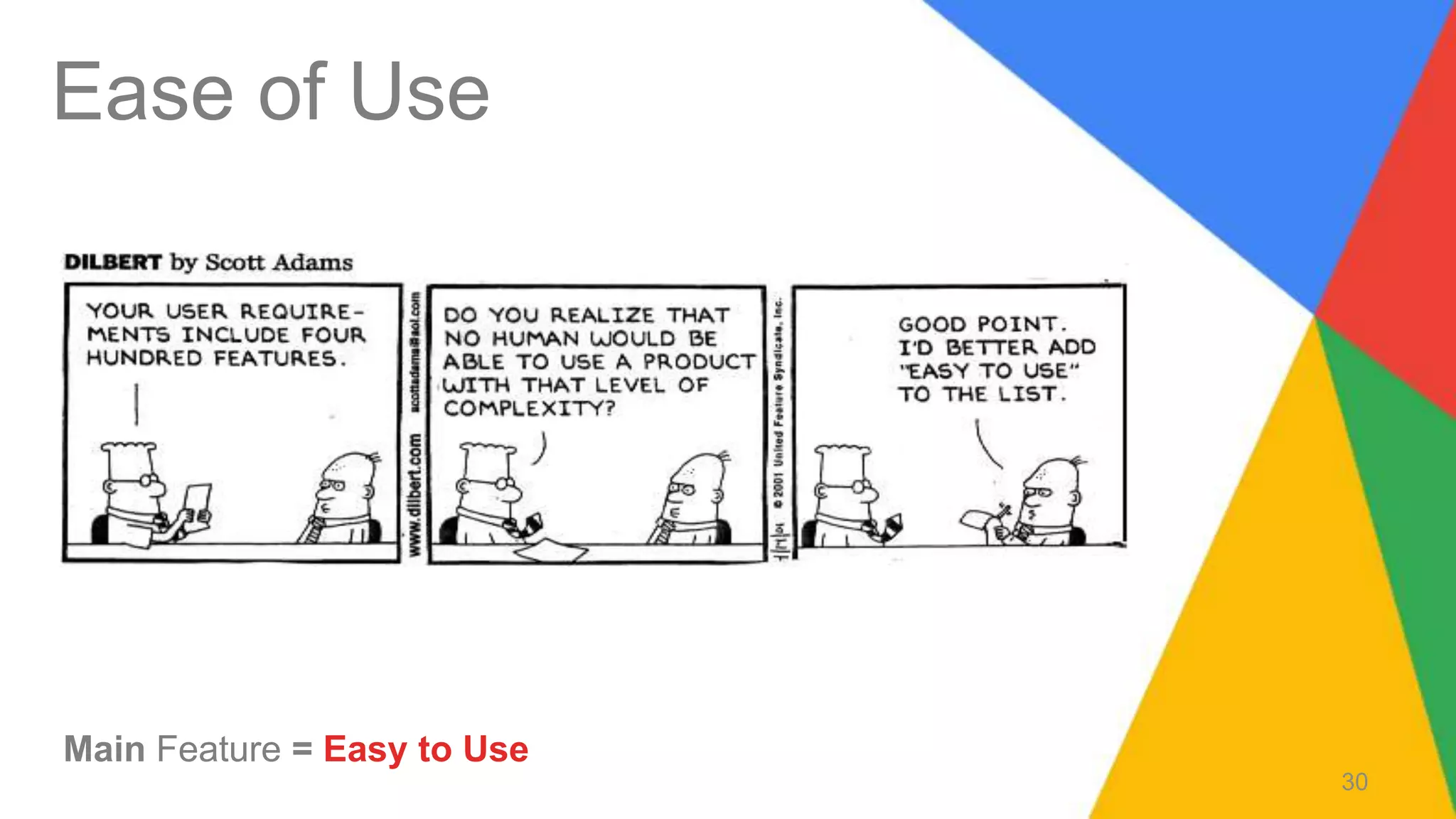
Ease of Use
Main Feature = Easy to Use
30
31
Path to Intent
Straightforward Path to Intent
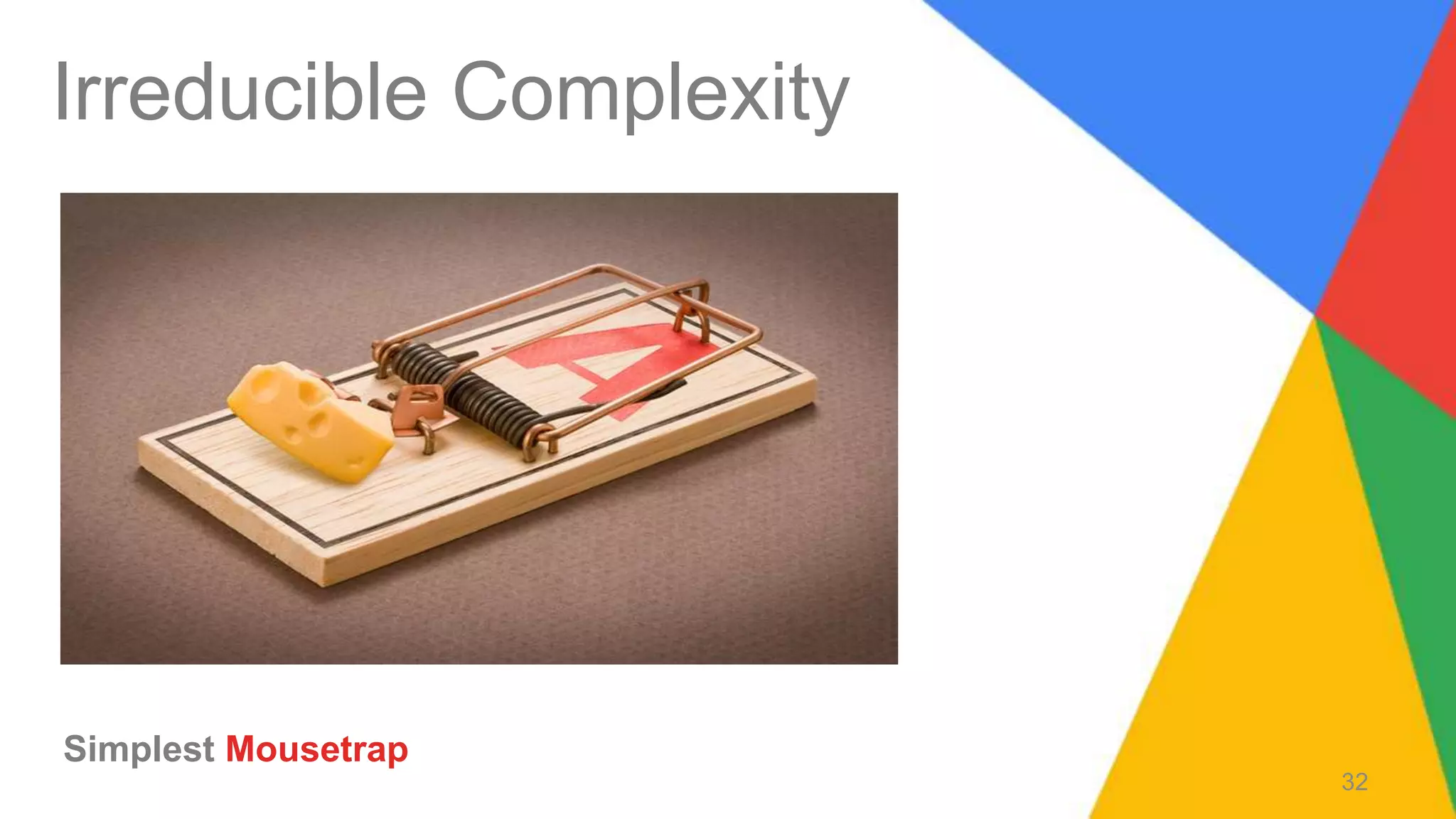
Irreducible Complexity
Simplest Mousetrap
32
Adjacent Possible Product
Your Product vs. Adjacent Possible Product
Existing Product
Your Product
33
Feature Debt Considerations
Intelligent Design and Evolutionary Concepts
• Aim For Adjacent Possible
IrreducibleComplexity
• Can’t TakeAnythingAway
• Can’t Be Simpler
Simplest for What It Does
• Simple Path to Intent
34
Product Debt Feature Curve
Number of Features
User
Happiness
Happy User Peak
“I rule!”
“Cool!”
“I’m so glad they
added this.”
“Nice, but I wish I
could do more…”
“Guess I better look at
the manual…”
“Hey, where the f***
did they put that?!”
“Now I can’t even do the ONE
SIMPLE THING I bought this
for…”
“I suck!”
35
Features Usage
36
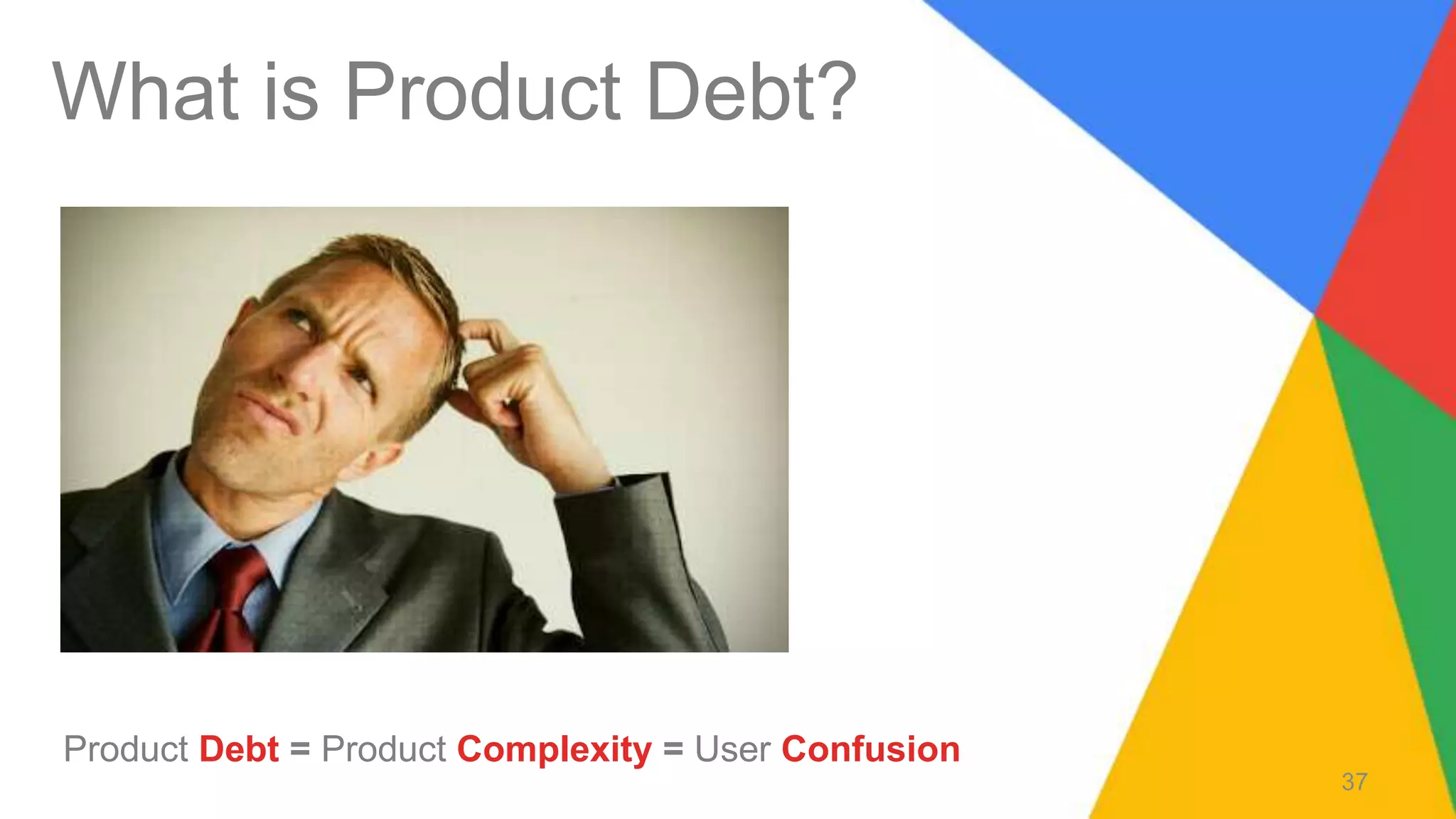
What is Product Debt?
Product Debt = Product Complexity = User Confusion
37
Multiplicative Complexity
N(N-1)/2– Undirected Graph
N(N-1)– Directed Graph
38
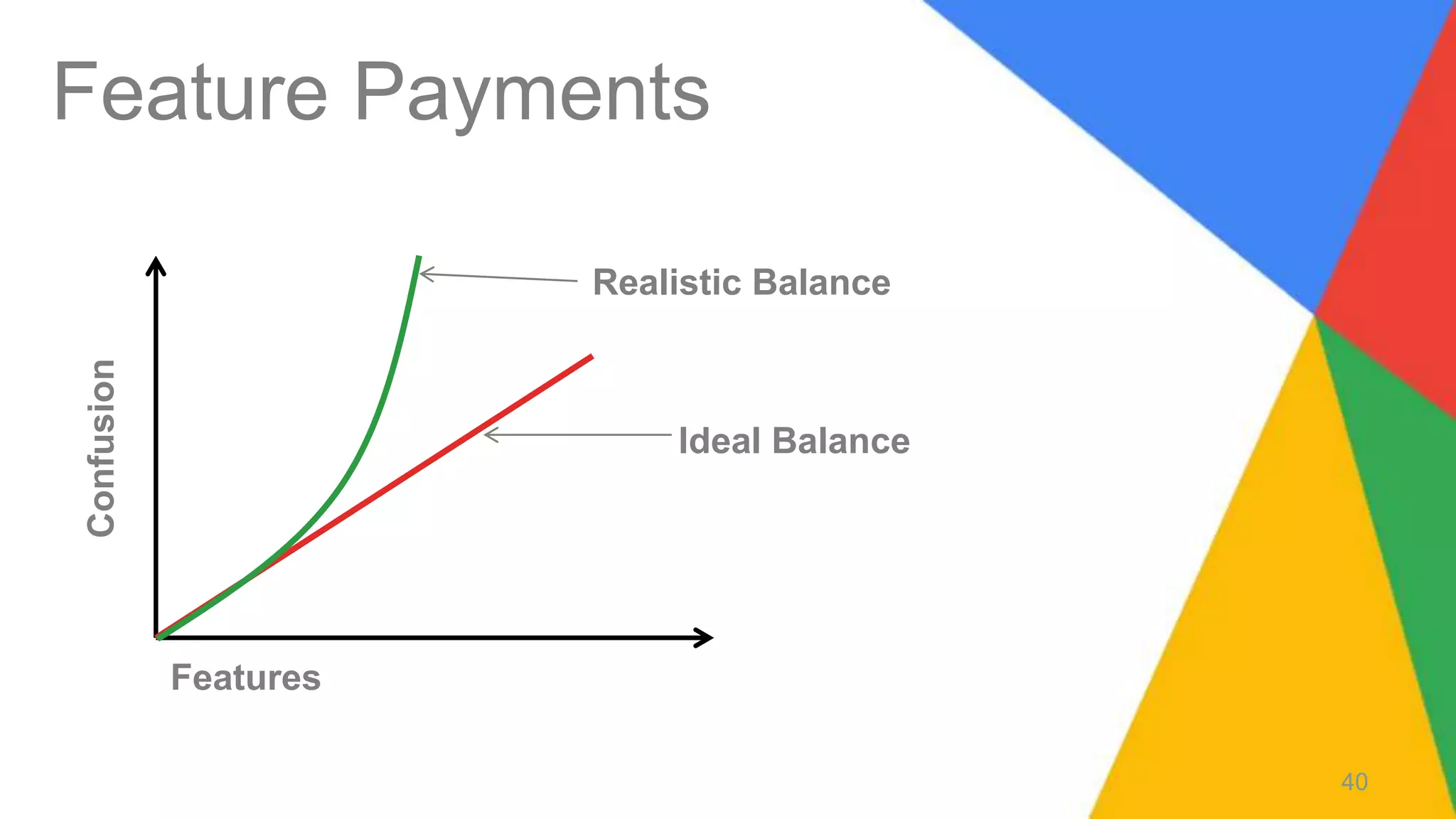
Feature Payments
FeatureCurrency
• Confusion “Payment”for Features
What DoTheyMean?
• “This IsConfusing”
Ideal Feature
• Minimal Confusion
• Minimal Multiplicative Complexity
39
40
Features
Confusion
Ideal Balance
Realistic Balance
Feature Payments
• Do Not ComplicateThings
• Do Not MakeUsers Think
• Do Not MakeUsers Work
• Do Not Defy User’s Expectations
• Do Not Confuse Yourself With Users
• Do Not Assume YouKnow Everything
41
Product Debt Don’ts
42
Always Be Testing
Product Debt Management and Debt Avoidance
• 30% of the Sprint Should Be Devoted to Feature Removal
• Test Before You Implement
• Collect User Feedback
• Measure and Correlate Churn
• Assess Complexity and Confusion
43
Product Debt
Management
Not The Same Thing
Management Mitigation
44
45
Selling Debt Mitigation
Debt Mitigation Is VeryHard ToSell
• Causeand effect is not immediately apparent
• ROI is verydifficult to quantify
• Definition of done is hardto come up with
• Perpetual projects are not crowd pleasers
• Users are not even aware that backend of apps even exists. UX/UIinuser’s mind is the
app itself
46
Debt Mitigation Advice
Debt Mitigation
Regular, Slow and Steady Does It
47
If You Can Help It, Do Not Sell It
• Schedule feature holidays (every 5th release)
• Refactor as you go
• Make debt mitigation as part of the process
• Give estimates considering debt mitigation
• Invite outside experts
If You Must Sell It
• Tell CEO/CTO story
• Use aircraft maintenance strategy
48
Debt Mitigation Advice
Continued

Technical and Product Debt Management

  • 1.
    Technical & Product DebtManagement By Dr. Sergey Sundukovskiy 1
  • 2.
  • 3.
  • 4.
    “… Adesign orconstruction approach that is expedient in theshort term but that creates a technical context inwhich the same workwill cost moreto do laterthan it would cost to do now (including increased cost over time).” 4 Debt
  • 5.
    EverythingYouWant toDo “Later”Is DEBT • Let’s Document Later • Let’s Test Later • Let’s Architect Later • Let’s Refactor Later 5 Debt
  • 6.
  • 7.
    • All DebtIs Bad • No Debt Is Great • Taking On Debt Always Gets You There Faster 7 Debt Misconceptions
  • 8.
    Technical Debt Story IHave Not Seen Organs Like These 8
  • 9.
    CEOs Tale • Wewere very productive • We kicked butt • We became complacent • I fired them all • I hired a new team • They are not productive either • Must have chosen wrong • I fired them all • SAVE ME 9 Common Story
  • 10.
    CTOs Tale • Wewere very productive through debt accumulation • We kicked butt but burned out • We slowed down due to increasing debt support • We got fired • New team got hired • They does not know where bodies are buried • They got fired as well • I have Not Seen Organs Like These 10 Common Story
  • 11.
    Support Cost isa Euphemism for Debt Support (15%) Innovation (85%) Support (50%) Innovation (50%) Support (85%) Innovation (15%) Year 1 Year 2 Year 3 Support to Innovation Ratio 11
  • 12.
  • 13.
    Known Cost forKnown Benefit • Time to Market – If taking on debt gets you to market disproportionately faster • Time to Contract – If strategic contract is at stake debt might be worth it • Time to Funding – If funding is at stake debt might be worth it • Time to Survival – Debt is irrelevant if there is no tomorrow Leveraging Debt 13
  • 14.
    Unknown Cost forUnknown Benefit • Unintentional – This Module Is Just a Temporary Fix • Unquantified – If We Develop This Feature Many New Customers Will Buy the Product • Unplanned – This Code Is Simple. We Do Not Need to Document It • Inadvertent – We Were Not Aware This Library Has a Particular Side Effect • Reckless – This New Framework Looks Very Interesting, Let’s Use It in Production Leveraging Debt 14
  • 15.
  • 16.
    Technical Debt Elements •Lack of Architectural Blueprint • Lack of Unit Testing • Lack of Integration Testing • Lack of Code Reviews • Lack of Starter Platform • Lack of Starter Framework • Lack of Technical Design • Lack of Development Recipes • Lack of Design Process 16
  • 17.
    How Did WeLet It Happen? One Logical Debt Step at a Time 17
  • 18.
    Broken Window Theory OneBroken Window Leads to Ruin 18
  • 19.
    Broken Window Theory DoSweat the Small Stuff Small Vandalism Urban Decay CRIME 19
  • 20.
    Debt Tipping Point ProductDeath Year 2 Year 1 Tipping Point 20
  • 21.
    Debt Creeps Upon You Yup, It is Kind of Like That No Turning Back Now! The Snowball Effect SPLAT! 21
  • 22.
    Technical Debt Management TechnologyDebt Management and Debt Avoidance • Build on Top of IaaS/PaaS • Build on Top of Starter Product/Starter Framework • Implement Unit/Integration/Functional Testing • Conduct Code Review • Implement CI/CD/CD • Establish Short Sprints (Agile) or No Sprints (Kanban) • Non-Monolithic Design 22
  • 23.
  • 24.
    Minimal Viable Eric Riesdefines MVP as “…thatversion of a new product which allows a team to collect the maximum amount of validated learning about customers with the least effort.” Minimal Product nobody wants touse Viable Productbuilt bycompanies that have no financial limitations MVP 24
  • 25.
    Ideal MVP Core Functionality •Same Major Features • Same Major Functionality • Same Usability • Not UpTo Scale • Not As Aesthetic 25
  • 26.
    Difficult Product Determinations Prototypevs.MVP • How Do IDistinguish? – MVPvs. MatureProduct • At What Point Do IStop? – Intent Matters • YouWill Get What YouAreAimingFor 26
  • 27.
    MVP vs. PrototypePurpose MVP • Test Product Viability • Test Assumptions • Test theMarket • Test Product Usability • Get User Feedback Prototype • Demonstrate the Product Concept 27
  • 28.
    MVP vs. PrototypeTargeting PrototypeTargetsInnovators MVPTargetsEarly Adopters EarlyAdopter Groups • Educators • Influencers • Opinion Makers • Social Connectors 28
  • 29.
    MVP vs. PrototypeDevelopment MVP • Built by a Minimal Viable Team • Evolutionaryin Its Development Prototype • Built by One Person • Usually Throwaway in Its Development 29
  • 30.
    Ease of Use MainFeature = Easy to Use 30
  • 31.
  • 32.
  • 33.
    Adjacent Possible Product YourProduct vs. Adjacent Possible Product Existing Product Your Product 33
  • 34.
    Feature Debt Considerations IntelligentDesign and Evolutionary Concepts • Aim For Adjacent Possible IrreducibleComplexity • Can’t TakeAnythingAway • Can’t Be Simpler Simplest for What It Does • Simple Path to Intent 34
  • 35.
    Product Debt FeatureCurve Number of Features User Happiness Happy User Peak “I rule!” “Cool!” “I’m so glad they added this.” “Nice, but I wish I could do more…” “Guess I better look at the manual…” “Hey, where the f*** did they put that?!” “Now I can’t even do the ONE SIMPLE THING I bought this for…” “I suck!” 35
  • 36.
  • 37.
    What is ProductDebt? Product Debt = Product Complexity = User Confusion 37
  • 38.
    Multiplicative Complexity N(N-1)/2– UndirectedGraph N(N-1)– Directed Graph 38
  • 39.
    Feature Payments FeatureCurrency • Confusion“Payment”for Features What DoTheyMean? • “This IsConfusing” Ideal Feature • Minimal Confusion • Minimal Multiplicative Complexity 39
  • 40.
  • 41.
    • Do NotComplicateThings • Do Not MakeUsers Think • Do Not MakeUsers Work • Do Not Defy User’s Expectations • Do Not Confuse Yourself With Users • Do Not Assume YouKnow Everything 41 Product Debt Don’ts
  • 42.
  • 43.
    Product Debt Managementand Debt Avoidance • 30% of the Sprint Should Be Devoted to Feature Removal • Test Before You Implement • Collect User Feedback • Measure and Correlate Churn • Assess Complexity and Confusion 43 Product Debt Management
  • 44.
    Not The SameThing Management Mitigation 44
  • 45.
  • 46.
    Debt Mitigation IsVeryHard ToSell • Causeand effect is not immediately apparent • ROI is verydifficult to quantify • Definition of done is hardto come up with • Perpetual projects are not crowd pleasers • Users are not even aware that backend of apps even exists. UX/UIinuser’s mind is the app itself 46 Debt Mitigation Advice
  • 47.
    Debt Mitigation Regular, Slowand Steady Does It 47
  • 48.
    If You CanHelp It, Do Not Sell It • Schedule feature holidays (every 5th release) • Refactor as you go • Make debt mitigation as part of the process • Give estimates considering debt mitigation • Invite outside experts If You Must Sell It • Tell CEO/CTO story • Use aircraft maintenance strategy 48 Debt Mitigation Advice Continued