TECH	TOOLSGETTING	THE	MOST	BANG	FOR	YOUR	BUCK
Presented by Deron Tse
dtse@ncnonprofits.org
.ME
Themighty pencil—besttechnologicaltoolever!
Technology assistantat the
North Carolina Center for Nonprofits
• Technology tinkerer for over 25 years
• Advertising & design print carrer
• Motionpicture production career
• Road trip for change!
.NGO
The center serves as an information center on effective
practices in nonprofit organizations, a statewide network
for nonprofit board and staff members, and an advocate
for the nonprofit sector as a whole.
Every Dollar Stretched!
www.flickr.com/photos/truthout
AGENDA
• WHO ARE YOU?
• 70/30 TCO
• TECHNOLOGY POLICY
• BACKCASTING
• LIGHTNING DEMO
• CAVEAT
• CONCLUDING
REMARKS
.1
Hey,	let’s	take	a	Poll
What	is	the	state	of	your	technology	infrastructure
www.clearbiology.com/wp-content/
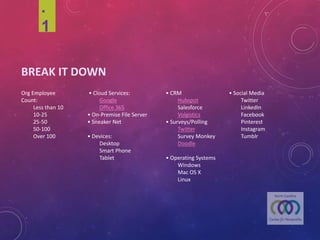
BREAK	IT	DOWN
•	Cloud	Services:
Google
Office	365
•	On-Premise	File	Server
•	Sneaker	Net
•	Devices:
Desktop
Smart	Phone
Tablet
Org	Employee	
Count:
Less	than	10	
10-25
25-50
50-100
Over	100
•	Social	Media
Twitter
LinkedIn
Facebook
Pinterest
Instagram
Tumblr
•	CRM
Hubspot
Salesforce
Volgistics
•	Surveys/Polling
Twitter
Survey	Monkey
Doodle
•	Operating	Systems
Windows
Mac	OS	X
Linux
.1
.2
ah	the	oft	used	“TCO”
The 70/30 Principle
Of Total Cost of Ownership
Whatever the cost of technology,
it’s only 30% upfront,
70% is over time.
• TECHSOUP
• TECHNET
• LYNDA.COM
• YOUTUBE
• SLIDESHARE
Develop	your	own	
Knowledge	base
.2
.3
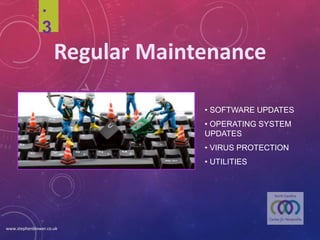
• SOFTWAREUPDATES
• OPERATING SYSTEM
UPDATES
• VIRUS PROTECTION
• UTILITIES
Regular	Maintenance
www.stephenblower.co.uk
DEVELOP A TECHNOLOGY POLICY
.4
Maybeyou work for a largeorganization that has it’s own
Technology Department. Ifso, more than likely,there’s a
policy that already exists.
Does it end there?
Absolutely not! Develop a departmentalpolicy that
contextualizes that org policy to fit the processes of your
department. And if you don’t havean existing policy to
contextualize,let’s developone.
S.M.A.R.T.
Is	it	really?
Specific, Measureable, Assignable, Realistic, Time-Related
• One person’s specific is another’s useless detail
• What are you really Measuring?
• What criteria do you use to define “realistic”?
• What criteria are we using to determine deadlines?
When you step back,
doesn’t it seem rather arbitrary
.4
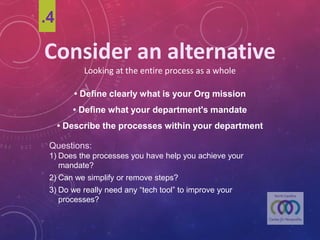
Consider	an	alternative
Looking	at	the	entire	process	as	a	whole
• Define clearly what is your Org mission
• Define what your department's mandate
• Describe the processes within your department
Questions:
1) Does the processes you have help you achieve your mandate?
2) Can we simplifyor remove steps?
3) Do we really need any “tech tool”to improveyour processes?
.4
Once youanswer the previousquestionsthen
youcan start to think abouttechnology solutions.
All	the	technology	in	the	world	won’t	help	if	the	system	
is	broken.	Improve	processes	first	then	consider	what	
technology	(if	any)	is	worth	acquiring.	Then	you	can	
look	toward	meeting	your	departmental	mandate	and	
in	turn	help	your	organization	fulfill	its	mission.	
.4
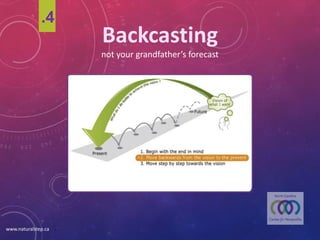
Backcasting
not	your	grandfather’s	forecast
www.naturalstep.ca
.4
.5
Lightning	Demo
Streak for Gmail
Wiggio
LibreOffice
LastPass
HipChat
Inky email
Unroll.me
NameChanger
FastStone Image viewer
LinkedIn
SlideShare
.6
Trending	vs.	Opportunity
Don’t get lulled intothe Ohs and Ahs of a new technology.
What’s trending may not be an actionable opportunity.
How can you tell the difference?
You just learned the basicidea of SystemsThinking.
Apply that to figure out your Technology Policy
which then guides you in your decision-making.
TECH	TOOLSGETTING	THE	MOST	BANG	FOR	YOUR	BUCK
Presented by Deron Tse
dtse@ncnonprofits.org

Tech Tools for Nonprofits

Editor's Notes

  • #6 Poll the audience on level of tech use (5 minutes) Google Docs, Office 365, Basic Email, Office Suite Salesforce, HubSpot, other CRM iContact, Constant Contact, Mail Chimp SurveyMonkey, Survey Gizmo, Doodle or other Social Media: Twitter, LinkedIn, Facebook, Pinterest, Hootsuite, Buffer On-site File Server, Cloud-based document sharing, hybrid Windows, Mac OSX, Android, iOS, Linux
  • #8 The Total Cost of Ownership includes additional Peripherals, ongoing Maintenance, Training, Upgrades, Fixing, Consultants, etc.
  • #10 Regular maintenance with updates and upgrades within reason Make sure your software vendors have your current email and it should be info@ email account Review your OS updates (best practice is to sandbox updates til it’s vetted but….) Run Virus protection Windows BitDefender Avast Symantec Endpoint Protection IObits Advanced System Care and Drive Booster
  • #12 The problem with SMART is that it arbitrarily chooses numbers to meet. And when you start focusing on numbers, you lose sight of why you’re doing what you’re doing. All you care about is meeting your numbers regardless if the process is effective. For instance, the state of American public education has oft been described as memorizing to test great. To meet the arbitrary test score goals, students aren’t really learning to learn and therefore not building knowledge which can grow into wisdom. Instead, most students learn to memorize just enough to do well on a test never really understanding what they’re memorizing. And teachers are forced to pile on ever more material to “challenge” students to be better—at what, memorizing!
  • #13 Systems Thinking considers the entire system and the desired outcomes. Process improvement is iterative and critiqued against desired outcome. Instead of focusing on arbitrary numbers, it focuses on the process to reach the outcome. If the outcome isn’t being reached then change the process. This is the feedback loop.
  • #15 I’ll pick one of the shared processes to try the backcasting exercise as a group activity that I lead. I could then interject some tech tools that might be useful. Backcasting contrasts against Forecasting in that you’re not guessing at what the outcome might be but rather saying, this is the outcome you will achieve.
  • #16 If possible, either go to the website to introduce the features or show a YouTube video
  • #17 Share my idea about the Center’s Economic Indicators Report as an example of doing something that’s trending but not actionable because we don’t have the capacity to do it. Choose to do a few things great instead of many things wrong.