

Getting Started With IOT
Jayant Rajwani
Software Engineer
Mindfire Solutions
AGENDA
- What is Micro-Controller?
- What is Arduino?
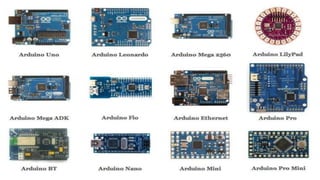
- Types of Arduino.
- Arduino UNO board.
- Sensors.
- Arduino IDE
- IoT
- Demos
Let’s get started
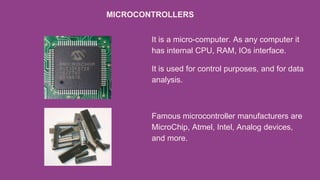
It is a micro-computer. As any computer it
has internal CPU, RAM, IOs interface.
It is used for control purposes, and for data
analysis.
Famous microcontroller manufacturers are
MicroChip, Atmel, Intel, Analog devices,
and more.
MICROCONTROLLERS
What is Arduino?
A microcontroller board, contains on-board power supply, USB
port to communicate with PC, and an Atmel microcontroller
chip.
It simplify the process of creating any control system by
providing the standard board that can be programmed and
connected to the system without the need to any sophisticated
PCB design and implementation.
It is an open source hardware, anyone can get the details of its
design and modify it or make his own one himself.
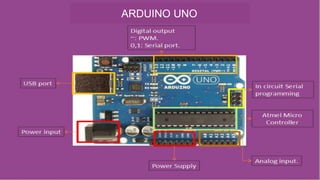
ARDUINO UNO
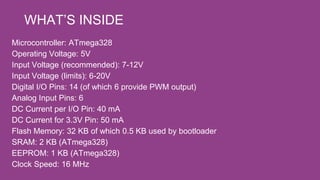
Microcontroller: ATmega328
Operating Voltage: 5V
Input Voltage (recommended): 7-12V
Input Voltage (limits): 6-20V
Digital I/O Pins: 14 (of which 6 provide PWM output)
Analog Input Pins: 6
DC Current per I/O Pin: 40 mA
DC Current for 3.3V Pin: 50 mA
Flash Memory: 32 KB of which 0.5 KB used by bootloader
SRAM: 2 KB (ATmega328)
EEPROM: 1 KB (ATmega328)
Clock Speed: 16 MHz
WHAT’S INSIDE
Digital or Analog?
All physical quantities are analog.
Analog means that the quantity can take any value between its minimum value
and maximum value.Digital means that the quantity can take specific levels of
values with specific offset between each other.
Ex: 1 - Digital:
English consists of 26 letter, there is no letter between A and B.
- Square waves are Digital.
Ex.: 2 - Analog:
Temperature, can take any value[-1,12.8,25.002,… etc.].
- Sine waves are analog.
Internet Pops Up here :D
What is IoT?
Prototyping electronics for IoT
How to connect?
IoT with Blynk and NodeMCU
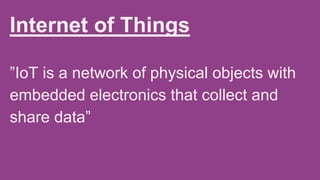
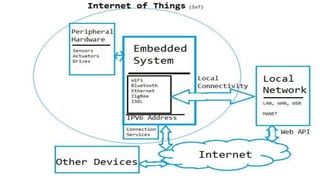
Internet of Things
”IoT is a network of physical objects with
embedded electronics that collect and
share data”
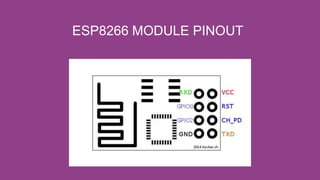
ESP8266 MODULE PINOUT
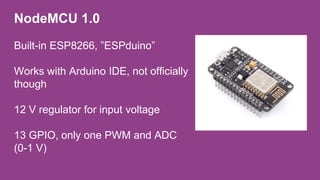
NodeMCU 1.0
Built-in ESP8266, ”ESPduino”
Works with Arduino IDE, not officially
though
12 V regulator for input voltage
13 GPIO, only one PWM and ADC
(0-1 V)
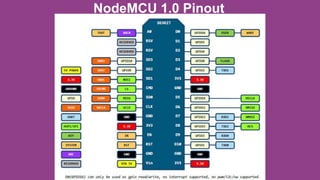
NodeMCU 1.0 Pinout
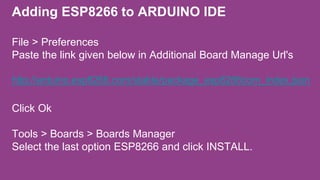
Adding ESP8266 to ARDUINO IDE
File > Preferences
Paste the link given below in Additional Board Manage Url's
http://arduino.esp8266.com/stable/package_esp8266com_index.json
Click Ok
Tools > Boards > Boards Manager
Select the last option ESP8266 and click INSTALL.
Adding ESP8266 to ARDUINO IDE
File > Preferences
Paste the link given below in Additional Board Manage Url's
http://arduino.esp8266.com/stable/package_esp8266com_index.json
Click Ok
Tools > Boards > Boards Manager
Select the last option ESP8266 and click INSTALL.
TIME FOR DEMO
Jayant Rajwani
Software Engineer
Mindfire Solutions
Connect with me
/jayantrajwani
@jayantrajwani
/jayantrajwani
/jayantrajwani

Tech Talk IOT

  • 1.
    Getting Started WithIOT Jayant Rajwani Software Engineer Mindfire Solutions
  • 2.
    AGENDA - What isMicro-Controller? - What is Arduino? - Types of Arduino. - Arduino UNO board. - Sensors. - Arduino IDE - IoT - Demos
  • 3.
  • 4.
    It is amicro-computer. As any computer it has internal CPU, RAM, IOs interface. It is used for control purposes, and for data analysis. Famous microcontroller manufacturers are MicroChip, Atmel, Intel, Analog devices, and more. MICROCONTROLLERS
  • 5.
    What is Arduino? Amicrocontroller board, contains on-board power supply, USB port to communicate with PC, and an Atmel microcontroller chip. It simplify the process of creating any control system by providing the standard board that can be programmed and connected to the system without the need to any sophisticated PCB design and implementation. It is an open source hardware, anyone can get the details of its design and modify it or make his own one himself.
  • 7.
  • 8.
    Microcontroller: ATmega328 Operating Voltage:5V Input Voltage (recommended): 7-12V Input Voltage (limits): 6-20V Digital I/O Pins: 14 (of which 6 provide PWM output) Analog Input Pins: 6 DC Current per I/O Pin: 40 mA DC Current for 3.3V Pin: 50 mA Flash Memory: 32 KB of which 0.5 KB used by bootloader SRAM: 2 KB (ATmega328) EEPROM: 1 KB (ATmega328) Clock Speed: 16 MHz WHAT’S INSIDE
  • 9.
    Digital or Analog? Allphysical quantities are analog. Analog means that the quantity can take any value between its minimum value and maximum value.Digital means that the quantity can take specific levels of values with specific offset between each other. Ex: 1 - Digital: English consists of 26 letter, there is no letter between A and B. - Square waves are Digital. Ex.: 2 - Analog: Temperature, can take any value[-1,12.8,25.002,… etc.]. - Sine waves are analog.
  • 10.
    Internet Pops Uphere :D What is IoT? Prototyping electronics for IoT How to connect? IoT with Blynk and NodeMCU
  • 11.
    Internet of Things ”IoTis a network of physical objects with embedded electronics that collect and share data”
  • 13.
  • 14.
    NodeMCU 1.0 Built-in ESP8266,”ESPduino” Works with Arduino IDE, not officially though 12 V regulator for input voltage 13 GPIO, only one PWM and ADC (0-1 V)
  • 15.
  • 16.
    Adding ESP8266 toARDUINO IDE File > Preferences Paste the link given below in Additional Board Manage Url's http://arduino.esp8266.com/stable/package_esp8266com_index.json Click Ok Tools > Boards > Boards Manager Select the last option ESP8266 and click INSTALL.
  • 17.
    Adding ESP8266 toARDUINO IDE File > Preferences Paste the link given below in Additional Board Manage Url's http://arduino.esp8266.com/stable/package_esp8266com_index.json Click Ok Tools > Boards > Boards Manager Select the last option ESP8266 and click INSTALL.
  • 18.
  • 19.
    Jayant Rajwani Software Engineer MindfireSolutions Connect with me /jayantrajwani @jayantrajwani /jayantrajwani /jayantrajwani