1
Execution process of a trade
When you place an order to buy or sell stock, you might not think about where
or how your broker will execute the trade. But where and how your order is
executed can impact the overall costs of the transaction, including the price you
pay for the stock.
Execution: An execution is the completion of a buy or sell order for a security.
The execution of an order happens when it is completely filled, not when it is
placed by the investor. When the investor places the trade, it goes to a broker,
who then determines the best way for it to be executed.
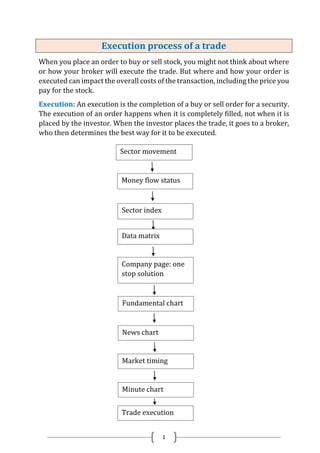
Sector movement
Money flow status
Sector index
Data matrix
Company page: one
stop solution
Fundamental chart
News chart
Market timing
Minute chart
Trade execution
2
1, Movement of a sector:
As a first step it is important to identify the status of the index in order to follow
the market movement. The basic aim for following the market movement is to
identify specific sector(s) the investors are mostly interested in. Market
composition is one of the tools, which helps to identify hot sectors with ease.
The market composition chart also exhibit sector that are on highest trading
level. Market composition generally compares trading contribution across
different sectors and also current day-trading with previous day’s trading.
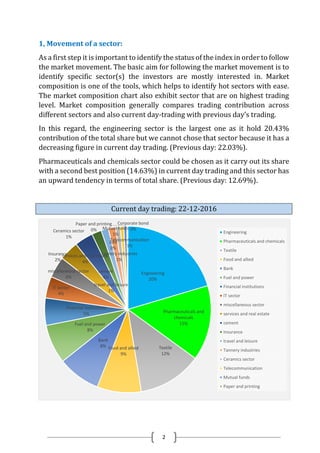
In this regard, the engineering sector is the largest one as it hold 20.43%
contribution of the total share but we cannot chose that sector because it has a
decreasing figure in current day trading. (Previous day: 22.03%).
Pharmaceuticals and chemicals sector could be chosen as it carry out its share
with a second best position (14.63%) in current day trading and this sector has
an upward tendency in terms of total share. (Previous day: 12.69%).
Current day trading: 22-12-2016
Engineering
20%
Pharmaceuticals and
chemicals
15%
Textile
12%
Food and allied
9%
Bank
8%
Fuel and power
8%
Financial institutions
5%
IT sector
4%
miscellaneous sector
4%
services and real estate
4%
cement
4%
Insurance
2%
travel and leisure
1%
Tannery industries
1%
Ceramics sector
1%
Telecommunication
1%
Mutual funds
1%
Paper and printing
0%
Jute
0%
Corporate bond
0%
Engineering
Pharmaceuticals and chemicals
Textile
Food and allied
Bank
Fuel and power
Financial institutions
IT sector
miscellaneous sector
services and real estate
cement
Insurance
travel and leisure
Tannery industries
Ceramics sector
Telecommunication
Mutual funds
Paper and printing
3
Previous day trading: 21-12-2016
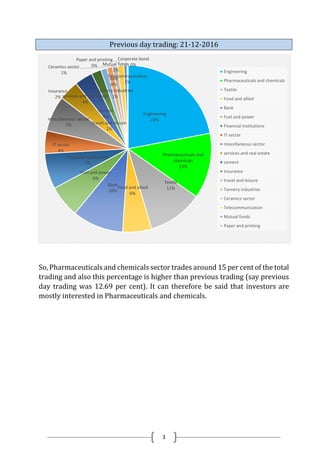
So, Pharmaceuticals and chemicals sector trades around 15 per cent of the total
trading and also this percentage is higher than previous trading (say previous
day trading was 12.69 per cent). It can therefore be said that investors are
mostly interested in Pharmaceuticals and chemicals.
Engineering
22%
Pharmaceuticals and
chemicals
13%
Textile
11%Food and allied
6%
Bank
10%
Fuel and power
6%
Financial institutions
7%
IT sector
4%
miscellaneous sector
7%
services and real estate
4%
cement
4%
Insurance
2%
travel and leisure
1%
Tannery industries
1%
Ceramics sector
1%
Telecommunication
1%
Mutual funds
1%
Paper and printing
0%
Jute
0%
Corporate bond
0%
Engineering
Pharmaceuticals and chemicals
Textile
Food and allied
Bank
Fuel and power
Financial institutions
IT sector
miscellaneous sector
services and real estate
cement
Insurance
travel and leisure
Tannery industries
Ceramics sector
Telecommunication
Mutual funds
Paper and printing
4
2, Money flow status:
It is essential, at this stage, to investigate whether the money flow of this sector
(say, Pharmaceuticals and chemicals) is positive or negative. The sign of the
money flow of this sector can easily be analyzed through analyzing the number
of Gainer and Loser companies. This can be examined using Gainer-Loser chart,
where we can identify the number of companies running with rising price
condition and number of companies running with declining of their respective
stocks.
Money flow status
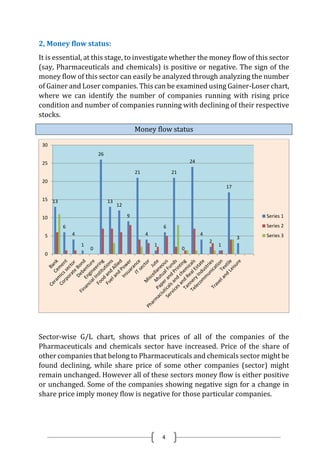
Sector-wise G/L chart, shows that prices of all of the companies of the
Pharmaceuticals and chemicals sector have increased. Price of the share of
other companies that belong to Pharmaceuticals and chemicals sector might be
found declining, while share price of some other companies (sector) might
remain unchanged. However all of these sectors money flow is either positive
or unchanged. Some of the companies showing negative sign for a change in
share price imply money flow is negative for those particular companies.
13
6
4
1
0
26
13
12
9
21
4
1
6
21
0
24
4
2
1
17
3
0
5
10
15
20
25
30
Series 1
Series 2
Series 3
5
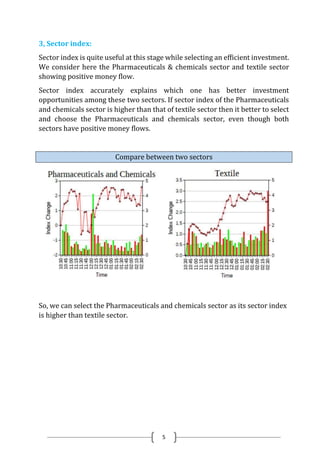
3, Sector index:
Sector index is quite useful at this stage while selecting an efficient investment.
We consider here the Pharmaceuticals & chemicals sector and textile sector
showing positive money flow.
Sector index accurately explains which one has better investment
opportunities among these two sectors. If sector index of the Pharmaceuticals
and chemicals sector is higher than that of textile sector then it better to select
and choose the Pharmaceuticals and chemicals sector, even though both
sectors have positive money flows.
Compare between two sectors
So, we can select the Pharmaceuticals and chemicals sector as its sector index
is higher than textile sector.
6
4, Data matrix:
The Pharmaceuticals and chemicals sector is selected as it is identified as
feasible for investment. It is now important to figure out price related and other
information for all companies of the Pharmaceuticals and chemicals sector.
Data matrix allows the investor to sort price- related and other data for a given
sector in terms of profit or return and in terms of other attributes.
For example, data sort can be done in terms of information on EPS (Earning per
share), NAV (Net asset value) and volume or price change information etc.
Some can select desired companies of the Pharmaceuticals and chemicals
sector: data matrix would be expected to portray required information (say
price change) for every minute’s interval.
[Net asset value (NAV) is the value of an entity’s assets minus the value of its liabilities. Often
in relation to open-end or mutual funds. The volume is commonly reported as the number of
shares that changed hands during a given day. The average volume of a security over a longer
period of time is the total amount traded in that period, divided by the length of the period.]
Procedure: Data matrix is a very powerful scanner by which one can select a
share according to his own choice. Let, one eager to see the list of companies
which PE ratio are between 4 to12 and the rate of price increase is greater than
5% among the A-category share. By using Data matrix one can easily find out
that list.
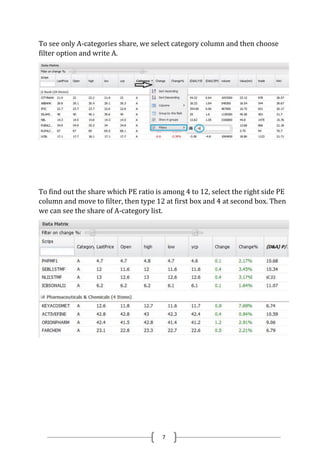
Some column are used as default in Data matrix tools. Now, it is necessary to
add the category column.
7
To see only A-categories share, we select category column and then choose
filter option and write A.
To find out the share which PE ratio is among 4 to 12, select the right side PE
column and move to filter, then type 12 at first box and 4 at second box. Then
we can see the share of A-category list.
8
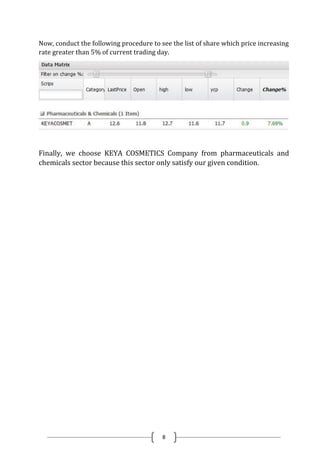
Now, conduct the following procedure to see the list of share which price increasing
rate greater than 5% of current trading day.
Finally, we choose KEYA COSMETICS Company from pharmaceuticals and
chemicals sector because this sector only satisfy our given condition.
9
5, Company page: one stop solution
When a companies selected by analyzing all of the companies that belong to a
given sector, then the company page of the selected company provides
important and useful information for investors. For example: information
highest and lowest price of current year, volume, minuet chart, sector chart,
sector details, share holdings, capital details, beta coefficient, basic information
and company news etc. can be found and evaluated visiting the company page.
Company page of the other similar and competitive companies can also be
visited at this stage. This enables the investor to confirm his/her selection.
[Beta is a measure of the volatility, or systematic risk of a security or a portfolio in comparison
to the market as a whole. Beta is used in the capital asset pricing model (CAPM), which
calculates the expected return of an asset based on its beta and expected market returns.]
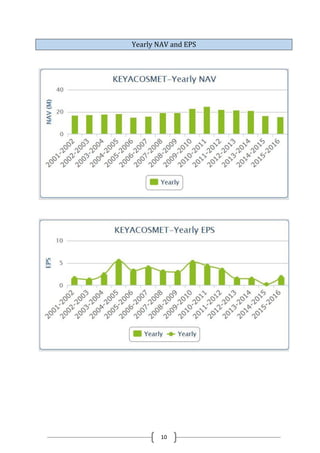
6, Fundamental chart:
Financial condition of last few years can be exhibited by fundamental charts.
10
Yearly NAV and EPS
11
7, News chart:
The news chart allows the investors to know the dates the selected company
generally deposits the dividend.
[A dividend is defined as a payment made by a corporation to its shareholders. Usually these
payouts are made in cash (called “cash dividend”), but sometimes companies will also
distribute stock dividend, whereby additional stock shares are distributed to shareholders.
Stock dividend is also known as stock splits.]
From the chart, we see that there is an upward trends of dividend deposit.
12
8, Market timing:
The market timing is an important and essential step selecting the best asset.
Market timing is the strategy of making buy or sell decisions of financial assets
(often stocks) by attempting to predict future market price movements. The
prediction may be based on an outlook of market or economic conditions
resulting from technical or fundamental analysis. This is an investment
strategy based on the outlook for an aggregate market, rather than for a
particular financial asset.
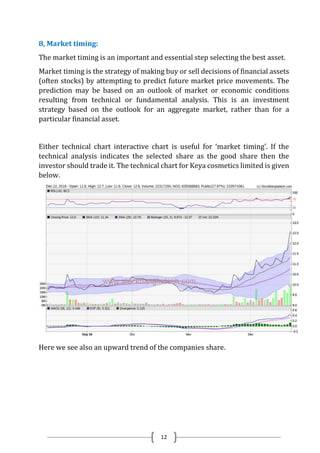
Either technical chart interactive chart is useful for ‘market timing’. If the
technical analysis indicates the selected share as the good share then the
investor should trade it. The technical chart for Keya cosmetics limited is given
below.
Here we see also an upward trend of the companies share.
13
9, Minute chart:
Minute chart shows movements off the buyers and sellers. It also provides with
market price charts. Bid and ask price of the buyer and seller can be found in
market price chart followed by the minute chart.
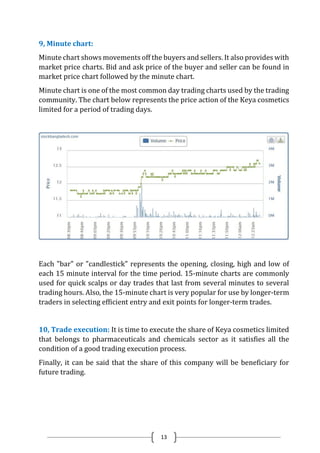
Minute chart is one of the most common day trading charts used by the trading
community. The chart below represents the price action of the Keya cosmetics
limited for a period of trading days.
Each "bar" or "candlestick" represents the opening, closing, high and low of
each 15 minute interval for the time period. 15-minute charts are commonly
used for quick scalps or day trades that last from several minutes to several
trading hours. Also, the 15-minute chart is very popular for use by longer-term
traders in selecting efficient entry and exit points for longer-term trades.
10, Trade execution: It is time to execute the share of Keya cosmetics limited
that belongs to pharmaceuticals and chemicals sector as it satisfies all the
condition of a good trading execution process.
Finally, it can be said that the share of this company will be beneficiary for
future trading.

Team work on stock maarket

  • 1.
    1 Execution process ofa trade When you place an order to buy or sell stock, you might not think about where or how your broker will execute the trade. But where and how your order is executed can impact the overall costs of the transaction, including the price you pay for the stock. Execution: An execution is the completion of a buy or sell order for a security. The execution of an order happens when it is completely filled, not when it is placed by the investor. When the investor places the trade, it goes to a broker, who then determines the best way for it to be executed. Sector movement Money flow status Sector index Data matrix Company page: one stop solution Fundamental chart News chart Market timing Minute chart Trade execution
  • 2.
    2 1, Movement ofa sector: As a first step it is important to identify the status of the index in order to follow the market movement. The basic aim for following the market movement is to identify specific sector(s) the investors are mostly interested in. Market composition is one of the tools, which helps to identify hot sectors with ease. The market composition chart also exhibit sector that are on highest trading level. Market composition generally compares trading contribution across different sectors and also current day-trading with previous day’s trading. In this regard, the engineering sector is the largest one as it hold 20.43% contribution of the total share but we cannot chose that sector because it has a decreasing figure in current day trading. (Previous day: 22.03%). Pharmaceuticals and chemicals sector could be chosen as it carry out its share with a second best position (14.63%) in current day trading and this sector has an upward tendency in terms of total share. (Previous day: 12.69%). Current day trading: 22-12-2016 Engineering 20% Pharmaceuticals and chemicals 15% Textile 12% Food and allied 9% Bank 8% Fuel and power 8% Financial institutions 5% IT sector 4% miscellaneous sector 4% services and real estate 4% cement 4% Insurance 2% travel and leisure 1% Tannery industries 1% Ceramics sector 1% Telecommunication 1% Mutual funds 1% Paper and printing 0% Jute 0% Corporate bond 0% Engineering Pharmaceuticals and chemicals Textile Food and allied Bank Fuel and power Financial institutions IT sector miscellaneous sector services and real estate cement Insurance travel and leisure Tannery industries Ceramics sector Telecommunication Mutual funds Paper and printing
  • 3.
    3 Previous day trading:21-12-2016 So, Pharmaceuticals and chemicals sector trades around 15 per cent of the total trading and also this percentage is higher than previous trading (say previous day trading was 12.69 per cent). It can therefore be said that investors are mostly interested in Pharmaceuticals and chemicals. Engineering 22% Pharmaceuticals and chemicals 13% Textile 11%Food and allied 6% Bank 10% Fuel and power 6% Financial institutions 7% IT sector 4% miscellaneous sector 7% services and real estate 4% cement 4% Insurance 2% travel and leisure 1% Tannery industries 1% Ceramics sector 1% Telecommunication 1% Mutual funds 1% Paper and printing 0% Jute 0% Corporate bond 0% Engineering Pharmaceuticals and chemicals Textile Food and allied Bank Fuel and power Financial institutions IT sector miscellaneous sector services and real estate cement Insurance travel and leisure Tannery industries Ceramics sector Telecommunication Mutual funds Paper and printing
  • 4.
    4 2, Money flowstatus: It is essential, at this stage, to investigate whether the money flow of this sector (say, Pharmaceuticals and chemicals) is positive or negative. The sign of the money flow of this sector can easily be analyzed through analyzing the number of Gainer and Loser companies. This can be examined using Gainer-Loser chart, where we can identify the number of companies running with rising price condition and number of companies running with declining of their respective stocks. Money flow status Sector-wise G/L chart, shows that prices of all of the companies of the Pharmaceuticals and chemicals sector have increased. Price of the share of other companies that belong to Pharmaceuticals and chemicals sector might be found declining, while share price of some other companies (sector) might remain unchanged. However all of these sectors money flow is either positive or unchanged. Some of the companies showing negative sign for a change in share price imply money flow is negative for those particular companies. 13 6 4 1 0 26 13 12 9 21 4 1 6 21 0 24 4 2 1 17 3 0 5 10 15 20 25 30 Series 1 Series 2 Series 3
  • 5.
    5 3, Sector index: Sectorindex is quite useful at this stage while selecting an efficient investment. We consider here the Pharmaceuticals & chemicals sector and textile sector showing positive money flow. Sector index accurately explains which one has better investment opportunities among these two sectors. If sector index of the Pharmaceuticals and chemicals sector is higher than that of textile sector then it better to select and choose the Pharmaceuticals and chemicals sector, even though both sectors have positive money flows. Compare between two sectors So, we can select the Pharmaceuticals and chemicals sector as its sector index is higher than textile sector.
  • 6.
    6 4, Data matrix: ThePharmaceuticals and chemicals sector is selected as it is identified as feasible for investment. It is now important to figure out price related and other information for all companies of the Pharmaceuticals and chemicals sector. Data matrix allows the investor to sort price- related and other data for a given sector in terms of profit or return and in terms of other attributes. For example, data sort can be done in terms of information on EPS (Earning per share), NAV (Net asset value) and volume or price change information etc. Some can select desired companies of the Pharmaceuticals and chemicals sector: data matrix would be expected to portray required information (say price change) for every minute’s interval. [Net asset value (NAV) is the value of an entity’s assets minus the value of its liabilities. Often in relation to open-end or mutual funds. The volume is commonly reported as the number of shares that changed hands during a given day. The average volume of a security over a longer period of time is the total amount traded in that period, divided by the length of the period.] Procedure: Data matrix is a very powerful scanner by which one can select a share according to his own choice. Let, one eager to see the list of companies which PE ratio are between 4 to12 and the rate of price increase is greater than 5% among the A-category share. By using Data matrix one can easily find out that list. Some column are used as default in Data matrix tools. Now, it is necessary to add the category column.
  • 7.
    7 To see onlyA-categories share, we select category column and then choose filter option and write A. To find out the share which PE ratio is among 4 to 12, select the right side PE column and move to filter, then type 12 at first box and 4 at second box. Then we can see the share of A-category list.
  • 8.
    8 Now, conduct thefollowing procedure to see the list of share which price increasing rate greater than 5% of current trading day. Finally, we choose KEYA COSMETICS Company from pharmaceuticals and chemicals sector because this sector only satisfy our given condition.
  • 9.
    9 5, Company page:one stop solution When a companies selected by analyzing all of the companies that belong to a given sector, then the company page of the selected company provides important and useful information for investors. For example: information highest and lowest price of current year, volume, minuet chart, sector chart, sector details, share holdings, capital details, beta coefficient, basic information and company news etc. can be found and evaluated visiting the company page. Company page of the other similar and competitive companies can also be visited at this stage. This enables the investor to confirm his/her selection. [Beta is a measure of the volatility, or systematic risk of a security or a portfolio in comparison to the market as a whole. Beta is used in the capital asset pricing model (CAPM), which calculates the expected return of an asset based on its beta and expected market returns.] 6, Fundamental chart: Financial condition of last few years can be exhibited by fundamental charts.
  • 10.
  • 11.
    11 7, News chart: Thenews chart allows the investors to know the dates the selected company generally deposits the dividend. [A dividend is defined as a payment made by a corporation to its shareholders. Usually these payouts are made in cash (called “cash dividend”), but sometimes companies will also distribute stock dividend, whereby additional stock shares are distributed to shareholders. Stock dividend is also known as stock splits.] From the chart, we see that there is an upward trends of dividend deposit.
  • 12.
    12 8, Market timing: Themarket timing is an important and essential step selecting the best asset. Market timing is the strategy of making buy or sell decisions of financial assets (often stocks) by attempting to predict future market price movements. The prediction may be based on an outlook of market or economic conditions resulting from technical or fundamental analysis. This is an investment strategy based on the outlook for an aggregate market, rather than for a particular financial asset. Either technical chart interactive chart is useful for ‘market timing’. If the technical analysis indicates the selected share as the good share then the investor should trade it. The technical chart for Keya cosmetics limited is given below. Here we see also an upward trend of the companies share.
  • 13.
    13 9, Minute chart: Minutechart shows movements off the buyers and sellers. It also provides with market price charts. Bid and ask price of the buyer and seller can be found in market price chart followed by the minute chart. Minute chart is one of the most common day trading charts used by the trading community. The chart below represents the price action of the Keya cosmetics limited for a period of trading days. Each "bar" or "candlestick" represents the opening, closing, high and low of each 15 minute interval for the time period. 15-minute charts are commonly used for quick scalps or day trades that last from several minutes to several trading hours. Also, the 15-minute chart is very popular for use by longer-term traders in selecting efficient entry and exit points for longer-term trades. 10, Trade execution: It is time to execute the share of Keya cosmetics limited that belongs to pharmaceuticals and chemicals sector as it satisfies all the condition of a good trading execution process. Finally, it can be said that the share of this company will be beneficiary for future trading.