Coming together is a beginning
Keeping together is Progress
Working together is SUCCESS
1
The Advanced Production Improvement Process
Vandeveer, 2011
•Team Training Background
•Ice Breaker – Introductions
•Training Session Contract
•Why Teams?
•Team Building Exercise
•Team Characteristics
•Summary / Questions
Advanced Production Improvement Process
Waste Elimination Tool Box
Quick Changeover
Standardized Work Batch Reduction Teams
Quality at Source
5S SystemVisual Plant Layout
POUS
Cellular/FlowPull/Kanban TPM
Continuous Improvement
Value
Stream
Mapping
Green = All Plants Have Knowledge
Yellow = Next Tool
White = Future Tools
3Vandeveer, 2011
Introductions / Ice Breaker
4Vandeveer, 2011
 What Do You Want To Make Sure We Cover In This
Session?
 What Are Your Expectations Of This Team Training
Session?
 Jot Down Your Expectations or Questions On A Blank Card
 Please Print
 Turn Card Face Down When Completed
Winning Teams Training Contract
5Vandeveer, 2011
Kinds of Wastes That We Can Reduce
or Eliminate
Types of Teams
•The Entire Corporation
•A Division
•Management Staff At A Division
•A Department At Corporate or At A Division
•Supplier – Division – Dealer – Consumer
• Can You Name Some Others?
7Vandeveer, 2011
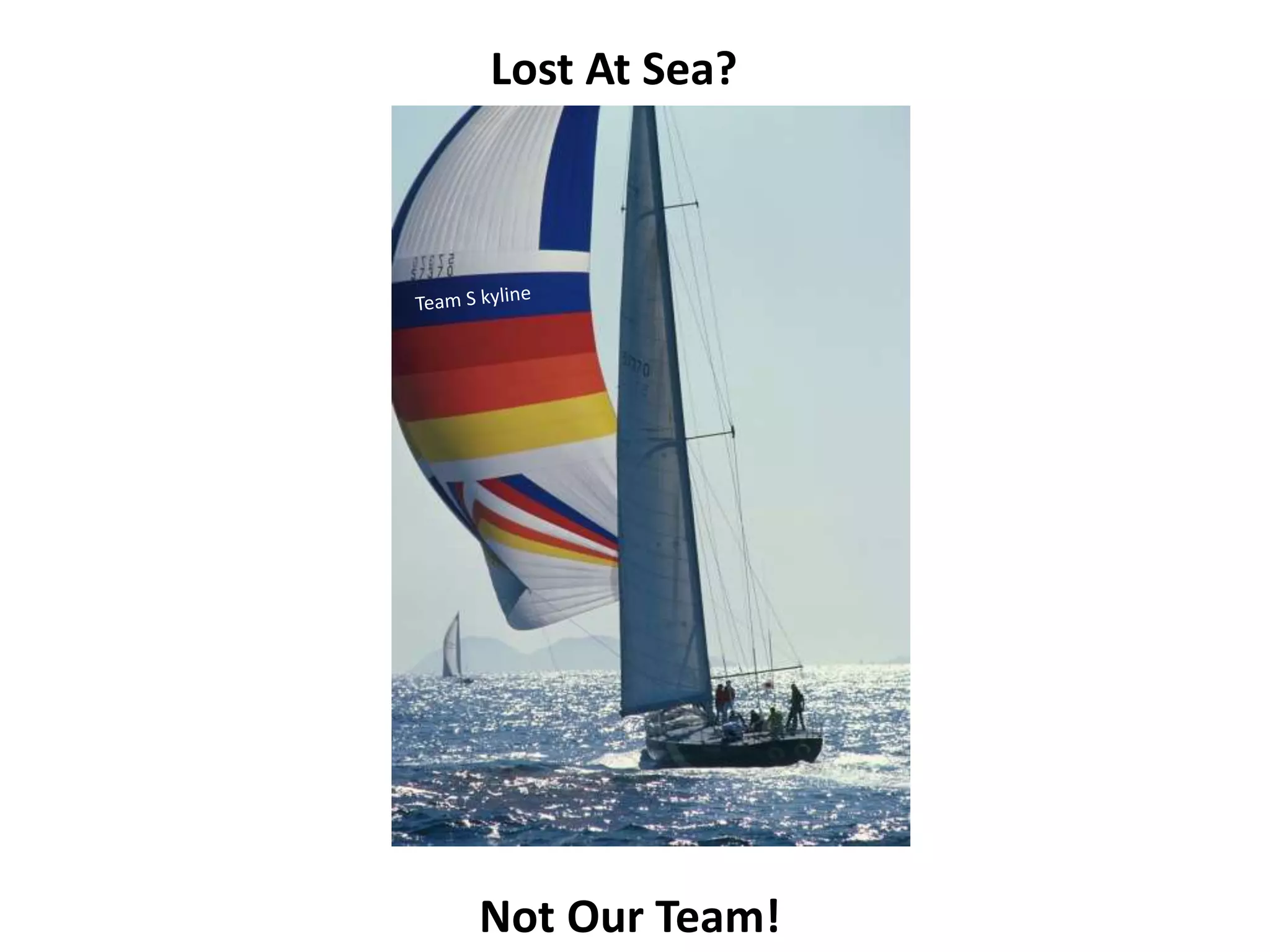
Lost At Sea
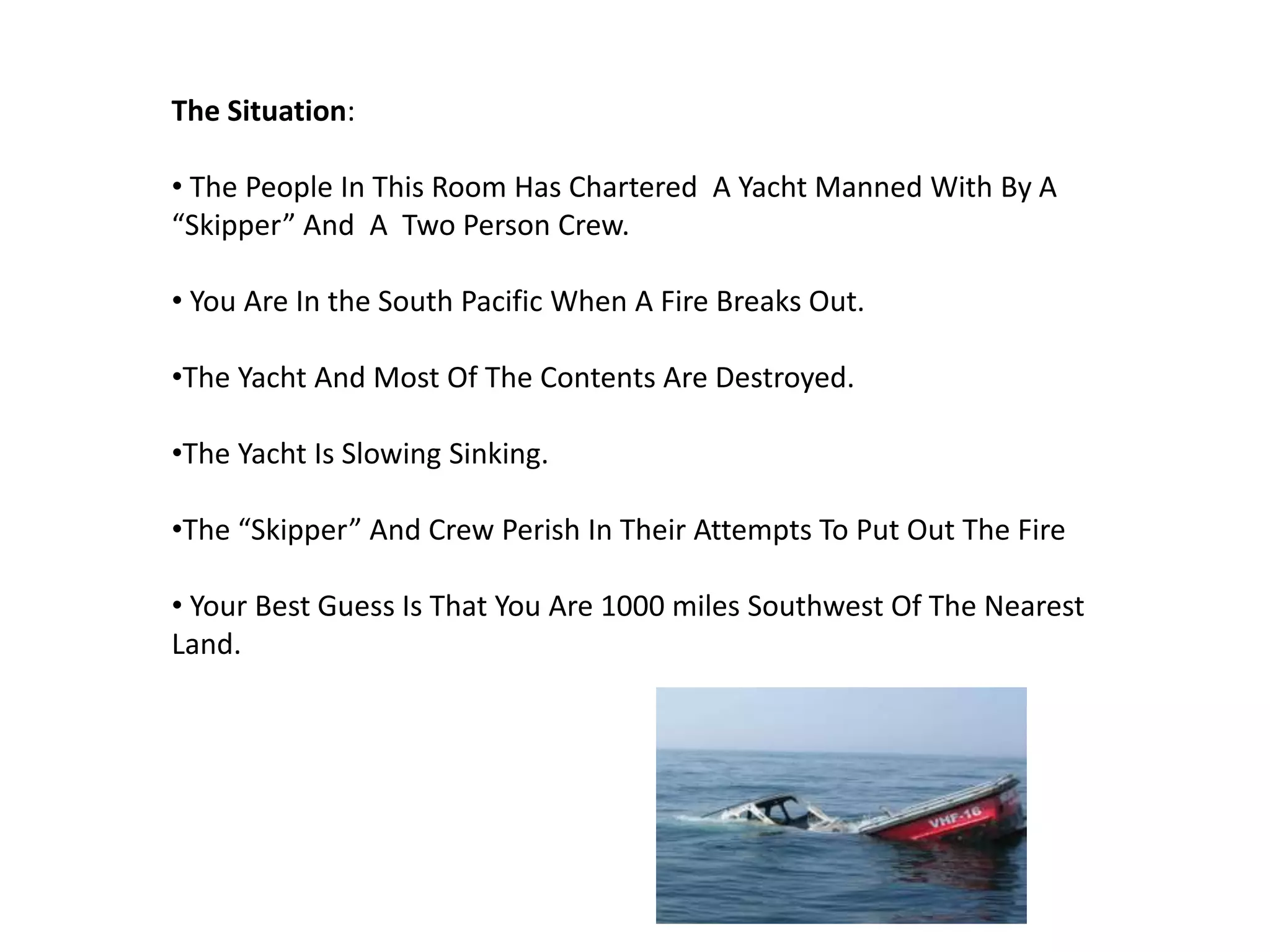
The Situation:
• The People In This Room Has Chartered A Yacht Manned With By A
“Skipper” And A Two Person Crew.
• You Are In the South Pacific When A Fire Breaks Out.
•The Yacht And Most Of The Contents Are Destroyed.
•The Yacht Is Slowing Sinking.
•The “Skipper” And Crew Perish In Their Attempts To Put Out The Fire
• Your Best Guess Is That You Are 1000 miles Southwest Of The Nearest
Land.
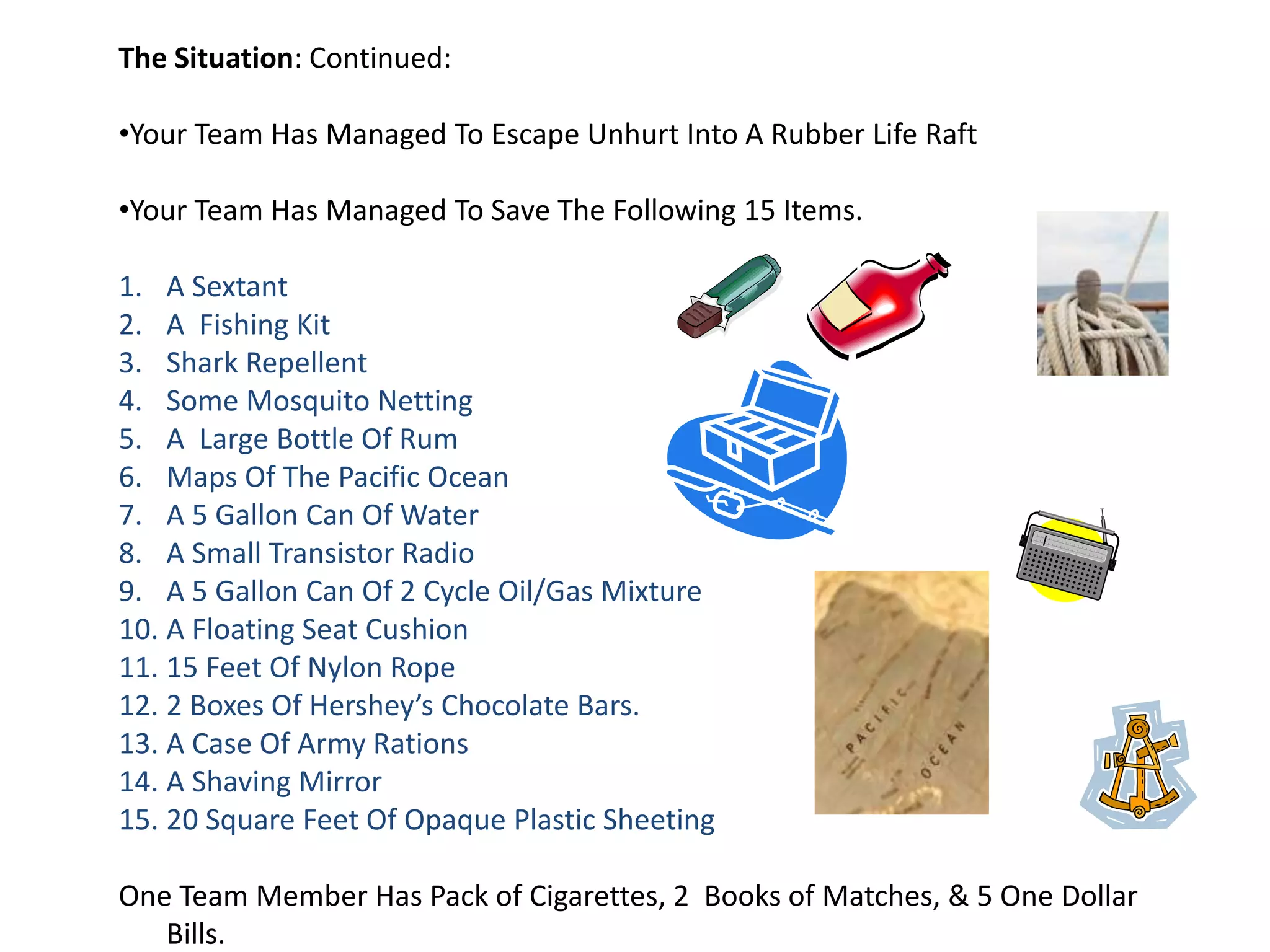
The Situation: Continued:
•Your Team Has Managed To Escape Unhurt Into A Rubber Life Raft
•Your Team Has Managed To Save The Following 15 Items.
1. A Sextant
2. A Fishing Kit
3. Shark Repellent
4. Some Mosquito Netting
5. A Large Bottle Of Rum
6. Maps Of The Pacific Ocean
7. A 5 Gallon Can Of Water
8. A Small Transistor Radio
9. A 5 Gallon Can Of 2 Cycle Oil/Gas Mixture
10. A Floating Seat Cushion
11. 15 Feet Of Nylon Rope
12. 2 Boxes Of Hershey’s Chocolate Bars.
13. A Case Of Army Rations
14. A Shaving Mirror
15. 20 Square Feet Of Opaque Plastic Sheeting
One Team Member Has Pack of Cigarettes, 2 Books of Matches, & 5 One Dollar
Bills.
The Task: Part 1:
Your Chances Of Survival Will Depend Upon Your
Ability To Rank The 15 Items In The Order Of
Importance.
On The Worksheet, Working Alone.
Rank The Importance Of The Items.
Example: If You Think The Transistor Radio Is #1 Mark
1 Next To It. Mark 2 For The Next Important Item And
So On....
You Have 5 Minutes.....
Go!
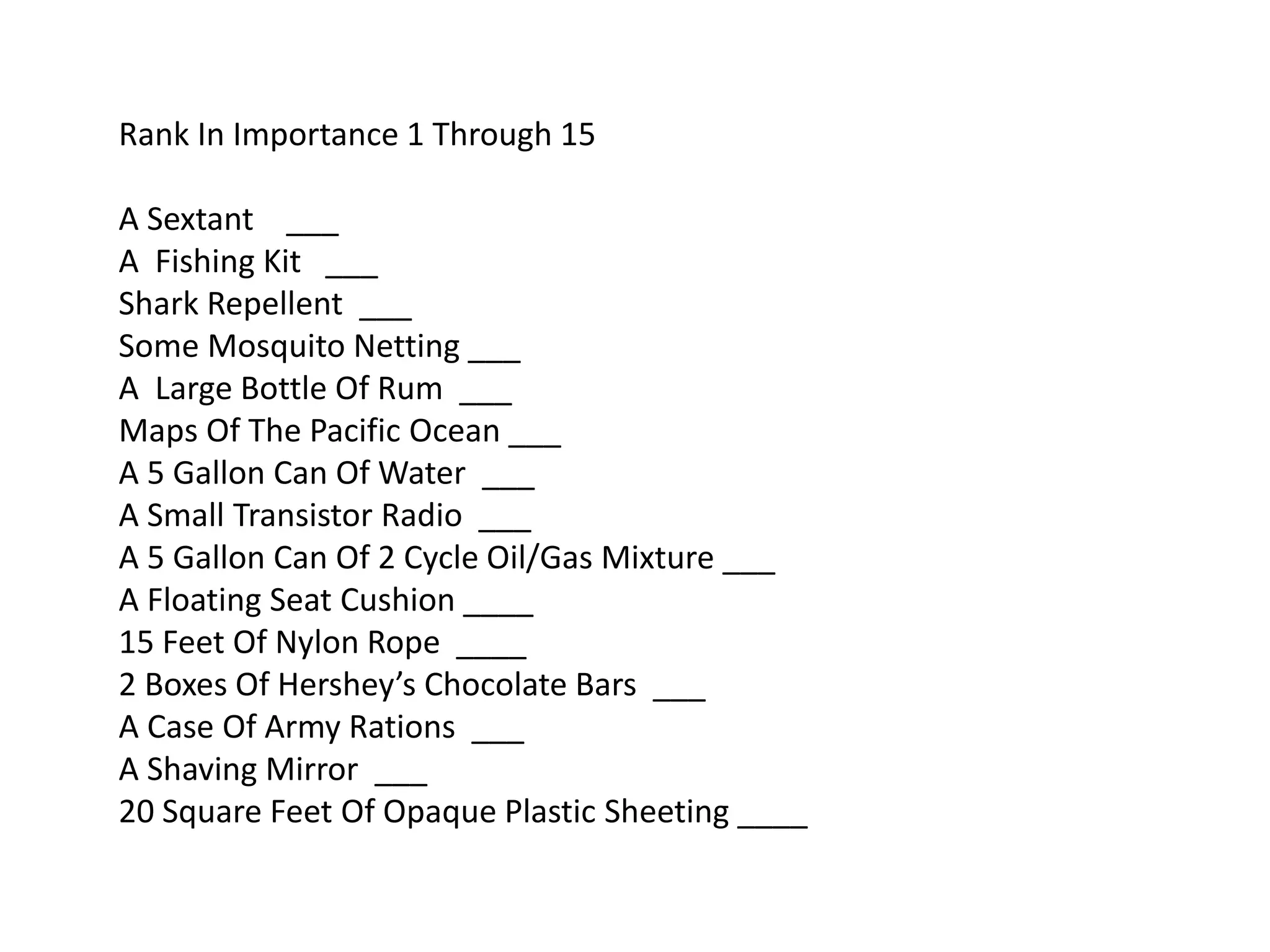
Rank In Importance 1 Through 15
A Sextant ___
A Fishing Kit ___
Shark Repellent ___
Some Mosquito Netting ___
A Large Bottle Of Rum ___
Maps Of The Pacific Ocean ___
A 5 Gallon Can Of Water ___
A Small Transistor Radio ___
A 5 Gallon Can Of 2 Cycle Oil/Gas Mixture ___
A Floating Seat Cushion ____
15 Feet Of Nylon Rope ____
2 Boxes Of Hershey’s Chocolate Bars ___
A Case Of Army Rations ___
A Shaving Mirror ___
20 Square Feet Of Opaque Plastic Sheeting ____
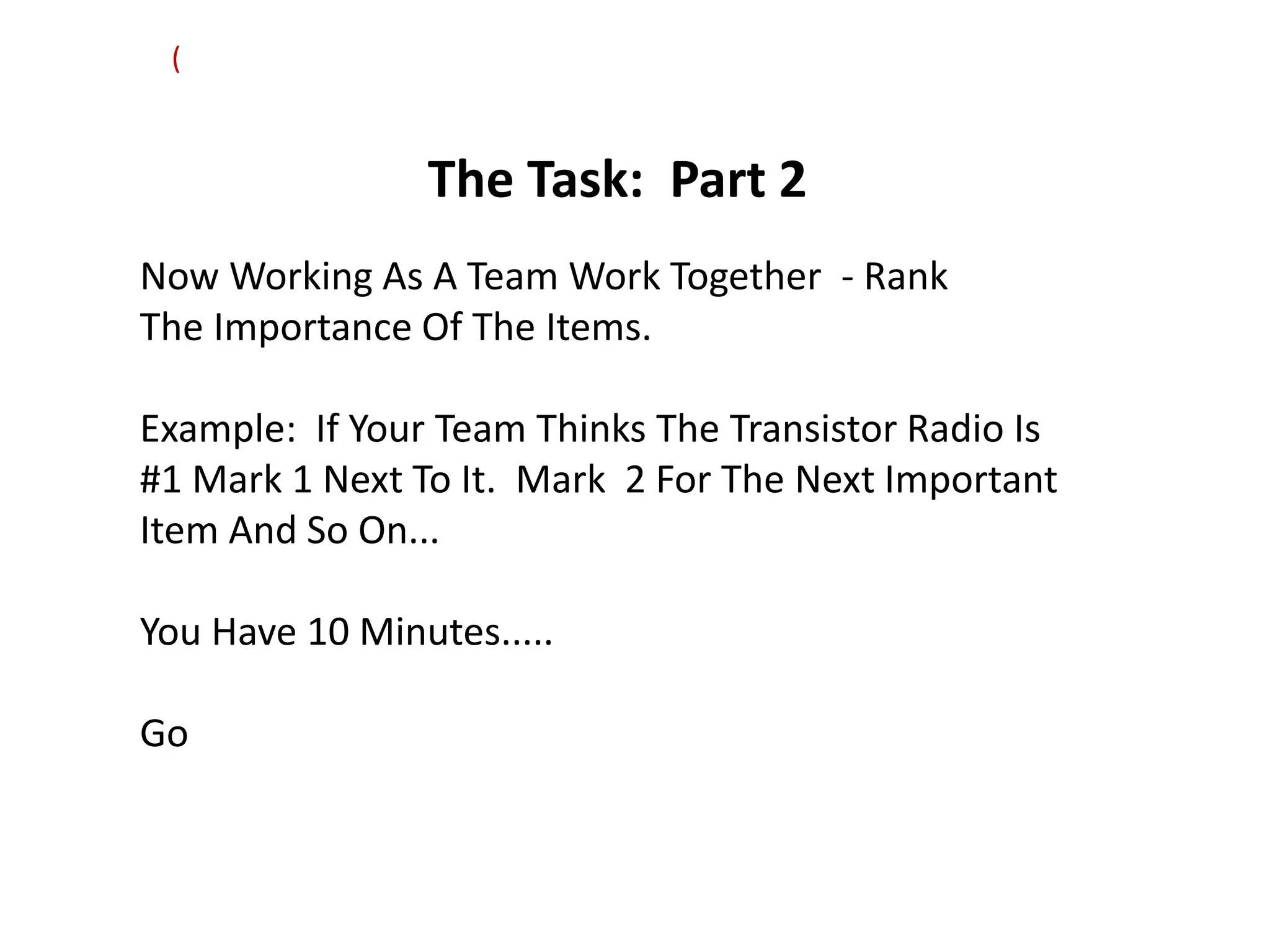
The Task: Part 2
Now Working As A Team Work Together - Rank
The Importance Of The Items.
Example: If Your Team Thinks The Transistor Radio Is
#1 Mark 1 Next To It. Mark 2 For The Next Important
Item And So On...
You Have 10 Minutes.....
Go
(
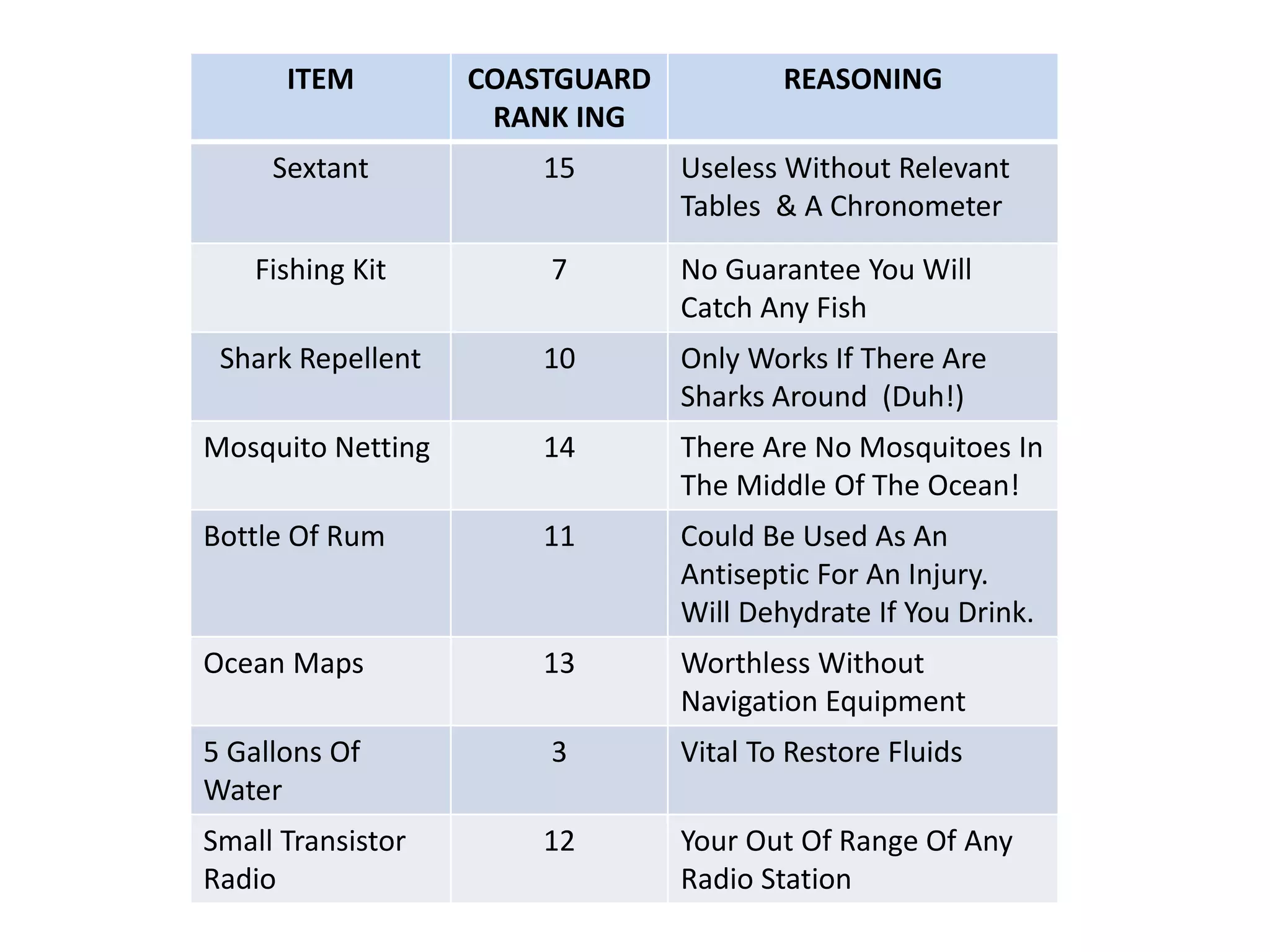
Coastguard Expert Analysis:
•The Basic Supplies Needed When People Are Stranded In Mid-
Ocean Are Articles To Attract Attention & Aid For Survival Until
Recue Help Arrives.
• Articles For Navigation Are Of Little Importance. Even If The
Life Raft Made It To Land It Would Be Impossible To Store
Enough Food and Water To Survive For That Amount Of Time.
•Most Rescues Occur Within The First 36 Hours.
ITEM COASTGUARD
RANK ING
REASONING
Sextant 15 Useless Without Relevant
Tables & A Chronometer
Fishing Kit 7 No Guarantee You Will
Catch Any Fish
Shark Repellent 10 Only Works If There Are
Sharks Around (Duh!)
Mosquito Netting 14 There Are No Mosquitoes In
The Middle Of The Ocean!
Bottle Of Rum 11 Could Be Used As An
Antiseptic For An Injury.
Will Dehydrate If You Drink.
Ocean Maps 13 Worthless Without
Navigation Equipment
5 Gallons Of
Water
3 Vital To Restore Fluids
Small Transistor
Radio
12 Your Out Of Range Of Any
Radio Station
ITEM COASTGUARD
RANK ING
REASONING
5 Gallons Of 2
Cycle Fuel Mix
2 Critical For Signaling.
Mixture Floats On Water Can
Be Lighted With The
Matches.
Floating Seat
Cushion
9 Useful As A Life Preserver If
Someone Falls Out The Raft
15 Feet Of Rope 8 Could Be Used To Lash
People Or Gear Together
During A Storm
Hershey Bars 6 Your Reserve Food Supply
Army Rations 4 Your Basic Food Supply
Shaving Mirror 1 Critical For Signaling.
20 Sq. Ft. Plastic 5 Can Be Used To Collect Rain
Water. Shelter From Sun,
Wind, Waves, etc.
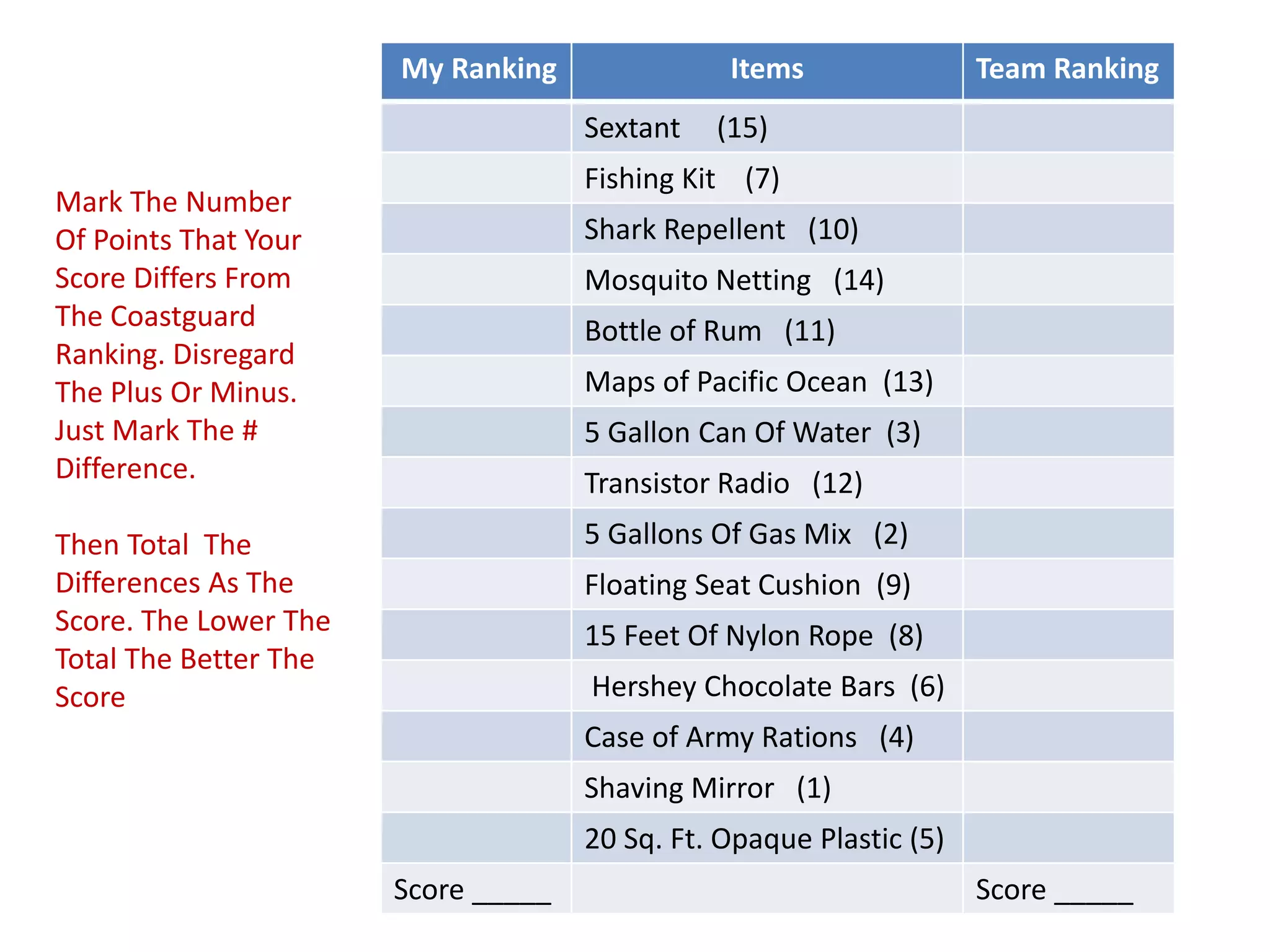
Let’s Do Some Math And See If You Would Have Survived
Individually And If Your Team Made It.
USCG: Skyline
My Ranking Items Team Ranking
Sextant (15)
Fishing Kit (7)
Shark Repellent (10)
Mosquito Netting (14)
Bottle of Rum (11)
Maps of Pacific Ocean (13)
5 Gallon Can Of Water (3)
Transistor Radio (12)
5 Gallons Of Gas Mix (2)
Floating Seat Cushion (9)
15 Feet Of Nylon Rope (8)
Hershey Chocolate Bars (6)
Case of Army Rations (4)
Shaving Mirror (1)
20 Sq. Ft. Opaque Plastic (5)
Score _____ Score _____
Mark The Number
Of Points That Your
Score Differs From
The Coastguard
Ranking. Disregard
The Plus Or Minus.
Just Mark The #
Difference.
Then Total The
Differences As The
Score. The Lower The
Total The Better The
Score
My Ranking Items Team Ranking
5 Sextant (15) 5
4 Fishing Kit (7) 4
Shark Repellent (10)
Mosquito Netting (14)
Bottle of Rum (11)
Maps of Pacific Ocean (13)
5 Gallon Can Of Water (3)
Transistor Radio (12)
5 Gallons Of Gas Mix (2)
Floating Seat Cushion (9)
15 Feet Of Nylon Rope (8)
Hershey Chocolate Bars (6)
Case of Army Rations (4)
Shaving Mirror (1)
20 Sq. Ft. Opaque Plastic (5)
Score _____ Score _____
Here’s
An Example:
If You Ranked The
Sextant As A 10;
The Difference
Would Be Marked
As 5.
If You Ranked The
Fishing Kit As A 11;
The Difference
Would Be Marked
As 4.
0 – 25: Excellent. You Demonstrated Great Skills. Rescued !
26-32: Above Average Results. Ok Skills. Rescued !
33-45: Average: Seasick, Hungry, Tired...But Rescued !
Your New Nickname Is “Gillian”!
46-55: Fair: Dehydrated & Barely Alive. It Was Tough, But Rescued.
56-70: Poor: A Few Of You Barely Made It & Will Need Hospital
Care...Some Didn’t Make It. Partial Rescue.
71-112: Not: Your Are History... Welcome To Davey Jones Locker !
Lost At Sea............
What Are The Take Aways?
Lost At Sea?
Not Our Team!
• Generate list. . .
What are Americans like?
23Vandeveer, 2011
• Competitive
• Individualistic
• Get it done attitude
• Direct
• Informal
• Questioners
• Dislike Silence
• Value punctuality and cleanliness
What are Americans like?
Are
these good
teambuilding
qualities?
24Vandeveer, 2011
• “An effective team is made up of capable and
interested people, in small freely
communicating groups, influenced by a
strong, results-oriented leader committed to
clear and attainable goals and highly active in
working with team members to solve any
problem standing in the way of goal
achievement.”
Team: The Essential Ingredients
25Vandeveer, 2011
• Exist to achieve a shared goal
Characteristics of Teams
26Vandeveer, 2011
• Exist to achieve a shared goal
• Members are interdependent regarding
accomplishing that goal
Characteristics of Teams
27Vandeveer, 2011
• Exist to achieve a shared goal
• Members are interdependent regarding
accomplishing that goal
• Are bounded and remain relatively
stable over time
Characteristics of Teams
28Vandeveer, 2011
• Exist to achieve a shared goal
• Members are interdependent regarding
accomplishing that goal
• Are bounded and remain relatively stable over time
• Members have the authority to manage
their own work and internal processes
Characteristics of Teams
29Vandeveer, 2011
• Exist to achieve a shared goal
• Members are interdependent regarding
accomplishing that goal
• Are bounded and remain relatively stable over time
• Members have the authority to manage their own
work and internal processes
• Operate in a larger social system context
Characteristics of Teams
30Vandeveer, 2011
• A team is a group of people who are
interdependent with respect to
information, resources, and skills and
who seek to combine their efforts to
achieve a common goal.
What is a TEAM?
31Vandeveer, 2011
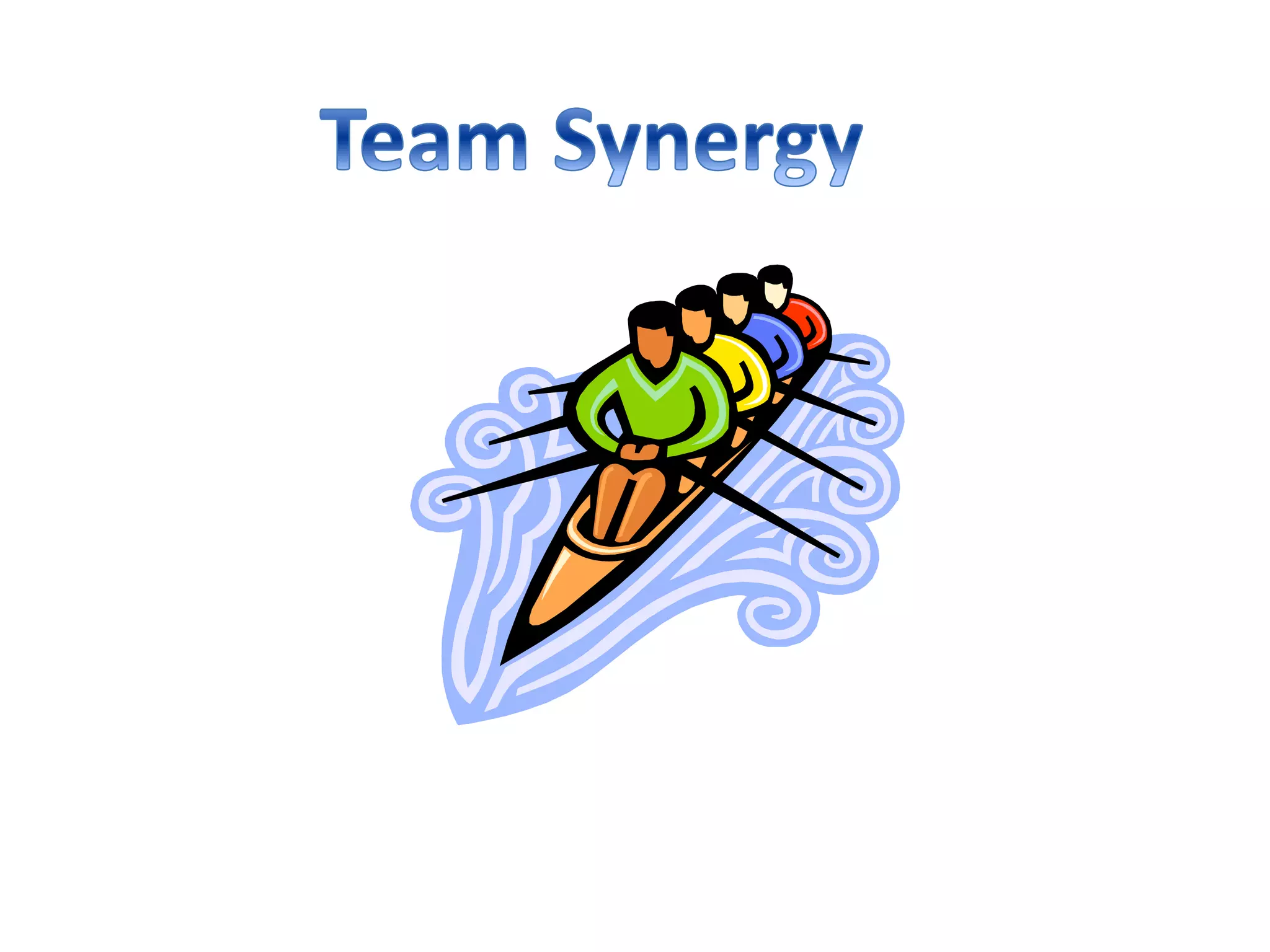
Synergy of Teams
“ An exciting potential is born
whenever two or more people come
together. Synergy, where the whole is
greater than the sum of the parts is
most effective when the differences
between people are valued. The
strengths of the individuals must be
built upon and their weaknesses
compensated for. In the fertile soil of
synergy, new alternatives are born.
-The 7 Habits of Highly Effective People
32Vandeveer, 2011
•Synergy Means..... “Working Together”
•Synergy Means...... “A Combined Action
Or Operation”
•Synergy Means..... “Working Together”
•Synergy Means...... “ A Combined Action Or Operation”
•Synergy Means....“The Whole is Greater
than the Sum of The Individual Part”
•Synergy Means..... “Working Together”
•Synergy Means...... “A Combined Action Or Operation”
•Synergy Means.... “The Whole is Greater than the Sum of The
Individual Part”
•Synergy Is Most Effective When The
Differences Between People Are Valued
•Synergy Means..... “Working Together”
•Synergy Means...... “A Combined Action Or Operation”
•Synergy Means.... “The Whole is Greater than the Sum of The
Individual Part”
•Synergy Is Most Effective When The Differences Between
People Are Valued
•Synergy Is Built Using The Strengths Of
The Individuals.
Team Expectations
39Vandeveer, 2011
Team Expectations
•Cross-trained, Multi Skilled Associates That Can Do
Many Tasks.
40Vandeveer, 2011
Team Expectations
•Cross-trained, Multi Skilled Associates That Can Do Many Tasks.
•Team Members Work Together To Build Products or
Provide A Service.
41Vandeveer, 2011
Team Expectations
•Cross-trained, Multi Skilled Associates That Can Do Many Tasks.
•Team Members Work Together To Build Products or Provide A
Service.
•Collectively Help Make Decisions.
42Vandeveer, 2011
Team Expectations
•Cross-trained, Multi Skilled Associates That Can Do Many Tasks.
•Team Members Work Together To Build Products or Provide A
Service.
•Collectively Help Make Decisions.
•Can Be A Group Of Associates That Come Together
For A Specific Purpose (IE: Solve A Tough Problem)
43Vandeveer, 2011
Team Expectations
•Cross-trained, Multi Skilled Associates That Can Do Many Tasks.
•Team Members Work Together To Build Products or Provide A
Service.
•Collectively Help Make Decisions.
•Can Be A Group Of Associates That Come Together For A
Specific
Purpose (IE: Solve A Tough Problem)
•Have A Goal That Is Achievable & Measurable
44Vandeveer, 2011
Team Expectations
•Cross-trained, Multi Skilled Associates That Can Do Many Tasks.
•Team Members Work Together To Build Products or Provide A
Service.
•Collectively Help Make Decisions.
•Can Be A Group Of Associates That Come Together For A
Specific
Purpose (IE: Solve A Tough Problem)
•Have A Goal That Is Achievable & Measurable
•The End Result Should Meet Or Exceed Stake Holder
Expectations, Add Value, And Enhance Continual
Improvement.
45Vandeveer, 2011
What Are Some Of The Frustrations You
Can Expect With Teams?
46Vandeveer, 2011
• It requires trust and great “people skills.”
Frustrating Aspects of Teamwork
47Vandeveer, 2011
• It requires trust and great “people skills.”
• Developing and sustaining high motivation
Frustrating Aspects of Teamwork
48Vandeveer, 2011
• It requires trust and great “people skills.”
• Developing and sustaining high motivation
• Managing conflict productively
Frustrating Aspects of Teamwork
49Vandeveer, 2011
• It requires trust and great “people skills.”
• Developing and sustaining high motivation
• Managing conflict productively
• Providing leadership and direction
Frustrating Aspects of Teamwork
50Vandeveer, 2011
• It requires trust and great “people skills.”
• Developing and sustaining high motivation
• Managing conflict productively
• Providing leadership and direction
• Fostering creativity and innovation
Frustrating Aspects of Teamwork
51Vandeveer, 2011
• It requires trust and great “people skills.”
• Developing and sustaining high motivation
• Managing conflict productively
• Providing leadership and direction
• Fostering creativity and innovation
• Minimizing confusion and coordination
problems.
Frustrating Aspects of Teamwork
52Vandeveer, 2011
Standard Team Ground Rules
53Vandeveer, 2011
• Use teams of about 10 members
Standard Team Ground Rules
54Vandeveer, 2011
• Use teams of about 10 members
• Use an agenda to give clear sense of where
they are going
Standard Team Ground Rules
55Vandeveer, 2011
• Use teams of about 10 members
• Use an agenda to give clear sense of where they are
going
• Start on time and stop on time
Standard Team Ground Rules
56Vandeveer, 2011
• Use teams of about 10 members
• Use an agenda to give clear sense of where they are going
• Start on time and stop on time
• Pick a good meeting area, few distractions,
Standard Team Ground Rules
57Vandeveer, 2011
• Use teams of about 10 members
• Use an agenda to give clear sense of where they are
going
• Start on time and stop on time
• Pick a good meeting area, few distractions,
• Train the team members together.
Standard Team Ground Rules
58Vandeveer, 2011
• Use teams of about 10 members
• Use an agenda to give clear sense of where they are
going
• Start on time and stop on time
• Pick a good meeting area, few distractions,
• Train the team members together.
• Get everyone involved
Standard Team Ground Rules
59Vandeveer, 2011
• Use teams of about 10 members
• Use an agenda to give clear sense of where they are
going
• Start on time and stop on time
• Pick a good meeting area, few distractions,
• Train the team members together.
• Get everyone involved
• Practice
Standard Team Ground Rules
60Vandeveer, 2011
• Use teams of about 10 members
• Use an agenda to give clear sense of where they are
going
• Start on time and stop on time
• Pick a good meeting area, few distractions,
• Train the team members together.
• Get everyone involved
• Practice
• Minimize links in the communication chain
Standard Team Ground Rules
61Vandeveer, 2011
• Use teams of about 10 members
• Use an agenda to give clear sense of where they are
going
• Start on time and stop on time
• Pick a good meeting area, few distractions,
• Train the team members together.
• Get everyone involved
• Practice
• Minimize links in the communication chain
• Set clear performance standards
Standard Team Ground Rules
62Vandeveer, 2011
The value of team is now known. The
following are some benefits that can result
from the introduction of work teams.
The Value of Teams
63Vandeveer, 2011
• The value of team is now known. The
following are some benefits that can result
from the introduction of work teams.
–Increased employee motivation
The Value of Teams
64Vandeveer, 2011
• The value of team is now known. The
following are some benefits that can result
from the introduction of work teams.
– Increased employee motivation
–Higher level of productivity
The Value of Teams
65Vandeveer, 2011
• The value of team is now known. The
following are some benefits that can result
from the introduction of work teams.
– Increased employee motivation
– Higher level of productivity
–Increased employee satisfaction
The Value of Teams
66Vandeveer, 2011
• The value of team is now known. The
following are some benefits that can result
from the introduction of work teams.
– Increased employee motivation
– Higher level of productivity
– Increased employee satisfaction
–Common commitment to goals
The Value of Teams
67Vandeveer, 2011
• The value of team is now known. The
following are some benefits that can result
from the introduction of work teams.
– Increased employee motivation
– Higher level of productivity
– Increased employee satisfaction
– Common commitment to goals
–Improved decision making
The Value of Teams
68Vandeveer, 2011
• The value of team is now known. The following
are some benefits that can result from the
introduction of work teams.
– Increased employee motivation
– Higher level of productivity
– Increased employee satisfaction
– Common commitment to goals
– Improved decision making
– Improved communication
–Expanded job skills
The Value of Teams
69Vandeveer, 2011
• The value of team is now known. The following
are some benefits that can result from the
introduction of work teams.
– Increased employee motivation
– Higher level of productivity
– Increased employee satisfaction
– Common commitment to goals
– Improved decision making
– Improved communication
– Expended job skills
–Organizational flexibility
The Value of Teams
70Vandeveer, 2011
The 4 Stages Teams Go Through
High
Low
Team
Cooperation
Negative Neutral Positive
Synergy
Storming
Forming
Norming
Performing
71Vandeveer, 2011
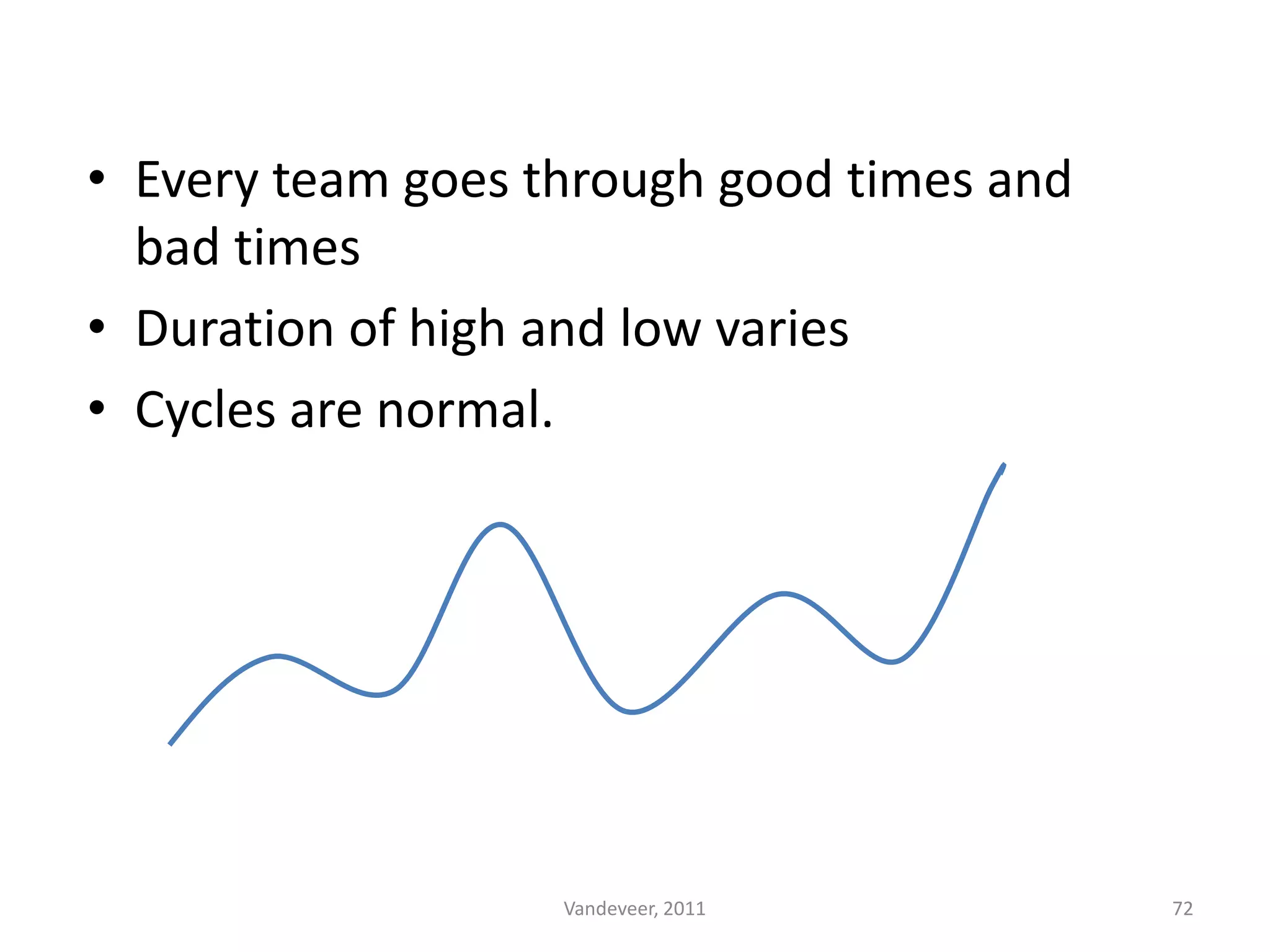
• Every team goes through good times and
bad times
• Duration of high and low varies
• Cycles are normal.
Vandeveer, 2011 72
Team Member Roles
Coach/Facilitator
73Vandeveer, 2011
Team Member Roles
Coach/Facilitator
• Provide Guidance, Direction, and
Training For The Team
74Vandeveer, 2011
Team Member Roles
Coach/Facilitator
• Provide Guidance, Direction, and
Training For The Team
• Attends meetings – is neither
a leader nor a member
75Vandeveer, 2011
Team Member Roles
Coach/Facilitator
• Provide Guidance, Direction, and
Training For The Team
• Attends meetings – is neither a leader nor
a member
• Focuses on the team process
76Vandeveer, 2011
Team Member Roles
Coach/Facilitator
• Provide Guidance, Direction, and
Training For The Team
• Attends meetings – is neither a leader nor
a member
• Focuses on the team process
• Helps team leader plan
meetings
77Vandeveer, 2011
Team Member Roles
Coach/Facilitator
• Provide Guidance, Direction, and
Training For The Team
• Attends meetings – is neither a leader nor
a member
• Focuses on the team process
• Helps team leader plan meetings
• Teaches team techniques to
members
78Vandeveer, 2011
Team Member Roles
Coach/Facilitator
• Provide Guidance, Direction, and
Training For The Team
• Attends meetings – is neither a leader nor a
member
• Focuses on the team process
• Helps team leader plan meetings
• Teaches team techniques to members
• Such as.. data collection... to
help seek the root causes of a
problem before trying to solve it.
79Vandeveer, 2011
Team Member Roles
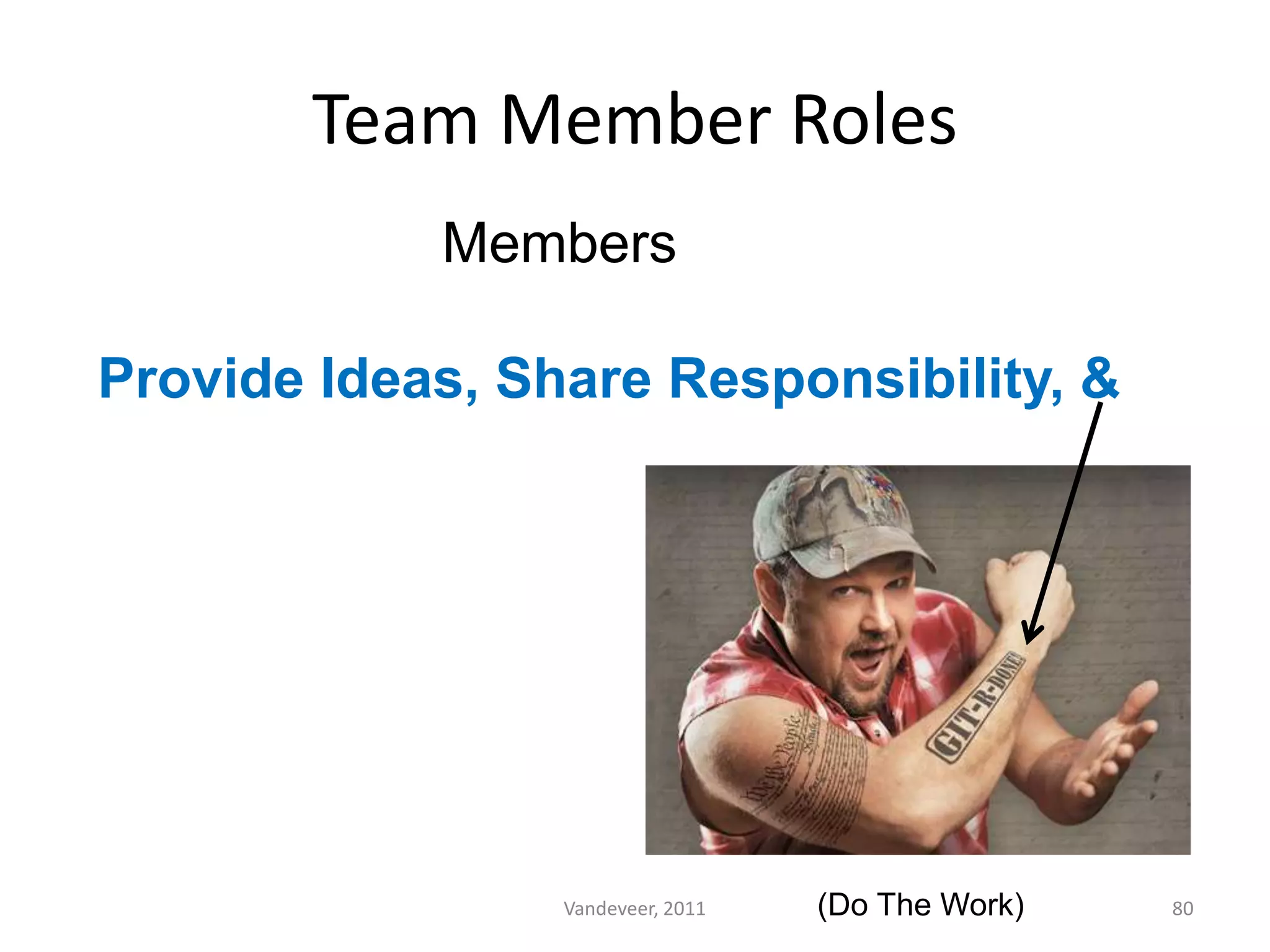
Members
Provide Ideas, Share Responsibility, &
80Vandeveer, 2011 (Do The Work)
Teams: Meetings That Work
81Vandeveer, 2011
Teams: Meetings That Work
•Have An Agenda
82Vandeveer, 2011
Teams: Meetings That Work
•Have An Agenda
•Pick A Good Meeting Room / Area
83Vandeveer, 2011
Teams: Meetings That Work
•Have An Agenda
•Pick A Good Meeting Room / Area
•Set A Start and Stop Time
84Vandeveer, 2011
Teams: Meetings That Work
•Have An Agenda
•Pick A Good Meeting Room / Area
•Set A Start and Stop Time
85Vandeveer, 2011
•Speak For Yourself While
Considering Other Team Members
Teams: Meetings That Work
•Have An Agenda
•Pick A Good Meeting Room / Area
•Set A Start and Stop Time
86Vandeveer, 2011
•Speak For Yourself While Considering Other
Team Members
•Separate The Idea From The Person
Teams: Meetings That Work
•Have An Agenda
•Pick A Good Meeting Room / Area
•Set A Start and Stop Time
87Vandeveer, 2011
•Speak For Yourself While Considering Other
Team Members
•Separate The Idea From The Person
•Don’t Ignore Others’ Contributions
Teams: Meetings That Work -Continued
•Balance participation - All Members
Participate
88Vandeveer, 2011
Teams: Meetings That Work -Continued
•Balance participation - All Members Participate
•View Differences/Conflict As Helpful
But Be Respectful
89Vandeveer, 2011
Teams: Meetings That Work -Continued
•Balance participation - All Members Participate
•View Differences/Conflict As Helpful
But Be Respectful
•Strive For A Consensus
90Vandeveer, 2011
Teams: Meetings That Work -Continued
•Balance participation - All Members Participate
•View Differences/Conflict As Helpful
But Be Respectful
•Strive For A Consensus
•Set Priorities At End Of Meeting:
“What’s Next”
•Or “Who Does What By When”
91Vandeveer, 2011
Teams: Meetings That Work -Continued
•Balance participation - All Members Participate
•View Differences/Conflict As Helpful
But Be Respectful
•Strive For A Consensus
•Set Priorities At End Of Meeting: “What’s Next”
Or “Who Does What By When”
•Close – Summarize- Debrief
92Vandeveer, 2011
Features Of High Performance Teams
93Vandeveer, 2011
Features Of High Performance Teams
–Clarity in team goals/objectives
94Vandeveer, 2011
Features Of High Performance Teams
– Clarity in team goals/objectives
–Have a shared plan for
improvement (Implementation
of lean process improvement)
95Vandeveer, 2011
Features Of High Performance Teams
– Clarity in team goals/objectives
– Have a shared plan for improvement
(Implementation of lean process
improvement)
–Commitment to common
purpose
96Vandeveer, 2011
Features Of High Performance Teams
– Clarity in team goals/objectives
– Have a shared plan for improvement
(Implementation of lean process
improvement)
– Commitment to common purpose
–Clearly defined roles;
Leadership and structure
97Vandeveer, 2011
Features Of High Performance Teams
– Clarity in team goals/objectives
– Have a shared plan for improvement
(Implementation of lean process improvement)
– Commitment to common purpose
– Clearly defined roles; Leadership and structure
– Clear communication – publish minute
–Training to meet the knowledge
and skill needs
98Vandeveer, 2011
Features Of High Performance Teams
– Clarity in team goals/objectives
– Have a shared plan for improvement
(Implementation of lean process improvement)
– Commitment to common purpose
– Clearly defined roles; Leadership and structure
– Clear communication – publish minute
– Training to meet the knowledge and skill needs
–Well defined decision procedures
99Vandeveer, 2011
Features Of High Performance Teams
– Clarity in team goals/objectives
– Have a shared plan for improvement
(Implementation of lean process improvement)
– Commitment to common purpose
– Clearly defined roles; Leadership and structure
– Clear communication – publish minute
– Training to meet the knowledge and skill needs
– Well defined decision procedures
–Appropriate evaluation and
reward systems
100Vandeveer, 2011
Features Of High Performance Teams
– Clarity in team goals/objectives
– Have a shared plan for improvement
(Implementation of lean process improvement)
– Commitment to common purpose
– Clearly defined roles; Leadership and structure
– Clear communication – publish minute
– Training to meet the knowledge and skill needs
– Well defined decision procedures
– Appropriate evaluation and reward systems
–Awareness of the group process
101Vandeveer, 2011
Features Of High Performance Teams
– Clarity in team goals/objectives
– Have a shared plan for improvement
(Implementation of lean process improvement)
– Commitment to common purpose
– Clearly defined roles; Leadership and structure
– Clear communication – publish minute
– Training to meet the knowledge and skill needs
– Well defined decision procedures
– Appropriate evaluation and reward systems
– Awareness of the group process
–High mutual trust
102Vandeveer, 2011
Summary
 Expectation Cards / Training Contract Review
 Questions?
 Where do we go from here?
Everyone reads the book “ The Five Dysfunctions
Of A Team”. We reconvene and start some
teams to address problems.
103Vandeveer, 2011
The Five Dysfunctions of a Team
• Lack of trust
• Fear of conflict
• Lack of commitment
• Avoidance of
accountability
• Inattention to results
Vandeveer, 2011 104
“It’s Easy To Get Good Players.
Getting Them To Play Together; That’s The Hard Part!”
Casey Stengel: New York Yankee’s Manager:
1949 -1960
7 World Series Championships

Team training

  • 1.
    Coming together isa beginning Keeping together is Progress Working together is SUCCESS 1 The Advanced Production Improvement Process Vandeveer, 2011
  • 2.
    •Team Training Background •IceBreaker – Introductions •Training Session Contract •Why Teams? •Team Building Exercise •Team Characteristics •Summary / Questions
  • 3.
    Advanced Production ImprovementProcess Waste Elimination Tool Box Quick Changeover Standardized Work Batch Reduction Teams Quality at Source 5S SystemVisual Plant Layout POUS Cellular/FlowPull/Kanban TPM Continuous Improvement Value Stream Mapping Green = All Plants Have Knowledge Yellow = Next Tool White = Future Tools 3Vandeveer, 2011
  • 4.
    Introductions / IceBreaker 4Vandeveer, 2011
  • 5.
     What DoYou Want To Make Sure We Cover In This Session?  What Are Your Expectations Of This Team Training Session?  Jot Down Your Expectations or Questions On A Blank Card  Please Print  Turn Card Face Down When Completed Winning Teams Training Contract 5Vandeveer, 2011
  • 6.
    Kinds of WastesThat We Can Reduce or Eliminate
  • 7.
    Types of Teams •TheEntire Corporation •A Division •Management Staff At A Division •A Department At Corporate or At A Division •Supplier – Division – Dealer – Consumer • Can You Name Some Others? 7Vandeveer, 2011
  • 8.
  • 9.
    The Situation: • ThePeople In This Room Has Chartered A Yacht Manned With By A “Skipper” And A Two Person Crew. • You Are In the South Pacific When A Fire Breaks Out. •The Yacht And Most Of The Contents Are Destroyed. •The Yacht Is Slowing Sinking. •The “Skipper” And Crew Perish In Their Attempts To Put Out The Fire • Your Best Guess Is That You Are 1000 miles Southwest Of The Nearest Land.
  • 10.
    The Situation: Continued: •YourTeam Has Managed To Escape Unhurt Into A Rubber Life Raft •Your Team Has Managed To Save The Following 15 Items. 1. A Sextant 2. A Fishing Kit 3. Shark Repellent 4. Some Mosquito Netting 5. A Large Bottle Of Rum 6. Maps Of The Pacific Ocean 7. A 5 Gallon Can Of Water 8. A Small Transistor Radio 9. A 5 Gallon Can Of 2 Cycle Oil/Gas Mixture 10. A Floating Seat Cushion 11. 15 Feet Of Nylon Rope 12. 2 Boxes Of Hershey’s Chocolate Bars. 13. A Case Of Army Rations 14. A Shaving Mirror 15. 20 Square Feet Of Opaque Plastic Sheeting One Team Member Has Pack of Cigarettes, 2 Books of Matches, & 5 One Dollar Bills.
  • 11.
    The Task: Part1: Your Chances Of Survival Will Depend Upon Your Ability To Rank The 15 Items In The Order Of Importance. On The Worksheet, Working Alone. Rank The Importance Of The Items. Example: If You Think The Transistor Radio Is #1 Mark 1 Next To It. Mark 2 For The Next Important Item And So On.... You Have 5 Minutes..... Go!
  • 12.
    Rank In Importance1 Through 15 A Sextant ___ A Fishing Kit ___ Shark Repellent ___ Some Mosquito Netting ___ A Large Bottle Of Rum ___ Maps Of The Pacific Ocean ___ A 5 Gallon Can Of Water ___ A Small Transistor Radio ___ A 5 Gallon Can Of 2 Cycle Oil/Gas Mixture ___ A Floating Seat Cushion ____ 15 Feet Of Nylon Rope ____ 2 Boxes Of Hershey’s Chocolate Bars ___ A Case Of Army Rations ___ A Shaving Mirror ___ 20 Square Feet Of Opaque Plastic Sheeting ____
  • 13.
    The Task: Part2 Now Working As A Team Work Together - Rank The Importance Of The Items. Example: If Your Team Thinks The Transistor Radio Is #1 Mark 1 Next To It. Mark 2 For The Next Important Item And So On... You Have 10 Minutes..... Go (
  • 14.
    Coastguard Expert Analysis: •TheBasic Supplies Needed When People Are Stranded In Mid- Ocean Are Articles To Attract Attention & Aid For Survival Until Recue Help Arrives. • Articles For Navigation Are Of Little Importance. Even If The Life Raft Made It To Land It Would Be Impossible To Store Enough Food and Water To Survive For That Amount Of Time. •Most Rescues Occur Within The First 36 Hours.
  • 15.
    ITEM COASTGUARD RANK ING REASONING Sextant15 Useless Without Relevant Tables & A Chronometer Fishing Kit 7 No Guarantee You Will Catch Any Fish Shark Repellent 10 Only Works If There Are Sharks Around (Duh!) Mosquito Netting 14 There Are No Mosquitoes In The Middle Of The Ocean! Bottle Of Rum 11 Could Be Used As An Antiseptic For An Injury. Will Dehydrate If You Drink. Ocean Maps 13 Worthless Without Navigation Equipment 5 Gallons Of Water 3 Vital To Restore Fluids Small Transistor Radio 12 Your Out Of Range Of Any Radio Station
  • 16.
    ITEM COASTGUARD RANK ING REASONING 5Gallons Of 2 Cycle Fuel Mix 2 Critical For Signaling. Mixture Floats On Water Can Be Lighted With The Matches. Floating Seat Cushion 9 Useful As A Life Preserver If Someone Falls Out The Raft 15 Feet Of Rope 8 Could Be Used To Lash People Or Gear Together During A Storm Hershey Bars 6 Your Reserve Food Supply Army Rations 4 Your Basic Food Supply Shaving Mirror 1 Critical For Signaling. 20 Sq. Ft. Plastic 5 Can Be Used To Collect Rain Water. Shelter From Sun, Wind, Waves, etc.
  • 17.
    Let’s Do SomeMath And See If You Would Have Survived Individually And If Your Team Made It. USCG: Skyline
  • 18.
    My Ranking ItemsTeam Ranking Sextant (15) Fishing Kit (7) Shark Repellent (10) Mosquito Netting (14) Bottle of Rum (11) Maps of Pacific Ocean (13) 5 Gallon Can Of Water (3) Transistor Radio (12) 5 Gallons Of Gas Mix (2) Floating Seat Cushion (9) 15 Feet Of Nylon Rope (8) Hershey Chocolate Bars (6) Case of Army Rations (4) Shaving Mirror (1) 20 Sq. Ft. Opaque Plastic (5) Score _____ Score _____ Mark The Number Of Points That Your Score Differs From The Coastguard Ranking. Disregard The Plus Or Minus. Just Mark The # Difference. Then Total The Differences As The Score. The Lower The Total The Better The Score
  • 19.
    My Ranking ItemsTeam Ranking 5 Sextant (15) 5 4 Fishing Kit (7) 4 Shark Repellent (10) Mosquito Netting (14) Bottle of Rum (11) Maps of Pacific Ocean (13) 5 Gallon Can Of Water (3) Transistor Radio (12) 5 Gallons Of Gas Mix (2) Floating Seat Cushion (9) 15 Feet Of Nylon Rope (8) Hershey Chocolate Bars (6) Case of Army Rations (4) Shaving Mirror (1) 20 Sq. Ft. Opaque Plastic (5) Score _____ Score _____ Here’s An Example: If You Ranked The Sextant As A 10; The Difference Would Be Marked As 5. If You Ranked The Fishing Kit As A 11; The Difference Would Be Marked As 4.
  • 20.
    0 – 25:Excellent. You Demonstrated Great Skills. Rescued ! 26-32: Above Average Results. Ok Skills. Rescued ! 33-45: Average: Seasick, Hungry, Tired...But Rescued ! Your New Nickname Is “Gillian”! 46-55: Fair: Dehydrated & Barely Alive. It Was Tough, But Rescued. 56-70: Poor: A Few Of You Barely Made It & Will Need Hospital Care...Some Didn’t Make It. Partial Rescue. 71-112: Not: Your Are History... Welcome To Davey Jones Locker !
  • 21.
    Lost At Sea............ WhatAre The Take Aways?
  • 22.
  • 23.
    • Generate list.. . What are Americans like? 23Vandeveer, 2011
  • 24.
    • Competitive • Individualistic •Get it done attitude • Direct • Informal • Questioners • Dislike Silence • Value punctuality and cleanliness What are Americans like? Are these good teambuilding qualities? 24Vandeveer, 2011
  • 25.
    • “An effectiveteam is made up of capable and interested people, in small freely communicating groups, influenced by a strong, results-oriented leader committed to clear and attainable goals and highly active in working with team members to solve any problem standing in the way of goal achievement.” Team: The Essential Ingredients 25Vandeveer, 2011
  • 26.
    • Exist toachieve a shared goal Characteristics of Teams 26Vandeveer, 2011
  • 27.
    • Exist toachieve a shared goal • Members are interdependent regarding accomplishing that goal Characteristics of Teams 27Vandeveer, 2011
  • 28.
    • Exist toachieve a shared goal • Members are interdependent regarding accomplishing that goal • Are bounded and remain relatively stable over time Characteristics of Teams 28Vandeveer, 2011
  • 29.
    • Exist toachieve a shared goal • Members are interdependent regarding accomplishing that goal • Are bounded and remain relatively stable over time • Members have the authority to manage their own work and internal processes Characteristics of Teams 29Vandeveer, 2011
  • 30.
    • Exist toachieve a shared goal • Members are interdependent regarding accomplishing that goal • Are bounded and remain relatively stable over time • Members have the authority to manage their own work and internal processes • Operate in a larger social system context Characteristics of Teams 30Vandeveer, 2011
  • 31.
    • A teamis a group of people who are interdependent with respect to information, resources, and skills and who seek to combine their efforts to achieve a common goal. What is a TEAM? 31Vandeveer, 2011
  • 32.
    Synergy of Teams “An exciting potential is born whenever two or more people come together. Synergy, where the whole is greater than the sum of the parts is most effective when the differences between people are valued. The strengths of the individuals must be built upon and their weaknesses compensated for. In the fertile soil of synergy, new alternatives are born. -The 7 Habits of Highly Effective People 32Vandeveer, 2011
  • 34.
  • 35.
    •Synergy Means..... “WorkingTogether” •Synergy Means...... “A Combined Action Or Operation”
  • 36.
    •Synergy Means..... “WorkingTogether” •Synergy Means...... “ A Combined Action Or Operation” •Synergy Means....“The Whole is Greater than the Sum of The Individual Part”
  • 37.
    •Synergy Means..... “WorkingTogether” •Synergy Means...... “A Combined Action Or Operation” •Synergy Means.... “The Whole is Greater than the Sum of The Individual Part” •Synergy Is Most Effective When The Differences Between People Are Valued
  • 38.
    •Synergy Means..... “WorkingTogether” •Synergy Means...... “A Combined Action Or Operation” •Synergy Means.... “The Whole is Greater than the Sum of The Individual Part” •Synergy Is Most Effective When The Differences Between People Are Valued •Synergy Is Built Using The Strengths Of The Individuals.
  • 39.
  • 40.
    Team Expectations •Cross-trained, MultiSkilled Associates That Can Do Many Tasks. 40Vandeveer, 2011
  • 41.
    Team Expectations •Cross-trained, MultiSkilled Associates That Can Do Many Tasks. •Team Members Work Together To Build Products or Provide A Service. 41Vandeveer, 2011
  • 42.
    Team Expectations •Cross-trained, MultiSkilled Associates That Can Do Many Tasks. •Team Members Work Together To Build Products or Provide A Service. •Collectively Help Make Decisions. 42Vandeveer, 2011
  • 43.
    Team Expectations •Cross-trained, MultiSkilled Associates That Can Do Many Tasks. •Team Members Work Together To Build Products or Provide A Service. •Collectively Help Make Decisions. •Can Be A Group Of Associates That Come Together For A Specific Purpose (IE: Solve A Tough Problem) 43Vandeveer, 2011
  • 44.
    Team Expectations •Cross-trained, MultiSkilled Associates That Can Do Many Tasks. •Team Members Work Together To Build Products or Provide A Service. •Collectively Help Make Decisions. •Can Be A Group Of Associates That Come Together For A Specific Purpose (IE: Solve A Tough Problem) •Have A Goal That Is Achievable & Measurable 44Vandeveer, 2011
  • 45.
    Team Expectations •Cross-trained, MultiSkilled Associates That Can Do Many Tasks. •Team Members Work Together To Build Products or Provide A Service. •Collectively Help Make Decisions. •Can Be A Group Of Associates That Come Together For A Specific Purpose (IE: Solve A Tough Problem) •Have A Goal That Is Achievable & Measurable •The End Result Should Meet Or Exceed Stake Holder Expectations, Add Value, And Enhance Continual Improvement. 45Vandeveer, 2011
  • 46.
    What Are SomeOf The Frustrations You Can Expect With Teams? 46Vandeveer, 2011
  • 47.
    • It requirestrust and great “people skills.” Frustrating Aspects of Teamwork 47Vandeveer, 2011
  • 48.
    • It requirestrust and great “people skills.” • Developing and sustaining high motivation Frustrating Aspects of Teamwork 48Vandeveer, 2011
  • 49.
    • It requirestrust and great “people skills.” • Developing and sustaining high motivation • Managing conflict productively Frustrating Aspects of Teamwork 49Vandeveer, 2011
  • 50.
    • It requirestrust and great “people skills.” • Developing and sustaining high motivation • Managing conflict productively • Providing leadership and direction Frustrating Aspects of Teamwork 50Vandeveer, 2011
  • 51.
    • It requirestrust and great “people skills.” • Developing and sustaining high motivation • Managing conflict productively • Providing leadership and direction • Fostering creativity and innovation Frustrating Aspects of Teamwork 51Vandeveer, 2011
  • 52.
    • It requirestrust and great “people skills.” • Developing and sustaining high motivation • Managing conflict productively • Providing leadership and direction • Fostering creativity and innovation • Minimizing confusion and coordination problems. Frustrating Aspects of Teamwork 52Vandeveer, 2011
  • 53.
    Standard Team GroundRules 53Vandeveer, 2011
  • 54.
    • Use teamsof about 10 members Standard Team Ground Rules 54Vandeveer, 2011
  • 55.
    • Use teamsof about 10 members • Use an agenda to give clear sense of where they are going Standard Team Ground Rules 55Vandeveer, 2011
  • 56.
    • Use teamsof about 10 members • Use an agenda to give clear sense of where they are going • Start on time and stop on time Standard Team Ground Rules 56Vandeveer, 2011
  • 57.
    • Use teamsof about 10 members • Use an agenda to give clear sense of where they are going • Start on time and stop on time • Pick a good meeting area, few distractions, Standard Team Ground Rules 57Vandeveer, 2011
  • 58.
    • Use teamsof about 10 members • Use an agenda to give clear sense of where they are going • Start on time and stop on time • Pick a good meeting area, few distractions, • Train the team members together. Standard Team Ground Rules 58Vandeveer, 2011
  • 59.
    • Use teamsof about 10 members • Use an agenda to give clear sense of where they are going • Start on time and stop on time • Pick a good meeting area, few distractions, • Train the team members together. • Get everyone involved Standard Team Ground Rules 59Vandeveer, 2011
  • 60.
    • Use teamsof about 10 members • Use an agenda to give clear sense of where they are going • Start on time and stop on time • Pick a good meeting area, few distractions, • Train the team members together. • Get everyone involved • Practice Standard Team Ground Rules 60Vandeveer, 2011
  • 61.
    • Use teamsof about 10 members • Use an agenda to give clear sense of where they are going • Start on time and stop on time • Pick a good meeting area, few distractions, • Train the team members together. • Get everyone involved • Practice • Minimize links in the communication chain Standard Team Ground Rules 61Vandeveer, 2011
  • 62.
    • Use teamsof about 10 members • Use an agenda to give clear sense of where they are going • Start on time and stop on time • Pick a good meeting area, few distractions, • Train the team members together. • Get everyone involved • Practice • Minimize links in the communication chain • Set clear performance standards Standard Team Ground Rules 62Vandeveer, 2011
  • 63.
    The value ofteam is now known. The following are some benefits that can result from the introduction of work teams. The Value of Teams 63Vandeveer, 2011
  • 64.
    • The valueof team is now known. The following are some benefits that can result from the introduction of work teams. –Increased employee motivation The Value of Teams 64Vandeveer, 2011
  • 65.
    • The valueof team is now known. The following are some benefits that can result from the introduction of work teams. – Increased employee motivation –Higher level of productivity The Value of Teams 65Vandeveer, 2011
  • 66.
    • The valueof team is now known. The following are some benefits that can result from the introduction of work teams. – Increased employee motivation – Higher level of productivity –Increased employee satisfaction The Value of Teams 66Vandeveer, 2011
  • 67.
    • The valueof team is now known. The following are some benefits that can result from the introduction of work teams. – Increased employee motivation – Higher level of productivity – Increased employee satisfaction –Common commitment to goals The Value of Teams 67Vandeveer, 2011
  • 68.
    • The valueof team is now known. The following are some benefits that can result from the introduction of work teams. – Increased employee motivation – Higher level of productivity – Increased employee satisfaction – Common commitment to goals –Improved decision making The Value of Teams 68Vandeveer, 2011
  • 69.
    • The valueof team is now known. The following are some benefits that can result from the introduction of work teams. – Increased employee motivation – Higher level of productivity – Increased employee satisfaction – Common commitment to goals – Improved decision making – Improved communication –Expanded job skills The Value of Teams 69Vandeveer, 2011
  • 70.
    • The valueof team is now known. The following are some benefits that can result from the introduction of work teams. – Increased employee motivation – Higher level of productivity – Increased employee satisfaction – Common commitment to goals – Improved decision making – Improved communication – Expended job skills –Organizational flexibility The Value of Teams 70Vandeveer, 2011
  • 71.
    The 4 StagesTeams Go Through High Low Team Cooperation Negative Neutral Positive Synergy Storming Forming Norming Performing 71Vandeveer, 2011
  • 72.
    • Every teamgoes through good times and bad times • Duration of high and low varies • Cycles are normal. Vandeveer, 2011 72
  • 73.
  • 74.
    Team Member Roles Coach/Facilitator •Provide Guidance, Direction, and Training For The Team 74Vandeveer, 2011
  • 75.
    Team Member Roles Coach/Facilitator •Provide Guidance, Direction, and Training For The Team • Attends meetings – is neither a leader nor a member 75Vandeveer, 2011
  • 76.
    Team Member Roles Coach/Facilitator •Provide Guidance, Direction, and Training For The Team • Attends meetings – is neither a leader nor a member • Focuses on the team process 76Vandeveer, 2011
  • 77.
    Team Member Roles Coach/Facilitator •Provide Guidance, Direction, and Training For The Team • Attends meetings – is neither a leader nor a member • Focuses on the team process • Helps team leader plan meetings 77Vandeveer, 2011
  • 78.
    Team Member Roles Coach/Facilitator •Provide Guidance, Direction, and Training For The Team • Attends meetings – is neither a leader nor a member • Focuses on the team process • Helps team leader plan meetings • Teaches team techniques to members 78Vandeveer, 2011
  • 79.
    Team Member Roles Coach/Facilitator •Provide Guidance, Direction, and Training For The Team • Attends meetings – is neither a leader nor a member • Focuses on the team process • Helps team leader plan meetings • Teaches team techniques to members • Such as.. data collection... to help seek the root causes of a problem before trying to solve it. 79Vandeveer, 2011
  • 80.
    Team Member Roles Members ProvideIdeas, Share Responsibility, & 80Vandeveer, 2011 (Do The Work)
  • 81.
    Teams: Meetings ThatWork 81Vandeveer, 2011
  • 82.
    Teams: Meetings ThatWork •Have An Agenda 82Vandeveer, 2011
  • 83.
    Teams: Meetings ThatWork •Have An Agenda •Pick A Good Meeting Room / Area 83Vandeveer, 2011
  • 84.
    Teams: Meetings ThatWork •Have An Agenda •Pick A Good Meeting Room / Area •Set A Start and Stop Time 84Vandeveer, 2011
  • 85.
    Teams: Meetings ThatWork •Have An Agenda •Pick A Good Meeting Room / Area •Set A Start and Stop Time 85Vandeveer, 2011 •Speak For Yourself While Considering Other Team Members
  • 86.
    Teams: Meetings ThatWork •Have An Agenda •Pick A Good Meeting Room / Area •Set A Start and Stop Time 86Vandeveer, 2011 •Speak For Yourself While Considering Other Team Members •Separate The Idea From The Person
  • 87.
    Teams: Meetings ThatWork •Have An Agenda •Pick A Good Meeting Room / Area •Set A Start and Stop Time 87Vandeveer, 2011 •Speak For Yourself While Considering Other Team Members •Separate The Idea From The Person •Don’t Ignore Others’ Contributions
  • 88.
    Teams: Meetings ThatWork -Continued •Balance participation - All Members Participate 88Vandeveer, 2011
  • 89.
    Teams: Meetings ThatWork -Continued •Balance participation - All Members Participate •View Differences/Conflict As Helpful But Be Respectful 89Vandeveer, 2011
  • 90.
    Teams: Meetings ThatWork -Continued •Balance participation - All Members Participate •View Differences/Conflict As Helpful But Be Respectful •Strive For A Consensus 90Vandeveer, 2011
  • 91.
    Teams: Meetings ThatWork -Continued •Balance participation - All Members Participate •View Differences/Conflict As Helpful But Be Respectful •Strive For A Consensus •Set Priorities At End Of Meeting: “What’s Next” •Or “Who Does What By When” 91Vandeveer, 2011
  • 92.
    Teams: Meetings ThatWork -Continued •Balance participation - All Members Participate •View Differences/Conflict As Helpful But Be Respectful •Strive For A Consensus •Set Priorities At End Of Meeting: “What’s Next” Or “Who Does What By When” •Close – Summarize- Debrief 92Vandeveer, 2011
  • 93.
    Features Of HighPerformance Teams 93Vandeveer, 2011
  • 94.
    Features Of HighPerformance Teams –Clarity in team goals/objectives 94Vandeveer, 2011
  • 95.
    Features Of HighPerformance Teams – Clarity in team goals/objectives –Have a shared plan for improvement (Implementation of lean process improvement) 95Vandeveer, 2011
  • 96.
    Features Of HighPerformance Teams – Clarity in team goals/objectives – Have a shared plan for improvement (Implementation of lean process improvement) –Commitment to common purpose 96Vandeveer, 2011
  • 97.
    Features Of HighPerformance Teams – Clarity in team goals/objectives – Have a shared plan for improvement (Implementation of lean process improvement) – Commitment to common purpose –Clearly defined roles; Leadership and structure 97Vandeveer, 2011
  • 98.
    Features Of HighPerformance Teams – Clarity in team goals/objectives – Have a shared plan for improvement (Implementation of lean process improvement) – Commitment to common purpose – Clearly defined roles; Leadership and structure – Clear communication – publish minute –Training to meet the knowledge and skill needs 98Vandeveer, 2011
  • 99.
    Features Of HighPerformance Teams – Clarity in team goals/objectives – Have a shared plan for improvement (Implementation of lean process improvement) – Commitment to common purpose – Clearly defined roles; Leadership and structure – Clear communication – publish minute – Training to meet the knowledge and skill needs –Well defined decision procedures 99Vandeveer, 2011
  • 100.
    Features Of HighPerformance Teams – Clarity in team goals/objectives – Have a shared plan for improvement (Implementation of lean process improvement) – Commitment to common purpose – Clearly defined roles; Leadership and structure – Clear communication – publish minute – Training to meet the knowledge and skill needs – Well defined decision procedures –Appropriate evaluation and reward systems 100Vandeveer, 2011
  • 101.
    Features Of HighPerformance Teams – Clarity in team goals/objectives – Have a shared plan for improvement (Implementation of lean process improvement) – Commitment to common purpose – Clearly defined roles; Leadership and structure – Clear communication – publish minute – Training to meet the knowledge and skill needs – Well defined decision procedures – Appropriate evaluation and reward systems –Awareness of the group process 101Vandeveer, 2011
  • 102.
    Features Of HighPerformance Teams – Clarity in team goals/objectives – Have a shared plan for improvement (Implementation of lean process improvement) – Commitment to common purpose – Clearly defined roles; Leadership and structure – Clear communication – publish minute – Training to meet the knowledge and skill needs – Well defined decision procedures – Appropriate evaluation and reward systems – Awareness of the group process –High mutual trust 102Vandeveer, 2011
  • 103.
    Summary  Expectation Cards/ Training Contract Review  Questions?  Where do we go from here? Everyone reads the book “ The Five Dysfunctions Of A Team”. We reconvene and start some teams to address problems. 103Vandeveer, 2011
  • 104.
    The Five Dysfunctionsof a Team • Lack of trust • Fear of conflict • Lack of commitment • Avoidance of accountability • Inattention to results Vandeveer, 2011 104
  • 105.
    “It’s Easy ToGet Good Players. Getting Them To Play Together; That’s The Hard Part!” Casey Stengel: New York Yankee’s Manager: 1949 -1960 7 World Series Championships