Teaching practice in LSP and beyond
Benoît Guilbaud
b.guilbaud@sussex.ac.uk
@benguilbaud
BenoîtGuilbaud,UniversityofSussex,2017
Discussions around two case-studies
Making discussion forums work
BenoîtGuilbaud,UniversityofSussex,2017
Case study #1
Context
25 final year
undergraduates (C1)
English ⇢ French
translation (L1 ⇢ L2)
September 2011 -
March 2012
Weekly contributions
to discussion forums
18 texts
18 weeks
1 hour / week
contact time
BenoîtGuilbaud,UniversityofSussex,2017
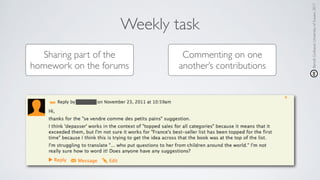
Weekly task
Sharing part of the
homework on the forums
Commenting on one
another’s contributions
BenoîtGuilbaud,UniversityofSussex,2017
The study
Collect student feedback on use of discussion forums for peer-feedback
Measure student engagement with discussion forums
Evaluate impact on performance (contributions / marks)
Evaluate quality of interactions on the forums
BenoîtGuilbaud,UniversityofSussex,2017
Methodology
3 feedback questionnaires assessing
expectations & satisfaction
pre / mid / post-study
quantitative + open questions
Section(2(–(Social(networking(sites(7(for!all!purposes!other!than!translation
2a.$Are$you$a$member$of$one$or$more$social$networking$sites$(Facebook,$Twitter,$Google+,$etc.)?$Which$one(s)?
_________________________________________________________________________________________________________________________________
_________________________________________________________________________________________________________________________________
_________________________________________________________________________________________________________________________________
_________________________________________________________________________________________________________________________________
2b.$If$you$answered$‘yes’$in$2a,$please$place$one$tick$per$line$in$the$following$table:
When using social
networking sites (not
for translation
purposes)
Never Rarely Sometimes Often
Very
often
Always
Not
applicable /
don’t know
I log in to my existing
member account.
I read other
members’
contributions and
existing discussions.
I post contributions
in response to other
members’ activity.
I engage in longer
discussions (more
than 2 posts) with
other members.
When another
member has a
question, I try and
answer it.
Using$social$media$in$an$undergraduate$translation$class$–$a$case$study
Preliminary$questionnaire$X$Benoît$Guilbaud$X$2011
Page 4 of 5
BenoîtGuilbaud,UniversityofSussex,2017
Methodology
Collection and analysis of
contributions to OADs (Online
Asynchronous Discussions) using
Murphy’s collaboration model (2004)
BenoîtGuilbaud,UniversityofSussex,2017
Findings
BenoîtGuilbaud,UniversityofSussex,2017
Feedback
BenoîtGuilbaud,UniversityofSussex,2017
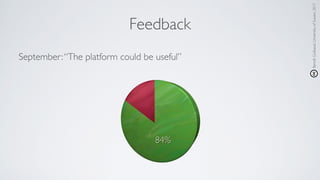
Feedback
September:“The platform could be useful”
BenoîtGuilbaud,UniversityofSussex,2017
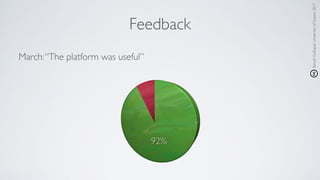
Feedback
March:“The platform was useful”
BenoîtGuilbaud,UniversityofSussex,2017
“I think it works really well and is easy to access.”
“Working really well - maybe we could
have a similar thing on other modules.”
“It would be useful to have it for other courses.”
“Very useful.”
Feedback
BenoîtGuilbaud,UniversityofSussex,2017
“Not enough students use it for it to be
wholly effective. I think most students just
rely on the contributions of others.”
“It is just down to ourselves to make more of
an effort this term, which I will attempt to do.”
Feedback
“Very useful. No improvements needed.”
BenoîtGuilbaud,UniversityofSussex,2017
Feedback from students who did not find the platform useful
“Make it more easily accessible - link on [VLE]?”
“I have tried to log in a few times but it won’t
work so I gave up out of frustration!”
“No one really uses it so it’s not very useful.
Maybe if you integrate it into the lesson.”
BenoîtGuilbaud,UniversityofSussex,2017
Engagement
BenoîtGuilbaud,UniversityofSussex,2017
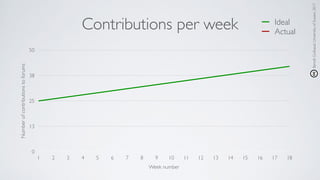
Contributions per weekNumberofcontributionstoforums
0
13
25
38
50
Week number
1 2 3 4 5 6 7 8 9 10 11 12 13 14 15 16 17 18
Ideal
Actual
BenoîtGuilbaud,UniversityofSussex,2017
Contributions per weekNumberofcontributionstoforums
0
13
25
38
50
Week number
1 2 3 4 5 6 7 8 9 10 11 12 13 14 15 16 17 18
Ideal
Actual
BenoîtGuilbaud,UniversityofSussex,2017
Impact of (non)assessment
BenoîtGuilbaud,UniversityofSussex,2017
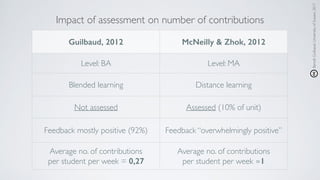
Impact of assessment on number of contributions
Guilbaud, 2012 McNeilly & Zhok, 2012
Level: BA Level: MA
Blended learning Distance learning
Not assessed Assessed (10% of unit)
Feedback mostly positive (92%) Feedback “overwhelmingly positive”
Average no. of contributions
per student per week = 0,27
Average no. of contributions
per student per week ≃1
BenoîtGuilbaud,UniversityofSussex,2017
Impact on student marks
BenoîtGuilbaud,UniversityofSussex,2017
Averagemark(in%)
30
40
50
60
70
80
Total number of contributions to forums
0 15 30 45 60
Number of contributions to OADs vs average mark
BenoîtGuilbaud,UniversityofSussex,2017
Averagemark(in%)
30
40
50
60
70
80
Total number of contributions to forums
0 15 30 45 60
Number of contributions to OADs vs average mark
BenoîtGuilbaud,UniversityofSussex,2017
Analysis of contributions
BenoîtGuilbaud,UniversityofSussex,2017
Murphy’s collaboration model
(2004)
BenoîtGuilbaud,UniversityofSussex,2017
Murphy’s collaboration model (2004)
A Producing shared artefacts
B Building shared goals and purposes
C Co-constructing shared perspectives and meanings
P Accommodating or reflecting the perspectives of others
I Articulating individual perspectives
S Social presence
Collaboration
BenoîtGuilbaud,UniversityofSussex,2017
A Producing shared artefacts
B Building shared goals and purposes
C Co-constructing shared perspectives and meanings
P Accommodating or reflecting the perspectives of others
I Articulating individual perspectives
S Social presence
Collaboration
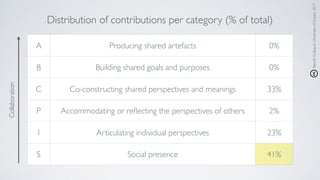
Distribution of contributions per category (% of total)
BenoîtGuilbaud,UniversityofSussex,2017
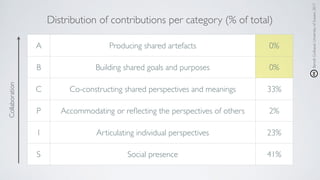
Distribution of contributions per category (% of total)
A Producing shared artefacts 0%
B Building shared goals and purposes 0%
C Co-constructing shared perspectives and meanings 33%
P Accommodating or reflecting the perspectives of others 2%
I Articulating individual perspectives 23%
S Social presence 41%
Collaboration
BenoîtGuilbaud,UniversityofSussex,2017
Distribution of contributions per category (% of total)
A Producing shared artefacts 0%
B Building shared goals and purposes 0%
C Co-constructing shared perspectives and meanings 33%
P Accommodating or reflecting the perspectives of others 2%
I Articulating individual perspectives 23%
S Social presence 41%
Collaboration
BenoîtGuilbaud,UniversityofSussex,2017
Distribution of contributions per category (% of total)
A Producing shared artefacts 0%
B Building shared goals and purposes 0%
C Co-constructing shared perspectives and meanings 33%
P Accommodating or reflecting the perspectives of others 2%
I Articulating individual perspectives 23%
S Social presence 41%
Collaboration
BenoîtGuilbaud,UniversityofSussex,2017
A Producing shared artefacts 0%
B Building shared goals and purposes 0%
C Co-constructing shared perspectives and meanings 33%
P Accommodating or reflecting the perspectives of others 2%
I Articulating individual perspectives 23%
S Social presence 41%
Collaboration
Distribution of contributions per category (% of total)
BenoîtGuilbaud,UniversityofSussex,2017
Articulating individual perspectives (I)
A
Summarising or reporting on content without reference to
the perspectives of others (S)
5%B
C
P
Statement of personal opinion or beliefs making no reference
to perspectives of others (O)
18%I
S
BenoîtGuilbaud,UniversityofSussex,2017
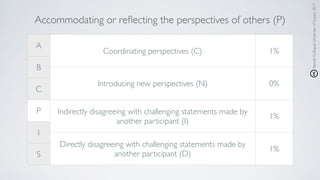
Accommodating or reflecting the perspectives of others (P)
A
Coordinating perspectives (C) 1%
B
Introducing new perspectives (N) 0%
C
P Indirectly disagreeing with challenging statements made by
another participant (I)
1%
I
Directly disagreeing with challenging statements made by
another participant (D)
1%
S
BenoîtGuilbaud,UniversityofSussex,2017
Co-constructing shared perspectives and meanings (C)
A Sharing advice (S) 0%
Responding to questions (R) 11%B
Provoking thought and discussion (P) 0%C
P Soliciting feedback (F) 9%
Posing rhetorical questions (Q) 0%
I
Asking for clarification/ elaboration (A) 10%
S Sharing information and resources (I) 4%
BenoîtGuilbaud,UniversityofSussex,2017
Co-constructing shared perspectives and meanings (C)
A Sharing advice (S) 0%
Responding to questions (R) 11%B
Provoking thought and discussion (P) 0%C
P Soliciting feedback (F) 9%
Posing rhetorical questions (Q) 0%
I
Asking for clarification/ elaboration (A) 10%
S Sharing information and resources (I) 4%
BenoîtGuilbaud,UniversityofSussex,2017
Co-constructing shared perspectives and meanings (C)
A Sharing advice (S) 0%
Responding to questions (R) 11%B
Provoking thought and discussion (P) 0%C
P Soliciting feedback (F) 9%
Posing rhetorical questions (Q) 0%
I
Asking for clarification/ elaboration (A) 10%
S Sharing information and resources (I) 4%
BenoîtGuilbaud,UniversityofSussex,2017
Co-constructing shared perspectives and meanings (C)
A Sharing advice (S) 0%
Responding to questions (R) 11%B
Provoking thought and discussion (P) 0%C
P Soliciting feedback (F) 9%
Posing rhetorical questions (Q) 0%
I
Asking for clarification/ elaboration (A) 10%
S Sharing information and resources (I) 4%
BenoîtGuilbaud,UniversityofSussex,2017
Picture by HckySo via flickr.com
Identified issues
Identified issues
Lack of a common goal
Little acknowledgement of perspectives of others
Near-absence of disagreements
50% of questions left unanswered
Near-absence of source referencing & sharing
BenoîtGuilbaud,UniversityofSussex,2017
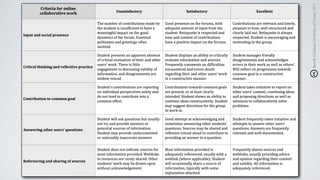
Suggested criteria for evaluating

online collaboration
BenoîtGuilbaud,UniversityofSussex,2017
!Work in progress
BenoîtGuilbaud,UniversityofSussex,2017
Input and social presence
Critical thinking and reflective practice
Contribution to common goal
Answering other users’ questions
Referencing and sharing of sources
Little acknowledgement of perspectives of others
Near-absence of disagreements
Lack of a common goal
50% of questions left unanswered
Near-absence of source referencing & sharing
Conclusions
BenoîtGuilbaud,UniversityofSussex,2017
BenoîtGuilbaud,ManchesterMetropolitanUniversity(UK),2012
Picture by ryancr via flickr.com
Sharing
Foster a culture of participation within the group
Promote sharing resources & crediting sources
© Rovio 2012
Encourage challenging perspectives & reward initiative
State goals to be attained as a group rather than individually
Motivation
Correlation between contribution and performance difficult to establish
Impact of non-assessment on student engagement
Limitations
Students’ technical ability not to be overestimated
Picture by marc falardeau via flickr.com
Extend use of OADs to promote open learning
and beyond...
Promote participation
Train critically-competent and digitally-literate learners
BenoîtGuilbaud,UniversityofSussex,2017
Belshaw, D., 2011. What is digital literacy? A Pragmatic investigation. Doctoral thesis, Durham University.Available at http://
neverendingthesis.com and http://etheses.dur.ac.uk/cgi/latest [accessed 28th March 2012].
Couros,A., 2011.Why networked learning matters. Education in a Changing Environment (ECE) 6th International Conference,
Creativity and Engagement in Higher Education, 6-8 July 2011, University of Salford, Greater Manchester, UK.
McNeilly, E. & Zhok,A., 2012.The Online Discussion Board forTranslation - An Undergraduate MFL Perspective for the
Study of Italian and Russian. In: LLAS: 7th e-learning symposium. University of Southampton, 26-27 January 2012.
Mott, John., 2011. The End In Mind. www.jonmott.com [blog].
Murphy, E., 2004. Recognising and promoting collaboration in an online asynchronous discussion. In: British Journal of
Educational Technology, 35(4) pp.421–431.
O’Reilly,T., 2005. Web 2.0. Exteme Interfaces,TTIVanguard. Geneva, Switzerland 16 September 2005.
Vygotsky, L.S., 1978. Mind in society:The development of higher mental processes. Cambridge, MA: Harvard University Press.
Wheeler, S.,Yeomans, P. and Wheeler, D., 2008.The Good, the Bad and the Wiki: Evaluating Student Generated Content as
a Collaborative LearningTool. In: British Journal of Educational Technology, 39(6), pp.987-995.
Wheeler, S., 2012. Digital Pedagogy: Content is aTyrant, Context is King. In: NAACE 2012 Annual Conference, 9 March 2012,
Leicester, United Kingdom.
BenoîtGuilbaud,UniversityofSussex,2017
Any questions or comments?
BenoîtGuilbaud,UniversityofSussex,2017
Group activity
BenoîtGuilbaud,UniversityofSussex,2017
Group activity 1 (see handout)
In your groups, discuss the following questions and statements:
1. How important is student collaboration and why?
2. In which ways do you currently promote collaboration in your class?
3. Would you use/adapt the proposed model? If so, how?
4. Do you, or do you intend to you assess collaboration? If so, would you
use a setup such as the proposed one? How else would you do it?
BenoîtGuilbaud,UniversityofSussex,2017
Bring your own vocabulary
BenoîtGuilbaud,UniversityofSussex,2017
Case study #2
Sydney Uni CC BY-NC-SA 2.0
Oh là là !
BenoîtGuilbaud,UniversityofSussex,2017
Context
Language for Specific Purposes: medical French - prevalence of lexicon
Y1&2 MBChB undergraduates / two academic years / 71 B2 students
Attempt to increase student engagement, motivation and collaboration
Draw on students’ specialist knowledge and clinical placement experience
BenoîtGuilbaud,UniversityofSussex,2017
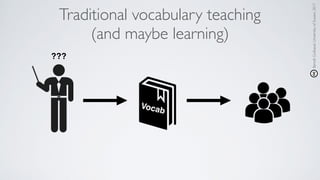
Traditional vocabulary teaching
(and maybe learning)
Vocab
???
BenoîtGuilbaud,UniversityofSussex,2017
Traditional vocabulary teaching
(and maybe learning)
Z Z Z
???
Vocab
BenoîtGuilbaud,UniversityofSussex,2017
Better vocabulary learning
Vocab
BenoîtGuilbaud,UniversityofSussex,2017
Better vocabulary learning
Vocab
+++
Vocab
BenoîtGuilbaud,UniversityofSussex,2017
What’s in it for…
•Increasing breadth of vocabulary easily
and systematically
•Active participants in their learning
process
•Collaboratively involved in content
design
•Engage with outward-facing learning &
OER production
•Reduces need for specialist
knowledge
•Keeps students engaged
outside of contact hours
•Increases class motivation
•Saves time
Students Staff
BenoîtGuilbaud,UniversityofSussex,2017
How?
BenoîtGuilbaud,UniversityofSussex,2017
GOOGLE DRIVE QUIZLET
+
BenoîtGuilbaud,UniversityofSussex,2017
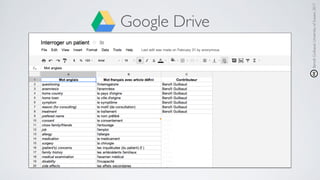
Google Drive
• Template list created by tutor for
each topic/fortnight
• Each student adds 5 words and
their translations
• Content is checked, curated and
completed by tutor
• Final list imported into web 2.0
vocab app Quizlet
• Students learn/revise list for
formative test the following week
• Summative vocab test in final
exam
Quizlet
BenoîtGuilbaud,UniversityofSussex,2017
Google Drive
BenoîtGuilbaud,UniversityofSussex,2017
QUIZLET
BenoîtGuilbaud,UniversityofSussex,2017
QUIZLET
IOS ANDROID WINDOWS PHONEWEB
BenoîtGuilbaud,UniversityofSussex,2017
The study
BenoîtGuilbaud,UniversityofSussex,2017
The study
•End-of-semester questionnaire
•53 open and closed questions
•44% respondents
18/06/2013 11:19Survey Results
Page 1 of 14https://selectsurveys.humanities.manchester.ac.uk/PrintOverview.aspx?SurveyID=9lK34l83
1. Please enter your full name (Optional) (NB: all survey results will be anonymised entirely)
Total Respondents 14
(skipped this question) 15
2. Which of the following units were you enrolled on in 2012-13?
Response
Total
Response
Percent
Points Avg
Medical French level 1 7 35% n/a n/a
Medical French level 2 9 45% n/a n/a
Business French
"further" level
4 20% n/a n/a
Total Respondents 20 100%
(skipped this question) 9
3. "I understand that my answers may be used and quoted anonymouly for the purpose of the present research study." Click here
to read more.
Response
Total
Response
Percent
Points Avg
Yes 20 100% n/a n/a
Total Respondents 20
(skipped this question) 9
4. From which devices did you usually access Quizlet? Tick all answers that apply.
Response
Total
Response
Percent
Points Avg
University PC 9 53% n/a n/a
Personal
computer
(including
laptop)
17 100% n/a n/a
Smartphone 5 29% n/a n/a
Tablet 0 0% n/a n/a
Printed lists 1 6% n/a n/a
Other, please
specify
0 0% n/a n/a
Total Respondents 17
(skipped this question) 12
5. From which device did you access Quizlet the most?
Response
Total
Response
Percent
Points Avg
University PC 1 6% n/a n/a
Personal computer
(including laptop)
14 82% n/a n/a
Smartphone 2 12% n/a n/a
Tablet 0 0% n/a n/a
Printed lists 0 0% n/a n/a
Other (as specified
above)
0 0% n/a n/a
Total Respondents 17 100%
(skipped this question) 12
Quizlet survey 2013
Respondents: 29 displayed, 29 total Status: Closed
Launched Date: 05/06/2013 Closed Date: 16/06/2013
BenoîtGuilbaud,UniversityofSussex,2017
Findings
BenoîtGuilbaud,UniversityofSussex,2017
Vocabulary learning
BenoîtGuilbaud,UniversityofSussex,2017
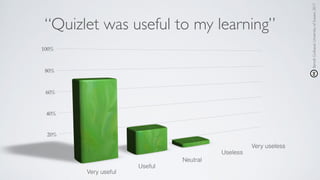
“Quizlet was useful to my learning”
Very useful
Useful
Neutral
Useless
Very useless
BenoîtGuilbaud,UniversityofSussex,2017
“I found that quizlet motivated me
to revise vocabulary”
Strongly agree
Agree
Neutral
Disagree
Strongly disagree
BenoîtGuilbaud,UniversityofSussex,2017
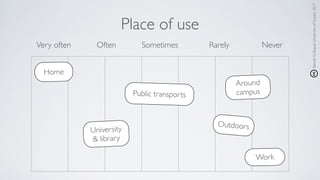
Place of use
Very often Often Sometimes Rarely Never
Public transports
Home
University
& library
Outdoors
Work
Around
campus
BenoîtGuilbaud,UniversityofSussex,2017
Length of revision session
AVERAGE MAX
40 mins 100 mins
BenoîtGuilbaud,UniversityofSussex,2017
Class-generated vocabulary lists
BenoîtGuilbaud,UniversityofSussex,2017
“Collaboratively creating vocabulary lists
is a good way to encourage student engagement”
Strongly agree Agree Neutral Disagree Strongly disagree
BenoîtGuilbaud,UniversityofSussex,2017
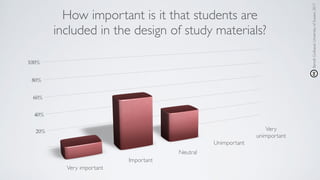
How important is it that students are
included in the design of study materials?
Very important
Important
Neutral
Unimportant
Very
unimportant
BenoîtGuilbaud,UniversityofSussex,2017
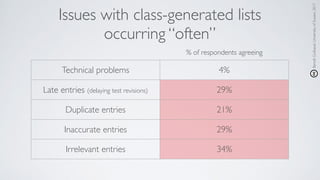
Issues with class-generated lists
occurring “often”
Technical problems 4%
Late entries (delaying test revisions) 29%
Duplicate entries 21%
Inaccurate entries 29%
Irrelevant entries 34%
% of respondents agreeing
BenoîtGuilbaud,UniversityofSussex,2017
Issues with class-generated lists
occurring “often”
Technical problems 4%
Late entries (delaying test revisions) 29%
Duplicate entries 21%
Inaccurate entries 29%
Irrelevant entries 34%
% of respondents agreeing
BenoîtGuilbaud,UniversityofSussex,2017
Conclusions
BenoîtGuilbaud,UniversityofSussex,2017
Conclusions
•Experience very positive overall
•High level of student engagement and satisfaction
•Several positive comments in unit satisfaction survey
•Summative test results show very effective learning
•System works best for individual words and short phrases
•Importance of thorough curation of contents by tutor
BenoîtGuilbaud,UniversityofSussex,2017
Comments
•“Provided there is appropriate oversight this is a fantastic resource.”
•“I will definitely continue to use Quizlet in the future. I have also started
using it to help me learn other areas of my medicine degree.”
•“Quizlet has revolutionised the way I learn vocabulary.”
BenoîtGuilbaud,UniversityofSussex,2017
References
• Casserly, C.M., Smith, MS.S, 2008. Revolutionizing education through innovation: Can openness transform
teaching and learning? In: Iiyoshi, T. & Kumar V. (eds), 2008. The collective advancement of Eduction through
Open Technology, Open Content and Open Knowledge. Cambridge, Mass, MIT Press.
• Couros, A., 2011. Why networked learning matters. Education in a Changing Environment (ECE) 6th International
Conference, Creativity and Engagement in Higher Education, 6-8 July 2011, University of Salford, Greater
Manchester, UK.
• Craig, D.V., 2011. Encouraging Participatory Culture and Language Learning: Assisting ELLs in Becoming Part of
the Digital Youth. In: TNTESOL Journal, 4(1) pp. 84-93.
• Kop, R., Hill, A., 2008. Connectivism: Learning theory of the future or vestige of the past? In: International Review
of Research in Open and Distance Learning, 9(3) [Online]. Accessible at: http://www.irrodl.org/index.php/irrodl/
article/viewArticle/523 [accessed 27th June 2013].
• Martin, A., Madigan, D. (eds), 2006. Digital Literacies for Learning. London: Facet publishing.
• Nation, I.S.P., 2001. Learning Vocabulary in Another Language. Cambridge: Cambridge University Press.
Cambridge Applied Linguistics.
• Siemens, G., 2005. Connectivism: A Learning Theory for the Digital Age. In: International journal instructional
technology and distance learning, 2(1) [Online]. Accessible at: http://itdl.org/journal/jan_05/index.htm [accessed
27th June 2013].
Group activity
BenoîtGuilbaud,UniversityofSussex,2017
Group activity 2 (see handout)
In your groups, discuss the following questions and statements:
1. What is the place of vocabulary learning in LSP?
2. Can you cite examples of integration of mobile learning in language teaching?
Have you used it yourself?
3. Can you think of ways to expand or improve on the proposed setup?
4. Can you suggest different ways of encouraging the creation of student-
generated materials?
BenoîtGuilbaud,UniversityofSussex,2017
Thank you very much
Benoît Guilbaud
b.guilbaud@sussex.ac.uk
@benguilbaud
BenoîtGuilbaud,UniversityofSussex,2017

Teaching practice in LSP and beyond

  • 1.
    Teaching practice inLSP and beyond Benoît Guilbaud b.guilbaud@sussex.ac.uk @benguilbaud BenoîtGuilbaud,UniversityofSussex,2017 Discussions around two case-studies
  • 2.
    Making discussion forumswork BenoîtGuilbaud,UniversityofSussex,2017 Case study #1
  • 3.
    Context 25 final year undergraduates(C1) English ⇢ French translation (L1 ⇢ L2) September 2011 - March 2012 Weekly contributions to discussion forums 18 texts 18 weeks 1 hour / week contact time BenoîtGuilbaud,UniversityofSussex,2017
  • 4.
    Weekly task Sharing partof the homework on the forums Commenting on one another’s contributions BenoîtGuilbaud,UniversityofSussex,2017
  • 5.
    The study Collect studentfeedback on use of discussion forums for peer-feedback Measure student engagement with discussion forums Evaluate impact on performance (contributions / marks) Evaluate quality of interactions on the forums BenoîtGuilbaud,UniversityofSussex,2017
  • 6.
    Methodology 3 feedback questionnairesassessing expectations & satisfaction pre / mid / post-study quantitative + open questions Section(2(–(Social(networking(sites(7(for!all!purposes!other!than!translation 2a.$Are$you$a$member$of$one$or$more$social$networking$sites$(Facebook,$Twitter,$Google+,$etc.)?$Which$one(s)? _________________________________________________________________________________________________________________________________ _________________________________________________________________________________________________________________________________ _________________________________________________________________________________________________________________________________ _________________________________________________________________________________________________________________________________ 2b.$If$you$answered$‘yes’$in$2a,$please$place$one$tick$per$line$in$the$following$table: When using social networking sites (not for translation purposes) Never Rarely Sometimes Often Very often Always Not applicable / don’t know I log in to my existing member account. I read other members’ contributions and existing discussions. I post contributions in response to other members’ activity. I engage in longer discussions (more than 2 posts) with other members. When another member has a question, I try and answer it. Using$social$media$in$an$undergraduate$translation$class$–$a$case$study Preliminary$questionnaire$X$Benoît$Guilbaud$X$2011 Page 4 of 5 BenoîtGuilbaud,UniversityofSussex,2017
  • 7.
    Methodology Collection and analysisof contributions to OADs (Online Asynchronous Discussions) using Murphy’s collaboration model (2004) BenoîtGuilbaud,UniversityofSussex,2017
  • 8.
  • 9.
  • 10.
    Feedback September:“The platform couldbe useful” BenoîtGuilbaud,UniversityofSussex,2017
  • 11.
    Feedback March:“The platform wasuseful” BenoîtGuilbaud,UniversityofSussex,2017
  • 12.
    “I think itworks really well and is easy to access.” “Working really well - maybe we could have a similar thing on other modules.” “It would be useful to have it for other courses.” “Very useful.” Feedback BenoîtGuilbaud,UniversityofSussex,2017
  • 13.
    “Not enough studentsuse it for it to be wholly effective. I think most students just rely on the contributions of others.” “It is just down to ourselves to make more of an effort this term, which I will attempt to do.” Feedback “Very useful. No improvements needed.” BenoîtGuilbaud,UniversityofSussex,2017
  • 14.
    Feedback from studentswho did not find the platform useful “Make it more easily accessible - link on [VLE]?” “I have tried to log in a few times but it won’t work so I gave up out of frustration!” “No one really uses it so it’s not very useful. Maybe if you integrate it into the lesson.” BenoîtGuilbaud,UniversityofSussex,2017
  • 15.
  • 16.
    Contributions per weekNumberofcontributionstoforums 0 13 25 38 50 Weeknumber 1 2 3 4 5 6 7 8 9 10 11 12 13 14 15 16 17 18 Ideal Actual BenoîtGuilbaud,UniversityofSussex,2017
  • 17.
    Contributions per weekNumberofcontributionstoforums 0 13 25 38 50 Weeknumber 1 2 3 4 5 6 7 8 9 10 11 12 13 14 15 16 17 18 Ideal Actual BenoîtGuilbaud,UniversityofSussex,2017
  • 18.
  • 19.
    Impact of assessmenton number of contributions Guilbaud, 2012 McNeilly & Zhok, 2012 Level: BA Level: MA Blended learning Distance learning Not assessed Assessed (10% of unit) Feedback mostly positive (92%) Feedback “overwhelmingly positive” Average no. of contributions per student per week = 0,27 Average no. of contributions per student per week ≃1 BenoîtGuilbaud,UniversityofSussex,2017
  • 20.
    Impact on studentmarks BenoîtGuilbaud,UniversityofSussex,2017
  • 21.
    Averagemark(in%) 30 40 50 60 70 80 Total number ofcontributions to forums 0 15 30 45 60 Number of contributions to OADs vs average mark BenoîtGuilbaud,UniversityofSussex,2017
  • 22.
    Averagemark(in%) 30 40 50 60 70 80 Total number ofcontributions to forums 0 15 30 45 60 Number of contributions to OADs vs average mark BenoîtGuilbaud,UniversityofSussex,2017
  • 23.
  • 24.
  • 25.
    Murphy’s collaboration model(2004) A Producing shared artefacts B Building shared goals and purposes C Co-constructing shared perspectives and meanings P Accommodating or reflecting the perspectives of others I Articulating individual perspectives S Social presence Collaboration BenoîtGuilbaud,UniversityofSussex,2017
  • 26.
    A Producing sharedartefacts B Building shared goals and purposes C Co-constructing shared perspectives and meanings P Accommodating or reflecting the perspectives of others I Articulating individual perspectives S Social presence Collaboration Distribution of contributions per category (% of total) BenoîtGuilbaud,UniversityofSussex,2017
  • 27.
    Distribution of contributionsper category (% of total) A Producing shared artefacts 0% B Building shared goals and purposes 0% C Co-constructing shared perspectives and meanings 33% P Accommodating or reflecting the perspectives of others 2% I Articulating individual perspectives 23% S Social presence 41% Collaboration BenoîtGuilbaud,UniversityofSussex,2017
  • 28.
    Distribution of contributionsper category (% of total) A Producing shared artefacts 0% B Building shared goals and purposes 0% C Co-constructing shared perspectives and meanings 33% P Accommodating or reflecting the perspectives of others 2% I Articulating individual perspectives 23% S Social presence 41% Collaboration BenoîtGuilbaud,UniversityofSussex,2017
  • 29.
    Distribution of contributionsper category (% of total) A Producing shared artefacts 0% B Building shared goals and purposes 0% C Co-constructing shared perspectives and meanings 33% P Accommodating or reflecting the perspectives of others 2% I Articulating individual perspectives 23% S Social presence 41% Collaboration BenoîtGuilbaud,UniversityofSussex,2017
  • 30.
    A Producing sharedartefacts 0% B Building shared goals and purposes 0% C Co-constructing shared perspectives and meanings 33% P Accommodating or reflecting the perspectives of others 2% I Articulating individual perspectives 23% S Social presence 41% Collaboration Distribution of contributions per category (% of total) BenoîtGuilbaud,UniversityofSussex,2017
  • 31.
    Articulating individual perspectives(I) A Summarising or reporting on content without reference to the perspectives of others (S) 5%B C P Statement of personal opinion or beliefs making no reference to perspectives of others (O) 18%I S BenoîtGuilbaud,UniversityofSussex,2017
  • 32.
    Accommodating or reflectingthe perspectives of others (P) A Coordinating perspectives (C) 1% B Introducing new perspectives (N) 0% C P Indirectly disagreeing with challenging statements made by another participant (I) 1% I Directly disagreeing with challenging statements made by another participant (D) 1% S BenoîtGuilbaud,UniversityofSussex,2017
  • 33.
    Co-constructing shared perspectivesand meanings (C) A Sharing advice (S) 0% Responding to questions (R) 11%B Provoking thought and discussion (P) 0%C P Soliciting feedback (F) 9% Posing rhetorical questions (Q) 0% I Asking for clarification/ elaboration (A) 10% S Sharing information and resources (I) 4% BenoîtGuilbaud,UniversityofSussex,2017
  • 34.
    Co-constructing shared perspectivesand meanings (C) A Sharing advice (S) 0% Responding to questions (R) 11%B Provoking thought and discussion (P) 0%C P Soliciting feedback (F) 9% Posing rhetorical questions (Q) 0% I Asking for clarification/ elaboration (A) 10% S Sharing information and resources (I) 4% BenoîtGuilbaud,UniversityofSussex,2017
  • 35.
    Co-constructing shared perspectivesand meanings (C) A Sharing advice (S) 0% Responding to questions (R) 11%B Provoking thought and discussion (P) 0%C P Soliciting feedback (F) 9% Posing rhetorical questions (Q) 0% I Asking for clarification/ elaboration (A) 10% S Sharing information and resources (I) 4% BenoîtGuilbaud,UniversityofSussex,2017
  • 36.
    Co-constructing shared perspectivesand meanings (C) A Sharing advice (S) 0% Responding to questions (R) 11%B Provoking thought and discussion (P) 0%C P Soliciting feedback (F) 9% Posing rhetorical questions (Q) 0% I Asking for clarification/ elaboration (A) 10% S Sharing information and resources (I) 4% BenoîtGuilbaud,UniversityofSussex,2017
  • 37.
    Picture by HckySovia flickr.com Identified issues
  • 38.
    Identified issues Lack ofa common goal Little acknowledgement of perspectives of others Near-absence of disagreements 50% of questions left unanswered Near-absence of source referencing & sharing BenoîtGuilbaud,UniversityofSussex,2017
  • 39.
    Suggested criteria forevaluating
 online collaboration BenoîtGuilbaud,UniversityofSussex,2017 !Work in progress
  • 40.
  • 41.
  • 42.
    BenoîtGuilbaud,UniversityofSussex,2017 Input and socialpresence Critical thinking and reflective practice Contribution to common goal Answering other users’ questions Referencing and sharing of sources Little acknowledgement of perspectives of others Near-absence of disagreements Lack of a common goal 50% of questions left unanswered Near-absence of source referencing & sharing
  • 43.
  • 44.
    BenoîtGuilbaud,ManchesterMetropolitanUniversity(UK),2012 Picture by ryancrvia flickr.com Sharing Foster a culture of participation within the group Promote sharing resources & crediting sources
  • 45.
    © Rovio 2012 Encouragechallenging perspectives & reward initiative State goals to be attained as a group rather than individually Motivation
  • 46.
    Correlation between contributionand performance difficult to establish Impact of non-assessment on student engagement Limitations Students’ technical ability not to be overestimated Picture by marc falardeau via flickr.com
  • 47.
    Extend use ofOADs to promote open learning and beyond... Promote participation Train critically-competent and digitally-literate learners BenoîtGuilbaud,UniversityofSussex,2017
  • 48.
    Belshaw, D., 2011.What is digital literacy? A Pragmatic investigation. Doctoral thesis, Durham University.Available at http:// neverendingthesis.com and http://etheses.dur.ac.uk/cgi/latest [accessed 28th March 2012]. Couros,A., 2011.Why networked learning matters. Education in a Changing Environment (ECE) 6th International Conference, Creativity and Engagement in Higher Education, 6-8 July 2011, University of Salford, Greater Manchester, UK. McNeilly, E. & Zhok,A., 2012.The Online Discussion Board forTranslation - An Undergraduate MFL Perspective for the Study of Italian and Russian. In: LLAS: 7th e-learning symposium. University of Southampton, 26-27 January 2012. Mott, John., 2011. The End In Mind. www.jonmott.com [blog]. Murphy, E., 2004. Recognising and promoting collaboration in an online asynchronous discussion. In: British Journal of Educational Technology, 35(4) pp.421–431. O’Reilly,T., 2005. Web 2.0. Exteme Interfaces,TTIVanguard. Geneva, Switzerland 16 September 2005. Vygotsky, L.S., 1978. Mind in society:The development of higher mental processes. Cambridge, MA: Harvard University Press. Wheeler, S.,Yeomans, P. and Wheeler, D., 2008.The Good, the Bad and the Wiki: Evaluating Student Generated Content as a Collaborative LearningTool. In: British Journal of Educational Technology, 39(6), pp.987-995. Wheeler, S., 2012. Digital Pedagogy: Content is aTyrant, Context is King. In: NAACE 2012 Annual Conference, 9 March 2012, Leicester, United Kingdom. BenoîtGuilbaud,UniversityofSussex,2017
  • 49.
    Any questions orcomments? BenoîtGuilbaud,UniversityofSussex,2017
  • 50.
  • 51.
    Group activity 1(see handout) In your groups, discuss the following questions and statements: 1. How important is student collaboration and why? 2. In which ways do you currently promote collaboration in your class? 3. Would you use/adapt the proposed model? If so, how? 4. Do you, or do you intend to you assess collaboration? If so, would you use a setup such as the proposed one? How else would you do it? BenoîtGuilbaud,UniversityofSussex,2017
  • 52.
    Bring your ownvocabulary BenoîtGuilbaud,UniversityofSussex,2017 Case study #2
  • 53.
    Sydney Uni CCBY-NC-SA 2.0 Oh là là !
  • 54.
    BenoîtGuilbaud,UniversityofSussex,2017 Context Language for SpecificPurposes: medical French - prevalence of lexicon Y1&2 MBChB undergraduates / two academic years / 71 B2 students Attempt to increase student engagement, motivation and collaboration Draw on students’ specialist knowledge and clinical placement experience
  • 55.
  • 56.
  • 57.
  • 58.
  • 59.
    BenoîtGuilbaud,UniversityofSussex,2017 What’s in itfor… •Increasing breadth of vocabulary easily and systematically •Active participants in their learning process •Collaboratively involved in content design •Engage with outward-facing learning & OER production •Reduces need for specialist knowledge •Keeps students engaged outside of contact hours •Increases class motivation •Saves time Students Staff
  • 60.
  • 61.
  • 62.
    BenoîtGuilbaud,UniversityofSussex,2017 Google Drive • Templatelist created by tutor for each topic/fortnight • Each student adds 5 words and their translations • Content is checked, curated and completed by tutor • Final list imported into web 2.0 vocab app Quizlet • Students learn/revise list for formative test the following week • Summative vocab test in final exam Quizlet
  • 63.
  • 64.
  • 70.
  • 71.
  • 72.
    BenoîtGuilbaud,UniversityofSussex,2017 The study •End-of-semester questionnaire •53open and closed questions •44% respondents 18/06/2013 11:19Survey Results Page 1 of 14https://selectsurveys.humanities.manchester.ac.uk/PrintOverview.aspx?SurveyID=9lK34l83 1. Please enter your full name (Optional) (NB: all survey results will be anonymised entirely) Total Respondents 14 (skipped this question) 15 2. Which of the following units were you enrolled on in 2012-13? Response Total Response Percent Points Avg Medical French level 1 7 35% n/a n/a Medical French level 2 9 45% n/a n/a Business French "further" level 4 20% n/a n/a Total Respondents 20 100% (skipped this question) 9 3. "I understand that my answers may be used and quoted anonymouly for the purpose of the present research study." Click here to read more. Response Total Response Percent Points Avg Yes 20 100% n/a n/a Total Respondents 20 (skipped this question) 9 4. From which devices did you usually access Quizlet? Tick all answers that apply. Response Total Response Percent Points Avg University PC 9 53% n/a n/a Personal computer (including laptop) 17 100% n/a n/a Smartphone 5 29% n/a n/a Tablet 0 0% n/a n/a Printed lists 1 6% n/a n/a Other, please specify 0 0% n/a n/a Total Respondents 17 (skipped this question) 12 5. From which device did you access Quizlet the most? Response Total Response Percent Points Avg University PC 1 6% n/a n/a Personal computer (including laptop) 14 82% n/a n/a Smartphone 2 12% n/a n/a Tablet 0 0% n/a n/a Printed lists 0 0% n/a n/a Other (as specified above) 0 0% n/a n/a Total Respondents 17 100% (skipped this question) 12 Quizlet survey 2013 Respondents: 29 displayed, 29 total Status: Closed Launched Date: 05/06/2013 Closed Date: 16/06/2013
  • 73.
  • 74.
  • 75.
    BenoîtGuilbaud,UniversityofSussex,2017 “Quizlet was usefulto my learning” Very useful Useful Neutral Useless Very useless
  • 76.
    BenoîtGuilbaud,UniversityofSussex,2017 “I found thatquizlet motivated me to revise vocabulary” Strongly agree Agree Neutral Disagree Strongly disagree
  • 77.
    BenoîtGuilbaud,UniversityofSussex,2017 Place of use Veryoften Often Sometimes Rarely Never Public transports Home University & library Outdoors Work Around campus
  • 78.
  • 79.
  • 80.
    BenoîtGuilbaud,UniversityofSussex,2017 “Collaboratively creating vocabularylists is a good way to encourage student engagement” Strongly agree Agree Neutral Disagree Strongly disagree
  • 81.
    BenoîtGuilbaud,UniversityofSussex,2017 How important isit that students are included in the design of study materials? Very important Important Neutral Unimportant Very unimportant
  • 82.
    BenoîtGuilbaud,UniversityofSussex,2017 Issues with class-generatedlists occurring “often” Technical problems 4% Late entries (delaying test revisions) 29% Duplicate entries 21% Inaccurate entries 29% Irrelevant entries 34% % of respondents agreeing
  • 83.
    BenoîtGuilbaud,UniversityofSussex,2017 Issues with class-generatedlists occurring “often” Technical problems 4% Late entries (delaying test revisions) 29% Duplicate entries 21% Inaccurate entries 29% Irrelevant entries 34% % of respondents agreeing
  • 84.
  • 85.
    BenoîtGuilbaud,UniversityofSussex,2017 Conclusions •Experience very positiveoverall •High level of student engagement and satisfaction •Several positive comments in unit satisfaction survey •Summative test results show very effective learning •System works best for individual words and short phrases •Importance of thorough curation of contents by tutor
  • 86.
    BenoîtGuilbaud,UniversityofSussex,2017 Comments •“Provided there isappropriate oversight this is a fantastic resource.” •“I will definitely continue to use Quizlet in the future. I have also started using it to help me learn other areas of my medicine degree.” •“Quizlet has revolutionised the way I learn vocabulary.”
  • 87.
    BenoîtGuilbaud,UniversityofSussex,2017 References • Casserly, C.M.,Smith, MS.S, 2008. Revolutionizing education through innovation: Can openness transform teaching and learning? In: Iiyoshi, T. & Kumar V. (eds), 2008. The collective advancement of Eduction through Open Technology, Open Content and Open Knowledge. Cambridge, Mass, MIT Press. • Couros, A., 2011. Why networked learning matters. Education in a Changing Environment (ECE) 6th International Conference, Creativity and Engagement in Higher Education, 6-8 July 2011, University of Salford, Greater Manchester, UK. • Craig, D.V., 2011. Encouraging Participatory Culture and Language Learning: Assisting ELLs in Becoming Part of the Digital Youth. In: TNTESOL Journal, 4(1) pp. 84-93. • Kop, R., Hill, A., 2008. Connectivism: Learning theory of the future or vestige of the past? In: International Review of Research in Open and Distance Learning, 9(3) [Online]. Accessible at: http://www.irrodl.org/index.php/irrodl/ article/viewArticle/523 [accessed 27th June 2013]. • Martin, A., Madigan, D. (eds), 2006. Digital Literacies for Learning. London: Facet publishing. • Nation, I.S.P., 2001. Learning Vocabulary in Another Language. Cambridge: Cambridge University Press. Cambridge Applied Linguistics. • Siemens, G., 2005. Connectivism: A Learning Theory for the Digital Age. In: International journal instructional technology and distance learning, 2(1) [Online]. Accessible at: http://itdl.org/journal/jan_05/index.htm [accessed 27th June 2013].
  • 88.
  • 89.
    Group activity 2(see handout) In your groups, discuss the following questions and statements: 1. What is the place of vocabulary learning in LSP? 2. Can you cite examples of integration of mobile learning in language teaching? Have you used it yourself? 3. Can you think of ways to expand or improve on the proposed setup? 4. Can you suggest different ways of encouraging the creation of student- generated materials? BenoîtGuilbaud,UniversityofSussex,2017
  • 90.
    Thank you verymuch Benoît Guilbaud b.guilbaud@sussex.ac.uk @benguilbaud BenoîtGuilbaud,UniversityofSussex,2017