APPROACHES
AND METHODS
thousand teachers,
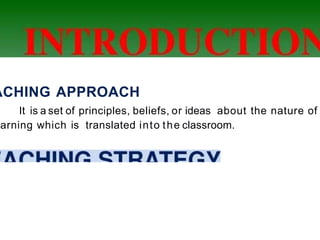
ACHING APPROACH
It is a set of principles, beliefs, or ideas about the nature of
arning which is translated into the classroom.
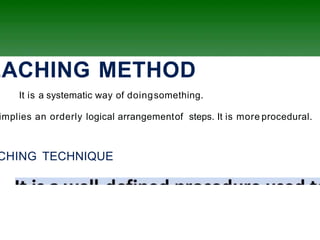
EACHING METHOD
It is a systematic way of doingsomething.
implies an orderly logical arrangementof steps. It is more procedural.
CHING TECHNIQUE
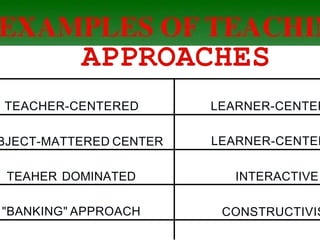
TEACHER-CENTERED LEARNER-CENTER
BJECT-MATTERED CENTER LEARNER-CENTER
TEAHER DOMINATED INTERACTIVE
"BANKING" APPROACH CONSTRUCTIVIS
APPROACHES
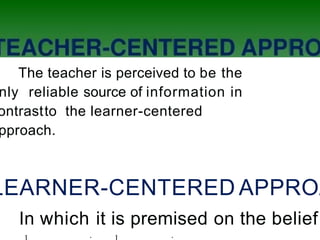
The teacher is perceived to be the
nly reliable source of information in
ontrastto the learner-centered
pproach.
LEARNER-CENTERED APPROA
In which it is premised on the belief
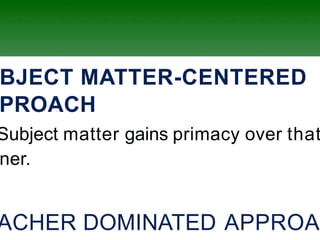
BJECT MATTER-CENTERED
PROACH
Subject matter gains primacy over that
ner.
ACHER DOMINATED APPROAC
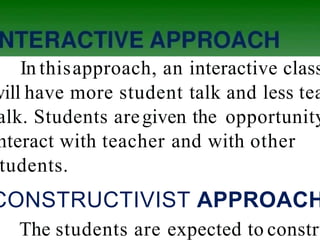
In thisapproach, an interactive class
will have more student talk and less tea
alk. Students aregiven the opportunity
nteract with teacher and with other
tudents.
CONSTRUCTIVIST APPROACH
The students are expected to constru
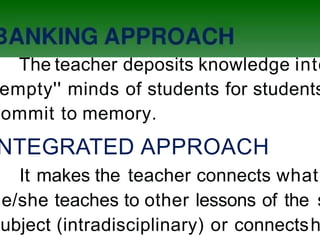
The teacher deposits knowledge into
empty'' minds of students for students
commit to memory.
NTEGRATED APPROACH
It makes the teacher connects what
he/she teaches to other lessons of the s
subject (intradisciplinary) or connectsh
DISCIPLINAL APPROACH
It limits the teacher to discussinghis
essons within the boundary of his/her
subject.
COLLABORATIVE APPROACH
NDIVIDUALISTIC APPROACH
It wants the individual students to w
y themselves.
DIRECT TEACHING APPROACH
The teacher directly tells or showsor
NDIRECT,GUIDED APPROACH
The teacher guides the learner to di
hings for himself/herself. The teacher
acilitates the learning process by allow
he learner to be engaged in the learnin
process with his/her guidance.
RESEARCH-BASED APPROAC
As the name implies, teaching and
earning are anchored onresearch findin
WHOLE CHILD APPROACH
The learning process itself takes into
The teaching process brings
he learner to the process of
hinking about thinking. The
earner reflects on what he
earned and on his/her ways of
earning.
PROBLEM-BASED APPROACH
As the name implies, the teaching-
,
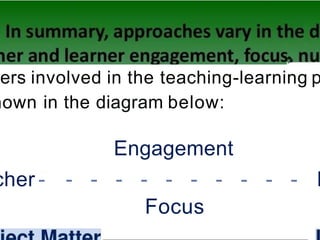
ers involved in the teaching-learning p
hown in the diagram below:
cher - - - - L
Engagement
- - - - - - -
Focus
DIRECT INSTRUCTION/
LECTURE METHOD
Direct instruction is aimed at helping
students acquire procedural knowledge
exercised in the performance of some ta
To employ the methodology inteachi
ill/s, follow these steps:
Provide the rationale,
Demonstrate the skill,
Provide guided practice until mastery,
Check for understanding and provide fee
evaluate student learning at the end
structional unit by comparing it agains
andard or benchmark.
Summative assessments are often hig
akes, which means that they have a hig
oint value.
Examples of summative assessments
clude:
ps are similar with those of teaching a
ive a short introduction by providing th
ationale,
resent your lesson,
evelop the lesson by explaining, illustra
ith diagrams if appropriate and/or givi
oncrete examples,
The goal of formative assessment is
monitor student learning to provide on
edback that can be used by instructors
prove their teaching and by students
prove their learning. More specifically
rmative assessments:
elp students id
.entify their strengths and
ta es, w 1c means t at t ey ave ow
no point value.
Examples of formative assessments
nclude asking students to:
draw a concept map in class to represen
heir understanding of a topic
submit one or two sentences identifying
The strategy is teacher-directed.
The emphasis is on the teaching of ski
Each step must be mastered, hence th
students gain ''how'' rather than ''what
termed procedural knowledge.
Taught in a step-by-step fashion, it ensu
Lesson objectives include easily obser
behaviors that can be measured accur
This is a form of learning through imit
sometimes termed ''behavioral mode
This can also beused to teach facts,
orincioles. and laws.
EACHING SKILL
The students must be given ample time
practice.
They must be included in the planning
since this technique is highly task-orie
and aimed at mastery of every step. Th
subskills or into its component steps so
can be taught easily and with precision
Design own strategy in teaching eachs
which will eventually contribute to the
learning of the entire skill.
Before the demonstration, carefully
Assignpractice for short periods of
time, then continue learning by imitati
others.
Provide feedback and encouragement
through praises. Positively motivated,
students will never get tired practicing.
and Laws
Be sure the facts, pr1nc1ples, and laws
correctly, clearly, and adequately expla
Use visual aids to concretize abstract
principles and laws.
Illustrate laws and principles with conc
examoles.
As the name implies, in the demonstra
method the teacher or an assigned stude
group shows how a process is done while
students become observers.
The demonstrator is knowledgeable in
preparingthe apparatus needed accordin
the steps to be followed. The rest of the c
EFORE
The demonstrator/s must be well-sele
He/she/they must be skilled in operat
modern equipment and proficient in
undertaking scientific investigations.
When planning the activities make sur
be used. Demonstration should be
scheduled as to day and class period.
The demonstrator must try the activity
several times before the real
demonstrationsfor a smooth sequenci
the steps as well as accuracy of the res
The observers must be preparedand
the-spot revision/s such as alternative
or substitute materials when needed.
Arrange the observers around the
demonstration area or at a distance wh
they will be able to observe fully what
go•
ing on.
Depending on the kind of demonstratio
be undertaken, pointers or questions m
The place must be quiet in order to sus
the observers' attention and interest d
the activity.
Extreme care must be taken in perform
some delicate steps.
The activity must not be interrupted b
unnecessary announcements or noise
surroundings.
during the demonstration.
An examination of the observed data a
nformation recorded follows.
Have an analysis of trends, patterns or
uniform occurrences that can help in ar
at a conclusion.
The demonstration method followsa
systematic procedure.
The use of expensive equipment and
machines will bemaximized.
Possible wastage of time, effort and
resources will be avoided since the
what happens with unplanned
learning activities.
The findings are reliable andaccurate s
the procedure has bee tried before.
The value of confidence is developeda
the demonstrators for such hands-on
l
n
d
i
r !:f cQeto 1s est u
when the learning process is inquiry-bas
he result is discovery and the learning
ontext is a problem. This can come as
) INQUIRY METHOD
We will never be able to help childr
earn if we tell them everything they ne
know. Rather, we must provide them w
opportunities to explore, inquire and
discover new learning. The core of inqui
METHOD
Define the topic or introduce theques
Guide students plan where and how to
gather data and information.
Students present findings through grap
charts, PowerPoint presentation, mode
• • •
The following are commonly observe
haracteristics of the discovery/inquiry
method:
Investigative processes such as inferrin
hypothesizing, measuring, predicting,
classifying, analyzing, and experiment
formulating conclusions andgeneraliza
The children are highly motivated to se
hence active participation is the best
indicator of inquisitiveness.
The answers arrived at are genuine pro
of their own efforts.
Focused questions before, during and
are critical ingredients that provide dir
Its emphasis is on the processes of gath
and processing of information
Its dependence on firsthand experienc
objects and phenomena occurring in th
environment is certainly in agreement
the most often cited theory of Piaget
earning, e 1tin pursuit o answers, ma
ontent or simply solving a problem tha
onfronts them instantly.
Educators strongly believes that facts an
oncepts that learners discover bythem
ecome stored as part of their permane
earning.
Experiencing success in inquiry-
Arrange for an ideal room setting.
Choose tools and equipment that can
be manipulated.
The materials to be used or examine m
lend themselves easily to the processe
be employed and the end product desi
by them.
At the completion of the activity, requi
evaluation of the steps undertaken as
effectiveness and the clarity of the res
Above all, the teacher himself/herself
should internalize his/her changed role
that of a guide, facilitator, and counse
rather than the traditional authority w
employs the scientific method in search
nformation. The five basic steps of scie
method or investigatory process are:
Sensing and defining the problem
Formulating hypothesis
Testing the likely hypothesis
This method is most effective in develo
skillin employing the science processe
The scientific method can likewise be u
effectively in other non-science objects
The student's active involvement resu
in meaningful experiences serves as as
motivation to follow the scientific proc
are much needed ingredients for
independent study.
The students become appreciative and
grateful for the achievement of scientis
Critical thinking, open-mindedness and
judgment are among scientific attitude
values inculcated through competence
Provide sufficient training in defining a
stating the problem in a clear and conc
manner.
Make sure that the problem to be solv
the age, interests and the skills of the
students.
Group the students and allow each one
Get ready with substitutions formateri
which may not beavailable.
The emphasis is on the procedure and
processes employed rather than on th
products.
The development of skills and attitude
takes priority over knowledge.

Teaching Methods and Strategies.pptx

  • 1.
  • 2.
    ACHING APPROACH It isa set of principles, beliefs, or ideas about the nature of arning which is translated into the classroom.
  • 3.
    EACHING METHOD It isa systematic way of doingsomething. implies an orderly logical arrangementof steps. It is more procedural. CHING TECHNIQUE
  • 4.
    TEACHER-CENTERED LEARNER-CENTER BJECT-MATTERED CENTERLEARNER-CENTER TEAHER DOMINATED INTERACTIVE "BANKING" APPROACH CONSTRUCTIVIS APPROACHES
  • 5.
    The teacher isperceived to be the nly reliable source of information in ontrastto the learner-centered pproach. LEARNER-CENTERED APPROA In which it is premised on the belief
  • 6.
    BJECT MATTER-CENTERED PROACH Subject mattergains primacy over that ner. ACHER DOMINATED APPROAC
  • 7.
    In thisapproach, aninteractive class will have more student talk and less tea alk. Students aregiven the opportunity nteract with teacher and with other tudents. CONSTRUCTIVIST APPROACH The students are expected to constru
  • 8.
    The teacher depositsknowledge into empty'' minds of students for students commit to memory. NTEGRATED APPROACH It makes the teacher connects what he/she teaches to other lessons of the s subject (intradisciplinary) or connectsh
  • 9.
    DISCIPLINAL APPROACH It limitsthe teacher to discussinghis essons within the boundary of his/her subject. COLLABORATIVE APPROACH
  • 10.
    NDIVIDUALISTIC APPROACH It wantsthe individual students to w y themselves. DIRECT TEACHING APPROACH The teacher directly tells or showsor
  • 11.
    NDIRECT,GUIDED APPROACH The teacherguides the learner to di hings for himself/herself. The teacher acilitates the learning process by allow he learner to be engaged in the learnin process with his/her guidance.
  • 12.
    RESEARCH-BASED APPROAC As thename implies, teaching and earning are anchored onresearch findin WHOLE CHILD APPROACH The learning process itself takes into
  • 13.
    The teaching processbrings he learner to the process of hinking about thinking. The earner reflects on what he earned and on his/her ways of earning. PROBLEM-BASED APPROACH As the name implies, the teaching-
  • 14.
    , ers involved inthe teaching-learning p hown in the diagram below: cher - - - - L Engagement - - - - - - - Focus
  • 15.
    DIRECT INSTRUCTION/ LECTURE METHOD Directinstruction is aimed at helping students acquire procedural knowledge exercised in the performance of some ta
  • 16.
    To employ themethodology inteachi ill/s, follow these steps: Provide the rationale, Demonstrate the skill, Provide guided practice until mastery, Check for understanding and provide fee
  • 17.
    evaluate student learningat the end structional unit by comparing it agains andard or benchmark. Summative assessments are often hig akes, which means that they have a hig oint value. Examples of summative assessments clude:
  • 18.
    ps are similarwith those of teaching a ive a short introduction by providing th ationale, resent your lesson, evelop the lesson by explaining, illustra ith diagrams if appropriate and/or givi oncrete examples,
  • 19.
    The goal offormative assessment is monitor student learning to provide on edback that can be used by instructors prove their teaching and by students prove their learning. More specifically rmative assessments: elp students id .entify their strengths and
  • 20.
    ta es, w1c means t at t ey ave ow no point value. Examples of formative assessments nclude asking students to: draw a concept map in class to represen heir understanding of a topic submit one or two sentences identifying
  • 21.
    The strategy isteacher-directed. The emphasis is on the teaching of ski Each step must be mastered, hence th students gain ''how'' rather than ''what termed procedural knowledge. Taught in a step-by-step fashion, it ensu
  • 22.
    Lesson objectives includeeasily obser behaviors that can be measured accur This is a form of learning through imit sometimes termed ''behavioral mode This can also beused to teach facts, orincioles. and laws.
  • 23.
    EACHING SKILL The studentsmust be given ample time practice. They must be included in the planning since this technique is highly task-orie and aimed at mastery of every step. Th
  • 24.
    subskills or intoits component steps so can be taught easily and with precision Design own strategy in teaching eachs which will eventually contribute to the learning of the entire skill. Before the demonstration, carefully
  • 25.
    Assignpractice for shortperiods of time, then continue learning by imitati others. Provide feedback and encouragement through praises. Positively motivated, students will never get tired practicing.
  • 26.
    and Laws Be surethe facts, pr1nc1ples, and laws correctly, clearly, and adequately expla Use visual aids to concretize abstract principles and laws. Illustrate laws and principles with conc examoles.
  • 27.
    As the nameimplies, in the demonstra method the teacher or an assigned stude group shows how a process is done while students become observers. The demonstrator is knowledgeable in preparingthe apparatus needed accordin the steps to be followed. The rest of the c
  • 28.
    EFORE The demonstrator/s mustbe well-sele He/she/they must be skilled in operat modern equipment and proficient in undertaking scientific investigations. When planning the activities make sur
  • 29.
    be used. Demonstrationshould be scheduled as to day and class period. The demonstrator must try the activity several times before the real demonstrationsfor a smooth sequenci the steps as well as accuracy of the res The observers must be preparedand
  • 30.
    the-spot revision/s suchas alternative or substitute materials when needed. Arrange the observers around the demonstration area or at a distance wh they will be able to observe fully what go• ing on. Depending on the kind of demonstratio be undertaken, pointers or questions m
  • 31.
    The place mustbe quiet in order to sus the observers' attention and interest d the activity. Extreme care must be taken in perform some delicate steps. The activity must not be interrupted b unnecessary announcements or noise surroundings.
  • 32.
    during the demonstration. Anexamination of the observed data a nformation recorded follows. Have an analysis of trends, patterns or uniform occurrences that can help in ar at a conclusion.
  • 33.
    The demonstration methodfollowsa systematic procedure. The use of expensive equipment and machines will bemaximized. Possible wastage of time, effort and resources will be avoided since the
  • 34.
    what happens withunplanned learning activities. The findings are reliable andaccurate s the procedure has bee tried before. The value of confidence is developeda the demonstrators for such hands-on
  • 35.
    l n d i r !:f cQeto1s est u when the learning process is inquiry-bas he result is discovery and the learning ontext is a problem. This can come as
  • 36.
    ) INQUIRY METHOD Wewill never be able to help childr earn if we tell them everything they ne know. Rather, we must provide them w opportunities to explore, inquire and discover new learning. The core of inqui
  • 37.
    METHOD Define the topicor introduce theques Guide students plan where and how to gather data and information. Students present findings through grap charts, PowerPoint presentation, mode • • •
  • 38.
    The following arecommonly observe haracteristics of the discovery/inquiry method: Investigative processes such as inferrin hypothesizing, measuring, predicting, classifying, analyzing, and experiment formulating conclusions andgeneraliza
  • 39.
    The children arehighly motivated to se hence active participation is the best indicator of inquisitiveness. The answers arrived at are genuine pro of their own efforts. Focused questions before, during and are critical ingredients that provide dir
  • 40.
    Its emphasis ison the processes of gath and processing of information Its dependence on firsthand experienc objects and phenomena occurring in th environment is certainly in agreement the most often cited theory of Piaget
  • 41.
    earning, e 1tinpursuit o answers, ma ontent or simply solving a problem tha onfronts them instantly. Educators strongly believes that facts an oncepts that learners discover bythem ecome stored as part of their permane earning. Experiencing success in inquiry-
  • 42.
    Arrange for anideal room setting. Choose tools and equipment that can be manipulated. The materials to be used or examine m lend themselves easily to the processe be employed and the end product desi
  • 43.
    by them. At thecompletion of the activity, requi evaluation of the steps undertaken as effectiveness and the clarity of the res Above all, the teacher himself/herself should internalize his/her changed role that of a guide, facilitator, and counse rather than the traditional authority w
  • 44.
    employs the scientificmethod in search nformation. The five basic steps of scie method or investigatory process are: Sensing and defining the problem Formulating hypothesis Testing the likely hypothesis
  • 45.
    This method ismost effective in develo skillin employing the science processe The scientific method can likewise be u effectively in other non-science objects The student's active involvement resu in meaningful experiences serves as as motivation to follow the scientific proc
  • 46.
    are much neededingredients for independent study. The students become appreciative and grateful for the achievement of scientis Critical thinking, open-mindedness and judgment are among scientific attitude values inculcated through competence
  • 47.
    Provide sufficient trainingin defining a stating the problem in a clear and conc manner. Make sure that the problem to be solv the age, interests and the skills of the students. Group the students and allow each one
  • 48.
    Get ready withsubstitutions formateri which may not beavailable. The emphasis is on the procedure and processes employed rather than on th products. The development of skills and attitude takes priority over knowledge.