Download to read offline
![International Journal of Recent advances in Mechanical Engineering (IJMECH) Vol.3, No.3, August 2014
STATISTICAL AND REGRESSION ANALYSIS OF
VIBRATION OF CARBON STEEL CUTTING TOOL FOR
TURNING OF EN24 STEEL USING DESIGN OF
EXPERIMENTS
Amit Aherwar1*, Deepak Unune2, BhargavPathri3, Jai kishan4
1,2,3,4 Department of Mechanical Engineering, Malaviya National Institute of Technology,
Jaipur-302017, India
ABSTRACT
Machining is a convoluted process in which many variables can deleterious the desired results. Among
them, cutting tool vibration is the most decisive phenomenon which influences dimensional precision of the
components machined, functional behavior of the machine tools and life of the cutting tool. In a machining
operation, cutting speed, depth of cut and the tool feed rate principally influence cutting tool vibrations. In
this paper, effects of cutting speed, feed rate and depth of cut on cutting tool vibration in both the
directions, i.e. axial and tangential are investigated by the statistical methods of signal to noise ratio
(SNR), analysis of variance (ANOVA) and regression analysis. Experiments have been conducted using the
L9 orthogonal array in the centre lathe machine. Carbon steel was selected as cutting tool materials to
conduct the experiments. From experimental results, the amplitude of vibration of the cutting tool was
ascertaining for each machining performance criteria. The significance and percentage contribution of
each parameter were determined by Analysis of variance (ANOVA).It has been observed that cutting speed
has a maximum contribution on cutting tool vibration in both the directions. Variation of the vibration of
cutting tool with machining parameters was mathematically modeled by using the regression analysis
method. The predicted value from the developed model and experimental values are found to be very close
to each other justifying the significance of the model. Confirmation runs demonstrates that the optimized
result and the values obtained through regression analysis are within the prescribed limit
KEYWORDS: ANOVA, Tool Vibration, Taguchi method, DOE, Centre Lathe
1. INTRODUCTION
Metal cutting is one of the imperative and extensively used manufacturing processes in
engineering industries. It primarily focuses on the tool’s features, input materials of work piece,
and machine parameter settings influencing process efficiency and output characteristics. A
significant expansion in process efficiency may be acquired by the optimization of process
parameter that identifies and find out the regions of critical process control factors leading to
desired output or responses to tolerable variations ensuring a lower cost of manufacturing [1].
Cutting conditions include cutting speed, cutting fluids, depth of cut and feed. For a machining
process such as turning, vibration is a common problem, which affects the machining
performance particularly, the surface finish and tool life. Dynamic motion between the cutting
tool and the work piece results in severe vibrations in the machining process. The monitoring of
DOI : 10.14810/ijmech.2014.3312 137](https://image.slidesharecdn.com/statisticalandregressionanalysisofvibrationofcarbonsteelcuttingtoolforturningofen24steelusingdesigno-140918234707-phpapp02/75/tcStatistical-and-regression-analysis-of-vibration-of-carbon-steel-cutting-tool-for-turning-of-en24-steel-using-design-of-experiments-1-2048.jpg)
![International Journal of Recent advances in Mechanical Engineering (IJMECH) Vol.3, No.3, August 2014
manufacturing processes and the conditions of equipment are the crucial part of a critical tactic
that impels manufacturing industries towards being leaner and more vying [1, 3]. Many sensors
were reported for tool condition monitoring system, namely; power sensors, vibration sensors,
vision sensors, temperature sensors, touch sensors, force sensors, acoustic emission sensors, flow
sensors and so on[4, 2, 5].The role of sensors and their signal interpretation capability is critical
in any automation process. The processing and investigation of signals is significant because it
will improve production capacity, reliability, reduced downtime and enhanced machining quality
[6]. Byrne et al. [7] described that 46% of the sensors monitoring systems were fully functional,
16% had limited functionality, 25% were non-functional owing to technical limitations and 13%
were switched over to alternate systems. Sensors based systems are the most vital choice for
prediction the condition of cutting tool.
Rotary and/or reciprocating parts in machines impose different vibration amplitudes. Machine
tools are likely to deteriorate in their performance with respect to time due to various aspects such
as ageing, unbalance, wear and tear, looseness of parts etc., and resulting in an increase overall
vibration level. Uncontrolled machine tool vibrations can adversely affect the dimensional
accuracy, tool life and surface finish. Increased vibration level could account about 70%of the
failures in the machine tools. Lathe is one of the most critical machine tool in manufacturing
industries. The quality of the workpiece hinge essentially on the condition of the lathe. It is
difficult to exploit the optimum functions of a machine owing to numerous adjustable machining
parameters [8]. The Taguchi’s dynamic experiments are efficient and systematic method to find
out the optimum settings of machining parameters [9-11]. The analysis of variance (ANOVA) is
extensively used to study the effects of factors on responses. In experimental studies, ANOVA is
often employed prior to other statistical analysis. Afterwards that, regression analysis is widely
applied to show a relation between independent variables and dependent variables [8].
The literature review shows that no plausible studies have been performed to examine the
vibration of the cutting tool in axial and tangential direction respectively with turning of EN24
steel. The main purpose of this paper is to monitor the vibration level of cutting tool and
investigate the effects of machining parameters on the cutting tool i.e. carbon-steel. It is presumed
that the condition of the machine and its components is good in all aspects such as machine
foundation, rigidity of the machine components. The vibration analysis is conducted through
collecting the overall vibration amplitude (RMS) and plotting the vibration data. From the basic
principle and characteristic feature of the centre lathe process, it has been discovered that the
machining parameters, such as depth of cut, cutting speed and feed rate are the important
controllable process parameters and therefore selected for the investigation. Taguchi’s L9
orthogonal array was used to analyze the experiment process [12].Furthermore, analysis of
variance is used to investigate the statistical significance of the cutting parameters. Finally,
confirmation test was carried out using the optimal conditions of cutting which were resulted via
Taguchi method.
138
2.MATERIAL AND METHOD
In this study, EN 24 steel was used as a workpiece. The chemical composition of the workpiece
sized Ø25 × 75 mm is given in Table 1. The experimental studies were carried out on a Mori
Seiki NL 2500 centre Lathe under dry cutting conditions. Carbon steel was used as the cutting
tool material. The vibrometer placed in two different locations to measure axial and tangential,
vibrations respectively. The experiments were repeated for different speed, depth of cut and feed
rate. Readings were noted down in three different levels, i.e. three different cutting speeds, depth](https://image.slidesharecdn.com/statisticalandregressionanalysisofvibrationofcarbonsteelcuttingtoolforturningofen24steelusingdesigno-140918234707-phpapp02/75/tcStatistical-and-regression-analysis-of-vibration-of-carbon-steel-cutting-tool-for-turning-of-en24-steel-using-design-of-experiments-2-2048.jpg)
![International Journal of Recent advances in Mechanical Engineering (IJMECH) Vol.3, No.3, August 2014
of cut, and feed rate. In this study, cutting speed (CS), depth of cut (DOC) and feed rate (FR)
selected as control factors and their levels are as shown in Table 2. The selection of an
appropriate orthogonal array is the first step of the Taguchi method. The most appropriate
orthogonal array (L9) was selected to study the effects of machining parameters and the optimal
machining conditions [13]. The nine possible combinations of machining parameters (shown in
Table 3) were formed to analyze their effect on cutting tool vibrations. The next section discusses
experimental design and analysis method used in this research work.
139
Table 1 Chemical composition of the work piece
C Si Mn S P Cr Mo Ni
0.36-
0.44%
0.10-
0.35%
0.45-
0.70%
0.040%
0.035%
1.0-1.4%
0.2-
0.35%
1.3-1.7%
3. EXPERIMENTAL DESIGN
Design of experiment is an imposing statistical technique for investigating the unknown attributes
of the machining parameters in the experimental process and for studying and modeling the
interaction between the factors [14]. The classical experimental design methods are overly
complex and not easy to apply. Additionally, when the number of machining parameters
increases a large number of experiments are required [15]. Therefore, the factors instigating
variations should be determined and checked under laboratory environments. These studies are
counted below the scope of off-line improvement of quality [16]. The Taguchi method usually
used to reduce the number of experiments by using orthogonal arrays and also attempts to
minimize the effects of control factors. The basic idea of the Taguchi method is to make sure
quality in the design phase. The greatest benefits of the Taguchi method are to cut the
experimental time and reduce costs [17].
The Taguchi technique is typically used for parametric design of product or process design that
focus on determining the parameter settings producing the best levels of a quality characteristic
(performance measure) with minimum variation. Selection of control factors is a very critical
stage in the design of experiments. More factors should be investigated in order to identify non-significant
variables at the initial prospect [18, 20]. Taguchi produces a typical orthogonal array
to accommodate this requirement. S/N ratio compares the level of a desired signal to the level of
background noise. If the ratio is high, the background noise is less obtrusive. It is used casually to
refer to the ratio of useful information to false or immaterial data in a conversation or exchange.
In other words, the standard deviation cannot be lessened first and the mean carried to the target
[18, 19, 20].Taguchi empirically founded that the two stage optimization procedure involving S/N
ratios indeed gives the parameter level combination, where the standard deviation is minimum
while keeping the mean on target [21].This suggests that engineering systems act in such a
manner that the manipulated production factors can be separated into three categories: i.e. control
factors, signal factors and factors. Process variability influenced by control factors measured in
terms of the S/N ratio. In general, the S/N ratio characteristics can be divided into three classes:
“larger-the-better”, “smaller-the-better” and “nominal-the-best”. Further, ANOVA is typically
used to find out the statistical significance of the cutting parameters. The optimum combination
of the cutting parameters is determined by the aid of ANOVA and S/N ratios. Finally,
confirmation experiments are done using the optimum machining parameters which were found](https://image.slidesharecdn.com/statisticalandregressionanalysisofvibrationofcarbonsteelcuttingtoolforturningofen24steelusingdesigno-140918234707-phpapp02/75/tcStatistical-and-regression-analysis-of-vibration-of-carbon-steel-cutting-tool-for-turning-of-en24-steel-using-design-of-experiments-3-2048.jpg)
![International Journal of Recent advances in Mechanical Engineering (IJMECH) Vol.3, No.3, August 2014
with the help of Taguchi optimization method and thereby validation of the optimization is tested
[22].
The experimental design for three turning parameters (cutting speed, feed rate and depth of cut)
with three levels are organized by the Taguchi’s L9 orthogonal array as shown in Table 3. In the
Taguchi method, the orthogonal array can provide an efficient means to perform the experiments
with the least number of trials. Taguchi used as the quality characteristic of choice on the basis of
signal-to-noise (S/N) ratio. The-smaller-the-better performance characteristic for tool vibration
were applied in order to obtain the optimal cutting parameters. S/N ratio is defined as follows:
140
() = −10](https://image.slidesharecdn.com/statisticalandregressionanalysisofvibrationofcarbonsteelcuttingtoolforturningofen24steelusingdesigno-140918234707-phpapp02/75/tcStatistical-and-regression-analysis-of-vibration-of-carbon-steel-cutting-tool-for-turning-of-en24-steel-using-design-of-experiments-4-2048.jpg)
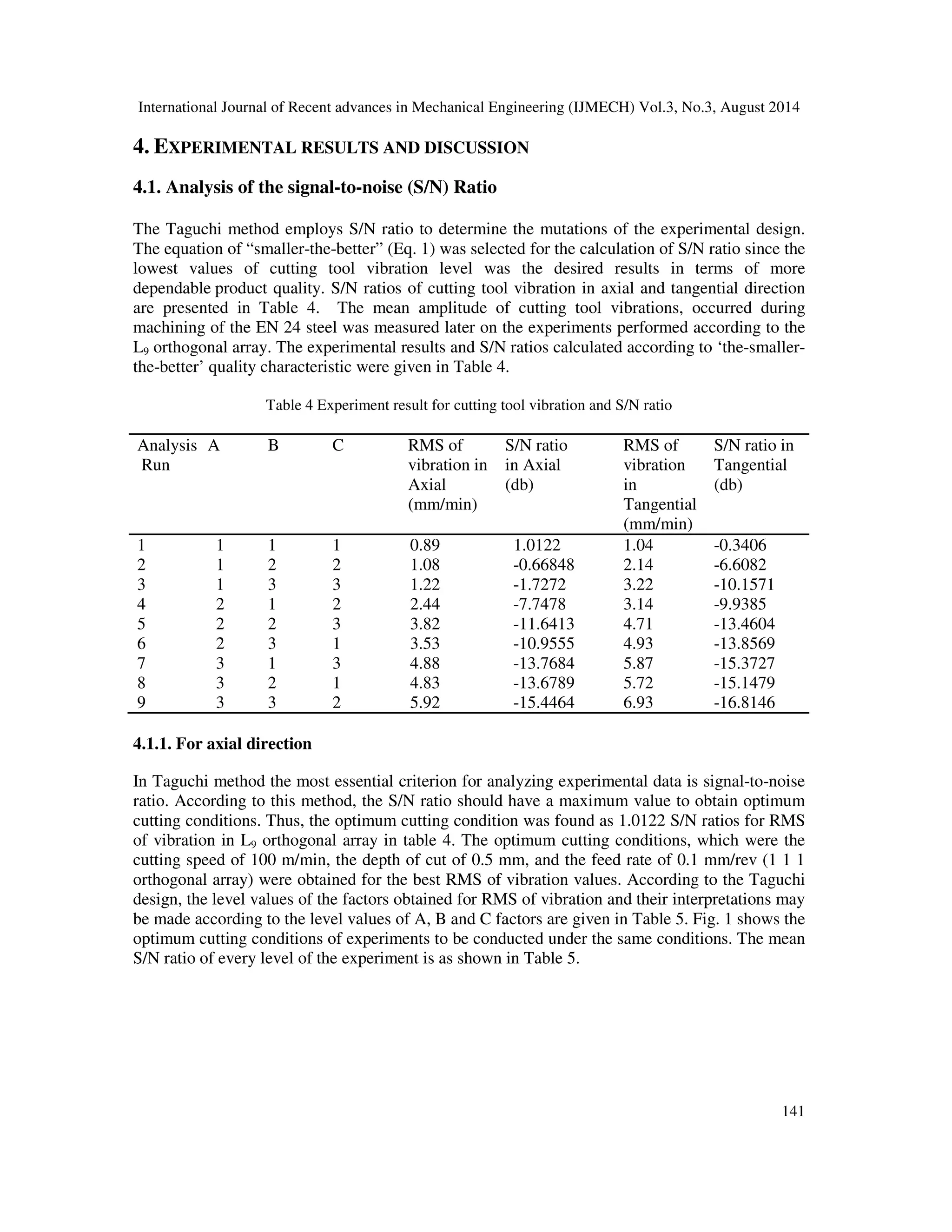
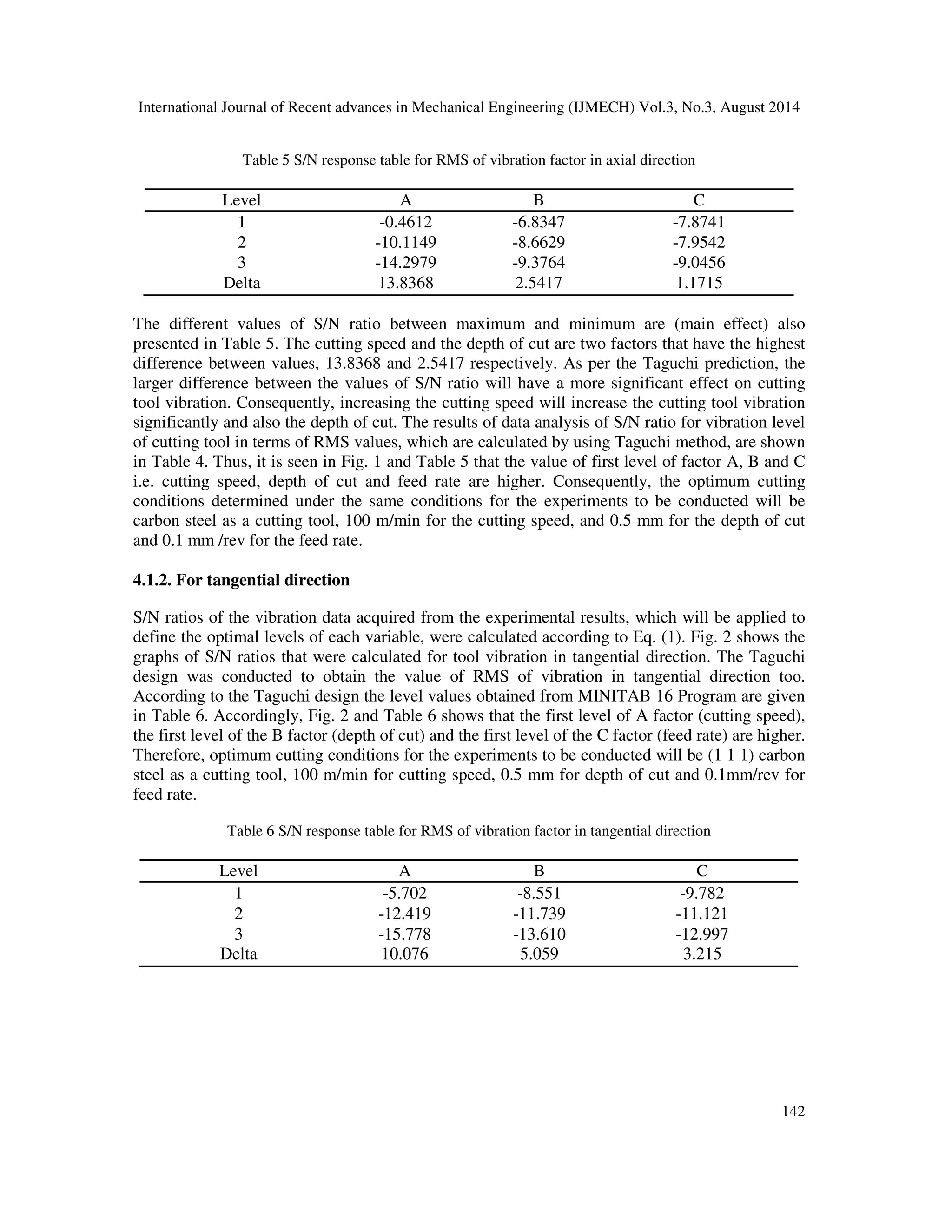
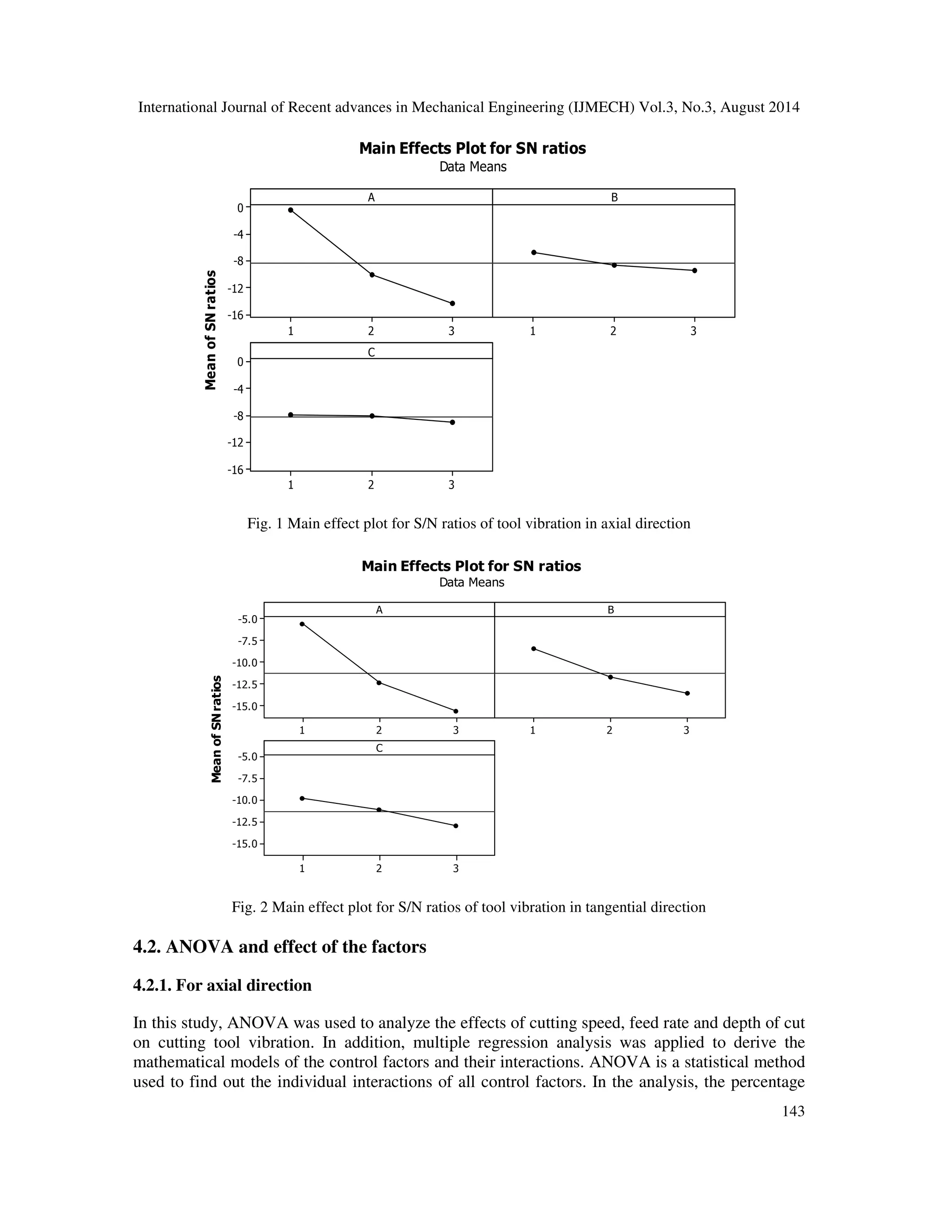
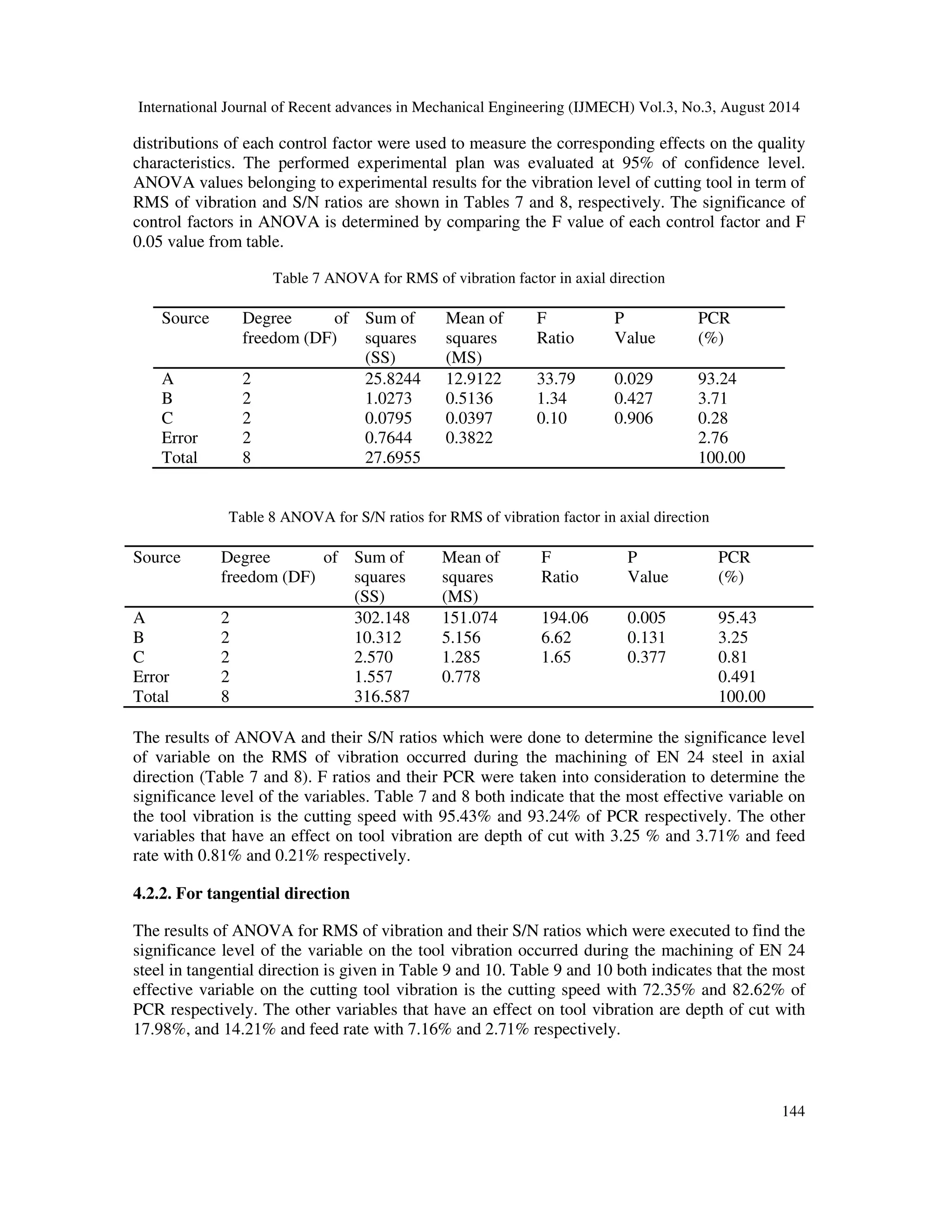
![International Journal of Recent advances in Mechanical Engineering (IJMECH) Vol.3, No.3, August 2014
145
Table 9 ANOVA for RMS of vibration factor in tangential direction
Source Degree of
freedom (DF)
Sum of
squares
(SS)
Mean of
squares
(MS)
F
Ratio
P
Value
PCR
(%)
A 2 24.5052 12.2526 188.95 0.005 82.62
B 2 4.2168 2.1084 32.51 0.030 14.21
C 2 0.8056 0.4028 6.21 0.139 2.71
Error 2 0.1297 0.0648 0.43
Total 8 29.6573
Table 10 ANOVA for S/N ratios for RMS of vibration factor in tangential direction
Source Degree of
freedom (DF)
Sum of
squares
(SS)
Mean of
squares
(MS)
F
Ratio
P
Value
PCR
(%)
A 2 157.936 78.968 28.98 0.033 72.35
B 2 39.257 19.628 7.20 0.122 17.98
C 2 15.648 7.824 2.87 0.258 7.16
Error 2 5.449 2.725 2.49
Total 8 218.290
4.3. Regression Equations
According to Huang and Chen [23], the correlations between the factors and the performance
measures were modeled using quadratic regressions. The equations of RMS of vibration axial and
tangential error were generated based on the control factors and their interactions. The predictive
equations generated for cutting tool vibration in terms of RMS in axial (axial) and tangential
(tangential) directions are given in Eqs. (2) and (3) respectively. The estimated regression
coefficients for RMS of vibration in axial and tangential using data in uncoded units are shown in
Tables 11 and 12.
=−2.01111 + 2.07333A + 0.41B + 0.111667C (2)
'()*(' =−2.23111 + 2.02A + 0.838333B + 0.351667C (3)
The empirical equation (2) and (3) shows a better agreement, greater than 95% in the fit values.
Hence, these equations can be used for calculating the amplitude of tool vibration in term of RMS
from machining parameters. ANOVA was derived to check the null hypothesis for the regression
presented in Tables 13 and 14. The result shows that the estimated model significant with a level
of significance alpha equal to 0.05.
R-squared (R2) amount was calculated to verify the goodness of fit. R2 (coefficient of
determination) values for the RMS of vibration in axial (axial) and tangential (tangential) directions
were calculated as 0.970 and 0.993 respectively. On the other hand, the predictive equations
which contain the control factors and their interactions for RMS of vibration in axial (axial) and
tangential (tangential) directions are shown in Eqs. (4) and (5), respectively.](https://image.slidesharecdn.com/statisticalandregressionanalysisofvibrationofcarbonsteelcuttingtoolforturningofen24steelusingdesigno-140918234707-phpapp02/75/tcStatistical-and-regression-analysis-of-vibration-of-carbon-steel-cutting-tool-for-turning-of-en24-steel-using-design-of-experiments-10-2048.jpg)
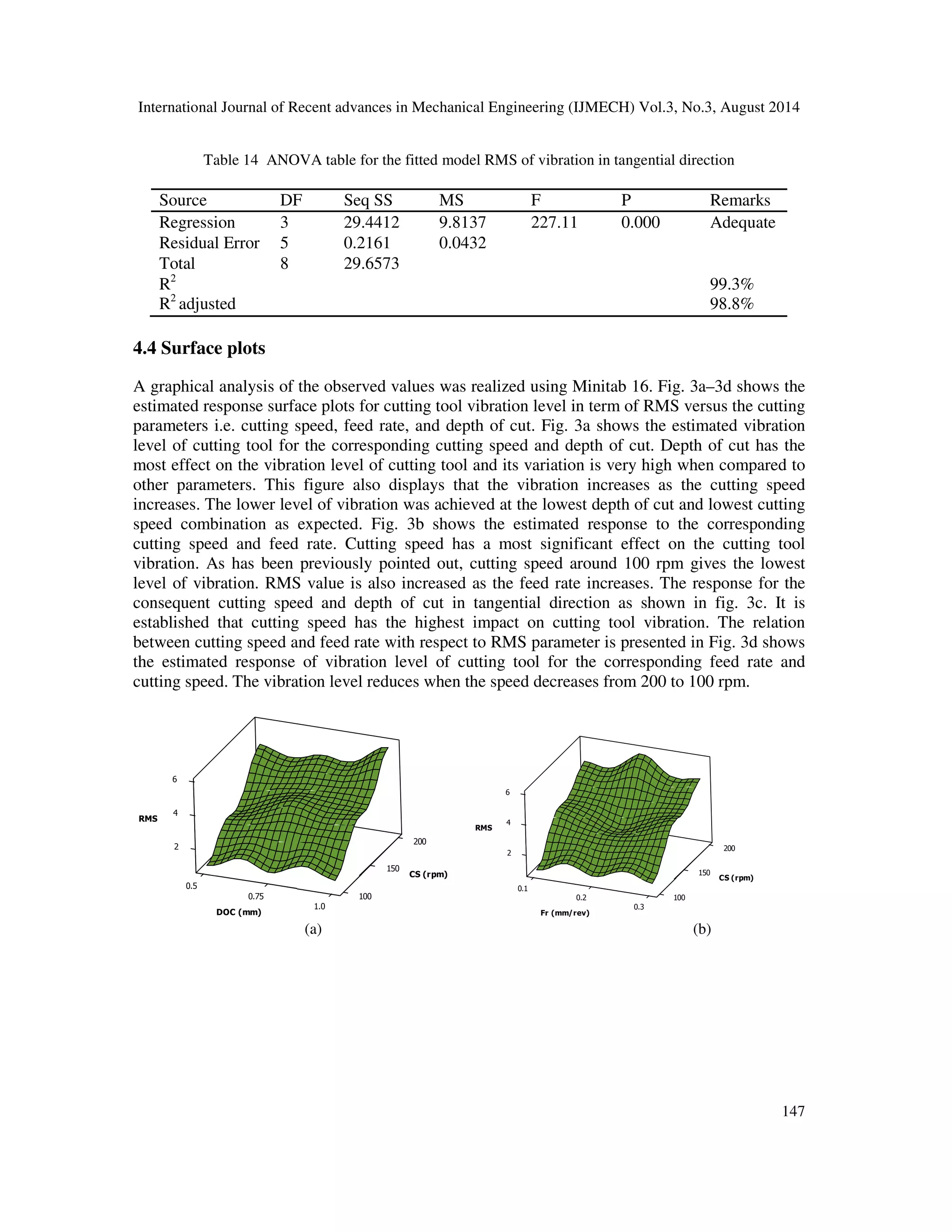
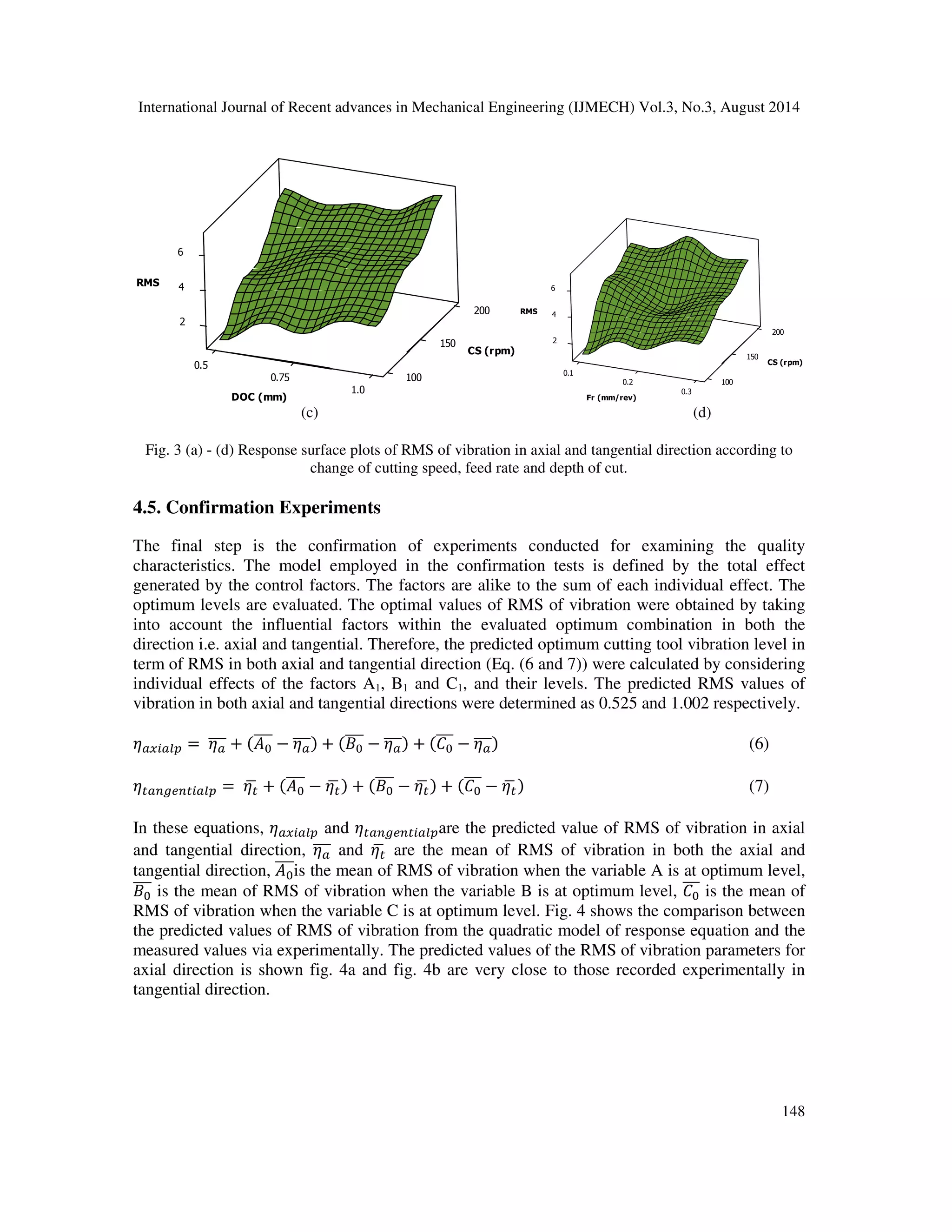
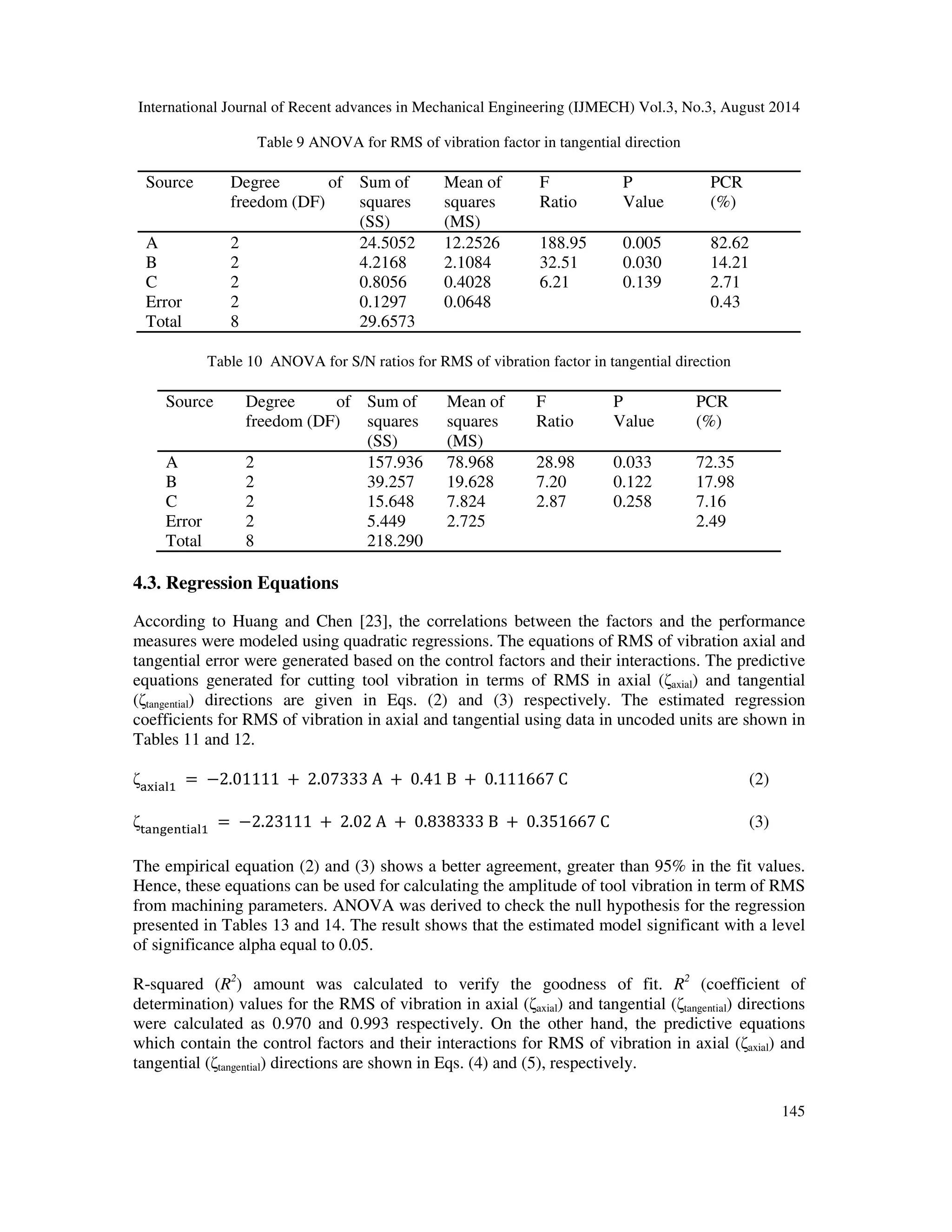
![International Journal of Recent advances in Mechanical Engineering (IJMECH) Vol.3, No.3, August 2014
vibration in term of RMS the influences are 93.24%, 82.62% for axial and tangential
direction, respectively. Besides the influence of depth of cut is 14.21% for tangential
direction. Nevertheless, the feed rate has no influence on the vibration of cutting tool in
both the directions.
4) Predicted values of RMS of vibration for both axial and tangential direction using
regression analysis were very close to the experimental values which suggest that the
regression model also holds good for tool vibration estimation of this newly developed
cutting tool.
150
ACKNOWLEDGEMENT
The authors would like to express their deep gratitude to the Department of Mechanical
engineering of Malaviya National Institute of Technology, Jaipur, India for providing the
laboratory facilities and financial support.
REFERENCES
[1] Al-Habaibeh A. and Gindy N., A new approach for systematic design of condition monitoring
systems for milling operation. Journal of Material Processing Technology, (2000); 107: 243-251.
[2] Dimla D.E., Sensors signals for tool-wear monitoring in metal cutting operations - A Review of
methods. International Journal of Machine tools and Manufacture, (2000); 40: 1073–1098.
[3] Frankowiak M., Grosvenor R. and Prickett P., A review of the evolution of microcontroller-based
machine and process monitoring. International Journal of Machine Tools Manufacturing, (2005);
45: 578-582.
[4] Jemielniak K. Commercial tool condition monitoring systems. International Journal of Advanced
Manufacturing Technology, (1999), 15 (4): 711–721.
[5] Xiaoli Li. A brief review: acoustic emission method for tool wears monitoring during turning.
International Journal of Machine tools and Manufacture, (2002); 42:157–165.
[6] Ghasempoor A, Jeswiet J, Moore TN, Real time implementation of on line tool condition monitoring
in turning. Int j machine tools manufacturing (1999) 39:1883–1902
[7] Byrne G, Dornfeld D, Insaki I, Ketteler G, König W, Teti R Tool condition monitoring (TCM) – The
status of research and industrial application. Annals of CIRP (1995) 44(2):541–567
[8] Aminollah Mohammadi, Alireza Fadaei Tehrani, Ehsan Emanian, Davoud Karimi, statistical analysis
of wire electrical discharge turning on material removal rate, Journal of Materials Processing
Technology 205 (2008) 283-289.
[9] Ting-Cheng Chang, Feng-Che Tsai, Jiuan-Hung Ke, Data mining and Taguchi method combination
applied to the selection of discharge factors and the best interactive factor combination under multiple
quality properties, Int J Adv Manuf Technol (2006) 31: 164–174.
[10] S. S. Mahapatra, Amar Patnaik, Optimization of wire electrical discharge machining (WEDM)
process parameters using Taguchi method, Int J Adv Manufacturing Technology (2007) 34:911–925.
[11] Aminollah Mohammadi, Alireza Fadaei Tehrani, Ehsan Emanian, Davoud Karimi, A new approach to
surface roughness and roundnessimprovement in wire electrical discharge turning based on statistical
analyses, Int J Adv Manufacturing Technology (2008) 39:64–73.
[12] M.S. Phadke, Quality Engineering Using Robust Design, Prentice-Hall, Englewood Cliffs, NJ,
(1989).
[13] Ranjit, K.R. A primer on the Taguchi method, competitive manufacturing series, Van Nostrand
Reinhold, New York (1999)
[14] G. Taguchi, S. Chowdhury, Y. Wu, Taguchi’s Quality Engineering Handbook, John Wiley Sons
Inc., New Jersey, (2005).
[15] T.R. Lin, Optimization technique for face milling stainless steel with multiple performance
characteristics, Int. J. Adv. Manuf. Technol. 19(2002) 330–335.](https://image.slidesharecdn.com/statisticalandregressionanalysisofvibrationofcarbonsteelcuttingtoolforturningofen24steelusingdesigno-140918234707-phpapp02/75/tcStatistical-and-regression-analysis-of-vibration-of-carbon-steel-cutting-tool-for-turning-of-en24-steel-using-design-of-experiments-15-2048.jpg)

This study investigates the effects of cutting speed, depth of cut, and feed rate on the vibration of a carbon steel cutting tool during machining of EN24 steel, utilizing statistical methods such as signal-to-noise ratio (SNR), analysis of variance (ANOVA), and regression analysis. Experimental results indicate that cutting speed significantly influences cutting tool vibration in both axial and tangential directions, with an optimal cutting condition determined for minimizing vibration. The model developed through regression analysis closely aligns with the experimental values, confirming the effectiveness of the optimization process.


![Coded Agents – with UiPath SDK + LangGraph [Virtual Hands-on Workshop]](https://cdn.slidesharecdn.com/ss_thumbnails/codedagentsdeck-251215155422-5497c599-thumbnail.jpg?width=640&height=640&fit=bounds)


