International Journal of Recent advances in Mechanical Engineering (IJMECH) Vol.3, No.3, August 2014 
DESIGN OF QUICK CONNECT-DISCONNECT 
HYDRAULIC COUPLING 
Rohit George Sebastian1 and Satheesh Kumar S.2 
1Final year B.Tech student, Department of Mechanical Engineering, Government 
Engineering College Barton Hill, Thiruvanthapuram, Kerala, India 
rohit.sebastian@gmail.com 
1Assistant Prodessor, Department of Mechanical Engineering, Government Engineering 
College Barton Hill, Thiruvanthapuram, Kerala, India 
satheeshgecb@gmail.com 
ABSTRACT 
Quick Connect-Disconnect Couplings (QCDCs) provide a means of rapidly disconnecting a fluid line 
without loss of hydraulic fluid or entrance of air into the system. They are most commonly used for 
hydraulic systems in aerospace applications like space stations, launch vehicles, etc. Information regarding 
the design of QCDCs is not available in open literature. This paper details the preliminary design and 
optimization of QCDCs for indigenization of the technology, and the general configuration arrived at. A 
QCDC consists of two halves – a male half and a female half. The sealing action is achieved by using 
poppet valve in the male half and a moveable sleeve in the female half. O-rings are used to ensure that the 
design is leak-proof. Changes in pressure and velocity of the fluid flowing through the QCDC have been 
kept to a minimum by ensuring gradual changes in cross-section wherever possible. 
KEYWORDS 
QCDC, quick connect, quick disconnect, hydraulic coupling, fluid coupling 
1. INTRODUCTION 
Quick Connect-Disconnect Couplings (QCDCs) provide a fast, convenient way to repeatedly 
connect and disconnect fluid lines without the loss of hydraulic fluid or entrance of air into the 
system. All QCDCs have two parts: a plug and a socket. The plug is the male half and the socket 
is the female half. When connected properly, these parts seal and lock the joint effectively to 
contain internal pressures and resist any tensile forces that tend to pull the joint apart. The parts 
are easily disconnected without tools by disengaging a locking mechanism and separating the 
parts. Each half contains a valve, which is held open when the coupling is connected. This action 
allows fluid to flow in either direction through the coupling. When the coupling is disconnected, a 
spring in each half closes the valve, preventing the loss of fluid and entrance of air. The union nut 
has a quick-lead thread that permits connecting or disconnecting the coupling by turning the nut. 
2. DESIGN CONFIGURATION 
The male half of the QCDC consists of a poppet valve, a compression spring, a guide for 
gradually altering the direction of fluid flow, and the main coupling body. The guide ensures that 
the changes in cross-section are gradual. For this, the guide offers a tapered flow path to the 
hydraulic fluid. The walls of the coupling body and the tail of the poppet valve are also tapered to 
DOI : 10.14810/ijmech.2014.3304 43
International Journal of Recent advances in Mechanical Engineering (IJMECH) Vol.3, No.3, August 2014 
provide a tapered flow path between changes in diameter. A spring cover which is welded to the 
back face of the poppet valve also aids to give a gradual and uniform change in diameter. The 
spring cover also serves the additional purpose of avoiding the formation of eddies (which would 
have contributed to pressure losses) at the back of the poppet valve. The guide also ensures that 
no component comes directly in the path of the fluid flow (which would have contributed to 
pressure losses). The guide also supports the compression spring and also helps to prevent it from 
buckling. The compression spring is held between a projection on the guide and the back face of 
the poppet valve. The poppet valve remains suspended in the hydraulic fluid. The valve surrounds 
the tail of the poppet valve and ensures that the poppet valve does not deviate too much from its 
axis. The tail of the poppet valve is provided with several circular grooves along its length. Fluid 
under pressure enters these grooves and provides a cushioning effect between the poppet valve 
and the valve guide, helping to prevent the tail of the poppet valve from coming in contact with 
the valve guide. In order to assemble the QCDC, the coupling body is made as 2 parts and then 
welded together after fixing all the internal components in their respective places. A triple start 
thread is provided on the outer surface of the coupling body to facilitate mating of the male and 
female halves of the QCDC. A valve seat is also incorporated into the coupling body. An O-ring 
is provided close to the valve seat to prevent leakage of the QCDC. 
44 
Figure 1. Half-sectional view of QCDC in coupled position showing the different parts 
Figure 2. Half-sectional view of male half in uncoupled position 
The female half consists of a flow cavity, a sleeve, a compression spring, and the main coupling 
body. As in the male half, the flow cavity ensures that the changes in cross-section are gradual.
International Journal of Recent advances in Mechanical Engineering (IJMECH) Vol.3, No.3, August 2014 
For this, the flow cavity offers a tapered flow path to the hydraulic fluid. The sleeve lies between 
the flow cavity and the coupling body. The compression spring is held between the inner surface 
of the coupling body and the back face of the sleeve. The sleeve remains suspended in the 
hydraulic fluid. An O-ring is provided in the coupling body above the narrow end of the sleeve to 
prevent leakage of the QCDC. To facilitate easy machining of the gland for the O-ring, the 
coupling body is made as 2 parts and threaded together. A triple start thread, matching the one on 
the male half is provided on the coupling body to facilitate mating of the male and female halves 
of the QCDC. 
45 
Figure 3. Half-sectional view of female half in uncoupled position 
In the closed or uncoupled position, the poppet valve in the male half pushes against a valve seat 
preventing leakage of hydraulic fluid and any entry of air into the system. The compression 
spring keeps the poppet valve firmly seated against the valve seat in the uncoupled or closed 
position. In the female half of the QCDC, a sleeve is responsible for sealing action in the closed 
or uncoupled condition. The compression spring pushes the sleeve against a valve seat. 
In the coupled position, the flat face of the female half pushes against the head of the poppet 
valve, pushing it backwards. At the same time, the valve seat in the male half pushes the sleeve in 
the female half backwards, opening a path for the hydraulic fluid to flow. The fluid flows over the 
circular face of the female half and the poppet valve in the male half in an annular flow path 
formed by the mating of the two coupling halves. 
3. DESIGN PARAMETERS 
1. Operating Static Pressure – 20.7MPa 
2. Burst Pressure – 82.8MPa 
3. Rated Flow – 23L/min 
4. Inlet Flow Velocity – 1.5m/s 
5. Specific Gravity of Fluid – 0.85 
6. Kinematic Viscosity of Fluid – 14.2cSt 
4. MATERIAL SELECTION 
The coupling should be made of a material with high yield stress (to minimize weight) and with 
high corrosion resistance to prevent corrosion due to the fluid flowing inside. 15-5 PH stainless 
steel (with yield stress of 958MPa[1] Rockwell C hardness 40[2]) has been chosen to make the 
coupling body, which includes the stoppers and guides for the poppet valve. 15-5 PH steel has 
high strength and hardness along with excellent corrosion resistance, making it ideally suited for 
this application. The valve seat should be able to withstand shearing forces due to the force
International Journal of Recent advances in Mechanical Engineering (IJMECH) Vol.3, No.3, August 2014 
imparted by the poppet valve when it is seated (these forces are due to fluid pressure acting on the 
back of the poppet head and due to the force from the spring), despite having a small area of 
contact with the inner wall of the coupling. Hence, 15-5 PH steel is suitable for the valve seats as 
well. 
For proper seating of the poppet valve, the valve seat must be softer than the valve, so that it can 
deform slightly (a slight deformation of the valve seat is required for the proper seating of the 
valve). Also the same time, the sleeve should bear the pressure of the hydraulic fluid in the 
uncoupled position. For this, a material with hardness greater than that of 15-5PH stainless steel 
while still having high yield strength is needed. AISI 440C Martensitic stainless steel hardened by 
quenching in oil at 1030oC and tempered at 150oC (with yield stress of 1930MPa and Rockwell 
C hardness 60[3]) has been chosen for the poppet valve and the sleeve. 
The most suitable material for springs are those which can store up the maximum amount of work 
or energy in a given weight or volume of spring material, without permanent deformation. These 
steels should have a high elastic limit as well as high deflection value. Spring steel should also 
possess maximum strength against fatigue effects and shocks. For the compression spring, we 
have chosen music wire.[4] 
The compound for the O-ring is selected considering several factors such as fluid compatibility, 
the effect of various operating environments and conditions, etc. We are designing a QCDC for 
use with a petroleum-based hydraulic fluid. Considering compatibility with the hydraulic fluid 
and the required operating conditions, Acrylonitrile-Butadiene (NBR) is the best suited 
compound for the O-ring.[5] 
46 
Table 1. Parts and the materials chosen 
Sl. No. Part Material Chosen 
1 Male Coupling Body 1 15-5 PH stainless steel 
2 Male Coupling Body 2 15-5 PH stainless steel 
3 Female Coupling Body 1 15-5 PH stainless steel 
4 Female Coupling Body 2 15-5 PH stainless steel 
5 Female Flow Cavity 15-5 PH stainless steel 
6 Male Guide 15-5 PH stainless steel 
7 Sleeve AISI 440C Martensitic stainless 
steel 
8 Poppet Valve AISI 440C Martensitic stainless 
steel 
9 Spring Cover AISI 440C Martensitic stainless 
steel 
10 Compression spring for male 
half 
Music wire 
11 Compression spring for female 
half 
Music wire 
12 O-ring for male half Acrylonitrile-Butadiene 
13 O-ring for female half Acrylonitrile-Butadiene
International Journal of Recent advances in Mechanical Engineering (IJMECH) Vol.3, No.3, August 2014 
47 
5. DESIGN OF INDIVIDUAL COMPONENTS 
The body of the QCDC can be considered as a pressure vessel. For ease of machining and 
assembly, both male and female halves of the coupling have been designed as two separate parts. 
The two parts of the male half are welded together along the circumference of the meeting edges, 
by butt welding using either TIG welding or electron beam welding. The two parts of the female 
coupling are threaded together, and for this, threads are cut on the parts as shown in the figure. 
The thickness of the body for different diameters were found based on strength using Lame’s 
equation [6], with a factor of safety of 2 and a proof pressure of 82.8MPa. 
According to Lame’s equation, 
. 
where, t is the thickness, ri is the internal radius, p is the internal pressure and is the design 
value of shear stress. 
The thicknesses of some internal cylindrical components such as the flow cavity of the female 
half and the sleeve were also found in this way with the same factor of safety, but with a proof 
pressure of 20.7MPa for the sleeve. The thickness obtained is rounded off to a convenient value, 
and in some cases, increased to account for additional factors such as cutting of threads, to 
account for the reduced strength at welded joints, etc. 
Since the parts joined by threads are of the same material, shear stress occurs at the pitch line. 
The threads designed have a very high margin of safety. The springs have also been designed to 
withstand the shear stress caused due to the curvature of the wire and axial loading, with a factor 
of safety of 1.5. 
6. ASSEMBLY 
The coupling body of the male half of the QCDC is made as 2 pieces. The male guide is threaded 
to the piece of the male coupling body which has the fluid outlet. The compression spring for the 
poppet valve is inserted over the cylindrical portion of the male guide, and the poppet valve is 
inserted such that the cylindrical portion of the male guide covers the stem of the poppet valve 
and its head rests on the compression spring. The O-ring is inserted into the other piece of the 
male half coupling body in the groove provided. The poppet valve should be held back before the 
two pieces of the male half coupling are butt welded together by either TIG welding or electron 
beam welding. 
The coupling body of the female half is also made as 2 pieces. The compression spring for the 
sleeve is inserted into the piece having the hydraulic fluid inlet in the cavity provided for the 
sleeve and the compression spring. The sleeve is also inserted into the same cavity so that the 
broader flat face rests on the compression spring. The sleeve should be held back before the 
female flow cavity is threaded into place. The two pieces of the coupling body of the female half 
are now threaded together. 
Since the above mentioned threaded connections (in both the male and female halves) are 
permanent, they are backed up by industrial grade adhesives in the thread cavity.
International Journal of Recent advances in Mechanical Engineering (IJMECH) Vol.3, No.3, August 2014 
48 
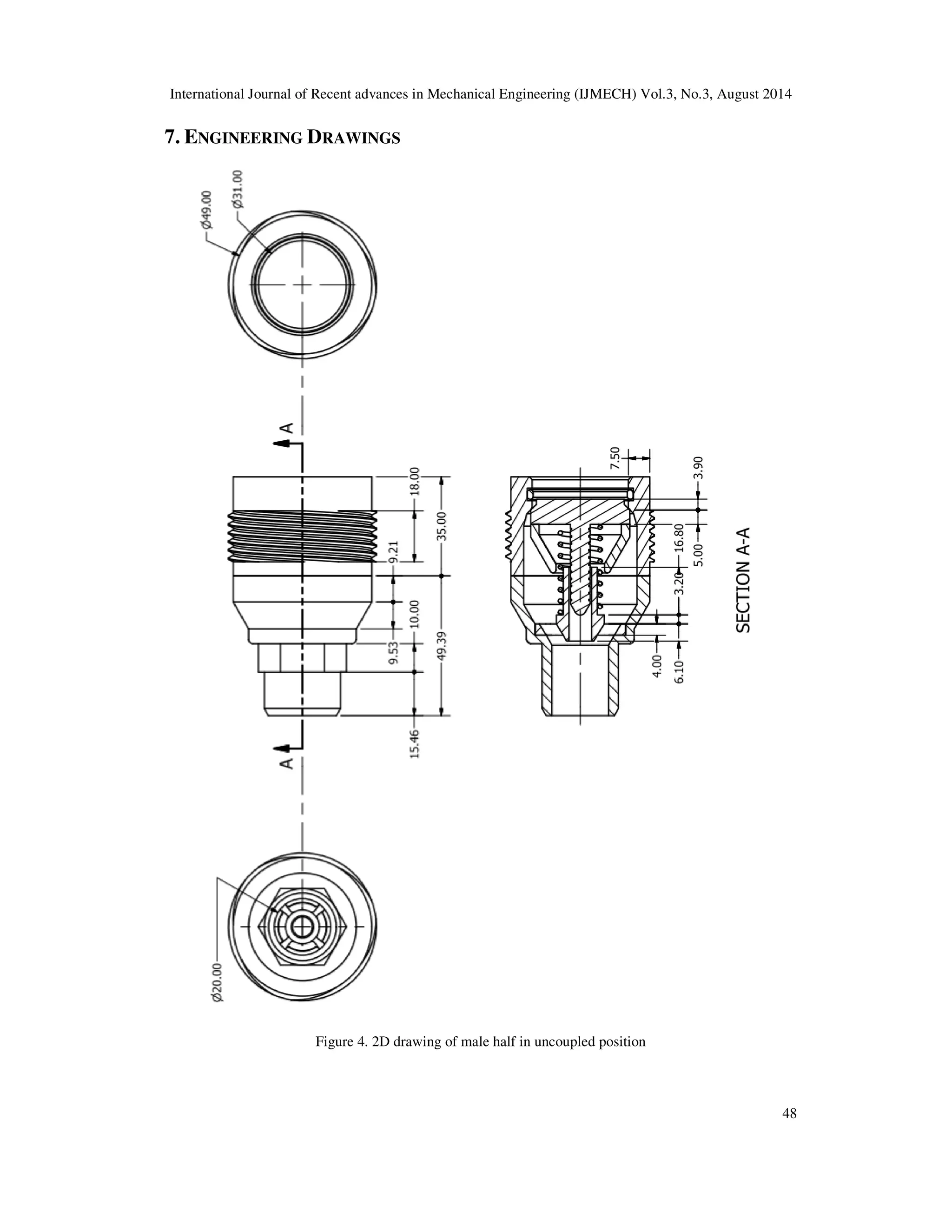
7. ENGINEERING DRAWINGS 
Figure 4. 2D drawing of male half in uncoupled position
International Journal of Recent advances in Mechanical Engineering (IJMECH) Vol.3, No.3, August 2014 
49 
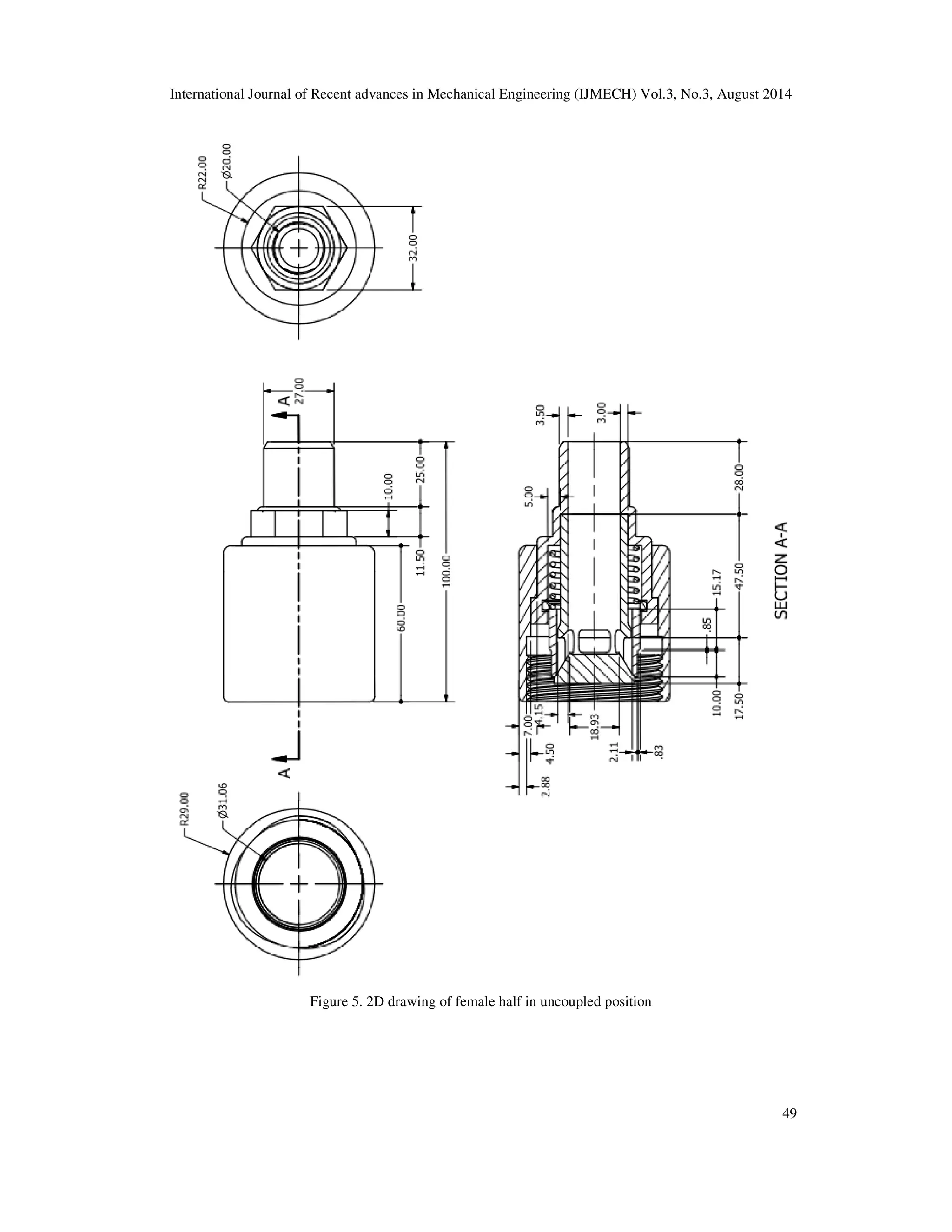
Figure 5. 2D drawing of female half in uncoupled position
International Journal of Recent advances in Mechanical Engineering (IJMECH) Vol.3, No.3, August 2014 
50 
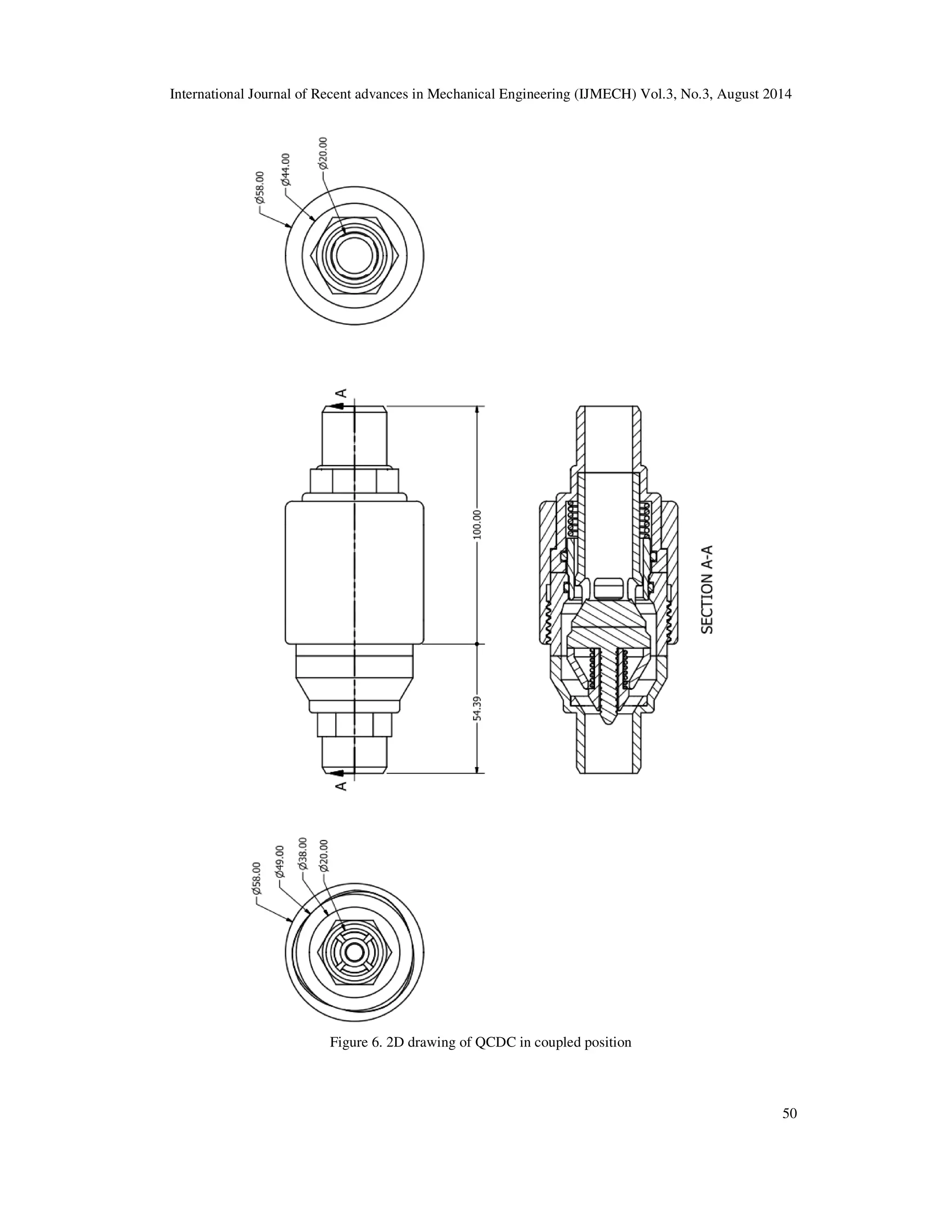
Figure 6. 2D drawing of QCDC in coupled position
International Journal of Recent advances in Mechanical Engineering (IJMECH) Vol.3, No.3, August 2014 
51 
8. CFD ANALYSIS AND RESULTS 
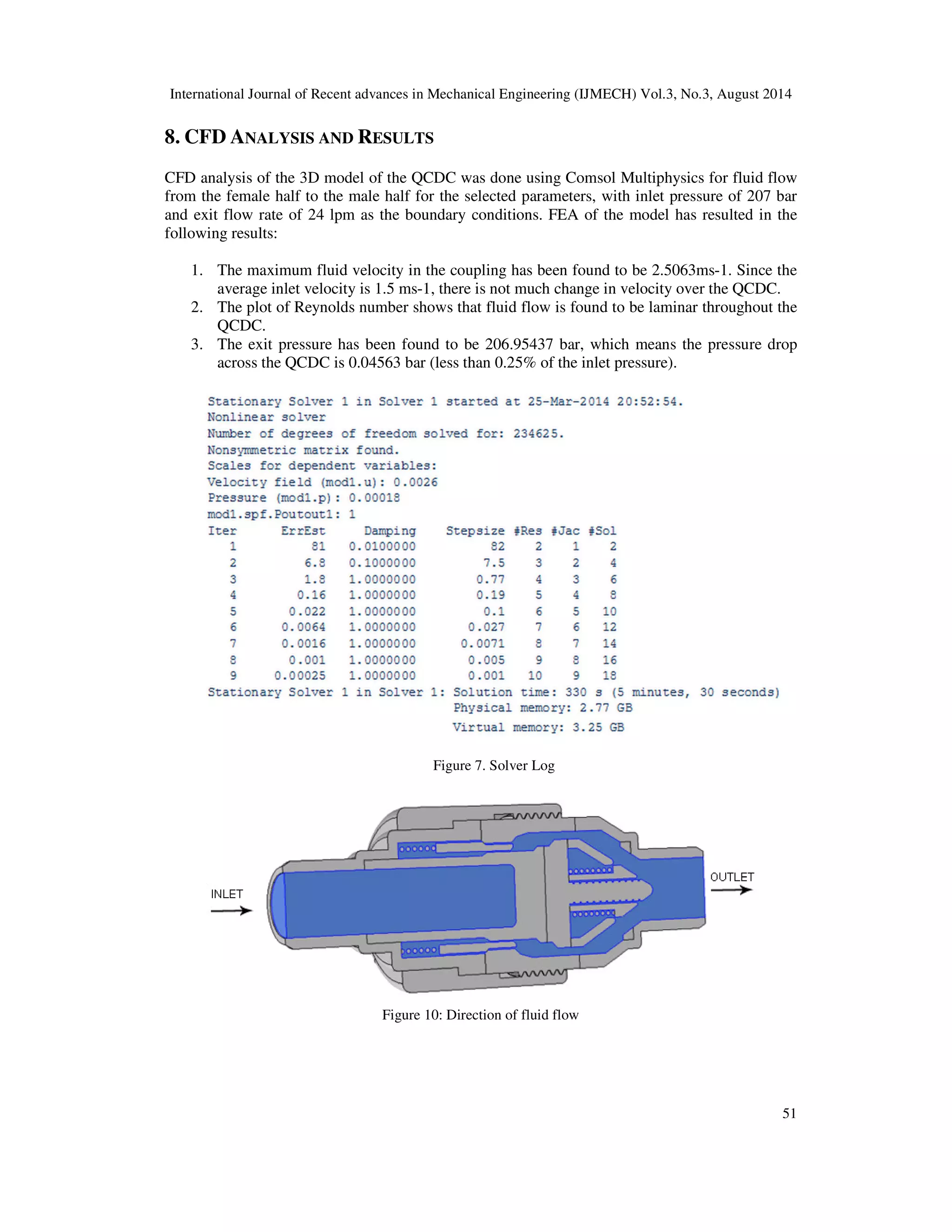
CFD analysis of the 3D model of the QCDC was done using Comsol Multiphysics for fluid flow 
from the female half to the male half for the selected parameters, with inlet pressure of 207 bar 
and exit flow rate of 24 lpm as the boundary conditions. FEA of the model has resulted in the 
following results: 
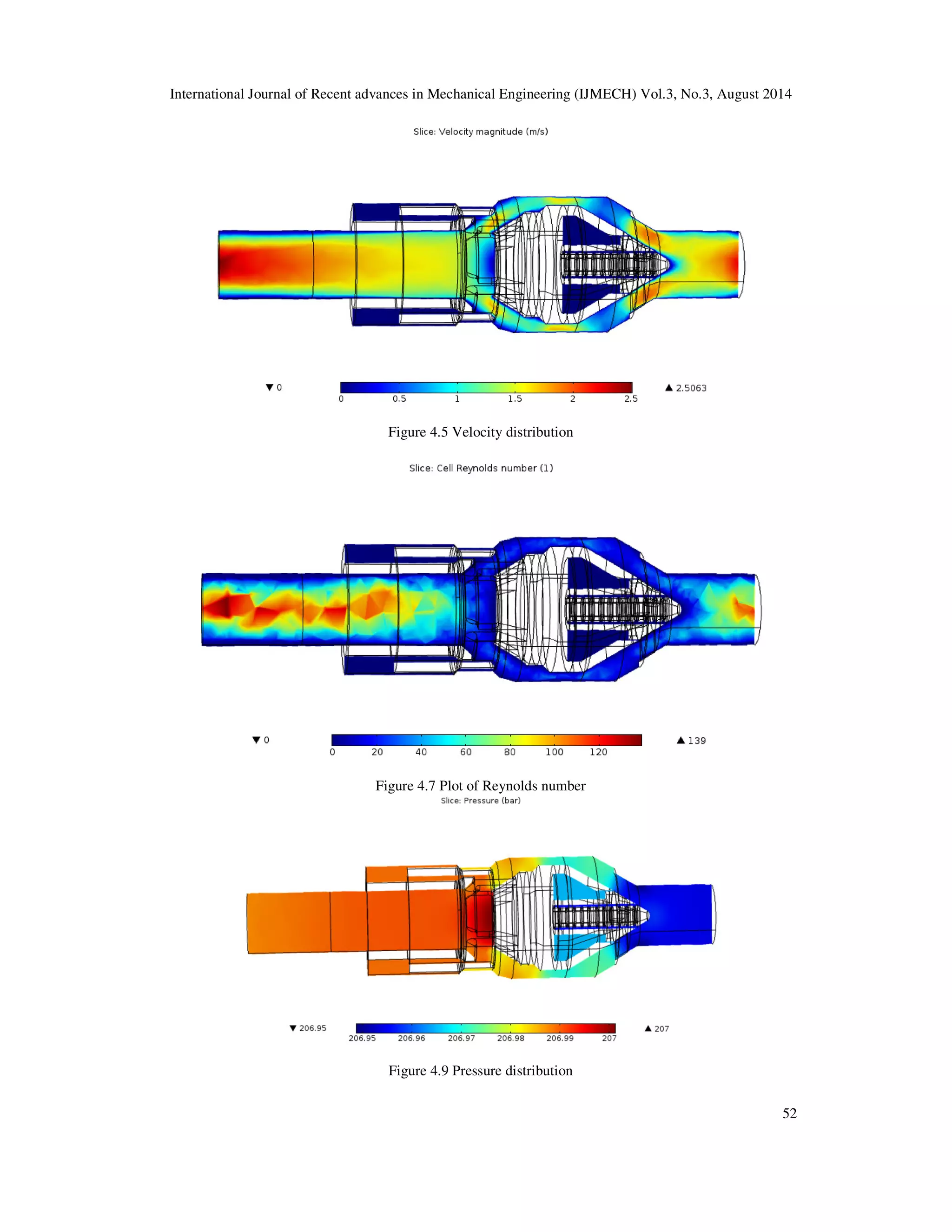
1. The maximum fluid velocity in the coupling has been found to be 2.5063ms-1. Since the 
average inlet velocity is 1.5 ms-1, there is not much change in velocity over the QCDC. 
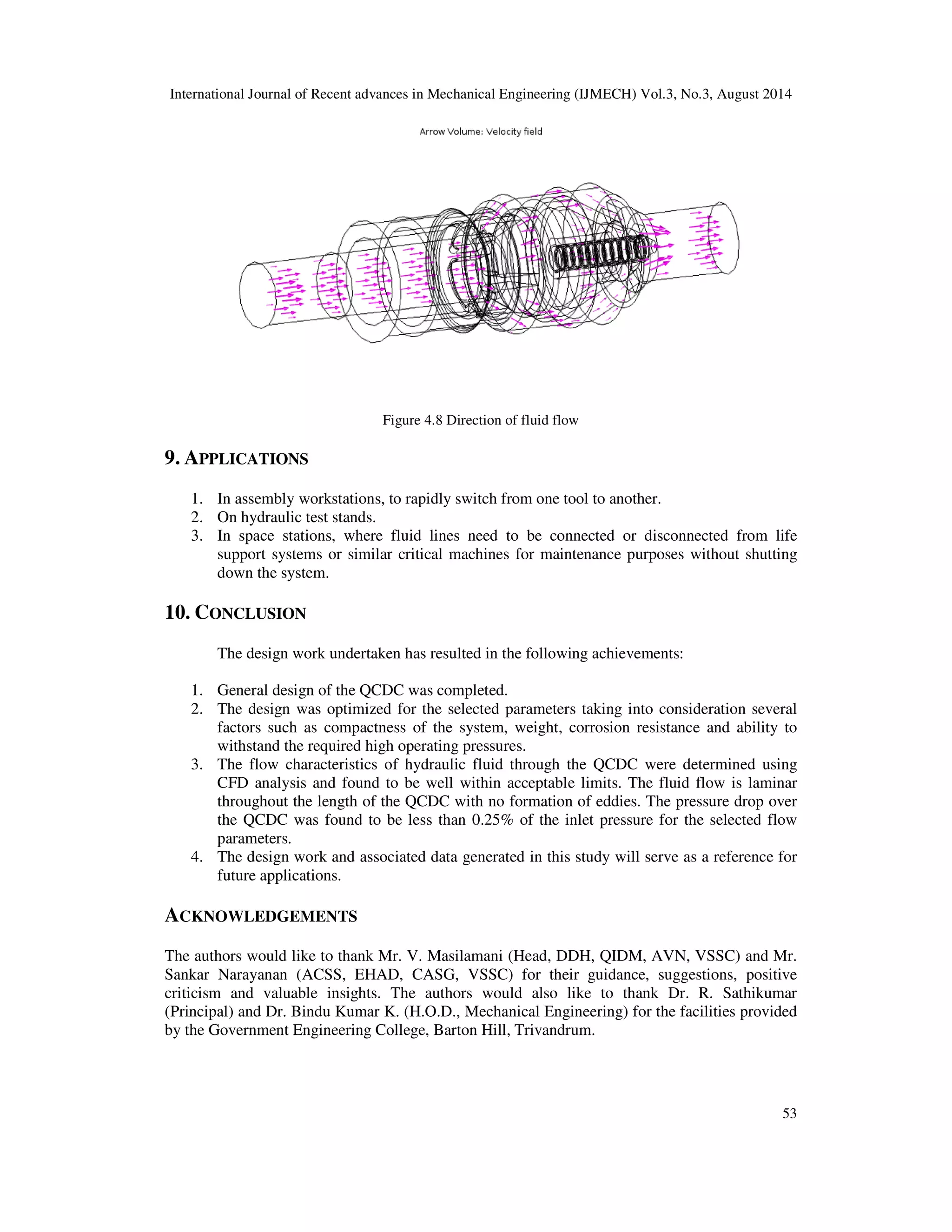
2. The plot of Reynolds number shows that fluid flow is found to be laminar throughout the 
QCDC. 
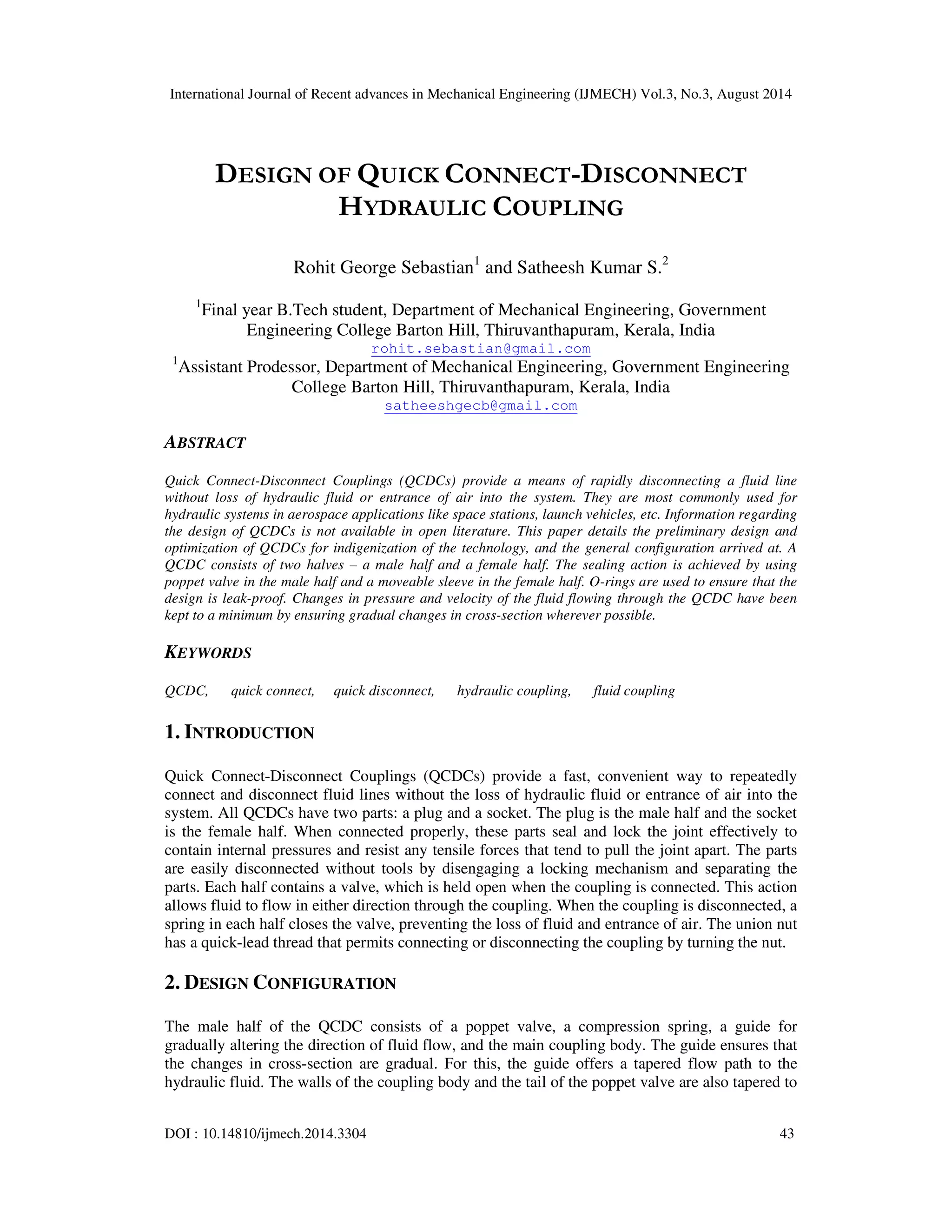
3. The exit pressure has been found to be 206.95437 bar, which means the pressure drop 
across the QCDC is 0.04563 bar (less than 0.25% of the inlet pressure). 
Figure 7. Solver Log 
Figure 10: Direction of fluid flow
International Journal of Recent advances in Mechanical Engineering (IJMECH) Vol.3, No.3, August 2014 
52 
Figure 4.5 Velocity distribution 
Figure 4.7 Plot of Reynolds number 
Figure 4.9 Pressure distribution
International Journal of Recent advances in Mechanical Engineering (IJMECH) Vol.3, No.3, August 2014 
53 
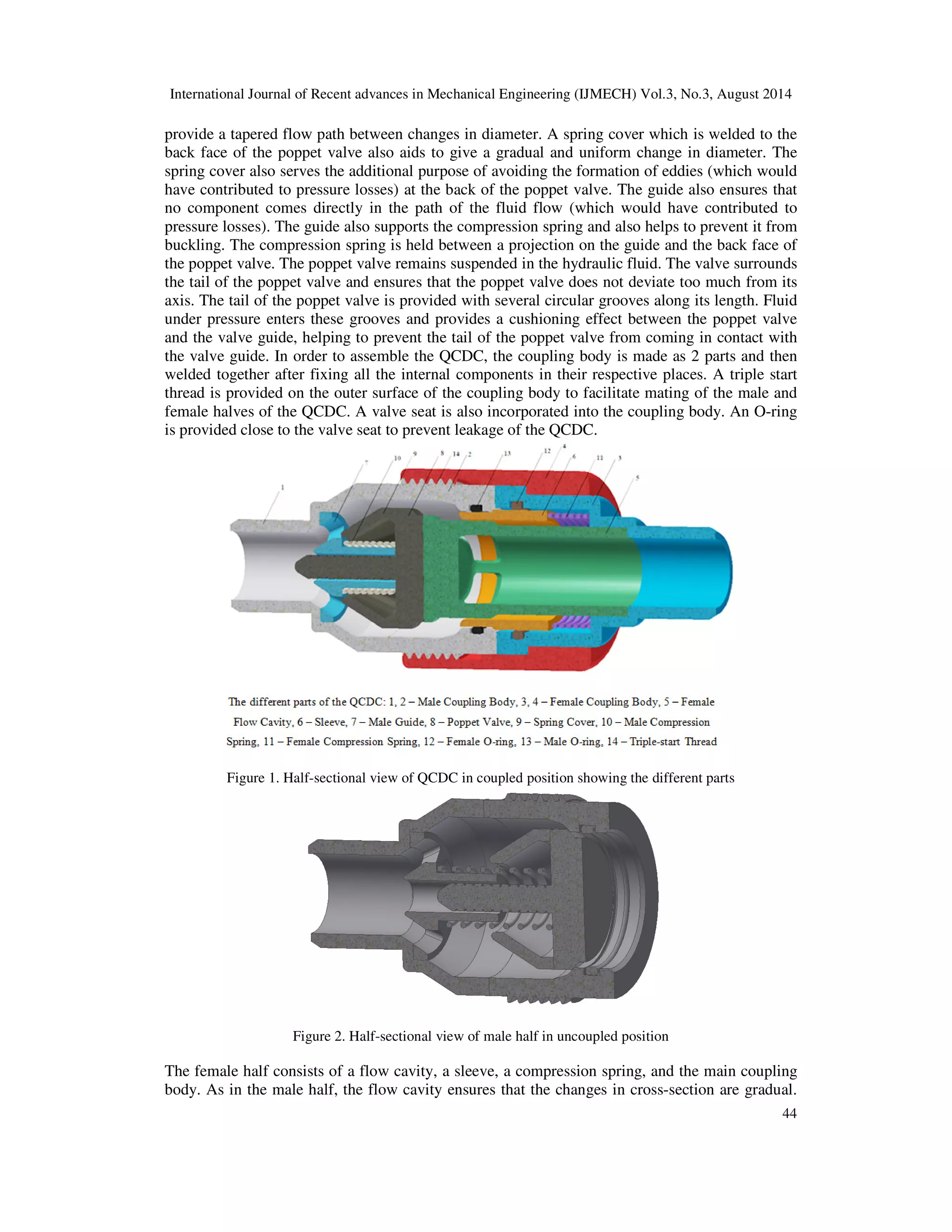
Figure 4.8 Direction of fluid flow 
9. APPLICATIONS 
1. In assembly workstations, to rapidly switch from one tool to another. 
2. On hydraulic test stands. 
3. In space stations, where fluid lines need to be connected or disconnected from life 
support systems or similar critical machines for maintenance purposes without shutting 
down the system. 
10. CONCLUSION 
The design work undertaken has resulted in the following achievements: 
1. General design of the QCDC was completed. 
2. The design was optimized for the selected parameters taking into consideration several 
factors such as compactness of the system, weight, corrosion resistance and ability to 
withstand the required high operating pressures. 
3. The flow characteristics of hydraulic fluid through the QCDC were determined using 
CFD analysis and found to be well within acceptable limits. The fluid flow is laminar 
throughout the length of the QCDC with no formation of eddies. The pressure drop over 
the QCDC was found to be less than 0.25% of the inlet pressure for the selected flow 
parameters. 
4. The design work and associated data generated in this study will serve as a reference for 
future applications. 
ACKNOWLEDGEMENTS 
The authors would like to thank Mr. V. Masilamani (Head, DDH, QIDM, AVN, VSSC) and Mr. 
Sankar Narayanan (ACSS, EHAD, CASG, VSSC) for their guidance, suggestions, positive 
criticism and valuable insights. The authors would also like to thank Dr. R. Sathikumar 
(Principal) and Dr. Bindu Kumar K. (H.O.D., Mechanical Engineering) for the facilities provided 
by the Government Engineering College, Barton Hill, Trivandrum.
International Journal of Recent advances in Mechanical Engineering (IJMECH) Vol.3, No.3, August 2014 
54 
REFERENCES 
[1] AISI Type S15500 (15Cr-5Ni) Precipitation Hardening Stainless Steel tested at 205°C (400°F), 
condition H1025. Available: 
http://asm.matweb.com/search/SpecificMaterial.asp?bassnum=MQM15AM 
[2] Stainless Steel – Precipitation Hardening – 15/5 PH. Available: 
http://www.aalco.co.uk/datasheets/Stainless-Steel_15~5-PH_310.ashx 
[3] 440C Martensitic Stainless Steel Bar. Available: http://www.interlloy.com.au/our-products/stainless-steel/ 
440c-martensitic-stainless-steel-bar/ 
[4] Materials – Music Wire. Available: http://www.springsandthings.com/music-wire.html 
[5] Parker O-ring Handbook. Available: http://www.parker.com/literature/ORD%205700%20Parker_O-Ring_ 
Handbook.pdf 
[6] John F. Harvey (1985) Theory and Design of Pressure Vessels, Van Nostrand Reinhold Company 
Authors 
Rohit George Sebastian is a final year B.Tech student (Mechanical Engineering) studying at 
Government Engineering College, Barton Hill, Thiruvananthapuram. 
Satheesh Kumar S, studied B.Tech (Mechanical Engineering) in College of 
Engineering, Thiruvananthapuram and M.Tech (Machine Design) in IIT Madras. Joined 
Kerala Government Service as Assistant Engineer in 2000 and is currently working as 
Assistant Professor in the Department of Mechanical Engineering, Government 
Engineering College, Barton Hill, Thiruvananthapuram, Kerala.

Design of quick connect disconnect hydraulic coupling

  • 1.
    International Journal ofRecent advances in Mechanical Engineering (IJMECH) Vol.3, No.3, August 2014 DESIGN OF QUICK CONNECT-DISCONNECT HYDRAULIC COUPLING Rohit George Sebastian1 and Satheesh Kumar S.2 1Final year B.Tech student, Department of Mechanical Engineering, Government Engineering College Barton Hill, Thiruvanthapuram, Kerala, India rohit.sebastian@gmail.com 1Assistant Prodessor, Department of Mechanical Engineering, Government Engineering College Barton Hill, Thiruvanthapuram, Kerala, India satheeshgecb@gmail.com ABSTRACT Quick Connect-Disconnect Couplings (QCDCs) provide a means of rapidly disconnecting a fluid line without loss of hydraulic fluid or entrance of air into the system. They are most commonly used for hydraulic systems in aerospace applications like space stations, launch vehicles, etc. Information regarding the design of QCDCs is not available in open literature. This paper details the preliminary design and optimization of QCDCs for indigenization of the technology, and the general configuration arrived at. A QCDC consists of two halves – a male half and a female half. The sealing action is achieved by using poppet valve in the male half and a moveable sleeve in the female half. O-rings are used to ensure that the design is leak-proof. Changes in pressure and velocity of the fluid flowing through the QCDC have been kept to a minimum by ensuring gradual changes in cross-section wherever possible. KEYWORDS QCDC, quick connect, quick disconnect, hydraulic coupling, fluid coupling 1. INTRODUCTION Quick Connect-Disconnect Couplings (QCDCs) provide a fast, convenient way to repeatedly connect and disconnect fluid lines without the loss of hydraulic fluid or entrance of air into the system. All QCDCs have two parts: a plug and a socket. The plug is the male half and the socket is the female half. When connected properly, these parts seal and lock the joint effectively to contain internal pressures and resist any tensile forces that tend to pull the joint apart. The parts are easily disconnected without tools by disengaging a locking mechanism and separating the parts. Each half contains a valve, which is held open when the coupling is connected. This action allows fluid to flow in either direction through the coupling. When the coupling is disconnected, a spring in each half closes the valve, preventing the loss of fluid and entrance of air. The union nut has a quick-lead thread that permits connecting or disconnecting the coupling by turning the nut. 2. DESIGN CONFIGURATION The male half of the QCDC consists of a poppet valve, a compression spring, a guide for gradually altering the direction of fluid flow, and the main coupling body. The guide ensures that the changes in cross-section are gradual. For this, the guide offers a tapered flow path to the hydraulic fluid. The walls of the coupling body and the tail of the poppet valve are also tapered to DOI : 10.14810/ijmech.2014.3304 43
  • 2.
    International Journal ofRecent advances in Mechanical Engineering (IJMECH) Vol.3, No.3, August 2014 provide a tapered flow path between changes in diameter. A spring cover which is welded to the back face of the poppet valve also aids to give a gradual and uniform change in diameter. The spring cover also serves the additional purpose of avoiding the formation of eddies (which would have contributed to pressure losses) at the back of the poppet valve. The guide also ensures that no component comes directly in the path of the fluid flow (which would have contributed to pressure losses). The guide also supports the compression spring and also helps to prevent it from buckling. The compression spring is held between a projection on the guide and the back face of the poppet valve. The poppet valve remains suspended in the hydraulic fluid. The valve surrounds the tail of the poppet valve and ensures that the poppet valve does not deviate too much from its axis. The tail of the poppet valve is provided with several circular grooves along its length. Fluid under pressure enters these grooves and provides a cushioning effect between the poppet valve and the valve guide, helping to prevent the tail of the poppet valve from coming in contact with the valve guide. In order to assemble the QCDC, the coupling body is made as 2 parts and then welded together after fixing all the internal components in their respective places. A triple start thread is provided on the outer surface of the coupling body to facilitate mating of the male and female halves of the QCDC. A valve seat is also incorporated into the coupling body. An O-ring is provided close to the valve seat to prevent leakage of the QCDC. 44 Figure 1. Half-sectional view of QCDC in coupled position showing the different parts Figure 2. Half-sectional view of male half in uncoupled position The female half consists of a flow cavity, a sleeve, a compression spring, and the main coupling body. As in the male half, the flow cavity ensures that the changes in cross-section are gradual.
  • 3.
    International Journal ofRecent advances in Mechanical Engineering (IJMECH) Vol.3, No.3, August 2014 For this, the flow cavity offers a tapered flow path to the hydraulic fluid. The sleeve lies between the flow cavity and the coupling body. The compression spring is held between the inner surface of the coupling body and the back face of the sleeve. The sleeve remains suspended in the hydraulic fluid. An O-ring is provided in the coupling body above the narrow end of the sleeve to prevent leakage of the QCDC. To facilitate easy machining of the gland for the O-ring, the coupling body is made as 2 parts and threaded together. A triple start thread, matching the one on the male half is provided on the coupling body to facilitate mating of the male and female halves of the QCDC. 45 Figure 3. Half-sectional view of female half in uncoupled position In the closed or uncoupled position, the poppet valve in the male half pushes against a valve seat preventing leakage of hydraulic fluid and any entry of air into the system. The compression spring keeps the poppet valve firmly seated against the valve seat in the uncoupled or closed position. In the female half of the QCDC, a sleeve is responsible for sealing action in the closed or uncoupled condition. The compression spring pushes the sleeve against a valve seat. In the coupled position, the flat face of the female half pushes against the head of the poppet valve, pushing it backwards. At the same time, the valve seat in the male half pushes the sleeve in the female half backwards, opening a path for the hydraulic fluid to flow. The fluid flows over the circular face of the female half and the poppet valve in the male half in an annular flow path formed by the mating of the two coupling halves. 3. DESIGN PARAMETERS 1. Operating Static Pressure – 20.7MPa 2. Burst Pressure – 82.8MPa 3. Rated Flow – 23L/min 4. Inlet Flow Velocity – 1.5m/s 5. Specific Gravity of Fluid – 0.85 6. Kinematic Viscosity of Fluid – 14.2cSt 4. MATERIAL SELECTION The coupling should be made of a material with high yield stress (to minimize weight) and with high corrosion resistance to prevent corrosion due to the fluid flowing inside. 15-5 PH stainless steel (with yield stress of 958MPa[1] Rockwell C hardness 40[2]) has been chosen to make the coupling body, which includes the stoppers and guides for the poppet valve. 15-5 PH steel has high strength and hardness along with excellent corrosion resistance, making it ideally suited for this application. The valve seat should be able to withstand shearing forces due to the force
  • 4.
    International Journal ofRecent advances in Mechanical Engineering (IJMECH) Vol.3, No.3, August 2014 imparted by the poppet valve when it is seated (these forces are due to fluid pressure acting on the back of the poppet head and due to the force from the spring), despite having a small area of contact with the inner wall of the coupling. Hence, 15-5 PH steel is suitable for the valve seats as well. For proper seating of the poppet valve, the valve seat must be softer than the valve, so that it can deform slightly (a slight deformation of the valve seat is required for the proper seating of the valve). Also the same time, the sleeve should bear the pressure of the hydraulic fluid in the uncoupled position. For this, a material with hardness greater than that of 15-5PH stainless steel while still having high yield strength is needed. AISI 440C Martensitic stainless steel hardened by quenching in oil at 1030oC and tempered at 150oC (with yield stress of 1930MPa and Rockwell C hardness 60[3]) has been chosen for the poppet valve and the sleeve. The most suitable material for springs are those which can store up the maximum amount of work or energy in a given weight or volume of spring material, without permanent deformation. These steels should have a high elastic limit as well as high deflection value. Spring steel should also possess maximum strength against fatigue effects and shocks. For the compression spring, we have chosen music wire.[4] The compound for the O-ring is selected considering several factors such as fluid compatibility, the effect of various operating environments and conditions, etc. We are designing a QCDC for use with a petroleum-based hydraulic fluid. Considering compatibility with the hydraulic fluid and the required operating conditions, Acrylonitrile-Butadiene (NBR) is the best suited compound for the O-ring.[5] 46 Table 1. Parts and the materials chosen Sl. No. Part Material Chosen 1 Male Coupling Body 1 15-5 PH stainless steel 2 Male Coupling Body 2 15-5 PH stainless steel 3 Female Coupling Body 1 15-5 PH stainless steel 4 Female Coupling Body 2 15-5 PH stainless steel 5 Female Flow Cavity 15-5 PH stainless steel 6 Male Guide 15-5 PH stainless steel 7 Sleeve AISI 440C Martensitic stainless steel 8 Poppet Valve AISI 440C Martensitic stainless steel 9 Spring Cover AISI 440C Martensitic stainless steel 10 Compression spring for male half Music wire 11 Compression spring for female half Music wire 12 O-ring for male half Acrylonitrile-Butadiene 13 O-ring for female half Acrylonitrile-Butadiene
  • 5.
    International Journal ofRecent advances in Mechanical Engineering (IJMECH) Vol.3, No.3, August 2014 47 5. DESIGN OF INDIVIDUAL COMPONENTS The body of the QCDC can be considered as a pressure vessel. For ease of machining and assembly, both male and female halves of the coupling have been designed as two separate parts. The two parts of the male half are welded together along the circumference of the meeting edges, by butt welding using either TIG welding or electron beam welding. The two parts of the female coupling are threaded together, and for this, threads are cut on the parts as shown in the figure. The thickness of the body for different diameters were found based on strength using Lame’s equation [6], with a factor of safety of 2 and a proof pressure of 82.8MPa. According to Lame’s equation, . where, t is the thickness, ri is the internal radius, p is the internal pressure and is the design value of shear stress. The thicknesses of some internal cylindrical components such as the flow cavity of the female half and the sleeve were also found in this way with the same factor of safety, but with a proof pressure of 20.7MPa for the sleeve. The thickness obtained is rounded off to a convenient value, and in some cases, increased to account for additional factors such as cutting of threads, to account for the reduced strength at welded joints, etc. Since the parts joined by threads are of the same material, shear stress occurs at the pitch line. The threads designed have a very high margin of safety. The springs have also been designed to withstand the shear stress caused due to the curvature of the wire and axial loading, with a factor of safety of 1.5. 6. ASSEMBLY The coupling body of the male half of the QCDC is made as 2 pieces. The male guide is threaded to the piece of the male coupling body which has the fluid outlet. The compression spring for the poppet valve is inserted over the cylindrical portion of the male guide, and the poppet valve is inserted such that the cylindrical portion of the male guide covers the stem of the poppet valve and its head rests on the compression spring. The O-ring is inserted into the other piece of the male half coupling body in the groove provided. The poppet valve should be held back before the two pieces of the male half coupling are butt welded together by either TIG welding or electron beam welding. The coupling body of the female half is also made as 2 pieces. The compression spring for the sleeve is inserted into the piece having the hydraulic fluid inlet in the cavity provided for the sleeve and the compression spring. The sleeve is also inserted into the same cavity so that the broader flat face rests on the compression spring. The sleeve should be held back before the female flow cavity is threaded into place. The two pieces of the coupling body of the female half are now threaded together. Since the above mentioned threaded connections (in both the male and female halves) are permanent, they are backed up by industrial grade adhesives in the thread cavity.
  • 6.
    International Journal ofRecent advances in Mechanical Engineering (IJMECH) Vol.3, No.3, August 2014 48 7. ENGINEERING DRAWINGS Figure 4. 2D drawing of male half in uncoupled position
  • 7.
    International Journal ofRecent advances in Mechanical Engineering (IJMECH) Vol.3, No.3, August 2014 49 Figure 5. 2D drawing of female half in uncoupled position
  • 8.
    International Journal ofRecent advances in Mechanical Engineering (IJMECH) Vol.3, No.3, August 2014 50 Figure 6. 2D drawing of QCDC in coupled position
  • 9.
    International Journal ofRecent advances in Mechanical Engineering (IJMECH) Vol.3, No.3, August 2014 51 8. CFD ANALYSIS AND RESULTS CFD analysis of the 3D model of the QCDC was done using Comsol Multiphysics for fluid flow from the female half to the male half for the selected parameters, with inlet pressure of 207 bar and exit flow rate of 24 lpm as the boundary conditions. FEA of the model has resulted in the following results: 1. The maximum fluid velocity in the coupling has been found to be 2.5063ms-1. Since the average inlet velocity is 1.5 ms-1, there is not much change in velocity over the QCDC. 2. The plot of Reynolds number shows that fluid flow is found to be laminar throughout the QCDC. 3. The exit pressure has been found to be 206.95437 bar, which means the pressure drop across the QCDC is 0.04563 bar (less than 0.25% of the inlet pressure). Figure 7. Solver Log Figure 10: Direction of fluid flow
  • 10.
    International Journal ofRecent advances in Mechanical Engineering (IJMECH) Vol.3, No.3, August 2014 52 Figure 4.5 Velocity distribution Figure 4.7 Plot of Reynolds number Figure 4.9 Pressure distribution
  • 11.
    International Journal ofRecent advances in Mechanical Engineering (IJMECH) Vol.3, No.3, August 2014 53 Figure 4.8 Direction of fluid flow 9. APPLICATIONS 1. In assembly workstations, to rapidly switch from one tool to another. 2. On hydraulic test stands. 3. In space stations, where fluid lines need to be connected or disconnected from life support systems or similar critical machines for maintenance purposes without shutting down the system. 10. CONCLUSION The design work undertaken has resulted in the following achievements: 1. General design of the QCDC was completed. 2. The design was optimized for the selected parameters taking into consideration several factors such as compactness of the system, weight, corrosion resistance and ability to withstand the required high operating pressures. 3. The flow characteristics of hydraulic fluid through the QCDC were determined using CFD analysis and found to be well within acceptable limits. The fluid flow is laminar throughout the length of the QCDC with no formation of eddies. The pressure drop over the QCDC was found to be less than 0.25% of the inlet pressure for the selected flow parameters. 4. The design work and associated data generated in this study will serve as a reference for future applications. ACKNOWLEDGEMENTS The authors would like to thank Mr. V. Masilamani (Head, DDH, QIDM, AVN, VSSC) and Mr. Sankar Narayanan (ACSS, EHAD, CASG, VSSC) for their guidance, suggestions, positive criticism and valuable insights. The authors would also like to thank Dr. R. Sathikumar (Principal) and Dr. Bindu Kumar K. (H.O.D., Mechanical Engineering) for the facilities provided by the Government Engineering College, Barton Hill, Trivandrum.
  • 12.
    International Journal ofRecent advances in Mechanical Engineering (IJMECH) Vol.3, No.3, August 2014 54 REFERENCES [1] AISI Type S15500 (15Cr-5Ni) Precipitation Hardening Stainless Steel tested at 205°C (400°F), condition H1025. Available: http://asm.matweb.com/search/SpecificMaterial.asp?bassnum=MQM15AM [2] Stainless Steel – Precipitation Hardening – 15/5 PH. Available: http://www.aalco.co.uk/datasheets/Stainless-Steel_15~5-PH_310.ashx [3] 440C Martensitic Stainless Steel Bar. Available: http://www.interlloy.com.au/our-products/stainless-steel/ 440c-martensitic-stainless-steel-bar/ [4] Materials – Music Wire. Available: http://www.springsandthings.com/music-wire.html [5] Parker O-ring Handbook. Available: http://www.parker.com/literature/ORD%205700%20Parker_O-Ring_ Handbook.pdf [6] John F. Harvey (1985) Theory and Design of Pressure Vessels, Van Nostrand Reinhold Company Authors Rohit George Sebastian is a final year B.Tech student (Mechanical Engineering) studying at Government Engineering College, Barton Hill, Thiruvananthapuram. Satheesh Kumar S, studied B.Tech (Mechanical Engineering) in College of Engineering, Thiruvananthapuram and M.Tech (Machine Design) in IIT Madras. Joined Kerala Government Service as Assistant Engineer in 2000 and is currently working as Assistant Professor in the Department of Mechanical Engineering, Government Engineering College, Barton Hill, Thiruvananthapuram, Kerala.