June 2023
Connected future:
How cloud drives
business innovation
TCS Global Cloud Study
2
Call to action
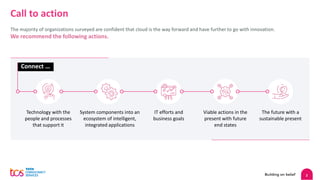
The majority of organizations surveyed are confident that cloud is the way forward and have further to go with innovation.
We recommend the following actions.
Technology with the
people and processes
that support it
System components into an
ecosystem of intelligent,
integrated applications
IT efforts and
business goals
Viable actions in the
present with future
end states
The future with a
sustainable present
Connect …
The current state of
cloud-enabled innovation
4
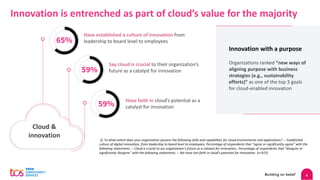
Innovation is entrenched as part of cloud’s value for the majority
Cloud &
innovation
Have established a culture of innovation from
leadership to board level to employees
65%
59%
Say cloud is crucial to their organization’s
future as a catalyst for innovation
59%
Have faith in cloud’s potential as a
catalyst for innovation
Innovation with a purpose
Organizations ranked “new ways of
aligning purpose with business
strategies (e.g., sustainability
efforts)” as one of the top 3 goals
for cloud-enabled innovation
Q. To what extent does your organization possess the following skills and capabilities for cloud environments and applications? :- Established
culture of digital innovation, from leadership to board level to employees; Percentage of respondents that “agree or significantly agree” with the
following statements. :- Cloud is crucial to our organization's future as a catalyst for innovation.; Percentage of respondents that “disagree or
significantly disagree” with the following statements. :- We have lost faith in cloud's potential for innovation. (n=972)
5
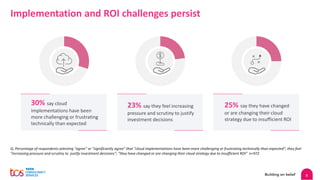
Q. Percentage of respondents selecting “agree” or “significantly agree” that “cloud implementations have been more challenging or frustrating technically than expected”; they feel
“increasing pressure and scrutiny to justify investment decisions”; “they have changed or are changing their cloud strategy due to insufficient ROI” n=972
Implementation and ROI challenges persist
30% say cloud
implementations have been
more challenging or frustrating
technically than expected
23% say they feel increasing
pressure and scrutiny to justify
investment decisions
25% say they have changed
or are changing their cloud
strategy due to insufficient ROI
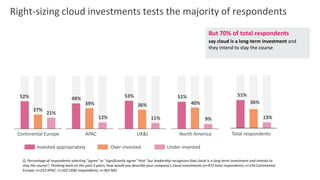
Right-sizing cloud investments tests the majority of respondents
TCS Confidential
But 70% of total respondents
say cloud is a long-term investment and
they intend to stay the course
Q. Percentage of respondents selecting “agree” or “significantly agree” that “our leadership recognizes that cloud is a long-term investment and intends to
stay the course”; Thinking back on the past 3 years, how would you describe your company's cloud investments (n=972 total respondents; n=256 Continental
Europe; n=252 APAC; n=102 UK&I respondents; n=362 NA)
52%
27%
21%
Continental Europe
48%
39%
12%
APAC
53%
36%
11%
UK&I
51%
40%
9%
North America
Invested appropriately Over-invested Under-invested
51%
13%
36%
Total respondents
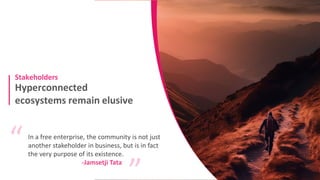
Hyperconnected
ecosystems remain elusive
Stakeholders
In a free enterprise, the community is not just
another stakeholder in business, but is in fact
the very purpose of its existence.
“ “
-Jamsetji Tata
8
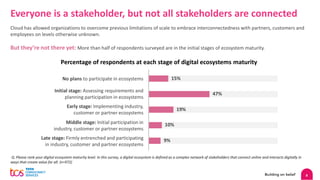
Everyone is a stakeholder, but not all stakeholders are connected
Cloud has allowed organizations to overcome previous limitations of scale to embrace interconnectedness with partners, customers and
employees on levels otherwise unknown.
But they’re not there yet: More than half of respondents surveyed are in the initial stages of ecosystem maturity.
Percentage of respondents at each stage of digital ecosystems maturity
No plans to participate in ecosystems
Initial stage: Assessing requirements and
planning participation in ecosystems
Early stage: Implementing industry,
customer or partner ecosystems
Middle stage: Initial participation in
industry, customer or partner ecosystems
Late stage: Firmly entrenched and participating
in industry, customer and partner ecosystems
Q. Please rank your digital ecosystem maturity level. In this survey, a digital ecosystem is defined as a complex network of stakeholders that connect online and interacts digitally in
ways that create value for all. (n=972)
15%
47%
19%
10%
9%
9
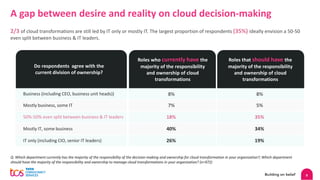
A gap between desire and reality on cloud decision-making
2/3 of cloud transformations are still led by IT only or mostly IT. The largest proportion of respondents (35%) ideally envision a 50-50
even split between business & IT leaders.
Business (including CEO, business unit heads))
Q. Which department currently has the majority of the responsibility of the decision-making and ownership for cloud transformation in your organization?; Which department
should have the majority of the responsibility and ownership to manage cloud transformations in your organization? (n=972)
Do respondents agree with the
current division of ownership?
8% 8%
IT only (including CIO, senior IT leaders) 26% 19%
Mostly IT, some business 40% 34%
50%-50% even split between business & IT leaders 18% 35%
Mostly business, some IT 7% 5%
Roles who currently have the
majority of the responsibility
and ownership of cloud
transformations
Roles that should have the
majority of the responsibility
and ownership of cloud
transformations
Stronger data governance sets
the stage for greater access,
investment and reporting
Insights
The best vision is insight.
“
“
- Malcolm Forbes
11
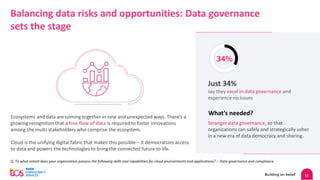
Balancing data risks and opportunities: Data governance
sets the stage
Ecosystems and data are coming together in new and unexpected ways. There’s a
growing recognition that a free flow of data is required to foster innovations
among the multi-stakeholders who comprise the ecosystem.
Cloud is the unifying digital fabric that makes this possible – it democratizes access
to data and powers the technologies to bring the connected future to life.
Q. To what extent does your organization possess the following skills and capabilities for cloud environments and applications? :- Data governance and compliance
What’s needed?
34%
Just 34%
say they excel in data governance and
experience no issues
Stronger data governance, so that
organizations can safely and strategically usher
in a new era of data democracy and sharing.
12
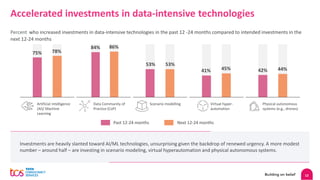
Accelerated investments in data-intensive technologies
Percent who increased investments in data-intensive technologies in the past 12 -24 months compared to intended investments in the
next 12-24 months
Investments are heavily slanted toward AI/ML technologies, unsurprising given the backdrop of renewed urgency. A more modest
number – around half – are investing in scenario modeling, virtual hyperautomation and physical autonomous systems.
Artificial Intelligence
(AI)/ Machine
Learning
Data Community of
Practice (CoP)
Scenario modelling Virtual hyper-
automation
Physical autonomous
systems (e.g., drones)
75% 78%
84% 86%
53% 53%
41% 45% 42% 44%
Next 12-24 months
Past 12-24 months
13
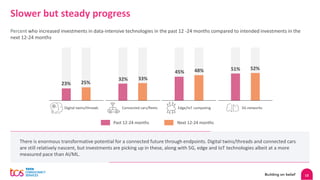
Slower but steady progress
Percent who increased investments in data-intensive technologies in the past 12 -24 months compared to intended investments in the
next 12-24 months
There is enormous transformative potential for a connected future through endpoints. Digital twins/threads and connected cars
are still relatively nascent, but investments are picking up in these, along with 5G, edge and IoT technologies albeit at a more
measured pace than AI/ML.
Digital twins/threads Connected cars/fleets Edge/IoT computing 5G networks
23% 25%
32% 33%
45% 48% 51% 52%
Next 12-24 months
Past 12-24 months
14
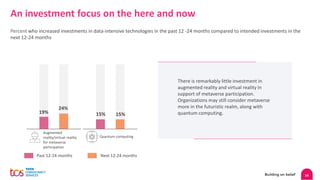
An investment focus on the here and now
Percent who increased investments in data-intensive technologies in the past 12 -24 months compared to intended investments in the
next 12-24 months
There is remarkably little investment in
augmented reality and virtual reality in
support of metaverse participation.
Organizations may still consider metaverse
more in the futuristic realm, along with
quantum computing.
Augmented
reality/virtual reality
for metaverse
participation
Quantum computing
19%
24%
15% 15%
Next 12-24 months
Past 12-24 months
15
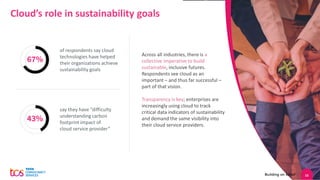
Cloud’s role in sustainability goals
of respondents say cloud
technologies have helped
their organizations achieve
sustainability goals
67%
43%
say they have “difficulty
understanding carbon
footprint impact of
cloud service provider”
Across all industries, there is a
collective imperative to build
sustainable, inclusive futures.
Respondents see cloud as an
important – and thus far successful –
part of that vision.
Transparency is key; enterprises are
increasingly using cloud to track
critical data indicators of sustainability
and demand the same visibility into
their cloud service providers.
Flexibility falters amid
greater complexity
Expertise
Sustaining innovation is the
lifeblood of any enterprise.
“ “
- Geoffrey Moore
17
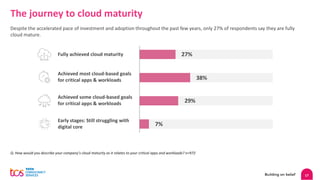
The journey to cloud maturity
Despite the accelerated pace of investment and adoption throughout the past few years, only 27% of respondents say they are fully
cloud mature.
Fully achieved cloud maturity
Achieved most cloud-based goals
for critical apps & workloads
Achieved some cloud-based goals
for critical apps & workloads
Early stages: Still struggling with
digital core
Q. How would you describe your company’s cloud maturity as it relates to your critical apps and workloads? n=972
27%
38%
29%
7%
18
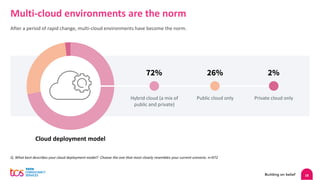
Multi-cloud environments are the norm
After a period of rapid change, multi-cloud environments have become the norm.
Q. What best describes your cloud deployment model? Choose the one that most closely resembles your current scenario. n=972
Cloud deployment model
Hybrid cloud (a mix of
public and private)
72%
Public cloud only
26%
Private cloud only
2%
19
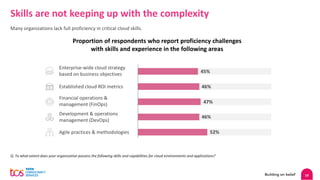
Skills are not keeping up with the complexity
Many organizations lack full proficiency in critical cloud skills.
Q. To what extent does your organization possess the following skills and capabilities for cloud environments and applications?
Proportion of respondents who report proficiency challenges
with skills and experience in the following areas
Enterprise-wide cloud strategy
based on business objectives
Established cloud ROI metrics
Financial operations &
management (FinOps)
Development & operations
management (DevOps)
Agile practices & methodologies
45%
46%
47%
46%
52%
20
Q. Proportion of all respondents saying that the following are the biggest obstacles to cloud-enabled innovation; To what extent does your organization possess the following skills and
capabilities for cloud environments and applications? :- Security (apps, data, etc.).
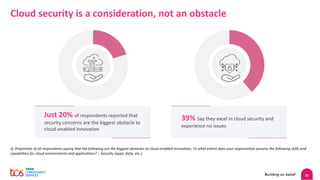
Cloud security is a consideration, not an obstacle
Just 20% of respondents reported that
security concerns are the biggest obstacle to
cloud-enabled innovation
39% Say they excel in cloud security and
experience no issues
21
Q. How often do you need to customize your ERP system to accommodate new functionality or business requirements? n=972
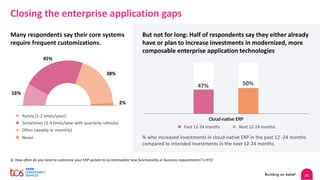
Closing the enterprise application gaps
Many respondents say their core systems
require frequent customizations.
45%
16%
38%
2%
Rarely (1-2 times/year)
Sometimes (3-4 times/year with quarterly rollouts)
Often (weekly or monthly)
Never
But not for long: Half of respondents say they either already
have or plan to increase investments in modernized, more
composable enterprise application technologies
Cloud-native ERP
Past 12-24 months Next 12-24 months
% who increased investments in cloud-native ERP in the past 12 -24 months
compared to intended investments in the next 12-24 months
47% 50%
22
Have already adopted industry-specific cloud solutions
or capabilities
Currently adopting industry-specific cloud solutions
or capabilities
Assessing requirements and planning implementation
of industry-specific cloud solutions or capabilities
No plans to adopt industry cloud
Q. Have you considered or are you considering adopting industry cloud solutions or capabilities? In this survey, an industry cloud is defined as a vertical cloud environment heavily
customized for a particular industry. n=972
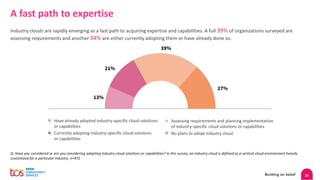
A fast path to expertise
Industry clouds are rapidly emerging as a fast path to acquiring expertise and capabilities. A full 39% of organizations surveyed are
assessing requirements and another 34% are either currently adopting them or have already done so.
39%
21%
13%
27%
23
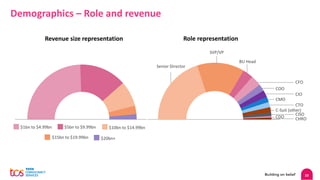
$10bn to $14.99bn
$5bn to $9.99bn
$1bn to $4.99bn
$20bn+
$15bn to $19.99bn
Demographics – Role and revenue
Senior Director
SVP/VP
BU Head
CFO
COO
CIO
CMO
CTO
C-Suit (other)
CISO
CDO CHRO
Revenue size representation Role representation
24
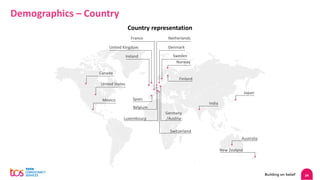
Demographics – Country
Country representation
United States
Canada
Mexico
United Kingdom
Ireland
Germany
/Austria
Switzerland
France Netherlands
Denmark
Spain
Luxembourg
Belgium
Norway
Sweden
Finland
India
Australia
New Zealand
Japan
25
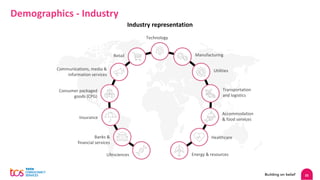
Demographics - Industry
Industry representation
Technology
Manufacturing
Utilities
Transportation
and logistics
Accommodation
& food services
Healthcare
Energy & resources
Lifesciences
Banks &
financial services
Insurance
Consumer packaged
goods (CPG)
Communications, media &
information services
Retail
Connected Future: How Cloud
Drives Business Innovation
TCS Global Cloud Study
Download
the Article
Contact Us

TCS Global Cloud Study – Key Findings

  • 1.
    June 2023 Connected future: Howcloud drives business innovation TCS Global Cloud Study
  • 2.
    2 Call to action Themajority of organizations surveyed are confident that cloud is the way forward and have further to go with innovation. We recommend the following actions. Technology with the people and processes that support it System components into an ecosystem of intelligent, integrated applications IT efforts and business goals Viable actions in the present with future end states The future with a sustainable present Connect …
  • 3.
    The current stateof cloud-enabled innovation
  • 4.
    4 Innovation is entrenchedas part of cloud’s value for the majority Cloud & innovation Have established a culture of innovation from leadership to board level to employees 65% 59% Say cloud is crucial to their organization’s future as a catalyst for innovation 59% Have faith in cloud’s potential as a catalyst for innovation Innovation with a purpose Organizations ranked “new ways of aligning purpose with business strategies (e.g., sustainability efforts)” as one of the top 3 goals for cloud-enabled innovation Q. To what extent does your organization possess the following skills and capabilities for cloud environments and applications? :- Established culture of digital innovation, from leadership to board level to employees; Percentage of respondents that “agree or significantly agree” with the following statements. :- Cloud is crucial to our organization's future as a catalyst for innovation.; Percentage of respondents that “disagree or significantly disagree” with the following statements. :- We have lost faith in cloud's potential for innovation. (n=972)
  • 5.
    5 Q. Percentage ofrespondents selecting “agree” or “significantly agree” that “cloud implementations have been more challenging or frustrating technically than expected”; they feel “increasing pressure and scrutiny to justify investment decisions”; “they have changed or are changing their cloud strategy due to insufficient ROI” n=972 Implementation and ROI challenges persist 30% say cloud implementations have been more challenging or frustrating technically than expected 23% say they feel increasing pressure and scrutiny to justify investment decisions 25% say they have changed or are changing their cloud strategy due to insufficient ROI
  • 6.
    Right-sizing cloud investmentstests the majority of respondents TCS Confidential But 70% of total respondents say cloud is a long-term investment and they intend to stay the course Q. Percentage of respondents selecting “agree” or “significantly agree” that “our leadership recognizes that cloud is a long-term investment and intends to stay the course”; Thinking back on the past 3 years, how would you describe your company's cloud investments (n=972 total respondents; n=256 Continental Europe; n=252 APAC; n=102 UK&I respondents; n=362 NA) 52% 27% 21% Continental Europe 48% 39% 12% APAC 53% 36% 11% UK&I 51% 40% 9% North America Invested appropriately Over-invested Under-invested 51% 13% 36% Total respondents
  • 7.
    Hyperconnected ecosystems remain elusive Stakeholders Ina free enterprise, the community is not just another stakeholder in business, but is in fact the very purpose of its existence. “ “ -Jamsetji Tata
  • 8.
    8 Everyone is astakeholder, but not all stakeholders are connected Cloud has allowed organizations to overcome previous limitations of scale to embrace interconnectedness with partners, customers and employees on levels otherwise unknown. But they’re not there yet: More than half of respondents surveyed are in the initial stages of ecosystem maturity. Percentage of respondents at each stage of digital ecosystems maturity No plans to participate in ecosystems Initial stage: Assessing requirements and planning participation in ecosystems Early stage: Implementing industry, customer or partner ecosystems Middle stage: Initial participation in industry, customer or partner ecosystems Late stage: Firmly entrenched and participating in industry, customer and partner ecosystems Q. Please rank your digital ecosystem maturity level. In this survey, a digital ecosystem is defined as a complex network of stakeholders that connect online and interacts digitally in ways that create value for all. (n=972) 15% 47% 19% 10% 9%
  • 9.
    9 A gap betweendesire and reality on cloud decision-making 2/3 of cloud transformations are still led by IT only or mostly IT. The largest proportion of respondents (35%) ideally envision a 50-50 even split between business & IT leaders. Business (including CEO, business unit heads)) Q. Which department currently has the majority of the responsibility of the decision-making and ownership for cloud transformation in your organization?; Which department should have the majority of the responsibility and ownership to manage cloud transformations in your organization? (n=972) Do respondents agree with the current division of ownership? 8% 8% IT only (including CIO, senior IT leaders) 26% 19% Mostly IT, some business 40% 34% 50%-50% even split between business & IT leaders 18% 35% Mostly business, some IT 7% 5% Roles who currently have the majority of the responsibility and ownership of cloud transformations Roles that should have the majority of the responsibility and ownership of cloud transformations
  • 10.
    Stronger data governancesets the stage for greater access, investment and reporting Insights The best vision is insight. “ “ - Malcolm Forbes
  • 11.
    11 Balancing data risksand opportunities: Data governance sets the stage Ecosystems and data are coming together in new and unexpected ways. There’s a growing recognition that a free flow of data is required to foster innovations among the multi-stakeholders who comprise the ecosystem. Cloud is the unifying digital fabric that makes this possible – it democratizes access to data and powers the technologies to bring the connected future to life. Q. To what extent does your organization possess the following skills and capabilities for cloud environments and applications? :- Data governance and compliance What’s needed? 34% Just 34% say they excel in data governance and experience no issues Stronger data governance, so that organizations can safely and strategically usher in a new era of data democracy and sharing.
  • 12.
    12 Accelerated investments indata-intensive technologies Percent who increased investments in data-intensive technologies in the past 12 -24 months compared to intended investments in the next 12-24 months Investments are heavily slanted toward AI/ML technologies, unsurprising given the backdrop of renewed urgency. A more modest number – around half – are investing in scenario modeling, virtual hyperautomation and physical autonomous systems. Artificial Intelligence (AI)/ Machine Learning Data Community of Practice (CoP) Scenario modelling Virtual hyper- automation Physical autonomous systems (e.g., drones) 75% 78% 84% 86% 53% 53% 41% 45% 42% 44% Next 12-24 months Past 12-24 months
  • 13.
    13 Slower but steadyprogress Percent who increased investments in data-intensive technologies in the past 12 -24 months compared to intended investments in the next 12-24 months There is enormous transformative potential for a connected future through endpoints. Digital twins/threads and connected cars are still relatively nascent, but investments are picking up in these, along with 5G, edge and IoT technologies albeit at a more measured pace than AI/ML. Digital twins/threads Connected cars/fleets Edge/IoT computing 5G networks 23% 25% 32% 33% 45% 48% 51% 52% Next 12-24 months Past 12-24 months
  • 14.
    14 An investment focuson the here and now Percent who increased investments in data-intensive technologies in the past 12 -24 months compared to intended investments in the next 12-24 months There is remarkably little investment in augmented reality and virtual reality in support of metaverse participation. Organizations may still consider metaverse more in the futuristic realm, along with quantum computing. Augmented reality/virtual reality for metaverse participation Quantum computing 19% 24% 15% 15% Next 12-24 months Past 12-24 months
  • 15.
    15 Cloud’s role insustainability goals of respondents say cloud technologies have helped their organizations achieve sustainability goals 67% 43% say they have “difficulty understanding carbon footprint impact of cloud service provider” Across all industries, there is a collective imperative to build sustainable, inclusive futures. Respondents see cloud as an important – and thus far successful – part of that vision. Transparency is key; enterprises are increasingly using cloud to track critical data indicators of sustainability and demand the same visibility into their cloud service providers.
  • 16.
    Flexibility falters amid greatercomplexity Expertise Sustaining innovation is the lifeblood of any enterprise. “ “ - Geoffrey Moore
  • 17.
    17 The journey tocloud maturity Despite the accelerated pace of investment and adoption throughout the past few years, only 27% of respondents say they are fully cloud mature. Fully achieved cloud maturity Achieved most cloud-based goals for critical apps & workloads Achieved some cloud-based goals for critical apps & workloads Early stages: Still struggling with digital core Q. How would you describe your company’s cloud maturity as it relates to your critical apps and workloads? n=972 27% 38% 29% 7%
  • 18.
    18 Multi-cloud environments arethe norm After a period of rapid change, multi-cloud environments have become the norm. Q. What best describes your cloud deployment model? Choose the one that most closely resembles your current scenario. n=972 Cloud deployment model Hybrid cloud (a mix of public and private) 72% Public cloud only 26% Private cloud only 2%
  • 19.
    19 Skills are notkeeping up with the complexity Many organizations lack full proficiency in critical cloud skills. Q. To what extent does your organization possess the following skills and capabilities for cloud environments and applications? Proportion of respondents who report proficiency challenges with skills and experience in the following areas Enterprise-wide cloud strategy based on business objectives Established cloud ROI metrics Financial operations & management (FinOps) Development & operations management (DevOps) Agile practices & methodologies 45% 46% 47% 46% 52%
  • 20.
    20 Q. Proportion ofall respondents saying that the following are the biggest obstacles to cloud-enabled innovation; To what extent does your organization possess the following skills and capabilities for cloud environments and applications? :- Security (apps, data, etc.). Cloud security is a consideration, not an obstacle Just 20% of respondents reported that security concerns are the biggest obstacle to cloud-enabled innovation 39% Say they excel in cloud security and experience no issues
  • 21.
    21 Q. How oftendo you need to customize your ERP system to accommodate new functionality or business requirements? n=972 Closing the enterprise application gaps Many respondents say their core systems require frequent customizations. 45% 16% 38% 2% Rarely (1-2 times/year) Sometimes (3-4 times/year with quarterly rollouts) Often (weekly or monthly) Never But not for long: Half of respondents say they either already have or plan to increase investments in modernized, more composable enterprise application technologies Cloud-native ERP Past 12-24 months Next 12-24 months % who increased investments in cloud-native ERP in the past 12 -24 months compared to intended investments in the next 12-24 months 47% 50%
  • 22.
    22 Have already adoptedindustry-specific cloud solutions or capabilities Currently adopting industry-specific cloud solutions or capabilities Assessing requirements and planning implementation of industry-specific cloud solutions or capabilities No plans to adopt industry cloud Q. Have you considered or are you considering adopting industry cloud solutions or capabilities? In this survey, an industry cloud is defined as a vertical cloud environment heavily customized for a particular industry. n=972 A fast path to expertise Industry clouds are rapidly emerging as a fast path to acquiring expertise and capabilities. A full 39% of organizations surveyed are assessing requirements and another 34% are either currently adopting them or have already done so. 39% 21% 13% 27%
  • 23.
    23 $10bn to $14.99bn $5bnto $9.99bn $1bn to $4.99bn $20bn+ $15bn to $19.99bn Demographics – Role and revenue Senior Director SVP/VP BU Head CFO COO CIO CMO CTO C-Suit (other) CISO CDO CHRO Revenue size representation Role representation
  • 24.
    24 Demographics – Country Countryrepresentation United States Canada Mexico United Kingdom Ireland Germany /Austria Switzerland France Netherlands Denmark Spain Luxembourg Belgium Norway Sweden Finland India Australia New Zealand Japan
  • 25.
    25 Demographics - Industry Industryrepresentation Technology Manufacturing Utilities Transportation and logistics Accommodation & food services Healthcare Energy & resources Lifesciences Banks & financial services Insurance Consumer packaged goods (CPG) Communications, media & information services Retail
  • 26.
    Connected Future: HowCloud Drives Business Innovation TCS Global Cloud Study Download the Article Contact Us