Key Findings:
Accenture's Intelligent
Enterprise Services Survey
HERE
TO STAY
Oil and Gas Perspective
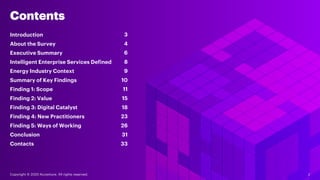
Contents
Energy Industry Context
8
Summary of Key Findings
11
Finding 2: Value 15
Finding 3: Digital Catalyst 18
Finding 4: New Practitioners 23
Finding 5: Ways of Working 26
Conclusion 31
Introduction 3
Intelligent Enterprise Services Defined
9
About the Survey
6
Contacts 33
4
Executive Summary
Finding 1: Scope
10
Copyright © 2020 Accenture. All rights reserved. 2
Introduction
• There continues to be a dramatic shift in shared services models
• The rumor that shared services is dying because of robotic process
automation (RPA) and artificial intelligence (AI) is unfounded
• New technologies eliminate transactional work. However, the need
for people who can manage complexity, implement standardization,
employ new technologies and find new ways to generate benefits is
increasing
• Many companies in the oil and gas, chemical, mining and metals,
forest products and utilities industries are scaling or plan to scale
shared services
The result is the rise of Intelligent Enterprise Services (IES),
the next generation shared services operating model
3Copyright © 2020 Accenture. All rights reserved.
Accenture, in collaboration with a third-party research agency, McGuire
Research Services Inc., conducted a global study with 120 shared services
senior executives in the oil and gas, utilities, chemicals, mining and metals,
and forest products industries.
4Copyright © 2020 Accenture. All rights reserved.
In scope:
• Companies with single or multi-functional shared services organizations,
captive and/or outsourced
• Results of direct respondents’ follow-up discussions with Accenture, where
respondents discussed their individual results in comparison to the baseline
• Respondents’ companies are headquartered in 27 countries
• Revenue ranges from approximately $2 billion to $50 billion
About the survey
About the survey
37%
5Copyright © 2020 Accenture. All rights reserved.
Respondents companysize in revenue
28% 26%
18% 17%
12%
Our analysis of the total sample data shows that the
overall findings are very much in line with our
experience working with oil and gas companies around
the world. What follows is a presentation of the overall
findings with insights for the oil and gas industry.
Sample composition:
Respondents company headquartered
in 27 countries across 5 regions
37%
27% 26%
6% 4%
Europe
Asia Pacific
North America
Middle East & Africa
Latin America
More than $20B
$10.1-$20B
$5.1-$10B
$3.1-$5B
$3B or less
Oil and gas n=30
Mining and metals,
forest products n=30
Utilities n=30
Chemicals n=30
EXECUTIVE
SUMMARY
Copyright © 2020 Accenture. All rights reserved. 6
Shared services organizations are in a unique position to
transform cost structure and how services are delivered
across the enterprise. The organization is reinventing
itself and leaping into a new era enabled by IES.
The expansion and growth of traditional “back office” processes into
shared services has accelerated companies’ digital and innovation
agendas.
With this continued momentum of improving and automating
performance, IES leaders are also being asked to scale to enable
enterprise-wide change beyond cost reduction.
Digital transformation is quickly becoming a pivotal part of IES
organizations, whose talent needs are rapidly evolving and forcing other
similar organizations to redefine skill profiles required for success.
Traditional end-to-end operating model process orientations, ways of
working, governance and third-party partnerships are being challenged to
pivot to become business and outcome orientations.
Accenture’s research examines
the emergence of Intelligent
Enterprise Services (IES) and
the transformational role it plays
in enabling enterprise-wide
change.
Executive summary
7Copyright © 2020 Accenture. All rights reserved.
MATURITY
Intelligent Enterprise Services defined
EXECUTIVE SUMMARY
Shared services is evolving to drive greater enterprise outcomes through technology, innovation and insights
8Copyright © 2020 Accenture. All rights reserved.
Maturing Models Emerging ModelsENTERPRISE
VALUE
Intelligent Enterprise
Services
1 2 3 4
Functional
Multi-functional
End-to-end process
Experience-based
offerings
Global Business
Services
Multi-functional
Discrete
Survey findings indicate that oil and gas companies are using shared services to:
• Continue to reduce costs
• Accelerate the digital transformation of processes
• Centralize and utilize data and analytics
• Improve quality and control
• Enable growth, especially through M&A but also divestitures
• Engage third parties to support strategic initiatives
The majority are transforming their traditional shared services models in some aspects to help
them better navigate the consistent volatility and demands of their markets.
WITHIN THE FULL SAMPLE OF 120 RESPONDENTS:
Energy industry context
62% said they are exploring
greater use of AI
37% said automation of complex
activities will be the top application
of AI in the next three years
49% said they were already offering
analytics as a service
38% said they would be offering analytics
as a service within the next year
44% said they will move post-merger
integration planning and
management activities to shared
services or outsourcing
Copyright © 2020 Accenture. All rights reserved. 9
EXECUTIVE SUMMARY
Summary of key findings:
Intelligent Enterprise Services survey
KEY FINDINGS
01
IES is being asked to
integrate more breadth
and depth into new
scope—92 percent of
respondents overall have
plans to add scope
02
Cost reduction is no
longer the number one
expected benefit of
leveraging this model;
37 percent considered
quality and accuracy as
the highest value
drivers
03
The IES model is a
catalyst for digital
transformation—97
percent cite it as the
best place to drive
digitalization after
centralization and
standardization
04
A new breed of shared
services practitioner is
emerging—one with
functional, industry and
technical expertise, with
more than 60 percent
listing technology as a
required new skill
05
Business leaders are
rethinking how to use
this model more
strategically to
maximize value for the
enterprise—75 percent
use a partner through
outsourcing or blended
hybrid in their delivery
models
IES is becoming the catalyst for driving enterprise-wide transformation through
technology, innovation and insights. Analysis of the 120 responses reveal:
10Copyright © 2020 Accenture. All rights reserved.
01IES is being asked to integrate more breadth and
depth—among all respondents, 92 percent have
plans to move scope into shared services centers
11Copyright © 2020 Accenture. All rights reserved.
IES urged to integrate more breadth
and depth into new scope
FINDING 1:
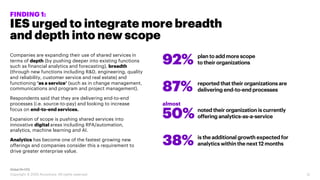
Companies are expanding their use of shared services in
terms of depth (by pushing deeper into existing functions
such as financial analytics and forecasting), breadth
(through new functions including R&D, engineering, quality
and reliability, customer service and real estate) and
functioning ‘as a service’ (such as in change management,
communications and program and project management).
Respondents said that they are delivering end-to-end
processes (i.e. source-to-pay) and looking to increase
focus on end-to-end services.
Expansion of scope is pushing shared services into
innovative digital areas including RPA/automation,
analytics, machine learning and AI.
Analytics has become one of the fastest growing new
offerings and companies consider this a requirement to
drive greater enterprise value.
plan to add more scope
to their organizations
reported that their organizations are
delivering end-to-end processes
noted their organization is currently
offering analytics-as-a-service
is the additional growth expected for
analytics within the next 12 months
92%
87%
50%
38%
almost
12Copyright © 2020 Accenture. All rights reserved.
Global (N=120).
Number of companies that plan
to move, automate, and/or
outsource in the next three years
FINDING 1:
What business processes is your organization planning to move to shared services
center, outsource, move back to business or automate in the near future (1-3 years)?
Business processes Companies
Information Technology 42
Supply Chain/Manufacturing 32
Research & Development 24
Sales and Marketing 24
Quality Assurance 23
Program and Project Management 23
Customer Service 22
Human Resources 22
Procurement 21
Finance 19
Health, Safety & Environment 15
Change Management & Communication 14
Engineering 9
Real Estate and Facilities 9
Mergers & Acquisitions 9
Energy companies are looking to move more functional
scope into their shared services companies as a way to better
manage costs across the enterprise.
Global (N=120). Responses over 100 percent due to multiple choices. 13Copyright © 2020 Accenture. All rights reserved.
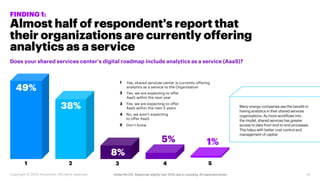
Almost half of respondent's report that
their organizations are currently offering
analytics as a service
FINDING 1:
Many energy companies see the benefit in
having analytics in their shared services
organizations. As more workflows into
the model, shared services has greater
access to data from end-to-end processes.
This helps with better cost control and
management of capital.
Does your shared services center’s digital roadmap include analytics as a service (AaaS)?
Global (N=120). Responses slightly over 100% due to rounding. All responses shown.
1%5%
8%
38%
49%
54321
1 Yes, shared services center is currently offering
analytics as a service to the Organization
Yes, we are expecting to offer
AaaS within the next year
Yes, we are expecting to offer
AaaS within the next 5 years
No, we aren’t expecting
to offer AaaS
Don’t know
2
3
4
5
14Copyright © 2020 Accenture. All rights reserved.
02Cost reduction is no longer the number one expected
benefit of leveraging this model; 37 percent considered
quality and accuracy as the highest value drivers
15Copyright © 2020 Accenture. All rights reserved.
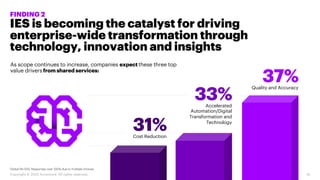
IES is becoming the catalyst for driving
enterprise-wide transformation through
technology, innovation and insights
As scope continues to increase, companies expect these three top
value drivers from shared services:
FINDING 2
16Copyright © 2020 Accenture. All rights reserved.
37%Quality and Accuracy
33%Accelerated
Automation/Digital
Transformation and
Technology
31%Cost Reduction
Global (N=120). Responses over 100% due to multiple choices.
Expectations on shared services are
expanding beyond traditional value drivers
FINDING 2
Global (N=120). Responses over 100% due to multiple choices.
37%
33%
31%
29%
28%
28%
28%
Quality and accuracy
Accelerated automation/digital
transformation and technology
innovation
Cost reduction
Process optimization
and standardization
Flexibility
Enable growth
Continuous improvement
BENEFIT 1
• Shared services’ ability to drive standardization
enables accurate information and data-driven
insights to improve business decisions and
subsequent outcomes
• Shared services reduces audit cost and effort
BENEFIT 2
• Shared services model accelerates
enterprise-wide digital agendas
• Greater receptiveness to adopt new technologies
• Greater willingness to use third-party
partners to help deliver digital programs
• Frees up capacity for new and
differentiated services
BENEFIT 3
• Service management increases the
transparency of the cost to serve
• Baselines cost and performance to
drive continuous improvement
• Measures improvement and
incentivizes the right behavior
• Automates where possible and
reinvests in innovation
17Copyright © 2020 Accenture. All rights reserved.
Energycompaniestend
tostillseethismodelasa
waytodecreaseoverall
enterprisecosts.
However,manyreport
thatbystandardizing
processesinthemodel
thattheycanbetter
automatethose
processeswhichalso
improvesqualityand
control.
What are the greatest benefits your organization expected from shared services
when you started your shared services center journey?
03The model is a catalyst for digital transformation—
97 percent of the 120 respondents believe it is the
best place to drive digitalization after centralization
and standardization
18Copyright © 2020 Accenture. All rights reserved.
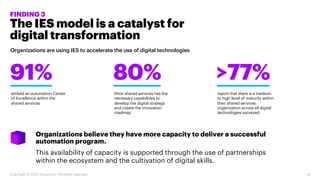
The IES model is a catalyst for
digital transformation
Organizations are using IES to accelerate the use of digital technologies
FINDING 3
Organizations believe they have more capacity to deliver a successful
automation program.
This availability of capacity is supported through the use of partnerships
within the ecosystem and the cultivation of digital skills.
>77%
report that there is a medium
to high level of maturity within
their shared services
organization across all digital
technologies surveyed
80%
think shared services has the
necessary capabilities to
develop the digital strategy
and create the innovation
roadmap
91%
embed an automation Center
of Excellence within the
shared services
19Copyright © 2020 Accenture. All rights reserved.
82%
of respondents standardized and/
or centralized processes before
automating. This practice is reported
across all business functions. These
are automated using a range of
technologies including RPA, AI,
analytics, blockchain and cloud-
based platforms.
37%
of respondents estimate that
digital technologies account for
25-49%
of the total shared services budget.
The high level of funding the shared
services organization is receiving for
digital technologies supports its
expected role in driving automation.
42%
of IES organizations report to the
CIO, who is also reported to be the
driver of enterprise-wide digital
decisions. IES organizations will
need to continuously evolve
governance to support automation
programs and achieve expected
business outcomes.82%
of respondents centralize and
standardize processes before
automating
Global (N=120).
20Copyright © 2020 Accenture. All rights reserved.
FINDING 3
50 percent standardize and 32 percent
centralize first when implementing
their shared services center model
For your organization, what did you focus on first when
implementing your shared services center model?
0%
50%
32%
16%
3%
Automating
processes instead of
centralizing them
(i.e., automate
and shift)
Centralizing
processes before
automating them
(i.e., automate
and shift)
Standardizing
processes, before
centralizing and
automating them
(i.e., lift, shift and
automate
Don’t know Automating
processes instead
of centralizing them
21Copyright © 2020 Accenture. All rights reserved.
Global (N=120).
IES organizations believe they have
a high to medium level of maturity
in the following technologies:
FINDING 3
93%
Analytics
Empowers the use
of data to make
more informed
business decisions
and generate
actionable insights
90%
Cloud-based
Platforms
Enables the ability
to freely access and
use applications on
demand via the
internet
89%
Reporting
VisualizationTools
Transforms data
into visual reports
that are easily
digestible for
anyone
80%
AI/Machine
Learning
Provides systems
the ability to
automatically learn
and improve from
experience without
being explicitly
programmed
80%
Blockchain
Allows digital
information to be
distributed, but not
copied, while enabling
the transparency,
security and
accessibility
of the data
77%
RPA
Allows the
configuration of
computer software
to emulate the
actions of a human
to handle
high-volume,
repeatable tasks
What is the level of automation maturity within your shared services center
in your organization? Within the shared services center?
Global (N=120).
22Copyright © 2020 Accenture. All rights reserved.
04A new breed of practitioner is emerging—one with functional,
industry and technical expertise—more than 60 percent list
technology as a required new skill
23Copyright © 2020 Accenture. All rights reserved.
Practitioners with functional, industry and
technical expertise are emerging
FINDING 4
55%said that talent quality is
the top priority for their
IES organizations
A new scope and digital transformation drive the need for a new skill set
65%see an increased need to
build up skills for digital
(RPA and AI)
>40%see an increased need to build
up functional and industry
skills, like agility and decision
making, change management
and communication, and
commercial acumen and
partnering
24Copyright © 2020 Accenture. All rights reserved.
Global (N=120).
IES Top Talent Priorities
60% of top priorities are
digital skills
FINDING 4
• Emerging technologies like RPA, AI and cloud
computing require IES organizations to refocus their
skills priorities
• Talent is being replaced with functional and technical
acumen along with curiosity, agility and self-learning
• The workforce of the future will require an updated
approach to acquire, develop and retain talent
• Companies need a strong focus on using technologies
that can be directly tied to achieve business outcomes,
promote new career paths and change the way
employees are measured and rewarded
What shared services center roles are currently your
Organization’s highest priority?
13%
Machine Learning/
AI Expert
17%Cloud Expert
11%RPA Expert
12%
Predictive Analytics
& Data Scientist
7%
Collaboration
Tool Expert
3%Controls Expert
8%
Change
Manager
8%
Service and
Improvement Manager
14%Project Manager
7%Process Expert
Digital Non-digital
Shared services is
driving the digital
transformation for the
whole company― and
that requires the right
skills
Copyright © 2020 Accenture. All rights reserved. 25
Global (N=120).
05
26Copyright © 2020 Accenture. All rights reserved. 2626
Business leaders are rethinking how to use this model more
strategically to maximize value for the enterprise—75 percent
use a partner through outsourcing or blended hybrid in their
delivery models
Global Delivery
Model
Organizational
Structure
Governance Ecosystem
Partners
Business leaders aim to use this model
more strategically for maximum value
FINDING 5
Business leaders are faced with increasing shareholder demands at a time of industry
volatility and market pricing pressures.
IES is a proven model that can help reduce costs to service, standardize processes for more
consistent business outcomes and enable agility. Currently, business leaders have more
choice on how to manage and utilize IES, including on scope, location, talent, the service
provider and application ecosystem and how to drive enterprise-wide transformation.
They are making strategic IES decisions across the following
dimensions to maximize enterprise value:
27Copyright © 2020 Accenture. All rights reserved.
Global (N=120).
FINDING 5
Global Delivery Model findings
More work is being centralized into global hubs than in regional models
Which of the below is your organization’s primary Shared Services delivery model?
0%
57%
23% 20%
Co-located
functions on a
local/country basis
Other
Global Hub and
Spoke
Regional
28Copyright © 2020 Accenture. All rights reserved.
Global (N=120).
Organizational
Structure findings
FINDING 5
55%
indicate that the CFO is involved in
investment and budget decisions
related to digital technologies
63%
report to the CFO (41 percent)
or CIO (22 percent)
78%
have shared services reporting
to a C-suite leader
The role of the CFOs in shared services organizations
is key to reporting structures, digital investments and
automation decisions along with the CIO
Governance findings
FINDING 5
About 99 percent of respondents have Global
Process Owners (GPOs) in place. Monitoring
performance, reviewing Service Level Agreements
(SLAs) and tracking benefits realization of the end to
end processes play a main role in their organization.
The voice of the customer is also becoming
increasingly important and SLAs are beginning to
focus on outcomes
40%
said SLAs are measuring
shared services outcomes
and/or impacts (such as
working capital, DPO, DSO,
customer satisfaction)
53%
reported having recurring
governance structures that
leverage customer
participation
29Copyright © 2020 Accenture. All rights reserved.
FINDING 5
Global (N=120). Responses over 100 percent due to multiple choices.
Ecosystem Partners findings
The majority of companies are finding value in hybrid, co-sourced delivery models. More
than 70 percent of companies surveyed are adopting outsourcing not only to deliver
services but also to scale faster and have better access to talent at a competitive cost
For your Organization, what are the main drivers to outsourcing business activities
rather than keeping them in house?
32%
Labor
quality
31%
Labor cost
44%
Flexibility and
scalability
35%
Ability to
automate
processes
28%
Third party
expertise
26%
Need to delegate
transactional/
low value add
activities
25%
Proximity
to business
30Copyright © 2020 Accenture. All rights reserved.
Conclusion
IES is an emerging model being used to drive more value across
the enterprise through technology, innovation and analytics. The
opportunities to drive these tangible business and enterprise
outcomes are limited only by enterprises’ willingness to seize on
the opportunities.
Company opportunities
• Accelerating digitalization can free up capacity to support
additional scope and new services; this will also create the need for
new skills and expand career path opportunities for the workforce
• The business will look to IES for advisory support and innovation,
automation and analytics
• As the role of the IES organization expands, changes in the
operating model are needed in order to maximize value for the
enterprise
• Global process owners’ decision rights will increase and focus more
on achieving business outcomes and partnerships with third
parties. These will continue to expand to accelerate the pace of
transformation and cultivate new capabilities in providing
improvements in data, insights and business performance
31Copyright © 2020 Accenture. All rights reserved.
Peggy Krendl
Managing Director
margaret.e.krendl@accenture.com
“The next generation shared services
model is rapidly evolving—it is
customer centric, digital, agile and
outcome obsessed.”
Contacts
Geoff Schuman
Managing Director
geoffrey.s.schuman@accenture.com
“The ability for Intelligent Enterprise Services
to unlock enterprise-wide business
outcomes through technology, innovation,
partnership, and talent development is
impressive!”
32Copyright © 2020 Accenture. All rights reserved.
This document is produced by consultants at Accenture as general guidance. It is not intended to provide
specific advice on your circumstances. If you require advice or further details on any matters referred to,
please contact your Accenture representative.
This document makes reference to marks owned by third parties. All such third-party marks are the
property of their respective owners. No sponsorship, endorsement or approval of this content by the
owners of such marks is intended, expressed or implied.
Accenture is a leading global professional services company,
providing a broad range of services and solutions in
strategy, consulting, digital, technology and operations.
Combining unmatched experience and specialized skills
across more than 40 industries and all business functions—
underpinned by the world’s largest delivery network—
Accenture works at the intersection of business and
technology to help clients improve their performance and
create sustainable value for their stakeholders. With
505,000 people serving clients in more than 120 countries,
Accenture drives innovation to improve the way the world
works and lives. Visit us at www.accenture.com.
Copyright © 2020 Accenture.
All rights reserved.
Accenture and its logo are registered
trademarks of Accenture.
Follow us About Accenture
Explore our Energy Blog
Follow us on LinkedIn
@AccentureEnergy
#digitalenergy