Thermoelectric Phenomena
• Electrically conductive materials exhibit three types of
thermoelectric phenomena:
• the Seebeck effect,
• the Thompson effect, and
• the Peltier effect.
• The use of thermocouples is based on thermoelectric
phenomenon discovered by Thomas Seebeck in 1821.
• When any two metals are connected together, a voltage is
developed which is a function of the temperatures of the
junctions and (mainly) the difference in temperatures.
• It was later found that the Seebeck voltage is the sum of two
effects: the Peltier effect, and the Thompson effect.
• The Peltier effect explains a voltage generated in a junction of
two metal wires.
• The Thompson effect explains a voltage generated by the
temperature gradient in the wires.
EMF Relationships for Thermocouples
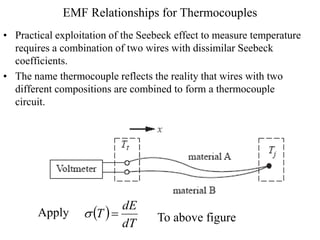
• Practical exploitation of the Seebeck effect to measure temperature
requires a combination of two wires with dissimilar Seebeck
coefficients.
• The name thermocouple reflects the reality that wires with two
different compositions are combined to form a thermocouple
circuit.
Apply  
dT
dE
T 
 To above figure
Misconception in Thermoelectricity
The EMF generated by the Seebeck effect is due to the temperature
gradient along the wire.
The EMF is not generated at the junction between two dissimilar wires.
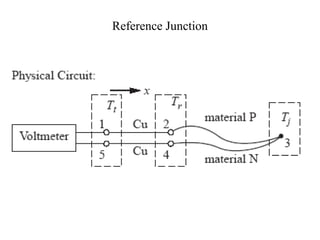
Reference Junction
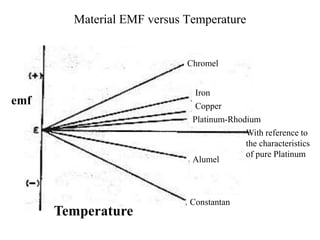
Material EMF versus Temperature
With reference to
the characteristics
of pure Platinum
emf
Temperature
Chromel
Iron
Copper
Platinum-Rhodium
Alumel
Constantan
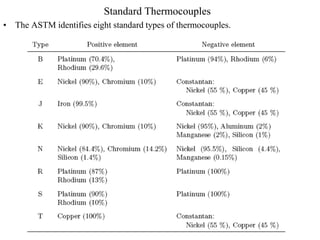
Standard Thermocouples
• The ASTM identifies eight standard types of thermocouples.
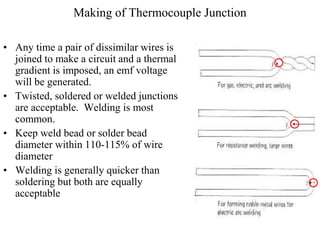
Making of Thermocouple Junction
• Any time a pair of dissimilar wires is
joined to make a circuit and a thermal
gradient is imposed, an emf voltage
will be generated.
• Twisted, soldered or welded junctions
are acceptable. Welding is most
common.
• Keep weld bead or solder bead
diameter within 110-115% of wire
diameter
• Welding is generally quicker than
soldering but both are equally
acceptable

tc.ppt

  • 1.
    Thermoelectric Phenomena • Electricallyconductive materials exhibit three types of thermoelectric phenomena: • the Seebeck effect, • the Thompson effect, and • the Peltier effect. • The use of thermocouples is based on thermoelectric phenomenon discovered by Thomas Seebeck in 1821. • When any two metals are connected together, a voltage is developed which is a function of the temperatures of the junctions and (mainly) the difference in temperatures. • It was later found that the Seebeck voltage is the sum of two effects: the Peltier effect, and the Thompson effect. • The Peltier effect explains a voltage generated in a junction of two metal wires. • The Thompson effect explains a voltage generated by the temperature gradient in the wires.
  • 2.
    EMF Relationships forThermocouples • Practical exploitation of the Seebeck effect to measure temperature requires a combination of two wires with dissimilar Seebeck coefficients. • The name thermocouple reflects the reality that wires with two different compositions are combined to form a thermocouple circuit. Apply   dT dE T   To above figure
  • 3.
    Misconception in Thermoelectricity TheEMF generated by the Seebeck effect is due to the temperature gradient along the wire. The EMF is not generated at the junction between two dissimilar wires.
  • 4.
  • 5.
    Material EMF versusTemperature With reference to the characteristics of pure Platinum emf Temperature Chromel Iron Copper Platinum-Rhodium Alumel Constantan
  • 6.
    Standard Thermocouples • TheASTM identifies eight standard types of thermocouples.
  • 7.
    Making of ThermocoupleJunction • Any time a pair of dissimilar wires is joined to make a circuit and a thermal gradient is imposed, an emf voltage will be generated. • Twisted, soldered or welded junctions are acceptable. Welding is most common. • Keep weld bead or solder bead diameter within 110-115% of wire diameter • Welding is generally quicker than soldering but both are equally acceptable