Total Chinese Lesson 1.1 Chinese Pronunciation Guide
Learning Objectives:
After completing this chapter, your will:
• Learn about Chinese Pinyin System
• Become familiar with syllabic structure, pinyin, and pronunciation
• Use common expressions in the classroom and daily life
What is Pinyin?
The Pinyin system is a pronunciation method used in Mainland China and language programs
world wide to learn the sounds of Chinese. It used the letters of the Latin alphabet and tone
marks to represent the sounds of Chinese. It will be helpful to learn Chinese pronunciation with
pinyin since there is no clear connection between the Chinese characters and Chinese
pronunciation.
Structure of Chinese Syllabus
Each Chinese character has its own syllable. A Chinese syllable consists of three parts: an initial,
a final, and the tone. For example: 好 hǎo (h initial, ao – final, v – tone) There are 21 initials, 35
finals and 4 tones. Altogether, there are 417 syllables, one pinyin syllable can have many
different characters. Tones play a very important role in differentiating these characters with the
same pinyin syllable.
-------------------------------------------------------------------------------------------------------------
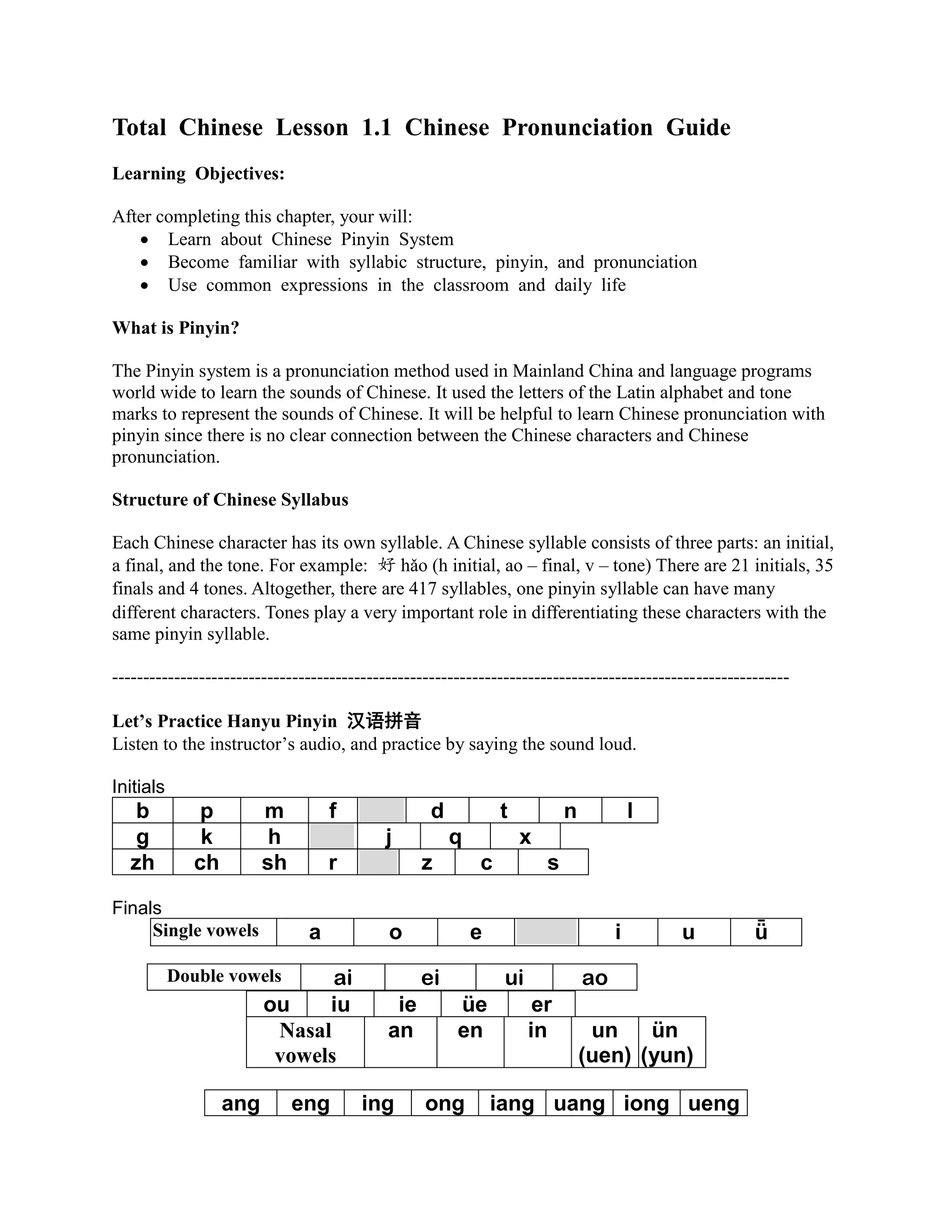
Let’s Practice Hanyu Pinyin 汉语拼音
Listen to the instructor’s audio, and practice by saying the sound loud.
Initials
b p m f d t n l
g k h j q x
zh ch sh r z c s
Finals
Single vowels a o e i u ǖ
ou iu ie üe er
Nasal
vowels
an en in un
(uen)
ün
(yun)
ang eng ing ong iang uang iong ueng
Double vowels ai ei ui ao
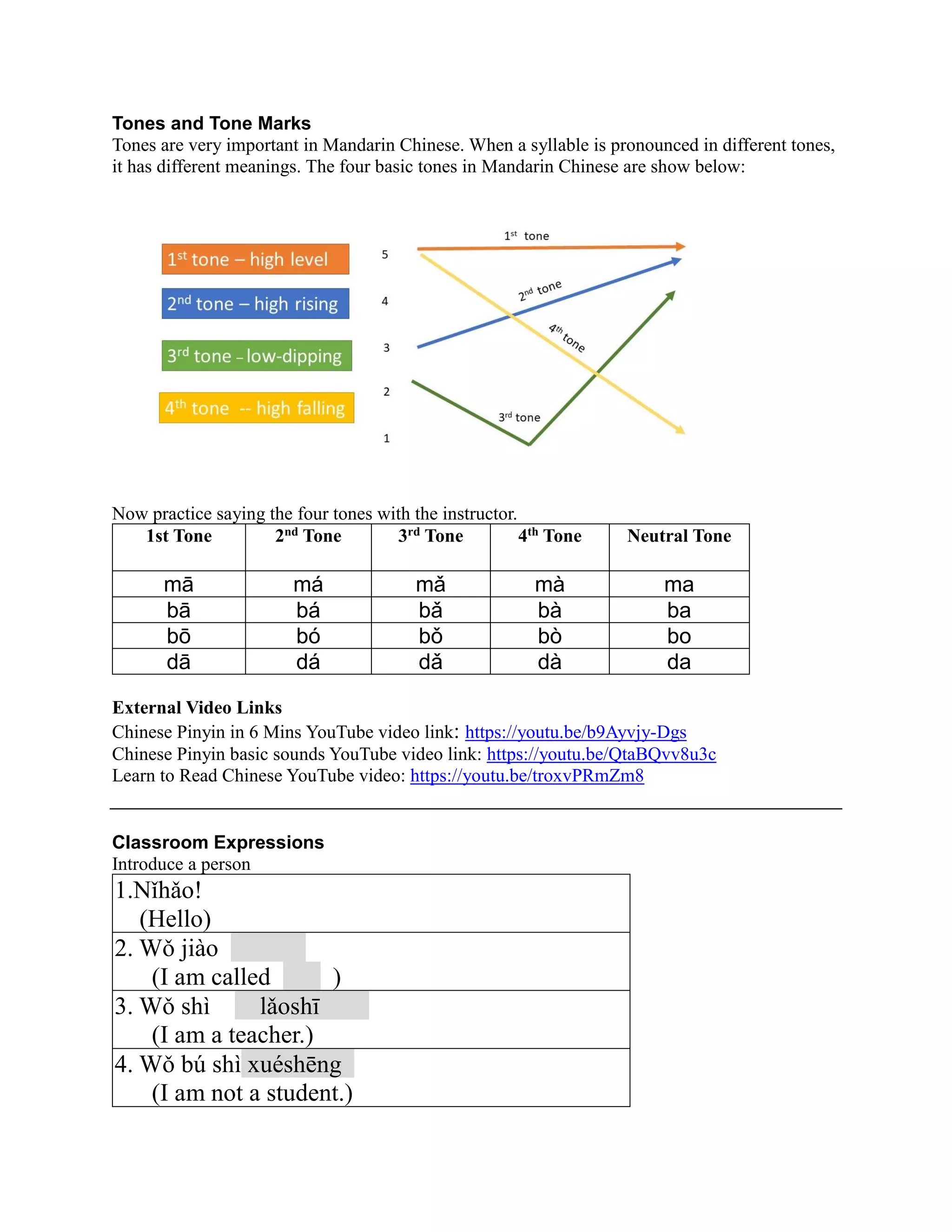
Tones and Tone Marks
Tones are very important in Mandarin Chinese. When a syllable is pronounced in different tones,
it has different meanings. The four basic tones in Mandarin Chinese are show below:
Now practice saying the four tones with the instructor.
1st Tone 2nd Tone 3rd Tone 4th Tone Neutral Tone
mā má mǎ mà ma
bā bá bǎ bà ba
bō bó bǒ bò bo
dā dá dǎ dà da
External Video Links
Chinese Pinyin in 6 Mins YouTube video link: https://youtu.be/b9Ayvjy-Dgs
Chinese Pinyin basic sounds YouTube video link: https://youtu.be/QtaBQvv8u3c
Learn to Read Chinese YouTube video: https://youtu.be/troxvPRmZm8
Classroom Expressions
Introduce a person
1.Nǐhǎo!
(Hello)
2. Wǒ jiào
(I am called )
3. Wǒ shì lǎoshī
(I am a teacher.)
4. Wǒ bú shì xuéshēng
(I am not a student.)
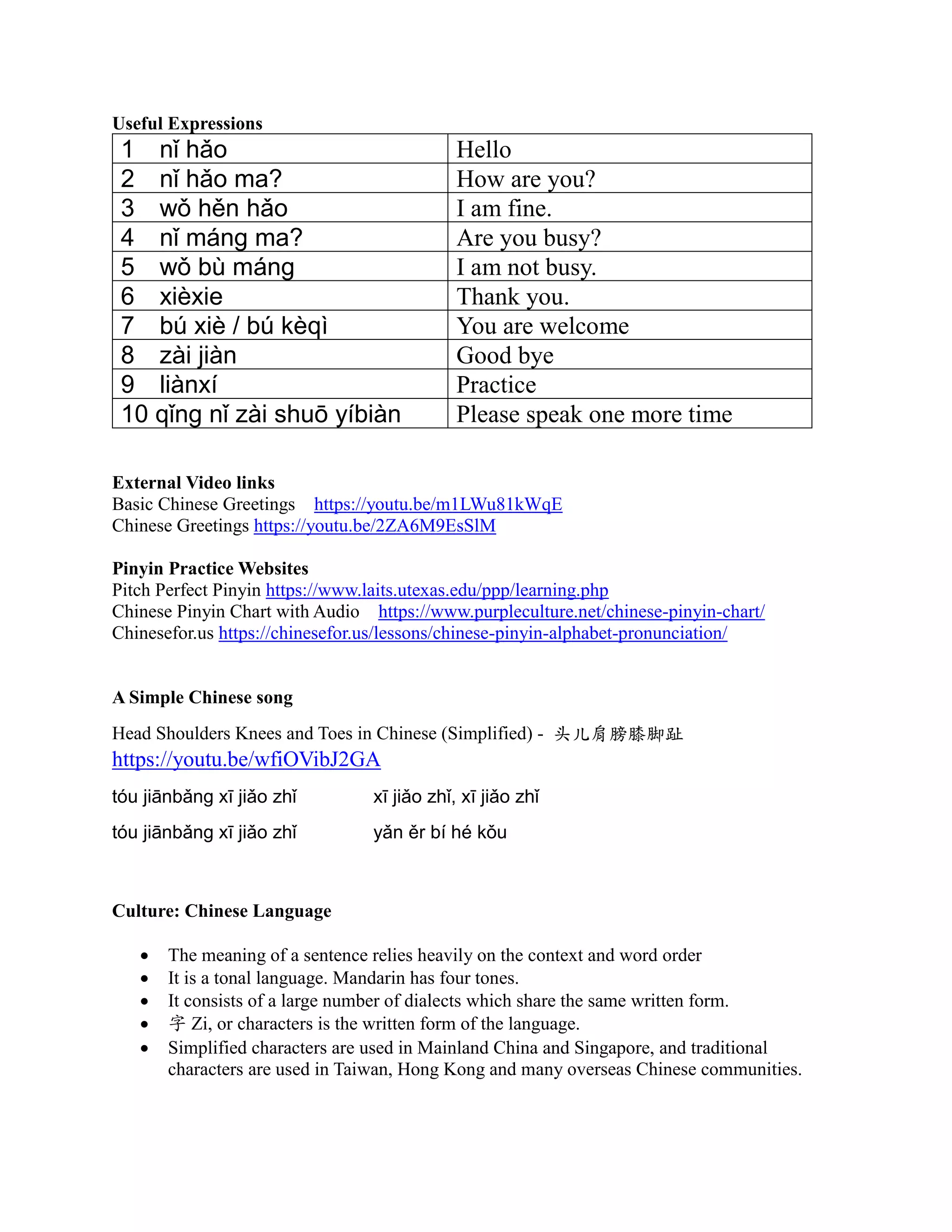
Useful Expressions
1 nǐ hǎo Hello
2 nǐ hǎo ma? How are you?
3 wǒ hěn hǎo I am fine.
4 nǐ máng ma? Are you busy?
5 wǒ bù máng I am not busy.
6 xièxie Thank you.
7 bú xiè / bú kèqì You are welcome
8 zài jiàn Good bye
9 liànxí Practice
10 qǐng nǐ zài shuō yíbiàn Please speak one more time
External Video links
Basic Chinese Greetings https://youtu.be/m1LWu81kWqE
Chinese Greetings https://youtu.be/2ZA6M9EsSlM
Pinyin Practice Websites
Pitch Perfect Pinyin https://www.laits.utexas.edu/ppp/learning.php
Chinese Pinyin Chart with Audio https://www.purpleculture.net/chinese-pinyin-chart/
Chinesefor.us https://chinesefor.us/lessons/chinese-pinyin-alphabet-pronunciation/
A Simple Chinese song
Head Shoulders Knees and Toes in Chinese (Simplified) - 头儿肩膀膝脚趾
https://youtu.be/wfiOVibJ2GA
tóu jiānbǎng xī jiǎo zhǐ xī jiǎo zhǐ, xī jiǎo zhǐ
tóu jiānbǎng xī jiǎo zhǐ yǎn ěr bí hé kǒu
Culture: Chinese Language
• The meaning of a sentence relies heavily on the context and word order
• It is a tonal language. Mandarin has four tones.
• It consists of a large number of dialects which share the same written form.
• 字 Zi, or characters is the written form of the language.
• Simplified characters are used in Mainland China and Singapore, and traditional
characters are used in Taiwan, Hong Kong and many overseas Chinese communities.
Lesson 1.2 Chinese Characters
Learning Objectives:
After completing this lesson, you will be able to:
• Identify basic Chinese radicals
• Write characters with the correct stroke order
A. Radicals 部首 or 部件
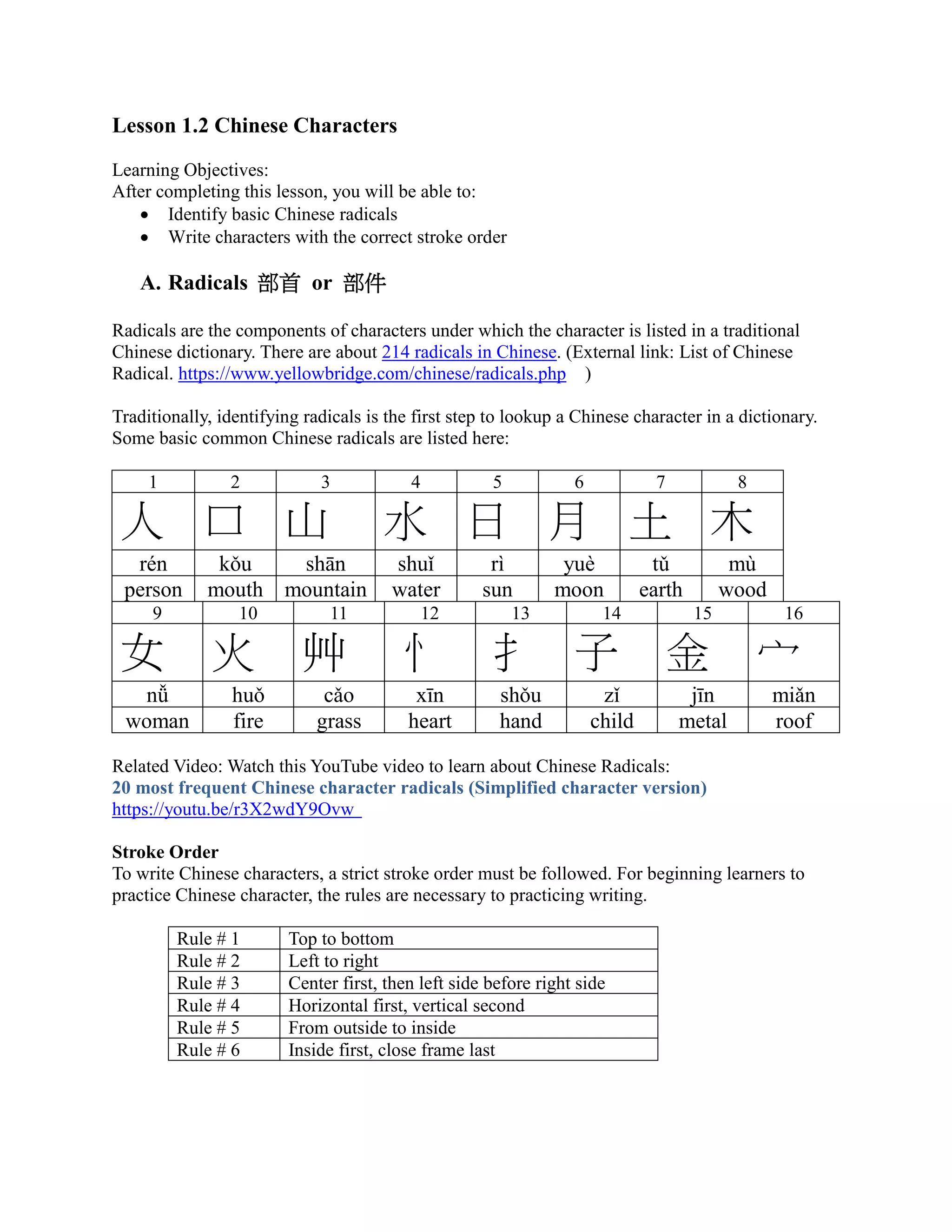
Radicals are the components of characters under which the character is listed in a traditional
Chinese dictionary. There are about 214 radicals in Chinese. (External link: List of Chinese
Radical. https://www.yellowbridge.com/chinese/radicals.php )
Traditionally, identifying radicals is the first step to lookup a Chinese character in a dictionary.
Some basic common Chinese radicals are listed here:
1 2 3 4 5 6 7 8
人 口 山 水 日 月 土 木
rén kǒu shān shuǐ rì yuè tǔ mù
person mouth mountain water sun moon earth wood
9 10 11 12 13 14 15 16
女 火 艸 忄 扌 子 金 宀
nǚ huǒ cǎo xīn shǒu zǐ jīn miǎn
woman fire grass heart hand child metal roof
Related Video: Watch this YouTube video to learn about Chinese Radicals:
20 most frequent Chinese character radicals (Simplified character version)
https://youtu.be/r3X2wdY9Ovw
Stroke Order
To write Chinese characters, a strict stroke order must be followed. For beginning learners to
practice Chinese character, the rules are necessary to practicing writing.
Rule # 1 Top to bottom
Rule # 2 Left to right
Rule # 3 Center first, then left side before right side
Rule # 4 Horizontal first, vertical second
Rule # 5 From outside to inside
Rule # 6 Inside first, close frame last
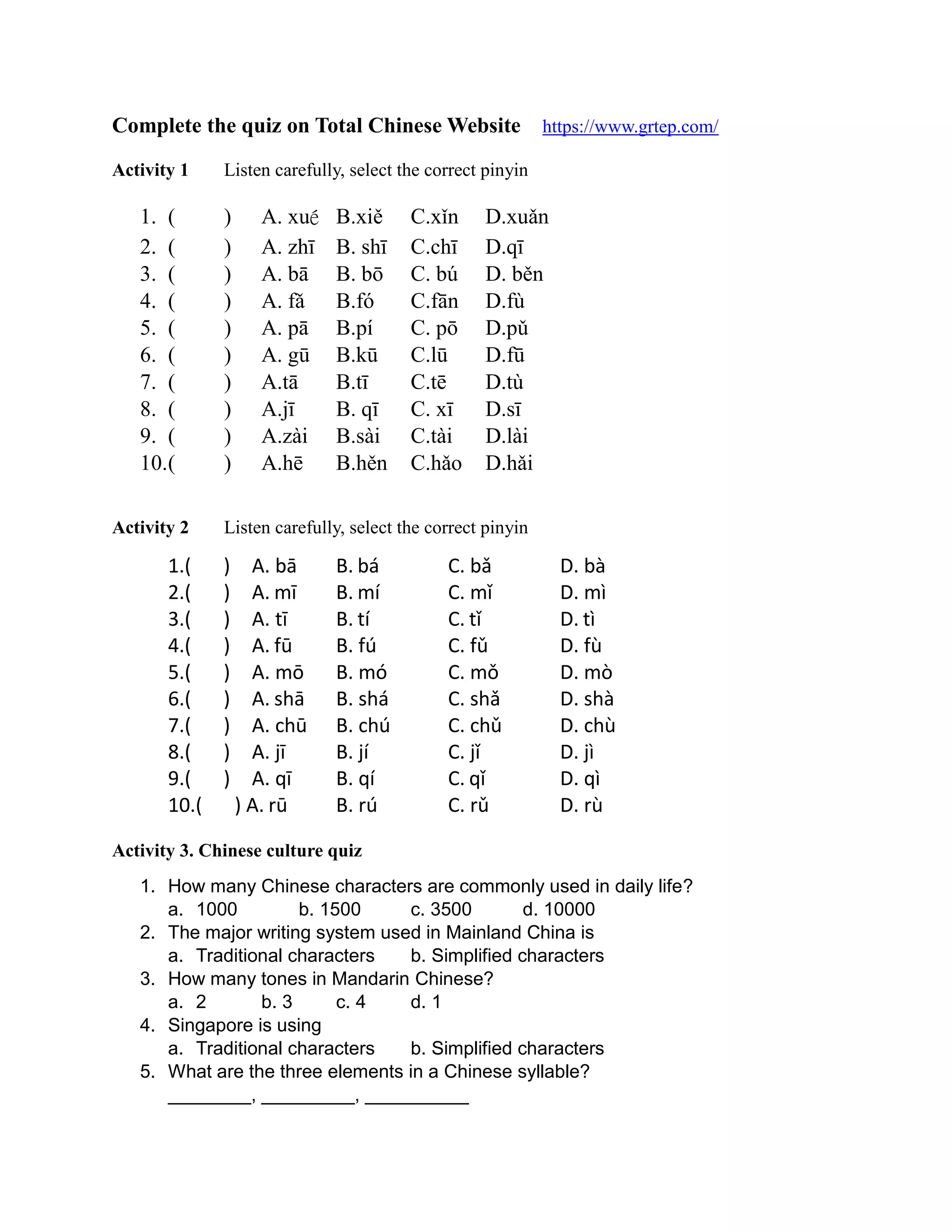
Complete the quiz on Total Chinese Website https://www.grtep.com/
Activity 1 Listen carefully, select the correct pinyin
1. ( ) A. xué B.xiě C.xǐn D.xuǎn
2. ( ) A. zhī B. shī C.chī D.qī
3. ( ) A. bā B. bō C. bú D. běn
4. ( ) A. fǎ B.fó C.fān D.fù
5. ( ) A. pā B.pí C. pō D.pǔ
6. ( ) A. gū B.kū C.lū D.fū
7. ( ) A.tā B.tī C.tē D.tù
8. ( ) A.jī B. qī C. xī D.sī
9. ( ) A.zài B.sài C.tài D.lài
10.( ) A.hē B.hěn C.hǎo D.hǎi
Activity 2 Listen carefully, select the correct pinyin
1.( ) A. bā B. bá C. bǎ D. bà
2.( ) A. mī B. mí C. mǐ D. mì
3.( ) A. tī B. tí C. tǐ D. tì
4.( ) A. fū B. fú C. fǔ D. fù
5.( ) A. mō B. mó C. mǒ D. mò
6.( ) A. shā B. shá C. shǎ D. shà
7.( ) A. chū B. chú C. chǔ D. chù
8.( ) A. jī B. jí C. jǐ D. jì
9.( ) A. qī B. qí C. qǐ D. qì
10.( ) A. rū B. rú C. rǔ D. rù
Activity 3. Chinese culture quiz
1. How many Chinese characters are commonly used in daily life?
a. 1000 b. 1500 c. 3500 d. 10000
2. The major writing system used in Mainland China is
a. Traditional characters b. Simplified characters
3. How many tones in Mandarin Chinese?
a. 2 b. 3 c. 4 d. 1
4. Singapore is using
a. Traditional characters b. Simplified characters
5. What are the three elements in a Chinese syllable?
________, _________, __________

Tc1 Lesson 1 pinyin introduction

  • 1.
    Total Chinese Lesson1.1 Chinese Pronunciation Guide Learning Objectives: After completing this chapter, your will: • Learn about Chinese Pinyin System • Become familiar with syllabic structure, pinyin, and pronunciation • Use common expressions in the classroom and daily life What is Pinyin? The Pinyin system is a pronunciation method used in Mainland China and language programs world wide to learn the sounds of Chinese. It used the letters of the Latin alphabet and tone marks to represent the sounds of Chinese. It will be helpful to learn Chinese pronunciation with pinyin since there is no clear connection between the Chinese characters and Chinese pronunciation. Structure of Chinese Syllabus Each Chinese character has its own syllable. A Chinese syllable consists of three parts: an initial, a final, and the tone. For example: 好 hǎo (h initial, ao – final, v – tone) There are 21 initials, 35 finals and 4 tones. Altogether, there are 417 syllables, one pinyin syllable can have many different characters. Tones play a very important role in differentiating these characters with the same pinyin syllable. ------------------------------------------------------------------------------------------------------------- Let’s Practice Hanyu Pinyin 汉语拼音 Listen to the instructor’s audio, and practice by saying the sound loud. Initials b p m f d t n l g k h j q x zh ch sh r z c s Finals Single vowels a o e i u ǖ ou iu ie üe er Nasal vowels an en in un (uen) ün (yun) ang eng ing ong iang uang iong ueng Double vowels ai ei ui ao
  • 2.
    Tones and ToneMarks Tones are very important in Mandarin Chinese. When a syllable is pronounced in different tones, it has different meanings. The four basic tones in Mandarin Chinese are show below: Now practice saying the four tones with the instructor. 1st Tone 2nd Tone 3rd Tone 4th Tone Neutral Tone mā má mǎ mà ma bā bá bǎ bà ba bō bó bǒ bò bo dā dá dǎ dà da External Video Links Chinese Pinyin in 6 Mins YouTube video link: https://youtu.be/b9Ayvjy-Dgs Chinese Pinyin basic sounds YouTube video link: https://youtu.be/QtaBQvv8u3c Learn to Read Chinese YouTube video: https://youtu.be/troxvPRmZm8 Classroom Expressions Introduce a person 1.Nǐhǎo! (Hello) 2. Wǒ jiào (I am called ) 3. Wǒ shì lǎoshī (I am a teacher.) 4. Wǒ bú shì xuéshēng (I am not a student.)
  • 3.
    Useful Expressions 1 nǐhǎo Hello 2 nǐ hǎo ma? How are you? 3 wǒ hěn hǎo I am fine. 4 nǐ máng ma? Are you busy? 5 wǒ bù máng I am not busy. 6 xièxie Thank you. 7 bú xiè / bú kèqì You are welcome 8 zài jiàn Good bye 9 liànxí Practice 10 qǐng nǐ zài shuō yíbiàn Please speak one more time External Video links Basic Chinese Greetings https://youtu.be/m1LWu81kWqE Chinese Greetings https://youtu.be/2ZA6M9EsSlM Pinyin Practice Websites Pitch Perfect Pinyin https://www.laits.utexas.edu/ppp/learning.php Chinese Pinyin Chart with Audio https://www.purpleculture.net/chinese-pinyin-chart/ Chinesefor.us https://chinesefor.us/lessons/chinese-pinyin-alphabet-pronunciation/ A Simple Chinese song Head Shoulders Knees and Toes in Chinese (Simplified) - 头儿肩膀膝脚趾 https://youtu.be/wfiOVibJ2GA tóu jiānbǎng xī jiǎo zhǐ xī jiǎo zhǐ, xī jiǎo zhǐ tóu jiānbǎng xī jiǎo zhǐ yǎn ěr bí hé kǒu Culture: Chinese Language • The meaning of a sentence relies heavily on the context and word order • It is a tonal language. Mandarin has four tones. • It consists of a large number of dialects which share the same written form. • 字 Zi, or characters is the written form of the language. • Simplified characters are used in Mainland China and Singapore, and traditional characters are used in Taiwan, Hong Kong and many overseas Chinese communities.
  • 4.
    Lesson 1.2 ChineseCharacters Learning Objectives: After completing this lesson, you will be able to: • Identify basic Chinese radicals • Write characters with the correct stroke order A. Radicals 部首 or 部件 Radicals are the components of characters under which the character is listed in a traditional Chinese dictionary. There are about 214 radicals in Chinese. (External link: List of Chinese Radical. https://www.yellowbridge.com/chinese/radicals.php ) Traditionally, identifying radicals is the first step to lookup a Chinese character in a dictionary. Some basic common Chinese radicals are listed here: 1 2 3 4 5 6 7 8 人 口 山 水 日 月 土 木 rén kǒu shān shuǐ rì yuè tǔ mù person mouth mountain water sun moon earth wood 9 10 11 12 13 14 15 16 女 火 艸 忄 扌 子 金 宀 nǚ huǒ cǎo xīn shǒu zǐ jīn miǎn woman fire grass heart hand child metal roof Related Video: Watch this YouTube video to learn about Chinese Radicals: 20 most frequent Chinese character radicals (Simplified character version) https://youtu.be/r3X2wdY9Ovw Stroke Order To write Chinese characters, a strict stroke order must be followed. For beginning learners to practice Chinese character, the rules are necessary to practicing writing. Rule # 1 Top to bottom Rule # 2 Left to right Rule # 3 Center first, then left side before right side Rule # 4 Horizontal first, vertical second Rule # 5 From outside to inside Rule # 6 Inside first, close frame last
  • 5.
    Complete the quizon Total Chinese Website https://www.grtep.com/ Activity 1 Listen carefully, select the correct pinyin 1. ( ) A. xué B.xiě C.xǐn D.xuǎn 2. ( ) A. zhī B. shī C.chī D.qī 3. ( ) A. bā B. bō C. bú D. běn 4. ( ) A. fǎ B.fó C.fān D.fù 5. ( ) A. pā B.pí C. pō D.pǔ 6. ( ) A. gū B.kū C.lū D.fū 7. ( ) A.tā B.tī C.tē D.tù 8. ( ) A.jī B. qī C. xī D.sī 9. ( ) A.zài B.sài C.tài D.lài 10.( ) A.hē B.hěn C.hǎo D.hǎi Activity 2 Listen carefully, select the correct pinyin 1.( ) A. bā B. bá C. bǎ D. bà 2.( ) A. mī B. mí C. mǐ D. mì 3.( ) A. tī B. tí C. tǐ D. tì 4.( ) A. fū B. fú C. fǔ D. fù 5.( ) A. mō B. mó C. mǒ D. mò 6.( ) A. shā B. shá C. shǎ D. shà 7.( ) A. chū B. chú C. chǔ D. chù 8.( ) A. jī B. jí C. jǐ D. jì 9.( ) A. qī B. qí C. qǐ D. qì 10.( ) A. rū B. rú C. rǔ D. rù Activity 3. Chinese culture quiz 1. How many Chinese characters are commonly used in daily life? a. 1000 b. 1500 c. 3500 d. 10000 2. The major writing system used in Mainland China is a. Traditional characters b. Simplified characters 3. How many tones in Mandarin Chinese? a. 2 b. 3 c. 4 d. 1 4. Singapore is using a. Traditional characters b. Simplified characters 5. What are the three elements in a Chinese syllable? ________, _________, __________