Chinese Language
Chinese Characters
(Calligraphy)
BCFL/VDLC Delegate Orientation
June 3, 2014
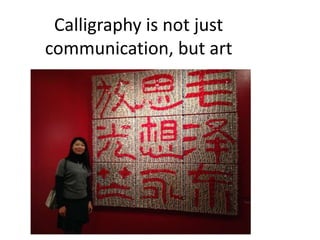
Calligraphy is not just
communication, but art
Each Chinese character is a syllable
• You need to know 3,000-4,000 characters to
be considered literate
• Students start learning them in kindergarten
and it takes 6 years to memorize them
• Literacy rate in China in 2013 was 95%
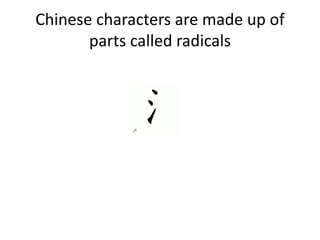
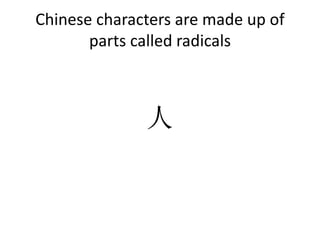
Chinese characters are made up of
parts called radicals
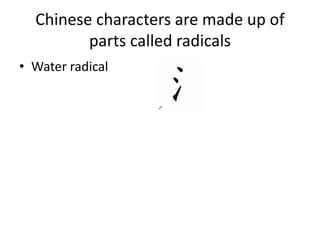
Chinese characters are made up of
parts called radicals
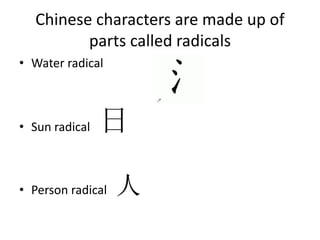
• Water radical
Chinese characters are made up of
parts called radicals
日
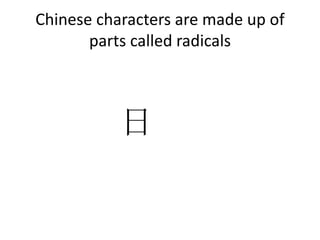
Chinese characters are made up of
parts called radicals
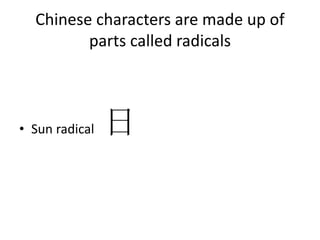
• Sun radical 日
Chinese characters are made up of
parts called radicals
人
Chinese characters are made up of
parts called radicals
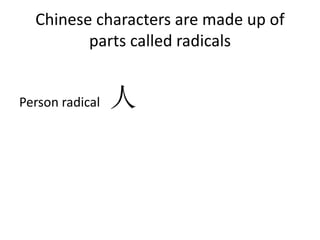
Person radical 人
Chinese characters are made up of
parts called radicals
• Water radical
• Sun radical 日
• Person radical 人
Chinese characters are made up of
parts called radicals
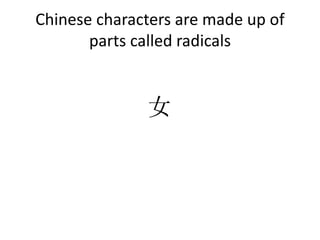
女
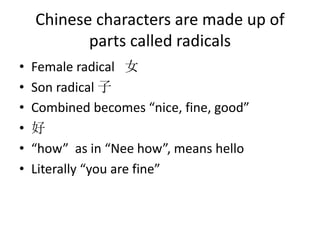
Chinese characters are made up of
parts called radicals
• Female radical 女
• Son radical 子
• Combined becomes “nice, fine, good”
• 好
• “how” as in “Nee how”, means hello
• Literally “you are fine”
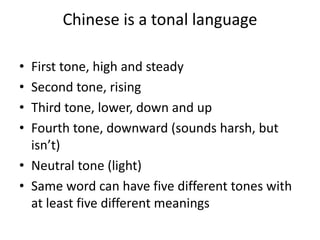
Chinese is a tonal language
• First tone, high and steady
• Second tone, rising
• Third tone, lower, down and up
• Fourth tone, downward (sounds harsh, but
isn’t)
• Neutral tone (light)
• Same word can have five different tones with
at least five different meanings
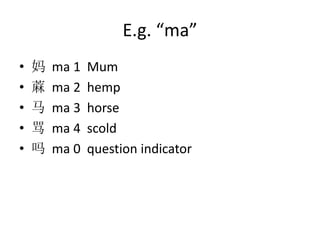
E.g. “ma”
• 妈 ma 1 Mum
• 蔴 ma 2 hemp
• 马 ma 3 horse
• 骂 ma 4 scold
• 吗 ma 0 question indicator
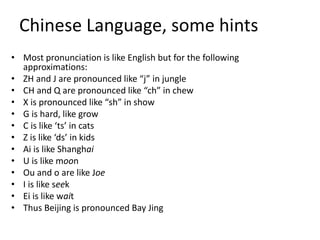
Chinese Language, some hints
• Most pronunciation is like English but for the following
approximations:
• ZH and J are pronounced like “j” in jungle
• CH and Q are pronounced like “ch” in chew
• X is pronounced like “sh” in show
• G is hard, like grow
• C is like ‘ts’ in cats
• Z is like ‘ds’ in kids
• Ai is like Shanghai
• U is like moon
• Ou and o are like Joe
• I is like seek
• Ei is like wait
• Thus Beijing is pronounced Bay Jing
Saying hello
• “Ni hao” is Nee how. It is singular.
• Plural is “Nimen hao” which is Neemen how

Chinese language

  • 1.
  • 2.
    Calligraphy is notjust communication, but art
  • 3.
    Each Chinese characteris a syllable • You need to know 3,000-4,000 characters to be considered literate • Students start learning them in kindergarten and it takes 6 years to memorize them • Literacy rate in China in 2013 was 95%
  • 4.
    Chinese characters aremade up of parts called radicals
  • 5.
    Chinese characters aremade up of parts called radicals • Water radical
  • 6.
    Chinese characters aremade up of parts called radicals 日
  • 7.
    Chinese characters aremade up of parts called radicals • Sun radical 日
  • 8.
    Chinese characters aremade up of parts called radicals 人
  • 9.
    Chinese characters aremade up of parts called radicals Person radical 人
  • 10.
    Chinese characters aremade up of parts called radicals • Water radical • Sun radical 日 • Person radical 人
  • 11.
    Chinese characters aremade up of parts called radicals 女
  • 12.
    Chinese characters aremade up of parts called radicals • Female radical 女 • Son radical 子 • Combined becomes “nice, fine, good” • 好 • “how” as in “Nee how”, means hello • Literally “you are fine”
  • 13.
    Chinese is atonal language • First tone, high and steady • Second tone, rising • Third tone, lower, down and up • Fourth tone, downward (sounds harsh, but isn’t) • Neutral tone (light) • Same word can have five different tones with at least five different meanings
  • 14.
    E.g. “ma” • 妈ma 1 Mum • 蔴 ma 2 hemp • 马 ma 3 horse • 骂 ma 4 scold • 吗 ma 0 question indicator
  • 15.
    Chinese Language, somehints • Most pronunciation is like English but for the following approximations: • ZH and J are pronounced like “j” in jungle • CH and Q are pronounced like “ch” in chew • X is pronounced like “sh” in show • G is hard, like grow • C is like ‘ts’ in cats • Z is like ‘ds’ in kids • Ai is like Shanghai • U is like moon • Ou and o are like Joe • I is like seek • Ei is like wait • Thus Beijing is pronounced Bay Jing
  • 16.
    Saying hello • “Nihao” is Nee how. It is singular. • Plural is “Nimen hao” which is Neemen how