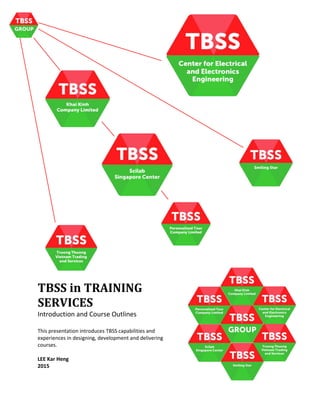



TBSS in TRAINING
SERVICES
Introduction and Course Outlines
This presentation introduces TBSS capabilities and
experiences in designing, development and delivering
courses.
LEE Kar Heng
2015
TBSS IN TRAINING SERVICES
INTRODUCTION TO TBSS
TBSS Group consists of the 7 specialized companies, with 5 companies
registered in Singapore and 2 companies registered in Vietnam. They are
 TBSS Group (Singapore)
 TBSS Center for Electrical and Electronics Engineering (Singapore)
 TBSS-Truong Thuong Vietnam Trading and Services (Singapore)
 TBSS-Scilab Singapore Center (Singapore)
 TBSS-Smiling Star (Singapore)
 TBSS Khai Kinh Company Limited (Vietnam)
 TBSS Personalized Tour Company Limited (Vietnam)
The detail group information, including functions and projects of each
company can be found at http://www.slideshare.net/karheng1/.
TBSS IN TRAINING RELATED ACTIVITIES
 TBSS GROUP
 Contributed to NUS Engineering Student Development Fund
 TBSS-Smiling Star
 Runs Smiling Star International playgroup and phonics
programs in the North-East Region of Singapore
 TBSS Khai Kinh Company Limited (Vietnam)
 Represents Scilab in Vietnam
 Conducted Scilab-related courses at the Ho Chi Minh
University of Technology
 Maintains the Scilab User Group in Vietnam
 Organized and presented in a Coastal Surveillance Seminar
 TBSS Center for Electrical and Electronics Engineering
 Designed, Developed and Delivered a Wireless Local Area
Network Course for the Electrical Engineering Staff of Ngee
Ann Polytechnic
 Designed, Developed and Delivered a WiMAX Course for the
Engineering Staff of Rohde & Schwarz, Singapore
 Designed, Developed and Delivered Radar System
Engineering, Radar Tracking, Airborne Radar, 3D Radar and
Phased Array Radar Courses for the Staff from MINDEF,
DSTA, DSO, …
 Offered various professional courses such as Electronic
Warfare, Radar Technology, Coastal Surveillance System, …
 Offered various courses in Analytical Hierarchy Process,
Integrated Logistic Support, System Engineering, System
Management, …
 TBSS-Scilab Singapore Center
 Represents Scilab (an Engineering and Scientific Software) in
Singapore
 Organized Scilab Challenge with Temasek Polytechnic (TP) and
Nanyang Technological University (NTU)
 Conducted Scilab-related courses at TP and NTU
 Sponsors the Gold, Silver and Bronze medal awards to Diploma
in Media and Communications Technology, TP
 Sponsors students to present project findings in the ScilabTEC
International Conference in Paris in May 2015
 Maintains the Scilab User Group in Singapore on Facebook
 The Technical Advisor is currently exploring BIG DATA with
Scilab and Matlab
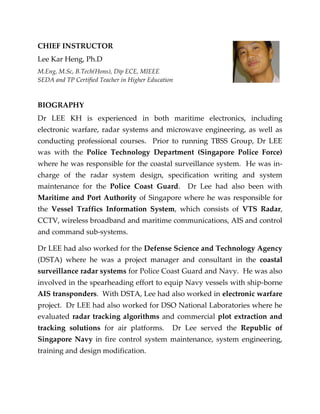
CHIEF INSTRUCTOR
Lee Kar Heng, Ph.D
M.Eng, M.Sc, B.Tech(Hons), Dip ECE, MIEEE
SEDA and TP Certified Teacher in Higher Education
BIOGRAPHY
Dr LEE KH is experienced in both maritime electronics, including
electronic warfare, radar systems and microwave engineering, as well as
conducting professional courses. Prior to running TBSS Group, Dr LEE
was with the Police Technology Department (Singapore Police Force)
where he was responsible for the coastal surveillance system. He was in-
charge of the radar system design, specification writing and system
maintenance for the Police Coast Guard. Dr Lee had also been with
Maritime and Port Authority of Singapore where he was responsible for
the Vessel Traffics Information System, which consists of VTS Radar,
CCTV, wireless broadband and maritime communications, AIS and control
and command sub-systems.
Dr LEE had also worked for the Defense Science and Technology Agency
(DSTA) where he was a project manager and consultant in the coastal
surveillance radar systems for Police Coast Guard and Navy. He was also
involved in the spearheading effort to equip Navy vessels with ship-borne
AIS transponders. With DSTA, Lee had also worked in electronic warfare
project. Dr LEE had also worked for DSO National Laboratories where he
evaluated radar tracking algorithms and commercial plot extraction and
tracking solutions for air platforms. Dr Lee served the Republic of
Singapore Navy in fire control system maintenance, system engineering,
training and design modification.
Dr LEE was an Associate Staff with the PSB Academy where he taught
Communications Engineering, Signal Processing, Antenna and
Propagation subjects and supervised Final Year Project students. Dr LEE
had developed Wireless and Optical Communication Systems course
materials for the SIM University. He also taught communications, radio
frequency, microwave and signal processing subjects in the University of
Newcastle, James Cook University, University of Southern Queensland,
RMIT University, Northumbria University and Edith Cowan University
undergraduate programs. Lee is also the Senior Adjunct Lecturer with
Edith Cowan University to ensure smooth running of the Bachelor of
Engineering courses in Singapore.
Dr Lee had conducted professional short courses in Radar System
Engineering, Radar Tracking and Phased Array Radar courses for the
Ministry of Defense, for participants from the SAF, NAVY, AIR FORCE,
DSTA and DSO National Laboratories. Dr Lee was in-charge of running
radar and system engineering courses during his appointments with DSTA
and Police Technology Department.
Dr LEE is certified to teach in Higher Education by the Staff Education and
Development Association, UK and had served as a Chairman and Secretary
in the Education Chapter, IEEE Singapore Section. Lee graduated from
NUS with Master of Engineering and Bachelor of Technology (Hons)
degrees. He also holds a Master of Science from the University of Sheffield.
Dr LEE obtained his Ph.D in Engineering Management via online study
with Madison Hills University. Dr Lee has published some papers in the
IEEE conferences and NUS research program. One of his supervised
projects was highlighted in Lian He Zhao Bao and FM88.3.
Currently, Lee serves as the Treasurer of the Education Chapter, IEEE
Singapore Section.
TBSS COURSES
TBSS offers courses (standard or customized) in three areas:
Defense
 Radar Engineering
 Radar tracking techniques and algorithms
 Radar operations and supports
 EMC/EMI
 Electronic Warfare
 Electronic Intelligence
 Electro-Optical System and Infrared
 Antenna Systems
 Communications: Wireless, Mobile and Satellite
 Communication Link Budget Computation
 Coastal Surveillance System
 Vessel Traffic System
Systems
 Integrated Logistic Support
 System Engineering
 Life Cycle Management
 Analytical Hierarchy Process
SCILAB
 Learning Scilab
 Creating Innovation GUI using Scilab
 Modeling Dynamic Systems with XCos
 Numerical Computation with Scilab
 Signal Processing with Scilab
 Radar Engineering with Scilab
 Electronic Warfare and Electronic Intelligence with Scilab
 Numerical Methods with Scilab
 Signals and Systems with Scilab
 Interfacing with Hardware from Scilab to Arduino
PRACTICAL OPERATIONS AND SUPPORTS IN RADAR SYSTEMS
Synopsis
This 3-day workshop is designed to help participants to gain knowledge in radar
system design and analysis for maintenance purposes, system engineering concept in
radar system maintenance, prevent and corrective maintenance, radar system
measurement and calibration, reliability and maintainability, safety considerations,
EMC/EMI considerations and radar LRU and modules maintenance issues. Typical
radar systems will be used in appropriate topics for detailed discussion.
WHAT YOU WILL LEARN & GAIN:
 Appreciate system engineering, integrated logistic support and system
management and their applications in radar system maintenance and
sustainability
 Understand radar block diagram, functional operations of each block and signal
flow between the blocks
 LRU and modules maintenance considerations
 Interpret the transmitter frequency spectrum in terms of frequency distribution,
power output, receiver response, and an acceptable spectrum curve
 Understand antenna, waveguides and radome
 Describe the methods for measuring the average and peak power outputs of a
radar transmitter
 Describe the methods of measuring receiver sensitivity
 Define receiver bandwidth in terms of the receiver response curve and state the
most common methods of measuring TR tube recovery time
 Learn various radar calibration, test and measurement techniques and
equipment used
 Understand preventive maintenance and associated tasks
 Understand corrective maintenance, fault finding methods and BITE
 Aware the safety concerns and precautions
 State the general rules for the prevention of personnel exposure to RF radiation
and emissions
 Understand EMC/EMI and faults caused by EMC and EMI issues
 Appreciate appropriate inventory of spare parts and importance of replacing
modules or components in accordance with manufacturers specifications
PROPOSED COURSE OUTLINE
Day 1
Radar Block Diagram, Block Functions and Signal Flow (2 hours)
System Engineering, Integrated Logistic Support and System Maintenance (3 hours)
Reliability Models (1 hour)
Radar LRU and modules and other non-radar parts such as lubricant and paint (2
hours)
Day 2
Radar Equations and Performance Considerations (1 hour)
Prevent and Corrective Maintenance (1 hour)
Transmitter and Receiver (2 hours)
Antenna, Waveguide and Radome (2 hours)
Calibration, Test and Measurement Techniques (1 hour)
Day 3
EMC and EMI in Performance Consideration (1 hour)
MIL-STD-460 (1 hour)
RF Radiation and Emission (1 hour)
HIRF (1 hour)
Human Exposure to RF EM Fields (1 hour)
Practical Fixes (2 hours)
2D AND 3D RADARS
SYNOPSIS
The participants will learn the fundamental concepts of 3D Surveillance and Airborne
radars. After the course, the participants will understand the issues and techniques in 2D
and 3D Radars and their applications in 2D and 3D surveillance.
Day 1 – 2D and 3D Surveillance Radar (8 hrs)
 2D and 3D concepts
 Height Finding
 Introduction to Planar Array Concept
 Beam and Frequency Scanning in 3D Radar
 Pulse Compression and LFM
 MTI Concepts and Processing in 3D Radar
Day 2 – Airborne and Coastal Surveillance Radars (8 hrs)
 Modes of Operation and Selection Considerations
 Motion Compensation in Moving Platform
 Effect of Motion on Clutter
 Search Modes in Airborne Radar
 Tracking in Airborne Radar
ANALYTIC HIERARCHY PROCESS FOR COMPLEX DECISION
MAKING AND TENDER EVALUATION
SYNOPSIS
This 1-day workshop attempts to introduce AHP working principles to participants.
With the hands on practical session, the participants will be able to combine all the
provided information to make informed decisions. Spreadsheet template will be used
in the workshop for familiarization and appreciation of the methodology by carrying
out a mock-up tender evaluation.
WHAT YOU WILL LEARN & GAIN:
 The mathematical principles behind AHP
 Application of AHP
 AHP pairwise comparison scale
 The inconsistency and sensitivity analysis
 Ratio scales
 The ratings model
 AHP and resources allocation
 AHP spreadsheet
 Practical hands on
PROPOSED COURSE OUTLINE
Day 1
 The mathematical principles behind AHP (30 mins)
 Application of AHP (30 mins)
 AHP pairwise comparison scale (30 mins)
 The inconsistency and sensitivity analysis (30 mins)
 Ratio scales (30 mins)
 The ratings model (30 mins)
 AHP and resources allocation (30 mins)
 AHP spreadsheet (30 mins)
 Practical hands on (3 hours)
ANTENNA SYSTEMS USED IN ELECTRONIC WARFARE
APPLICATIONS
SYNOPSIS
This 3-day workshop is designed to help participants to apply antenna theory and
understand antenna parameters in EW systems.
WHAT YOU WILL LEARN & GAIN:
 Basic principles of electromagnetic wave propagation
 Properties of transmission lines: Cables and Waveguides
 EW operations and systems
 Fundamental principles and parameters of antennas used in EW applications
 Dipole and monopole antennas, Loop antennas, Parabolic antennas, Yagi-Uda
antennas
 Patch and microstrip antennas and EW applications of patch antennas
 Antenna arrays and phased array antennas
 Multi-beam, beam forming and electronic beam steering
 EW applications of antenna arrays
 Frequency Independent EW antennas
 Electrical small EW antennas
 Related RF components: RF amplifiers, matching, multicouplers, oscillators,
modulators, transmitter and receiver
PROPOSED COURSE OUTLINE
Day 1
 EW operations and some equations used in EW (2 hours)
 Electromagnetic Radiation and Wave propagation (2 hours)
 Antenna Fundamentals and Parameters (3 hours)
Day 2
 Transmission lines (2 hours)
 Dipole and monopole antennas (2 hours)
 Antenna array (1 hour)
 Waveguide, horn and parabolic antennas in EW applications (2 hours)
Day 3
 RF components (1 hour)
 Phased-Array, beamforming and Electronic Beam Steering (2 hours)
 Adaptive and electrical small EW antennas and arrays (2 hours)
 Yagi-Uda and frequency independent antennas (2 hours)
ANTENNA SYSTEMS USED IN RADAR APPLICATIONS
SYNOPSIS
This 3-day workshop is designed to help participants to apply antenna theory and
understand antenna parameters in Radar Systems. The emphasis of this course is on
the radar system applications of the antennas.
WHAT YOU WILL LEARN & GAIN:
 Basic principles of electromagnetic wave propagation
 Properties of transmission lines: Cables and Waveguides
 Radar block diagram and associated equations
 Fundamental principles and parameters of antennas used in radar applications
 Dipole and monopole antennas, Patch and microstrip antennas
 Waveguide antennas, Parabolic antennas
 Antenna arrays and phased array antennas
 Multi-beam and electronic beam steering
 Antennas used in coastal surveillance, fire control and navigation for the Navy
 Antenna issues in FMCW radars
 Solid-state and Magnetron radars and issues in antenna design
 Related RF components: RF amplifiers, matching, multicouplers, oscillators,
modulators, transmitter and receiver
PROPOSED COURSE OUTLINE
Day 1
 Radar Block Diagram, Block Functions and Signal Flow (2 hours)
 Electromagnetic Radiation and Wave propagation (2 hours)
 Antenna Fundamentals and Parameters (3 hours)
Day 2
 Transmission lines (2 hours)
 Dipole and monopole antennas (2 hours)
 Antenna array (1 hour)
 Waveguide, horn and parabolic antennas (2 hours)
Day 3
 RF components (1 hour)
 Phased-Array and Electronic Beam Steering (1 hour)
 Multi-beam, Multi-function radars (2 hours)
 FMCW radar antennas (1 hour)
 Solid-State and Magnetron radars (2 hours)
ELECTRO-OPTICAL AND INFRARED SENSORS AND SYSTEMS
SYNOPSIS
This 3-day course is designed to provide an overview of EO-IR systems and EO-IP
based systems. It reviews the impact of environmental processes on EO-IR operations
and discusses the performance issues. Lastly, it covers the major EO-IR components
and technologies.
WHAT YOU WILL LEARN & GAIN:
 Basic EO-IR concepts
 EO-IR system overview and components
 Target characteristics, Atmospheric transmission
 Optics concepts
 Scanners and detectors
 Modulator transfer function and resolution
 Specification parameters
PROPOSED COURSE OUTLINE
Day 1
 EO and IR sensors (2 hour)
 Target characteristics (2 hours)
 Atmospheric transmission (3 hours)

Day 2
 Optics (3 hours)
 Scanners (1 hour)
 Detectors (3 hours)
Day 3
 Modulation transfer function and resolution (4 hours)
 Specification parameters (3 hours)
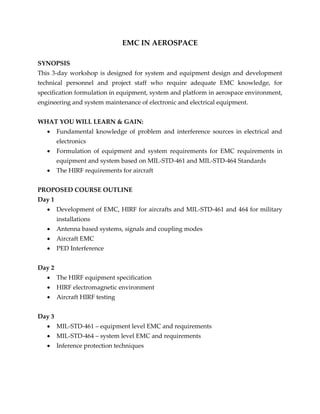
EMC IN AEROSPACE
SYNOPSIS
This 3-day workshop is designed for system and equipment design and development
technical personnel and project staff who require adequate EMC knowledge, for
specification formulation in equipment, system and platform in aerospace environment,
engineering and system maintenance of electronic and electrical equipment.
WHAT YOU WILL LEARN & GAIN:
 Fundamental knowledge of problem and interference sources in electrical and
electronics
 Formulation of equipment and system requirements for EMC requirements in
equipment and system based on MIL-STD-461 and MIL-STD-464 Standards
 The HIRF requirements for aircraft
PROPOSED COURSE OUTLINE
Day 1
 Development of EMC, HIRF for aircrafts and MIL-STD-461 and 464 for military
installations
 Antenna based systems, signals and coupling modes
 Aircraft EMC
 PED Interference
Day 2
 The HIRF equipment specification
 HIRF electromagnetic environment
 Aircraft HIRF testing
Day 3
 MIL-STD-461 – equipment level EMC and requirements
 MIL-STD-464 – system level EMC and requirements
 Inference protection techniques
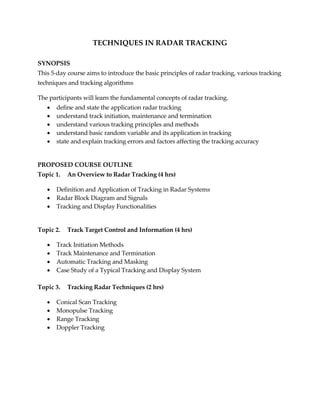
TECHNIQUES IN RADAR TRACKING
SYNOPSIS
This 5-day course aims to introduce the basic principles of radar tracking, various tracking
techniques and tracking algorithms
The participants will learn the fundamental concepts of radar tracking.
 define and state the application radar tracking
 understand track initiation, maintenance and termination
 understand various tracking principles and methods
 understand basic random variable and its application in tracking
 state and explain tracking errors and factors affecting the tracking accuracy
PROPOSED COURSE OUTLINE
Topic 1. An Overview to Radar Tracking (4 hrs)
 Definition and Application of Tracking in Radar Systems
 Radar Block Diagram and Signals
 Tracking and Display Functionalities
Topic 2. Track Target Control and Information (4 hrs)
 Track Initiation Methods
 Track Maintenance and Termination
 Automatic Tracking and Masking
 Case Study of a Typical Tracking and Display System
Topic 3. Tracking Radar Techniques (2 hrs)
 Conical Scan Tracking
 Monopulse Tracking
 Range Tracking
 Doppler Tracking
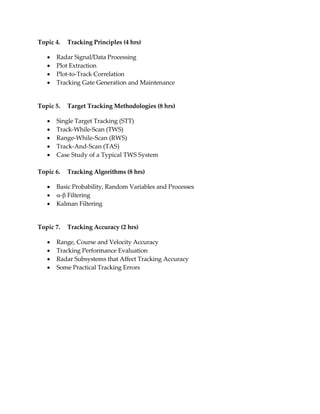
Topic 4. Tracking Principles (4 hrs)
 Radar Signal/Data Processing
 Plot Extraction
 Plot-to-Track Correlation
 Tracking Gate Generation and Maintenance
Topic 5. Target Tracking Methodologies (8 hrs)
 Single Target Tracking (STT)
 Track-While-Scan (TWS)
 Range-While-Scan (RWS)
 Track-And-Scan (TAS)
 Case Study of a Typical TWS System
Topic 6. Tracking Algorithms (8 hrs)
 Basic Probability, Random Variables and Processes
 - Filtering
 Kalman Filtering
Topic 7. Tracking Accuracy (2 hrs)
 Range, Course and Velocity Accuracy
 Tracking Performance Evaluation
 Radar Subsystems that Affect Tracking Accuracy
 Some Practical Tracking Errors
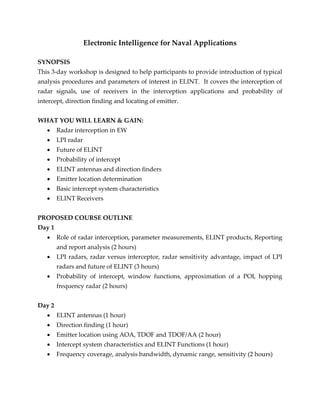
Electronic Intelligence for Naval Applications
SYNOPSIS
This 3-day workshop is designed to help participants to provide introduction of typical
analysis procedures and parameters of interest in ELINT. It covers the interception of
radar signals, use of receivers in the interception applications and probability of
intercept, direction finding and locating of emitter.
WHAT YOU WILL LEARN & GAIN:
 Radar interception in EW
 LPI radar
 Future of ELINT
 Probability of intercept
 ELINT antennas and direction finders
 Emitter location determination
 Basic intercept system characteristics
 ELINT Receivers
PROPOSED COURSE OUTLINE
Day 1
 Role of radar interception, parameter measurements, ELINT products, Reporting
and report analysis (2 hours)
 LPI radars, radar versus interceptor, radar sensitivity advantage, impact of LPI
radars and future of ELINT (3 hours)
 Probability of intercept, window functions, approximation of a POI, hopping
frequency radar (2 hours)
Day 2
 ELINT antennas (1 hour)
 Direction finding (1 hour)
 Emitter location using AOA, TDOF and TDOF/AA (2 hour)
 Intercept system characteristics and ELINT Functions (1 hour)
 Frequency coverage, analysis bandwidth, dynamic range, sensitivity (2 hours)
Day 3
 Limits of ELINT parameter measurements (1 hours)
 ECM and ELINT receivers (1 hour)
 Crystal video receiver and superheterodyne receiver (2 hours)
 Instantaneous frequency measurement receiver (2 hours)
 Other ELINT receivers (1 hour)

TBSS in Training Services 25032015

  • 1.
    TBSS in TRAINING SERVICES Introductionand Course Outlines This presentation introduces TBSS capabilities and experiences in designing, development and delivering courses. LEE Kar Heng 2015
  • 2.
    TBSS IN TRAININGSERVICES INTRODUCTION TO TBSS TBSS Group consists of the 7 specialized companies, with 5 companies registered in Singapore and 2 companies registered in Vietnam. They are  TBSS Group (Singapore)  TBSS Center for Electrical and Electronics Engineering (Singapore)  TBSS-Truong Thuong Vietnam Trading and Services (Singapore)  TBSS-Scilab Singapore Center (Singapore)  TBSS-Smiling Star (Singapore)  TBSS Khai Kinh Company Limited (Vietnam)  TBSS Personalized Tour Company Limited (Vietnam) The detail group information, including functions and projects of each company can be found at http://www.slideshare.net/karheng1/. TBSS IN TRAINING RELATED ACTIVITIES  TBSS GROUP  Contributed to NUS Engineering Student Development Fund  TBSS-Smiling Star  Runs Smiling Star International playgroup and phonics programs in the North-East Region of Singapore  TBSS Khai Kinh Company Limited (Vietnam)  Represents Scilab in Vietnam  Conducted Scilab-related courses at the Ho Chi Minh University of Technology  Maintains the Scilab User Group in Vietnam  Organized and presented in a Coastal Surveillance Seminar
  • 3.
     TBSS Centerfor Electrical and Electronics Engineering  Designed, Developed and Delivered a Wireless Local Area Network Course for the Electrical Engineering Staff of Ngee Ann Polytechnic  Designed, Developed and Delivered a WiMAX Course for the Engineering Staff of Rohde & Schwarz, Singapore  Designed, Developed and Delivered Radar System Engineering, Radar Tracking, Airborne Radar, 3D Radar and Phased Array Radar Courses for the Staff from MINDEF, DSTA, DSO, …  Offered various professional courses such as Electronic Warfare, Radar Technology, Coastal Surveillance System, …  Offered various courses in Analytical Hierarchy Process, Integrated Logistic Support, System Engineering, System Management, …  TBSS-Scilab Singapore Center  Represents Scilab (an Engineering and Scientific Software) in Singapore  Organized Scilab Challenge with Temasek Polytechnic (TP) and Nanyang Technological University (NTU)  Conducted Scilab-related courses at TP and NTU  Sponsors the Gold, Silver and Bronze medal awards to Diploma in Media and Communications Technology, TP  Sponsors students to present project findings in the ScilabTEC International Conference in Paris in May 2015  Maintains the Scilab User Group in Singapore on Facebook  The Technical Advisor is currently exploring BIG DATA with Scilab and Matlab
  • 4.
    CHIEF INSTRUCTOR Lee KarHeng, Ph.D M.Eng, M.Sc, B.Tech(Hons), Dip ECE, MIEEE SEDA and TP Certified Teacher in Higher Education BIOGRAPHY Dr LEE KH is experienced in both maritime electronics, including electronic warfare, radar systems and microwave engineering, as well as conducting professional courses. Prior to running TBSS Group, Dr LEE was with the Police Technology Department (Singapore Police Force) where he was responsible for the coastal surveillance system. He was in- charge of the radar system design, specification writing and system maintenance for the Police Coast Guard. Dr Lee had also been with Maritime and Port Authority of Singapore where he was responsible for the Vessel Traffics Information System, which consists of VTS Radar, CCTV, wireless broadband and maritime communications, AIS and control and command sub-systems. Dr LEE had also worked for the Defense Science and Technology Agency (DSTA) where he was a project manager and consultant in the coastal surveillance radar systems for Police Coast Guard and Navy. He was also involved in the spearheading effort to equip Navy vessels with ship-borne AIS transponders. With DSTA, Lee had also worked in electronic warfare project. Dr LEE had also worked for DSO National Laboratories where he evaluated radar tracking algorithms and commercial plot extraction and tracking solutions for air platforms. Dr Lee served the Republic of Singapore Navy in fire control system maintenance, system engineering, training and design modification.
  • 5.
    Dr LEE wasan Associate Staff with the PSB Academy where he taught Communications Engineering, Signal Processing, Antenna and Propagation subjects and supervised Final Year Project students. Dr LEE had developed Wireless and Optical Communication Systems course materials for the SIM University. He also taught communications, radio frequency, microwave and signal processing subjects in the University of Newcastle, James Cook University, University of Southern Queensland, RMIT University, Northumbria University and Edith Cowan University undergraduate programs. Lee is also the Senior Adjunct Lecturer with Edith Cowan University to ensure smooth running of the Bachelor of Engineering courses in Singapore. Dr Lee had conducted professional short courses in Radar System Engineering, Radar Tracking and Phased Array Radar courses for the Ministry of Defense, for participants from the SAF, NAVY, AIR FORCE, DSTA and DSO National Laboratories. Dr Lee was in-charge of running radar and system engineering courses during his appointments with DSTA and Police Technology Department. Dr LEE is certified to teach in Higher Education by the Staff Education and Development Association, UK and had served as a Chairman and Secretary in the Education Chapter, IEEE Singapore Section. Lee graduated from NUS with Master of Engineering and Bachelor of Technology (Hons) degrees. He also holds a Master of Science from the University of Sheffield. Dr LEE obtained his Ph.D in Engineering Management via online study with Madison Hills University. Dr Lee has published some papers in the IEEE conferences and NUS research program. One of his supervised projects was highlighted in Lian He Zhao Bao and FM88.3. Currently, Lee serves as the Treasurer of the Education Chapter, IEEE Singapore Section.
  • 6.
    TBSS COURSES TBSS offerscourses (standard or customized) in three areas: Defense  Radar Engineering  Radar tracking techniques and algorithms  Radar operations and supports  EMC/EMI  Electronic Warfare  Electronic Intelligence  Electro-Optical System and Infrared  Antenna Systems  Communications: Wireless, Mobile and Satellite  Communication Link Budget Computation  Coastal Surveillance System  Vessel Traffic System Systems  Integrated Logistic Support  System Engineering  Life Cycle Management  Analytical Hierarchy Process SCILAB  Learning Scilab  Creating Innovation GUI using Scilab  Modeling Dynamic Systems with XCos  Numerical Computation with Scilab  Signal Processing with Scilab  Radar Engineering with Scilab  Electronic Warfare and Electronic Intelligence with Scilab  Numerical Methods with Scilab  Signals and Systems with Scilab  Interfacing with Hardware from Scilab to Arduino
  • 7.
    PRACTICAL OPERATIONS ANDSUPPORTS IN RADAR SYSTEMS Synopsis This 3-day workshop is designed to help participants to gain knowledge in radar system design and analysis for maintenance purposes, system engineering concept in radar system maintenance, prevent and corrective maintenance, radar system measurement and calibration, reliability and maintainability, safety considerations, EMC/EMI considerations and radar LRU and modules maintenance issues. Typical radar systems will be used in appropriate topics for detailed discussion. WHAT YOU WILL LEARN & GAIN:  Appreciate system engineering, integrated logistic support and system management and their applications in radar system maintenance and sustainability  Understand radar block diagram, functional operations of each block and signal flow between the blocks  LRU and modules maintenance considerations  Interpret the transmitter frequency spectrum in terms of frequency distribution, power output, receiver response, and an acceptable spectrum curve  Understand antenna, waveguides and radome  Describe the methods for measuring the average and peak power outputs of a radar transmitter  Describe the methods of measuring receiver sensitivity  Define receiver bandwidth in terms of the receiver response curve and state the most common methods of measuring TR tube recovery time  Learn various radar calibration, test and measurement techniques and equipment used  Understand preventive maintenance and associated tasks  Understand corrective maintenance, fault finding methods and BITE  Aware the safety concerns and precautions  State the general rules for the prevention of personnel exposure to RF radiation and emissions  Understand EMC/EMI and faults caused by EMC and EMI issues  Appreciate appropriate inventory of spare parts and importance of replacing modules or components in accordance with manufacturers specifications
  • 8.
    PROPOSED COURSE OUTLINE Day1 Radar Block Diagram, Block Functions and Signal Flow (2 hours) System Engineering, Integrated Logistic Support and System Maintenance (3 hours) Reliability Models (1 hour) Radar LRU and modules and other non-radar parts such as lubricant and paint (2 hours) Day 2 Radar Equations and Performance Considerations (1 hour) Prevent and Corrective Maintenance (1 hour) Transmitter and Receiver (2 hours) Antenna, Waveguide and Radome (2 hours) Calibration, Test and Measurement Techniques (1 hour) Day 3 EMC and EMI in Performance Consideration (1 hour) MIL-STD-460 (1 hour) RF Radiation and Emission (1 hour) HIRF (1 hour) Human Exposure to RF EM Fields (1 hour) Practical Fixes (2 hours)
  • 9.
    2D AND 3DRADARS SYNOPSIS The participants will learn the fundamental concepts of 3D Surveillance and Airborne radars. After the course, the participants will understand the issues and techniques in 2D and 3D Radars and their applications in 2D and 3D surveillance. Day 1 – 2D and 3D Surveillance Radar (8 hrs)  2D and 3D concepts  Height Finding  Introduction to Planar Array Concept  Beam and Frequency Scanning in 3D Radar  Pulse Compression and LFM  MTI Concepts and Processing in 3D Radar Day 2 – Airborne and Coastal Surveillance Radars (8 hrs)  Modes of Operation and Selection Considerations  Motion Compensation in Moving Platform  Effect of Motion on Clutter  Search Modes in Airborne Radar  Tracking in Airborne Radar
  • 10.
    ANALYTIC HIERARCHY PROCESSFOR COMPLEX DECISION MAKING AND TENDER EVALUATION SYNOPSIS This 1-day workshop attempts to introduce AHP working principles to participants. With the hands on practical session, the participants will be able to combine all the provided information to make informed decisions. Spreadsheet template will be used in the workshop for familiarization and appreciation of the methodology by carrying out a mock-up tender evaluation. WHAT YOU WILL LEARN & GAIN:  The mathematical principles behind AHP  Application of AHP  AHP pairwise comparison scale  The inconsistency and sensitivity analysis  Ratio scales  The ratings model  AHP and resources allocation  AHP spreadsheet  Practical hands on PROPOSED COURSE OUTLINE Day 1  The mathematical principles behind AHP (30 mins)  Application of AHP (30 mins)  AHP pairwise comparison scale (30 mins)  The inconsistency and sensitivity analysis (30 mins)  Ratio scales (30 mins)  The ratings model (30 mins)  AHP and resources allocation (30 mins)  AHP spreadsheet (30 mins)  Practical hands on (3 hours)
  • 11.
    ANTENNA SYSTEMS USEDIN ELECTRONIC WARFARE APPLICATIONS SYNOPSIS This 3-day workshop is designed to help participants to apply antenna theory and understand antenna parameters in EW systems. WHAT YOU WILL LEARN & GAIN:  Basic principles of electromagnetic wave propagation  Properties of transmission lines: Cables and Waveguides  EW operations and systems  Fundamental principles and parameters of antennas used in EW applications  Dipole and monopole antennas, Loop antennas, Parabolic antennas, Yagi-Uda antennas  Patch and microstrip antennas and EW applications of patch antennas  Antenna arrays and phased array antennas  Multi-beam, beam forming and electronic beam steering  EW applications of antenna arrays  Frequency Independent EW antennas  Electrical small EW antennas  Related RF components: RF amplifiers, matching, multicouplers, oscillators, modulators, transmitter and receiver PROPOSED COURSE OUTLINE Day 1  EW operations and some equations used in EW (2 hours)  Electromagnetic Radiation and Wave propagation (2 hours)  Antenna Fundamentals and Parameters (3 hours) Day 2  Transmission lines (2 hours)  Dipole and monopole antennas (2 hours)  Antenna array (1 hour)  Waveguide, horn and parabolic antennas in EW applications (2 hours)
  • 12.
    Day 3  RFcomponents (1 hour)  Phased-Array, beamforming and Electronic Beam Steering (2 hours)  Adaptive and electrical small EW antennas and arrays (2 hours)  Yagi-Uda and frequency independent antennas (2 hours)
  • 13.
    ANTENNA SYSTEMS USEDIN RADAR APPLICATIONS SYNOPSIS This 3-day workshop is designed to help participants to apply antenna theory and understand antenna parameters in Radar Systems. The emphasis of this course is on the radar system applications of the antennas. WHAT YOU WILL LEARN & GAIN:  Basic principles of electromagnetic wave propagation  Properties of transmission lines: Cables and Waveguides  Radar block diagram and associated equations  Fundamental principles and parameters of antennas used in radar applications  Dipole and monopole antennas, Patch and microstrip antennas  Waveguide antennas, Parabolic antennas  Antenna arrays and phased array antennas  Multi-beam and electronic beam steering  Antennas used in coastal surveillance, fire control and navigation for the Navy  Antenna issues in FMCW radars  Solid-state and Magnetron radars and issues in antenna design  Related RF components: RF amplifiers, matching, multicouplers, oscillators, modulators, transmitter and receiver PROPOSED COURSE OUTLINE Day 1  Radar Block Diagram, Block Functions and Signal Flow (2 hours)  Electromagnetic Radiation and Wave propagation (2 hours)  Antenna Fundamentals and Parameters (3 hours) Day 2  Transmission lines (2 hours)  Dipole and monopole antennas (2 hours)  Antenna array (1 hour)  Waveguide, horn and parabolic antennas (2 hours)
  • 14.
    Day 3  RFcomponents (1 hour)  Phased-Array and Electronic Beam Steering (1 hour)  Multi-beam, Multi-function radars (2 hours)  FMCW radar antennas (1 hour)  Solid-State and Magnetron radars (2 hours)
  • 15.
    ELECTRO-OPTICAL AND INFRAREDSENSORS AND SYSTEMS SYNOPSIS This 3-day course is designed to provide an overview of EO-IR systems and EO-IP based systems. It reviews the impact of environmental processes on EO-IR operations and discusses the performance issues. Lastly, it covers the major EO-IR components and technologies. WHAT YOU WILL LEARN & GAIN:  Basic EO-IR concepts  EO-IR system overview and components  Target characteristics, Atmospheric transmission  Optics concepts  Scanners and detectors  Modulator transfer function and resolution  Specification parameters PROPOSED COURSE OUTLINE Day 1  EO and IR sensors (2 hour)  Target characteristics (2 hours)  Atmospheric transmission (3 hours)  Day 2  Optics (3 hours)  Scanners (1 hour)  Detectors (3 hours) Day 3  Modulation transfer function and resolution (4 hours)  Specification parameters (3 hours)
  • 16.
    EMC IN AEROSPACE SYNOPSIS This3-day workshop is designed for system and equipment design and development technical personnel and project staff who require adequate EMC knowledge, for specification formulation in equipment, system and platform in aerospace environment, engineering and system maintenance of electronic and electrical equipment. WHAT YOU WILL LEARN & GAIN:  Fundamental knowledge of problem and interference sources in electrical and electronics  Formulation of equipment and system requirements for EMC requirements in equipment and system based on MIL-STD-461 and MIL-STD-464 Standards  The HIRF requirements for aircraft PROPOSED COURSE OUTLINE Day 1  Development of EMC, HIRF for aircrafts and MIL-STD-461 and 464 for military installations  Antenna based systems, signals and coupling modes  Aircraft EMC  PED Interference Day 2  The HIRF equipment specification  HIRF electromagnetic environment  Aircraft HIRF testing Day 3  MIL-STD-461 – equipment level EMC and requirements  MIL-STD-464 – system level EMC and requirements  Inference protection techniques
  • 17.
    TECHNIQUES IN RADARTRACKING SYNOPSIS This 5-day course aims to introduce the basic principles of radar tracking, various tracking techniques and tracking algorithms The participants will learn the fundamental concepts of radar tracking.  define and state the application radar tracking  understand track initiation, maintenance and termination  understand various tracking principles and methods  understand basic random variable and its application in tracking  state and explain tracking errors and factors affecting the tracking accuracy PROPOSED COURSE OUTLINE Topic 1. An Overview to Radar Tracking (4 hrs)  Definition and Application of Tracking in Radar Systems  Radar Block Diagram and Signals  Tracking and Display Functionalities Topic 2. Track Target Control and Information (4 hrs)  Track Initiation Methods  Track Maintenance and Termination  Automatic Tracking and Masking  Case Study of a Typical Tracking and Display System Topic 3. Tracking Radar Techniques (2 hrs)  Conical Scan Tracking  Monopulse Tracking  Range Tracking  Doppler Tracking
  • 18.
    Topic 4. TrackingPrinciples (4 hrs)  Radar Signal/Data Processing  Plot Extraction  Plot-to-Track Correlation  Tracking Gate Generation and Maintenance Topic 5. Target Tracking Methodologies (8 hrs)  Single Target Tracking (STT)  Track-While-Scan (TWS)  Range-While-Scan (RWS)  Track-And-Scan (TAS)  Case Study of a Typical TWS System Topic 6. Tracking Algorithms (8 hrs)  Basic Probability, Random Variables and Processes  - Filtering  Kalman Filtering Topic 7. Tracking Accuracy (2 hrs)  Range, Course and Velocity Accuracy  Tracking Performance Evaluation  Radar Subsystems that Affect Tracking Accuracy  Some Practical Tracking Errors
  • 19.
    Electronic Intelligence forNaval Applications SYNOPSIS This 3-day workshop is designed to help participants to provide introduction of typical analysis procedures and parameters of interest in ELINT. It covers the interception of radar signals, use of receivers in the interception applications and probability of intercept, direction finding and locating of emitter. WHAT YOU WILL LEARN & GAIN:  Radar interception in EW  LPI radar  Future of ELINT  Probability of intercept  ELINT antennas and direction finders  Emitter location determination  Basic intercept system characteristics  ELINT Receivers PROPOSED COURSE OUTLINE Day 1  Role of radar interception, parameter measurements, ELINT products, Reporting and report analysis (2 hours)  LPI radars, radar versus interceptor, radar sensitivity advantage, impact of LPI radars and future of ELINT (3 hours)  Probability of intercept, window functions, approximation of a POI, hopping frequency radar (2 hours) Day 2  ELINT antennas (1 hour)  Direction finding (1 hour)  Emitter location using AOA, TDOF and TDOF/AA (2 hour)  Intercept system characteristics and ELINT Functions (1 hour)  Frequency coverage, analysis bandwidth, dynamic range, sensitivity (2 hours)
  • 20.
    Day 3  Limitsof ELINT parameter measurements (1 hours)  ECM and ELINT receivers (1 hour)  Crystal video receiver and superheterodyne receiver (2 hours)  Instantaneous frequency measurement receiver (2 hours)  Other ELINT receivers (1 hour)